What is the CDM FOR? Section 1 CDM - Duty to have regard to bishops role Any body or person on whom functions in connection with the discipline of persons in Holy Orders are conferred by this Measure shall, in exercising those functions,
"What is the CDM FOR? Section 1 CDM - Duty" is the property of its rightful owner. Permission is granted to
download and print the materials on this website for personal, non-commercial use only, and to display it
on your personal computer provided you do not modify the materials and that you retain all copyright
notices contained in the materials. By downloading content from our website, you accept the terms of this
agreement.
Presentation Transcript
01
What is the CDM FOR? Section 1 CDM - Duty to have regard to bishop’s role
“Any body or person on whom functions in connection with the discipline of persons in Holy Orders are conferred by this Measure shall, in exercising those functions, have due regard to the role in that connection of the bishop or archbishop who, by virtue of his office and consecration, is required to administer discipline.”<br>
02
What is the CDM FOR? Code of Practice para 4:
The purpose of the administration of discipline is to deal with clergy who are found to have fallen below the very high standards required and expected of them. For the individual member of the clergy who is subject to discipline, this involves:
the imposition of an appropriate penalty
pastoral support
encouraging repentance and forgiveness
whenever possible putting right that which is wrong
attempting reconciliation
moving on constructively from the past<br>
03
The Complaint Who can bring an allegation of misconduct?
PCC – requires a two-thirds resolution.
Churchwarden
Others
Archdeacon
DSA
NST
Anyone else with a ‘proper interest’ – person who has “experienced” the misconduct.
The allegation will
Set out the alleged misconduct
The date(s) it is said to have taken place
The evidence in support
Provide a timeline.<br>
04
Time limits Proceedings must be instituted within one year of the misconduct in question, or the last instance of it in the case of a series of acts or omissions.
There are three exceptions to this strict rule.
Misconduct which also amounts to a criminal offence. Clock starts from date that any conviction becomes conclusive.
Permission for proceedings to be instituted after the expiry of the period of one year if the President considers that there was good reason why the complainant did not institute proceedings at an earlier date.
The one year limitation period does not apply where a complainant alleges misconduct of a sexual nature towards a child or an adult if, in the opinion of the president of tribunals, the adult was a ‘vulnerable adult’ at the time of the conduct.<br>
05
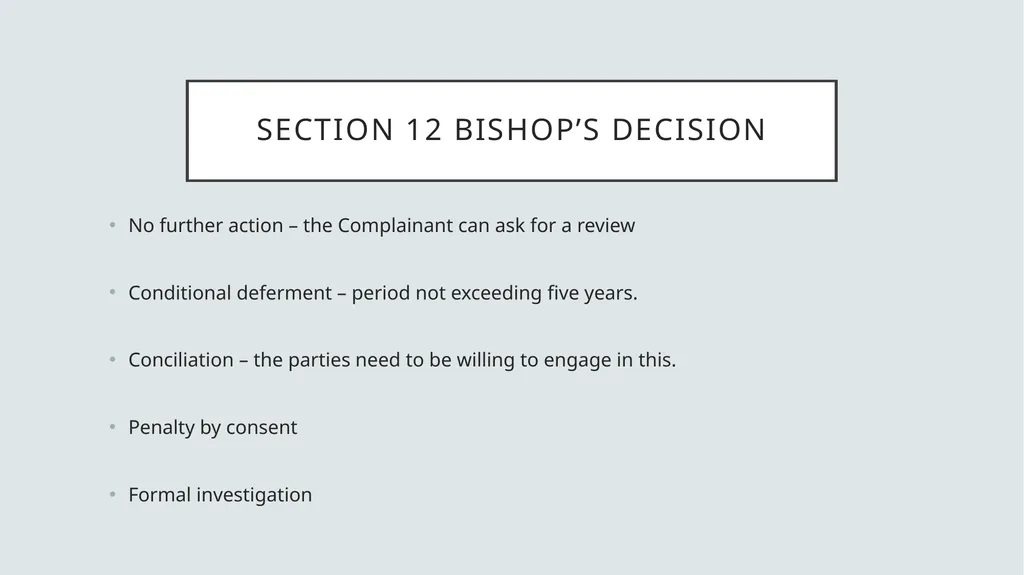
Section 12 Bishop’s decision No further action – the Complainant can ask for a review
Conditional deferment – period not exceeding five years.
Conciliation – the parties need to be willing to engage in this.
Penalty by consent
Formal investigation<br>
06
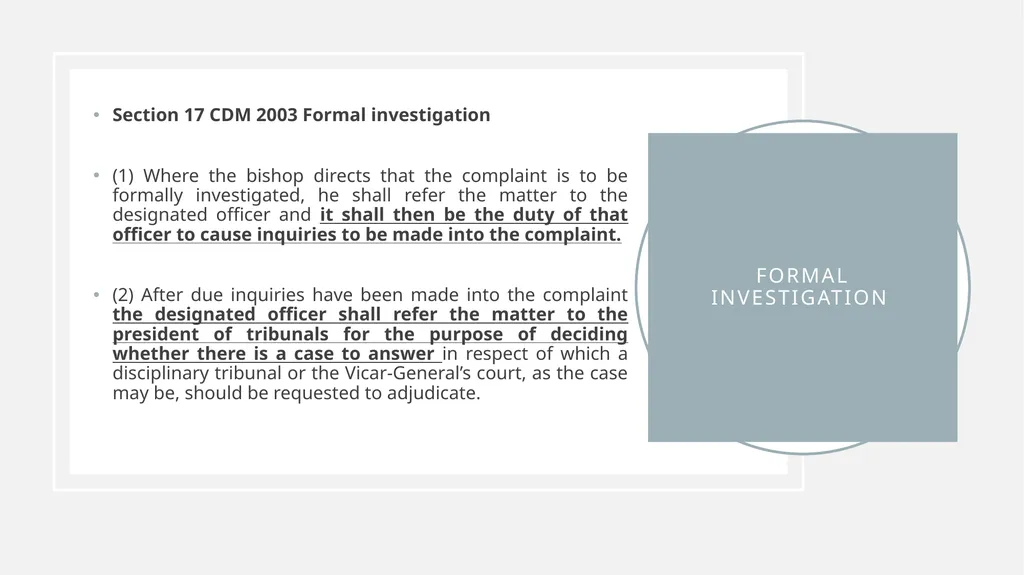
Section 17 CDM 2003 Formal investigation
(1) Where the bishop directs that the complaint is to be formally investigated, he shall refer the matter to the designated officer and it shall then be the duty of that officer to cause inquiries to be made into the complaint.
(2) After due inquiries have been made into the complaint the designated officer shall refer the matter to the president of tribunals for the purpose of deciding whether there is a case to answer in respect of which a disciplinary tribunal or the Vicar-General’s court, as the case may be, should be requested to adjudicate. Formal Investigation<br>
07
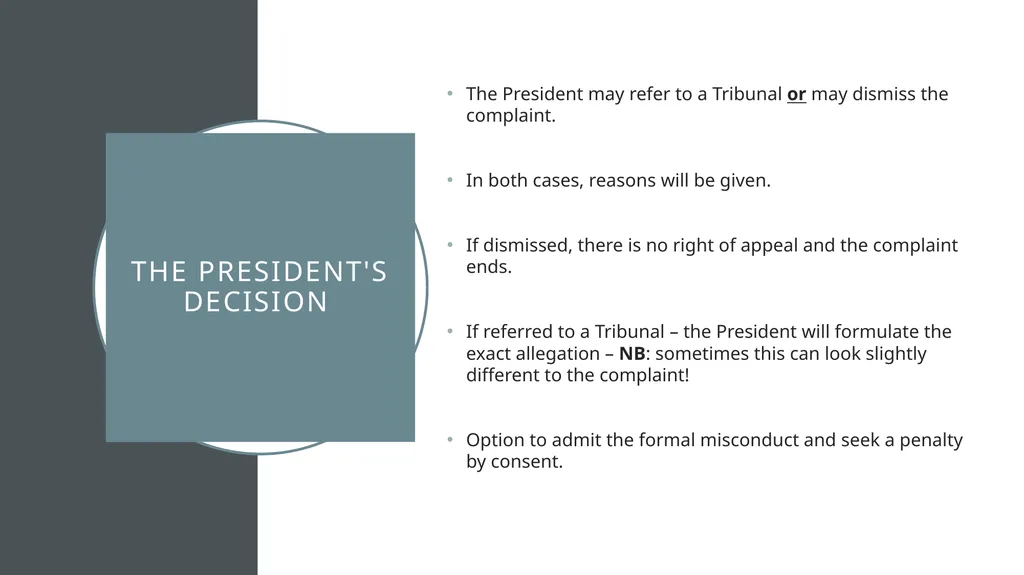
The President's Decision The President may refer to a Tribunal or may dismiss the complaint.
In both cases, reasons will be given.
If dismissed, there is no right of appeal and the complaint ends.
If referred to a Tribunal – the President will formulate the exact allegation – NB: sometimes this can look slightly different to the complaint!
Option to admit the formal misconduct and seek a penalty by consent.<br>
08
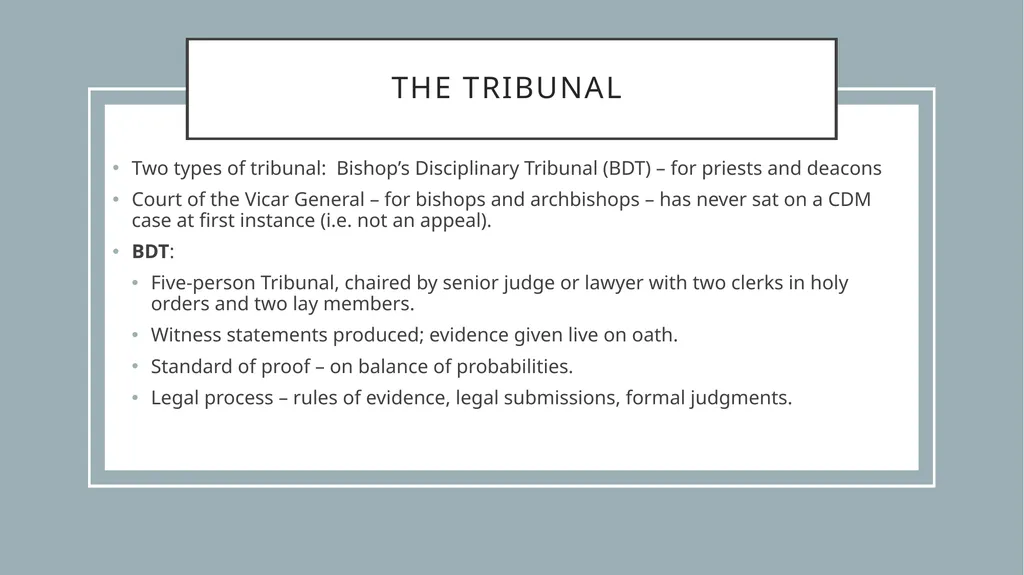
THe Tribunal Two types of tribunal: Bishop’s Disciplinary Tribunal (BDT) – for priests and deacons
Court of the Vicar General – for bishops and archbishops – has never sat on a CDM case at first instance (i.e. not an appeal).
BDT:
Five-person Tribunal, chaired by senior judge or lawyer with two clerks in holy orders and two lay members.
Witness statements produced; evidence given live on oath.
Standard of proof – on balance of probabilities.
Legal process – rules of evidence, legal submissions, formal judgments.<br>
09
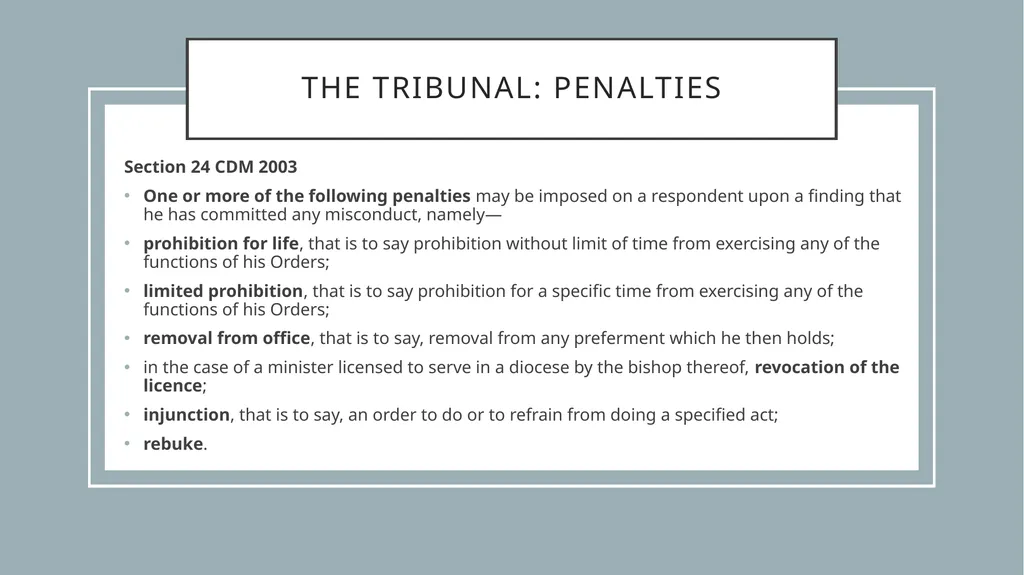
THe Tribunal: Penalties Section 24 CDM 2003
One or more of the following penalties may be imposed on a respondent upon a finding that he has committed any misconduct, namely—
prohibition for life, that is to say prohibition without limit of time from exercising any of the functions of his Orders;
limited prohibition, that is to say prohibition for a specific time from exercising any of the functions of his Orders;
removal from office, that is to say, removal from any preferment which he then holds;
in the case of a minister licensed to serve in a diocese by the bishop thereof, revocation of the licence;
injunction, that is to say, an order to do or to refrain from doing a specified act;
rebuke.<br>
10
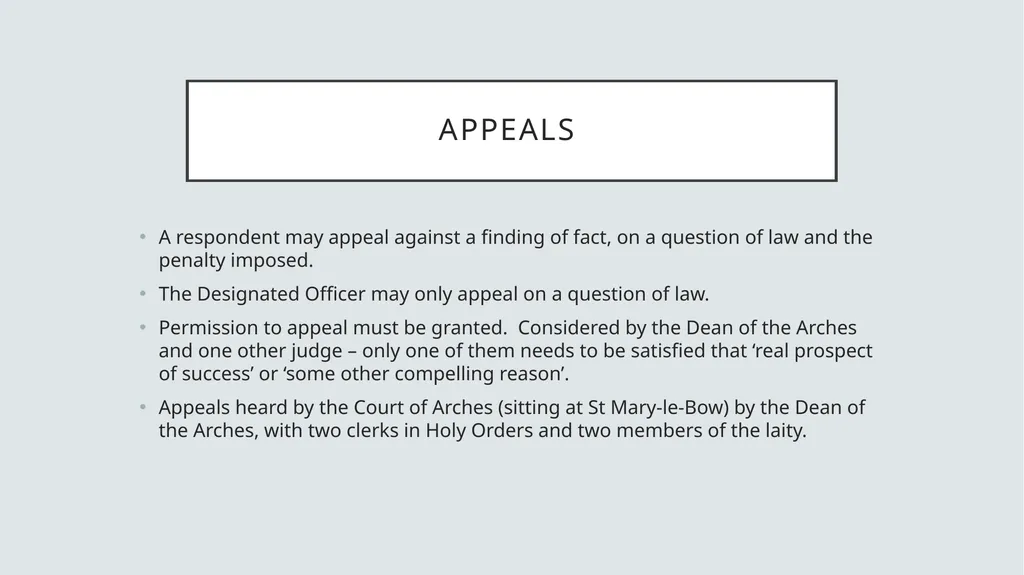
Appeals A respondent may appeal against a finding of fact, on a question of law and the penalty imposed.
The Designated Officer may only appeal on a question of law.
Permission to appeal must be granted. Considered by the Dean of the Arches and one other judge – only one of them needs to be satisfied that ‘real prospect of success’ or ‘some other compelling reason’.
Appeals heard by the Court of Arches (sitting at St Mary-le-Bow) by the Dean of the Arches, with two clerks in Holy Orders and two members of the laity.<br>