What is the definition of marketing? Marketing is

Published  . 0 views
↓ Download
What is the definition of marketing? Marketing is
1 / 1
What is the definition of marketing? Marketing is - slide 1 of 3 What is the definition of marketing? Marketing is - slide 2 of 3 What is the definition of marketing? Marketing is - slide 3 of 3
Description: What is the definition of marketing? Marketing is more than just selling. Its all about identifying, anticipating and meeting customer needs What are the benefits of marketing for a business? It reduces the risk of product failure

Related Topics

Download Presentation

"What is the definition of marketing? Marketing is" is the property of its rightful owner. Permission is granted to download and print the materials on this website for personal, non-commercial use only, and to display it on your personal computer provided you do not modify the materials and that you retain all copyright notices contained in the materials. By downloading content from our website, you accept the terms of this agreement.

Presentation Transcript

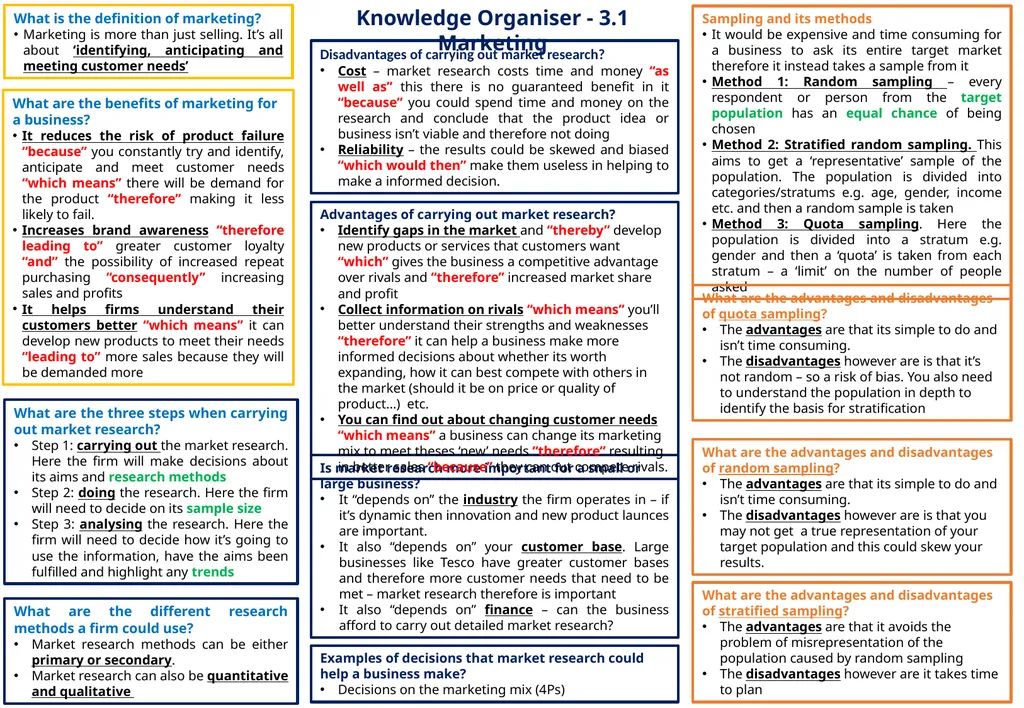
slide1. What is the definition of marketing?
Marketing is more than just selling. It’s all about ‘identifying, anticipating and meeting customer needs’ What are the benefits of marketing for a business?
It reduces the risk of product failure “because” you constantly try and identify, anticipate and meet customer needs “which means” there will be demand for the product “therefore” making it less likely to fail.
Increases brand awareness “therefore leading to” greater customer loyalty “and” the possibility of increased repeat purchasing “consequently” increasing sales and profits
It helps firms understand their customers better “which means” it can develop new products to meet their needs “leading to” more sales because they will be demanded more What are the three steps when carrying out market research?
Step 1: carrying out the market research. Here the firm will make decisions about its aims and research methods
Step 2: doing the research. Here the firm will need to decide on its sample size
Step 3: analysing the research. Here the firm will need to decide how it’s going to use the information, have the aims been fulfilled and highlight any trends Knowledge Organiser - 3.1 Marketing What are the different research methods a firm could use?
Market research methods can be either primary or secondary.
Market research can also be quantitative and qualitative Disadvantages of carrying out market research?
Cost – market research costs time and money “as well as” this there is no guaranteed benefit in it “because” you could spend time and money on the research and conclude that the product idea or business isn’t viable and therefore not doing
Reliability – the results could be skewed and biased “which would then” make them useless in helping to make a informed decision. Is market research more important for a small or large business?
It “depends on” the industry the firm operates in – if it’s dynamic then innovation and new product launces are important.
It also “depends on” your customer base. Large businesses like Tesco have greater customer bases and therefore more customer needs that need to be met – market research therefore is important
It also “depends on” finance – can the business afford to carry out detailed market research? Sampling and its methods
It would be expensive and time consuming for a business to ask its entire target market therefore it instead takes a sample from it
Method 1: Random sampling – every respondent or person from the target population has an equal chance of being chosen
Method 2: Stratified random sampling. This aims to get a ‘representative’ sample of the population. The population is divided into categories/stratums e.g. age, gender, income etc. and then a random sample is taken
Method 3: Quota sampling. Here the population is divided into a stratum e.g. gender and then a ‘quota’ is taken from each stratum – a ‘limit’ on the number of people asked What are the advantages and disadvantages of random sampling?
The advantages are that its simple to do and isn’t time consuming.
The disadvantages however are is that you may not get a true representation of your target population and this could skew your results. What are the advantages and disadvantages of quota sampling?
The advantages are that its simple to do and isn’t time consuming.
The disadvantages however are is that it’s not random – so a risk of bias. You also need to understand the population in depth to identify the basis for stratification What are the advantages and disadvantages of stratified sampling?
The advantages are that it avoids the problem of misrepresentation of the population caused by random sampling
The disadvantages however are it takes time to plan Advantages of carrying out market research?
Identify gaps in the market and “thereby” develop new products or services that customers want “which” gives the business a competitive advantage over rivals and “therefore” increased market share and profit
Collect information on rivals “which means” you’ll better understand their strengths and weaknesses “therefore” it can help a business make more informed decisions about whether its worth expanding, how it can best compete with others in the market (should it be on price or quality of product…) etc.
You can find out about changing customer needs “which means” a business can change its marketing mix to meet theses ‘new’ needs “therefore” resulting in better sales “because” they can out compete rivals. Examples of decisions that market research could help a business make?
Decisions on the marketing mix (4Ps)<br>
slide2. What is the difference between product trial and repeat purchase?
Product trial is when customers buy a good for the first time and assess whether they want to buy it again
Repeat purchase is when a customer buys a product more than once What are the methods that will help persuade a customer to product trial?
Advertising - customers are more likely to trial a product they have heard of, “so” advertising increases awareness of the product “and” makes it more credible “which” makes customers trust it
Public relations (PR). Part of this is viral marketing - getting people to spread a message about a product through social media like Twitter and Facebook
Free samples
User testing
Low prices e.g. BOGOF Knowledge Organiser - 3.1 Marketing What is the product life cycle?
It is a model which describes the stages a product goes through from launch to decline. The four phases of the product life cycle and their characteristics
Phase 1: Launch
High costs due to advertising etc.
Low or negative profits
Low level of sales (demand)
Low level of competition
Phase 2: Growth
Profits start to rise
Cost begin to lower
Increase in sales/demand
Competition begins to rise as increase in profits attracts others
Phase 3: Maturity
Business in profit
Costs reduce as product is established so less money on marketing
Sales reach their peak and begin to fall
Competition high
Focus here on extending this phase & protecting market share
Phase 4: Decline
Profits start to fall
Costs reduce (stop marketing costs)
Sales/demand decline as unable to attract customers
Competition is high
Temporarily reverse this phase by reducing price Definition of extension strategies
An extension strategy is used by a business in order to extend the life of the product before it goes into decline. What is the Boston Matrix
A model that analyses the product portfolio of a business according to market growth and market share Methods that will help persuade a customer to repeat purchase?
Promotion – helps keep the brand image of the product in the customers minds
Price – lowering price creates repeat purchase because demand will increase
Product - Updating products (or product ranges) will help keep customer loyalty
Place - making products easily available ensures they repeatedly buy them Cash flow and the product life cycle
Phase 1: Launch
Inflows: Low
Outflows: High
Net cash flow: Negative/deficit
Phase 2: Growth
Inflows: Begin to increase/high
Outflows: Lower
Net cash flow: Positive/surplus (small)
Phase 3: Maturity
Inflows: High
Outflows: Low
Net cash flow: Positive/surplus (large)
Phase 4: Decline
Inflows: Low
Outflows: Low
Net cash flow: Positive/surplus (small) How can a business turn product trials into repeat purchases?
To turn trials into repeat purchases a business needs to offer products/services at a price that offers value for money Examples of extension strategies
Reducing the price
Adapting the product i.e. adding ‘extra flavour’ or having ‘less fat’
Introducing promotional offers i.e. BOGOF
Develop a wider product range to include new varieties
Advertising The four boxes in the Boston Matrix and their characteristics
Star
High market share in a high growth market
Generates a lot of revenue
Equivalent to the “growth” stage of the product life cycle
Dog:
Low market share in a low growth market
Equivalent to the “decline” stage of the product life cycle
Negative cash flow
Cash cow:
High market share but in a low growth market
Equivalent to the “maturity” stage of the product life cycle
Problem child:
Low market share but in a high growth market
Equivalent to the “launch” stage of the product life cycle Boston matrix strategies
Divest – linked to Dog and Problem Child
Harvest – linked to Cash Cow
Hold – linked to Star
Build market share – linked to Star and Problem Child Benefits of the Boston matrix
Helps to balance a firm’s product portfolio at different stages of the product life cycle
Helps firms to identify Dogs
Helps a firm to plan for the future<br>
slide3. What is branding?
Branding is the use of a name or logo to give a product an identity How is product trial, repeat purchase and product range linked to branding?
Product trial: Customers are likely to trial a product with an already established brand because its trusted and well-known
Repeat purchase: One of the key benefits of having a strong brand is customer loyalty which will increase revenue because of repeat purchasing. These customers can be said to be “brand loyal”
Product range: Businesses use their products ranges as a form of branding. For example Tesco’s “Finest” range is an example of ‘own branding’ Knowledge Organiser - 3.1 Marketing What are the definitions of ‘differentiation’ and ‘unique selling point’?
Differentiation: It means giving your product or service a competitive advantage by making it stand out from its rivals
USP: a specific feature that makes a product different from its rivals. How can you differentiate a product/service?
Design of product
Logo
Packaging
Price Advantages of branding and differentiation?
You can charge a premium price because it adds value
Helps develop customer loyalty & repeat purchases thereby making them ‘brand loyal’
Differentiation is very important if competition in the market is intense - helps remain competitive as you have a USP Disadvantages of branding and differentiation?
Costly Branding? That’s just a logo isn’t it? Discuss.
A part of branding is creating a logo for a product however I believe it’s much more than that. Branding is about creating an identity and status in mind of the customer for your product/service, in order to differentiate itself from competitors, which will encourage brand loyalty from them. This could lead to repeat purchases and therefore the business having constant cash flow which will help it succeed. If the business were to launch a new product in the future, customers are much more likely to trial it because it’s a brand they trust.<br>