
What’s new at NIH (with special attention to
KB
Published · 17 slides · 0 views

1 / 1


Description
Whats new at NIH (with special attention to social science research) Institute for Population ResearchOhio Population Consortium September 8, 2026 Sarah Hayford, Director; Carol Bitzinger, Senior Grants Specialist Todays talk Substance
Related Topics
Share
Embed code
Download this presentation From Below
"What’s new at NIH (with special attention to" is the property of its rightful owner. Permission is granted to download and print the materials on this website for personal, non-commercial use only, and to display it on your personal computer provided you do not modify the materials and that you retain all copyright notices contained in the materials. By downloading content from our website, you accept the terms of this agreement.
Presentation Transcript
01
What’s new at NIH
(with special attention to social science research) Institute for Population Research/Ohio Population Consortium
September 8, 2026
Sarah Hayford, Director; Carol Bitzinger, Senior Grants Specialist<br>
September 8, 2026
Sarah Hayford, Director; Carol Bitzinger, Senior Grants Specialist<br>
02
Today’s talk Substance and review process (Sarah)
Forms and requirements (Carol)<br>
Forms and requirements (Carol)<br>
03
The take-home Things are constantly changing, both in the topics being funded and the process for review and funding decisions.
Many of the changes are not written down, and the ways changes are being implemented vary across institutes.
Social science research is still being funded.
Talk to your program official!
Carol and I are also happy to chat.<br>
Many of the changes are not written down, and the ways changes are being implemented vary across institutes.
Social science research is still being funded.
Talk to your program official!
Carol and I are also happy to chat.<br>
04
Substance and review process<br>
05
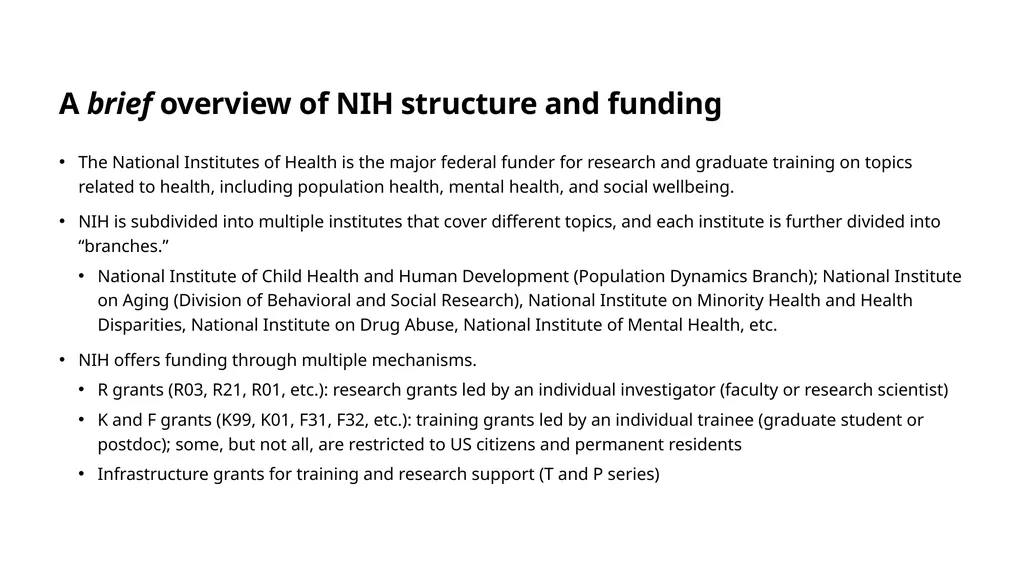
A brief overview of NIH structure and funding The National Institutes of Health is the major federal funder for research and graduate training on topics related to health, including population health, mental health, and social wellbeing.
NIH is subdivided into multiple institutes that cover different topics, and each institute is further divided into “branches.”
National Institute of Child Health and Human Development (Population Dynamics Branch); National Institute on Aging (Division of Behavioral and Social Research), National Institute on Minority Health and Health Disparities, National Institute on Drug Abuse, National Institute of Mental Health, etc.
NIH offers funding through multiple mechanisms.
R grants (R03, R21, R01, etc.): research grants led by an individual investigator (faculty or research scientist)
K and F grants (K99, K01, F31, F32, etc.): training grants led by an individual trainee (graduate student or postdoc); some, but not all, are restricted to US citizens and permanent residents
Infrastructure grants for training and research support (T and P series)<br>
NIH is subdivided into multiple institutes that cover different topics, and each institute is further divided into “branches.”
National Institute of Child Health and Human Development (Population Dynamics Branch); National Institute on Aging (Division of Behavioral and Social Research), National Institute on Minority Health and Health Disparities, National Institute on Drug Abuse, National Institute of Mental Health, etc.
NIH offers funding through multiple mechanisms.
R grants (R03, R21, R01, etc.): research grants led by an individual investigator (faculty or research scientist)
K and F grants (K99, K01, F31, F32, etc.): training grants led by an individual trainee (graduate student or postdoc); some, but not all, are restricted to US citizens and permanent residents
Infrastructure grants for training and research support (T and P series)<br>
06
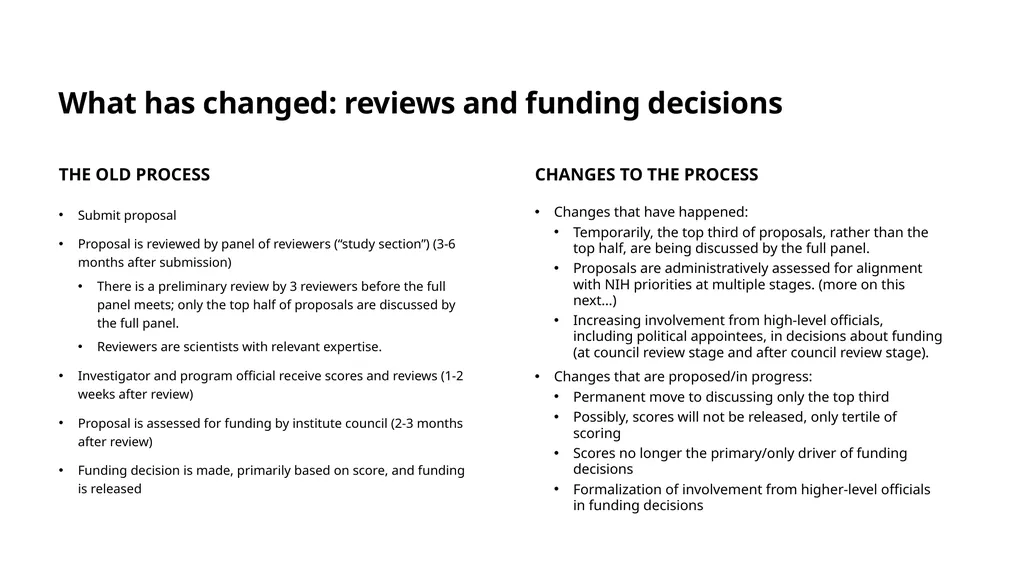
What has changed: reviews and funding decisions The old process Submit proposal
Proposal is reviewed by panel of reviewers (“study section”) (3-6 months after submission)
There is a preliminary review by 3 reviewers before the full panel meets; only the top half of proposals are discussed by the full panel.
Reviewers are scientists with relevant expertise.
Investigator and program official receive scores and reviews (1-2 weeks after review)
Proposal is assessed for funding by institute council (2-3 months after review)
Funding decision is made, primarily based on score, and funding is released Changes to the process Changes that have happened:
Temporarily, the top third of proposals, rather than the top half, are being discussed by the full panel.
Proposals are administratively assessed for alignment with NIH priorities at multiple stages. (more on this next…)
Increasing involvement from high-level officials, including political appointees, in decisions about funding (at council review stage and after council review stage).
Changes that are proposed/in progress:
Permanent move to discussing only the top third
Possibly, scores will not be released, only tertile of scoring
Scores no longer the primary/only driver of funding decisions
Formalization of involvement from higher-level officials in funding decisions<br>
Proposal is reviewed by panel of reviewers (“study section”) (3-6 months after submission)
There is a preliminary review by 3 reviewers before the full panel meets; only the top half of proposals are discussed by the full panel.
Reviewers are scientists with relevant expertise.
Investigator and program official receive scores and reviews (1-2 weeks after review)
Proposal is assessed for funding by institute council (2-3 months after review)
Funding decision is made, primarily based on score, and funding is released Changes to the process Changes that have happened:
Temporarily, the top third of proposals, rather than the top half, are being discussed by the full panel.
Proposals are administratively assessed for alignment with NIH priorities at multiple stages. (more on this next…)
Increasing involvement from high-level officials, including political appointees, in decisions about funding (at council review stage and after council review stage).
Changes that are proposed/in progress:
Permanent move to discussing only the top third
Possibly, scores will not be released, only tertile of scoring
Scores no longer the primary/only driver of funding decisions
Formalization of involvement from higher-level officials in funding decisions<br>
07
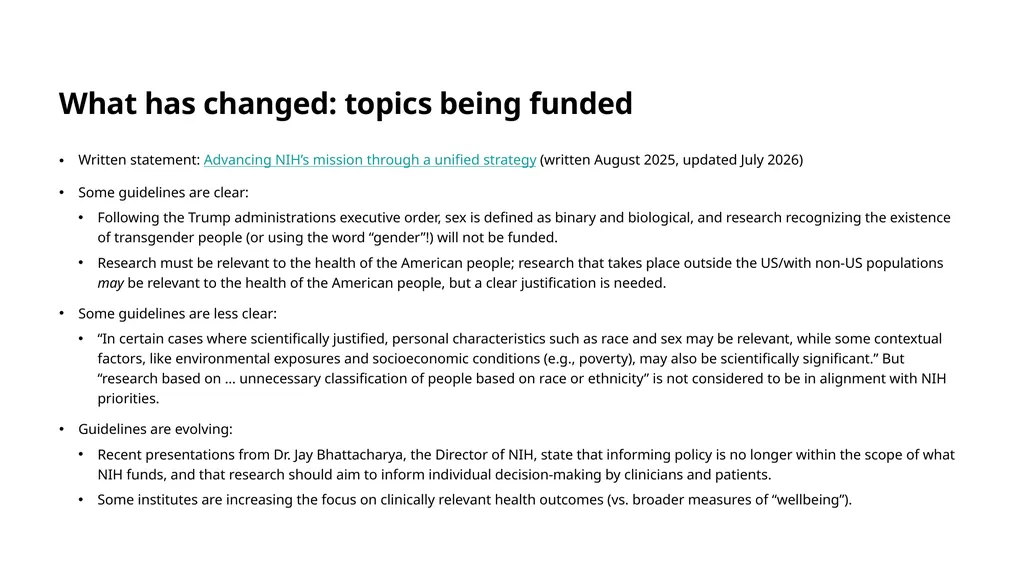
What has changed: topics being funded Written statement: Advancing NIH’s mission through a unified strategy (written August 2025, updated July 2026)
Some guidelines are clear:
Following the Trump administrations executive order, sex is defined as binary and biological, and research recognizing the existence of transgender people (or using the word “gender”!) will not be funded.
Research must be relevant to the health of the American people; research that takes place outside the US/with non-US populations may be relevant to the health of the American people, but a clear justification is needed.
Some guidelines are less clear:
“In certain cases where scientifically justified, personal characteristics such as race and sex may be relevant, while some contextual factors, like environmental exposures and socioeconomic conditions (e.g., poverty), may also be scientifically significant.” But “research based on … unnecessary classification of people based on race or ethnicity” is not considered to be in alignment with NIH priorities.
Guidelines are evolving:
Recent presentations from Dr. Jay Bhattacharya, the Director of NIH, state that informing policy is no longer within the scope of what NIH funds, and that research should aim to inform individual decision-making by clinicians and patients.
Some institutes are increasing the focus on clinically relevant health outcomes (vs. broader measures of “wellbeing”).<br>
Some guidelines are clear:
Following the Trump administrations executive order, sex is defined as binary and biological, and research recognizing the existence of transgender people (or using the word “gender”!) will not be funded.
Research must be relevant to the health of the American people; research that takes place outside the US/with non-US populations may be relevant to the health of the American people, but a clear justification is needed.
Some guidelines are less clear:
“In certain cases where scientifically justified, personal characteristics such as race and sex may be relevant, while some contextual factors, like environmental exposures and socioeconomic conditions (e.g., poverty), may also be scientifically significant.” But “research based on … unnecessary classification of people based on race or ethnicity” is not considered to be in alignment with NIH priorities.
Guidelines are evolving:
Recent presentations from Dr. Jay Bhattacharya, the Director of NIH, state that informing policy is no longer within the scope of what NIH funds, and that research should aim to inform individual decision-making by clinicians and patients.
Some institutes are increasing the focus on clinically relevant health outcomes (vs. broader measures of “wellbeing”).<br>
08
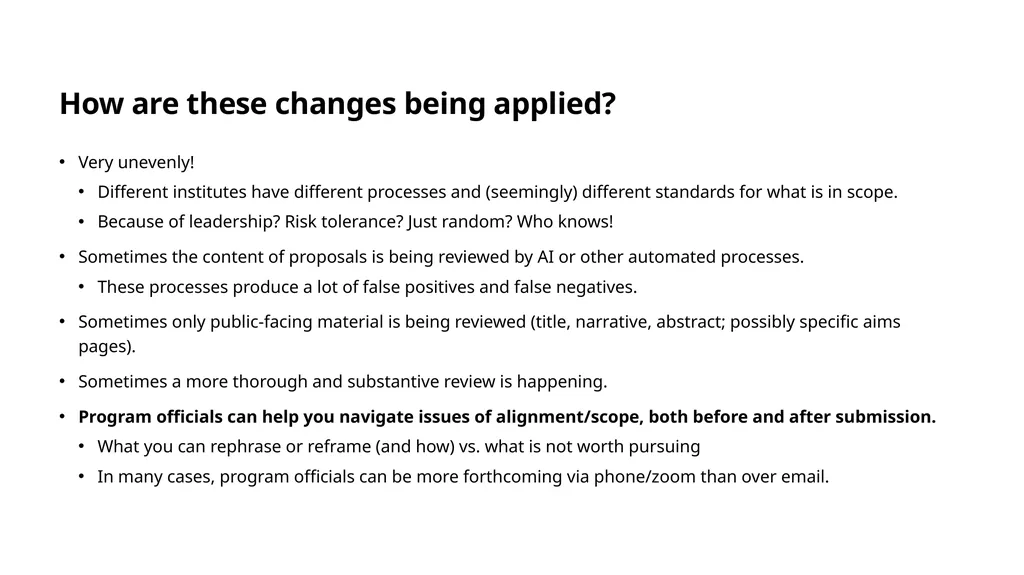
How are these changes being applied? Very unevenly!
Different institutes have different processes and (seemingly) different standards for what is in scope.
Because of leadership? Risk tolerance? Just random? Who knows!
Sometimes the content of proposals is being reviewed by AI or other automated processes.
These processes produce a lot of false positives and false negatives.
Sometimes only public-facing material is being reviewed (title, narrative, abstract; possibly specific aims pages).
Sometimes a more thorough and substantive review is happening.
Program officials can help you navigate issues of alignment/scope, both before and after submission.
What you can rephrase or reframe (and how) vs. what is not worth pursuing
In many cases, program officials can be more forthcoming via phone/zoom than over email.<br>
Different institutes have different processes and (seemingly) different standards for what is in scope.
Because of leadership? Risk tolerance? Just random? Who knows!
Sometimes the content of proposals is being reviewed by AI or other automated processes.
These processes produce a lot of false positives and false negatives.
Sometimes only public-facing material is being reviewed (title, narrative, abstract; possibly specific aims pages).
Sometimes a more thorough and substantive review is happening.
Program officials can help you navigate issues of alignment/scope, both before and after submission.
What you can rephrase or reframe (and how) vs. what is not worth pursuing
In many cases, program officials can be more forthcoming via phone/zoom than over email.<br>
09
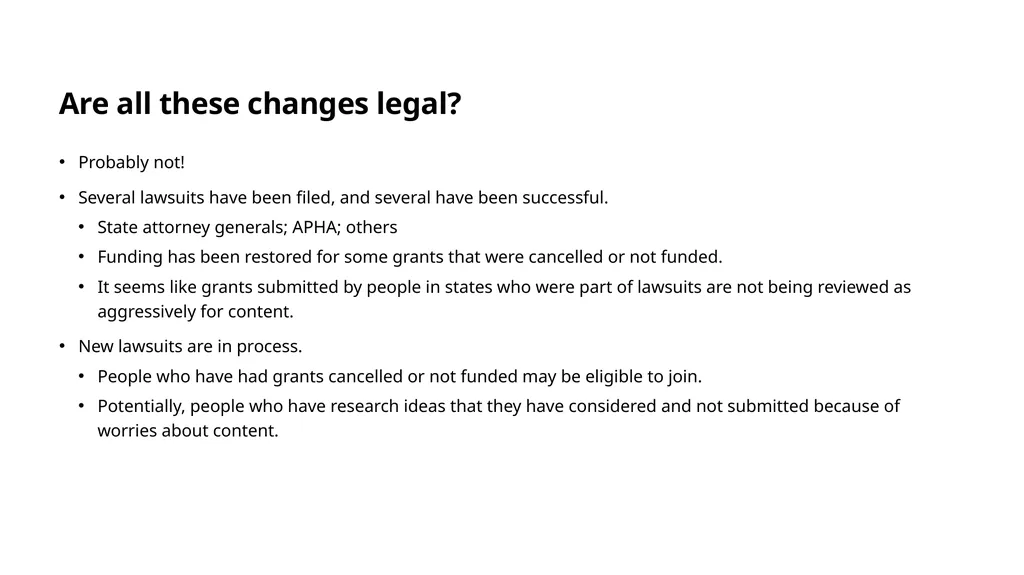
Are all these changes legal? Probably not!
Several lawsuits have been filed, and several have been successful.
State attorney generals; APHA; others
Funding has been restored for some grants that were cancelled or not funded.
It seems like grants submitted by people in states who were part of lawsuits are not being reviewed as aggressively for content.
New lawsuits are in process.
People who have had grants cancelled or not funded may be eligible to join.
Potentially, people who have research ideas that they have considered and not submitted because of worries about content.<br>
Several lawsuits have been filed, and several have been successful.
State attorney generals; APHA; others
Funding has been restored for some grants that were cancelled or not funded.
It seems like grants submitted by people in states who were part of lawsuits are not being reviewed as aggressively for content.
New lawsuits are in process.
People who have had grants cancelled or not funded may be eligible to join.
Potentially, people who have research ideas that they have considered and not submitted because of worries about content.<br>
10
Forms and requirements<br>
11
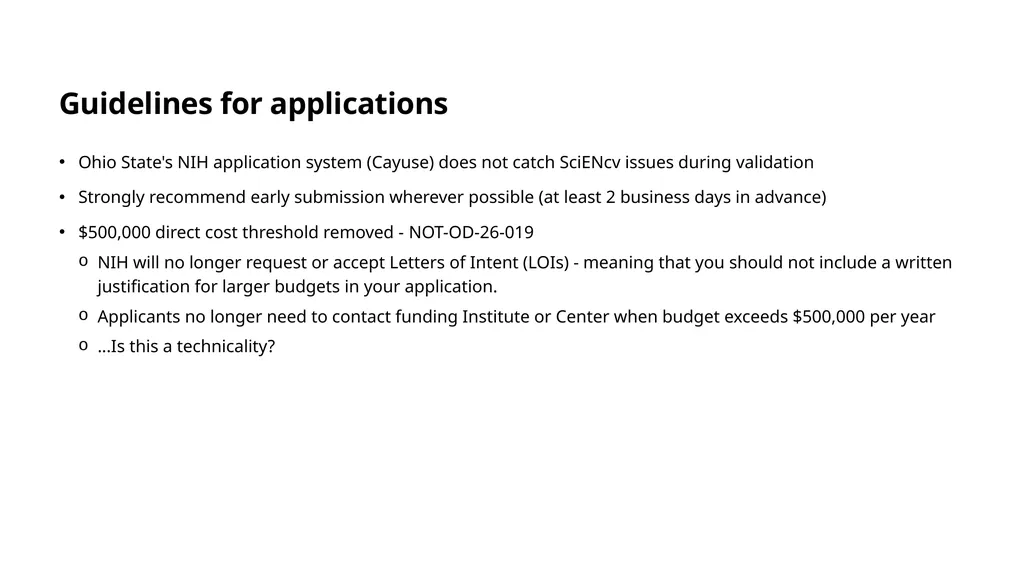
Guidelines for applications Ohio State's NIH application system (Cayuse) does not catch SciENcv issues during validation
Strongly recommend early submission wherever possible (at least 2 business days in advance)
$500,000 direct cost threshold removed - NOT-OD-26-019
NIH will no longer request or accept Letters of Intent (LOIs) - meaning that you should not include a written justification for larger budgets in your application.
Applicants no longer need to contact funding Institute or Center when budget exceeds $500,000 per year
...Is this a technicality?<br>
Strongly recommend early submission wherever possible (at least 2 business days in advance)
$500,000 direct cost threshold removed - NOT-OD-26-019
NIH will no longer request or accept Letters of Intent (LOIs) - meaning that you should not include a written justification for larger budgets in your application.
Applicants no longer need to contact funding Institute or Center when budget exceeds $500,000 per year
...Is this a technicality?<br>
12
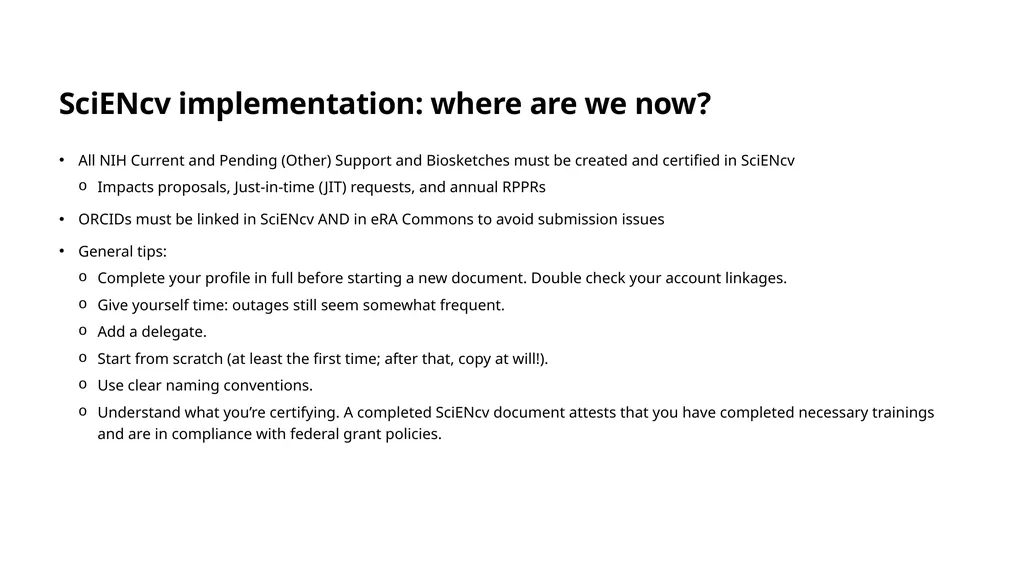
SciENcv implementation: where are we now? All NIH Current and Pending (Other) Support and Biosketches must be created and certified in SciENcv
Impacts proposals, Just-in-time (JIT) requests, and annual RPPRs
ORCIDs must be linked in SciENcv AND in eRA Commons to avoid submission issues
General tips:
Complete your profile in full before starting a new document. Double check your account linkages.
Give yourself time: outages still seem somewhat frequent.
Add a delegate.
Start from scratch (at least the first time; after that, copy at will!).
Use clear naming conventions.
Understand what you’re certifying. A completed SciENcv document attests that you have completed necessary trainings and are in compliance with federal grant policies.<br>
Impacts proposals, Just-in-time (JIT) requests, and annual RPPRs
ORCIDs must be linked in SciENcv AND in eRA Commons to avoid submission issues
General tips:
Complete your profile in full before starting a new document. Double check your account linkages.
Give yourself time: outages still seem somewhat frequent.
Add a delegate.
Start from scratch (at least the first time; after that, copy at will!).
Use clear naming conventions.
Understand what you’re certifying. A completed SciENcv document attests that you have completed necessary trainings and are in compliance with federal grant policies.<br>
13
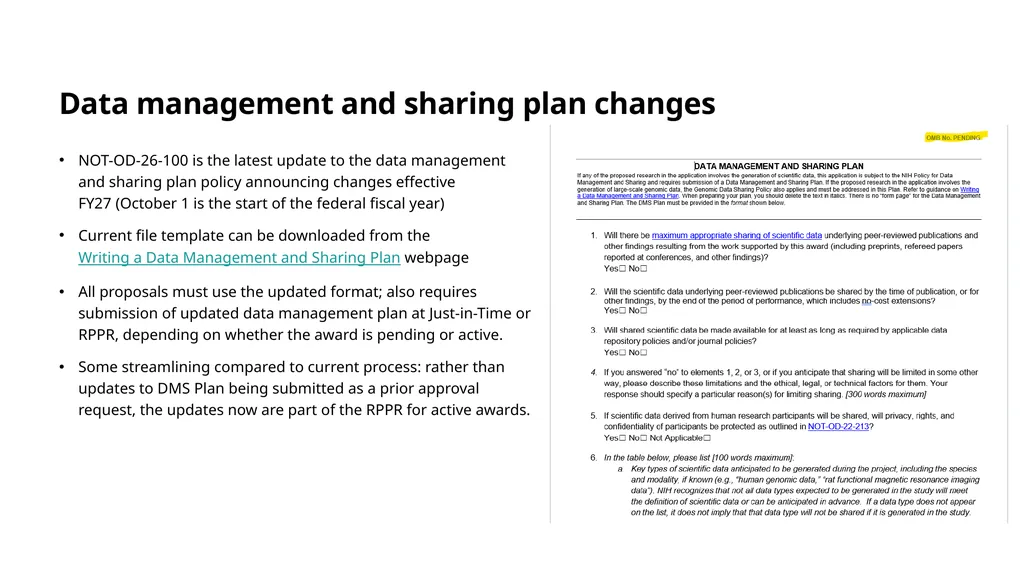
Data management and sharing plan changes NOT-OD-26-100 is the latest update to the data management and sharing plan policy announcing changes effective FY27 (October 1 is the start of the federal fiscal year)
Current file template can be downloaded from the Writing a Data Management and Sharing Plan webpage
All proposals must use the updated format; also requires submission of updated data management plan at Just-in-Time or RPPR, depending on whether the award is pending or active.
Some streamlining compared to current process: rather than updates to DMS Plan being submitted as a prior approval request, the updates now are part of the RPPR for active awards.<br>
Current file template can be downloaded from the Writing a Data Management and Sharing Plan webpage
All proposals must use the updated format; also requires submission of updated data management plan at Just-in-Time or RPPR, depending on whether the award is pending or active.
Some streamlining compared to current process: rather than updates to DMS Plan being submitted as a prior approval request, the updates now are part of the RPPR for active awards.<br>
14
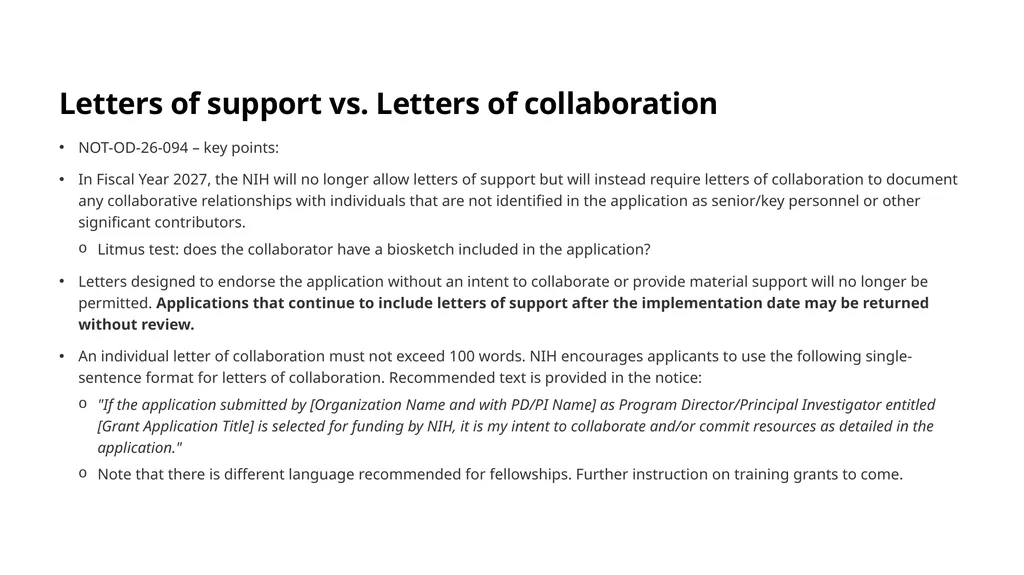
Letters of support vs. Letters of collaboration NOT-OD-26-094 – key points:
In Fiscal Year 2027, the NIH will no longer allow letters of support but will instead require letters of collaboration to document any collaborative relationships with individuals that are not identified in the application as senior/key personnel or other significant contributors.
Litmus test: does the collaborator have a biosketch included in the application?
Letters designed to endorse the application without an intent to collaborate or provide material support will no longer be permitted. Applications that continue to include letters of support after the implementation date may be returned without review.
An individual letter of collaboration must not exceed 100 words. NIH encourages applicants to use the following single-sentence format for letters of collaboration. Recommended text is provided in the notice:
"If the application submitted by [Organization Name and with PD/PI Name] as Program Director/Principal Investigator entitled [Grant Application Title] is selected for funding by NIH, it is my intent to collaborate and/or commit resources as detailed in the application."
Note that there is different language recommended for fellowships. Further instruction on training grants to come.<br>
In Fiscal Year 2027, the NIH will no longer allow letters of support but will instead require letters of collaboration to document any collaborative relationships with individuals that are not identified in the application as senior/key personnel or other significant contributors.
Litmus test: does the collaborator have a biosketch included in the application?
Letters designed to endorse the application without an intent to collaborate or provide material support will no longer be permitted. Applications that continue to include letters of support after the implementation date may be returned without review.
An individual letter of collaboration must not exceed 100 words. NIH encourages applicants to use the following single-sentence format for letters of collaboration. Recommended text is provided in the notice:
"If the application submitted by [Organization Name and with PD/PI Name] as Program Director/Principal Investigator entitled [Grant Application Title] is selected for funding by NIH, it is my intent to collaborate and/or commit resources as detailed in the application."
Note that there is different language recommended for fellowships. Further instruction on training grants to come.<br>
15
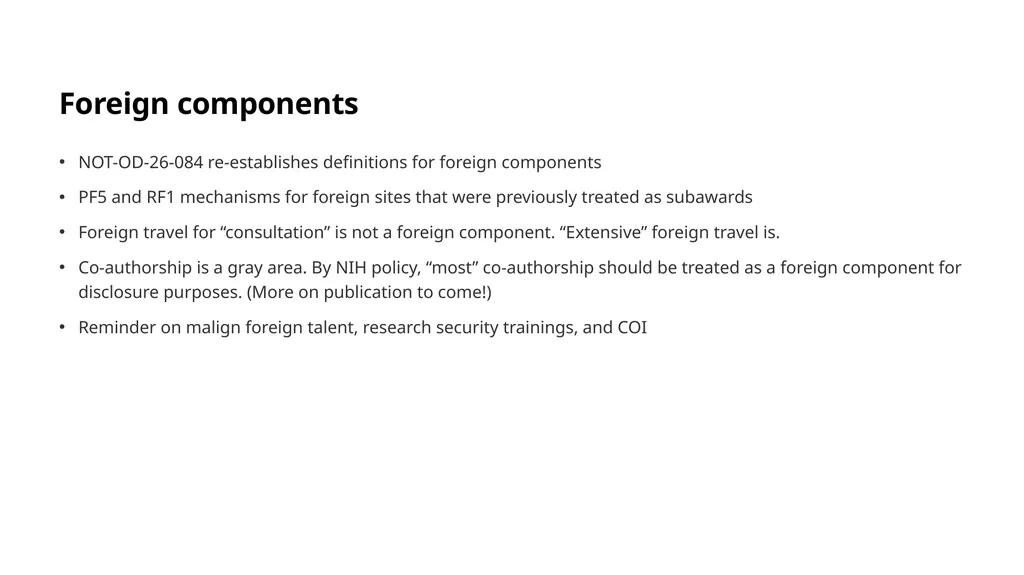
Foreign components NOT-OD-26-084 re-establishes definitions for foreign components
PF5 and RF1 mechanisms for foreign sites that were previously treated as subawards
Foreign travel for “consultation” is not a foreign component. “Extensive” foreign travel is.
Co-authorship is a gray area. By NIH policy, “most” co-authorship should be treated as a foreign component for disclosure purposes. (More on publication to come!)
Reminder on malign foreign talent, research security trainings, and COI<br>
PF5 and RF1 mechanisms for foreign sites that were previously treated as subawards
Foreign travel for “consultation” is not a foreign component. “Extensive” foreign travel is.
Co-authorship is a gray area. By NIH policy, “most” co-authorship should be treated as a foreign component for disclosure purposes. (More on publication to come!)
Reminder on malign foreign talent, research security trainings, and COI<br>
16
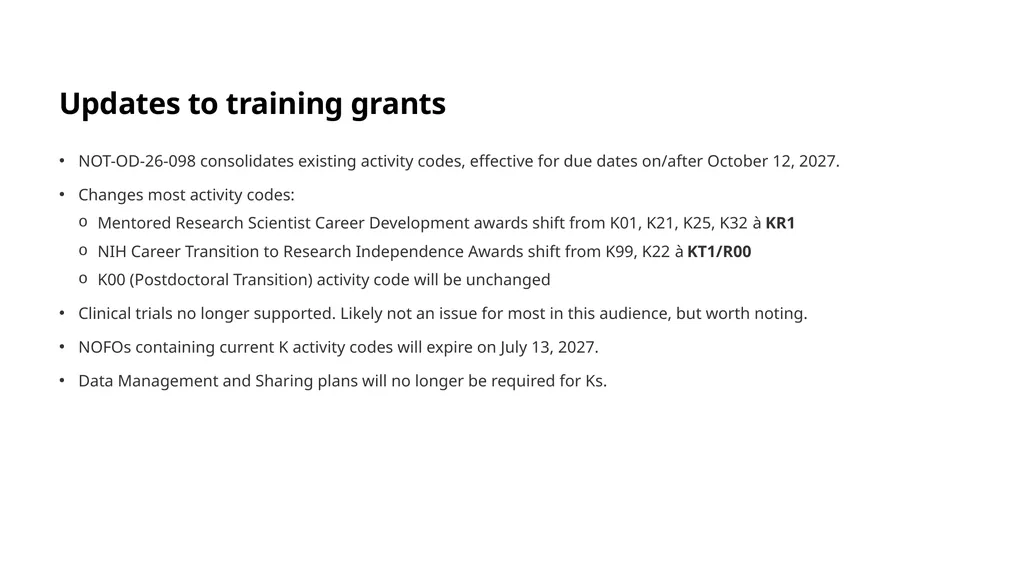
Updates to training grants NOT-OD-26-098 consolidates existing activity codes, effective for due dates on/after October 12, 2027.
Changes most activity codes:
Mentored Research Scientist Career Development awards shift from K01, K21, K25, K32 à KR1
NIH Career Transition to Research Independence Awards shift from K99, K22 à KT1/R00
K00 (Postdoctoral Transition) activity code will be unchanged
Clinical trials no longer supported. Likely not an issue for most in this audience, but worth noting.
NOFOs containing current K activity codes will expire on July 13, 2027.
Data Management and Sharing plans will no longer be required for Ks.<br>
Changes most activity codes:
Mentored Research Scientist Career Development awards shift from K01, K21, K25, K32 à KR1
NIH Career Transition to Research Independence Awards shift from K99, K22 à KT1/R00
K00 (Postdoctoral Transition) activity code will be unchanged
Clinical trials no longer supported. Likely not an issue for most in this audience, but worth noting.
NOFOs containing current K activity codes will expire on July 13, 2027.
Data Management and Sharing plans will no longer be required for Ks.<br>
17
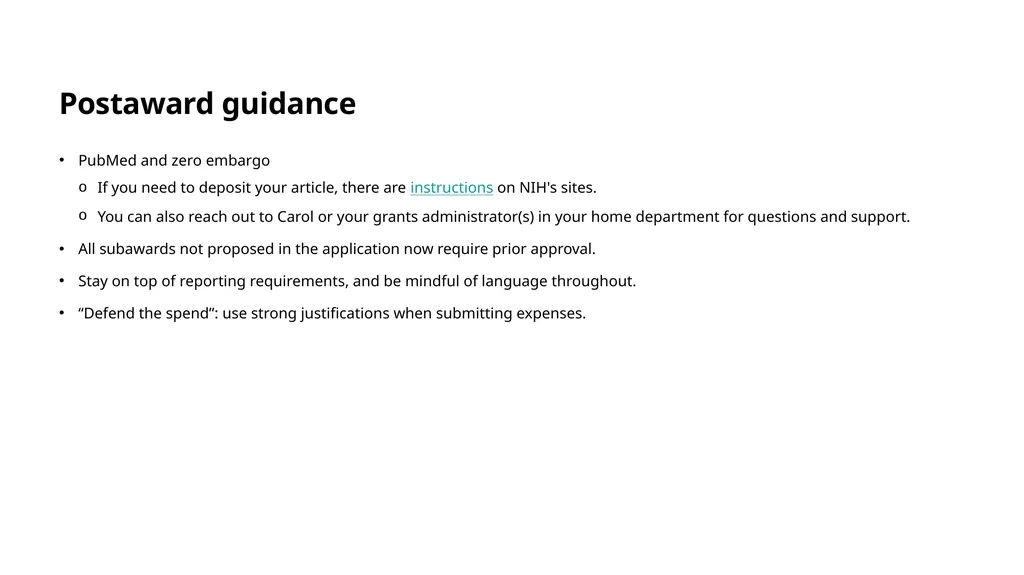
Postaward guidance PubMed and zero embargo
If you need to deposit your article, there are instructions on NIH's sites.
You can also reach out to Carol or your grants administrator(s) in your home department for questions and support.
All subawards not proposed in the application now require prior approval.
Stay on top of reporting requirements, and be mindful of language throughout.
“Defend the spend”: use strong justifications when submitting expenses.<br>
If you need to deposit your article, there are instructions on NIH's sites.
You can also reach out to Carol or your grants administrator(s) in your home department for questions and support.
All subawards not proposed in the application now require prior approval.
Stay on top of reporting requirements, and be mindful of language throughout.
“Defend the spend”: use strong justifications when submitting expenses.<br>