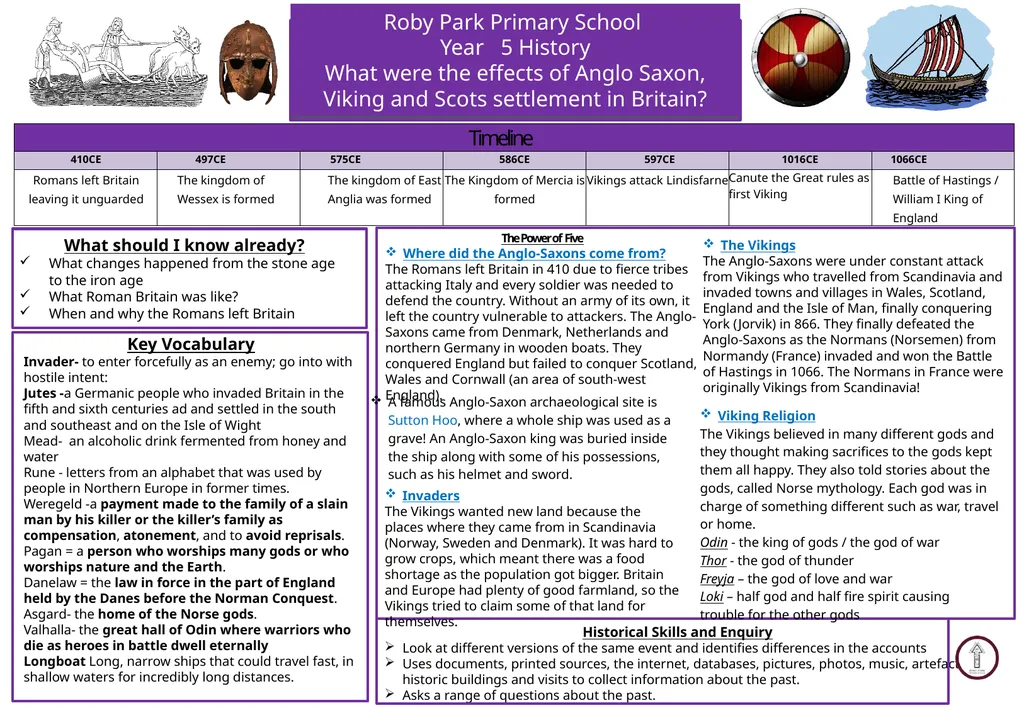
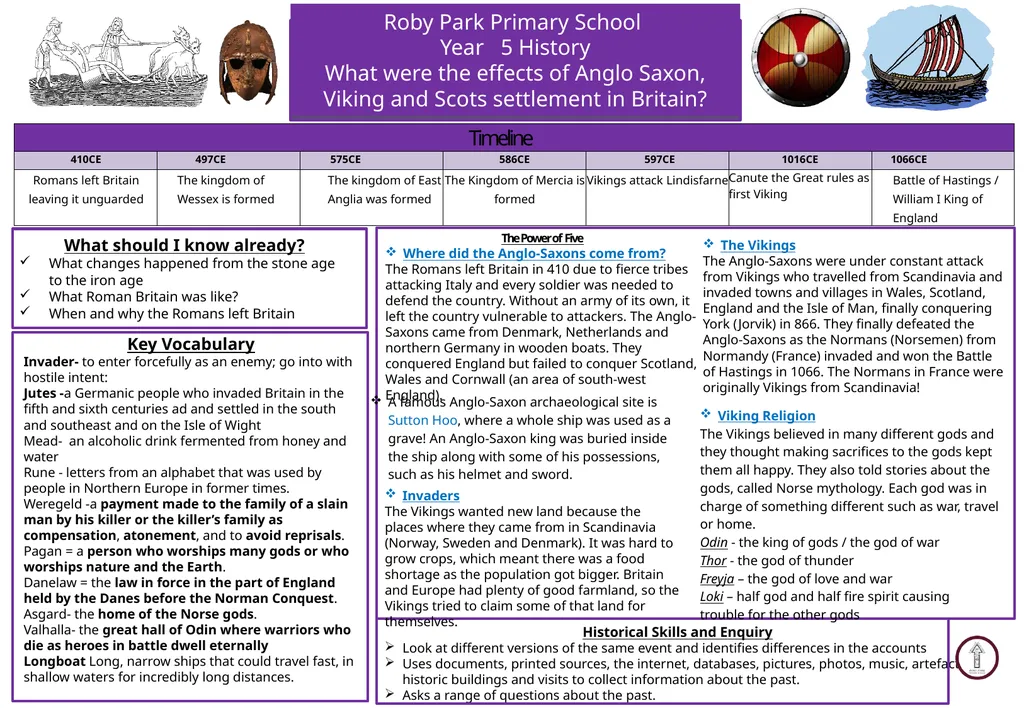
01
What should I know already?
What changes happened from the stone age to the iron age
What Roman Britain was like?
When and why the Romans left Britain The Power of Five
Where did the Anglo-Saxons come from?
The Romans left Britain in 410 due to fierce tribes attacking Italy and every soldier was needed to defend the country. Without an army of its own, it left the country vulnerable to attackers. The Anglo-Saxons came from Denmark, Netherlands and northern Germany in wooden boats. They conquered England but failed to conquer Scotland, Wales and Cornwall (an area of south-west England). Key Vocabulary
Invader- to enter forcefully as an enemy; go into with hostile intent:
Jutes -a Germanic people who invaded Britain in the fifth and sixth centuries ad and settled in the south and southeast and on the Isle of Wight
Mead- an alcoholic drink fermented from honey and water
Rune - letters from an alphabet that was used by people in Northern Europe in former times.
Weregeld -a payment made to the family of a slain man by his killer or the killer’s family as compensation, atonement, and to avoid reprisals.
Pagan = a person who worships many gods or who worships nature and the Earth.
Danelaw = the law in force in the part of England held by the Danes before the Norman Conquest.
Asgard- the home of the Norse gods.
Valhalla- the great hall of Odin where warriors who die as heroes in battle dwell eternally
Longboat Long, narrow ships that could travel fast, in shallow waters for incredibly long distances. Historical Skills and Enquiry
Look at different versions of the same event and identifies differences in the accounts
Uses documents, printed sources, the internet, databases, pictures, photos, music, artefacts, historic buildings and visits to collect information about the past.
Asks a range of questions about the past. Roby Park Primary School
Year 5 History
What were the effects of Anglo Saxon, Viking and Scots settlement in Britain? A famous Anglo-Saxon archaeological site is Sutton Hoo, where a whole ship was used as a grave! An Anglo-Saxon king was buried inside the ship along with some of his possessions, such as his helmet and sword. The Vikings
The Anglo-Saxons were under constant attack from Vikings who travelled from Scandinavia and invaded towns and villages in Wales, Scotland, England and the Isle of Man, finally conquering York (Jorvik) in 866. They finally defeated the Anglo-Saxons as the Normans (Norsemen) from Normandy (France) invaded and won the Battle of Hastings in 1066. The Normans in France were originally Vikings from Scandinavia! Viking Religion
The Vikings believed in many different gods and they thought making sacrifices to the gods kept them all happy. They also told stories about the gods, called Norse mythology. Each god was in charge of something different such as war, travel or home.
Odin - the king of gods / the god of war
Thor - the god of thunder
Freyja – the god of love and war
Loki – half god and half fire spirit causing
trouble for the other gods Invaders
The Vikings wanted new land because the places where they came from in Scandinavia (Norway, Sweden and Denmark). It was hard to grow crops, which meant there was a food shortage as the population got bigger. Britain and Europe had plenty of good farmland, so the Vikings tried to claim some of that land for themselves.<br>
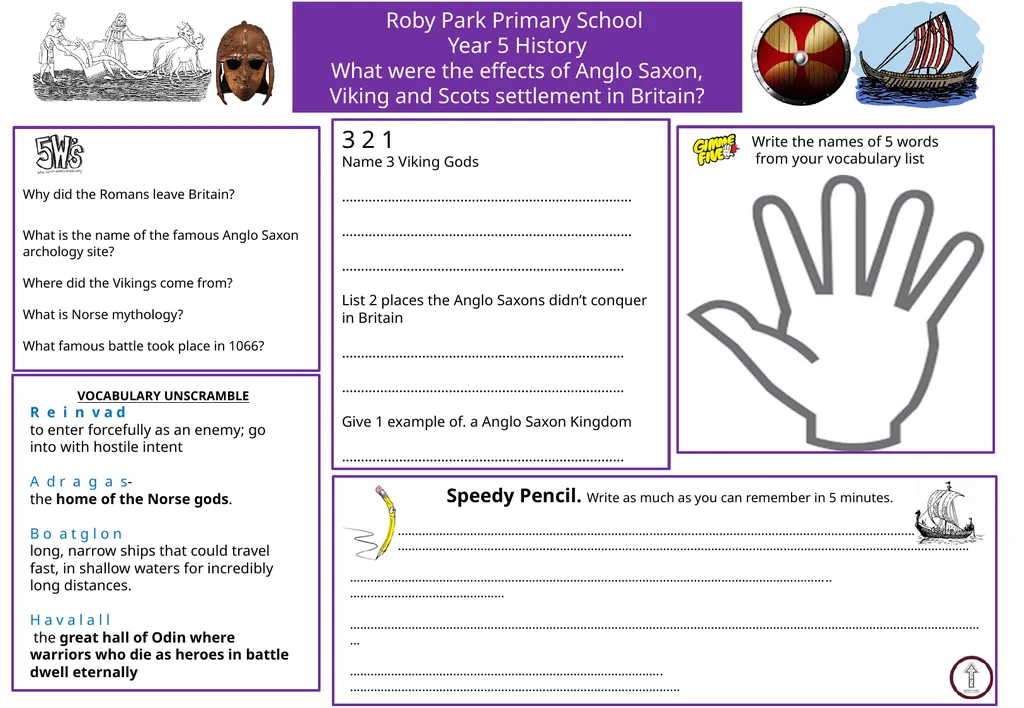
02
Roby Park Primary School
Year 5 History
What were the effects of Anglo Saxon, Viking and Scots settlement in Britain? Why did the Romans leave Britain?
What is the name of the famous Anglo Saxon archology site?
Where did the Vikings come from?
What is Norse mythology?
What famous battle took place in 1066? 3 2 1
Name 3 Viking Gods
…………………………..……………………………..………
………………………..………………………………..………
……………………….……………………………….….…..
List 2 places the Anglo Saxons didn’t conquer in Britain
…………………….………………………………….………
……………………….……………………………….………
Give 1 example of. a Anglo Saxon Kingdom
……………………….….…………………………………… Write the names of 5 words
from your vocabulary list Speedy Pencil. Write as much as you can remember in 5 minutes.
…………………………………………………………………………….................................................................................... ………………………………………...……………………………………………………………………………………………………………………
…………………………………………………………………………………………………………………………..………………………………………
……………………………………………………………………………………………………………………………………………………………………
……………………………………………………………………………….…………………………………………………………………………………… VOCABULARY UNSCRAMBLE
R e i n v a d
to enter forcefully as an enemy; go into with hostile intent
A d r a g a s-
the home of the Norse gods.
B o a t g l o n
long, narrow ships that could travel fast, in shallow waters for incredibly long distances.
H a v a l a l l
the great hall of Odin where warriors who die as heroes in battle dwell eternally<br>