
“What Top Performing Organizations Do and Don’t




Description: What Top Performing Organizations Do and Dont Do Jon Burroughs, MD, MBA, FACHE, FACPE President and CEO, The Burroughs Healthcare Consulting Network, Inc. April 28, 2017 How do you define High Performance? Economic (volume, margin,
Related Topics
Download Presentation
"“What Top Performing Organizations Do and Don’t" is the property of its rightful owner. Permission is granted to download and print the materials on this website for personal, non-commercial use only, and to display it on your personal computer provided you do not modify the materials and that you retain all copyright notices contained in the materials. By downloading content from our website, you accept the terms of this agreement.
Presentation Transcript
slide1. “What Top Performing Organizations Do and Don’t Do” Jon Burroughs, MD, MBA, FACHE, FACPE
President and CEO, The Burroughs Healthcare Consulting Network, Inc.
April 28, 2017<br>
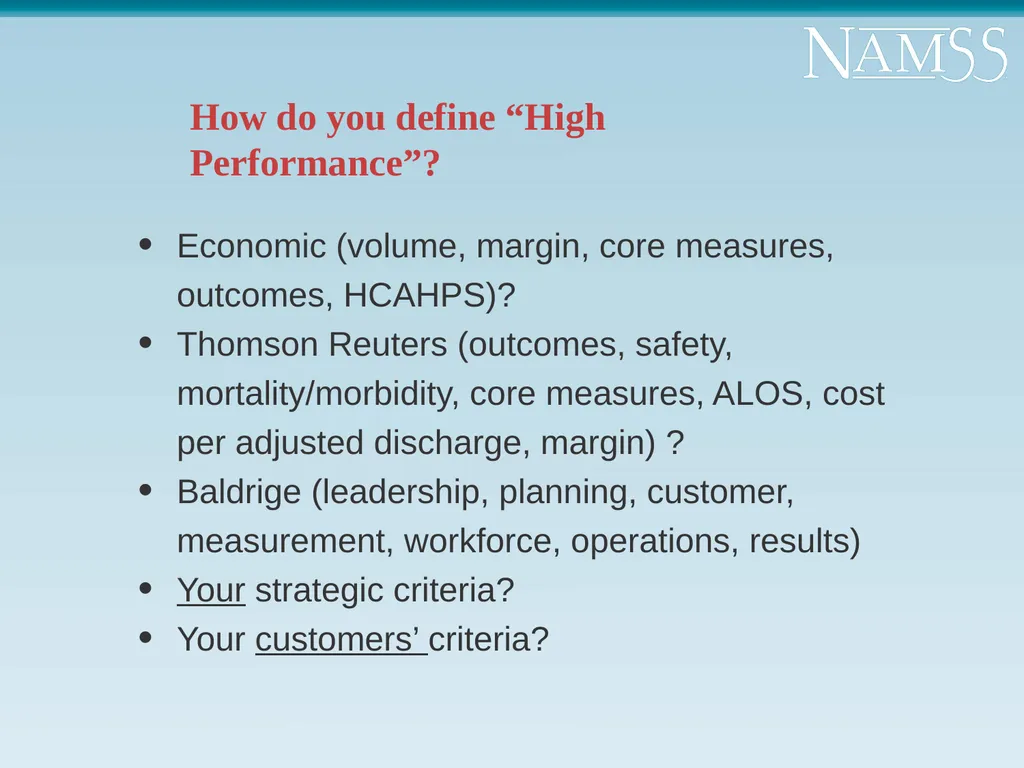
slide2. How do you define “High Performance”? Economic (volume, margin, core measures, outcomes, HCAHPS)?
Thomson Reuters (outcomes, safety, mortality/morbidity, core measures, ALOS, cost per adjusted discharge, margin) ?
Baldrige (leadership, planning, customer, measurement, workforce, operations, results)
Your strategic criteria?
Your customers’ criteria?<br>
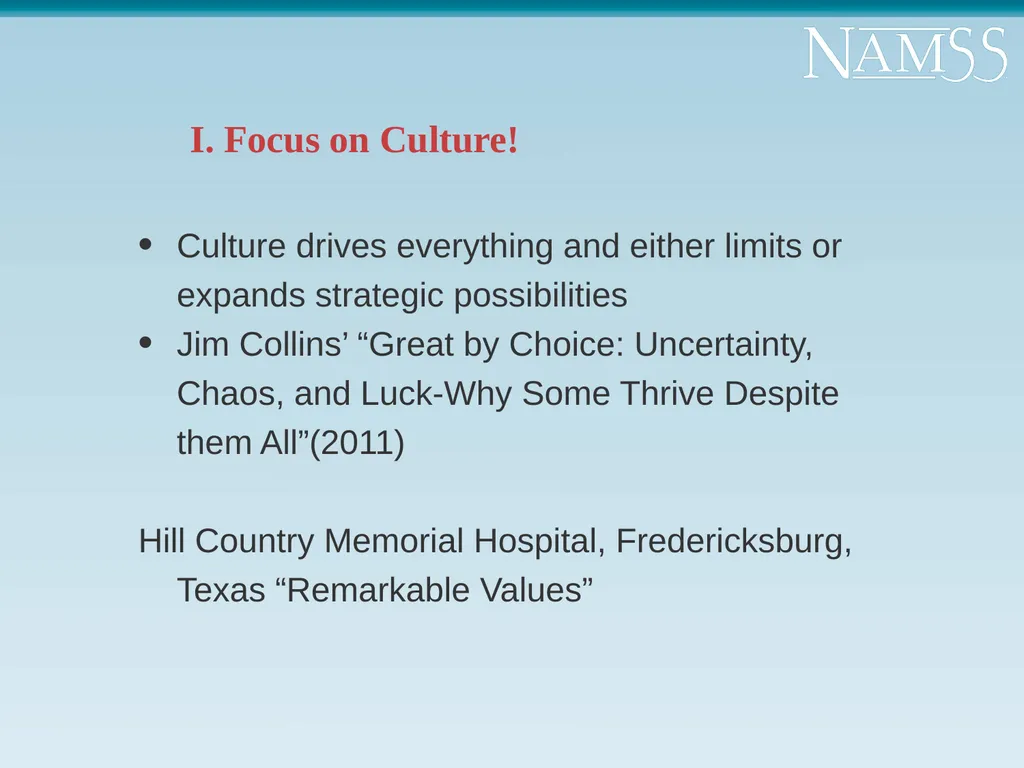
slide3. I. Focus on Culture! Culture drives everything and either limits or expands strategic possibilities
Jim Collins’ “Great by Choice: Uncertainty, Chaos, and Luck-Why Some Thrive Despite them All”(2011)
Hill Country Memorial Hospital, Fredericksburg, Texas “Remarkable Values”<br>
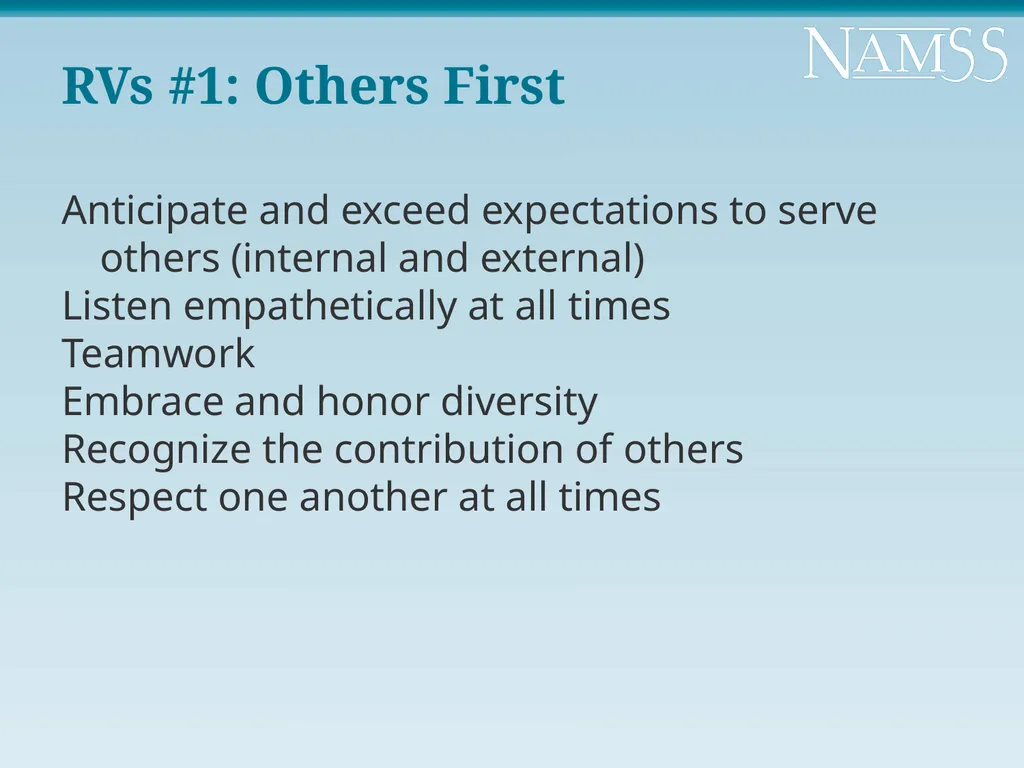
slide4. RVs #1: Others First Anticipate and exceed expectations to serve others (internal and external)
Listen empathetically at all times
Teamwork
Embrace and honor diversity
Recognize the contribution of others
Respect one another at all times<br>
slide5. RVs #2: Compassion Consistently treat others with courtesy, respect, kindness, and patience
Show genuine interest in what is important to others
Display a helpful and friendly attitude
Support and encourage always<br>
slide6. RVs #3: Innovation Embrace evidence based practices
Learn from experience and share with others
Create unique ways to provide remarkable care
Incorporate technology to improve patient and team member experience/outcomes
Always think beyond the box<br>
slide7. RVs #4: Accountability Provide safe care
Lead by example at all times
Be open and honest about successes and failures
Take initiative for personal growth and development
Make appropriate decisions in difficult situations<br>
slide8. RVs #5: Stewardship Demonstrate ownership of continuous improvement
Actively participate in financial success by optimizing resources
Make a positive contribution to our community
Note: Everyone in the organization is obligated to sign off on these values annually<br>
slide9. Results: Increased Medicare CMI from 1.3 to 1.7 (significant impact on net margin)
Press Ganey ‘Mentoring Hospital’ (99%tile)
Top 10%tile for all core/safety measures
“Chasing 0” safety program (eliminate the denominator)
Texas Quality Award
Able to attract top national talent
2014 Baldrige Award for Healthcare
One of the Top Small Hospitals in the US<br>
slide10. II. Commit to Leadership Training and Roles at all Levels of the Organization Leadership academies
Certified Physician Executive (CPE) program
MBA, MMM, MHA programs
10/17 US News and World Report Top US Hospitals overseen by physician leaders
Baylor Healthcare, Dallas, Texas: Mandatory physician leadership boot camp and executive MBA program for committed physician leaders<br>
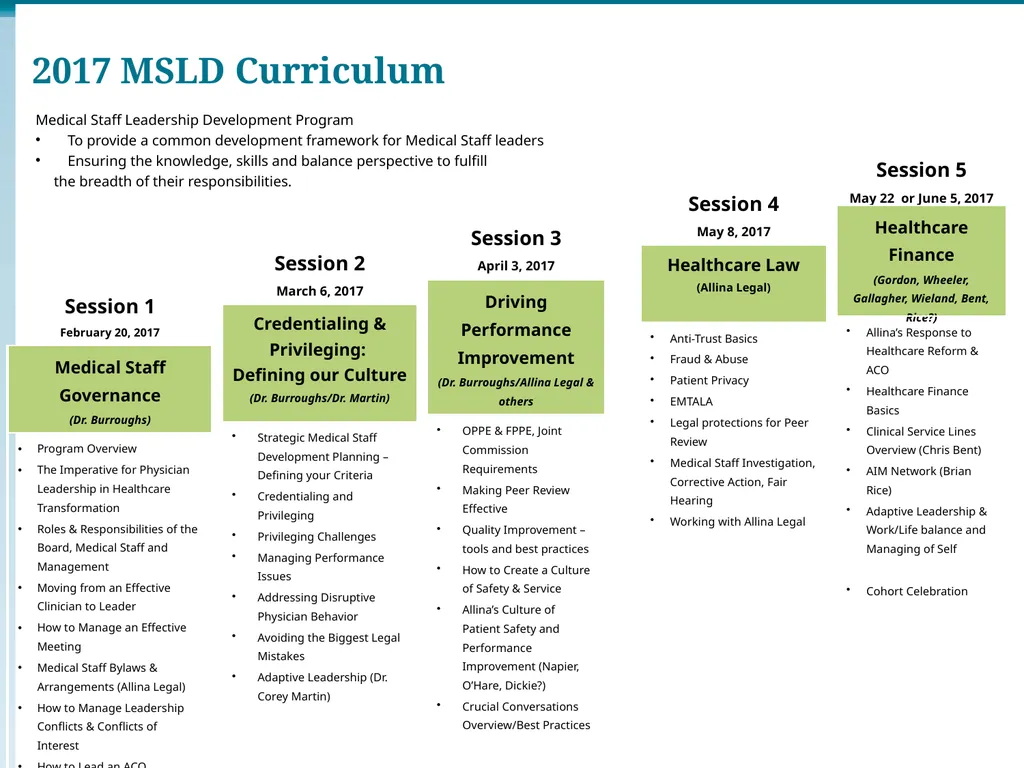
slide11. 2017 MSLD Curriculum Medical Staff Leadership Development Program
To provide a common development framework for Medical Staff leaders
Ensuring the knowledge, skills and balance perspective to fulfill
the breadth of their responsibilities.<br>
slide12. Leadership Compensation Must be based upon fair market value in a not for profit 501(c)(3) entity per IRS and state attorney general’s office (anti-kickback, personal inurement)
Incentives should be based upon negotiated and aligned organizational strategic goals/objectives
Compensation should be proportional to accountability
Metrics derive from overarching dimensions (performance excellence commitments)<br>
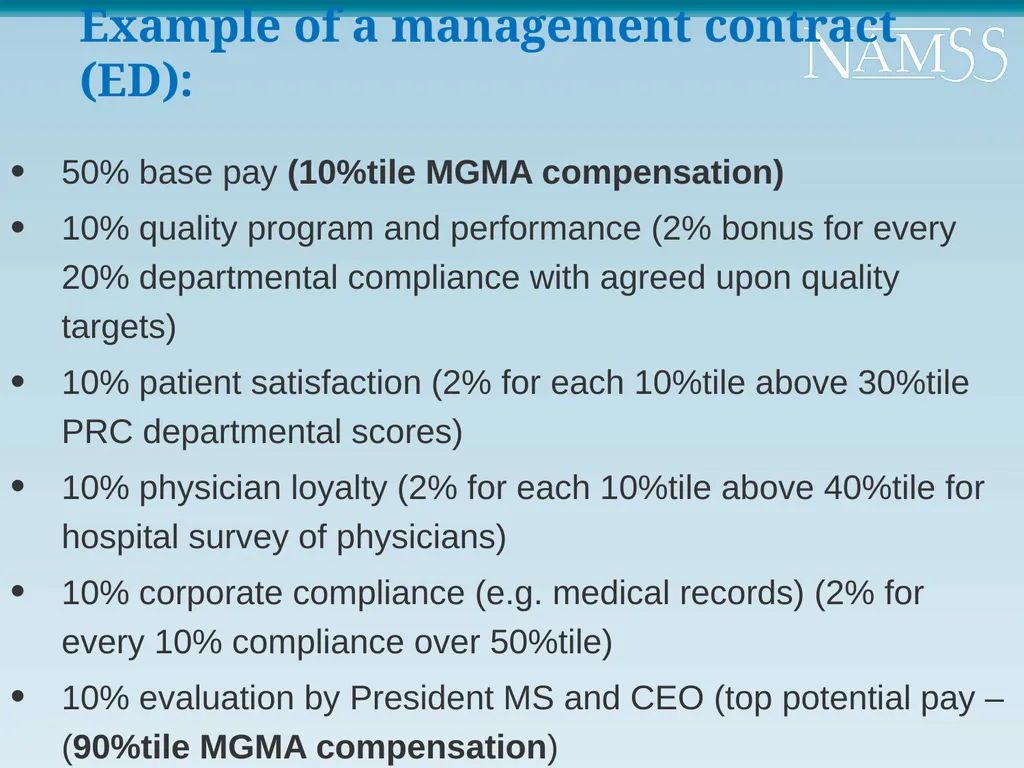
slide13. Example of a management contract (ED): 50% base pay (10%tile MGMA compensation)
10% quality program and performance (2% bonus for every 20% departmental compliance with agreed upon quality targets)
10% patient satisfaction (2% for each 10%tile above 30%tile PRC departmental scores)
10% physician loyalty (2% for each 10%tile above 40%tile for hospital survey of physicians)
10% corporate compliance (e.g. medical records) (2% for every 10% compliance over 50%tile)
10% evaluation by President MS and CEO (top potential pay – (90%tile MGMA compensation)<br>
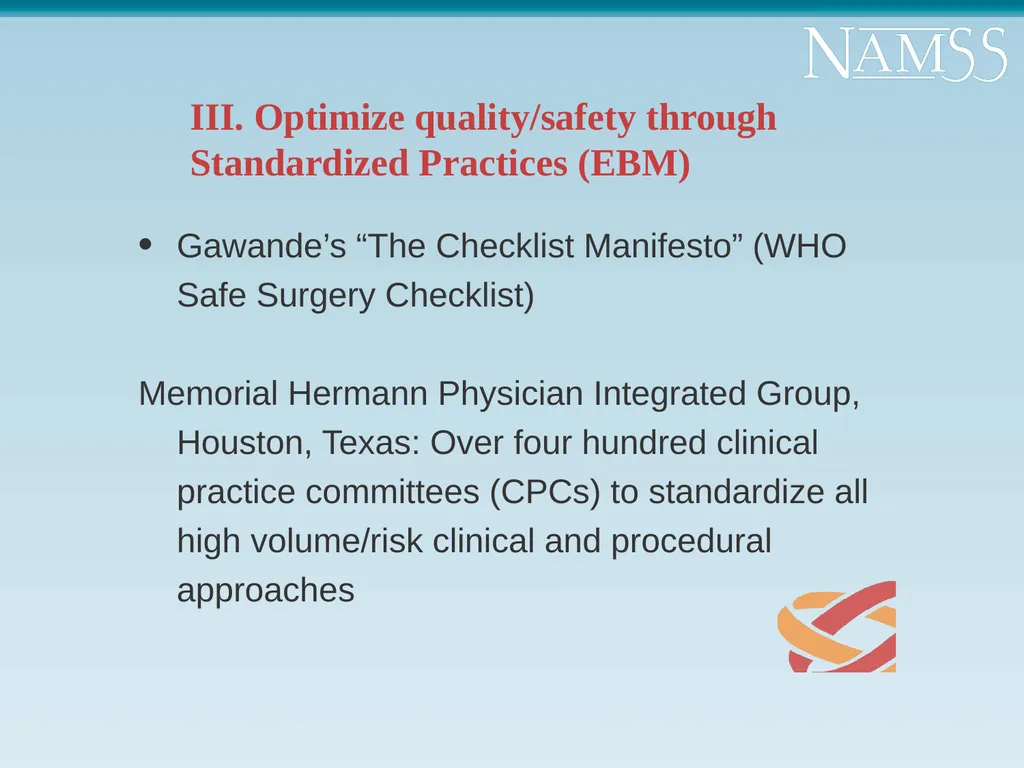
slide14. III. Optimize quality/safety through Standardized Practices (EBM) Gawande’s “The Checklist Manifesto” (WHO Safe Surgery Checklist)
Memorial Hermann Physician Integrated Group, Houston, Texas: Over four hundred clinical practice committees (CPCs) to standardize all high volume/risk clinical and procedural approaches<br>
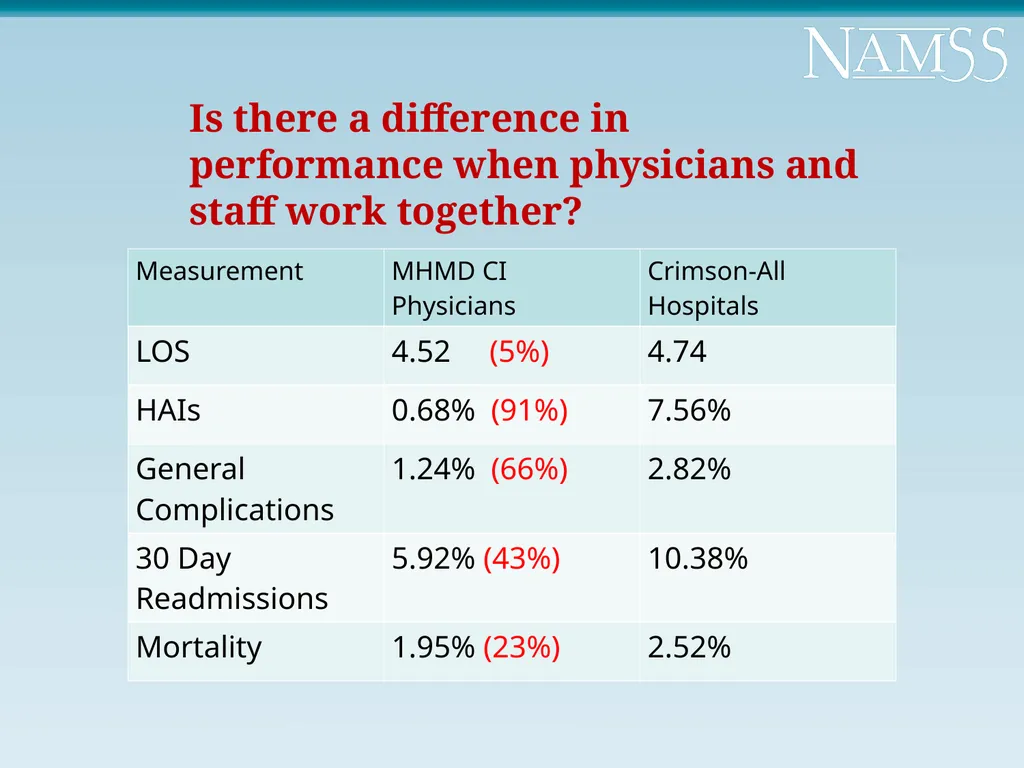
slide15. Is there a difference in performance when physicians and staff work together?<br>
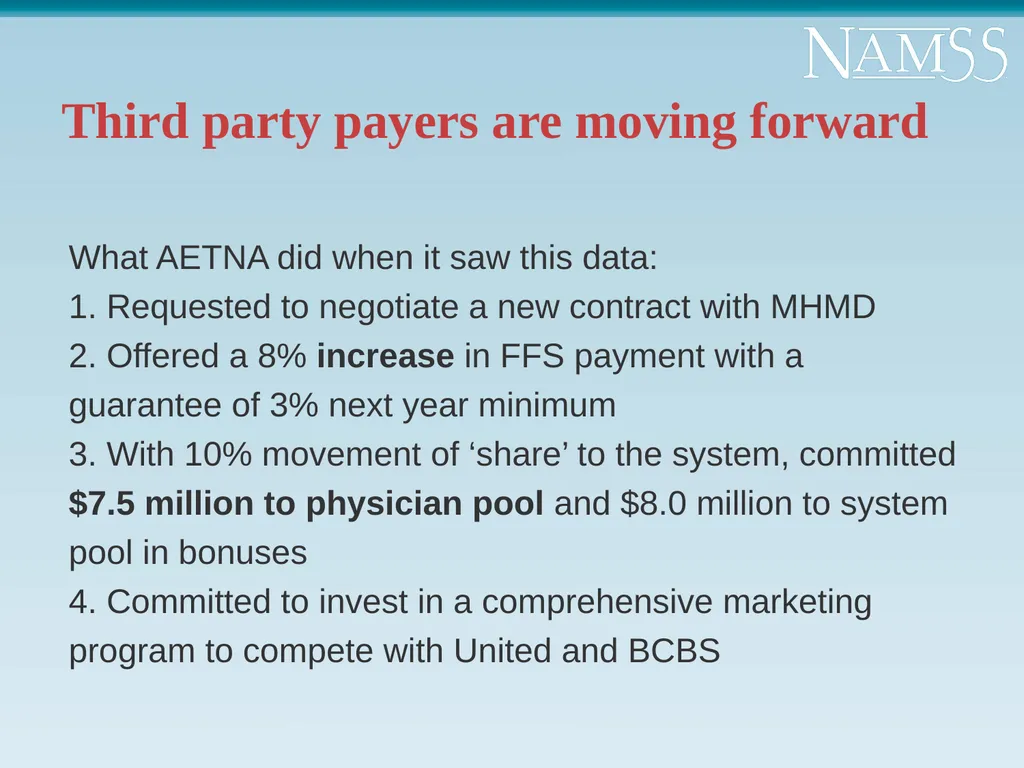
slide16. Third party payers are moving forward What AETNA did when it saw this data:
1. Requested to negotiate a new contract with MHMD
2. Offered a 8% increase in FFS payment with a guarantee of 3% next year minimum
3. With 10% movement of ‘share’ to the system, committed $7.5 million to physician pool and $8.0 million to system pool in bonuses
4. Committed to invest in a comprehensive marketing program to compete with United and BCBS<br>
slide17. The New Reality: Competency is no longer enough!
Bottom decile performers will subsidize top decile performers
Top decile performers will earn disproportionate market share (why is this?)
Quality, operations and finance will need to be linked
Physician-management alignment and collaboration will be the engine to get you there!<br>
slide18. IV. Continuous Focus on Customer Service and Loyalty Internal AND external customers!
“Satisfaction is fool’s gold”
What is the leading indicator for patient loyalty?
Mercy Medical Center, Baltimore, Maryland: Physician Centric Business Plan (patient centered and physician led)<br>
slide19. It turns out that patient loyalty is the greatest driver of…. Compliance with recommended treatment and follow up (up to 400%)
Reduced medical negligence claims (the critical 3%)
Enhanced reputation and market share (think Apple/Harley-Davidson)
Measurable quality outcomes (due to compliance)<br>
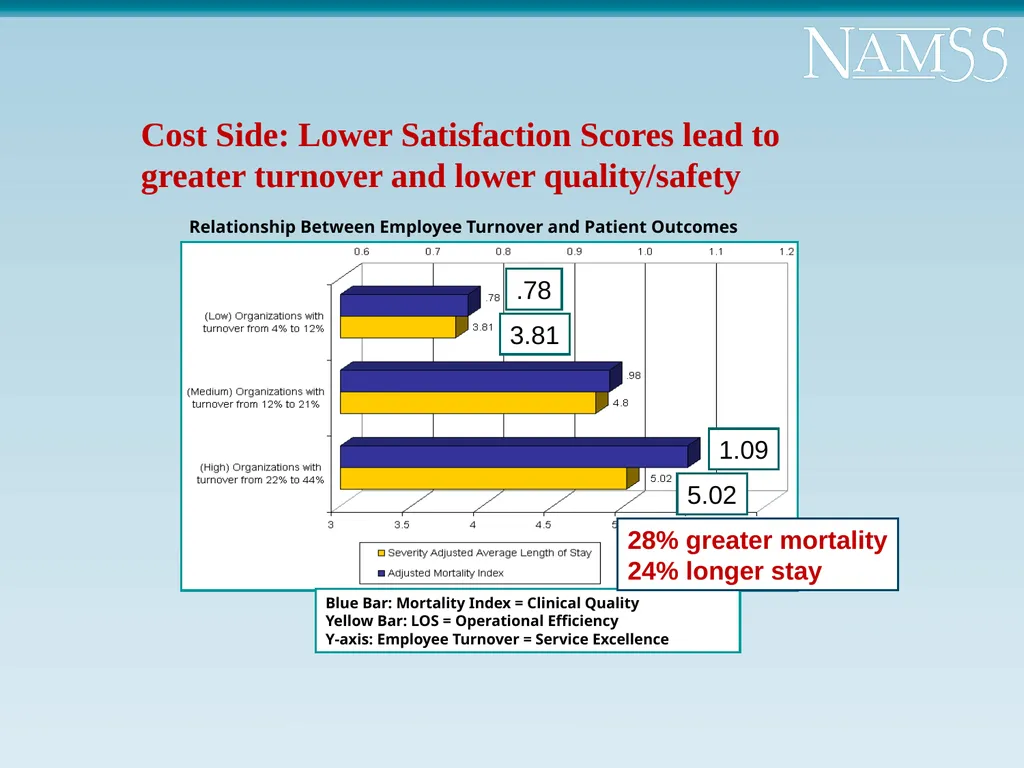
slide20. Cost Side: Lower Satisfaction Scores lead to greater turnover and lower quality/safety Relationship Between Employee Turnover and Patient Outcomes Blue Bar: Mortality Index = Clinical Quality
Yellow Bar: LOS = Operational Efficiency
Y-axis: Employee Turnover = Service Excellence .78 3.81 5.02 1.09 28% greater mortality
24% longer stay<br>
slide21. V. Work with Management to Continually Reduce Operating Costs What is the impact on your organization to reduce LOS by 0.1 day? Reduce cost per adjusted discharge? Increase CMI by 0.1?
University of Pittsburgh Medical Center-Hamot, Erie, Pennsylvania clinical documentation improvement (CDI) program<br>
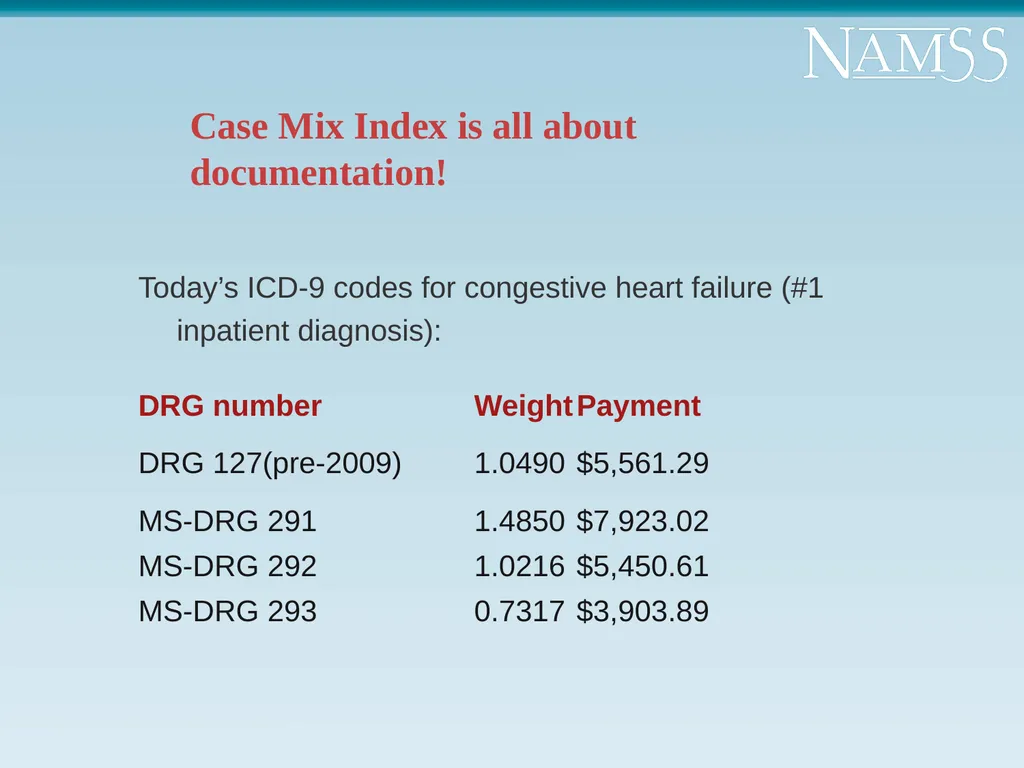
slide22. Case Mix Index is all about documentation! Today’s ICD-9 codes for congestive heart failure (#1 inpatient diagnosis):
DRG number Weight Payment
DRG 127(pre-2009) 1.0490 $5,561.29
MS-DRG 291 1.4850 $7,923.02
MS-DRG 292 1.0216 $5,450.61
MS-DRG 293 0.7317 $3,903.89<br>
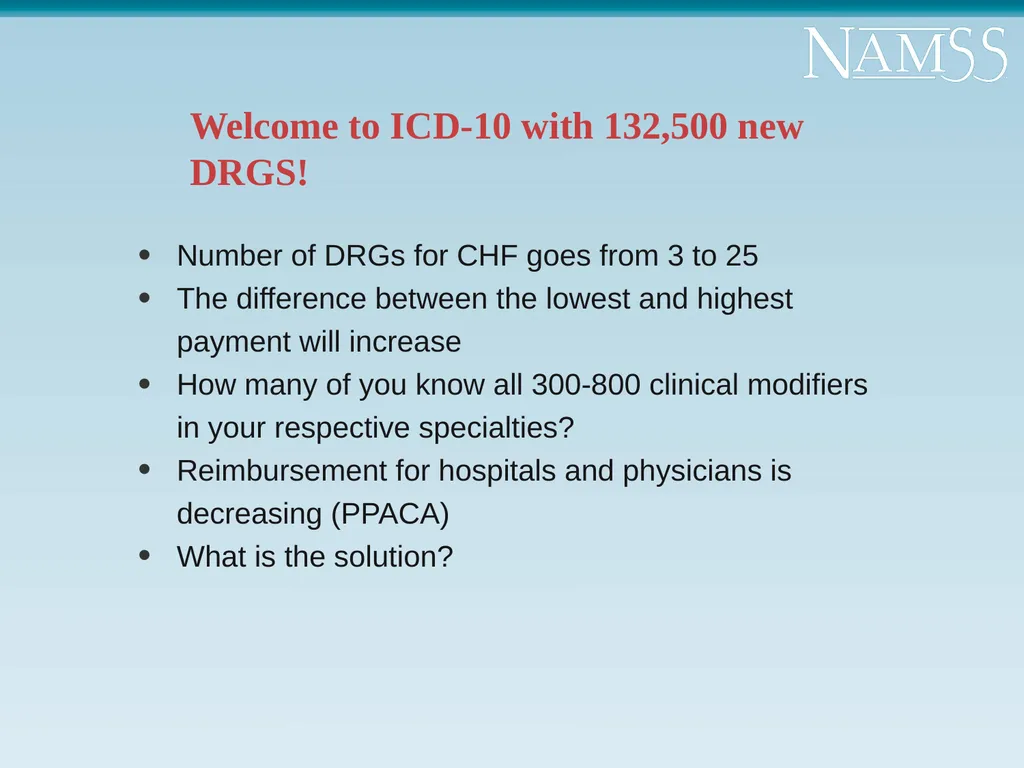
slide23. Welcome to ICD-10 with 132,500 new DRGS! Number of DRGs for CHF goes from 3 to 25
The difference between the lowest and highest payment will increase
How many of you know all 300-800 clinical modifiers in your respective specialties?
Reimbursement for hospitals and physicians is decreasing (PPACA)
What is the solution?<br>
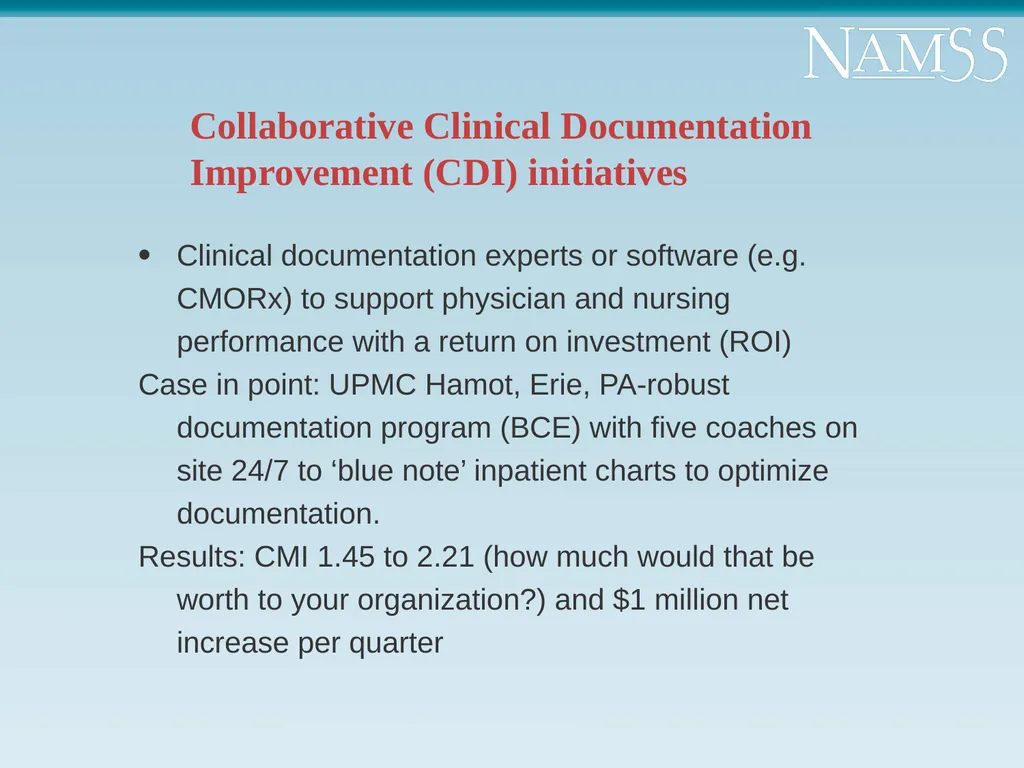
slide24. Collaborative Clinical Documentation Improvement (CDI) initiatives Clinical documentation experts or software (e.g. CMORx) to support physician and nursing performance with a return on investment (ROI)
Case in point: UPMC Hamot, Erie, PA-robust documentation program (BCE) with five coaches on site 24/7 to ‘blue note’ inpatient charts to optimize documentation.
Results: CMI 1.45 to 2.21 (how much would that be worth to your organization?) and $1 million net increase per quarter<br>
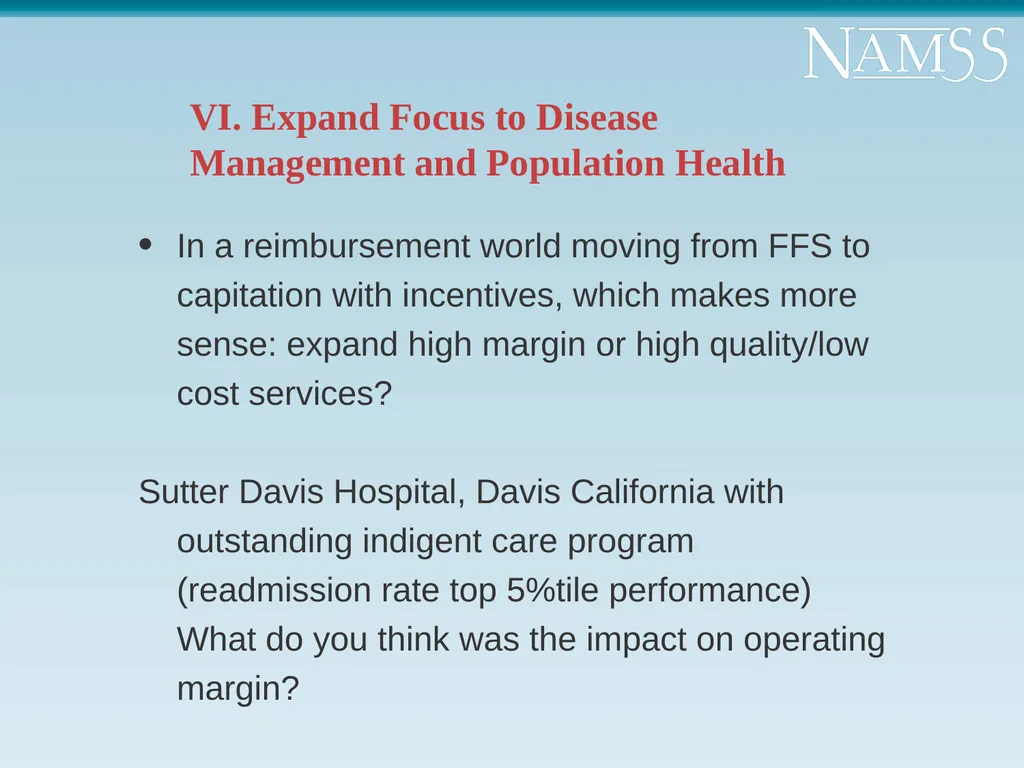
slide25. VI. Expand Focus to Disease Management and Population Health In a reimbursement world moving from FFS to capitation with incentives, which makes more sense: expand high margin or high quality/low cost services?
Sutter Davis Hospital, Davis California with outstanding indigent care program (readmission rate top 5%tile performance) What do you think was the impact on operating margin?<br>
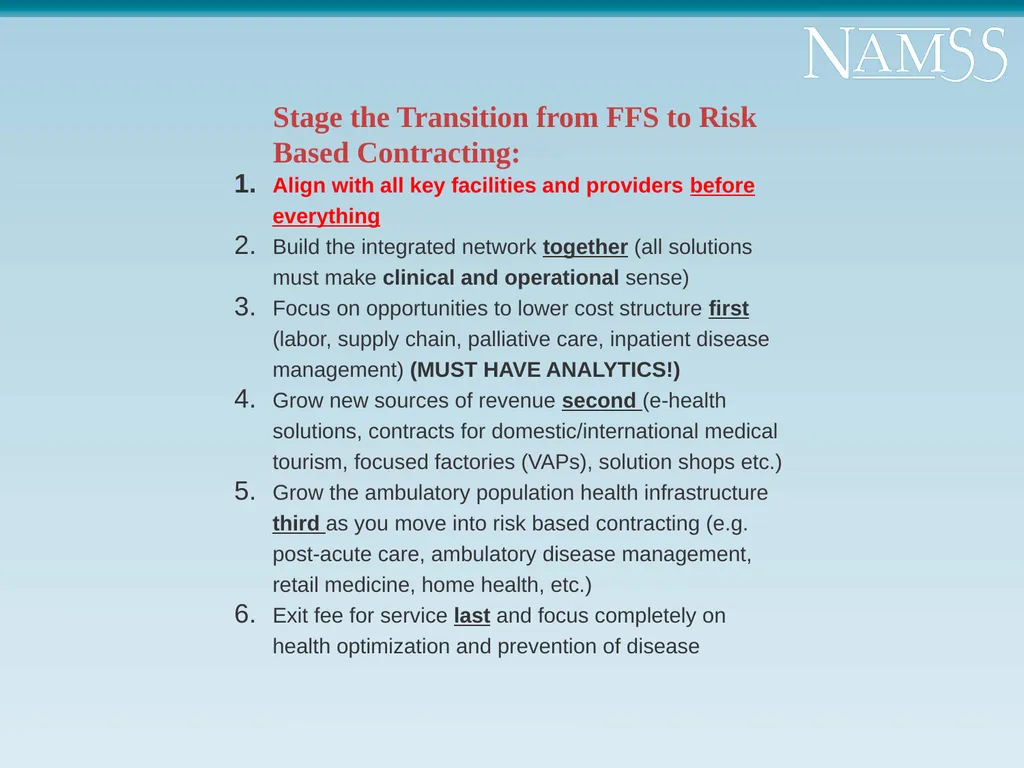
slide26. Stage the Transition from FFS to Risk Based Contracting: Align with all key facilities and providers before everything
Build the integrated network together (all solutions must make clinical and operational sense)
Focus on opportunities to lower cost structure first (labor, supply chain, palliative care, inpatient disease management) (MUST HAVE ANALYTICS!)
Grow new sources of revenue second (e-health solutions, contracts for domestic/international medical tourism, focused factories (VAPs), solution shops etc.)
Grow the ambulatory population health infrastructure third as you move into risk based contracting (e.g. post-acute care, ambulatory disease management, retail medicine, home health, etc.)
Exit fee for service last and focus completely on health optimization and prevention of disease<br>
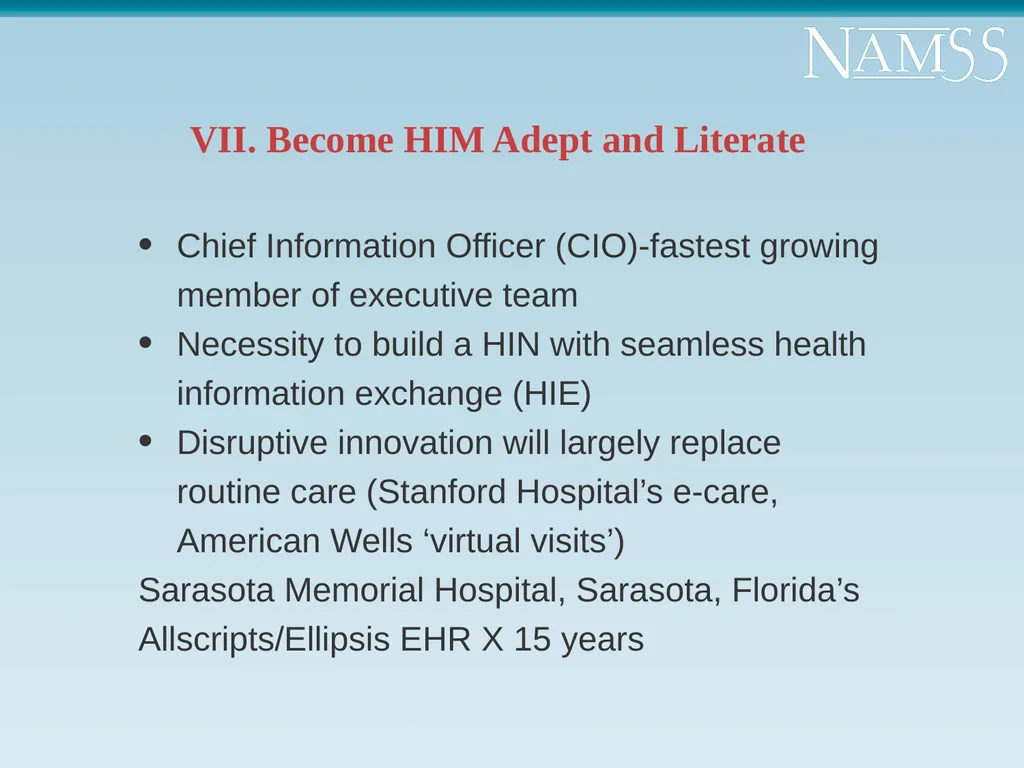
slide27. VII. Become HIM Adept and Literate Chief Information Officer (CIO)-fastest growing member of executive team
Necessity to build a HIN with seamless health information exchange (HIE)
Disruptive innovation will largely replace routine care (Stanford Hospital’s e-care, American Wells ‘virtual visits’)
Sarasota Memorial Hospital, Sarasota, Florida’s
Allscripts/Ellipsis EHR X 15 years<br>
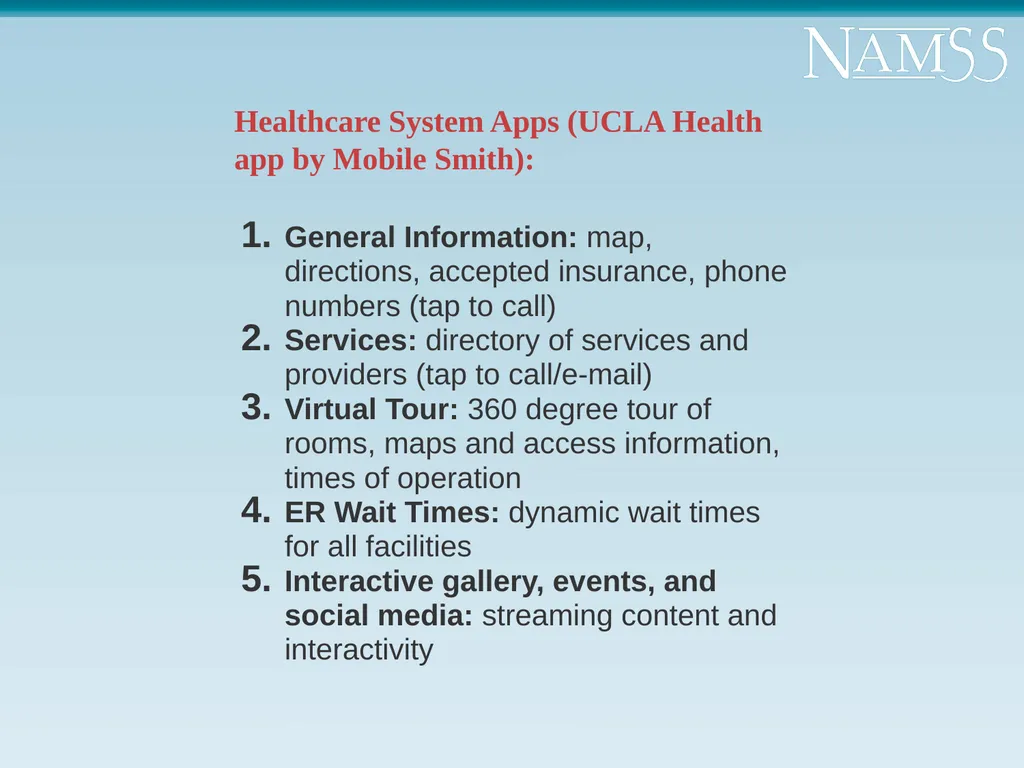
slide28. Healthcare System Apps (UCLA Health app by Mobile Smith): General Information: map, directions, accepted insurance, phone numbers (tap to call)
Services: directory of services and providers (tap to call/e-mail)
Virtual Tour: 360 degree tour of rooms, maps and access information, times of operation
ER Wait Times: dynamic wait times for all facilities
Interactive gallery, events, and social media: streaming content and interactivity<br>
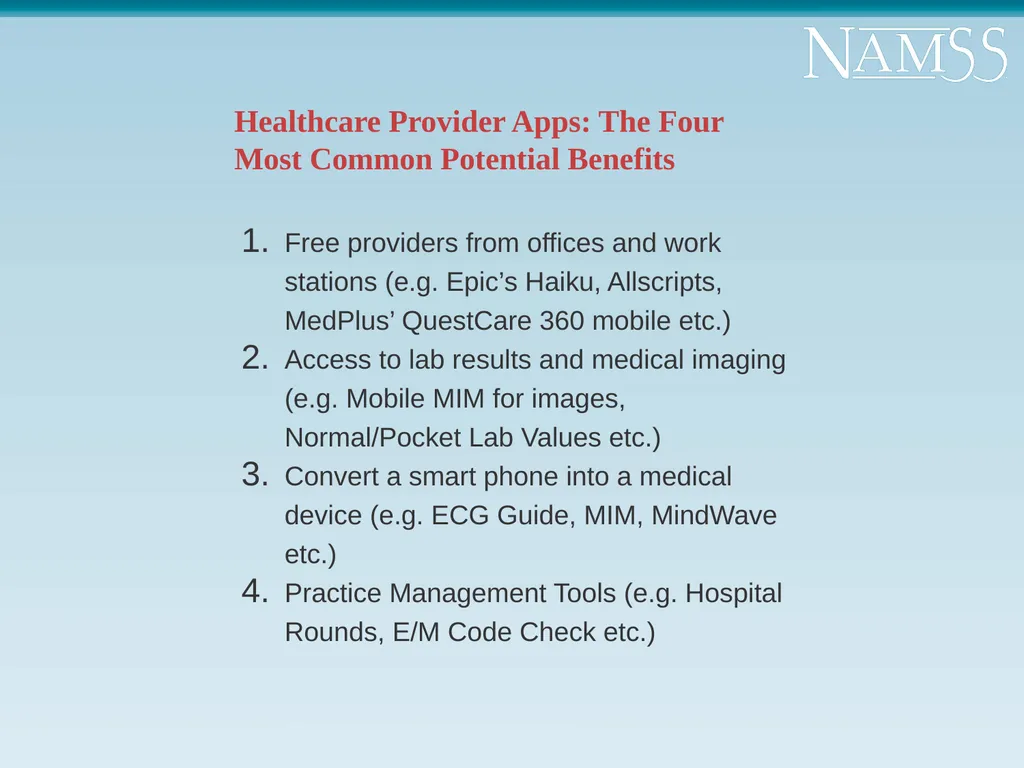
slide29. Healthcare Provider Apps: The Four Most Common Potential Benefits Free providers from offices and work stations (e.g. Epic’s Haiku, Allscripts, MedPlus’ QuestCare 360 mobile etc.)
Access to lab results and medical imaging (e.g. Mobile MIM for images, Normal/Pocket Lab Values etc.)
Convert a smart phone into a medical device (e.g. ECG Guide, MIM, MindWave etc.)
Practice Management Tools (e.g. Hospital Rounds, E/M Code Check etc.)<br>
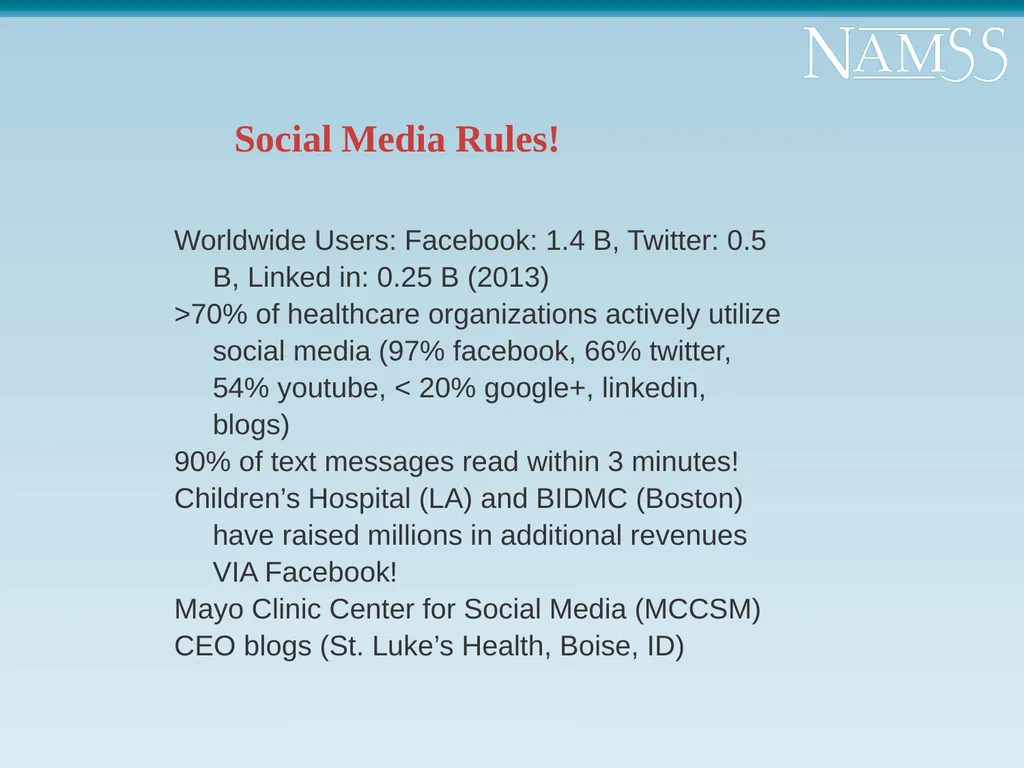
slide30. Social Media Rules! Worldwide Users: Facebook: 1.4 B, Twitter: 0.5 B, Linked in: 0.25 B (2013)
>70% of healthcare organizations actively utilize social media (97% facebook, 66% twitter, 54% youtube, < 20% google+, linkedin, blogs)
90% of text messages read within 3 minutes!
Children’s Hospital (LA) and BIDMC (Boston) have raised millions in additional revenues VIA Facebook!
Mayo Clinic Center for Social Media (MCCSM)
CEO blogs (St. Luke’s Health, Boise, ID)<br>
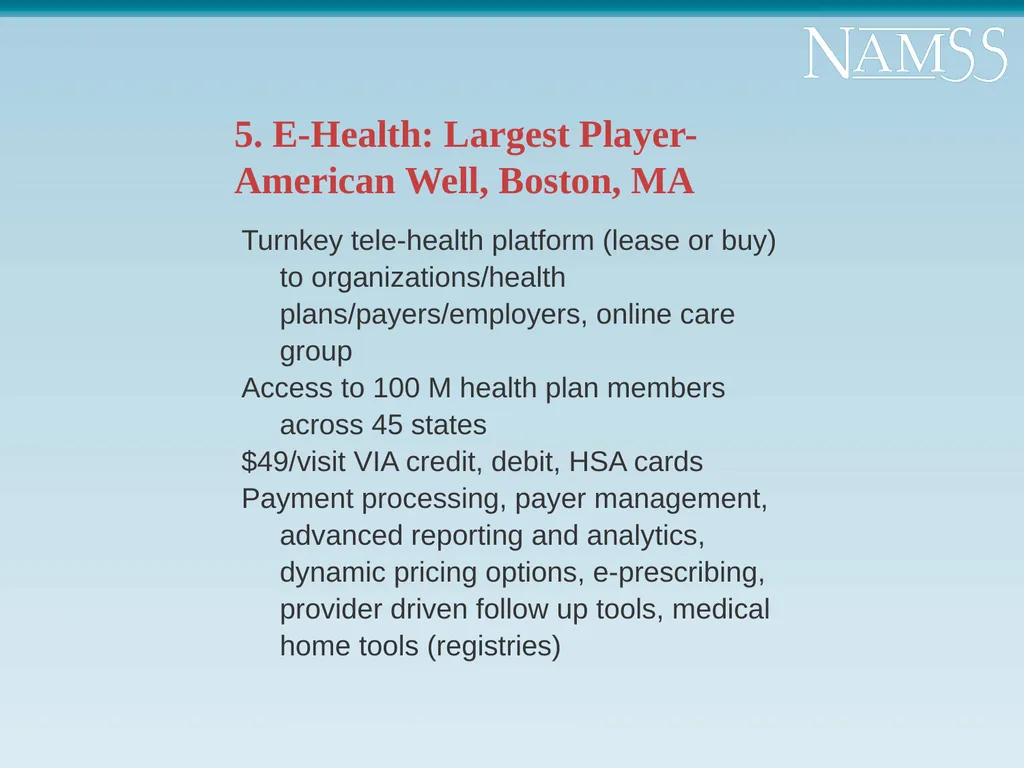
slide31. 5. E-Health: Largest Player-American Well, Boston, MA Turnkey tele-health platform (lease or buy) to organizations/health plans/payers/employers, online care group
Access to 100 M health plan members across 45 states
$49/visit VIA credit, debit, HSA cards
Payment processing, payer management, advanced reporting and analytics, dynamic pricing options, e-prescribing, provider driven follow up tools, medical home tools (registries)<br>
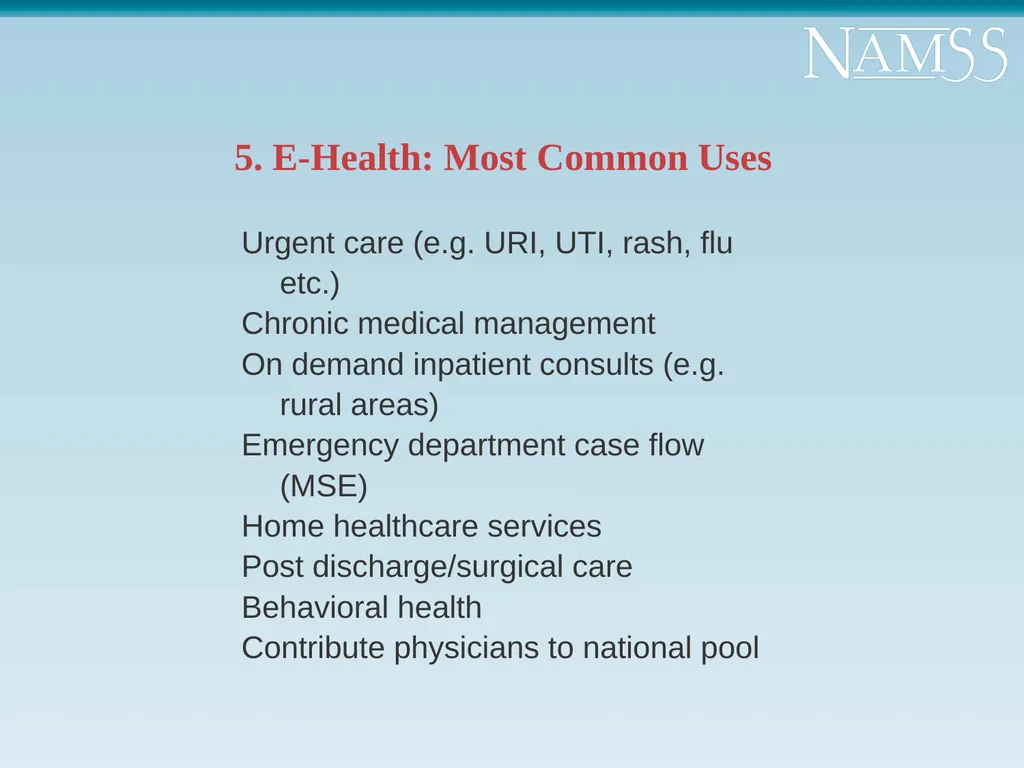
slide32. 5. E-Health: Most Common Uses Urgent care (e.g. URI, UTI, rash, flu etc.)
Chronic medical management
On demand inpatient consults (e.g. rural areas)
Emergency department case flow (MSE)
Home healthcare services
Post discharge/surgical care
Behavioral health
Contribute physicians to national pool<br>
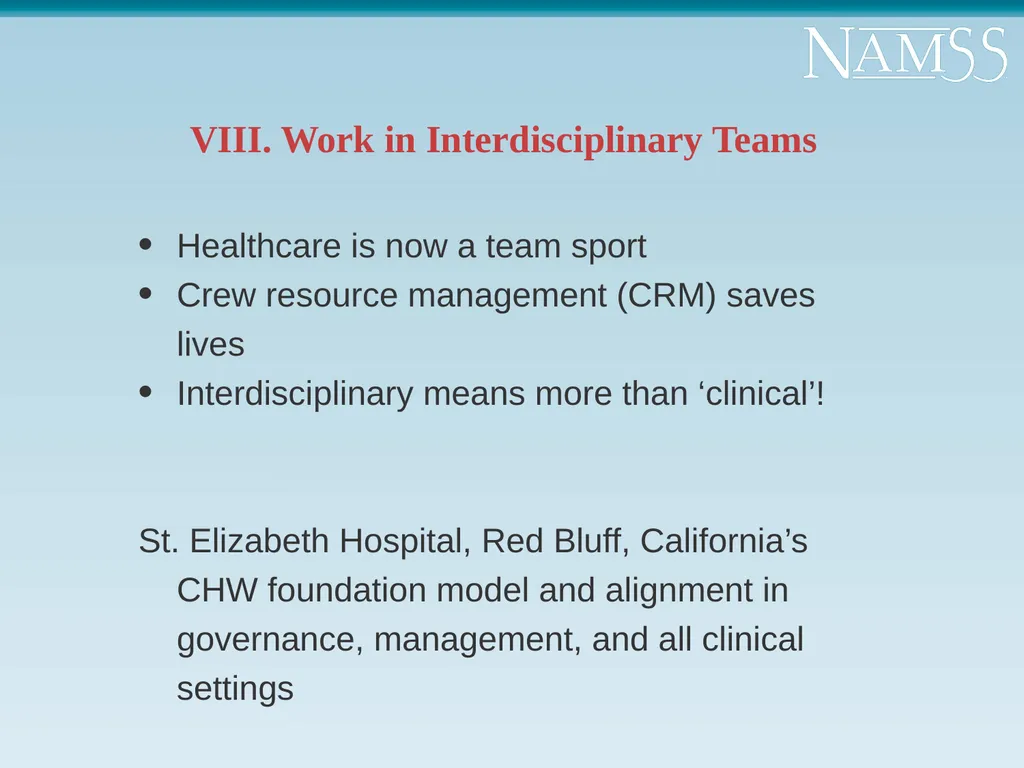
slide33. VIII. Work in Interdisciplinary Teams Healthcare is now a team sport
Crew resource management (CRM) saves lives
Interdisciplinary means more than ‘clinical’!
St. Elizabeth Hospital, Red Bluff, California’s CHW foundation model and alignment in governance, management, and all clinical settings<br>
slide34. IX. Be Willing to Exclude Low Performers or “Non-Performers” Performance is the ultimate manifestation of ‘culture’ and ‘values’
Not everyone can go on the journey to excellence
“Non-performers” can excel in other environments
Mayo Clinic, Rochester, Minnesota’s membership ‘by invitation only’
University of Virginia ‘eligibility criteria’<br>
slide35. X. Become Completely Aligned with Physicians Employment and ‘pay for call’ ≠ alignment
Cultural alignment precedes economic alignment precedes clinical alignment
Culture of alignment = trust + respect + partnership
Memorial Hermann Physician Integration Program and Baylor Healthcare alignment with self-employed physicians<br>
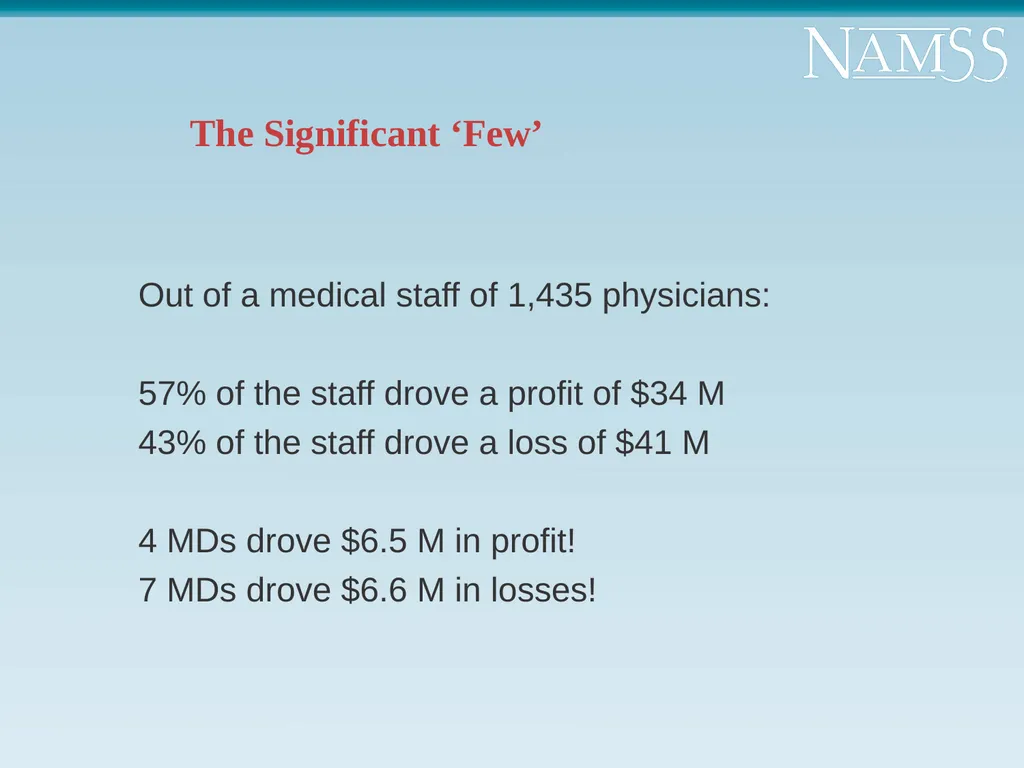
slide36. The Significant ‘Few’ Out of a medical staff of 1,435 physicians:
57% of the staff drove a profit of $34 M
43% of the staff drove a loss of $41 M
4 MDs drove $6.5 M in profit!
7 MDs drove $6.6 M in losses!<br>
slide37. What would Self-Employed or Employed Physicians be interested in? Enterprise partnership
Hospital based revenue (leveraged contracts)
Access to GPO (supply chain costs)
Access to IT (HITECH)
Revenue cycle management (RCM) support
Access to investment capital
Access to preferential referrals
Input/increasing control at the highest levels of the organization<br>
slide38. What are the non-negotiable quid pro quos of such a partnership? Standardize regulatory quality, safety, service and cost effectiveness
Work with management to drive down operating costs
Work with management to achieve strategic goals/objectives (e.g. service culture, population health etc.)<br>
slide39. Key Components of ‘At Risk’ Contracts with Physicians (Intermountain Health): Be willing to participate in ‘at risk’ contracts based upon strategic goals/objectives developed and approved by physicians and management
Comply with clinical and business ‘best practices’ as determined by peer group/management (and be willing to be peer audited for exceptions)
Agree to un-blinded transparency of all clinical and financial data/analytics
Be willing to comply with value analysis process
Disclose all potential conflicts of interest and accept determination of deliberative physician bodies<br>
slide40. What is the Difference between Clinical Departments and Service Lines?: Independence v. collaboration (team)
Autonomy v. consensus
Wide variation v. narrow variation
Clinical focus v. clinical + operational + financial focus
Open v. semi-open or closed
Self-employed/employed v. contractual with performance expectations
Voluntary leadership v. dyad/triad contractual leadership<br>
slide41. Dyad/Triad Model of Leadership: Physician + Manager (e.g. nurse) + Executive partnership:
Clinical quality (physicians + staff)
Safety
Service
Operations (e.g. supply chain/budget)
Financial performance
HR
Branding/marketing<br>
slide42. Co-Management Agreements Partnering physician and managerial leaders to oversee inpatient/outpatient services, ancillary, multi-site specialty care (exclusives), service lines, clinical institutes, and enterprises for performance in:
Quality
Cost savings
Service
Safety
Efficiency
Marketing/branding<br>
slide43. Perspective from the ages…. "Excellence is never an accident. It is always the result of high intention, sincere effort, and intelligent execution; it represents the wise choice of many alternatives - choice, not chance, determines your destiny.”
--Aristotle (384-322 BC)<br>
slide44. Jon Burroughs, MD, MBA, FACHE, FAAPL
jburroughs@burroughshealthcare.com; 603-733-8156 Thank You for Joining Us!<br>
President and CEO, The Burroughs Healthcare Consulting Network, Inc.
April 28, 2017<br>
slide2. How do you define “High Performance”? Economic (volume, margin, core measures, outcomes, HCAHPS)?
Thomson Reuters (outcomes, safety, mortality/morbidity, core measures, ALOS, cost per adjusted discharge, margin) ?
Baldrige (leadership, planning, customer, measurement, workforce, operations, results)
Your strategic criteria?
Your customers’ criteria?<br>
slide3. I. Focus on Culture! Culture drives everything and either limits or expands strategic possibilities
Jim Collins’ “Great by Choice: Uncertainty, Chaos, and Luck-Why Some Thrive Despite them All”(2011)
Hill Country Memorial Hospital, Fredericksburg, Texas “Remarkable Values”<br>
slide4. RVs #1: Others First Anticipate and exceed expectations to serve others (internal and external)
Listen empathetically at all times
Teamwork
Embrace and honor diversity
Recognize the contribution of others
Respect one another at all times<br>
slide5. RVs #2: Compassion Consistently treat others with courtesy, respect, kindness, and patience
Show genuine interest in what is important to others
Display a helpful and friendly attitude
Support and encourage always<br>
slide6. RVs #3: Innovation Embrace evidence based practices
Learn from experience and share with others
Create unique ways to provide remarkable care
Incorporate technology to improve patient and team member experience/outcomes
Always think beyond the box<br>
slide7. RVs #4: Accountability Provide safe care
Lead by example at all times
Be open and honest about successes and failures
Take initiative for personal growth and development
Make appropriate decisions in difficult situations<br>
slide8. RVs #5: Stewardship Demonstrate ownership of continuous improvement
Actively participate in financial success by optimizing resources
Make a positive contribution to our community
Note: Everyone in the organization is obligated to sign off on these values annually<br>
slide9. Results: Increased Medicare CMI from 1.3 to 1.7 (significant impact on net margin)
Press Ganey ‘Mentoring Hospital’ (99%tile)
Top 10%tile for all core/safety measures
“Chasing 0” safety program (eliminate the denominator)
Texas Quality Award
Able to attract top national talent
2014 Baldrige Award for Healthcare
One of the Top Small Hospitals in the US<br>
slide10. II. Commit to Leadership Training and Roles at all Levels of the Organization Leadership academies
Certified Physician Executive (CPE) program
MBA, MMM, MHA programs
10/17 US News and World Report Top US Hospitals overseen by physician leaders
Baylor Healthcare, Dallas, Texas: Mandatory physician leadership boot camp and executive MBA program for committed physician leaders<br>
slide11. 2017 MSLD Curriculum Medical Staff Leadership Development Program
To provide a common development framework for Medical Staff leaders
Ensuring the knowledge, skills and balance perspective to fulfill
the breadth of their responsibilities.<br>
slide12. Leadership Compensation Must be based upon fair market value in a not for profit 501(c)(3) entity per IRS and state attorney general’s office (anti-kickback, personal inurement)
Incentives should be based upon negotiated and aligned organizational strategic goals/objectives
Compensation should be proportional to accountability
Metrics derive from overarching dimensions (performance excellence commitments)<br>
slide13. Example of a management contract (ED): 50% base pay (10%tile MGMA compensation)
10% quality program and performance (2% bonus for every 20% departmental compliance with agreed upon quality targets)
10% patient satisfaction (2% for each 10%tile above 30%tile PRC departmental scores)
10% physician loyalty (2% for each 10%tile above 40%tile for hospital survey of physicians)
10% corporate compliance (e.g. medical records) (2% for every 10% compliance over 50%tile)
10% evaluation by President MS and CEO (top potential pay – (90%tile MGMA compensation)<br>
slide14. III. Optimize quality/safety through Standardized Practices (EBM) Gawande’s “The Checklist Manifesto” (WHO Safe Surgery Checklist)
Memorial Hermann Physician Integrated Group, Houston, Texas: Over four hundred clinical practice committees (CPCs) to standardize all high volume/risk clinical and procedural approaches<br>
slide15. Is there a difference in performance when physicians and staff work together?<br>
slide16. Third party payers are moving forward What AETNA did when it saw this data:
1. Requested to negotiate a new contract with MHMD
2. Offered a 8% increase in FFS payment with a guarantee of 3% next year minimum
3. With 10% movement of ‘share’ to the system, committed $7.5 million to physician pool and $8.0 million to system pool in bonuses
4. Committed to invest in a comprehensive marketing program to compete with United and BCBS<br>
slide17. The New Reality: Competency is no longer enough!
Bottom decile performers will subsidize top decile performers
Top decile performers will earn disproportionate market share (why is this?)
Quality, operations and finance will need to be linked
Physician-management alignment and collaboration will be the engine to get you there!<br>
slide18. IV. Continuous Focus on Customer Service and Loyalty Internal AND external customers!
“Satisfaction is fool’s gold”
What is the leading indicator for patient loyalty?
Mercy Medical Center, Baltimore, Maryland: Physician Centric Business Plan (patient centered and physician led)<br>
slide19. It turns out that patient loyalty is the greatest driver of…. Compliance with recommended treatment and follow up (up to 400%)
Reduced medical negligence claims (the critical 3%)
Enhanced reputation and market share (think Apple/Harley-Davidson)
Measurable quality outcomes (due to compliance)<br>
slide20. Cost Side: Lower Satisfaction Scores lead to greater turnover and lower quality/safety Relationship Between Employee Turnover and Patient Outcomes Blue Bar: Mortality Index = Clinical Quality
Yellow Bar: LOS = Operational Efficiency
Y-axis: Employee Turnover = Service Excellence .78 3.81 5.02 1.09 28% greater mortality
24% longer stay<br>
slide21. V. Work with Management to Continually Reduce Operating Costs What is the impact on your organization to reduce LOS by 0.1 day? Reduce cost per adjusted discharge? Increase CMI by 0.1?
University of Pittsburgh Medical Center-Hamot, Erie, Pennsylvania clinical documentation improvement (CDI) program<br>
slide22. Case Mix Index is all about documentation! Today’s ICD-9 codes for congestive heart failure (#1 inpatient diagnosis):
DRG number Weight Payment
DRG 127(pre-2009) 1.0490 $5,561.29
MS-DRG 291 1.4850 $7,923.02
MS-DRG 292 1.0216 $5,450.61
MS-DRG 293 0.7317 $3,903.89<br>
slide23. Welcome to ICD-10 with 132,500 new DRGS! Number of DRGs for CHF goes from 3 to 25
The difference between the lowest and highest payment will increase
How many of you know all 300-800 clinical modifiers in your respective specialties?
Reimbursement for hospitals and physicians is decreasing (PPACA)
What is the solution?<br>
slide24. Collaborative Clinical Documentation Improvement (CDI) initiatives Clinical documentation experts or software (e.g. CMORx) to support physician and nursing performance with a return on investment (ROI)
Case in point: UPMC Hamot, Erie, PA-robust documentation program (BCE) with five coaches on site 24/7 to ‘blue note’ inpatient charts to optimize documentation.
Results: CMI 1.45 to 2.21 (how much would that be worth to your organization?) and $1 million net increase per quarter<br>
slide25. VI. Expand Focus to Disease Management and Population Health In a reimbursement world moving from FFS to capitation with incentives, which makes more sense: expand high margin or high quality/low cost services?
Sutter Davis Hospital, Davis California with outstanding indigent care program (readmission rate top 5%tile performance) What do you think was the impact on operating margin?<br>
slide26. Stage the Transition from FFS to Risk Based Contracting: Align with all key facilities and providers before everything
Build the integrated network together (all solutions must make clinical and operational sense)
Focus on opportunities to lower cost structure first (labor, supply chain, palliative care, inpatient disease management) (MUST HAVE ANALYTICS!)
Grow new sources of revenue second (e-health solutions, contracts for domestic/international medical tourism, focused factories (VAPs), solution shops etc.)
Grow the ambulatory population health infrastructure third as you move into risk based contracting (e.g. post-acute care, ambulatory disease management, retail medicine, home health, etc.)
Exit fee for service last and focus completely on health optimization and prevention of disease<br>
slide27. VII. Become HIM Adept and Literate Chief Information Officer (CIO)-fastest growing member of executive team
Necessity to build a HIN with seamless health information exchange (HIE)
Disruptive innovation will largely replace routine care (Stanford Hospital’s e-care, American Wells ‘virtual visits’)
Sarasota Memorial Hospital, Sarasota, Florida’s
Allscripts/Ellipsis EHR X 15 years<br>
slide28. Healthcare System Apps (UCLA Health app by Mobile Smith): General Information: map, directions, accepted insurance, phone numbers (tap to call)
Services: directory of services and providers (tap to call/e-mail)
Virtual Tour: 360 degree tour of rooms, maps and access information, times of operation
ER Wait Times: dynamic wait times for all facilities
Interactive gallery, events, and social media: streaming content and interactivity<br>
slide29. Healthcare Provider Apps: The Four Most Common Potential Benefits Free providers from offices and work stations (e.g. Epic’s Haiku, Allscripts, MedPlus’ QuestCare 360 mobile etc.)
Access to lab results and medical imaging (e.g. Mobile MIM for images, Normal/Pocket Lab Values etc.)
Convert a smart phone into a medical device (e.g. ECG Guide, MIM, MindWave etc.)
Practice Management Tools (e.g. Hospital Rounds, E/M Code Check etc.)<br>
slide30. Social Media Rules! Worldwide Users: Facebook: 1.4 B, Twitter: 0.5 B, Linked in: 0.25 B (2013)
>70% of healthcare organizations actively utilize social media (97% facebook, 66% twitter, 54% youtube, < 20% google+, linkedin, blogs)
90% of text messages read within 3 minutes!
Children’s Hospital (LA) and BIDMC (Boston) have raised millions in additional revenues VIA Facebook!
Mayo Clinic Center for Social Media (MCCSM)
CEO blogs (St. Luke’s Health, Boise, ID)<br>
slide31. 5. E-Health: Largest Player-American Well, Boston, MA Turnkey tele-health platform (lease or buy) to organizations/health plans/payers/employers, online care group
Access to 100 M health plan members across 45 states
$49/visit VIA credit, debit, HSA cards
Payment processing, payer management, advanced reporting and analytics, dynamic pricing options, e-prescribing, provider driven follow up tools, medical home tools (registries)<br>
slide32. 5. E-Health: Most Common Uses Urgent care (e.g. URI, UTI, rash, flu etc.)
Chronic medical management
On demand inpatient consults (e.g. rural areas)
Emergency department case flow (MSE)
Home healthcare services
Post discharge/surgical care
Behavioral health
Contribute physicians to national pool<br>
slide33. VIII. Work in Interdisciplinary Teams Healthcare is now a team sport
Crew resource management (CRM) saves lives
Interdisciplinary means more than ‘clinical’!
St. Elizabeth Hospital, Red Bluff, California’s CHW foundation model and alignment in governance, management, and all clinical settings<br>
slide34. IX. Be Willing to Exclude Low Performers or “Non-Performers” Performance is the ultimate manifestation of ‘culture’ and ‘values’
Not everyone can go on the journey to excellence
“Non-performers” can excel in other environments
Mayo Clinic, Rochester, Minnesota’s membership ‘by invitation only’
University of Virginia ‘eligibility criteria’<br>
slide35. X. Become Completely Aligned with Physicians Employment and ‘pay for call’ ≠ alignment
Cultural alignment precedes economic alignment precedes clinical alignment
Culture of alignment = trust + respect + partnership
Memorial Hermann Physician Integration Program and Baylor Healthcare alignment with self-employed physicians<br>
slide36. The Significant ‘Few’ Out of a medical staff of 1,435 physicians:
57% of the staff drove a profit of $34 M
43% of the staff drove a loss of $41 M
4 MDs drove $6.5 M in profit!
7 MDs drove $6.6 M in losses!<br>
slide37. What would Self-Employed or Employed Physicians be interested in? Enterprise partnership
Hospital based revenue (leveraged contracts)
Access to GPO (supply chain costs)
Access to IT (HITECH)
Revenue cycle management (RCM) support
Access to investment capital
Access to preferential referrals
Input/increasing control at the highest levels of the organization<br>
slide38. What are the non-negotiable quid pro quos of such a partnership? Standardize regulatory quality, safety, service and cost effectiveness
Work with management to drive down operating costs
Work with management to achieve strategic goals/objectives (e.g. service culture, population health etc.)<br>
slide39. Key Components of ‘At Risk’ Contracts with Physicians (Intermountain Health): Be willing to participate in ‘at risk’ contracts based upon strategic goals/objectives developed and approved by physicians and management
Comply with clinical and business ‘best practices’ as determined by peer group/management (and be willing to be peer audited for exceptions)
Agree to un-blinded transparency of all clinical and financial data/analytics
Be willing to comply with value analysis process
Disclose all potential conflicts of interest and accept determination of deliberative physician bodies<br>
slide40. What is the Difference between Clinical Departments and Service Lines?: Independence v. collaboration (team)
Autonomy v. consensus
Wide variation v. narrow variation
Clinical focus v. clinical + operational + financial focus
Open v. semi-open or closed
Self-employed/employed v. contractual with performance expectations
Voluntary leadership v. dyad/triad contractual leadership<br>
slide41. Dyad/Triad Model of Leadership: Physician + Manager (e.g. nurse) + Executive partnership:
Clinical quality (physicians + staff)
Safety
Service
Operations (e.g. supply chain/budget)
Financial performance
HR
Branding/marketing<br>
slide42. Co-Management Agreements Partnering physician and managerial leaders to oversee inpatient/outpatient services, ancillary, multi-site specialty care (exclusives), service lines, clinical institutes, and enterprises for performance in:
Quality
Cost savings
Service
Safety
Efficiency
Marketing/branding<br>
slide43. Perspective from the ages…. "Excellence is never an accident. It is always the result of high intention, sincere effort, and intelligent execution; it represents the wise choice of many alternatives - choice, not chance, determines your destiny.”
--Aristotle (384-322 BC)<br>
slide44. Jon Burroughs, MD, MBA, FACHE, FAAPL
jburroughs@burroughshealthcare.com; 603-733-8156 Thank You for Joining Us!<br>