
WHO QualityRights core training - for all services
FD
Published · 174 slides · 0 views

1 / 1




Description
WHO QualityRights core training - for all services all people Course Slides CBMSarah Isaacs WHOMSDQR19.2 World Health Organization 2019 Some rights reserved. This work is available under the Creative Commons
Related Topics
Share
Embed code
Download this presentation From Below
"WHO QualityRights core training - for all services" is the property of its rightful owner. Permission is granted to download and print the materials on this website for personal, non-commercial use only, and to display it on your personal computer provided you do not modify the materials and that you retain all copyright notices contained in the materials. By downloading content from our website, you accept the terms of this agreement.
Presentation Transcript
01
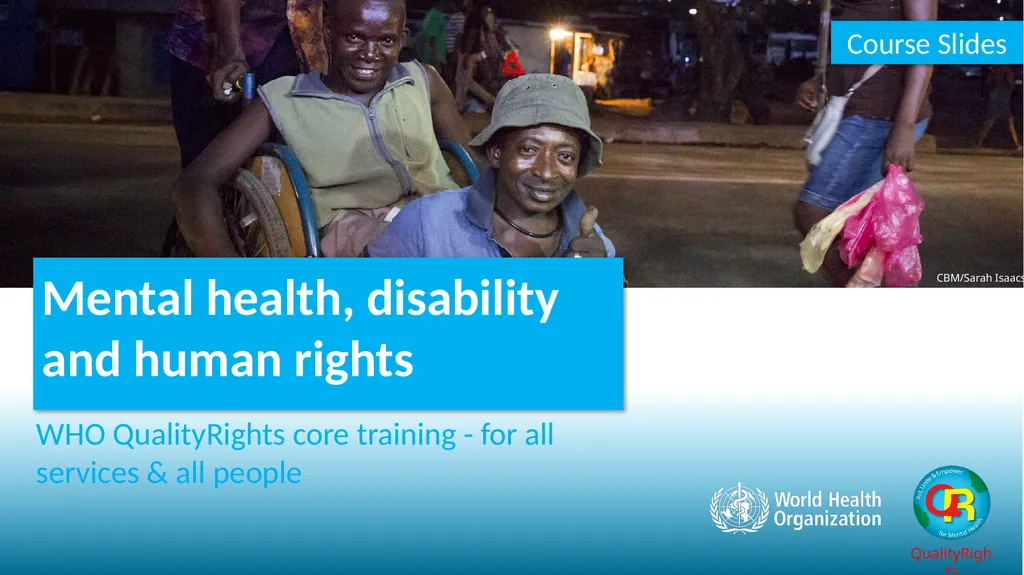
WHO QualityRights core training - for all services & all people Course Slides CBM/Sarah Isaacs<br>
02
WHO/MSD/QR/19.2
© World Health Organization 2019
Some rights reserved. This work is available under the Creative Commons Attribution-NonCommercial-ShareAlike 3.0 IGO licence (CC BY-NC-SA 3.0 IGO; https://creativecommons.org/licenses/by-nc-sa/3.0/igo).
Under the terms of this licence, you may copy, redistribute and adapt the work for non-commercial purposes, provided the work is appropriately cited, as indicated below. In any use of this work, there should be no suggestion that WHO endorses any specific organization, products or services. The use of the WHO logo is not permitted. If you adapt the work, then you must license your work under the same or equivalent Creative Commons licence. If you create a translation of this work, you should add the following disclaimer along with the suggested citation: “This translation was not created by the World Health Organization (WHO). WHO is not responsible for the content or accuracy of this translation. The original English edition shall be the binding and authentic edition”.
Any mediation relating to disputes arising under the licence shall be conducted in accordance with the mediation rules of the World Intellectual Property Organization.
Suggested citation. Mental health, disability and human rights. WHO QualityRights Core training - for all services and all people. Course slides. Geneva: World Health Organization; 2019 (WHO/MSD/QR/19.2). Licence: CC BY-NC-SA 3.0 IGO.
Sales, rights and licensing. To purchase WHO publications, see http://apps.who.int/bookorders. To submit requests for commercial use and queries on rights and licensing, see http://www.who.int/about/licensing.
Third-party materials. If you wish to reuse material from this work that is attributed to a third party, such as tables, figures or images, it is your responsibility to determine whether permission is needed for that reuse and to obtain permission from the copyright holder. The risk of claims resulting from infringement of any third-party-owned component in the work rests solely with the user.
General disclaimers. The designations employed and the presentation of the material in this publication do not imply the expression of any opinion whatsoever on the part of WHO concerning the legal status of any country, territory, city or area or of its authorities, or concerning the delimitation of its frontiers or boundaries. Dotted and dashed lines on maps represent approximate border lines for which there may not yet be full agreement. The mention of specific companies or of certain manufacturers’ products does not imply that they are endorsed or recommended by WHO in preference to others of a similar nature that are not mentioned. Errors and omissions excepted, the names of proprietary products are distinguished by initial capital letters.
All reasonable precautions have been taken by WHO to verify the information contained in this publication. However, the published material is being distributed without warranty of any kind, either expressed or implied. The responsibility for the interpretation and use of the material lies with the reader. In no event shall WHO be liable for damages arising from its use.
Cover photo. CBM/Sarah Isaacs
Accompanying course guide is available here https://www.who.int/publications-detail/who-qualityrights-guidance-and-training-tools<br>
© World Health Organization 2019
Some rights reserved. This work is available under the Creative Commons Attribution-NonCommercial-ShareAlike 3.0 IGO licence (CC BY-NC-SA 3.0 IGO; https://creativecommons.org/licenses/by-nc-sa/3.0/igo).
Under the terms of this licence, you may copy, redistribute and adapt the work for non-commercial purposes, provided the work is appropriately cited, as indicated below. In any use of this work, there should be no suggestion that WHO endorses any specific organization, products or services. The use of the WHO logo is not permitted. If you adapt the work, then you must license your work under the same or equivalent Creative Commons licence. If you create a translation of this work, you should add the following disclaimer along with the suggested citation: “This translation was not created by the World Health Organization (WHO). WHO is not responsible for the content or accuracy of this translation. The original English edition shall be the binding and authentic edition”.
Any mediation relating to disputes arising under the licence shall be conducted in accordance with the mediation rules of the World Intellectual Property Organization.
Suggested citation. Mental health, disability and human rights. WHO QualityRights Core training - for all services and all people. Course slides. Geneva: World Health Organization; 2019 (WHO/MSD/QR/19.2). Licence: CC BY-NC-SA 3.0 IGO.
Sales, rights and licensing. To purchase WHO publications, see http://apps.who.int/bookorders. To submit requests for commercial use and queries on rights and licensing, see http://www.who.int/about/licensing.
Third-party materials. If you wish to reuse material from this work that is attributed to a third party, such as tables, figures or images, it is your responsibility to determine whether permission is needed for that reuse and to obtain permission from the copyright holder. The risk of claims resulting from infringement of any third-party-owned component in the work rests solely with the user.
General disclaimers. The designations employed and the presentation of the material in this publication do not imply the expression of any opinion whatsoever on the part of WHO concerning the legal status of any country, territory, city or area or of its authorities, or concerning the delimitation of its frontiers or boundaries. Dotted and dashed lines on maps represent approximate border lines for which there may not yet be full agreement. The mention of specific companies or of certain manufacturers’ products does not imply that they are endorsed or recommended by WHO in preference to others of a similar nature that are not mentioned. Errors and omissions excepted, the names of proprietary products are distinguished by initial capital letters.
All reasonable precautions have been taken by WHO to verify the information contained in this publication. However, the published material is being distributed without warranty of any kind, either expressed or implied. The responsibility for the interpretation and use of the material lies with the reader. In no event shall WHO be liable for damages arising from its use.
Cover photo. CBM/Sarah Isaacs
Accompanying course guide is available here https://www.who.int/publications-detail/who-qualityrights-guidance-and-training-tools<br>
03
3 GOAL: Improve access to good quality mental health and social services and to promote the human rights of people with mental health conditions, psychosocial, intellectual or cognitive disabilities Build capacity to combat stigma and discrimination and promote human rights and recovery
Improve the quality and human rights conditions in mental health and social services
Create community-based services and recovery-oriented services that respect and promote human rights
Support the development of a civil society movement to conduct advocacy and influence policy-making
Reform national policies and legislation in line with the CRPD and other international human rights standards WHO QualityRights: Goals and objectives<br>
Improve the quality and human rights conditions in mental health and social services
Create community-based services and recovery-oriented services that respect and promote human rights
Support the development of a civil society movement to conduct advocacy and influence policy-making
Reform national policies and legislation in line with the CRPD and other international human rights standards WHO QualityRights: Goals and objectives<br>
04
4 Language and terminology are used differently by different people in different contexts.
“Psychosocial disability” includes people who have received a mental health-related diagnosis or who self-identify with this term.
“Cognitive disability” and “intellectual disability” refer to people who have received a diagnosis related to their cognitive or intellectual function, including dementia and autism.
The term “disability” highlights the barriers that hinder the full participation in society of people with actual or perceived impairments and the fact that they are protected under the CRPD.
The use of “disability” in this context does not imply that people have an impairment or a disorder. A few words about terminology in this training – 1<br>
“Psychosocial disability” includes people who have received a mental health-related diagnosis or who self-identify with this term.
“Cognitive disability” and “intellectual disability” refer to people who have received a diagnosis related to their cognitive or intellectual function, including dementia and autism.
The term “disability” highlights the barriers that hinder the full participation in society of people with actual or perceived impairments and the fact that they are protected under the CRPD.
The use of “disability” in this context does not imply that people have an impairment or a disorder. A few words about terminology in this training – 1<br>
05
5 “People who are using” or “who have previously used” mental health and social services refer to people who do not necessarily identify as having a disability but who have a variety of experiences applicable to this training.
The term “mental health and social services” refers to a wide range of services provided by countries within the public, private and nongovernmental sectors.
Terminology has been chosen for inclusiveness.
It is a personal choice to self-identify with certain expressions or concepts, but human rights apply to everyone everywhere.
A diagnosis or disability should never define a person.
We are all individuals, with a unique social context, personality, goals, aspirations and relationships with others. A few words about terminology in this training – 2<br>
The term “mental health and social services” refers to a wide range of services provided by countries within the public, private and nongovernmental sectors.
Terminology has been chosen for inclusiveness.
It is a personal choice to self-identify with certain expressions or concepts, but human rights apply to everyone everywhere.
A diagnosis or disability should never define a person.
We are all individuals, with a unique social context, personality, goals, aspirations and relationships with others. A few words about terminology in this training – 2<br>
06
6 At the end of the training, participants will: understand the concepts of discrimination and denial of rights;
understand the concept of disability;
acquire an understanding of the Convention on the Rights of Persons with Disabilities (CRPD) and how this instrument is central to respecting, protecting and fulfilling the human rights of persons with disabilities;
be able to apply knowledge of the CRPD to real-life scenarios and identify violation of the rights of persons with disabilities;
be able to identify concrete ways to respect and uphold the rights of people with psychosocial, intellectual or cognitive disabilities. What we aim to achieve during this module<br>
understand the concept of disability;
acquire an understanding of the Convention on the Rights of Persons with Disabilities (CRPD) and how this instrument is central to respecting, protecting and fulfilling the human rights of persons with disabilities;
be able to apply knowledge of the CRPD to real-life scenarios and identify violation of the rights of persons with disabilities;
be able to identify concrete ways to respect and uphold the rights of people with psychosocial, intellectual or cognitive disabilities. What we aim to achieve during this module<br>
07
7 Topic 1: Understanding discrimination and denial of rights
Topic 2: Understanding disability from a human rights’ perspective
Topic 3: The Convention on the Rights of Persons with Disabilities
Topic 4: Applying the CRPD to real-life scenarios
Topic 5: Zooming in on article 12 – Equal recognition before the law
Topic 6: Zooming in on article 16 – Freedom from exploitation, violence and abuse
Topic 7: Zooming in on article 19 – Living independently and being included in the community
Topic 8: Empowering people to defend CRPD rights Topics covered in this module<br>
Topic 2: Understanding disability from a human rights’ perspective
Topic 3: The Convention on the Rights of Persons with Disabilities
Topic 4: Applying the CRPD to real-life scenarios
Topic 5: Zooming in on article 12 – Equal recognition before the law
Topic 6: Zooming in on article 16 – Freedom from exploitation, violence and abuse
Topic 7: Zooming in on article 19 – Living independently and being included in the community
Topic 8: Empowering people to defend CRPD rights Topics covered in this module<br>
08
8 Topic 1: Understanding discrimination and denial of rights<br>
09
9 Do you think people with psychosocial, intellectual or cognitive disabilities are able to enjoy the rights in the UDHR? Exercise 1.1: Rights of people with psychosocial, intellectual or cognitive disabilities - 1<br>
10
10 What do you understand by the word “discrimination” ? Exercise 1.1: Rights of people with psychosocial, intellectual or cognitive disabilities - 2<br>
11
11 Discrimination means any distinction, exclusion or restriction on the basis of characteristics such as race, gender, sexual orientation, disability etc. which has the purpose or effect of impairing or nullifying the recognition, enjoyment of exercise, on an equal basis with others, of human rights and fundamental freedoms in political, economic, social, cultural, civil or any other fields
Simple definition of discrimination - when some people are treated differently from others because of one or more characteristics they have or are perceived to have and, as a consequence, are deprived of their human rights. Presentation: Defining discrimination – 1<br>
Simple definition of discrimination - when some people are treated differently from others because of one or more characteristics they have or are perceived to have and, as a consequence, are deprived of their human rights. Presentation: Defining discrimination – 1<br>
12
12 Anastasia lives in the poorest area of a large urban city. She has been suffering from stomach pain for a few weeks. As she does not have enough money to pay for a private doctor, she has to present herself to the emergency department of a general hospital. The emergency staff know her as she was brought by the police for mental health issues before. When she complains to the staff about the stomach pain, they say that she is imagining it and send her away. Two days later she has to be brought back by ambulance and she is diagnosed with a perforated ulcer. Presentation: Defining discrimination - 2<br>
13
13 Discrimination and the denial of rights have strong impacts on people’s lives.
People with psychosocial, intellectual or cognitive disabilities often face discriminatory attitudes because of negative stereotypes and prejudice that others hold against them. Presentation: Defining discrimination - 3<br>
People with psychosocial, intellectual or cognitive disabilities often face discriminatory attitudes because of negative stereotypes and prejudice that others hold against them. Presentation: Defining discrimination - 3<br>
14
14 Discrimination needs to be addressed at different levels:
misinformation, prejudice and the fear of difference
“institutionalized discrimination” or “systemic discrimination”.
Discriminatory laws, policies, discrimination embedded in the health or social system, poverty and power inequalities in society Presentation: Defining discrimination - 4<br>
misinformation, prejudice and the fear of difference
“institutionalized discrimination” or “systemic discrimination”.
Discriminatory laws, policies, discrimination embedded in the health or social system, poverty and power inequalities in society Presentation: Defining discrimination - 4<br>
15
15 Can you think of an occasion when you felt that you were discriminated against? Exercise 1.2: Discussion – That’s not who I am ! - 1<br>
16
16 What impact did this have on you ? Exercise 1.2: Discussion – That’s not who I am ! - 2<br>
17
17 How are people with psychosocial, intellectual or cognitive disabilities often perceived by society ? Exercise 1.2: Discussion – That’s not who I am ! - 3<br>
18
18 What are some common labels or abusive words used in relation to people with psychosocial, intellectual or cognitive disabilities? Exercise 1.2: Discussion – That’s not who I am ! - 4<br>
19
19 The Gestalt Project (2012): Stop the stigma. https://www.youtube.com/watch?v=Ol8OELgJPzw&feature=youtu.be
(illustrates the importance of seeing persons beyond psychiatric labels/diagnoses).
Let’s talk about intellectual disabilities: Tedx Talks. https://www.youtube.com/watch?v=0XXqr_ZSsMg
(illustrates not only the stigma and bullying faced by people with intellectual disabilities but also how it is possible for individuals to fight against these).
Stigma and dementia, people with dementia speak out Alzheimer’s Society (4:13) https://www.youtube.com/watch?v=kIz6gurnNVc (accessed 9 April 2019)
(illustrates the stigma faced by individuals with Alzheimer's disease). Exercise 1.2: Discussion – That’s not who I am ! - 5<br>
(illustrates the importance of seeing persons beyond psychiatric labels/diagnoses).
Let’s talk about intellectual disabilities: Tedx Talks. https://www.youtube.com/watch?v=0XXqr_ZSsMg
(illustrates not only the stigma and bullying faced by people with intellectual disabilities but also how it is possible for individuals to fight against these).
Stigma and dementia, people with dementia speak out Alzheimer’s Society (4:13) https://www.youtube.com/watch?v=kIz6gurnNVc (accessed 9 April 2019)
(illustrates the stigma faced by individuals with Alzheimer's disease). Exercise 1.2: Discussion – That’s not who I am ! - 5<br>
20
20 Many people with psychosocial, intellectual or cognitive disabilities refuse to be defined or limited by a label or diagnosis. They achieve lives that are as fulfilling and successful as anyone else’s.
Others may internalize the negative views that society holds towards them; they may feel ashamed and this becomes a barrier to achieving their aspirations. This can prevent people from asserting their rights and obtaining redress for mistreatment and discrimination. Exercise 1.2: Discussion – That’s not who I am ! - 6<br>
Others may internalize the negative views that society holds towards them; they may feel ashamed and this becomes a barrier to achieving their aspirations. This can prevent people from asserting their rights and obtaining redress for mistreatment and discrimination. Exercise 1.2: Discussion – That’s not who I am ! - 6<br>
21
21 Can you give examples of laws, policies and other systemic issues that prevent people with psychosocial, intellectual or cognitive disabilities from enjoying their rights? Exercise 1.3: Discussion – Understanding institutionalized discrimination - 1<br>
22
Exercise 1.3: Discussion – Understanding institutionalized discrimination - 2 People with psychosocial, intellectual or cognitive disabilities experience many forms of discrimination in everyday life.
Negative attitudes, laws, policies and environments constitute “barriers” that prevent people from enjoying their rights.
These barriers will be explored in more depth in the following topic.<br>
Negative attitudes, laws, policies and environments constitute “barriers” that prevent people from enjoying their rights.
These barriers will be explored in more depth in the following topic.<br>
23
23 Topic 2: Understanding disability from a human rights’ perspective<br>
24
Make a list of the possible physical, attitudinal, communication, social or legal barriers that are faced by people with disabilities. Exercise 2.1: Understanding disability – 1<br>
25
Make a list of the possible physical, attitudinal, communication, social or legal barriers that are faced by people with disabilities. Exercise 2.1: Understanding disability – 2<br>
26
Presentation: The different models of disability – 1 For a long time disability has been understood as resulting only from impairment.
However, it is now understood that people with disabilities are prevented from enjoying their rights by the barriers they face in society. 26<br>
However, it is now understood that people with disabilities are prevented from enjoying their rights by the barriers they face in society. 26<br>
27
27 The charity model The charity model sees people with disabilities as helpless victims who are dependent on others.
The model relies on the goodwill and benevolence of others to care for and protect people with disabilities.
The charity model assumes that persons with disabilities lack the capacity to participate in their communities by themselves.
The charity model is disempowering. Presentation: The different models of disability - 2<br>
The model relies on the goodwill and benevolence of others to care for and protect people with disabilities.
The charity model assumes that persons with disabilities lack the capacity to participate in their communities by themselves.
The charity model is disempowering. Presentation: The different models of disability - 2<br>
28
28 The medical model (a) While many health interventions are important, desirable and helpful, an approach based solely on the medical model can be problematic.
According to the medical model, disability is a health condition needing treatment and people with disabilities are thought to be different from what is “normal”.
From this perspective, the problem is believed to be with the person and the aim is to cure the person so they can become “normal” again. Presentation: The different models of disability - 3<br>
According to the medical model, disability is a health condition needing treatment and people with disabilities are thought to be different from what is “normal”.
From this perspective, the problem is believed to be with the person and the aim is to cure the person so they can become “normal” again. Presentation: The different models of disability - 3<br>
29
Presentation: The different models of disability – 4 The medical model can be disempowering when it leaves social issues unresolved rather than fostering diversity and inclusion.
People with psychosocial disabilities are sometimes told by mental health and other practitioners that that they will never be able to live “a normal life”.
Experiences that may seem to mental health and other practitioners to be symptoms of an ”illness” may be understood differently by the persons experiencing them.
The focus of this model is primarily on people’s perceived disability or deficiency The medical model (b)<br>
People with psychosocial disabilities are sometimes told by mental health and other practitioners that that they will never be able to live “a normal life”.
Experiences that may seem to mental health and other practitioners to be symptoms of an ”illness” may be understood differently by the persons experiencing them.
The focus of this model is primarily on people’s perceived disability or deficiency The medical model (b)<br>
30
Presentation: The different models of disability – 5 According to the social model, disability is understood to result from the interaction between persons with actual or perceived impairments and attitudinal and environmental barriers that hinder their full and effective participation in society on an equal basis with others (Preamble to the CRPD).
In the social model, disability results when barriers prevent inclusion in the community.
The problem originates from society rather than from the person’s actual or perceived impairment.
It is up to society to remove barriers and to accommodate human diversity.
Disability can be overcome by enabling all people to participate equally in society. The social model (a)<br>
In the social model, disability results when barriers prevent inclusion in the community.
The problem originates from society rather than from the person’s actual or perceived impairment.
It is up to society to remove barriers and to accommodate human diversity.
Disability can be overcome by enabling all people to participate equally in society. The social model (a)<br>
31
Presentation: The different models of disability – 6 The social model does not imply that health or social services are not useful.
However, the social model considers persons as a whole, including their interactions with their environment.
Within the social model, medical intervention is a means to support people to achieve the activities they want to achieve. The social model (b)<br>
However, the social model considers persons as a whole, including their interactions with their environment.
Within the social model, medical intervention is a means to support people to achieve the activities they want to achieve. The social model (b)<br>
32
Presentation: The different models of disability – 7 The human rights model recognizes that disability is caused by barriers in society.
But it goes further because it recognizes that persons with disabilities are equal to others and are entitled to equal rights and opportunities.
Barriers that prevent people with disabilities from participating fully in society and from enjoying their rights are discriminatory.
Main different between the human rights and social models – people have the right to have barriers removed and to claim rights The human rights model (a)<br>
But it goes further because it recognizes that persons with disabilities are equal to others and are entitled to equal rights and opportunities.
Barriers that prevent people with disabilities from participating fully in society and from enjoying their rights are discriminatory.
Main different between the human rights and social models – people have the right to have barriers removed and to claim rights The human rights model (a)<br>
33
Presentation: The different models of disability – 8 Like the social model, the human rights model does not mean that health services are not useful.
People should have a right to access quality health services on the basis of their free and informed consent. The human rights model (b)<br>
People should have a right to access quality health services on the basis of their free and informed consent. The human rights model (b)<br>
34
Presentation: The different models of disability - 9 The models described above are theoretical and not necessarily representative of practice.
The terms “medical model” and “charity model” do not refer to the medical or charity sectors but to ways in which society may look at people with disabilities.<br>
The terms “medical model” and “charity model” do not refer to the medical or charity sectors but to ways in which society may look at people with disabilities.<br>
35
Presentation: The different models of disability - 10 Often, people refer to the “biopsychosocial model” in the field of mental health. This places equal emphasis on the biological, psychological and social aspects of mental health.
Addressing all these elements is important but it should be done within the framework of the human rights model.<br>
Addressing all these elements is important but it should be done within the framework of the human rights model.<br>
36
Presentation: The different models of disability - 11 Speech by Mr. Craig Mokhiber (Director of the New York Office of the High Commissioner for Human Rights at the “Time to Act on Global Mental Health - Building Momentum on Mental Health in the SDG Era” event, during the 73rd Session of the UN General Assembly. https://www.youtube.com/watch?v=H2AmCDDAJ4c&feature=youtu.be
No more barriers, BC Self Advocacy Foundation. https://youtu.be/nX7slb9ACX0
Human rights, ageing and dementia: challenging current practice, by Kate Swaffer. https://youtu.be/MdnobJo8AkM<br>
No more barriers, BC Self Advocacy Foundation. https://youtu.be/nX7slb9ACX0
Human rights, ageing and dementia: challenging current practice, by Kate Swaffer. https://youtu.be/MdnobJo8AkM<br>
37
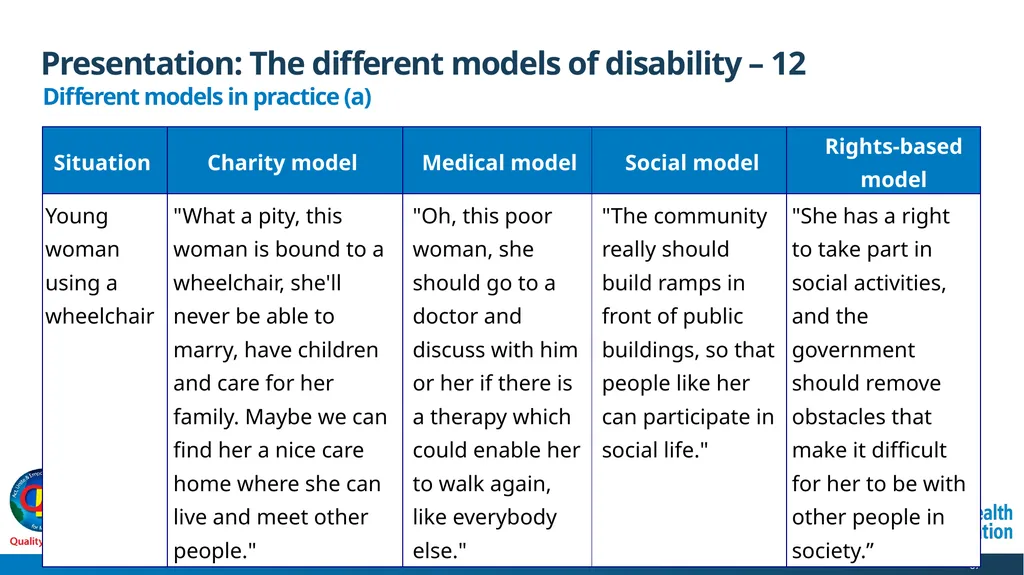
Different models in practice (a) Presentation: The different models of disability – 12<br>
38
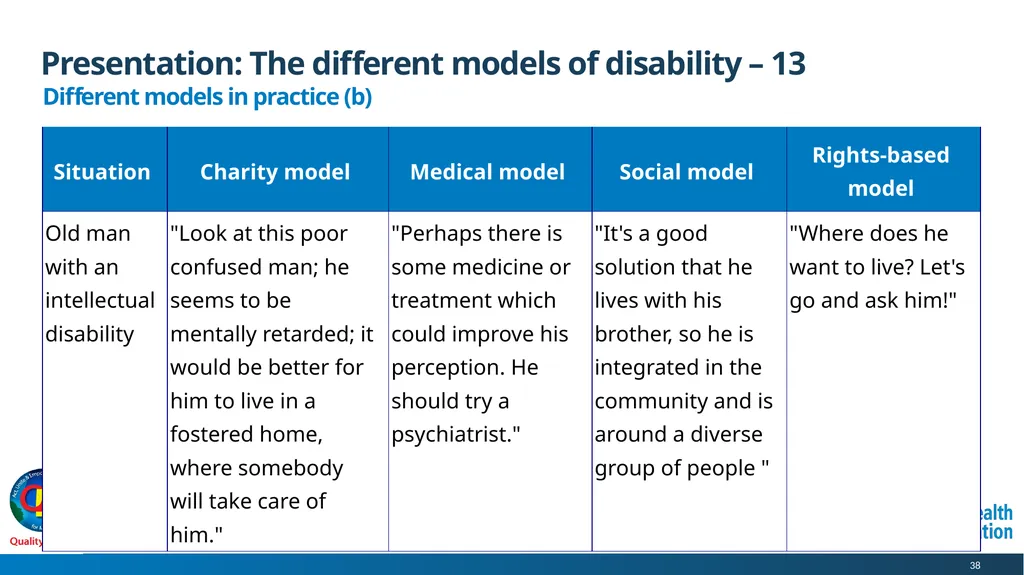
Different models in practice (b) Presentation: The different models of disability – 13<br>
39
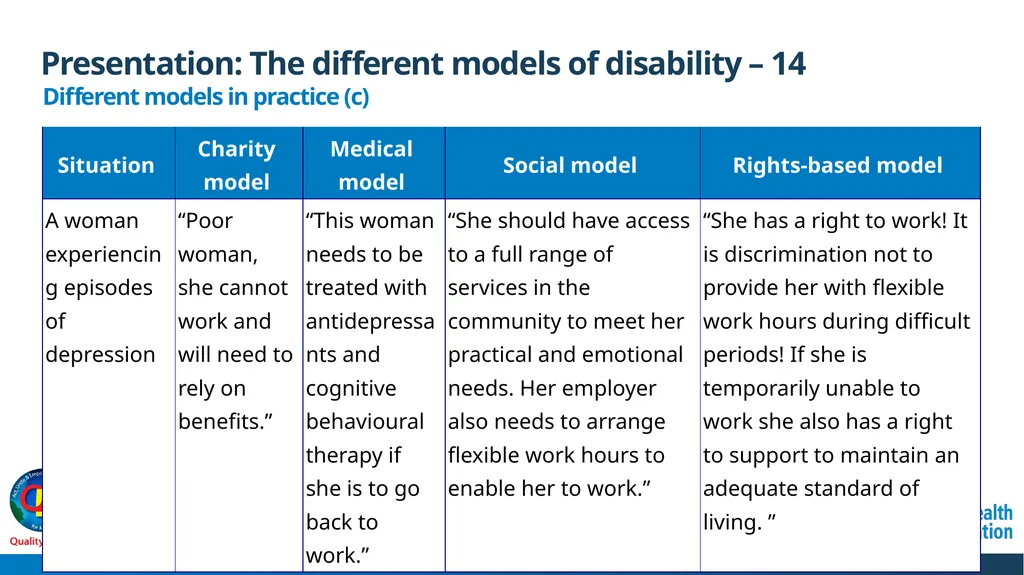
Different models in practice (c) Presentation: The different models of disability – 14<br>
40
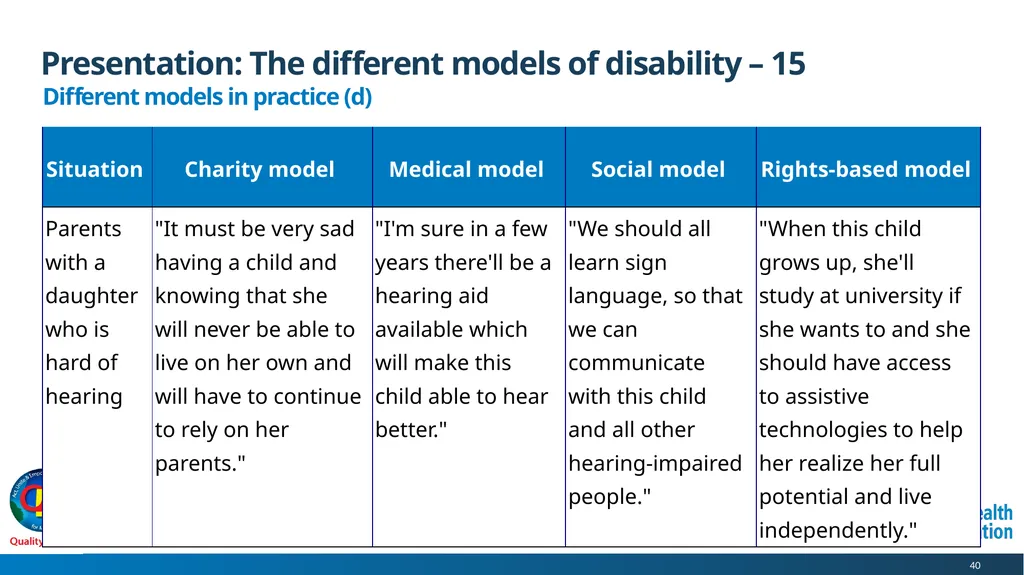
Different models in practice (d) Presentation: The different models of disability – 15<br>
41
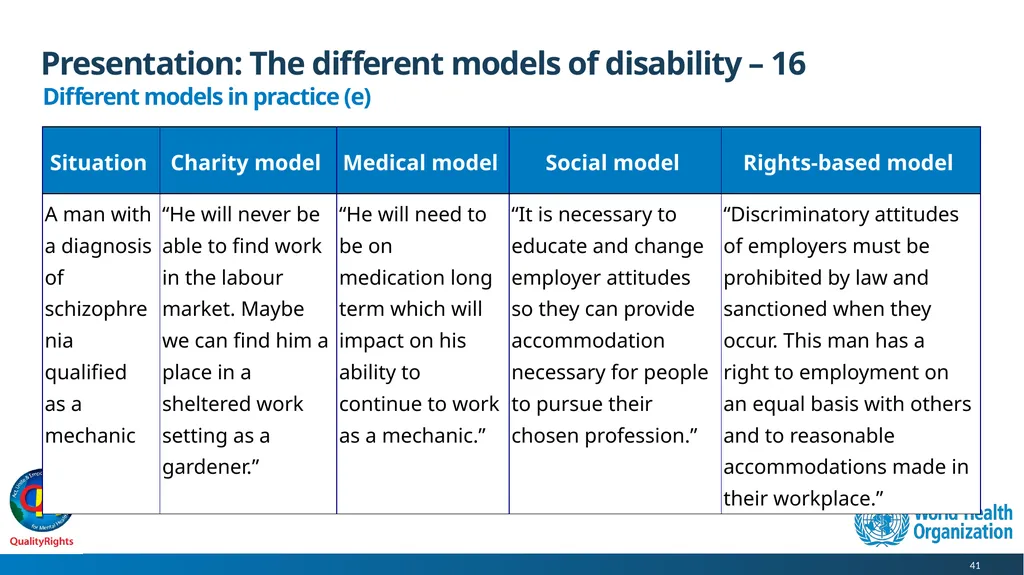
Different models in practice (e) Presentation: The different models of disability – 16<br>
42
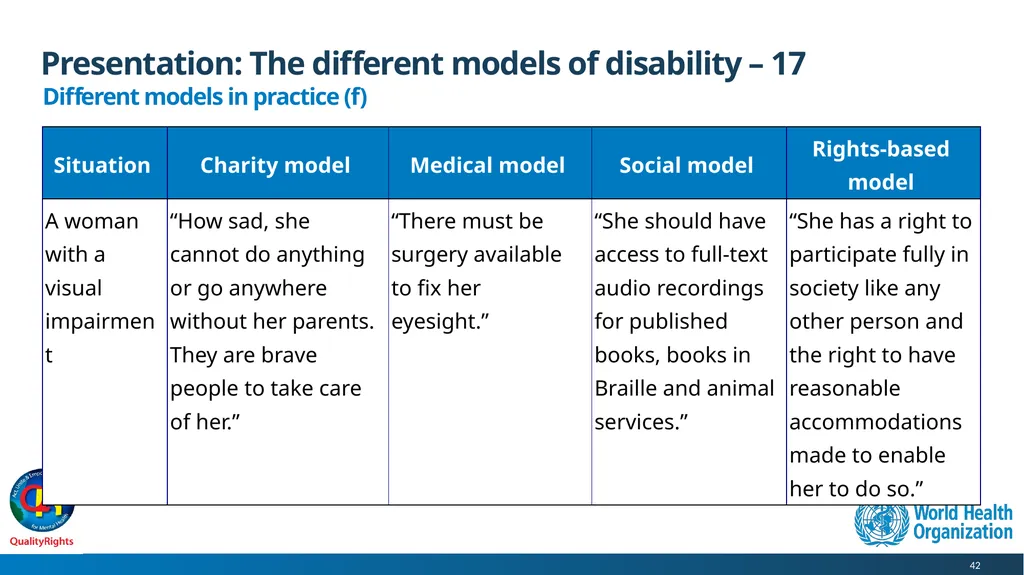
Different models in practice (f) Presentation: The different models of disability – 17<br>
43
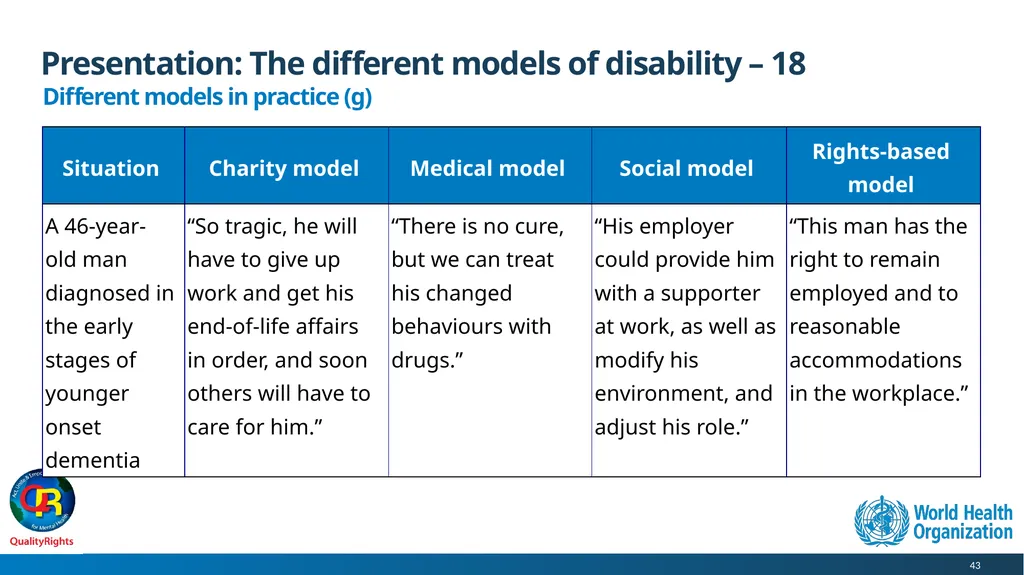
Different models in practice (g) Presentation: The different models of disability – 18<br>
44
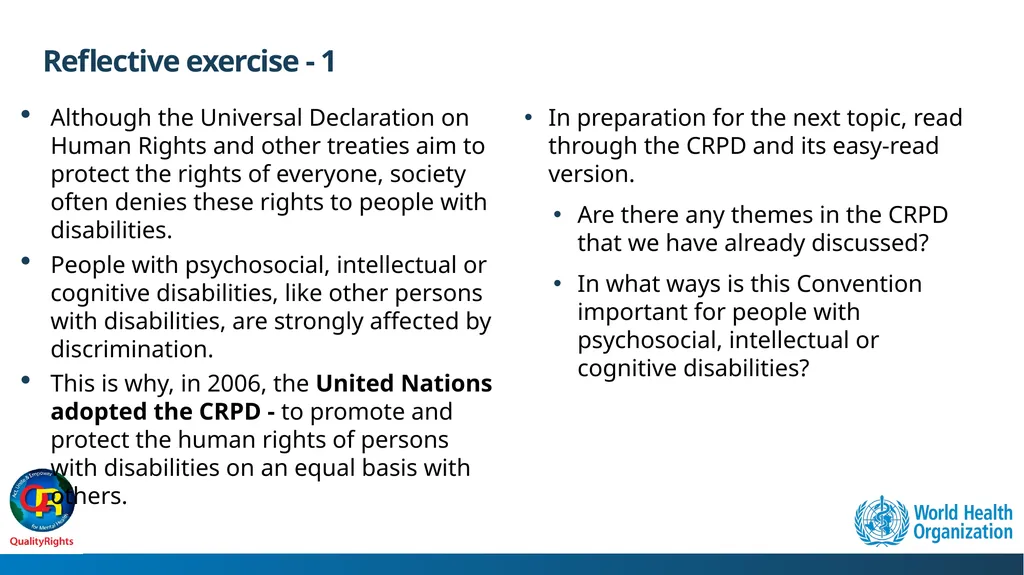
Although the Universal Declaration on Human Rights and other treaties aim to protect the rights of everyone, society often denies these rights to people with disabilities.
People with psychosocial, intellectual or cognitive disabilities, like other persons with disabilities, are strongly affected by discrimination.
This is why, in 2006, the United Nations adopted the CRPD - to promote and protect the human rights of persons with disabilities on an equal basis with others. In preparation for the next topic, read through the CRPD and its easy-read version.
Are there any themes in the CRPD that we have already discussed?
In what ways is this Convention important for people with psychosocial, intellectual or cognitive disabilities? Reflective exercise - 1<br>
People with psychosocial, intellectual or cognitive disabilities, like other persons with disabilities, are strongly affected by discrimination.
This is why, in 2006, the United Nations adopted the CRPD - to promote and protect the human rights of persons with disabilities on an equal basis with others. In preparation for the next topic, read through the CRPD and its easy-read version.
Are there any themes in the CRPD that we have already discussed?
In what ways is this Convention important for people with psychosocial, intellectual or cognitive disabilities? Reflective exercise - 1<br>
45
Topic 3: The Convention on the Rights of Persons with Disabilities<br>
46
Based on your reading of the CRPD prior to this session:
Do you have any preliminary reactions or questions?
Are there any themes that we have already discussed?
In what ways is this Convention important for people with psychosocial, intellectual or cognitive disabilities? Reflection from previous topics<br>
Do you have any preliminary reactions or questions?
Are there any themes that we have already discussed?
In what ways is this Convention important for people with psychosocial, intellectual or cognitive disabilities? Reflection from previous topics<br>
47
The United Nations (UN) was created after World War II to promote integration and peaceful relationships among nations.
The adoption of the Universal Declaration of Human Rights (UDHR) by the UN General Assembly in 1948 was a landmark moment for human rights across the world.
Subsequently, several other human rights treaties were adopted.
The UDHR and other international human rights instruments include rights that we should ALL be able to enjoy. Presentation: Introduction to the Convention on the Rights of Persons with Disability - 1<br>
The adoption of the Universal Declaration of Human Rights (UDHR) by the UN General Assembly in 1948 was a landmark moment for human rights across the world.
Subsequently, several other human rights treaties were adopted.
The UDHR and other international human rights instruments include rights that we should ALL be able to enjoy. Presentation: Introduction to the Convention on the Rights of Persons with Disability - 1<br>
48
The Convention on the Rights of Persons with Disabilities (CRPD) was adopted by the UN in 2006 in response to discrimination and human rights violations experienced by people with disability across the world.
It was drafted with input and active engagement and participation of persons with disabilities and disabled peoples’ organizations. Presentation: Introduction to the Convention on the Rights of Persons with Disability - 2<br>
It was drafted with input and active engagement and participation of persons with disabilities and disabled peoples’ organizations. Presentation: Introduction to the Convention on the Rights of Persons with Disability - 2<br>
49
The CRPD is a major step towards changing negative perceptions of disability and ensuring that countries recognize that people with disabilities must be provided with opportunities to live life to their fullest potential on an equal basis with others.
The Convention was not intended to create new rights but to show how existing rights apply to people with disabilities. Presentation: Introduction to the Convention on the Rights of Persons with Disability - 3<br>
The Convention was not intended to create new rights but to show how existing rights apply to people with disabilities. Presentation: Introduction to the Convention on the Rights of Persons with Disability - 3<br>
50
The CRPD adopts the social and human rights models of disability.
The Convention recognizes that:
“disability is an evolving concept and that disability results from the interaction between persons with impairments and attitudinal and environmental barriers that hinders their full and effective participation in society on an equal basis with others” (Preamble to the CRPD). Presentation: Introduction to the Convention on the Rights of Persons with Disability - 4<br>
The Convention recognizes that:
“disability is an evolving concept and that disability results from the interaction between persons with impairments and attitudinal and environmental barriers that hinders their full and effective participation in society on an equal basis with others” (Preamble to the CRPD). Presentation: Introduction to the Convention on the Rights of Persons with Disability - 4<br>
51
People with psychosocial, intellectual or cognitive disabilities face many barriers and forms of discrimination which prevent them from participating in society. That is why they are protected by the Convention.
The argument that people with psychosocial, intellectual or cognitive disabilities are not “persons with disabilities” because they have an “illness” is not valid under the social and the human rights models. Presentation: Introduction to the Convention on the Rights of Persons with Disability - 5<br>
The argument that people with psychosocial, intellectual or cognitive disabilities are not “persons with disabilities” because they have an “illness” is not valid under the social and the human rights models. Presentation: Introduction to the Convention on the Rights of Persons with Disability - 5<br>
52
The CRPD is a legally binding instrument.
This means that countries are under the obligation to take a full range of measures to ensure that people with disabilities have the same rights as everyone else.
Actions to be taken by States Parties include adopting legislation, policies and other measures to realize the rights recognized in the Convention. Presentation: Introduction to the Convention on the Rights of Persons with Disability - 6<br>
This means that countries are under the obligation to take a full range of measures to ensure that people with disabilities have the same rights as everyone else.
Actions to be taken by States Parties include adopting legislation, policies and other measures to realize the rights recognized in the Convention. Presentation: Introduction to the Convention on the Rights of Persons with Disability - 6<br>
53
Presentation: Introduction to the Convention on the Rights of Persons with Disability - 7 A list of the signatures and ratifications of the CRPD can be found here: https://treaties.un.org/Pages/ViewDetails.aspx?src=IND&mtdsg_no=IV-15&chapter=4&lang=en<br>
54
The CRPD requires a shift in the way people with psychosocial, intellectual or cognitive disabilities are perceived by society and in the way mental health and social services operate.
Institutionalization and forced admission and treatment is not acceptable under the Convention.
Services need to provide community-based support and promote inclusion.
The recovery approach is consistent with the CRPD and with a human rights model of disability. Presentation: Introduction to the Convention on the Rights of Persons with Disability - 8<br>
Institutionalization and forced admission and treatment is not acceptable under the Convention.
Services need to provide community-based support and promote inclusion.
The recovery approach is consistent with the CRPD and with a human rights model of disability. Presentation: Introduction to the Convention on the Rights of Persons with Disability - 8<br>
55
Many human rights bodies have reaffirmed need for paradigm shift:
The Human Rights Council adopted two resolutions in 2016 and 2017, both stating that: “persons with mental health conditions or psychosocial disabilities, in particular persons using mental health services, may be subject to, inter alia, widespread discrimination, stigma, prejudice, violence, social exclusion and segregation, unlawful or arbitrary institutionalization, overmedicalization and treatment practices that fail to respect their autonomy, will and preferences.”
The High Commissioner for Human Rights in 2017 recommended policy shifts to support the realization of the full human rights of people with psychosocial disabilities. Presentation: Introduction to the Convention on the Rights of Persons with Disability - 9<br>
The Human Rights Council adopted two resolutions in 2016 and 2017, both stating that: “persons with mental health conditions or psychosocial disabilities, in particular persons using mental health services, may be subject to, inter alia, widespread discrimination, stigma, prejudice, violence, social exclusion and segregation, unlawful or arbitrary institutionalization, overmedicalization and treatment practices that fail to respect their autonomy, will and preferences.”
The High Commissioner for Human Rights in 2017 recommended policy shifts to support the realization of the full human rights of people with psychosocial disabilities. Presentation: Introduction to the Convention on the Rights of Persons with Disability - 9<br>
56
The Special Rapporteur on the Right to Health issued a landmark report in 2017 on the right to mental health, calling for a major shift to end human rights violations against persons with intellectual, cognitive or psychosocial disabilities.
The Special Rapporteur on the Rights of Persons with Disabilities has reaffirmed in various reports the necessity to end discrimination and human rights violations towards people with disabilities, including people with psychosocial, intellectual or cognitive disabilities. Presentation: Introduction to the Convention on the Rights of Persons with Disability - 10<br>
The Special Rapporteur on the Rights of Persons with Disabilities has reaffirmed in various reports the necessity to end discrimination and human rights violations towards people with disabilities, including people with psychosocial, intellectual or cognitive disabilities. Presentation: Introduction to the Convention on the Rights of Persons with Disability - 10<br>
57
Split into groups of 3–4.
Read the Convention on the Rights of Persons with Disabilities
Discuss its implications in your groups. Group work on the CRPD<br>
Read the Convention on the Rights of Persons with Disabilities
Discuss its implications in your groups. Group work on the CRPD<br>
58
Presentation: The articles of the CRPD The preamble to the CRPD outlines certain principles, including:
interrelatedness of all human rights and the need for persons with disabilities to be guaranteed their full enjoyment;
recognizing disability as an evolving concept resulting from interactions, attitudinal and environmental barriers;
recognizing the diversity of persons with disabilities;
recognizing the importance of autonomy, independence and the freedom to make one’s own choices; and
concern about multiple forms of discrimination across “race, colour, sex, language, religion, political or other opinion, national, ethnic, indigenous or social origin, property, birth, age or other status”.<br>
interrelatedness of all human rights and the need for persons with disabilities to be guaranteed their full enjoyment;
recognizing disability as an evolving concept resulting from interactions, attitudinal and environmental barriers;
recognizing the diversity of persons with disabilities;
recognizing the importance of autonomy, independence and the freedom to make one’s own choices; and
concern about multiple forms of discrimination across “race, colour, sex, language, religion, political or other opinion, national, ethnic, indigenous or social origin, property, birth, age or other status”.<br>
59
Presentation: The articles of the CRPD The purpose of the CRPD is to make sure that persons with disabilities enjoy all their human rights and fundamental freedoms and to promote respect for their inherent dignity.
This article also defines who are considered “persons with disabilities” for the purpose of the Convention.
“People with disabilities” are defined as persons who have long-term impairments which, in interaction with various barriers, may hinder their full and effective participation in society on an equal basis with others. Article 1 - Purpose<br>
This article also defines who are considered “persons with disabilities” for the purpose of the Convention.
“People with disabilities” are defined as persons who have long-term impairments which, in interaction with various barriers, may hinder their full and effective participation in society on an equal basis with others. Article 1 - Purpose<br>
60
Presentation: The articles of the CRPD Article 2 outlines the definitions used in the Convention:
Communication
Language
Discrimination on the basis of disability
Reasonable accommodation
Universal design. Article 2 - Definitions<br>
Communication
Language
Discrimination on the basis of disability
Reasonable accommodation
Universal design. Article 2 - Definitions<br>
61
Presentation: The articles of the CRPD The general principles that guide the Convention are in many ways inspired by the UDHR.
The CRPD specifically applies these principles to the lives of people with disabilities. Article 3 – General principles (a)<br>
The CRPD specifically applies these principles to the lives of people with disabilities. Article 3 – General principles (a)<br>
62
Presentation: The articles of the CRPD General principles:
Respect for inherent dignity, individual autonomy including the freedom to make one’s own choices, and independence of persons.
Non-discrimination.
Full and effective participation and inclusion in society.
Respect for difference and acceptance of persons with disabilities as part of human diversity and humanity.
Equality of opportunity.
Equality between men and women.
Respect for the evolving capacity of children with disabilities and respect for the rights of children with disabilities to preserve their identities. Article 3 – General principles (b)<br>
Respect for inherent dignity, individual autonomy including the freedom to make one’s own choices, and independence of persons.
Non-discrimination.
Full and effective participation and inclusion in society.
Respect for difference and acceptance of persons with disabilities as part of human diversity and humanity.
Equality of opportunity.
Equality between men and women.
Respect for the evolving capacity of children with disabilities and respect for the rights of children with disabilities to preserve their identities. Article 3 – General principles (b)<br>
63
Presentation: The articles of the CRPD Article 3 underpins the whole of the CRPD.
It is particularly important because all other articles of the Convention are interpreted with the principles of article 3 in mind. Article 3 – General principles (c)<br>
It is particularly important because all other articles of the Convention are interpreted with the principles of article 3 in mind. Article 3 – General principles (c)<br>
64
Presentation: The articles of the CRPD Article 4 outlines the obligations of governments in respecting, protecting and fulfilling the rights enshrined in the CRPD. They are required to do this via:
laws
policies
education and training
other actions.
This article requires governments to involve people with disabilities and ask for their input when they make new laws and policies. Article 4 – Government responsibilities (a)<br>
laws
policies
education and training
other actions.
This article requires governments to involve people with disabilities and ask for their input when they make new laws and policies. Article 4 – Government responsibilities (a)<br>
65
Presentation: The articles of the CRPD The CRPD shows a new way of thinking about disabilities. In the past the common view was that disability was a health issue or “defect”.
The Convention shows that disability is not just about health services and treatments.
It is also about providing people with disabilities with opportunities for employment, education, housing and social services. Article 4 – Government responsibilities (b)<br>
The Convention shows that disability is not just about health services and treatments.
It is also about providing people with disabilities with opportunities for employment, education, housing and social services. Article 4 – Government responsibilities (b)<br>
66
Presentation: The articles of the CRPD Disability is not just the responsibility of health workers and other professionals; it is the responsibility of society as a whole. Article 4 – Government responsibilities (c)<br>
67
Presentation: The articles of the CRPD Governments have major responsibilities with regard to changing outdated laws.
Existing laws are often based on negative stereotypes of people with psychosocial, intellectual or cognitive disabilities.
Basic rights are legally denied to them Article 4 – Government responsibilities (d)<br>
Existing laws are often based on negative stereotypes of people with psychosocial, intellectual or cognitive disabilities.
Basic rights are legally denied to them Article 4 – Government responsibilities (d)<br>
68
Presentation: The articles of the CRPD This article means that countries are required:
to recognize that all persons are equal,
to prevent and prohibit discrimination, and
to make sure that laws protect people with disabilities against discrimination. Article 5 – Equality and non-discrimination (a)<br>
to recognize that all persons are equal,
to prevent and prohibit discrimination, and
to make sure that laws protect people with disabilities against discrimination. Article 5 – Equality and non-discrimination (a)<br>
69
Presentation: The articles of the CRPD Examples of country actions could include:
Employers who discriminate against people with disabilities should be sanctioned.
Laws that authorize people with psychosocial, intellectual or cognitive disabilities to be treated without their consent should be repealed.
Reasonable accommodations must be provided to people with disabilities.
Even when laws do not seem discriminatory, governments should make sure they do not have a discriminatory effect on people with disabilities. Article 5 – Equality and non-discrimination (b)<br>
Employers who discriminate against people with disabilities should be sanctioned.
Laws that authorize people with psychosocial, intellectual or cognitive disabilities to be treated without their consent should be repealed.
Reasonable accommodations must be provided to people with disabilities.
Even when laws do not seem discriminatory, governments should make sure they do not have a discriminatory effect on people with disabilities. Article 5 – Equality and non-discrimination (b)<br>
70
Presentation: The articles of the CRPD This article also explains that measures and accommodations that are specific to persons with disabilities but aim at achieving equality with the general population are NOT considered discriminatory towards people with disabilities. Article 5 – Equality and non-discrimination (c)<br>
71
Presentation: The articles of the CRPD The CRPD acknowledges that women with disabilities experience particular injustice and multiple forms of discrimination.
The Convention states that countries must make sure that women with disabilities enjoy equal rights. Article 6 – Women with disabilities<br>
The Convention states that countries must make sure that women with disabilities enjoy equal rights. Article 6 – Women with disabilities<br>
72
Presentation: The articles of the CRPD When actions are taken regarding children with disabilities, their best interest must be the primary consideration.
Children with disabilities have the right to express their views, and their views must be given due weight in all decisions affecting them, without discrimination based on disability. Article 7 – Children with disabilities<br>
Children with disabilities have the right to express their views, and their views must be given due weight in all decisions affecting them, without discrimination based on disability. Article 7 – Children with disabilities<br>
73
Presentation: The articles of the CRPD Countries must take measures to:
Raise awareness about the rights and dignity of people with disabilities.
Combat stereotypes, prejudice and harmful practices.
Promote awareness of the capabilities and contributions to society of persons with disabilities.
Article 8 is about giving information to all people about the rights of persons with disabilities. Article 8 – Awareness-raising (a)<br>
Raise awareness about the rights and dignity of people with disabilities.
Combat stereotypes, prejudice and harmful practices.
Promote awareness of the capabilities and contributions to society of persons with disabilities.
Article 8 is about giving information to all people about the rights of persons with disabilities. Article 8 – Awareness-raising (a)<br>
74
Presentation: The articles of the CRPD Ways to raise awareness include:
Organize campaigns to change perceptions about people with disabilities.
Teach about the rights of persons with disabilities.
Stimulate the media to spread accurate information about human rights violations.
Implement other awareness-raising strategies and programmes. Article 8 – Awareness-raising (b)<br>
Organize campaigns to change perceptions about people with disabilities.
Teach about the rights of persons with disabilities.
Stimulate the media to spread accurate information about human rights violations.
Implement other awareness-raising strategies and programmes. Article 8 – Awareness-raising (b)<br>
75
Presentation: The articles of the CRPD Accessibility is not just about people with disabilities being physically able to gain entry to a building.
It means that people with disabilities should be able to access and participate in all areas of life on an equal basis with others. Article 9 – Accessibility (a)<br>
It means that people with disabilities should be able to access and participate in all areas of life on an equal basis with others. Article 9 – Accessibility (a)<br>
76
Presentation: The articles of the CRPD The physical environment should enable people with disabilities to participate in society.
Nobody should deny anyone access to activities because of disability.
Access to information is key and people with disabilities should benefit from modern technology.
Persons who use alternative modes and methods of communication should be accommodated according to their need. Article 9 – Accessibility (b)<br>
Nobody should deny anyone access to activities because of disability.
Access to information is key and people with disabilities should benefit from modern technology.
Persons who use alternative modes and methods of communication should be accommodated according to their need. Article 9 – Accessibility (b)<br>
77
Presentation: The articles of the CRPD People with disabilities have the right to life on an equal basis to everybody else.
This includes making sure the life expectancy of persons with disabilities is not reduced and avoiding preventable death.
Conditions in institutions or other long-stay residential homes or facilities can be very bad
inadequate food, lack of fresh air, poor hygiene standards, adverse effects of medication, heavy medication that includes prescription of multiple and potentially interacting drugs, lack of access to general health services
This has extremely negative consequences for people’s life expectancy and can violate their right to life. Article 10 – Right to life<br>
This includes making sure the life expectancy of persons with disabilities is not reduced and avoiding preventable death.
Conditions in institutions or other long-stay residential homes or facilities can be very bad
inadequate food, lack of fresh air, poor hygiene standards, adverse effects of medication, heavy medication that includes prescription of multiple and potentially interacting drugs, lack of access to general health services
This has extremely negative consequences for people’s life expectancy and can violate their right to life. Article 10 – Right to life<br>
78
Article 11 – Situations of risk and humanitarian emergencies During an emergency people with disabilities should be properly protected.
Often during emergencies, the specific requirements of persons with disabilities are not taken into account.
During emergencies, people detained in mental health or social services are particularly at risk. Sometimes, the staff may abandon the residents.
The needs of people with disabilities should be considered during the preparation for emergencies, during the management of disasters and during the reconstruction afterwards. Presentation: The articles of the CRPD<br>
Often during emergencies, the specific requirements of persons with disabilities are not taken into account.
During emergencies, people detained in mental health or social services are particularly at risk. Sometimes, the staff may abandon the residents.
The needs of people with disabilities should be considered during the preparation for emergencies, during the management of disasters and during the reconstruction afterwards. Presentation: The articles of the CRPD<br>
79
Presentation: The articles of the CRPD People with disabilities have the right to make decisions and choices for themselves. This is called the right to legal capacity.
When it is challenging for people to make decisions on their own, they have a right to receive support if they wish.
Mechanisms should be in place to make sure that people are not abused by their supporters and that their will and preferences are always respected.
Article 12 affirms that people with disabilities have the right to own or inherit property, control their own financial affairs, have access to financial credits and must not be arbitrarily deprived of their property. Article 12 – Equal recognition before the law<br>
When it is challenging for people to make decisions on their own, they have a right to receive support if they wish.
Mechanisms should be in place to make sure that people are not abused by their supporters and that their will and preferences are always respected.
Article 12 affirms that people with disabilities have the right to own or inherit property, control their own financial affairs, have access to financial credits and must not be arbitrarily deprived of their property. Article 12 – Equal recognition before the law<br>
80
Presentation: The articles of the CRPD People with disabilities must have fair and equal access to lawyers and courts.
They frequently have their rights violated, yet have limited opportunities to take complaints to courts eg.
Cannot seek redress when they are victims of a crime because they are considered to be “unreliable”.
Laws themselves are barriers to accessing justice
People who are involuntarily detained in institutions unable to access courts.
CRPD requires countries to provide access to justice to people with disabilities on equal basis with others.
Training on providing legal services for people with disabilities.
Courts must understand implications of CRPD rights and ensure people with disabilities can obtain redress Article 13 – Access to justice<br>
They frequently have their rights violated, yet have limited opportunities to take complaints to courts eg.
Cannot seek redress when they are victims of a crime because they are considered to be “unreliable”.
Laws themselves are barriers to accessing justice
People who are involuntarily detained in institutions unable to access courts.
CRPD requires countries to provide access to justice to people with disabilities on equal basis with others.
Training on providing legal services for people with disabilities.
Courts must understand implications of CRPD rights and ensure people with disabilities can obtain redress Article 13 – Access to justice<br>
81
Presentation: The articles of the CRPD People with disabilities should not be deprived of their liberty unlawfully or arbitrarily. The existence of a disability shall in no case justify detention.
This means that persons with psychosocial, intellectual or cognitive disability cannot be involuntarily detained.
Detention on the basis of a diagnosed or perceived disability is not allowed.
People with disabilities can be deprived of liberty only for the same reasons as any other person but they cannot be detained for reasons that would not cause people without disabilities to be detained. Article 14 – Liberty and security of person<br>
This means that persons with psychosocial, intellectual or cognitive disability cannot be involuntarily detained.
Detention on the basis of a diagnosed or perceived disability is not allowed.
People with disabilities can be deprived of liberty only for the same reasons as any other person but they cannot be detained for reasons that would not cause people without disabilities to be detained. Article 14 – Liberty and security of person<br>
82
Presentation: The articles of the CRPD People with disabilities must not be subjected to torture and other cruel, inhuman or degrading treatment or punishment.
Coercive practices in the mental health context can be considered as a form of torture and ill-treatment.
People with disabilities must not be subjected to medical or scientific experimentation unless they provide informed consent.
Countries must do everything possible to prevent torture or cruel, inhuman or degrading treatment of persons with disabilities. Article 15 – Freedom from torture or cruel, inhuman or degrading treatment or punishment<br>
Coercive practices in the mental health context can be considered as a form of torture and ill-treatment.
People with disabilities must not be subjected to medical or scientific experimentation unless they provide informed consent.
Countries must do everything possible to prevent torture or cruel, inhuman or degrading treatment of persons with disabilities. Article 15 – Freedom from torture or cruel, inhuman or degrading treatment or punishment<br>
83
Presentation: The articles of the CRPD Countries must make laws to protect people with disabilities from exploitation, violence and abuse.
Countries must provide support and information to people with disabilities to recognize and report exploitation, violence and abuse.
Countries must ensure that services for people with disabilities are monitored to make sure that abuses do not occur.
When people with disabilities are victims of abuses, they should be supported to take necessary actions to report it.
Countries must make sure that complaints and signs of abuse are investigated and that abusers face criminal charges. Article 16 – Freedom from exploitation, violence and abuse<br>
Countries must provide support and information to people with disabilities to recognize and report exploitation, violence and abuse.
Countries must ensure that services for people with disabilities are monitored to make sure that abuses do not occur.
When people with disabilities are victims of abuses, they should be supported to take necessary actions to report it.
Countries must make sure that complaints and signs of abuse are investigated and that abusers face criminal charges. Article 16 – Freedom from exploitation, violence and abuse<br>
84
Presentation: The articles of the CRPD People with disabilities have a right to respect for their physical and mental integrity on an equal basis with others.
This means that their body and mind must be respected.
They should not be tortured, beaten, raped or otherwise abused, and should not be given treatment or surgery without their consent. Article 17 – Protecting the integrity of the person<br>
This means that their body and mind must be respected.
They should not be tortured, beaten, raped or otherwise abused, and should not be given treatment or surgery without their consent. Article 17 – Protecting the integrity of the person<br>
85
Presentation: The articles of the CRPD People with disabilities have a right to:
liberty of movement
freedom to choose their residence
a nationality.
People with disabilities are free to have passports and identity documents, to travel abroad and change their nationality on an equal basis with others. Article 18 – Liberty of movement and nationality (a)<br>
liberty of movement
freedom to choose their residence
a nationality.
People with disabilities are free to have passports and identity documents, to travel abroad and change their nationality on an equal basis with others. Article 18 – Liberty of movement and nationality (a)<br>
86
Presentation: The articles of the CRPD Children with disabilities must be particularly protected. They should:
be registered immediately after birth
be given a name
have a nationality, and
as far as possible, know and be cared for by their parents
Important because in some countries babies born with disabilities are not declared to the authorities and are hidden from society. When they grow up, they have no legal existence. Article 18 – Liberty of movement and nationality (b)<br>
be registered immediately after birth
be given a name
have a nationality, and
as far as possible, know and be cared for by their parents
Important because in some countries babies born with disabilities are not declared to the authorities and are hidden from society. When they grow up, they have no legal existence. Article 18 – Liberty of movement and nationality (b)<br>
87
Presentation: The articles of the CRPD People with disabilities have a right to:
live in the community
be included in the community
participate in the community. Article 19 – Living independently and being included in the community (a)<br>
live in the community
be included in the community
participate in the community. Article 19 – Living independently and being included in the community (a)<br>
88
Presentation: The articles of the CRPD This means people with disabilities must be able to:
Choose their place of residence.
Decide with whom to live.
Have access to a wide range of support and services to enable them to live in their chosen community.
Have access to the same services and facilities as the rest of the population.
Love, loss and laughter - Living with dementia, Fire Films. https://youtu.be/0-N4cOKRLtQ Article 19 – Living independently and being included in the community (b)<br>
Choose their place of residence.
Decide with whom to live.
Have access to a wide range of support and services to enable them to live in their chosen community.
Have access to the same services and facilities as the rest of the population.
Love, loss and laughter - Living with dementia, Fire Films. https://youtu.be/0-N4cOKRLtQ Article 19 – Living independently and being included in the community (b)<br>
89
Presentation: The articles of the CRPD Persons with disabilities should have the greatest possible mobility and independence.
This is important because people with disabilities are often unable to go where they want because of environmental, physical and other barriers which hinder their access to the community.
People with disabilities must have access to affordable, good-quality mobility aids, devices and assistive technologies to enable them to lead full lives in the community. Article 20 – Personal mobility<br>
This is important because people with disabilities are often unable to go where they want because of environmental, physical and other barriers which hinder their access to the community.
People with disabilities must have access to affordable, good-quality mobility aids, devices and assistive technologies to enable them to lead full lives in the community. Article 20 – Personal mobility<br>
90
Presentation: The articles of the CRPD On an equal basis with others, people with disabilities have the right to:
think and say what they want
receive and give information.
However:
People with psychosocial, intellectual or cognitive disabilities are often not given full information about their health or mental health care.
They are often denied information on legal means to protect their rights.
The views and perspectives of people with psychosocial, intellectual or cognitive disabilities are often disregarded and ignored. Article 21 – Freedom of expression and opinion, and access to information (a)<br>
think and say what they want
receive and give information.
However:
People with psychosocial, intellectual or cognitive disabilities are often not given full information about their health or mental health care.
They are often denied information on legal means to protect their rights.
The views and perspectives of people with psychosocial, intellectual or cognitive disabilities are often disregarded and ignored. Article 21 – Freedom of expression and opinion, and access to information (a)<br>
91
Presentation: The articles of the CRPD There is a special responsibility to provide information to people with disabilities in a way that they can access and understand.
Any information for the general public, whether provided by states or by private entities, should also be made accessible to persons with disabilities Article 21 – Freedom of expression and opinion, and access to information (b)<br>
Any information for the general public, whether provided by states or by private entities, should also be made accessible to persons with disabilities Article 21 – Freedom of expression and opinion, and access to information (b)<br>
92
Presentation: The articles of the CRPD No one should:
interfere with the privacy, family life, home or correspondence of persons with disabilities;
attack their honour and reputation.
Confidential information about people with disabilities should be kept private.
Best practices with regard to privacy in services allow persons to retain control of information about themselves.
The right to privacy is very broad e.g.:
practitioners enter uninvited into people’s homes or rooms – violates right to privacy.
institutions open and/or withhold people’s correspondence – violates right to privacy. Article 22 – Respect for privacy<br>
interfere with the privacy, family life, home or correspondence of persons with disabilities;
attack their honour and reputation.
Confidential information about people with disabilities should be kept private.
Best practices with regard to privacy in services allow persons to retain control of information about themselves.
The right to privacy is very broad e.g.:
practitioners enter uninvited into people’s homes or rooms – violates right to privacy.
institutions open and/or withhold people’s correspondence – violates right to privacy. Article 22 – Respect for privacy<br>
93
Presentation: The articles of the CRPD Respect for home and the family is also often denied to people with disabilities.
Countries should ensure that people with disabilities have the following rights:
The right to marry and found a family.
The right to decide freely to have children or not (including when and how many).
The right not to be sterilized or prevented from having children by any other method.
The right not to be prevented from exercising their rights and duties as parents.
Children should not be separated from their parents on the basis of the parent’s or child’s disability. Article 23 – Respect for home and the family (a)<br>
Countries should ensure that people with disabilities have the following rights:
The right to marry and found a family.
The right to decide freely to have children or not (including when and how many).
The right not to be sterilized or prevented from having children by any other method.
The right not to be prevented from exercising their rights and duties as parents.
Children should not be separated from their parents on the basis of the parent’s or child’s disability. Article 23 – Respect for home and the family (a)<br>
94
Presentation: The articles of the CRPD Children with disabilities have a right to live with their family on an equal basis with others. When they cannot live with their own family, they should be taken care of by their wider family or in the community in a family setting.
Sometimes, parents of children with disabilities are told after birth that they should give up their children. The children are then placed in the social care system, with significant negative consequences on their well-being.
According to the CRPD, children with disabilities should not be abandoned and segregated in institutions. Article 23 – Respect for home and the family (b)<br>
Sometimes, parents of children with disabilities are told after birth that they should give up their children. The children are then placed in the social care system, with significant negative consequences on their well-being.
According to the CRPD, children with disabilities should not be abandoned and segregated in institutions. Article 23 – Respect for home and the family (b)<br>
95
Presentation: The articles of the CRPD Living with mental health problems in Russia, Sky News. http://news.sky.com/story/living-with-mental-health-problems-in-russia-10289759.
NZ Herald (2017) "He's the love-light of my life" - Intellectually disabled couple reveal normal life. http://www.nzherald.co.nz/nz/news/article.cfm?c_id=1&objectid=11833202 Article 23 – Respect for home and the family (c)<br>
NZ Herald (2017) "He's the love-light of my life" - Intellectually disabled couple reveal normal life. http://www.nzherald.co.nz/nz/news/article.cfm?c_id=1&objectid=11833202 Article 23 – Respect for home and the family (c)<br>
96
Presentation: The articles of the CRPD Education is often denied to people with disabilities.
Children who are institutionalized do not receive an education, or do not receive an education of equal quality
Special education is poorly resourced and does not provide real opportunities for skills learning.
Children often first to be denied schooling when families cannot afford to educate all children.
Even when children do go to school, they often lack support.
The impact of this lack of education is large-scale and long-term. Article 24 – Education (a)<br>
Children who are institutionalized do not receive an education, or do not receive an education of equal quality
Special education is poorly resourced and does not provide real opportunities for skills learning.
Children often first to be denied schooling when families cannot afford to educate all children.
Even when children do go to school, they often lack support.
The impact of this lack of education is large-scale and long-term. Article 24 – Education (a)<br>
97
Presentation: The articles of the CRPD According to Article 24, education must be inclusive of persons with disabilities at each level.
Like everyone else, people with disabilities have the right to attend primary school, high school and universities, and to receive the training needed to get jobs and improve their lives. Article 24 – Education (b)<br>
Like everyone else, people with disabilities have the right to attend primary school, high school and universities, and to receive the training needed to get jobs and improve their lives. Article 24 – Education (b)<br>
98
Presentation: The articles of the CRPD States must take many steps to ensure this. For instance:
To make sure that children with disabilities have access to the general education system and are not segregated.
To provide reasonable accommodation and support.
To facilitate the learning of sign language, Braille or other communication.
To train teachers to work with people with disabilities on the basis of respect for diversity, learning needs and learning styles.
To provide access to universities and other training for adults. Article 24 – Education (c)<br>
To make sure that children with disabilities have access to the general education system and are not segregated.
To provide reasonable accommodation and support.
To facilitate the learning of sign language, Braille or other communication.
To train teachers to work with people with disabilities on the basis of respect for diversity, learning needs and learning styles.
To provide access to universities and other training for adults. Article 24 – Education (c)<br>
99
Presentation: The articles of the CRPD People with disabilities have the right to access mental and physical health services on an equal basis with the same standard of service as others.
Mental health and other practitioners should not treat people with disabilities badly by being disrespectful, neglectful, rude or by denying them care and treatment.
People with disabilities should receive the health services they may need.
Health professionals must be aware of the human rights and autonomy of people with disabilities and must not act without the informed consent of patients.
People with disabilities should not be discriminated against when they seek health or life insurance. Article 25 – Health<br>
Mental health and other practitioners should not treat people with disabilities badly by being disrespectful, neglectful, rude or by denying them care and treatment.
People with disabilities should receive the health services they may need.
Health professionals must be aware of the human rights and autonomy of people with disabilities and must not act without the informed consent of patients.
People with disabilities should not be discriminated against when they seek health or life insurance. Article 25 – Health<br>
100
Presentation: The articles of the CRPD Habilitation and rehabilitation services - maintaining, gaining, restoring or improving skills necessary to participate in society.
Not only about health but about the full range of services people need for community living.
services and supports in the work, education, health and social fields
Services and supports need to be:
available in the community
accessible on a voluntary basis
as close as possible to where people with disabilities live.
People with disabilities should also have access to peer support services. Article 26 – Habilitation and rehabilitation<br>
Not only about health but about the full range of services people need for community living.
services and supports in the work, education, health and social fields
Services and supports need to be:
available in the community
accessible on a voluntary basis
as close as possible to where people with disabilities live.
People with disabilities should also have access to peer support services. Article 26 – Habilitation and rehabilitation<br>
101
Presentation: The articles of the CRPD People with disabilities have the right to work on an equal basis with others.
Governments must, for instance:
Prohibit discrimination both in access and conditions of employment.
Require employers to make reasonable accommodations in the workplace.
Ensure that people with disabilities receive equal pay for work of equal value.
Hire people with disabilities in the public sector.
Promote the hiring of persons with disabilities in the public and private sectors.
Promote work-related training and employment opportunities. Article 27 – Work and employment (a)<br>
Governments must, for instance:
Prohibit discrimination both in access and conditions of employment.
Require employers to make reasonable accommodations in the workplace.
Ensure that people with disabilities receive equal pay for work of equal value.
Hire people with disabilities in the public sector.
Promote the hiring of persons with disabilities in the public and private sectors.
Promote work-related training and employment opportunities. Article 27 – Work and employment (a)<br>
102
Presentation: The articles of the CRPD The right to work on an equal basis with others is often denied because people are falsely considered incapable, unreliable or dangerous.
Governments must combat these stereotypes through laws, policies and awareness-raising.
In addition, people with disabilities may face indirect discrimination when laws and practices appear to be neutral but result in people with disability being disproportionately disadvantaged. Article 27 – Work and employment (b)<br>
Governments must combat these stereotypes through laws, policies and awareness-raising.
In addition, people with disabilities may face indirect discrimination when laws and practices appear to be neutral but result in people with disability being disproportionately disadvantaged. Article 27 – Work and employment (b)<br>
103
Presentation: The articles of the CRPD Kate Swaffer (2019) Kate Swaffer - Dementia, Disability & Rights https://www.youtube.com/watch?v=9USeDHQCKoA&feature=youtu.be (1:43 min.): (accessed 04 April 2019).
Working together. Ivymount School and PAHO. PAHO TV. https://youtu.be/WkNNhPnSCi8 Article 27 – Work and employment (c)<br>
Working together. Ivymount School and PAHO. PAHO TV. https://youtu.be/WkNNhPnSCi8 Article 27 – Work and employment (c)<br>
104
Presentation: The articles of the CRPD Many people do not have access to adequate standards of living.
Living conditions can amount to inhuman and degrading treatment.
Persons with disabilities are even more vulnerable to poverty and homelessness.
Article 28 recognizes the right of people with disabilities and their families to social protection without discrimination.
Need to ensure access to social protection and poverty reduction programmes for all – particularly vulnerable groups/population segments Article 28 – Adequate standard of living and social protection (a)<br>
Living conditions can amount to inhuman and degrading treatment.
Persons with disabilities are even more vulnerable to poverty and homelessness.
Article 28 recognizes the right of people with disabilities and their families to social protection without discrimination.
Need to ensure access to social protection and poverty reduction programmes for all – particularly vulnerable groups/population segments Article 28 – Adequate standard of living and social protection (a)<br>
105
Presentation: The articles of the CRPD Governments must take steps to promote this right including by ensuring access to:
clean water;
services and assistance related to disability (benefits, counselling, training, respite services, etc.);
programmes and services to ensure that people with disabilities do not live in poverty;
public housing;
retirement benefits and programmes (pensions, support for the elderly, etc.).
Social protection programmes should not apply additional requirements to people with disabilities (e.g. a requirement to receive medical care, or to give up working in order to receive benefits, etc.). Article 28 – Adequate standard of living and social protection (b)<br>
clean water;
services and assistance related to disability (benefits, counselling, training, respite services, etc.);
programmes and services to ensure that people with disabilities do not live in poverty;
public housing;
retirement benefits and programmes (pensions, support for the elderly, etc.).
Social protection programmes should not apply additional requirements to people with disabilities (e.g. a requirement to receive medical care, or to give up working in order to receive benefits, etc.). Article 28 – Adequate standard of living and social protection (b)<br>
106
Presentation: The articles of the CRPD People with disabilities have the right, like other people, to take part in political and public life:
Political life includes the right to vote, run for office, lead campaigns, join political parties, etc.
Public life includes the right to speak publicly, join trade unions, join NGOs and to conduct advocacy campaigns etc.
People with psychosocial, intellectual or cognitive disabilities are often denied all of these rights, both in law as well as in practice. This is contrary to the CRPD. Article 29 – Participation in political and public life<br>
Political life includes the right to vote, run for office, lead campaigns, join political parties, etc.
Public life includes the right to speak publicly, join trade unions, join NGOs and to conduct advocacy campaigns etc.
People with psychosocial, intellectual or cognitive disabilities are often denied all of these rights, both in law as well as in practice. This is contrary to the CRPD. Article 29 – Participation in political and public life<br>
107
Presentation: The articles of the CRPD People with disabilities are entitled to access and participate in all areas of life, including:
cultural life
recreation
leisure
sports.
Interview - Special Olympic athlete Victoria Smith, ESPN, 4 July 2018. https://youtu.be/k3KASttFTB8 Article 30 – Participation in cultural life, recreation, leisure and sports (a)<br>
cultural life
recreation
leisure
sports.
Interview - Special Olympic athlete Victoria Smith, ESPN, 4 July 2018. https://youtu.be/k3KASttFTB8 Article 30 – Participation in cultural life, recreation, leisure and sports (a)<br>
108
Presentation: The articles of the CRPD People with disabilities should have opportunities to develop their intellectual and creative potential both for their own benefit and to contribute to society.
They should also have support for diverse cultures and languages.
EQUASS Europe, Quality in Social Services – Understanding the Convention on the Rights of Persons with Disabilities. https://youtu.be/vwmcv8DVfeo
Decolonizing the mind: a trans-cultural dialogue on rights, inclusion and community. INTAR India 2016. https://youtu.be/wcsHuGE0ETg Article 30 – Participation in cultural life, recreation, leisure and sports (b)<br>
They should also have support for diverse cultures and languages.
EQUASS Europe, Quality in Social Services – Understanding the Convention on the Rights of Persons with Disabilities. https://youtu.be/vwmcv8DVfeo
Decolonizing the mind: a trans-cultural dialogue on rights, inclusion and community. INTAR India 2016. https://youtu.be/wcsHuGE0ETg Article 30 – Participation in cultural life, recreation, leisure and sports (b)<br>
109
Topic 4: Applying the CRPD to real-life scenarios<br>
110
Exercise 4.1: Different scenarios<br>
111
Exercise 4.1: Different scenarios Amelia is a young woman who was diagnosed with Down syndrome. At birth, her parents were told by the staff at the hospital that she was a lost cause and that they should give up on her and place her in an institution. Due to the lack of support in the community, her parents reluctantly decided to do so thinking that she would have more life opportunities. As a consequence, she spent her childhood in an orphanage for children with disabilities. The education she received was provided by the orphanage and was very limited. She could not go to school like other children. When she turned 18, she was moved to an institution for adults.
One day, a crew from the national television service came to make a documentary about the people residing in the institution. The residents were not asked to give permission for being filmed and when the documentary was broadcast on television, many residents, including Joan, were clearly identifiable. Medical information was also disclosed. The documentary depicted the residents in a very negative and stigmatizing way.
The documentary caught the attention of a national human rights NGO which decided to provide support to the residents. When they visited the institution and talked to Amelia, she explained that she was very upset about the images of her shown on television but that she did not know what to do about it. She also explained that she did not like living there but she had never known anything else and that she was very afraid to live outside by herself.
People at the NGO offered to put her in contact with a legal aid service to claim damages in regard to the documentary and to make sure that it would not be broadcast in future. She agreed and, with the support of the legal aid service, initiated a proceeding. However, when she received the paperwork, it was written in very small characters and full of words that she could not understand. She was very distressed at first but when she contacted the legal aid service they offered to meet her to explain the paperwork and to help her fill it in. Ultimately her claim was successful.
The NGOs also supported her to move to a supported house in the community with two other residents. After a few months she gained increasing confidence and decided to start vocational training as part of an employment programme. Option 1: Long scenario A (a)<br>
One day, a crew from the national television service came to make a documentary about the people residing in the institution. The residents were not asked to give permission for being filmed and when the documentary was broadcast on television, many residents, including Joan, were clearly identifiable. Medical information was also disclosed. The documentary depicted the residents in a very negative and stigmatizing way.
The documentary caught the attention of a national human rights NGO which decided to provide support to the residents. When they visited the institution and talked to Amelia, she explained that she was very upset about the images of her shown on television but that she did not know what to do about it. She also explained that she did not like living there but she had never known anything else and that she was very afraid to live outside by herself.
People at the NGO offered to put her in contact with a legal aid service to claim damages in regard to the documentary and to make sure that it would not be broadcast in future. She agreed and, with the support of the legal aid service, initiated a proceeding. However, when she received the paperwork, it was written in very small characters and full of words that she could not understand. She was very distressed at first but when she contacted the legal aid service they offered to meet her to explain the paperwork and to help her fill it in. Ultimately her claim was successful.
The NGOs also supported her to move to a supported house in the community with two other residents. After a few months she gained increasing confidence and decided to start vocational training as part of an employment programme. Option 1: Long scenario A (a)<br>
112
Exercise 4.1: Different scenarios What articles of the CRPD have been violated? Option 1: Long scenario A (b)<br>
113
Exercise 4.1: Different scenarios What articles of the CRPD have been respected, protected or fulfilled? Option 1: Long scenario A (c)<br>
114
Exercise 4.1: Different scenarios Two months ago Karim felt a loss of control, had a gloomy outlook and could not get out of bed for days. Karim wanted to go to sleep and not wake up, feeling so hopeless that he attempted to end his life. He was admitted to hospital and his physical injuries were treated. He was then admitted without his consent to a psychiatric unit. During his time at the psychiatric unit he was restrained to a bed, forced to take medications, isolated in a room and was not consulted regarding his options.
He overheard staff discussing his health care, and anyone else could hear his personal information being shared. He wanted to leave but was not allowed to phone his father. Now Karim is reluctant to speak openly about his thoughts of hopelessness for fear that he may be locked up again.
Karim has recently lost interest in spending time with his family and friends. He has periods of time when he has little energy and becomes worried at the prospect of seeing others and then avoids the interaction entirely. His mother told him to toughen up and to avoid sharing how he feels with anyone outside his family due to concern about bringing shame on his parents.
Karim did not complete his schooling and feels this has limited his job opportunities and confidence. When he has managed to secure a job, he has had difficulty maintaining it in the long term. In a recent job working in a cafe, his boss ended his employment within a few weeks without explanation. He continues to search for a new job but feels that he may be rejected once more.
After Karim was released from the hospital, his father prevented him from helping with his sister’s children. His father said it was due to concerns that he might harm them. Karim still maintains hope of going back to school, finding a job and having a relationship. He longs for life to return to normal and to laugh with his friends again. Option 1: Long scenario B (a)<br>
He overheard staff discussing his health care, and anyone else could hear his personal information being shared. He wanted to leave but was not allowed to phone his father. Now Karim is reluctant to speak openly about his thoughts of hopelessness for fear that he may be locked up again.
Karim has recently lost interest in spending time with his family and friends. He has periods of time when he has little energy and becomes worried at the prospect of seeing others and then avoids the interaction entirely. His mother told him to toughen up and to avoid sharing how he feels with anyone outside his family due to concern about bringing shame on his parents.
Karim did not complete his schooling and feels this has limited his job opportunities and confidence. When he has managed to secure a job, he has had difficulty maintaining it in the long term. In a recent job working in a cafe, his boss ended his employment within a few weeks without explanation. He continues to search for a new job but feels that he may be rejected once more.
After Karim was released from the hospital, his father prevented him from helping with his sister’s children. His father said it was due to concerns that he might harm them. Karim still maintains hope of going back to school, finding a job and having a relationship. He longs for life to return to normal and to laugh with his friends again. Option 1: Long scenario B (a)<br>
115
Exercise 4.1: Different scenarios What articles of the CRPD have been violated? Option 1: Long scenario B (b)<br>
116
Exercise 4.1: Different scenarios We will now look at 3 scenarios that involve people with psychosocial, intellectual or cognitive disabilities (Annex 1).
In each scenario, identify the rights that are being denied or enjoyed using your hand-out on the rights in the CRPD (Annex 3). Option 2: Three short scenarios (a)<br>
In each scenario, identify the rights that are being denied or enjoyed using your hand-out on the rights in the CRPD (Annex 3). Option 2: Three short scenarios (a)<br>
117
Exercise 4.1: Different scenarios Minsuh is a 27-year-old woman. When she was 20, she first began to hear frightening voices and to have thoughts that people were trying to send her messages through the television. Her voices ceased for several years and during this time she got married. She was also able to receive support from a psychologist and an occupational therapist to help her work through some of the concerns that were troubling her.
Recently, she has started to hear the voices again and has become increasingly distressed, to the point where her husband decided to call an emergency doctor. The doctor committed Minsuh to a psychiatric hospital against her will. The hospital is far away from her home town and from her loved ones. At the hospital, Minsuh is told that she must take a neuroleptic drug, which she does not want to do.
On her first day there, she sees hospital staff putting a man in restraints and giving him an injection. She is told that this is because the man refused to take the medication. She becomes frightened and agrees to take the medication which makes her feel unwell and out of touch with her emotions. She explains this to the doctor, but the doctor’s only proposal is to increase the dosage. She doesn’t know what to do. She wants to get out and stop taking the medication but lack of contact with family and friends has left her isolated, feeling lonely, despondent and powerless about her situation. Option 2: Three short scenarios (a: Minsuh’s story)<br>
Recently, she has started to hear the voices again and has become increasingly distressed, to the point where her husband decided to call an emergency doctor. The doctor committed Minsuh to a psychiatric hospital against her will. The hospital is far away from her home town and from her loved ones. At the hospital, Minsuh is told that she must take a neuroleptic drug, which she does not want to do.
On her first day there, she sees hospital staff putting a man in restraints and giving him an injection. She is told that this is because the man refused to take the medication. She becomes frightened and agrees to take the medication which makes her feel unwell and out of touch with her emotions. She explains this to the doctor, but the doctor’s only proposal is to increase the dosage. She doesn’t know what to do. She wants to get out and stop taking the medication but lack of contact with family and friends has left her isolated, feeling lonely, despondent and powerless about her situation. Option 2: Three short scenarios (a: Minsuh’s story)<br>
118
Exercise 4.1: Different scenarios Claire is a 35-year-old woman with an intellectual disability. She lives with her family, and her mother is her primary care partner. She has many friends in the neighbourhood and is able to visit them when she likes. Claire works in a local restaurant and enjoys meeting new customers and seeing them leave happy after a good meal.
In her spare time Claire plays badminton in a local sports club. She is also a member of a group that supports people with intellectual disabilities. Next summer she is hoping to have saved enough money to go on a short trip with some friends. Option 2: Three short scenarios (b: Claire’s story)<br>
In her spare time Claire plays badminton in a local sports club. She is also a member of a group that supports people with intellectual disabilities. Next summer she is hoping to have saved enough money to go on a short trip with some friends. Option 2: Three short scenarios (b: Claire’s story)<br>
119
Exercise 4.1: Different scenarios Pradeep is 75-year-old man with dementia. He has lived in a small, comfortable care home in his community for some time now and he has been very content there. His main care partner at the care home, Seema, knows that at times Pradeep can act in ways that people find upseting. In these situations, she knows how to help him to regain control in a calm way. However, Seema was unable to come into work for several weeks and was replaced by Vikram who did not know Pradeep so well and did not understand his actions or behaviour when he became distressed.
One day Pradeep was particularly distressed and agitated. Vikram tries to get him to take sedative medication but he refuses. Vikram then straps Pradeep to the bed and forcefully gives him the medication. When Pradeep’s relatives come to visit him, they notice that he has bruises all over his body. Pradeep informs them that his new care partner at the home had been violent with him. His relatives were extremely upset at the way Pradeep was treated and asked for an explanation from the care home staff. They urged the management to take measures to prevent this from happening again Option 2: Three short scenarios (c: Pradeep’s story)<br>
One day Pradeep was particularly distressed and agitated. Vikram tries to get him to take sedative medication but he refuses. Vikram then straps Pradeep to the bed and forcefully gives him the medication. When Pradeep’s relatives come to visit him, they notice that he has bruises all over his body. Pradeep informs them that his new care partner at the home had been violent with him. His relatives were extremely upset at the way Pradeep was treated and asked for an explanation from the care home staff. They urged the management to take measures to prevent this from happening again Option 2: Three short scenarios (c: Pradeep’s story)<br>
120
Topic 5: Zooming in on article 12 – Equal recognition before the law<br>
121
Exercise 5.1: Zooming in on article 12 - The right to equal recognition before the law 1. States Parties reaffirm that persons with disabilities have the right to recognition everywhere as persons before the law.
The law must recognize that people with disabilities are human beings with rights and responsibilities like anyone else. Paragraph 1<br>
The law must recognize that people with disabilities are human beings with rights and responsibilities like anyone else. Paragraph 1<br>
122
Exercise 5.1: Zooming in on article 12 - The right to equal recognition before the law 2. States Parties shall recognize that persons with disabilities enjoy legal capacity on an equal basis with others in all aspects of life.
People with disabilities have the same rights as everybody else and must be able to use them. People with disabilities must be able to act under the law which means they can engage in transactions and create, modify or end legal relationships. They can make their own decisions and others must respect their decisions. Paragraph 2<br>
People with disabilities have the same rights as everybody else and must be able to use them. People with disabilities must be able to act under the law which means they can engage in transactions and create, modify or end legal relationships. They can make their own decisions and others must respect their decisions. Paragraph 2<br>
123
Exercise 5.1: Zooming in on article 12 - The right to equal recognition before the law 3. States Parties shall take appropriate measures to provide access by persons with disabilities to the support they may require in exercising their legal capacity.
When it is hard for people with disabilities to make decisions on their own, they have the right to receive support to help them make decisions. Paragraph 3<br>
When it is hard for people with disabilities to make decisions on their own, they have the right to receive support to help them make decisions. Paragraph 3<br>
124
Exercise 5.1: Zooming in on article 12 - The right to equal recognition before the law 4. States Parties shall ensure that all measures that relate to the exercise of legal capacity provide for appropriate and effective safeguards to prevent abuse in accordance with international human rights law. Such safeguards shall ensure that measures relating to the exercise of legal capacity respect the rights, will and preferences of the person, are free of conflict of interest and undue influence, are proportional and tailored to the person’s circumstances, apply for the shortest time possible and are subject to regular review by a competent, independent and impartial authority or judicial body. The safeguards shall be proportional to the degree to which such measures affect the person’s rights and interests.
When people receive support to make decisions, they must be protected against possible abuse. Also:
The support that the person receives should respect the rights of the person and what the person wants;
It should not be in the interest of or benefit others;
The persons providing support should not try to influence the person to make decisions they do not want to make
There should be the right amount of support for what the person needs;
The support should be for as short a time as possible;
It should be checked regularly by an authority which can be trusted. Paragraph 4<br>
When people receive support to make decisions, they must be protected against possible abuse. Also:
The support that the person receives should respect the rights of the person and what the person wants;
It should not be in the interest of or benefit others;
The persons providing support should not try to influence the person to make decisions they do not want to make
There should be the right amount of support for what the person needs;
The support should be for as short a time as possible;
It should be checked regularly by an authority which can be trusted. Paragraph 4<br>
125
Exercise 5.1: Zooming in on article 12 - The right to equal recognition before the law 5. Subject to the provisions of this article, States Parties shall take all appropriate and effective measures to ensure the equal right of persons with disabilities to own or inherit property, to control their own financial affairs and to have equal access to bank loans, mortgages and other forms of financial credit, and shall ensure that persons with disabilities are not arbitrarily deprived of their property.
Countries must protect the equal rights of people with disabilities:
To have or be given property;
To control their money;
To borrow money; and
Not to have their homes or money taken away from them. Paragraph 5<br>
Countries must protect the equal rights of people with disabilities:
To have or be given property;
To control their money;
To borrow money; and
Not to have their homes or money taken away from them. Paragraph 5<br>
126
Exercise 5.1: Zooming in on article 12 - The right to equal recognition before the law Having read this right, consider the following question:
What does the current law(s) say about legal capacity in your country?<br>
What does the current law(s) say about legal capacity in your country?<br>
127
Presentation: Article 12 of the CRPD – Equal recognition before the law Article 12 is a key right of the CRPD. It underlies all the other rights. If people are not able to enjoy their right to legal capacity, it is very likely that they won’t be able to enjoy other rights.
Article 12 includes a number of different elements:<br>
Article 12 includes a number of different elements:<br>
128
Presentation: Article 12 of the CRPD – Equal recognition before the law Article 12 requires the recognition of people with disabilities as persons before the law.
This means that they should be protected by, and experience the benefits of, all laws in a country on an equal basis with all other people. Element 1: Equal recognition before the law<br>
This means that they should be protected by, and experience the benefits of, all laws in a country on an equal basis with all other people. Element 1: Equal recognition before the law<br>
129
Presentation: Article 12 of the CRPD – Equal recognition before the law According to article 12, people with disabilities have the right to make their own decisions and enjoy their right to legal capacity, including:
the right to hold rights
the right to exercise these rights.
The right to legal capacity is often said to be “the right to decide”.
The CRPD states that people with disabilities have the right to make decisions in all aspects of life, including:
formal decisions: signing contracts, marrying, buying property, consenting to treatment, etc.
informal, day-to-day decisions: deciding about clothes, meals, activities, personal relationships, etc. Element 2: Legal capacity and decision-making (a)<br>
the right to hold rights
the right to exercise these rights.
The right to legal capacity is often said to be “the right to decide”.
The CRPD states that people with disabilities have the right to make decisions in all aspects of life, including:
formal decisions: signing contracts, marrying, buying property, consenting to treatment, etc.
informal, day-to-day decisions: deciding about clothes, meals, activities, personal relationships, etc. Element 2: Legal capacity and decision-making (a)<br>
130
Presentation: Article 12 of the CRPD – Equal recognition before the law Mental health, guardianship and related laws deprive people with psychosocial, intellectual or cognitive disabilities from making formal decisions.
decisions are made by court-appointed guardians, practitioners and families
Substitute decision-making - has different names (e.g. guardianship, conservatorship, surrogate, supervision, mentorship, etc.).
Laws allow practitioners or other persons to make decisions for people against their will
People with psychosocial, intellectual or cognitive disabilities may also be deprived of the right to make informal, day-to-day decisions.
These decisions may be made by others, particularly families and other care partners. Element 2: Legal capacity and decision-making (b)<br>
decisions are made by court-appointed guardians, practitioners and families
Substitute decision-making - has different names (e.g. guardianship, conservatorship, surrogate, supervision, mentorship, etc.).
Laws allow practitioners or other persons to make decisions for people against their will
People with psychosocial, intellectual or cognitive disabilities may also be deprived of the right to make informal, day-to-day decisions.
These decisions may be made by others, particularly families and other care partners. Element 2: Legal capacity and decision-making (b)<br>
131
Presentation: Article 12 of the CRPD – Equal recognition before the law Making one’s own decisions is something that many people take for granted. Yet it is often not a reality for many people with disabilities.
It is profoundly disempowering to deny people the right and opportunity to make decisions in their lives.
Why is the right to make decisions important?
It allows people to control their own lives.
It allows people to be full members of their community.
It allows people to better defend themselves against abuses, exploitation and discrimination.
It conveys to everyone that people with psychosocial, intellectual or cognitive disabilities must be respected and treated as equals Element 2: Legal capacity and decision-making (c)<br>
It is profoundly disempowering to deny people the right and opportunity to make decisions in their lives.
Why is the right to make decisions important?
It allows people to control their own lives.
It allows people to be full members of their community.
It allows people to better defend themselves against abuses, exploitation and discrimination.
It conveys to everyone that people with psychosocial, intellectual or cognitive disabilities must be respected and treated as equals Element 2: Legal capacity and decision-making (c)<br>
132
Presentation: Article 12 of the CRPD – Equal recognition before the law Supported decision-making
The CRPD acknowledges that at varying times people may need support to make decisions on their own.
In such situations, people must be provided with the opportunity to have support. This is known as supported decision-making. Element 3: Supported decision-making (a)<br>
The CRPD acknowledges that at varying times people may need support to make decisions on their own.
In such situations, people must be provided with the opportunity to have support. This is known as supported decision-making. Element 3: Supported decision-making (a)<br>
133
Presentation: Article 12 of the CRPD – Equal recognition before the law Supported decision-making enables people with disabilities to identify trusted people to support them to make decisions.
Supporters may sometimes be legally recognized (e.g. representation agreements, advance directives, etc.).
Supporters can also be informally designated by the person.
Where such support networks do not exist, people can be assisted in establishing one.
Supporters can :
offer emotional or practical support;
assist in communication and accommodation;
discuss issues with the person concerned;
take time to understand the will and preference of the person;
help the person to identify the advantages and disadvantages of a decision;
help the person to weigh up different options or to identify alternatives;
help the person to communicate their decisions to others.
Supported decision-making enables people to choose person to communicate wishes when they cannot.
Supporters should not make decisions on behalf of the person or exercise undue influence over them. Element 3: Supported decision-making (b)<br>
Supporters may sometimes be legally recognized (e.g. representation agreements, advance directives, etc.).
Supporters can also be informally designated by the person.
Where such support networks do not exist, people can be assisted in establishing one.
Supporters can :
offer emotional or practical support;
assist in communication and accommodation;
discuss issues with the person concerned;
take time to understand the will and preference of the person;
help the person to identify the advantages and disadvantages of a decision;
help the person to weigh up different options or to identify alternatives;
help the person to communicate their decisions to others.
Supported decision-making enables people to choose person to communicate wishes when they cannot.
Supporters should not make decisions on behalf of the person or exercise undue influence over them. Element 3: Supported decision-making (b)<br>
134
Presentation: Article 12 of the CRPD – Equal recognition before the law Varying needs for support
Support needs to be tailored to the person.
Because the ability to make decisions can vary at different times in life, a person may need different levels of support at different times.
Persons with dementia may initially need no or minimal support, whereas later they may need more intensive support.
Some people may require support only for complex decisions while others may require support for simple, daily decisions.
In situations of stress, people may need more support than at other times. Element 3: Supported decision-making (c)<br>
Support needs to be tailored to the person.
Because the ability to make decisions can vary at different times in life, a person may need different levels of support at different times.
Persons with dementia may initially need no or minimal support, whereas later they may need more intensive support.
Some people may require support only for complex decisions while others may require support for simple, daily decisions.
In situations of stress, people may need more support than at other times. Element 3: Supported decision-making (c)<br>
135
Presentation: Article 12 of the CRPD – Equal recognition before the law Respecting the will and preferences of the person
All decisions/forms of support must be based on the will and preferences
Sometimes it is not possible to determine will and preferences.
In those situations, others have to make a best interpretation of the will and preferences of the person.
Even when a decision has to be made on this basis, attempts should be made regularly afterwards to check how the person is responding to the decision.
Different from substitute decision-making and guardianship where the “best interest” is defined by other people
CRPD says models which do not respect the will and preferences must be replaced by supported decision-making. Element 3: Supported decision-making (d)<br>
All decisions/forms of support must be based on the will and preferences
Sometimes it is not possible to determine will and preferences.
In those situations, others have to make a best interpretation of the will and preferences of the person.
Even when a decision has to be made on this basis, attempts should be made regularly afterwards to check how the person is responding to the decision.
Different from substitute decision-making and guardianship where the “best interest” is defined by other people
CRPD says models which do not respect the will and preferences must be replaced by supported decision-making. Element 3: Supported decision-making (d)<br>
136
Presentation: Article 12 of the CRPD – Equal recognition before the law What is crucial about Article 12 is that people must be able to make decisions for themselves about all aspects of their lives. It includes the right to take risks and to make mistakes, like anyone else.
It is essential to remember that supported decision-making is voluntary. It cannot be imposed on a person. If someone refuses offers of support, their wish must be respected. Element 3: Supported decision-making (e)<br>
It is essential to remember that supported decision-making is voluntary. It cannot be imposed on a person. If someone refuses offers of support, their wish must be respected. Element 3: Supported decision-making (e)<br>
137
Exercise 5.2: What changes does article 12 bring? How would respecting and implementing article 12 improve the lives of people with psychosocial, intellectual and cognitive disabilities?<br>
138
Topic 6: Zooming in on article 16 – Freedom from exploitation, violence and abuse<br>
139
Exercise 6.1: Discussion on article 16 of the CRPD - Freedom from exploitation, violence and abuse 1. States Parties shall take all appropriate legislative, administrative, social, educational and other measures to protect persons with disabilities, both within and outside the home, from all forms of exploitation, violence and abuse, including their gender-based aspects.
Countries must make laws and rules to make sure that people with disabilities are protected within and outside their home from violence, and from being exploited or abused. Paragraph 1<br>
Countries must make laws and rules to make sure that people with disabilities are protected within and outside their home from violence, and from being exploited or abused. Paragraph 1<br>
140
Exercise 6.1: Discussion on article 16 of the CRPD - Freedom from exploitation, violence and abuse 2. States Parties shall also take all appropriate measures to prevent all forms of exploitation, violence and abuse by ensuring, inter alia, appropriate forms of gender- and age-sensitive assistance and support for persons with disabilities and their families and caregivers, including through the provision of information and education on how to avoid, recognize and report instances of exploitation, violence and abuse. States Parties shall ensure that protection services are age-, gender- and disability-sensitive.
Countries must prevent abuse by giving support, information and training to persons with disabilities, their families and caregivers. Everybody should learn how to avoid, recognize and report violence and abuse. They should make sure that support for preventing abuse takes into account women, older persons, children and persons with different kinds of disabilities. Paragraph 2<br>
Countries must prevent abuse by giving support, information and training to persons with disabilities, their families and caregivers. Everybody should learn how to avoid, recognize and report violence and abuse. They should make sure that support for preventing abuse takes into account women, older persons, children and persons with different kinds of disabilities. Paragraph 2<br>
141
Exercise 6.1: Discussion on article 16 of the CRPD - Freedom from exploitation, violence and abuse 3. In order to prevent the occurrence of all forms of exploitation, violence and abuse, States Parties shall ensure that all facilities and programmes designed to serve persons with disabilities are effectively monitored by independent authorities.
Countries must make sure that services that support people with disabilities are properly checked by an independent body. Paragraph 3<br>
Countries must make sure that services that support people with disabilities are properly checked by an independent body. Paragraph 3<br>
142
Exercise 6.1: Discussion on article 16 of the CRPD - Freedom from exploitation, violence and abuse 4. States Parties shall take all appropriate measures to promote the physical, cognitive and psychological recovery, rehabilitation and social reintegration of persons with disabilities who become victims of any form of exploitation, violence or abuse, including through the provision of protection services. Such recovery and reintegration shall take place in an environment that fosters the health, welfare, self-respect, dignity and autonomy of the person and takes into account gender- and age-specific needs.
Countries must make sure that people with disabilities who have been abused get the help and support they need to keep them safe and help them recover from the abuse Paragraph 4<br>
Countries must make sure that people with disabilities who have been abused get the help and support they need to keep them safe and help them recover from the abuse Paragraph 4<br>
143
Exercise 6.1: Discussion on article 16 of the CRPD - Freedom from exploitation, violence and abuse 5. States Parties shall put in place effective legislation and policies, including women- and child-focused legislation and policies, to ensure that instances of exploitation, violence and abuse against persons with disabilities are identified, investigated and, where appropriate, prosecuted.
Countries must make sure they create laws and policies (including ones that focus on women and children) to effectively find out if abuses are occurring, to investigate these and take abusers to court. Paragraph 5<br>
Countries must make sure they create laws and policies (including ones that focus on women and children) to effectively find out if abuses are occurring, to investigate these and take abusers to court. Paragraph 5<br>
144
Exercise 6.1: Discussion on article 16 of the CRPD - Freedom from exploitation, violence and abuse What other articles of the CRPD are relevant to the topics of exploitation, violence and abuse?<br>
145
Exercise 6.2: Freedom from exploitation, violence and abuse - 1 What kinds of violence, exploitation and abuse do you think people with psychosocial, intellectual or cognitive disabilities experience?<br>
146
Exercise 6.2: Freedom from exploitation, violence and abuse - 2 How would being free from exploitation, violence and abuse improve the lives of people with psychosocial, intellectual and cognitive disabilities?<br>
147
Topic 7: Zooming in on article 19 – Living independently and being included in the community<br>
148
Exercise 7.1: Discussion on article 19 of the CRPD – Living independently and being included in the community What does it mean for you to live independently and to be included in the community?<br>
149
Exercise 7.1: Discussion on article 19 of the CRPD – Living independently and being included in the community States Parties to this Convention recognize the equal right of all persons with disabilities to live in the community, with choices equal to others, and shall take effective and appropriate measures to facilitate full enjoyment by persons with disabilities of this right and their full inclusion and participation in the community, including by ensuring that:
People with disabilities have the right to live like other people and to have the same choices in life. Countries should make sure that people with disabilities: Article 19 - Living independently and being included in the community<br>
People with disabilities have the right to live like other people and to have the same choices in life. Countries should make sure that people with disabilities: Article 19 - Living independently and being included in the community<br>
150
Exercise 7.1: Discussion on article 19 of the CRPD – Living independently and being included in the community a. Persons with disabilities have the opportunity to choose their place of residence and where and with whom they live on an equal basis with others and are not obliged to live in a particular living arrangement;
Can choose where to live and with who. They should not be forced to live somewhere if they do not want to; Article 19 - Living independently and being included in the community (a)<br>
Can choose where to live and with who. They should not be forced to live somewhere if they do not want to; Article 19 - Living independently and being included in the community (a)<br>
151
Exercise 7.1: Discussion on article 19 of the CRPD – Living independently and being included in the community b. Persons with disabilities have access to a range of in-home, residential and other community support services, including personal assistance necessary to support living and inclusion in the community, and to prevent isolation or segregation from the community;
Have access to a lot of different community services so they can live with others in the community. They should not live in places that isolate them or keeps them away from their community; Article 19 - Living independently and being included in the community (b)<br>
Have access to a lot of different community services so they can live with others in the community. They should not live in places that isolate them or keeps them away from their community; Article 19 - Living independently and being included in the community (b)<br>
152
Exercise 7.1: Discussion on article 19 of the CRPD – Living independently and being included in the community c. Community services and facilities for the general population are available on an equal basis to persons with disabilities and are responsive to their needs.
Have access to the same community services as all other people. Article 19 - Living independently and being included in the community (c)<br>
Have access to the same community services as all other people. Article 19 - Living independently and being included in the community (c)<br>
153
Presentation: Article 19 of the CRPD – The right to live independently and to be included in the community Article 19 has 3 key dimensions:
Choice
Support
Availability of community services and facilities.<br>
Choice
Support
Availability of community services and facilities.<br>
154
Presentation: Article 19 of the CRPD – The right to live independently and to be included in the community Persons with disabilities must be able to choose from the same range of service and support options as other people.
They must have same opportunities for choice and control anyone else.
To make choices, people need to exercise legal capacity.
Article 12 allows people to make decisions about where and with whom to live & day-to-day decisions (eg. when to go out, what to eat, what to wear).
These actions and decisions are part of who we are.
Choice also means that people cannot be forcibly admitted to institutions. Dimension 1: Choice<br>
They must have same opportunities for choice and control anyone else.
To make choices, people need to exercise legal capacity.
Article 12 allows people to make decisions about where and with whom to live & day-to-day decisions (eg. when to go out, what to eat, what to wear).
These actions and decisions are part of who we are.
Choice also means that people cannot be forcibly admitted to institutions. Dimension 1: Choice<br>
155
Presentation: Article 19 of the CRPD – The right to live independently and to be included in the community A wide range of support services should be available to enable people to live in the community.
People should have choice and control over their support.
Support services may include: cash transfers, personal assistance, help with self-care, crisis respite, help with advance planning, family crisis services, mediation, raising children etc.
People have the choice whether to interact with mental health services or not - may prefer other forms of support.
People have the right to create their own supports, to access personal assistance and to access services and facilities available to others in the community. Dimension 2: Support<br>
People should have choice and control over their support.
Support services may include: cash transfers, personal assistance, help with self-care, crisis respite, help with advance planning, family crisis services, mediation, raising children etc.
People have the choice whether to interact with mental health services or not - may prefer other forms of support.
People have the right to create their own supports, to access personal assistance and to access services and facilities available to others in the community. Dimension 2: Support<br>
156
Presentation: Article 19 of the CRPD – The right to live independently and to be included in the community Services and facilities available to the general population must be available to persons with disabilities.
The community is all places where people interact with each other.
Many services may not be inclusive and may perpetuate segregation and exclusion.
In some countries, people live with their families while in others having a place on one’s own is important.
Independent living does not mean that people must live alone, live away from their home, do everything by themselves or manage without support.
It means people must have the same choices in terms of living arrangements and other areas as others.
Article 19 prohibits forced institutionalization of people and requires that people have access to a wide range of services for community living. Dimension 3: Availability of community services and facilities<br>
The community is all places where people interact with each other.
Many services may not be inclusive and may perpetuate segregation and exclusion.
In some countries, people live with their families while in others having a place on one’s own is important.
Independent living does not mean that people must live alone, live away from their home, do everything by themselves or manage without support.
It means people must have the same choices in terms of living arrangements and other areas as others.
Article 19 prohibits forced institutionalization of people and requires that people have access to a wide range of services for community living. Dimension 3: Availability of community services and facilities<br>
157
Presentation: Article 19 of the CRPD – The right to live independently and to be included in the community UN CRPD: What is article 19 and independent living? Mental Health Europe: https://youtu.be/gy7fJ2kJXKo<br>
158
Reflective exercise Do you think that the rights outlined in the CRPD are currently protected, respected and fulfilled for people with psychosocial, intellectual and cognitive disabilities?<br>
159
Topic 8: Empowering people to defend CRPD rights<br>
160
Reflection from previous topics Do you think that the rights outlined in the CRPD are currently protected, respected and fulfilled for people with psychosocial, intellectual and cognitive disabilities?<br>
161
Exercise 8.1: Why should I get involved and will it change anything? - 1 Why is it important that you, as an individual, actively uphold the rights of people with psychosocial, intellectual and cognitive disabilities?<br>
162
Exercise 8.1: Why should I get involved and will it change anything? - 2 Can you think of some concrete actions that you could undertake to make the rights in the CRPD a reality?<br>
163
Exercise 8.1: Why should I get involved and will it change anything? - 3 If everyone takes action to fulfil the rights of the CRPD, what would be the positive impact of these actions for the following groups:
People with psychosocial, intellectual or cognitive disabilities?
Mental health and other practitioners?
Family members and other care partners?
Other relevant persons in the community?<br>
People with psychosocial, intellectual or cognitive disabilities?
Mental health and other practitioners?
Family members and other care partners?
Other relevant persons in the community?<br>
164
Exercise 8.2: Taking action to promote CRPD rights - 1 What actions can you take to protect this right of the CRPD?<br>
165
Exercise 8.2: Taking action to promote CRPD rights - 2<br>
166
Concluding the training - 1 What are the key points that you have learned from this training?<br>
167
Concluding the training – 2 Many actions can be taken to fight discrimination and other human rights violations and to protect, respect and fulfill the rights of persons with disabilities.
The CRPD is a legally binding Convention that is key to protecting the rights of people with disabilities, including the rights of people with psychosocial, intellectual and cognitive disabilities.
Everyone can play an important role in making sure that the rights of people with psychosocial disabilities and with intellectual disabilities are respected, protected and fulfilled. Take-home messages<br>
The CRPD is a legally binding Convention that is key to protecting the rights of people with disabilities, including the rights of people with psychosocial, intellectual and cognitive disabilities.
Everyone can play an important role in making sure that the rights of people with psychosocial disabilities and with intellectual disabilities are respected, protected and fulfilled. Take-home messages<br>
168
Acknowledgements (1)<br>
169
Acknowledgements (2)<br>
170
Acknowledgements (3)<br>
171
171 Acknowledgements (4)<br>
172
Acknowledgements (5)<br>
173
Acknowledgements (6)<br>
174
Acknowledgements (7)<br>