WHY WEBSITE? Informational sites are used by people or businesses to display their work and describe their services, whereas actual transactions and service delivery takes place offline. The main purpose of such a website is to allow your
Related Topics
Share
Embed code
Download this presentation From Below
"WHY WEBSITE? Informational sites are used by" is the property of its rightful owner. Permission is granted to
download and print the materials on this website for personal, non-commercial use only, and to display it
on your personal computer provided you do not modify the materials and that you retain all copyright
notices contained in the materials. By downloading content from our website, you accept the terms of this
agreement.
Presentation Transcript
01
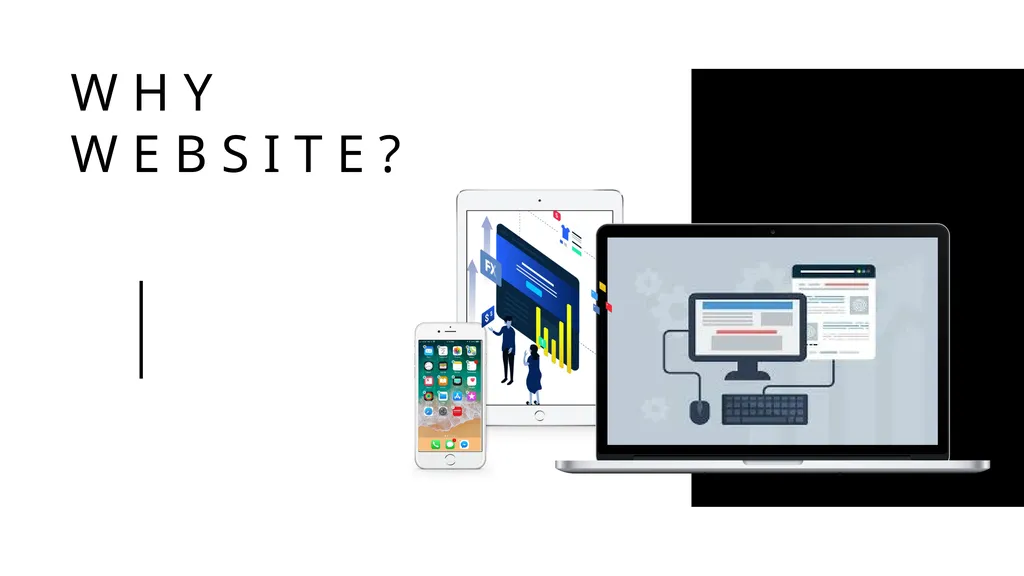
WHY WEBSITE?<br>
02
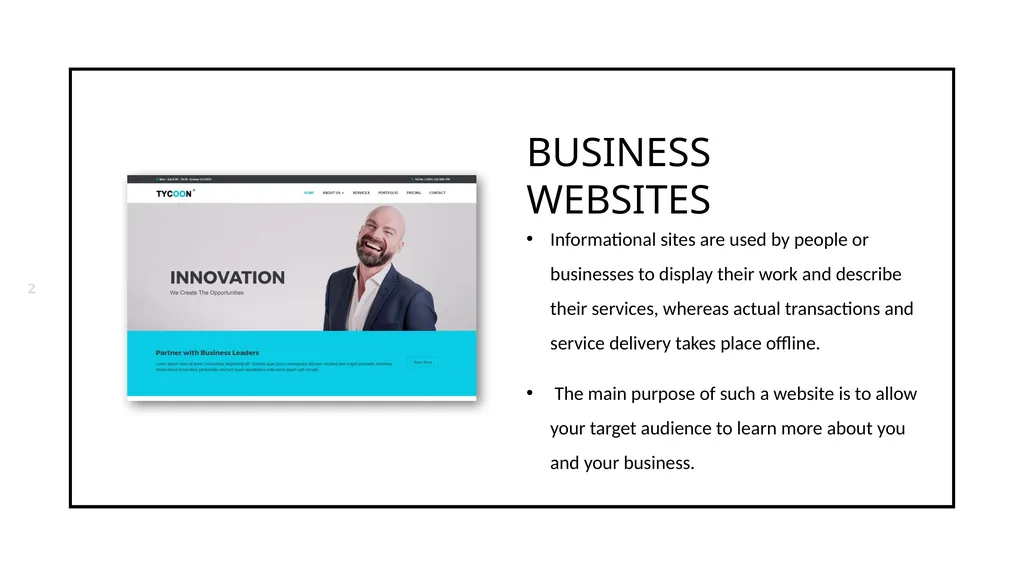
Informational sites are used by people or businesses to display their work and describe their services, whereas actual transactions and service delivery takes place offline.
The main purpose of such a website is to allow your target audience to learn more about you and your business. BUSINESS WEBSITES<br>
03
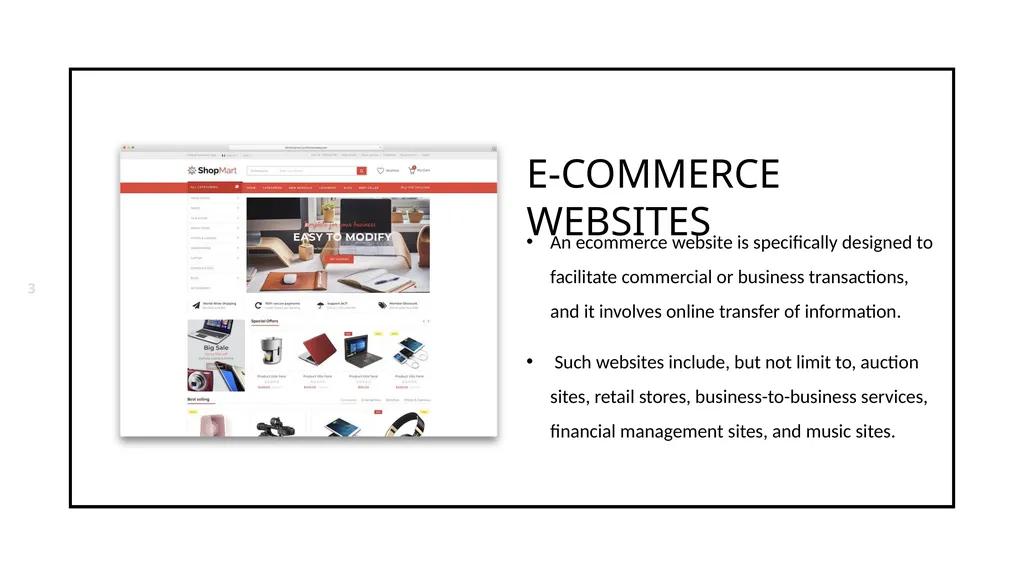
An ecommerce website is specifically designed to facilitate commercial or business transactions, and it involves online transfer of information.
Such websites include, but not limit to, auction sites, retail stores, business-to-business services, financial management sites, and music sites. E-COMMERCE WEBSITES<br>
04
WIX VS WORDPRESS Wordpress and Wix are both tools for building a website— but they have completely different approaches: Wix is a website builder and Wordpress is a CMS (or Content Management System).<br>
05
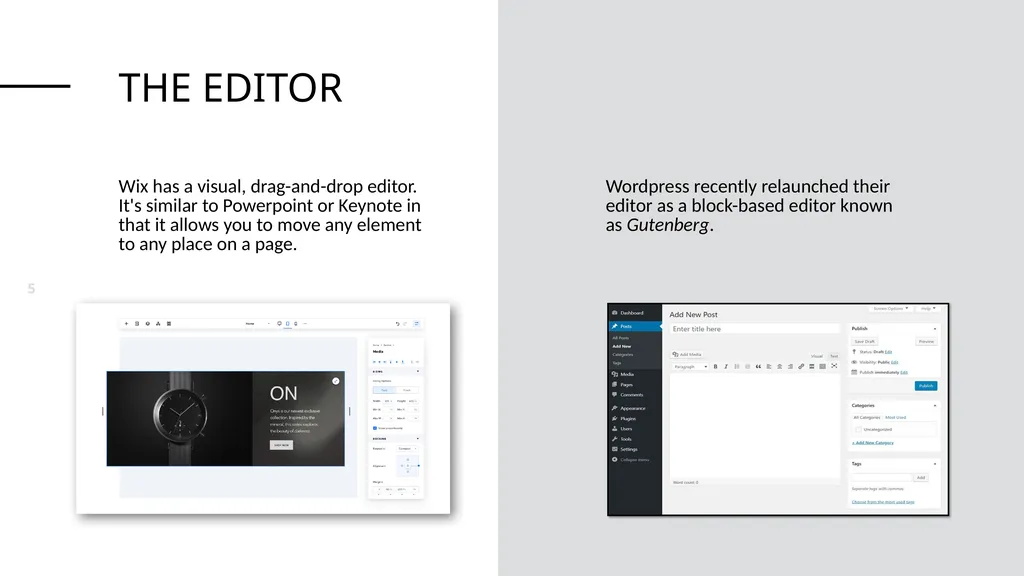
THE EDITOR Wix has a visual, drag-and-drop editor. It's similar to Powerpoint or Keynote in that it allows you to move any element to any place on a page. Wordpress recently relaunched their editor as a block-based editor known as Gutenberg.<br>
06
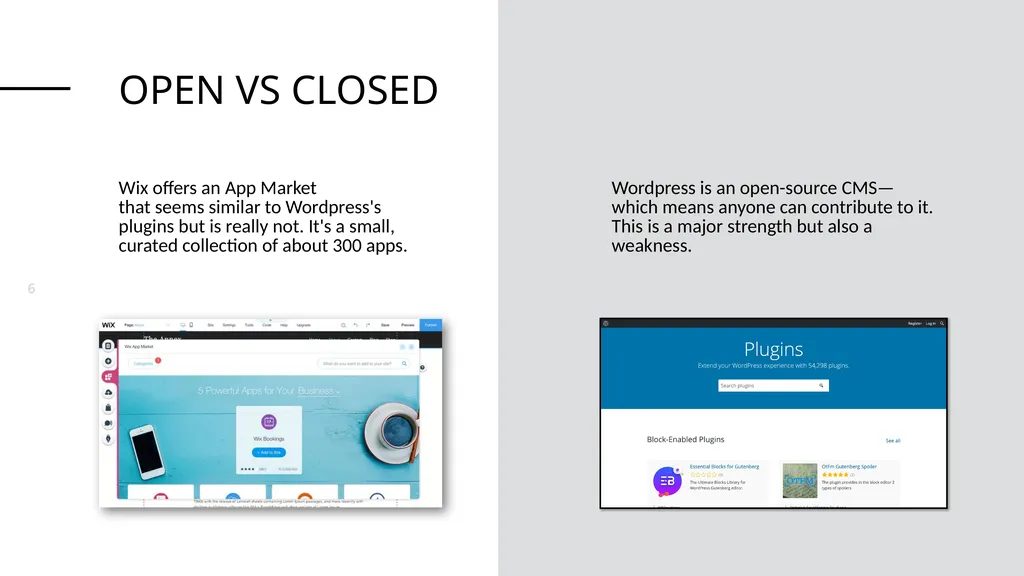
OPEN VS CLOSED Wix offers an App Market that seems similar to Wordpress's plugins but is really not. It's a small, curated collection of about 300 apps. Wordpress is an open-source CMS— which means anyone can contribute to it. This is a major strength but also a weakness.<br>
07
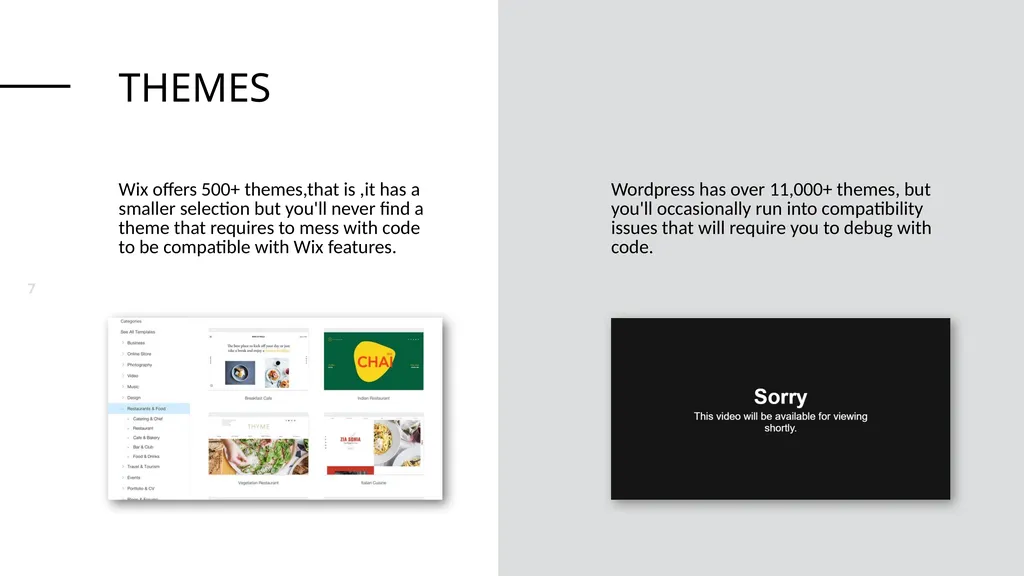
THEMES Wix offers 500+ themes,that is ,it has a smaller selection but you'll never find a theme that requires to mess with code to be compatible with Wix features. Wordpress has over 11,000+ themes, but you'll occasionally run into compatibility issues that will require you to debug with code.<br>
08
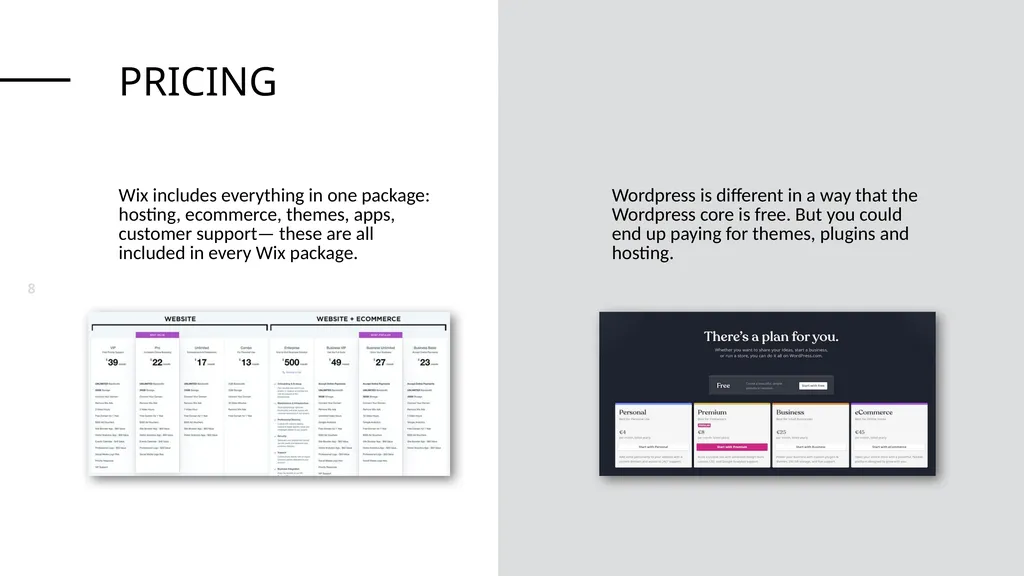
PRICING Wix includes everything in one package: hosting, ecommerce, themes, apps, customer support— these are all included in every Wix package. Wordpress is different in a way that the Wordpress core is free. But you could end up paying for themes, plugins and hosting.<br>
09
SHOPIFY VS WOO COMMERCE You can build and publish your own online store entirely through Shopify, and make use of its neat features and apps.
WooCommerce is for you if you already have a website. It’s a plugin that works with WordPress, and helps turn your website into an online store.<br>
10
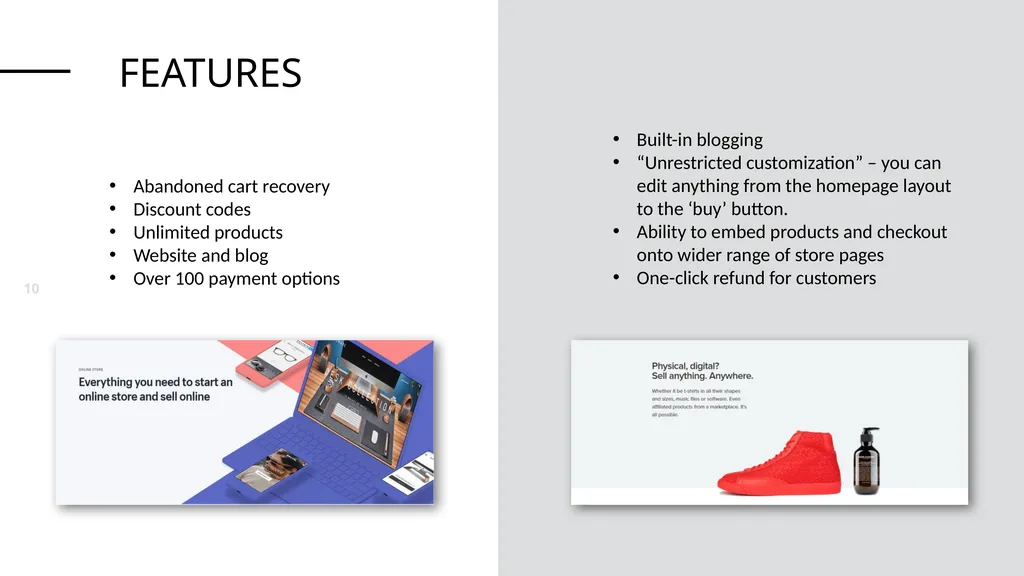
FEATURES Abandoned cart recovery
Discount codes
Unlimited products
Website and blog
Over 100 payment options Built-in blogging
“Unrestricted customization” – you can edit anything from the homepage layout to the ‘buy’ button.
Ability to embed products and checkout onto wider range of store pages
One-click refund for customers<br>
11
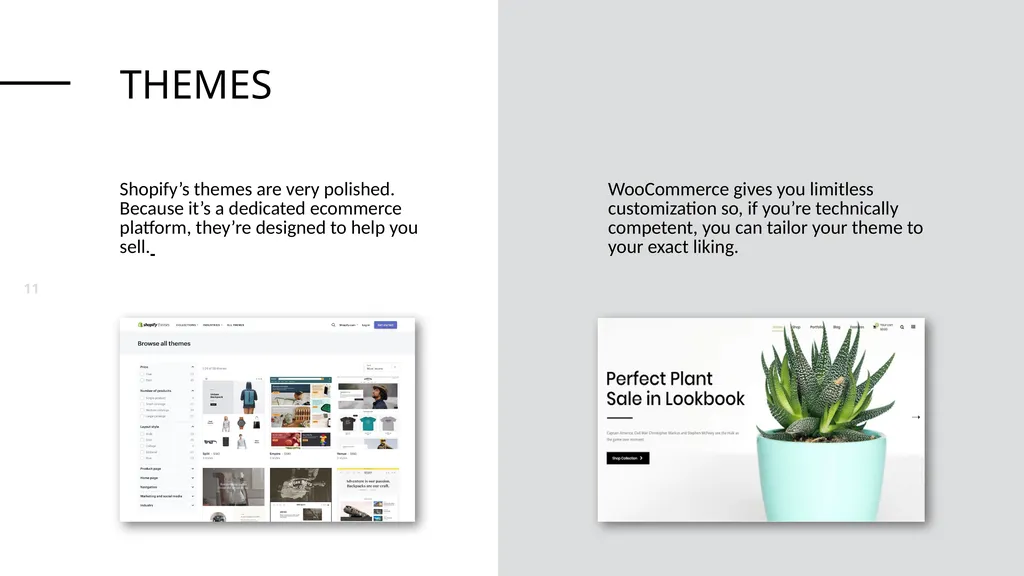
THEMES Shopify’s themes are very polished. Because it’s a dedicated ecommerce platform, they’re designed to help you sell. WooCommerce gives you limitless customization so, if you’re technically competent, you can tailor your theme to your exact liking.<br>
12
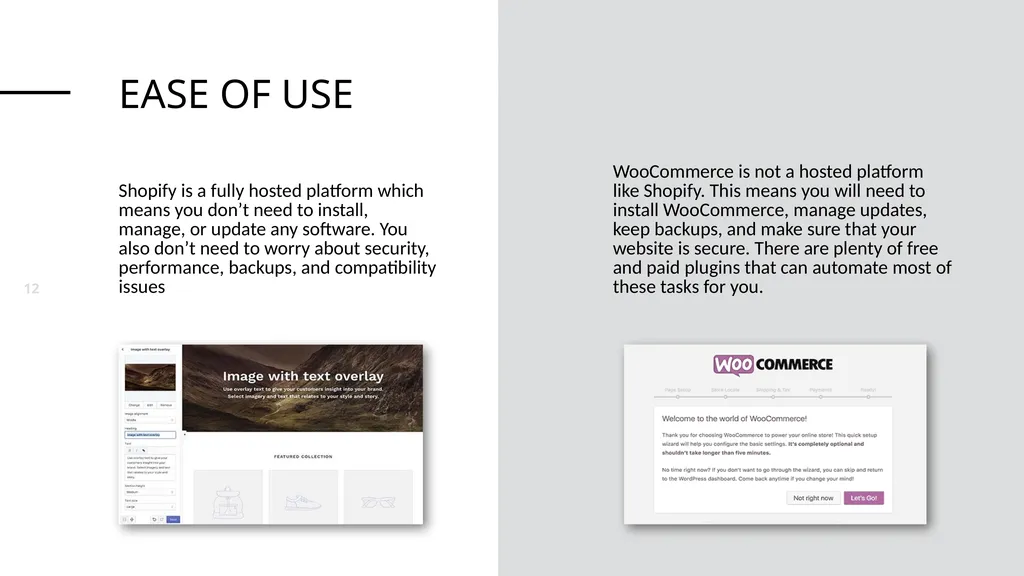
EASE OF USE Shopify is a fully hosted platform which means you don’t need to install, manage, or update any software. You also don’t need to worry about security, performance, backups, and compatibility issues WooCommerce is not a hosted platform like Shopify. This means you will need to install WooCommerce, manage updates, keep backups, and make sure that your website is secure. There are plenty of free and paid plugins that can automate most of these tasks for you.<br>
13
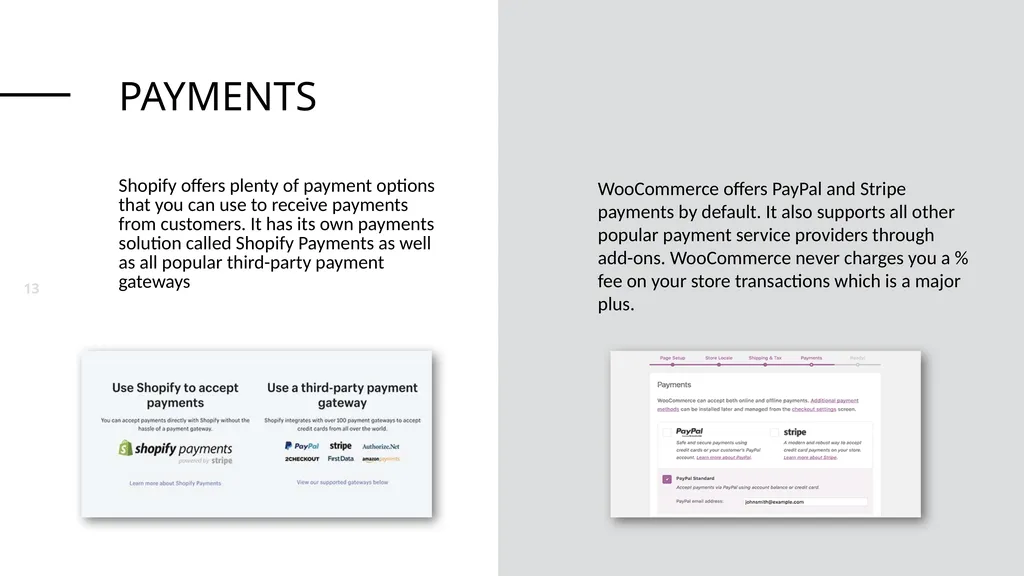
PAYMENTS Shopify offers plenty of payment options that you can use to receive payments from customers. It has its own payments solution called Shopify Payments as well as all popular third-party payment gateways WooCommerce offers PayPal and Stripe payments by default. It also supports all other popular payment service providers through add-ons. WooCommerce never charges you a % fee on your store transactions which is a major plus.<br>
14
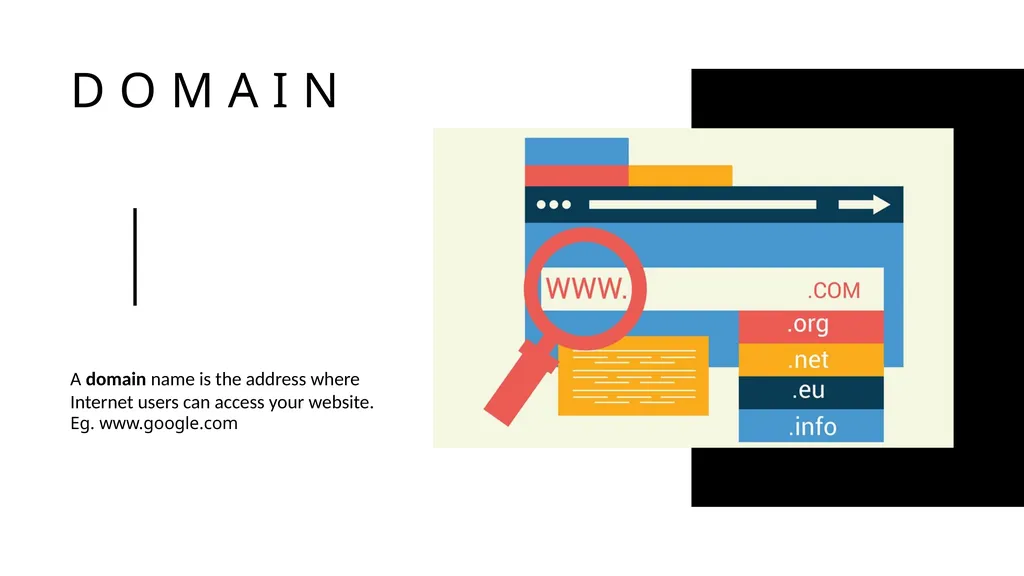
DOMAIN A domain name is the address where Internet users can access your website.
Eg. www.google.com<br>
15
HOW DOES IT WORK? 01 02 03 04<br>
16
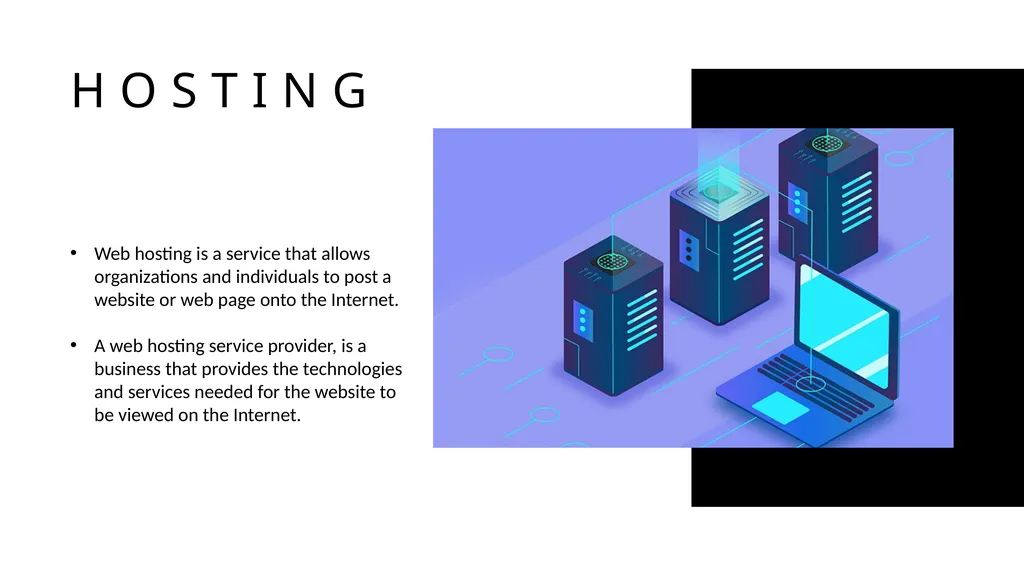
HOSTING Web hosting is a service that allows organizations and individuals to post a website or web page onto the Internet.
A web hosting service provider, is a business that provides the technologies and services needed for the website to be viewed on the Internet.<br>
17
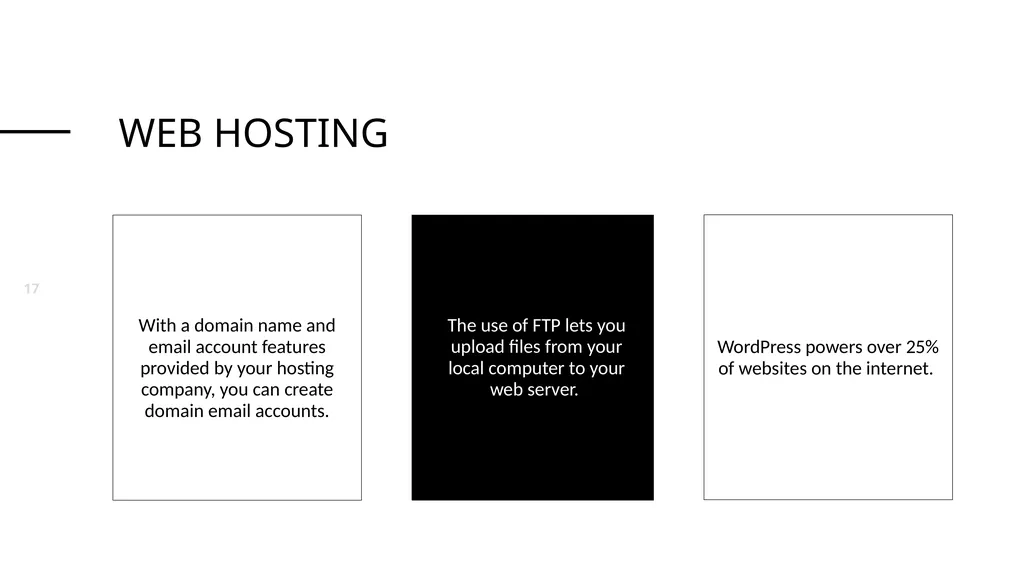
WEB HOSTING With a domain name and email account features provided by your hosting company, you can create domain email accounts. WordPress powers over 25% of websites on the internet.<br>
18
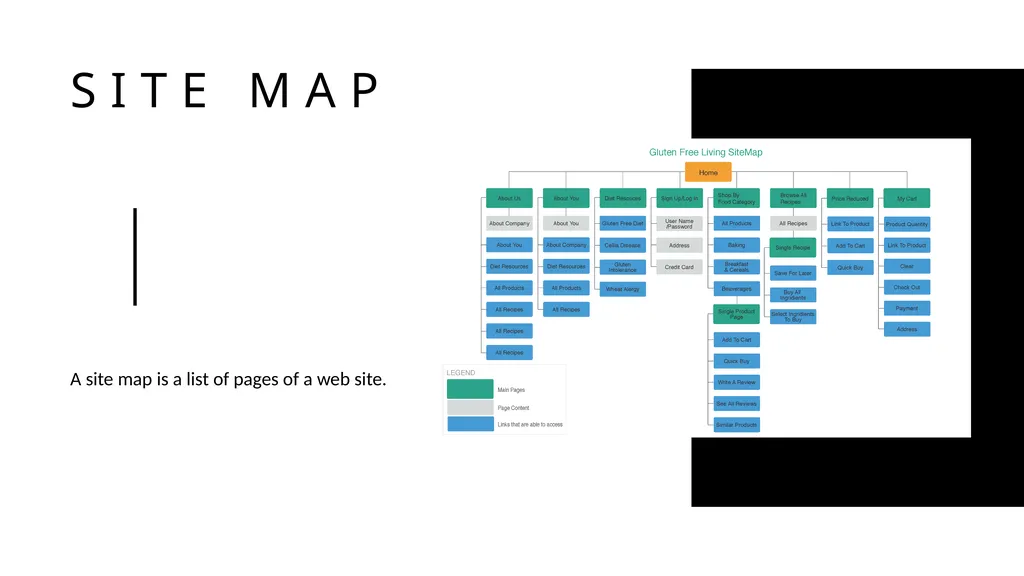
SITE MAP A site map is a list of pages of a web site.<br>
19
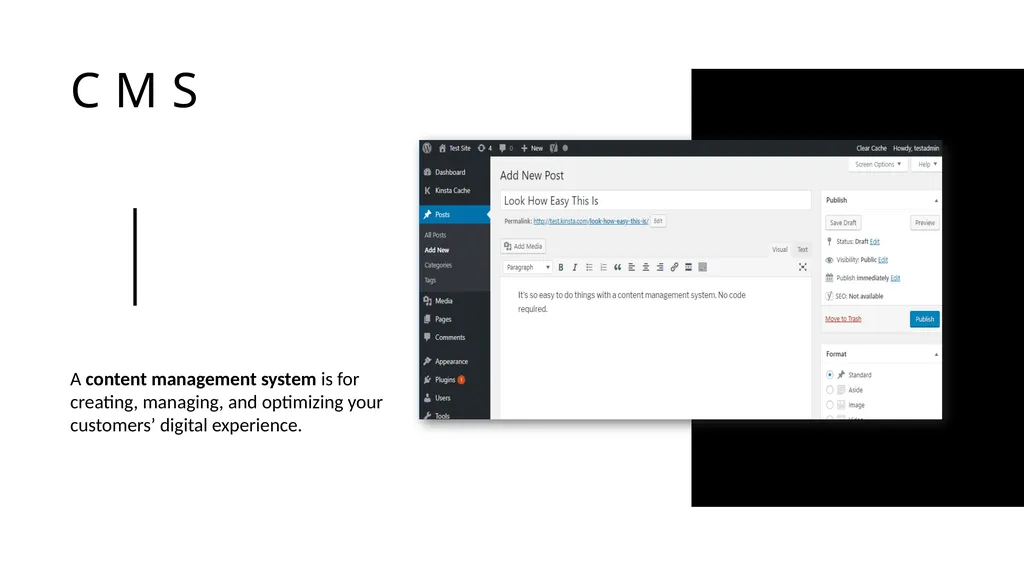
CMS A content management system is for creating, managing, and optimizing your customers’ digital experience.<br>
20
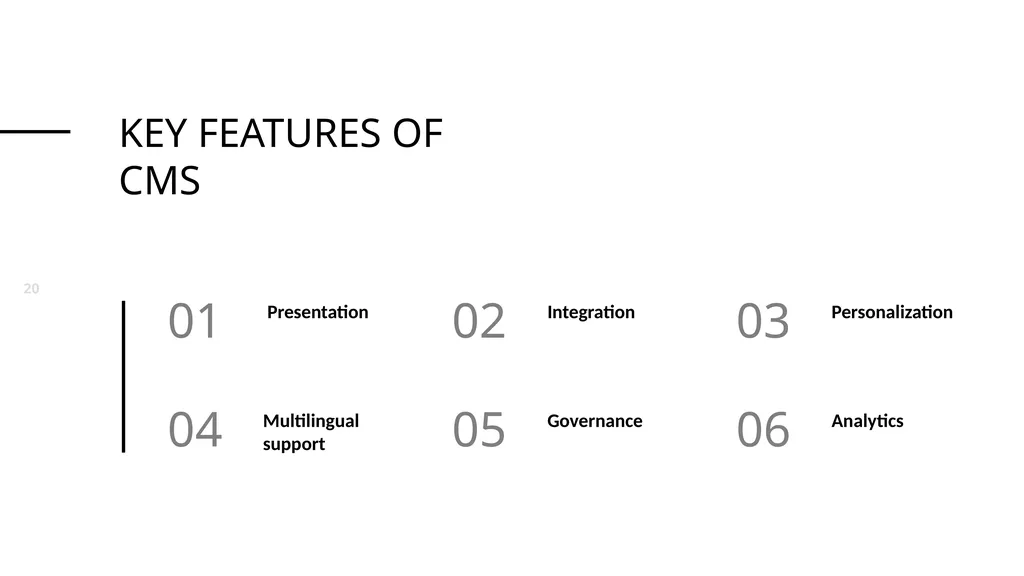
KEY FEATURES OF CMS 01 02 03 04 05 06 Presentation Integration Personalization Analytics<br>