William Wordsworths She Dwelt Among the Untrodden Ways: A Critical Analysis Presented by : Asst. Prof. Aseel Hatif Jassam 1st Year Students Department of English Language College of Basic Education Mustansiriyah University
"William Wordsworth’s ‘She Dwelt Among the" is the property of its rightful owner. Permission is granted to
download and print the materials on this website for personal, non-commercial use only, and to display it
on your personal computer provided you do not modify the materials and that you retain all copyright
notices contained in the materials. By downloading content from our website, you accept the terms of this
agreement.
Presentation Transcript
01
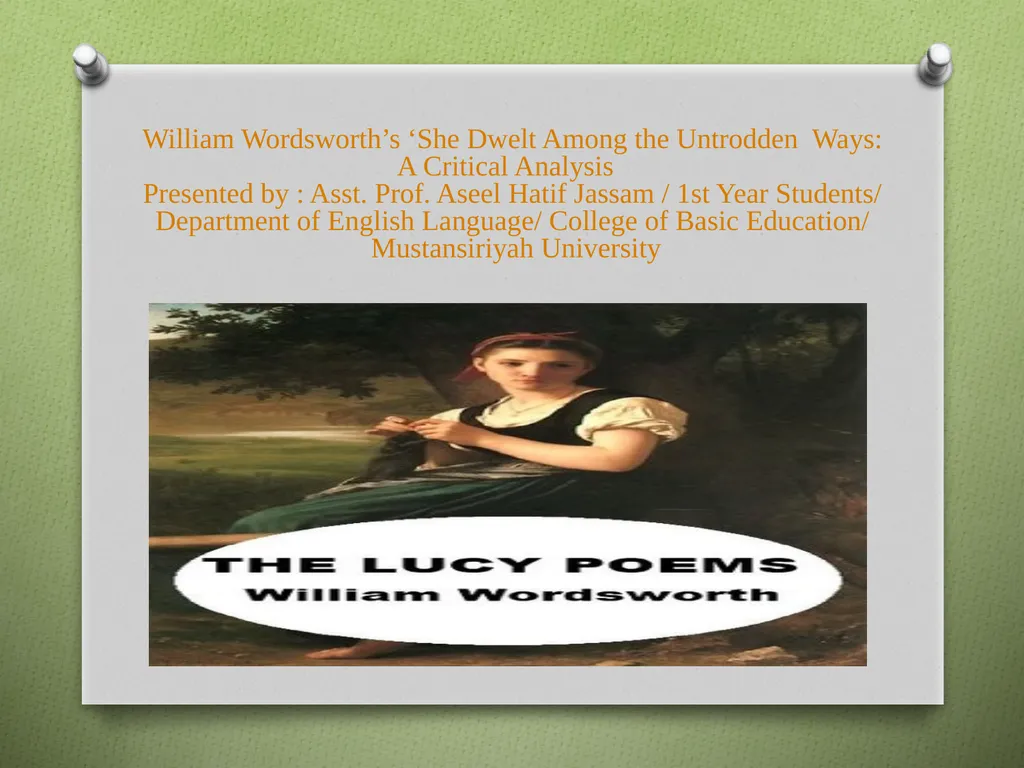
William Wordsworth’s ‘She Dwelt Among the Untrodden Ways: A Critical Analysis Presented by : Asst. Prof. Aseel Hatif Jassam / 1st Year Students/ Department of English Language/ College of Basic Education/ Mustansiriyah University<br>
02
Introduction She Dwelt among the Untrodden Ways was written in 1798. This poem is Wordsworth’s best known work from a series of five texts that form his “Lucy” series. In this series, Wordsworth examines an idealized and unrequited love for Lucy, a girl who has died young.
The poem examines loneliness and loss, but also unrecognized beauty and dignity. She Dwelt among the Untrodden Ways has three quatrains with simple language (mainly words of one syllable), and it has an ABAB rhyme scheme.<br>
03
Furthermore, Wordsworth’s poem can be read as an elegiac poem, with graceful descriptions and a mourning tone. Thus, the main theme of this poem is death, a death that is described and grieved for throughout the entire poem.
She Dwelt among the Untrodden Ways is a prototypical representative of a Romantic poem. The poem celebrates a girl by associating her to nature with straightforward language and emphasizing on emotional expression. Moreover, it is a short lyric form that concerns rural life.<br>
04
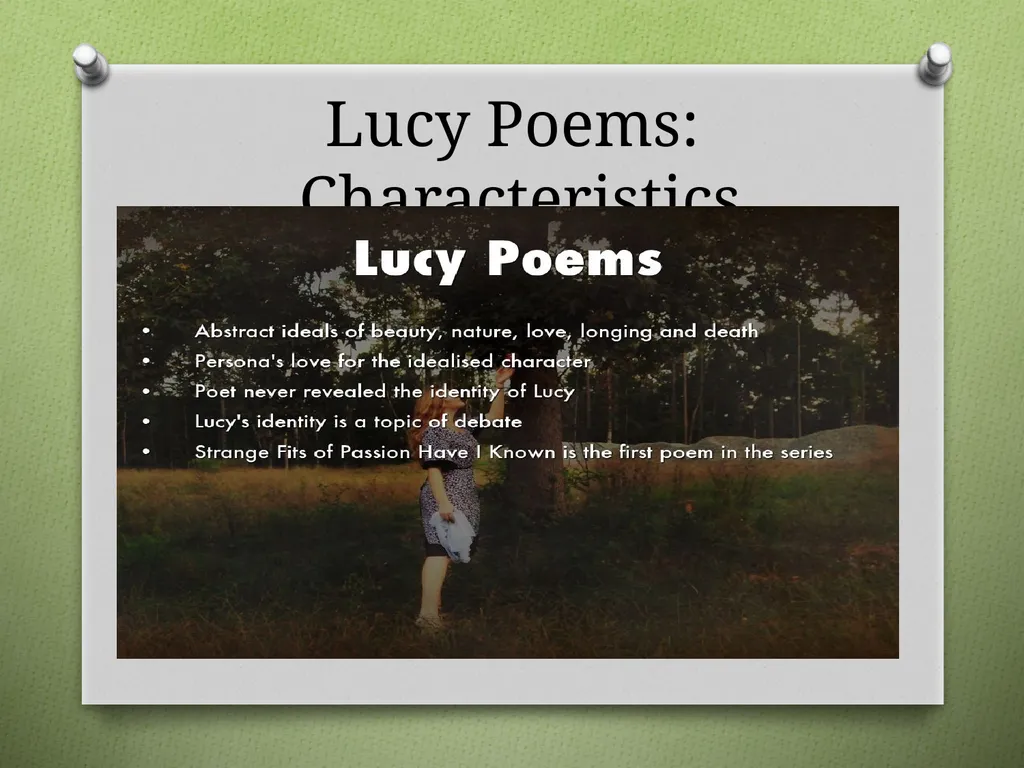
Lucy Poems: Characteristics<br>
05
She Dwelt among the Untrodden Ways: Analysis The first stanza describes the area in which Lucy lived. This rural scenery is described as an idealized beautiful place. The pronoun she will later acquire a name “Lucy”. She “dwelt” means that she lived there in the past. Although this rural scenery is described as idyllic and magnificent place (“among the untrodden ways/Beside the springs of Dove”), Lucy was alone and there was no one to praise her and to love her (A Maid whom there were none to praise/ And very few to love).
The first line, which serves also as the title of the poem, suggests that Lucy lived both physically and spiritually unrevealed and distant.<br>
06
The second stanza focuses on nature. As a representative Romanic device, the lyrical voice compares the beauty of nature to the grace of Lucy.
She is likened to “A violet by a mossy stone/ Half hidden from the eye” and to a fair star “when only one/Is shining in the sky ”. These comparisons serve to exemplify Lucy as an embodiment of all beauty.
The final stanza serves as an antithesis. The lyrical voice accentuates her isolation: “She lived unknown, and few could know/ When Lucy ceased to be;”. The poem follows a cyclical pattern.<br>
07
The last stanza repeats the characterization of Lucy as distant and unknown (like in the first stanza). Moreover, this cycle is also related to the movement between growth and death (In the first stanza she is presented as alive, whereas in the last stanza the lyrical voice talks about her death). This cyclical form conveys great dramatic intensity.
Lucy’s death is expressed with great sadness: “But she is in her grave, and, oh”. Love is asserted by the lyrical voice’s exclamation of difference (“The difference to me!”).<br>
08
The lyrical voice, dissimilarly from others, feels that he/she is unlike he/she was before because he/she could love her passionately, and that changed him/her.
This “difference” functions powerfully trough understatement, and establishes a dramatic ending for the poem.<br>