
Win-Win Strategies and Student Positions Module 2
MY
Published · 52 slides · 0 views
1 / 1
Description
Win-Win Strategies and Student Positions Module 2 Topics to be Covered in this Presentation Win-Win strategies Student positions Win-Win strategies Win-Win Strategies This is a strategy in which the student has hisher need met and the
Related Topics
Share
Embed code
Download this presentation From Below
"Win-Win Strategies and Student Positions Module 2" is the property of its rightful owner. Permission is granted to download and print the materials on this website for personal, non-commercial use only, and to display it on your personal computer provided you do not modify the materials and that you retain all copyright notices contained in the materials. By downloading content from our website, you accept the terms of this agreement.
Presentation Transcript
01
Win-Win Strategies and Student Positions Module 2<br>
02
Topics to be Covered in this Presentation Win-Win strategies
Student positions<br>
Student positions<br>
03
Win-Win strategies<br>
04
Win-Win Strategies This is a strategy in which the student has his/her need met and the teacher is able to continue teaching all students
Both parties win!<br>
Both parties win!<br>
05
Where Did Win-Win Strategies Come From? Kagan’s Win-Win Discipline Theory<br>
06
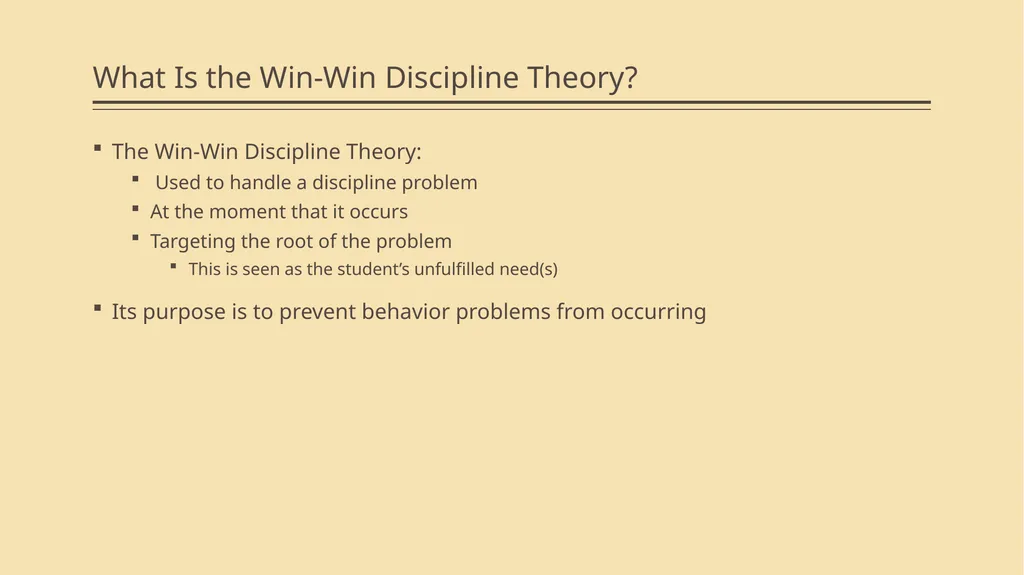
What Is the Win-Win Discipline Theory? The Win-Win Discipline Theory:
Used to handle a discipline problem
At the moment that it occurs
Targeting the root of the problem
This is seen as the student’s unfulfilled need(s)
Its purpose is to prevent behavior problems from occurring<br>
Used to handle a discipline problem
At the moment that it occurs
Targeting the root of the problem
This is seen as the student’s unfulfilled need(s)
Its purpose is to prevent behavior problems from occurring<br>
07
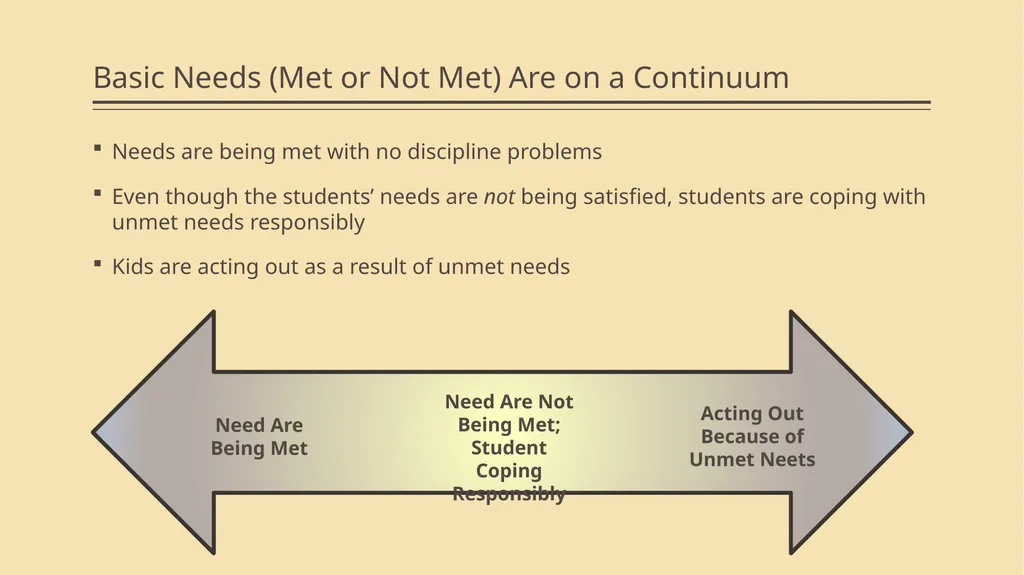
Basic Needs (Met or Not Met) Are on a Continuum Needs are being met with no discipline problems
Even though the students’ needs are not being satisfied, students are coping with unmet needs responsibly
Kids are acting out as a result of unmet needs Need Are Being Met Need Are Not Being Met; Student Coping Responsibly Acting Out Because of Unmet Neets<br>
Even though the students’ needs are not being satisfied, students are coping with unmet needs responsibly
Kids are acting out as a result of unmet needs Need Are Being Met Need Are Not Being Met; Student Coping Responsibly Acting Out Because of Unmet Neets<br>
08
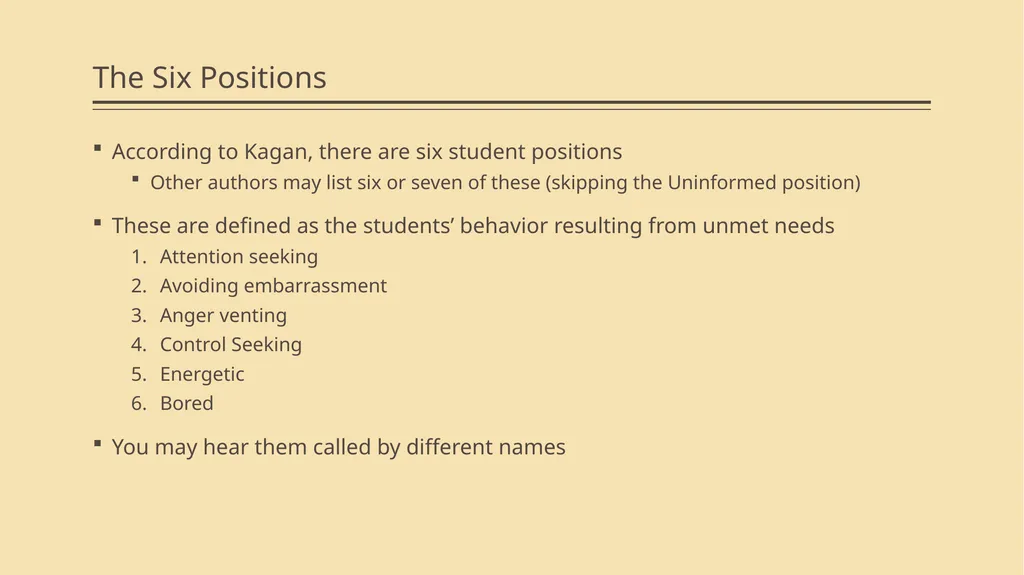
The Six Positions According to Kagan, there are six student positions
Other authors may list six or seven of these (skipping the Uninformed position)
These are defined as the students’ behavior resulting from unmet needs
Attention seeking
Avoiding embarrassment
Anger venting
Control Seeking
Energetic
Bored
You may hear them called by different names<br>
Other authors may list six or seven of these (skipping the Uninformed position)
These are defined as the students’ behavior resulting from unmet needs
Attention seeking
Avoiding embarrassment
Anger venting
Control Seeking
Energetic
Bored
You may hear them called by different names<br>
09
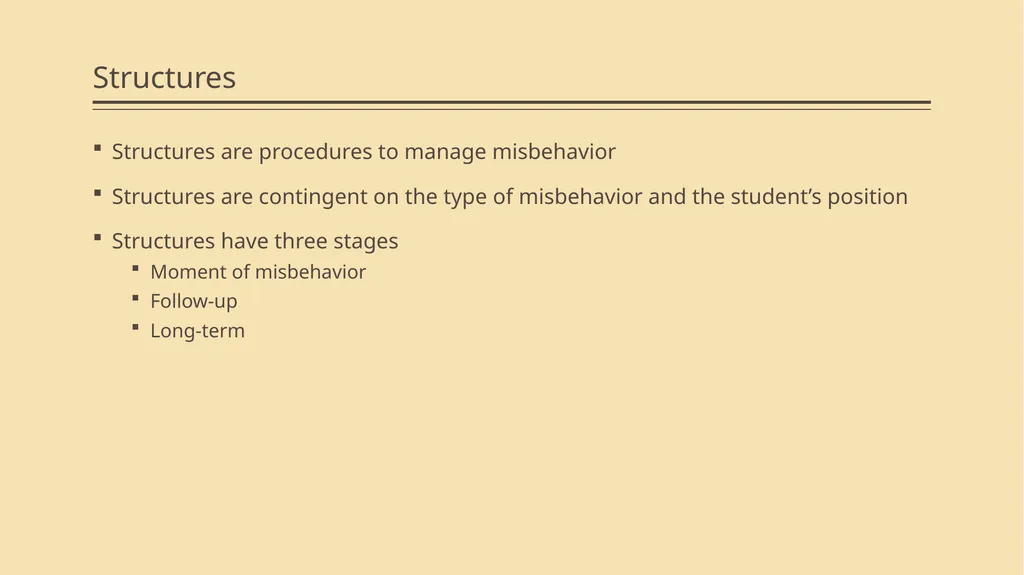
Structures Structures are procedures to manage misbehavior
Structures are contingent on the type of misbehavior and the student’s position
Structures have three stages
Moment of misbehavior
Follow-up
Long-term<br>
Structures are contingent on the type of misbehavior and the student’s position
Structures have three stages
Moment of misbehavior
Follow-up
Long-term<br>
10
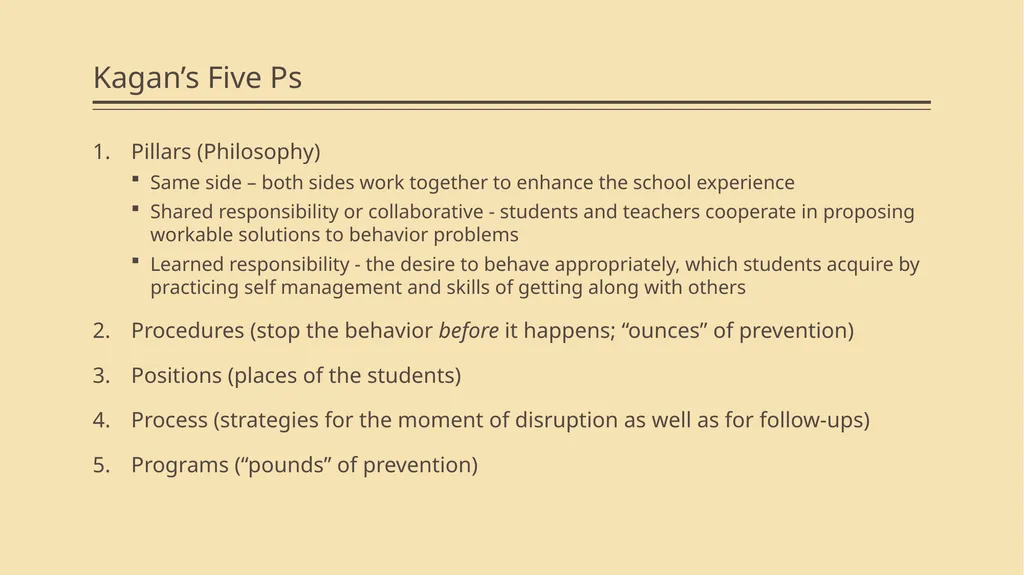
Kagan’s Five Ps Pillars (Philosophy)
Same side – both sides work together to enhance the school experience
Shared responsibility or collaborative - students and teachers cooperate in proposing workable solutions to behavior problems
Learned responsibility - the desire to behave appropriately, which students acquire by practicing self management and skills of getting along with others
Procedures (stop the behavior before it happens; “ounces” of prevention)
Positions (places of the students)
Process (strategies for the moment of disruption as well as for follow-ups)
Programs (“pounds” of prevention)<br>
Same side – both sides work together to enhance the school experience
Shared responsibility or collaborative - students and teachers cooperate in proposing workable solutions to behavior problems
Learned responsibility - the desire to behave appropriately, which students acquire by practicing self management and skills of getting along with others
Procedures (stop the behavior before it happens; “ounces” of prevention)
Positions (places of the students)
Process (strategies for the moment of disruption as well as for follow-ups)
Programs (“pounds” of prevention)<br>
11
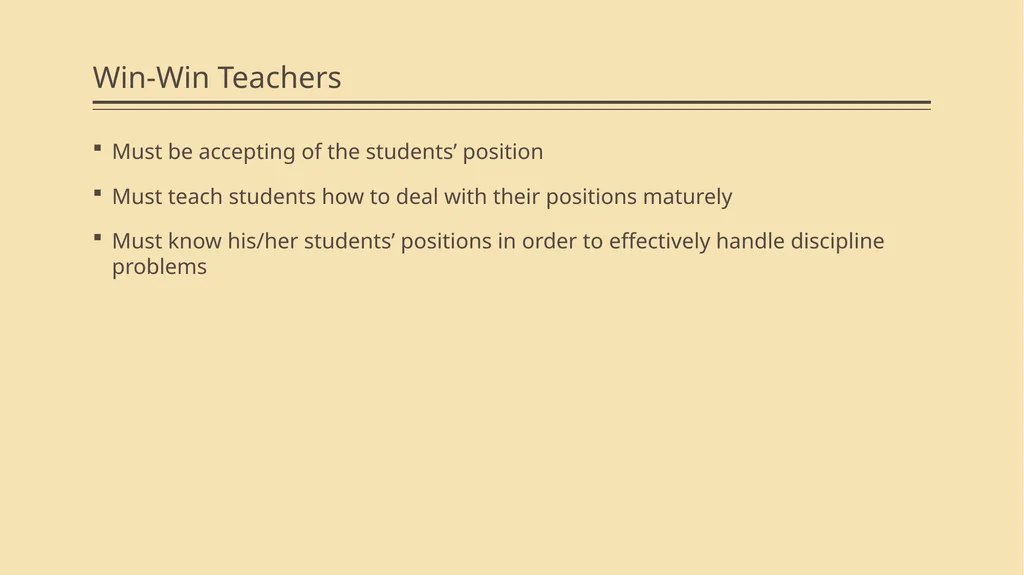
Win-Win Teachers Must be accepting of the students’ position
Must teach students how to deal with their positions maturely
Must know his/her students’ positions in order to effectively handle discipline problems<br>
Must teach students how to deal with their positions maturely
Must know his/her students’ positions in order to effectively handle discipline problems<br>
12
Key Points of the Win-Win Discipline Theory The key purpose of the theory is to “promote life skills, cooperation, and critical thinking about choices and consequences”
It is important for children to be corrected instead of being punished in some way
Why it is called The Win-Win Discipline Theory?
When we meet the needs of the students in a responsible and respectful manner, bad behavior decreases; therefore they win
When teachers are able to teach their students in an environment that is safe and productive, they win
Both sides win
This is a “win-win proposition”<br>
It is important for children to be corrected instead of being punished in some way
Why it is called The Win-Win Discipline Theory?
When we meet the needs of the students in a responsible and respectful manner, bad behavior decreases; therefore they win
When teachers are able to teach their students in an environment that is safe and productive, they win
Both sides win
This is a “win-win proposition”<br>
13
Student Positions and
Strategies That (May) Work<br>
14
Student Basic Needs All students (all people) have the same basic needs; these are seen as student positions if the need in unmet
Positions:
Attention-seeking
Angry
Avoiding failure
Bored
Excess energy
Control-seeking
When any of these basic needs cannot be fulfilled respectfully through logical consequences, the child will resort to disruptive behaviors<br>
Positions:
Attention-seeking
Angry
Avoiding failure
Bored
Excess energy
Control-seeking
When any of these basic needs cannot be fulfilled respectfully through logical consequences, the child will resort to disruptive behaviors<br>
15
Tip for Remembering the Positions AAA-BE-C
Attention-seeking
Angry
Avoiding failure
Bored
Excessive energy
Control-seeking<br>
Attention-seeking
Angry
Avoiding failure
Bored
Excessive energy
Control-seeking<br>
16
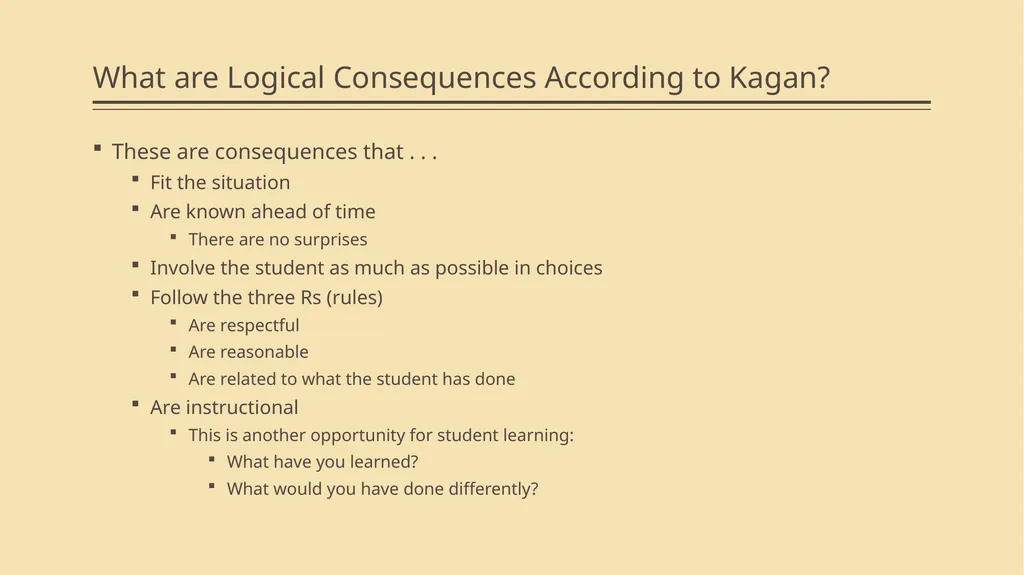
What are Logical Consequences According to Kagan? These are consequences that . . .
Fit the situation
Are known ahead of time
There are no surprises
Involve the student as much as possible in choices
Follow the three Rs (rules)
Are respectful
Are reasonable
Are related to what the student has done
Are instructional
This is another opportunity for student learning:
What have you learned?
What would you have done differently?<br>
Fit the situation
Are known ahead of time
There are no surprises
Involve the student as much as possible in choices
Follow the three Rs (rules)
Are respectful
Are reasonable
Are related to what the student has done
Are instructional
This is another opportunity for student learning:
What have you learned?
What would you have done differently?<br>
17
Let’s take a closer look at the three Rs of logical consequences.<br>
18
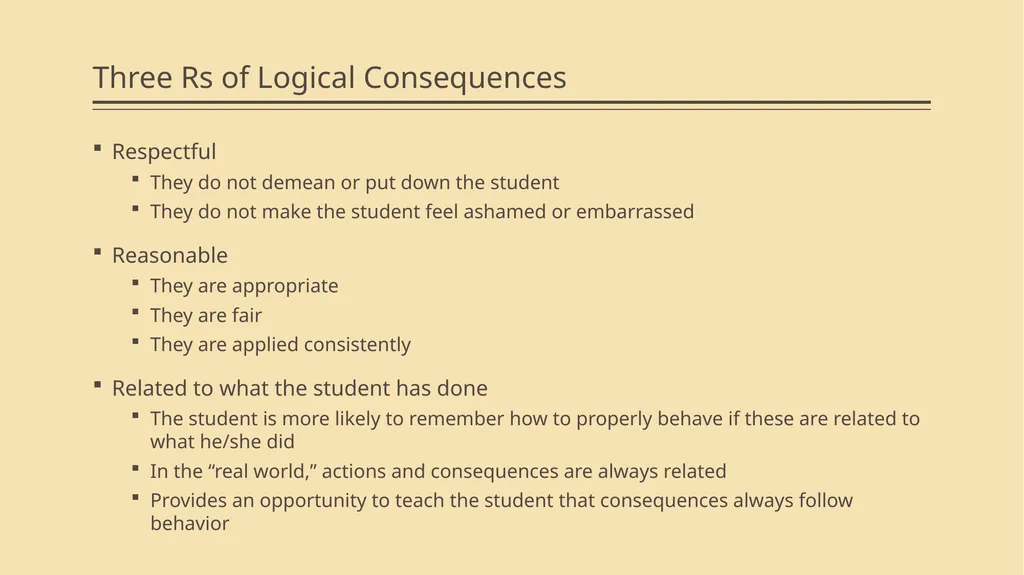
Three Rs of Logical Consequences Respectful
They do not demean or put down the student
They do not make the student feel ashamed or embarrassed
Reasonable
They are appropriate
They are fair
They are applied consistently
Related to what the student has done
The student is more likely to remember how to properly behave if these are related to what he/she did
In the “real world,” actions and consequences are always related
Provides an opportunity to teach the student that consequences always follow behavior<br>
They do not demean or put down the student
They do not make the student feel ashamed or embarrassed
Reasonable
They are appropriate
They are fair
They are applied consistently
Related to what the student has done
The student is more likely to remember how to properly behave if these are related to what he/she did
In the “real world,” actions and consequences are always related
Provides an opportunity to teach the student that consequences always follow behavior<br>
19
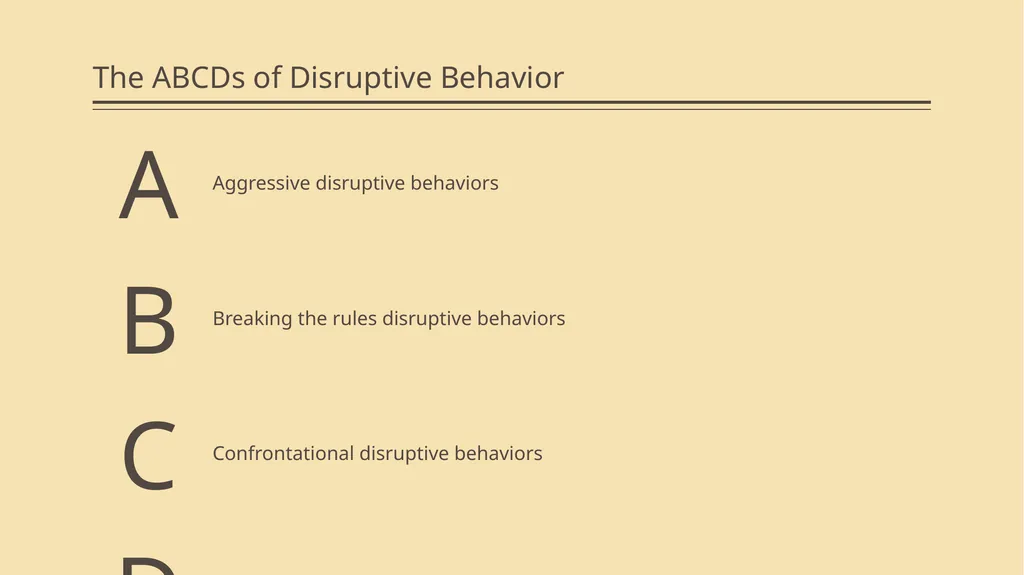
The ABCDs of Disruptive Behavior<br>
20
Let’s look more in-depth now at the student positions along with strategies that may often be useful when used with students exhibiting that position<br>
21
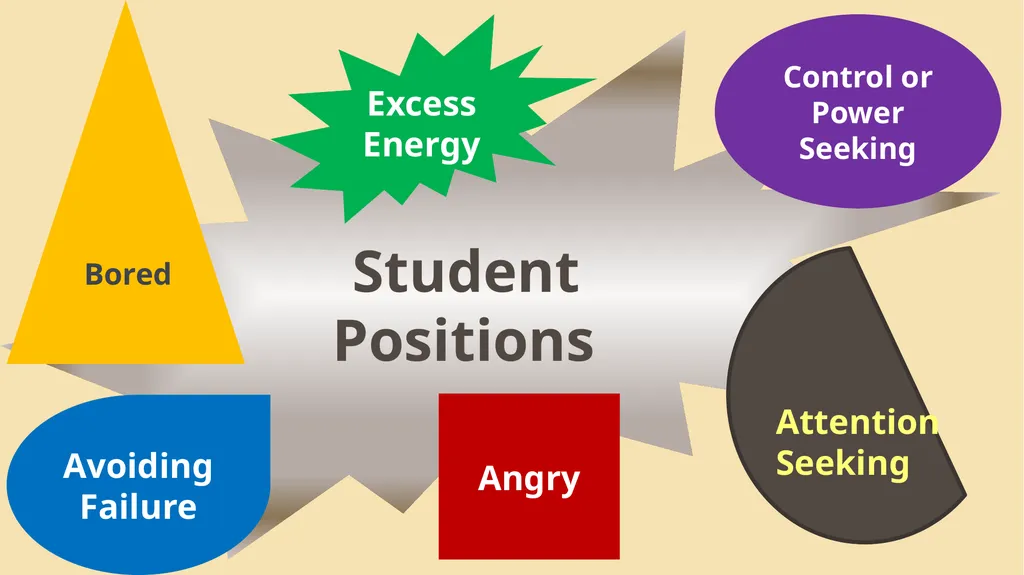
Student Positions Attention Seeking Bored Excess Energy Angry Avoiding Failure Control or Power Seeking<br>
22
Student Position Attention Seeking<br>
23
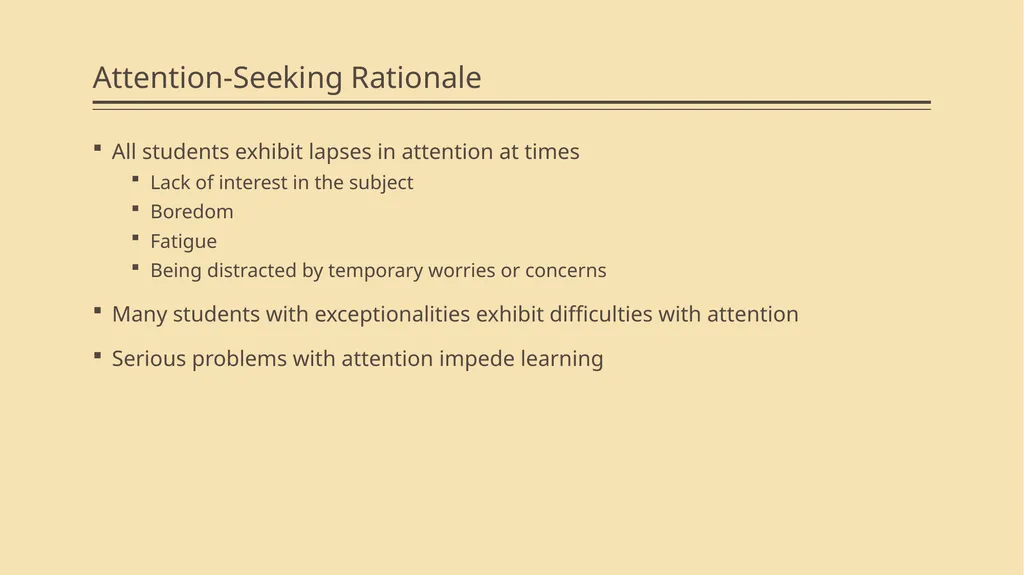
Attention-Seeking Rationale All students exhibit lapses in attention at times
Lack of interest in the subject
Boredom
Fatigue
Being distracted by temporary worries or concerns
Many students with exceptionalities exhibit difficulties with attention
Serious problems with attention impede learning<br>
Lack of interest in the subject
Boredom
Fatigue
Being distracted by temporary worries or concerns
Many students with exceptionalities exhibit difficulties with attention
Serious problems with attention impede learning<br>
24
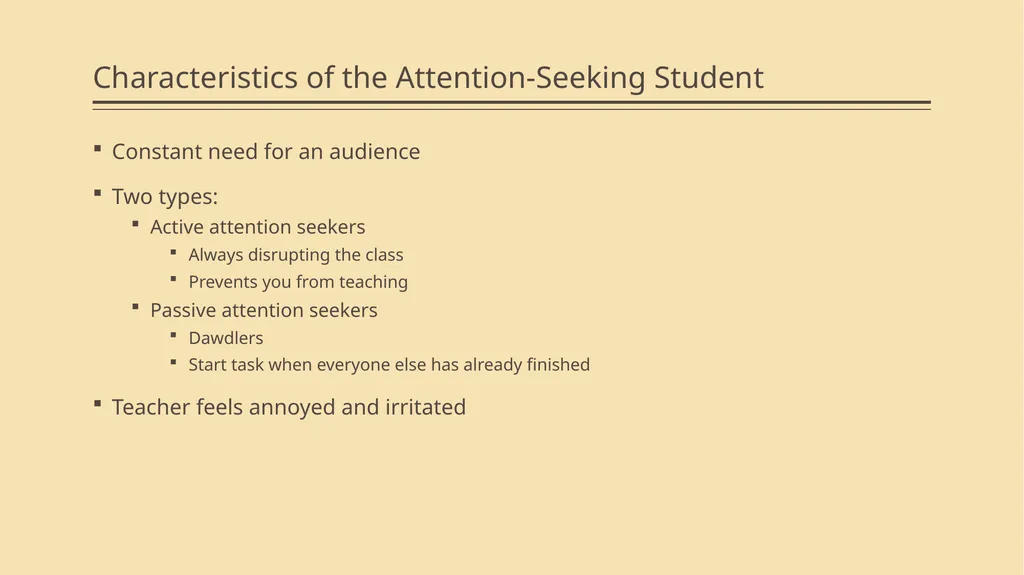
Characteristics of the Attention-Seeking Student Constant need for an audience
Two types:
Active attention seekers
Always disrupting the class
Prevents you from teaching
Passive attention seekers
Dawdlers
Start task when everyone else has already finished
Teacher feels annoyed and irritated<br>
Two types:
Active attention seekers
Always disrupting the class
Prevents you from teaching
Passive attention seekers
Dawdlers
Start task when everyone else has already finished
Teacher feels annoyed and irritated<br>
25
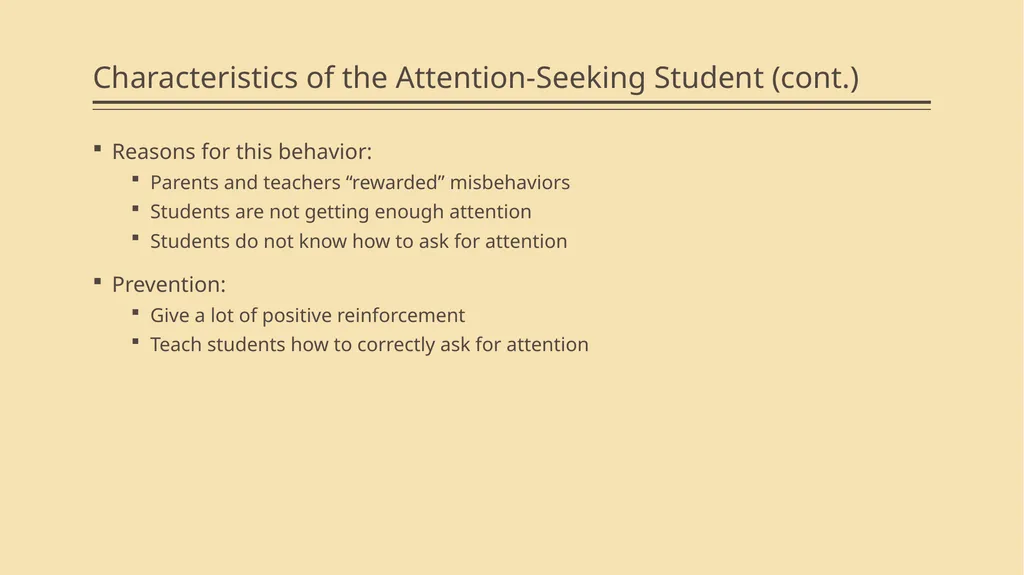
Characteristics of the Attention-Seeking Student (cont.) Reasons for this behavior:
Parents and teachers “rewarded” misbehaviors
Students are not getting enough attention
Students do not know how to ask for attention
Prevention:
Give a lot of positive reinforcement
Teach students how to correctly ask for attention<br>
Parents and teachers “rewarded” misbehaviors
Students are not getting enough attention
Students do not know how to ask for attention
Prevention:
Give a lot of positive reinforcement
Teach students how to correctly ask for attention<br>
26
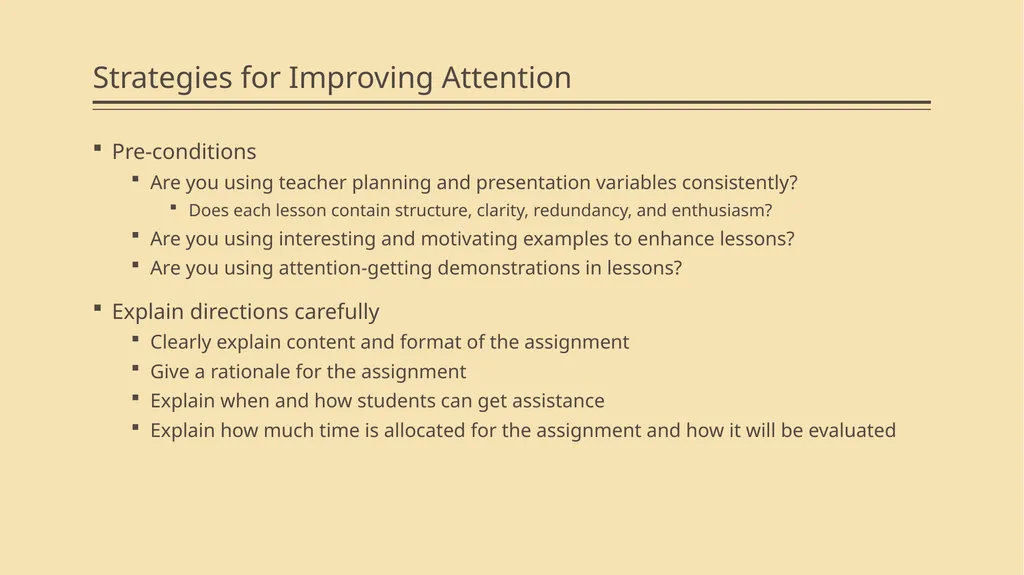
Strategies for Improving Attention Pre-conditions
Are you using teacher planning and presentation variables consistently?
Does each lesson contain structure, clarity, redundancy, and enthusiasm?
Are you using interesting and motivating examples to enhance lessons?
Are you using attention-getting demonstrations in lessons?
Explain directions carefully
Clearly explain content and format of the assignment
Give a rationale for the assignment
Explain when and how students can get assistance
Explain how much time is allocated for the assignment and how it will be evaluated<br>
Are you using teacher planning and presentation variables consistently?
Does each lesson contain structure, clarity, redundancy, and enthusiasm?
Are you using interesting and motivating examples to enhance lessons?
Are you using attention-getting demonstrations in lessons?
Explain directions carefully
Clearly explain content and format of the assignment
Give a rationale for the assignment
Explain when and how students can get assistance
Explain how much time is allocated for the assignment and how it will be evaluated<br>
27
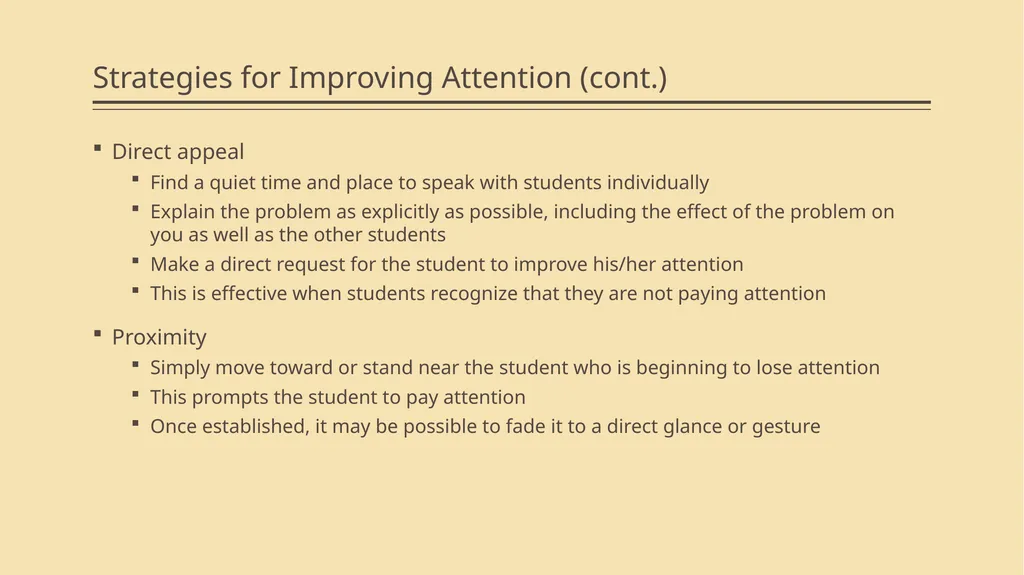
Strategies for Improving Attention (cont.) Direct appeal
Find a quiet time and place to speak with students individually
Explain the problem as explicitly as possible, including the effect of the problem on you as well as the other students
Make a direct request for the student to improve his/her attention
This is effective when students recognize that they are not paying attention
Proximity
Simply move toward or stand near the student who is beginning to lose attention
This prompts the student to pay attention
Once established, it may be possible to fade it to a direct glance or gesture<br>
Find a quiet time and place to speak with students individually
Explain the problem as explicitly as possible, including the effect of the problem on you as well as the other students
Make a direct request for the student to improve his/her attention
This is effective when students recognize that they are not paying attention
Proximity
Simply move toward or stand near the student who is beginning to lose attention
This prompts the student to pay attention
Once established, it may be possible to fade it to a direct glance or gesture<br>
28
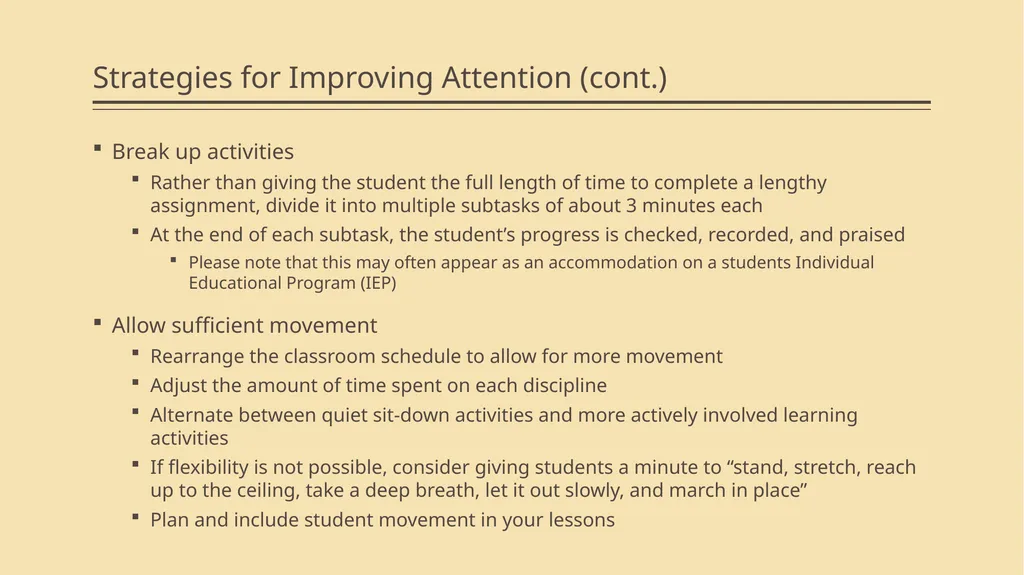
Strategies for Improving Attention (cont.) Break up activities
Rather than giving the student the full length of time to complete a lengthy assignment, divide it into multiple subtasks of about 3 minutes each
At the end of each subtask, the student’s progress is checked, recorded, and praised
Please note that this may often appear as an accommodation on a students Individual Educational Program (IEP)
Allow sufficient movement
Rearrange the classroom schedule to allow for more movement
Adjust the amount of time spent on each discipline
Alternate between quiet sit-down activities and more actively involved learning activities
If flexibility is not possible, consider giving students a minute to “stand, stretch, reach up to the ceiling, take a deep breath, let it out slowly, and march in place”
Plan and include student movement in your lessons<br>
Rather than giving the student the full length of time to complete a lengthy assignment, divide it into multiple subtasks of about 3 minutes each
At the end of each subtask, the student’s progress is checked, recorded, and praised
Please note that this may often appear as an accommodation on a students Individual Educational Program (IEP)
Allow sufficient movement
Rearrange the classroom schedule to allow for more movement
Adjust the amount of time spent on each discipline
Alternate between quiet sit-down activities and more actively involved learning activities
If flexibility is not possible, consider giving students a minute to “stand, stretch, reach up to the ceiling, take a deep breath, let it out slowly, and march in place”
Plan and include student movement in your lessons<br>
29
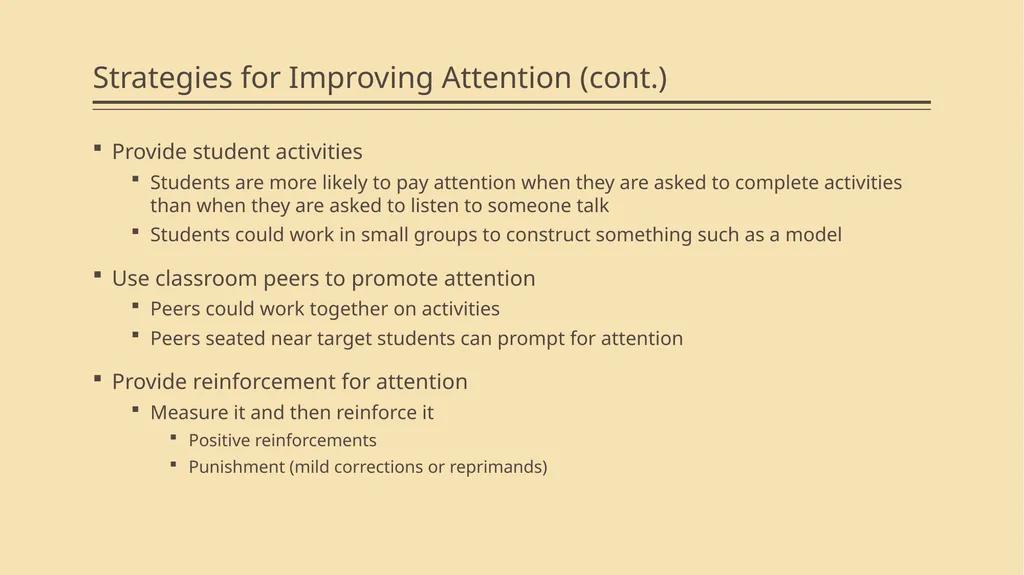
Strategies for Improving Attention (cont.) Provide student activities
Students are more likely to pay attention when they are asked to complete activities than when they are asked to listen to someone talk
Students could work in small groups to construct something such as a model
Use classroom peers to promote attention
Peers could work together on activities
Peers seated near target students can prompt for attention
Provide reinforcement for attention
Measure it and then reinforce it
Positive reinforcements
Punishment (mild corrections or reprimands)<br>
Students are more likely to pay attention when they are asked to complete activities than when they are asked to listen to someone talk
Students could work in small groups to construct something such as a model
Use classroom peers to promote attention
Peers could work together on activities
Peers seated near target students can prompt for attention
Provide reinforcement for attention
Measure it and then reinforce it
Positive reinforcements
Punishment (mild corrections or reprimands)<br>
30
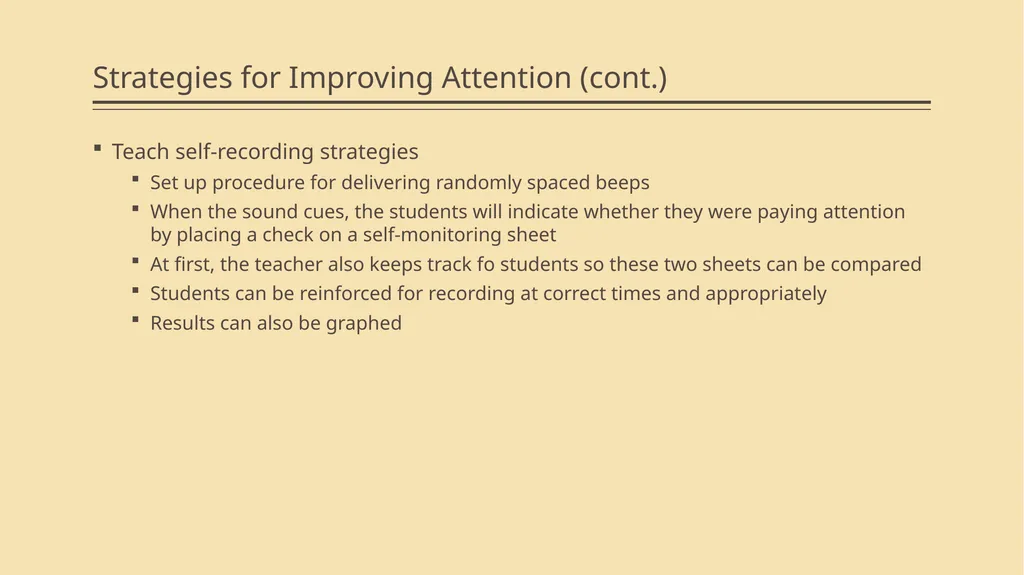
Strategies for Improving Attention (cont.) Teach self-recording strategies
Set up procedure for delivering randomly spaced beeps
When the sound cues, the students will indicate whether they were paying attention by placing a check on a self-monitoring sheet
At first, the teacher also keeps track fo students so these two sheets can be compared
Students can be reinforced for recording at correct times and appropriately
Results can also be graphed<br>
Set up procedure for delivering randomly spaced beeps
When the sound cues, the students will indicate whether they were paying attention by placing a check on a self-monitoring sheet
At first, the teacher also keeps track fo students so these two sheets can be compared
Students can be reinforced for recording at correct times and appropriately
Results can also be graphed<br>
31
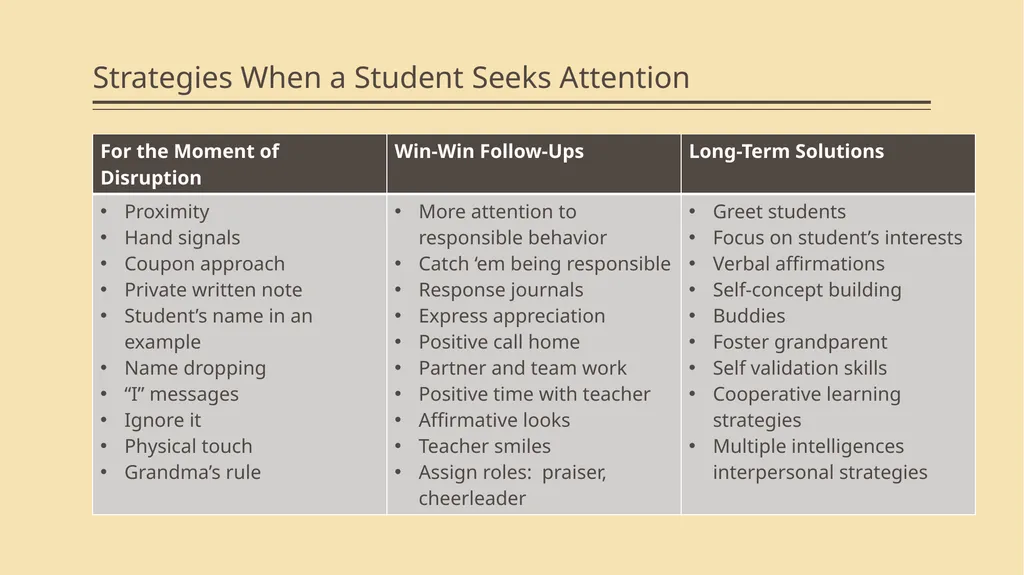
Strategies When a Student Seeks Attention<br>
32
Student Position Angry<br>
33
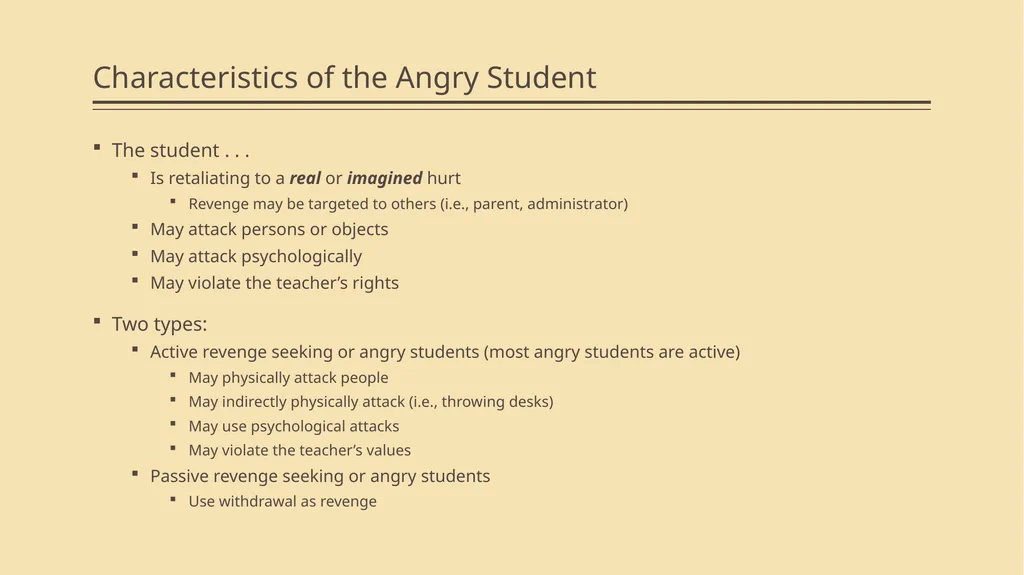
Characteristics of the Angry Student The student . . .
Is retaliating to a real or imagined hurt
Revenge may be targeted to others (i.e., parent, administrator)
May attack persons or objects
May attack psychologically
May violate the teacher’s rights
Two types:
Active revenge seeking or angry students (most angry students are active)
May physically attack people
May indirectly physically attack (i.e., throwing desks)
May use psychological attacks
May violate the teacher’s values
Passive revenge seeking or angry students
Use withdrawal as revenge<br>
Is retaliating to a real or imagined hurt
Revenge may be targeted to others (i.e., parent, administrator)
May attack persons or objects
May attack psychologically
May violate the teacher’s rights
Two types:
Active revenge seeking or angry students (most angry students are active)
May physically attack people
May indirectly physically attack (i.e., throwing desks)
May use psychological attacks
May violate the teacher’s values
Passive revenge seeking or angry students
Use withdrawal as revenge<br>
34
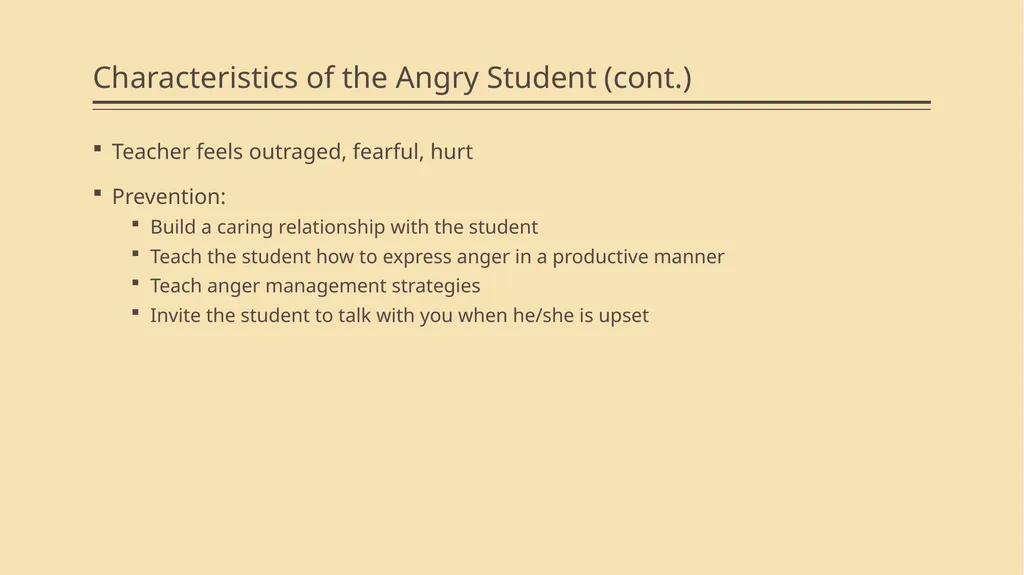
Characteristics of the Angry Student (cont.) Teacher feels outraged, fearful, hurt
Prevention:
Build a caring relationship with the student
Teach the student how to express anger in a productive manner
Teach anger management strategies
Invite the student to talk with you when he/she is upset<br>
Prevention:
Build a caring relationship with the student
Teach the student how to express anger in a productive manner
Teach anger management strategies
Invite the student to talk with you when he/she is upset<br>
35
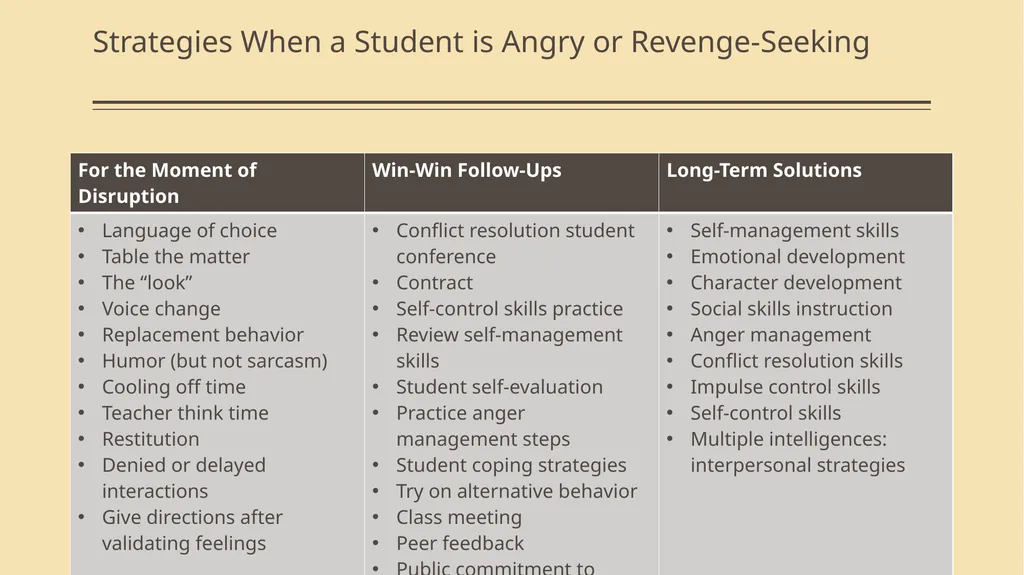
Strategies When a Student is Angry or Revenge-Seeking<br>
36
Student Position Avoiding Failure<br>
37
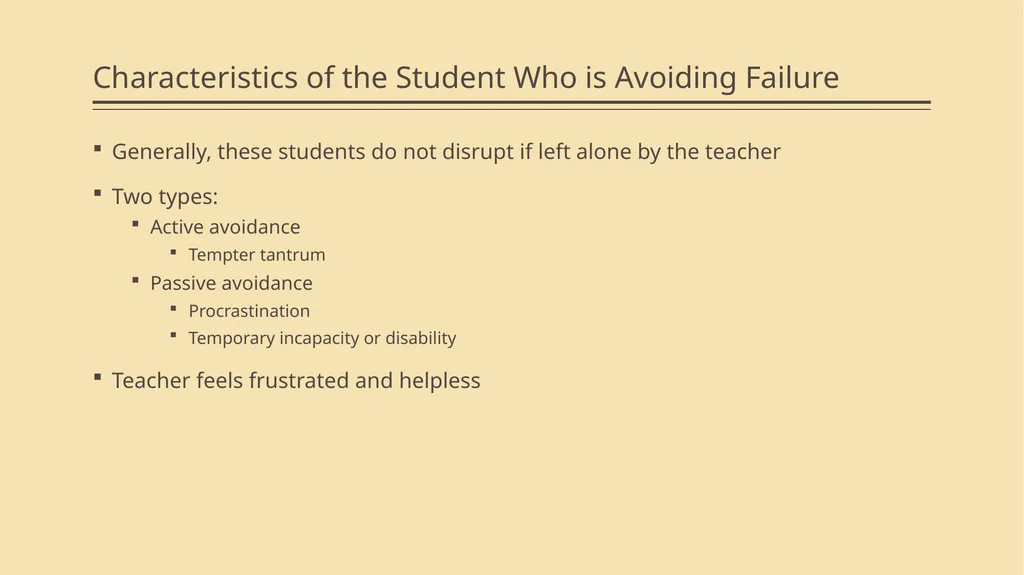
Characteristics of the Student Who is Avoiding Failure Generally, these students do not disrupt if left alone by the teacher
Two types:
Active avoidance
Tempter tantrum
Passive avoidance
Procrastination
Temporary incapacity or disability
Teacher feels frustrated and helpless<br>
Two types:
Active avoidance
Tempter tantrum
Passive avoidance
Procrastination
Temporary incapacity or disability
Teacher feels frustrated and helpless<br>
38
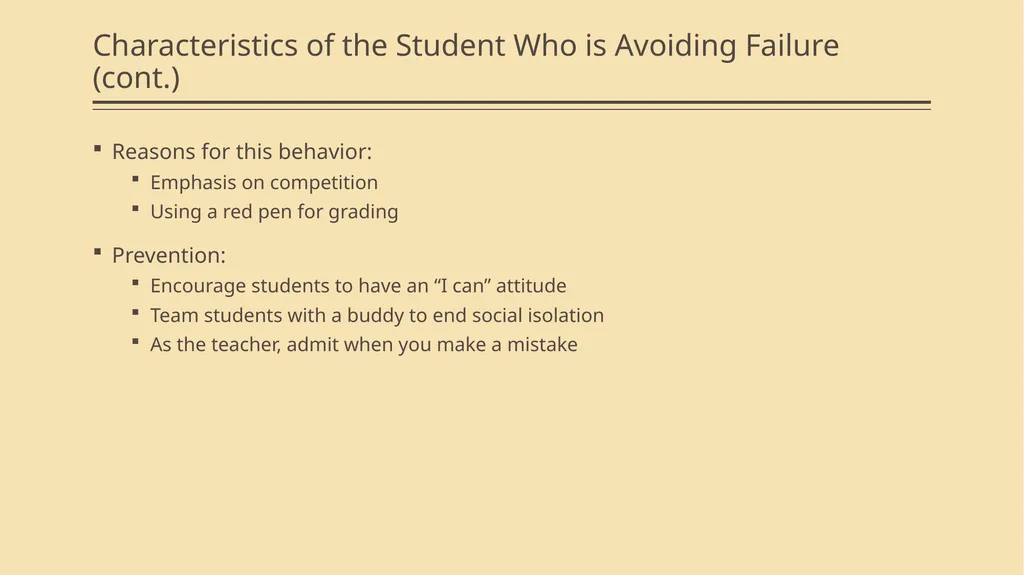
Characteristics of the Student Who is Avoiding Failure (cont.) Reasons for this behavior:
Emphasis on competition
Using a red pen for grading
Prevention:
Encourage students to have an “I can” attitude
Team students with a buddy to end social isolation
As the teacher, admit when you make a mistake<br>
Emphasis on competition
Using a red pen for grading
Prevention:
Encourage students to have an “I can” attitude
Team students with a buddy to end social isolation
As the teacher, admit when you make a mistake<br>
39
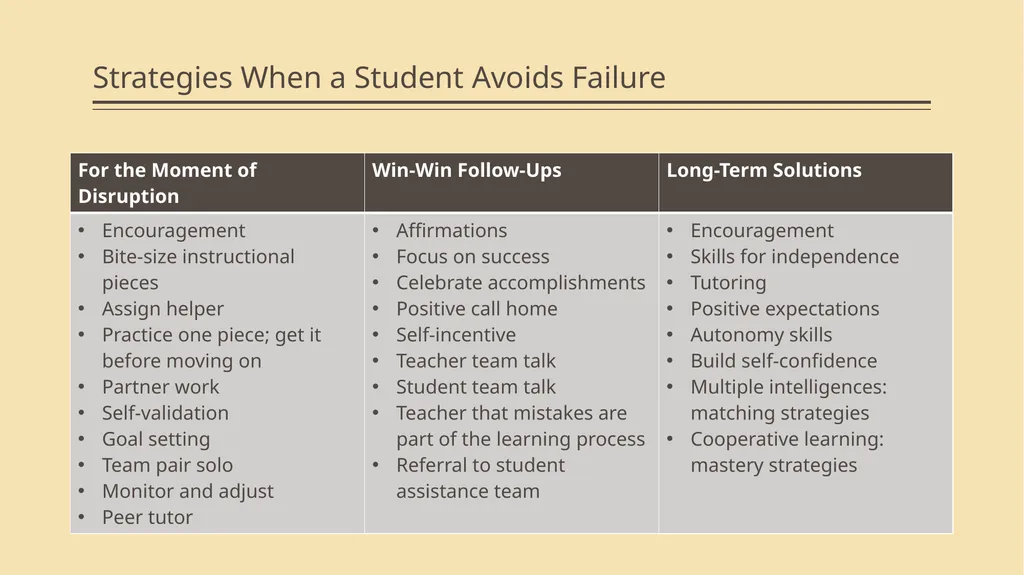
Strategies When a Student Avoids Failure<br>
40
Student Position Bored<br>
41
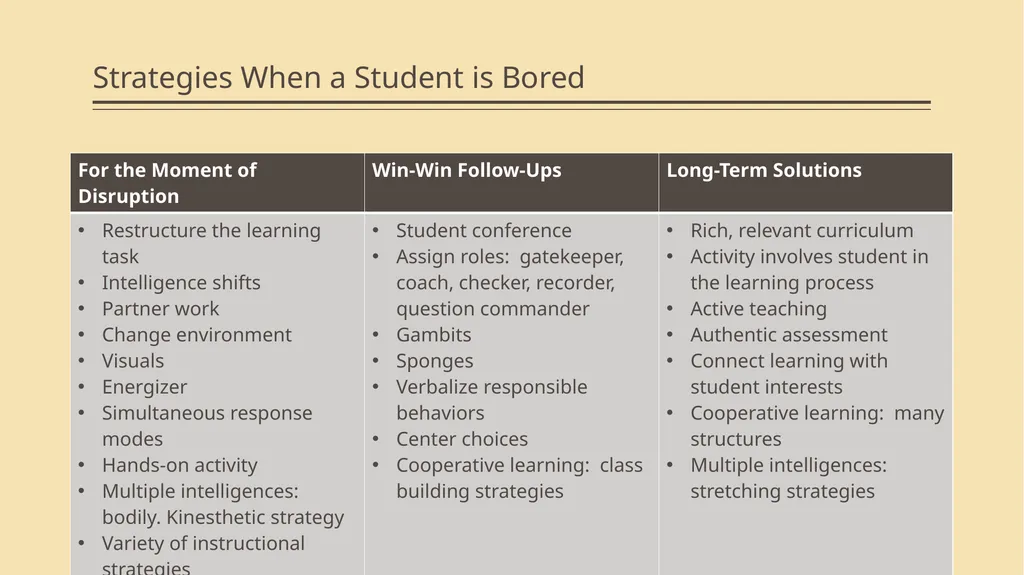
Strategies When a Student is Bored<br>
42
Student Position Excess Energy<br>
43
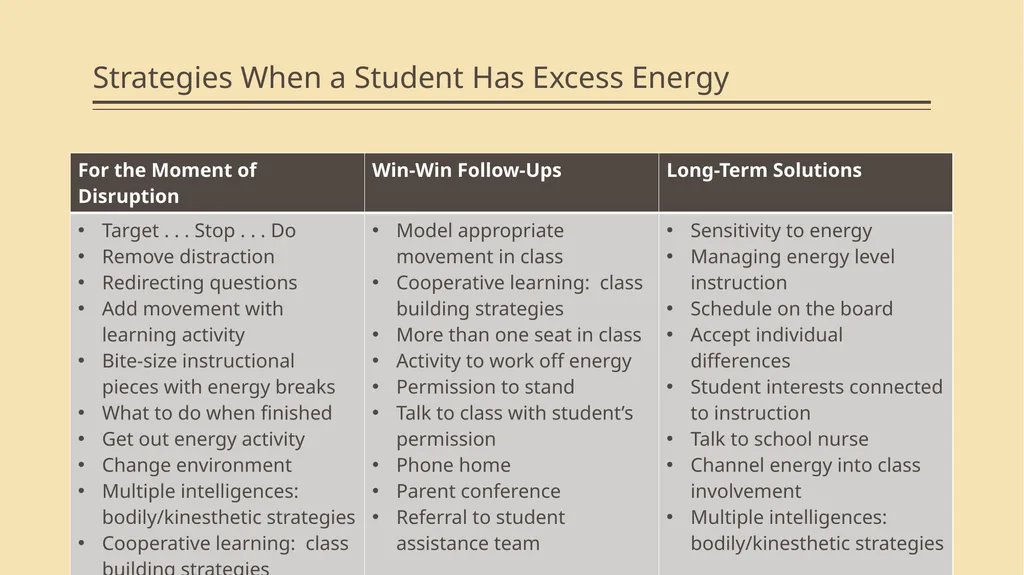
Strategies When a Student Has Excess Energy<br>
44
Student Position Control or Power Seeking<br>
45
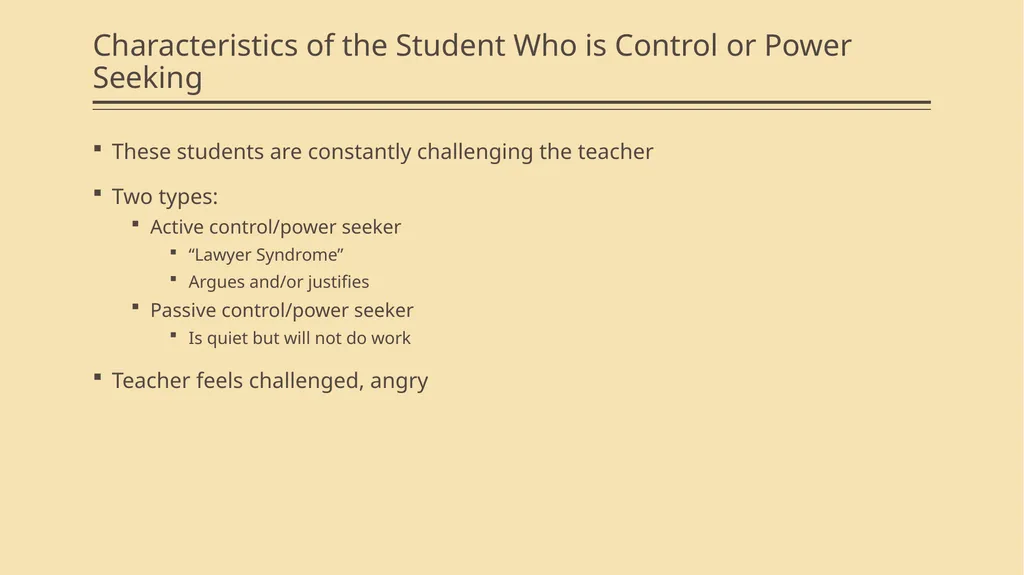
Characteristics of the Student Who is Control or Power Seeking These students are constantly challenging the teacher
Two types:
Active control/power seeker
“Lawyer Syndrome”
Argues and/or justifies
Passive control/power seeker
Is quiet but will not do work
Teacher feels challenged, angry<br>
Two types:
Active control/power seeker
“Lawyer Syndrome”
Argues and/or justifies
Passive control/power seeker
Is quiet but will not do work
Teacher feels challenged, angry<br>
46
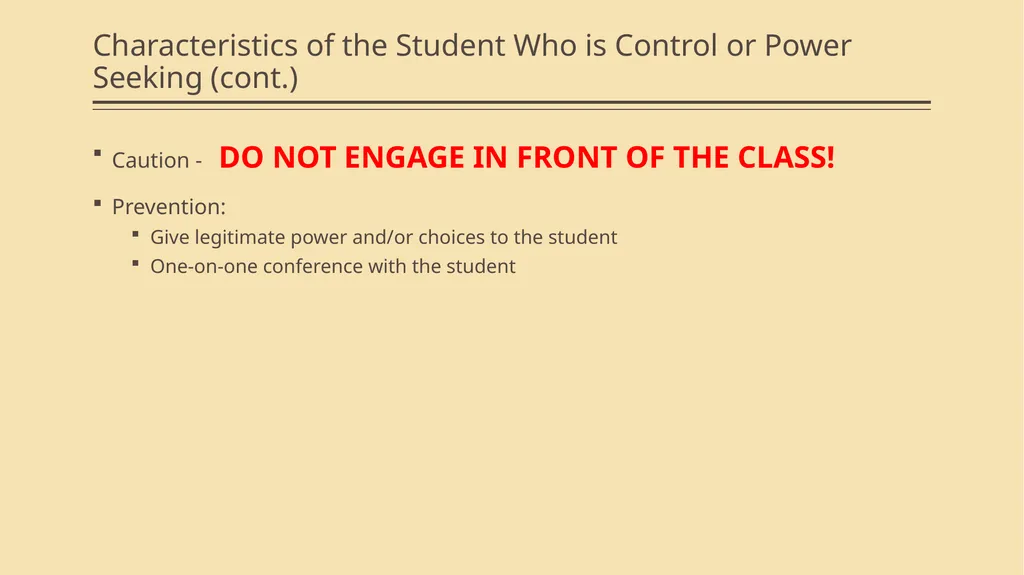
Characteristics of the Student Who is Control or Power Seeking (cont.) Caution - DO NOT ENGAGE IN FRONT OF THE CLASS!
Prevention:
Give legitimate power and/or choices to the student
One-on-one conference with the student<br>
Prevention:
Give legitimate power and/or choices to the student
One-on-one conference with the student<br>
47
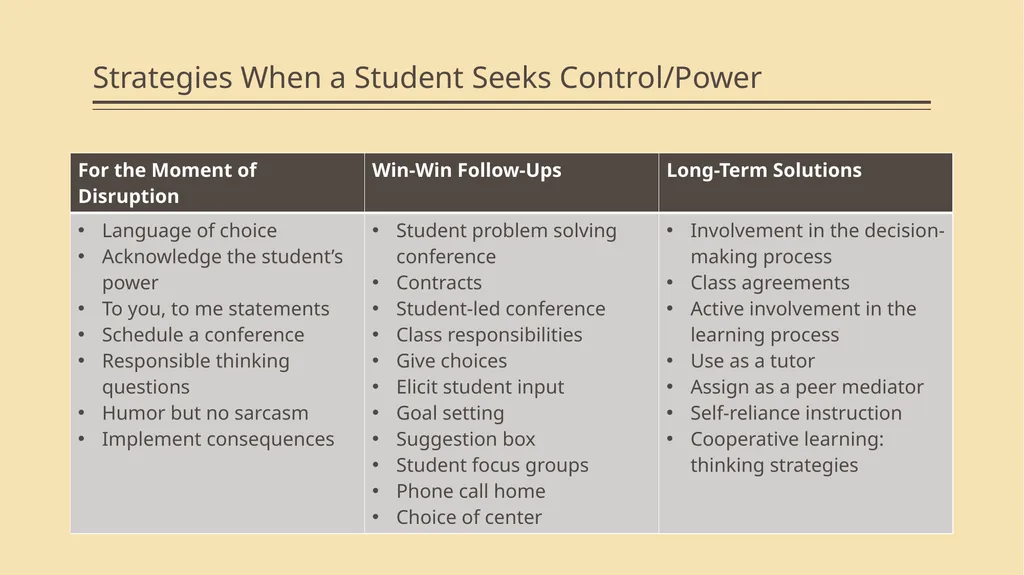
Strategies When a Student Seeks Control/Power<br>
48
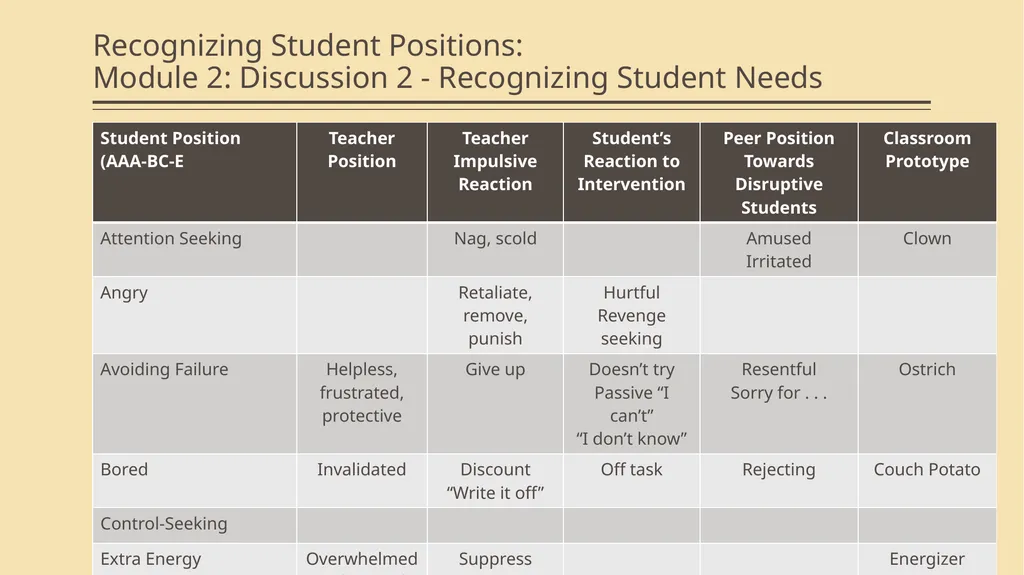
Recognizing Student Positions:
Module 2: Discussion 2 - Recognizing Student Needs<br>
49
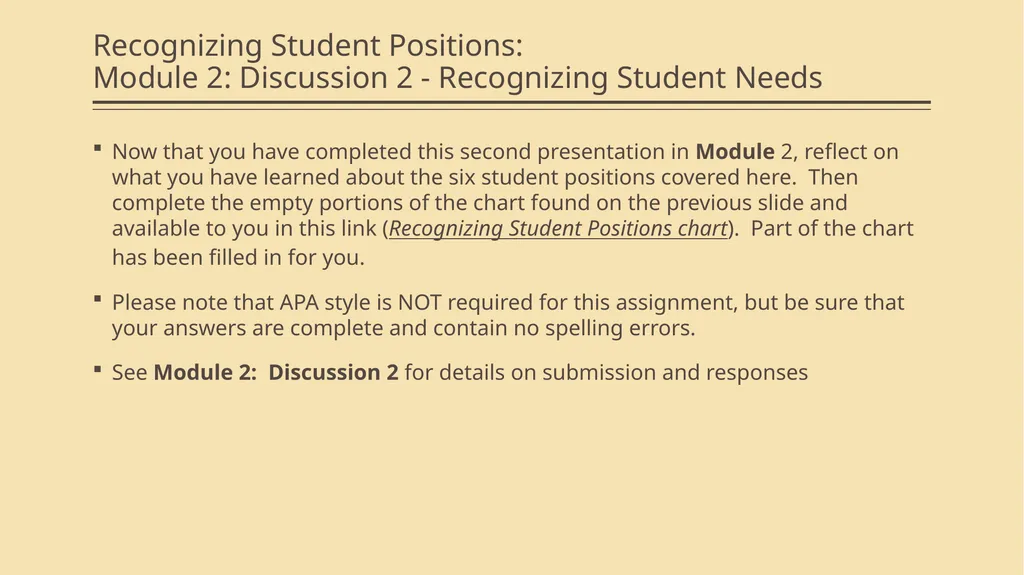
Recognizing Student Positions:
Module 2: Discussion 2 - Recognizing Student Needs Now that you have completed this second presentation in Module 2, reflect on what you have learned about the six student positions covered here. Then complete the empty portions of the chart found on the previous slide and available to you in this link (Recognizing Student Positions chart). Part of the chart has been filled in for you.
Please note that APA style is NOT required for this assignment, but be sure that your answers are complete and contain no spelling errors.
See Module 2: Discussion 2 for details on submission and responses<br>
Please note that APA style is NOT required for this assignment, but be sure that your answers are complete and contain no spelling errors.
See Module 2: Discussion 2 for details on submission and responses<br>
50
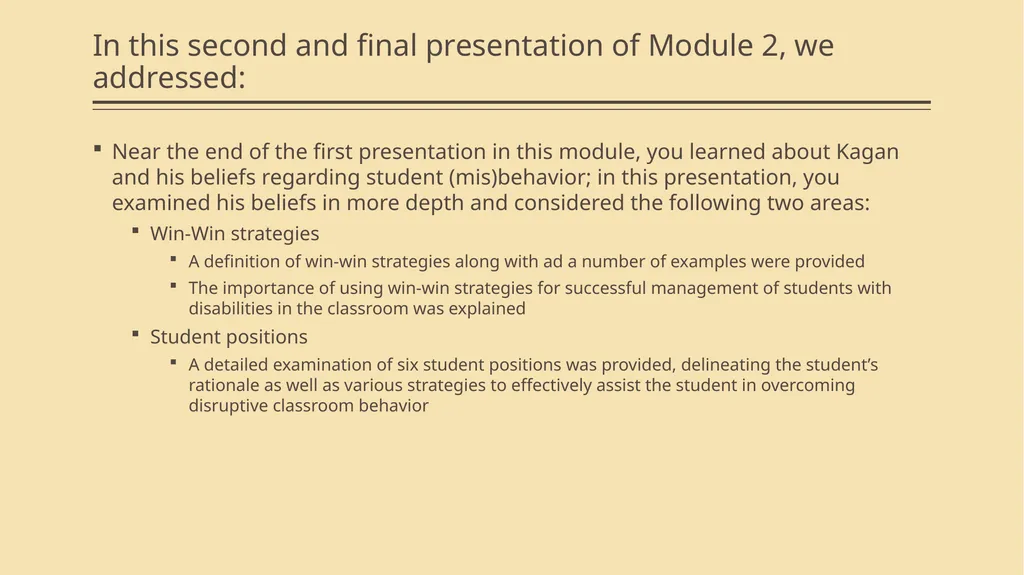
In this second and final presentation of Module 2, we addressed: Near the end of the first presentation in this module, you learned about Kagan and his beliefs regarding student (mis)behavior; in this presentation, you examined his beliefs in more depth and considered the following two areas:
Win-Win strategies
A definition of win-win strategies along with ad a number of examples were provided
The importance of using win-win strategies for successful management of students with disabilities in the classroom was explained
Student positions
A detailed examination of six student positions was provided, delineating the student’s rationale as well as various strategies to effectively assist the student in overcoming disruptive classroom behavior<br>
Win-Win strategies
A definition of win-win strategies along with ad a number of examples were provided
The importance of using win-win strategies for successful management of students with disabilities in the classroom was explained
Student positions
A detailed examination of six student positions was provided, delineating the student’s rationale as well as various strategies to effectively assist the student in overcoming disruptive classroom behavior<br>
51
Before moving forward . . . Review the previous slide
Decide if you are comfortable with the information presented in this presentation
If you are not comfortable, please go back and view all or part of this presentation again; if you continue to have questions, then please use the Ask Questions Here! page in the Getting Started area to get assistance
If you are comfortable, then you may continue with the remaining steps in Module 2<br>
Decide if you are comfortable with the information presented in this presentation
If you are not comfortable, please go back and view all or part of this presentation again; if you continue to have questions, then please use the Ask Questions Here! page in the Getting Started area to get assistance
If you are comfortable, then you may continue with the remaining steps in Module 2<br>
52
Thank You!<br>