Wool Part 2 (A part of Unit II- 3rd Prof. Year) Dr. Gargi Mahapatra Asst. Prof. cum Jnr. Sc. Dept. of Livestock Products Technology Bihar Veterinary College BASU, Patna. Development of Wool Wool follicles produce the mature fleece. Basal
"Wool Part 2 (A part of Unit II- 3rd Prof." is the property of its rightful owner. Permission is granted to
download and print the materials on this website for personal, non-commercial use only, and to display it
on your personal computer provided you do not modify the materials and that you retain all copyright
notices contained in the materials. By downloading content from our website, you accept the terms of this
agreement.
Presentation Transcript
01
Wool Part 2 (A part of Unit II- 3rd Prof. Year) Dr. Gargi Mahapatra
Asst. Prof. cum Jnr. Sc.
Dept. of Livestock Products Technology
Bihar Veterinary College
BASU, Patna.<br>
02
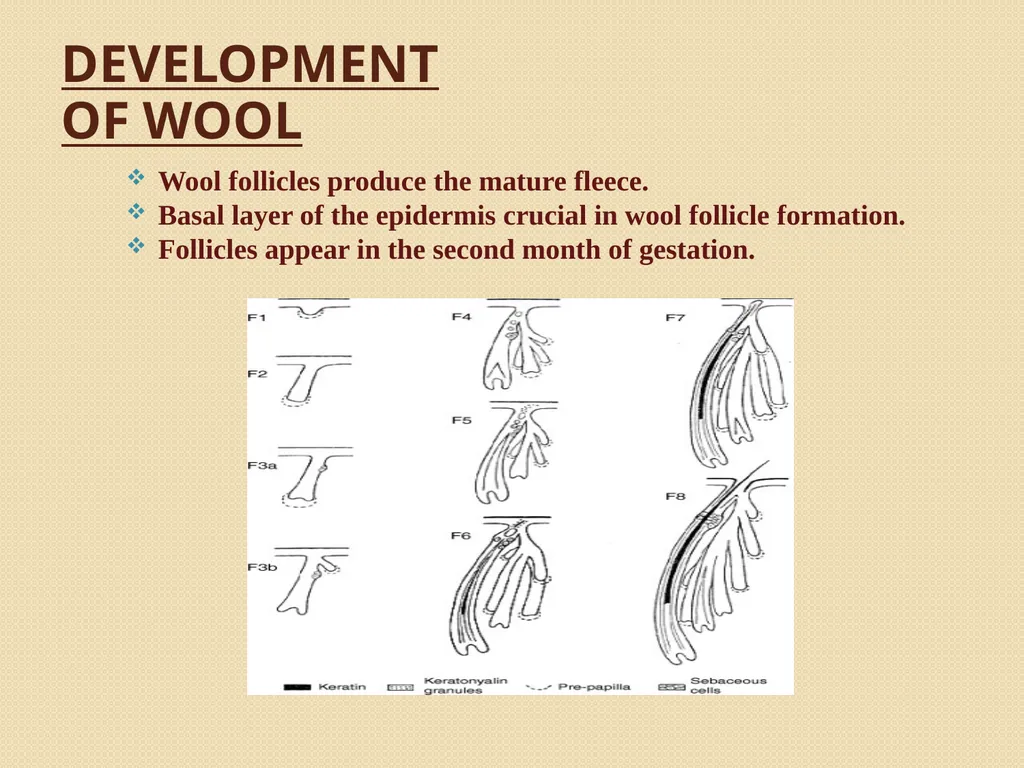
Development of Wool Wool follicles produce the mature fleece.
Basal layer of the epidermis crucial in wool follicle formation.
Follicles appear in the second month of gestation.<br>
03
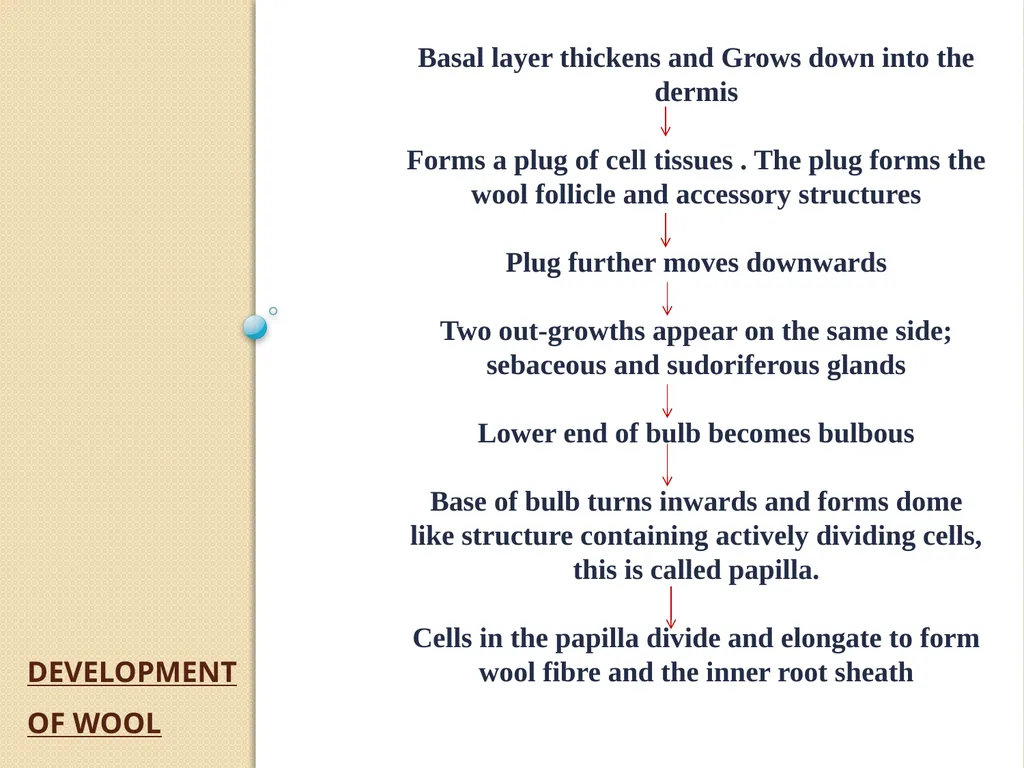
Development of Wool Basal layer thickens and Grows down into the dermis
Forms a plug of cell tissues . The plug forms the wool follicle and accessory structures
Plug further moves downwards
Two out-growths appear on the same side; sebaceous and sudoriferous glands
Lower end of bulb becomes bulbous
Base of bulb turns inwards and forms dome like structure containing actively dividing cells, this is called papilla.
Cells in the papilla divide and elongate to form wool fibre and the inner root sheath<br>
04
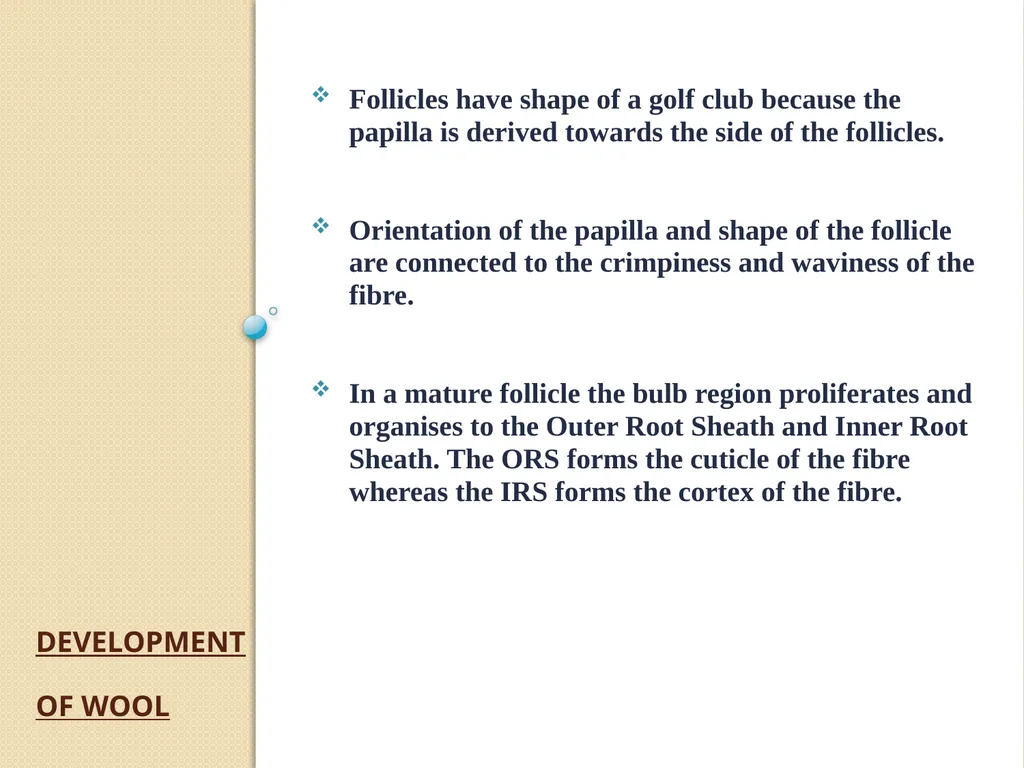
Development of Wool Follicles have shape of a golf club because the papilla is derived towards the side of the follicles.
Orientation of the papilla and shape of the follicle are connected to the crimpiness and waviness of the fibre.
In a mature follicle the bulb region proliferates and organises to the Outer Root Sheath and Inner Root Sheath. The ORS forms the cuticle of the fibre whereas the IRS forms the cortex of the fibre.<br>
05
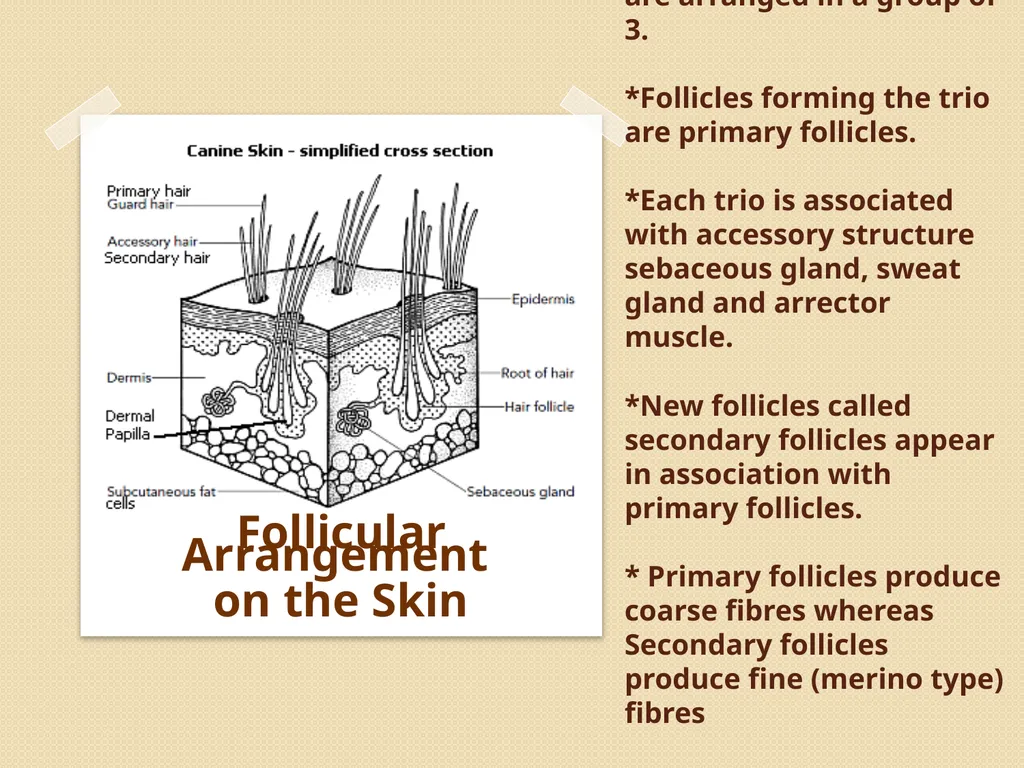
*Follicles in the unborn are arranged in a group of 3. *Follicles forming the trio are primary follicles. *Each trio is associated with accessory structure sebaceous gland, sweat gland and arrector muscle. *New follicles called secondary follicles appear in association with primary follicles. * Primary follicles produce coarse fibres whereas Secondary follicles produce fine (merino type) fibres Follicular Arrangement
on the Skin<br>
06
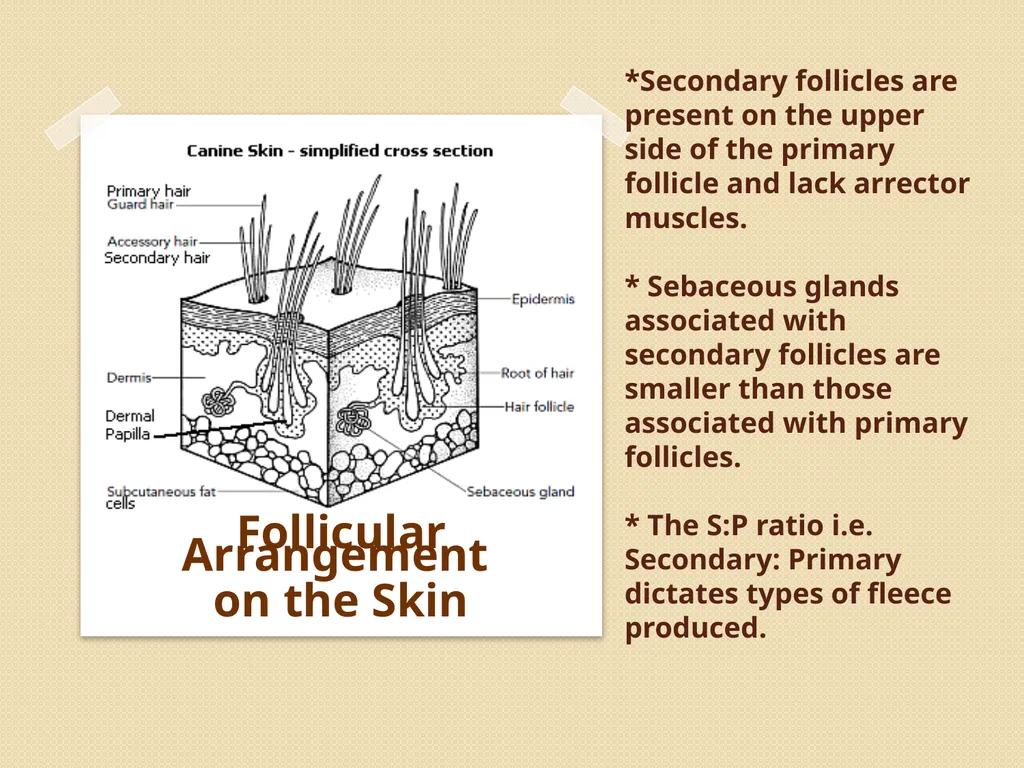
*Secondary follicles are present on the upper side of the primary follicle and lack arrector muscles. * Sebaceous glands associated with secondary follicles are smaller than those associated with primary follicles. * The S:P ratio i.e. Secondary: Primary dictates types of fleece produced. Follicular Arrangement
on the Skin<br>
07
Wool Shearing Process of clipping wool from sheep Preparing Animal for Shearing
Animal is washed 10-15 days before shearing
Animal should be kept off-feed 10 hr. prior shearing starts.
Clean each and every animal individually by picking soil and thorns from the fleece.
Clip away the dung and urine stained wool.
Move the cleaned animals to a clean pen, until their turn for shearing arrives
Place the animal on a clean and smooth board platform and then shear the animal either along or around the sheep.<br>
08
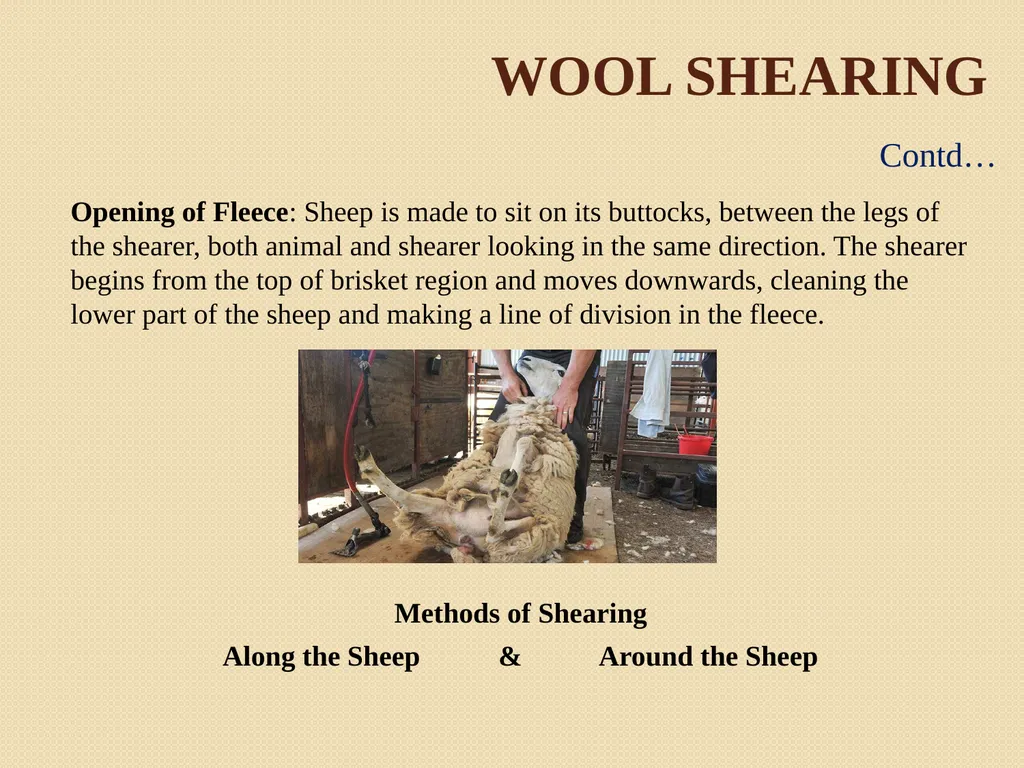
Wool Shearing Contd… Opening of Fleece: Sheep is made to sit on its buttocks, between the legs of the shearer, both animal and shearer looking in the same direction. The shearer begins from the top of brisket region and moves downwards, cleaning the lower part of the sheep and making a line of division in the fleece.
Methods of Shearing
Along the Sheep & Around the Sheep<br>
09
Time of Shearing Spring/ Before Summer- March to April
Autumn/ Before Winter- September to October
(Animal is generally sheared on an annual basis)<br>
10
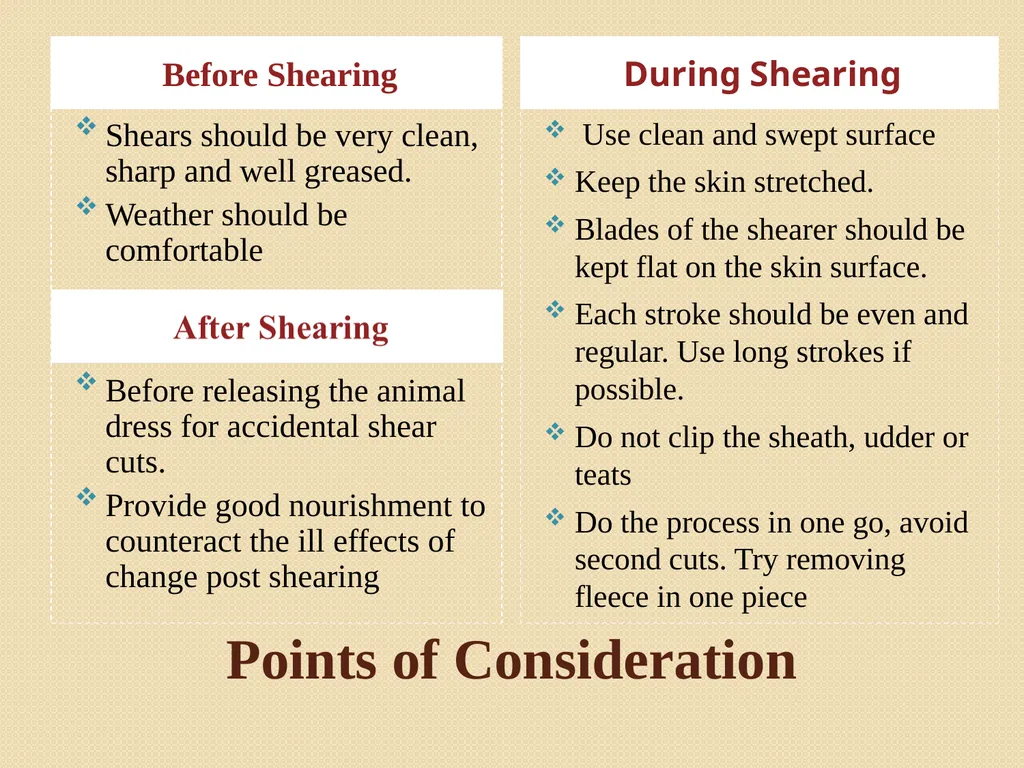
Points of Consideration Before Shearing During Shearing Shears should be very clean, sharp and well greased.
Weather should be comfortable
Before releasing the animal dress for accidental shear cuts.
Provide good nourishment to counteract the ill effects of change post shearing Use clean and swept surface
Keep the skin stretched.
Blades of the shearer should be kept flat on the skin surface.
Each stroke should be even and regular. Use long strokes if possible.
Do not clip the sheath, udder or teats
Do the process in one go, avoid second cuts. Try removing fleece in one piece<br>
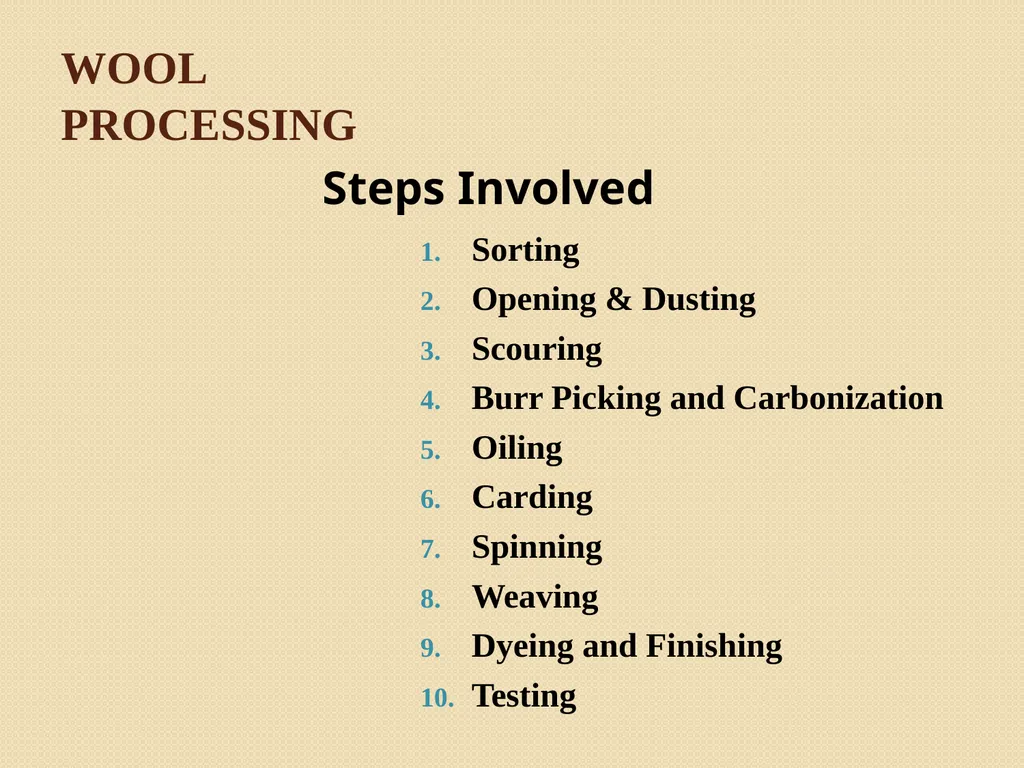
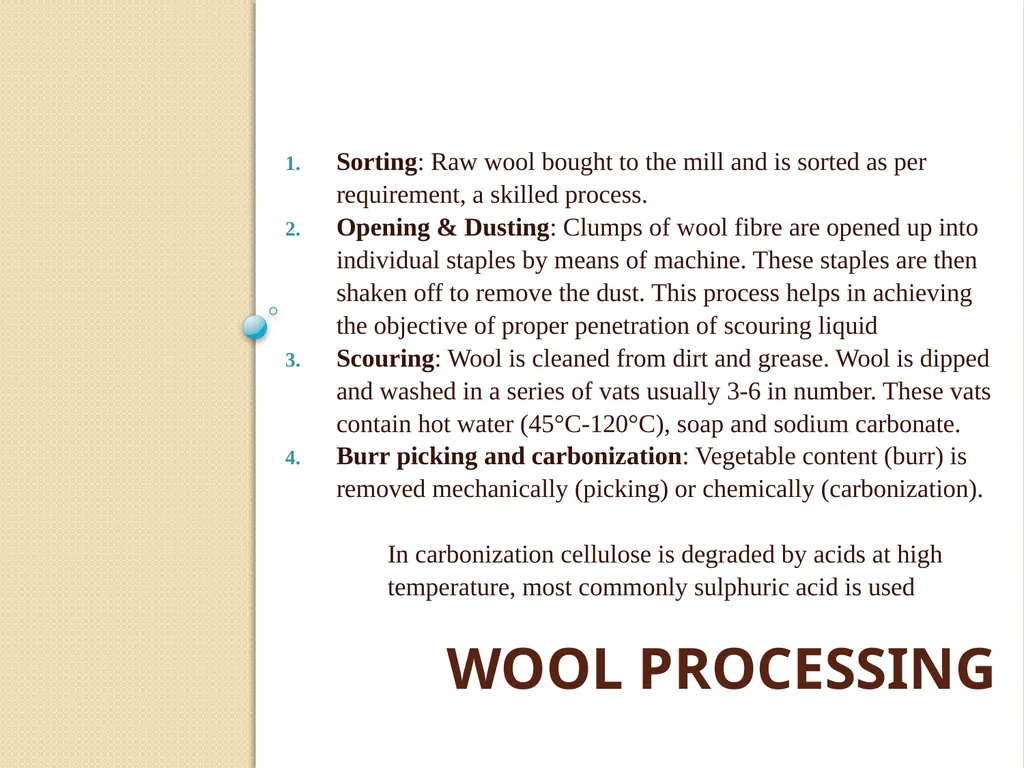
Wool processing Sorting: Raw wool bought to the mill and is sorted as per requirement, a skilled process.
Opening & Dusting: Clumps of wool fibre are opened up into individual staples by means of machine. These staples are then shaken off to remove the dust. This process helps in achieving the objective of proper penetration of scouring liquid
Scouring: Wool is cleaned from dirt and grease. Wool is dipped and washed in a series of vats usually 3-6 in number. These vats contain hot water (45°C-120°C), soap and sodium carbonate.
Burr picking and carbonization: Vegetable content (burr) is removed mechanically (picking) or chemically (carbonization).
In carbonization cellulose is degraded by acids at high temperature, most commonly sulphuric acid is used<br>
13
Wool processing contd… Oiling: Wool fibre is lubricated with oil emulsion to reduce breakage of fibre and maximise cohesion. Generally, mineral oils are emulsified with non-ioninc soaps @ 3-5% of wool wt.
Carding: Wool fibres are blended into one another, vegetable matter is removed, fibres are straightened and laid in such manner that they lie parallel to each other, all pointing in the same direction. The wool fibre are bundled into strips known as “Roving/Sliver”.
Spinning: The roving's are passed through small rollers, applying a twist that gives the resulting yarn strength and size.
Weaving: One of the most crucial part. The whole process provides a basis for the final product. It intertwines the yarns into desired product
It includes a number of steps namely; cone winding, warp preparation, warp sizing, pirn winding of welt yarns and tying in and drying in of the wrap<br>
14
Wool processing contd… Dyeing : Dyeing refers to induction of permanent colour into the wool fibres. Dyes used for wools are classified as Acid Dyes; Metal Complex Dyes; Chrome Dyes; Vat Dyes; Reactive Dyes and Direct Dyes. Some commonly used dyes are Rhodamine b, Rhodamine C, Sandoz Yellow, Sand Blue etc.
Finishing: This process improves the appearance of the garment, as that received from loom, thereby making it more acceptable to buyer. Steps involved in finishing are Milling; Carbonization; Raising and Shearing.
Testing: Critical examination of the end product to obtain desirable quantitative and qualitative information. This process assesses the quality, value, defect and other characteristics of the end product.<br>
15
Steps involved in finishing Milling; Carbonization; Raising and Shearing. Milling: Shrinkage of the fabric to the required degree in order to thicken it and give it a desired appearance.
Carbonization: Chemically burr is removed by treating the finished product with dilute acid at high temperature. Thereafter wrinkles are removed by bearming.
Raising: This process involves lifting out of wool from the body of the fabric. The action is simply to entangle fibres with sharp points of wire roller and bring them to the surface of the fabric.
Shearing: The fibres which have been raised out during brushing/raising, from the cloth surface are levelled out.<br>
16
Organizations Having Standard Testing Procedures Indian Standard Association (ISI)