
Work Experience Education Update and
Description: Work Experience Education Update and Opportunities: Noncredit Work Experience Kimberley H. Stiemke, Professor, NOCE Richard Gholson, Curriculum Chair, SDCCE Amy Babb, WEE Faculty, Academic Senate President, CIWEA Board of Directors, Lemoore
Related Topics
Download Presentation
"Work Experience Education Update and" is the property of its rightful owner. Permission is granted to download and print the materials on this website for personal, non-commercial use only, and to display it on your personal computer provided you do not modify the materials and that you retain all copyright notices contained in the materials. By downloading content from our website, you accept the terms of this agreement.
Presentation Transcript
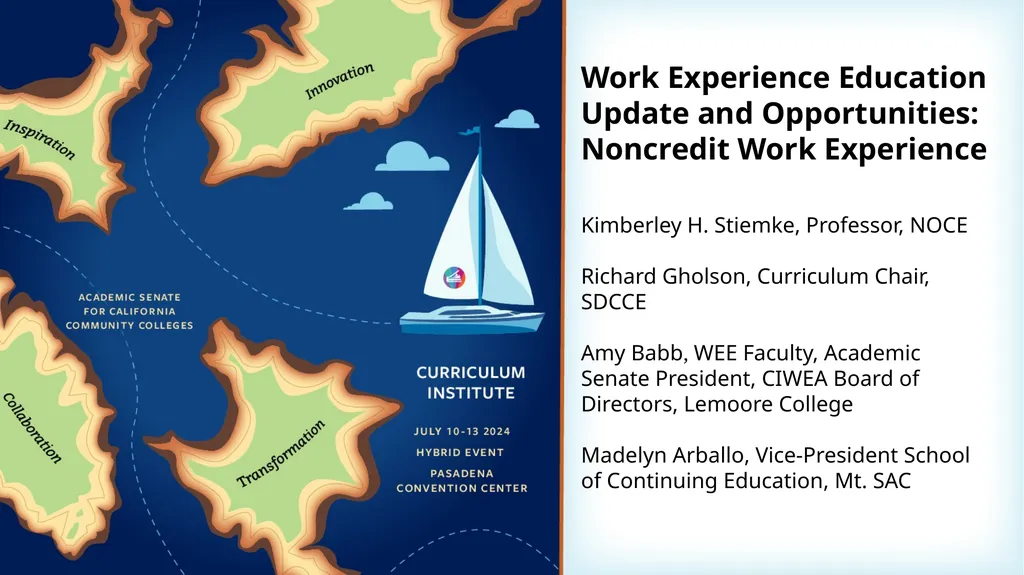
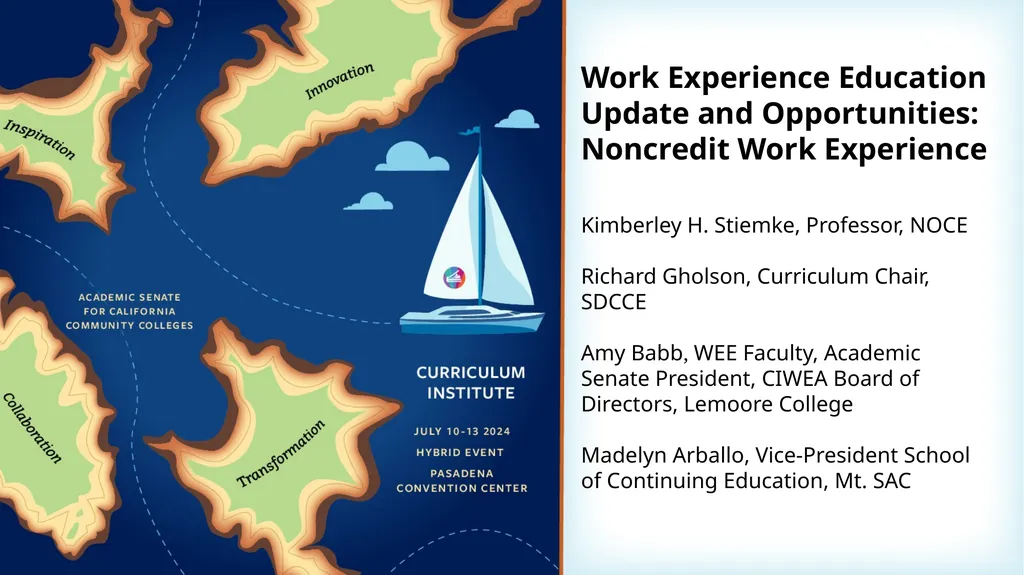
slide1. Work Experience Education Update and Opportunities: Noncredit Work Experience
Kimberley H. Stiemke, Professor, NOCE
Richard Gholson, Curriculum Chair, SDCCE
Amy Babb, WEE Faculty, Academic Senate President, CIWEA Board of Directors, Lemoore College
Madelyn Arballo, Vice-President School of Continuing Education, Mt. SAC<br>
slide2. Session Topics 2<br>
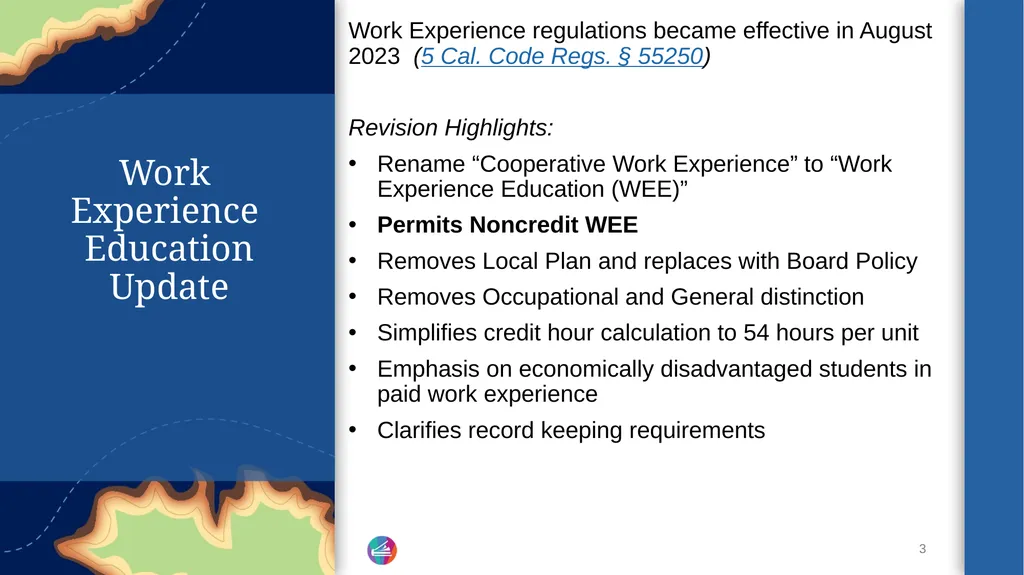
slide3. Work Experience Education Update 3 Work Experience regulations became effective in August 2023 (5 Cal. Code Regs. § 55250)
Revision Highlights:
Rename “Cooperative Work Experience” to “Work Experience Education (WEE)”
Permits Noncredit WEE
Removes Local Plan and replaces with Board Policy
Removes Occupational and General distinction
Simplifies credit hour calculation to 54 hours per unit
Emphasis on economically disadvantaged students in paid work experience
Clarifies record keeping requirements<br>
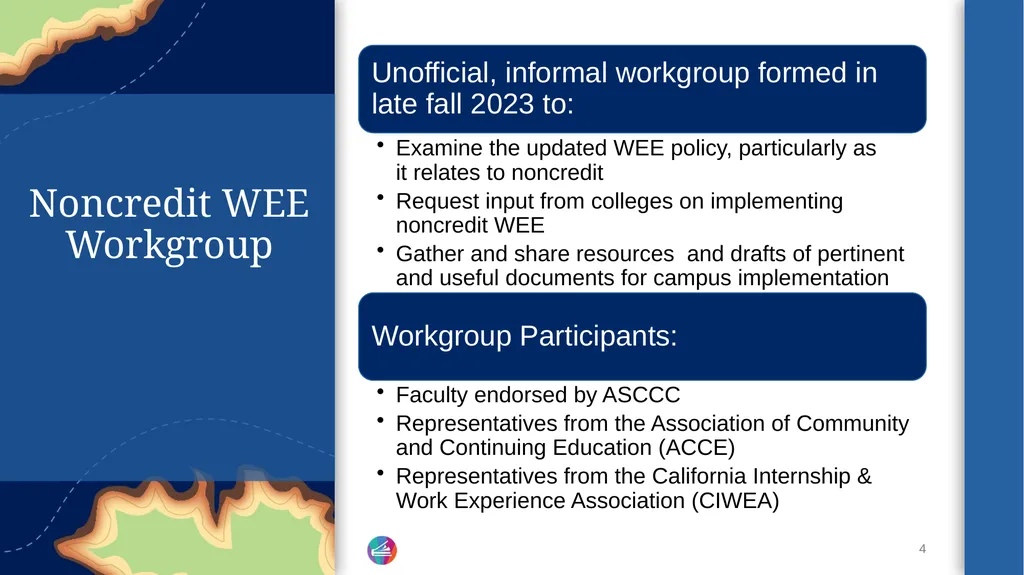
slide4. Noncredit WEE Workgroup 4<br>
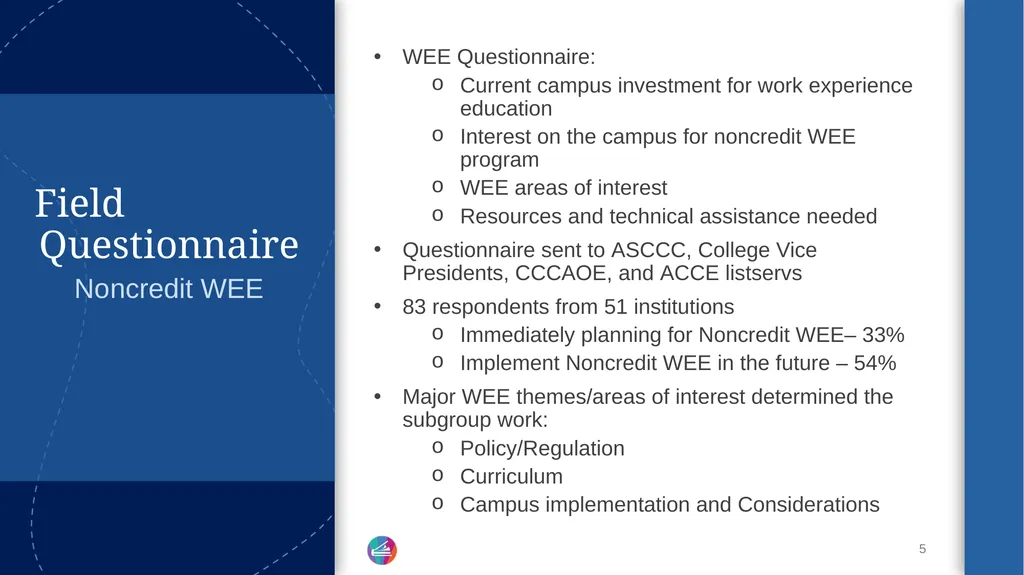
slide5. Field Questionnaire Noncredit WEE 5 WEE Questionnaire:
Current campus investment for work experience education
Interest on the campus for noncredit WEE program
WEE areas of interest
Resources and technical assistance needed
Questionnaire sent to ASCCC, College Vice Presidents, CCCAOE, and ACCE listservs
83 respondents from 51 institutions
Immediately planning for Noncredit WEE– 33%
Implement Noncredit WEE in the future – 54%
Major WEE themes/areas of interest determined the subgroup work:
Policy/Regulation
Curriculum
Campus implementation and Considerations<br>
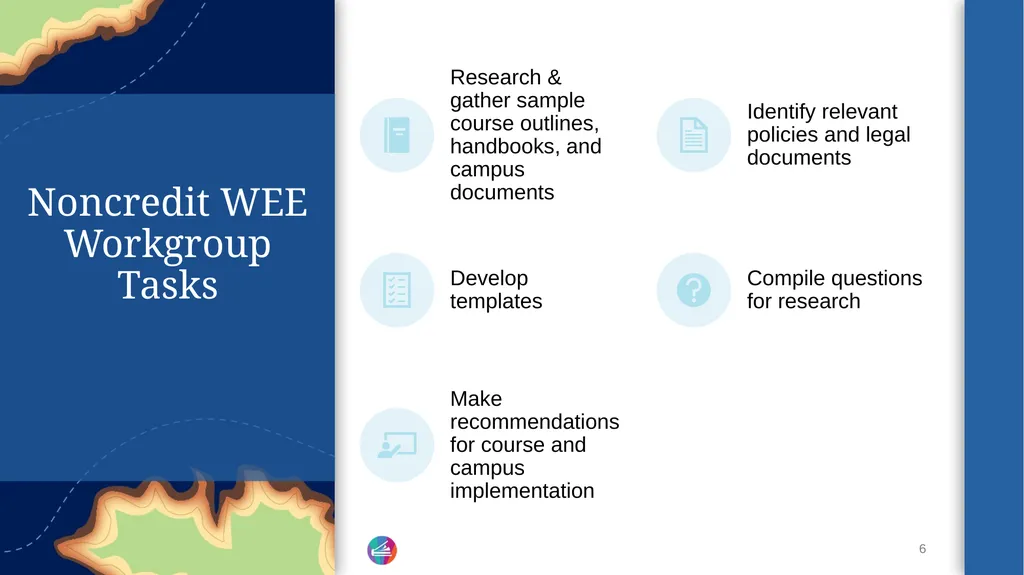
slide6. Noncredit WEE Workgroup Tasks 6<br>
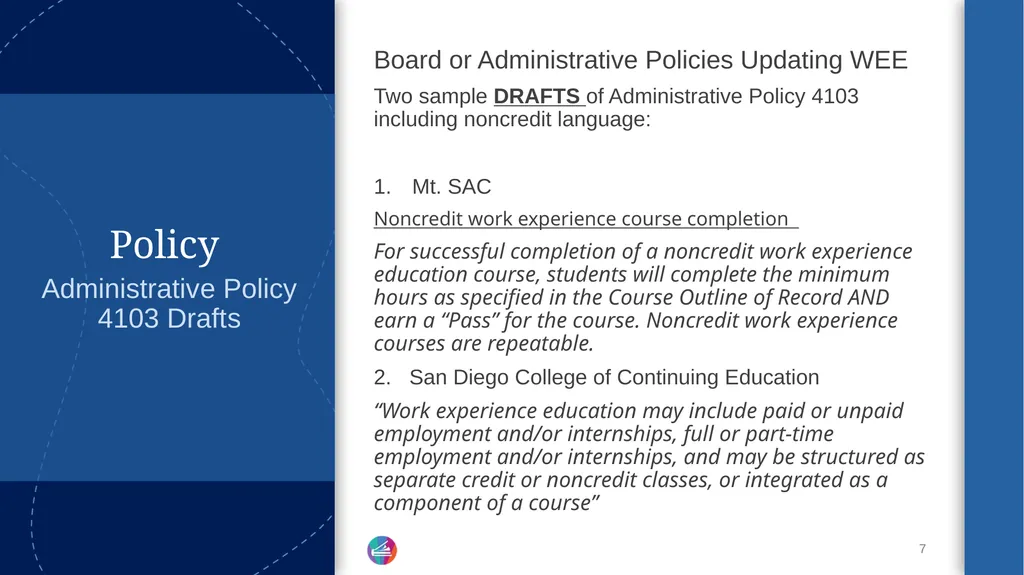
slide7. Policy Administrative Policy 4103 Drafts 7 Board or Administrative Policies Updating WEE
Two sample DRAFTS of Administrative Policy 4103 including noncredit language:
Mt. SAC
Noncredit work experience course completion
For successful completion of a noncredit work experience education course, students will complete the minimum hours as specified in the Course Outline of Record AND earn a “Pass” for the course. Noncredit work experience courses are repeatable.
2. San Diego College of Continuing Education
“Work experience education may include paid or unpaid employment and/or internships, full or part-time employment and/or internships, and may be structured as separate credit or noncredit classes, or integrated as a component of a course”<br>
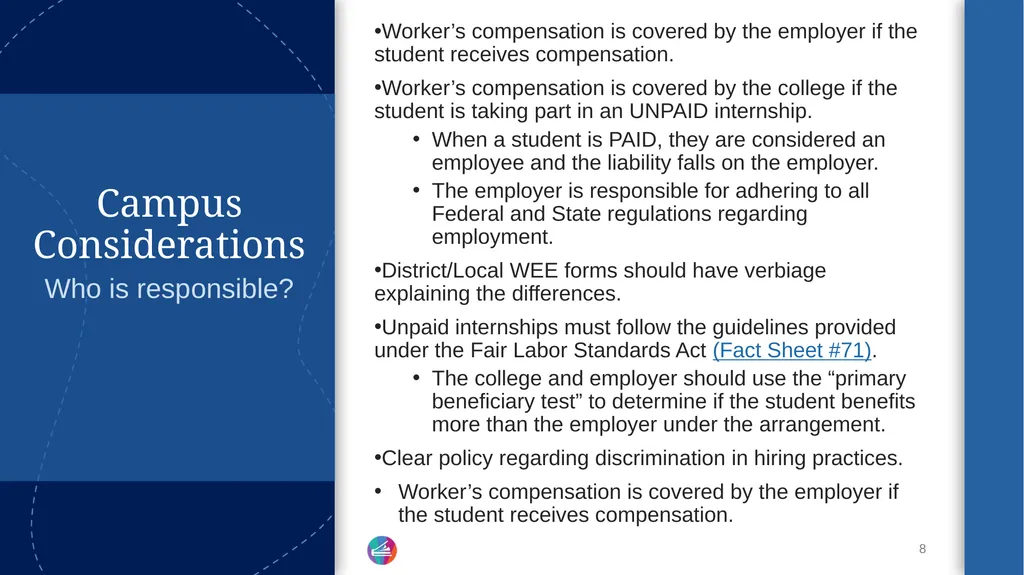
slide8. Campus Considerations Who is responsible? 8 Worker’s compensation is covered by the employer if the student receives compensation.
Worker’s compensation is covered by the college if the student is taking part in an UNPAID internship.
When a student is PAID, they are considered an employee and the liability falls on the employer.
The employer is responsible for adhering to all Federal and State regulations regarding employment.
District/Local WEE forms should have verbiage explaining the differences.
Unpaid internships must follow the guidelines provided under the Fair Labor Standards Act (Fact Sheet #71).
The college and employer should use the “primary beneficiary test” to determine if the student benefits more than the employer under the arrangement.
Clear policy regarding discrimination in hiring practices.
Worker’s compensation is covered by the employer if the student receives compensation.<br>
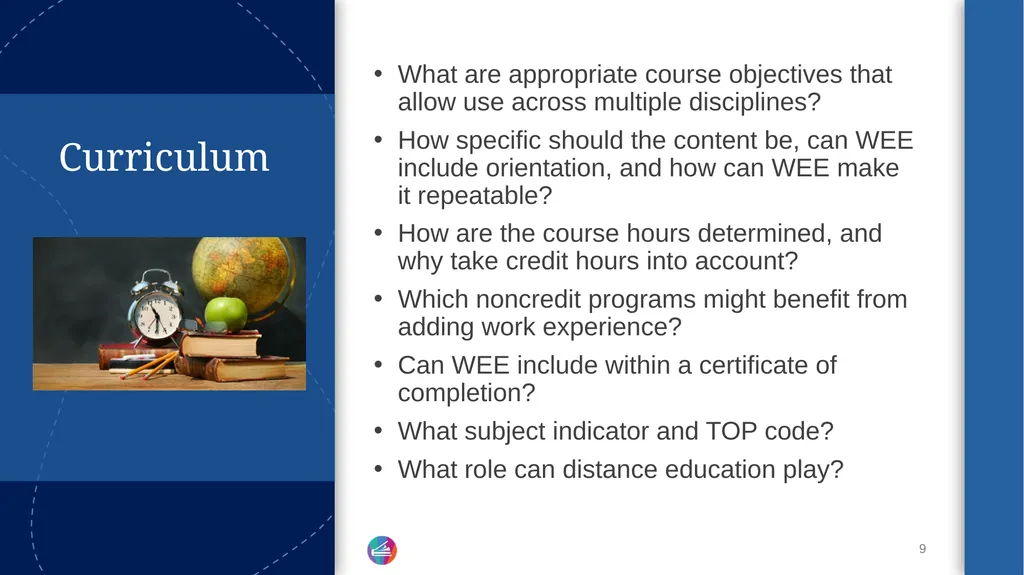
slide9. Curriculum What are appropriate course objectives that allow use across multiple disciplines?
How specific should the content be, can WEE include orientation, and how can WEE make it repeatable?
How are the course hours determined, and why take credit hours into account?
Which noncredit programs might benefit from adding work experience?
Can WEE include within a certificate of completion?
What subject indicator and TOP code?
What role can distance education play? 9<br>
slide10. Course Objectives Recommendations, Options, and Considerations 10 Focus on growth and learning elements as expressed in the objectives, rather than the number of hours worked. (Example SDCCD SMART objectives, 1 OBJ per unit) Link to COR.
Important to have a structured collaboration between students, instructors, and employers, hours should be in this context.
Importance and benefits of students setting their own learning objectives.<br>
slide11. Course Hours Recommendations, Options, and Considerations Use course hour ranges as hour requirements may vary.
Minimum hours should account for: employer investment in new employee or intern, time commitment for feedback and meetings.
Consider including outside-of-class time in the course hours
Consider aligning with credit requirements (54 hrs per unit) to create opportunities for CBE/CPL
Better opportunities to mirror courses (single course/instructor, advantages for scheduling)
Eligibility of work experience courses for credit for prior learning should be noted on outline 11<br>
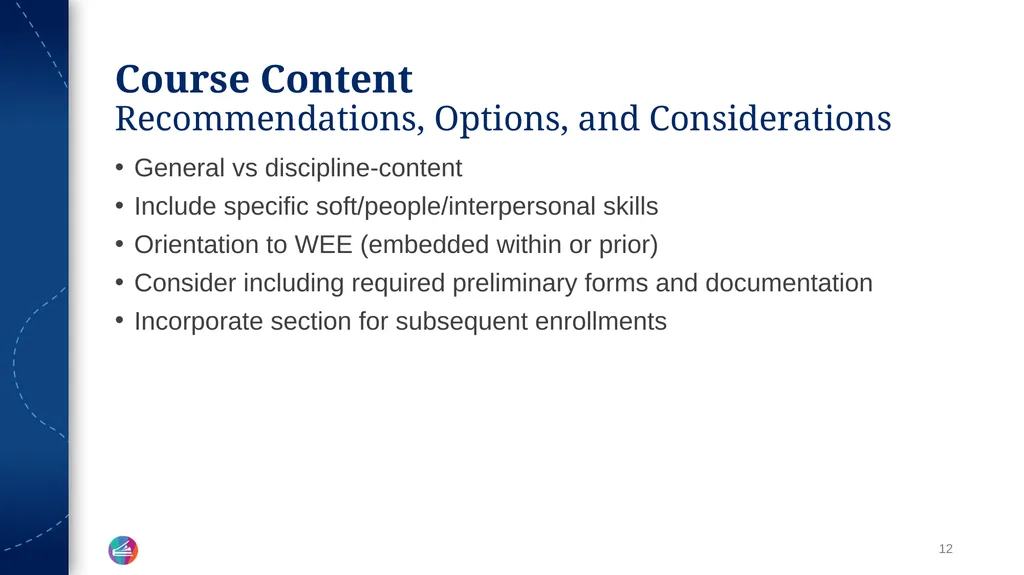
slide12. Course Content Recommendations, Options, and Considerations General vs discipline-content
Include specific soft/people/interpersonal skills
Orientation to WEE (embedded within or prior)
Consider including required preliminary forms and documentation
Incorporate section for subsequent enrollments 12<br>
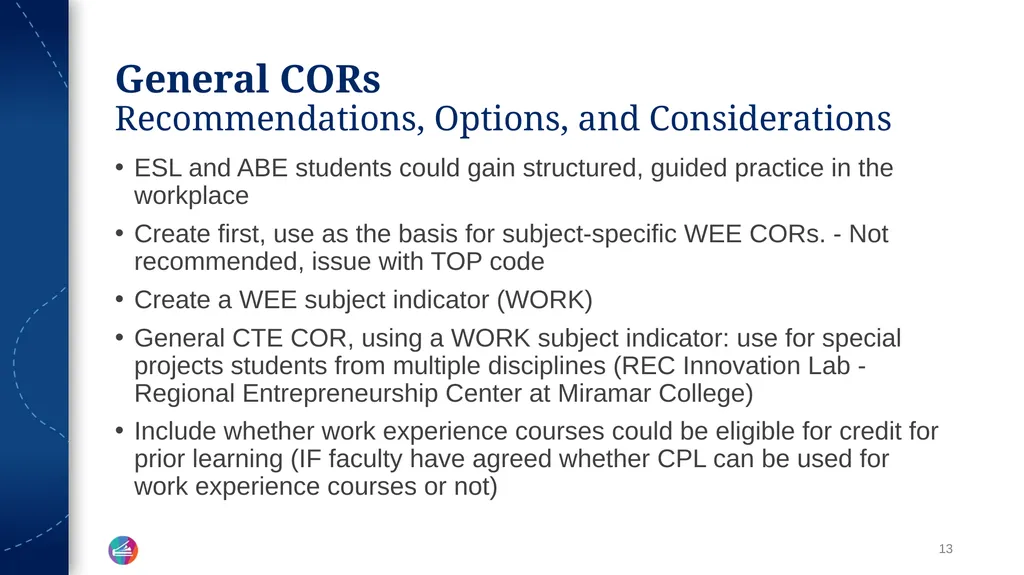
slide13. General CORs Recommendations, Options, and Considerations ESL and ABE students could gain structured, guided practice in the workplace
Create first, use as the basis for subject-specific WEE CORs. - Not recommended, issue with TOP code
Create a WEE subject indicator (WORK)
General CTE COR, using a WORK subject indicator: use for special projects students from multiple disciplines (REC Innovation Lab - Regional Entrepreneurship Center at Miramar College)
Include whether work experience courses could be eligible for credit for prior learning (IF faculty have agreed whether CPL can be used for work experience courses or not) 13<br>
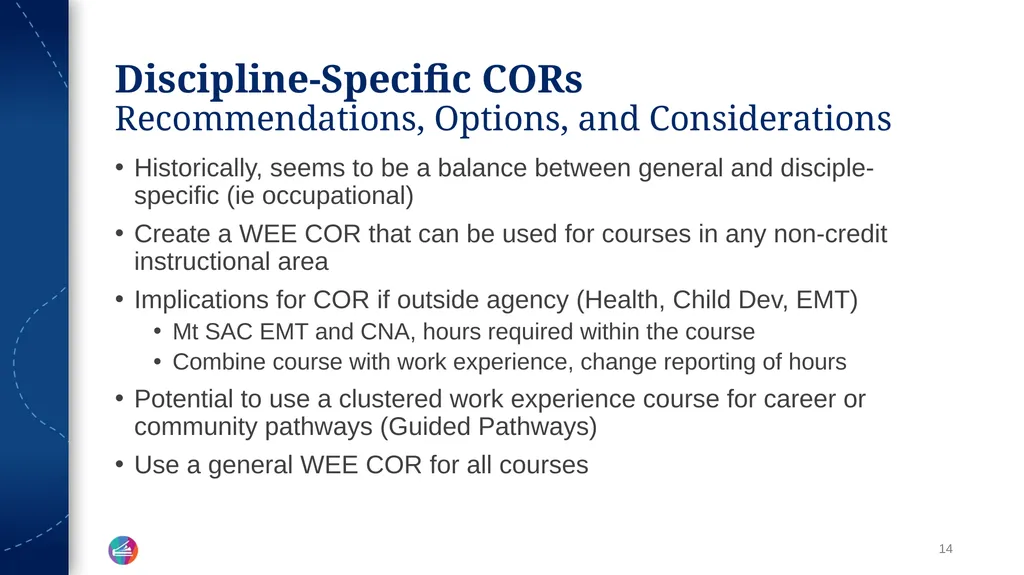
slide14. Discipline-Specific CORs Recommendations, Options, and Considerations Historically, seems to be a balance between general and disciple-specific (ie occupational)
Create a WEE COR that can be used for courses in any non-credit instructional area
Implications for COR if outside agency (Health, Child Dev, EMT)
Mt SAC EMT and CNA, hours required within the course
Combine course with work experience, change reporting of hours
Potential to use a clustered work experience course for career or community pathways (Guided Pathways)
Use a general WEE COR for all courses 14<br>
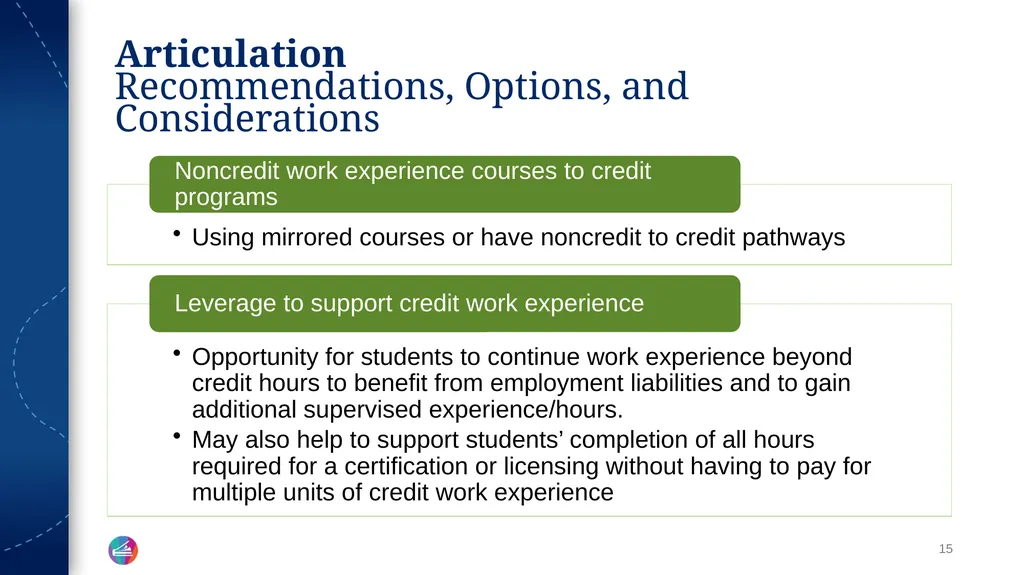
slide15. Articulation Recommendations, Options, and Considerations 15<br>
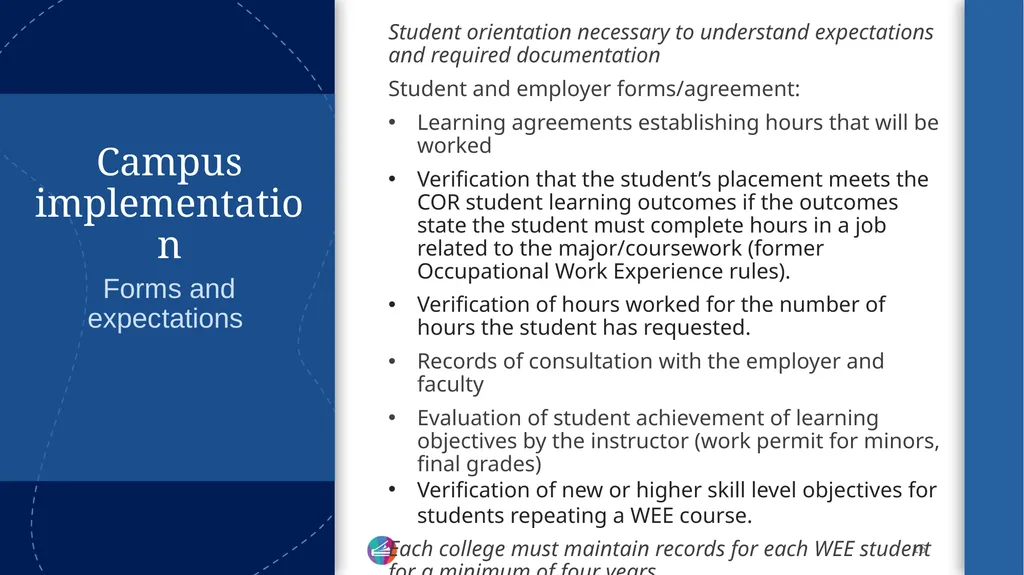
slide16. Campus implementation Forms and expectations 16 Student orientation necessary to understand expectations and required documentation
Student and employer forms/agreement:
Learning agreements establishing hours that will be worked
Verification that the student’s placement meets the COR student learning outcomes if the outcomes state the student must complete hours in a job related to the major/coursework (former Occupational Work Experience rules).
Verification of hours worked for the number of hours the student has requested.
Records of consultation with the employer and faculty
Evaluation of student achievement of learning objectives by the instructor (work permit for minors, final grades)
Verification of new or higher skill level objectives for students repeating a WEE course.
Each college must maintain records for each WEE student for a minimum of four years<br>
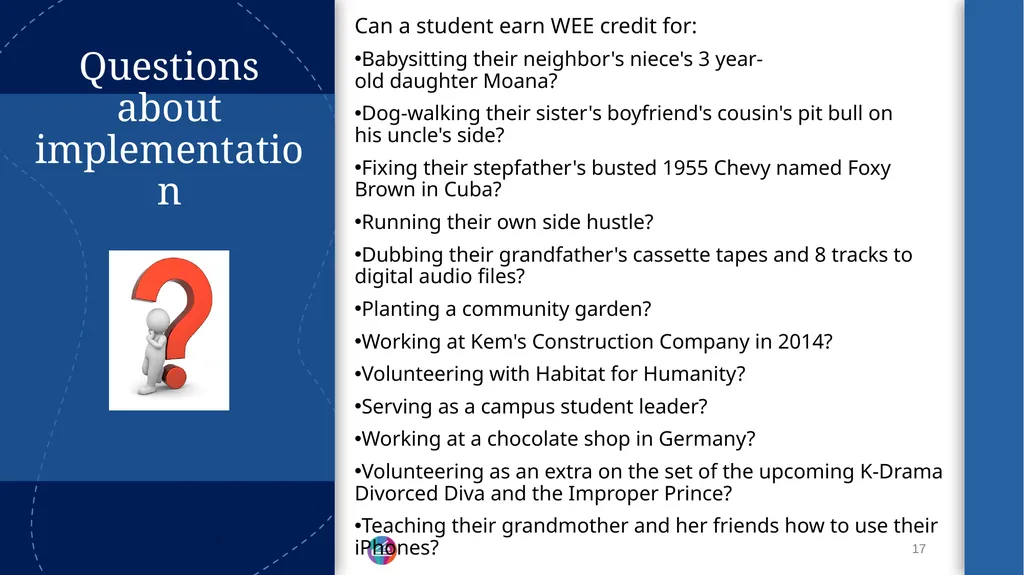
slide17. Questions about implementation ThePhoto by PhotoAuthor is licensed under CCYYSA. Can a student earn WEE credit for:
Babysitting their neighbor's niece's 3 year-old daughter Moana?
Dog-walking their sister's boyfriend's cousin's pit bull on his uncle's side?
Fixing their stepfather's busted 1955 Chevy named Foxy Brown in Cuba?
Running their own side hustle?
Dubbing their grandfather's cassette tapes and 8 tracks to digital audio files?
Planting a community garden?
Working at Kem's Construction Company in 2014?
Volunteering with Habitat for Humanity?
Serving as a campus student leader?
Working at a chocolate shop in Germany?
Volunteering as an extra on the set of the upcoming K-Drama Divorced Diva and the Improper Prince?
Teaching their grandmother and her friends how to use their iPhones? 17<br>
slide18. Next Steps for Noncredit WEE Research 18 Explore noncredit attendance taking modality
Alternative attendance accounting method or positive attendance?
Align with credit?
Noncredit faculty load
Develop publications/written resources
Curriculum questions
Other areas to explore - your thoughts?<br>
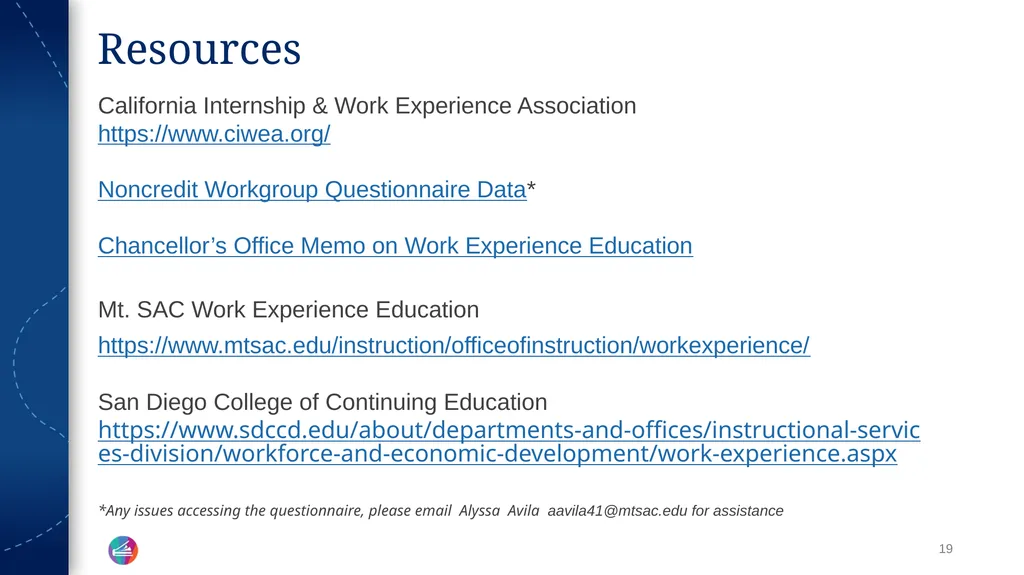
slide19. Resources California Internship & Work Experience Association
https://www.ciwea.org/
Noncredit Workgroup Questionnaire Data*
Chancellor’s Office Memo on Work Experience Education
Mt. SAC Work Experience Education
https://www.mtsac.edu/instruction/officeofinstruction/workexperience/
San Diego College of Continuing Education
https://www.sdccd.edu/about/departments-and-offices/instructional-services-division/workforce-and-economic-development/work-experience.aspx
*Any issues accessing the questionnaire, please email Alyssa Avila aavila41@mtsac.edu for assistance 19<br>
slide20. Thank you! 20<br>
slide2. Session Topics 2<br>
slide3. Work Experience Education Update 3 Work Experience regulations became effective in August 2023 (5 Cal. Code Regs. § 55250)
Revision Highlights:
Rename “Cooperative Work Experience” to “Work Experience Education (WEE)”
Permits Noncredit WEE
Removes Local Plan and replaces with Board Policy
Removes Occupational and General distinction
Simplifies credit hour calculation to 54 hours per unit
Emphasis on economically disadvantaged students in paid work experience
Clarifies record keeping requirements<br>
slide4. Noncredit WEE Workgroup 4<br>
slide5. Field Questionnaire Noncredit WEE 5 WEE Questionnaire:
Current campus investment for work experience education
Interest on the campus for noncredit WEE program
WEE areas of interest
Resources and technical assistance needed
Questionnaire sent to ASCCC, College Vice Presidents, CCCAOE, and ACCE listservs
83 respondents from 51 institutions
Immediately planning for Noncredit WEE– 33%
Implement Noncredit WEE in the future – 54%
Major WEE themes/areas of interest determined the subgroup work:
Policy/Regulation
Curriculum
Campus implementation and Considerations<br>
slide6. Noncredit WEE Workgroup Tasks 6<br>
slide7. Policy Administrative Policy 4103 Drafts 7 Board or Administrative Policies Updating WEE
Two sample DRAFTS of Administrative Policy 4103 including noncredit language:
Mt. SAC
Noncredit work experience course completion
For successful completion of a noncredit work experience education course, students will complete the minimum hours as specified in the Course Outline of Record AND earn a “Pass” for the course. Noncredit work experience courses are repeatable.
2. San Diego College of Continuing Education
“Work experience education may include paid or unpaid employment and/or internships, full or part-time employment and/or internships, and may be structured as separate credit or noncredit classes, or integrated as a component of a course”<br>
slide8. Campus Considerations Who is responsible? 8 Worker’s compensation is covered by the employer if the student receives compensation.
Worker’s compensation is covered by the college if the student is taking part in an UNPAID internship.
When a student is PAID, they are considered an employee and the liability falls on the employer.
The employer is responsible for adhering to all Federal and State regulations regarding employment.
District/Local WEE forms should have verbiage explaining the differences.
Unpaid internships must follow the guidelines provided under the Fair Labor Standards Act (Fact Sheet #71).
The college and employer should use the “primary beneficiary test” to determine if the student benefits more than the employer under the arrangement.
Clear policy regarding discrimination in hiring practices.
Worker’s compensation is covered by the employer if the student receives compensation.<br>
slide9. Curriculum What are appropriate course objectives that allow use across multiple disciplines?
How specific should the content be, can WEE include orientation, and how can WEE make it repeatable?
How are the course hours determined, and why take credit hours into account?
Which noncredit programs might benefit from adding work experience?
Can WEE include within a certificate of completion?
What subject indicator and TOP code?
What role can distance education play? 9<br>
slide10. Course Objectives Recommendations, Options, and Considerations 10 Focus on growth and learning elements as expressed in the objectives, rather than the number of hours worked. (Example SDCCD SMART objectives, 1 OBJ per unit) Link to COR.
Important to have a structured collaboration between students, instructors, and employers, hours should be in this context.
Importance and benefits of students setting their own learning objectives.<br>
slide11. Course Hours Recommendations, Options, and Considerations Use course hour ranges as hour requirements may vary.
Minimum hours should account for: employer investment in new employee or intern, time commitment for feedback and meetings.
Consider including outside-of-class time in the course hours
Consider aligning with credit requirements (54 hrs per unit) to create opportunities for CBE/CPL
Better opportunities to mirror courses (single course/instructor, advantages for scheduling)
Eligibility of work experience courses for credit for prior learning should be noted on outline 11<br>
slide12. Course Content Recommendations, Options, and Considerations General vs discipline-content
Include specific soft/people/interpersonal skills
Orientation to WEE (embedded within or prior)
Consider including required preliminary forms and documentation
Incorporate section for subsequent enrollments 12<br>
slide13. General CORs Recommendations, Options, and Considerations ESL and ABE students could gain structured, guided practice in the workplace
Create first, use as the basis for subject-specific WEE CORs. - Not recommended, issue with TOP code
Create a WEE subject indicator (WORK)
General CTE COR, using a WORK subject indicator: use for special projects students from multiple disciplines (REC Innovation Lab - Regional Entrepreneurship Center at Miramar College)
Include whether work experience courses could be eligible for credit for prior learning (IF faculty have agreed whether CPL can be used for work experience courses or not) 13<br>
slide14. Discipline-Specific CORs Recommendations, Options, and Considerations Historically, seems to be a balance between general and disciple-specific (ie occupational)
Create a WEE COR that can be used for courses in any non-credit instructional area
Implications for COR if outside agency (Health, Child Dev, EMT)
Mt SAC EMT and CNA, hours required within the course
Combine course with work experience, change reporting of hours
Potential to use a clustered work experience course for career or community pathways (Guided Pathways)
Use a general WEE COR for all courses 14<br>
slide15. Articulation Recommendations, Options, and Considerations 15<br>
slide16. Campus implementation Forms and expectations 16 Student orientation necessary to understand expectations and required documentation
Student and employer forms/agreement:
Learning agreements establishing hours that will be worked
Verification that the student’s placement meets the COR student learning outcomes if the outcomes state the student must complete hours in a job related to the major/coursework (former Occupational Work Experience rules).
Verification of hours worked for the number of hours the student has requested.
Records of consultation with the employer and faculty
Evaluation of student achievement of learning objectives by the instructor (work permit for minors, final grades)
Verification of new or higher skill level objectives for students repeating a WEE course.
Each college must maintain records for each WEE student for a minimum of four years<br>
slide17. Questions about implementation ThePhoto by PhotoAuthor is licensed under CCYYSA. Can a student earn WEE credit for:
Babysitting their neighbor's niece's 3 year-old daughter Moana?
Dog-walking their sister's boyfriend's cousin's pit bull on his uncle's side?
Fixing their stepfather's busted 1955 Chevy named Foxy Brown in Cuba?
Running their own side hustle?
Dubbing their grandfather's cassette tapes and 8 tracks to digital audio files?
Planting a community garden?
Working at Kem's Construction Company in 2014?
Volunteering with Habitat for Humanity?
Serving as a campus student leader?
Working at a chocolate shop in Germany?
Volunteering as an extra on the set of the upcoming K-Drama Divorced Diva and the Improper Prince?
Teaching their grandmother and her friends how to use their iPhones? 17<br>
slide18. Next Steps for Noncredit WEE Research 18 Explore noncredit attendance taking modality
Alternative attendance accounting method or positive attendance?
Align with credit?
Noncredit faculty load
Develop publications/written resources
Curriculum questions
Other areas to explore - your thoughts?<br>
slide19. Resources California Internship & Work Experience Association
https://www.ciwea.org/
Noncredit Workgroup Questionnaire Data*
Chancellor’s Office Memo on Work Experience Education
Mt. SAC Work Experience Education
https://www.mtsac.edu/instruction/officeofinstruction/workexperience/
San Diego College of Continuing Education
https://www.sdccd.edu/about/departments-and-offices/instructional-services-division/workforce-and-economic-development/work-experience.aspx
*Any issues accessing the questionnaire, please email Alyssa Avila aavila41@mtsac.edu for assistance 19<br>
slide20. Thank you! 20<br>