
“Working together towards one common goal One
CP
Published · 70 slides · 0 views

1 / 1
Description
Working together towards one common goal One organisation one plan DEPARTMENT OF WOMEN, YOUTH AND PERSONS WITH DISABILITIES ANNUAL REPORT 201920 Presentation to the Select Committee on Health and Social Services Date: 27 November 2020
Related Topics
Share
Embed code
Download this presentation From Below
"“Working together towards one common goal One" is the property of its rightful owner. Permission is granted to download and print the materials on this website for personal, non-commercial use only, and to display it on your personal computer provided you do not modify the materials and that you retain all copyright notices contained in the materials. By downloading content from our website, you accept the terms of this agreement.
Presentation Transcript
01
“Working together towards one common goal
One organisation one plan” DEPARTMENT OF WOMEN, YOUTH AND PERSONS WITH DISABILITIES ANNUAL REPORT 2019/20
Presentation to the Select Committee on Health and Social Services
Date: 27 November 2020<br>
One organisation one plan” DEPARTMENT OF WOMEN, YOUTH AND PERSONS WITH DISABILITIES ANNUAL REPORT 2019/20
Presentation to the Select Committee on Health and Social Services
Date: 27 November 2020<br>
02
PRESENTATION OUTLINE BACKGROUND
PART A
Strategic Focus and General Information
PART B
Departmental Performance Information 2019/20
PART C
Governance
PART D
Human Resource Oversight
PART E
Financial Information
END<br>
PART A
Strategic Focus and General Information
PART B
Departmental Performance Information 2019/20
PART C
Governance
PART D
Human Resource Oversight
PART E
Financial Information
END<br>
03
BACKGROUND We are presenting the Annual Report 2019/20 FY. In the year under review the department managed to achieve 80% of the planned targets compared to 69% in 2018/19 financial year.
On 29 May 2019, the President of the Republic of South Africa announced the Department of Women, Youth and Persons with Disabilities. In his announcement, the President indicated that the function of Persons with Disabilities would be transferred from the Department of Social Development to the Department of Women; as well as the function of Youth Development would be transferred from the Department of Planning, Monitoring and Evaluation to the Department of Women. Subsequent to the announcement by the President, a proclamation amending Schedule 1 of the Public Service Act, 1994 was published on 27 June 2019. In addition, a proclamation to transfer administration and powers and functions entrusted by legislation to certain members of Cabinet in terms of section 97 of the Constitution of the Republic of South Africa, 1996 was published in a Government Gazette on 23 August 2019; entrusting the Minister of Women, Youth and Persons with Disabilities with the powers to administer any legislation related to women, youth and persons with disabilities.
The reporting information is informed by the Department of Women Strategic Plan 2015-2020 and the DWYPD Annual Performance Plan 2019-20. The Audit raised a concern that the Department erred in integrating the Youth and Rights of Persons with disabilities programmes during a financial period under review prior to NMOG finalisation.<br>
On 29 May 2019, the President of the Republic of South Africa announced the Department of Women, Youth and Persons with Disabilities. In his announcement, the President indicated that the function of Persons with Disabilities would be transferred from the Department of Social Development to the Department of Women; as well as the function of Youth Development would be transferred from the Department of Planning, Monitoring and Evaluation to the Department of Women. Subsequent to the announcement by the President, a proclamation amending Schedule 1 of the Public Service Act, 1994 was published on 27 June 2019. In addition, a proclamation to transfer administration and powers and functions entrusted by legislation to certain members of Cabinet in terms of section 97 of the Constitution of the Republic of South Africa, 1996 was published in a Government Gazette on 23 August 2019; entrusting the Minister of Women, Youth and Persons with Disabilities with the powers to administer any legislation related to women, youth and persons with disabilities.
The reporting information is informed by the Department of Women Strategic Plan 2015-2020 and the DWYPD Annual Performance Plan 2019-20. The Audit raised a concern that the Department erred in integrating the Youth and Rights of Persons with disabilities programmes during a financial period under review prior to NMOG finalisation.<br>
04
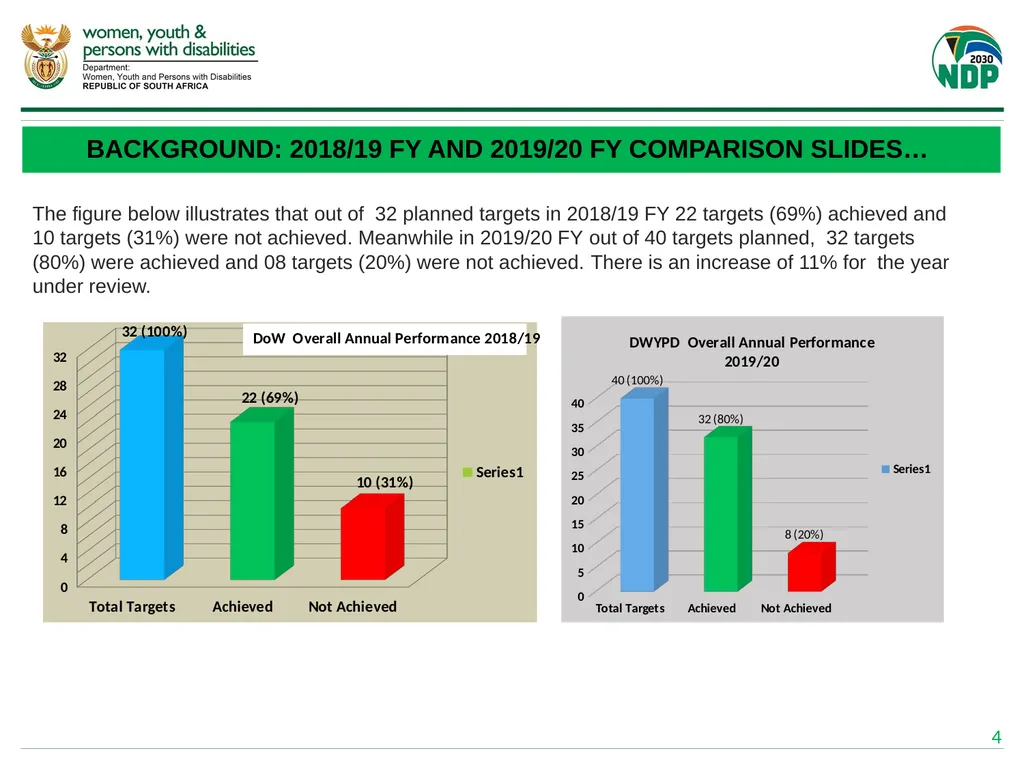
BACKGROUND: 2018/19 FY AND 2019/20 FY COMPARISON SLIDES… The figure below illustrates that out of 32 planned targets in 2018/19 FY 22 targets (69%) achieved and 10 targets (31%) were not achieved. Meanwhile in 2019/20 FY out of 40 targets planned, 32 targets (80%) were achieved and 08 targets (20%) were not achieved. There is an increase of 11% for the year under review.<br>
05
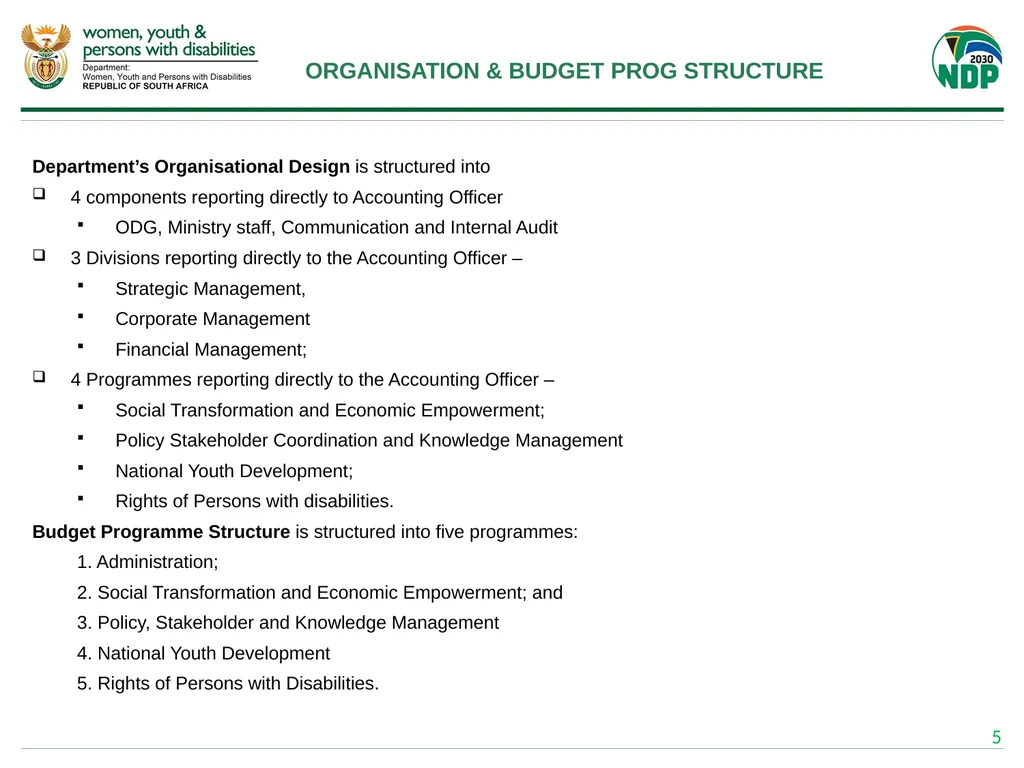
ORGANISATION & BUDGET PROG STRUCTURE Department’s Organisational Design is structured into
4 components reporting directly to Accounting Officer
ODG, Ministry staff, Communication and Internal Audit
3 Divisions reporting directly to the Accounting Officer –
Strategic Management,
Corporate Management
Financial Management;
4 Programmes reporting directly to the Accounting Officer –
Social Transformation and Economic Empowerment;
Policy Stakeholder Coordination and Knowledge Management
National Youth Development;
Rights of Persons with disabilities.
Budget Programme Structure is structured into five programmes:
1. Administration;
2. Social Transformation and Economic Empowerment; and
3. Policy, Stakeholder and Knowledge Management
4. National Youth Development
5. Rights of Persons with Disabilities.<br>
4 components reporting directly to Accounting Officer
ODG, Ministry staff, Communication and Internal Audit
3 Divisions reporting directly to the Accounting Officer –
Strategic Management,
Corporate Management
Financial Management;
4 Programmes reporting directly to the Accounting Officer –
Social Transformation and Economic Empowerment;
Policy Stakeholder Coordination and Knowledge Management
National Youth Development;
Rights of Persons with disabilities.
Budget Programme Structure is structured into five programmes:
1. Administration;
2. Social Transformation and Economic Empowerment; and
3. Policy, Stakeholder and Knowledge Management
4. National Youth Development
5. Rights of Persons with Disabilities.<br>
06
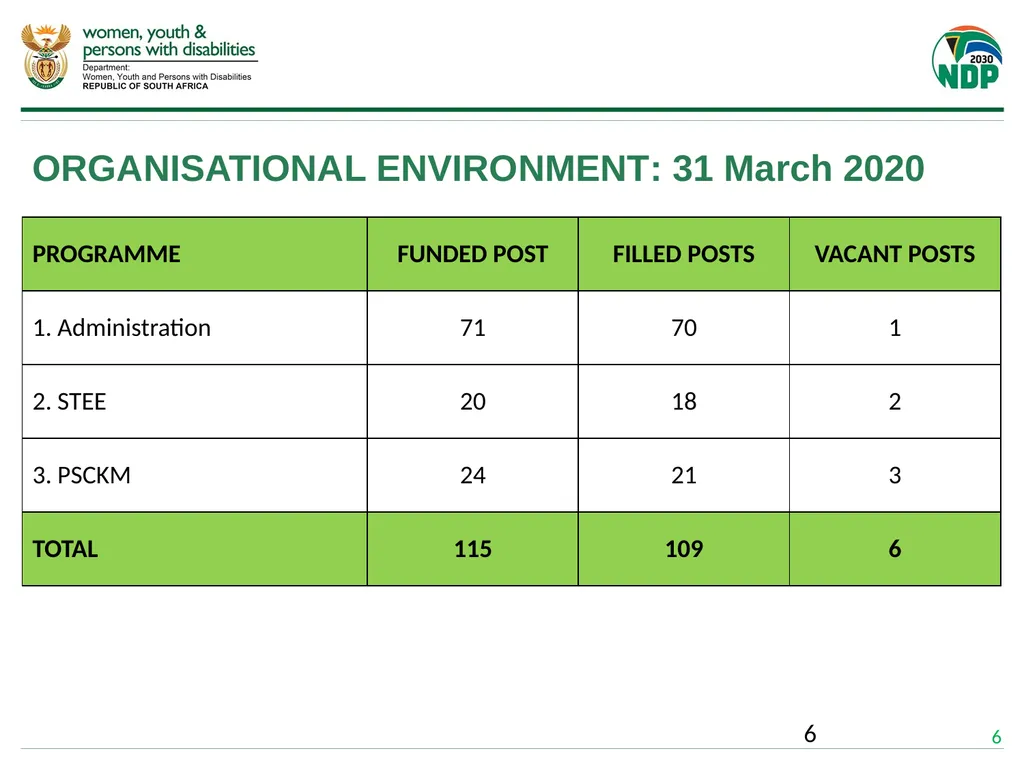
ORGANISATIONAL ENVIRONMENT: 31 March 2020 6<br>
07
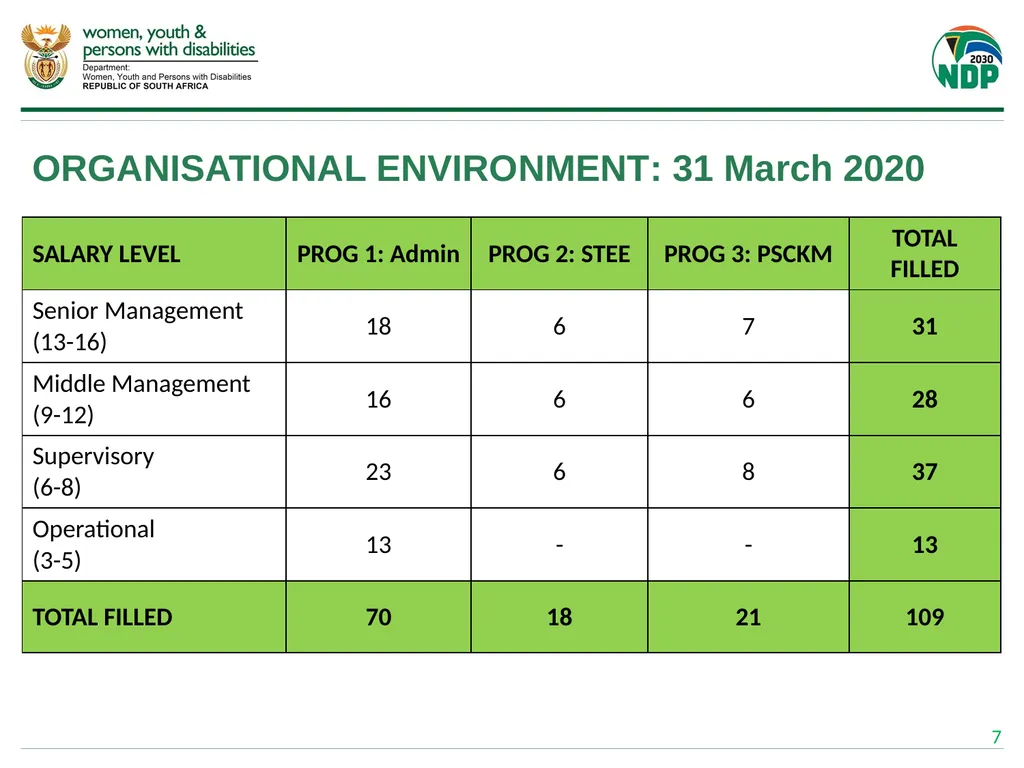
ORGANISATIONAL ENVIRONMENT: 31 March 2020<br>
08
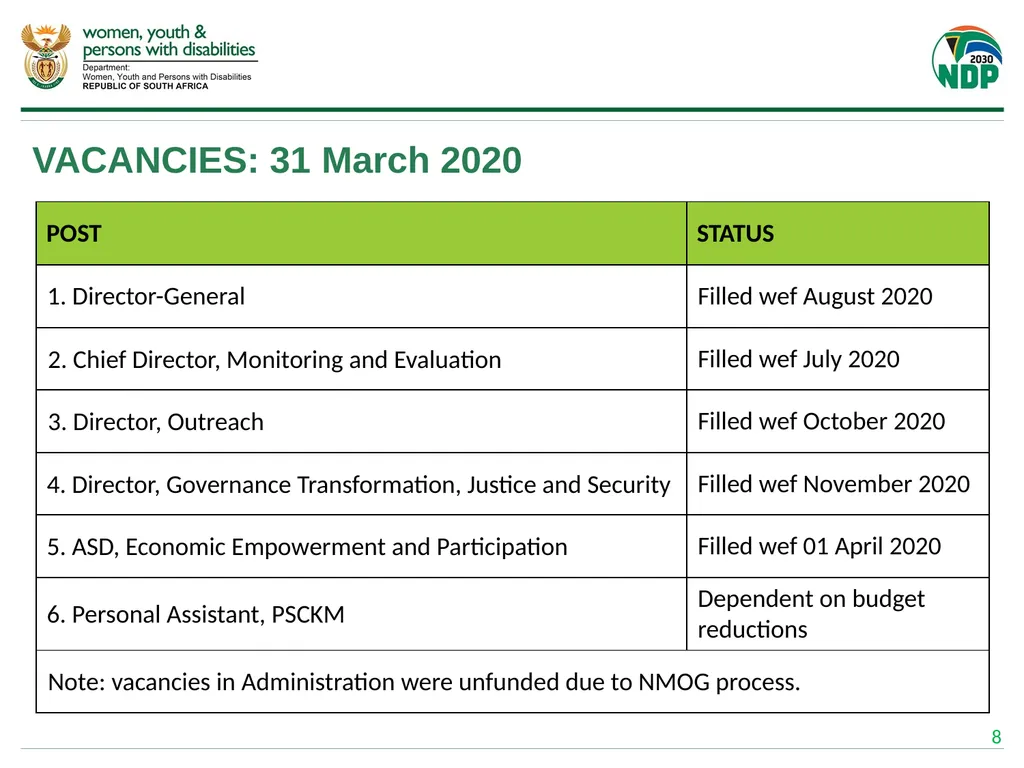
VACANCIES: 31 March 2020<br>
09
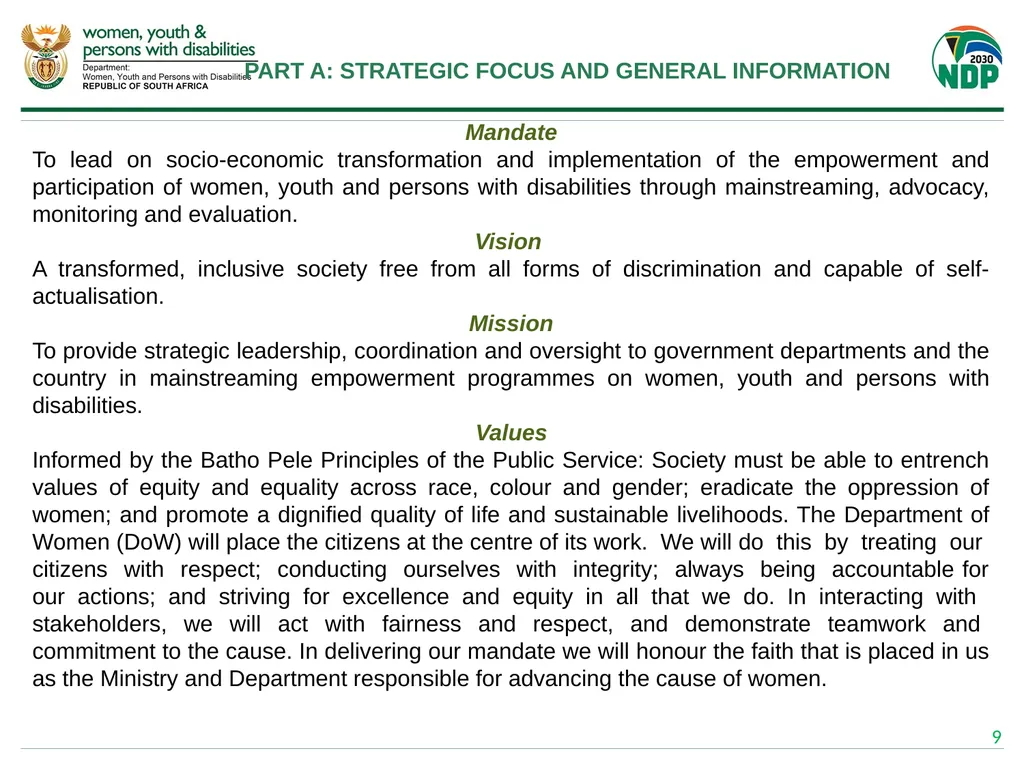
PART A: STRATEGIC FOCUS AND GENERAL INFORMATION Mandate
To lead on socio-economic transformation and implementation of the empowerment and participation of women, youth and persons with disabilities through mainstreaming, advocacy, monitoring and evaluation.
Vision
A transformed, inclusive society free from all forms of discrimination and capable of self-actualisation.
Mission
To provide strategic leadership, coordination and oversight to government departments and the country in mainstreaming empowerment programmes on women, youth and persons with disabilities.
Values
Informed by the Batho Pele Principles of the Public Service: Society must be able to entrench values of equity and equality across race, colour and gender; eradicate the oppression of women; and promote a dignified quality of life and sustainable livelihoods. The Department of Women (DoW) will place the citizens at the centre of its work. We will do this by treating our citizens with respect; conducting ourselves with integrity; always being accountable for our actions; and striving for excellence and equity in all that we do. In interacting with stakeholders, we will act with fairness and respect, and demonstrate teamwork and commitment to the cause. In delivering our mandate we will honour the faith that is placed in us as the Ministry and Department responsible for advancing the cause of women.<br>
To lead on socio-economic transformation and implementation of the empowerment and participation of women, youth and persons with disabilities through mainstreaming, advocacy, monitoring and evaluation.
Vision
A transformed, inclusive society free from all forms of discrimination and capable of self-actualisation.
Mission
To provide strategic leadership, coordination and oversight to government departments and the country in mainstreaming empowerment programmes on women, youth and persons with disabilities.
Values
Informed by the Batho Pele Principles of the Public Service: Society must be able to entrench values of equity and equality across race, colour and gender; eradicate the oppression of women; and promote a dignified quality of life and sustainable livelihoods. The Department of Women (DoW) will place the citizens at the centre of its work. We will do this by treating our citizens with respect; conducting ourselves with integrity; always being accountable for our actions; and striving for excellence and equity in all that we do. In interacting with stakeholders, we will act with fairness and respect, and demonstrate teamwork and commitment to the cause. In delivering our mandate we will honour the faith that is placed in us as the Ministry and Department responsible for advancing the cause of women.<br>
10
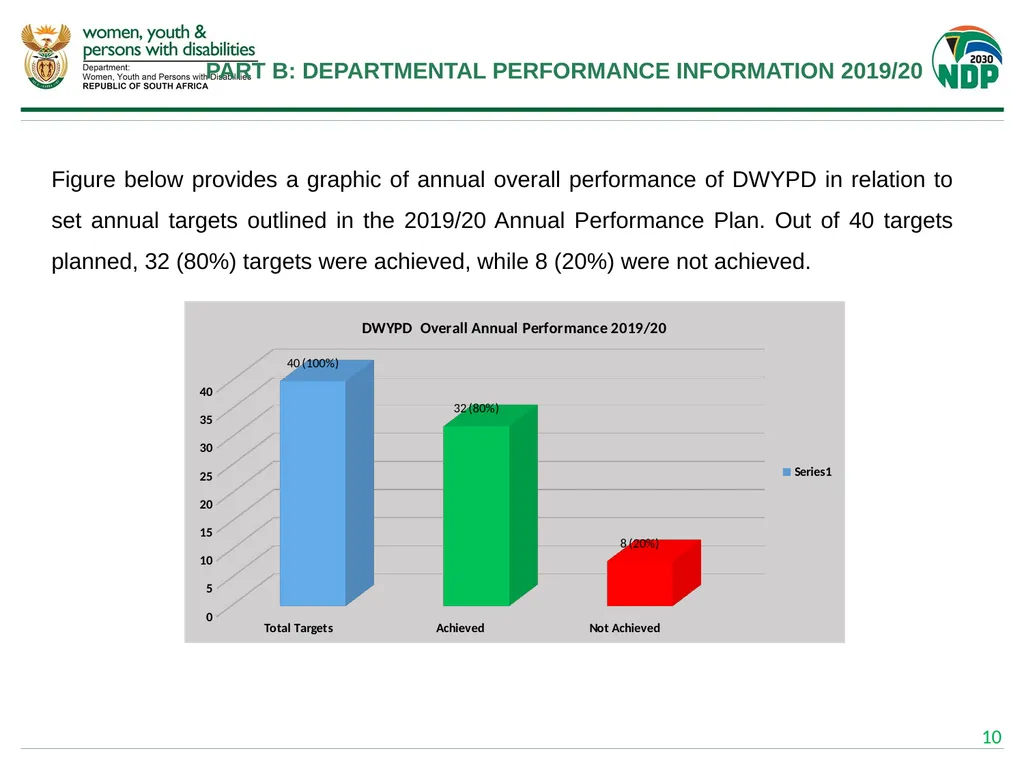
PART B: DEPARTMENTAL PERFORMANCE INFORMATION 2019/20 Figure below provides a graphic of annual overall performance of DWYPD in relation to set annual targets outlined in the 2019/20 Annual Performance Plan. Out of 40 targets planned, 32 (80%) targets were achieved, while 8 (20%) were not achieved.<br>
11
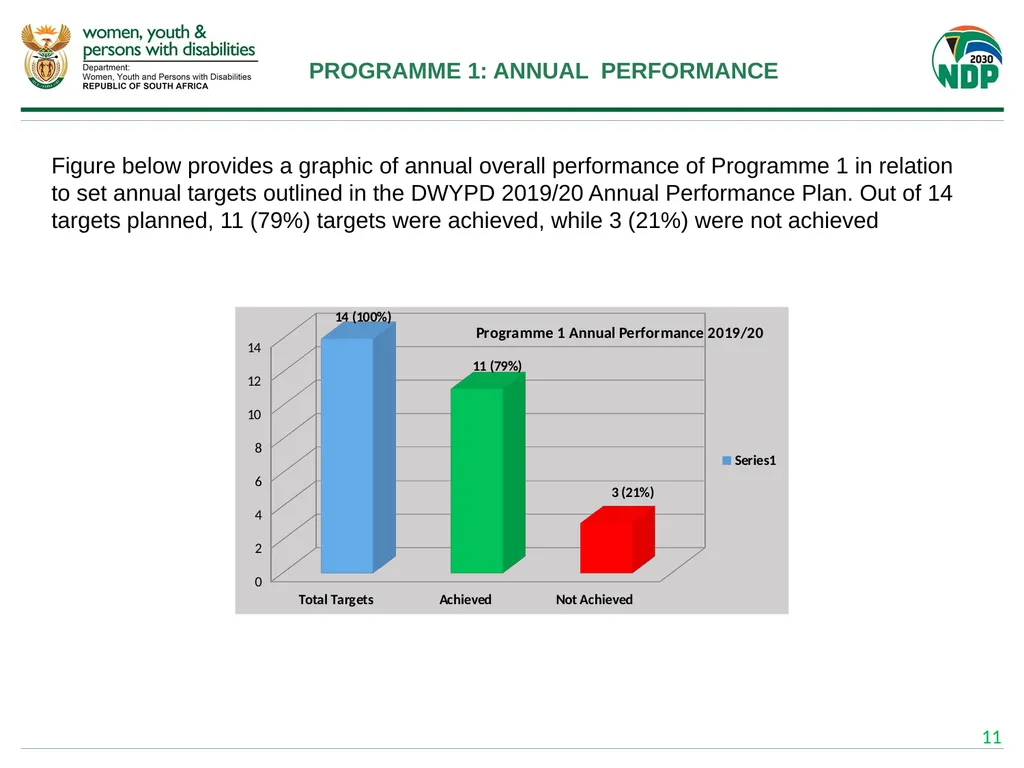
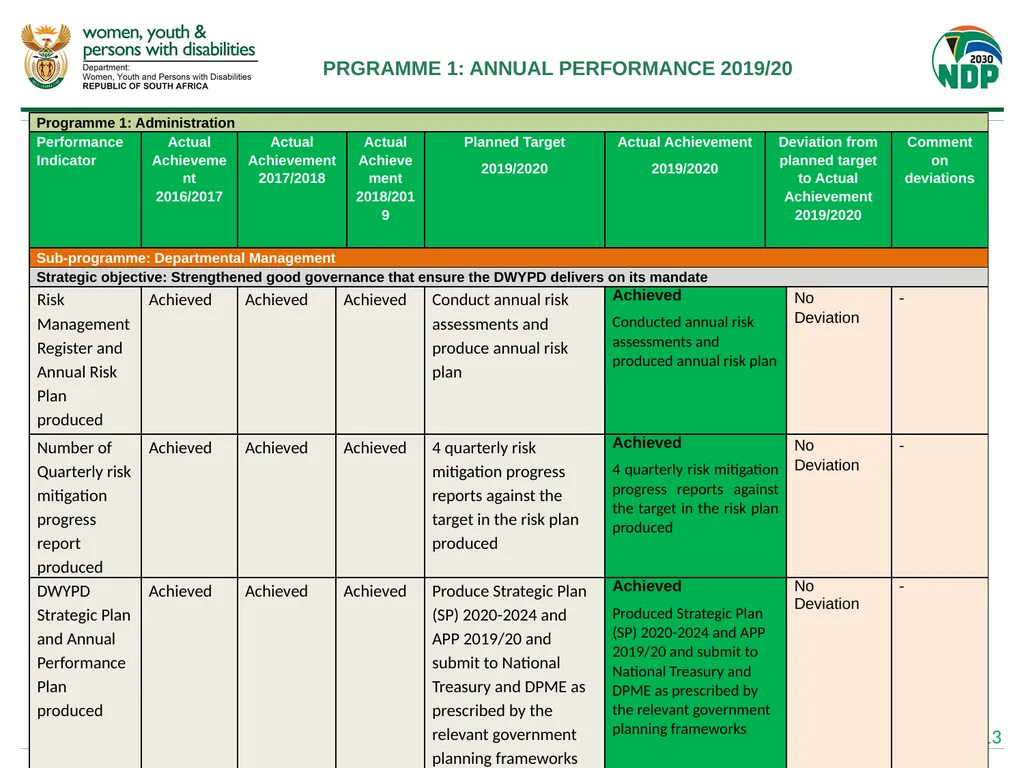
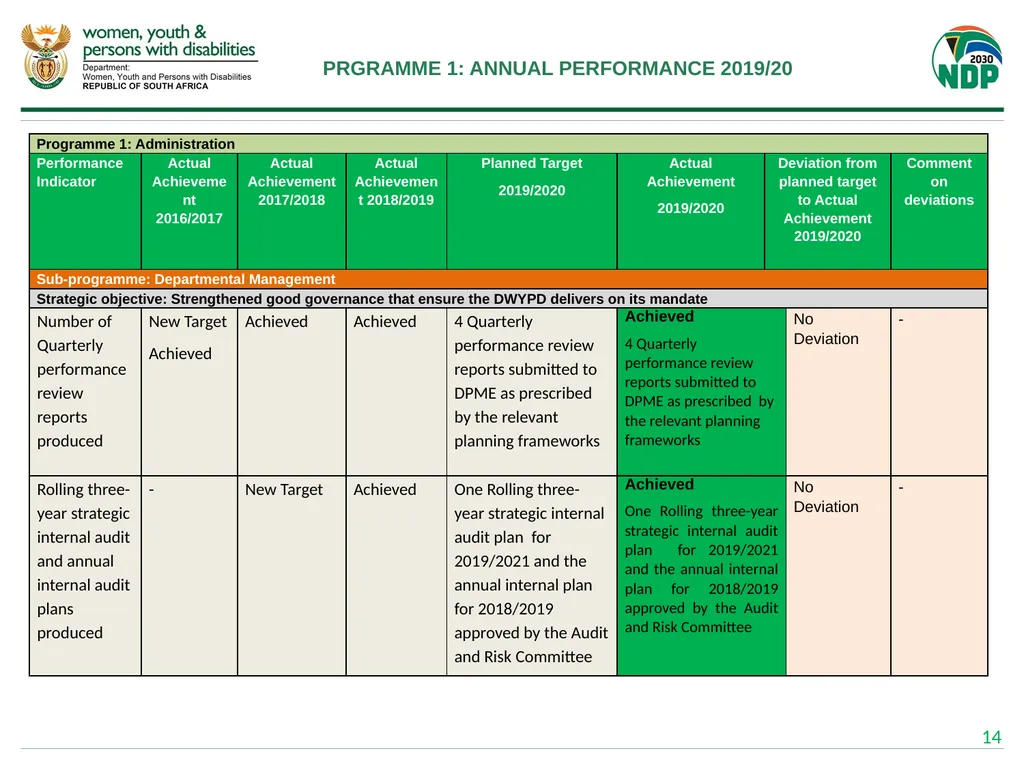
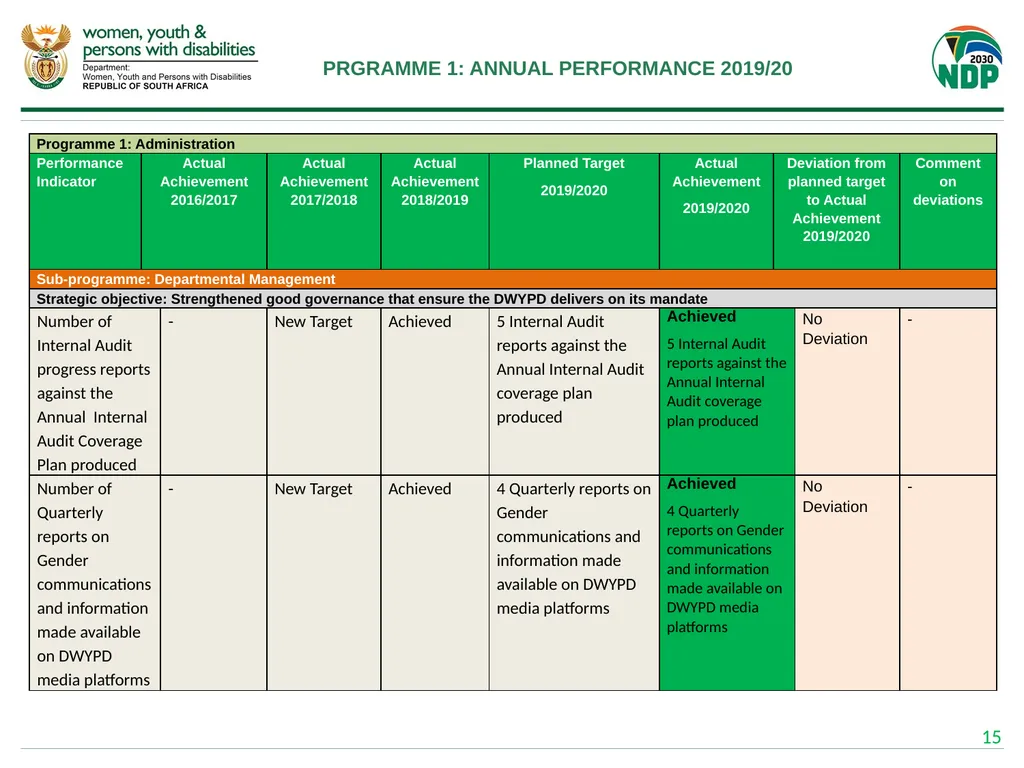
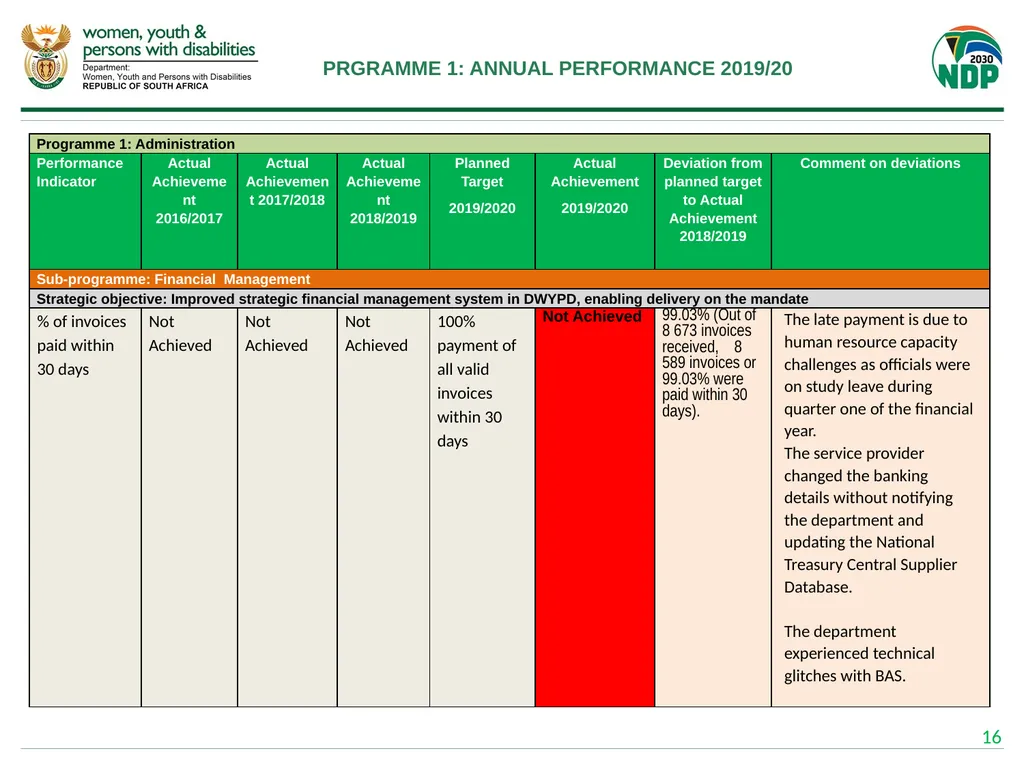
PROGRAMME 1: ANNUAL PERFORMANCE Figure below provides a graphic of annual overall performance of Programme 1 in relation to set annual targets outlined in the DWYPD 2019/20 Annual Performance Plan. Out of 14 targets planned, 11 (79%) targets were achieved, while 3 (21%) were not achieved<br>
12
PROGRAMME 1: ANNUAL PERFORMANCE Some of the main achievements of Programme 1
Department Risk Management function is effective;
Department has ensured consistent compliance with government’s short to medium term planning and reporting requirements, including the development of Strategic Plan (SP) 2020-2025 and APP 2020/21 and submitted to National Treasury and DPME as prescribed by the relevant government planning frameworks. Quarterly and annual performance information reports were produced to DPME through eQPRS; ;
Internal Audit Rolling three-year rolling plan for 2019/2021 and the annual internal plan for 2018/2019 was produced and approved by the Audit and Risk Committee;
Communications on gender information made available on DWYPD media platforms;
In the year under review the department appointed contract workers and interns;
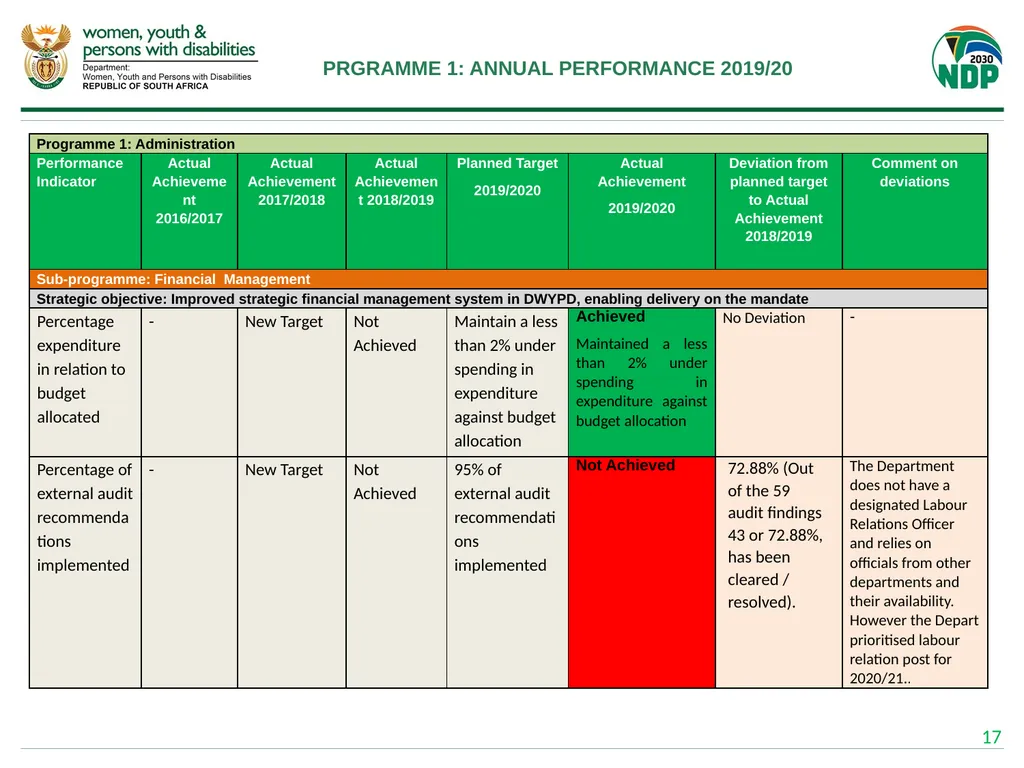
Department in the year under review managed to maintain a less than 2% under spending in expenditure against budget allocation;
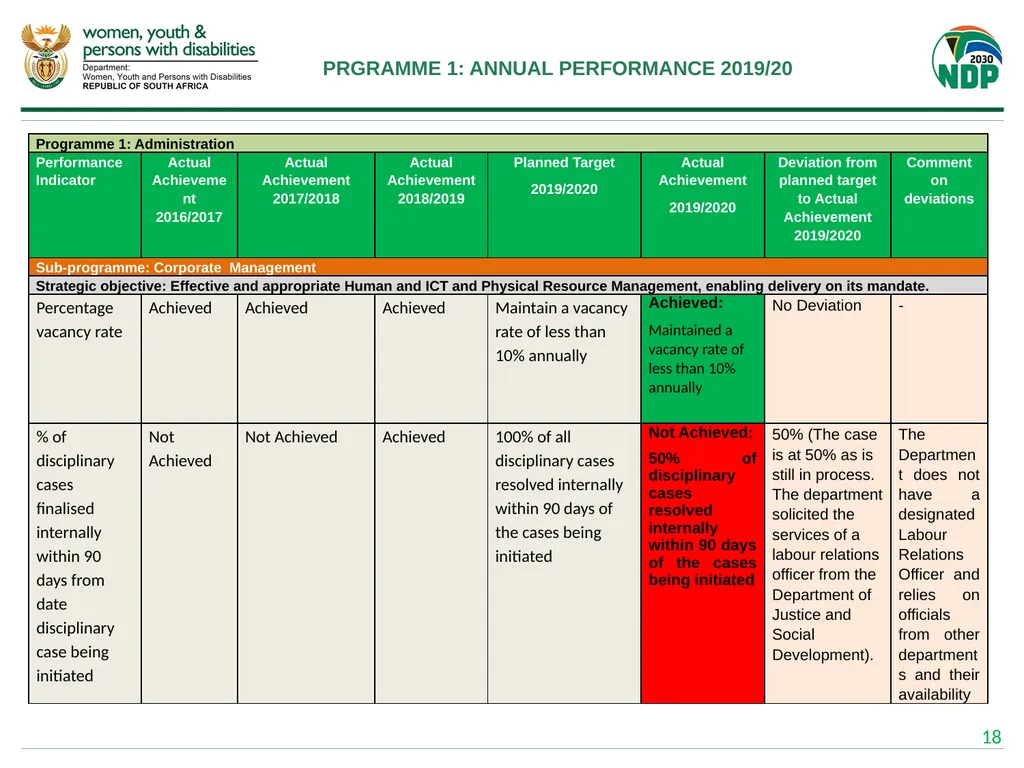
The Department maintained a vacancy rate below the targeted 10% ; and
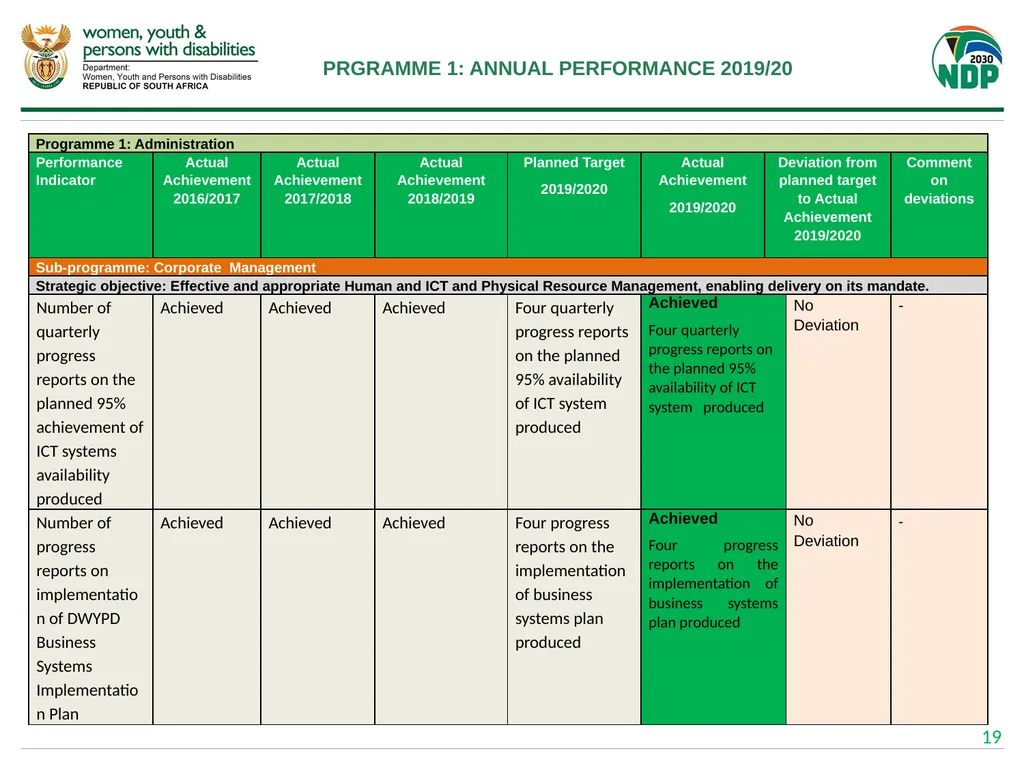
95% availability of ICT systems was achieved as planned.<br>
Department Risk Management function is effective;
Department has ensured consistent compliance with government’s short to medium term planning and reporting requirements, including the development of Strategic Plan (SP) 2020-2025 and APP 2020/21 and submitted to National Treasury and DPME as prescribed by the relevant government planning frameworks. Quarterly and annual performance information reports were produced to DPME through eQPRS; ;
Internal Audit Rolling three-year rolling plan for 2019/2021 and the annual internal plan for 2018/2019 was produced and approved by the Audit and Risk Committee;
Communications on gender information made available on DWYPD media platforms;
In the year under review the department appointed contract workers and interns;
Department in the year under review managed to maintain a less than 2% under spending in expenditure against budget allocation;
The Department maintained a vacancy rate below the targeted 10% ; and
95% availability of ICT systems was achieved as planned.<br>
13
PRGRAMME 1: ANNUAL PERFORMANCE 2019/20<br>
14
PRGRAMME 1: ANNUAL PERFORMANCE 2019/20<br>
15
PRGRAMME 1: ANNUAL PERFORMANCE 2019/20<br>
16
PRGRAMME 1: ANNUAL PERFORMANCE 2019/20<br>
17
PRGRAMME 1: ANNUAL PERFORMANCE 2019/20<br>
18
PRGRAMME 1: ANNUAL PERFORMANCE 2019/20<br>
19
PRGRAMME 1: ANNUAL PERFORMANCE 2019/20<br>
20
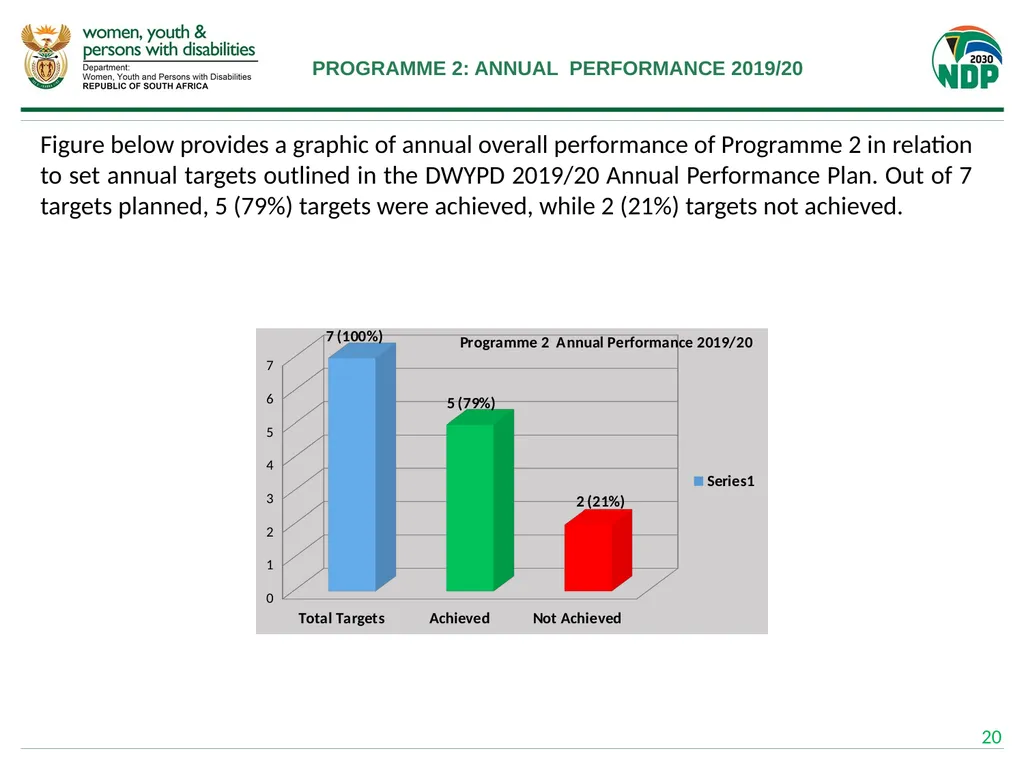
PROGRAMME 2: ANNUAL PERFORMANCE 2019/20 Figure below provides a graphic of annual overall performance of Programme 2 in relation to set annual targets outlined in the DWYPD 2019/20 Annual Performance Plan. Out of 7 targets planned, 5 (79%) targets were achieved, while 2 (21%) targets not achieved.<br>
21
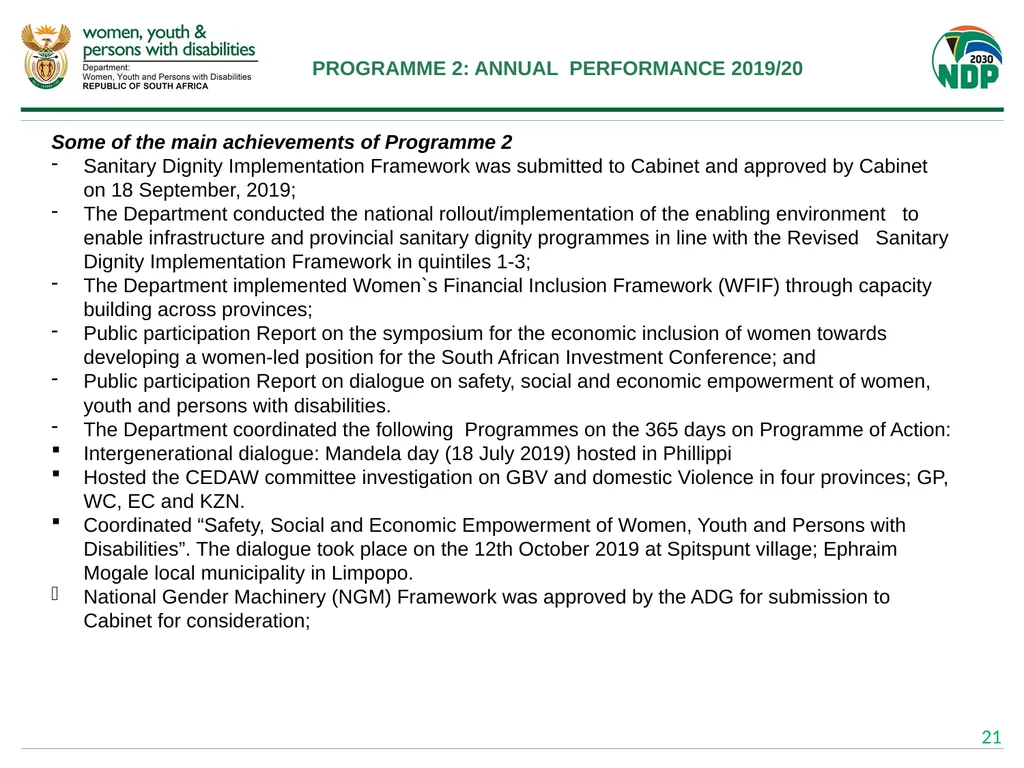
PROGRAMME 2: ANNUAL PERFORMANCE 2019/20 Some of the main achievements of Programme 2
Sanitary Dignity Implementation Framework was submitted to Cabinet and approved by Cabinet on 18 September, 2019;
The Department conducted the national rollout/implementation of the enabling environment to enable infrastructure and provincial sanitary dignity programmes in line with the Revised Sanitary Dignity Implementation Framework in quintiles 1-3;
The Department implemented Women`s Financial Inclusion Framework (WFIF) through capacity building across provinces;
Public participation Report on the symposium for the economic inclusion of women towards developing a women-led position for the South African Investment Conference; and
Public participation Report on dialogue on safety, social and economic empowerment of women, youth and persons with disabilities.
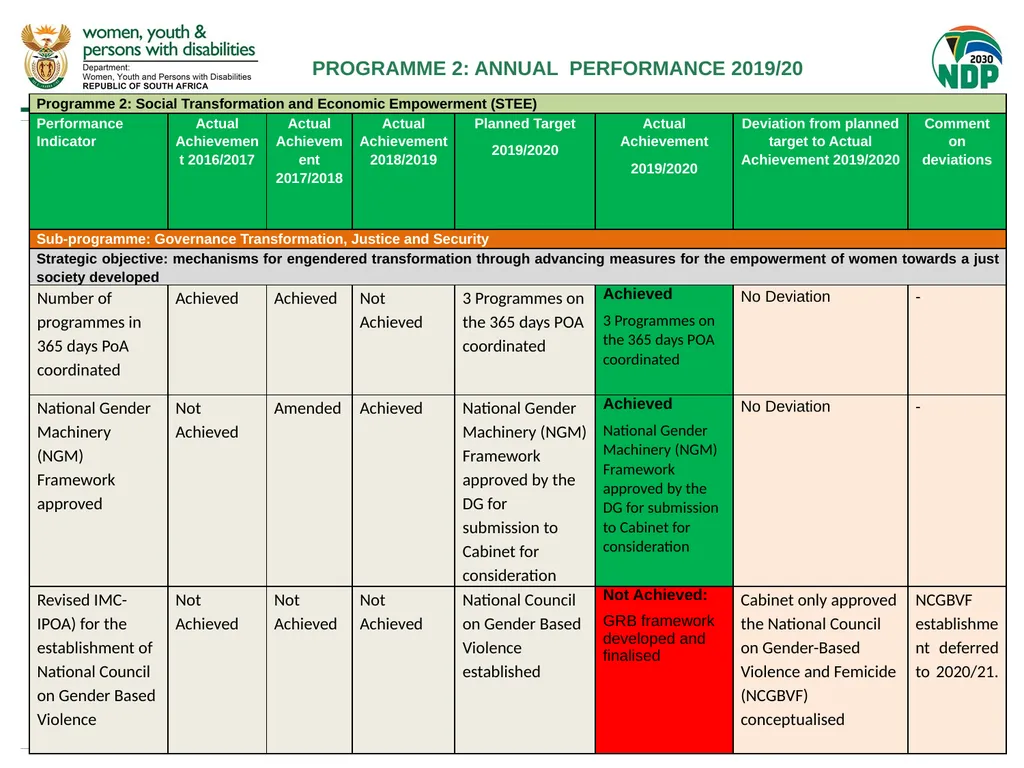
The Department coordinated the following Programmes on the 365 days on Programme of Action:
Intergenerational dialogue: Mandela day (18 July 2019) hosted in Phillippi
Hosted the CEDAW committee investigation on GBV and domestic Violence in four provinces; GP, WC, EC and KZN.
Coordinated “Safety, Social and Economic Empowerment of Women, Youth and Persons with Disabilities”. The dialogue took place on the 12th October 2019 at Spitspunt village; Ephraim Mogale local municipality in Limpopo.
National Gender Machinery (NGM) Framework was approved by the ADG for submission to Cabinet for consideration;<br>
Sanitary Dignity Implementation Framework was submitted to Cabinet and approved by Cabinet on 18 September, 2019;
The Department conducted the national rollout/implementation of the enabling environment to enable infrastructure and provincial sanitary dignity programmes in line with the Revised Sanitary Dignity Implementation Framework in quintiles 1-3;
The Department implemented Women`s Financial Inclusion Framework (WFIF) through capacity building across provinces;
Public participation Report on the symposium for the economic inclusion of women towards developing a women-led position for the South African Investment Conference; and
Public participation Report on dialogue on safety, social and economic empowerment of women, youth and persons with disabilities.
The Department coordinated the following Programmes on the 365 days on Programme of Action:
Intergenerational dialogue: Mandela day (18 July 2019) hosted in Phillippi
Hosted the CEDAW committee investigation on GBV and domestic Violence in four provinces; GP, WC, EC and KZN.
Coordinated “Safety, Social and Economic Empowerment of Women, Youth and Persons with Disabilities”. The dialogue took place on the 12th October 2019 at Spitspunt village; Ephraim Mogale local municipality in Limpopo.
National Gender Machinery (NGM) Framework was approved by the ADG for submission to Cabinet for consideration;<br>
22
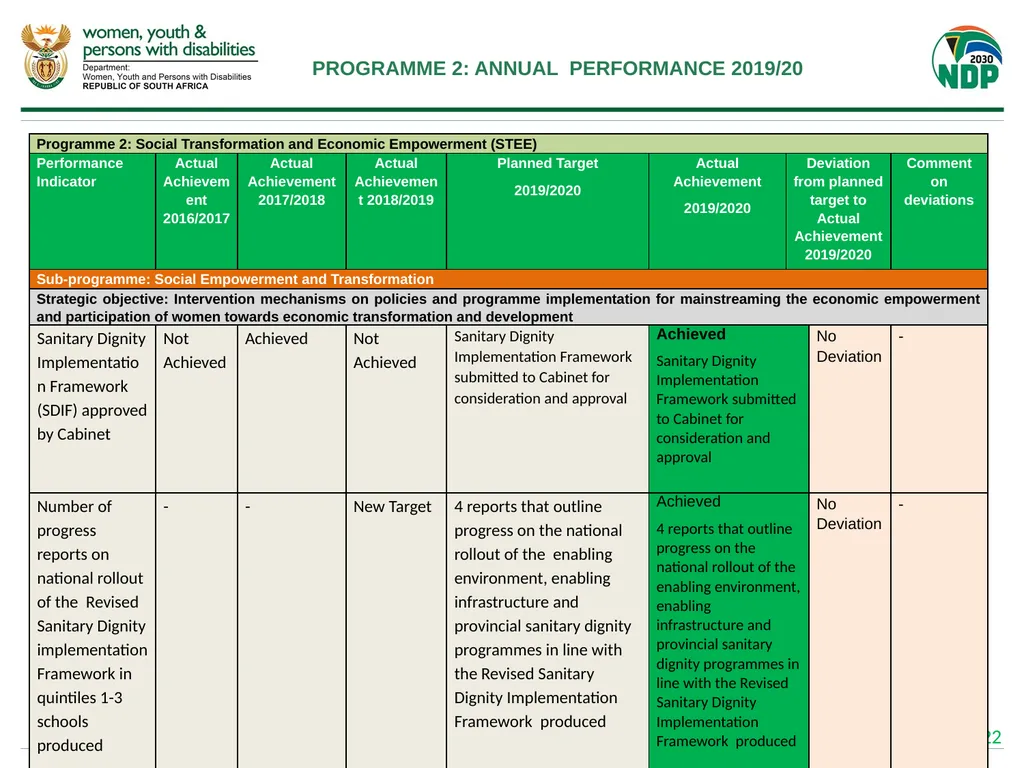
PROGRAMME 2: ANNUAL PERFORMANCE 2019/20<br>
23
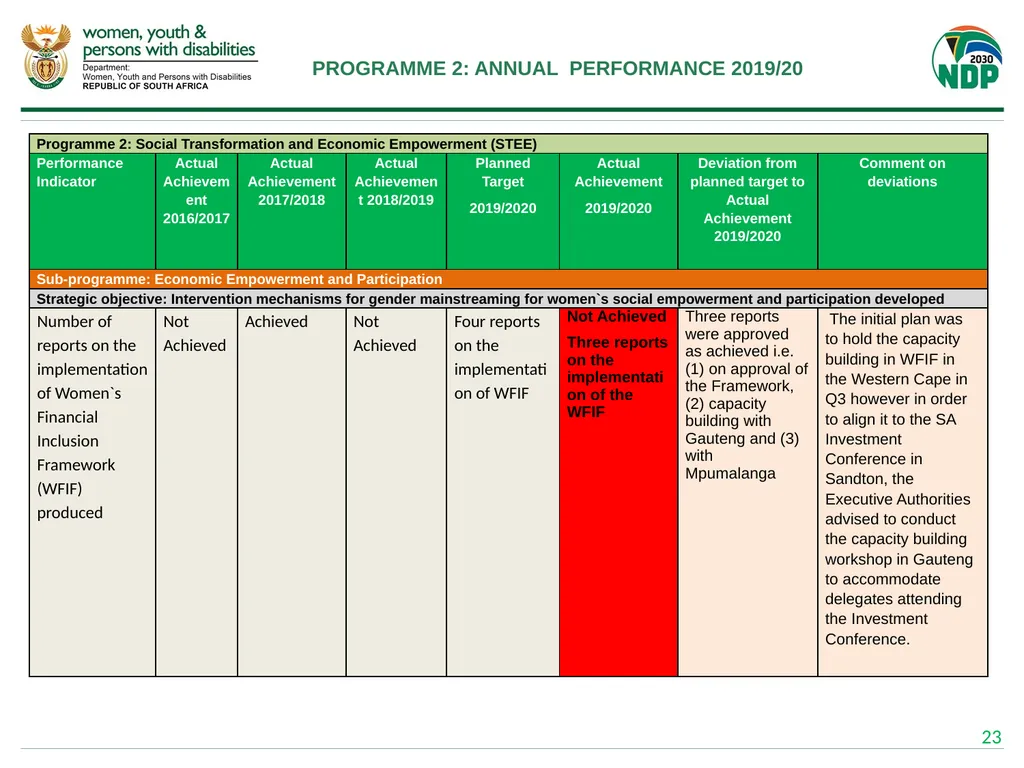
PROGRAMME 2: ANNUAL PERFORMANCE 2019/20<br>
24
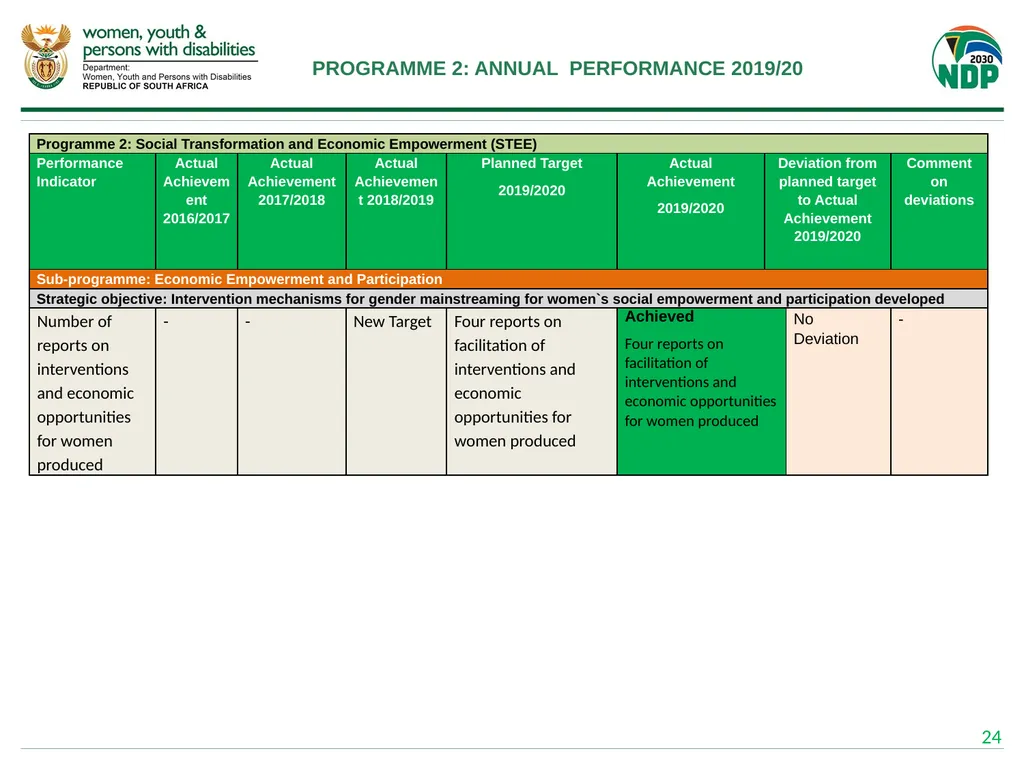
PROGRAMME 2: ANNUAL PERFORMANCE 2019/20<br>
25
PROGRAMME 2: ANNUAL PERFORMANCE 2019/20<br>
26
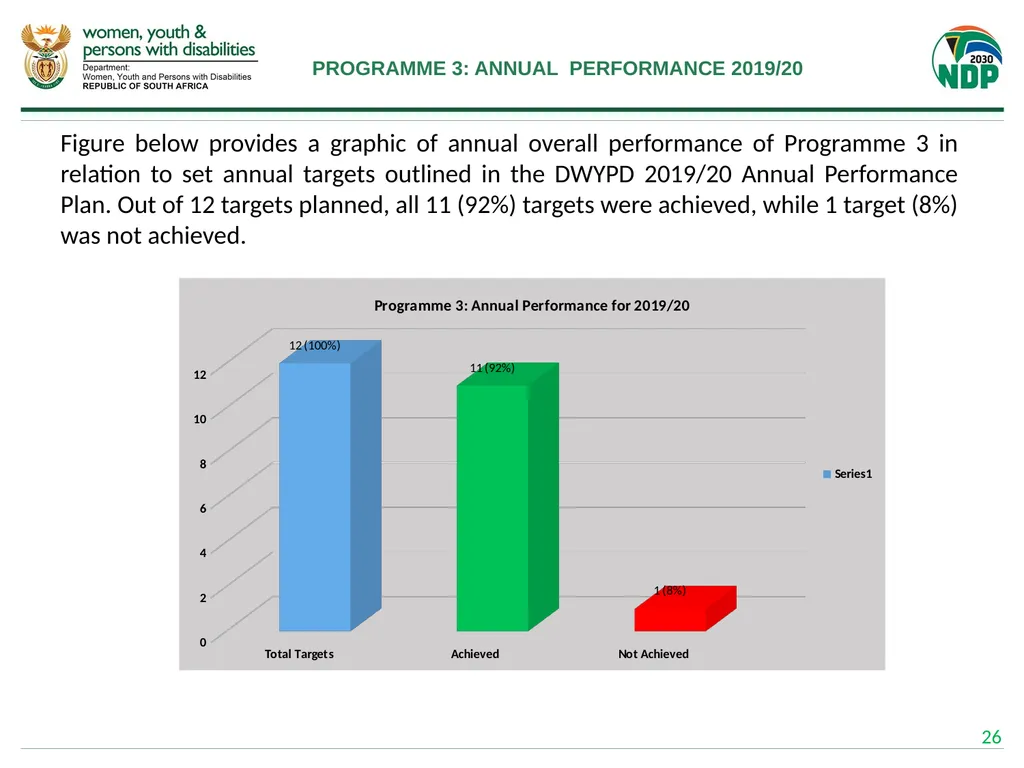
PROGRAMME 3: ANNUAL PERFORMANCE 2019/20 Figure below provides a graphic of annual overall performance of Programme 3 in relation to set annual targets outlined in the DWYPD 2019/20 Annual Performance Plan. Out of 12 targets planned, all 11 (92%) targets were achieved, while 1 target (8%) was not achieved.<br>
27
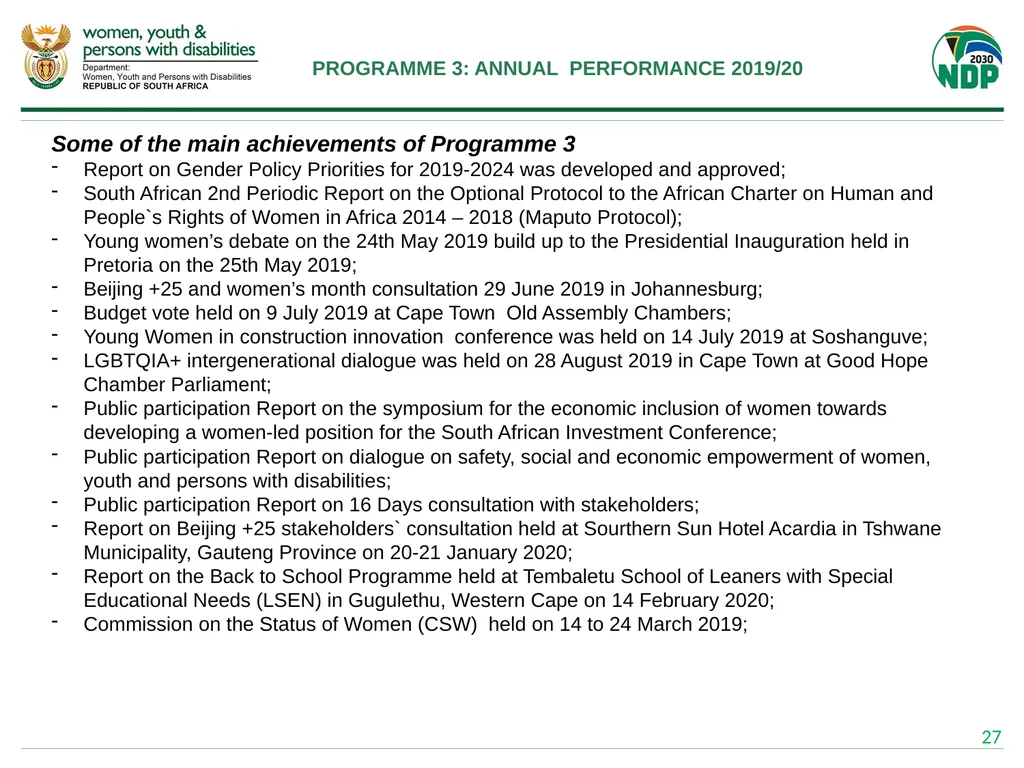
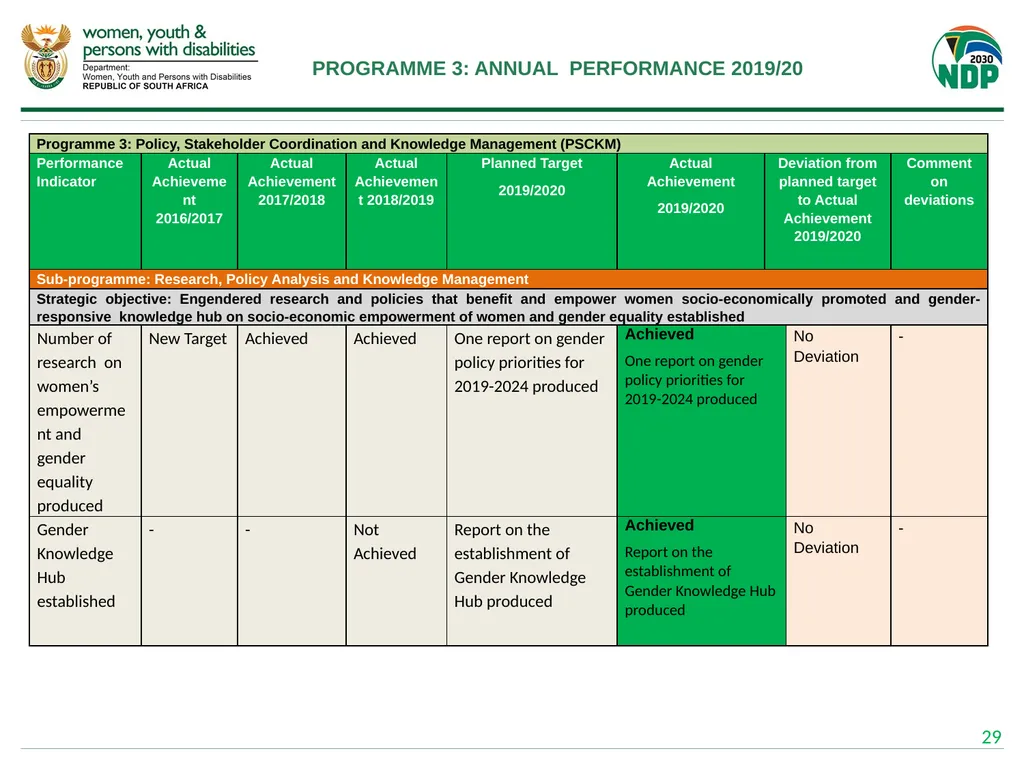
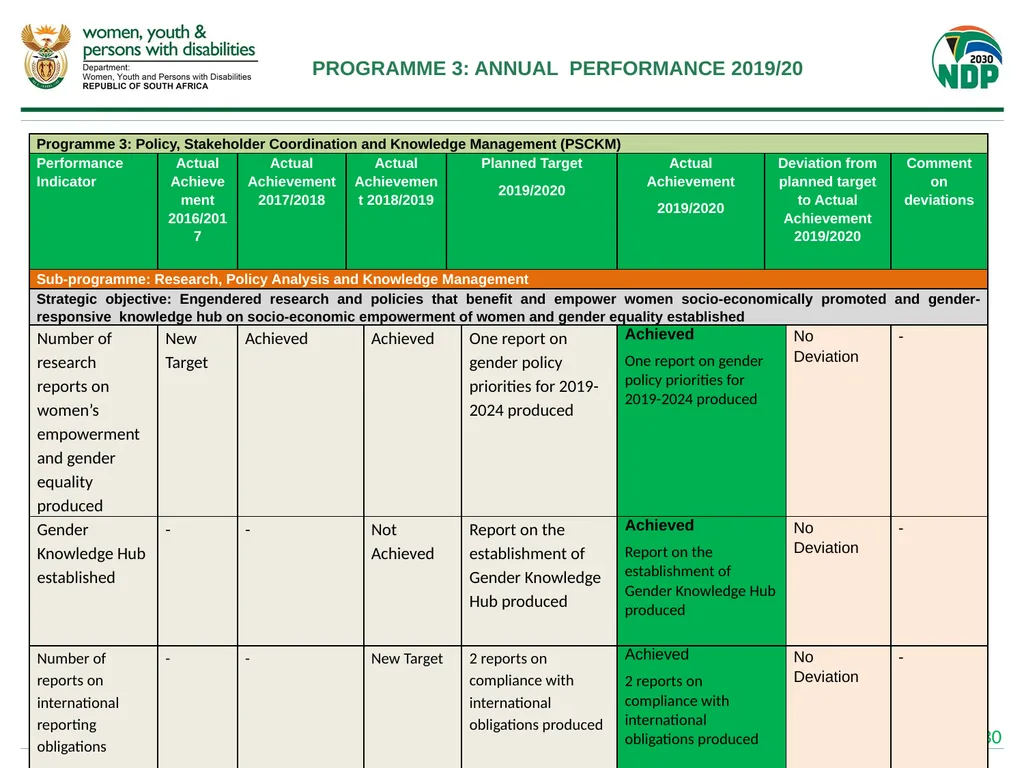
PROGRAMME 3: ANNUAL PERFORMANCE 2019/20 Some of the main achievements of Programme 3
Report on Gender Policy Priorities for 2019-2024 was developed and approved;
South African 2nd Periodic Report on the Optional Protocol to the African Charter on Human and People`s Rights of Women in Africa 2014 – 2018 (Maputo Protocol);
Young women’s debate on the 24th May 2019 build up to the Presidential Inauguration held in Pretoria on the 25th May 2019;
Beijing +25 and women’s month consultation 29 June 2019 in Johannesburg;
Budget vote held on 9 July 2019 at Cape Town Old Assembly Chambers;
Young Women in construction innovation conference was held on 14 July 2019 at Soshanguve;
LGBTQIA+ intergenerational dialogue was held on 28 August 2019 in Cape Town at Good Hope Chamber Parliament;
Public participation Report on the symposium for the economic inclusion of women towards developing a women-led position for the South African Investment Conference;
Public participation Report on dialogue on safety, social and economic empowerment of women, youth and persons with disabilities;
Public participation Report on 16 Days consultation with stakeholders;
Report on Beijing +25 stakeholders` consultation held at Sourthern Sun Hotel Acardia in Tshwane Municipality, Gauteng Province on 20-21 January 2020;
Report on the Back to School Programme held at Tembaletu School of Leaners with Special Educational Needs (LSEN) in Gugulethu, Western Cape on 14 February 2020;
Commission on the Status of Women (CSW) held on 14 to 24 March 2019;<br>
Report on Gender Policy Priorities for 2019-2024 was developed and approved;
South African 2nd Periodic Report on the Optional Protocol to the African Charter on Human and People`s Rights of Women in Africa 2014 – 2018 (Maputo Protocol);
Young women’s debate on the 24th May 2019 build up to the Presidential Inauguration held in Pretoria on the 25th May 2019;
Beijing +25 and women’s month consultation 29 June 2019 in Johannesburg;
Budget vote held on 9 July 2019 at Cape Town Old Assembly Chambers;
Young Women in construction innovation conference was held on 14 July 2019 at Soshanguve;
LGBTQIA+ intergenerational dialogue was held on 28 August 2019 in Cape Town at Good Hope Chamber Parliament;
Public participation Report on the symposium for the economic inclusion of women towards developing a women-led position for the South African Investment Conference;
Public participation Report on dialogue on safety, social and economic empowerment of women, youth and persons with disabilities;
Public participation Report on 16 Days consultation with stakeholders;
Report on Beijing +25 stakeholders` consultation held at Sourthern Sun Hotel Acardia in Tshwane Municipality, Gauteng Province on 20-21 January 2020;
Report on the Back to School Programme held at Tembaletu School of Leaners with Special Educational Needs (LSEN) in Gugulethu, Western Cape on 14 February 2020;
Commission on the Status of Women (CSW) held on 14 to 24 March 2019;<br>
28
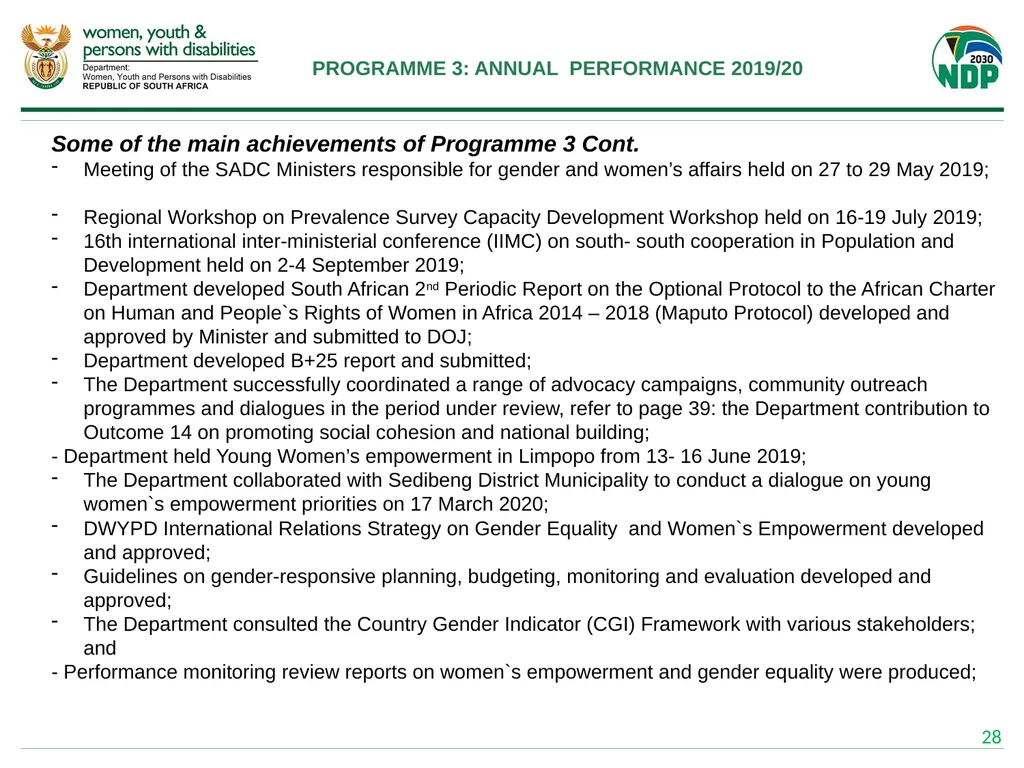
PROGRAMME 3: ANNUAL PERFORMANCE 2019/20 Some of the main achievements of Programme 3 Cont.
Meeting of the SADC Ministers responsible for gender and women’s affairs held on 27 to 29 May 2019;
Regional Workshop on Prevalence Survey Capacity Development Workshop held on 16-19 July 2019;
16th international inter-ministerial conference (IIMC) on south- south cooperation in Population and Development held on 2-4 September 2019;
Department developed South African 2nd Periodic Report on the Optional Protocol to the African Charter on Human and People`s Rights of Women in Africa 2014 – 2018 (Maputo Protocol) developed and approved by Minister and submitted to DOJ;
Department developed B+25 report and submitted;
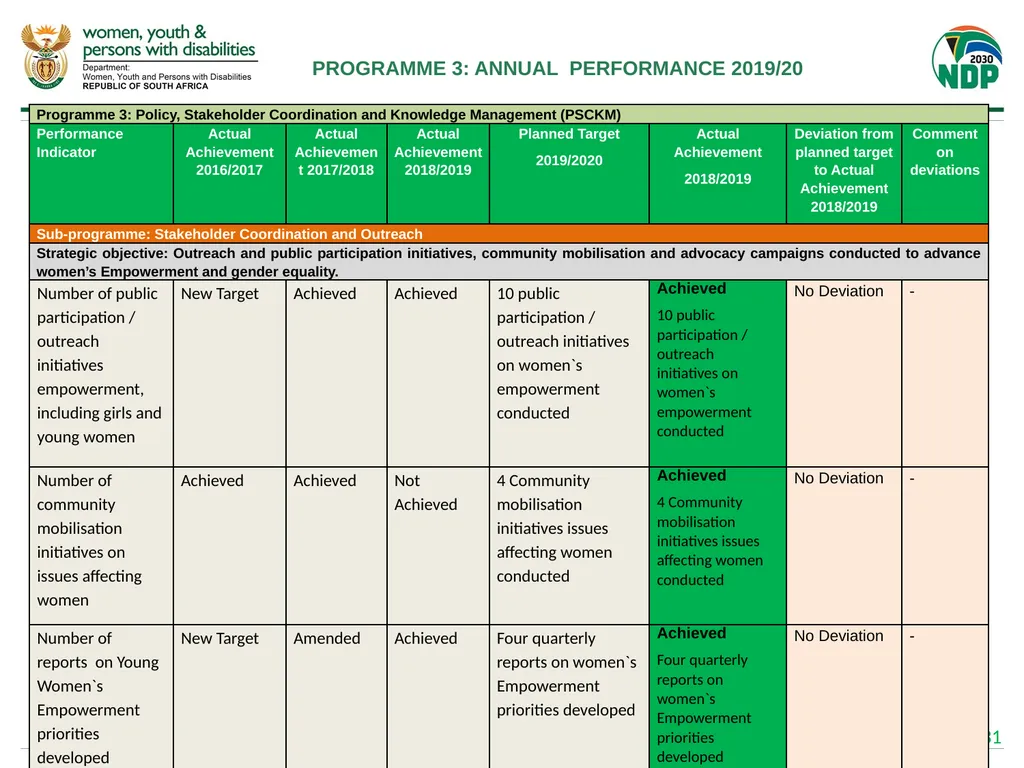
The Department successfully coordinated a range of advocacy campaigns, community outreach programmes and dialogues in the period under review, refer to page 39: the Department contribution to Outcome 14 on promoting social cohesion and national building;
- Department held Young Women’s empowerment in Limpopo from 13- 16 June 2019;
The Department collaborated with Sedibeng District Municipality to conduct a dialogue on young women`s empowerment priorities on 17 March 2020;
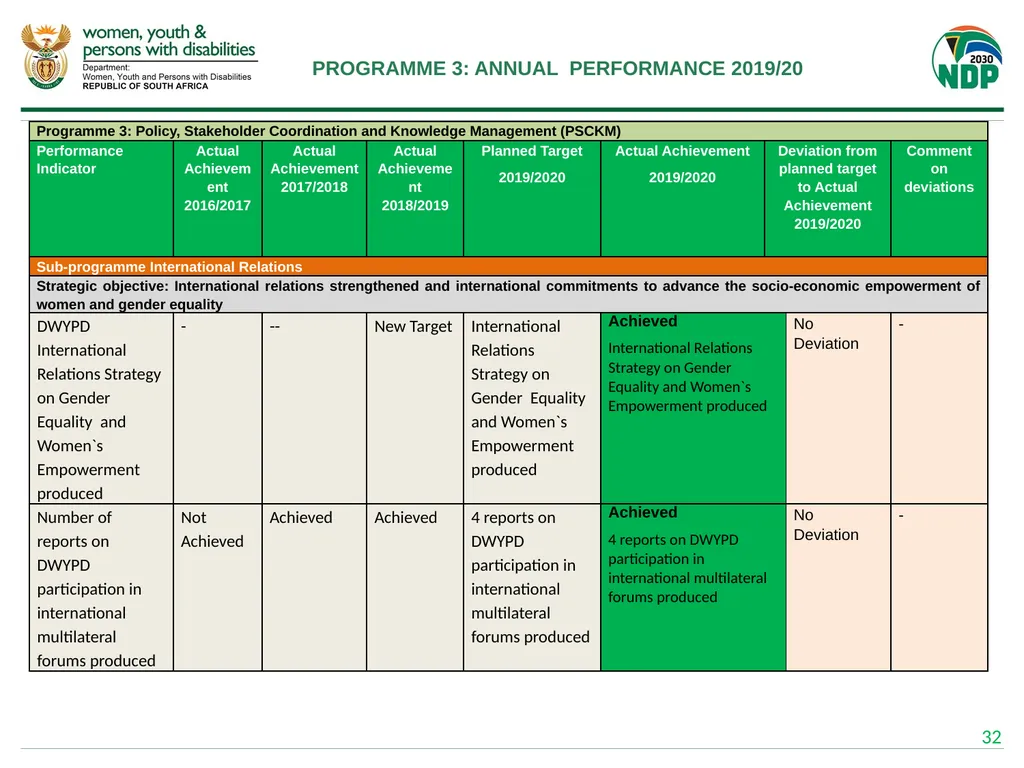
DWYPD International Relations Strategy on Gender Equality and Women`s Empowerment developed and approved;
Guidelines on gender-responsive planning, budgeting, monitoring and evaluation developed and approved;
The Department consulted the Country Gender Indicator (CGI) Framework with various stakeholders; and
- Performance monitoring review reports on women`s empowerment and gender equality were produced;<br>
Meeting of the SADC Ministers responsible for gender and women’s affairs held on 27 to 29 May 2019;
Regional Workshop on Prevalence Survey Capacity Development Workshop held on 16-19 July 2019;
16th international inter-ministerial conference (IIMC) on south- south cooperation in Population and Development held on 2-4 September 2019;
Department developed South African 2nd Periodic Report on the Optional Protocol to the African Charter on Human and People`s Rights of Women in Africa 2014 – 2018 (Maputo Protocol) developed and approved by Minister and submitted to DOJ;
Department developed B+25 report and submitted;
The Department successfully coordinated a range of advocacy campaigns, community outreach programmes and dialogues in the period under review, refer to page 39: the Department contribution to Outcome 14 on promoting social cohesion and national building;
- Department held Young Women’s empowerment in Limpopo from 13- 16 June 2019;
The Department collaborated with Sedibeng District Municipality to conduct a dialogue on young women`s empowerment priorities on 17 March 2020;
DWYPD International Relations Strategy on Gender Equality and Women`s Empowerment developed and approved;
Guidelines on gender-responsive planning, budgeting, monitoring and evaluation developed and approved;
The Department consulted the Country Gender Indicator (CGI) Framework with various stakeholders; and
- Performance monitoring review reports on women`s empowerment and gender equality were produced;<br>
29
PROGRAMME 3: ANNUAL PERFORMANCE 2019/20<br>
30
PROGRAMME 3: ANNUAL PERFORMANCE 2019/20<br>
31
PROGRAMME 3: ANNUAL PERFORMANCE 2019/20<br>
32
PROGRAMME 3: ANNUAL PERFORMANCE 2019/20<br>
33
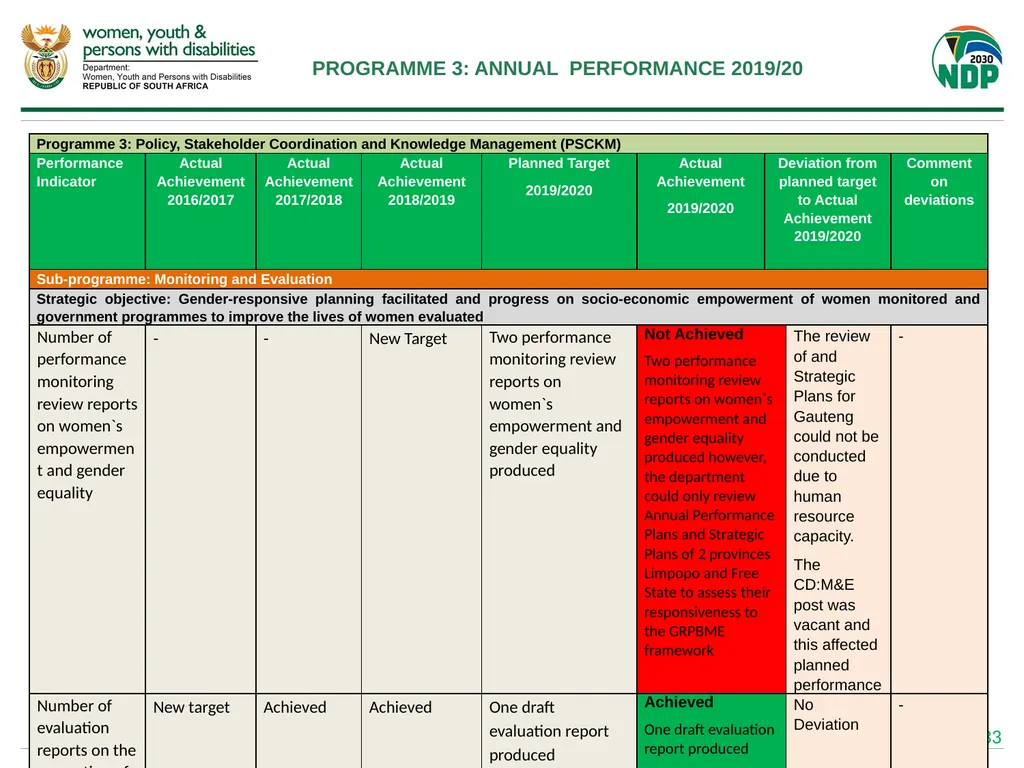
PROGRAMME 3: ANNUAL PERFORMANCE 2019/20<br>
34
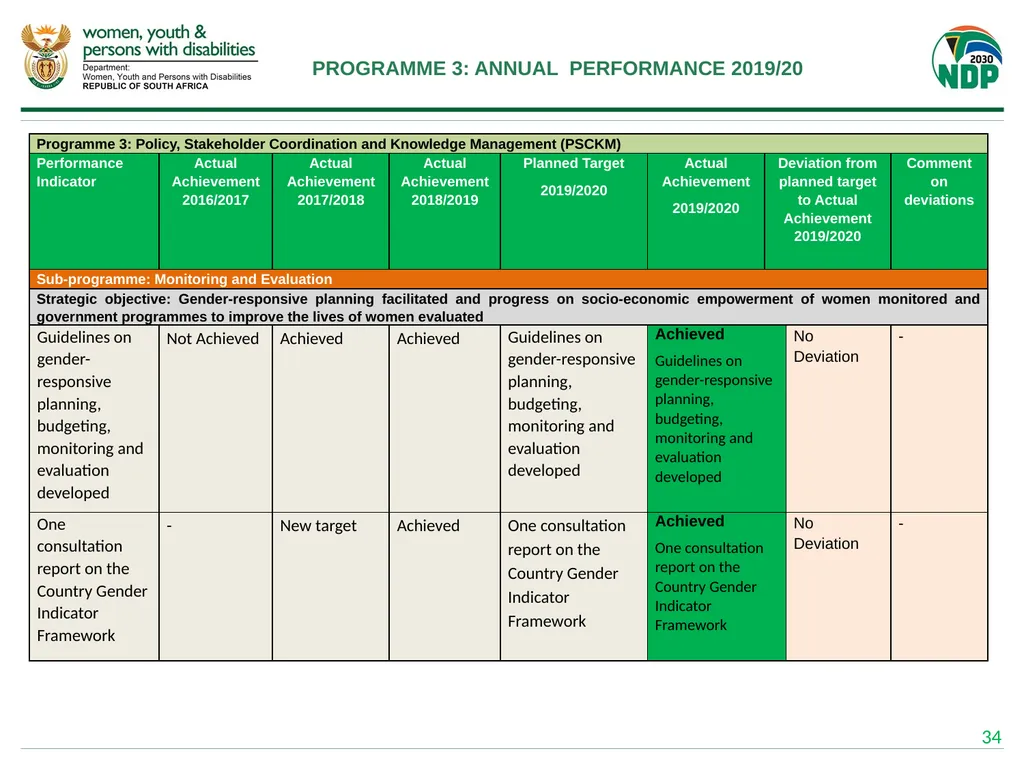
PROGRAMME 3: ANNUAL PERFORMANCE 2019/20<br>
35
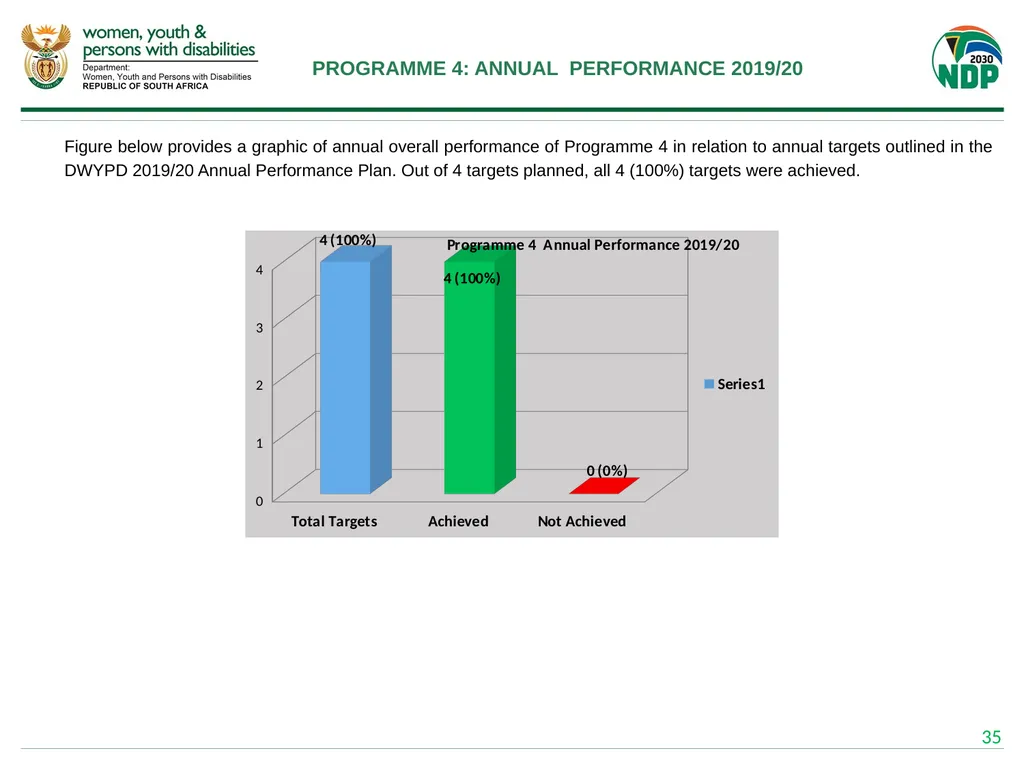
PROGRAMME 4: ANNUAL PERFORMANCE 2019/20 Figure below provides a graphic of annual overall performance of Programme 4 in relation to annual targets outlined in the DWYPD 2019/20 Annual Performance Plan. Out of 4 targets planned, all 4 (100%) targets were achieved.<br>
36
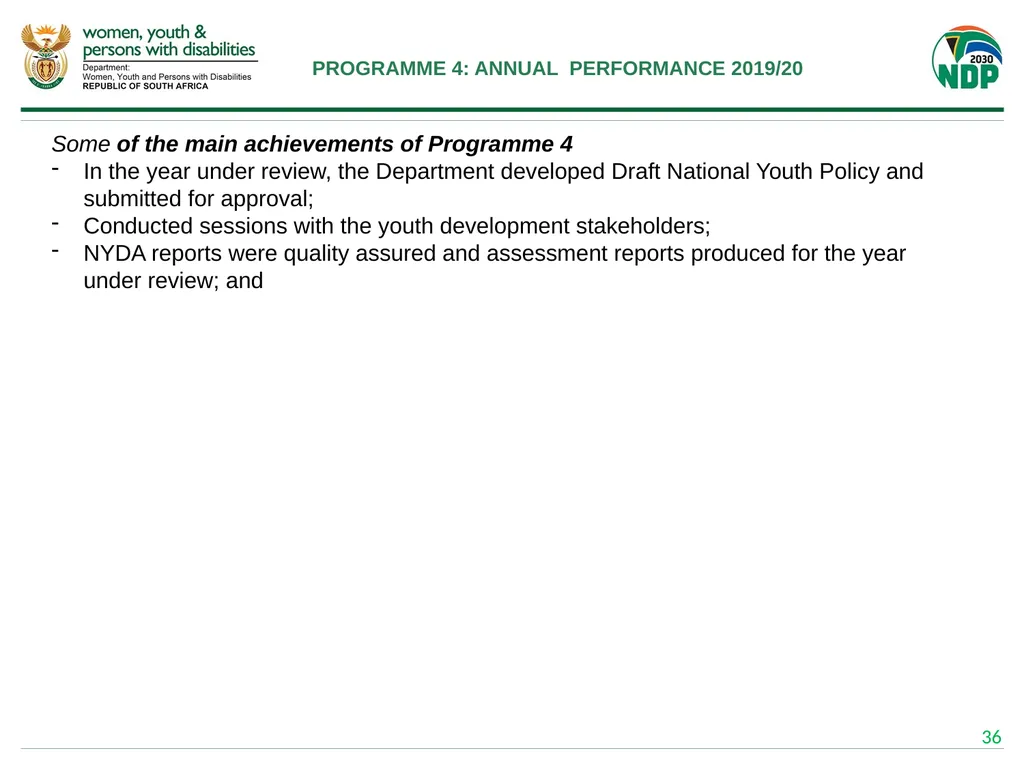
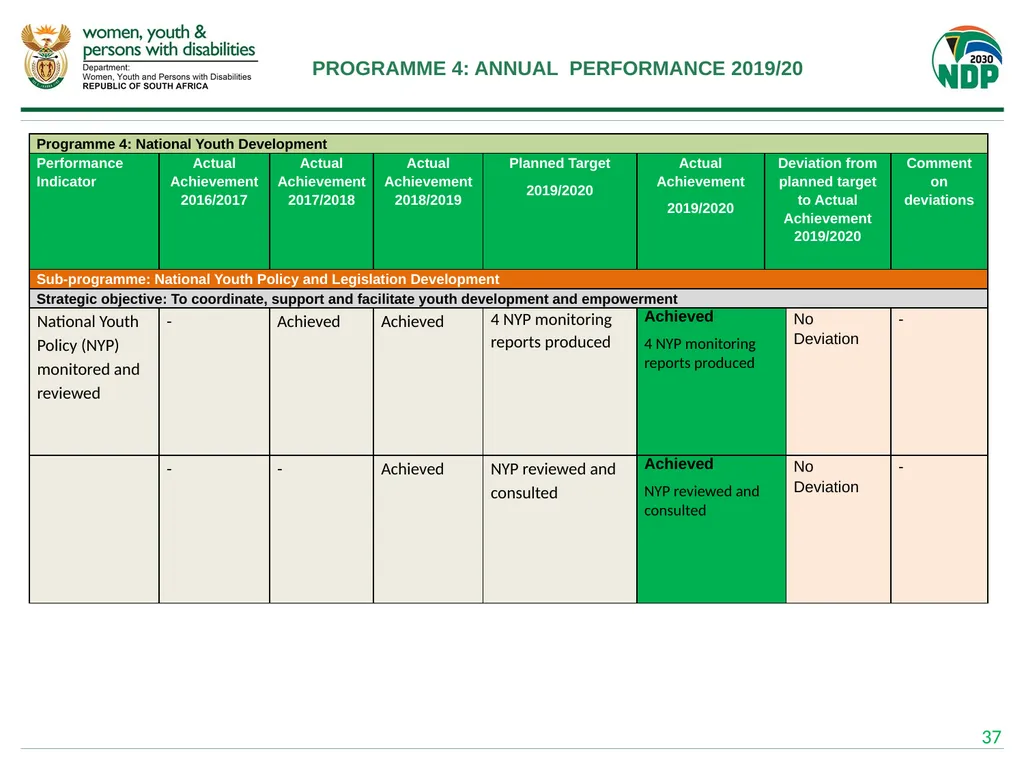
PROGRAMME 4: ANNUAL PERFORMANCE 2019/20 Some of the main achievements of Programme 4
In the year under review, the Department developed Draft National Youth Policy and submitted for approval;
Conducted sessions with the youth development stakeholders;
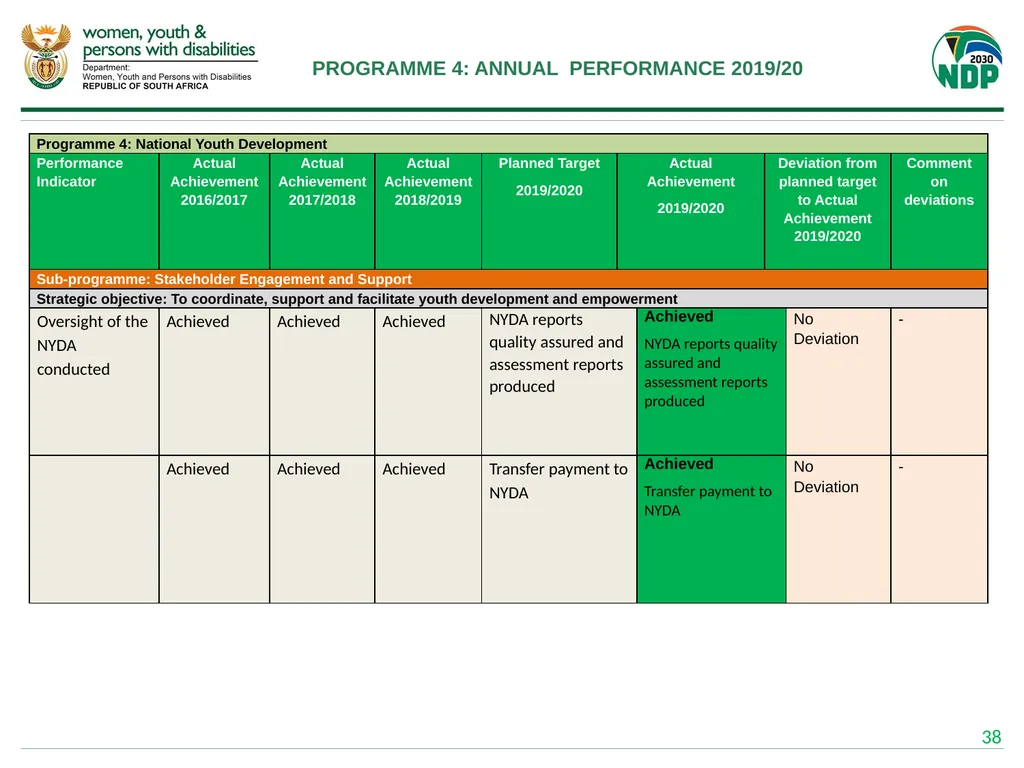
NYDA reports were quality assured and assessment reports produced for the year under review; and<br>
In the year under review, the Department developed Draft National Youth Policy and submitted for approval;
Conducted sessions with the youth development stakeholders;
NYDA reports were quality assured and assessment reports produced for the year under review; and<br>
37
PROGRAMME 4: ANNUAL PERFORMANCE 2019/20<br>
38
PROGRAMME 4: ANNUAL PERFORMANCE 2019/20<br>
39
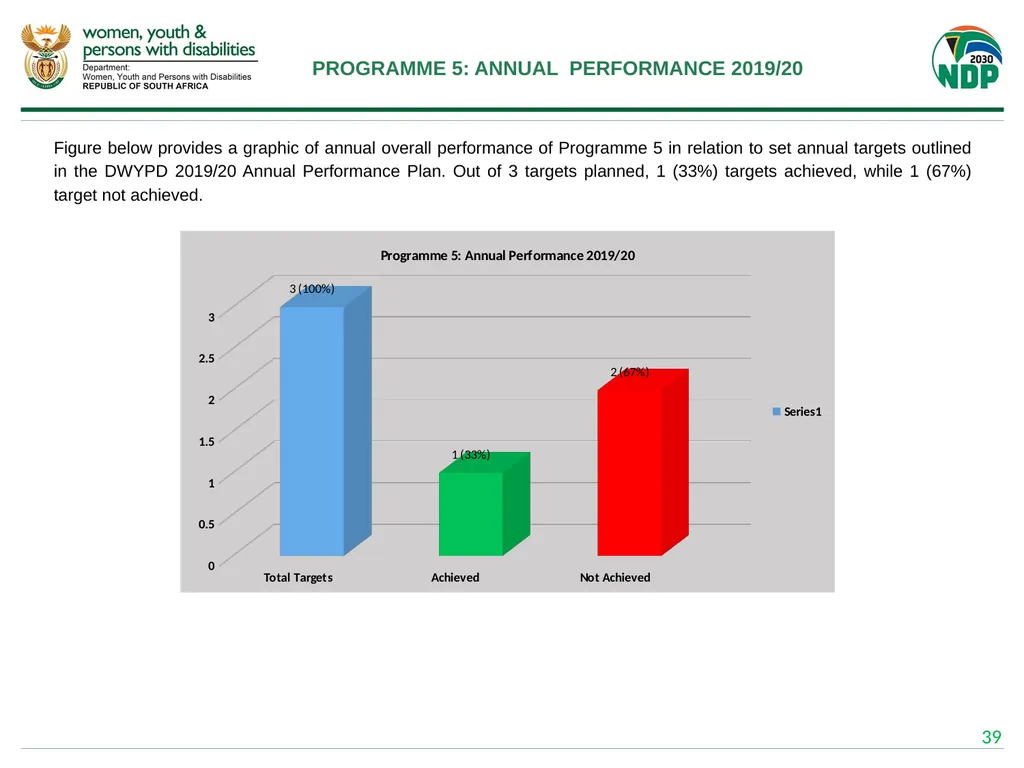
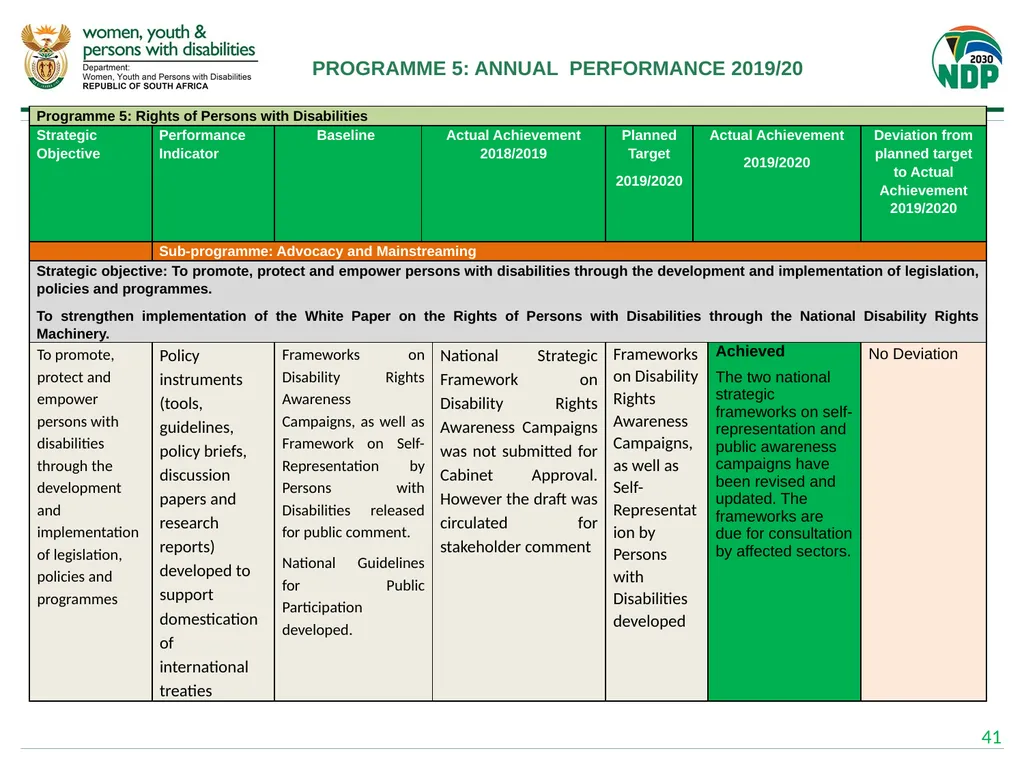
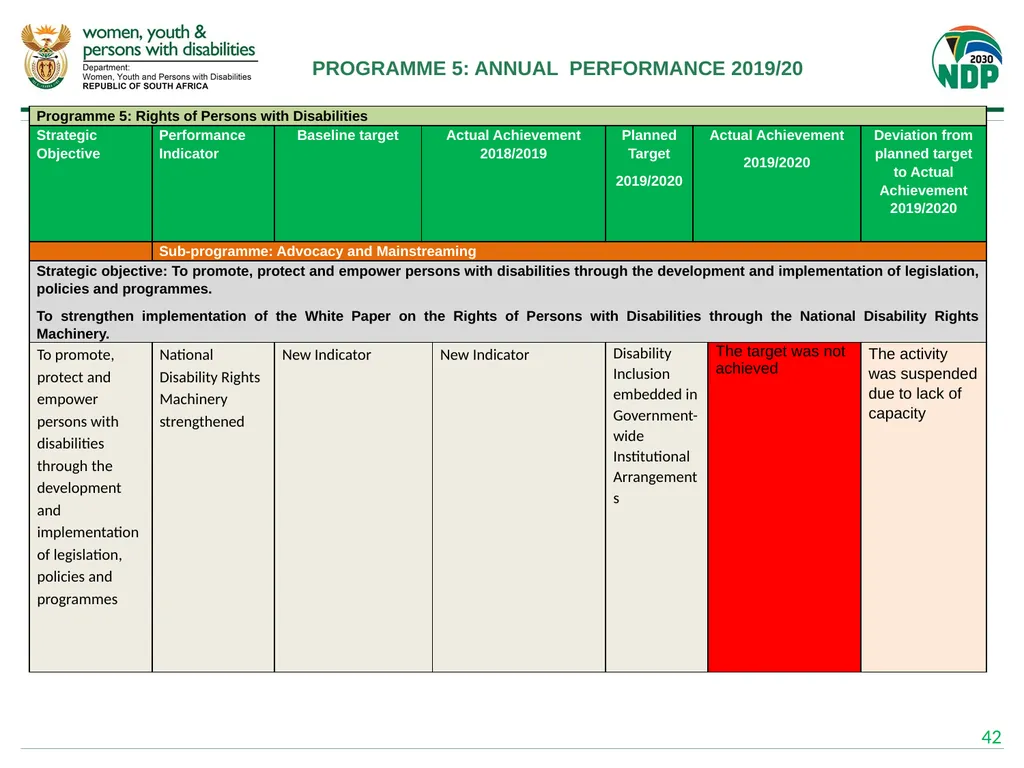
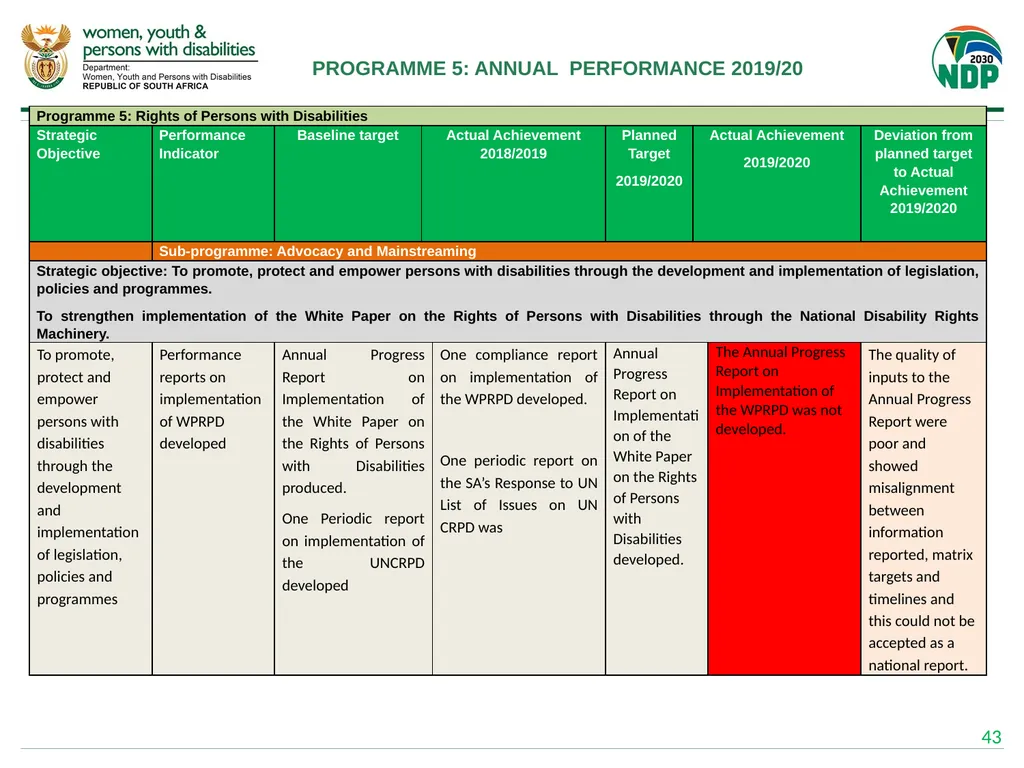
PROGRAMME 5: ANNUAL PERFORMANCE 2019/20 Figure below provides a graphic of annual overall performance of Programme 5 in relation to set annual targets outlined in the DWYPD 2019/20 Annual Performance Plan. Out of 3 targets planned, 1 (33%) targets achieved, while 1 (67%) target not achieved.<br>
40
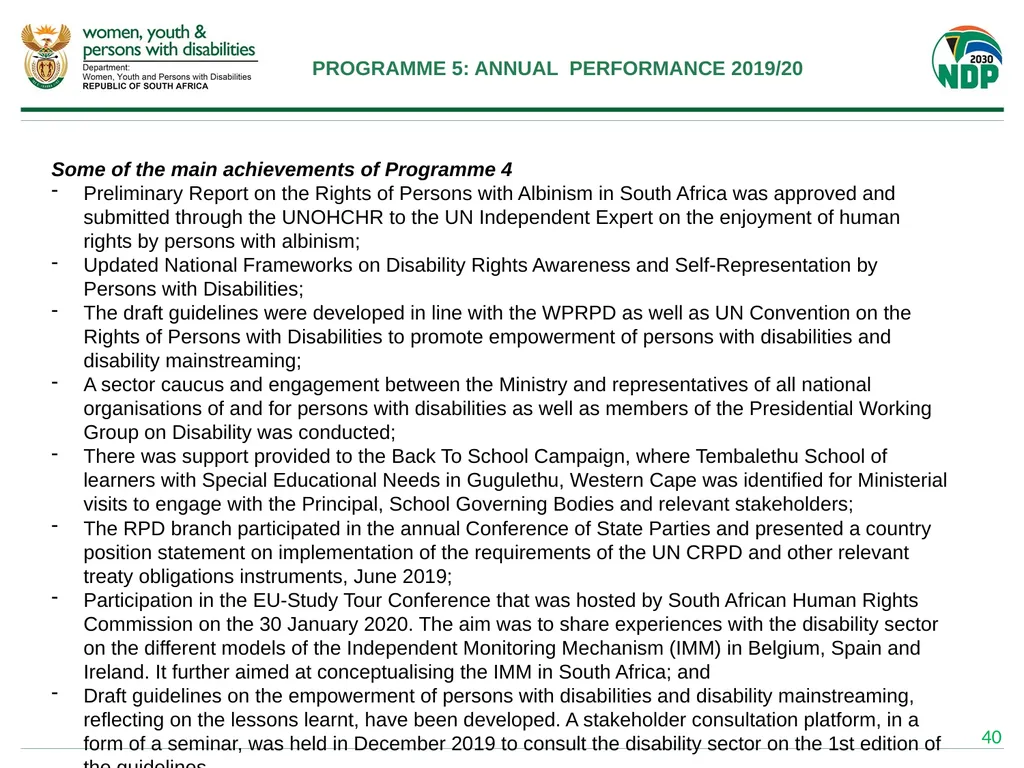
PROGRAMME 5: ANNUAL PERFORMANCE 2019/20 Some of the main achievements of Programme 4
Preliminary Report on the Rights of Persons with Albinism in South Africa was approved and submitted through the UNOHCHR to the UN Independent Expert on the enjoyment of human rights by persons with albinism;
Updated National Frameworks on Disability Rights Awareness and Self-Representation by Persons with Disabilities;
The draft guidelines were developed in line with the WPRPD as well as UN Convention on the Rights of Persons with Disabilities to promote empowerment of persons with disabilities and disability mainstreaming;
A sector caucus and engagement between the Ministry and representatives of all national organisations of and for persons with disabilities as well as members of the Presidential Working Group on Disability was conducted;
There was support provided to the Back To School Campaign, where Tembalethu School of learners with Special Educational Needs in Gugulethu, Western Cape was identified for Ministerial visits to engage with the Principal, School Governing Bodies and relevant stakeholders;
The RPD branch participated in the annual Conference of State Parties and presented a country position statement on implementation of the requirements of the UN CRPD and other relevant treaty obligations instruments, June 2019;
Participation in the EU-Study Tour Conference that was hosted by South African Human Rights Commission on the 30 January 2020. The aim was to share experiences with the disability sector on the different models of the Independent Monitoring Mechanism (IMM) in Belgium, Spain and Ireland. It further aimed at conceptualising the IMM in South Africa; and
Draft guidelines on the empowerment of persons with disabilities and disability mainstreaming, reflecting on the lessons learnt, have been developed. A stakeholder consultation platform, in a form of a seminar, was held in December 2019 to consult the disability sector on the 1st edition of the guidelines.<br>
Preliminary Report on the Rights of Persons with Albinism in South Africa was approved and submitted through the UNOHCHR to the UN Independent Expert on the enjoyment of human rights by persons with albinism;
Updated National Frameworks on Disability Rights Awareness and Self-Representation by Persons with Disabilities;
The draft guidelines were developed in line with the WPRPD as well as UN Convention on the Rights of Persons with Disabilities to promote empowerment of persons with disabilities and disability mainstreaming;
A sector caucus and engagement between the Ministry and representatives of all national organisations of and for persons with disabilities as well as members of the Presidential Working Group on Disability was conducted;
There was support provided to the Back To School Campaign, where Tembalethu School of learners with Special Educational Needs in Gugulethu, Western Cape was identified for Ministerial visits to engage with the Principal, School Governing Bodies and relevant stakeholders;
The RPD branch participated in the annual Conference of State Parties and presented a country position statement on implementation of the requirements of the UN CRPD and other relevant treaty obligations instruments, June 2019;
Participation in the EU-Study Tour Conference that was hosted by South African Human Rights Commission on the 30 January 2020. The aim was to share experiences with the disability sector on the different models of the Independent Monitoring Mechanism (IMM) in Belgium, Spain and Ireland. It further aimed at conceptualising the IMM in South Africa; and
Draft guidelines on the empowerment of persons with disabilities and disability mainstreaming, reflecting on the lessons learnt, have been developed. A stakeholder consultation platform, in a form of a seminar, was held in December 2019 to consult the disability sector on the 1st edition of the guidelines.<br>
41
PROGRAMME 5: ANNUAL PERFORMANCE 2019/20<br>
42
PROGRAMME 5: ANNUAL PERFORMANCE 2019/20<br>
43
PROGRAMME 5: ANNUAL PERFORMANCE 2019/20<br>
44
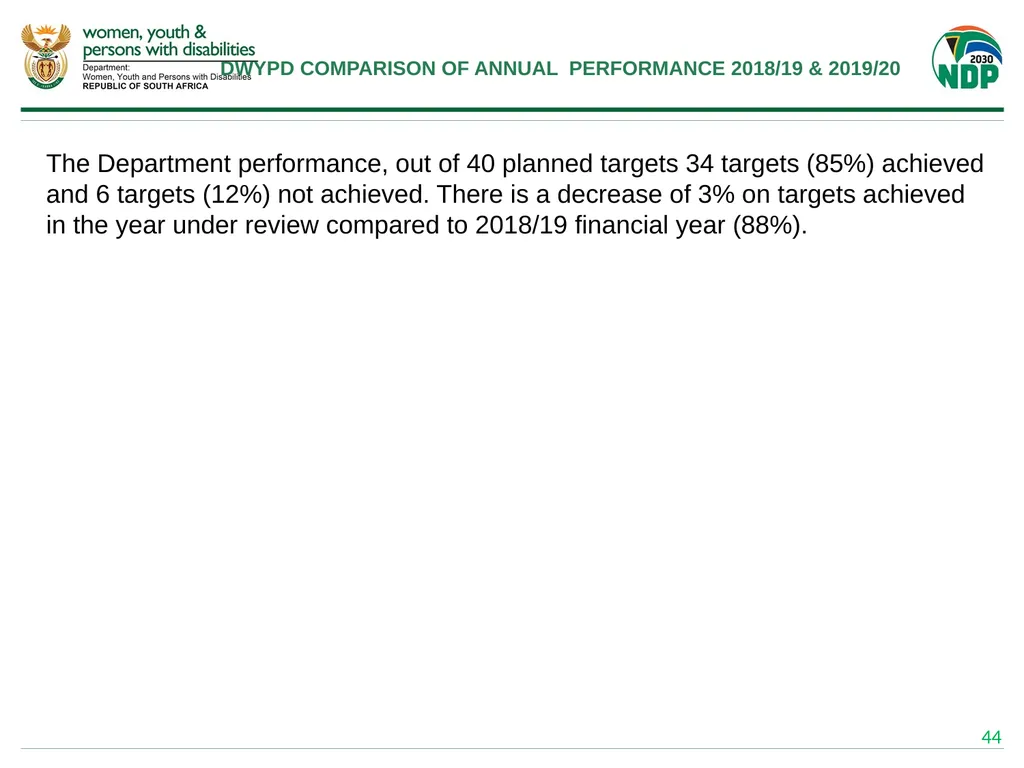
DWYPD COMPARISON OF ANNUAL PERFORMANCE 2018/19 & 2019/20 The Department performance, out of 40 planned targets 34 targets (85%) achieved and 6 targets (12%) not achieved. There is a decrease of 3% on targets achieved in the year under review compared to 2018/19 financial year (88%).<br>
45
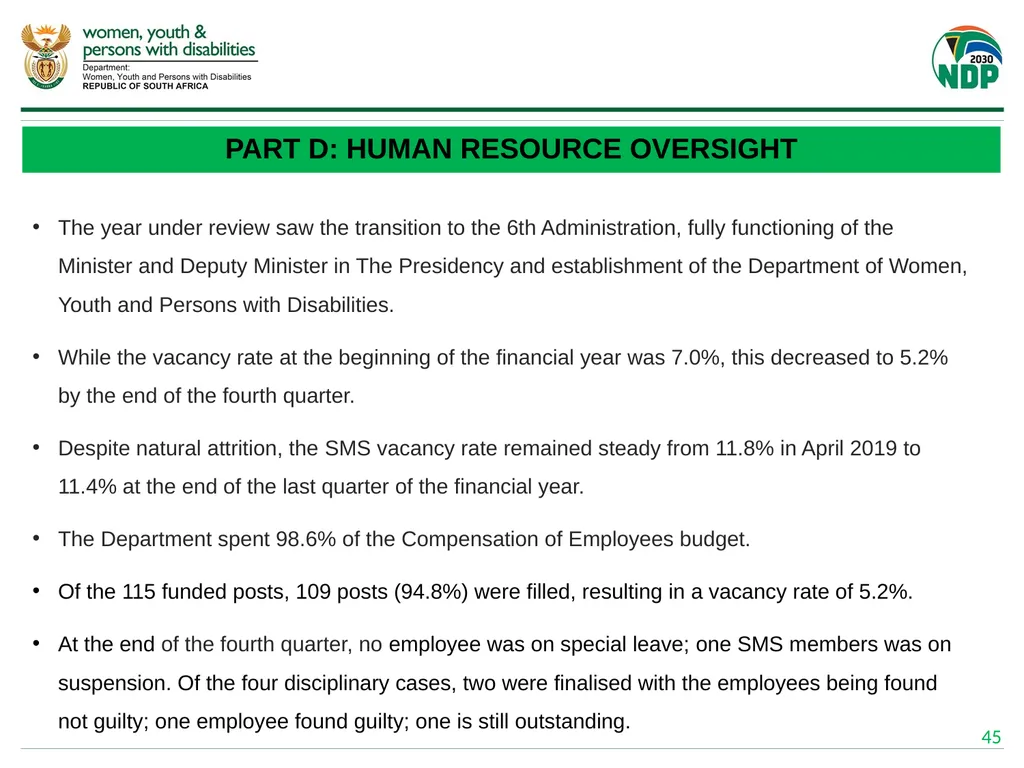
PART D: HUMAN RESOURCE OVERSIGHT The year under review saw the transition to the 6th Administration, fully functioning of the Minister and Deputy Minister in The Presidency and establishment of the Department of Women, Youth and Persons with Disabilities.
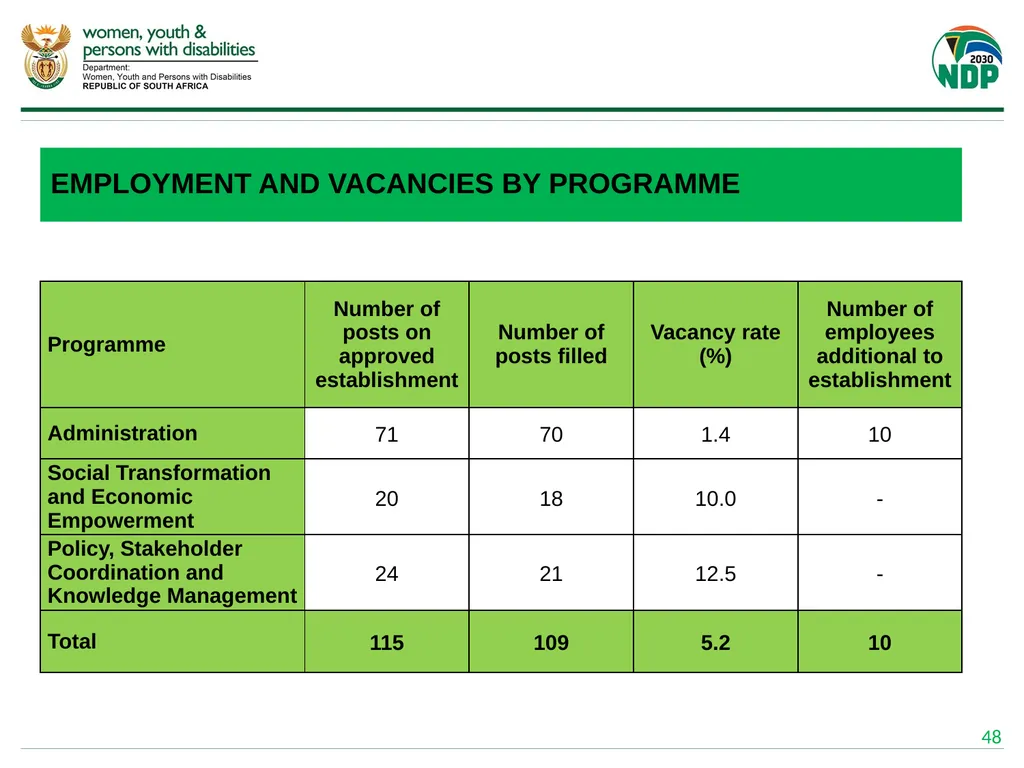
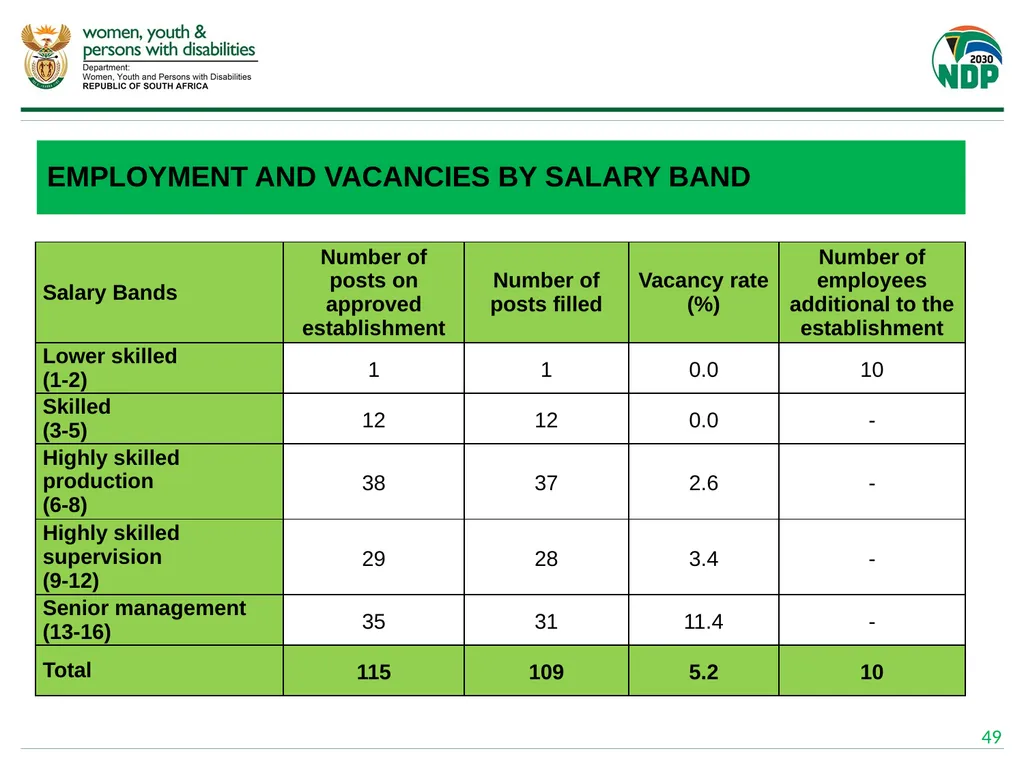
While the vacancy rate at the beginning of the financial year was 7.0%, this decreased to 5.2% by the end of the fourth quarter.
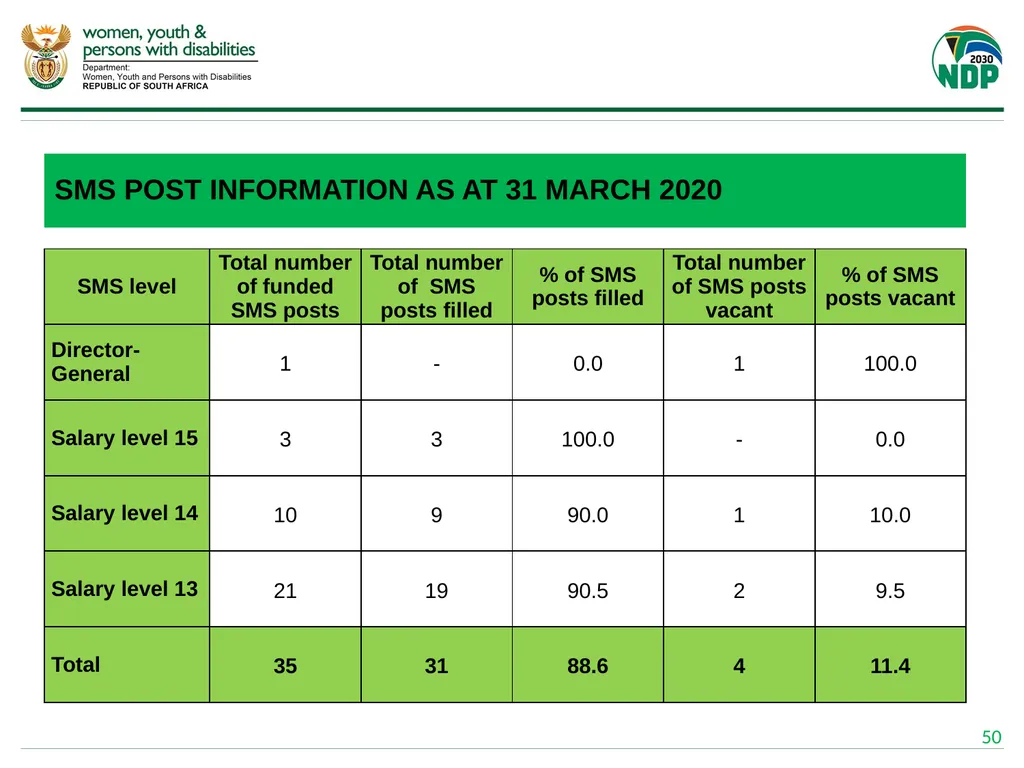
Despite natural attrition, the SMS vacancy rate remained steady from 11.8% in April 2019 to 11.4% at the end of the last quarter of the financial year.
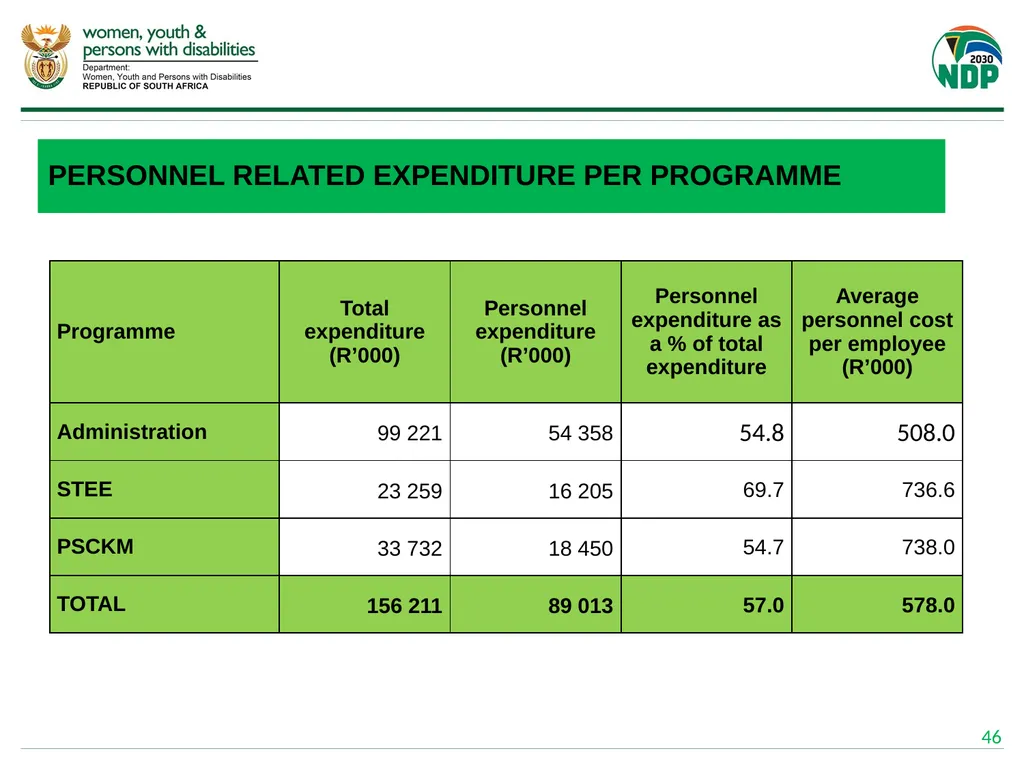
The Department spent 98.6% of the Compensation of Employees budget.
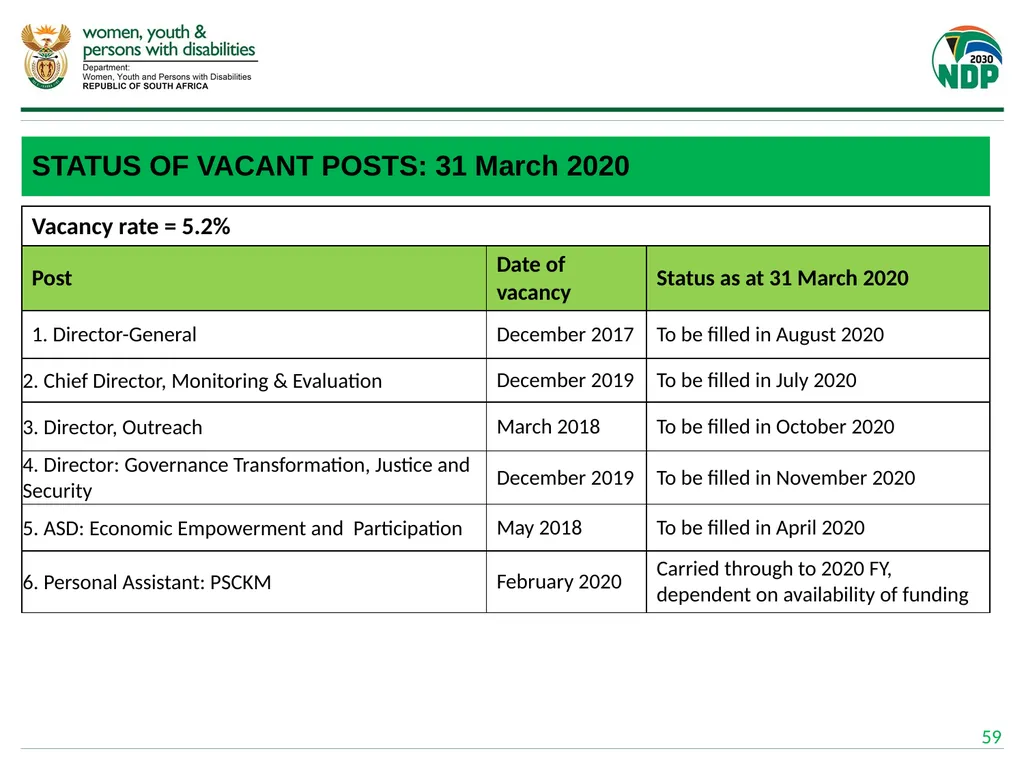
Of the 115 funded posts, 109 posts (94.8%) were filled, resulting in a vacancy rate of 5.2%.
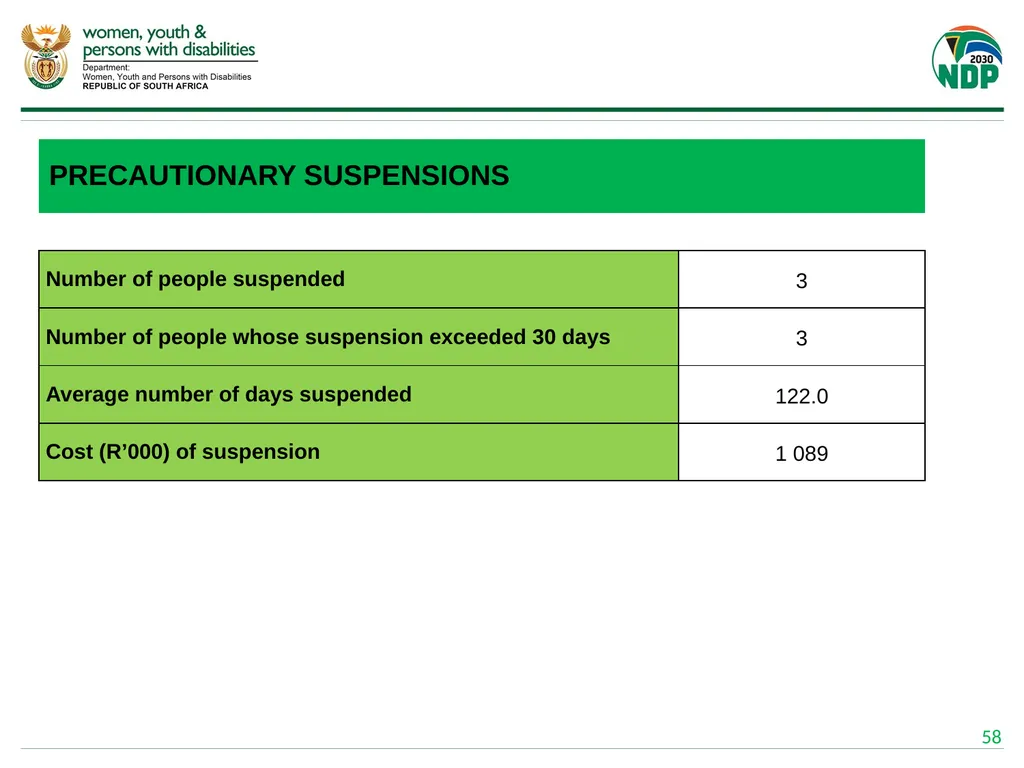
At the end of the fourth quarter, no employee was on special leave; one SMS members was on suspension. Of the four disciplinary cases, two were finalised with the employees being found not guilty; one employee found guilty; one is still outstanding.<br>
While the vacancy rate at the beginning of the financial year was 7.0%, this decreased to 5.2% by the end of the fourth quarter.
Despite natural attrition, the SMS vacancy rate remained steady from 11.8% in April 2019 to 11.4% at the end of the last quarter of the financial year.
The Department spent 98.6% of the Compensation of Employees budget.
Of the 115 funded posts, 109 posts (94.8%) were filled, resulting in a vacancy rate of 5.2%.
At the end of the fourth quarter, no employee was on special leave; one SMS members was on suspension. Of the four disciplinary cases, two were finalised with the employees being found not guilty; one employee found guilty; one is still outstanding.<br>
46
PERSONNEL RELATED EXPENDITURE PER PROGRAMME<br>
47
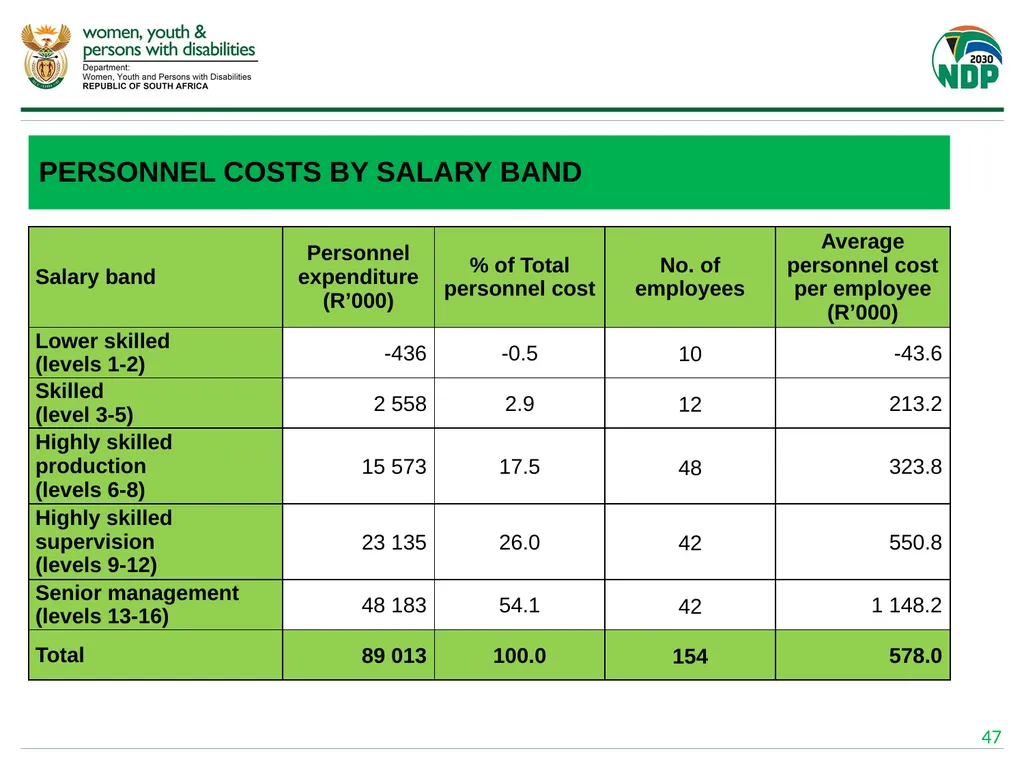
PERSONNEL COSTS BY SALARY BAND<br>
48
EMPLOYMENT AND VACANCIES BY PROGRAMME<br>
49
EMPLOYMENT AND VACANCIES BY SALARY BAND<br>
50
SMS POST INFORMATION AS AT 31 MARCH 2020<br>
51
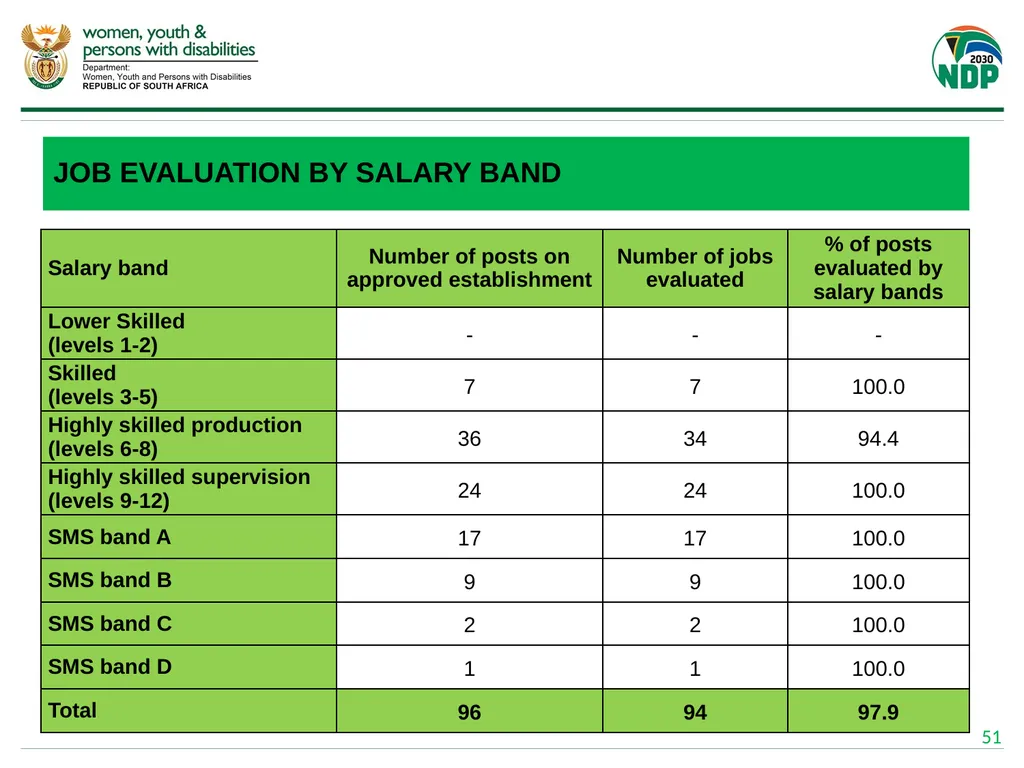
JOB EVALUATION BY SALARY BAND<br>
52
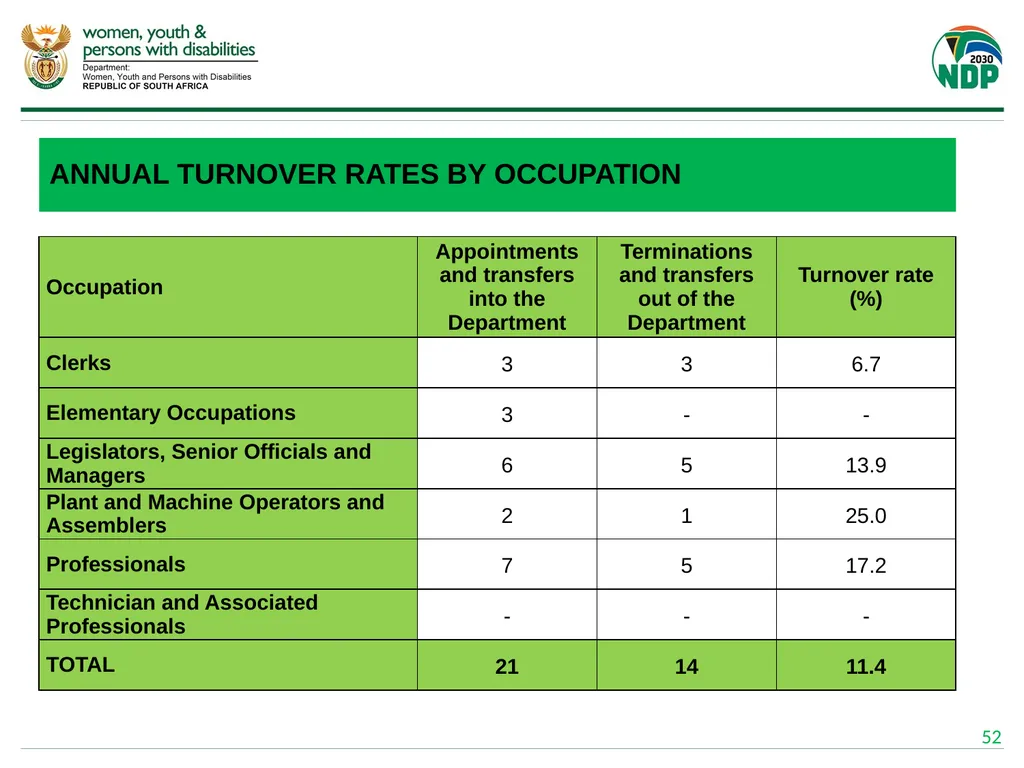
ANNUAL TURNOVER RATES BY OCCUPATION<br>
53
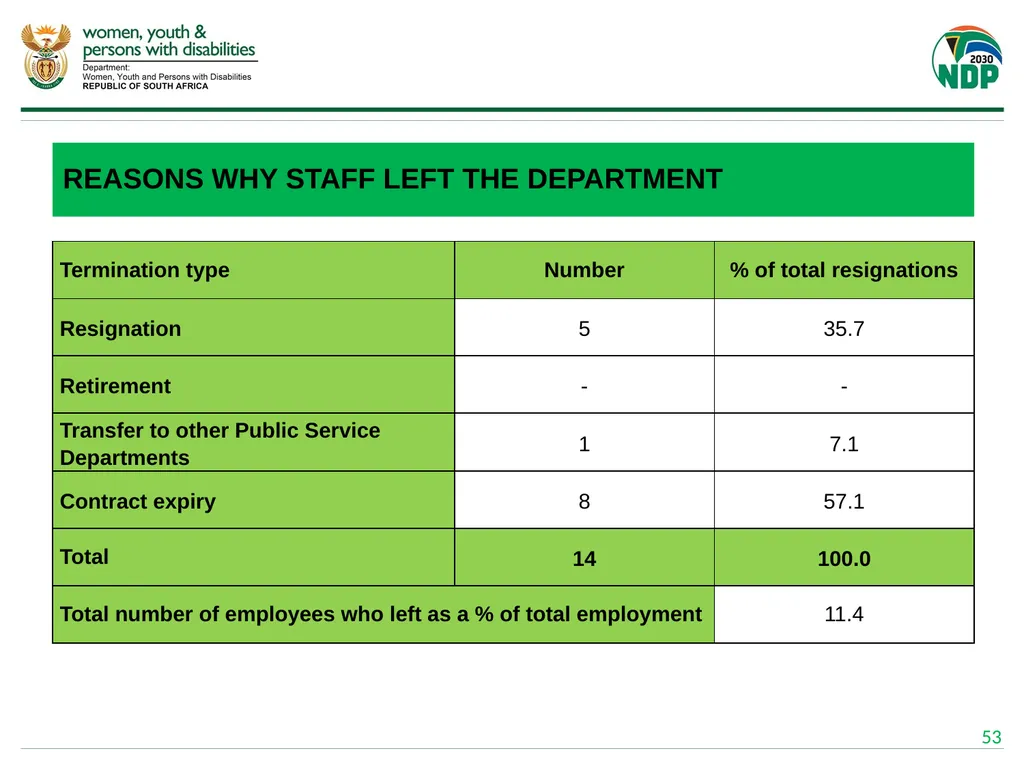
REASONS WHY STAFF LEFT THE DEPARTMENT<br>
54
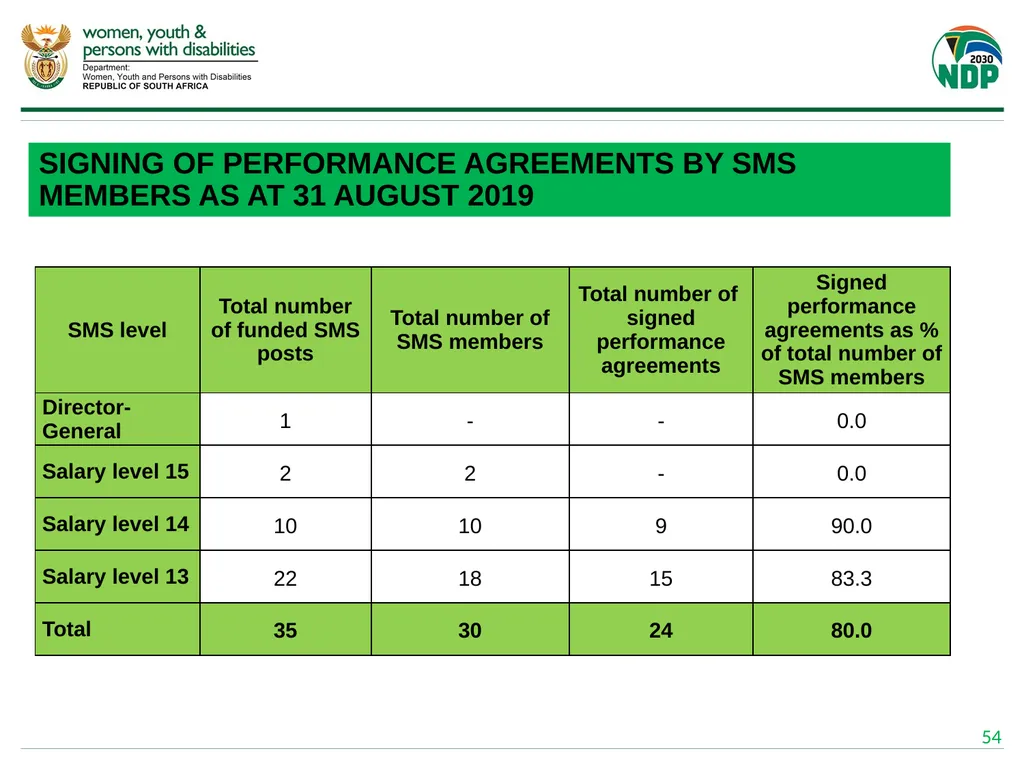
SIGNING OF PERFORMANCE AGREEMENTS BY SMS MEMBERS AS AT 31 AUGUST 2019<br>
55
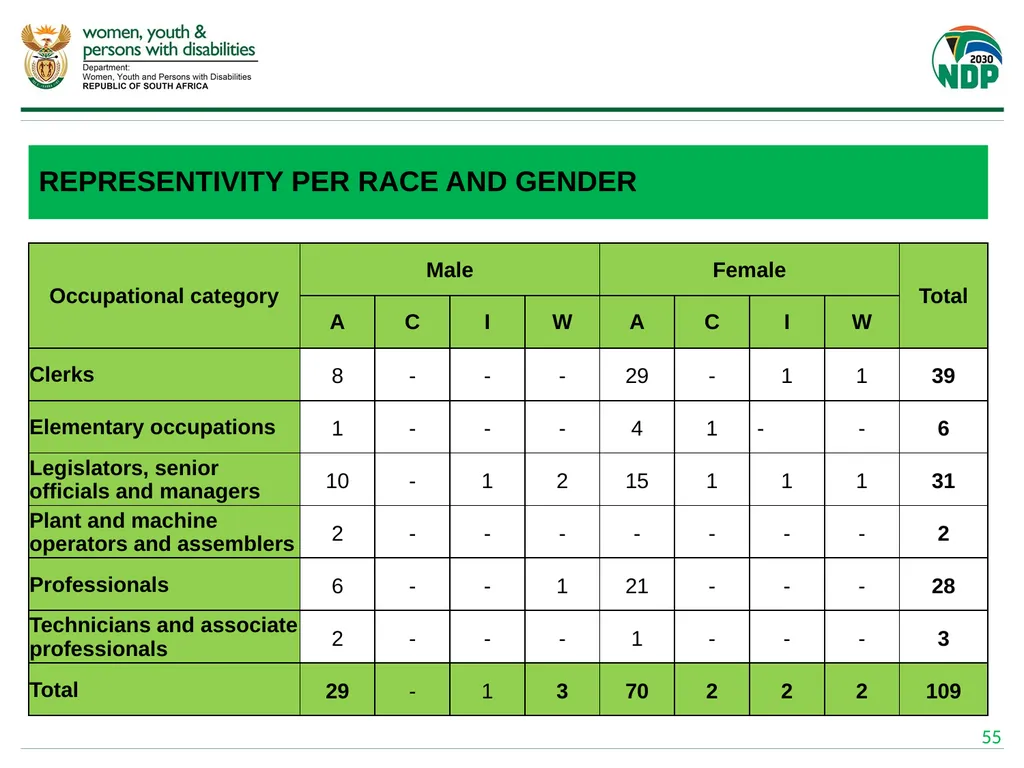
REPRESENTIVITY PER RACE AND GENDER<br>
56
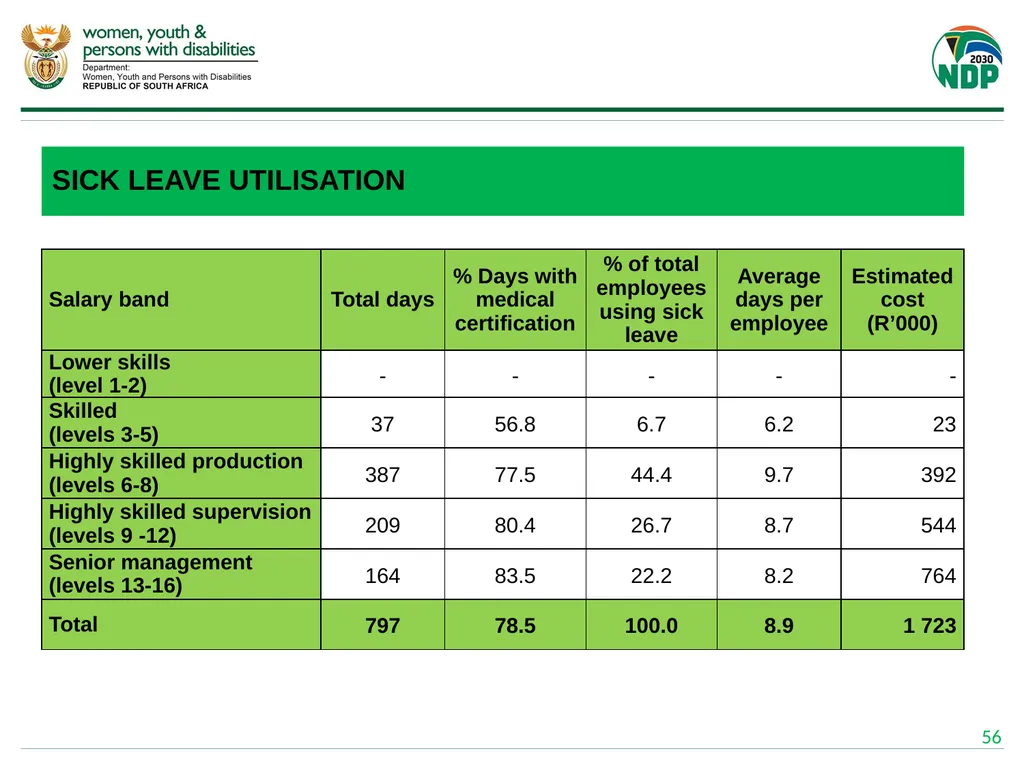
SICK LEAVE UTILISATION<br>
57
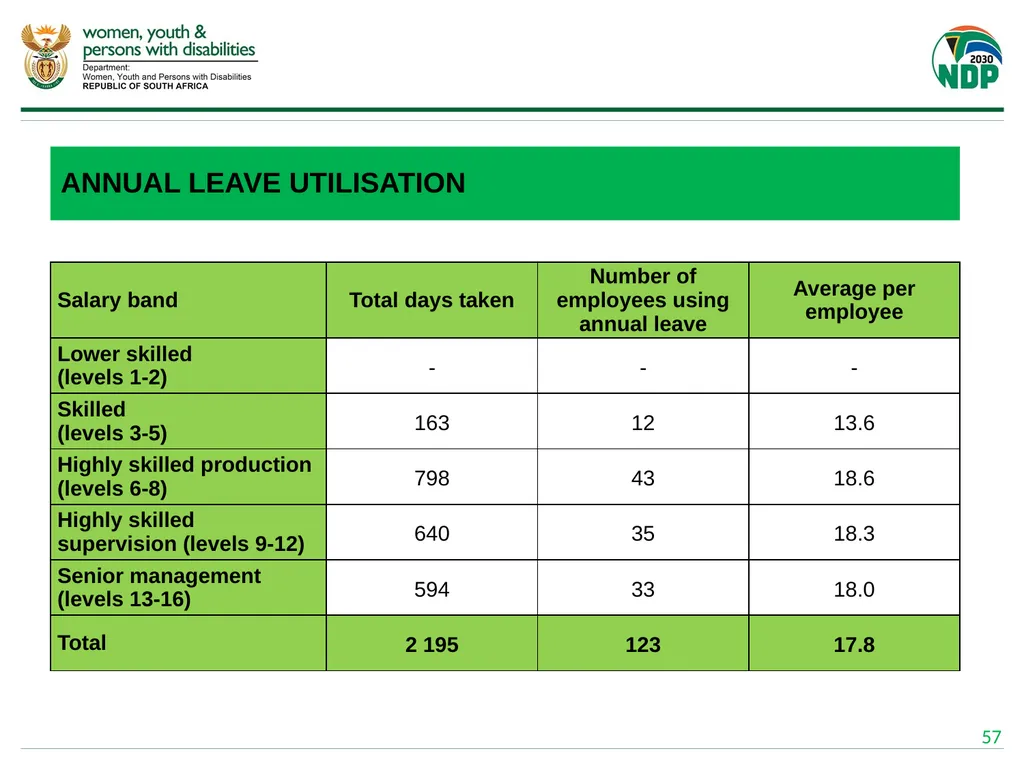
ANNUAL LEAVE UTILISATION<br>
58
PRECAUTIONARY SUSPENSIONS<br>
59
STATUS OF VACANT POSTS: 31 March 2020<br>
60
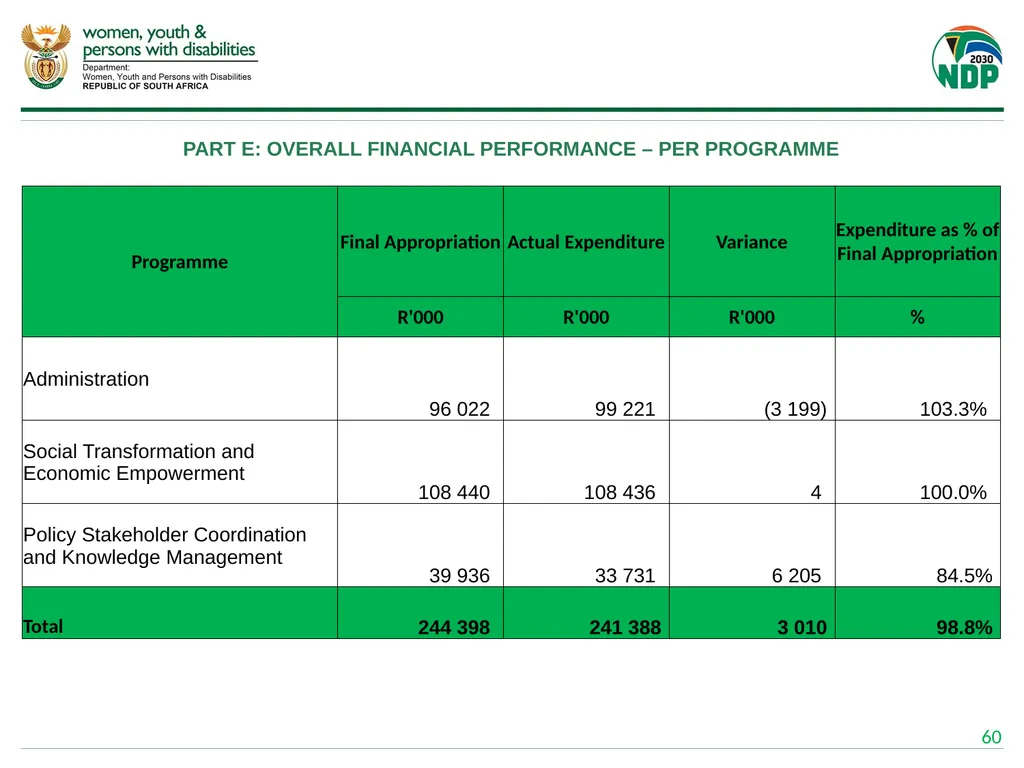
PART E: OVERALL FINANCIAL PERFORMANCE – PER PROGRAMME<br>
61
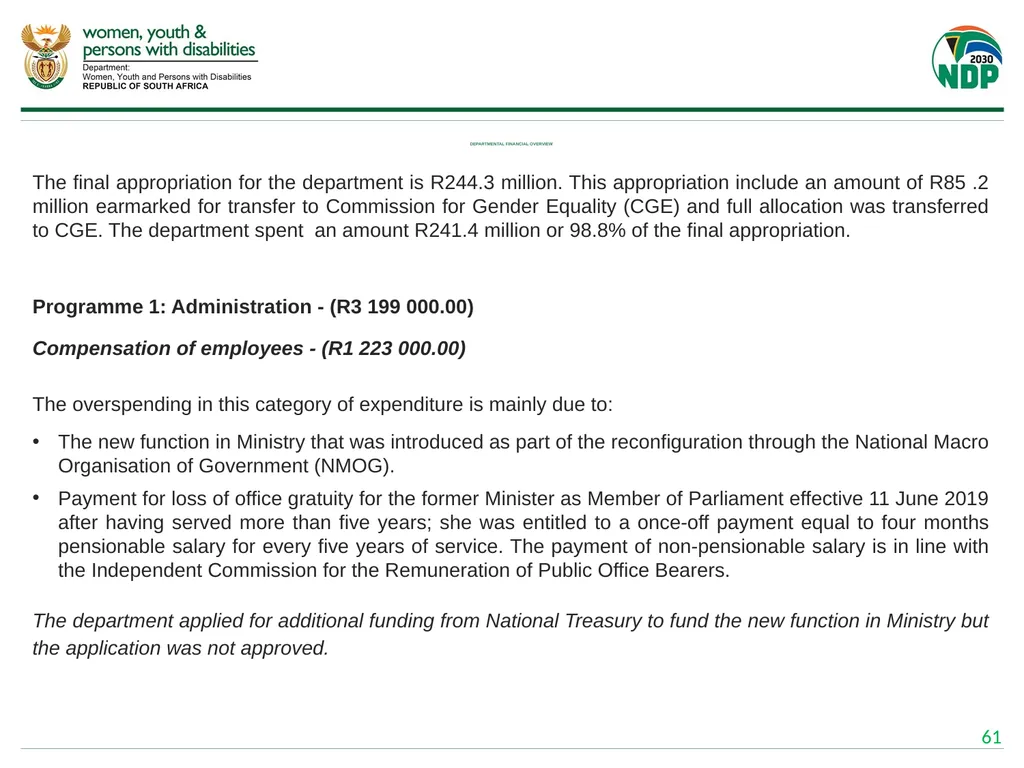
DEPARTMENTAL FINANCIAL OVERVIEW The final appropriation for the department is R244.3 million. This appropriation include an amount of R85 .2 million earmarked for transfer to Commission for Gender Equality (CGE) and full allocation was transferred to CGE. The department spent an amount R241.4 million or 98.8% of the final appropriation.
Programme 1: Administration - (R3 199 000.00)
Compensation of employees - (R1 223 000.00)
The overspending in this category of expenditure is mainly due to:
The new function in Ministry that was introduced as part of the reconfiguration through the National Macro Organisation of Government (NMOG).
Payment for loss of office gratuity for the former Minister as Member of Parliament effective 11 June 2019 after having served more than five years; she was entitled to a once-off payment equal to four months pensionable salary for every five years of service. The payment of non-pensionable salary is in line with the Independent Commission for the Remuneration of Public Office Bearers.
The department applied for additional funding from National Treasury to fund the new function in Ministry but the application was not approved.<br>
Programme 1: Administration - (R3 199 000.00)
Compensation of employees - (R1 223 000.00)
The overspending in this category of expenditure is mainly due to:
The new function in Ministry that was introduced as part of the reconfiguration through the National Macro Organisation of Government (NMOG).
Payment for loss of office gratuity for the former Minister as Member of Parliament effective 11 June 2019 after having served more than five years; she was entitled to a once-off payment equal to four months pensionable salary for every five years of service. The payment of non-pensionable salary is in line with the Independent Commission for the Remuneration of Public Office Bearers.
The department applied for additional funding from National Treasury to fund the new function in Ministry but the application was not approved.<br>
62
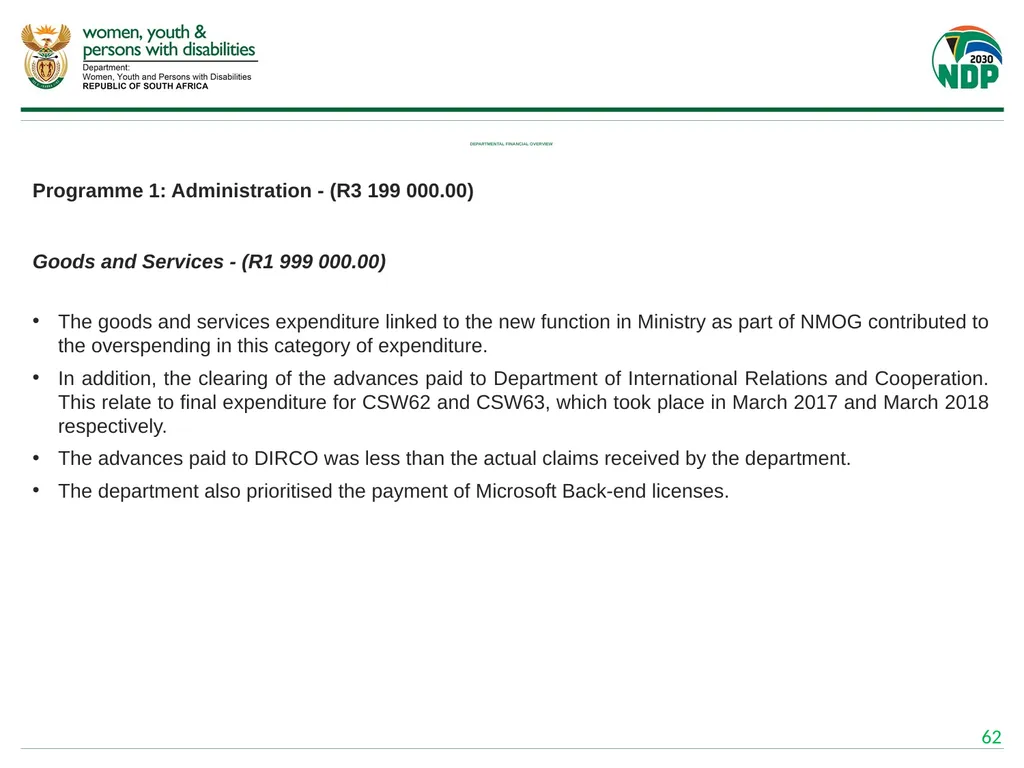
DEPARTMENTAL FINANCIAL OVERVIEW Programme 1: Administration - (R3 199 000.00)
Goods and Services - (R1 999 000.00)
The goods and services expenditure linked to the new function in Ministry as part of NMOG contributed to the overspending in this category of expenditure.
In addition, the clearing of the advances paid to Department of International Relations and Cooperation. This relate to final expenditure for CSW62 and CSW63, which took place in March 2017 and March 2018 respectively.
The advances paid to DIRCO was less than the actual claims received by the department.
The department also prioritised the payment of Microsoft Back-end licenses.<br>
Goods and Services - (R1 999 000.00)
The goods and services expenditure linked to the new function in Ministry as part of NMOG contributed to the overspending in this category of expenditure.
In addition, the clearing of the advances paid to Department of International Relations and Cooperation. This relate to final expenditure for CSW62 and CSW63, which took place in March 2017 and March 2018 respectively.
The advances paid to DIRCO was less than the actual claims received by the department.
The department also prioritised the payment of Microsoft Back-end licenses.<br>
63
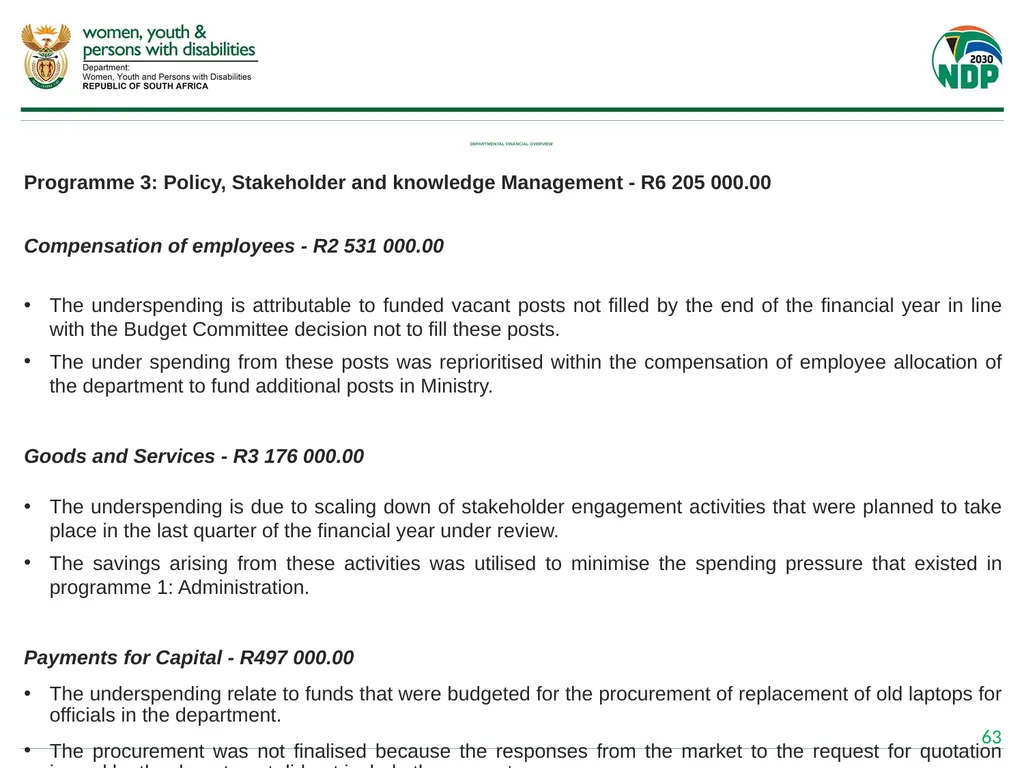
DEPARTMENTAL FINANCIAL OVERVIEW Programme 3: Policy, Stakeholder and knowledge Management - R6 205 000.00
Compensation of employees - R2 531 000.00
The underspending is attributable to funded vacant posts not filled by the end of the financial year in line with the Budget Committee decision not to fill these posts.
The under spending from these posts was reprioritised within the compensation of employee allocation of the department to fund additional posts in Ministry.
Goods and Services - R3 176 000.00
The underspending is due to scaling down of stakeholder engagement activities that were planned to take place in the last quarter of the financial year under review.
The savings arising from these activities was utilised to minimise the spending pressure that existed in programme 1: Administration.
Payments for Capital - R497 000.00
The underspending relate to funds that were budgeted for the procurement of replacement of old laptops for officials in the department.
The procurement was not finalised because the responses from the market to the request for quotation issued by the department did not include the warranty.<br>
Compensation of employees - R2 531 000.00
The underspending is attributable to funded vacant posts not filled by the end of the financial year in line with the Budget Committee decision not to fill these posts.
The under spending from these posts was reprioritised within the compensation of employee allocation of the department to fund additional posts in Ministry.
Goods and Services - R3 176 000.00
The underspending is due to scaling down of stakeholder engagement activities that were planned to take place in the last quarter of the financial year under review.
The savings arising from these activities was utilised to minimise the spending pressure that existed in programme 1: Administration.
Payments for Capital - R497 000.00
The underspending relate to funds that were budgeted for the procurement of replacement of old laptops for officials in the department.
The procurement was not finalised because the responses from the market to the request for quotation issued by the department did not include the warranty.<br>
64
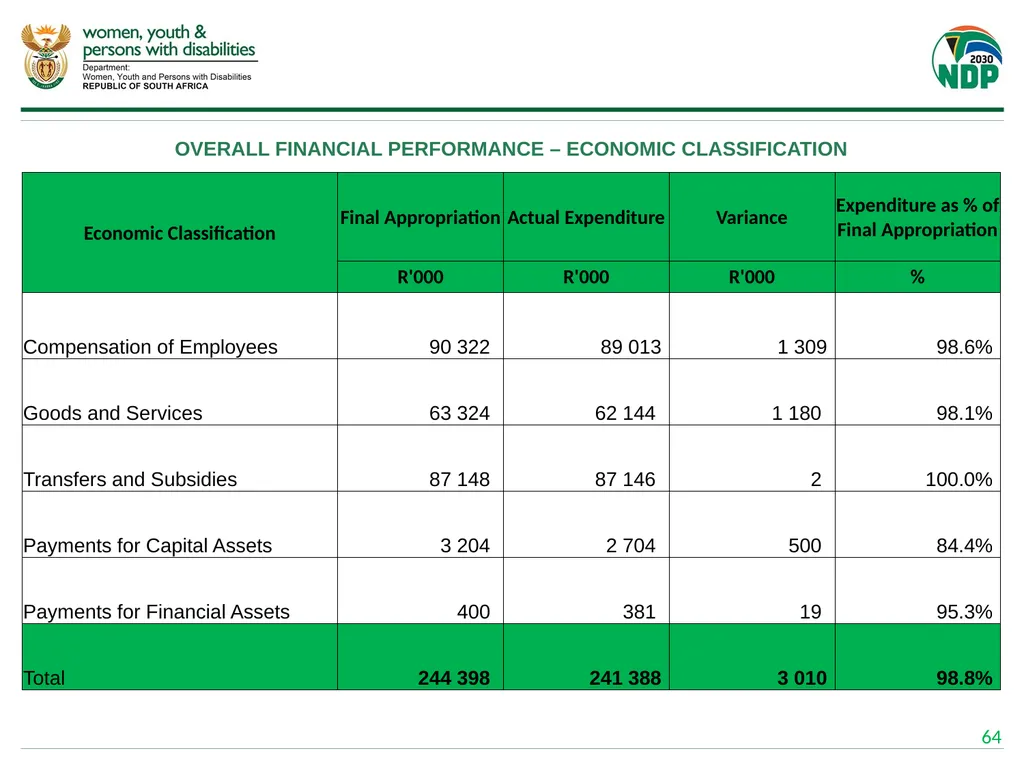
OVERALL FINANCIAL PERFORMANCE – ECONOMIC CLASSIFICATION<br>
65
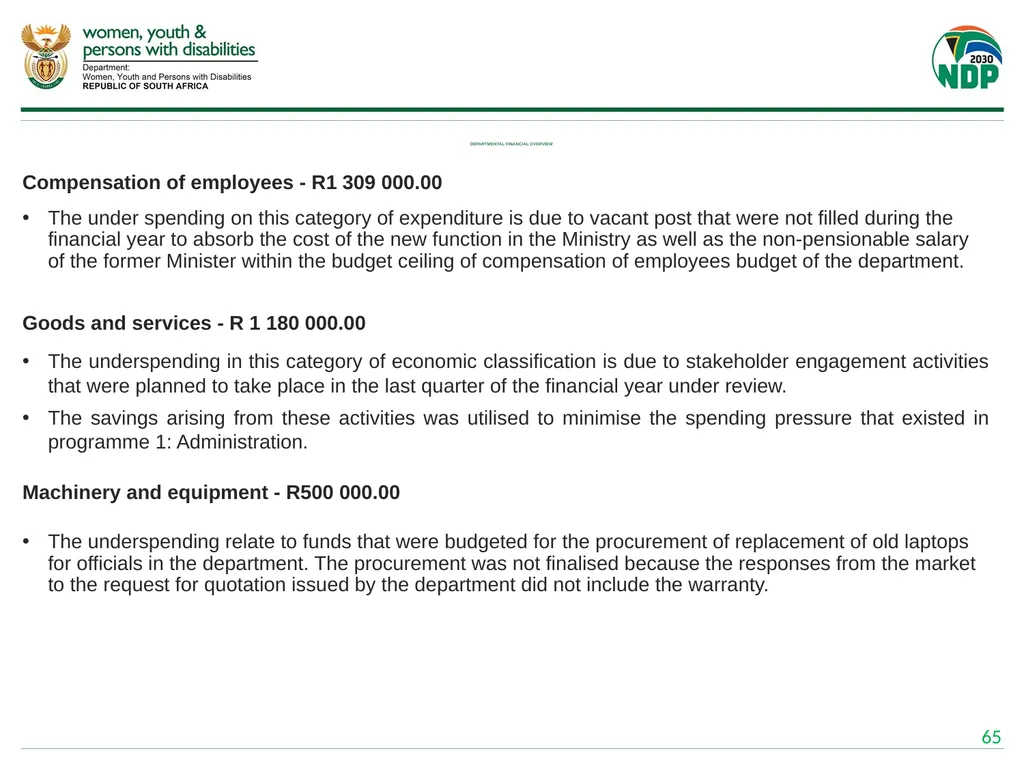
DEPARTMENTAL FINANCIAL OVERVIEW Compensation of employees - R1 309 000.00
The under spending on this category of expenditure is due to vacant post that were not filled during the financial year to absorb the cost of the new function in the Ministry as well as the non-pensionable salary of the former Minister within the budget ceiling of compensation of employees budget of the department.
Goods and services - R 1 180 000.00
The underspending in this category of economic classification is due to stakeholder engagement activities that were planned to take place in the last quarter of the financial year under review.
The savings arising from these activities was utilised to minimise the spending pressure that existed in programme 1: Administration.
Machinery and equipment - R500 000.00
The underspending relate to funds that were budgeted for the procurement of replacement of old laptops for officials in the department. The procurement was not finalised because the responses from the market to the request for quotation issued by the department did not include the warranty.<br>
The under spending on this category of expenditure is due to vacant post that were not filled during the financial year to absorb the cost of the new function in the Ministry as well as the non-pensionable salary of the former Minister within the budget ceiling of compensation of employees budget of the department.
Goods and services - R 1 180 000.00
The underspending in this category of economic classification is due to stakeholder engagement activities that were planned to take place in the last quarter of the financial year under review.
The savings arising from these activities was utilised to minimise the spending pressure that existed in programme 1: Administration.
Machinery and equipment - R500 000.00
The underspending relate to funds that were budgeted for the procurement of replacement of old laptops for officials in the department. The procurement was not finalised because the responses from the market to the request for quotation issued by the department did not include the warranty.<br>
66
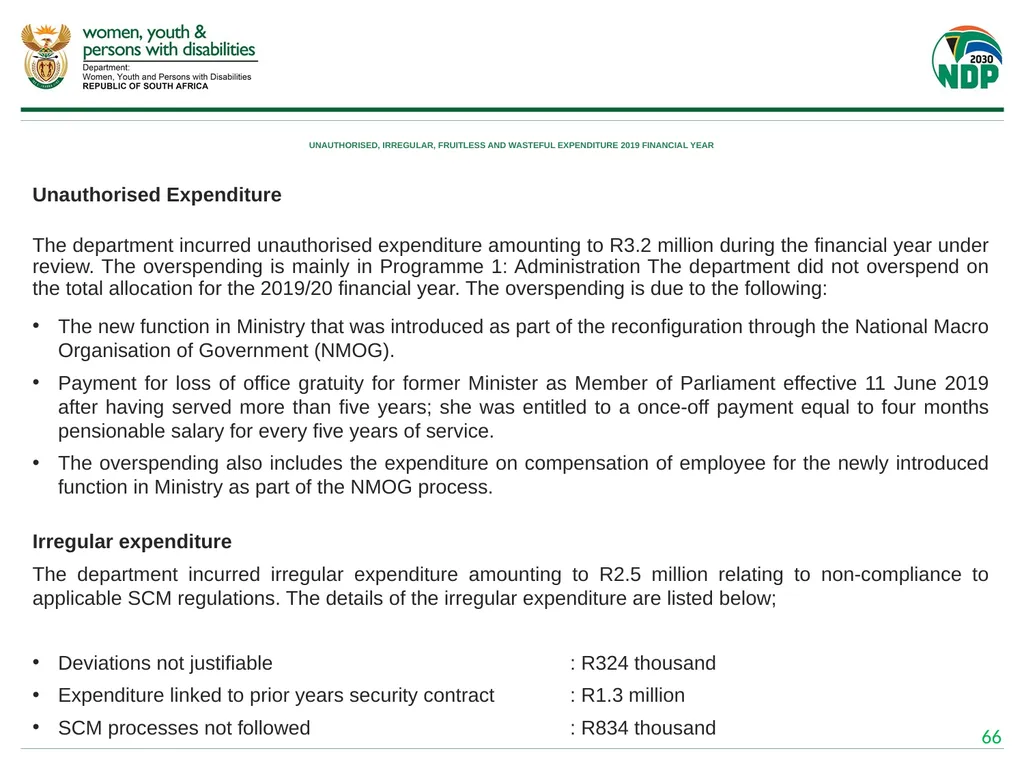
UNAUTHORISED, IRREGULAR, FRUITLESS AND WASTEFUL EXPENDITURE 2019 FINANCIAL YEAR Unauthorised Expenditure
The department incurred unauthorised expenditure amounting to R3.2 million during the financial year under review. The overspending is mainly in Programme 1: Administration The department did not overspend on the total allocation for the 2019/20 financial year. The overspending is due to the following:
The new function in Ministry that was introduced as part of the reconfiguration through the National Macro Organisation of Government (NMOG).
Payment for loss of office gratuity for former Minister as Member of Parliament effective 11 June 2019 after having served more than five years; she was entitled to a once-off payment equal to four months pensionable salary for every five years of service.
The overspending also includes the expenditure on compensation of employee for the newly introduced function in Ministry as part of the NMOG process.
Irregular expenditure
The department incurred irregular expenditure amounting to R2.5 million relating to non-compliance to applicable SCM regulations. The details of the irregular expenditure are listed below;
Deviations not justifiable : R324 thousand
Expenditure linked to prior years security contract : R1.3 million
SCM processes not followed : R834 thousand<br>
The department incurred unauthorised expenditure amounting to R3.2 million during the financial year under review. The overspending is mainly in Programme 1: Administration The department did not overspend on the total allocation for the 2019/20 financial year. The overspending is due to the following:
The new function in Ministry that was introduced as part of the reconfiguration through the National Macro Organisation of Government (NMOG).
Payment for loss of office gratuity for former Minister as Member of Parliament effective 11 June 2019 after having served more than five years; she was entitled to a once-off payment equal to four months pensionable salary for every five years of service.
The overspending also includes the expenditure on compensation of employee for the newly introduced function in Ministry as part of the NMOG process.
Irregular expenditure
The department incurred irregular expenditure amounting to R2.5 million relating to non-compliance to applicable SCM regulations. The details of the irregular expenditure are listed below;
Deviations not justifiable : R324 thousand
Expenditure linked to prior years security contract : R1.3 million
SCM processes not followed : R834 thousand<br>
67
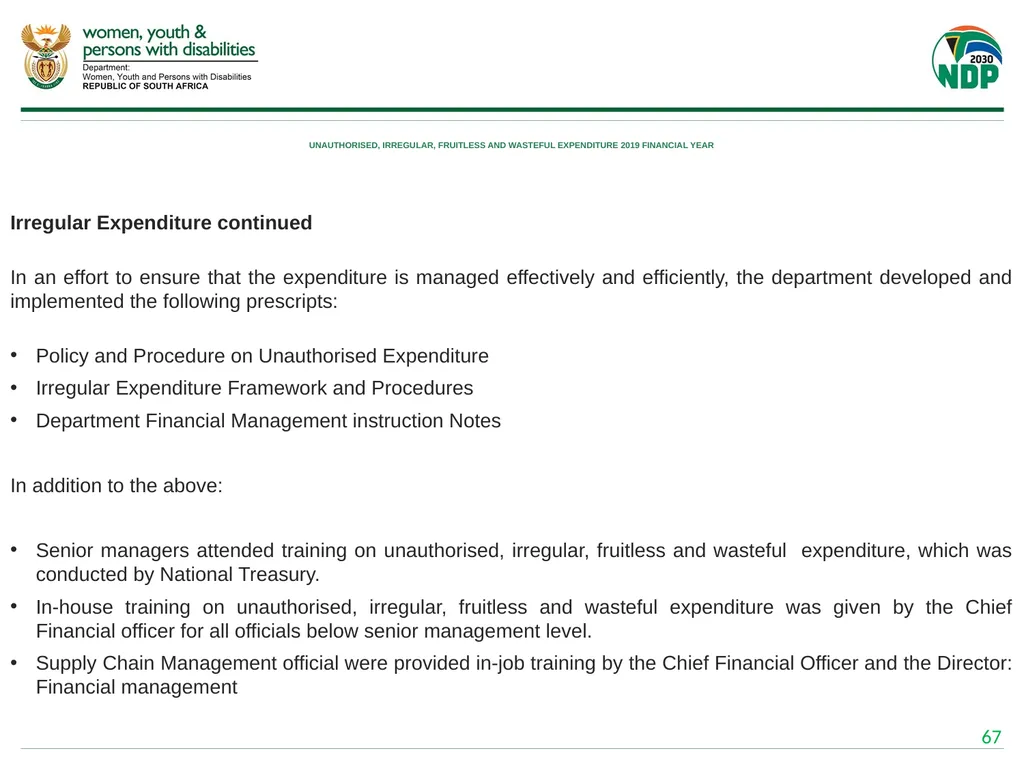
UNAUTHORISED, IRREGULAR, FRUITLESS AND WASTEFUL EXPENDITURE 2019 FINANCIAL YEAR Irregular Expenditure continued
In an effort to ensure that the expenditure is managed effectively and efficiently, the department developed and implemented the following prescripts:
Policy and Procedure on Unauthorised Expenditure
Irregular Expenditure Framework and Procedures
Department Financial Management instruction Notes
In addition to the above:
Senior managers attended training on unauthorised, irregular, fruitless and wasteful expenditure, which was conducted by National Treasury.
In-house training on unauthorised, irregular, fruitless and wasteful expenditure was given by the Chief Financial officer for all officials below senior management level.
Supply Chain Management official were provided in-job training by the Chief Financial Officer and the Director: Financial management<br>
In an effort to ensure that the expenditure is managed effectively and efficiently, the department developed and implemented the following prescripts:
Policy and Procedure on Unauthorised Expenditure
Irregular Expenditure Framework and Procedures
Department Financial Management instruction Notes
In addition to the above:
Senior managers attended training on unauthorised, irregular, fruitless and wasteful expenditure, which was conducted by National Treasury.
In-house training on unauthorised, irregular, fruitless and wasteful expenditure was given by the Chief Financial officer for all officials below senior management level.
Supply Chain Management official were provided in-job training by the Chief Financial Officer and the Director: Financial management<br>
68
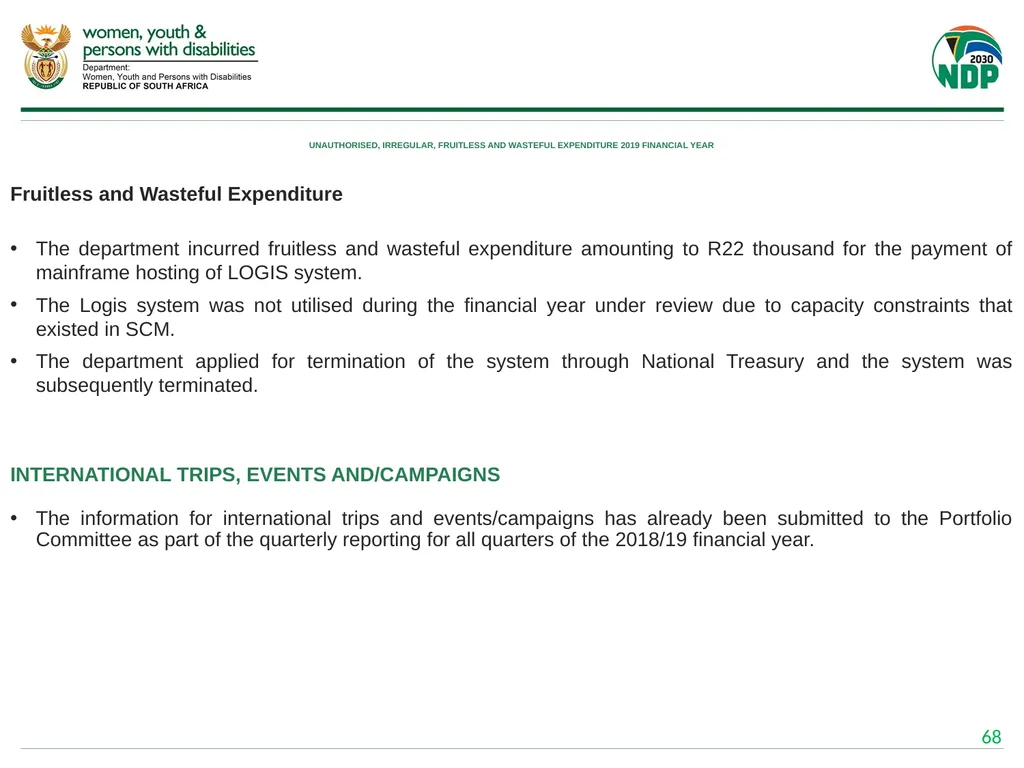
UNAUTHORISED, IRREGULAR, FRUITLESS AND WASTEFUL EXPENDITURE 2019 FINANCIAL YEAR Fruitless and Wasteful Expenditure
The department incurred fruitless and wasteful expenditure amounting to R22 thousand for the payment of mainframe hosting of LOGIS system.
The Logis system was not utilised during the financial year under review due to capacity constraints that existed in SCM.
The department applied for termination of the system through National Treasury and the system was subsequently terminated.
INTERNATIONAL TRIPS, EVENTS AND/CAMPAIGNS
The information for international trips and events/campaigns has already been submitted to the Portfolio Committee as part of the quarterly reporting for all quarters of the 2018/19 financial year.<br>
The department incurred fruitless and wasteful expenditure amounting to R22 thousand for the payment of mainframe hosting of LOGIS system.
The Logis system was not utilised during the financial year under review due to capacity constraints that existed in SCM.
The department applied for termination of the system through National Treasury and the system was subsequently terminated.
INTERNATIONAL TRIPS, EVENTS AND/CAMPAIGNS
The information for international trips and events/campaigns has already been submitted to the Portfolio Committee as part of the quarterly reporting for all quarters of the 2018/19 financial year.<br>
69
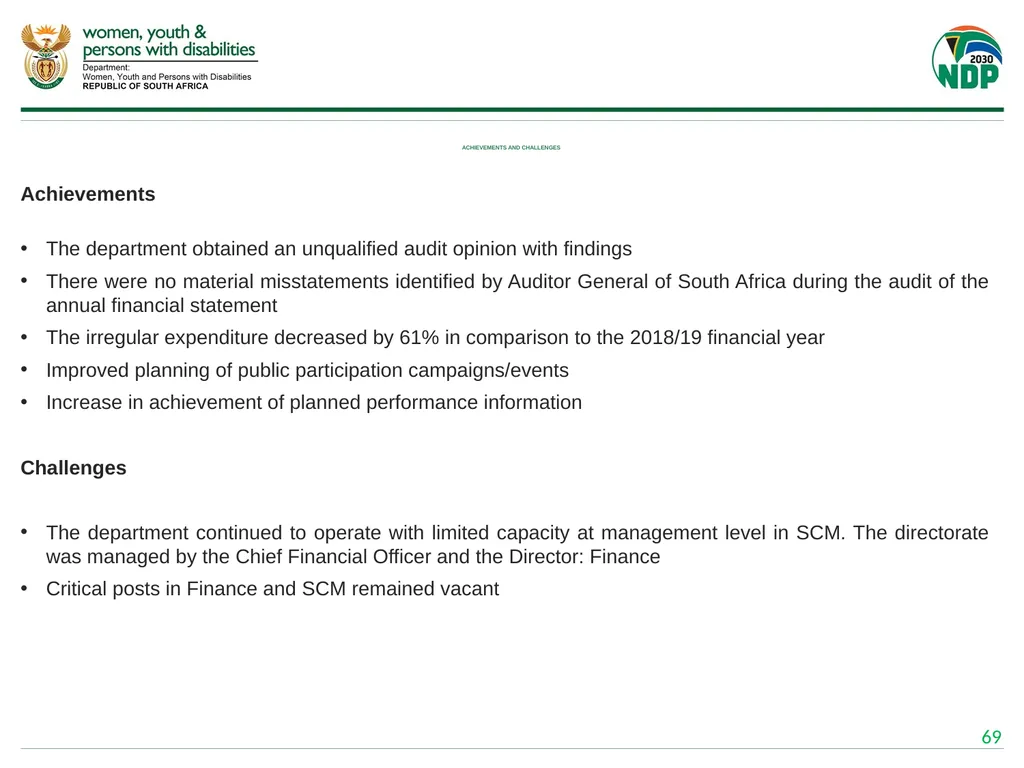
ACHIEVEMENTS AND CHALLENGES Achievements
The department obtained an unqualified audit opinion with findings
There were no material misstatements identified by Auditor General of South Africa during the audit of the annual financial statement
The irregular expenditure decreased by 61% in comparison to the 2018/19 financial year
Improved planning of public participation campaigns/events
Increase in achievement of planned performance information
Challenges
The department continued to operate with limited capacity at management level in SCM. The directorate was managed by the Chief Financial Officer and the Director: Finance
Critical posts in Finance and SCM remained vacant<br>
The department obtained an unqualified audit opinion with findings
There were no material misstatements identified by Auditor General of South Africa during the audit of the annual financial statement
The irregular expenditure decreased by 61% in comparison to the 2018/19 financial year
Improved planning of public participation campaigns/events
Increase in achievement of planned performance information
Challenges
The department continued to operate with limited capacity at management level in SCM. The directorate was managed by the Chief Financial Officer and the Director: Finance
Critical posts in Finance and SCM remained vacant<br>