
Working with International Collaborators Mary



Description: Working with International Collaborators Mary Kirker Chief, Grants Management Officer National Institute of Allergy and Infectious Diseases, National Institutes of Health 2016 NIH Regional Seminar International Collaboration HHS Secretary
Related Topics
Download Presentation
"Working with International Collaborators Mary" is the property of its rightful owner. Permission is granted to download and print the materials on this website for personal, non-commercial use only, and to display it on your personal computer provided you do not modify the materials and that you retain all copyright notices contained in the materials. By downloading content from our website, you accept the terms of this agreement.
Presentation Transcript
slide1. Working with International Collaborators Mary Kirker
Chief, Grants Management Officer
National Institute of Allergy and Infectious Diseases, National Institutes of Health
2016 NIH Regional Seminar<br>
slide2. International Collaboration HHS Secretary says US plays key role in global health
(January 2015)
The U.S. has a "very strong" role to play in global health, not least in the battle to control Ebola and other threats to the domestic as well as worldwide populations, according to Sylvia Burwell, Secretary of the U.S. DHHS, which oversees the NIH.
"The role of HHS in the global health
space is going to be front and center,"
Burwell said during a recent visit to
NIH to tour the main campus
and meet staff.
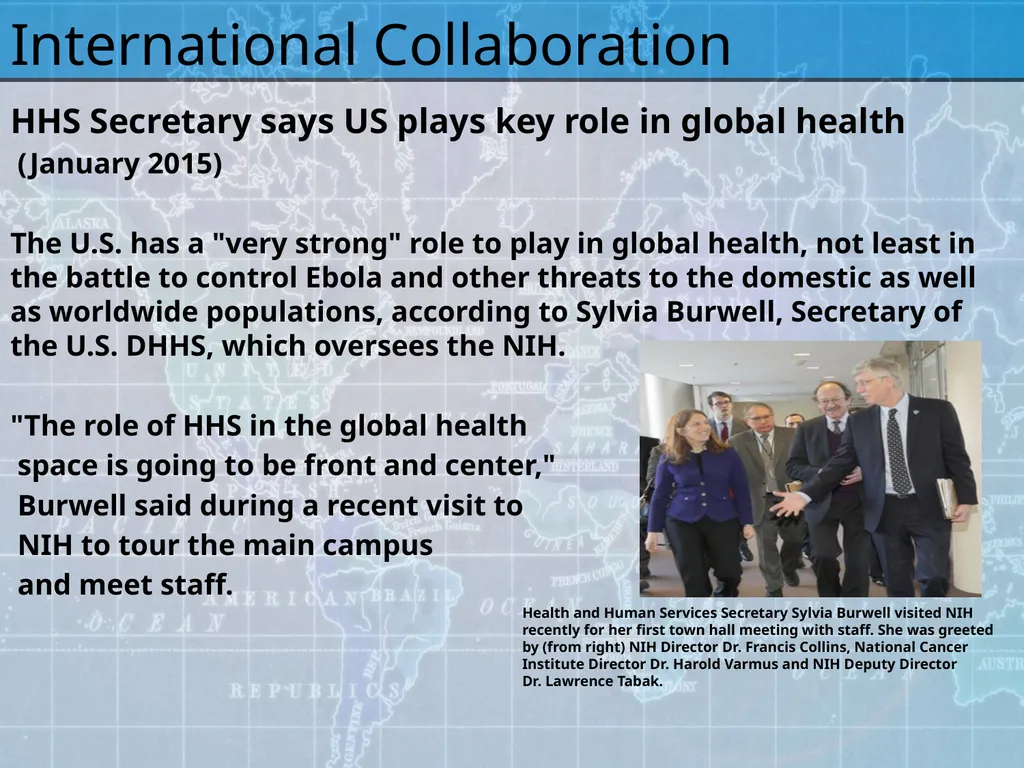
Health and Human Services Secretary Sylvia Burwell visited NIH recently for her first town hall meeting with staff. She was greeted by (from right) NIH Director Dr. Francis Collins, National Cancer Institute Director Dr. Harold Varmus and NIH Deputy Director Dr. Lawrence Tabak.<br>
slide3. International Collaboration Ebola Test Vaccines Appear Safe in Phase 2 Liberian Clinical Trial….NIH News - March 26, 2015
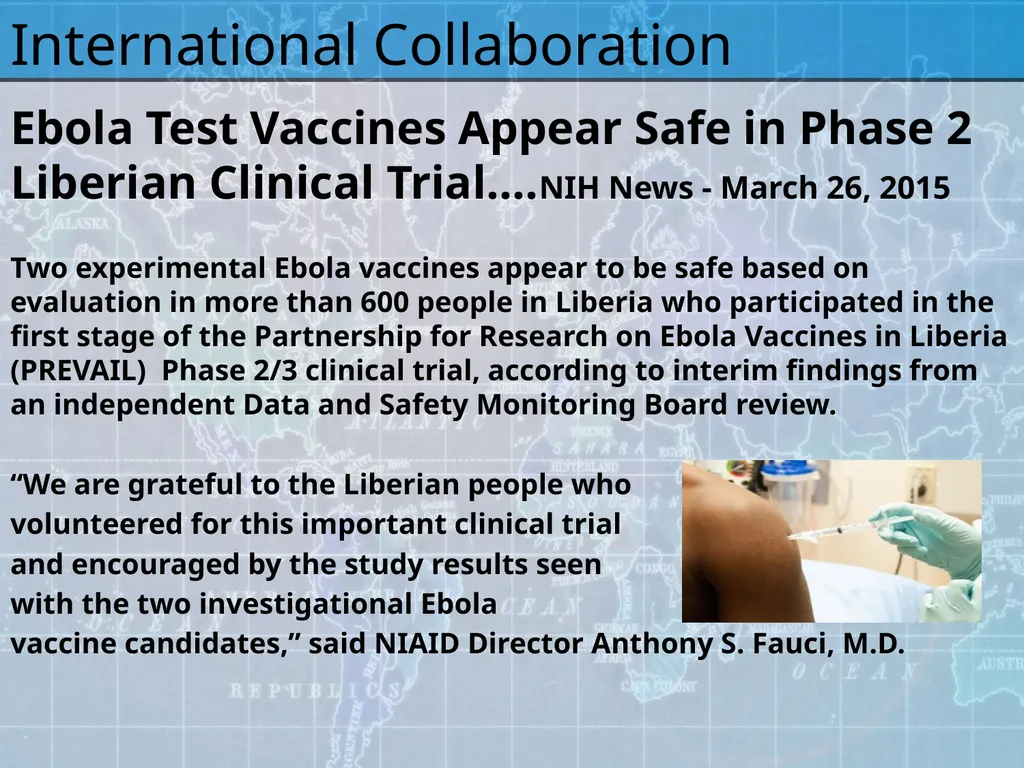
Two experimental Ebola vaccines appear to be safe based on evaluation in more than 600 people in Liberia who participated in the first stage of the Partnership for Research on Ebola Vaccines in Liberia (PREVAIL) Phase 2/3 clinical trial, according to interim findings from an independent Data and Safety Monitoring Board review.
“We are grateful to the Liberian people who
volunteered for this important clinical trial
and encouraged by the study results seen
with the two investigational Ebola
vaccine candidates,” said NIAID Director Anthony S. Fauci, M.D.<br>
slide4. Outline Overarching considerations in working with foreign institutions and investigators
US-based investigators collaborating with foreign investigators
Foreign investigators as primary grantees
Changes – 45 CFR Part 75 Uniform Guidance
Conclusion and key take away<br>
slide5. Overarching Considerations Foreign Institutions function differently
Language
Time Zones
Internet Access
Sponsored programs staff
NIH funding requirements
Plan for delays, differences and dialogue<br>
slide6. Overarching Considerations Start Early - Foreign Institution Registration:
Grants.gov and NIH eRA Commons
(Need to register prior to submission)
Data Universal Number System (DUNS)
System for Award Management (SAM) –required annually
NATO Commercial and Government Entity (NCAGE)
http://grants.nih.gov/grants/foreign<br>
slide7. Overarching Considerations NIH Funding for Foreign Institutions
Review Funding Opportunity Announcement (FOA)
Contact NIH program staff
Collaboration is critical
Collaborations may be required in FOA and will be considered by the peer review committee<br>
slide8. Funding Collaborations Grants Awarded to Institutions, not Individuals
Traditional Subcontract/Consortium
U.S. Institution responsible
Requires a formalized written agreement
Substantial involvement<br>
slide9. Funding Collaborations Traditional Subcontract/Consortium
Determine who has the authority to sign for the organization
Ensure the collaborating organization(s) understand the rules and regulations
Decide how the funds will be disbursed
Establish procedures for reporting progress and the use of funds<br>
slide10. Funding Collaborations Vendor Agreement
Routine goods and services
Ancillary to the research
Provides similar service to many
Not the same written requirements as consortium agreement<br>
slide11. Tips for U.S. Investigators U.S. Institutional Support
Connect with centers or institutes in global health
Identification of Key Personnel
Local hierarchy in foreign organization
Key personnel 25% reduction = program approval
(Key personnel = NIH designates in the NoA)
Understand local reimbursement systems
Salary support for local investigators
Project delays = no salary for support staff<br>
slide12. Tips for U.S. Investigators On-going Project Monitoring
Progress Reports
Updating NIH Program Officers
Monitoring Budget
Human Subjects Protections
Staff Management
The U.S. based PI is responsible.
U.S. awardees will flow down to foreign subrecipients applicable parts of the Uniform Guidance and monitor foreign entity progress<br>
slide13. Examples of Problem Areas. . . Little or no knowledge of the NIH Grants Policy Statement
Little or no knowledge of the requirements of a grant
Time and effort reporting insufficient
Accounting for the 8% F&A
Audit – often none
Compliance Requirements – often none implemented – Financial Conflict of Interest (FCOI), NIH Public Access
Close Out<br>
slide14. Tips for Foreign Investigators Eligible does not equal competitive
Publication record
Previous funding: best if from NIH
Justification of foreign site<br>
slide15. Tips for Foreign Investigators Application Review Criteria for Foreign Grant Applications
Whether the project presents special opportunities for furthering research programs through the use of unusual talents, resources, populations, or environmental conditions in other countries that are not readily available in the United States or that augment existing U.S. resources; and,
Whether the proposed project has specific relevance to the mission and objectives of the NIH Institute/Center (IC) and has the potential for significantly advancing the health sciences in the United States and the health of the people of the United States.
Note these additional criteria are not applied to applications from domestic institutions with foreign components.<br>
slide16. Tips for Foreign Investigators Allowable Costs:
Four Principles that Dictate Allowability:
1. Reasonableness – The dollar amount is within the limitations that a prudent person would pay for the good or service.
Allocability – The goods or services that can be assigned directly to the grant.
Consistency – Routinely applied to the same category.<br>
slide17. Tips for Foreign Investigators 4. Conformance – Test of allowability. Grants costs must conform to the “Allowability of Costs/Activities” section of the NIH Grants Policy Statement.
The NIH GPS section 7.9.1 provides a subset of common, allowable costs. The list is not all inclusive.
The NIH Grants Policy Statement (GPS) Section 16.6 provides unallowable costs and grant requirements for foreign grantees and foreign components.<br>
slide18. Tips for Foreign Investigators Unallowable Costs
Major alterations and renovations (A&R). Costs for major A&R (>$500,000).
Patient Care Costs are provided only in exceptional circumstances.
Grantees are reminded that they may not invest grant funds to defray the cost of inflation.<br>
slide19. Tips for Foreign Investigators F & A –
“NIH provides limited F&A costs (8 percent of total direct costs less equipment) to foreign institutions and international organizations. NIH will not support the acquisition of, or provide for depreciation on, any capital expenditures, or support the normal, general operations of foreign and international organizations. These expenses should not be requested as a Direct Cost budget expense. Note the reference to “capital expenditures” for the purpose of allowable F&A costs do not include purchases if equipment. Equipment is still allowable as a direct cost. Note: other items normally considered an F&A cost can be requested a direct cost, e.g. rent.<br>
slide21. Tips for Foreign Investigators Payment
Awards issued to foreign Grantees after October 2012 are paid through the Payment Management System (PMS) but unlike US NIH grantees they are paid through B subaccount rather than G account or a P subaccount.
Grantees are required to maintain grant funds in an interest bearing account; however, interest earned in excess of $500 per year in the aggregate on advances of Federal funds must be returned.<br>
slide22. Tips for Foreign Investigators Supplements due to currency fluctuation. Once an award is made, the NIH will not routinely make adjustments for currency exchange fluctuations through the issuance of supplemental awards. NIH recognizes that some foreign countries have significantly high inflation rates.<br>
slide23. Other Considerations Travel – Fly America Act Applies
http://www.tvlon.com/resources/FlyAct.html
Review Notice of Award (NoA) to determine SNAP vs. non-SNAP
Review NoA to determine automatic carryover authority<br>
slide24. Other Considerations Federal Financial Report (FFR) – required annually for all foreign awards that are non-SNAP.
FFR – required at the end on the competitive segment (SNAP)
Audit Requirements – required if expended $750,000 or more in Federal awards.
Closeout - New requirements implemented for ALL grants with project period end dates of 10/1/2014 or later.<br>
slide25. Other Considerations Closeout Notable Changes:
Adherence to designated deadlines will be strictly enforced
New requirements for NIH to initiate “unilateral” closeout if reports are missing or unacceptable.
“Unilateral” closeout could result a grantee debt obligation.
NIH Guide Notice - NOT-OD-14-084
Closeout FAQs (http://grants.nih.gov/grants/closeout/faq_grants_closeout.htm<br>
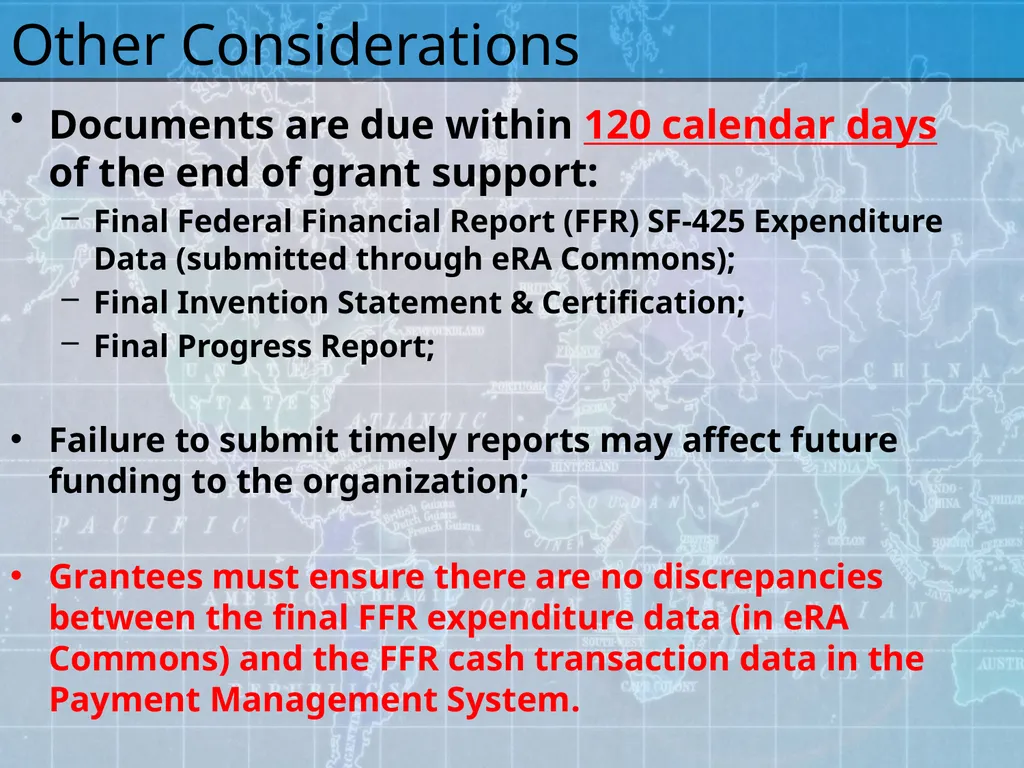
slide26. Other Considerations Documents are due within 120 calendar days of the end of grant support:
Final Federal Financial Report (FFR) SF-425 Expenditure Data (submitted through eRA Commons);
Final Invention Statement & Certification;
Final Progress Report;
Failure to submit timely reports may affect future funding to the organization;
Grantees must ensure there are no discrepancies between the final FFR expenditure data (in eRA Commons) and the FFR cash transaction data in the Payment Management System.<br>
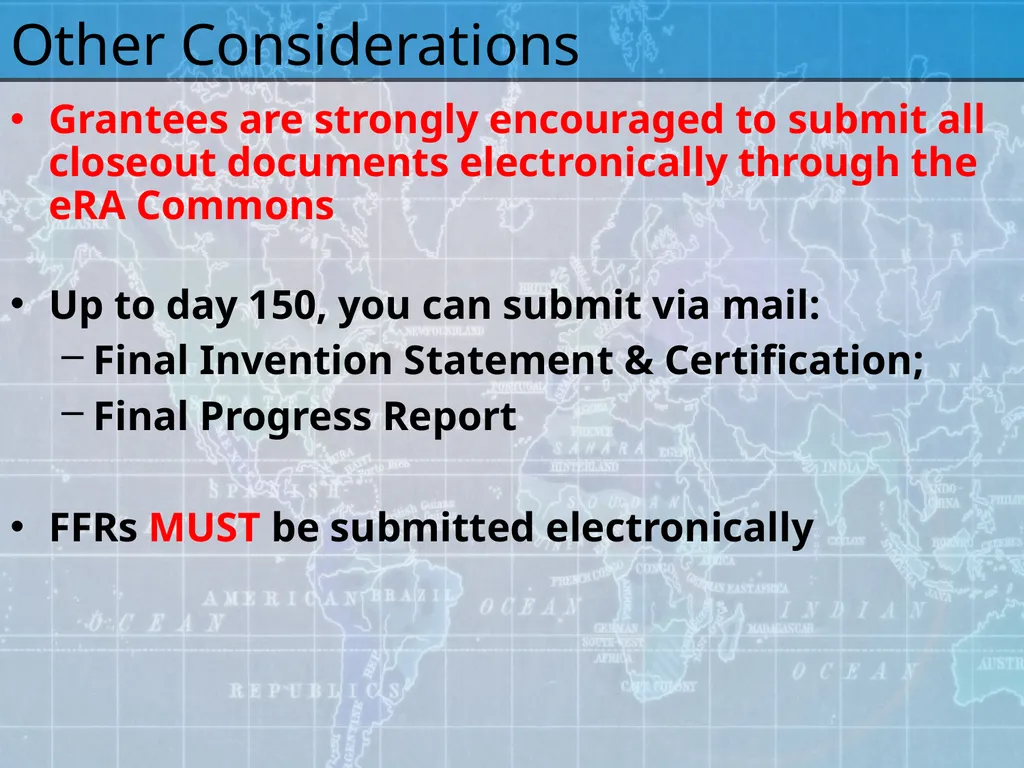
slide27. Other Considerations Grantees are strongly encouraged to submit all closeout documents electronically through the eRA Commons
Up to day 150, you can submit via mail:
Final Invention Statement & Certification;
Final Progress Report
FFRs MUST be submitted electronically<br>
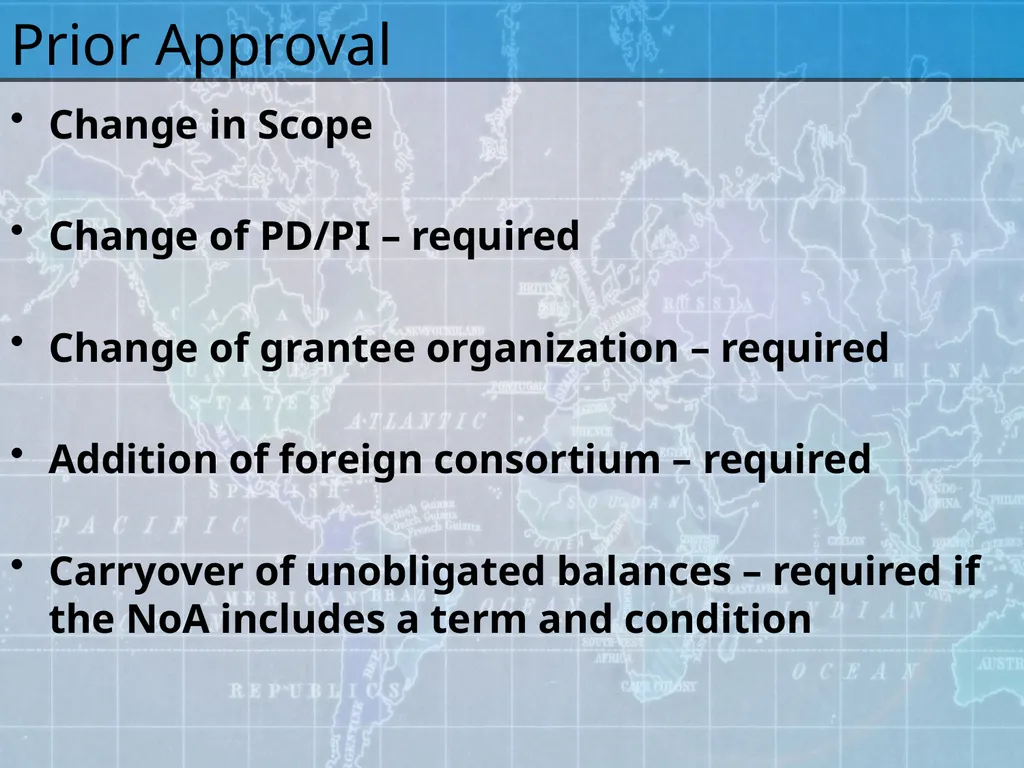
slide28. Prior Approval Change in Scope
Change of PD/PI – required
Change of grantee organization – required
Addition of foreign consortium – required
Carryover of unobligated balances – required if the NoA includes a term and condition<br>
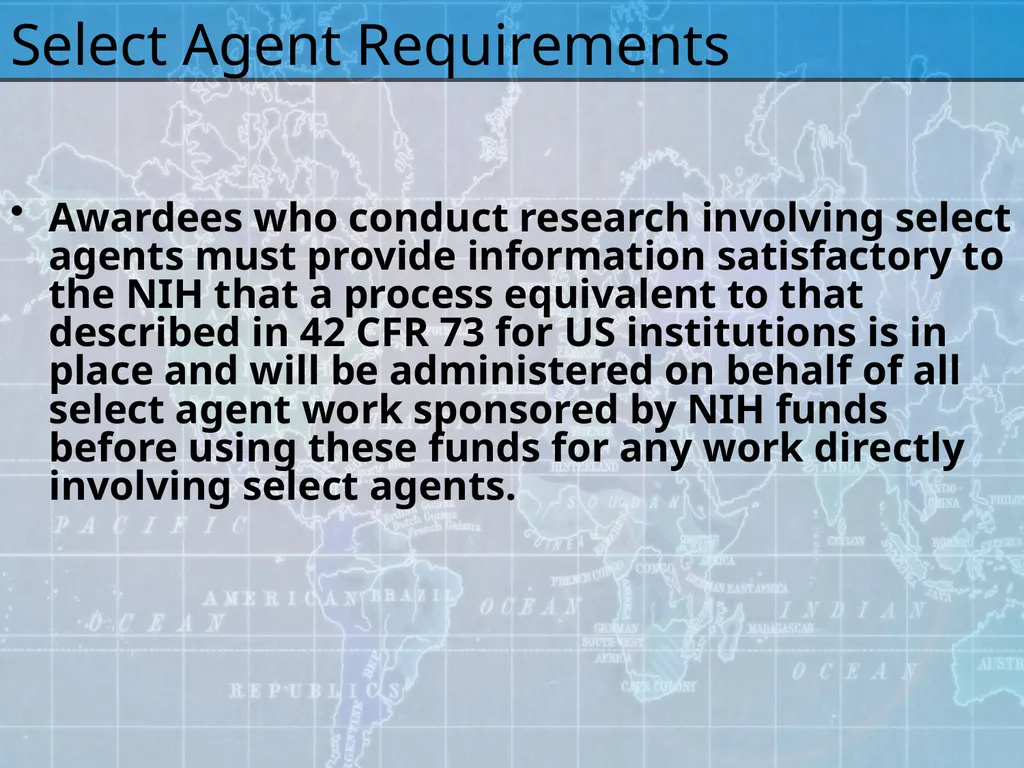
slide29. Select Agent Requirements Awardees who conduct research involving select agents must provide information satisfactory to the NIH that a process equivalent to that described in 42 CFR 73 for US institutions is in place and will be administered on behalf of all select agent work sponsored by NIH funds before using these funds for any work directly involving select agents.<br>
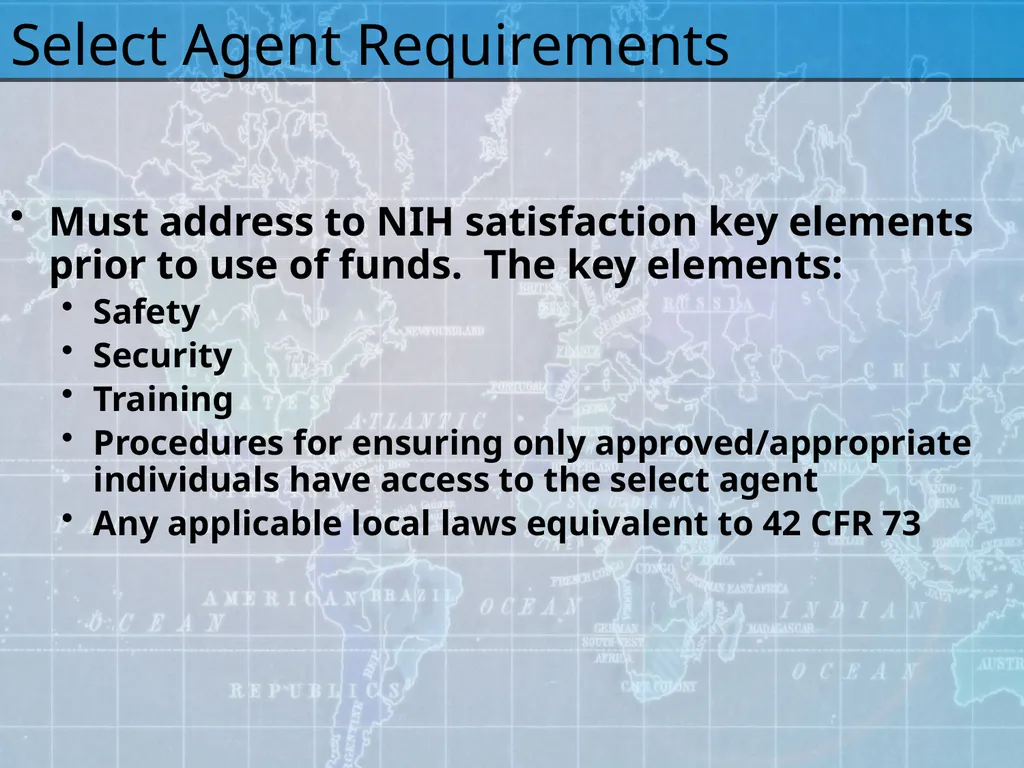
slide30. Select Agent Requirements Must address to NIH satisfaction key elements prior to use of funds. The key elements:
Safety
Security
Training
Procedures for ensuring only approved/appropriate individuals have access to the select agent
Any applicable local laws equivalent to 42 CFR 73<br>
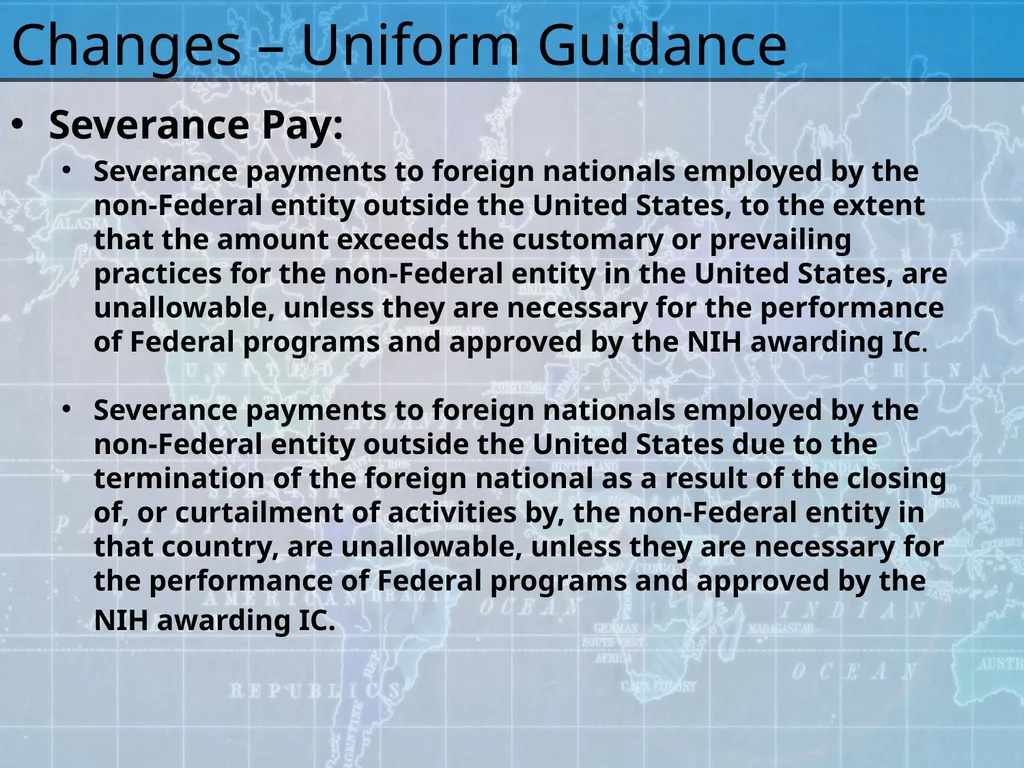
slide31. Changes – Uniform Guidance Severance Pay:
Severance payments to foreign nationals employed by the non-Federal entity outside the United States, to the extent that the amount exceeds the customary or prevailing practices for the non-Federal entity in the United States, are unallowable, unless they are necessary for the performance of Federal programs and approved by the NIH awarding IC.
Severance payments to foreign nationals employed by the non-Federal entity outside the United States due to the termination of the foreign national as a result of the closing of, or curtailment of activities by, the non-Federal entity in that country, are unallowable, unless they are necessary for the performance of Federal programs and approved by the NIH awarding IC.<br>
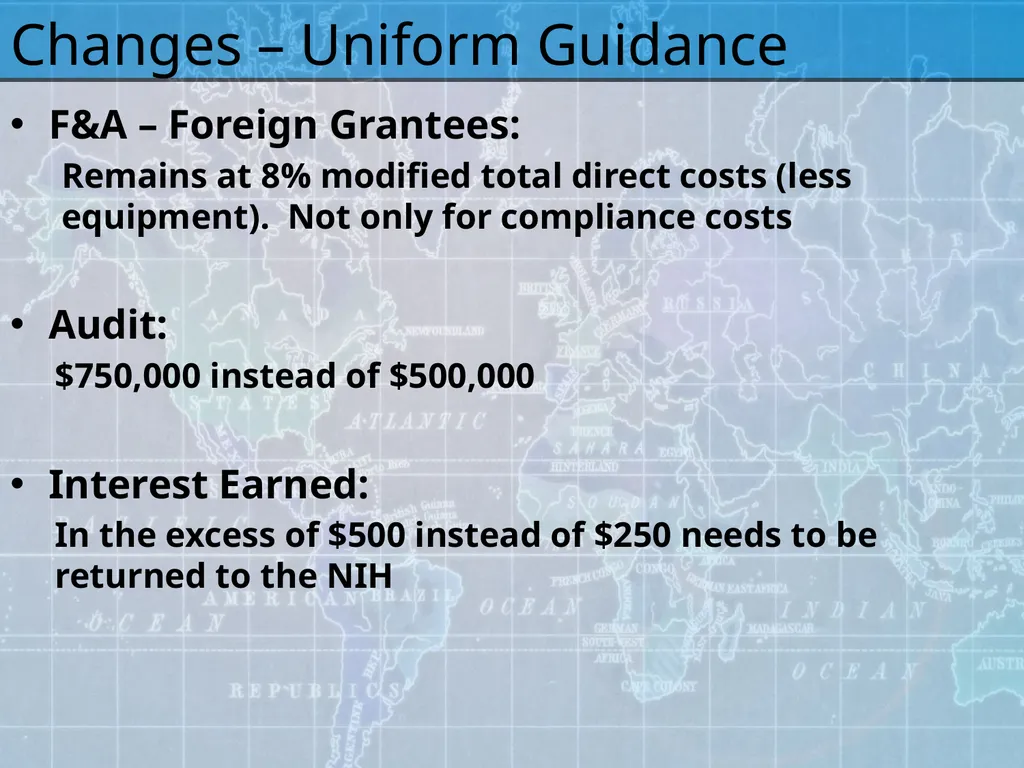
slide32. Changes – Uniform Guidance F&A – Foreign Grantees:
Remains at 8% modified total direct costs (less equipment). Not only for compliance costs
Audit:
$750,000 instead of $500,000
Interest Earned:
In the excess of $500 instead of $250 needs to be returned to the NIH<br>
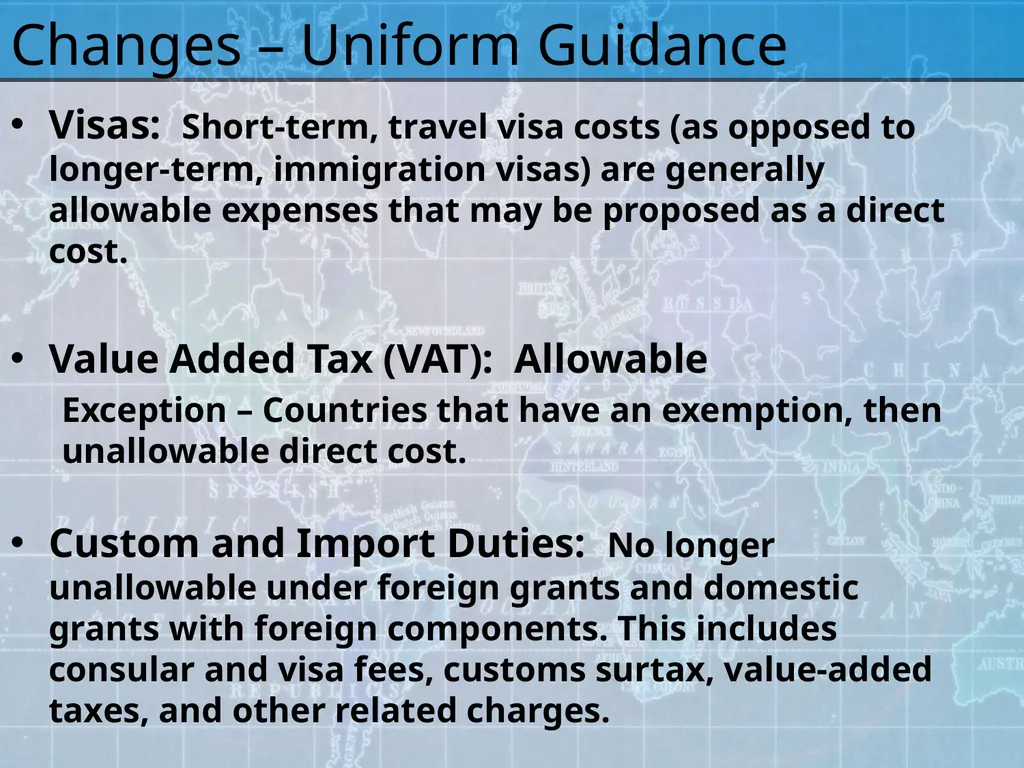
slide33. Changes – Uniform Guidance Visas: Short-term, travel visa costs (as opposed to longer-term, immigration visas) are generally allowable expenses that may be proposed as a direct cost.
Value Added Tax (VAT): Allowable
Exception – Countries that have an exemption, then unallowable direct cost.
Custom and Import Duties: No longer unallowable under foreign grants and domestic grants with foreign components. This includes consular and visa fees, customs surtax, value-added taxes, and other related charges.<br>
slide34. Key Take Away Communication
most foreign institutions need assistance in understanding NIH requirements
Understand their unique policies, regulations and practices
Be involved for the long term
Be patient<br>
slide35. THANK YOU!
Mary Kirker
mk35h@nih.gov<br>
Chief, Grants Management Officer
National Institute of Allergy and Infectious Diseases, National Institutes of Health
2016 NIH Regional Seminar<br>
slide2. International Collaboration HHS Secretary says US plays key role in global health
(January 2015)
The U.S. has a "very strong" role to play in global health, not least in the battle to control Ebola and other threats to the domestic as well as worldwide populations, according to Sylvia Burwell, Secretary of the U.S. DHHS, which oversees the NIH.
"The role of HHS in the global health
space is going to be front and center,"
Burwell said during a recent visit to
NIH to tour the main campus
and meet staff.
Health and Human Services Secretary Sylvia Burwell visited NIH recently for her first town hall meeting with staff. She was greeted by (from right) NIH Director Dr. Francis Collins, National Cancer Institute Director Dr. Harold Varmus and NIH Deputy Director Dr. Lawrence Tabak.<br>
slide3. International Collaboration Ebola Test Vaccines Appear Safe in Phase 2 Liberian Clinical Trial….NIH News - March 26, 2015
Two experimental Ebola vaccines appear to be safe based on evaluation in more than 600 people in Liberia who participated in the first stage of the Partnership for Research on Ebola Vaccines in Liberia (PREVAIL) Phase 2/3 clinical trial, according to interim findings from an independent Data and Safety Monitoring Board review.
“We are grateful to the Liberian people who
volunteered for this important clinical trial
and encouraged by the study results seen
with the two investigational Ebola
vaccine candidates,” said NIAID Director Anthony S. Fauci, M.D.<br>
slide4. Outline Overarching considerations in working with foreign institutions and investigators
US-based investigators collaborating with foreign investigators
Foreign investigators as primary grantees
Changes – 45 CFR Part 75 Uniform Guidance
Conclusion and key take away<br>
slide5. Overarching Considerations Foreign Institutions function differently
Language
Time Zones
Internet Access
Sponsored programs staff
NIH funding requirements
Plan for delays, differences and dialogue<br>
slide6. Overarching Considerations Start Early - Foreign Institution Registration:
Grants.gov and NIH eRA Commons
(Need to register prior to submission)
Data Universal Number System (DUNS)
System for Award Management (SAM) –required annually
NATO Commercial and Government Entity (NCAGE)
http://grants.nih.gov/grants/foreign<br>
slide7. Overarching Considerations NIH Funding for Foreign Institutions
Review Funding Opportunity Announcement (FOA)
Contact NIH program staff
Collaboration is critical
Collaborations may be required in FOA and will be considered by the peer review committee<br>
slide8. Funding Collaborations Grants Awarded to Institutions, not Individuals
Traditional Subcontract/Consortium
U.S. Institution responsible
Requires a formalized written agreement
Substantial involvement<br>
slide9. Funding Collaborations Traditional Subcontract/Consortium
Determine who has the authority to sign for the organization
Ensure the collaborating organization(s) understand the rules and regulations
Decide how the funds will be disbursed
Establish procedures for reporting progress and the use of funds<br>
slide10. Funding Collaborations Vendor Agreement
Routine goods and services
Ancillary to the research
Provides similar service to many
Not the same written requirements as consortium agreement<br>
slide11. Tips for U.S. Investigators U.S. Institutional Support
Connect with centers or institutes in global health
Identification of Key Personnel
Local hierarchy in foreign organization
Key personnel 25% reduction = program approval
(Key personnel = NIH designates in the NoA)
Understand local reimbursement systems
Salary support for local investigators
Project delays = no salary for support staff<br>
slide12. Tips for U.S. Investigators On-going Project Monitoring
Progress Reports
Updating NIH Program Officers
Monitoring Budget
Human Subjects Protections
Staff Management
The U.S. based PI is responsible.
U.S. awardees will flow down to foreign subrecipients applicable parts of the Uniform Guidance and monitor foreign entity progress<br>
slide13. Examples of Problem Areas. . . Little or no knowledge of the NIH Grants Policy Statement
Little or no knowledge of the requirements of a grant
Time and effort reporting insufficient
Accounting for the 8% F&A
Audit – often none
Compliance Requirements – often none implemented – Financial Conflict of Interest (FCOI), NIH Public Access
Close Out<br>
slide14. Tips for Foreign Investigators Eligible does not equal competitive
Publication record
Previous funding: best if from NIH
Justification of foreign site<br>
slide15. Tips for Foreign Investigators Application Review Criteria for Foreign Grant Applications
Whether the project presents special opportunities for furthering research programs through the use of unusual talents, resources, populations, or environmental conditions in other countries that are not readily available in the United States or that augment existing U.S. resources; and,
Whether the proposed project has specific relevance to the mission and objectives of the NIH Institute/Center (IC) and has the potential for significantly advancing the health sciences in the United States and the health of the people of the United States.
Note these additional criteria are not applied to applications from domestic institutions with foreign components.<br>
slide16. Tips for Foreign Investigators Allowable Costs:
Four Principles that Dictate Allowability:
1. Reasonableness – The dollar amount is within the limitations that a prudent person would pay for the good or service.
Allocability – The goods or services that can be assigned directly to the grant.
Consistency – Routinely applied to the same category.<br>
slide17. Tips for Foreign Investigators 4. Conformance – Test of allowability. Grants costs must conform to the “Allowability of Costs/Activities” section of the NIH Grants Policy Statement.
The NIH GPS section 7.9.1 provides a subset of common, allowable costs. The list is not all inclusive.
The NIH Grants Policy Statement (GPS) Section 16.6 provides unallowable costs and grant requirements for foreign grantees and foreign components.<br>
slide18. Tips for Foreign Investigators Unallowable Costs
Major alterations and renovations (A&R). Costs for major A&R (>$500,000).
Patient Care Costs are provided only in exceptional circumstances.
Grantees are reminded that they may not invest grant funds to defray the cost of inflation.<br>
slide19. Tips for Foreign Investigators F & A –
“NIH provides limited F&A costs (8 percent of total direct costs less equipment) to foreign institutions and international organizations. NIH will not support the acquisition of, or provide for depreciation on, any capital expenditures, or support the normal, general operations of foreign and international organizations. These expenses should not be requested as a Direct Cost budget expense. Note the reference to “capital expenditures” for the purpose of allowable F&A costs do not include purchases if equipment. Equipment is still allowable as a direct cost. Note: other items normally considered an F&A cost can be requested a direct cost, e.g. rent.<br>
slide21. Tips for Foreign Investigators Payment
Awards issued to foreign Grantees after October 2012 are paid through the Payment Management System (PMS) but unlike US NIH grantees they are paid through B subaccount rather than G account or a P subaccount.
Grantees are required to maintain grant funds in an interest bearing account; however, interest earned in excess of $500 per year in the aggregate on advances of Federal funds must be returned.<br>
slide22. Tips for Foreign Investigators Supplements due to currency fluctuation. Once an award is made, the NIH will not routinely make adjustments for currency exchange fluctuations through the issuance of supplemental awards. NIH recognizes that some foreign countries have significantly high inflation rates.<br>
slide23. Other Considerations Travel – Fly America Act Applies
http://www.tvlon.com/resources/FlyAct.html
Review Notice of Award (NoA) to determine SNAP vs. non-SNAP
Review NoA to determine automatic carryover authority<br>
slide24. Other Considerations Federal Financial Report (FFR) – required annually for all foreign awards that are non-SNAP.
FFR – required at the end on the competitive segment (SNAP)
Audit Requirements – required if expended $750,000 or more in Federal awards.
Closeout - New requirements implemented for ALL grants with project period end dates of 10/1/2014 or later.<br>
slide25. Other Considerations Closeout Notable Changes:
Adherence to designated deadlines will be strictly enforced
New requirements for NIH to initiate “unilateral” closeout if reports are missing or unacceptable.
“Unilateral” closeout could result a grantee debt obligation.
NIH Guide Notice - NOT-OD-14-084
Closeout FAQs (http://grants.nih.gov/grants/closeout/faq_grants_closeout.htm<br>
slide26. Other Considerations Documents are due within 120 calendar days of the end of grant support:
Final Federal Financial Report (FFR) SF-425 Expenditure Data (submitted through eRA Commons);
Final Invention Statement & Certification;
Final Progress Report;
Failure to submit timely reports may affect future funding to the organization;
Grantees must ensure there are no discrepancies between the final FFR expenditure data (in eRA Commons) and the FFR cash transaction data in the Payment Management System.<br>
slide27. Other Considerations Grantees are strongly encouraged to submit all closeout documents electronically through the eRA Commons
Up to day 150, you can submit via mail:
Final Invention Statement & Certification;
Final Progress Report
FFRs MUST be submitted electronically<br>
slide28. Prior Approval Change in Scope
Change of PD/PI – required
Change of grantee organization – required
Addition of foreign consortium – required
Carryover of unobligated balances – required if the NoA includes a term and condition<br>
slide29. Select Agent Requirements Awardees who conduct research involving select agents must provide information satisfactory to the NIH that a process equivalent to that described in 42 CFR 73 for US institutions is in place and will be administered on behalf of all select agent work sponsored by NIH funds before using these funds for any work directly involving select agents.<br>
slide30. Select Agent Requirements Must address to NIH satisfaction key elements prior to use of funds. The key elements:
Safety
Security
Training
Procedures for ensuring only approved/appropriate individuals have access to the select agent
Any applicable local laws equivalent to 42 CFR 73<br>
slide31. Changes – Uniform Guidance Severance Pay:
Severance payments to foreign nationals employed by the non-Federal entity outside the United States, to the extent that the amount exceeds the customary or prevailing practices for the non-Federal entity in the United States, are unallowable, unless they are necessary for the performance of Federal programs and approved by the NIH awarding IC.
Severance payments to foreign nationals employed by the non-Federal entity outside the United States due to the termination of the foreign national as a result of the closing of, or curtailment of activities by, the non-Federal entity in that country, are unallowable, unless they are necessary for the performance of Federal programs and approved by the NIH awarding IC.<br>
slide32. Changes – Uniform Guidance F&A – Foreign Grantees:
Remains at 8% modified total direct costs (less equipment). Not only for compliance costs
Audit:
$750,000 instead of $500,000
Interest Earned:
In the excess of $500 instead of $250 needs to be returned to the NIH<br>
slide33. Changes – Uniform Guidance Visas: Short-term, travel visa costs (as opposed to longer-term, immigration visas) are generally allowable expenses that may be proposed as a direct cost.
Value Added Tax (VAT): Allowable
Exception – Countries that have an exemption, then unallowable direct cost.
Custom and Import Duties: No longer unallowable under foreign grants and domestic grants with foreign components. This includes consular and visa fees, customs surtax, value-added taxes, and other related charges.<br>
slide34. Key Take Away Communication
most foreign institutions need assistance in understanding NIH requirements
Understand their unique policies, regulations and practices
Be involved for the long term
Be patient<br>
slide35. THANK YOU!
Mary Kirker
mk35h@nih.gov<br>