
Workshop 3: Funding Quality? Identifying promising
MS
Published · 10 slides · 0 views
1 / 1
Description
Workshop 3: Funding Quality? Identifying promising practices Mathias Maucher QualitySocialServices Policy Project Coordinator Public Procurement and Alternatives EU Public Procurement Law Social Services Public procurement: A system
Related Topics
Share
Embed code
Download this presentation From Below
"Workshop 3: Funding Quality? Identifying promising" is the property of its rightful owner. Permission is granted to download and print the materials on this website for personal, non-commercial use only, and to display it on your personal computer provided you do not modify the materials and that you retain all copyright notices contained in the materials. By downloading content from our website, you accept the terms of this agreement.
Presentation Transcript
01
Workshop 3: Funding Quality? Identifying promising practices Mathias Maucher #QualitySocialServices Policy & Project Coordinator Public Procurement and Alternatives<br>
02
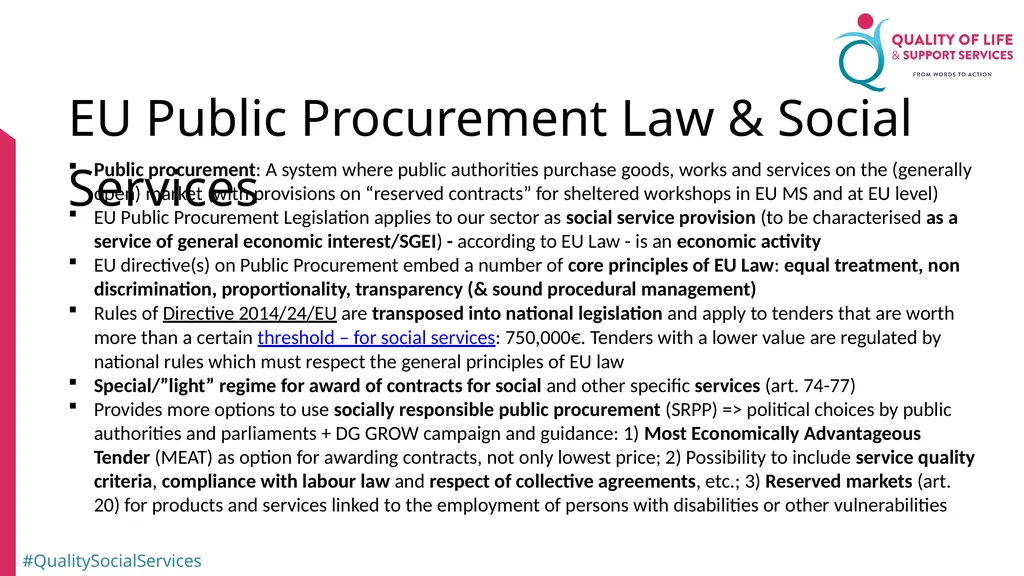
EU Public Procurement Law & Social Services Public procurement: A system where public authorities purchase goods, works and services on the (generally open) market (with provisions on “reserved contracts” for sheltered workshops in EU MS and at EU level)
EU Public Procurement Legislation applies to our sector as social service provision (to be characterised as a service of general economic interest/SGEI) - according to EU Law - is an economic activity
EU directive(s) on Public Procurement embed a number of core principles of EU Law: equal treatment, non discrimination, proportionality, transparency (& sound procedural management)
Rules of Directive 2014/24/EU are transposed into national legislation and apply to tenders that are worth more than a certain threshold – for social services: 750,000€. Tenders with a lower value are regulated by national rules which must respect the general principles of EU law
Special/”light” regime for award of contracts for social and other specific services (art. 74-77)
Provides more options to use socially responsible public procurement (SRPP) => political choices by public authorities and parliaments + DG GROW campaign and guidance: 1) Most Economically Advantageous Tender (MEAT) as option for awarding contracts, not only lowest price; 2) Possibility to include service quality criteria, compliance with labour law and respect of collective agreements, etc.; 3) Reserved markets (art. 20) for products and services linked to the employment of persons with disabilities or other vulnerabilities #QualitySocialServices<br>
03
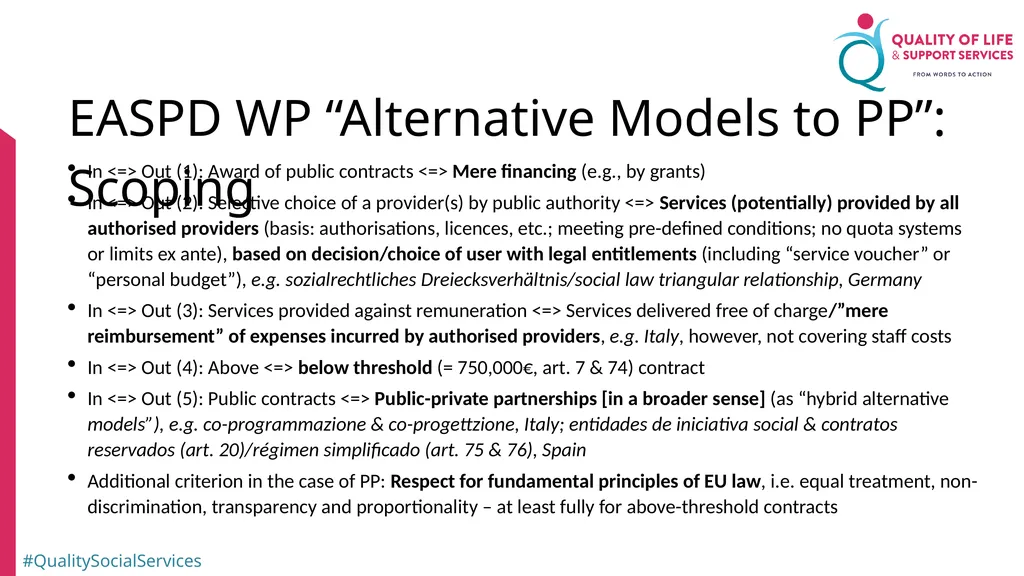
EASPD WP “Alternative Models to PP”: Scoping In <=> Out (1): Award of public contracts <=> Mere financing (e.g., by grants)
In <=> Out (2): Selective choice of a provider(s) by public authority <=> Services (potentially) provided by all authorised providers (basis: authorisations, licences, etc.; meeting pre-defined conditions; no quota systems or limits ex ante), based on decision/choice of user with legal entitlements (including “service voucher” or “personal budget”), e.g. sozialrechtliches Dreiecksverhältnis/social law triangular relationship, Germany
In <=> Out (3): Services provided against remuneration <=> Services delivered free of charge/”mere reimbursement” of expenses incurred by authorised providers, e.g. Italy, however, not covering staff costs
In <=> Out (4): Above <=> below threshold (= 750,000€, art. 7 & 74) contract
In <=> Out (5): Public contracts <=> Public-private partnerships [in a broader sense] (as “hybrid alternative models”), e.g. co-programmazione & co-progettzione, Italy; entidades de iniciativa social & contratos reservados (art. 20)/régimen simplificado (art. 75 & 76), Spain
Additional criterion in the case of PP: Respect for fundamental principles of EU law, i.e. equal treatment, non-discrimination, transparency and proportionality – at least fully for above-threshold contracts #QualitySocialServices<br>
04
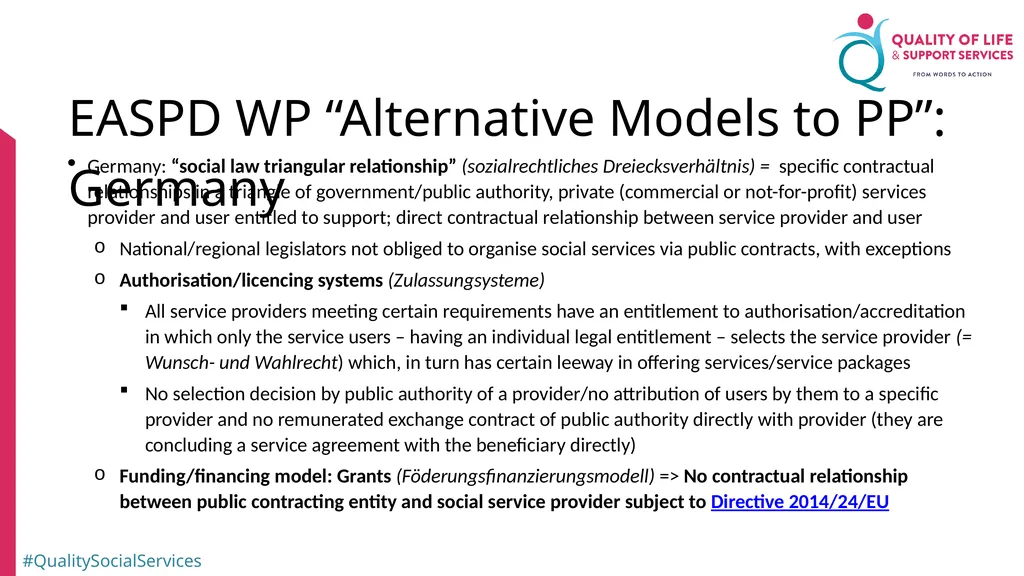
EASPD WP “Alternative Models to PP”: Germany Germany: “social law triangular relationship” (sozialrechtliches Dreiecksverhältnis) = specific contractual relationships in a triangle of government/public authority, private (commercial or not-for-profit) services provider and user entitled to support; direct contractual relationship between service provider and user
National/regional legislators not obliged to organise social services via public contracts, with exceptions
Authorisation/licencing systems (Zulassungsysteme)
All service providers meeting certain requirements have an entitlement to authorisation/accreditation in which only the service users – having an individual legal entitlement – selects the service provider (= Wunsch- und Wahlrecht) which, in turn has certain leeway in offering services/service packages
No selection decision by public authority of a provider/no attribution of users by them to a specific provider and no remunerated exchange contract of public authority directly with provider (they are concluding a service agreement with the beneficiary directly)
Funding/financing model: Grants (Föderungsfinanzierungsmodell) => No contractual relationship between public contracting entity and social service provider subject to Directive 2014/24/EU #QualitySocialServices<br>
05
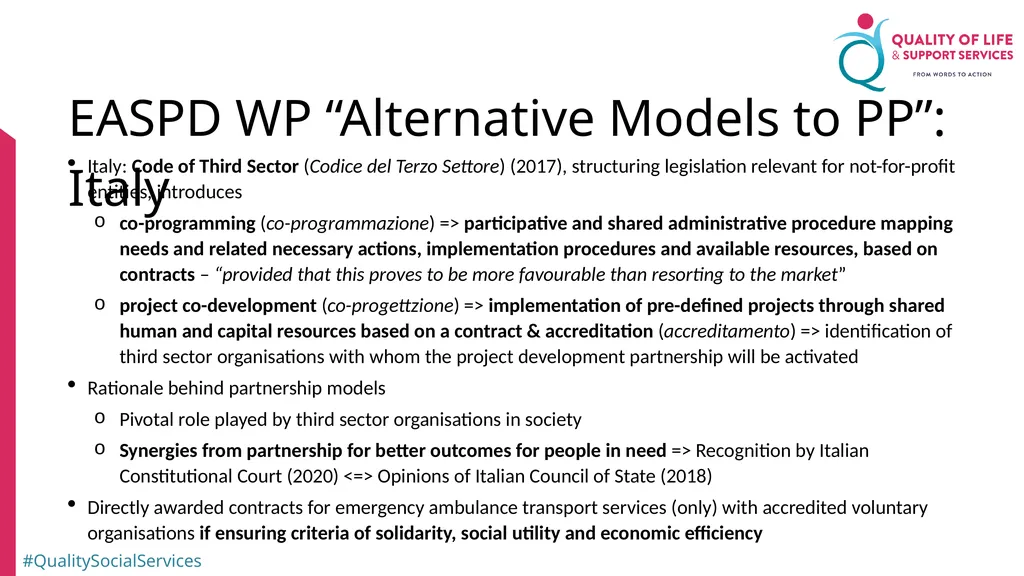
EASPD WP “Alternative Models to PP”: Italy Italy: Code of Third Sector (Codice del Terzo Settore) (2017), structuring legislation relevant for not-for-profit entities, introduces
co-programming (co-programmazione) => participative and shared administrative procedure mapping needs and related necessary actions, implementation procedures and available resources, based on contracts – “provided that this proves to be more favourable than resorting to the market”
project co-development (co-progettzione) => implementation of pre-defined projects through shared human and capital resources based on a contract & accreditation (accreditamento) => identification of third sector organisations with whom the project development partnership will be activated
Rationale behind partnership models
Pivotal role played by third sector organisations in society
Synergies from partnership for better outcomes for people in need => Recognition by Italian Constitutional Court (2020) <=> Opinions of Italian Council of State (2018)
Directly awarded contracts for emergency ambulance transport services (only) with accredited voluntary organisations if ensuring criteria of solidarity, social utility and economic efficiency #QualitySocialServices<br>
06
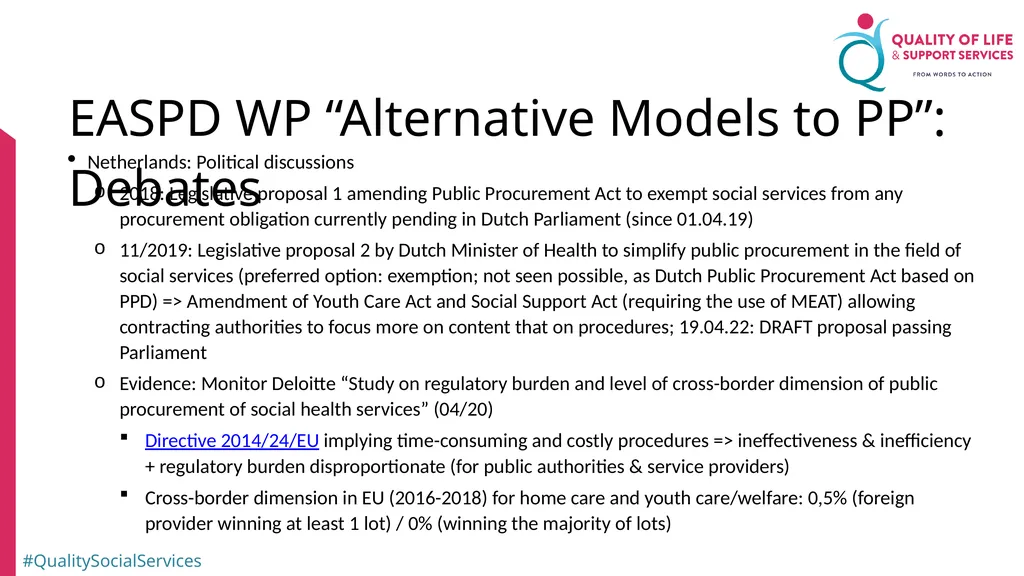
EASPD WP “Alternative Models to PP”: Debates Netherlands: Political discussions
2018: Legislative proposal 1 amending Public Procurement Act to exempt social services from any procurement obligation currently pending in Dutch Parliament (since 01.04.19)
11/2019: Legislative proposal 2 by Dutch Minister of Health to simplify public procurement in the field of social services (preferred option: exemption; not seen possible, as Dutch Public Procurement Act based on PPD) => Amendment of Youth Care Act and Social Support Act (requiring the use of MEAT) allowing contracting authorities to focus more on content that on procedures; 19.04.22: DRAFT proposal passing Parliament
Evidence: Monitor Deloitte “Study on regulatory burden and level of cross-border dimension of public procurement of social health services” (04/20)
Directive 2014/24/EU implying time-consuming and costly procedures => ineffectiveness & inefficiency + regulatory burden disproportionate (for public authorities & service providers)
Cross-border dimension in EU (2016-2018) for home care and youth care/welfare: 0,5% (foreign provider winning at least 1 lot) / 0% (winning the majority of lots) #QualitySocialServices<br>
07
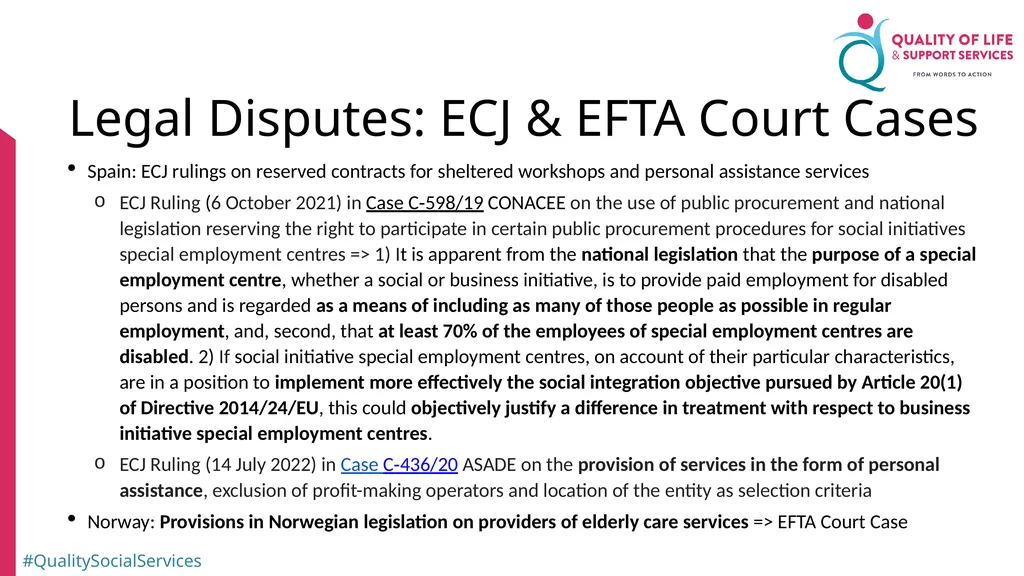
Legal Disputes: ECJ & EFTA Court Cases Spain: ECJ rulings on reserved contracts for sheltered workshops and personal assistance services
ECJ Ruling (6 October 2021) in Case C‑598/19 CONACEE on the use of public procurement and national legislation reserving the right to participate in certain public procurement procedures for social initiatives special employment centres => 1) It is apparent from the national legislation that the purpose of a special employment centre, whether a social or business initiative, is to provide paid employment for disabled persons and is regarded as a means of including as many of those people as possible in regular employment, and, second, that at least 70% of the employees of special employment centres are disabled. 2) If social initiative special employment centres, on account of their particular characteristics, are in a position to implement more effectively the social integration objective pursued by Article 20(1) of Directive 2014/24/EU, this could objectively justify a difference in treatment with respect to business initiative special employment centres.
ECJ Ruling (14 July 2022) in Case C‑436/20 ASADE on the provision of services in the form of personal assistance, exclusion of profit-making operators and location of the entity as selection criteria
Norway: Provisions in Norwegian legislation on providers of elderly care services => EFTA Court Case #QualitySocialServices<br>
08
EASPD WP “Alternative Models to PP”: Evidence Reflections on the relationship between EU social policy objectives and the use of public procurement
=> Is public procurement the right instrument to implement quality assurance frameworks, such as, e.g., the
European Voluntary Quality Framework for Social Services of General Interest (2010)? Primarily NO!
Freedom of choice of provider by user: 1) selection and award criteria (and thus indirectly also quality criteria) set by public authorities and 2) if selection by public authority if only one provider
Person-centred services: public procurement not allowing for 1) co-production of services and 2) for negotiations between public authority and provider on new/changing demands/needs
Respect for user rights: 1) rigidity and complexity of public procurement procedures and 2) non-representation of users at the stage of the selection and/or award of contracts
Participation and empowerment: emphasis on 1) costs and 2) standardisable services
Partnership: buyer-supplier-type relationship => [financial & political] dependency structures
SSE Statement on the EC Guide/Commission Notice “Buying Social – a guide to taking account of social considerations in public procurement (2nd edition)”, Brussels, 26.05.21, C(2021)3573 final (6 December 2021) => article & document #QualitySocialServices<br>
09
EASPD WP “Alternative Models to PP”: Questions Possible questions to participants to get more knowledge, to share experiences, to make proposals, etc.
Existence of alternative models focusing on partnership and cooperation between not-for profit/social economy providers of social services and competent public authorities (local/regional/national level?)
Are those alternative models sector specific (e.g. disability services; labour market inclusion/integration services, including by PES) or do they exists across the different sub-sectors of social services?
Experiences with use of public procurement vs. alternative models, e.g., in view of service quality achieved, staffing levels, pay and working conditions of staff, user involvement, quality of life for users, possibility to deliver services taking account of individual needs/person-centred services, flexibility to adapt contracts to new/changed needs, possibility to do service innovation
Transposition of special/”light” regime included in of Directive 2014/24/EU for (i.a.) social services into national legislation in your country? Does this have any positive/negative impact?
Relevance of alternative procedures offered by in Directive 2014/24/EU – e.g., competitive procedure with negotiation (art. 29), competitive dialogue (art. 30), innovation partnership (art. 31), use of negotiated procedure without prior publication (art. 32) – or of models outside its scope (e.g., open house contracts)? #QualitySocialServices<br>
10
#QualitySocialServices In case of questions or comments please contact:
Mathias Maucher
Social Services Europe (SSE)
Policy & Project Coordinator mathias.maucher@socialserviceseurope.eu Thank you for your attention!<br>
Mathias Maucher
Social Services Europe (SSE)
Policy & Project Coordinator mathias.maucher@socialserviceseurope.eu Thank you for your attention!<br>