
WORKSHOP ON proposed CMA regulations BUSINESS
OM
Published · 17 slides · 0 views

1 / 1
Description
WORKSHOP ON proposed CMA regulations BUSINESS CONDUCT regulation John Carson Lead Advisor to CMA Compliax Consulting Inc. Toronto, Canada Khalil Ghalayini Head of the Financial Control Unit CMA, Beirut Lebanon. September 2014 Agenda Purpose
Related Topics
Share
Embed code
Download this presentation From Below
"WORKSHOP ON proposed CMA regulations BUSINESS" is the property of its rightful owner. Permission is granted to download and print the materials on this website for personal, non-commercial use only, and to display it on your personal computer provided you do not modify the materials and that you retain all copyright notices contained in the materials. By downloading content from our website, you accept the terms of this agreement.
Presentation Transcript
01
WORKSHOP ON proposed CMA regulations BUSINESS CONDUCT
regulation John Carson
Lead Advisor to CMA
Compliax Consulting Inc.
Toronto, Canada
Khalil Ghalayini
Head of the Financial Control Unit
CMA, Beirut Lebanon. September 2014<br>
regulation John Carson
Lead Advisor to CMA
Compliax Consulting Inc.
Toronto, Canada
Khalil Ghalayini
Head of the Financial Control Unit
CMA, Beirut Lebanon. September 2014<br>
02
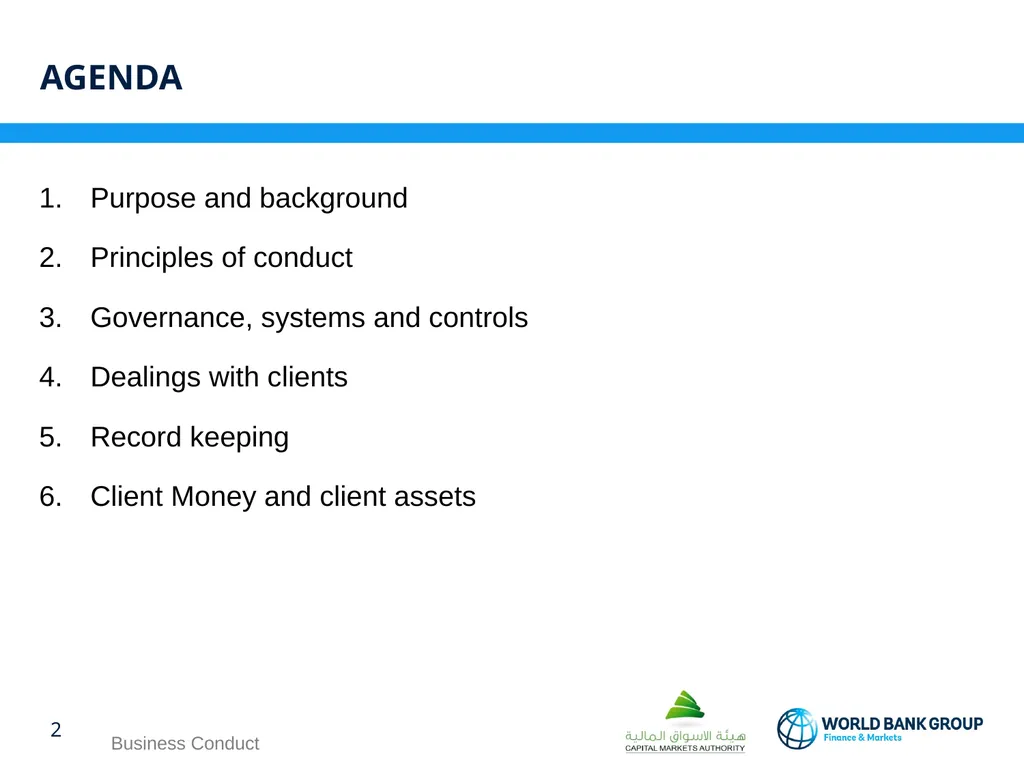
Agenda Purpose and background
Principles of conduct
Governance, systems and controls
Dealings with clients
Record keeping
Client Money and client assets Business Conduct 1<br>
Principles of conduct
Governance, systems and controls
Dealings with clients
Record keeping
Client Money and client assets Business Conduct 1<br>
03
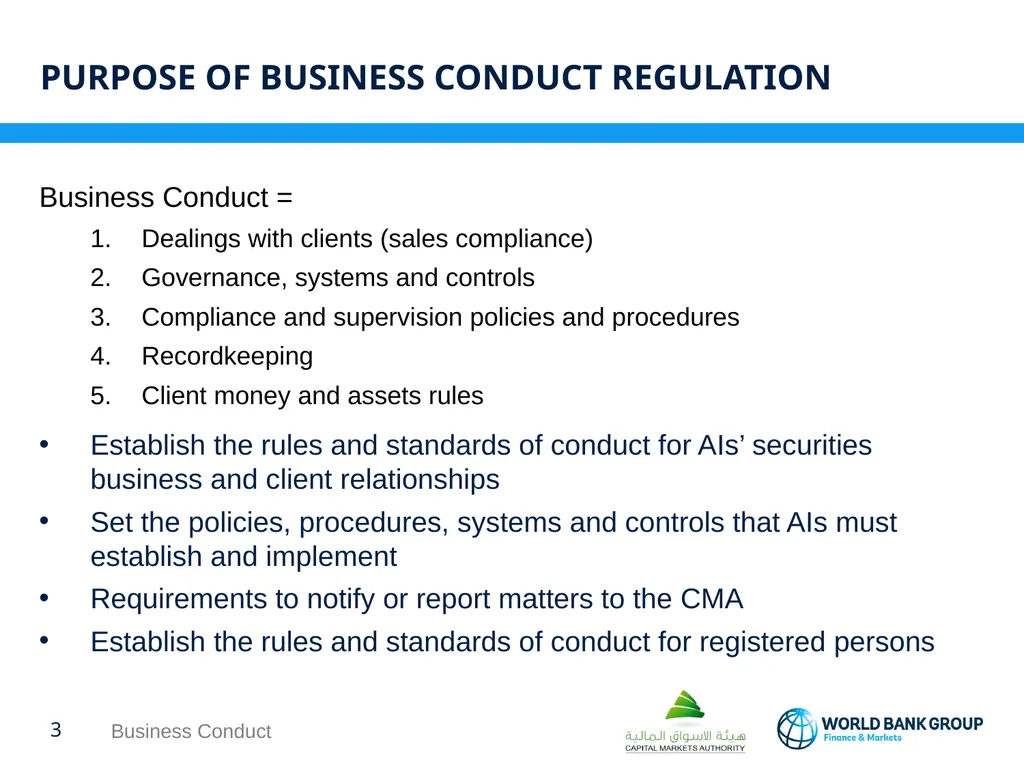
Purpose of business conduct Regulation Business Conduct =
Dealings with clients (sales compliance)
Governance, systems and controls
Compliance and supervision policies and procedures
Recordkeeping
Client money and assets rules
Establish the rules and standards of conduct for AIs’ securities business and client relationships
Set the policies, procedures, systems and controls that AIs must establish and implement
Requirements to notify or report matters to the CMA
Establish the rules and standards of conduct for registered persons Business Conduct 2<br>
Dealings with clients (sales compliance)
Governance, systems and controls
Compliance and supervision policies and procedures
Recordkeeping
Client money and assets rules
Establish the rules and standards of conduct for AIs’ securities business and client relationships
Set the policies, procedures, systems and controls that AIs must establish and implement
Requirements to notify or report matters to the CMA
Establish the rules and standards of conduct for registered persons Business Conduct 2<br>
04
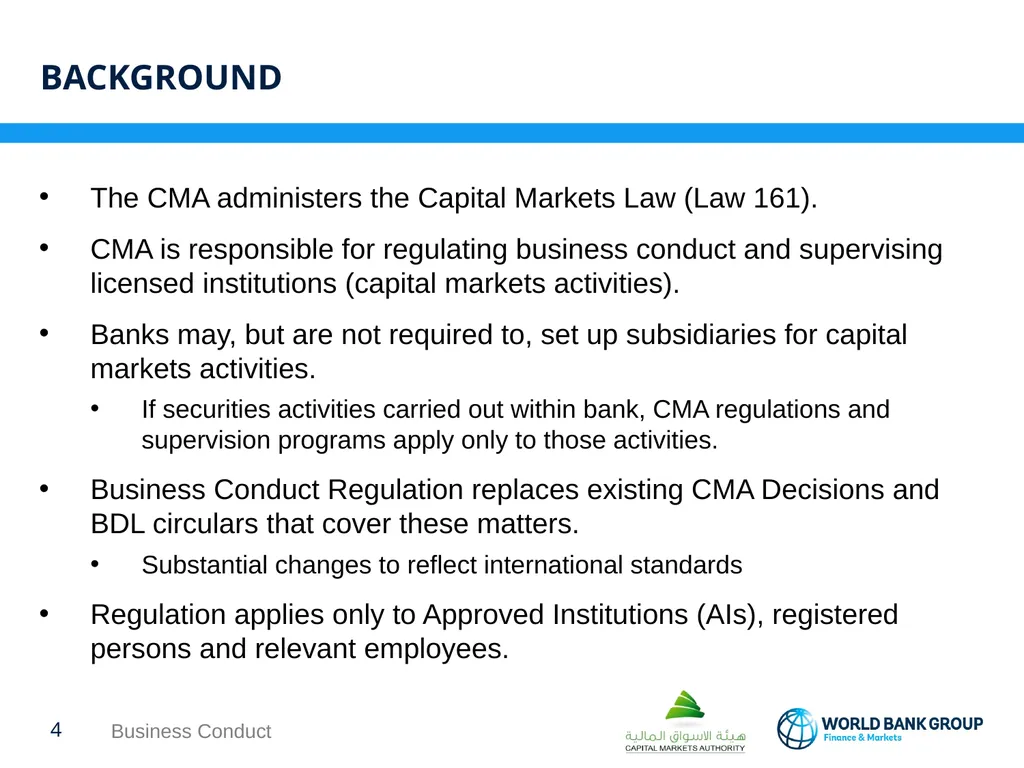
Background The CMA administers the Capital Markets Law (Law 161).
CMA is responsible for regulating business conduct and supervising licensed institutions (capital markets activities).
Banks may, but are not required to, set up subsidiaries for capital markets activities.
If securities activities carried out within bank, CMA regulations and supervision programs apply only to those activities.
Business Conduct Regulation replaces existing CMA Decisions and BDL circulars that cover these matters.
Substantial changes to reflect international standards
Regulation applies only to Approved Institutions (AIs), registered persons and relevant employees. Business Conduct 3<br>
CMA is responsible for regulating business conduct and supervising licensed institutions (capital markets activities).
Banks may, but are not required to, set up subsidiaries for capital markets activities.
If securities activities carried out within bank, CMA regulations and supervision programs apply only to those activities.
Business Conduct Regulation replaces existing CMA Decisions and BDL circulars that cover these matters.
Substantial changes to reflect international standards
Regulation applies only to Approved Institutions (AIs), registered persons and relevant employees. Business Conduct 3<br>
05
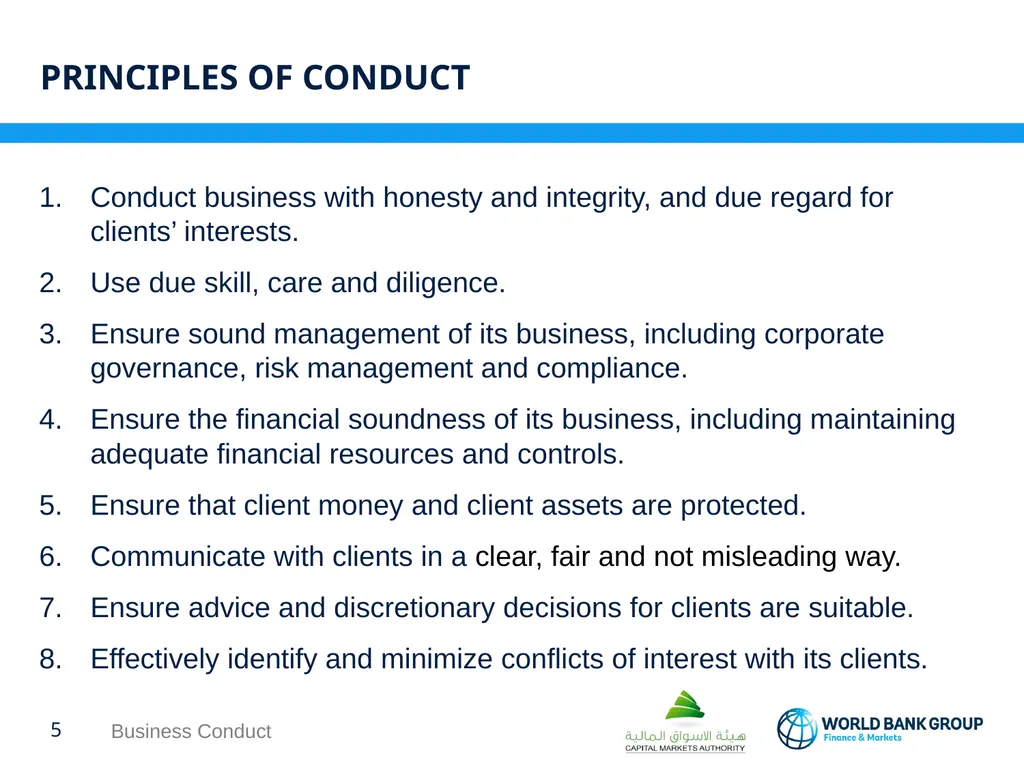
principles of conduct Conduct business with honesty and integrity, and due regard for clients’ interests.
Use due skill, care and diligence.
Ensure sound management of its business, including corporate governance, risk management and compliance.
Ensure the financial soundness of its business, including maintaining adequate financial resources and controls.
Ensure that client money and client assets are protected.
Communicate with clients in a clear, fair and not misleading way.
Ensure advice and discretionary decisions for clients are suitable.
Effectively identify and minimize conflicts of interest with its clients. Business Conduct 4<br>
Use due skill, care and diligence.
Ensure sound management of its business, including corporate governance, risk management and compliance.
Ensure the financial soundness of its business, including maintaining adequate financial resources and controls.
Ensure that client money and client assets are protected.
Communicate with clients in a clear, fair and not misleading way.
Ensure advice and discretionary decisions for clients are suitable.
Effectively identify and minimize conflicts of interest with its clients. Business Conduct 4<br>
06
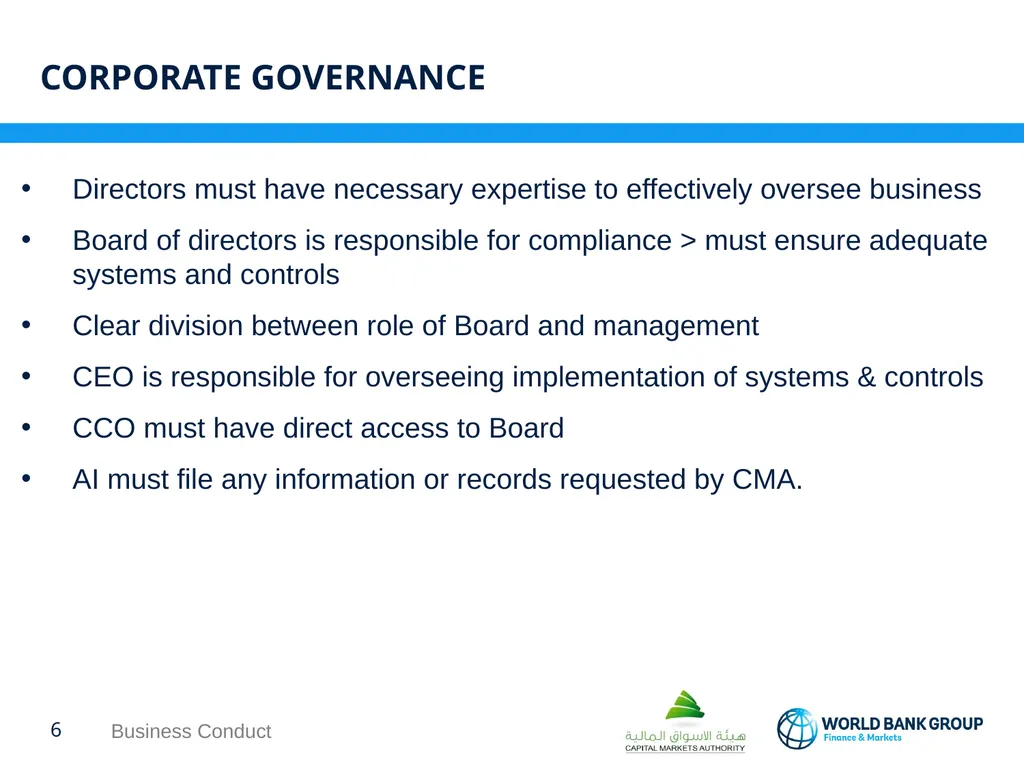
corporate governance Directors must have necessary expertise to effectively oversee business
Board of directors is responsible for compliance > must ensure adequate systems and controls
Clear division between role of Board and management
CEO is responsible for overseeing implementation of systems & controls
CCO must have direct access to Board
AI must file any information or records requested by CMA. Business Conduct 5<br>
Board of directors is responsible for compliance > must ensure adequate systems and controls
Clear division between role of Board and management
CEO is responsible for overseeing implementation of systems & controls
CCO must have direct access to Board
AI must file any information or records requested by CMA. Business Conduct 5<br>
07
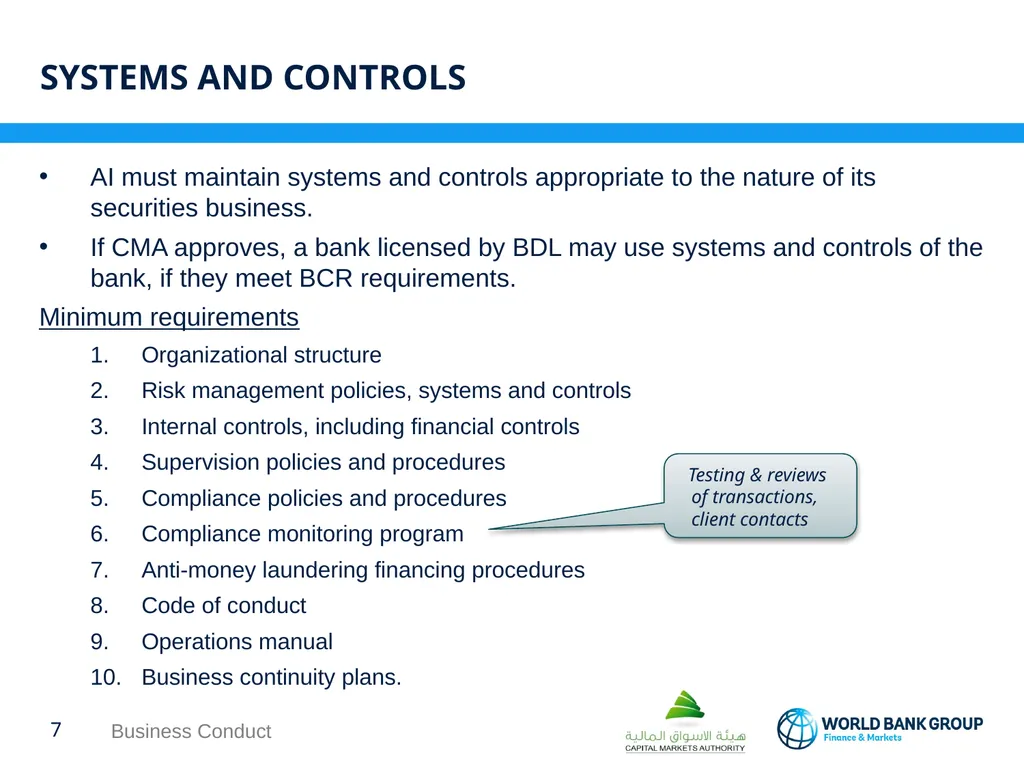
systems and controls AI must maintain systems and controls appropriate to the nature of its securities business.
If CMA approves, a bank licensed by BDL may use systems and controls of the bank, if they meet BCR requirements.
Minimum requirements
Organizational structure
Risk management policies, systems and controls
Internal controls, including financial controls
Supervision policies and procedures
Compliance policies and procedures
Compliance monitoring program
Anti-money laundering financing procedures
Code of conduct
Operations manual
Business continuity plans. Business Conduct 6 Testing & reviews of transactions, client contacts<br>
If CMA approves, a bank licensed by BDL may use systems and controls of the bank, if they meet BCR requirements.
Minimum requirements
Organizational structure
Risk management policies, systems and controls
Internal controls, including financial controls
Supervision policies and procedures
Compliance policies and procedures
Compliance monitoring program
Anti-money laundering financing procedures
Code of conduct
Operations manual
Business continuity plans. Business Conduct 6 Testing & reviews of transactions, client contacts<br>
08
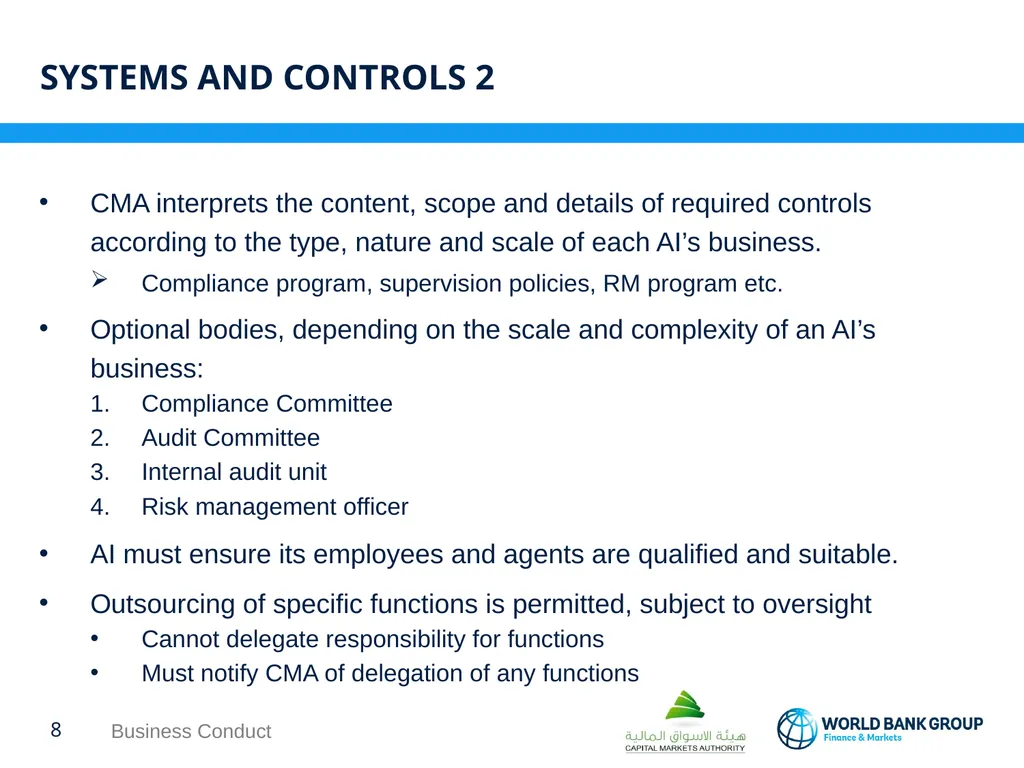
systems and controls 2 CMA interprets the content, scope and details of required controls according to the type, nature and scale of each AI’s business.
Compliance program, supervision policies, RM program etc.
Optional bodies, depending on the scale and complexity of an AI’s business:
Compliance Committee
Audit Committee
Internal audit unit
Risk management officer
AI must ensure its employees and agents are qualified and suitable.
Outsourcing of specific functions is permitted, subject to oversight
Cannot delegate responsibility for functions
Must notify CMA of delegation of any functions Business Conduct 7<br>
Compliance program, supervision policies, RM program etc.
Optional bodies, depending on the scale and complexity of an AI’s business:
Compliance Committee
Audit Committee
Internal audit unit
Risk management officer
AI must ensure its employees and agents are qualified and suitable.
Outsourcing of specific functions is permitted, subject to oversight
Cannot delegate responsibility for functions
Must notify CMA of delegation of any functions Business Conduct 7<br>
09
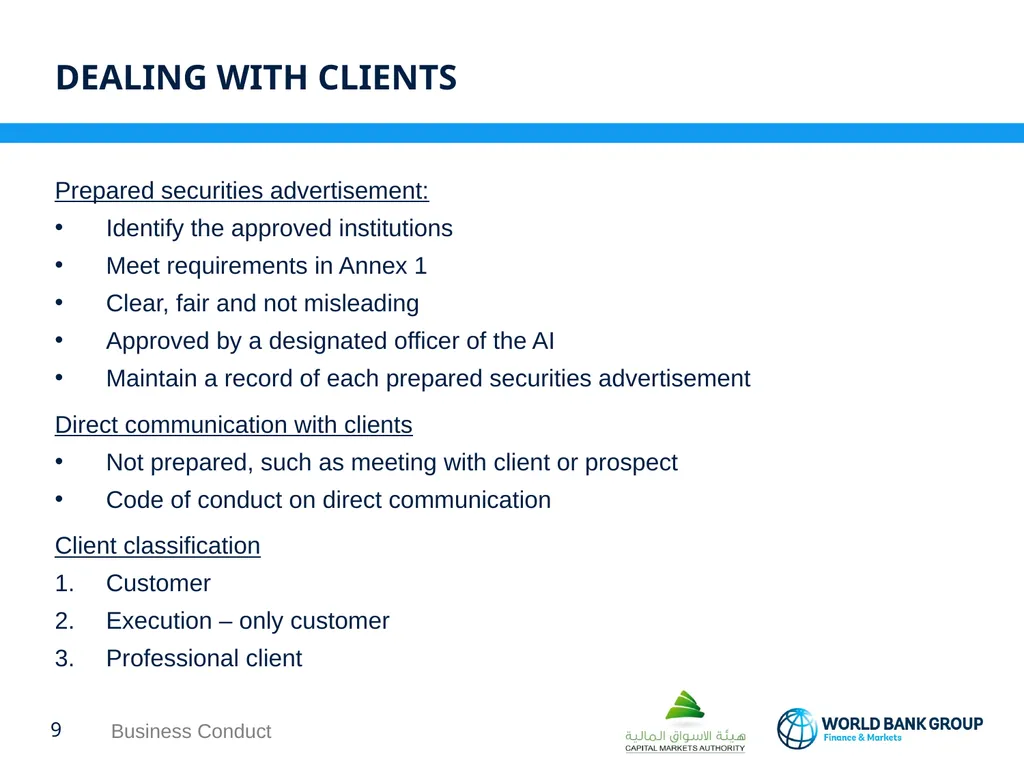
Dealing with clients Prepared securities advertisement:
Identify the approved institutions
Meet requirements in Annex 1
Clear, fair and not misleading
Approved by a designated officer of the AI
Maintain a record of each prepared securities advertisement
Direct communication with clients
Not prepared, such as meeting with client or prospect
Code of conduct on direct communication
Client classification
Customer
Execution – only customer
Professional client Business Conduct 8<br>
Identify the approved institutions
Meet requirements in Annex 1
Clear, fair and not misleading
Approved by a designated officer of the AI
Maintain a record of each prepared securities advertisement
Direct communication with clients
Not prepared, such as meeting with client or prospect
Code of conduct on direct communication
Client classification
Customer
Execution – only customer
Professional client Business Conduct 8<br>
10
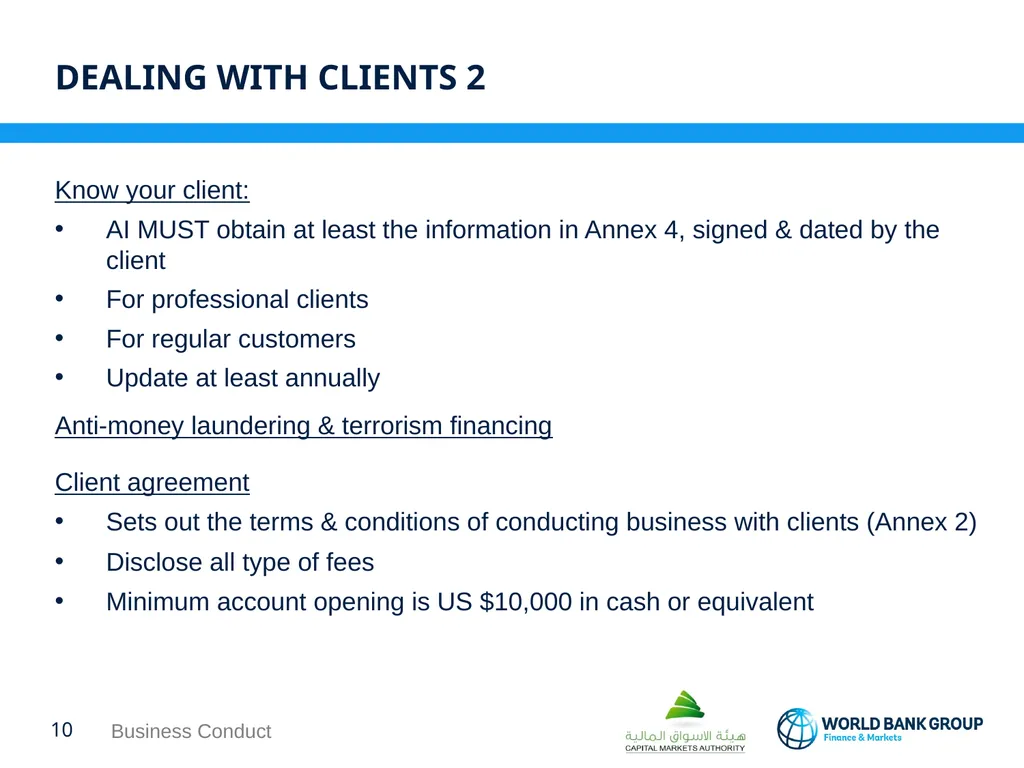
Business Conduct 9 Dealing with clients 2 Know your client:
AI MUST obtain at least the information in Annex 4, signed & dated by the client
For professional clients
For regular customers
Update at least annually
Anti-money laundering & terrorism financing
Client agreement
Sets out the terms & conditions of conducting business with clients (Annex 2)
Disclose all type of fees
Minimum account opening is US $10,000 in cash or equivalent<br>
AI MUST obtain at least the information in Annex 4, signed & dated by the client
For professional clients
For regular customers
Update at least annually
Anti-money laundering & terrorism financing
Client agreement
Sets out the terms & conditions of conducting business with clients (Annex 2)
Disclose all type of fees
Minimum account opening is US $10,000 in cash or equivalent<br>
11
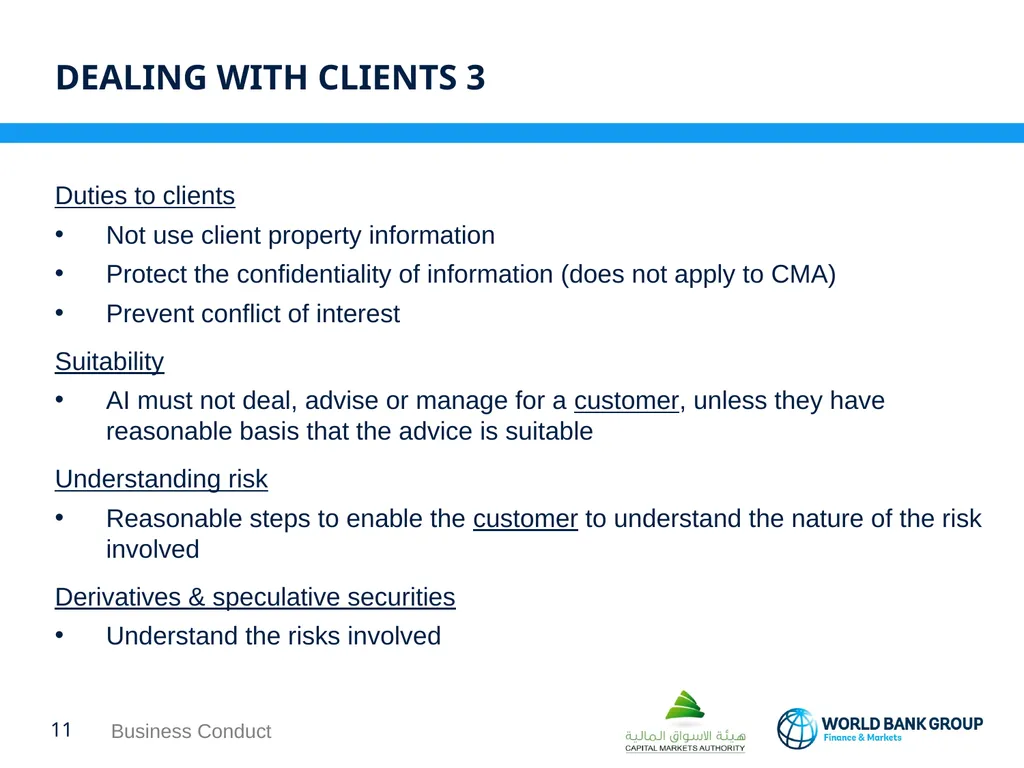
Business Conduct 10 Dealing with clients 3 Duties to clients
Not use client property information
Protect the confidentiality of information (does not apply to CMA)
Prevent conflict of interest
Suitability
AI must not deal, advise or manage for a customer, unless they have reasonable basis that the advice is suitable
Understanding risk
Reasonable steps to enable the customer to understand the nature of the risk involved
Derivatives & speculative securities
Understand the risks involved<br>
Not use client property information
Protect the confidentiality of information (does not apply to CMA)
Prevent conflict of interest
Suitability
AI must not deal, advise or manage for a customer, unless they have reasonable basis that the advice is suitable
Understanding risk
Reasonable steps to enable the customer to understand the nature of the risk involved
Derivatives & speculative securities
Understand the risks involved<br>
12
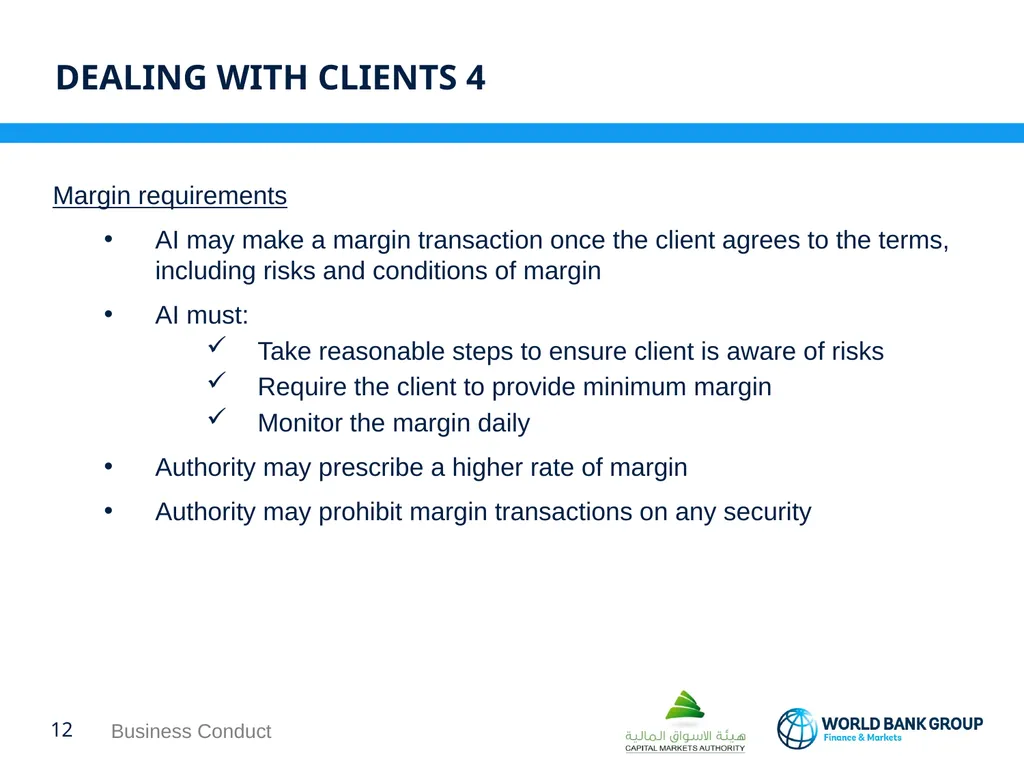
Business Conduct 11 Dealing with clients 4 Margin requirements
AI may make a margin transaction once the client agrees to the terms, including risks and conditions of margin
AI must:
Take reasonable steps to ensure client is aware of risks
Require the client to provide minimum margin
Monitor the margin daily
Authority may prescribe a higher rate of margin
Authority may prohibit margin transactions on any security<br>
AI may make a margin transaction once the client agrees to the terms, including risks and conditions of margin
AI must:
Take reasonable steps to ensure client is aware of risks
Require the client to provide minimum margin
Monitor the margin daily
Authority may prescribe a higher rate of margin
Authority may prohibit margin transactions on any security<br>
13
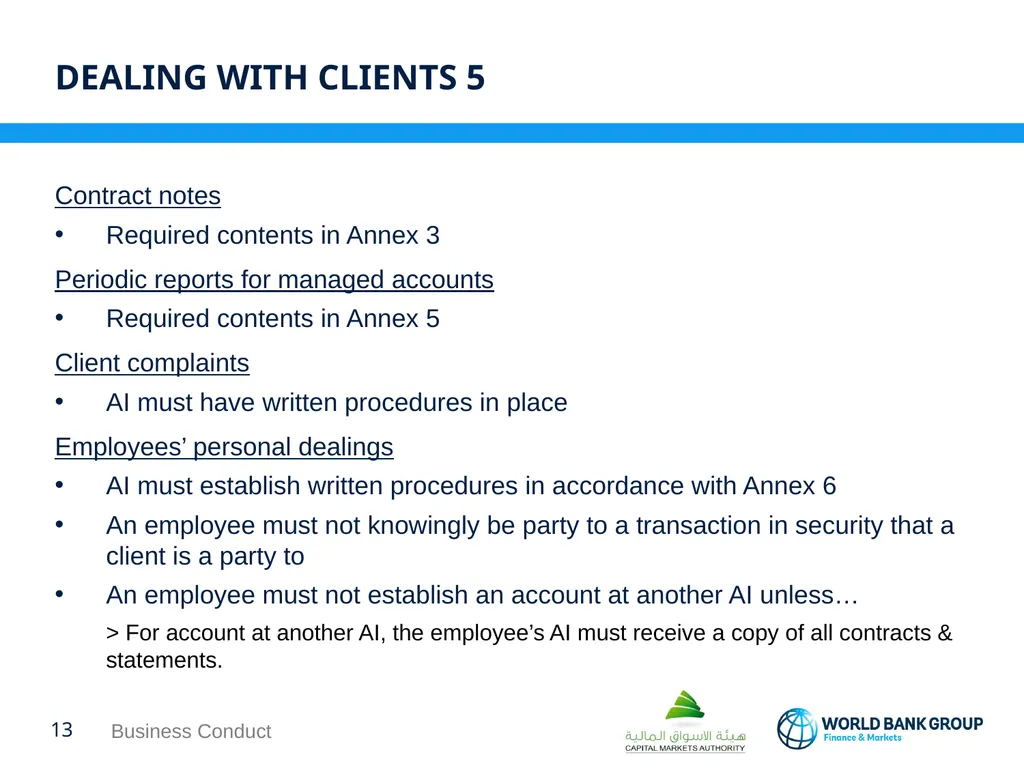
Business Conduct 12 Dealing with clients 5 Contract notes
Required contents in Annex 3
Periodic reports for managed accounts
Required contents in Annex 5
Client complaints
AI must have written procedures in place
Employees’ personal dealings
AI must establish written procedures in accordance with Annex 6
An employee must not knowingly be party to a transaction in security that a client is a party to
An employee must not establish an account at another AI unless…
> For account at another AI, the employee’s AI must receive a copy of all contracts & statements.<br>
Required contents in Annex 3
Periodic reports for managed accounts
Required contents in Annex 5
Client complaints
AI must have written procedures in place
Employees’ personal dealings
AI must establish written procedures in accordance with Annex 6
An employee must not knowingly be party to a transaction in security that a client is a party to
An employee must not establish an account at another AI unless…
> For account at another AI, the employee’s AI must receive a copy of all contracts & statements.<br>
14
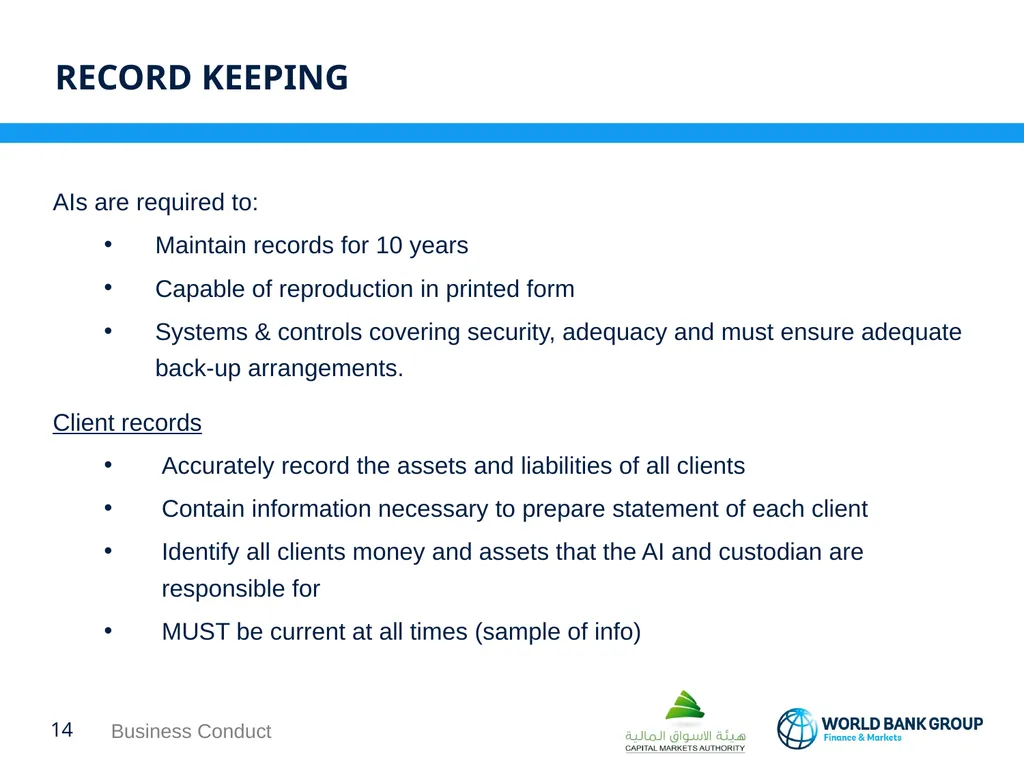
Business Conduct 13 Record keeping AIs are required to:
Maintain records for 10 years
Capable of reproduction in printed form
Systems & controls covering security, adequacy and must ensure adequate back-up arrangements.
Client records
Accurately record the assets and liabilities of all clients
Contain information necessary to prepare statement of each client
Identify all clients money and assets that the AI and custodian are responsible for
MUST be current at all times (sample of info)<br>
Maintain records for 10 years
Capable of reproduction in printed form
Systems & controls covering security, adequacy and must ensure adequate back-up arrangements.
Client records
Accurately record the assets and liabilities of all clients
Contain information necessary to prepare statement of each client
Identify all clients money and assets that the AI and custodian are responsible for
MUST be current at all times (sample of info)<br>
15
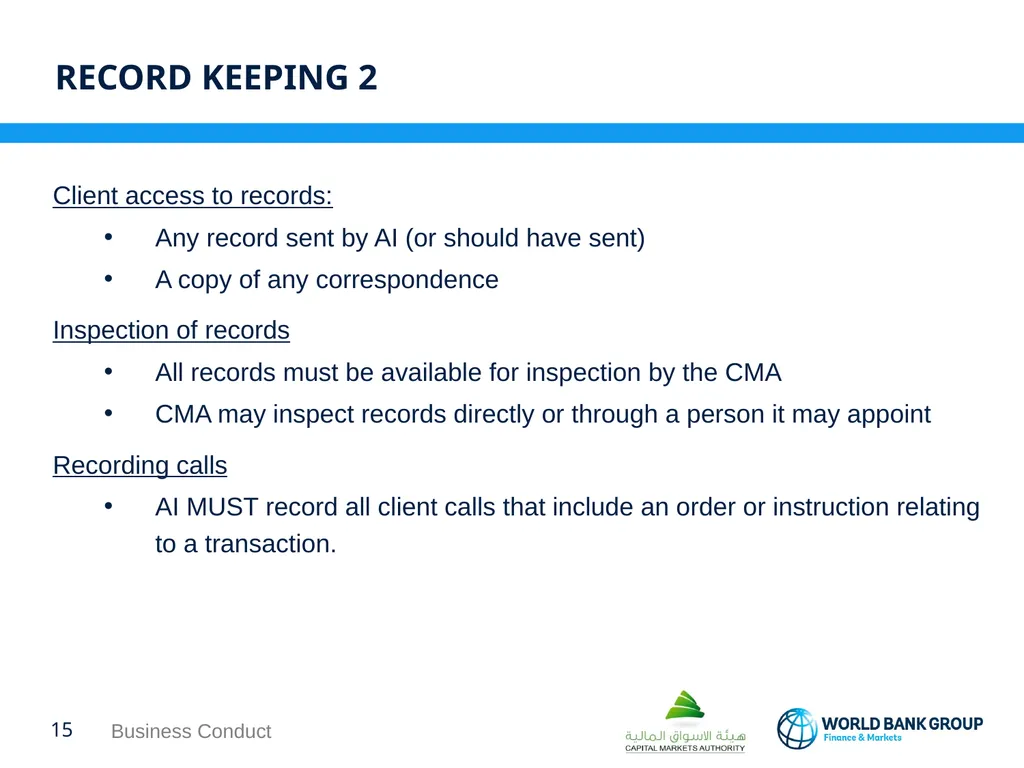
Business Conduct 14 Record keeping 2 Client access to records:
Any record sent by AI (or should have sent)
A copy of any correspondence
Inspection of records
All records must be available for inspection by the CMA
CMA may inspect records directly or through a person it may appoint
Recording calls
AI MUST record all client calls that include an order or instruction relating to a transaction.<br>
Any record sent by AI (or should have sent)
A copy of any correspondence
Inspection of records
All records must be available for inspection by the CMA
CMA may inspect records directly or through a person it may appoint
Recording calls
AI MUST record all client calls that include an order or instruction relating to a transaction.<br>
16
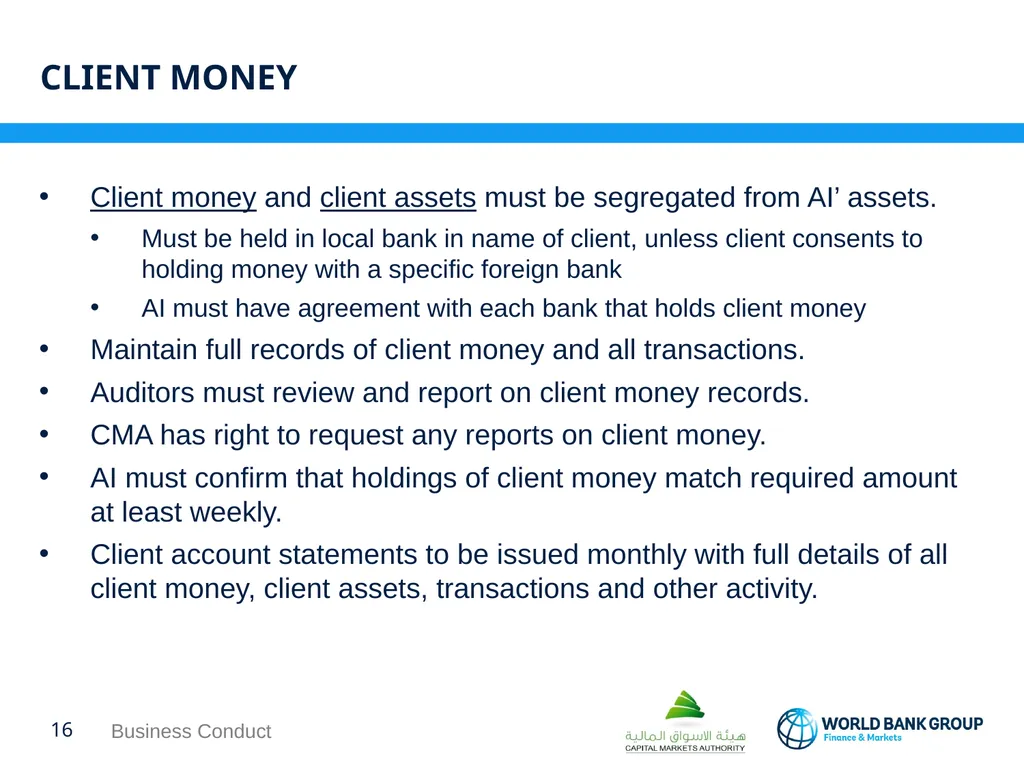
CLIENT MONEY Client money and client assets must be segregated from AI’ assets.
Must be held in local bank in name of client, unless client consents to holding money with a specific foreign bank
AI must have agreement with each bank that holds client money
Maintain full records of client money and all transactions.
Auditors must review and report on client money records.
CMA has right to request any reports on client money.
AI must confirm that holdings of client money match required amount at least weekly.
Client account statements to be issued monthly with full details of all client money, client assets, transactions and other activity. Business Conduct 15<br>
Must be held in local bank in name of client, unless client consents to holding money with a specific foreign bank
AI must have agreement with each bank that holds client money
Maintain full records of client money and all transactions.
Auditors must review and report on client money records.
CMA has right to request any reports on client money.
AI must confirm that holdings of client money match required amount at least weekly.
Client account statements to be issued monthly with full details of all client money, client assets, transactions and other activity. Business Conduct 15<br>
17
client assets AI must have custody license to hold client assets.
Client agreement required to provide custody services.
Midclear must hold eligible assets in a client account.
AI must do risk assessment of a custodian that holds client assets.
Client assets include collateral (unless it must be applied to debt).
Records must make clear clients hold title to segregated assets.
Foreign custodian may hold title to assets in the AI’s name if client agrees in writing.
Reconciliation of records required at least weekly.
AI must obtain client’s agreement to lend securities.
securities lending agreement required (see contents of general agreement). Business Conduct 16<br>
Client agreement required to provide custody services.
Midclear must hold eligible assets in a client account.
AI must do risk assessment of a custodian that holds client assets.
Client assets include collateral (unless it must be applied to debt).
Records must make clear clients hold title to segregated assets.
Foreign custodian may hold title to assets in the AI’s name if client agrees in writing.
Reconciliation of records required at least weekly.
AI must obtain client’s agreement to lend securities.
securities lending agreement required (see contents of general agreement). Business Conduct 16<br>