
Workshops/foundation seminars1: Globalization,
LO
Published · 33 slides · 0 views
1 / 1
Description
Workshopsfoundation seminars1: Globalization, Globalizations Deglobalization: theories and its limits. Globalization definition: The world integration of capitals, markets and communications. (ROSENBERG, Justin. The Follies of
Related Topics
Share
Embed code
Download this presentation From Below
"Workshops/foundation seminars1: Globalization," is the property of its rightful owner. Permission is granted to download and print the materials on this website for personal, non-commercial use only, and to display it on your personal computer provided you do not modify the materials and that you retain all copyright notices contained in the materials. By downloading content from our website, you accept the terms of this agreement.
Presentation Transcript
01
Workshops/foundation seminars1: Globalization, Globalizations & Deglobalization:
theories and its limits.<br>
theories and its limits.<br>
02
Globalization definition: The world integration of capitals, markets and communications.
(ROSENBERG, Justin. The Follies of Globalisation Theory. London: Verso, 2001, 3.)<br>
(ROSENBERG, Justin. The Follies of Globalisation Theory. London: Verso, 2001, 3.)<br>
03
PRO “globalization would tend to facilitate the world economical and financial movements, developing investments, multina-tional companies, technologies, legal systems, infra-structures and global institutions”.
(EICHENGREEN, Barry. Globalizing Capital: A History of the International Monetary System. Princeton: Princeton University Press, 1996, 19.)<br>
(EICHENGREEN, Barry. Globalizing Capital: A History of the International Monetary System. Princeton: Princeton University Press, 1996, 19.)<br>
04
CON “the progressive globalization of terrorisms and of many forms of international crime; the exponential growth of clandestine emigration; the deepening of poverty and un-employment in the “peripheries” of the industrial north; the continued erosion of national sovereignties; an even more uniform idea of global multiculturalism competing to diminish cultural diversity, increasing the loss of languages, dialects and ‘traditional’ cultures”.
BHAGWATI, Jagdish. In Defence of Globalization. Oxford: Oxford University Press, 2004, 57).<br>
BHAGWATI, Jagdish. In Defence of Globalization. Oxford: Oxford University Press, 2004, 57).<br>
05
Evidence Globalization is more than the common notion of the growing interdependence of the world generally and the formation of global institutions.<br>
06
Evidence Problematic Evidence now shows that the global – whether an institution, a process, a discursive practice, or an imaginary – simultaneous transcends the exclusive framing of national states yet partly inhabits national territories and institutions, including sub-national and even local scales.<br>
07
Nation-state global survival The nation-state as a container of social process continue to work well for many of the subjects studied in the social sciences but they are not helpful in elucidating a great number of questions about globalization and the large array of transnational processes.<br>
08
Global National Thus methods and conceptual frameworks that rest on the assumption that the nation-state is a closed unit and that the state has exclusive authority over its territory cannot fully accommodate a new critical thinking: the fact that a process or an entity is located within the territory of a sovereign state does not necessarily mean its national or of the type traditionally authorized by the state (foreign tourists, embassies, etc.):
it might be a localization of the global.<br>
it might be a localization of the global.<br>
09
Research Agenda There is a need to research the presence of globalizing dynamics in thick social environments that mix national, sub national, local, and non/national elements.
The dominant form of globalization – the global corporate economy- is one of several processes.<br>
The dominant form of globalization – the global corporate economy- is one of several processes.<br>
10
Globalization dynamics 1 Globalization involves two distinct sets of dynamics.
One involves the formation of explicitly global institutions and processes, such as the WTO, global financial markets, the new cosmopolitanism, and the International War Crimes Tribunals. Although they are partly enacted at the national scale, they are to a large extent novel and self-evidently global formations.<br>
One involves the formation of explicitly global institutions and processes, such as the WTO, global financial markets, the new cosmopolitanism, and the International War Crimes Tribunals. Although they are partly enacted at the national scale, they are to a large extent novel and self-evidently global formations.<br>
11
Globalization dynamics 2 The second set of dynamics involves processes that do not necessarily scale at the global level as such yet are part of globalization. Cross/border networks of activists engaged in specific localized struggles with an explicit or implicit global agenda, as is the case with many human rights and environmental organizations; particular aspects of the work of states, for example the implementation of certain monetary and fiscal policies in a growing number of countries; and the fact that national courts are now using international instruments – whether human rights, international environment standards, WTO regulations, etc. - to address issues where they would have used national instruments.<br>
12
Rescaling Transnational Existing theories are not enough to map today’s multiplication of practices and actors contributing to rescaling transnational processes. Various globalization processes are multiscalar.
A financial center in a global city, for example, is a local entity that is also part of a globally scaled electronic market.
A local terrorist network hidden in the mountains between Afghanistan and Pakistan can and is a global entity.<br>
A financial center in a global city, for example, is a local entity that is also part of a globally scaled electronic market.
A local terrorist network hidden in the mountains between Afghanistan and Pakistan can and is a global entity.<br>
13
Sub-national The sub-national is now a site for globalization as in global cities and on commodity chains. Global cities, for example, are sub-national places in which multiple global circuits intersect ant thereby position these cities in several structured cross border geographies.<br>
14
Interactive technologies We need also to add the role of new interactive technologies in repositioning the local. Trough the new technologies a financial services firm becomes a microenvironment with a continuous global span. And so, too, do resource-poor organizations or households.
These microenvironments can be oriented to other microenvironments located far away, thereby destabilizing the notion of context which is often associated with the local.<br>
These microenvironments can be oriented to other microenvironments located far away, thereby destabilizing the notion of context which is often associated with the local.<br>
15
Localizations of the Global Simultaneity of scales, spaces, and relations, some national in the historic sense of the term, some denationalized or in the process of becoming so, and some global.
Different processes of localizations of the global.<br>
Different processes of localizations of the global.<br>
16
Scale 1 Formation of global domains that function at the self-evidently global scale – for example, some types of very-large scale Internet based conversations or global digitized outsourcing.<br>
17
Scale 2 Local practices that become directly articulated with global dynamics which no longer have to move through the traditional hierarchy of jurisdictions, as in the case of electronic financial markets.<br>
18
Scale 3 Interconnectivity and decentralized simultaneous access multiply the cross-border connections among various localities, as in the formation of worldwide social networks.<br>
19
Scale 4 Global formations can actually be partially embedded in subnational sites and move between these differently scaled practices and organizational forms in a continuous two-way flow.<br>
20
First conclusion When internetworked, the meaning of each the local and the global is repositioned because each can be multiscalar, locating them in the scalar complexity that the new technologies have made possible rather than taking scales as givens and self-contained.
In this sense only exists globalizations.<br>
In this sense only exists globalizations.<br>
21
Deglobalization The process of diminishing interdependence and integration between capitals, markets and communications.
It is now measured through downturns in world trade, capital flows and protectionist strategies.<br>
It is now measured through downturns in world trade, capital flows and protectionist strategies.<br>
22
Less Trade The motors of economic expansion were meant to be foreign investment, trade and finance: i.e., economic globalization.
World Bank: global trade peaked at 61% of world GDP in 2008, crashed to 52% the next year, rose back to 60% in 2012, and then fell back to 2015’s 58% (- 0.6/1.1% in 2016).
Excess capacity levels in PRC had reached more than 30% in coal, non-ferrous metals, cement and chemicals in 2015; Chinese banks’ high-risk ratio rose from 4% in 2010 to more than 12% in 2015.<br>
23
Less Finances Cross-border financial assets fell from 58% of world GDP in 2008 to 38% in 2016, in spite of fast overall indebtedness.
Global debt has reached $217 trillion (327% of world GDP), up from $86 trillion (246% of GDP) in 2002 and $149 billion (276%) in 2007.
Massive debt plus stock market speculation: China’s stock exchanges in 2015-16 lost more than $5 trillion in two share bubble bursts.<br>
Global debt has reached $217 trillion (327% of world GDP), up from $86 trillion (246% of GDP) in 2002 and $149 billion (276%) in 2007.
Massive debt plus stock market speculation: China’s stock exchanges in 2015-16 lost more than $5 trillion in two share bubble bursts.<br>
24
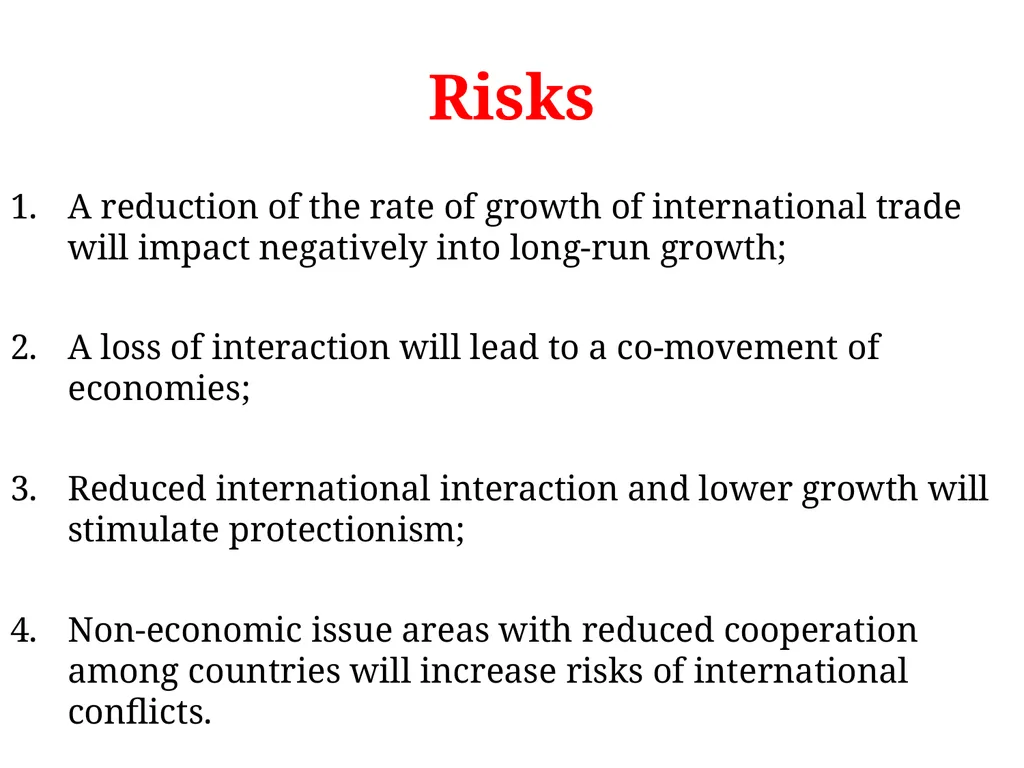
Risks A reduction of the rate of growth of international trade will impact negatively into long-run growth;
A loss of interaction will lead to a co-movement of economies;
Reduced international interaction and lower growth will stimulate protectionism;
Non-economic issue areas with reduced cooperation among countries will increase risks of international conflicts.<br>
A loss of interaction will lead to a co-movement of economies;
Reduced international interaction and lower growth will stimulate protectionism;
Non-economic issue areas with reduced cooperation among countries will increase risks of international conflicts.<br>
25
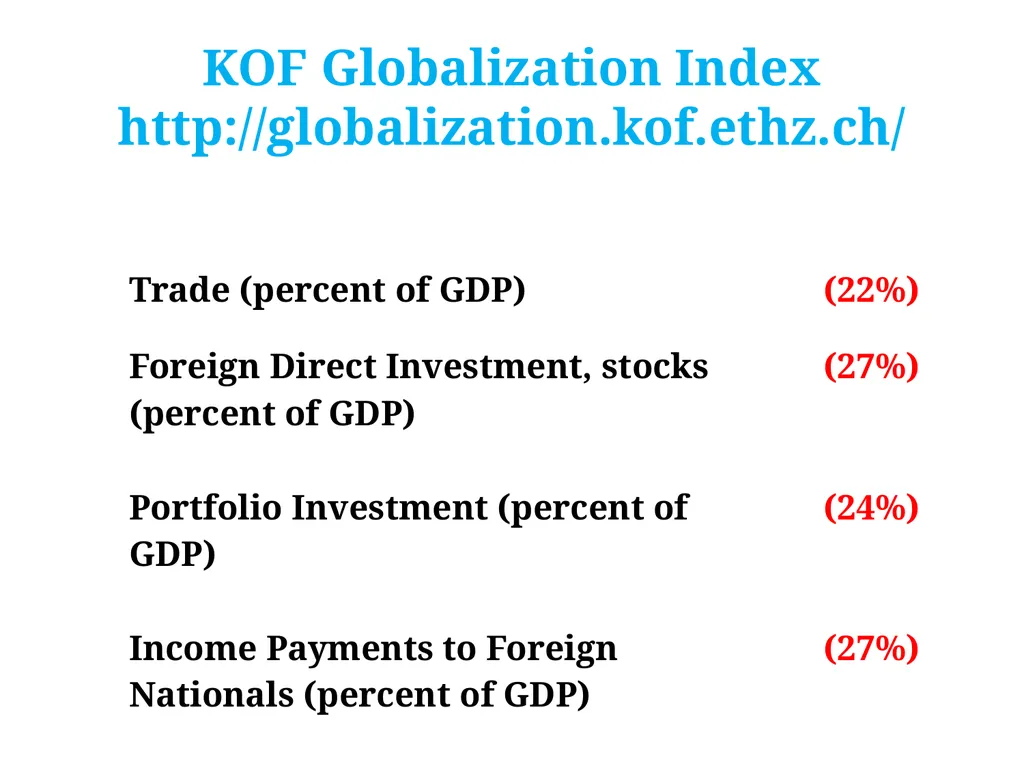
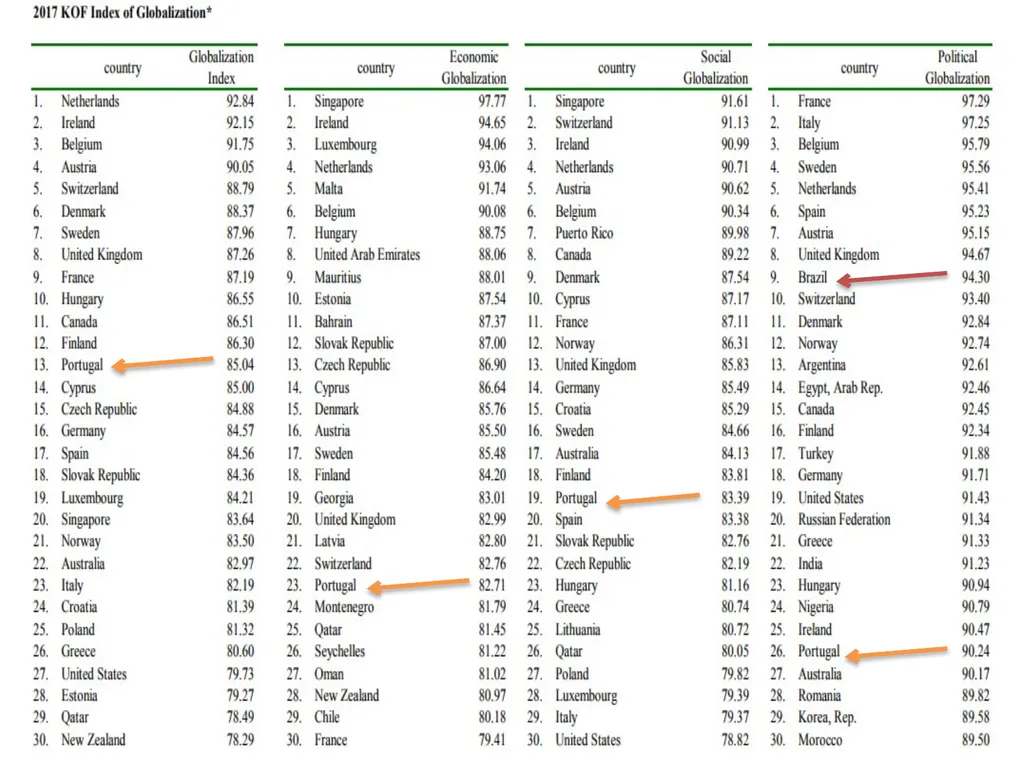
KOF Globalization Index
http://globalization.kof.ethz.ch/<br>
26
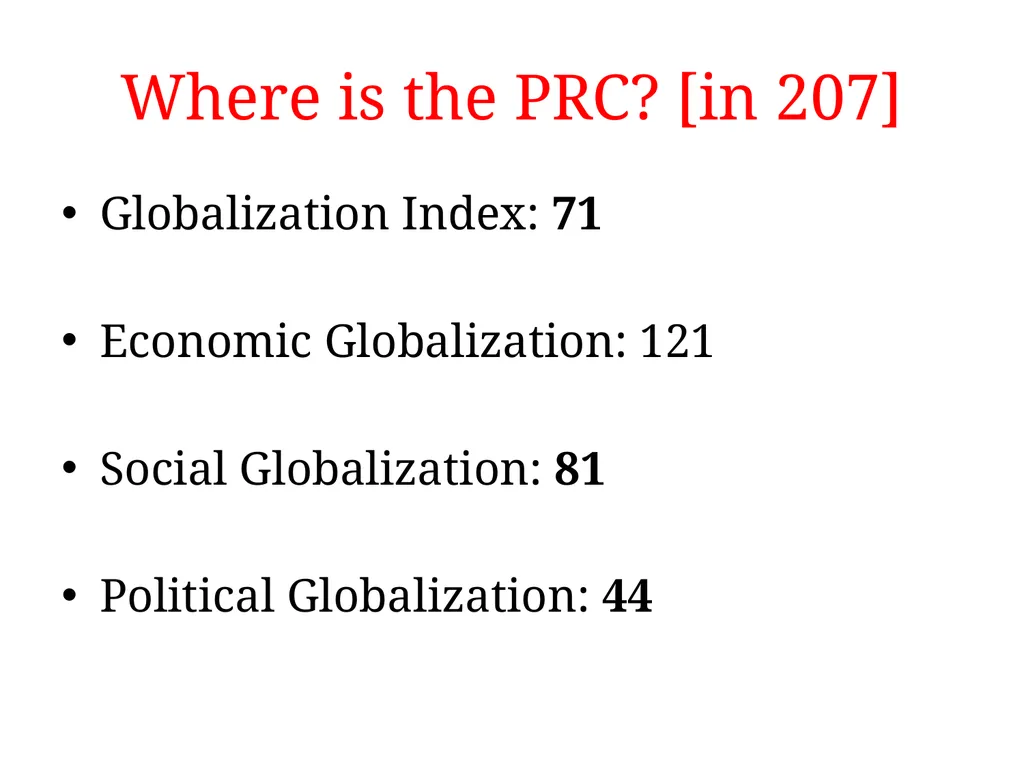
Where is the PRC? [in 207] Globalization Index: 71
Economic Globalization: 121
Social Globalization: 81
Political Globalization: 44<br>
Economic Globalization: 121
Social Globalization: 81
Political Globalization: 44<br>
27
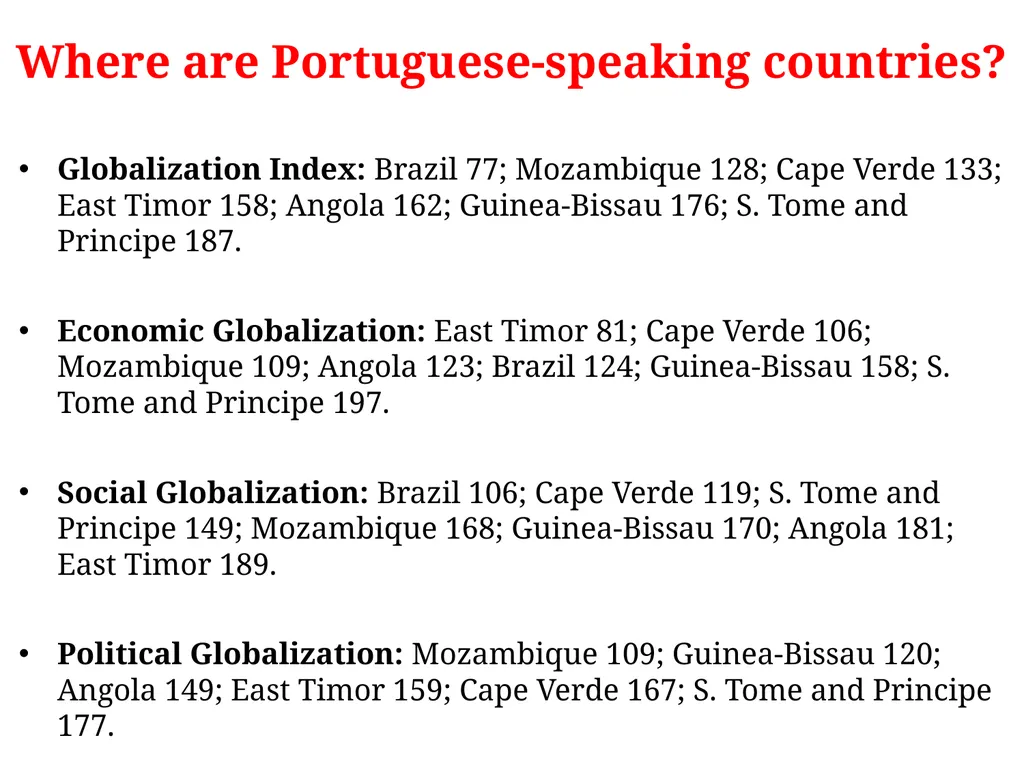
Where are Portuguese-speaking countries? Globalization Index: Brazil 77; Mozambique 128; Cape Verde 133; East Timor 158; Angola 162; Guinea-Bissau 176; S. Tome and Principe 187.
Economic Globalization: East Timor 81; Cape Verde 106; Mozambique 109; Angola 123; Brazil 124; Guinea-Bissau 158; S. Tome and Principe 197.
Social Globalization: Brazil 106; Cape Verde 119; S. Tome and Principe 149; Mozambique 168; Guinea-Bissau 170; Angola 181; East Timor 189.
Political Globalization: Mozambique 109; Guinea-Bissau 120; Angola 149; East Timor 159; Cape Verde 167; S. Tome and Principe 177.<br>
28
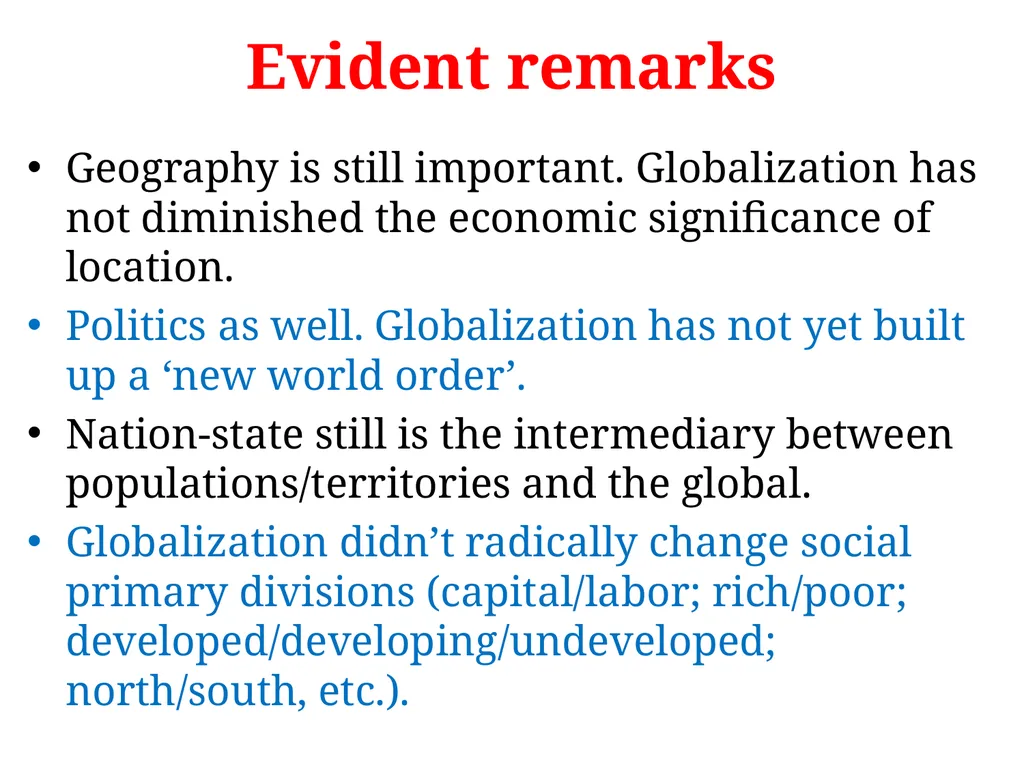
Evident remarks Geography is still important. Globalization has not diminished the economic significance of location.
Politics as well. Globalization has not yet built up a ‘new world order’.
Nation-state still is the intermediary between populations/territories and the global.
Globalization didn’t radically change social primary divisions (capital/labor; rich/poor; developed/developing/undeveloped; north/south, etc.).<br>
29
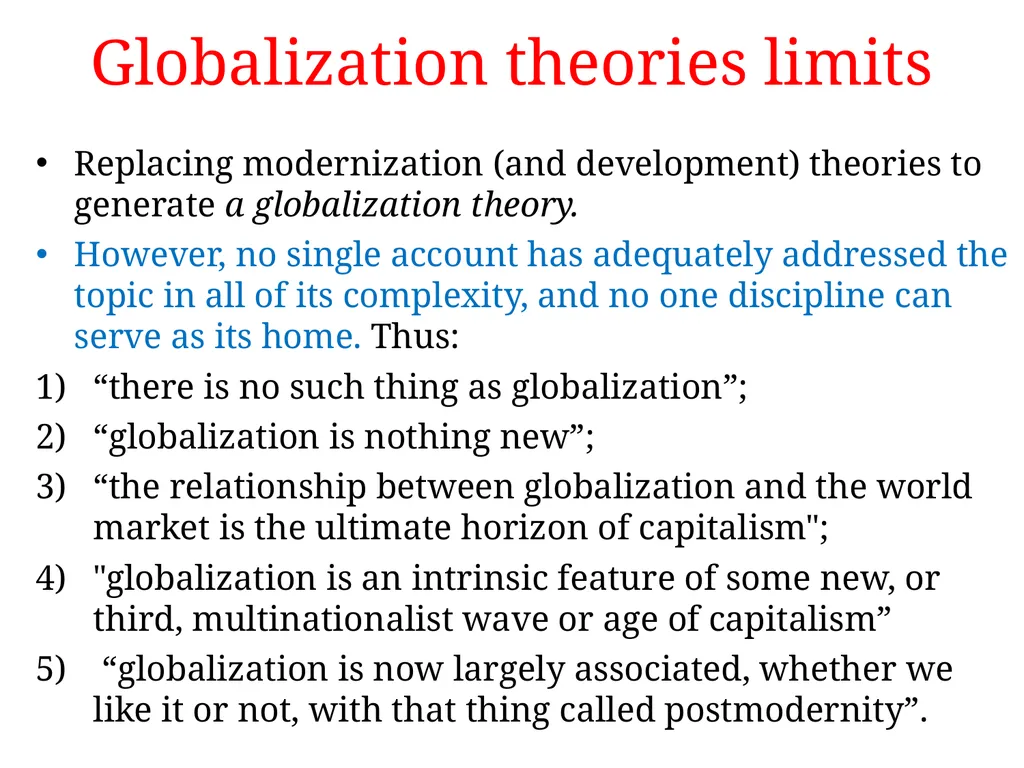
Globalization theories limits Replacing modernization (and development) theories to generate a globalization theory.
However, no single account has adequately addressed the topic in all of its complexity, and no one discipline can serve as its home. Thus:
“there is no such thing as globalization”;
“globalization is nothing new”;
“the relationship between globalization and the world market is the ultimate horizon of capitalism";
"globalization is an intrinsic feature of some new, or third, multinationalist wave or age of capitalism”
“globalization is now largely associated, whether we like it or not, with that thing called postmodernity”.<br>
30
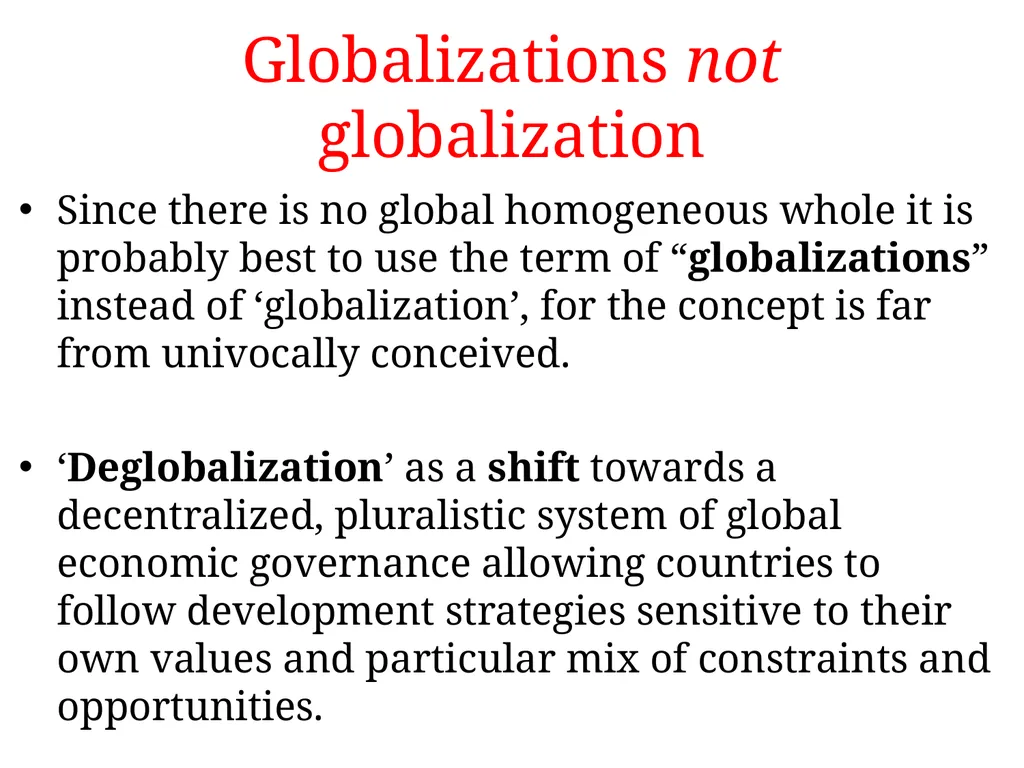
Globalizations not globalization Since there is no global homogeneous whole it is probably best to use the term of “globalizations” instead of ‘globalization’, for the concept is far from univocally conceived.
‘Deglobalization’ as a shift towards a decentralized, pluralistic system of global economic governance allowing countries to follow development strategies sensitive to their own values and particular mix of constraints and opportunities.<br>
‘Deglobalization’ as a shift towards a decentralized, pluralistic system of global economic governance allowing countries to follow development strategies sensitive to their own values and particular mix of constraints and opportunities.<br>
31
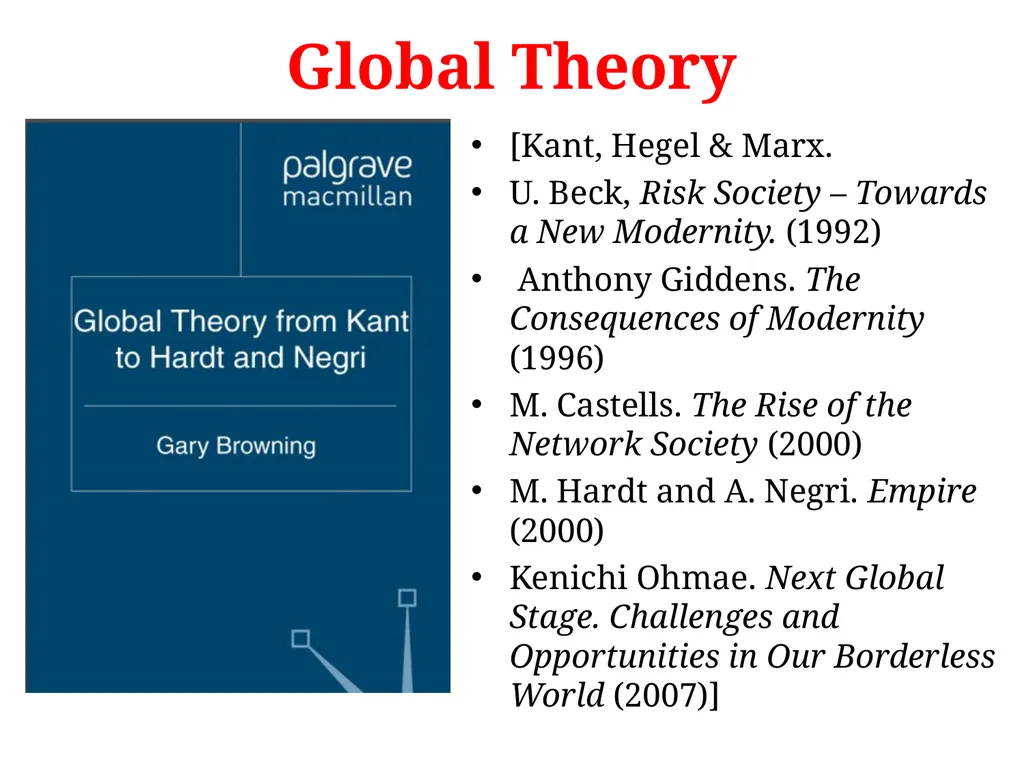
Global Theory [Kant, Hegel & Marx.
U. Beck, Risk Society – Towards a New Modernity. (1992)
Anthony Giddens. The Consequences of Modernity (1996)
M. Castells. The Rise of the Network Society (2000)
M. Hardt and A. Negri. Empire (2000)
Kenichi Ohmae. Next Global Stage. Challenges and Opportunities in Our Borderless World (2007)]<br>
U. Beck, Risk Society – Towards a New Modernity. (1992)
Anthony Giddens. The Consequences of Modernity (1996)
M. Castells. The Rise of the Network Society (2000)
M. Hardt and A. Negri. Empire (2000)
Kenichi Ohmae. Next Global Stage. Challenges and Opportunities in Our Borderless World (2007)]<br>
32
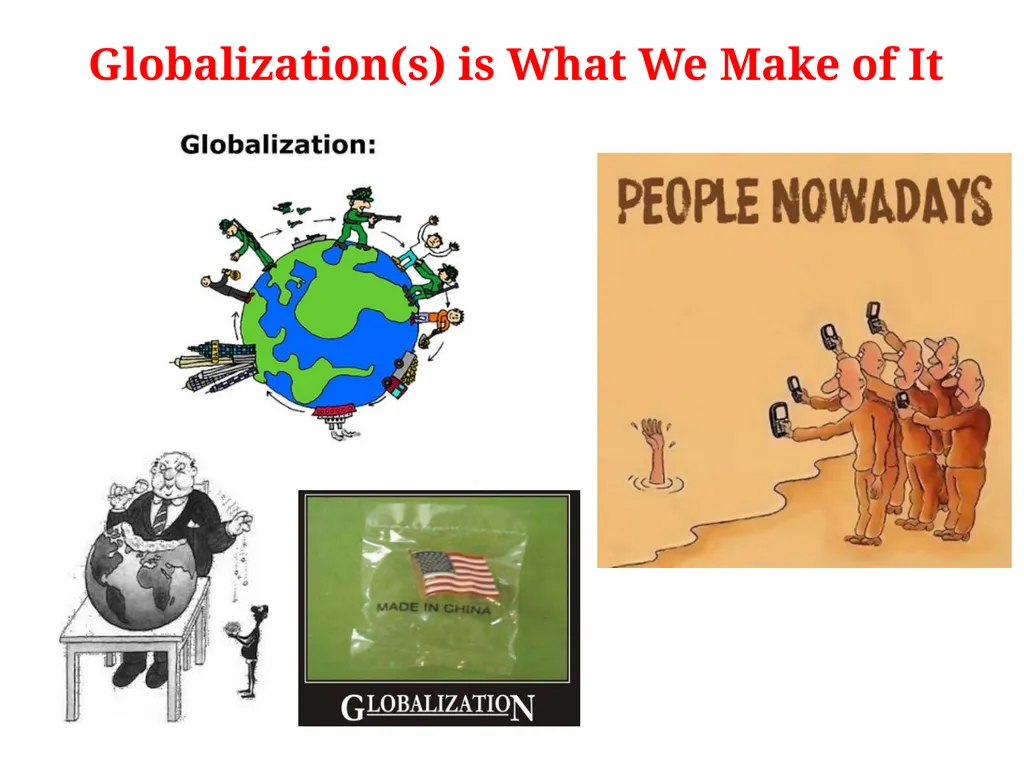
Globalization(s) is What We Make of It<br>