
WP12 - Business Models and Procurement Sergio

Description: WP12 - Business Models and Procurement Sergio Andreozzi, Strategy and Policy Manager (EGI Foundation), WP12 Leader Luxembourg, 8-9 October 2019 Dissemination level: Confidential Objectives: Analysis Demand-side market research to understand
Related Topics
Download Presentation
"WP12 - Business Models and Procurement Sergio" is the property of its rightful owner. Permission is granted to download and print the materials on this website for personal, non-commercial use only, and to display it on your personal computer provided you do not modify the materials and that you retain all copyright notices contained in the materials. By downloading content from our website, you accept the terms of this agreement.
Presentation Transcript
slide1. WP12 - Business Models and Procurement Sergio Andreozzi, Strategy and Policy Manager (EGI Foundation), WP12 Leader
Luxembourg, 8-9 October 2019 Dissemination level: Confidential<br>
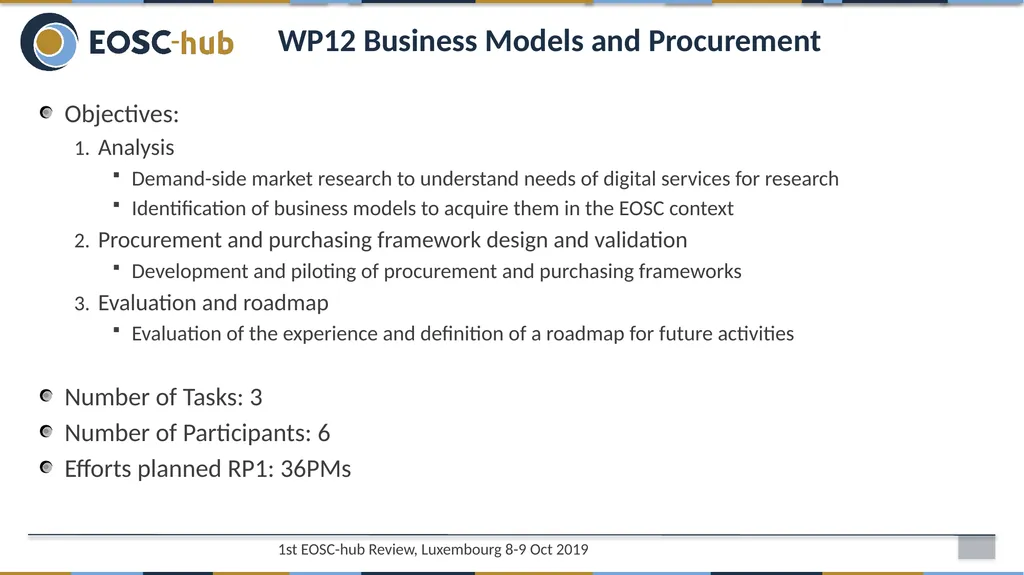
slide2. Objectives:
Analysis
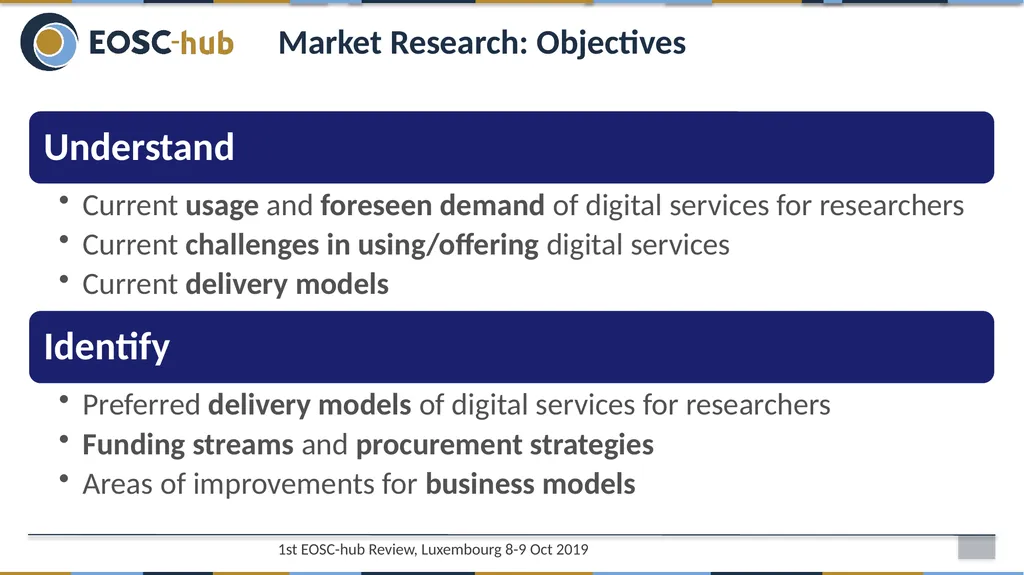
Demand-side market research to understand needs of digital services for research
Identification of business models to acquire them in the EOSC context
Procurement and purchasing framework design and validation
Development and piloting of procurement and purchasing frameworks
Evaluation and roadmap
Evaluation of the experience and definition of a roadmap for future activities
Number of Tasks: 3
Number of Participants: 6
Efforts planned RP1: 36PMs 1st EOSC-hub Review, Luxembourg 8-9 Oct 2019 WP12 Business Models and Procurement<br>
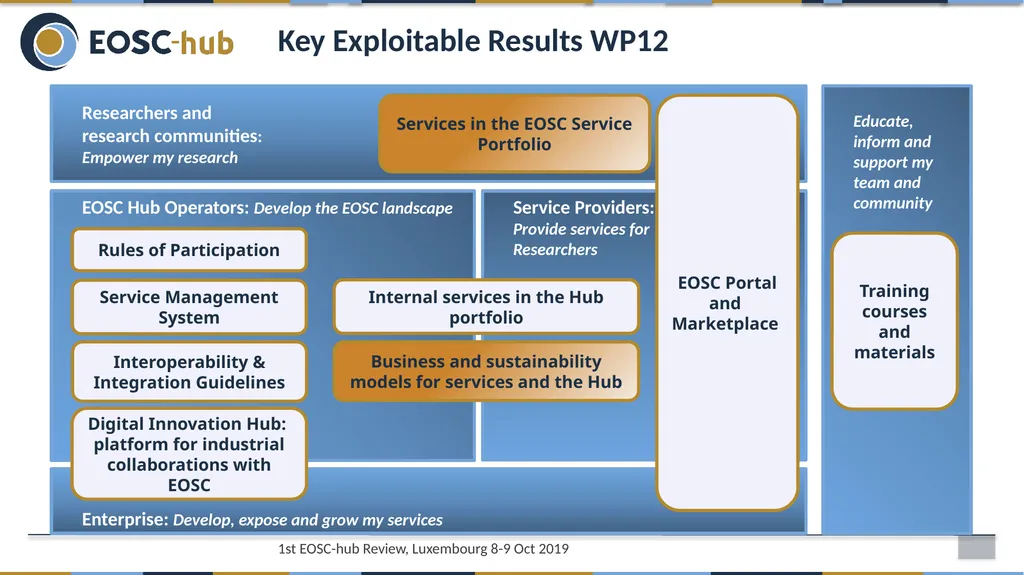
slide3. Service Providers:
Provide services for
Researchers Enterprise: Develop, expose and grow my services Researchers and
research communities:
Empower my research EOSC Hub Operators: Develop the EOSC landscape Educate, inform and support my team and community Training courses and materials EOSC Portal
and
Marketplace Services in the EOSC Service Portfolio Digital Innovation Hub:
platform for industrial collaborations with EOSC Rules of Participation Service Management System Interoperability & Integration Guidelines Internal services in the Hub portfolio Business and sustainability models for services and the Hub Key Exploitable Results WP12 1st EOSC-hub Review, Luxembourg 8-9 Oct 2019<br>
slide4. Market research
Business model analysis
Collaborations
Use of resources
Plans for the second period & deviations 1st EOSC-hub Review, Luxembourg 8-9 Oct 2019<br>
slide5. Market Research: Objectives 1st EOSC-hub Review, Luxembourg 8-9 Oct 2019<br>
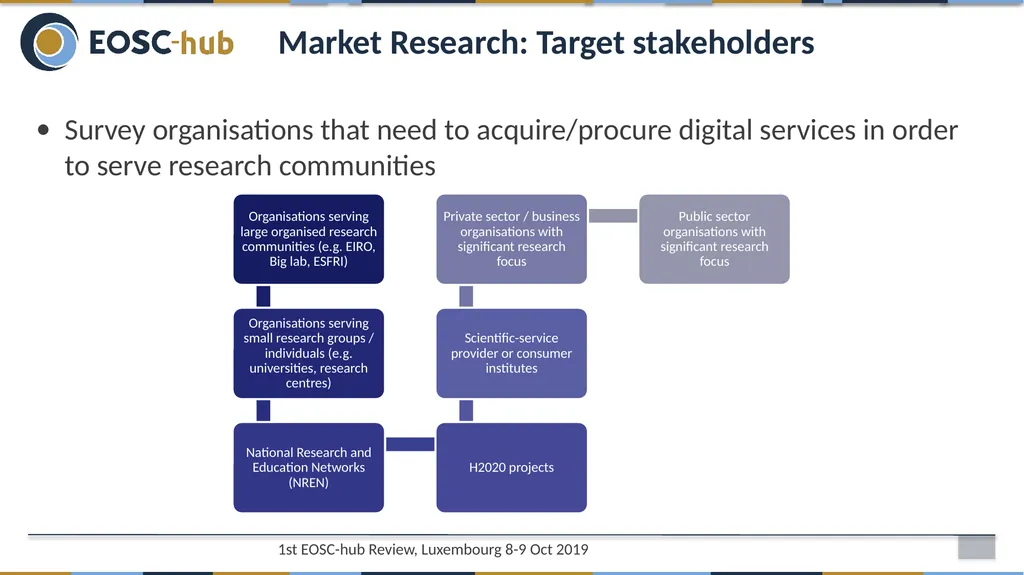
slide6. Survey organisations that need to acquire/procure digital services in order to serve research communities Market Research: Target stakeholders 1st EOSC-hub Review, Luxembourg 8-9 Oct 2019<br>
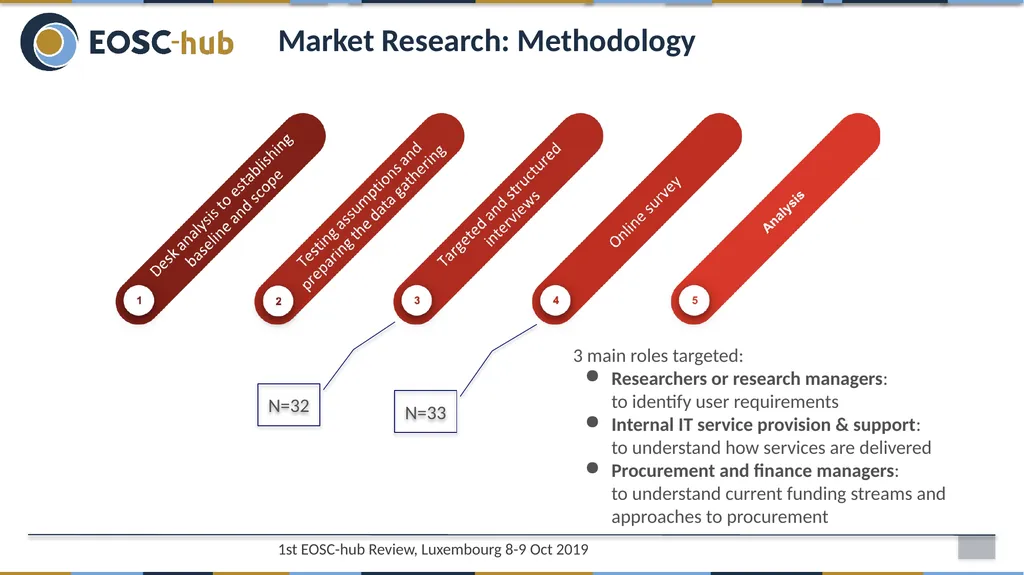
slide7. 1st EOSC-hub Review, Luxembourg 8-9 Oct 2019 Market Research: Methodology 3 main roles targeted:
Researchers or research managers: to identify user requirements
Internal IT service provision & support: to understand how services are delivered
Procurement and finance managers: to understand current funding streams and approaches to procurement N=32 N=33<br>
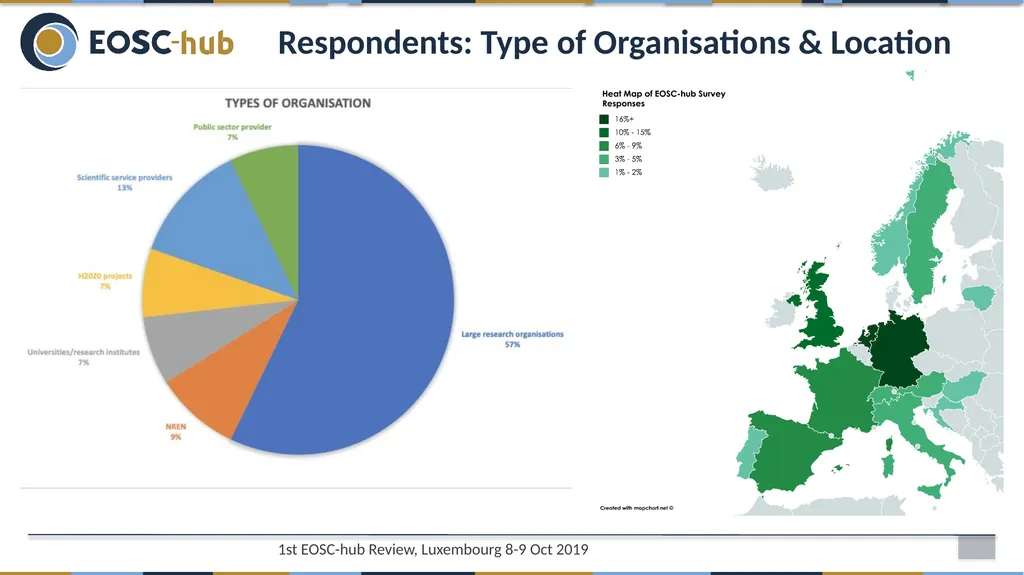
slide8. Respondents: Type of Organisations & Location 1st EOSC-hub Review, Luxembourg 8-9 Oct 2019<br>
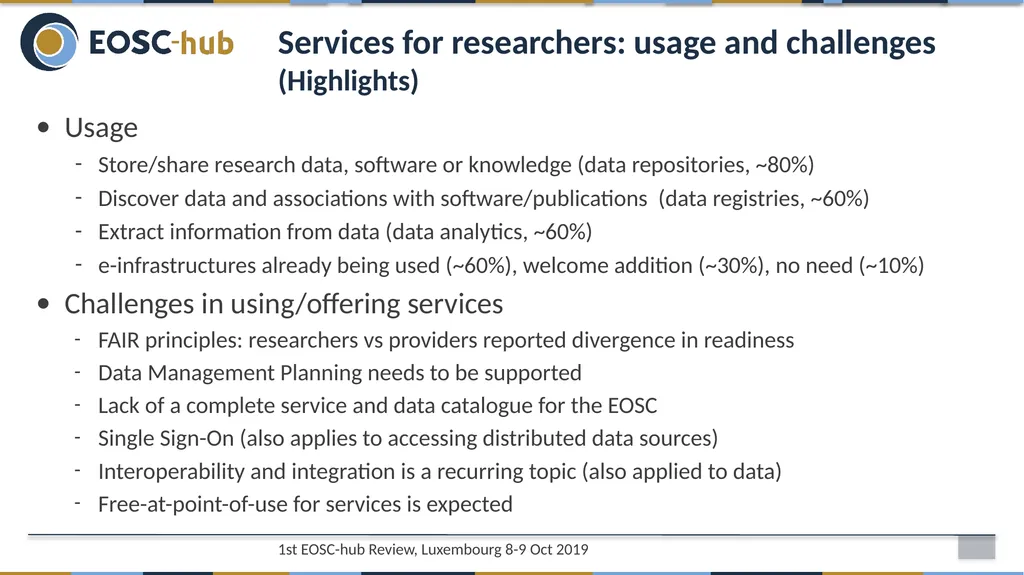
slide9. Usage
Store/share research data, software or knowledge (data repositories, ~80%)
Discover data and associations with software/publications (data registries, ~60%)
Extract information from data (data analytics, ~60%)
e-infrastructures already being used (~60%), welcome addition (~30%), no need (~10%)
Challenges in using/offering services
FAIR principles: researchers vs providers reported divergence in readiness
Data Management Planning needs to be supported
Lack of a complete service and data catalogue for the EOSC
Single Sign-On (also applies to accessing distributed data sources)
Interoperability and integration is a recurring topic (also applied to data)
Free-at-point-of-use for services is expected Services for researchers: usage and challenges (Highlights) 1st EOSC-hub Review, Luxembourg 8-9 Oct 2019<br>
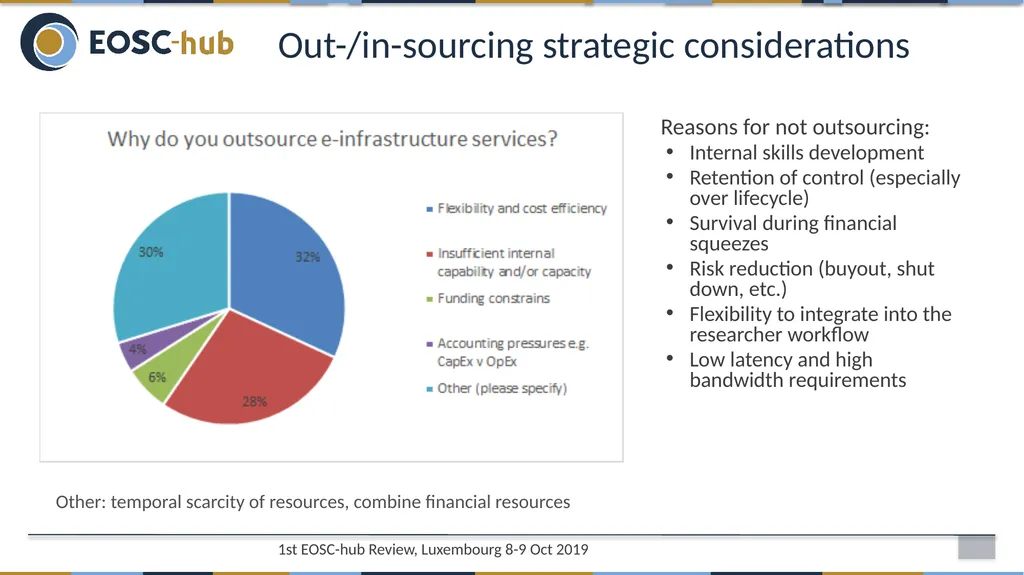
slide10. Reasons for not outsourcing:
Internal skills development
Retention of control (especially over lifecycle)
Survival during financial squeezes
Risk reduction (buyout, shut down, etc.)
Flexibility to integrate into the researcher workflow
Low latency and high bandwidth requirements Out-/in-sourcing strategic considerations Other: temporal scarcity of resources, combine financial resources 1st EOSC-hub Review, Luxembourg 8-9 Oct 2019<br>
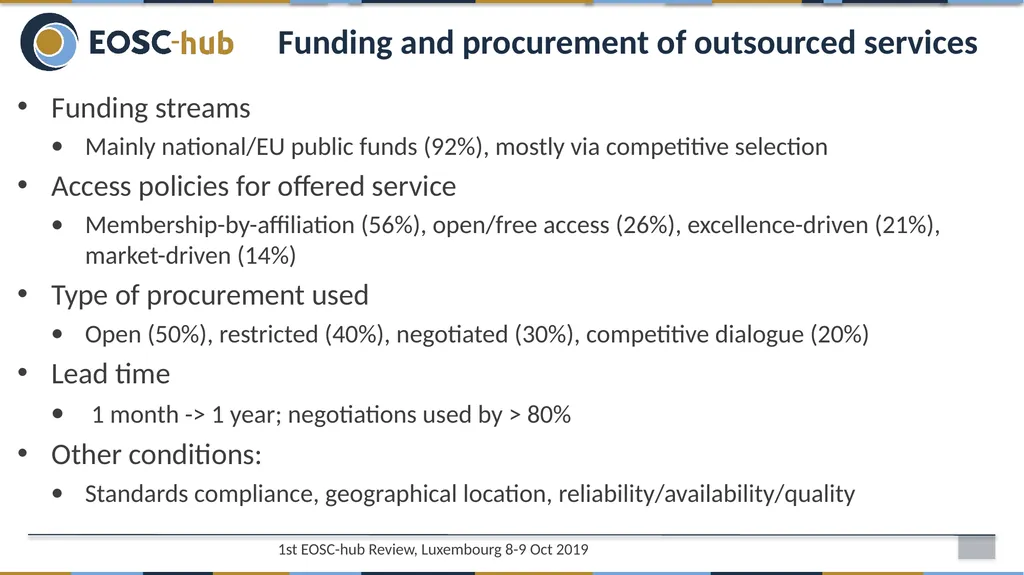
slide11. Funding streams
Mainly national/EU public funds (92%), mostly via competitive selection
Access policies for offered service
Membership-by-affiliation (56%), open/free access (26%), excellence-driven (21%), market-driven (14%)
Type of procurement used
Open (50%), restricted (40%), negotiated (30%), competitive dialogue (20%)
Lead time
1 month -> 1 year; negotiations used by > 80%
Other conditions:
Standards compliance, geographical location, reliability/availability/quality Funding and procurement of outsourced services 1st EOSC-hub Review, Luxembourg 8-9 Oct 2019<br>
slide12. Market research
Business model analysis
Collaborations
Use of resources
Plans for the second period & deviations 1st EOSC-hub Review, Luxembourg 8-9 Oct 2019<br>
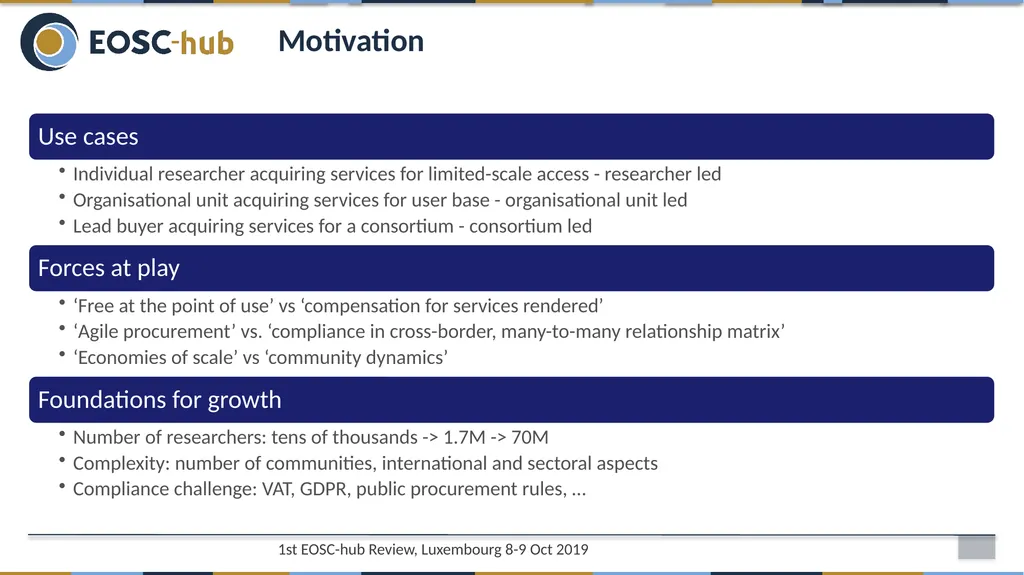
slide13. Motivation 1st EOSC-hub Review, Luxembourg 8-9 Oct 2019<br>
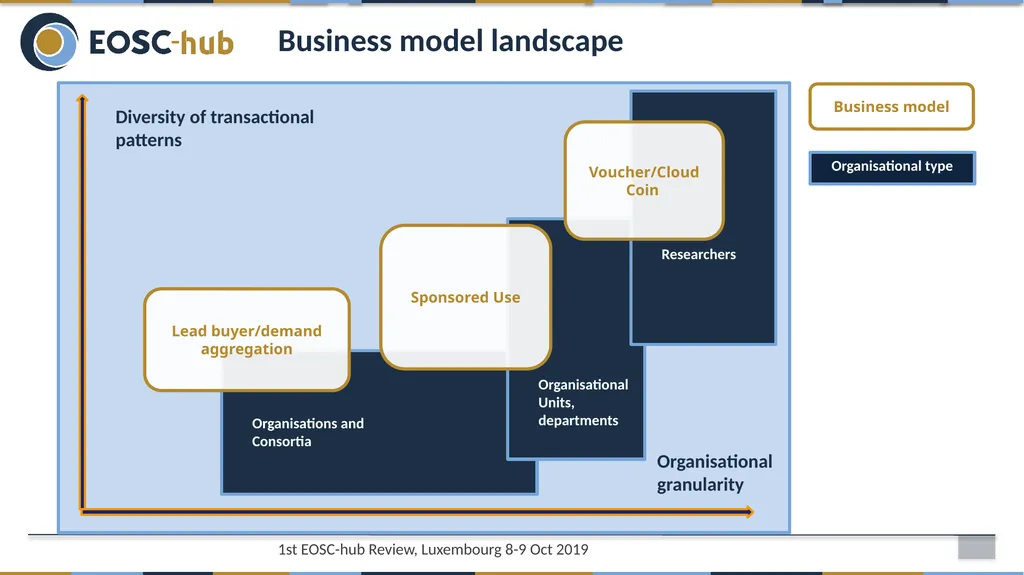
slide14. Business model landscape Organisations and
Consortia Organisational Units, departments Researchers Sponsored Use Lead buyer/demand aggregation Business model Organisational type Diversity of transactional
patterns Organisational
granularity Voucher/Cloud Coin 1st EOSC-hub Review, Luxembourg 8-9 Oct 2019<br>
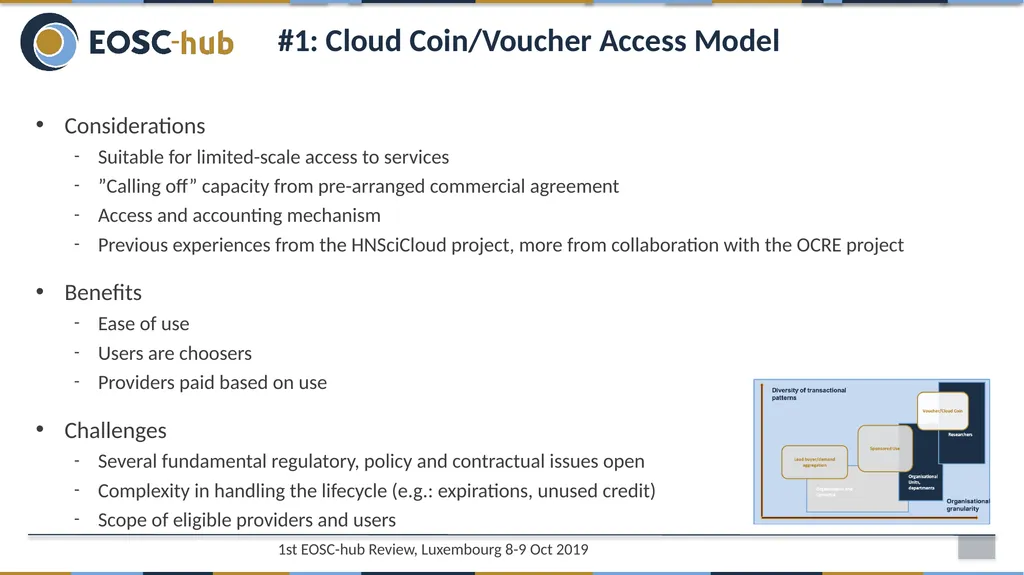
slide15. Considerations
Suitable for limited-scale access to services
”Calling off” capacity from pre-arranged commercial agreement
Access and accounting mechanism
Previous experiences from the HNSciCloud project, more from collaboration with the OCRE project
Benefits
Ease of use
Users are choosers
Providers paid based on use
Challenges
Several fundamental regulatory, policy and contractual issues open
Complexity in handling the lifecycle (e.g.: expirations, unused credit)
Scope of eligible providers and users #1: Cloud Coin/Voucher Access Model 1st EOSC-hub Review, Luxembourg 8-9 Oct 2019<br>
slide16. Considerations
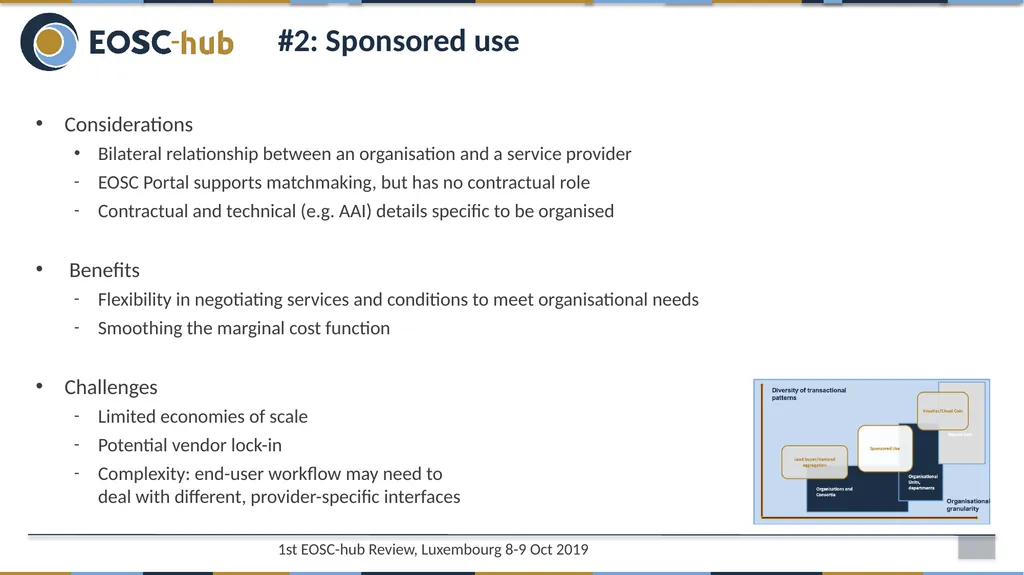
Bilateral relationship between an organisation and a service provider
EOSC Portal supports matchmaking, but has no contractual role
Contractual and technical (e.g. AAI) details specific to be organised
Benefits
Flexibility in negotiating services and conditions to meet organisational needs
Smoothing the marginal cost function
Challenges
Limited economies of scale
Potential vendor lock-in
Complexity: end-user workflow may need to deal with different, provider-specific interfaces #2: Sponsored use 1st EOSC-hub Review, Luxembourg 8-9 Oct 2019<br>
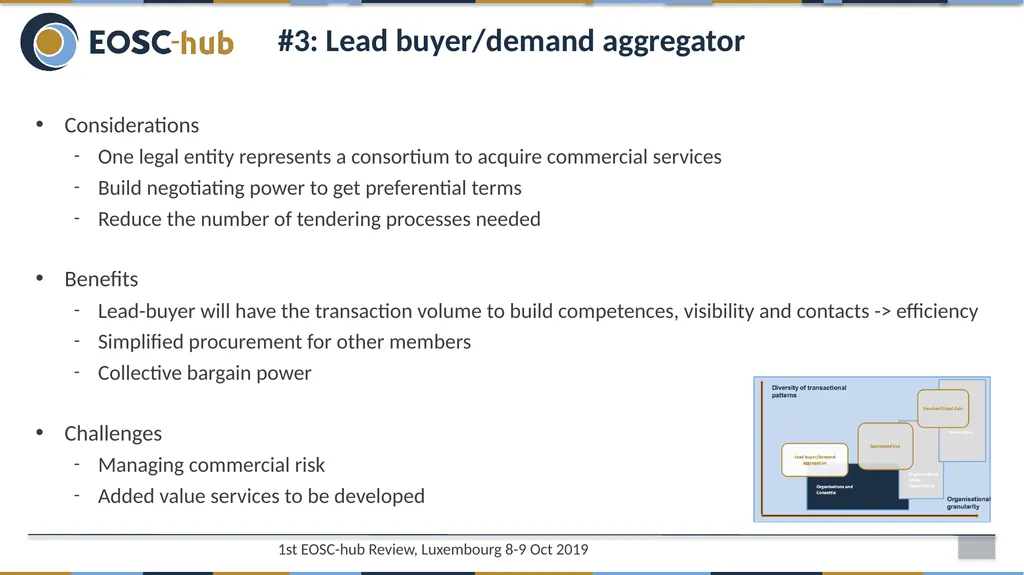
slide17. #3: Lead buyer/demand aggregator Considerations
One legal entity represents a consortium to acquire commercial services
Build negotiating power to get preferential terms
Reduce the number of tendering processes needed
Benefits
Lead-buyer will have the transaction volume to build competences, visibility and contacts -> efficiency
Simplified procurement for other members
Collective bargain power
Challenges
Managing commercial risk
Added value services to be developed 1st EOSC-hub Review, Luxembourg 8-9 Oct 2019<br>
slide18. Market research
Business model analysis
Collaborations
Use of resources
Plans for the second period & deviations 1st EOSC-hub Review, Luxembourg 8-9 Oct 2019<br>
slide19. The evolving EOSC landscape 1st EOSC-hub Review, Luxembourg 8-9 Oct 2019<br>
slide20. Disseminated EOSC-hub D12.1 deliverable
Part of the content referenced in the EOSC Sustainability Strawman document
”Minimum Viable Product” based on EOSC-hub analysis
Feedback on EOSC Sustainability Strawman document
WP12 drafted a feedback that was validated by the EOSC-hub PMB
Key messages:
‘Public good’ vs. ‘commons’
Federating core and shared resources
Digital marketplaces approach vs. cross-pollination and cross-provider integration
Co-existence of publicly-funded services providers vs. commercial service providers
Governance model and inclusiveness Contributions to the EOSC sustainability WG 1st EOSC-hub Review, Luxembourg 8-9 Oct 2019<br>
slide21. Agreed and signed collaboration MoU
Aggregate requirements and demand of the research community into a public procurement / tender to establish ready-to-use agreements with capable cloud and earth observation suppliers
Support individual institutions and buyer groups to buy cloud resources via dedicated budget
Provided feedback to tender requirements
Agreed and signed voucher distributions MoU Collaboration with the OCRE project 1st EOSC-hub Review, Luxembourg 8-9 Oct 2019<br>
slide22. Market research
Business model analysis
Collaborations
Use of resources
Plans for the second period & deviations 1st EOSC-hub Review, Luxembourg 8-9 Oct 2019<br>
slide23. WP12: M1-M18 Efforts Planned & Used 1st EOSC-hub Review, Luxembourg 8-9 Oct 2019<br>
slide24. Market research
Business model analysis
Collaborations
Use of resources
Plans for the second period & deviations 1st EOSC-hub Review, Luxembourg 8-9 Oct 2019<br>
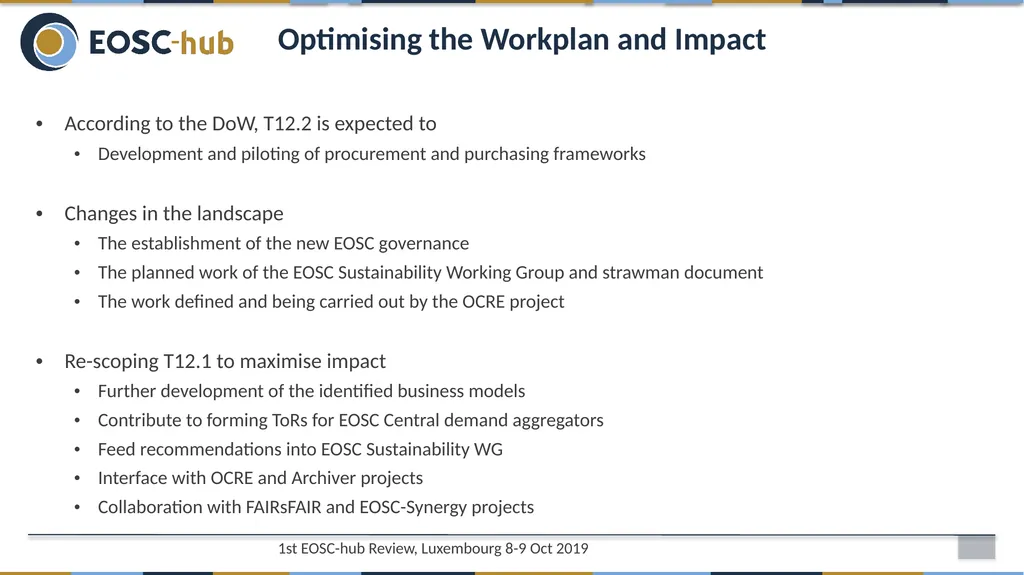
slide25. According to the DoW, T12.2 is expected to
Development and piloting of procurement and purchasing frameworks
Changes in the landscape
The establishment of the new EOSC governance
The planned work of the EOSC Sustainability Working Group and strawman document
The work defined and being carried out by the OCRE project
Re-scoping T12.1 to maximise impact
Further development of the identified business models
Contribute to forming ToRs for EOSC Central demand aggregators
Feed recommendations into EOSC Sustainability WG
Interface with OCRE and Archiver projects
Collaboration with FAIRsFAIR and EOSC-Synergy projects Optimising the Workplan and Impact 1st EOSC-hub Review, Luxembourg 8-9 Oct 2019<br>
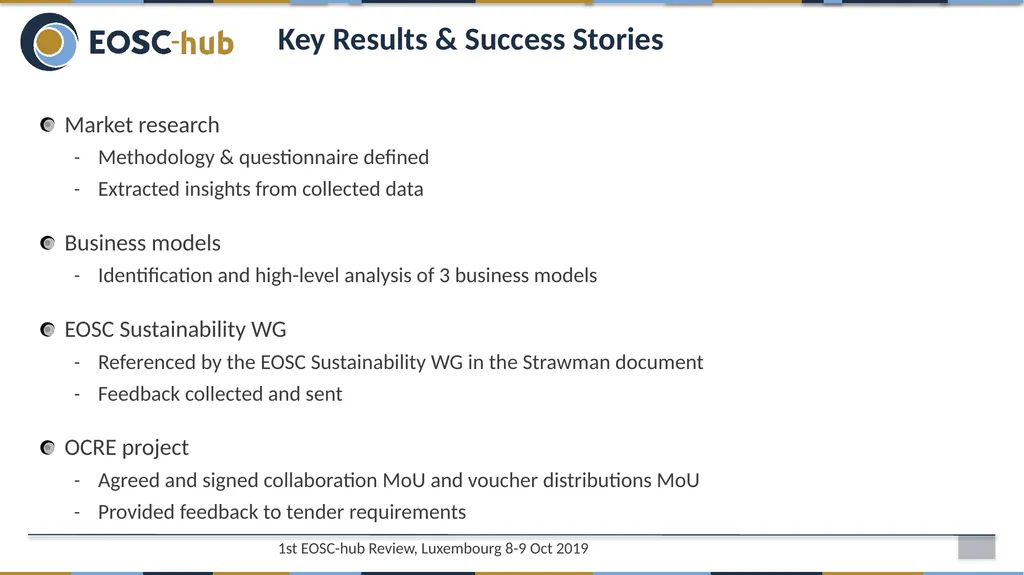
slide26. Market research
Methodology & questionnaire defined
Extracted insights from collected data
Business models
Identification and high-level analysis of 3 business models
EOSC Sustainability WG
Referenced by the EOSC Sustainability WG in the Strawman document
Feedback collected and sent
OCRE project
Agreed and signed collaboration MoU and voucher distributions MoU
Provided feedback to tender requirements Key Results & Success Stories 1st EOSC-hub Review, Luxembourg 8-9 Oct 2019<br>
Luxembourg, 8-9 October 2019 Dissemination level: Confidential<br>
slide2. Objectives:
Analysis
Demand-side market research to understand needs of digital services for research
Identification of business models to acquire them in the EOSC context
Procurement and purchasing framework design and validation
Development and piloting of procurement and purchasing frameworks
Evaluation and roadmap
Evaluation of the experience and definition of a roadmap for future activities
Number of Tasks: 3
Number of Participants: 6
Efforts planned RP1: 36PMs 1st EOSC-hub Review, Luxembourg 8-9 Oct 2019 WP12 Business Models and Procurement<br>
slide3. Service Providers:
Provide services for
Researchers Enterprise: Develop, expose and grow my services Researchers and
research communities:
Empower my research EOSC Hub Operators: Develop the EOSC landscape Educate, inform and support my team and community Training courses and materials EOSC Portal
and
Marketplace Services in the EOSC Service Portfolio Digital Innovation Hub:
platform for industrial collaborations with EOSC Rules of Participation Service Management System Interoperability & Integration Guidelines Internal services in the Hub portfolio Business and sustainability models for services and the Hub Key Exploitable Results WP12 1st EOSC-hub Review, Luxembourg 8-9 Oct 2019<br>
slide4. Market research
Business model analysis
Collaborations
Use of resources
Plans for the second period & deviations 1st EOSC-hub Review, Luxembourg 8-9 Oct 2019<br>
slide5. Market Research: Objectives 1st EOSC-hub Review, Luxembourg 8-9 Oct 2019<br>
slide6. Survey organisations that need to acquire/procure digital services in order to serve research communities Market Research: Target stakeholders 1st EOSC-hub Review, Luxembourg 8-9 Oct 2019<br>
slide7. 1st EOSC-hub Review, Luxembourg 8-9 Oct 2019 Market Research: Methodology 3 main roles targeted:
Researchers or research managers: to identify user requirements
Internal IT service provision & support: to understand how services are delivered
Procurement and finance managers: to understand current funding streams and approaches to procurement N=32 N=33<br>
slide8. Respondents: Type of Organisations & Location 1st EOSC-hub Review, Luxembourg 8-9 Oct 2019<br>
slide9. Usage
Store/share research data, software or knowledge (data repositories, ~80%)
Discover data and associations with software/publications (data registries, ~60%)
Extract information from data (data analytics, ~60%)
e-infrastructures already being used (~60%), welcome addition (~30%), no need (~10%)
Challenges in using/offering services
FAIR principles: researchers vs providers reported divergence in readiness
Data Management Planning needs to be supported
Lack of a complete service and data catalogue for the EOSC
Single Sign-On (also applies to accessing distributed data sources)
Interoperability and integration is a recurring topic (also applied to data)
Free-at-point-of-use for services is expected Services for researchers: usage and challenges (Highlights) 1st EOSC-hub Review, Luxembourg 8-9 Oct 2019<br>
slide10. Reasons for not outsourcing:
Internal skills development
Retention of control (especially over lifecycle)
Survival during financial squeezes
Risk reduction (buyout, shut down, etc.)
Flexibility to integrate into the researcher workflow
Low latency and high bandwidth requirements Out-/in-sourcing strategic considerations Other: temporal scarcity of resources, combine financial resources 1st EOSC-hub Review, Luxembourg 8-9 Oct 2019<br>
slide11. Funding streams
Mainly national/EU public funds (92%), mostly via competitive selection
Access policies for offered service
Membership-by-affiliation (56%), open/free access (26%), excellence-driven (21%), market-driven (14%)
Type of procurement used
Open (50%), restricted (40%), negotiated (30%), competitive dialogue (20%)
Lead time
1 month -> 1 year; negotiations used by > 80%
Other conditions:
Standards compliance, geographical location, reliability/availability/quality Funding and procurement of outsourced services 1st EOSC-hub Review, Luxembourg 8-9 Oct 2019<br>
slide12. Market research
Business model analysis
Collaborations
Use of resources
Plans for the second period & deviations 1st EOSC-hub Review, Luxembourg 8-9 Oct 2019<br>
slide13. Motivation 1st EOSC-hub Review, Luxembourg 8-9 Oct 2019<br>
slide14. Business model landscape Organisations and
Consortia Organisational Units, departments Researchers Sponsored Use Lead buyer/demand aggregation Business model Organisational type Diversity of transactional
patterns Organisational
granularity Voucher/Cloud Coin 1st EOSC-hub Review, Luxembourg 8-9 Oct 2019<br>
slide15. Considerations
Suitable for limited-scale access to services
”Calling off” capacity from pre-arranged commercial agreement
Access and accounting mechanism
Previous experiences from the HNSciCloud project, more from collaboration with the OCRE project
Benefits
Ease of use
Users are choosers
Providers paid based on use
Challenges
Several fundamental regulatory, policy and contractual issues open
Complexity in handling the lifecycle (e.g.: expirations, unused credit)
Scope of eligible providers and users #1: Cloud Coin/Voucher Access Model 1st EOSC-hub Review, Luxembourg 8-9 Oct 2019<br>
slide16. Considerations
Bilateral relationship between an organisation and a service provider
EOSC Portal supports matchmaking, but has no contractual role
Contractual and technical (e.g. AAI) details specific to be organised
Benefits
Flexibility in negotiating services and conditions to meet organisational needs
Smoothing the marginal cost function
Challenges
Limited economies of scale
Potential vendor lock-in
Complexity: end-user workflow may need to deal with different, provider-specific interfaces #2: Sponsored use 1st EOSC-hub Review, Luxembourg 8-9 Oct 2019<br>
slide17. #3: Lead buyer/demand aggregator Considerations
One legal entity represents a consortium to acquire commercial services
Build negotiating power to get preferential terms
Reduce the number of tendering processes needed
Benefits
Lead-buyer will have the transaction volume to build competences, visibility and contacts -> efficiency
Simplified procurement for other members
Collective bargain power
Challenges
Managing commercial risk
Added value services to be developed 1st EOSC-hub Review, Luxembourg 8-9 Oct 2019<br>
slide18. Market research
Business model analysis
Collaborations
Use of resources
Plans for the second period & deviations 1st EOSC-hub Review, Luxembourg 8-9 Oct 2019<br>
slide19. The evolving EOSC landscape 1st EOSC-hub Review, Luxembourg 8-9 Oct 2019<br>
slide20. Disseminated EOSC-hub D12.1 deliverable
Part of the content referenced in the EOSC Sustainability Strawman document
”Minimum Viable Product” based on EOSC-hub analysis
Feedback on EOSC Sustainability Strawman document
WP12 drafted a feedback that was validated by the EOSC-hub PMB
Key messages:
‘Public good’ vs. ‘commons’
Federating core and shared resources
Digital marketplaces approach vs. cross-pollination and cross-provider integration
Co-existence of publicly-funded services providers vs. commercial service providers
Governance model and inclusiveness Contributions to the EOSC sustainability WG 1st EOSC-hub Review, Luxembourg 8-9 Oct 2019<br>
slide21. Agreed and signed collaboration MoU
Aggregate requirements and demand of the research community into a public procurement / tender to establish ready-to-use agreements with capable cloud and earth observation suppliers
Support individual institutions and buyer groups to buy cloud resources via dedicated budget
Provided feedback to tender requirements
Agreed and signed voucher distributions MoU Collaboration with the OCRE project 1st EOSC-hub Review, Luxembourg 8-9 Oct 2019<br>
slide22. Market research
Business model analysis
Collaborations
Use of resources
Plans for the second period & deviations 1st EOSC-hub Review, Luxembourg 8-9 Oct 2019<br>
slide23. WP12: M1-M18 Efforts Planned & Used 1st EOSC-hub Review, Luxembourg 8-9 Oct 2019<br>
slide24. Market research
Business model analysis
Collaborations
Use of resources
Plans for the second period & deviations 1st EOSC-hub Review, Luxembourg 8-9 Oct 2019<br>
slide25. According to the DoW, T12.2 is expected to
Development and piloting of procurement and purchasing frameworks
Changes in the landscape
The establishment of the new EOSC governance
The planned work of the EOSC Sustainability Working Group and strawman document
The work defined and being carried out by the OCRE project
Re-scoping T12.1 to maximise impact
Further development of the identified business models
Contribute to forming ToRs for EOSC Central demand aggregators
Feed recommendations into EOSC Sustainability WG
Interface with OCRE and Archiver projects
Collaboration with FAIRsFAIR and EOSC-Synergy projects Optimising the Workplan and Impact 1st EOSC-hub Review, Luxembourg 8-9 Oct 2019<br>
slide26. Market research
Methodology & questionnaire defined
Extracted insights from collected data
Business models
Identification and high-level analysis of 3 business models
EOSC Sustainability WG
Referenced by the EOSC Sustainability WG in the Strawman document
Feedback collected and sent
OCRE project
Agreed and signed collaboration MoU and voucher distributions MoU
Provided feedback to tender requirements Key Results & Success Stories 1st EOSC-hub Review, Luxembourg 8-9 Oct 2019<br>