
WRIT CONSTITUTION Is it a law/Statute? It is a
OM
Published · 36 slides · 0 views

1 / 1



Description
WRIT CONSTITUTION Is it a lawStatute? It is a document having special legal sanctity which sets out the framework and principles of functioning of Government. It defines the powersroles and responsibilities of different organs of
Related Topics
Share
Embed code
Download this presentation From Below
"WRIT CONSTITUTION Is it a law/Statute? It is a" is the property of its rightful owner. Permission is granted to download and print the materials on this website for personal, non-commercial use only, and to display it on your personal computer provided you do not modify the materials and that you retain all copyright notices contained in the materials. By downloading content from our website, you accept the terms of this agreement.
Presentation Transcript
01
WRIT<br>
02
CONSTITUTION
Is it a law/Statute?
It is a document having special legal sanctity which sets out the framework and principles of functioning of Government.
It defines the powers/roles and responsibilities of different organs of Government and also establishes relationship
with each organ and people. Executive, Judiciary and Legislature (Lawmaking).
It is a Fundamental law of a country which reflects peoples faith and aspirations.<br>
Is it a law/Statute?
It is a document having special legal sanctity which sets out the framework and principles of functioning of Government.
It defines the powers/roles and responsibilities of different organs of Government and also establishes relationship
with each organ and people. Executive, Judiciary and Legislature (Lawmaking).
It is a Fundamental law of a country which reflects peoples faith and aspirations.<br>
03
INTRODUCTION Writs are a written order from Supreme court or High court that commands the constitutional remedies for Indian citizens against the violation of their fundamental rights.
Art.32 in the Indian constitution deals with constitutional remedies that an Indian citizen can seek from the Supreme court against the violation of his/her fundamental rights. It also gives the Supreme court power to issue writs for the enforcement of the rights. Art 139 is also important.
Art.226 in the Indian constitution gives High court power to issue writs for fundamental and other legal rights.
Writs protect the individual rights and ensures the rule of law, it acts as a tool for the judicial review and provides direct access to higher courts for redressal of grievances.<br>
Art.32 in the Indian constitution deals with constitutional remedies that an Indian citizen can seek from the Supreme court against the violation of his/her fundamental rights. It also gives the Supreme court power to issue writs for the enforcement of the rights. Art 139 is also important.
Art.226 in the Indian constitution gives High court power to issue writs for fundamental and other legal rights.
Writs protect the individual rights and ensures the rule of law, it acts as a tool for the judicial review and provides direct access to higher courts for redressal of grievances.<br>
04
BACKGROUND Writs were originally developed in England as royal commands issued by the king’s court.
It provided remedies for grievances and were key to the evolution of English administrative law.
The concept of writs was introduced in India during British rule.
The Regulating Act of 1773 established the Supreme court in Calcutta, which was empowered to issue writs within its territorial jurisdiction. The writ jurisdiction of other Presidency towns (Madras and Bombay) was also recognized.
Writs acts as a safeguard against violations of rights guaranteed under part III of the Constitution, it ensures accountability of administrative and quasi-judicial actions.
The case of Bandhua Mukti Morcha V. UOI expanded the use of writs for social justice and public interest litigation.
The case of Kesavananda Bharati V. State of Kerala reaffirmed writs as essential tools for safeguarding the basic structure of the constitution.<br>
It provided remedies for grievances and were key to the evolution of English administrative law.
The concept of writs was introduced in India during British rule.
The Regulating Act of 1773 established the Supreme court in Calcutta, which was empowered to issue writs within its territorial jurisdiction. The writ jurisdiction of other Presidency towns (Madras and Bombay) was also recognized.
Writs acts as a safeguard against violations of rights guaranteed under part III of the Constitution, it ensures accountability of administrative and quasi-judicial actions.
The case of Bandhua Mukti Morcha V. UOI expanded the use of writs for social justice and public interest litigation.
The case of Kesavananda Bharati V. State of Kerala reaffirmed writs as essential tools for safeguarding the basic structure of the constitution.<br>
05
ARTICLE.32 It gives an extensive original jurisdiction to the Supreme court for enforcement of fundamental rights by issuing direction, orders or writs and enforce them.
It allows the citizens to approach the Supreme court directly if their fundamental rights are violated.
It ensures that fundamental rights are not violated and empowers the judiciary to review actions of the legislature and executive.
It is exclusive to fundamental rights and does not address violations of other legal rights.
In the case of Bnadhua Mukti Morcha V. Union of India the Supreme court held that Art.32 could be invoked not only by aggrieved individuals but also by public spirited-persons or organizations on their behalf.<br>
It allows the citizens to approach the Supreme court directly if their fundamental rights are violated.
It ensures that fundamental rights are not violated and empowers the judiciary to review actions of the legislature and executive.
It is exclusive to fundamental rights and does not address violations of other legal rights.
In the case of Bnadhua Mukti Morcha V. Union of India the Supreme court held that Art.32 could be invoked not only by aggrieved individuals but also by public spirited-persons or organizations on their behalf.<br>
06
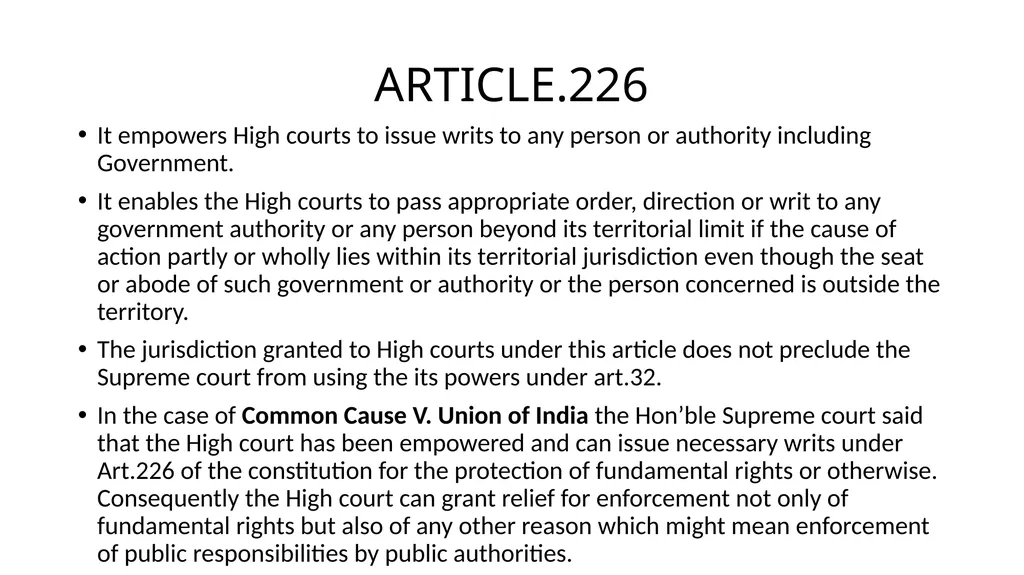
ARTICLE.226 It empowers High courts to issue writs to any person or authority including Government.
It enables the High courts to pass appropriate order, direction or writ to any government authority or any person beyond its territorial limit if the cause of action partly or wholly lies within its territorial jurisdiction even though the seat or abode of such government or authority or the person concerned is outside the territory.
The jurisdiction granted to High courts under this article does not preclude the Supreme court from using the its powers under art.32.
In the case of Common Cause V. Union of India the Hon’ble Supreme court said that the High court has been empowered and can issue necessary writs under Art.226 of the constitution for the protection of fundamental rights or otherwise. Consequently the High court can grant relief for enforcement not only of fundamental rights but also of any other reason which might mean enforcement of public responsibilities by public authorities.<br>
It enables the High courts to pass appropriate order, direction or writ to any government authority or any person beyond its territorial limit if the cause of action partly or wholly lies within its territorial jurisdiction even though the seat or abode of such government or authority or the person concerned is outside the territory.
The jurisdiction granted to High courts under this article does not preclude the Supreme court from using the its powers under art.32.
In the case of Common Cause V. Union of India the Hon’ble Supreme court said that the High court has been empowered and can issue necessary writs under Art.226 of the constitution for the protection of fundamental rights or otherwise. Consequently the High court can grant relief for enforcement not only of fundamental rights but also of any other reason which might mean enforcement of public responsibilities by public authorities.<br>
07
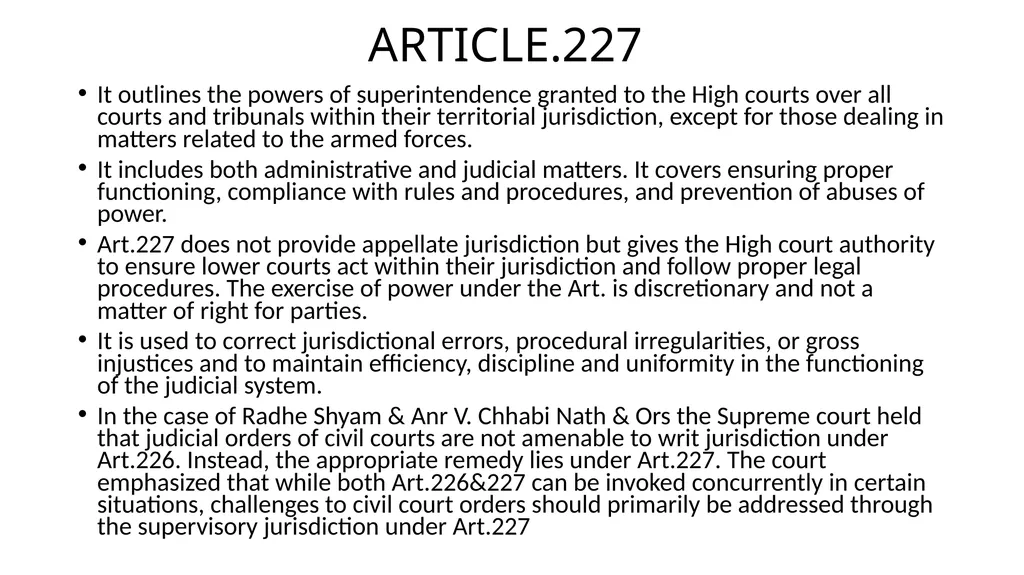
ARTICLE.227 It outlines the powers of superintendence granted to the High courts over all courts and tribunals within their territorial jurisdiction, except for those dealing in matters related to the armed forces.
It includes both administrative and judicial matters. It covers ensuring proper functioning, compliance with rules and procedures, and prevention of abuses of power.
Art.227 does not provide appellate jurisdiction but gives the High court authority to ensure lower courts act within their jurisdiction and follow proper legal procedures. The exercise of power under the Art. is discretionary and not a matter of right for parties.
It is used to correct jurisdictional errors, procedural irregularities, or gross injustices and to maintain efficiency, discipline and uniformity in the functioning of the judicial system.
In the case of Radhe Shyam & Anr V. Chhabi Nath & Ors the Supreme court held that judicial orders of civil courts are not amenable to writ jurisdiction under Art.226. Instead, the appropriate remedy lies under Art.227. The court emphasized that while both Art.226&227 can be invoked concurrently in certain situations, challenges to civil court orders should primarily be addressed through the supervisory jurisdiction under Art.227<br>
It includes both administrative and judicial matters. It covers ensuring proper functioning, compliance with rules and procedures, and prevention of abuses of power.
Art.227 does not provide appellate jurisdiction but gives the High court authority to ensure lower courts act within their jurisdiction and follow proper legal procedures. The exercise of power under the Art. is discretionary and not a matter of right for parties.
It is used to correct jurisdictional errors, procedural irregularities, or gross injustices and to maintain efficiency, discipline and uniformity in the functioning of the judicial system.
In the case of Radhe Shyam & Anr V. Chhabi Nath & Ors the Supreme court held that judicial orders of civil courts are not amenable to writ jurisdiction under Art.226. Instead, the appropriate remedy lies under Art.227. The court emphasized that while both Art.226&227 can be invoked concurrently in certain situations, challenges to civil court orders should primarily be addressed through the supervisory jurisdiction under Art.227<br>
08
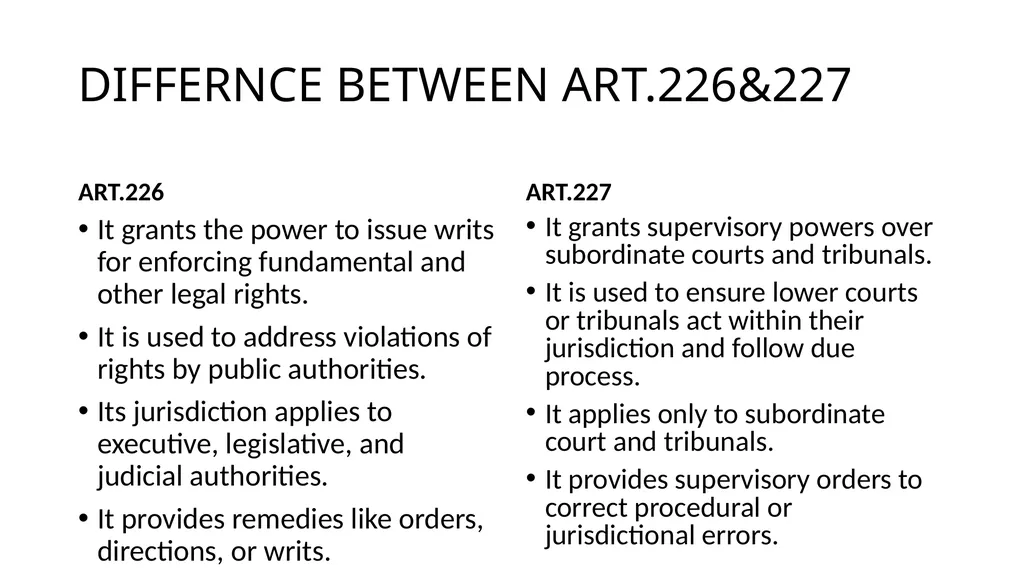
DIFFERNCE BETWEEN ART.226&227 ART.226 It grants the power to issue writs for enforcing fundamental and other legal rights.
It is used to address violations of rights by public authorities.
Its jurisdiction applies to executive, legislative, and judicial authorities.
It provides remedies like orders, directions, or writs. ART.227 It grants supervisory powers over subordinate courts and tribunals.
It is used to ensure lower courts or tribunals act within their jurisdiction and follow due process.
It applies only to subordinate court and tribunals.
It provides supervisory orders to correct procedural or jurisdictional errors.<br>
It is used to address violations of rights by public authorities.
Its jurisdiction applies to executive, legislative, and judicial authorities.
It provides remedies like orders, directions, or writs. ART.227 It grants supervisory powers over subordinate courts and tribunals.
It is used to ensure lower courts or tribunals act within their jurisdiction and follow due process.
It applies only to subordinate court and tribunals.
It provides supervisory orders to correct procedural or jurisdictional errors.<br>
09
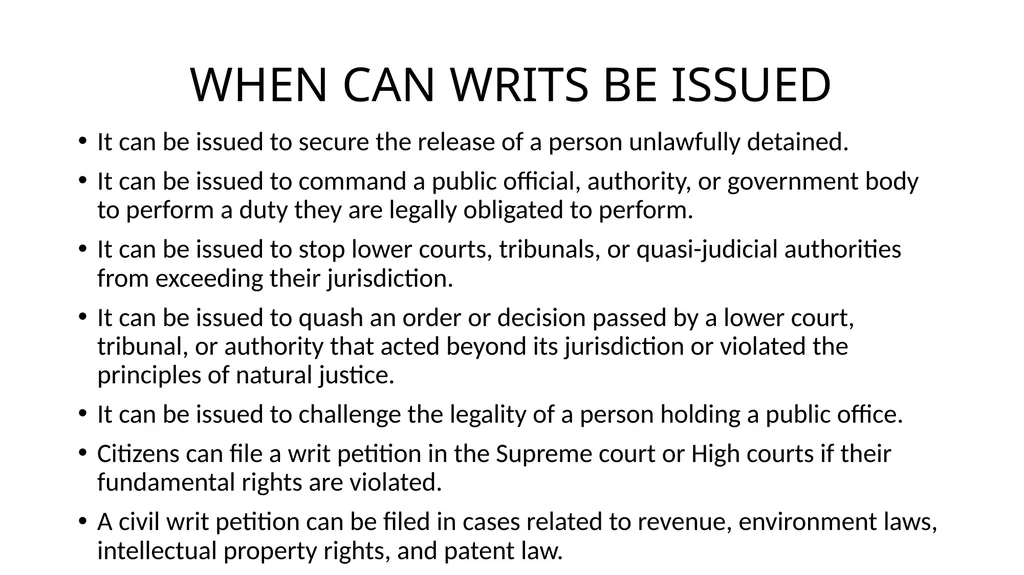
WHEN CAN WRITS BE ISSUED It can be issued to secure the release of a person unlawfully detained.
It can be issued to command a public official, authority, or government body to perform a duty they are legally obligated to perform.
It can be issued to stop lower courts, tribunals, or quasi-judicial authorities from exceeding their jurisdiction.
It can be issued to quash an order or decision passed by a lower court, tribunal, or authority that acted beyond its jurisdiction or violated the principles of natural justice.
It can be issued to challenge the legality of a person holding a public office.
Citizens can file a writ petition in the Supreme court or High courts if their fundamental rights are violated.
A civil writ petition can be filed in cases related to revenue, environment laws, intellectual property rights, and patent law.<br>
It can be issued to command a public official, authority, or government body to perform a duty they are legally obligated to perform.
It can be issued to stop lower courts, tribunals, or quasi-judicial authorities from exceeding their jurisdiction.
It can be issued to quash an order or decision passed by a lower court, tribunal, or authority that acted beyond its jurisdiction or violated the principles of natural justice.
It can be issued to challenge the legality of a person holding a public office.
Citizens can file a writ petition in the Supreme court or High courts if their fundamental rights are violated.
A civil writ petition can be filed in cases related to revenue, environment laws, intellectual property rights, and patent law.<br>
10
WHO CAN APPLY FOR A WRIT A writ petition may be filed by an aggrieved person(s) to seek legal remedies for violation of fundamental rights. The petition can be filed under Art.226 before a High court or under Art.32 before the Supreme court of India.
An aggrieved individual can file a writ petition in the High court or the Supreme court.
Public-spirited individuals or groups can file a writ on behalf of people whose rights are affected, particularly marginalized communities or those unable to approach the court themselves, if the public interest is involved.
In the case of Calcutta Gas Co. (Proprietary) Ltd V. State of W.B. , the Supreme court observed that the article in terms does not describe the classes of persons entitled to apply thereunder; but it is implicit in the exercise of the extraordinary jurisdiction that the relief asked must be one to enforce a legal right…The right that can be enforced under Art.226 also shall ordinarily be the personal or individual right of the petitioner himself…<br>
An aggrieved individual can file a writ petition in the High court or the Supreme court.
Public-spirited individuals or groups can file a writ on behalf of people whose rights are affected, particularly marginalized communities or those unable to approach the court themselves, if the public interest is involved.
In the case of Calcutta Gas Co. (Proprietary) Ltd V. State of W.B. , the Supreme court observed that the article in terms does not describe the classes of persons entitled to apply thereunder; but it is implicit in the exercise of the extraordinary jurisdiction that the relief asked must be one to enforce a legal right…The right that can be enforced under Art.226 also shall ordinarily be the personal or individual right of the petitioner himself…<br>
11
WHO CANNOT APPLY FOR A WRIT A writ cannot be filed by someone who is not directly affected or aggrieved by the issue. Locus standi requires that the person filing the writ has a legitimate interest in the matter.
If the dispute is purely contractual or between private parties without any violation of public law or fundamental rights, writ jurisdiction does not apply.
In a case if there is an alternative remedy available, such as an appeal to a tribunal or statutory authority then it cannot file a writ petition.
Matters falling outside a court’s territorial or subject matter jurisdiction cannot be entertained.
A writ petition may be dismissed if there is an unreasonable delay in filing it without a valid reason.
Certain laws may specifically exclude certain individuals or groups from filing writ petitions in specific contexts (e.g., service disputes governed by separate tribunals).<br>
If the dispute is purely contractual or between private parties without any violation of public law or fundamental rights, writ jurisdiction does not apply.
In a case if there is an alternative remedy available, such as an appeal to a tribunal or statutory authority then it cannot file a writ petition.
Matters falling outside a court’s territorial or subject matter jurisdiction cannot be entertained.
A writ petition may be dismissed if there is an unreasonable delay in filing it without a valid reason.
Certain laws may specifically exclude certain individuals or groups from filing writ petitions in specific contexts (e.g., service disputes governed by separate tribunals).<br>
12
WHO CANNOT APPLY FOR A WRIT(IT&IBC) If the Income Tax Act, 1961, provides a statutory remedy (e.g., appeals to the commissioner of income tax, ITAT, or High court), the petitioner must exhaust those remedies before filing a writ.
Writs cannot be filed for trivial grievances, such as mere disagreements over the quantum of tax assessed, without substantive claims of illegality.
Courts typically avoid writ petitions in cases requiring detailed factual analysis, like disputed valuations or the interpretation of records. These issues are better suited for tax tribunals.
The parties must approach the prescribed specific forums (NCLT, NCLAT, or the Supreme court) before seeking writ jurisdiction unless there is a violation of fundamental rights, the NCLT/NCLAT acts outside its jurisdiction, or there is a grave procedural irregularity.
Only financial&operational creditors or the corporate debtor can initiate proceeding under IBC. Other parties such as unrelated third parties, cannot file a writ challenging insolvency proceedings unless directly affected.
Stakeholders not directly involved or affected by the insolvency resolution process (like minor investors, or unsecured creditors with no statutory rights) are not eligible to file writs.<br>
Writs cannot be filed for trivial grievances, such as mere disagreements over the quantum of tax assessed, without substantive claims of illegality.
Courts typically avoid writ petitions in cases requiring detailed factual analysis, like disputed valuations or the interpretation of records. These issues are better suited for tax tribunals.
The parties must approach the prescribed specific forums (NCLT, NCLAT, or the Supreme court) before seeking writ jurisdiction unless there is a violation of fundamental rights, the NCLT/NCLAT acts outside its jurisdiction, or there is a grave procedural irregularity.
Only financial&operational creditors or the corporate debtor can initiate proceeding under IBC. Other parties such as unrelated third parties, cannot file a writ challenging insolvency proceedings unless directly affected.
Stakeholders not directly involved or affected by the insolvency resolution process (like minor investors, or unsecured creditors with no statutory rights) are not eligible to file writs.<br>
13
Courts are reluctant to stay the CIRP once initiated, as it defeats the purpose of a time-bound resolution under the IBC. Hence, writs challenging CIRP are rarely entertained unless egregious illegality is evident.
In the case of Canara Bank V. Deccan Chronicle Holdings Limited the NCLAT held that moratorium under sec.14 of the IBC does not restrict the constitutional powers of the Supreme court under Art.32 or the High courts under Art.226. These powers are part of the Constitutions basic structure and cannot be curtailed by the IBC. However, the moratorium does bar suits for recovery or similar proceedings against the corporate debtor filed under a High court’s original jurisdiction. Thus, while writ jurisdiction remains unaffected, other suits directly against the debtor cannot proceed during the moratorium.
In the case of Anthony Raphael Kallarakkal V. National Company Law Tribunal, Mumbai the Bombay High court clarified that it generally refrains from exercising its jurisdiction under Art.226 of the constitution when an effective alternative remedy exists, such as an appeal to the NCLAT under sec.61 of the IBC. This is a self-imposed restraint. However, the High court may exercise its writ jurisdiction in cases involving exceptional facts or circumstances. Here the High court dismissed the writ petition, reasoning that the petitioner had equally effective remedies available under sec.61 (appeal to NCLAT) and sec.62 (appeal to the Supreme court) of the IBC.<br>
In the case of Canara Bank V. Deccan Chronicle Holdings Limited the NCLAT held that moratorium under sec.14 of the IBC does not restrict the constitutional powers of the Supreme court under Art.32 or the High courts under Art.226. These powers are part of the Constitutions basic structure and cannot be curtailed by the IBC. However, the moratorium does bar suits for recovery or similar proceedings against the corporate debtor filed under a High court’s original jurisdiction. Thus, while writ jurisdiction remains unaffected, other suits directly against the debtor cannot proceed during the moratorium.
In the case of Anthony Raphael Kallarakkal V. National Company Law Tribunal, Mumbai the Bombay High court clarified that it generally refrains from exercising its jurisdiction under Art.226 of the constitution when an effective alternative remedy exists, such as an appeal to the NCLAT under sec.61 of the IBC. This is a self-imposed restraint. However, the High court may exercise its writ jurisdiction in cases involving exceptional facts or circumstances. Here the High court dismissed the writ petition, reasoning that the petitioner had equally effective remedies available under sec.61 (appeal to NCLAT) and sec.62 (appeal to the Supreme court) of the IBC.<br>
14
In the case of Embassy Property Developments Pvt Ltd V. State of Karnataka, the Supreme court held that the NCLT, as a tribunal under the IBC, lacks the authority to exercise judicial review over administrative actions or public law matters. Such decisions fall under the jurisdiction of High courts under Art.226&227. The court ruled that the Karnataka High court was justified in entertaining a writ petition because the NCLT Chennai had acted beyond its statutory powers. The judgment clarified that sec.60(5) of the IBC does not cover isssues related to public law, which can only be addressed through judicial review.
In the case of Kamal K Singh V. UOI also known as the Rolta India case, the Bombay High court dealt with a writ petition challenging the NCLT Mumbai’s admission order under sec.7 of the IBC. The petitioner argued that the order was invalid as it violated rules 150&150(2) of the NCLT Rules,2016 which requires proper pronouncement of orders. The High court issued a writ of Certiorari, quashing the NCLT order due to procedural defect that vitiated the entire proceedings. The court reaffirmed that High courts can exercise jurisdiction under Art.226 in cases involving exceptional circumstances, even when alternative remedies like appeal to the NCLAT exist. It referred to its earlier decision in Anthony Raphael Kallarakkal and emphasized that writ jurisdiction is justified when the actions of subordinate courts or tribunals result in a failure of justice, The court clarified that procedural defects leading to such failures warrant intervention, irrespective of the availability of alternative remedies.<br>
In the case of Kamal K Singh V. UOI also known as the Rolta India case, the Bombay High court dealt with a writ petition challenging the NCLT Mumbai’s admission order under sec.7 of the IBC. The petitioner argued that the order was invalid as it violated rules 150&150(2) of the NCLT Rules,2016 which requires proper pronouncement of orders. The High court issued a writ of Certiorari, quashing the NCLT order due to procedural defect that vitiated the entire proceedings. The court reaffirmed that High courts can exercise jurisdiction under Art.226 in cases involving exceptional circumstances, even when alternative remedies like appeal to the NCLAT exist. It referred to its earlier decision in Anthony Raphael Kallarakkal and emphasized that writ jurisdiction is justified when the actions of subordinate courts or tribunals result in a failure of justice, The court clarified that procedural defects leading to such failures warrant intervention, irrespective of the availability of alternative remedies.<br>
15
PARTIES AGAINST WHOM WRIT CAN BE ISSUED Writs can be issued against Central Government, State Government and Local Authorities as they are obligated to perform duties under the constitution or statutory laws.
Writs can be directed against any public officer or individual holding an official position who fails to perform a legal duty or acts in violation of the law.
Writs can be issued to Tribunals or Quasi-Judicial authorities if they are acting beyond their jurisdiction, violating principles of natural justice, not performing their statutory duties.
Bodies created under statutes, such as SEBI, ELECTION COMMISSION or UNIVERSITIES, can be subject to writs if they fail to actin accordance with their statutory mandates.
Writs cannot be issued against the President or Governors, as per Art.361 of the Constitution, the President of India and Governors are immune from court proceedings during their term of office.<br>
Writs can be directed against any public officer or individual holding an official position who fails to perform a legal duty or acts in violation of the law.
Writs can be issued to Tribunals or Quasi-Judicial authorities if they are acting beyond their jurisdiction, violating principles of natural justice, not performing their statutory duties.
Bodies created under statutes, such as SEBI, ELECTION COMMISSION or UNIVERSITIES, can be subject to writs if they fail to actin accordance with their statutory mandates.
Writs cannot be issued against the President or Governors, as per Art.361 of the Constitution, the President of India and Governors are immune from court proceedings during their term of office.<br>
16
LIMITATIONS OF WRITS Writs cannot be issued for the enforcement of purely private rights.
No writ can be issued against the President and Governor; and private individuals.
Courts refuse to entertain a writ petition if an adequate alternative remedy is available.
A High court can issue writs only within its territorial jurisdiction or for acts that have substantial effects within its jurisdiction.
The Supreme court has broader jurisdiction but is limited to the enforcement of fundamental rights.
The state can restrict the issuance of writs incases involving national security, defense, or public safety under reasonable restrictions allowed by the constitution.<br>
No writ can be issued against the President and Governor; and private individuals.
Courts refuse to entertain a writ petition if an adequate alternative remedy is available.
A High court can issue writs only within its territorial jurisdiction or for acts that have substantial effects within its jurisdiction.
The Supreme court has broader jurisdiction but is limited to the enforcement of fundamental rights.
The state can restrict the issuance of writs incases involving national security, defense, or public safety under reasonable restrictions allowed by the constitution.<br>
17
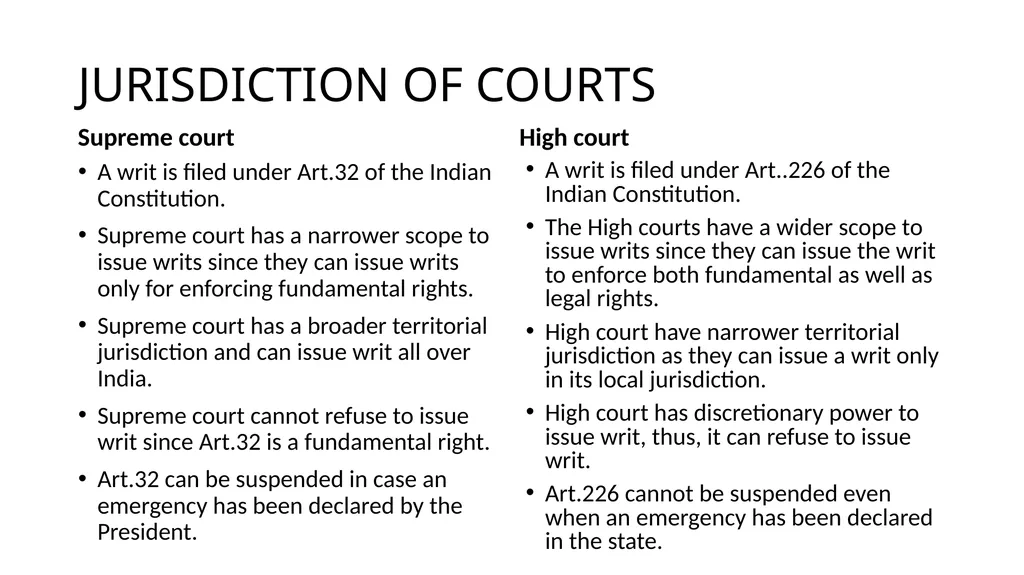
JURISDICTION OF COURTS Supreme court A writ is filed under Art.32 of the Indian Constitution.
Supreme court has a narrower scope to issue writs since they can issue writs only for enforcing fundamental rights.
Supreme court has a broader territorial jurisdiction and can issue writ all over India.
Supreme court cannot refuse to issue writ since Art.32 is a fundamental right.
Art.32 can be suspended in case an emergency has been declared by the President. High court A writ is filed under Art..226 of the Indian Constitution.
The High courts have a wider scope to issue writs since they can issue the writ to enforce both fundamental as well as legal rights.
High court have narrower territorial jurisdiction as they can issue a writ only in its local jurisdiction.
High court has discretionary power to issue writ, thus, it can refuse to issue writ.
Art.226 cannot be suspended even when an emergency has been declared in the state.<br>
Supreme court has a narrower scope to issue writs since they can issue writs only for enforcing fundamental rights.
Supreme court has a broader territorial jurisdiction and can issue writ all over India.
Supreme court cannot refuse to issue writ since Art.32 is a fundamental right.
Art.32 can be suspended in case an emergency has been declared by the President. High court A writ is filed under Art..226 of the Indian Constitution.
The High courts have a wider scope to issue writs since they can issue the writ to enforce both fundamental as well as legal rights.
High court have narrower territorial jurisdiction as they can issue a writ only in its local jurisdiction.
High court has discretionary power to issue writ, thus, it can refuse to issue writ.
Art.226 cannot be suspended even when an emergency has been declared in the state.<br>
18
TYPES OF WRITS Habeas Corpus
Mandamus
Prohibition
Certiorari
Quo Warranto<br>
Mandamus
Prohibition
Certiorari
Quo Warranto<br>
19
Habeas Corpus Habeas Corpus literally means “to have a body of”. This writ is used to release a person who has been unlawfully detained or imprisoned.
If the state illegally detains an individual, then such an individual can use the writ of Habeas Corpus for the release.
The writ of Habeas Corpus cannot be issued if the detention is lawful. The case is being prosecuted for failure to comply with a legislative or judicial mandate, a competent court authorized the detention, the writ jurisdiction of the court on detention is ultra vires.
In the case of Kanu Sanyal V. District Magistrate Darjeeling & Ors the Supreme court held that rather than focusing on the defined meaning i.e. produce the body, there should be a focus on the examination of the legality of the detention by looking at the facts and circumstances of the case. It stated that this writ is a procedural writ and not a substantive writ. This case dealt with the nature and scope of the writ of Habeas Corpus.
In the case of ADM Jabalpur V. Shivakant Shukla it was held that the writ of Habeas Corpus cannot be suspended even at the time of an emergency.<br>
If the state illegally detains an individual, then such an individual can use the writ of Habeas Corpus for the release.
The writ of Habeas Corpus cannot be issued if the detention is lawful. The case is being prosecuted for failure to comply with a legislative or judicial mandate, a competent court authorized the detention, the writ jurisdiction of the court on detention is ultra vires.
In the case of Kanu Sanyal V. District Magistrate Darjeeling & Ors the Supreme court held that rather than focusing on the defined meaning i.e. produce the body, there should be a focus on the examination of the legality of the detention by looking at the facts and circumstances of the case. It stated that this writ is a procedural writ and not a substantive writ. This case dealt with the nature and scope of the writ of Habeas Corpus.
In the case of ADM Jabalpur V. Shivakant Shukla it was held that the writ of Habeas Corpus cannot be suspended even at the time of an emergency.<br>
20
MANDAMUS Mandamus means “we command”. It is issued by the court to direct a public authority to perform the legal duties which it has not or refused to perform.
It can be issued by the court against a public official, public corporation, tribunal, inferior court or the Government but cannot be issued against a private individual or body, the President or Governors of states or against a working chief justice.
Mandamus can be issued if there is misuse of discretionary power; exceeding its scope of power; ignoring relevant factors; deciding of irrelevant factors; acting with mala fide intentions.
In the case of All India Tea Trading Co. V. S.D.O. the land acquisition officer erroneously refused to pay the interest on compensation amount. A writ of Mandamus was issued against the land acquisition officer directing him to reconsider the application for the payment of interest.
In the case of Binny Ltd & Anr V. V.sadasivan & Ors stated that a writ of Mandamus is not applicable against any private wrong, it can be issued only when any public authority exercises its duty unlawfully or refuses to perform its duty within the ambit of the law.<br>
It can be issued by the court against a public official, public corporation, tribunal, inferior court or the Government but cannot be issued against a private individual or body, the President or Governors of states or against a working chief justice.
Mandamus can be issued if there is misuse of discretionary power; exceeding its scope of power; ignoring relevant factors; deciding of irrelevant factors; acting with mala fide intentions.
In the case of All India Tea Trading Co. V. S.D.O. the land acquisition officer erroneously refused to pay the interest on compensation amount. A writ of Mandamus was issued against the land acquisition officer directing him to reconsider the application for the payment of interest.
In the case of Binny Ltd & Anr V. V.sadasivan & Ors stated that a writ of Mandamus is not applicable against any private wrong, it can be issued only when any public authority exercises its duty unlawfully or refuses to perform its duty within the ambit of the law.<br>
21
PROHIBITION The writ of prohibition literally means “to forbid”.
It is issued by a court to prohibit the lower courts, tribunal and other quasi-judicial authorities form doing something beyond their authority.
Prohibition is used until the lower court has pronounced the judgement, it directs a lower court to stop doing something which the law prohibits it from doing.
In the case of East India Commercial Co. Ltd V. Collector of Customs the Supreme court emphasized on the meaning of writ of prohibition and stated that is an order passed by a higher court directing a lower/inferior court to stop the proceedings on the grounds that the court either does not have a jurisdiction or the court is exceeding its jurisdiction in deciding the case.<br>
It is issued by a court to prohibit the lower courts, tribunal and other quasi-judicial authorities form doing something beyond their authority.
Prohibition is used until the lower court has pronounced the judgement, it directs a lower court to stop doing something which the law prohibits it from doing.
In the case of East India Commercial Co. Ltd V. Collector of Customs the Supreme court emphasized on the meaning of writ of prohibition and stated that is an order passed by a higher court directing a lower/inferior court to stop the proceedings on the grounds that the court either does not have a jurisdiction or the court is exceeding its jurisdiction in deciding the case.<br>
22
CERTIORARI Certiorari means “to be certified” or “to be informed”. It is curative as well as preventive writ unlike Prohibition Writ which is only preventive. When the court is of the opinion that a lower court or a tribunal has passed an order which is beyond its powers or committed an error of law then, through the writ of Certiorari, it may transfer the case to itself or quash the order passed by the lower court or tribunal.
Before 1991 the writ was only allowed to be issued against the judicial authority or quasi-judicial authority and not the administrative authority but post 1991 it can be issued against the administrative authority as well but it cannot be issued against private individuals.
Certiorari is issued on the grounds of an excess of jurisdiction or lack of jurisdiction or error of law. It not only prevents but also cures for the mistakes in the judiciary.
In the case of Yekoob V. K.S. Radhakrishnan the court stated that this writ cannot be invoked for an appeal.
In the case of Radhe Shyam and Anr. V. Chhabi Nath and Ors. the court said that power under Art.227 cannot be used for writ filed under Art.226.<br>
Before 1991 the writ was only allowed to be issued against the judicial authority or quasi-judicial authority and not the administrative authority but post 1991 it can be issued against the administrative authority as well but it cannot be issued against private individuals.
Certiorari is issued on the grounds of an excess of jurisdiction or lack of jurisdiction or error of law. It not only prevents but also cures for the mistakes in the judiciary.
In the case of Yekoob V. K.S. Radhakrishnan the court stated that this writ cannot be invoked for an appeal.
In the case of Radhe Shyam and Anr. V. Chhabi Nath and Ors. the court said that power under Art.227 cannot be used for writ filed under Art.226.<br>
23
QUO WARRANTO The literal meaning of the writ of “Quo Warranto” is “by what authority or warrant”. The Supreme court or High court issue this writ to prevent illegal usurpation of a public office by a person.
Quo Warranto can be issued only when the substantive public office of a permanent character created by a statute or the Constitution is involved.
Quo Warranto can’t be issued against private or ministerial office.
In the case of Jamalpur Arya Samaj Sabha V. Dr D Rama the petitioner filed an application for issuing the writ of Quo Warranto against the working committee of Bihar Raj Arya Samaj Pratinidhi Sabha, which was a private body. The High court of Patna refused to issue the writ of Quo Warranto because it was not a public office.
In the case of University of Mysore V. CD Govinda Rao it was held that the public office must be of a statutory nature to issue the writ of Quo Warranto.<br>
Quo Warranto can be issued only when the substantive public office of a permanent character created by a statute or the Constitution is involved.
Quo Warranto can’t be issued against private or ministerial office.
In the case of Jamalpur Arya Samaj Sabha V. Dr D Rama the petitioner filed an application for issuing the writ of Quo Warranto against the working committee of Bihar Raj Arya Samaj Pratinidhi Sabha, which was a private body. The High court of Patna refused to issue the writ of Quo Warranto because it was not a public office.
In the case of University of Mysore V. CD Govinda Rao it was held that the public office must be of a statutory nature to issue the writ of Quo Warranto.<br>
24
PUBLIC INTEREST LITIGATION A PIL is not particularly defined in any law, statute or act, it is filed before the courts under the Constitution of India to protect public rights and promote general welfare.
PIL is a legal mechanism in India that allows citizen to file a case in court to protect the public interest or enforce the rights of a group of people or an individual. PILs are filed to address issues that affect the legal rights of the public or a community.
All Indian citizens or organisations can file a PIL before the Supreme court under Art.32 of the Constitution of India or the High courts under Art.226 of the Constitution of India. The person filing the petition must prove to the court that the petition is being filed for public interest, such as road safety, pollution, terrorism, exploitation of casual workers, bonded labour, etc.
A PIL can only be filed against the Central Government, Municipal Governments or State Governments and not against individuals. The Parliament of India, each states legislature, and all local or other authorities under the control of the government are included in the definition of the government.<br>
PIL is a legal mechanism in India that allows citizen to file a case in court to protect the public interest or enforce the rights of a group of people or an individual. PILs are filed to address issues that affect the legal rights of the public or a community.
All Indian citizens or organisations can file a PIL before the Supreme court under Art.32 of the Constitution of India or the High courts under Art.226 of the Constitution of India. The person filing the petition must prove to the court that the petition is being filed for public interest, such as road safety, pollution, terrorism, exploitation of casual workers, bonded labour, etc.
A PIL can only be filed against the Central Government, Municipal Governments or State Governments and not against individuals. The Parliament of India, each states legislature, and all local or other authorities under the control of the government are included in the definition of the government.<br>
25
PIL is a vital tool to enforce the human rights of those people who do not have access to them due to poverty or other reasons. PIL aims to facilitate common people to access the courts to seek redress in legal matters. It is a crucial tool for social change, accelerating the attainment of justice and law and upholding the rule of law.
The case of Hussainara Khatoon V. State of Bihar it was the first reported instance of PIL in India, which brought attention to the issue of inhuman conditions of prisoners and undertrial prisoners.
In the case of M. C. Mehta V. Union of India the judgement criticised the Local Government for giving permission for untreated sewage from Kanpur’s tanneries to enter the Ganges. Directions were given to prevent the consequences of water and air pollution on millions of people in the Ganga basin and emphasised the need for sustainable development.
In the case of Parmanand Katara V. Union of India the judgement made it obligatory for a hospital or doctor, public and private, to provide immediate medical aid to a road accident victim.<br>
The case of Hussainara Khatoon V. State of Bihar it was the first reported instance of PIL in India, which brought attention to the issue of inhuman conditions of prisoners and undertrial prisoners.
In the case of M. C. Mehta V. Union of India the judgement criticised the Local Government for giving permission for untreated sewage from Kanpur’s tanneries to enter the Ganges. Directions were given to prevent the consequences of water and air pollution on millions of people in the Ganga basin and emphasised the need for sustainable development.
In the case of Parmanand Katara V. Union of India the judgement made it obligatory for a hospital or doctor, public and private, to provide immediate medical aid to a road accident victim.<br>
26
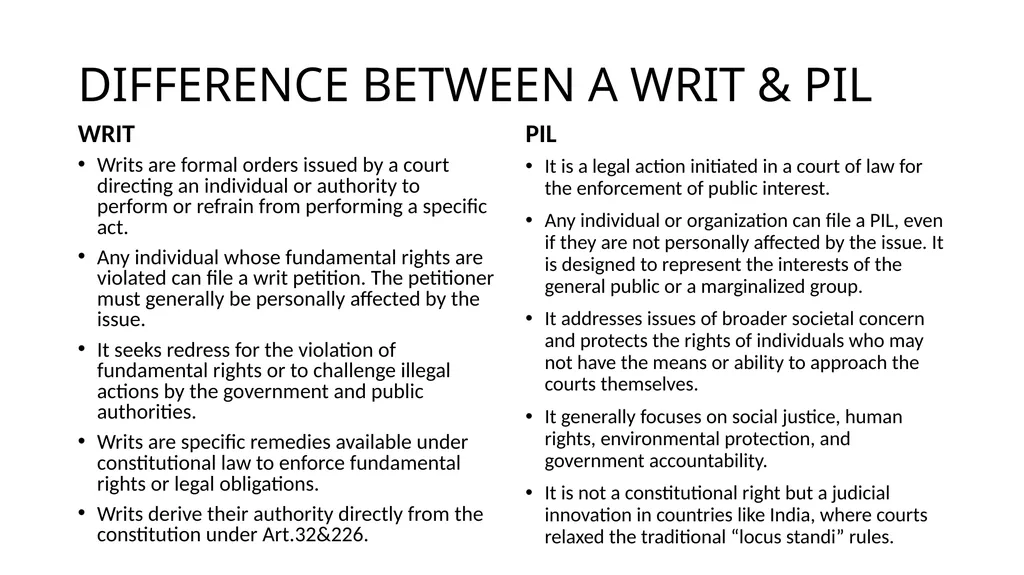
DIFFERENCE BETWEEN A WRIT & PIL WRIT Writs are formal orders issued by a court directing an individual or authority to perform or refrain from performing a specific act.
Any individual whose fundamental rights are violated can file a writ petition. The petitioner must generally be personally affected by the issue.
It seeks redress for the violation of fundamental rights or to challenge illegal actions by the government and public authorities.
Writs are specific remedies available under constitutional law to enforce fundamental rights or legal obligations.
Writs derive their authority directly from the constitution under Art.32&226. PIL It is a legal action initiated in a court of law for the enforcement of public interest.
Any individual or organization can file a PIL, even if they are not personally affected by the issue. It is designed to represent the interests of the general public or a marginalized group.
It addresses issues of broader societal concern and protects the rights of individuals who may not have the means or ability to approach the courts themselves.
It generally focuses on social justice, human rights, environmental protection, and government accountability.
It is not a constitutional right but a judicial innovation in countries like India, where courts relaxed the traditional “locus standi” rules.<br>
Any individual whose fundamental rights are violated can file a writ petition. The petitioner must generally be personally affected by the issue.
It seeks redress for the violation of fundamental rights or to challenge illegal actions by the government and public authorities.
Writs are specific remedies available under constitutional law to enforce fundamental rights or legal obligations.
Writs derive their authority directly from the constitution under Art.32&226. PIL It is a legal action initiated in a court of law for the enforcement of public interest.
Any individual or organization can file a PIL, even if they are not personally affected by the issue. It is designed to represent the interests of the general public or a marginalized group.
It addresses issues of broader societal concern and protects the rights of individuals who may not have the means or ability to approach the courts themselves.
It generally focuses on social justice, human rights, environmental protection, and government accountability.
It is not a constitutional right but a judicial innovation in countries like India, where courts relaxed the traditional “locus standi” rules.<br>
27
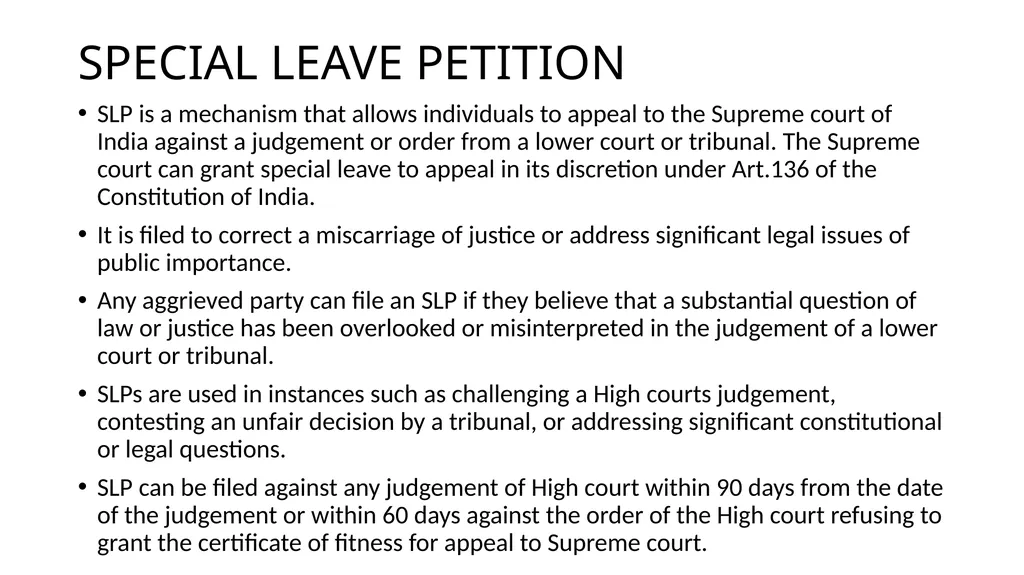
SPECIAL LEAVE PETITION SLP is a mechanism that allows individuals to appeal to the Supreme court of India against a judgement or order from a lower court or tribunal. The Supreme court can grant special leave to appeal in its discretion under Art.136 of the Constitution of India.
It is filed to correct a miscarriage of justice or address significant legal issues of public importance.
Any aggrieved party can file an SLP if they believe that a substantial question of law or justice has been overlooked or misinterpreted in the judgement of a lower court or tribunal.
SLPs are used in instances such as challenging a High courts judgement, contesting an unfair decision by a tribunal, or addressing significant constitutional or legal questions.
SLP can be filed against any judgement of High court within 90 days from the date of the judgement or within 60 days against the order of the High court refusing to grant the certificate of fitness for appeal to Supreme court.<br>
It is filed to correct a miscarriage of justice or address significant legal issues of public importance.
Any aggrieved party can file an SLP if they believe that a substantial question of law or justice has been overlooked or misinterpreted in the judgement of a lower court or tribunal.
SLPs are used in instances such as challenging a High courts judgement, contesting an unfair decision by a tribunal, or addressing significant constitutional or legal questions.
SLP can be filed against any judgement of High court within 90 days from the date of the judgement or within 60 days against the order of the High court refusing to grant the certificate of fitness for appeal to Supreme court.<br>
28
SLP has a prime place in the Indian judicial system and has been provided as a discretionary power vested in the Supreme court of India and the court may in its discretion refuse to grant leave to appeal. The aggrieved party cannot claim special leave to appeal under Art.136 as a right but it is a privilege vested in the Supreme court of India to grant leave to appeal or not.
In the case of Smt. Tej Kumari V. CIT the full bench of Patna High court held that in case a SLP is summarily rejected or dismissed under Art.136 of the Constitution then such a dismissal does not lay down any law. The decision of the High court against which the SLP is dismissed in limine would not operate as res-judicata. However, when the Supreme court dismisses and SLP with reason, it might be taken as a affirmation of the High court views on the merits of the case, thus there is no reason to dilute the binding nature of precedents in such cases.
In the case of N. Suriyakala V. A. Mohan Doss and Ors the Supreme court observed with regard to scope of Art.136 that Art.136 of the Constitution is not a regular form of appeal at all. It is a ‘residual’ provision which enables the Supreme court to interfere with the judgement or order of any court or tribunal in India in its discretion.<br>
In the case of Smt. Tej Kumari V. CIT the full bench of Patna High court held that in case a SLP is summarily rejected or dismissed under Art.136 of the Constitution then such a dismissal does not lay down any law. The decision of the High court against which the SLP is dismissed in limine would not operate as res-judicata. However, when the Supreme court dismisses and SLP with reason, it might be taken as a affirmation of the High court views on the merits of the case, thus there is no reason to dilute the binding nature of precedents in such cases.
In the case of N. Suriyakala V. A. Mohan Doss and Ors the Supreme court observed with regard to scope of Art.136 that Art.136 of the Constitution is not a regular form of appeal at all. It is a ‘residual’ provision which enables the Supreme court to interfere with the judgement or order of any court or tribunal in India in its discretion.<br>
29
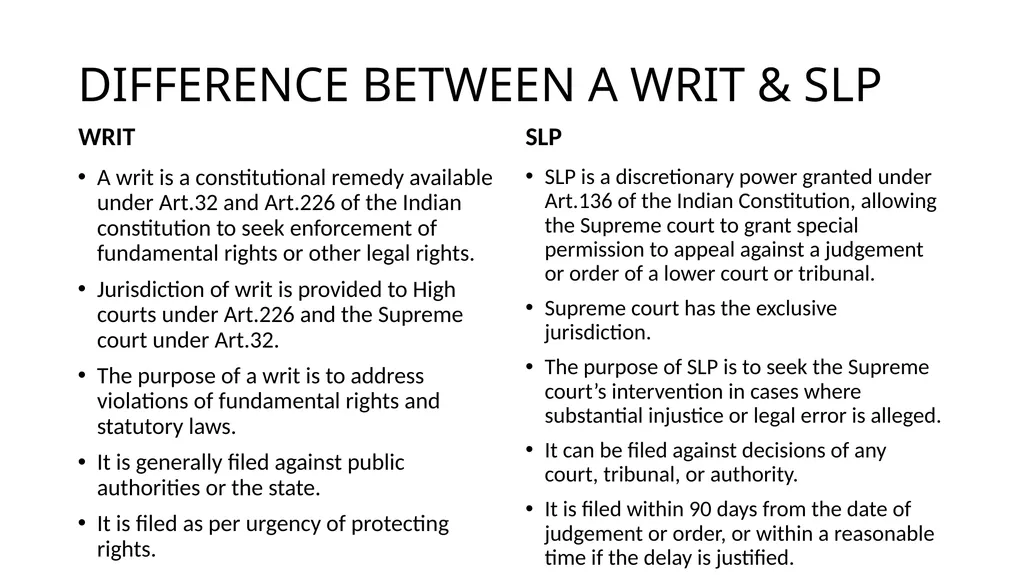
DIFFERENCE BETWEEN A WRIT & SLP WRIT A writ is a constitutional remedy available under Art.32 and Art.226 of the Indian constitution to seek enforcement of fundamental rights or other legal rights.
Jurisdiction of writ is provided to High courts under Art.226 and the Supreme court under Art.32.
The purpose of a writ is to address violations of fundamental rights and statutory laws.
It is generally filed against public authorities or the state.
It is filed as per urgency of protecting rights. SLP SLP is a discretionary power granted under Art.136 of the Indian Constitution, allowing the Supreme court to grant special permission to appeal against a judgement or order of a lower court or tribunal.
Supreme court has the exclusive jurisdiction.
The purpose of SLP is to seek the Supreme court’s intervention in cases where substantial injustice or legal error is alleged.
It can be filed against decisions of any court, tribunal, or authority.
It is filed within 90 days from the date of judgement or order, or within a reasonable time if the delay is justified.<br>
Jurisdiction of writ is provided to High courts under Art.226 and the Supreme court under Art.32.
The purpose of a writ is to address violations of fundamental rights and statutory laws.
It is generally filed against public authorities or the state.
It is filed as per urgency of protecting rights. SLP SLP is a discretionary power granted under Art.136 of the Indian Constitution, allowing the Supreme court to grant special permission to appeal against a judgement or order of a lower court or tribunal.
Supreme court has the exclusive jurisdiction.
The purpose of SLP is to seek the Supreme court’s intervention in cases where substantial injustice or legal error is alleged.
It can be filed against decisions of any court, tribunal, or authority.
It is filed within 90 days from the date of judgement or order, or within a reasonable time if the delay is justified.<br>
30
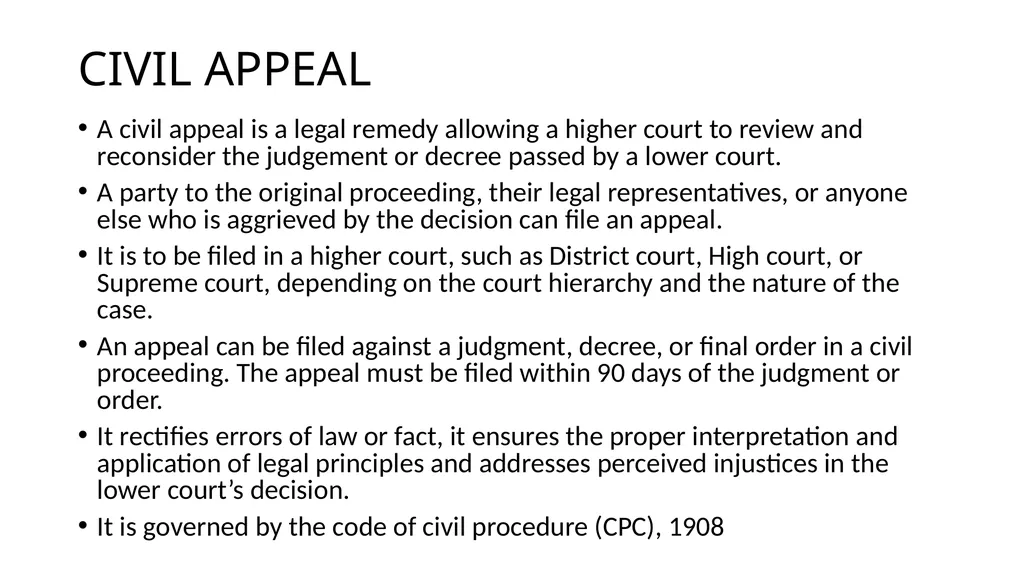
CIVIL APPEAL A civil appeal is a legal remedy allowing a higher court to review and reconsider the judgement or decree passed by a lower court.
A party to the original proceeding, their legal representatives, or anyone else who is aggrieved by the decision can file an appeal.
It is to be filed in a higher court, such as District court, High court, or Supreme court, depending on the court hierarchy and the nature of the case.
An appeal can be filed against a judgment, decree, or final order in a civil proceeding. The appeal must be filed within 90 days of the judgment or order.
It rectifies errors of law or fact, it ensures the proper interpretation and application of legal principles and addresses perceived injustices in the lower court’s decision.
It is governed by the code of civil procedure (CPC), 1908<br>
A party to the original proceeding, their legal representatives, or anyone else who is aggrieved by the decision can file an appeal.
It is to be filed in a higher court, such as District court, High court, or Supreme court, depending on the court hierarchy and the nature of the case.
An appeal can be filed against a judgment, decree, or final order in a civil proceeding. The appeal must be filed within 90 days of the judgment or order.
It rectifies errors of law or fact, it ensures the proper interpretation and application of legal principles and addresses perceived injustices in the lower court’s decision.
It is governed by the code of civil procedure (CPC), 1908<br>
31
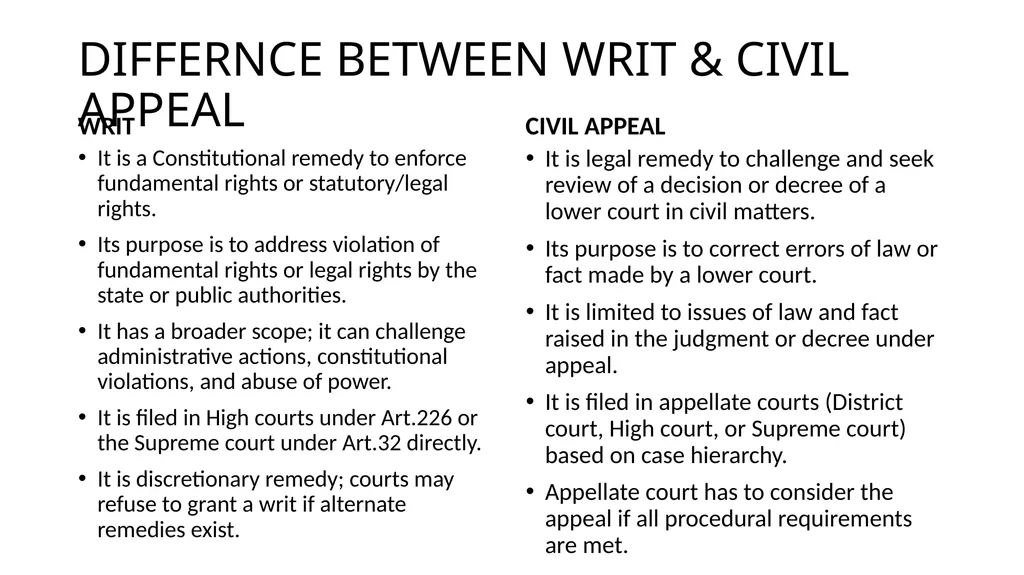
DIFFERNCE BETWEEN WRIT & CIVIL APPEAL WRIT It is a Constitutional remedy to enforce fundamental rights or statutory/legal rights.
Its purpose is to address violation of fundamental rights or legal rights by the state or public authorities.
It has a broader scope; it can challenge administrative actions, constitutional violations, and abuse of power.
It is filed in High courts under Art.226 or the Supreme court under Art.32 directly.
It is discretionary remedy; courts may refuse to grant a writ if alternate remedies exist. CIVIL APPEAL It is legal remedy to challenge and seek review of a decision or decree of a lower court in civil matters.
Its purpose is to correct errors of law or fact made by a lower court.
It is limited to issues of law and fact raised in the judgment or decree under appeal.
It is filed in appellate courts (District court, High court, or Supreme court) based on case hierarchy.
Appellate court has to consider the appeal if all procedural requirements are met.<br>
Its purpose is to address violation of fundamental rights or legal rights by the state or public authorities.
It has a broader scope; it can challenge administrative actions, constitutional violations, and abuse of power.
It is filed in High courts under Art.226 or the Supreme court under Art.32 directly.
It is discretionary remedy; courts may refuse to grant a writ if alternate remedies exist. CIVIL APPEAL It is legal remedy to challenge and seek review of a decision or decree of a lower court in civil matters.
Its purpose is to correct errors of law or fact made by a lower court.
It is limited to issues of law and fact raised in the judgment or decree under appeal.
It is filed in appellate courts (District court, High court, or Supreme court) based on case hierarchy.
Appellate court has to consider the appeal if all procedural requirements are met.<br>
32
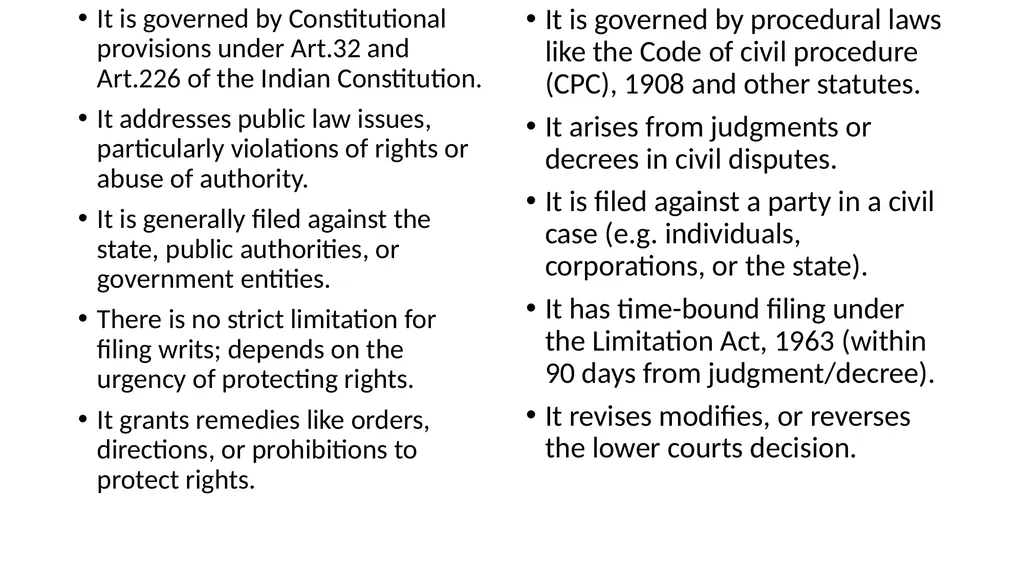
It is governed by Constitutional provisions under Art.32 and Art.226 of the Indian Constitution.
It addresses public law issues, particularly violations of rights or abuse of authority.
It is generally filed against the state, public authorities, or government entities.
There is no strict limitation for filing writs; depends on the urgency of protecting rights.
It grants remedies like orders, directions, or prohibitions to protect rights. It is governed by procedural laws like the Code of civil procedure (CPC), 1908 and other statutes.
It arises from judgments or decrees in civil disputes.
It is filed against a party in a civil case (e.g. individuals, corporations, or the state).
It has time-bound filing under the Limitation Act, 1963 (within 90 days from judgment/decree).
It revises modifies, or reverses the lower courts decision.<br>
It addresses public law issues, particularly violations of rights or abuse of authority.
It is generally filed against the state, public authorities, or government entities.
There is no strict limitation for filing writs; depends on the urgency of protecting rights.
It grants remedies like orders, directions, or prohibitions to protect rights. It is governed by procedural laws like the Code of civil procedure (CPC), 1908 and other statutes.
It arises from judgments or decrees in civil disputes.
It is filed against a party in a civil case (e.g. individuals, corporations, or the state).
It has time-bound filing under the Limitation Act, 1963 (within 90 days from judgment/decree).
It revises modifies, or reverses the lower courts decision.<br>
33
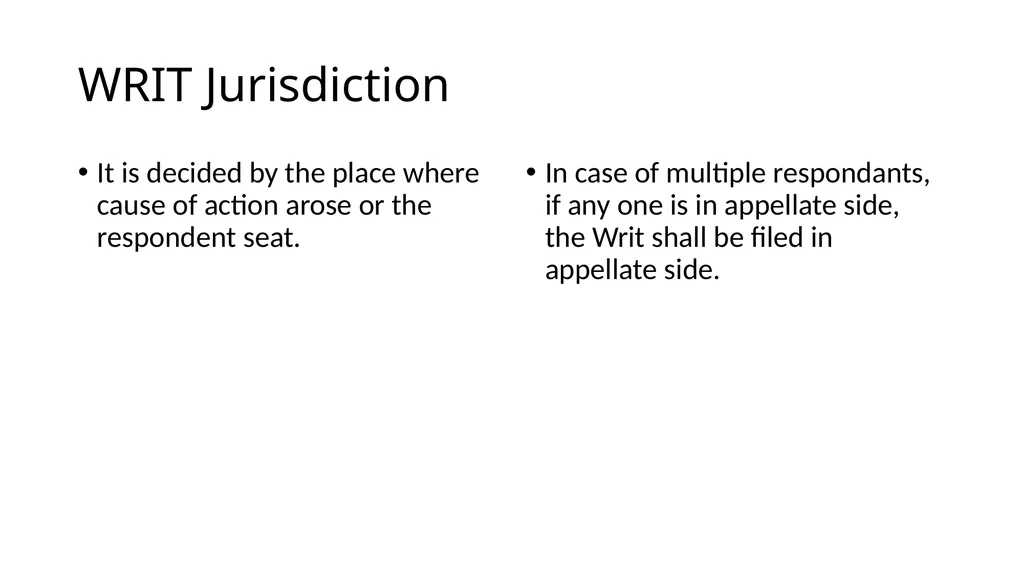
WRIT Jurisdiction It is decided by the place where cause of action arose or the respondent seat. In case of multiple respondants, if any one is in appellate side, the Writ shall be filed in appellate side.<br>
34
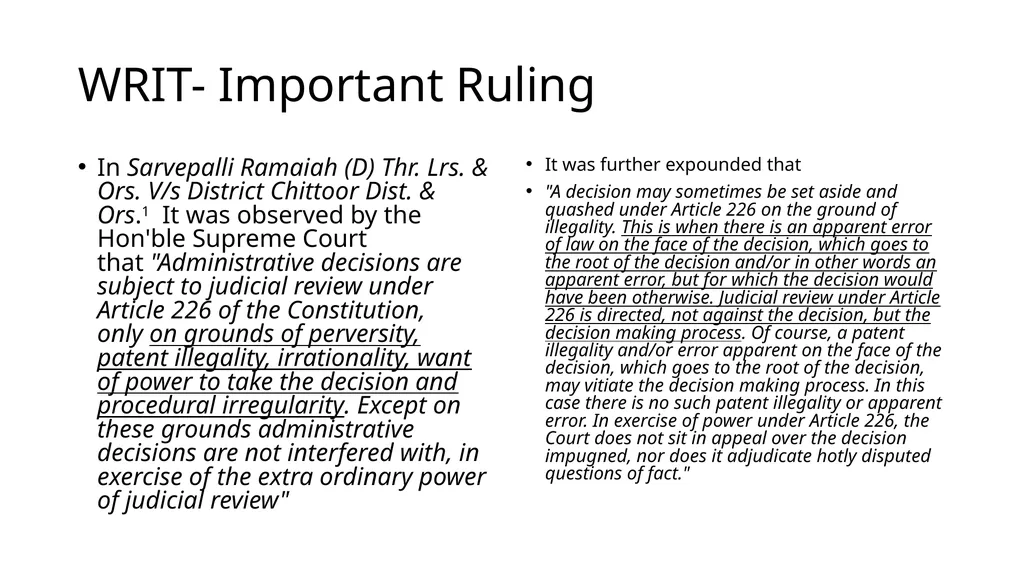
WRIT- Important Ruling In Sarvepalli Ramaiah (D) Thr. Lrs. & Ors. V/s District Chittoor Dist. & Ors.1 It was observed by the Hon'ble Supreme Court that "Administrative decisions are subject to judicial review under Article 226 of the Constitution, only on grounds of perversity, patent illegality, irrationality, want of power to take the decision and procedural irregularity. Except on these grounds administrative decisions are not interfered with, in exercise of the extra ordinary power of judicial review" It was further expounded that
"A decision may sometimes be set aside and quashed under Article 226 on the ground of illegality. This is when there is an apparent error of law on the face of the decision, which goes to the root of the decision and/or in other words an apparent error, but for which the decision would have been otherwise. Judicial review under Article 226 is directed, not against the decision, but the decision making process. Of course, a patent illegality and/or error apparent on the face of the decision, which goes to the root of the decision, may vitiate the decision making process. In this case there is no such patent illegality or apparent error. In exercise of power under Article 226, the Court does not sit in appeal over the decision impugned, nor does it adjudicate hotly disputed questions of fact."<br>
"A decision may sometimes be set aside and quashed under Article 226 on the ground of illegality. This is when there is an apparent error of law on the face of the decision, which goes to the root of the decision and/or in other words an apparent error, but for which the decision would have been otherwise. Judicial review under Article 226 is directed, not against the decision, but the decision making process. Of course, a patent illegality and/or error apparent on the face of the decision, which goes to the root of the decision, may vitiate the decision making process. In this case there is no such patent illegality or apparent error. In exercise of power under Article 226, the Court does not sit in appeal over the decision impugned, nor does it adjudicate hotly disputed questions of fact."<br>
35
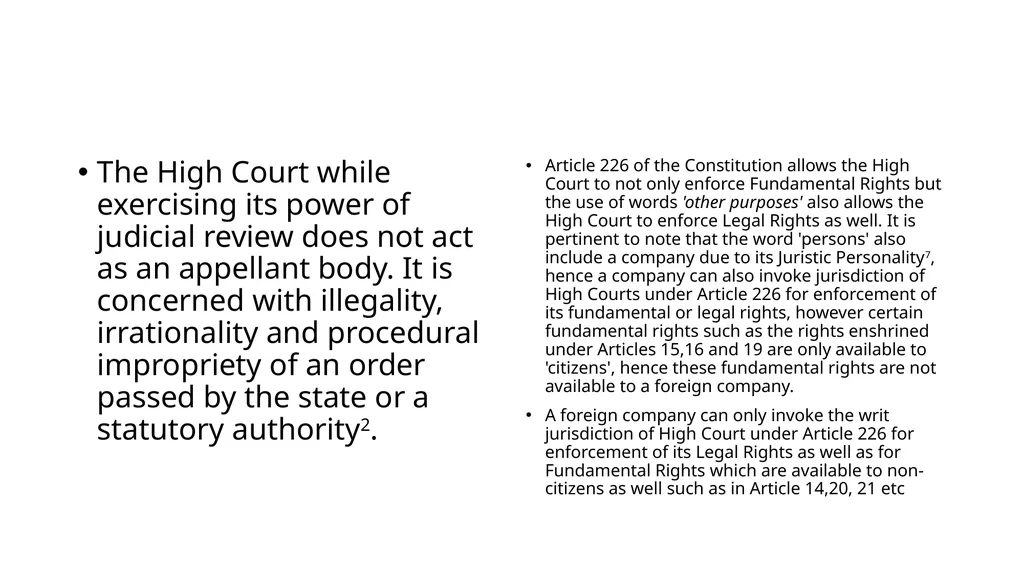
The High Court while exercising its power of judicial review does not act as an appellant body. It is concerned with illegality, irrationality and procedural impropriety of an order passed by the state or a statutory authority2. Article 226 of the Constitution allows the High Court to not only enforce Fundamental Rights but the use of words 'other purposes' also allows the High Court to enforce Legal Rights as well. It is pertinent to note that the word 'persons' also include a company due to its Juristic Personality7, hence a company can also invoke jurisdiction of High Courts under Article 226 for enforcement of its fundamental or legal rights, however certain fundamental rights such as the rights enshrined under Articles 15,16 and 19 are only available to 'citizens', hence these fundamental rights are not available to a foreign company.
A foreign company can only invoke the writ jurisdiction of High Court under Article 226 for enforcement of its Legal Rights as well as for Fundamental Rights which are available to non-citizens as well such as in Article 14,20, 21 etc<br>
A foreign company can only invoke the writ jurisdiction of High Court under Article 226 for enforcement of its Legal Rights as well as for Fundamental Rights which are available to non-citizens as well such as in Article 14,20, 21 etc<br>
36
Person In Erbis Engineering Company Ltd. V/s State of West Bengal6, the Hon'ble High Court of Calcutta held that, "The word "person" includes "any company". It is pertinent to note while Articles 15, 16 and 19 confer fundamental rights on the "citizens", Article 14 confers fundamental rights on "any person." This distinction between a '"citizen" and a "person" was engrafted in our Constitution by its framers with a specific intent - to grant certain fundamental rights to its "citizens" and to grant certain rights or legal rights to a "person". There is no ambiguity in the language of the Articles and the intent is expressed with sufficient linguistic precision. Thus, then definition of "person" is wide enough to encompass a foreign company which has been permitted to establish business in the country by the authorities." It was further expounded by the High Court that "High Court under Article 226 has been conferred power not only to issue writs for enforcement of fundamental rights but also for any other purpose", meaning thereby for enforcement of any legal right. Now it is a settled proposition of law that the words "for any other purpose" in Article 226, which are absent in Article 32, make the jurisdiction of the High Court wide and more extensive than that of the Supreme Court. Therefore, High Court can exercise its power to issue writs under Article 226 for two-fold purposes-for enforcement of (i) fundamental rights and ii) for enforcement of legal rights. Hence, if it is established by a party aggrieved that he has a legal right and such right has been infringed, an order or writ may be issued under Article 226."<br>