
Write Good, Part 1 Structuring Your Writing June
Description: Write Good, Part 1 Structuring Your Writing June 29, 2023 1 Boz Bostrom, CPA Professor of Accounting and Finance Saint Bens and Saint Johns bbostromcsbsju.edu (612) 414-9629 Jamie Lauer Freelance Editor JL Editorial Services
Related Topics
Download Presentation
"Write Good, Part 1 Structuring Your Writing June" is the property of its rightful owner. Permission is granted to download and print the materials on this website for personal, non-commercial use only, and to display it on your personal computer provided you do not modify the materials and that you retain all copyright notices contained in the materials. By downloading content from our website, you accept the terms of this agreement.
Presentation Transcript
slide1. Write Good, Part 1
Structuring Your Writing June 29, 2023 1 Boz Bostrom, CPA
Professor of Accounting and Finance
Saint Ben’s and Saint John’s
bbostrom@csbsju.edu | (612) 414-9629 Jamie Lauer
Freelance Editor
JL Editorial Services
jamie@jamielauer.com | (612) 816-0259<br>
slide2. Logistics Polling questions throughout the meeting
Required for CPE
If you have issues answering the polling questions, please chat or email across your answer
2.0 CPE hours (Specialized Knowledge – Technical)
Partial credit available – minimum of 1.0 hours
Questions (and tips) are very welcome; submit at any time
Course evaluation and CPE certificate will be emailed within a day 2<br>
slide3. Learning objectives/agenda Understand the components that make up good writing.
Understand how to structure and organize written work, including emails, letters, and reports. 3<br>
slide4. Introductions Boz
Nine years in the Big 4 CPA firms
Began at Saint Ben’s and Saint John’s in 2004
Speaks nationally on the topics of ethics and leadership
Wrote the memoirs of John Gagliardi and Bill Sexton
Jamie
MA in Comparative Lit, Certificate in Literary Translation
Worked in marketing/communications with a technology firm for 4 years
Started JL Editorial Services in January 2020 4<br>
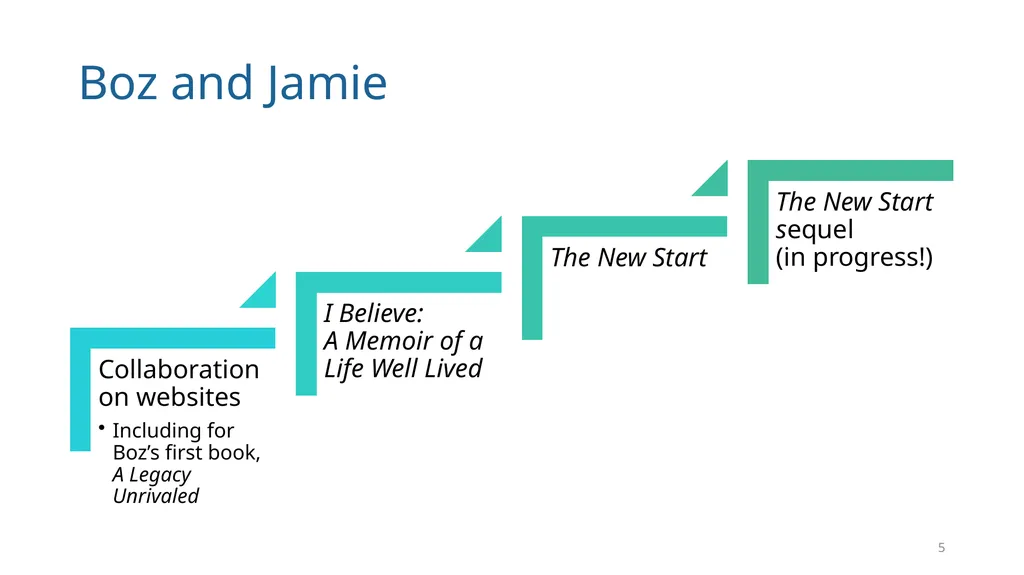
slide5. Boz and Jamie 5<br>
slide6. Importance of good writing 6<br>
slide7. Poll #1 – How important would you say writing is in your day-to-day work? Very important
Important
Neither important nor unimportant
Unimportant
Very unimportant 7<br>
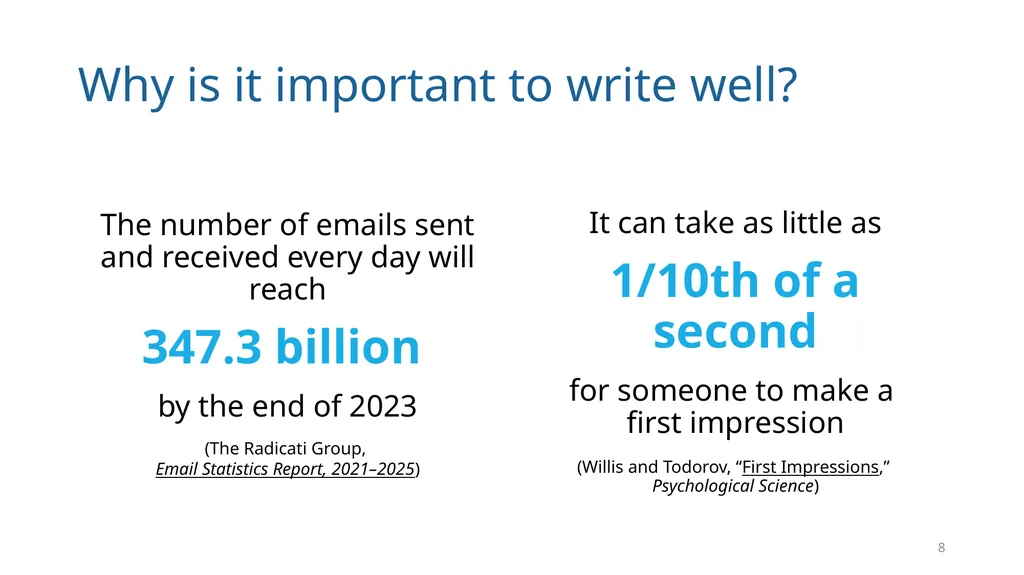
slide8. Why is it important to write well? The number of emails sent and received every day will reach
347.3 billion
by the end of 2023
(The Radicati Group, Email Statistics Report, 2021–2025) It can take as little as
1/10th of a second
for someone to make a first impression
(Willis and Todorov, “First Impressions,” Psychological Science) 8<br>
slide9. Writing impacts you, the people you work with, and your business 9 Photo by Timon Studler on Unsplash<br>
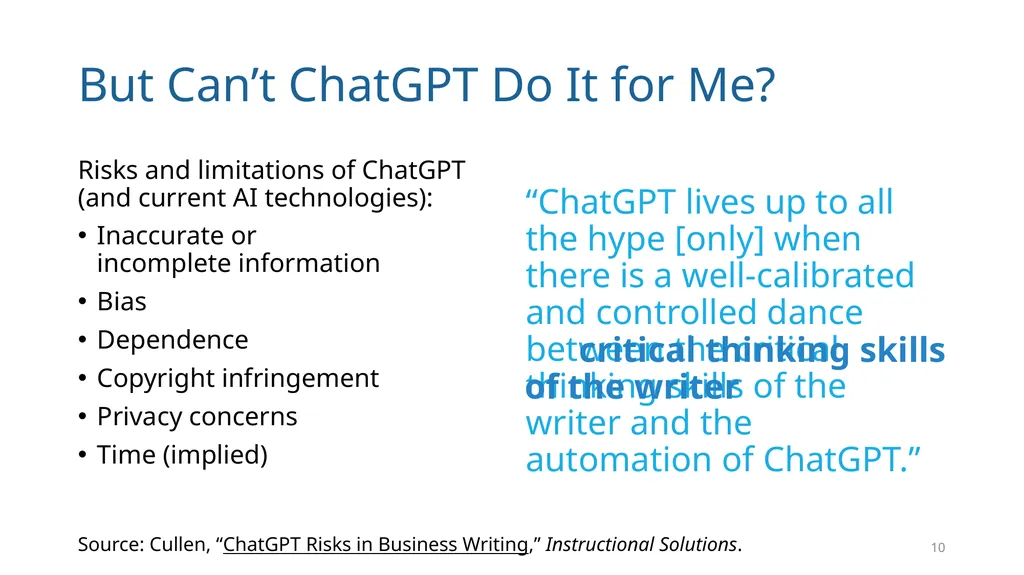
slide10. But Can’t ChatGPT Do It for Me? Risks and limitations of ChatGPT (and current AI technologies):
Inaccurate or incomplete information
Bias
Dependence
Copyright infringement
Privacy concerns
Time (implied) “ChatGPT lives up to all the hype [only] when there is a well-calibrated and controlled dance between the critical thinking skills of the writer and the automation of ChatGPT.” 10 Source: Cullen, “ChatGPT Risks in Business Writing,” Instructional Solutions. critical thinking skills of the writer<br>
slide11. Traits of good writing 11<br>
slide12. Traits of good writing? Traits of bad writing? 12<br>
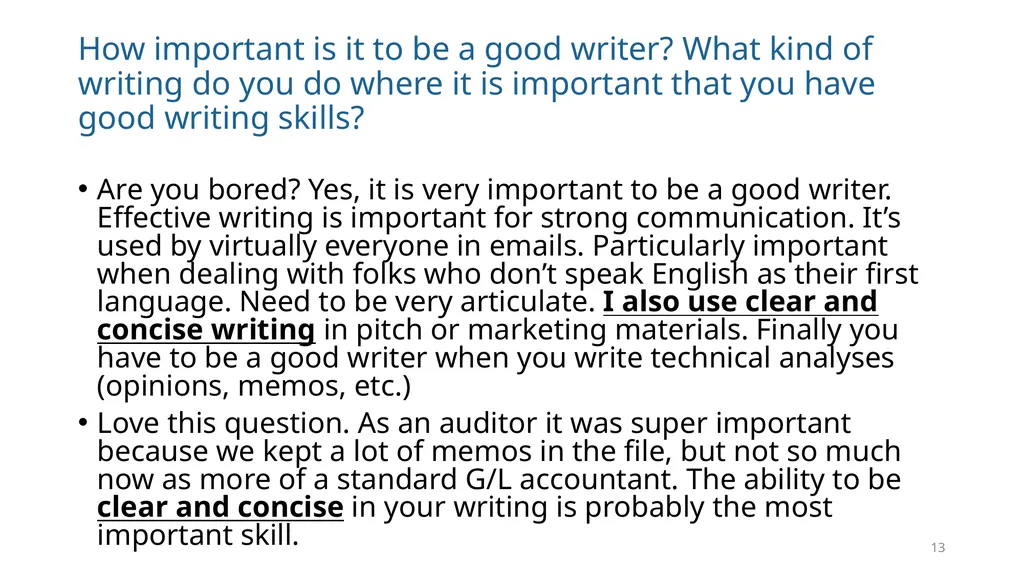
slide13. How important is it to be a good writer? What kind of writing do you do where it is important that you have good writing skills? Are you bored? Yes, it is very important to be a good writer. Effective writing is important for strong communication. It’s used by virtually everyone in emails. Particularly important when dealing with folks who don’t speak English as their first language. Need to be very articulate. I also use clear and concise writing in pitch or marketing materials. Finally you have to be a good writer when you write technical analyses (opinions, memos, etc.)
Love this question. As an auditor it was super important because we kept a lot of memos in the file, but not so much now as more of a standard G/L accountant. The ability to be clear and concise in your writing is probably the most important skill. 13<br>
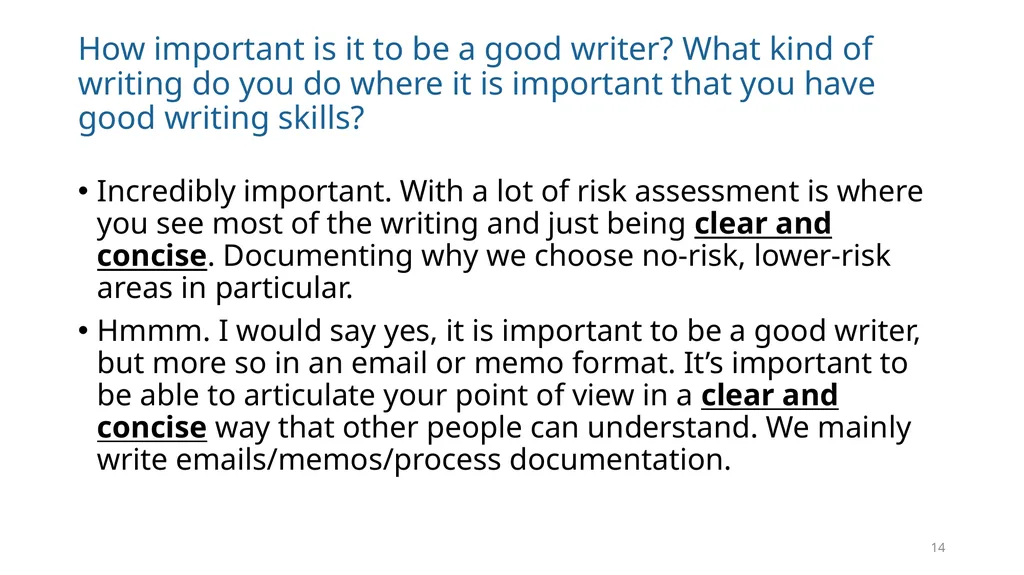
slide14. How important is it to be a good writer? What kind of writing do you do where it is important that you have good writing skills? Incredibly important. With a lot of risk assessment is where you see most of the writing and just being clear and concise. Documenting why we choose no-risk, lower-risk areas in particular.
Hmmm. I would say yes, it is important to be a good writer, but more so in an email or memo format. It’s important to be able to articulate your point of view in a clear and concise way that other people can understand. We mainly write emails/memos/process documentation. 14<br>
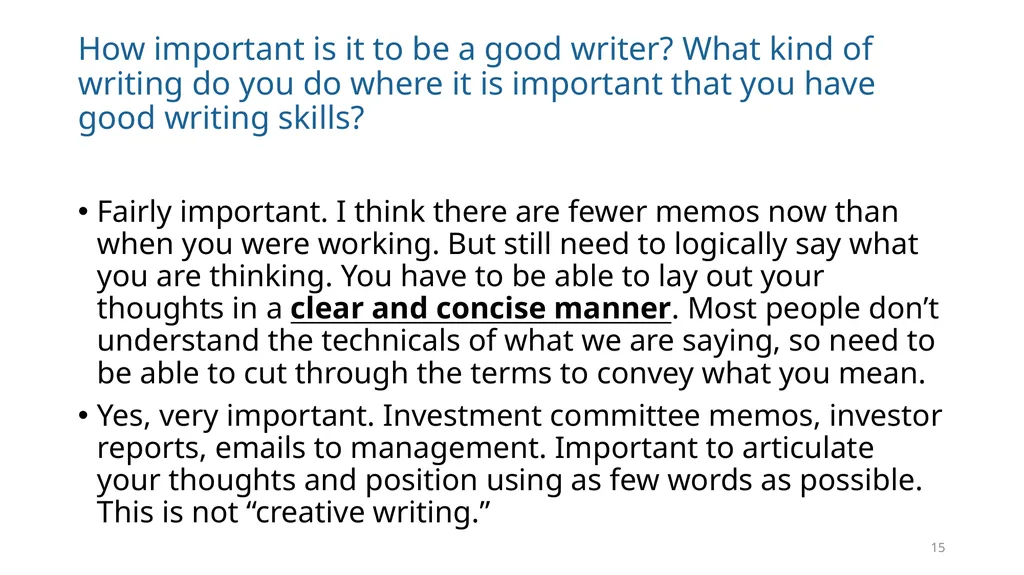
slide15. How important is it to be a good writer? What kind of writing do you do where it is important that you have good writing skills? Fairly important. I think there are fewer memos now than when you were working. But still need to logically say what you are thinking. You have to be able to lay out your thoughts in a clear and concise manner. Most people don’t understand the technicals of what we are saying, so need to be able to cut through the terms to convey what you mean.
Yes, very important. Investment committee memos, investor reports, emails to management. Important to articulate your thoughts and position using as few words as possible. This is not “creative writing.” 15<br>
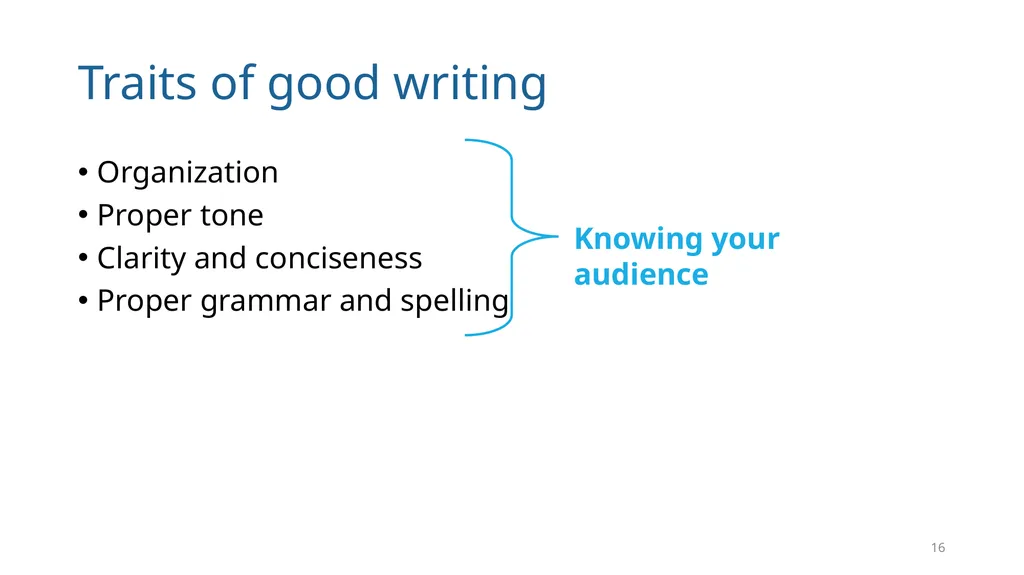
slide16. Traits of good writing Organization
Proper tone
Clarity and conciseness
Proper grammar and spelling 16 Knowing your audience<br>
slide17. Common pitfalls Lack of coherent flow
Not paying attention to tone
Being verbose/not being clear and concise
Blatant grammar and spelling mistakes
Not writing for your audience 17<br>
slide18. Poll #2 – In which of the following areas do you most want to improve your writing? Organization and flow
Tone
Clarity and conciseness
Grammar and spelling
All of the above
None of the above 18<br>
slide19. Organizing your writing 19<br>
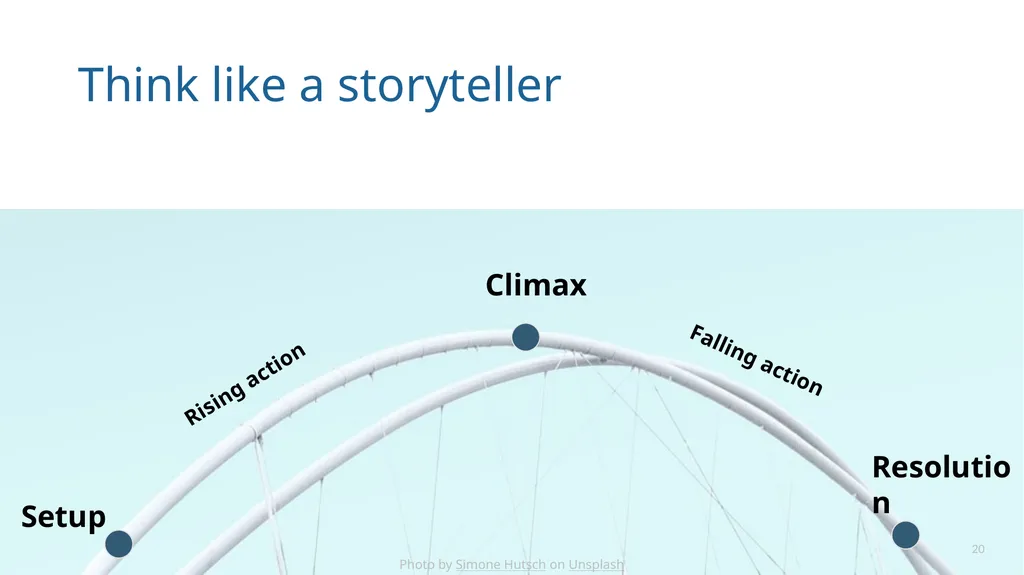
slide20. Think like a storyteller 20 20 Climax Setup Resolution Rising action Falling action Photo by Simone Hutsch on Unsplash<br>
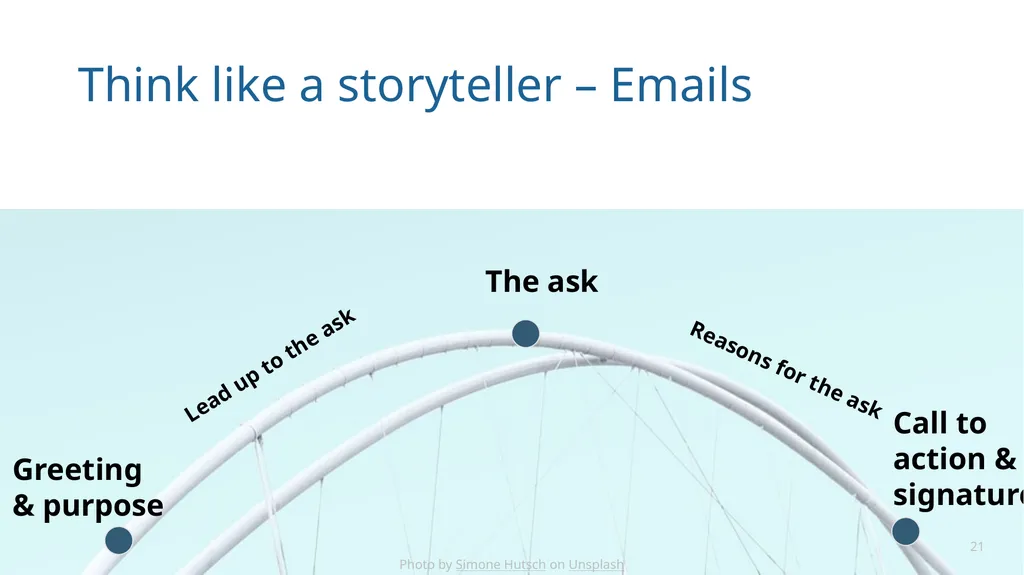
slide21. Think like a storyteller – Emails 21 The ask Greeting & purpose Call to action & signature Lead up to the ask Reasons for the ask Photo by Simone Hutsch on Unsplash<br>
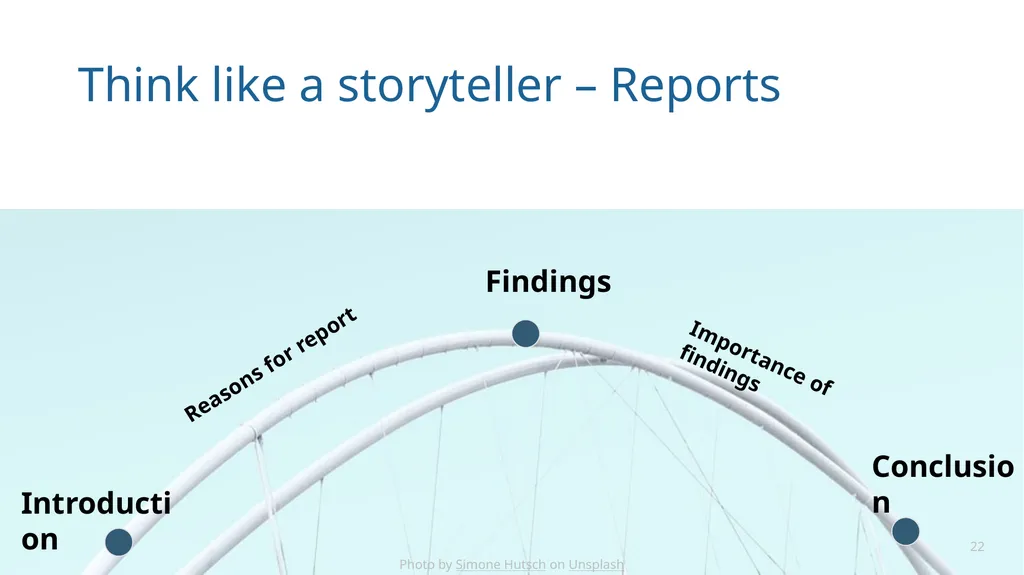
slide22. Photo by Simone Hutsch on Unsplash Think like a storyteller – Reports 22 Findings Introduction Conclusion Reasons for report Importance of findings<br>
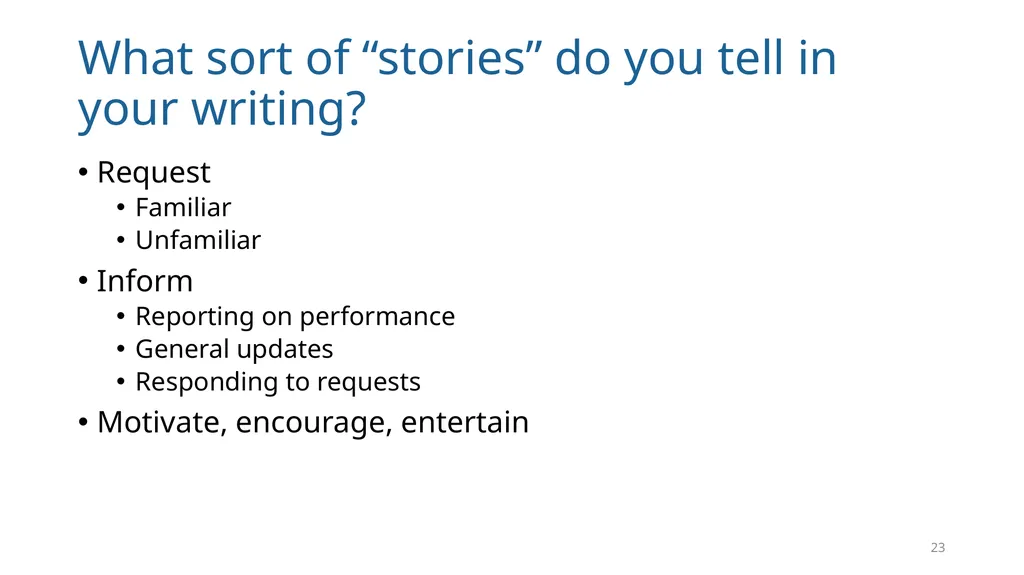
slide23. What sort of “stories” do you tell in your writing? Request
Familiar
Unfamiliar
Inform
Reporting on performance
General updates
Responding to requests
Motivate, encourage, entertain 23<br>
slide24. Plan A plan will help you be both more organized as well as clearer and more concise
You will know exactly what you want to say and avoid rambling
Oftentimes you are responding to a request – read the request carefully and understand exactly why you are writing
Write down the purpose in 1–2 sentences
Until you know why you are writing, don’t write anything! 24<br>
slide25. Plan – Understand your audience Who is/are the reader(s) of your writing?
Understand their knowledge of the topic
Understand their biases/anticipate their questions 25<br>
slide26. Plan – Use the following format Introduction – context, purpose, and recommendation/request
Body
List your supporting points/organize by order of importance. Order of importance to who?
Your reader!
Conclusion/action
Example . . . 26<br>
slide27. How can we deal with writer’s block? Draft!
Put your ideas down on paper
Don’t stop to edit
Write the parts of the document in whatever order you wish 27<br>
slide28. Revise Revise the document for logical flow
Examine transitions: a single word, short phrase, or a full sentence
Use the correct transition, but also don’t overuse transitions
Review the document for clarity and conciseness
Proofread for grammatical, mechanical, and typographical errors
Examine a hard copy or read it out loud
Spacing between paragraphs
If it is a critical document, try to sleep on it. Why??? 28<br>
slide29. 29<br>
slide30. Poll #3 – The three stages of writing are plan, draft, and revise. Which do you struggle with most? Plan
Draft
Revise
All of them!
None of them 30<br>
slide31. Writing emails 31<br>
slide32. What are your pet peeves when receiving emails? 32<br>
slide33. What kinds of emails can grab your attention? 33<br>
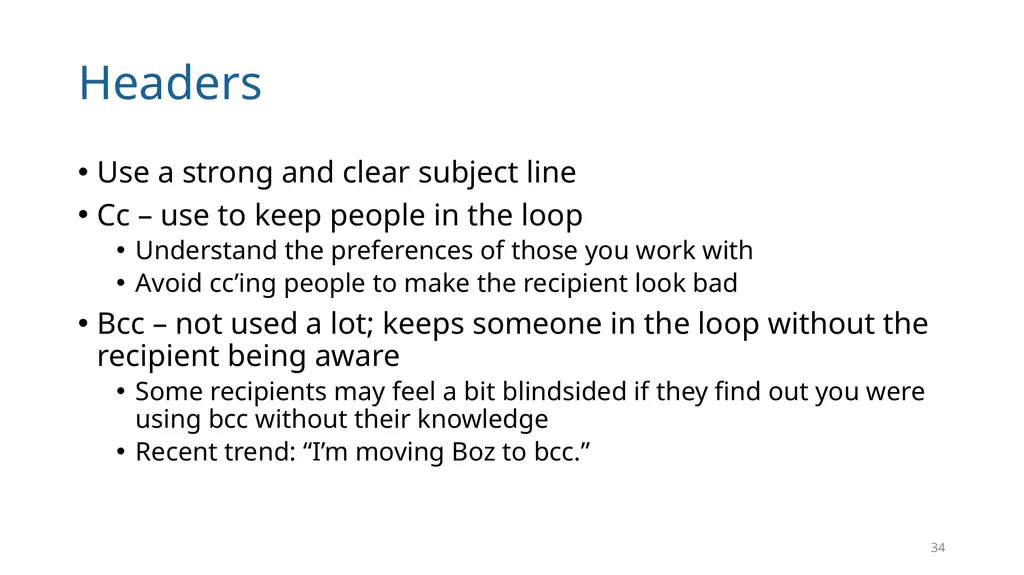
slide34. Headers Use a strong and clear subject line
Cc – use to keep people in the loop
Understand the preferences of those you work with
Avoid cc’ing people to make the recipient look bad
Bcc – not used a lot; keeps someone in the loop without the recipient being aware
Some recipients may feel a bit blindsided if they find out you were using bcc without their knowledge
Recent trend: “I’m moving Boz to bcc.” 34<br>
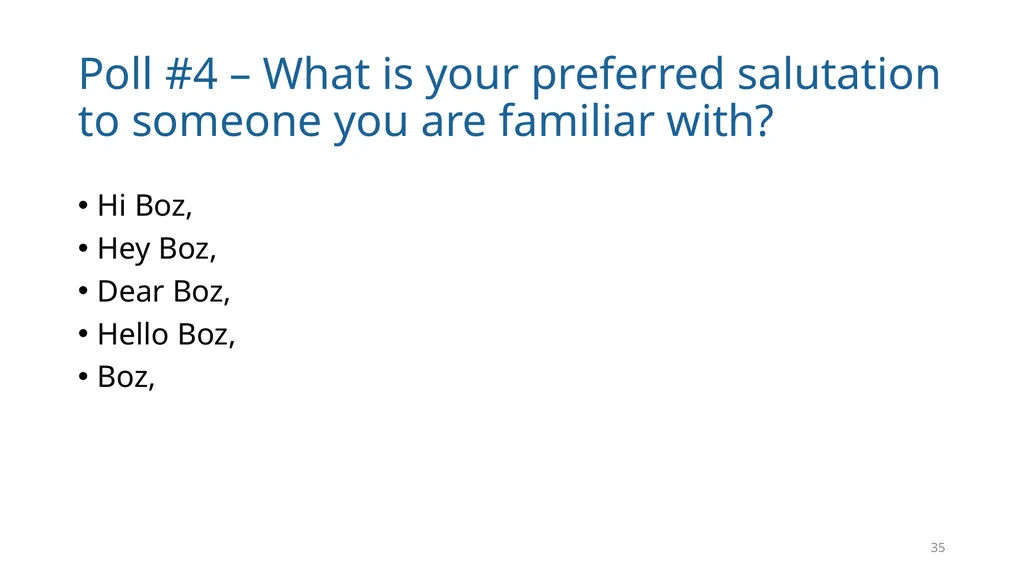
slide35. Poll #4 – What is your preferred salutation to someone you are familiar with? Hi Boz,
Hey Boz,
Dear Boz,
Hello Boz,
Boz, 35<br>
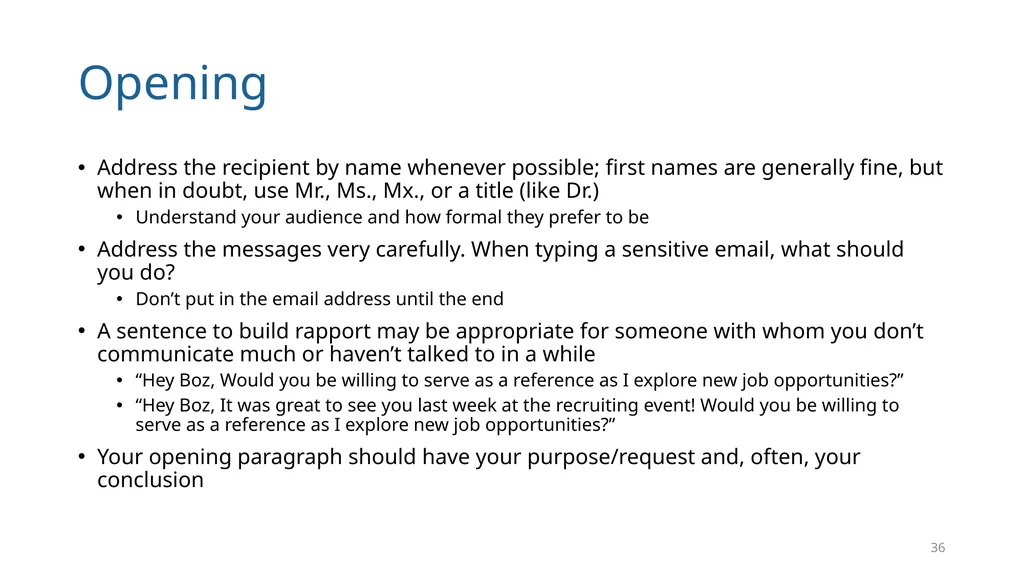
slide36. Opening Address the recipient by name whenever possible; first names are generally fine, but when in doubt, use Mr., Ms., Mx., or a title (like Dr.)
Understand your audience and how formal they prefer to be
Address the messages very carefully. When typing a sensitive email, what should you do?
Don’t put in the email address until the end
A sentence to build rapport may be appropriate for someone with whom you don’t communicate much or haven’t talked to in a while
“Hey Boz, Would you be willing to serve as a reference as I explore new job opportunities?”
“Hey Boz, It was great to see you last week at the recruiting event! Would you be willing to serve as a reference as I explore new job opportunities?”
Your opening paragraph should have your purpose/request and, often, your conclusion 36<br>
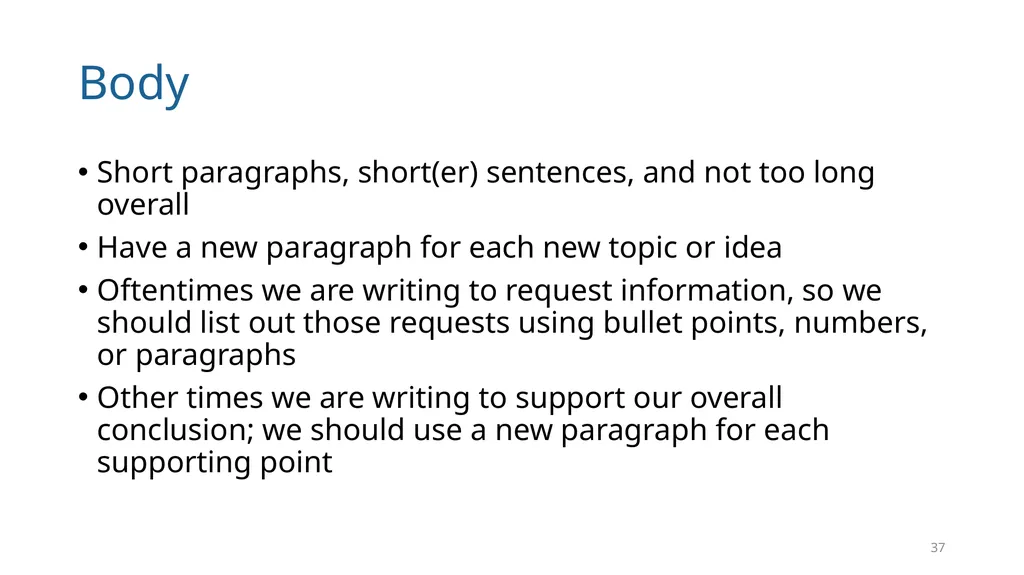
slide37. Body Short paragraphs, short(er) sentences, and not too long overall
Have a new paragraph for each new topic or idea
Oftentimes we are writing to request information, so we should list out those requests using bullet points, numbers, or paragraphs
Other times we are writing to support our overall conclusion; we should use a new paragraph for each supporting point 37<br>
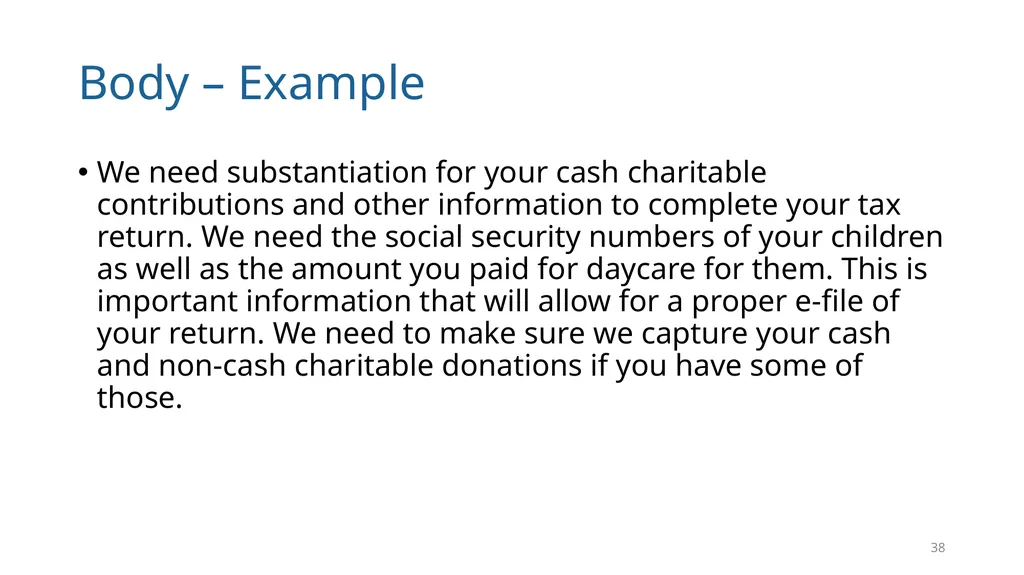
slide38. Body – Example We need substantiation for your cash charitable contributions and other information to complete your tax return. We need the social security numbers of your children as well as the amount you paid for daycare for them. This is important information that will allow for a proper e-file of your return. We need to make sure we capture your cash and non-cash charitable donations if you have some of those. 38<br>
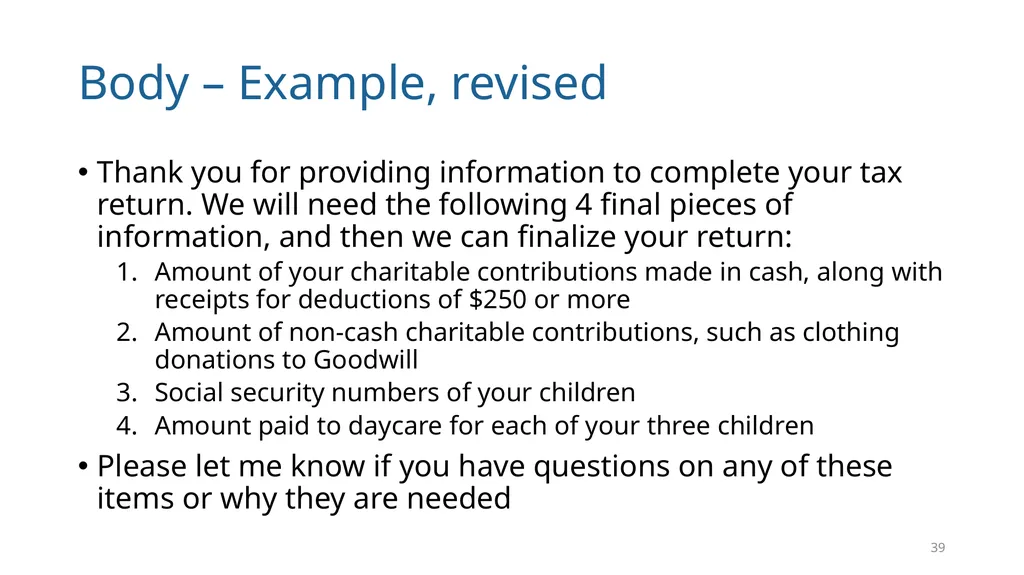
slide39. Body – Example, revised Thank you for providing information to complete your tax return. We will need the following 4 final pieces of information, and then we can finalize your return:
Amount of your charitable contributions made in cash, along with receipts for deductions of $250 or more
Amount of non-cash charitable contributions, such as clothing donations to Goodwill
Social security numbers of your children
Amount paid to daycare for each of your three children
Please let me know if you have questions on any of these items or why they are needed 39<br>
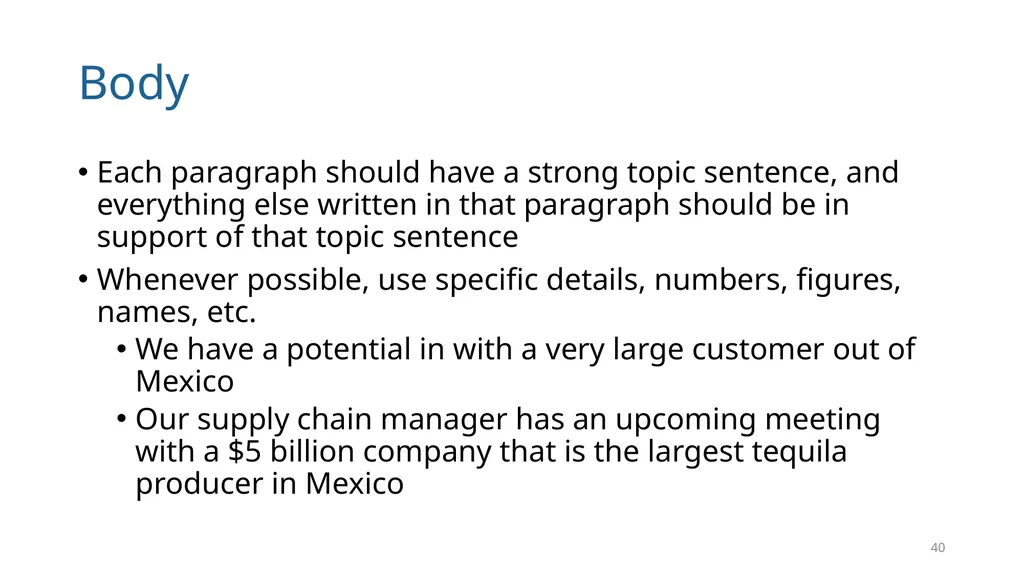
slide40. Body Each paragraph should have a strong topic sentence, and everything else written in that paragraph should be in support of that topic sentence
Whenever possible, use specific details, numbers, figures, names, etc.
We have a potential in with a very large customer out of Mexico
Our supply chain manager has an upcoming meeting with a $5 billion company that is the largest tequila producer in Mexico 40<br>
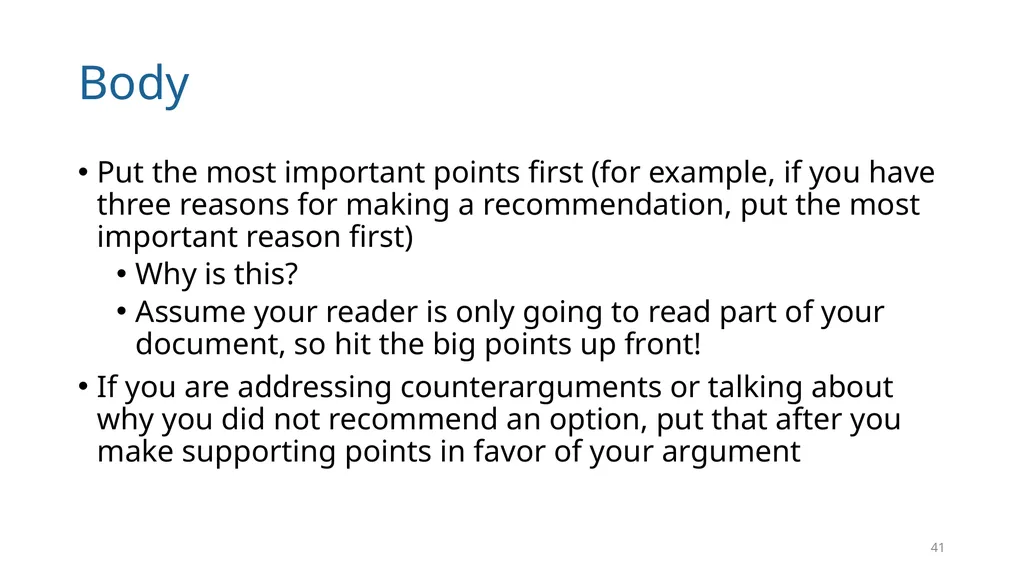
slide41. Body Put the most important points first (for example, if you have three reasons for making a recommendation, put the most important reason first)
Why is this?
Assume your reader is only going to read part of your document, so hit the big points up front!
If you are addressing counterarguments or talking about why you did not recommend an option, put that after you make supporting points in favor of your argument 41<br>
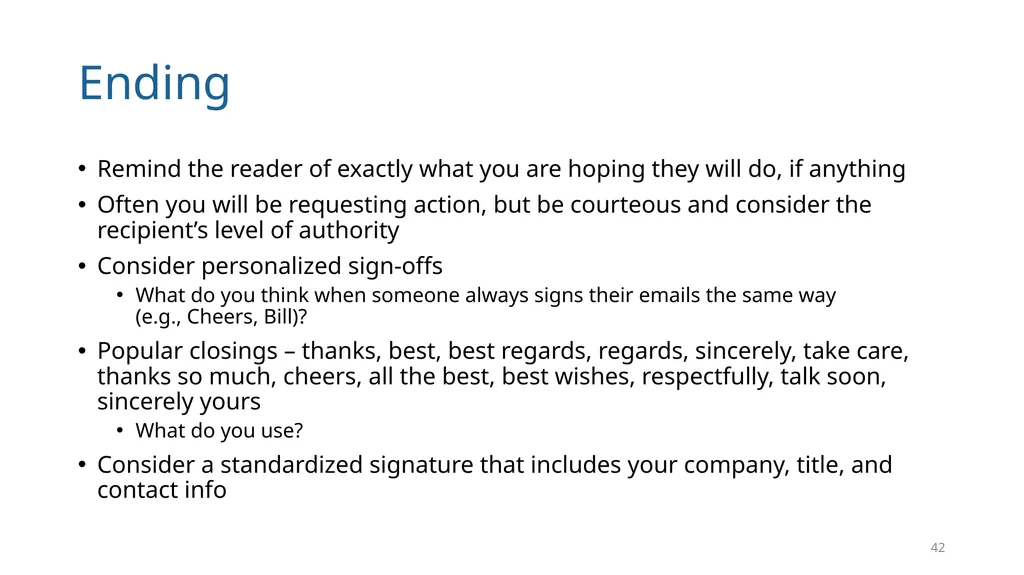
slide42. Ending Remind the reader of exactly what you are hoping they will do, if anything
Often you will be requesting action, but be courteous and consider the recipient’s level of authority
Consider personalized sign-offs
What do you think when someone always signs their emails the same way (e.g., Cheers, Bill)?
Popular closings – thanks, best, best regards, regards, sincerely, take care, thanks so much, cheers, all the best, best wishes, respectfully, talk soon, sincerely yours
What do you use?
Consider a standardized signature that includes your company, title, and contact info 42<br>
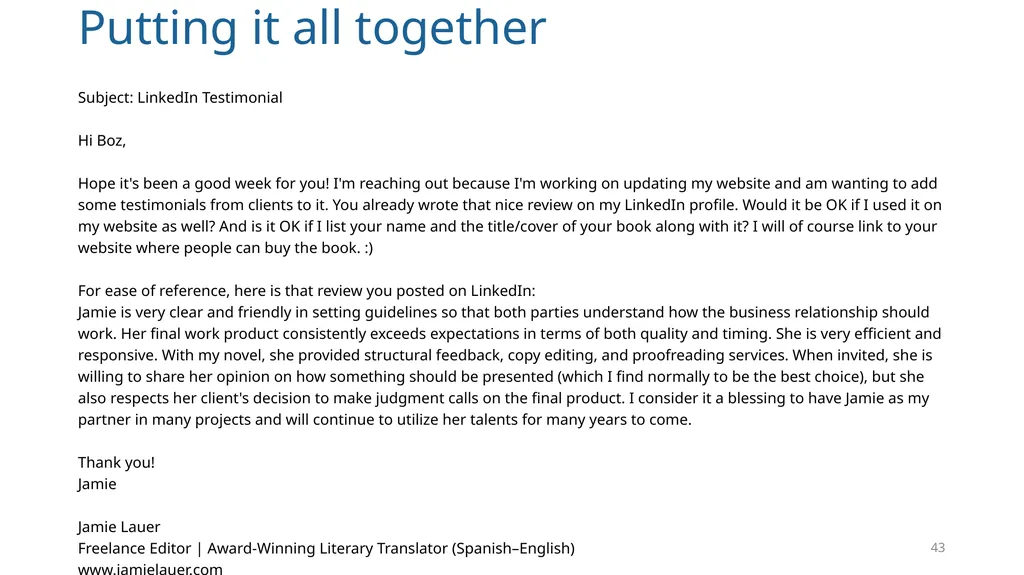
slide43. Putting it all together Subject: LinkedIn Testimonial
Hi Boz,
Hope it's been a good week for you! I'm reaching out because I'm working on updating my website and am wanting to add some testimonials from clients to it. You already wrote that nice review on my LinkedIn profile. Would it be OK if I used it on my website as well? And is it OK if I list your name and the title/cover of your book along with it? I will of course link to your website where people can buy the book. :)
For ease of reference, here is that review you posted on LinkedIn:
Jamie is very clear and friendly in setting guidelines so that both parties understand how the business relationship should work. Her final work product consistently exceeds expectations in terms of both quality and timing. She is very efficient and responsive. With my novel, she provided structural feedback, copy editing, and proofreading services. When invited, she is willing to share her opinion on how something should be presented (which I find normally to be the best choice), but she also respects her client's decision to make judgment calls on the final product. I consider it a blessing to have Jamie as my partner in many projects and will continue to utilize her talents for many years to come.
Thank you!
Jamie
Jamie Lauer
Freelance Editor | Award-Winning Literary Translator (Spanish–English)
www.jamielauer.com 43<br>
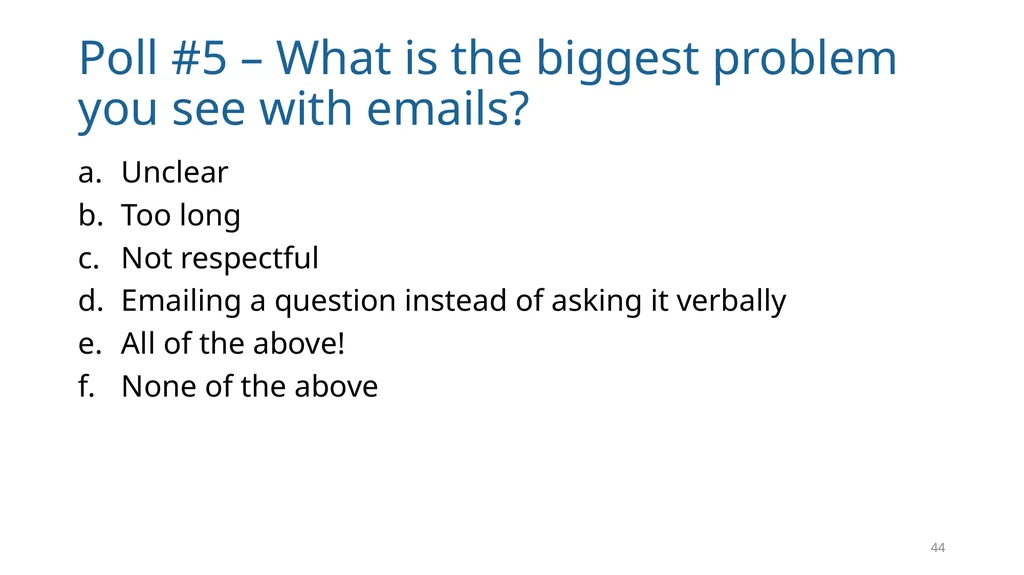
slide44. Poll #5 – What is the biggest problem you see with emails? Unclear
Too long
Not respectful
Emailing a question instead of asking it verbally
All of the above!
None of the above 44<br>
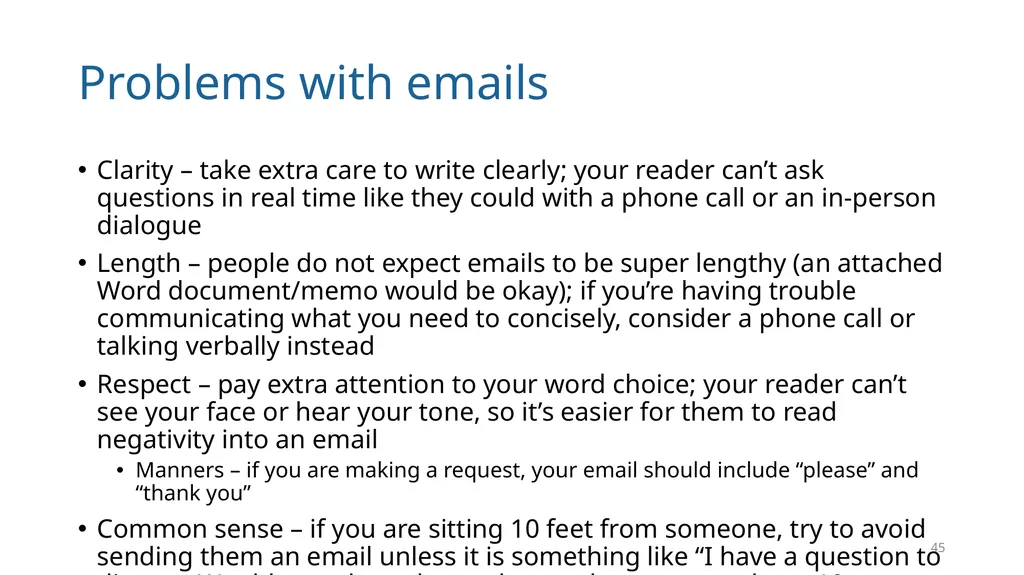
slide45. Problems with emails Clarity – take extra care to write clearly; your reader can’t ask questions in real time like they could with a phone call or an in-person dialogue
Length – people do not expect emails to be super lengthy (an attached Word document/memo would be okay); if you’re having trouble communicating what you need to concisely, consider a phone call or talking verbally instead
Respect – pay extra attention to your word choice; your reader can’t see your face or hear your tone, so it’s easier for them to read negativity into an email
Manners – if you are making a request, your email should include “please” and “thank you”
Common sense – if you are sitting 10 feet from someone, try to avoid sending them an email unless it is something like “I have a question to discuss. Would you please let me know when you may have 10 minutes?” 45<br>
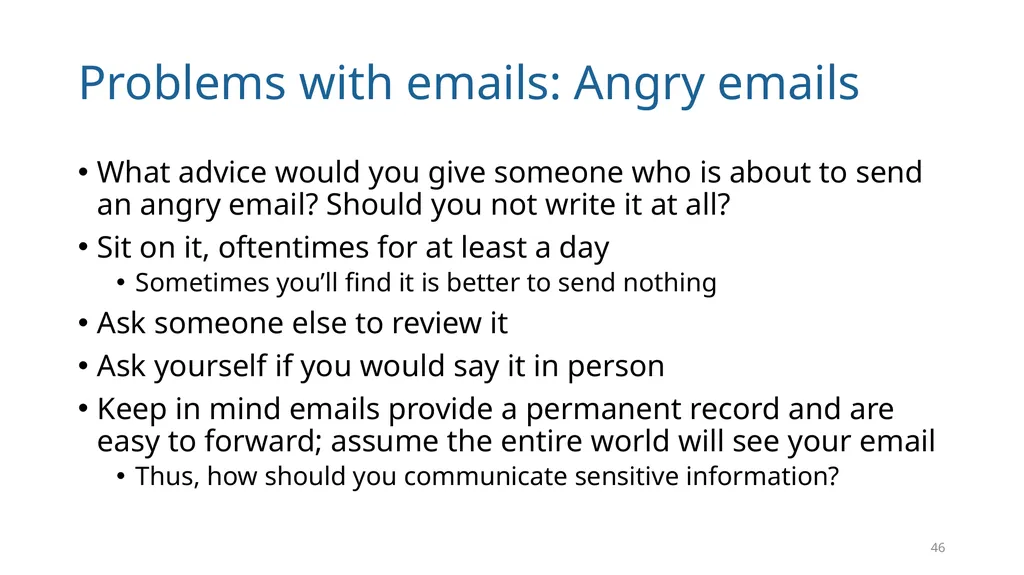
slide46. Problems with emails: Angry emails What advice would you give someone who is about to send an angry email? Should you not write it at all?
Sit on it, oftentimes for at least a day
Sometimes you’ll find it is better to send nothing
Ask someone else to review it
Ask yourself if you would say it in person
Keep in mind emails provide a permanent record and are easy to forward; assume the entire world will see your email
Thus, how should you communicate sensitive information? 46<br>
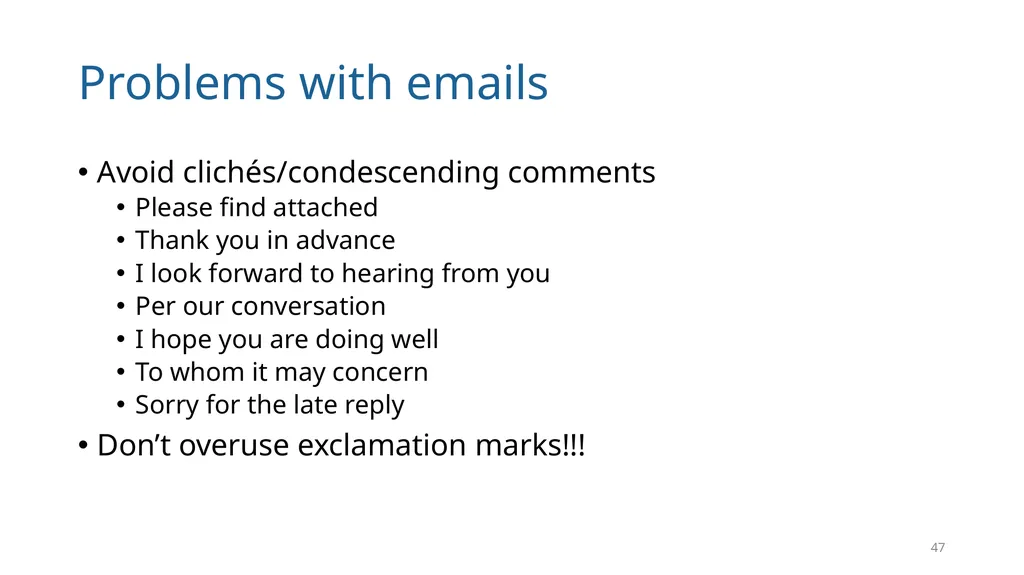
slide47. Problems with emails Avoid clichés/condescending comments
Please find attached
Thank you in advance
I look forward to hearing from you
Per our conversation
I hope you are doing well
To whom it may concern
Sorry for the late reply
Don’t overuse exclamation marks!!! 47<br>
slide48. Replying to emails Always try to reply within 24 hours, even if all you can say is that you are busy and need a couple of days to give a full reply
Bad news is better than no news! 48<br>
slide49. Scheduling emails Be careful about making requests or sending bad news in the evenings or on weekends
Draft it, but . . .
Schedule it to send during business hours
Keep it in your draft folder until the next business day 49<br>
slide50. Letters and reports (and longer emails) 50<br>
slide51. Poll #6 – How often do you write reports of a more technical nature? Regularly
Sometimes
Almost never 51<br>
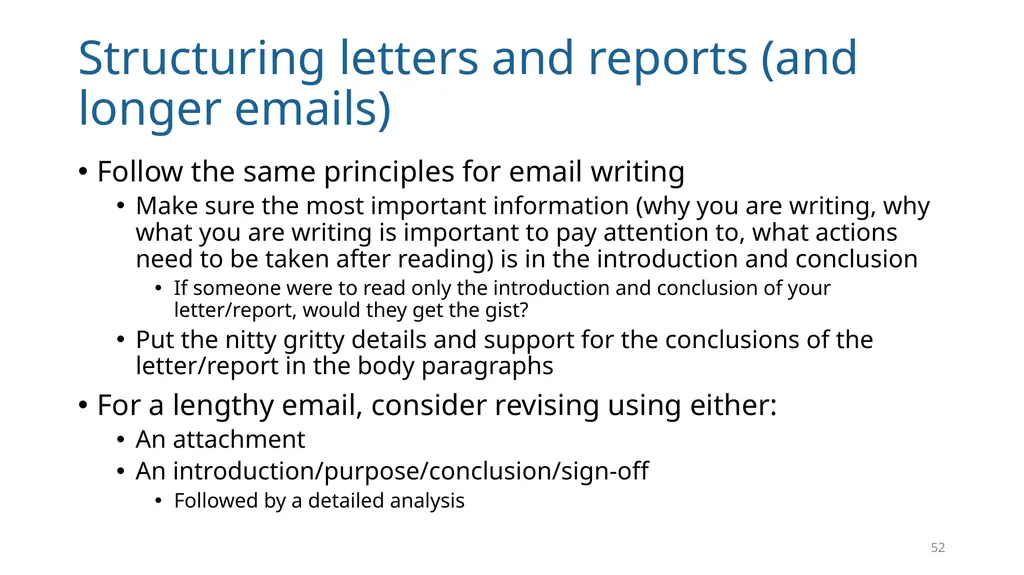
slide52. Structuring letters and reports (and longer emails) Follow the same principles for email writing
Make sure the most important information (why you are writing, why what you are writing is important to pay attention to, what actions need to be taken after reading) is in the introduction and conclusion
If someone were to read only the introduction and conclusion of your letter/report, would they get the gist?
Put the nitty gritty details and support for the conclusions of the letter/report in the body paragraphs
For a lengthy email, consider revising using either:
An attachment
An introduction/purpose/conclusion/sign-off
Followed by a detailed analysis 52<br>
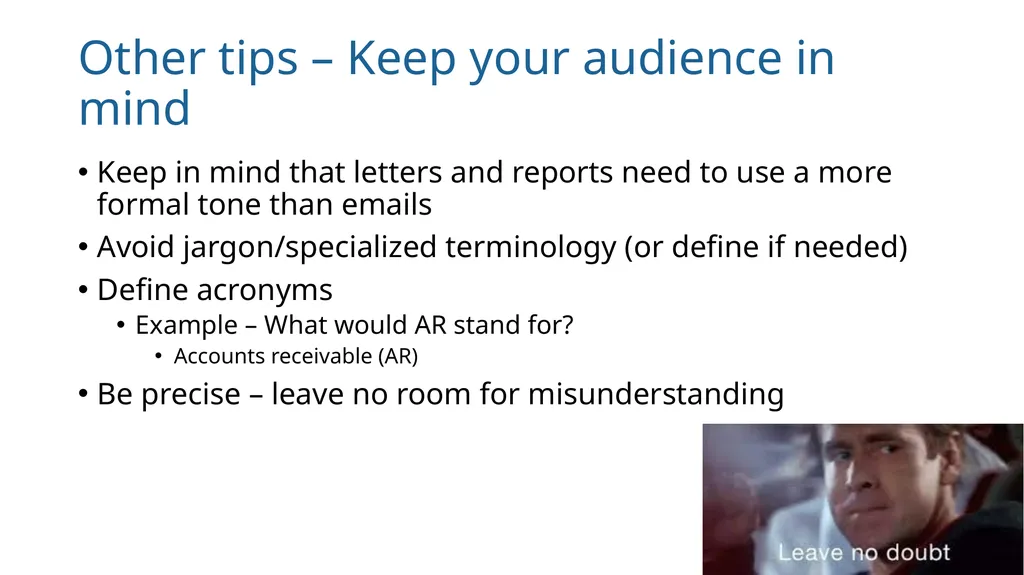
slide53. Other tips – Keep your audience in mind Keep in mind that letters and reports need to use a more formal tone than emails
Avoid jargon/specialized terminology (or define if needed)
Define acronyms
Example – What would AR stand for?
Accounts receivable (AR)
Be precise – leave no room for misunderstanding 53<br>
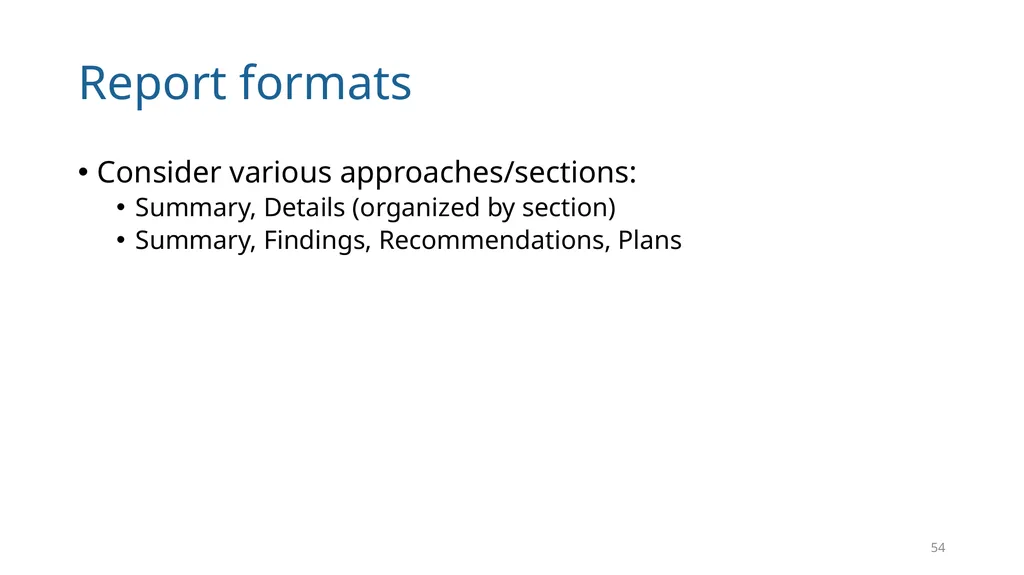
slide54. Report formats Consider various approaches/sections:
Summary, Details (organized by section)
Summary, Findings, Recommendations, Plans 54<br>
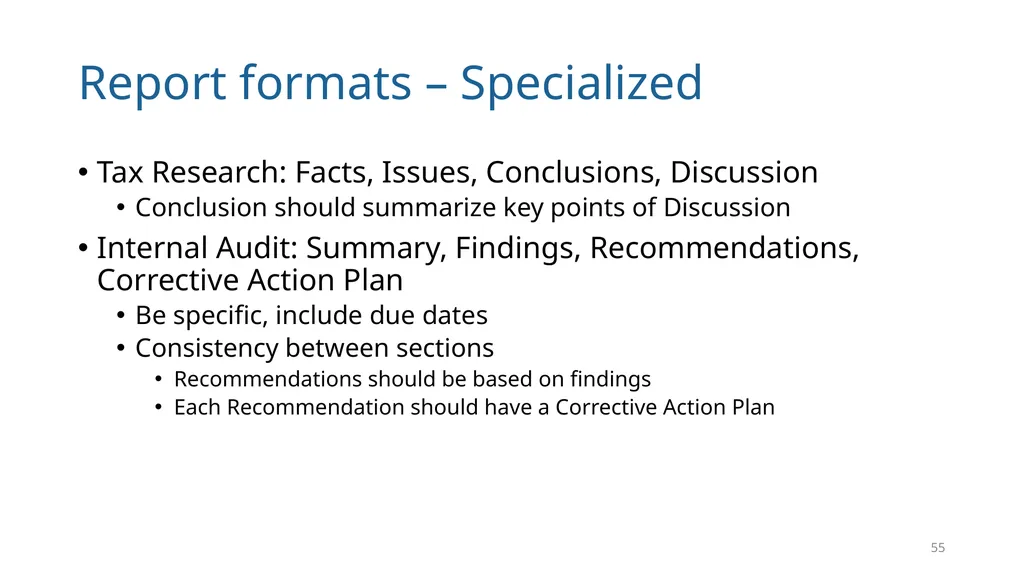
slide55. Report formats – Specialized Tax Research: Facts, Issues, Conclusions, Discussion
Conclusion should summarize key points of Discussion
Internal Audit: Summary, Findings, Recommendations, Corrective Action Plan
Be specific, include due dates
Consistency between sections
Recommendations should be based on findings
Each Recommendation should have a Corrective Action Plan 55<br>
slide56. Join us for part 2 for more tips! 56<br>
Professor of Accounting and Finance
Saint Ben’s and Saint John’s
bbostrom@csbsju.edu | (612) 414-9629 Jamie Lauer
Freelance Editor
JL Editorial Services
jamie@jamielauer.com | (612) 816-0259<br>
slide2. Logistics Polling questions throughout the meeting
Required for CPE
If you have issues answering the polling questions, please chat or email across your answer
2.0 CPE hours (Specialized Knowledge – Technical)
Partial credit available – minimum of 1.0 hours
Questions (and tips) are very welcome; submit at any time
Course evaluation and CPE certificate will be emailed within a day 2<br>
slide3. Learning objectives/agenda Understand the components that make up good writing.
Understand how to structure and organize written work, including emails, letters, and reports. 3<br>
slide4. Introductions Boz
Nine years in the Big 4 CPA firms
Began at Saint Ben’s and Saint John’s in 2004
Speaks nationally on the topics of ethics and leadership
Wrote the memoirs of John Gagliardi and Bill Sexton
Jamie
MA in Comparative Lit, Certificate in Literary Translation
Worked in marketing/communications with a technology firm for 4 years
Started JL Editorial Services in January 2020 4<br>
slide5. Boz and Jamie 5<br>
slide6. Importance of good writing 6<br>
slide7. Poll #1 – How important would you say writing is in your day-to-day work? Very important
Important
Neither important nor unimportant
Unimportant
Very unimportant 7<br>
slide8. Why is it important to write well? The number of emails sent and received every day will reach
347.3 billion
by the end of 2023
(The Radicati Group, Email Statistics Report, 2021–2025) It can take as little as
1/10th of a second
for someone to make a first impression
(Willis and Todorov, “First Impressions,” Psychological Science) 8<br>
slide9. Writing impacts you, the people you work with, and your business 9 Photo by Timon Studler on Unsplash<br>
slide10. But Can’t ChatGPT Do It for Me? Risks and limitations of ChatGPT (and current AI technologies):
Inaccurate or incomplete information
Bias
Dependence
Copyright infringement
Privacy concerns
Time (implied) “ChatGPT lives up to all the hype [only] when there is a well-calibrated and controlled dance between the critical thinking skills of the writer and the automation of ChatGPT.” 10 Source: Cullen, “ChatGPT Risks in Business Writing,” Instructional Solutions. critical thinking skills of the writer<br>
slide11. Traits of good writing 11<br>
slide12. Traits of good writing? Traits of bad writing? 12<br>
slide13. How important is it to be a good writer? What kind of writing do you do where it is important that you have good writing skills? Are you bored? Yes, it is very important to be a good writer. Effective writing is important for strong communication. It’s used by virtually everyone in emails. Particularly important when dealing with folks who don’t speak English as their first language. Need to be very articulate. I also use clear and concise writing in pitch or marketing materials. Finally you have to be a good writer when you write technical analyses (opinions, memos, etc.)
Love this question. As an auditor it was super important because we kept a lot of memos in the file, but not so much now as more of a standard G/L accountant. The ability to be clear and concise in your writing is probably the most important skill. 13<br>
slide14. How important is it to be a good writer? What kind of writing do you do where it is important that you have good writing skills? Incredibly important. With a lot of risk assessment is where you see most of the writing and just being clear and concise. Documenting why we choose no-risk, lower-risk areas in particular.
Hmmm. I would say yes, it is important to be a good writer, but more so in an email or memo format. It’s important to be able to articulate your point of view in a clear and concise way that other people can understand. We mainly write emails/memos/process documentation. 14<br>
slide15. How important is it to be a good writer? What kind of writing do you do where it is important that you have good writing skills? Fairly important. I think there are fewer memos now than when you were working. But still need to logically say what you are thinking. You have to be able to lay out your thoughts in a clear and concise manner. Most people don’t understand the technicals of what we are saying, so need to be able to cut through the terms to convey what you mean.
Yes, very important. Investment committee memos, investor reports, emails to management. Important to articulate your thoughts and position using as few words as possible. This is not “creative writing.” 15<br>
slide16. Traits of good writing Organization
Proper tone
Clarity and conciseness
Proper grammar and spelling 16 Knowing your audience<br>
slide17. Common pitfalls Lack of coherent flow
Not paying attention to tone
Being verbose/not being clear and concise
Blatant grammar and spelling mistakes
Not writing for your audience 17<br>
slide18. Poll #2 – In which of the following areas do you most want to improve your writing? Organization and flow
Tone
Clarity and conciseness
Grammar and spelling
All of the above
None of the above 18<br>
slide19. Organizing your writing 19<br>
slide20. Think like a storyteller 20 20 Climax Setup Resolution Rising action Falling action Photo by Simone Hutsch on Unsplash<br>
slide21. Think like a storyteller – Emails 21 The ask Greeting & purpose Call to action & signature Lead up to the ask Reasons for the ask Photo by Simone Hutsch on Unsplash<br>
slide22. Photo by Simone Hutsch on Unsplash Think like a storyteller – Reports 22 Findings Introduction Conclusion Reasons for report Importance of findings<br>
slide23. What sort of “stories” do you tell in your writing? Request
Familiar
Unfamiliar
Inform
Reporting on performance
General updates
Responding to requests
Motivate, encourage, entertain 23<br>
slide24. Plan A plan will help you be both more organized as well as clearer and more concise
You will know exactly what you want to say and avoid rambling
Oftentimes you are responding to a request – read the request carefully and understand exactly why you are writing
Write down the purpose in 1–2 sentences
Until you know why you are writing, don’t write anything! 24<br>
slide25. Plan – Understand your audience Who is/are the reader(s) of your writing?
Understand their knowledge of the topic
Understand their biases/anticipate their questions 25<br>
slide26. Plan – Use the following format Introduction – context, purpose, and recommendation/request
Body
List your supporting points/organize by order of importance. Order of importance to who?
Your reader!
Conclusion/action
Example . . . 26<br>
slide27. How can we deal with writer’s block? Draft!
Put your ideas down on paper
Don’t stop to edit
Write the parts of the document in whatever order you wish 27<br>
slide28. Revise Revise the document for logical flow
Examine transitions: a single word, short phrase, or a full sentence
Use the correct transition, but also don’t overuse transitions
Review the document for clarity and conciseness
Proofread for grammatical, mechanical, and typographical errors
Examine a hard copy or read it out loud
Spacing between paragraphs
If it is a critical document, try to sleep on it. Why??? 28<br>
slide29. 29<br>
slide30. Poll #3 – The three stages of writing are plan, draft, and revise. Which do you struggle with most? Plan
Draft
Revise
All of them!
None of them 30<br>
slide31. Writing emails 31<br>
slide32. What are your pet peeves when receiving emails? 32<br>
slide33. What kinds of emails can grab your attention? 33<br>
slide34. Headers Use a strong and clear subject line
Cc – use to keep people in the loop
Understand the preferences of those you work with
Avoid cc’ing people to make the recipient look bad
Bcc – not used a lot; keeps someone in the loop without the recipient being aware
Some recipients may feel a bit blindsided if they find out you were using bcc without their knowledge
Recent trend: “I’m moving Boz to bcc.” 34<br>
slide35. Poll #4 – What is your preferred salutation to someone you are familiar with? Hi Boz,
Hey Boz,
Dear Boz,
Hello Boz,
Boz, 35<br>
slide36. Opening Address the recipient by name whenever possible; first names are generally fine, but when in doubt, use Mr., Ms., Mx., or a title (like Dr.)
Understand your audience and how formal they prefer to be
Address the messages very carefully. When typing a sensitive email, what should you do?
Don’t put in the email address until the end
A sentence to build rapport may be appropriate for someone with whom you don’t communicate much or haven’t talked to in a while
“Hey Boz, Would you be willing to serve as a reference as I explore new job opportunities?”
“Hey Boz, It was great to see you last week at the recruiting event! Would you be willing to serve as a reference as I explore new job opportunities?”
Your opening paragraph should have your purpose/request and, often, your conclusion 36<br>
slide37. Body Short paragraphs, short(er) sentences, and not too long overall
Have a new paragraph for each new topic or idea
Oftentimes we are writing to request information, so we should list out those requests using bullet points, numbers, or paragraphs
Other times we are writing to support our overall conclusion; we should use a new paragraph for each supporting point 37<br>
slide38. Body – Example We need substantiation for your cash charitable contributions and other information to complete your tax return. We need the social security numbers of your children as well as the amount you paid for daycare for them. This is important information that will allow for a proper e-file of your return. We need to make sure we capture your cash and non-cash charitable donations if you have some of those. 38<br>
slide39. Body – Example, revised Thank you for providing information to complete your tax return. We will need the following 4 final pieces of information, and then we can finalize your return:
Amount of your charitable contributions made in cash, along with receipts for deductions of $250 or more
Amount of non-cash charitable contributions, such as clothing donations to Goodwill
Social security numbers of your children
Amount paid to daycare for each of your three children
Please let me know if you have questions on any of these items or why they are needed 39<br>
slide40. Body Each paragraph should have a strong topic sentence, and everything else written in that paragraph should be in support of that topic sentence
Whenever possible, use specific details, numbers, figures, names, etc.
We have a potential in with a very large customer out of Mexico
Our supply chain manager has an upcoming meeting with a $5 billion company that is the largest tequila producer in Mexico 40<br>
slide41. Body Put the most important points first (for example, if you have three reasons for making a recommendation, put the most important reason first)
Why is this?
Assume your reader is only going to read part of your document, so hit the big points up front!
If you are addressing counterarguments or talking about why you did not recommend an option, put that after you make supporting points in favor of your argument 41<br>
slide42. Ending Remind the reader of exactly what you are hoping they will do, if anything
Often you will be requesting action, but be courteous and consider the recipient’s level of authority
Consider personalized sign-offs
What do you think when someone always signs their emails the same way (e.g., Cheers, Bill)?
Popular closings – thanks, best, best regards, regards, sincerely, take care, thanks so much, cheers, all the best, best wishes, respectfully, talk soon, sincerely yours
What do you use?
Consider a standardized signature that includes your company, title, and contact info 42<br>
slide43. Putting it all together Subject: LinkedIn Testimonial
Hi Boz,
Hope it's been a good week for you! I'm reaching out because I'm working on updating my website and am wanting to add some testimonials from clients to it. You already wrote that nice review on my LinkedIn profile. Would it be OK if I used it on my website as well? And is it OK if I list your name and the title/cover of your book along with it? I will of course link to your website where people can buy the book. :)
For ease of reference, here is that review you posted on LinkedIn:
Jamie is very clear and friendly in setting guidelines so that both parties understand how the business relationship should work. Her final work product consistently exceeds expectations in terms of both quality and timing. She is very efficient and responsive. With my novel, she provided structural feedback, copy editing, and proofreading services. When invited, she is willing to share her opinion on how something should be presented (which I find normally to be the best choice), but she also respects her client's decision to make judgment calls on the final product. I consider it a blessing to have Jamie as my partner in many projects and will continue to utilize her talents for many years to come.
Thank you!
Jamie
Jamie Lauer
Freelance Editor | Award-Winning Literary Translator (Spanish–English)
www.jamielauer.com 43<br>
slide44. Poll #5 – What is the biggest problem you see with emails? Unclear
Too long
Not respectful
Emailing a question instead of asking it verbally
All of the above!
None of the above 44<br>
slide45. Problems with emails Clarity – take extra care to write clearly; your reader can’t ask questions in real time like they could with a phone call or an in-person dialogue
Length – people do not expect emails to be super lengthy (an attached Word document/memo would be okay); if you’re having trouble communicating what you need to concisely, consider a phone call or talking verbally instead
Respect – pay extra attention to your word choice; your reader can’t see your face or hear your tone, so it’s easier for them to read negativity into an email
Manners – if you are making a request, your email should include “please” and “thank you”
Common sense – if you are sitting 10 feet from someone, try to avoid sending them an email unless it is something like “I have a question to discuss. Would you please let me know when you may have 10 minutes?” 45<br>
slide46. Problems with emails: Angry emails What advice would you give someone who is about to send an angry email? Should you not write it at all?
Sit on it, oftentimes for at least a day
Sometimes you’ll find it is better to send nothing
Ask someone else to review it
Ask yourself if you would say it in person
Keep in mind emails provide a permanent record and are easy to forward; assume the entire world will see your email
Thus, how should you communicate sensitive information? 46<br>
slide47. Problems with emails Avoid clichés/condescending comments
Please find attached
Thank you in advance
I look forward to hearing from you
Per our conversation
I hope you are doing well
To whom it may concern
Sorry for the late reply
Don’t overuse exclamation marks!!! 47<br>
slide48. Replying to emails Always try to reply within 24 hours, even if all you can say is that you are busy and need a couple of days to give a full reply
Bad news is better than no news! 48<br>
slide49. Scheduling emails Be careful about making requests or sending bad news in the evenings or on weekends
Draft it, but . . .
Schedule it to send during business hours
Keep it in your draft folder until the next business day 49<br>
slide50. Letters and reports (and longer emails) 50<br>
slide51. Poll #6 – How often do you write reports of a more technical nature? Regularly
Sometimes
Almost never 51<br>
slide52. Structuring letters and reports (and longer emails) Follow the same principles for email writing
Make sure the most important information (why you are writing, why what you are writing is important to pay attention to, what actions need to be taken after reading) is in the introduction and conclusion
If someone were to read only the introduction and conclusion of your letter/report, would they get the gist?
Put the nitty gritty details and support for the conclusions of the letter/report in the body paragraphs
For a lengthy email, consider revising using either:
An attachment
An introduction/purpose/conclusion/sign-off
Followed by a detailed analysis 52<br>
slide53. Other tips – Keep your audience in mind Keep in mind that letters and reports need to use a more formal tone than emails
Avoid jargon/specialized terminology (or define if needed)
Define acronyms
Example – What would AR stand for?
Accounts receivable (AR)
Be precise – leave no room for misunderstanding 53<br>
slide54. Report formats Consider various approaches/sections:
Summary, Details (organized by section)
Summary, Findings, Recommendations, Plans 54<br>
slide55. Report formats – Specialized Tax Research: Facts, Issues, Conclusions, Discussion
Conclusion should summarize key points of Discussion
Internal Audit: Summary, Findings, Recommendations, Corrective Action Plan
Be specific, include due dates
Consistency between sections
Recommendations should be based on findings
Each Recommendation should have a Corrective Action Plan 55<br>
slide56. Join us for part 2 for more tips! 56<br>