
Writing it Right! How to Structure and Write an
MS
Published · 24 slides · 0 views

1 / 1






Description
Writing it Right! How to Structure and Write an Effective CASA Report Role of a CASA Gather information about the child; Advocate for a childs best interest. Advocacy Tool Your court report Your chance to tell the judge what is going on
Related Topics
Share
Embed code
Download this presentation From Below
"Writing it Right! How to Structure and Write an" is the property of its rightful owner. Permission is granted to download and print the materials on this website for personal, non-commercial use only, and to display it on your personal computer provided you do not modify the materials and that you retain all copyright notices contained in the materials. By downloading content from our website, you accept the terms of this agreement.
Presentation Transcript
01
Writing it
Right! How to Structure and Write an Effective CASA Report<br>
02
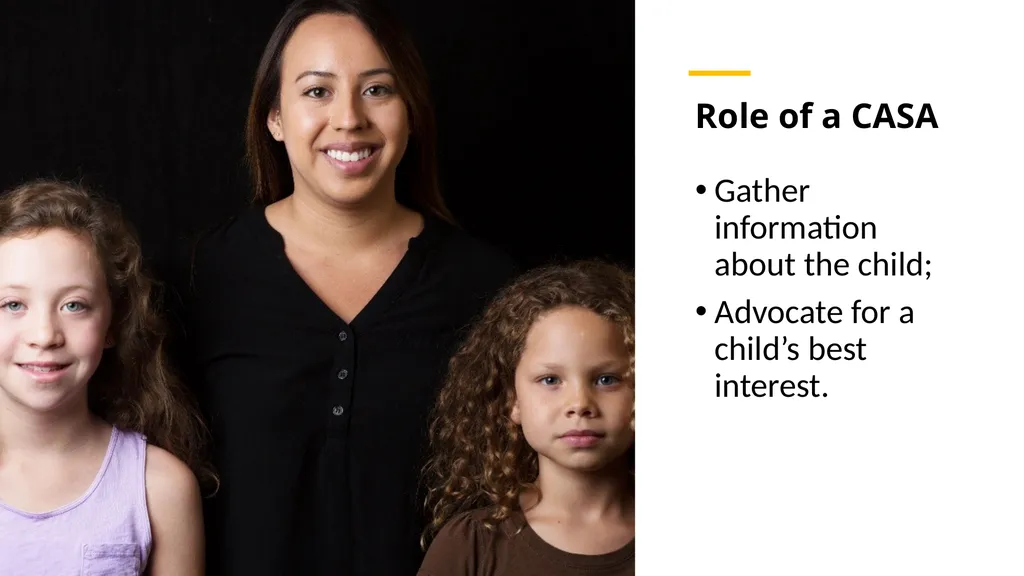
Role of a CASA Gather information about the child;
Advocate for a child’s best interest.<br>
Advocate for a child’s best interest.<br>
03
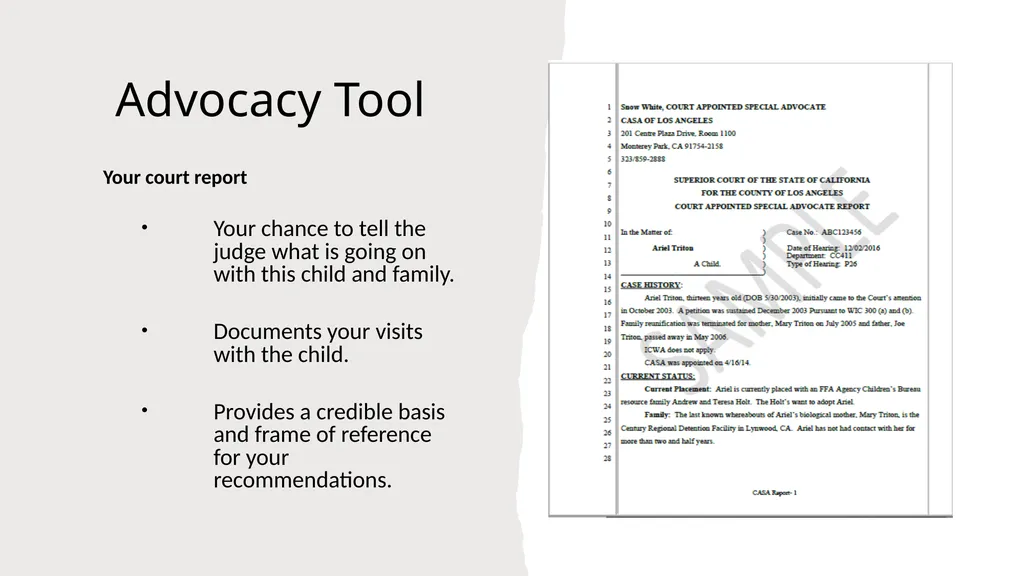
Advocacy Tool Your court report
Your chance to tell the judge what is going on with this child and family.
Documents your visits with the child.
Provides a credible basis and frame of reference for your recommendations.<br>
Your chance to tell the judge what is going on with this child and family.
Documents your visits with the child.
Provides a credible basis and frame of reference for your recommendations.<br>
04
Getting Started with Your Report Keep these things in mind:
The CASAs report is a summary of key information since the last report.
Keep your report child-focused and fact-based
Write with your principal reader in mind:
THE JUDGE! #1: Check-in with your advocate supervisor!<br>
The CASAs report is a summary of key information since the last report.
Keep your report child-focused and fact-based
Write with your principal reader in mind:
THE JUDGE! #1: Check-in with your advocate supervisor!<br>
05
Keys to Good Report Writing Accuracy (to be exact, free from errors and misstatements) being consistent with names
Brevity (to be concise and complete)
Clarity (to be easily understood)
Strengths-based language #1: Communicate with your advocate supervisor!!!<br>
Brevity (to be concise and complete)
Clarity (to be easily understood)
Strengths-based language #1: Communicate with your advocate supervisor!!!<br>
06
Who reads the court repot??<br>
07
Editing your Court Report Give yourself time – editing is a process!
Your advocate supervisor will provide feedback on your report.
Discuss and clarify any edits/questions with your advocate supervisor.
Your supervisor has final approval over your court report.<br>
Your advocate supervisor will provide feedback on your report.
Discuss and clarify any edits/questions with your advocate supervisor.
Your supervisor has final approval over your court report.<br>
08
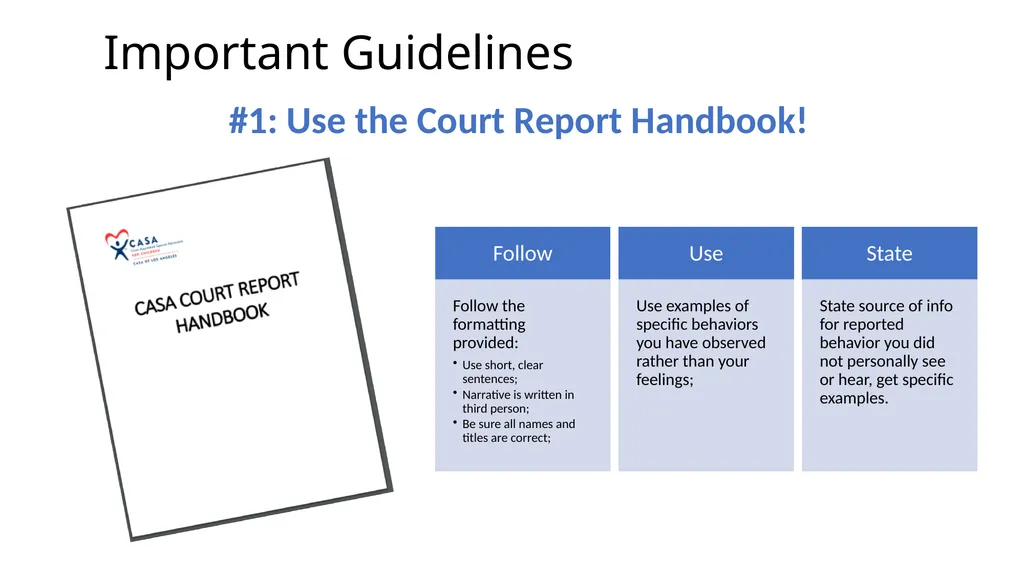
Important Guidelines #1: Use the Court Report Handbook!<br>
09
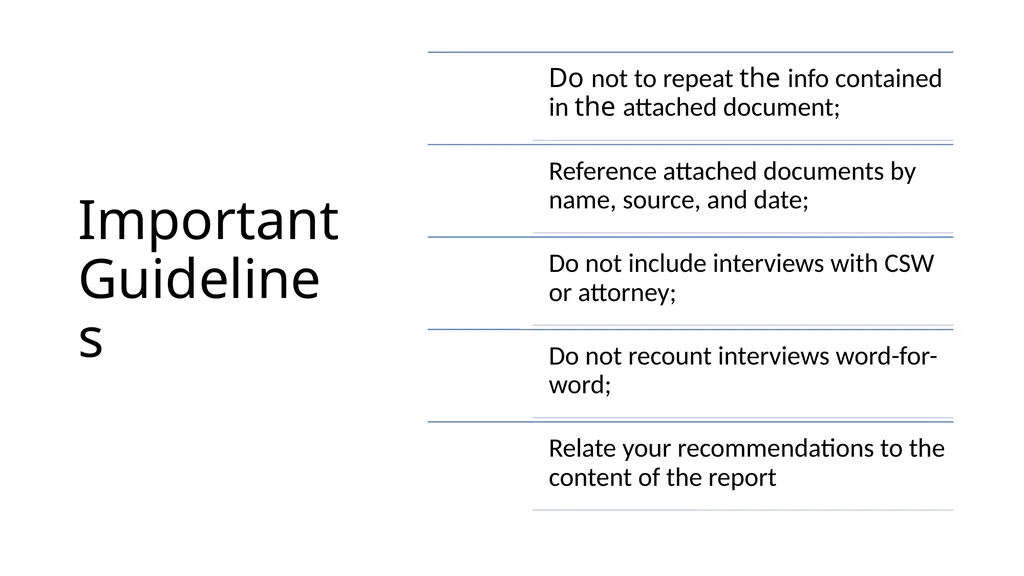
Important Guidelines<br>
10
Common Court Report Red Flags! Including your opinion throughout the report.
Assumptions vs. facts.
Disclosing sensitive information without speaking to your advocate supervisor (see page 7 of court report handbook)
Portraying the child, case parties or family in a negative light.
Focusing on deficit rather than strengths<br>
Assumptions vs. facts.
Disclosing sensitive information without speaking to your advocate supervisor (see page 7 of court report handbook)
Portraying the child, case parties or family in a negative light.
Focusing on deficit rather than strengths<br>
11
What is A Strengths-Based APPROACH? A strength-based approach involves a shift from a deficit focus (which emphasizes problems) to a positive partnership with the child/youth, their family and their team.
This approach acknowledges each child/youth’s and their family’s unique set of strengths and challenges and engages them as a crucial partner in developing and implementing an action plan<br>
This approach acknowledges each child/youth’s and their family’s unique set of strengths and challenges and engages them as a crucial partner in developing and implementing an action plan<br>
12
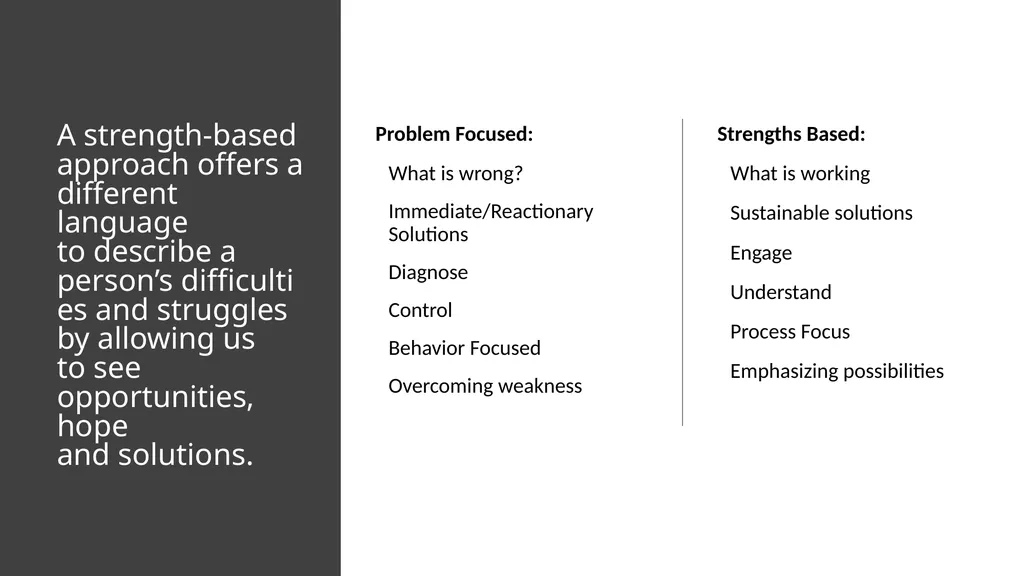
A strength-based approach offers a different language to describe a person’s difficulties and struggles by allowing us to see opportunities, hope and solutions. Problem Focused:
What is wrong?
Immediate/Reactionary Solutions
Diagnose
Control
Behavior Focused
Overcoming weakness Strengths Based:
What is working
Sustainable solutions
Engage
Understand
Process Focus
Emphasizing possibilities<br>
What is wrong?
Immediate/Reactionary Solutions
Diagnose
Control
Behavior Focused
Overcoming weakness Strengths Based:
What is working
Sustainable solutions
Engage
Understand
Process Focus
Emphasizing possibilities<br>
13
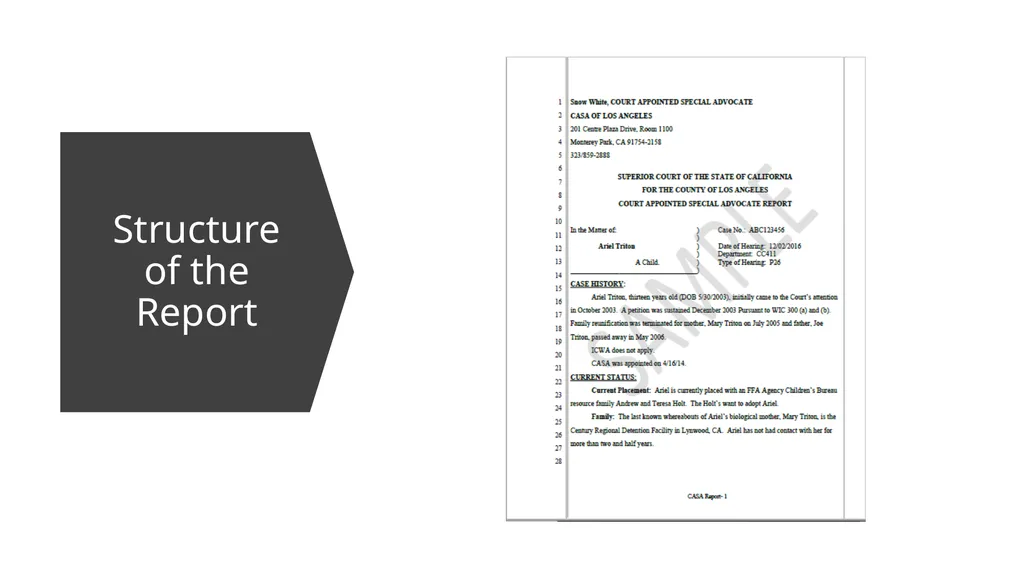
Structure of the Report<br>
14
History:
• Child’s/youth’s name and age.
• Date petition was filed, sustained, and counts sustained.
• Status of family reunification services or parental rights.
• Name(s) of parent(s) or legal guardian(s).
• Date CASA was appointed.
• ICWA Status. Example:
Jennifer is a 10 year old girl (DOB 06-11-2005) who came to the court’s attention on January 15, 2016.
A petition was sustained on March 10, 2016 pursuant to WIC 300(b) and (g). Family reunification services have been ordered for mother.
ICWA does not apply. CASA was appointed on April 1, 2016.<br>
• Date petition was filed, sustained, and counts sustained.
• Status of family reunification services or parental rights.
• Name(s) of parent(s) or legal guardian(s).
• Date CASA was appointed.
• ICWA Status. Example:
Jennifer is a 10 year old girl (DOB 06-11-2005) who came to the court’s attention on January 15, 2016.
A petition was sustained on March 10, 2016 pursuant to WIC 300(b) and (g). Family reunification services have been ordered for mother.
ICWA does not apply. CASA was appointed on April 1, 2016.<br>
15
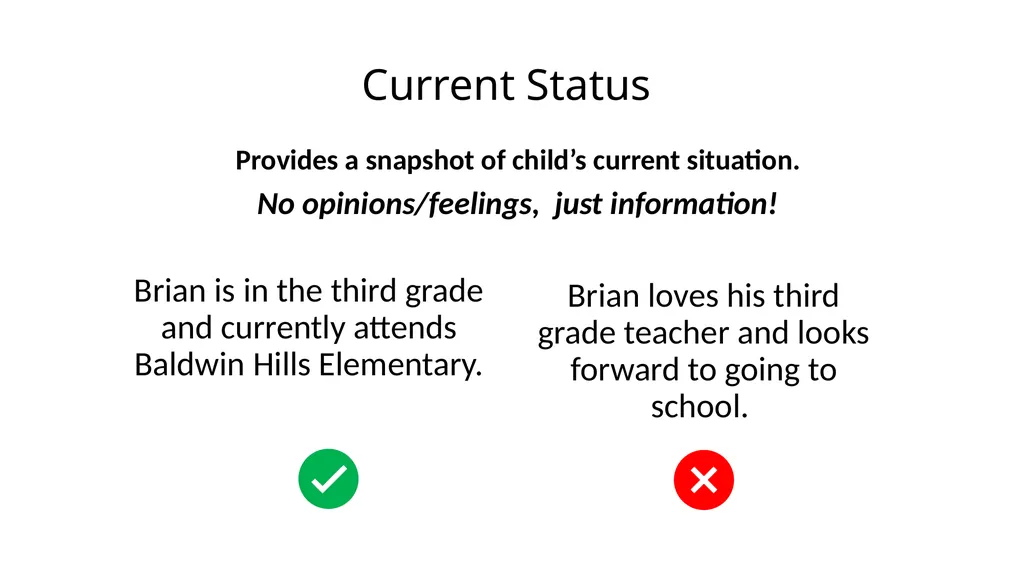
Current Status Provides a snapshot of child’s current situation.
No opinions/feelings, just information! Brian is in the third grade and currently attends Baldwin Hills Elementary. Brian loves his third grade teacher and looks forward to going to school.<br>
No opinions/feelings, just information! Brian is in the third grade and currently attends Baldwin Hills Elementary. Brian loves his third grade teacher and looks forward to going to school.<br>
16
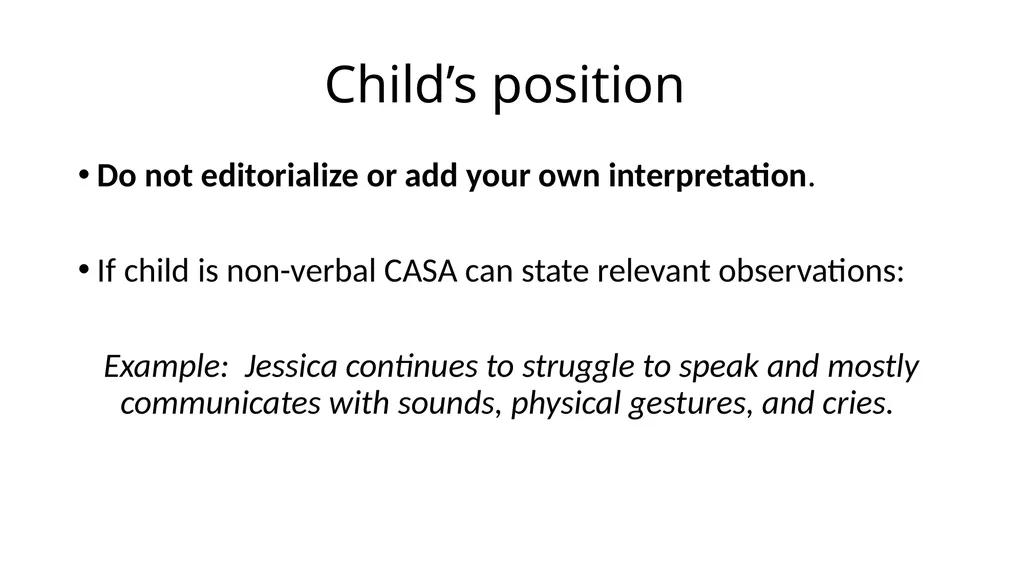
Child’s position Do not editorialize or add your own interpretation.
If child is non-verbal CASA can state relevant observations:
Example: Jessica continues to struggle to speak and mostly communicates with sounds, physical gestures, and cries.<br>
If child is non-verbal CASA can state relevant observations:
Example: Jessica continues to struggle to speak and mostly communicates with sounds, physical gestures, and cries.<br>
17
Thomas enjoys his social life at school and wishes he could take more mainstream classes to be with his friends. He enjoys being alone at home and uses his time to pursue Lego models and keep in touch with his friends through social media. He shared that has had some communications with his father in Long Beach in recent months however, he seems ambivalent regarding his relationship. Ms. Jones is his favorite caregiver ever, and he wishes he could have been with her since the beginning of foster care. He feels stability and trust for the first time and is eager to be adopted in the spring. Child's Positions sample:<br>
18
Thomas enjoys his social life at school and wishes he could take more mainstream classes to be with his friends. He enjoys being able to be alone at home and uses his time to pursue Lego models and keep in touch with his friends through social media. He shared that has had some communications with his father in Long Beach in recent months, however, he seems ambivalent regarding his relationship. Ms. Jones is his favorite caregiver ever, and he wishes he could have been with her since the beginning of foster care. He feels stability and trust for the first time and is eager to be adopted in the spring. Thomas has expressed that he enjoys his social life at school and wishes he could take more mainstream classes to be with his friends. He states being alone at home is better than the after-school programs, he uses his time to pursue Lego models and keep in touch with his friends through social media. He shared that has had some communications with his father in Long Beach in recent months. Thomas has told CASA multiple times that Ms. Jones is his favorite caregiver ever, and he wishes he could have been with her since the beginning of foster care.<br>
19
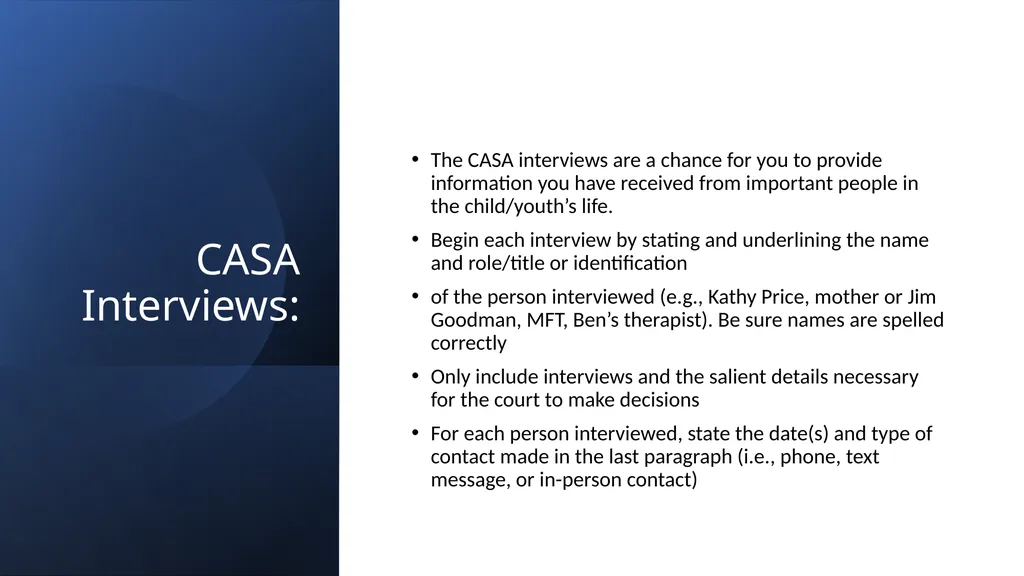
CASA Interviews: The CASA interviews are a chance for you to provide information you have received from important people in the child/youth’s life.
Begin each interview by stating and underlining the name and role/title or identification
of the person interviewed (e.g., Kathy Price, mother or Jim Goodman, MFT, Ben’s therapist). Be sure names are spelled correctly
Only include interviews and the salient details necessary for the court to make decisions
For each person interviewed, state the date(s) and type of contact made in the last paragraph (i.e., phone, text message, or in-person contact)<br>
Begin each interview by stating and underlining the name and role/title or identification
of the person interviewed (e.g., Kathy Price, mother or Jim Goodman, MFT, Ben’s therapist). Be sure names are spelled correctly
Only include interviews and the salient details necessary for the court to make decisions
For each person interviewed, state the date(s) and type of contact made in the last paragraph (i.e., phone, text message, or in-person contact)<br>
20
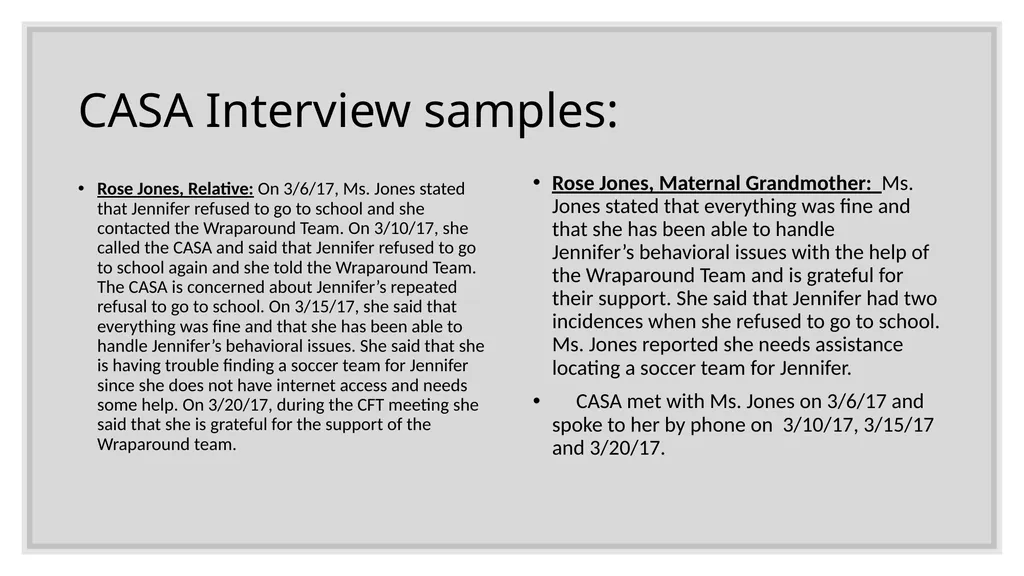
CASA Interview samples: Rose Jones, Relative: On 3/6/17, Ms. Jones stated that Jennifer refused to go to school and she contacted the Wraparound Team. On 3/10/17, she called the CASA and said that Jennifer refused to go to school again and she told the Wraparound Team. The CASA is concerned about Jennifer’s repeated refusal to go to school. On 3/15/17, she said that everything was fine and that she has been able to handle Jennifer’s behavioral issues. She said that she is having trouble finding a soccer team for Jennifer since she does not have internet access and needs some help. On 3/20/17, during the CFT meeting she said that she is grateful for the support of the Wraparound team. Rose Jones, Maternal Grandmother: Ms. Jones stated that everything was fine and that she has been able to handle Jennifer’s behavioral issues with the help of the Wraparound Team and is grateful for their support. She said that Jennifer had two incidences when she refused to go to school. Ms. Jones reported she needs assistance locating a soccer team for Jennifer.
CASA met with Ms. Jones on 3/6/17 and spoke to her by phone on 3/10/17, 3/15/17 and 3/20/17.<br>
CASA met with Ms. Jones on 3/6/17 and spoke to her by phone on 3/10/17, 3/15/17 and 3/20/17.<br>
21
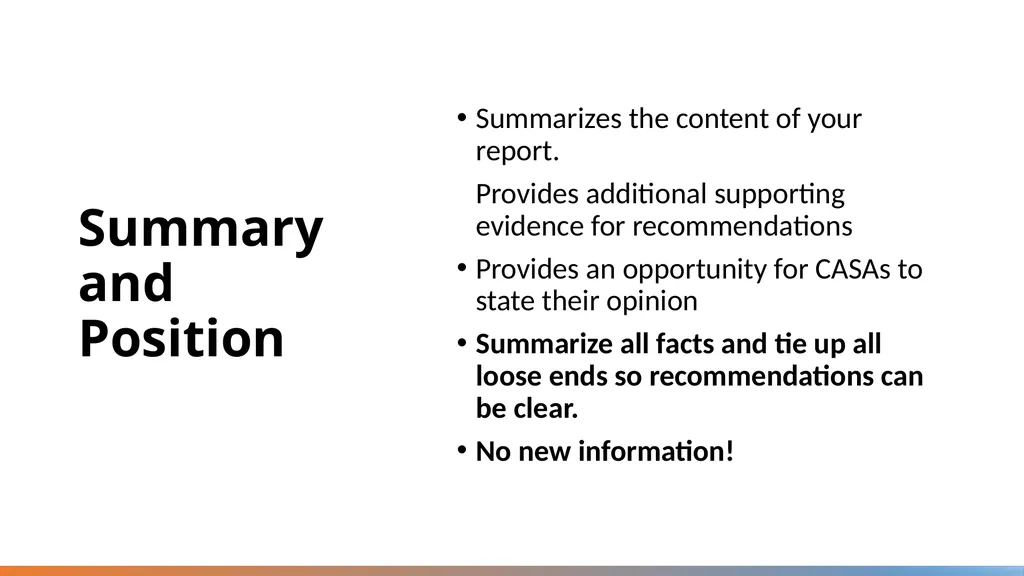
Summary and Position Summarizes the content of your report.
Provides additional supporting evidence for recommendations
Provides an opportunity for CASAs to state their opinion
Summarize all facts and tie up all loose ends so recommendations can be clear.
No new information!<br>
Provides additional supporting evidence for recommendations
Provides an opportunity for CASAs to state their opinion
Summarize all facts and tie up all loose ends so recommendations can be clear.
No new information!<br>
22
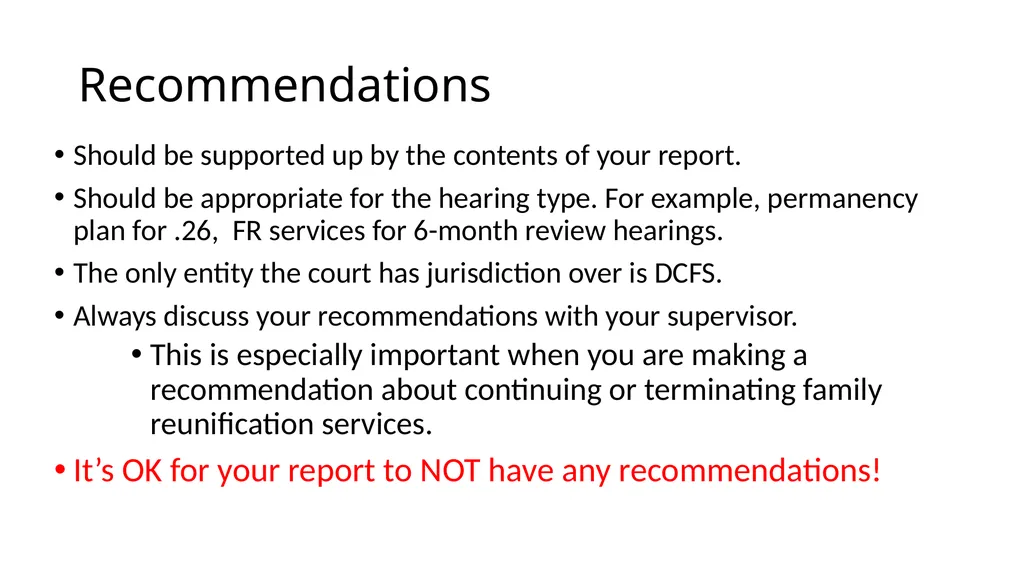
Recommendations Should be supported up by the contents of your report.
Should be appropriate for the hearing type. For example, permanency plan for .26, FR services for 6-month review hearings.
The only entity the court has jurisdiction over is DCFS.
Always discuss your recommendations with your supervisor.
This is especially important when you are making a recommendation about continuing or terminating family reunification services.
It’s OK for your report to NOT have any recommendations!<br>
Should be appropriate for the hearing type. For example, permanency plan for .26, FR services for 6-month review hearings.
The only entity the court has jurisdiction over is DCFS.
Always discuss your recommendations with your supervisor.
This is especially important when you are making a recommendation about continuing or terminating family reunification services.
It’s OK for your report to NOT have any recommendations!<br>
23
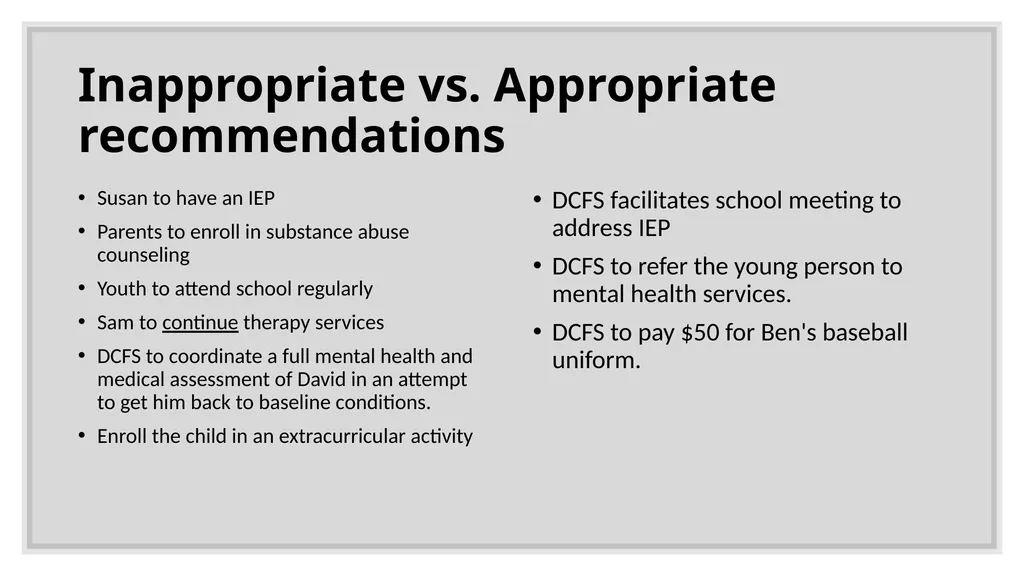
Inappropriate vs. Appropriate recommendations Susan to have an IEP
Parents to enroll in substance abuse counseling
Youth to attend school regularly
Sam to continue therapy services
DCFS to coordinate a full mental health and medical assessment of David in an attempt to get him back to baseline conditions.
Enroll the child in an extracurricular activity DCFS facilitates school meeting to address IEP
DCFS to refer the young person to mental health services.
DCFS to pay $50 for Ben's baseball uniform.<br>
Parents to enroll in substance abuse counseling
Youth to attend school regularly
Sam to continue therapy services
DCFS to coordinate a full mental health and medical assessment of David in an attempt to get him back to baseline conditions.
Enroll the child in an extracurricular activity DCFS facilitates school meeting to address IEP
DCFS to refer the young person to mental health services.
DCFS to pay $50 for Ben's baseball uniform.<br>
24
THANK YOU!! Adriana Lopez, Advocacy Team Manager
alopez@casala.org<br>
alopez@casala.org<br>