Y11 Core Subjects Preparation for Success 2024-2025 For you and your child to understand the revision strategies to support success in Maths, English and Science. Have informal discussions with English, Maths and Science staff about
Related Topics
Share
Embed code
Download this presentation From Below
"Y11 Core Subjects’ ‘Preparation for Success’" is the property of its rightful owner. Permission is granted to
download and print the materials on this website for personal, non-commercial use only, and to display it
on your personal computer provided you do not modify the materials and that you retain all copyright
notices contained in the materials. By downloading content from our website, you accept the terms of this
agreement.
Presentation Transcript
01
Y11 Core Subjects’ ‘Preparation for Success’ 2024-2025<br>
02
For you and your child to understand the revision strategies to support success in Maths, English and Science.
Have informal discussions with English, Maths and Science staff about revision strategies for the summer. Purpose of this evening<br>
03
Paper 2 Question 5 – transactional writing (argue, persuade, inform, explain)
SPaG – basic errors costing huge marks
P1 Q4 (evaluation) and P2 Q4 (comparison) - high tariff questions!
Over Easter Break: Prepare for Speaking and Listening assessment which will take place in the first two weeks after the break. Part of the course requirements and an official grade is given. English Language<br>
04
Quotations for An Inspector Calls – No extract!
Choosing the right poem for comparison – learn up to 5 key quotes for each poem, that can be adapted for any theme.
Remember to analyse writer's choices and not just re tell the story! English Literature<br>
05
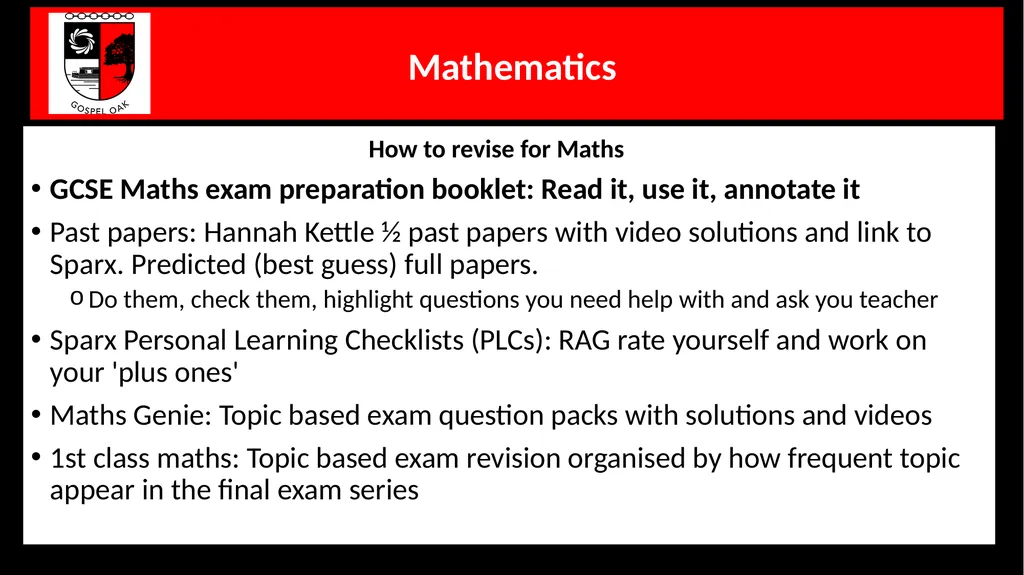
How to revise for Maths
GCSE Maths exam preparation booklet: Read it, use it, annotate it
Past papers: Hannah Kettle ½ past papers with video solutions and link to Sparx. Predicted (best guess) full papers.
Do them, check them, highlight questions you need help with and ask you teacher
Sparx Personal Learning Checklists (PLCs): RAG rate yourself and work on your 'plus ones'
Maths Genie: Topic based exam question packs with solutions and videos
1st class maths: Topic based exam revision organised by how frequent topic appear in the final exam series Mathematics<br>
06
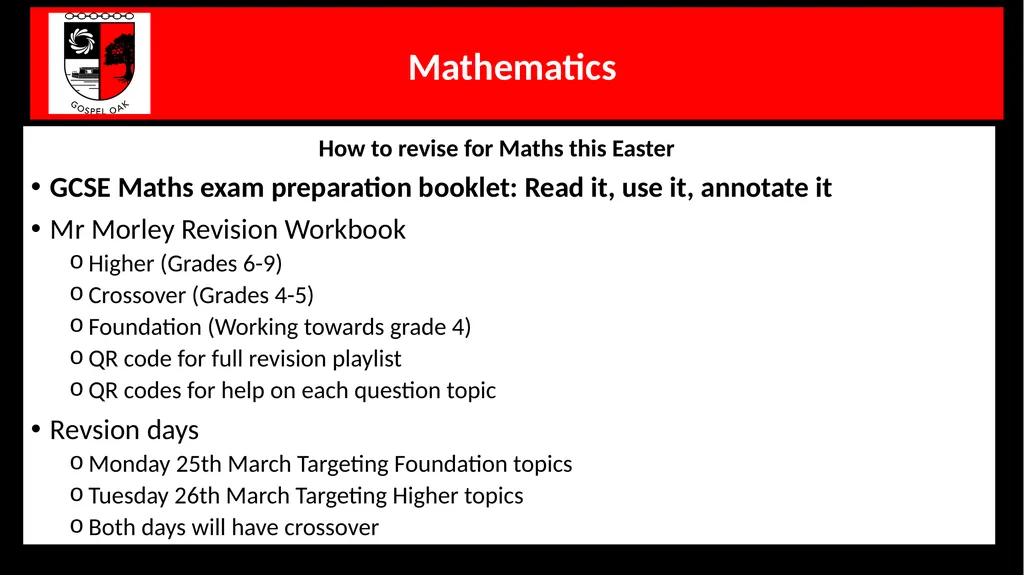
How to revise for Maths this Easter
GCSE Maths exam preparation booklet: Read it, use it, annotate it
Mr Morley Revision Workbook
Higher (Grades 6-9)
Crossover (Grades 4-5)
Foundation (Working towards grade 4)
QR code for full revision playlist
QR codes for help on each question topic
Revsion days
Monday 25th March Targeting Foundation topics
Tuesday 26th March Targeting Higher topics
Both days will have crossover Mathematics<br>
07
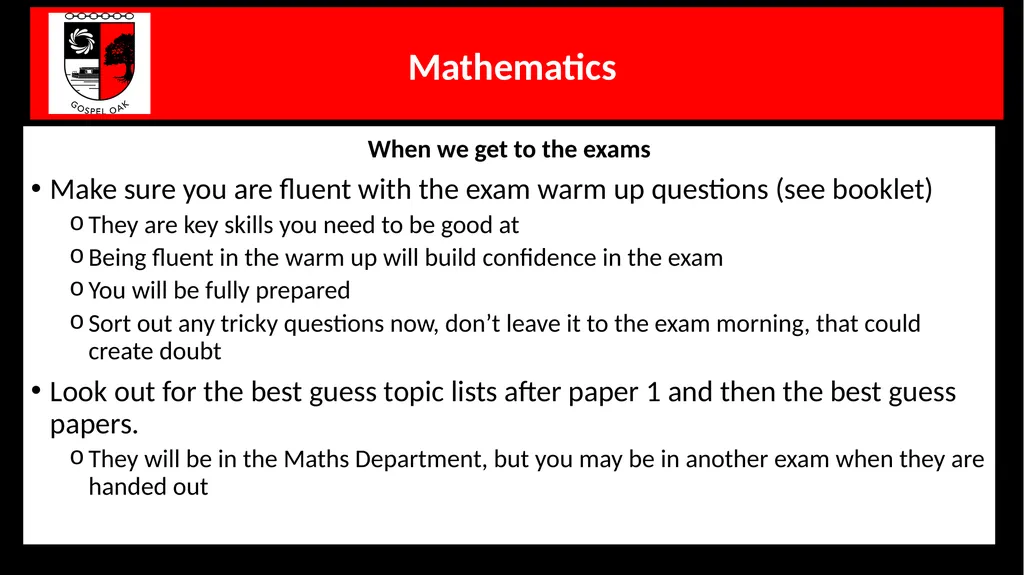
When we get to the exams
Make sure you are fluent with the exam warm up questions (see booklet)
They are key skills you need to be good at
Being fluent in the warm up will build confidence in the exam
You will be fully prepared
Sort out any tricky questions now, don’t leave it to the exam morning, that could create doubt
Look out for the best guess topic lists after paper 1 and then the best guess papers.
They will be in the Maths Department, but you may be in another exam when they are handed out Mathematics<br>
08
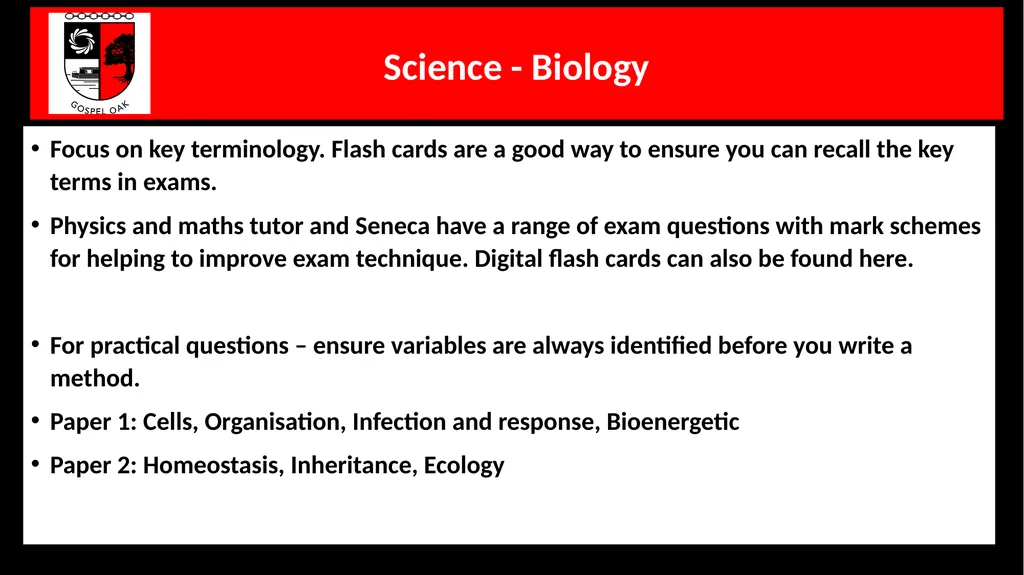
Focus on key terminology. Flash cards are a good way to ensure you can recall the key terms in exams.
Physics and maths tutor and Seneca have a range of exam questions with mark schemes for helping to improve exam technique. Digital flash cards can also be found here.
For practical questions – ensure variables are always identified before you write a method.
Paper 1: Cells, Organisation, Infection and response, Bioenergetic
Paper 2: Homeostasis, Inheritance, Ecology Science - Biology<br>
09
Focus on making sure you can annotate the Periodic Table. Higher tier focus on Chemical calculations.
Physics and maths tutor has a range of exam questions with mark schemes for helping to improve exam technique.
For practical questions – ensure variables are always identified before you write a method.
Paper 1: Atomic Structure and the Periodic Table, Bonding, Structure and Physical properties, Quantitative Chemistry, Chemical Changes, Energy Changes
Paper 2: Rate and extent of reaction, Organic Chemistry, Chemical Analysis, Chemistry of the atmosphere, Using resources. Science - Chemistry<br>
10
Focus on theory – students have an equation sheet in the exam. Remember to use FIFA.
Physics and maths tutor has a range of exam questions with mark schemes for helping to improve exam technique.
For practical 6 mark questions – ensure variables are always identified before you write a method.
Paper 1: Energy, Electricity, Particle model of matter, Atomic structure
Paper 2: Forces, Waves, Electromagnetism, Space (Separates only) Science - Physics<br>
11
Make sure login details are known; your form tutor can support you with resetting your GCSEPod account if needed.
See your Maths’ teacher is you need support with logging in to Sparx.
There are a lot of resources available; do check that they are for the exam board we follow – visit Gospel Oak School – Curriculum – if you are unsure.
Information on well-being during the exam season can be found at How to keep calm when I'm revising? - BBC Bitesize General Revision Advice<br>