Y7 Language Detectives Investigating how language works: choosing nouns carefully Names Ebenezer Scrooge Augustus Snodgrass Anne Chickenstalker Violet Beauregarde Veruca Salt Bleak House Privet Drive How do writers use nouns to describe
"Y7 Language Detectives Investigating how language" is the property of its rightful owner. Permission is granted to
download and print the materials on this website for personal, non-commercial use only, and to display it
on your personal computer provided you do not modify the materials and that you retain all copyright
notices contained in the materials. By downloading content from our website, you accept the terms of this
agreement.
Presentation Transcript
01
Y7 Language Detectives Investigating how language works: choosing nouns carefully<br>
02
Names Ebenezer Scrooge
Augustus Snodgrass
Anne Chickenstalker
Violet Beauregarde
Veruca Salt
Bleak House
Privet Drive<br>
03
How do writers use nouns to describe characters and settings in fiction? Mr and Mrs Dursley, of number four, Privet Drive, were proud to say that they were perfectly normal, thank you very much. They were the last people you’d expect to be involved in anything strange or mysterious, because they just didn’t hold with such things.
Mr Dursley was the director of a firm called Grunnings, which made drills. He was a big, beefy man with hardly any neck, although he did have a very large moustache. Mrs Dursley was thin and blonde and had nearly twice the usual amount of neck, which came in very useful as she spent so much of her time craning over garden fences, spying on the neighbours. The Dursleys had a small son called Dudley and in their opinion there was no finer boy anywhere.
J.K Rowling , Harry Potter and the Sorceror’s Stone<br>
04
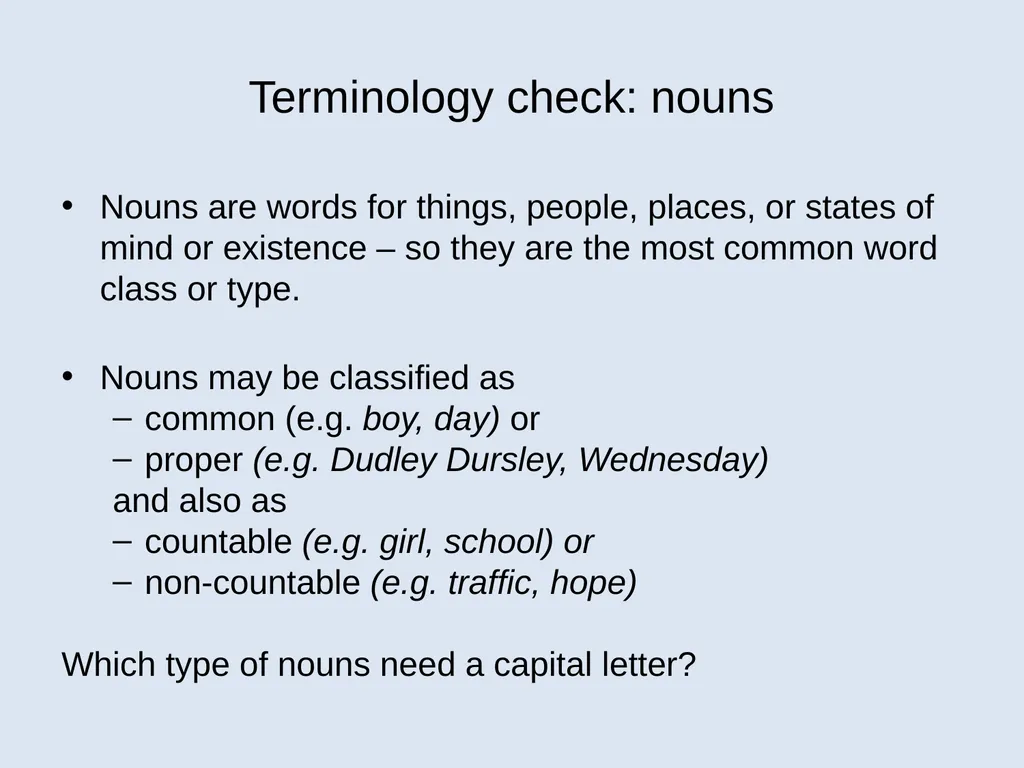
Terminology check: nouns Nouns are words for things, people, places, or states of mind or existence – so they are the most common word class or type.
Nouns may be classified as
common (e.g. boy, day) or
proper (e.g. Dudley Dursley, Wednesday)
and also as
countable (e.g. girl, school) or
non-countable (e.g. traffic, hope)
Which type of nouns need a capital letter?<br>
05
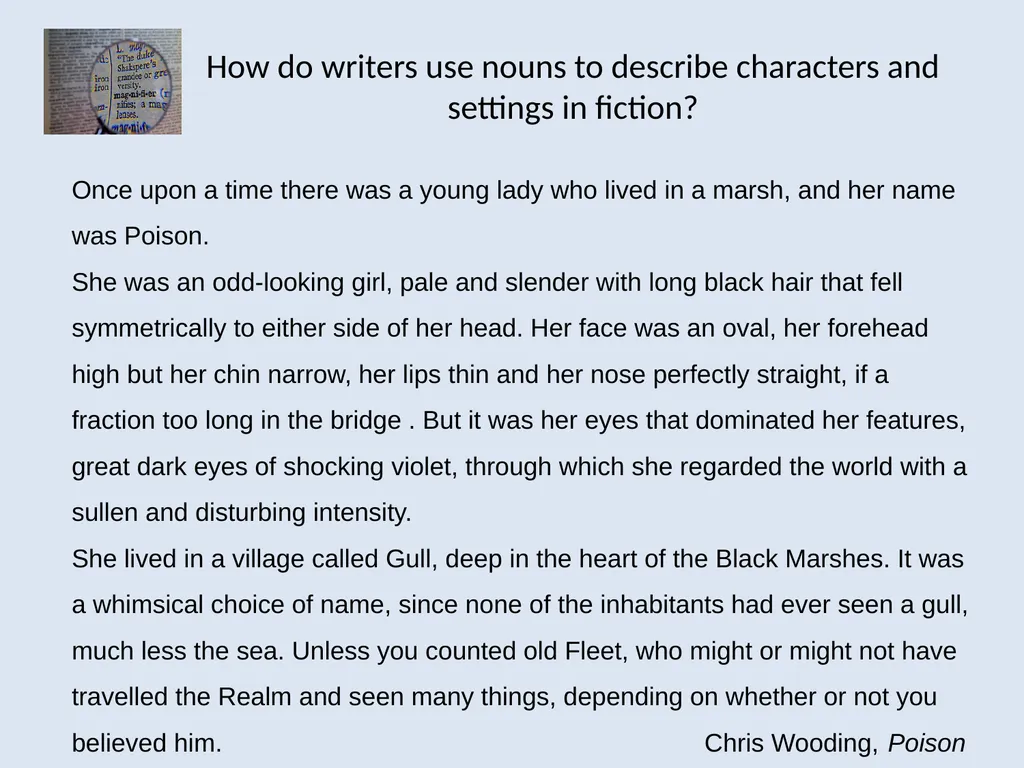
How do writers use nouns to describe characters and settings in fiction? Once upon a time there was a young lady who lived in a marsh, and her name was Poison.
She was an odd-looking girl, pale and slender with long black hair that fell symmetrically to either side of her head. Her face was an oval, her forehead high but her chin narrow, her lips thin and her nose perfectly straight, if a fraction too long in the bridge . But it was her eyes that dominated her features, great dark eyes of shocking violet, through which she regarded the world with a sullen and disturbing intensity.
She lived in a village called Gull, deep in the heart of the Black Marshes. It was a whimsical choice of name, since none of the inhabitants had ever seen a gull, much less the sea. Unless you counted old Fleet, who might or might not have travelled the Realm and seen many things, depending on whether or not you believed him. Chris Wooding, Poison<br>
06
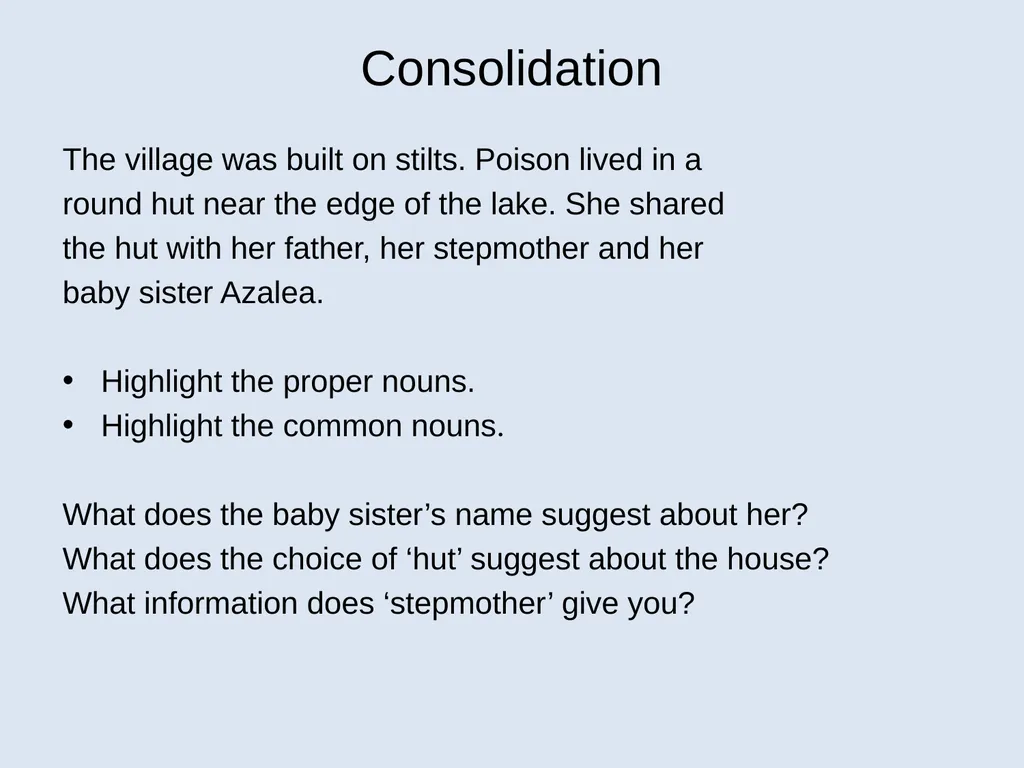
Consolidation The village was built on stilts. Poison lived in a
round hut near the edge of the lake. She shared
the hut with her father, her stepmother and her
baby sister Azalea.
Highlight the proper nouns.
Highlight the common nouns.
What does the baby sister’s name suggest about her?
What does the choice of ‘hut’ suggest about the house?
What information does ‘stepmother’ give you?<br>
07
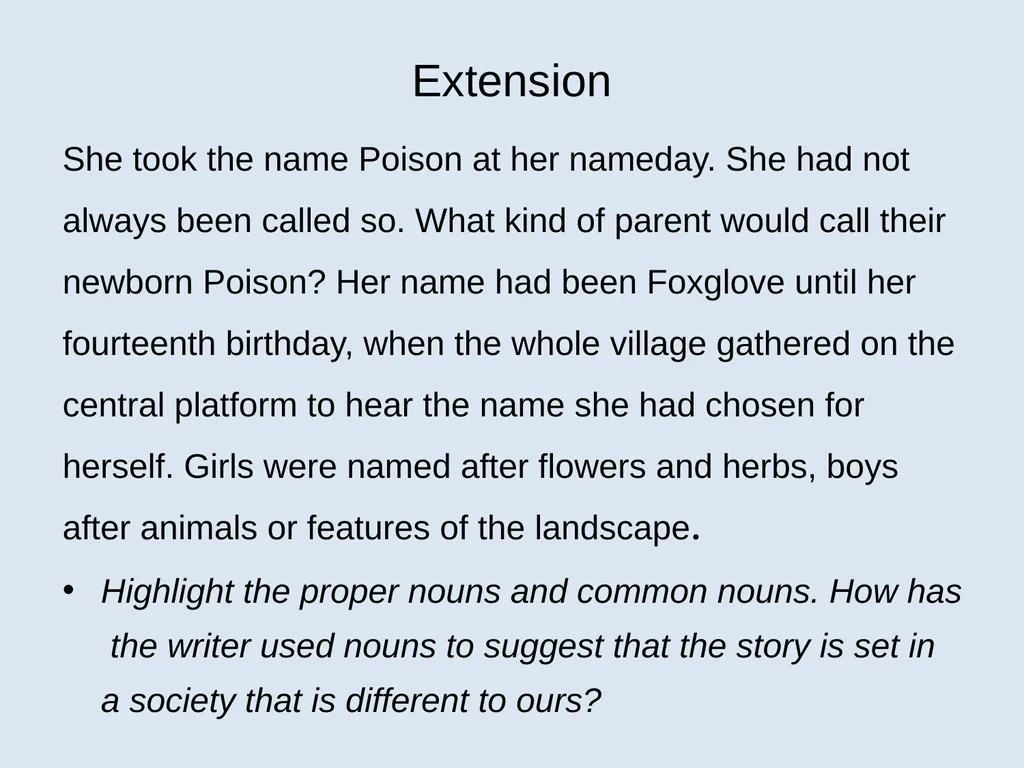
Extension She took the name Poison at her nameday. She had not
always been called so. What kind of parent would call their
newborn Poison? Her name had been Foxglove until her
fourteenth birthday, when the whole village gathered on the
central platform to hear the name she had chosen for
herself. Girls were named after flowers and herbs, boys
after animals or features of the landscape.
Highlight the proper nouns and common nouns. How has the writer used nouns to suggest that the story is set in a society that is different to ours?<br>