Y8 Language Detectives Investigating how language works: using conjunctions to write well-balanced arguments Yes, but.... Label yourselves A and B. Take it in turns to speak. The key rule is that anything you say is true you cant deny
"Y8 Language Detectives Investigating how language" is the property of its rightful owner. Permission is granted to
download and print the materials on this website for personal, non-commercial use only, and to display it
on your personal computer provided you do not modify the materials and that you retain all copyright
notices contained in the materials. By downloading content from our website, you accept the terms of this
agreement.
Presentation Transcript
01
Y8 Language Detectives Investigating how language works: using conjunctions to write
well-balanced arguments<br>
02
“Yes, but....” Label yourselves A and B. Take it in turns to speak. The key rule is that anything you say is true – you can’t deny what the other person says – but you have to start each sentence with ‘Yes, but….” and come up with a convincing argument to counter what the other person says. B starts off.
Topics:
A is a teacher who strongly believes homework is good for you; B is a student who doesn’t.
A is a parent who does not want their child staying up late on a school night; B is their child who wants to stay overnight for a friend’s birthday.<br>
03
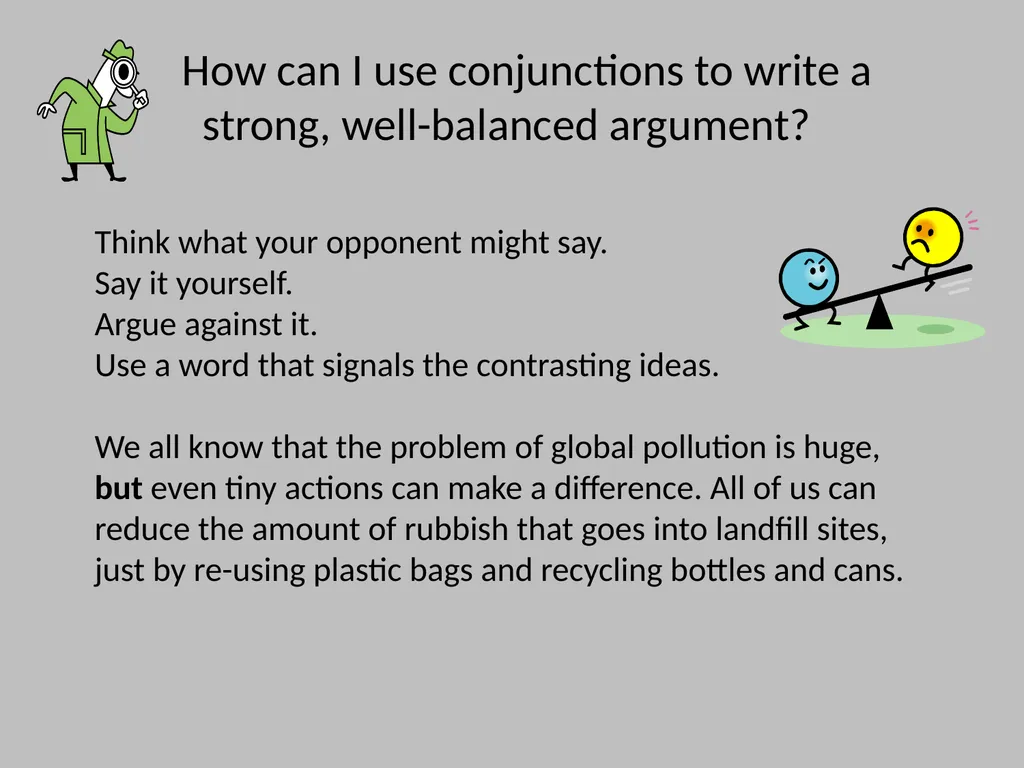
How can I use conjunctions to write a strong, well-balanced argument? Think what your opponent might say.
Say it yourself.
Argue against it.
Use a word that signals the contrasting ideas.
We all know that the problem of global pollution is huge, but even tiny actions can make a difference. All of us can reduce the amount of rubbish that goes into landfill sites, just by re-using plastic bags and recycling bottles and cans.<br>
04
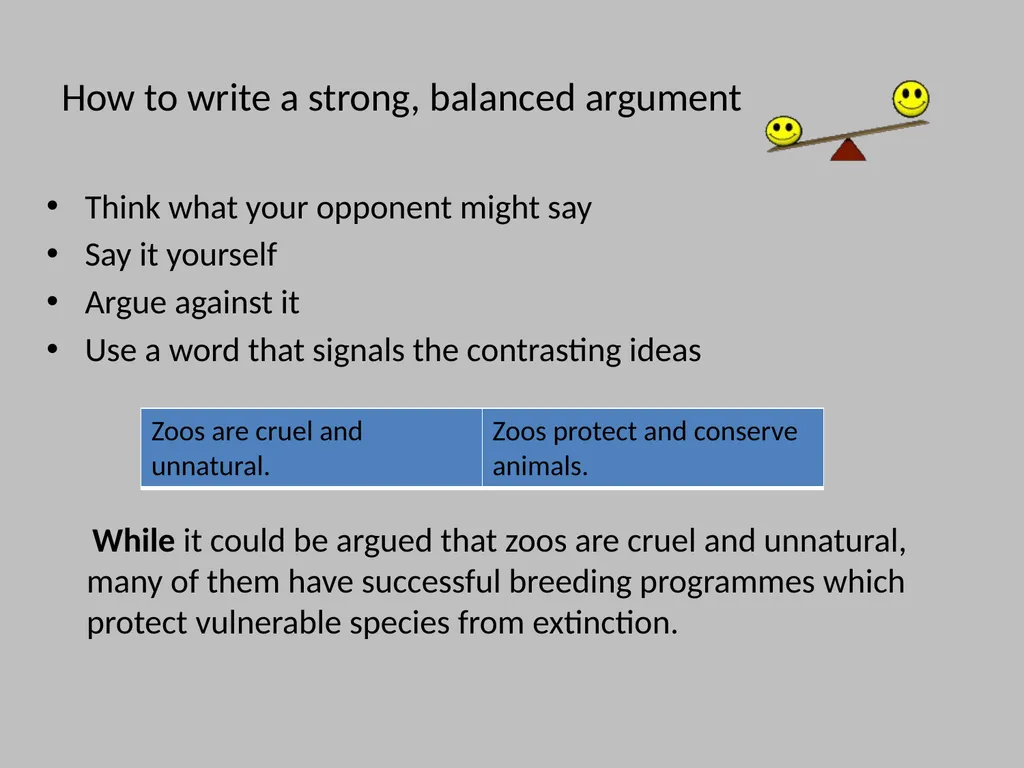
How to write a strong, balanced argument Think what your opponent might say
Say it yourself
Argue against it
Use a word that signals the contrasting ideas While it could be argued that zoos are cruel and unnatural, many of them have successful breeding programmes which protect vulnerable species from extinction.<br>
05
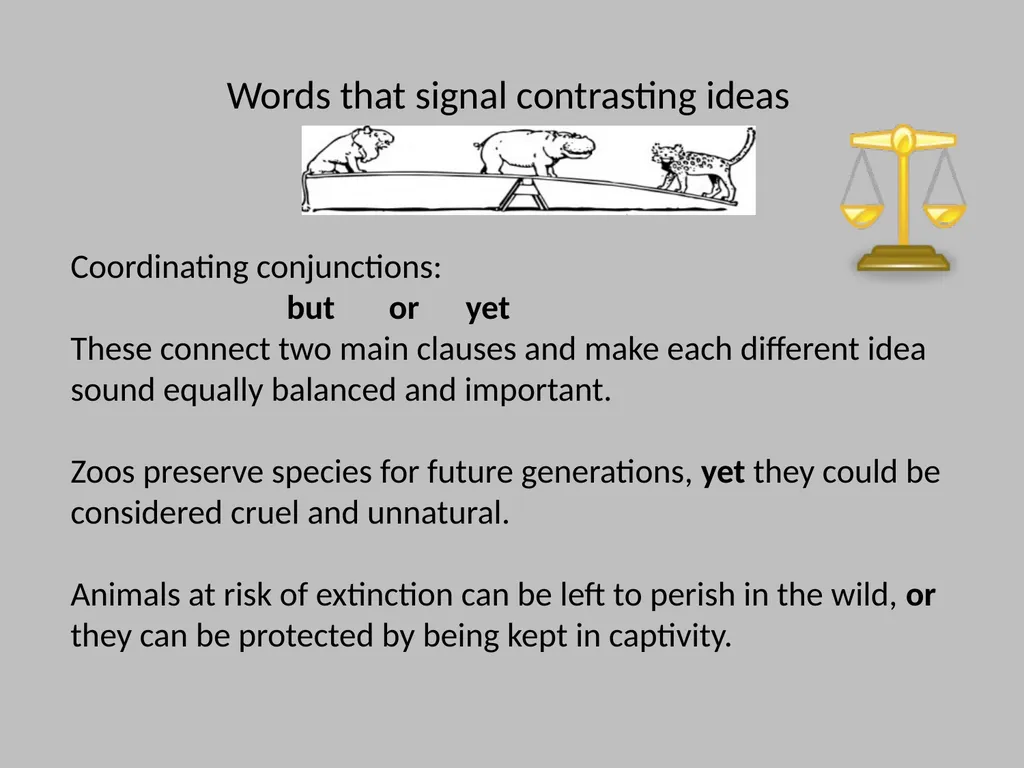
Words that signal contrasting ideas Coordinating conjunctions:
but or yet
These connect two main clauses and make each different idea sound equally balanced and important.
Zoos preserve species for future generations, yet they could be considered cruel and unnatural.
Animals at risk of extinction can be left to perish in the wild, or they can be protected by being kept in captivity.<br>
06
Your mum says: “No you can’t keep a hippo as a pet. Don’t be ridiculous!” You say:
You may think hippos........................, but actually they
need very little to keep them happy.
I know that hippos have a reputation for eating people,
yet....................
Do you want to let hippos die out in the wild or .................?<br>
07
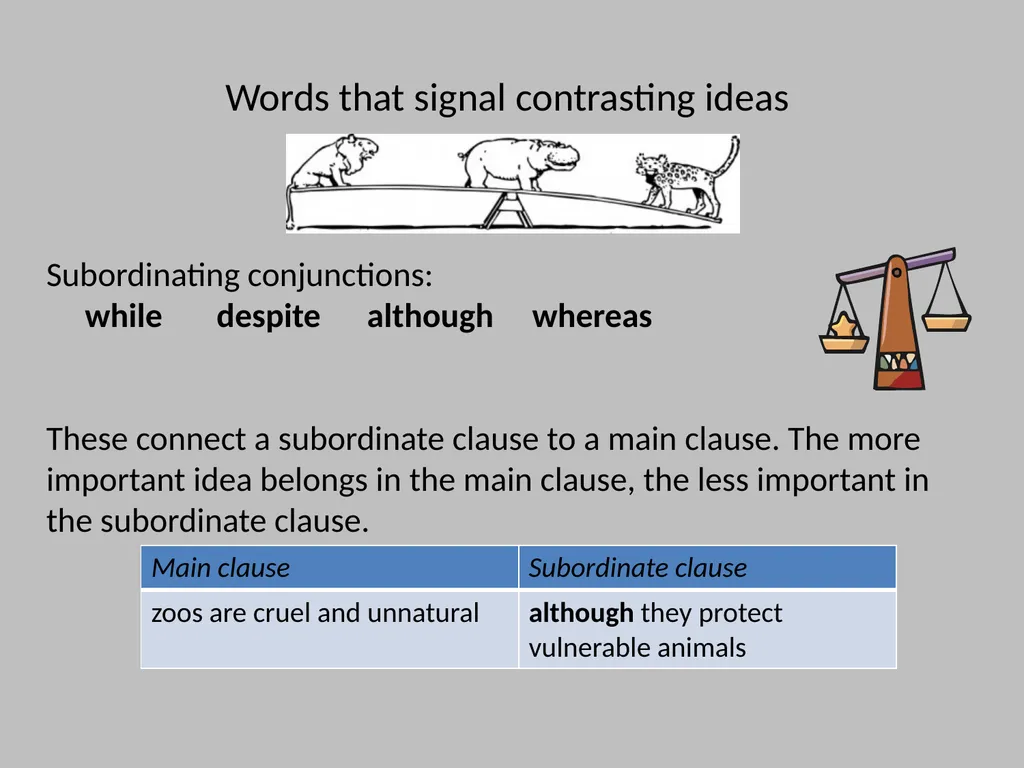
Words that signal contrasting ideas Subordinating conjunctions:
while despite although whereas
These connect a subordinate clause to a main clause. The more important idea belongs in the main clause, the less important in the subordinate clause.<br>
08
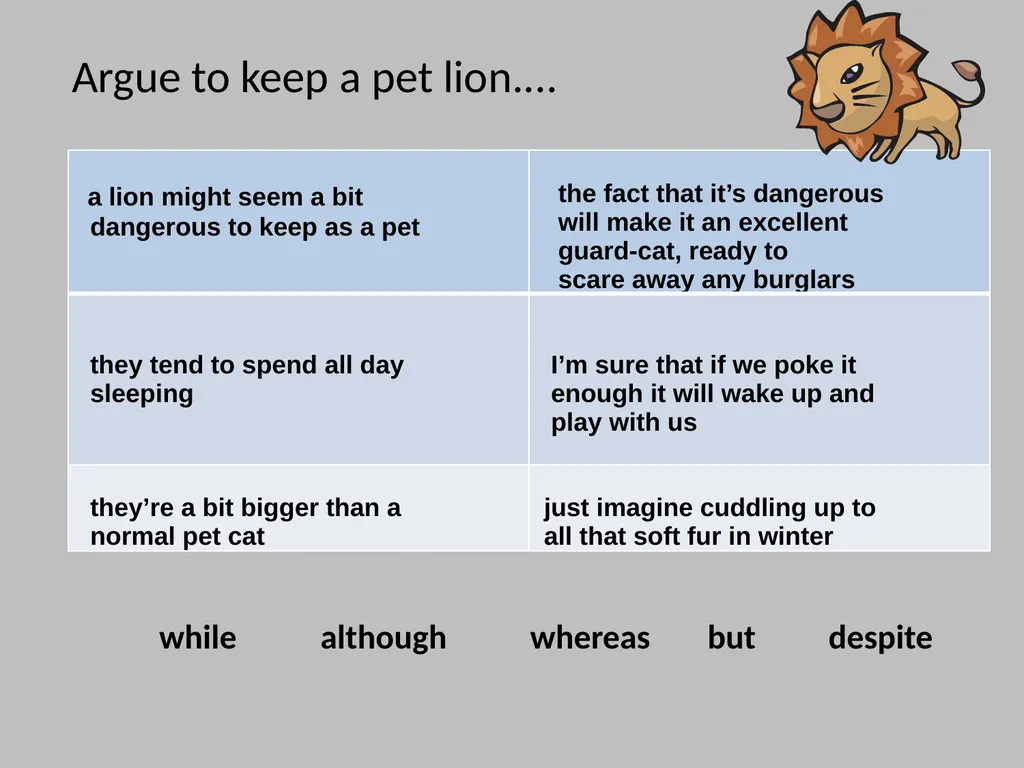
Argue to keep a pet lion.... while although whereas but despite<br>
09
Have you noticed? You can use subordinating conjunctions at the start of a sentence as well as between clauses in a sentence:
Despite the fact that pollution is a huge problem to solve,
even tiny actions can make a difference.
It is cruel to keep exotic animals as pets, although it seems
to be increasingly popular.
A coordinating conjunction must go between clauses in a sentence:
The problem of global pollution is huge, but even tiny
actions can make a difference so we must all act now. What do you notice about commas in these sentences?<br>
10
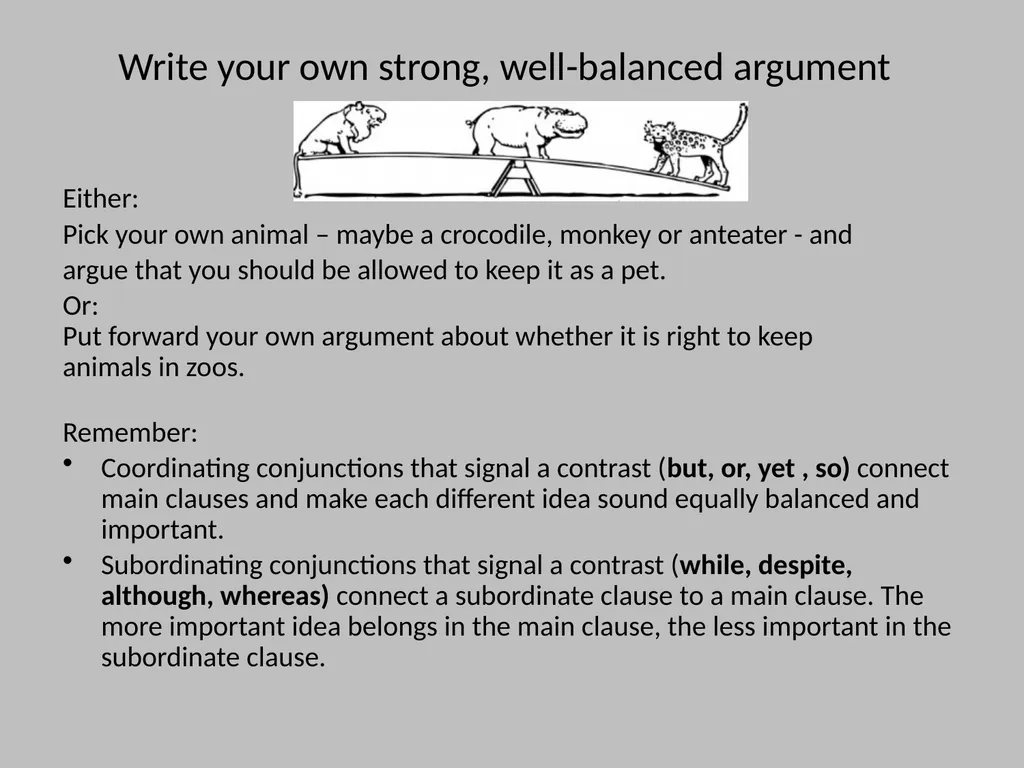
Write your own strong, well-balanced argument Either:
Pick your own animal – maybe a crocodile, monkey or anteater - and
argue that you should be allowed to keep it as a pet.
Or:
Put forward your own argument about whether it is right to keep
animals in zoos.
Remember:
Coordinating conjunctions that signal a contrast (but, or, yet , so) connect main clauses and make each different idea sound equally balanced and important.
Subordinating conjunctions that signal a contrast (while, despite, although, whereas) connect a subordinate clause to a main clause. The more important idea belongs in the main clause, the less important in the subordinate clause.<br>