02
Year 4
Romans Value Links -
Justice - Understand Roman crime and punishment and how we show justice today (Strand 4a, i ii) Local Links
Roman architecture and artefacts in Chester Think like a historian by
Exploring artefacts like a historian
Using historical terms correctly
Asking questions about life in the past National Curriculum coverage
Pupils should be taught about:
The Roman Empire and its impact on Britain Lesson sequence
Can I evaluate why the Romans wanted to invade Britain? (Extended Write – Debate)
Can I understand how the Roman empire expanded over time? (Reading Task: Julius Caesar)
Can I explain how the landscape of Britain was changed by what the Romans built?
Can I compare different types of houses in Roman Britain?
Can I describe Roman sites in Britain?
Can I evaluate the impact of the Roman empire on modern Britain? Key Content
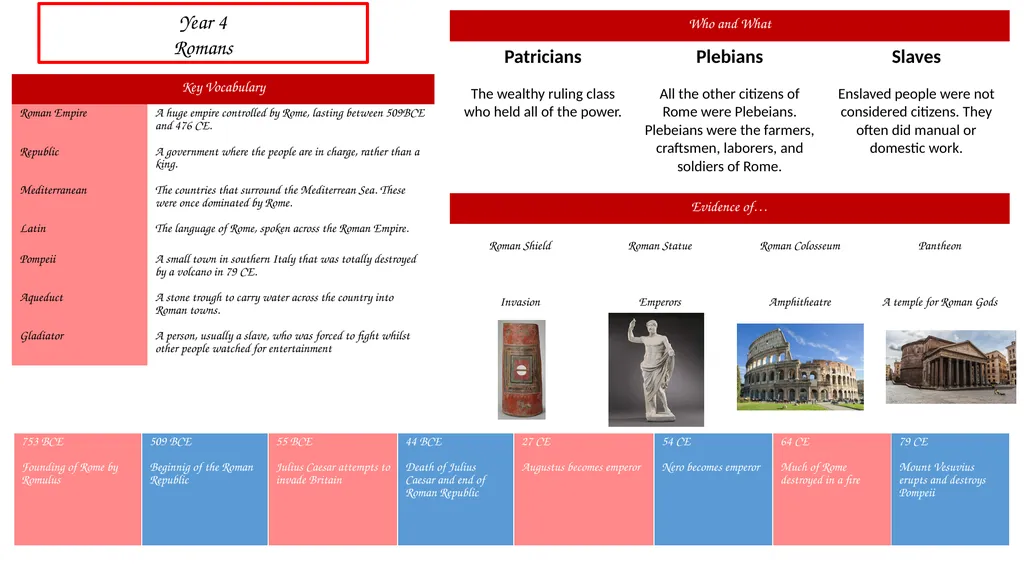
Ancient Roman civilization was based in modern day Italy, and included the entire Mediterranean, France, most of Britain and parts of the Middle East. Rome was founded around 750 BCE, and for 250 years was a monarchy. After the last king was driven out in 509 BCE, Rome became a republic – meaning a government of the people. This changed after the death of Julius Caesar, when Augustus became the first Roman emperor. The Roman Republic was controlled by a group of several hundred wealthy, powerful men, called senators. From these senators, two consuls were elected each year. These were roughly equivalent to a modern president. The rest of Roman society was split into patricians (landowners), plebeians (working Romans) and slaves, who were not Roman. Pompeii was a rich town, south of Rome. In 79 CE it was completely destroyed by an eruption from the volcano Vesuvius. Although it destroyed the town, the eruption preserved the town perfectly. Today Pompeii is one of the richest sources of information about Roman society and daily life. The forum was the centre of Roman public life, where people would buy food, meet friends, do business and make political speeches. For their leisure time, Romans might go to the public baths, watch plays at the theatre, attend chariot races at the circus, or gladiator fights at the amphitheatre. For hundreds of years, Latin was the language used in all international relations, politics, religion and scholarship. English today is heavily influenced by the Latin language, as are the languages: Italian, French, Spanish, Portuguese and Romanian. The Roman Empire also gave Europe the idea of a single government, and even up to the 20th Century, kings in Russia and Germany used the title of Caesar. Key Vocabulary
Invasion
Empire
Julius Caesar
Settlements
Aqueduct
Gladiator
Republic<br>