
Year 7 History Ancient China Starter Sheet
YM
Published · 12 slides · 0 views

1 / 1


Description
Year 7 History Ancient China Starter Sheet Readings Year 7 Hist - Ancient China 1 Geography Reading Activity Write down the heading. Number the paragraphs. Circle the metalanguage words :
Related Topics
Share
Embed code
Download this presentation From Below
"Year 7 History Ancient China Starter Sheet" is the property of its rightful owner. Permission is granted to download and print the materials on this website for personal, non-commercial use only, and to display it on your personal computer provided you do not modify the materials and that you retain all copyright notices contained in the materials. By downloading content from our website, you accept the terms of this agreement.
Presentation Transcript
01
Year 7 History
Ancient China
Starter Sheet
Readings<br>
02
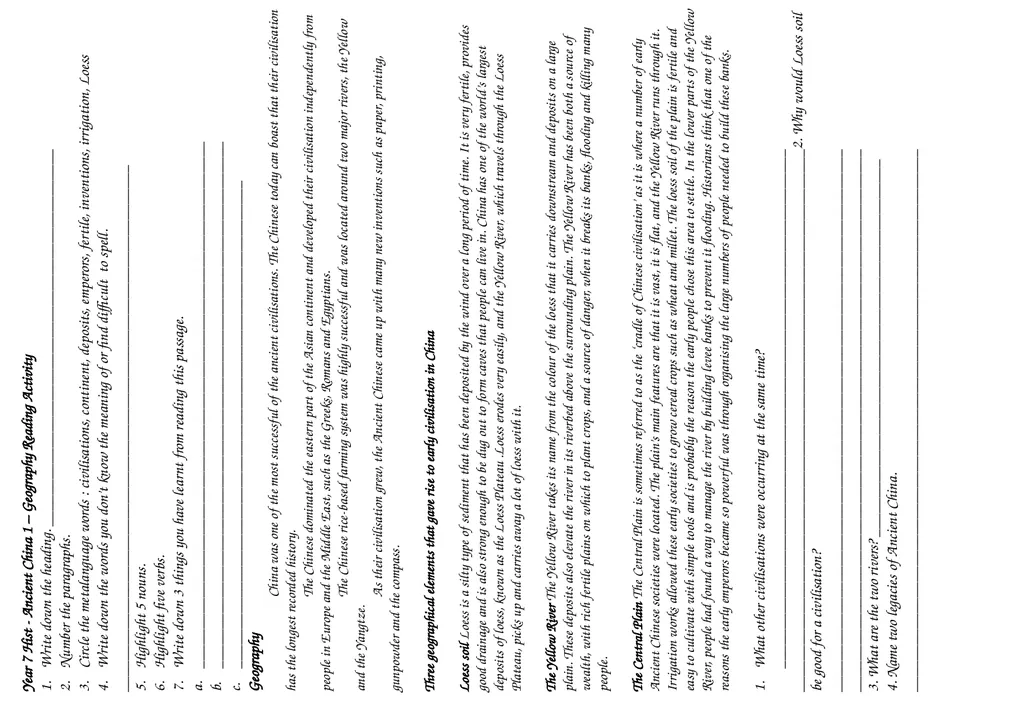
Year 7 Hist - Ancient China 1 – Geography Reading Activity
Write down the heading. ________________________________________________
Number the paragraphs.
Circle the metalanguage words : civilisations, continent, deposits, emperors, fertile, inventions, irrigation, Loess
Write down the words you don’t know the meaning of or find difficult to spell.
___________________________________________________________________
Highlight 5 nouns.
Highlight five verbs.
Write down 3 things you have learnt from reading this passage.
___________________________________________________________________
___________________________________________________________________
______________________________________________________________
Geography
China was one of the most successful of the ancient civilisations. The Chinese today can boast that their civilisation has the longest recorded history.
The Chinese dominated the eastern part of the Asian continent and developed their civilisation independently from people in Europe and the Middle East, such as the Greeks, Romans and Egyptians.
The Chinese rice-based farming system was highly successful and was located around two major rivers, the Yellow and the Yangtze.
As their civilisation grew, the Ancient Chinese came up with many new inventions such as paper, printing, gunpowder and the compass.
Three geographical elements that gave rise to early civilisation in China
Loess soil Loess is a silty type of sediment that has been deposited by the wind over a long period of time. It is very fertile, provides good drainage and is also strong enough to be dug out to form caves that people can live in. China has one of the world’s largest deposits of loess, known as the Loess Plateau .Loess erodes very easily, and the Yellow River, which travels through the Loess Plateau, picks up and carries away a lot of loess with it.
The Yellow River The Yellow River takes its name from the colour of the loess that it carries downstream and deposits on a large plain. These deposits also elevate the river in its riverbed above the surrounding plain. The Yellow River has been both a source of wealth, with rich fertile plains on which to plant crops, and a source of danger, when it breaks its banks, flooding and killing many people.
The Central Plain The Central Plain is sometimes referred to as the ‘cradle of Chinese civilisation’ as it is where a number of early Ancient Chinese societies were located. The plain’s main features are that it is vast, it is flat, and the Yellow River runs through it. Irrigation works allowed these early societies to grow cereal crops such as wheat and millet. The loess soil of the plain is fertile and easy to cultivate with simple tools and is probably the reason the early people chose this area to settle. In the lower parts of the Yellow River, people had found a way to manage the river by building levee banks to prevent it flooding. Historians think that one of the reasons the early emperors became so powerful was through organising the large numbers of people needed to build these banks.
What other civilisations were occurring at the same time? __________________________________________________________________
_____________________________________________________________________2. Why would Loess soil be good for a civilisation? _____________________________________________________________________
_____________________________________________________________________
3. What are the two rivers? ________________________________________________
4. Name two legacies of Ancient China. _____________________________________________________________________<br>
Write down the heading. ________________________________________________
Number the paragraphs.
Circle the metalanguage words : civilisations, continent, deposits, emperors, fertile, inventions, irrigation, Loess
Write down the words you don’t know the meaning of or find difficult to spell.
___________________________________________________________________
Highlight 5 nouns.
Highlight five verbs.
Write down 3 things you have learnt from reading this passage.
___________________________________________________________________
___________________________________________________________________
______________________________________________________________
Geography
China was one of the most successful of the ancient civilisations. The Chinese today can boast that their civilisation has the longest recorded history.
The Chinese dominated the eastern part of the Asian continent and developed their civilisation independently from people in Europe and the Middle East, such as the Greeks, Romans and Egyptians.
The Chinese rice-based farming system was highly successful and was located around two major rivers, the Yellow and the Yangtze.
As their civilisation grew, the Ancient Chinese came up with many new inventions such as paper, printing, gunpowder and the compass.
Three geographical elements that gave rise to early civilisation in China
Loess soil Loess is a silty type of sediment that has been deposited by the wind over a long period of time. It is very fertile, provides good drainage and is also strong enough to be dug out to form caves that people can live in. China has one of the world’s largest deposits of loess, known as the Loess Plateau .Loess erodes very easily, and the Yellow River, which travels through the Loess Plateau, picks up and carries away a lot of loess with it.
The Yellow River The Yellow River takes its name from the colour of the loess that it carries downstream and deposits on a large plain. These deposits also elevate the river in its riverbed above the surrounding plain. The Yellow River has been both a source of wealth, with rich fertile plains on which to plant crops, and a source of danger, when it breaks its banks, flooding and killing many people.
The Central Plain The Central Plain is sometimes referred to as the ‘cradle of Chinese civilisation’ as it is where a number of early Ancient Chinese societies were located. The plain’s main features are that it is vast, it is flat, and the Yellow River runs through it. Irrigation works allowed these early societies to grow cereal crops such as wheat and millet. The loess soil of the plain is fertile and easy to cultivate with simple tools and is probably the reason the early people chose this area to settle. In the lower parts of the Yellow River, people had found a way to manage the river by building levee banks to prevent it flooding. Historians think that one of the reasons the early emperors became so powerful was through organising the large numbers of people needed to build these banks.
What other civilisations were occurring at the same time? __________________________________________________________________
_____________________________________________________________________2. Why would Loess soil be good for a civilisation? _____________________________________________________________________
_____________________________________________________________________
3. What are the two rivers? ________________________________________________
4. Name two legacies of Ancient China. _____________________________________________________________________<br>
03
Royal family and allied noble families
Resided in_____________, palatial compounds and lived on the agricultural surplus and _____________ delivered by their subjects
Power tied to bronze
Privileged class of hereditary aristocrats
Rose from the military allies of the rulers
Possessed extensive land holdings and performed ___________________ and
administrative tasks
Some access to _______________for those who lived in cities
Detailed rules of etiquette during Zhou era
Artisans and craftsmen
Lived in _______________
hose who worked almost extensively for the privileged classes lived reasonably comfortably
Farmers
Semi-servile class that lived in the _____________________ and did not own land
Provided agricultural, military, and labor _______________________ for lords in
exchange for plots to cultivate, security, and a portion of the harvest
Merchants
Sold _____________________to all classes
Looked down on because did not create anything but money
Were ________________but without status
Slaves
Most were ______________________enemy warriors
Performed hard labor that required a large work force such as
______________fields or building city walls
During the Shang Dynasty many were victims of human
_____________________ during funerals and other religious and ritual
observances EMPEROR NOBLES ARTISANS FARMERS MERCHANTS SLAVES captured,
Cities,
clearing ,
countryside
education,
goods
Large,
military,
rules
sacrifice
services,
taxes,
wealthy Year 7 Hist - Ancient China 2 - Social Hierarchy Reading Activity
Write down the heading. ________________________________________________
Number the paragraphs.
Write down the words you don’t know the meaning of or find difficult to spell.
___________________________________________________________________
Highlight 5 nouns.
Highlight 5 verbs.<br>
Resided in_____________, palatial compounds and lived on the agricultural surplus and _____________ delivered by their subjects
Power tied to bronze
Privileged class of hereditary aristocrats
Rose from the military allies of the rulers
Possessed extensive land holdings and performed ___________________ and
administrative tasks
Some access to _______________for those who lived in cities
Detailed rules of etiquette during Zhou era
Artisans and craftsmen
Lived in _______________
hose who worked almost extensively for the privileged classes lived reasonably comfortably
Farmers
Semi-servile class that lived in the _____________________ and did not own land
Provided agricultural, military, and labor _______________________ for lords in
exchange for plots to cultivate, security, and a portion of the harvest
Merchants
Sold _____________________to all classes
Looked down on because did not create anything but money
Were ________________but without status
Slaves
Most were ______________________enemy warriors
Performed hard labor that required a large work force such as
______________fields or building city walls
During the Shang Dynasty many were victims of human
_____________________ during funerals and other religious and ritual
observances EMPEROR NOBLES ARTISANS FARMERS MERCHANTS SLAVES captured,
Cities,
clearing ,
countryside
education,
goods
Large,
military,
rules
sacrifice
services,
taxes,
wealthy Year 7 Hist - Ancient China 2 - Social Hierarchy Reading Activity
Write down the heading. ________________________________________________
Number the paragraphs.
Write down the words you don’t know the meaning of or find difficult to spell.
___________________________________________________________________
Highlight 5 nouns.
Highlight 5 verbs.<br>
04
Year 7 Hist - Ancient China 3 - Filial piety and Marriage Reading Activity
Write down the heading. ________________________________________________
Number the paragraphs.
Circle the metalanguage words : arranged, birth, compatible, honour, important, individualism, obeyed, piety, respect.
Write down the words you don’t know the meaning of or find difficult to spell.
___________________________________________________________________
Highlight 5 nouns.
Highlight 5 verbs.
Write down 3 things you have learnt from reading this passage.
___________________________________________________________________
___________________________________________________________________
___________________________________________________________________
8. What is filial piety ______________________________________________________________________
______________________________________________________________________
9. Who was the ruler of the household? Why? ______________________________________________________________________
10. In what ways were females discriminated against? ______________________________________________________________________
__________________________________________________________________________________________________________________________________________________________________________________________________________________
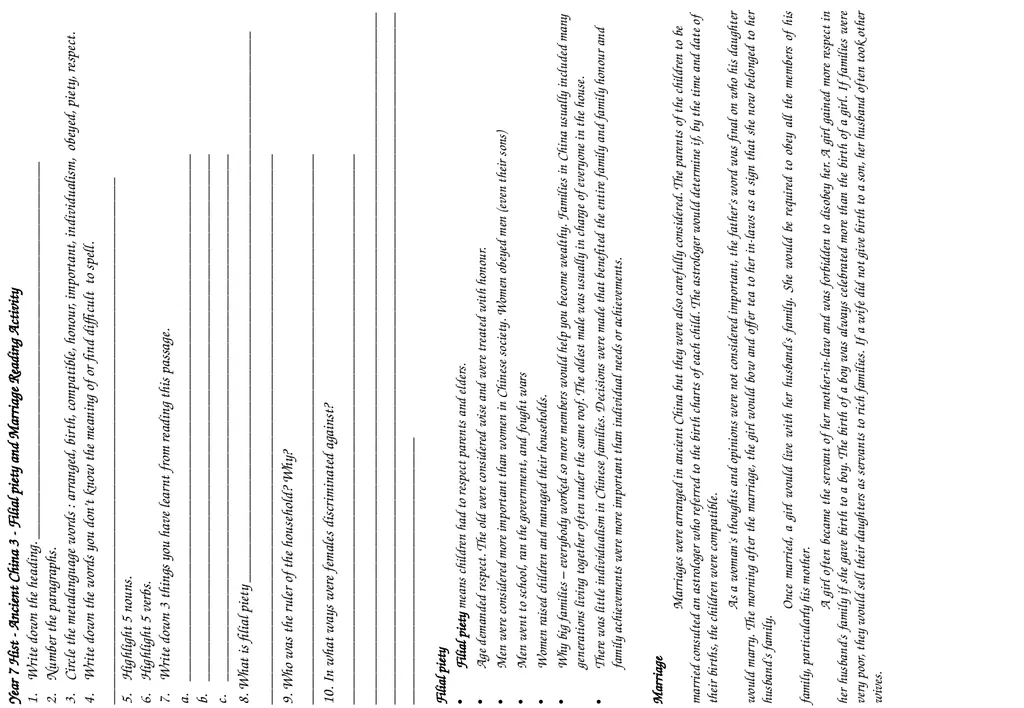
Filial piety
Filial piety means children had to respect parents and elders.
Age demanded respect. The old were considered wise and were treated with honour.
Men were considered more important than women in Chinese society. Women obeyed men (even their sons)
Men went to school, ran the government, and fought wars
Women raised children and managed their households.
Why big families – everybody worked so more members would help you become wealthy. Families in China usually included many generations living together often under the same roof. The oldest male was usually in charge of everyone in the house.
There was little individualism in Chinese families. Decisions were made that benefited the entire family and family honour and family achievements were more important than individual needs or achievements.
Marriage
Marriages were arranged in ancient China but they were also carefully considered. The parents of the children to be married consulted an astrologer who referred to the birth charts of each child. The astrologer would determine if, by the time and date of their births, the children were compatible.
As a woman's thoughts and opinions were not considered important, the father's word was final on who his daughter would marry. The morning after the marriage, the girl would bow and offer tea to her in-laws as a sign that she now belonged to her husband's family.
Once married, a girl would live with her husband's family. She would be required to obey all the members of his family, particularly his mother.
A girl often became the servant of her mother-in-law and was forbidden to disobey her. A girl gained more respect in her husband's family if she gave birth to a boy. The birth of a boy was always celebrated more than the birth of a girl. If families were very poor, they would sell their daughters as servants to rich families. If a wife did not give birth to a son, her husband often took other wives.<br>
Write down the heading. ________________________________________________
Number the paragraphs.
Circle the metalanguage words : arranged, birth, compatible, honour, important, individualism, obeyed, piety, respect.
Write down the words you don’t know the meaning of or find difficult to spell.
___________________________________________________________________
Highlight 5 nouns.
Highlight 5 verbs.
Write down 3 things you have learnt from reading this passage.
___________________________________________________________________
___________________________________________________________________
___________________________________________________________________
8. What is filial piety ______________________________________________________________________
______________________________________________________________________
9. Who was the ruler of the household? Why? ______________________________________________________________________
10. In what ways were females discriminated against? ______________________________________________________________________
__________________________________________________________________________________________________________________________________________________________________________________________________________________
Filial piety
Filial piety means children had to respect parents and elders.
Age demanded respect. The old were considered wise and were treated with honour.
Men were considered more important than women in Chinese society. Women obeyed men (even their sons)
Men went to school, ran the government, and fought wars
Women raised children and managed their households.
Why big families – everybody worked so more members would help you become wealthy. Families in China usually included many generations living together often under the same roof. The oldest male was usually in charge of everyone in the house.
There was little individualism in Chinese families. Decisions were made that benefited the entire family and family honour and family achievements were more important than individual needs or achievements.
Marriage
Marriages were arranged in ancient China but they were also carefully considered. The parents of the children to be married consulted an astrologer who referred to the birth charts of each child. The astrologer would determine if, by the time and date of their births, the children were compatible.
As a woman's thoughts and opinions were not considered important, the father's word was final on who his daughter would marry. The morning after the marriage, the girl would bow and offer tea to her in-laws as a sign that she now belonged to her husband's family.
Once married, a girl would live with her husband's family. She would be required to obey all the members of his family, particularly his mother.
A girl often became the servant of her mother-in-law and was forbidden to disobey her. A girl gained more respect in her husband's family if she gave birth to a boy. The birth of a boy was always celebrated more than the birth of a girl. If families were very poor, they would sell their daughters as servants to rich families. If a wife did not give birth to a son, her husband often took other wives.<br>
05
Year 7 Hist - Ancient China 4 -Crime and punishment Reading Activity.
Write down the heading. ________________________________________________
Number the paragraphs.
Circle the metalanguage words : authority, banishment, culture, decapitation, devotion, embedded, executioners, government, protection, punishments
Write down the words you don’t know the meaning of or find difficult to spell.
___________________________________________________________________
Highlight 5 nouns.
Highlight 5 verbs.
Write down 3 things you have learnt from reading this passage.
___________________________________________________________________
___________________________________________________________________
___________________________________________________________________
8. Put in the capital letters. Remember at the beginning of a sentence and for names of countries . Eg China
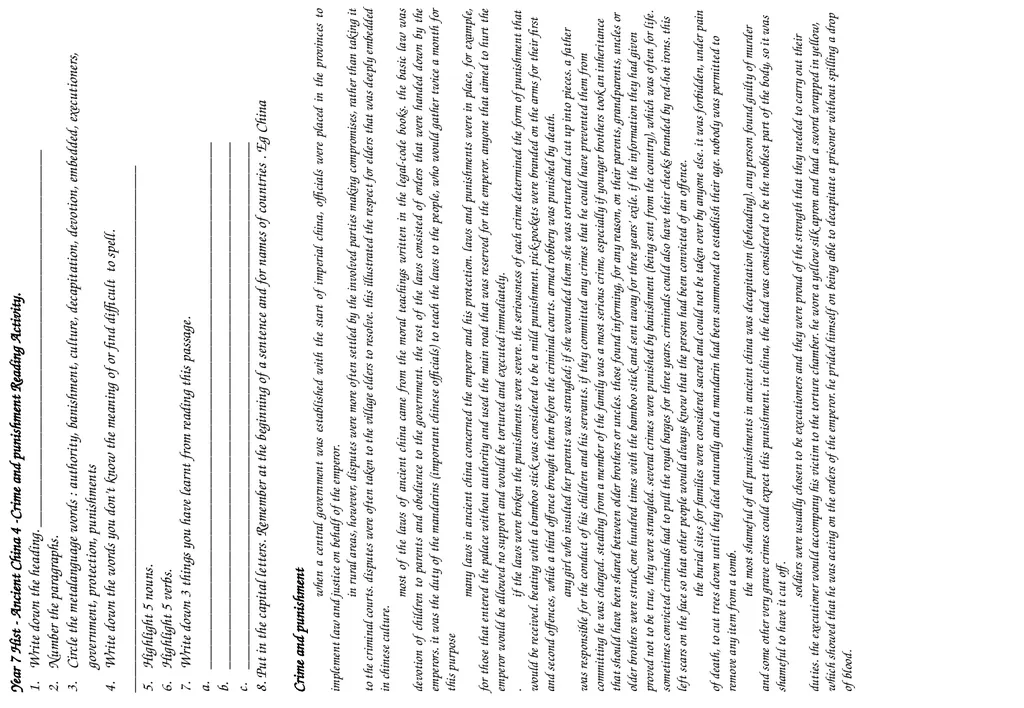
Crime and punishment
when a central government was established with the start of imperial china, officials were placed in the provinces to implement law and justice on behalf of the emperor.
in rural areas, however, disputes were more often settled by the involved parties making compromises, rather than taking it to the criminal courts. disputes were often taken to the village elders to resolve. this illustrated the respect for elders that was deeply embedded in chinese culture.
most of the laws of ancient china came from the moral teachings written in the legal-code books. the basic law was devotion of children to parents and obedience to the government. the rest of the laws consisted of orders that were handed down by the emperors. it was the duty of the mandarins (important chinese officials) to teach the laws to the people, who would gather twice a month for this purpose
many laws in ancient china concerned the emperor and his protection. laws and punishments were in place, for example, for those that entered the palace without authority and used the main road that was reserved for the emperor. anyone that aimed to hurt the emperor would be allowed no support and would be tortured and executed immediately.
. if the laws were broken the punishments were severe. the seriousness of each crime determined the form of punishment that would be received. beating with a bamboo stick was considered to be a mild punishment. pick-pockets were branded on the arms for their first and second offences, while a third offence brought them before the criminal courts. armed robbery was punished by death.
any girl who insulted her parents was strangled; if she wounded them she was tortured and cut up into pieces. a father was responsible for the conduct of his children and his servants. if they committed any crimes that he could have prevented them from committing he was charged. stealing from a member of the family was a most serious crime, especially if younger brothers took an inheritance that should have been shared between older brothers or uncles. those found informing, for any reason, on their parents, grandparents, uncles or older brothers were struck one hundred times with the bamboo stick and sent away for three years’ exile. if the information they had given proved not to be true, they were strangled. several crimes were punished by banishment (being sent from the country), which was often for life. sometimes convicted criminals had to pull the royal barges for three years. criminals could also have their cheeks branded by red-hot irons. this left scars on the face so that other people would always know that the person had been convicted of an offence.
the burial sites for families were considered sacred and could not be taken over by anyone else. it was forbidden, under pain of death, to cut trees down until they died naturally and a mandarin had been summoned to establish their age. nobody was permitted to remove any item from a tomb.
the most shameful of all punishments in ancient china was decapitation (beheading). any person found guilty of murder and some other very grave crimes could expect this punishment. in china, the head was considered to be the noblest part of the body, so it was shameful to have it cut off.
soldiers were usually chosen to be executioners and they were proud of the strength that they needed to carry out their duties. the executioner would accompany his victim to the torture chamber. he wore a yellow silk apron and had a sword wrapped in yellow, which showed that he was acting on the orders of the emperor. he prided himself on being able to decapitate a prisoner without spilling a drop of blood.<br>
Write down the heading. ________________________________________________
Number the paragraphs.
Circle the metalanguage words : authority, banishment, culture, decapitation, devotion, embedded, executioners, government, protection, punishments
Write down the words you don’t know the meaning of or find difficult to spell.
___________________________________________________________________
Highlight 5 nouns.
Highlight 5 verbs.
Write down 3 things you have learnt from reading this passage.
___________________________________________________________________
___________________________________________________________________
___________________________________________________________________
8. Put in the capital letters. Remember at the beginning of a sentence and for names of countries . Eg China
Crime and punishment
when a central government was established with the start of imperial china, officials were placed in the provinces to implement law and justice on behalf of the emperor.
in rural areas, however, disputes were more often settled by the involved parties making compromises, rather than taking it to the criminal courts. disputes were often taken to the village elders to resolve. this illustrated the respect for elders that was deeply embedded in chinese culture.
most of the laws of ancient china came from the moral teachings written in the legal-code books. the basic law was devotion of children to parents and obedience to the government. the rest of the laws consisted of orders that were handed down by the emperors. it was the duty of the mandarins (important chinese officials) to teach the laws to the people, who would gather twice a month for this purpose
many laws in ancient china concerned the emperor and his protection. laws and punishments were in place, for example, for those that entered the palace without authority and used the main road that was reserved for the emperor. anyone that aimed to hurt the emperor would be allowed no support and would be tortured and executed immediately.
. if the laws were broken the punishments were severe. the seriousness of each crime determined the form of punishment that would be received. beating with a bamboo stick was considered to be a mild punishment. pick-pockets were branded on the arms for their first and second offences, while a third offence brought them before the criminal courts. armed robbery was punished by death.
any girl who insulted her parents was strangled; if she wounded them she was tortured and cut up into pieces. a father was responsible for the conduct of his children and his servants. if they committed any crimes that he could have prevented them from committing he was charged. stealing from a member of the family was a most serious crime, especially if younger brothers took an inheritance that should have been shared between older brothers or uncles. those found informing, for any reason, on their parents, grandparents, uncles or older brothers were struck one hundred times with the bamboo stick and sent away for three years’ exile. if the information they had given proved not to be true, they were strangled. several crimes were punished by banishment (being sent from the country), which was often for life. sometimes convicted criminals had to pull the royal barges for three years. criminals could also have their cheeks branded by red-hot irons. this left scars on the face so that other people would always know that the person had been convicted of an offence.
the burial sites for families were considered sacred and could not be taken over by anyone else. it was forbidden, under pain of death, to cut trees down until they died naturally and a mandarin had been summoned to establish their age. nobody was permitted to remove any item from a tomb.
the most shameful of all punishments in ancient china was decapitation (beheading). any person found guilty of murder and some other very grave crimes could expect this punishment. in china, the head was considered to be the noblest part of the body, so it was shameful to have it cut off.
soldiers were usually chosen to be executioners and they were proud of the strength that they needed to carry out their duties. the executioner would accompany his victim to the torture chamber. he wore a yellow silk apron and had a sword wrapped in yellow, which showed that he was acting on the orders of the emperor. he prided himself on being able to decapitate a prisoner without spilling a drop of blood.<br>
06
Year 7 Hist – Ancient China 5 – Chinese New Year Reading Activity
Write down the heading. ________________________________________________
Number the paragraphs.
Write down the words you don’t know the meaning of or find difficult to spell.
___________________________________________________________________
Highlight 5 nouns.
Highlight 5 verbs.
Highlight 5 adjectives
Highlight 3 adverbs
The Story of Chinese New Year
In ancient China there lived a monster named Year who, with a horn on his head, was extremely ferocious. Year lived at the bottom of the deep sea all the year round and climbed up to the shore only on New Year's Eve to eat the cattle and people.
On the day of every New Year's Eve, people from all the villages would flee, bringing along the old and the young, to the remote mountains so as to avoid the calamity caused by the monster of Year.
On the day of that New Year's Eve the people of Peach Blossom village were bringing along the old and the young to take flight when there came from outside the village an old beggar. With a stick in his hand and a bag hanging upon his arm, he had eyes twinkling like stars and graceful beard as white as silver.
Seized with panic, the villagers were in a great hurry to run away. Some were closing the windows and locking the doors, some were packing, and others were urging the cattle and driving the sheep. at a time when the people were shouting and the horses were neighing no one was in the mood to care for the beggar.
Only a grandmother living in the east end of the village gave the old man some food and advised him to flee to the mountains to avoid the Year monster. But the old man stroked his beard and said with a smile, "If you allow me to stay at your home for the night, I'm sure to drive away the monster Year."
The old woman was surprised to hear this. She looked at him unbelievingly only to find that, with white hair and ruddy complexion, the old man had a bearing out of the ordinary. She went on to persuade him to take flight. But he only smiled without reply. Thereupon the grandmother could not help but leave her home and flee to the mountains.
around midnight the monster Year rushed into the villages. He found the atmosphere was quite different from that of the previous year. The house of the grandmother in the east end of the village was brilliantly illuminated, with bright red paper stuck on the doors. Greatly shocked, the monster gave a strange loud cry. The monster Year stared angrily at the house for a moment. and then howling furiously, he made a pounce on it. as he approached the door, there came all of a sudden the exploding sounds of bang-bong. Trembling all over, the monster dared not make a step forward.
It turned out that the red colour; flame and exploding were what Year feared the most. and when the door of the grandmother's house was thrown open and an old man in a red robe burst out laughing in the courtyard, the monster Year was scared out of his wits and fled helter-skelter.
The next day was the 1st of the first lunar month. When people came back from their hideouts and found everything safe and sound, they were quite surprised. The old woman suddenly realized what had happened and told the villagers about the old beggar's promise. The villagers swarmed into the grandmother's house, only to find that the doors were struck with red paper , the ember of a pile of bamboo were still giving out exploding sound of bang-bong in the courtyard, and a few candles were still glowing in the room...
The story was soon spread far and wide and everybody was talking about it. They concluded in the end that the old beggar was surely the celestial being who came to expel the calamities and bless the people, and that red paper, red cloth, red candles and the exploding firecracker were certainly the magic weapons to drive out the monster Year.
To celebrate the arrival of the god, the happy villagers put on their clothes and new hats and went one after another to their relatives and friends to send their regards and congratulations. This was soon spread to the surrounding villages, and people all got to know the way to drive away the monster Year.
From then on, on each New Year's Eve, each family stick on their doors warning letters written on red paper, blow up firecrackers, keep their houses brilliantly illuminated and stay up late into the night. Early in the morning of the 1st of the first lunar month they go to their relatives and friends' to send their regards and congratulations. These customs have spread far and wide and kept for generations. It is the most ceremonious traditional festival of the Chinese people.<br>
Write down the heading. ________________________________________________
Number the paragraphs.
Write down the words you don’t know the meaning of or find difficult to spell.
___________________________________________________________________
Highlight 5 nouns.
Highlight 5 verbs.
Highlight 5 adjectives
Highlight 3 adverbs
The Story of Chinese New Year
In ancient China there lived a monster named Year who, with a horn on his head, was extremely ferocious. Year lived at the bottom of the deep sea all the year round and climbed up to the shore only on New Year's Eve to eat the cattle and people.
On the day of every New Year's Eve, people from all the villages would flee, bringing along the old and the young, to the remote mountains so as to avoid the calamity caused by the monster of Year.
On the day of that New Year's Eve the people of Peach Blossom village were bringing along the old and the young to take flight when there came from outside the village an old beggar. With a stick in his hand and a bag hanging upon his arm, he had eyes twinkling like stars and graceful beard as white as silver.
Seized with panic, the villagers were in a great hurry to run away. Some were closing the windows and locking the doors, some were packing, and others were urging the cattle and driving the sheep. at a time when the people were shouting and the horses were neighing no one was in the mood to care for the beggar.
Only a grandmother living in the east end of the village gave the old man some food and advised him to flee to the mountains to avoid the Year monster. But the old man stroked his beard and said with a smile, "If you allow me to stay at your home for the night, I'm sure to drive away the monster Year."
The old woman was surprised to hear this. She looked at him unbelievingly only to find that, with white hair and ruddy complexion, the old man had a bearing out of the ordinary. She went on to persuade him to take flight. But he only smiled without reply. Thereupon the grandmother could not help but leave her home and flee to the mountains.
around midnight the monster Year rushed into the villages. He found the atmosphere was quite different from that of the previous year. The house of the grandmother in the east end of the village was brilliantly illuminated, with bright red paper stuck on the doors. Greatly shocked, the monster gave a strange loud cry. The monster Year stared angrily at the house for a moment. and then howling furiously, he made a pounce on it. as he approached the door, there came all of a sudden the exploding sounds of bang-bong. Trembling all over, the monster dared not make a step forward.
It turned out that the red colour; flame and exploding were what Year feared the most. and when the door of the grandmother's house was thrown open and an old man in a red robe burst out laughing in the courtyard, the monster Year was scared out of his wits and fled helter-skelter.
The next day was the 1st of the first lunar month. When people came back from their hideouts and found everything safe and sound, they were quite surprised. The old woman suddenly realized what had happened and told the villagers about the old beggar's promise. The villagers swarmed into the grandmother's house, only to find that the doors were struck with red paper , the ember of a pile of bamboo were still giving out exploding sound of bang-bong in the courtyard, and a few candles were still glowing in the room...
The story was soon spread far and wide and everybody was talking about it. They concluded in the end that the old beggar was surely the celestial being who came to expel the calamities and bless the people, and that red paper, red cloth, red candles and the exploding firecracker were certainly the magic weapons to drive out the monster Year.
To celebrate the arrival of the god, the happy villagers put on their clothes and new hats and went one after another to their relatives and friends to send their regards and congratulations. This was soon spread to the surrounding villages, and people all got to know the way to drive away the monster Year.
From then on, on each New Year's Eve, each family stick on their doors warning letters written on red paper, blow up firecrackers, keep their houses brilliantly illuminated and stay up late into the night. Early in the morning of the 1st of the first lunar month they go to their relatives and friends' to send their regards and congratulations. These customs have spread far and wide and kept for generations. It is the most ceremonious traditional festival of the Chinese people.<br>
07
Confucianism
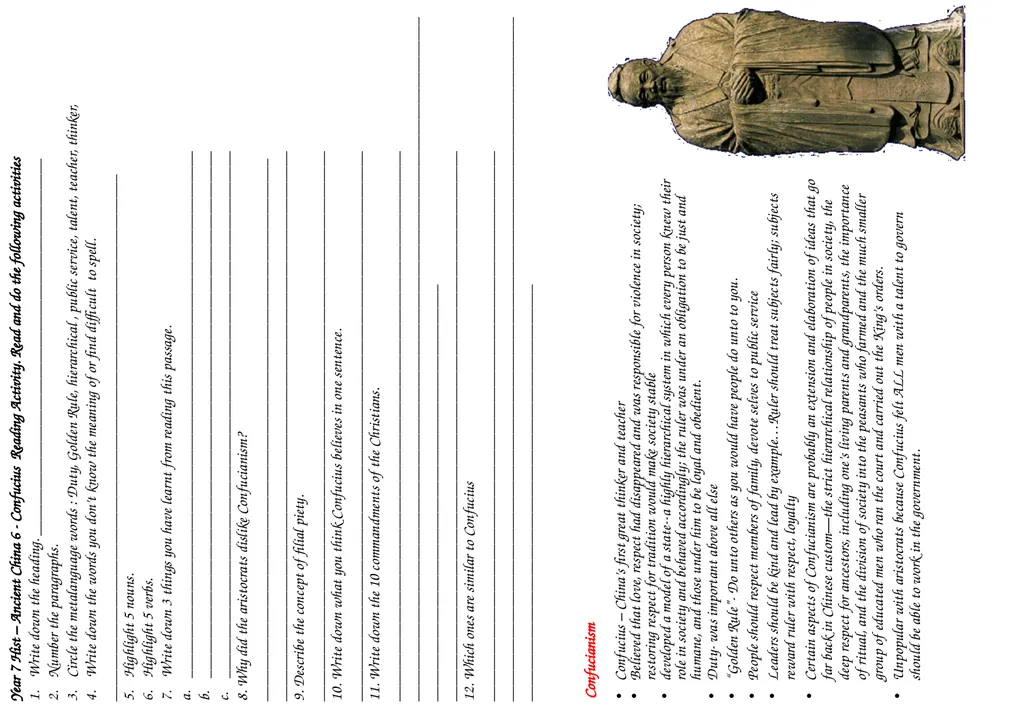
Confucius – China’s first great thinker and teacher
Believed that love, respect had disappeared and was responsible for violence in society; restoring respect for tradition would make society stable
developed a model of a state--a highly hierarchical system in which every person knew their role in society and behaved accordingly; the ruler was under an obligation to be just and humane, and those under him to be loyal and obedient.
Duty- was important above all else
“Golden Rule”- Do unto others as you would have people do unto to you.
People should respect members of family, devote selves to public service
Leaders should be kind and lead by example…Ruler should treat subjects fairly; subjects reward ruler with respect, loyalty
Certain aspects of Confucianism are probably an extension and elaboration of ideas that go far back in Chinese custom—the strict hierarchical relationship of people in society, the deep respect for ancestors, including one’s living parents and grandparents, the importance of ritual, and the division of society into the peasants who farmed and the much smaller group of educated men who ran the court and carried out the King’s orders.
Unpopular with aristocrats because Confucius felt ALL men with a talent to govern should be able to work in the government. Year 7 Hist – Ancient China 6 - Confucius Reading Activity. Read and do the following activities
Write down the heading. ________________________________________________
Number the paragraphs.
Circle the metalanguage words : Duty, Golden Rule, hierarchical , public service, talent, teacher, thinker,
Write down the words you don’t know the meaning of or find difficult to spell.
___________________________________________________________________
Highlight 5 nouns.
Highlight 5 verbs.
Write down 3 things you have learnt from reading this passage.
___________________________________________________________________
___________________________________________________________________
___________________________________________________________________
8. Why did the aristocrats dislike Confucianism? _____________________________________________________________________
______________________________________________________________________
9. Describe the concept of filial piety. ______________________________________________________________________
10. Write down what you think Confucius believes in one sentence.
______________________________________________________________________
11. Write down the 10 commandments of the Christians. ______________________________________________________________________
____________________________________________________________________________________________________________________________________________
______________________________________________________________________
12. Which ones are similar to Confucius ______________________________________________________________________
____________________________________________________________________________________________________________________________________________<br>
Confucius – China’s first great thinker and teacher
Believed that love, respect had disappeared and was responsible for violence in society; restoring respect for tradition would make society stable
developed a model of a state--a highly hierarchical system in which every person knew their role in society and behaved accordingly; the ruler was under an obligation to be just and humane, and those under him to be loyal and obedient.
Duty- was important above all else
“Golden Rule”- Do unto others as you would have people do unto to you.
People should respect members of family, devote selves to public service
Leaders should be kind and lead by example…Ruler should treat subjects fairly; subjects reward ruler with respect, loyalty
Certain aspects of Confucianism are probably an extension and elaboration of ideas that go far back in Chinese custom—the strict hierarchical relationship of people in society, the deep respect for ancestors, including one’s living parents and grandparents, the importance of ritual, and the division of society into the peasants who farmed and the much smaller group of educated men who ran the court and carried out the King’s orders.
Unpopular with aristocrats because Confucius felt ALL men with a talent to govern should be able to work in the government. Year 7 Hist – Ancient China 6 - Confucius Reading Activity. Read and do the following activities
Write down the heading. ________________________________________________
Number the paragraphs.
Circle the metalanguage words : Duty, Golden Rule, hierarchical , public service, talent, teacher, thinker,
Write down the words you don’t know the meaning of or find difficult to spell.
___________________________________________________________________
Highlight 5 nouns.
Highlight 5 verbs.
Write down 3 things you have learnt from reading this passage.
___________________________________________________________________
___________________________________________________________________
___________________________________________________________________
8. Why did the aristocrats dislike Confucianism? _____________________________________________________________________
______________________________________________________________________
9. Describe the concept of filial piety. ______________________________________________________________________
10. Write down what you think Confucius believes in one sentence.
______________________________________________________________________
11. Write down the 10 commandments of the Christians. ______________________________________________________________________
____________________________________________________________________________________________________________________________________________
______________________________________________________________________
12. Which ones are similar to Confucius ______________________________________________________________________
____________________________________________________________________________________________________________________________________________<br>
08
Year 7 Hist - Ancient China 7 – Prehistory to Zhou Dynasty
Write down the heading. ________________________________________________
Number the paragraphs.
Circle the metalanguage words : authorities, domesticated, dynasties, hostile, Huang He, organisations, underground, Yangzi
Write down the words you don’t know the meaning of or find difficult to spell.
___________________________________________________________________
Highlight 5 nouns.
Highlight 5 verbs.
Write down 3 things you have learnt from reading this passage.
___________________________________________________________________
___________________________________________________________________
___________________________________________________________________
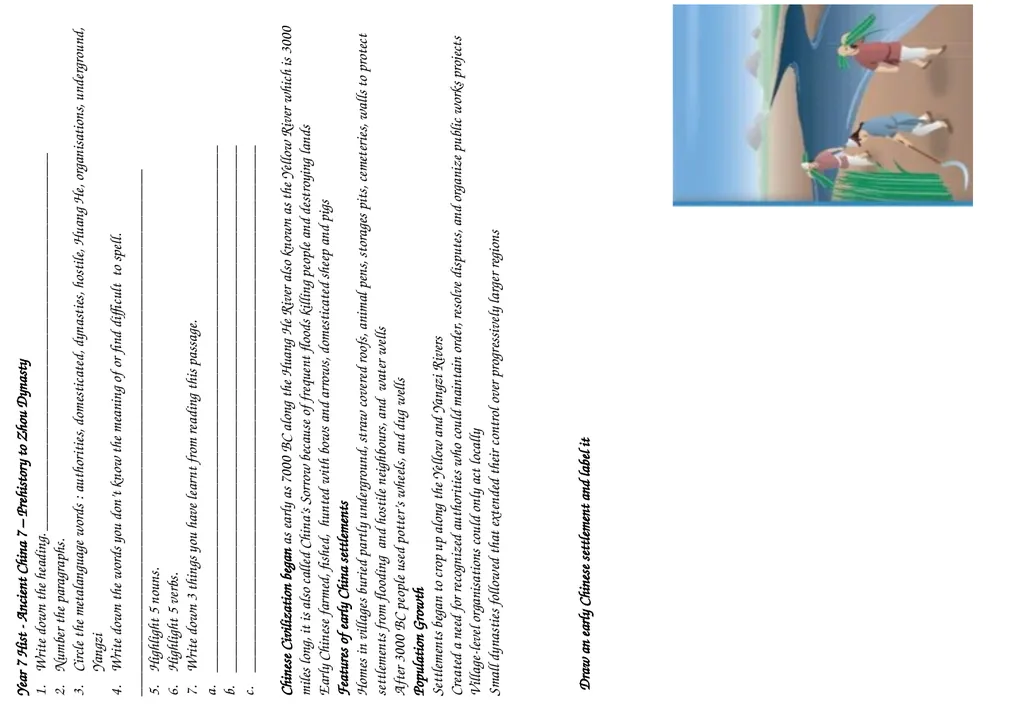
Chinese Civilization began as early as 7000 BC along the Huang He River also known as the Yellow River which is 3000 miles long, it is also called China’s Sorrow because of frequent floods killing people and destroying lands
Early Chinese farmed, fished, hunted with bows and arrows, domesticated sheep and pigs
Features of early China settlements
Homes in villages buried partly underground, straw covered roofs, animal pens, storages pits, cemeteries, walls to protect settlements from flooding and hostile neighbours, and water wells
After 3000 BC people used potter’s wheels, and dug wells
Population Growth
Settlements began to crop up along the Yellow and Yangzi Rivers
Created a need for recognized authorities who could maintain order, resolve disputes, and organize public works projects
Village-level organisations could only act locally
Small dynasties followed that extended their control over progressively larger regions Draw an early Chinese settlement and label it<br>
Write down the heading. ________________________________________________
Number the paragraphs.
Circle the metalanguage words : authorities, domesticated, dynasties, hostile, Huang He, organisations, underground, Yangzi
Write down the words you don’t know the meaning of or find difficult to spell.
___________________________________________________________________
Highlight 5 nouns.
Highlight 5 verbs.
Write down 3 things you have learnt from reading this passage.
___________________________________________________________________
___________________________________________________________________
___________________________________________________________________
Chinese Civilization began as early as 7000 BC along the Huang He River also known as the Yellow River which is 3000 miles long, it is also called China’s Sorrow because of frequent floods killing people and destroying lands
Early Chinese farmed, fished, hunted with bows and arrows, domesticated sheep and pigs
Features of early China settlements
Homes in villages buried partly underground, straw covered roofs, animal pens, storages pits, cemeteries, walls to protect settlements from flooding and hostile neighbours, and water wells
After 3000 BC people used potter’s wheels, and dug wells
Population Growth
Settlements began to crop up along the Yellow and Yangzi Rivers
Created a need for recognized authorities who could maintain order, resolve disputes, and organize public works projects
Village-level organisations could only act locally
Small dynasties followed that extended their control over progressively larger regions Draw an early Chinese settlement and label it<br>
09
Year 7 Hist - Ancient China 8 -Achievements of Emperor Qin Reading Activity
Write down the heading. ________________________________________________
Number the paragraphs.
Circle the metalanguage words : communication , banliang , bureaucracy, empire, feudal, imperial , masonry, rebellion, regional , standardising, unified
Write down the words you don’t know the meaning of or find difficult to spell.
___________________________________________________________________
Highlight 5 nouns.
Highlight 5 verbs.
Write down 3 things you have learnt from reading this passage.
___________________________________________________________________
___________________________________________________________________
___________________________________________________________________
8. Which achievement do you think was the most important? Why? ______________________________________________________________________
__________________________________________________________________________________________________________________________________________________________________________________________________________________
Put in the capitals. Remember at the start of a sentence and for the names of people and places.
Achievements of Emperor Qin
emperor qin set about organising his huge empire and standardising many things in china to make it more efficient. chinese culture differed from region to region. each region had its own culture, customs, money, measures and weights and writing system
he replaced the feudal system with a highly efficient bureaucracy.. he divided china into 36 units called commanderies. each commandery had 3 officials to run it. civil official in charge of the law and agriculture, a military official in charge of he army and an imperial official who oversaw the other two officials and informed the emperor of all government matters. each commandery was decided into smaller counties that was overseen by a judge who helped enforce the laws .
he created a vast unified system of laws and punishments that all men rich and poor had to conform to. they were extremely detailed.
he improved china’s irrigation and water system therefore expanding china’s farmland.
he prevented rebellion by melting down the weapons of his enemies into human shaped bells and forced the families of 12000 ex feudal lords to live in his capital city so he could keep an eye on them.
one of his first acts was to simplify and standardised the writing system and force everyone to use it. this improved communication and formed a strong foundation for chinese culture
he chose the number 6 as the basis of all measurements and ordered all measuring cups to be the same size. he also replaced regional coins with a small round coin made out of bronze or gold called banliang which had a small hole in the middle so they could be strung on a string.
he built an impressive network of roads connecting the capital with various regions of he empire. he standardized the width of cart wheels, making long-distance trade easier.
qin shi huang also had pieces of the great wall (still earthen, not the masonry structure that exists today) linked aiming at protecting china’s borders.<br>
Write down the heading. ________________________________________________
Number the paragraphs.
Circle the metalanguage words : communication , banliang , bureaucracy, empire, feudal, imperial , masonry, rebellion, regional , standardising, unified
Write down the words you don’t know the meaning of or find difficult to spell.
___________________________________________________________________
Highlight 5 nouns.
Highlight 5 verbs.
Write down 3 things you have learnt from reading this passage.
___________________________________________________________________
___________________________________________________________________
___________________________________________________________________
8. Which achievement do you think was the most important? Why? ______________________________________________________________________
__________________________________________________________________________________________________________________________________________________________________________________________________________________
Put in the capitals. Remember at the start of a sentence and for the names of people and places.
Achievements of Emperor Qin
emperor qin set about organising his huge empire and standardising many things in china to make it more efficient. chinese culture differed from region to region. each region had its own culture, customs, money, measures and weights and writing system
he replaced the feudal system with a highly efficient bureaucracy.. he divided china into 36 units called commanderies. each commandery had 3 officials to run it. civil official in charge of the law and agriculture, a military official in charge of he army and an imperial official who oversaw the other two officials and informed the emperor of all government matters. each commandery was decided into smaller counties that was overseen by a judge who helped enforce the laws .
he created a vast unified system of laws and punishments that all men rich and poor had to conform to. they were extremely detailed.
he improved china’s irrigation and water system therefore expanding china’s farmland.
he prevented rebellion by melting down the weapons of his enemies into human shaped bells and forced the families of 12000 ex feudal lords to live in his capital city so he could keep an eye on them.
one of his first acts was to simplify and standardised the writing system and force everyone to use it. this improved communication and formed a strong foundation for chinese culture
he chose the number 6 as the basis of all measurements and ordered all measuring cups to be the same size. he also replaced regional coins with a small round coin made out of bronze or gold called banliang which had a small hole in the middle so they could be strung on a string.
he built an impressive network of roads connecting the capital with various regions of he empire. he standardized the width of cart wheels, making long-distance trade easier.
qin shi huang also had pieces of the great wall (still earthen, not the masonry structure that exists today) linked aiming at protecting china’s borders.<br>
10
Year 7 Hist - Ancient China 9 – Terracotta Warriors Reading Activity
UNDERGROUND TERRACOTTA ARMY IN A BATTLE FOR SURVIVAL 6 July 2005 They may have guarded the tomb of China’s first emperor for thousands of years, but the terracotta warriors are facing their toughest battle yet.
The life-sized clay figures unearthed three decades ago in Shaanxi province are starting to fall apart and Chinese and US scientists have launched a two-year research project to study the impact that indoor air pollutants are having on the Emperor Qin Terracotta Warriors and Horses Museum in Xi’an.
Cao Junji, executive director of the aerosol and environment division at the Chinese Academy of Sciences’ Institute of Earth Environment and head of the research team, said it was time to take action to save the relics. If nothing is done now, in 100 years the warriors may have corroded to such an extent that the pits will look just like a coal mine and not have any aesthetic value, he said.
If a leg or a shoulder falls off, the whole figure is damaged. There are only a few hundred of them—how many more can we afford to have damaged?
The richly coloured terracotta figures with individual facial expressions lay underground for about 2,000 years, but began to lose their luster and turn an oxidized grey once they were exposed to air.
Acidic particles in the air have eaten into the surfaces of the statues, leaving a fine powder. These particles are also weakening the gypsum that holds the joints together. Dr Cao said the damage caused by corrosion was often minor at first, but larger features of the statues—their noses, for instance—could shrink as the surface was worn away.
He said the individual features of the warriors—such as a moustache or certain hairstyle which indicate age or rank— might become less noticeable over time, eroding the figures’ cultural value.
Temperature, humidity, pollutants and solar radiation all pose threats to the statues. Dr Cao said the team could only delay the ageing process by targeting the main pollutants and finding ways to reduce them.
Even then, he could not say how many more years the warriors would last.
‘Air pollution is a disease affecting cultural relics. [We cannot] wipe out air pollution, but we can alleviate and minimize it.
‘It’s very hard to restore the original colour of the statues that have already been exposed to air’, Dr Cao said. But as the museum is still excavating new ones, we need to conduct more research to avoid a repeat of old problems. It is estimated that the museum’s three underground pits house 8,000 life-size pottery warriors and horses. About 2,000 have been unearthed so far, of which 1,172 are on display, said Rong Bo, the museum’s conservation scientist.
Create a poster to raise funds to help preserve the army.<br>
UNDERGROUND TERRACOTTA ARMY IN A BATTLE FOR SURVIVAL 6 July 2005 They may have guarded the tomb of China’s first emperor for thousands of years, but the terracotta warriors are facing their toughest battle yet.
The life-sized clay figures unearthed three decades ago in Shaanxi province are starting to fall apart and Chinese and US scientists have launched a two-year research project to study the impact that indoor air pollutants are having on the Emperor Qin Terracotta Warriors and Horses Museum in Xi’an.
Cao Junji, executive director of the aerosol and environment division at the Chinese Academy of Sciences’ Institute of Earth Environment and head of the research team, said it was time to take action to save the relics. If nothing is done now, in 100 years the warriors may have corroded to such an extent that the pits will look just like a coal mine and not have any aesthetic value, he said.
If a leg or a shoulder falls off, the whole figure is damaged. There are only a few hundred of them—how many more can we afford to have damaged?
The richly coloured terracotta figures with individual facial expressions lay underground for about 2,000 years, but began to lose their luster and turn an oxidized grey once they were exposed to air.
Acidic particles in the air have eaten into the surfaces of the statues, leaving a fine powder. These particles are also weakening the gypsum that holds the joints together. Dr Cao said the damage caused by corrosion was often minor at first, but larger features of the statues—their noses, for instance—could shrink as the surface was worn away.
He said the individual features of the warriors—such as a moustache or certain hairstyle which indicate age or rank— might become less noticeable over time, eroding the figures’ cultural value.
Temperature, humidity, pollutants and solar radiation all pose threats to the statues. Dr Cao said the team could only delay the ageing process by targeting the main pollutants and finding ways to reduce them.
Even then, he could not say how many more years the warriors would last.
‘Air pollution is a disease affecting cultural relics. [We cannot] wipe out air pollution, but we can alleviate and minimize it.
‘It’s very hard to restore the original colour of the statues that have already been exposed to air’, Dr Cao said. But as the museum is still excavating new ones, we need to conduct more research to avoid a repeat of old problems. It is estimated that the museum’s three underground pits house 8,000 life-size pottery warriors and horses. About 2,000 have been unearthed so far, of which 1,172 are on display, said Rong Bo, the museum’s conservation scientist.
Create a poster to raise funds to help preserve the army.<br>
11
Year 7 Hist – Ancient China 10 Reading Activity
Write down the heading. ________________________________________________
Number the paragraphs.
Circle the metalanguage words : allies , bureaucrats, cavalry, Confucianism, diplomatic, emperors, military , public service, wealth
Write down the words you don’t know the meaning of or find difficult to spell.
___________________________________________________________________
Highlight 5 nouns.
Highlight 5 verbs.
Write down 3 things you have learnt from reading this passage.
___________________________________________________________________
___________________________________________________________________
___________________________________________________________________
8. List the evidence that indicates that Wu Ti was an excellent emperor.
______________________________________________________________________
______________________________________________________________________
______________________________________________________________________
______________________________________________________________________
______________________________________________________________________
______________________________________________________________________
______________________________________________________________________ On Wu Ti
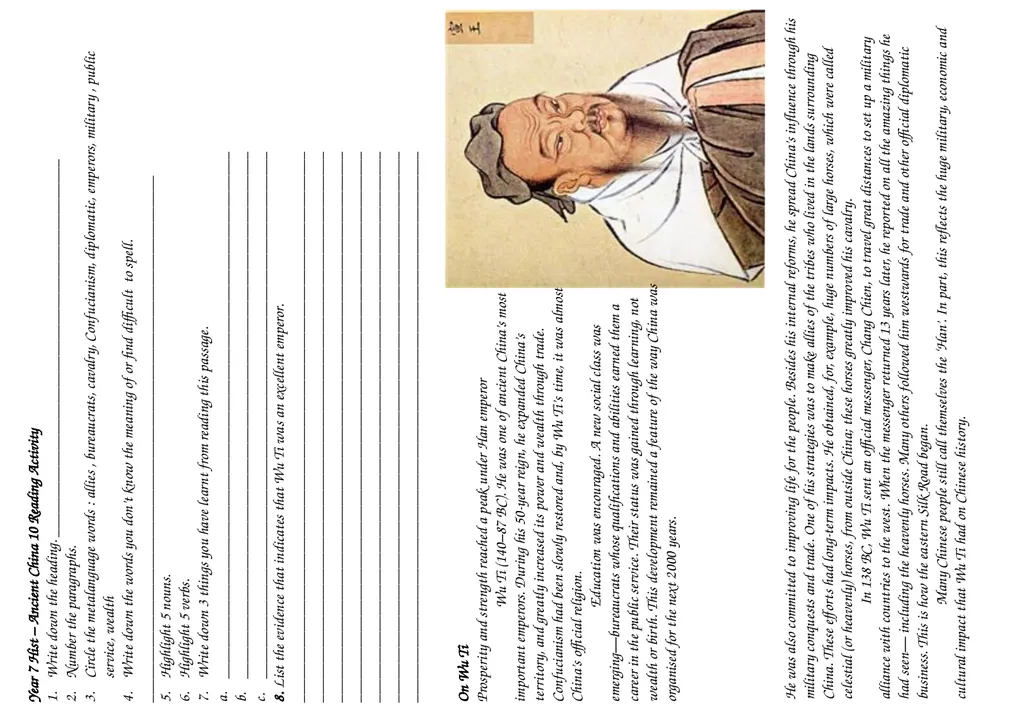
Prosperity and strength reached a peak under Han emperor
Wu Ti (140–87 BC). He was one of ancient China’s most important emperors. During his 50-year reign, he expanded China’s territory, and greatly increased its power and wealth through trade. Confucianism had been slowly restored and, by Wu Ti’s time, it was almost China’s official religion.
Education was encouraged. A new social class was emerging—bureaucrats whose qualifications and abilities earned them a career in the public service. Their status was gained through learning, not wealth or birth. This development remained a feature of the way China was organised for the next 2000 years. He was also committed to improving life for the people. Besides his internal reforms, he spread China’s influence through his military conquests and trade. One of his strategies was to make allies of the tribes who lived in the lands surrounding China. These efforts had long-term impacts. He obtained, for, example, huge numbers of large horses, which were called celestial (or heavenly) horses, from outside China; these horses greatly improved his cavalry.
In 138 BC, Wu Ti sent an official messenger, Chang Chien, to travel great distances to set up a military alliance with countries to the west. When the messenger returned 13 years later, he reported on all the amazing things he had seen— including the heavenly horses. Many others followed him westwards for trade and other official diplomatic business. This is how the eastern Silk Road began.
Many Chinese people still call themselves the ‘Han’. In part, this reflects the huge military, economic and cultural impact that Wu Ti had on Chinese history.<br>
Write down the heading. ________________________________________________
Number the paragraphs.
Circle the metalanguage words : allies , bureaucrats, cavalry, Confucianism, diplomatic, emperors, military , public service, wealth
Write down the words you don’t know the meaning of or find difficult to spell.
___________________________________________________________________
Highlight 5 nouns.
Highlight 5 verbs.
Write down 3 things you have learnt from reading this passage.
___________________________________________________________________
___________________________________________________________________
___________________________________________________________________
8. List the evidence that indicates that Wu Ti was an excellent emperor.
______________________________________________________________________
______________________________________________________________________
______________________________________________________________________
______________________________________________________________________
______________________________________________________________________
______________________________________________________________________
______________________________________________________________________ On Wu Ti
Prosperity and strength reached a peak under Han emperor
Wu Ti (140–87 BC). He was one of ancient China’s most important emperors. During his 50-year reign, he expanded China’s territory, and greatly increased its power and wealth through trade. Confucianism had been slowly restored and, by Wu Ti’s time, it was almost China’s official religion.
Education was encouraged. A new social class was emerging—bureaucrats whose qualifications and abilities earned them a career in the public service. Their status was gained through learning, not wealth or birth. This development remained a feature of the way China was organised for the next 2000 years. He was also committed to improving life for the people. Besides his internal reforms, he spread China’s influence through his military conquests and trade. One of his strategies was to make allies of the tribes who lived in the lands surrounding China. These efforts had long-term impacts. He obtained, for, example, huge numbers of large horses, which were called celestial (or heavenly) horses, from outside China; these horses greatly improved his cavalry.
In 138 BC, Wu Ti sent an official messenger, Chang Chien, to travel great distances to set up a military alliance with countries to the west. When the messenger returned 13 years later, he reported on all the amazing things he had seen— including the heavenly horses. Many others followed him westwards for trade and other official diplomatic business. This is how the eastern Silk Road began.
Many Chinese people still call themselves the ‘Han’. In part, this reflects the huge military, economic and cultural impact that Wu Ti had on Chinese history.<br>
12
Year 7 Hist - Ancient China 11 – Silk Reading Activity
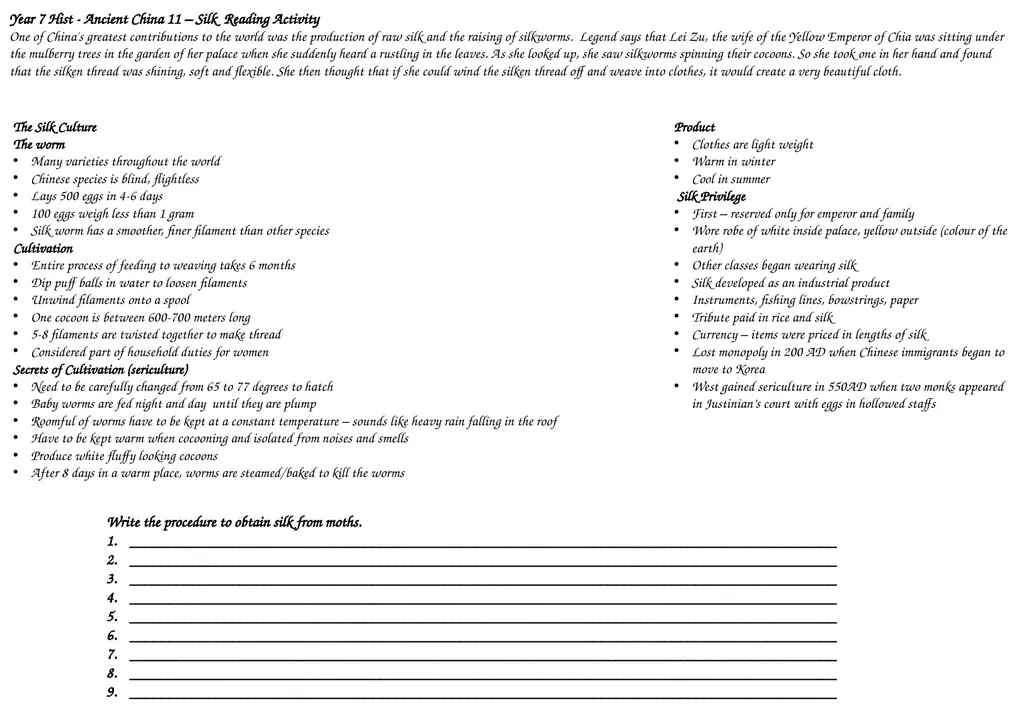
One of China's greatest contributions to the world was the production of raw silk and the raising of silkworms. Legend says that Lei Zu, the wife of the Yellow Emperor of Chia was sitting under the mulberry trees in the garden of her palace when she suddenly heard a rustling in the leaves. As she looked up, she saw silkworms spinning their cocoons. So she took one in her hand and found that the silken thread was shining, soft and flexible. She then thought that if she could wind the silken thread off and weave into clothes, it would create a very beautiful cloth. Product
Clothes are light weight
Warm in winter
Cool in summer
Silk Privilege
First – reserved only for emperor and family
Wore robe of white inside palace, yellow outside (colour of the earth)
Other classes began wearing silk
Silk developed as an industrial product
Instruments, fishing lines, bowstrings, paper
Tribute paid in rice and silk
Currency – items were priced in lengths of silk
Lost monopoly in 200 AD when Chinese immigrants began to move to Korea
West gained sericulture in 550AD when two monks appeared in Justinian’s court with eggs in hollowed staffs The Silk Culture
The worm
Many varieties throughout the world
Chinese species is blind, flightless
Lays 500 eggs in 4-6 days
100 eggs weigh less than 1 gram
Silk worm has a smoother, finer filament than other species
Cultivation
Entire process of feeding to weaving takes 6 months
Dip puff balls in water to loosen filaments
Unwind filaments onto a spool
One cocoon is between 600-700 meters long
5-8 filaments are twisted together to make thread
Considered part of household duties for women
Secrets of Cultivation (sericulture)
Need to be carefully changed from 65 to 77 degrees to hatch
Baby worms are fed night and day until they are plump
Roomful of worms have to be kept at a constant temperature – sounds like heavy rain falling in the roof
Have to be kept warm when cocooning and isolated from noises and smells
Produce white fluffy looking cocoons
After 8 days in a warm place, worms are steamed/baked to kill the worms Write the procedure to obtain silk from moths.
__________________________________________________________________________________________
__________________________________________________________________________________________
__________________________________________________________________________________________
__________________________________________________________________________________________
__________________________________________________________________________________________
__________________________________________________________________________________________
__________________________________________________________________________________________
__________________________________________________________________________________________
__________________________________________________________________________________________<br>
One of China's greatest contributions to the world was the production of raw silk and the raising of silkworms. Legend says that Lei Zu, the wife of the Yellow Emperor of Chia was sitting under the mulberry trees in the garden of her palace when she suddenly heard a rustling in the leaves. As she looked up, she saw silkworms spinning their cocoons. So she took one in her hand and found that the silken thread was shining, soft and flexible. She then thought that if she could wind the silken thread off and weave into clothes, it would create a very beautiful cloth. Product
Clothes are light weight
Warm in winter
Cool in summer
Silk Privilege
First – reserved only for emperor and family
Wore robe of white inside palace, yellow outside (colour of the earth)
Other classes began wearing silk
Silk developed as an industrial product
Instruments, fishing lines, bowstrings, paper
Tribute paid in rice and silk
Currency – items were priced in lengths of silk
Lost monopoly in 200 AD when Chinese immigrants began to move to Korea
West gained sericulture in 550AD when two monks appeared in Justinian’s court with eggs in hollowed staffs The Silk Culture
The worm
Many varieties throughout the world
Chinese species is blind, flightless
Lays 500 eggs in 4-6 days
100 eggs weigh less than 1 gram
Silk worm has a smoother, finer filament than other species
Cultivation
Entire process of feeding to weaving takes 6 months
Dip puff balls in water to loosen filaments
Unwind filaments onto a spool
One cocoon is between 600-700 meters long
5-8 filaments are twisted together to make thread
Considered part of household duties for women
Secrets of Cultivation (sericulture)
Need to be carefully changed from 65 to 77 degrees to hatch
Baby worms are fed night and day until they are plump
Roomful of worms have to be kept at a constant temperature – sounds like heavy rain falling in the roof
Have to be kept warm when cocooning and isolated from noises and smells
Produce white fluffy looking cocoons
After 8 days in a warm place, worms are steamed/baked to kill the worms Write the procedure to obtain silk from moths.
__________________________________________________________________________________________
__________________________________________________________________________________________
__________________________________________________________________________________________
__________________________________________________________________________________________
__________________________________________________________________________________________
__________________________________________________________________________________________
__________________________________________________________________________________________
__________________________________________________________________________________________
__________________________________________________________________________________________<br>