01
Year 7 Knowledge Organiser – Human Reproduction Key words:
Gamete: The male gamete (sex cell) in animals is a sperm, the female an egg.
Fertilisation: Joining of a nucleus from a male and female sex cell.
Ovary: Organ which contains eggs.
Testicle: Organ where sperm are produced.
Oviduct, or fallopian tube: Carries an egg from the ovary to the uterus and is where fertilisation occurs.
Uterus, or womb: Where a baby develops in a pregnant woman.
Ovulation: Release of an egg cell during the menstrual cycle, which may be met by a sperm.
Menstruation: Loss of the lining of the uterus during the menstrual cycle.
Reproductive system: All the male and female organs involved in reproduction.
Penis: Organ which carries sperm out of the male’s body.
Vagina: Where the penis enters the female’s body and sperm is received.
Foetus: The developing baby during pregnancy.
Gestation: Process where the baby develops during pregnancy.
Placenta: Organ that provides the foetus with oxygen and nutrients and removes waste substances.
Amniotic fluid: Liquid that surrounds and protects the foetus.
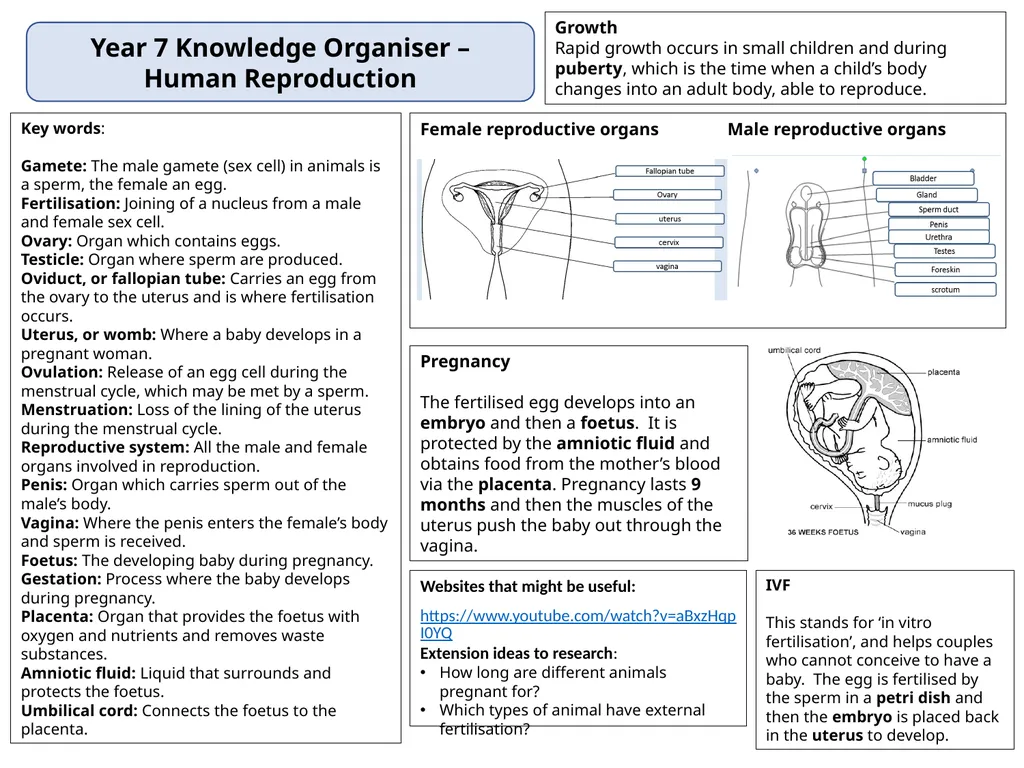
Umbilical cord: Connects the foetus to the placenta. Female reproductive organs Male reproductive organs IVF
This stands for ‘in vitro fertilisation’, and helps couples who cannot conceive to have a baby. The egg is fertilised by the sperm in a petri dish and then the embryo is placed back in the uterus to develop. Pregnancy
The fertilised egg develops into an embryo and then a foetus. It is protected by the amniotic fluid and obtains food from the mother’s blood via the placenta. Pregnancy lasts 9 months and then the muscles of the uterus push the baby out through the vagina. Websites that might be useful:
https://www.youtube.com/watch?v=aBxzHqpI0YQ
Extension ideas to research:
How long are different animals pregnant for?
Which types of animal have external fertilisation? Growth
Rapid growth occurs in small children and during puberty, which is the time when a child’s body changes into an adult body, able to reproduce.<br>