Year 7 :: Sequences Dr J Frost (jfrosttiffin.kingston.sch.uk) www.drfrostmaths.com Last modified: 6th November 2015 Objectives: Understand term-to-term vs position-to-term rules. Be able to generate terms of a sequence given a formula.
"Year 7 :: Sequences Dr J Frost" is the property of its rightful owner. Permission is granted to
download and print the materials on this website for personal, non-commercial use only, and to display it
on your personal computer provided you do not modify the materials and that you retain all copyright
notices contained in the materials. By downloading content from our website, you accept the terms of this
agreement.
Presentation Transcript
01
Year 7 :: Sequences Dr J Frost (jfrost@tiffin.kingston.sch.uk)
www.drfrostmaths.com Last modified: 6th November 2015 Objectives: Understand term-to-term vs position-to-term rules.
Be able to generate terms of a sequence given a formula. Find the formula for a linear sequence.
Be able to find a term of an oscillating sequence.<br>
02
Go > Go > Go > Go ><br>
03
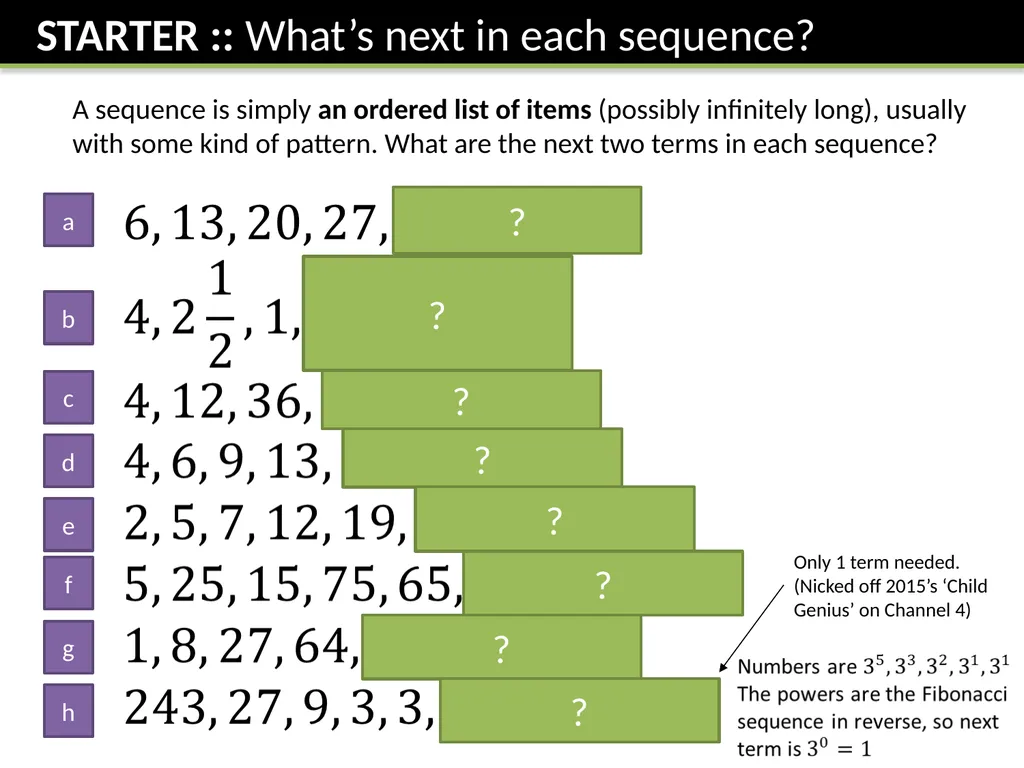
A sequence is simply an ordered list of items (possibly infinitely long), usually with some kind of pattern. What are the next two terms in each sequence? ? ? ? ? ? ? ? ? Only 1 term needed. (Nicked off 2015’s ‘Child Genius’ on Channel 4) a b c d e f g h<br>
04
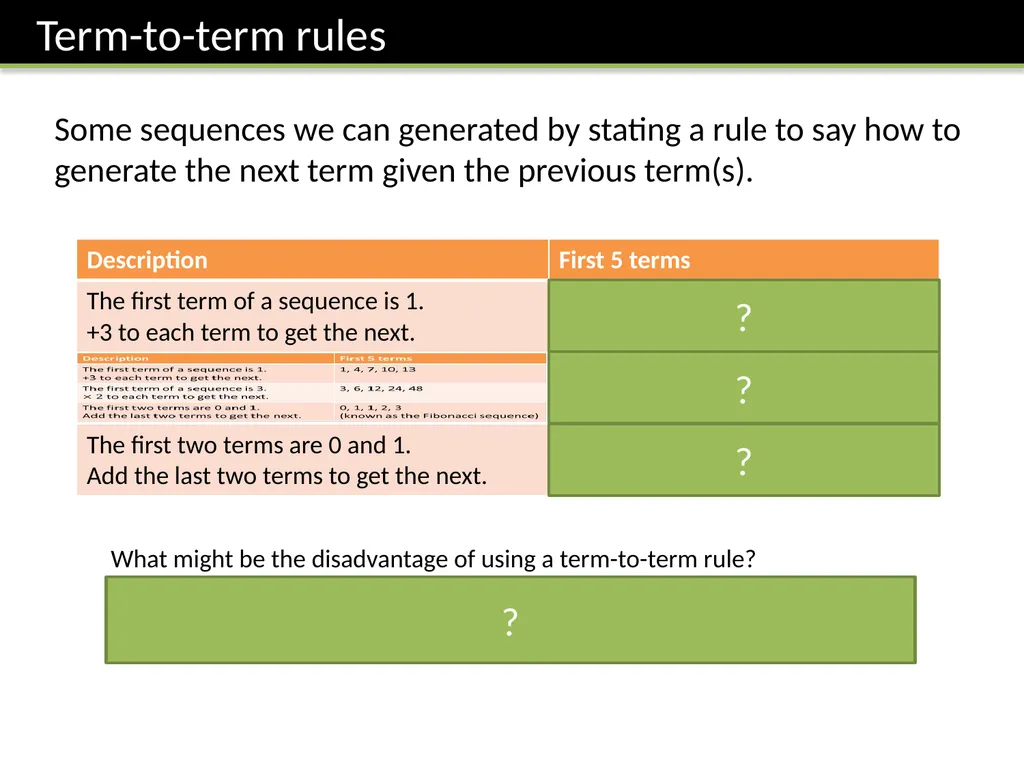
Some sequences we can generated by stating a rule to say how to generate the next term given the previous term(s). ? ? ? What might be the disadvantage of using a term-to-term rule?
To get a particular term in the sequence, we have to generate all the terms in the sequence before it. This is rather slow if you say want to know the 1000th term! ?<br>
05
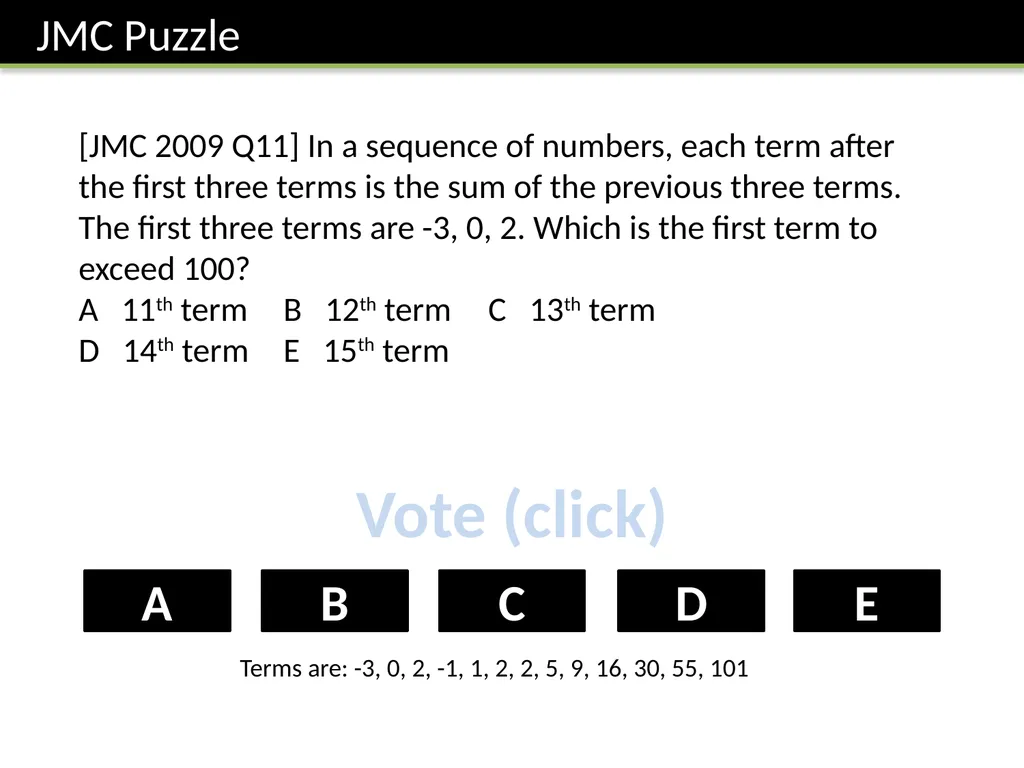
[JMC 2009 Q11] In a sequence of numbers, each term after the first three terms is the sum of the previous three terms. The first three terms are -3, 0, 2. Which is the first term to exceed 100? A 11th term B 12th term C 13th term
D 14th term E 15th term Vote (click) C B A D E Terms are: -3, 0, 2, -1, 1, 2, 2, 5, 9, 16, 30, 55, 101<br>
06
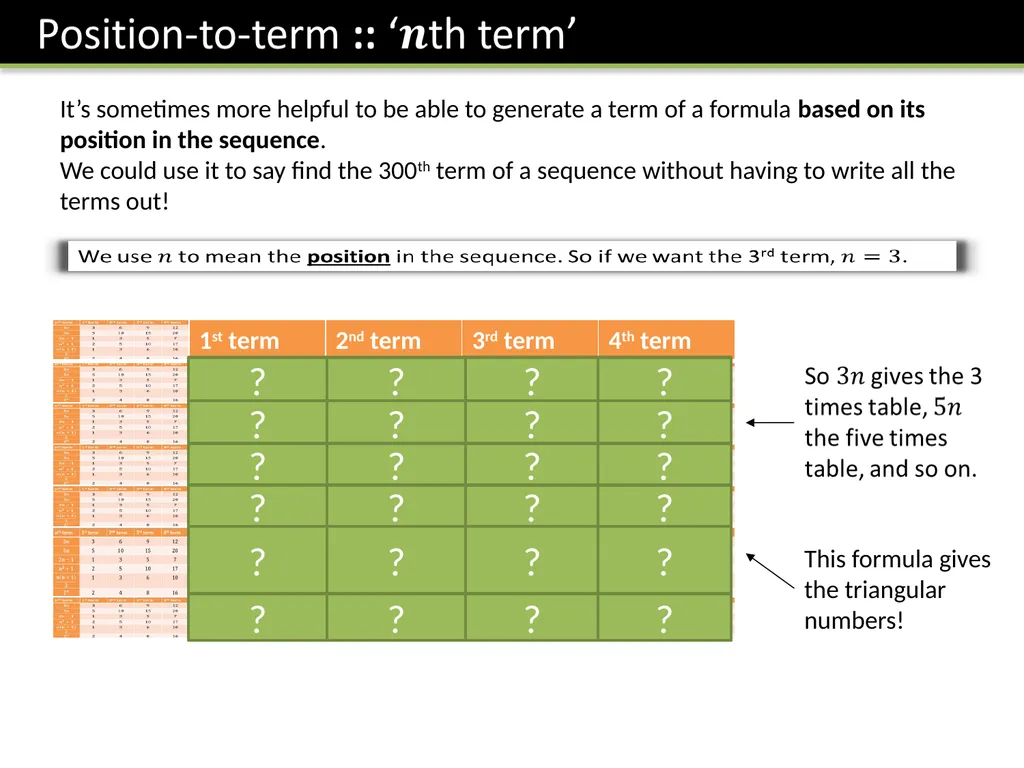
It’s sometimes more helpful to be able to generate a term of a formula based on its position in the sequence.
We could use it to say find the 300th term of a sequence without having to write all the terms out! ? ? ? ? ? ? ? ? ? ? ? ? ? ? ? ? ? ? ? ? ? ? ? ?<br>
07
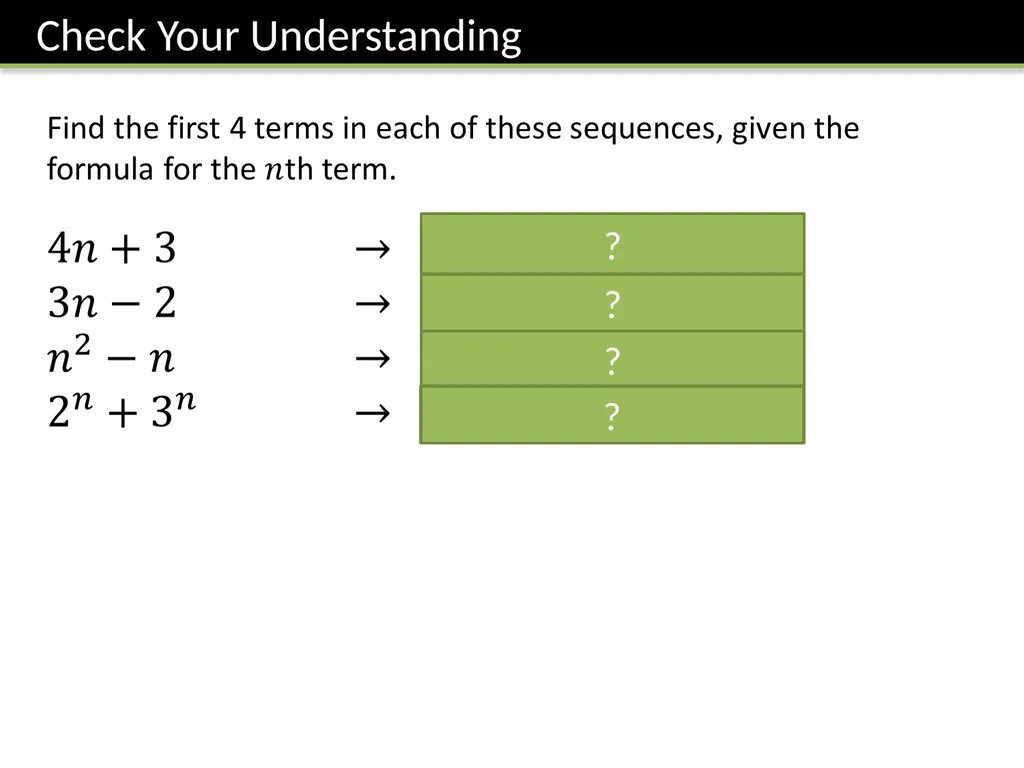
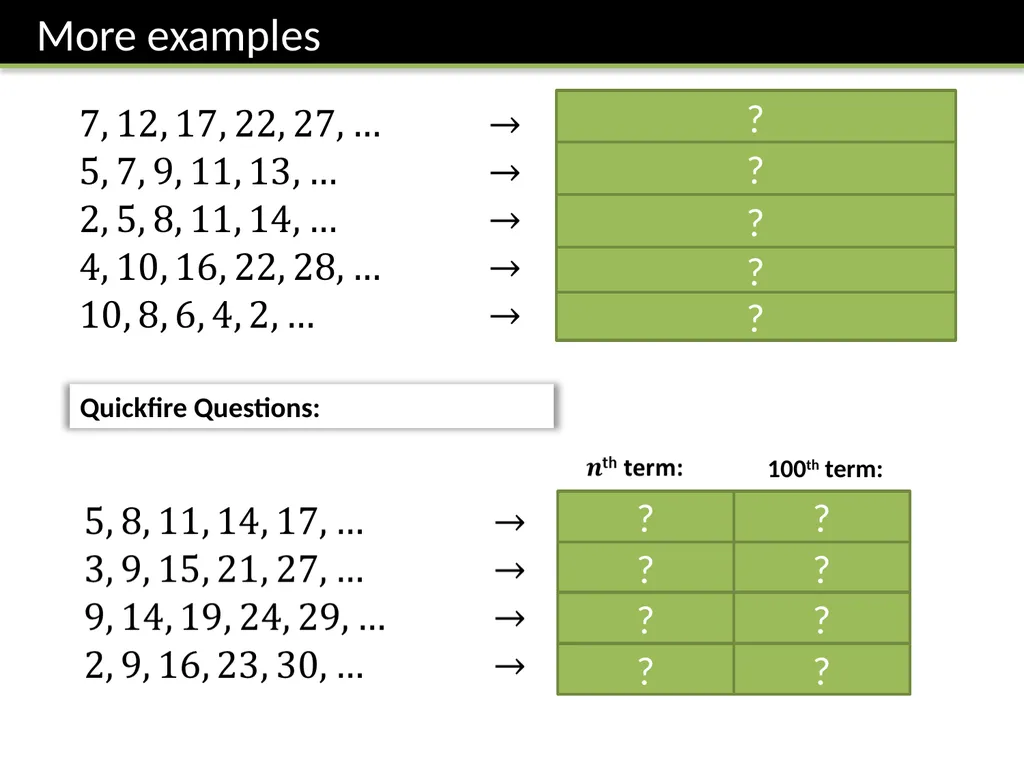
? ? ? ?<br>
08
A MERIT for the most interesting sequence!<br>
09
MOVE QUESTION TO LINEAR DIOPHANTINE EQS: [JMO 2008 B6] In a sequence of positive integers, each term is larger than the previous term. Also, after the first two terms, each term is the sum of the previous two terms.
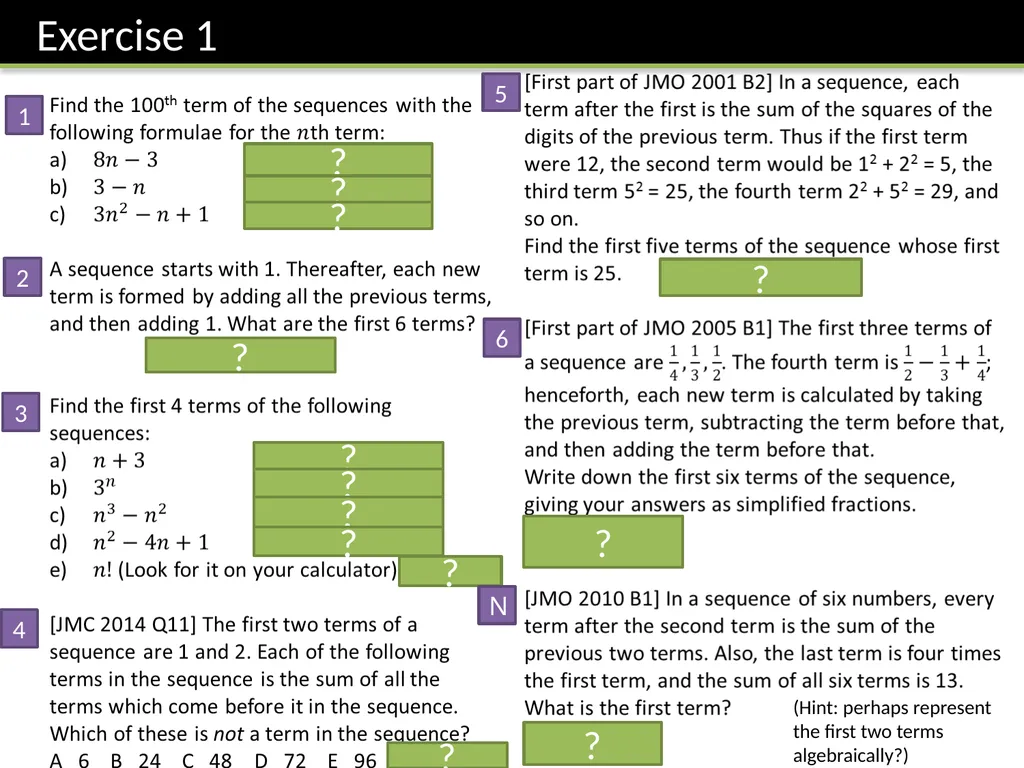
The eighth term of the sequence is 390. What is the ninth term? Solution: 631 (Hint: perhaps represent the first two terms algebraically?) ? ? ? ? ? ? ? ? ? ? ? ? ? 1 2 3 4 5 6 N<br>
10
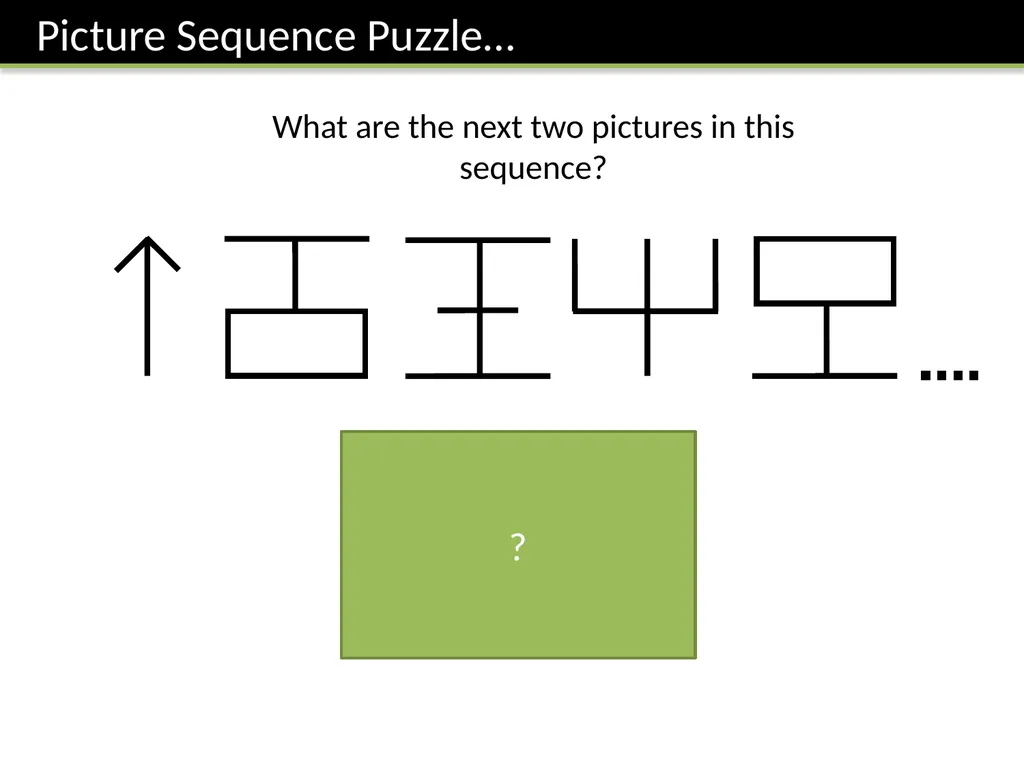
What are the next two pictures in this sequence? It’s the numbers 1, 2, 3, … but reflected. Sneaky! ?<br>
11
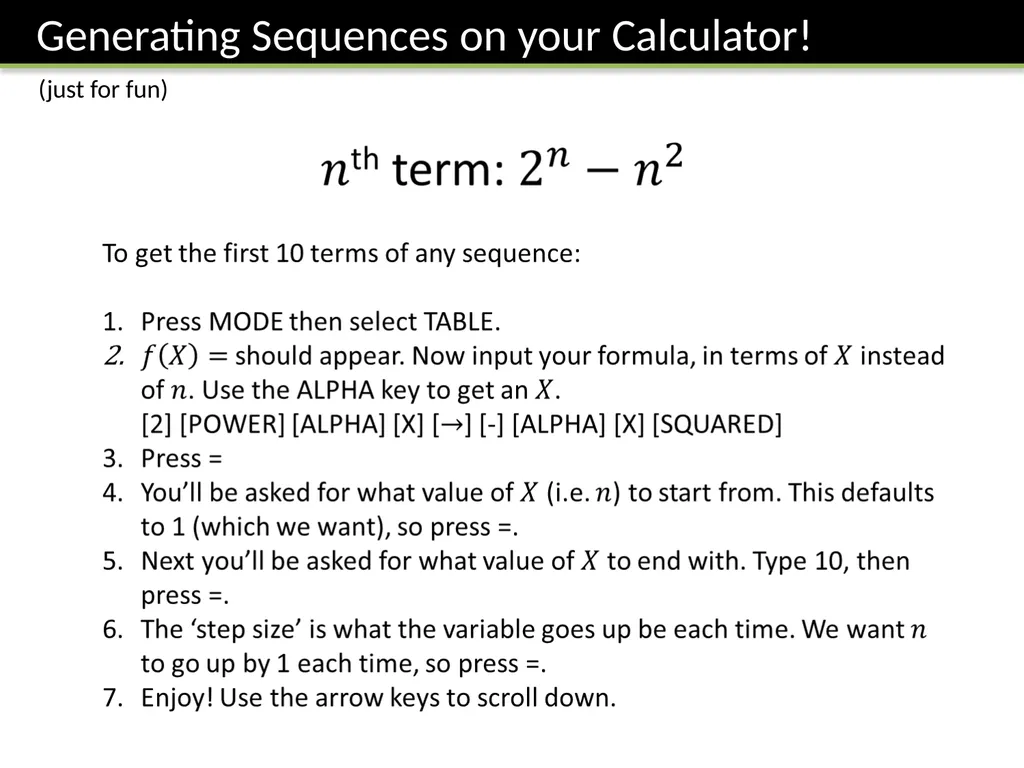
(just for fun)<br>
12
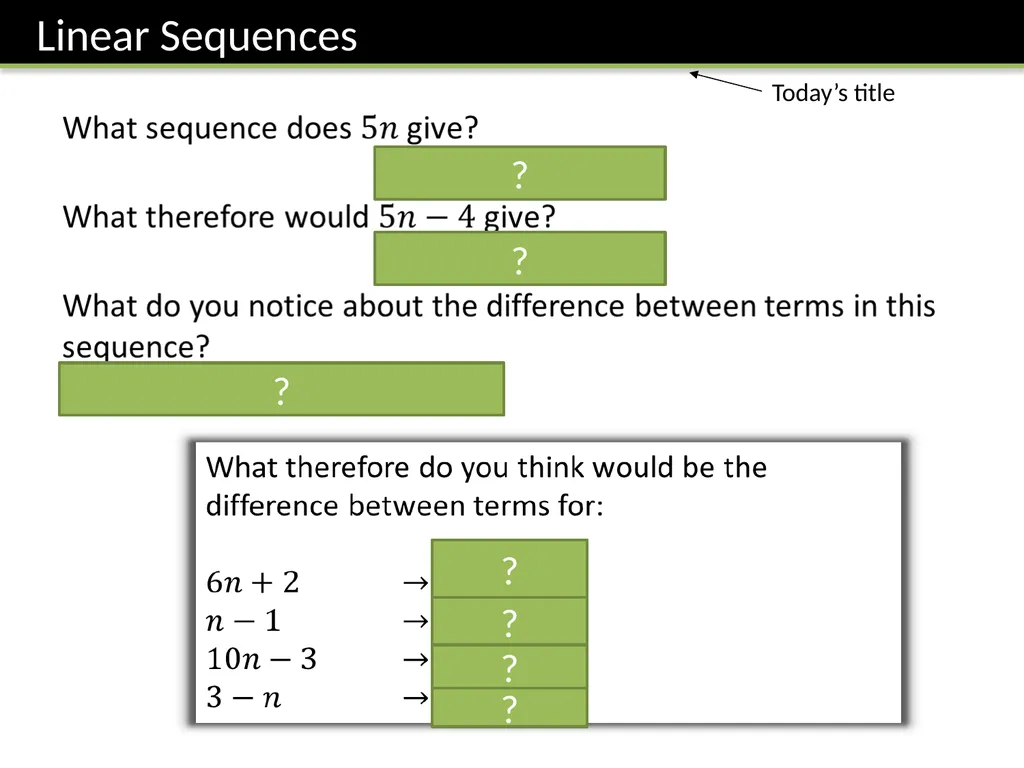
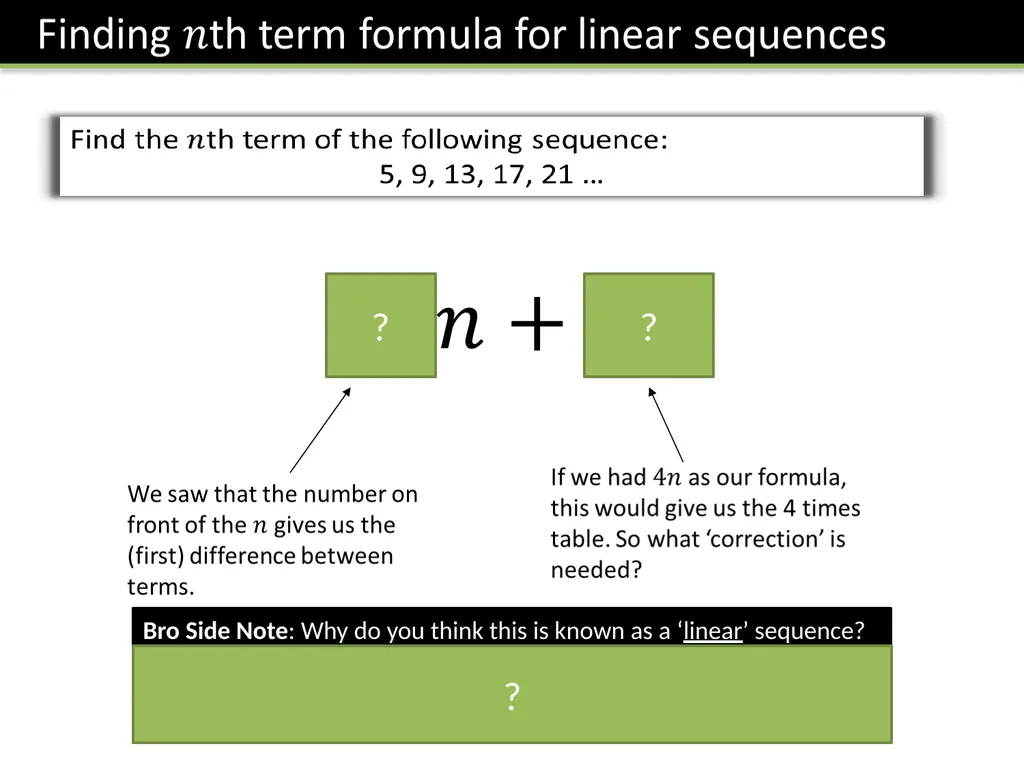
? ? ? ? ? ? ? Today’s title<br>
13
? ? Bro Side Note: Why do you think this is known as a ‘linear’ sequence?
If you plotted each position with the term on some axes (e.g. for this sequence (1,5),(2,9),(3,13),(4,17), …, it would form a straight line. The word ‘linear’ means ‘straight’. ?<br>
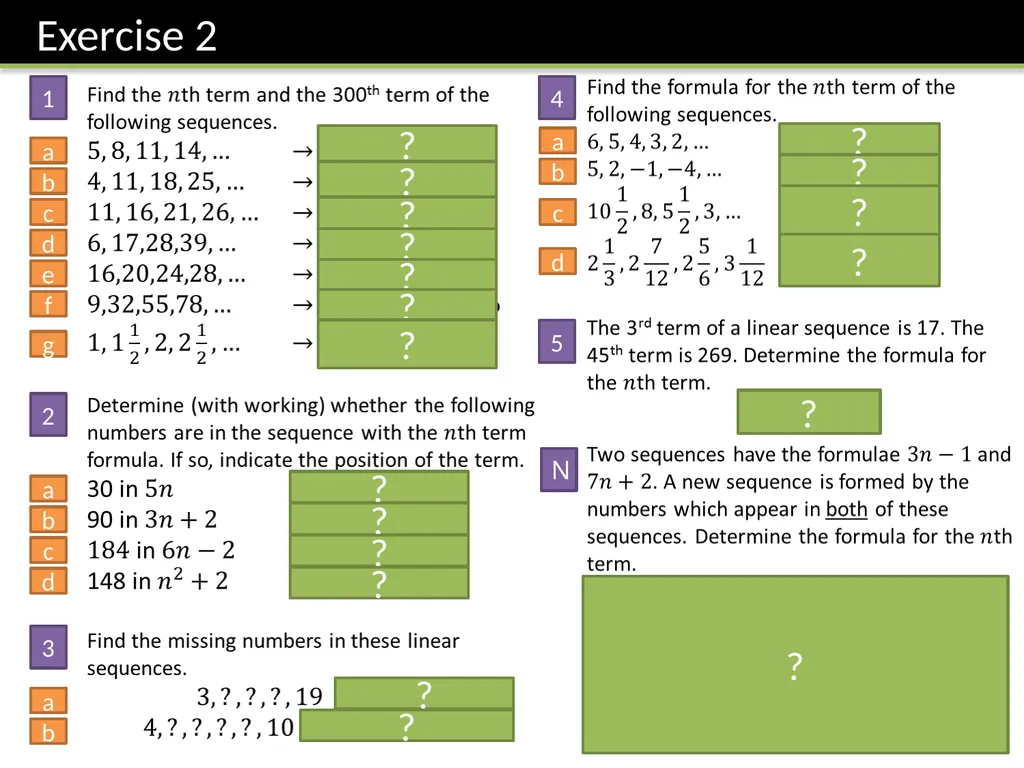
2 1 3 4 5 N a b c d e f g a b c d a b a b c d ? ? ? ? ? ? ? ? ? ? ? ? ? ? ? ? ? ? ?<br>
18
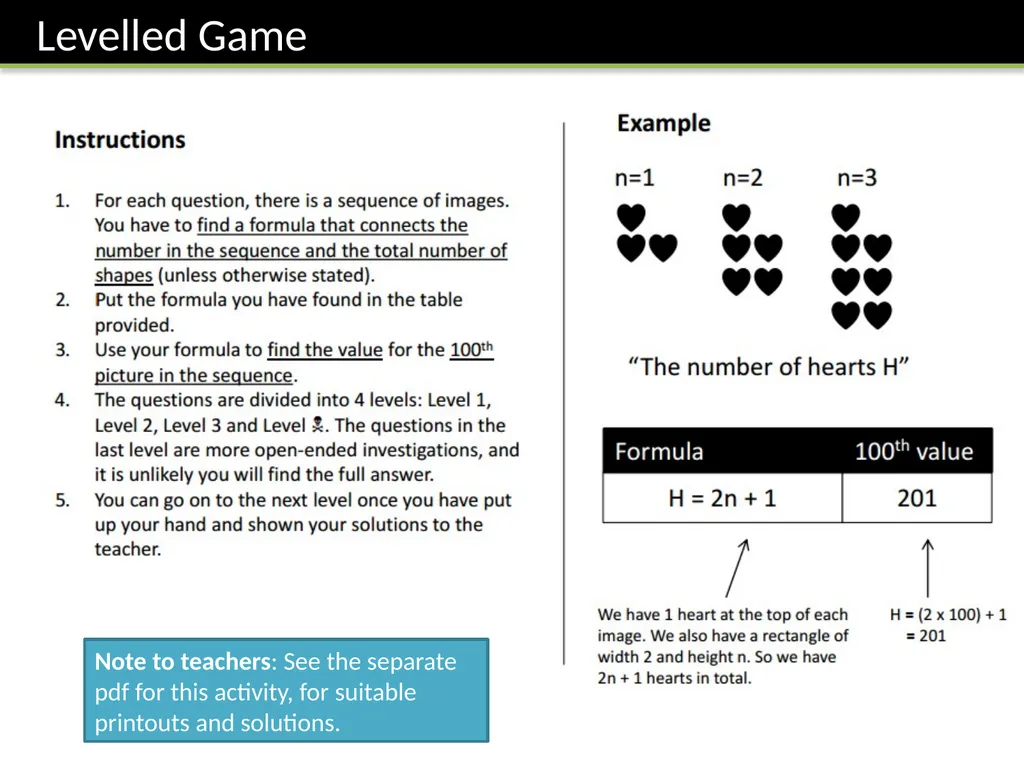
Note to teachers: See the separate pdf for this activity, for suitable printouts and solutions.<br>
19
There are many places in mathematics where sequences repeat.
e.g. tiffintiffintiffintiffintiffintiffin… What is the 60th letter in this sequence? ‘n’
What is the 100th letter in this sequence? ‘f’
What is the 175th letter in this sequence? ‘t’ ? ? ?<br>
20
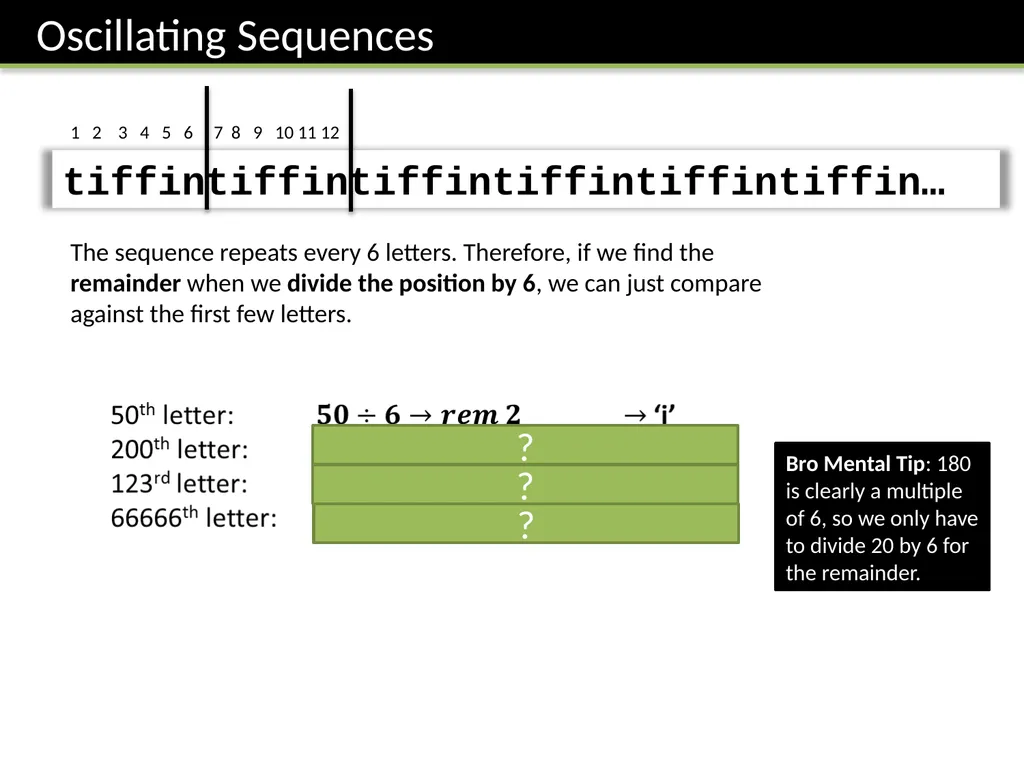
tiffintiffintiffintiffintiffintiffin… 1 2 3 4 5 6 7 8 9 10 11 12 The sequence repeats every 6 letters. Therefore, if we find the remainder when we divide the position by 6, we can just compare against the first few letters. ? ? ? Bro Mental Tip: 180 is clearly a multiple of 6, so we only have to divide 20 by 6 for the remainder.<br>
21
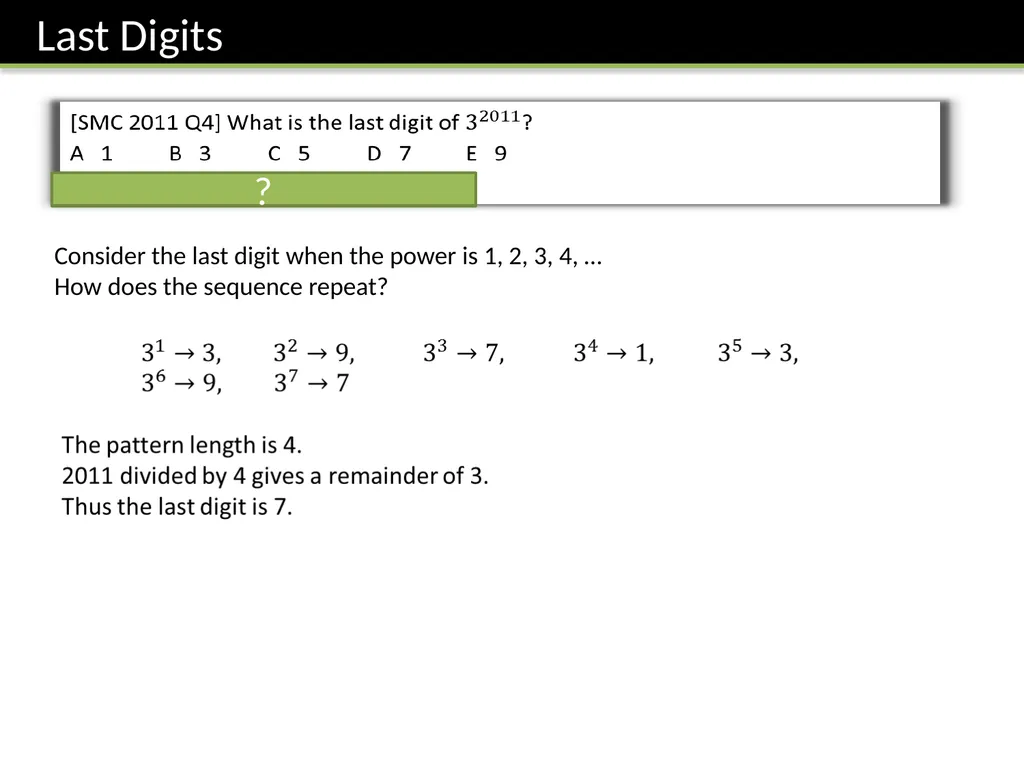
? Consider the last digit when the power is 1, 2, 3, 4, …
How does the sequence repeat?<br>
22
A B ? ?<br>
23
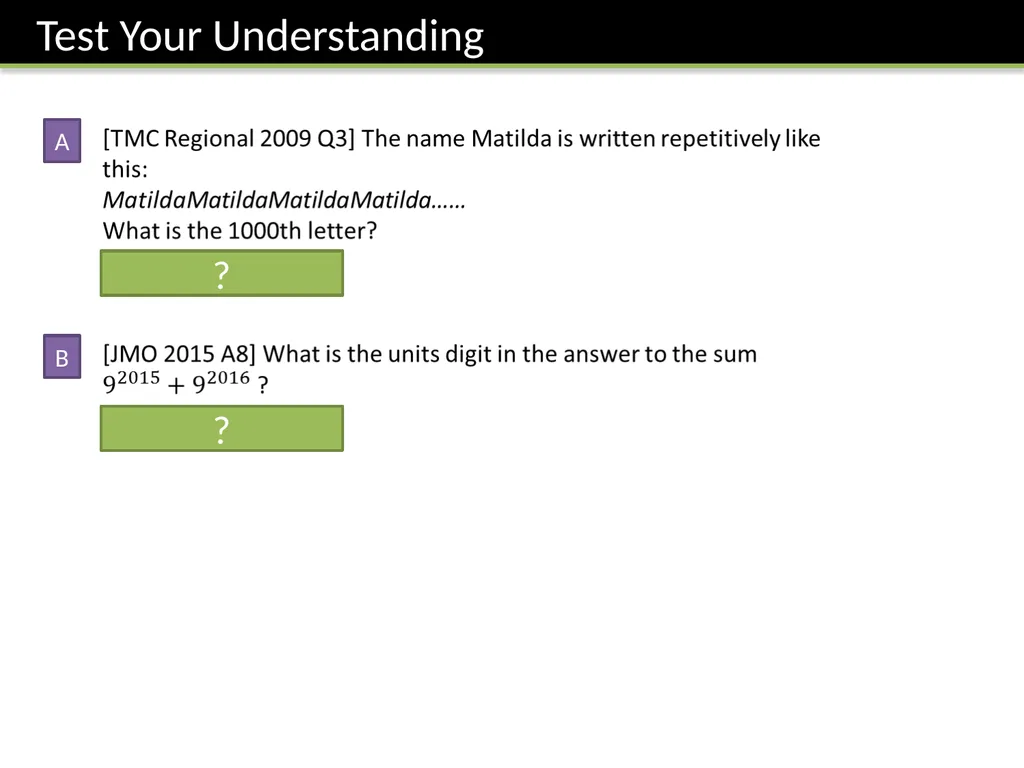
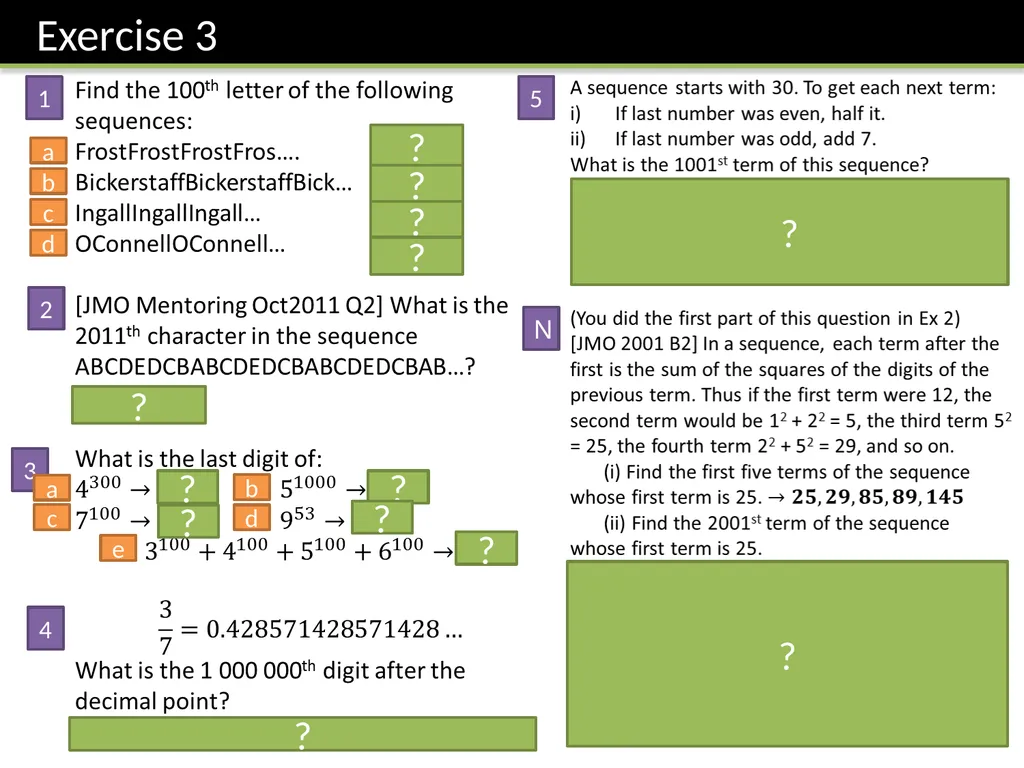
1 2 3 4 5 N a b c d a b c d e ? ? ? ? ? ? ? ? ? ? ? ? ?<br>