
Year 9 Geography Readings Year 9 Geog -
EM
Published · 35 slides · 0 views

1 / 1






Description
Year 9 Geography Readings Year 9 Geog - Australias Environment Lesson 1 - Intro to Year 9 Geography Write down the heading. What do you think this piece of writing is
Related Topics
Share
Embed code
Download this presentation From Below
"Year 9 Geography Readings Year 9 Geog -" is the property of its rightful owner. Permission is granted to download and print the materials on this website for personal, non-commercial use only, and to display it on your personal computer provided you do not modify the materials and that you retain all copyright notices contained in the materials. By downloading content from our website, you accept the terms of this agreement.
Presentation Transcript
01
Year 9 Geography Readings<br>
02
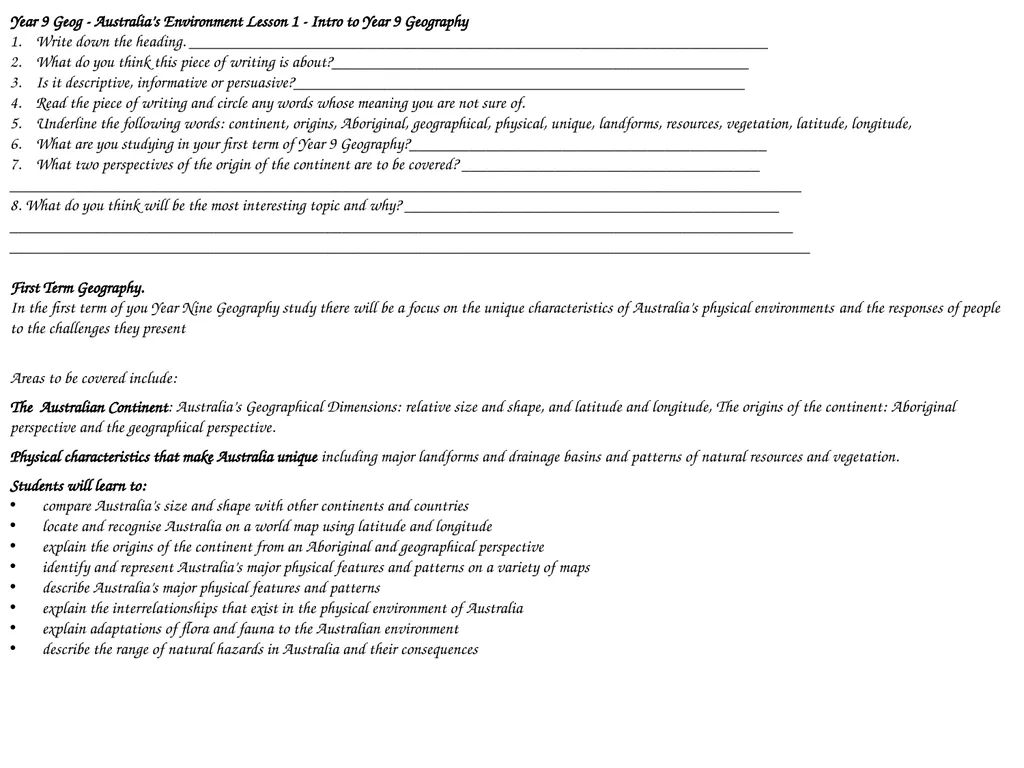
Year 9 Geog - Australia’s Environment Lesson 1 - Intro to Year 9 Geography
Write down the heading. ____________________________________________________________________
What do you think this piece of writing is about?_________________________________________________
Is it descriptive, informative or persuasive?_____________________________________________________
Read the piece of writing and circle any words whose meaning you are not sure of.
Underline the following words: continent, origins, Aboriginal, geographical, physical, unique, landforms, resources, vegetation, latitude, longitude,
What are you studying in your first term of Year 9 Geography?__________________________________________
What two perspectives of the origin of the continent are to be covered? ___________________________________
_____________________________________________________________________________________________
8. What do you think will be the most interesting topic and why? ____________________________________________
____________________________________________________________________________________________
______________________________________________________________________________________________
First Term Geography.
In the first term of you Year Nine Geography study there will be a focus on the unique characteristics of Australia’s physical environments and the responses of people to the challenges they present
Areas to be covered include:
The Australian Continent: Australia’s Geographical Dimensions: relative size and shape, and latitude and longitude, The origins of the continent: Aboriginal perspective and the geographical perspective.
Physical characteristics that make Australia unique including major landforms and drainage basins and patterns of natural resources and vegetation.
Students will learn to:
compare Australia’s size and shape with other continents and countries
locate and recognise Australia on a world map using latitude and longitude
explain the origins of the continent from an Aboriginal and geographical perspective
identify and represent Australia’s major physical features and patterns on a variety of maps
describe Australia’s major physical features and patterns
explain the interrelationships that exist in the physical environment of Australia
explain adaptations of flora and fauna to the Australian environment
describe the range of natural hazards in Australia and their consequences<br>
Write down the heading. ____________________________________________________________________
What do you think this piece of writing is about?_________________________________________________
Is it descriptive, informative or persuasive?_____________________________________________________
Read the piece of writing and circle any words whose meaning you are not sure of.
Underline the following words: continent, origins, Aboriginal, geographical, physical, unique, landforms, resources, vegetation, latitude, longitude,
What are you studying in your first term of Year 9 Geography?__________________________________________
What two perspectives of the origin of the continent are to be covered? ___________________________________
_____________________________________________________________________________________________
8. What do you think will be the most interesting topic and why? ____________________________________________
____________________________________________________________________________________________
______________________________________________________________________________________________
First Term Geography.
In the first term of you Year Nine Geography study there will be a focus on the unique characteristics of Australia’s physical environments and the responses of people to the challenges they present
Areas to be covered include:
The Australian Continent: Australia’s Geographical Dimensions: relative size and shape, and latitude and longitude, The origins of the continent: Aboriginal perspective and the geographical perspective.
Physical characteristics that make Australia unique including major landforms and drainage basins and patterns of natural resources and vegetation.
Students will learn to:
compare Australia’s size and shape with other continents and countries
locate and recognise Australia on a world map using latitude and longitude
explain the origins of the continent from an Aboriginal and geographical perspective
identify and represent Australia’s major physical features and patterns on a variety of maps
describe Australia’s major physical features and patterns
explain the interrelationships that exist in the physical environment of Australia
explain adaptations of flora and fauna to the Australian environment
describe the range of natural hazards in Australia and their consequences<br>
03
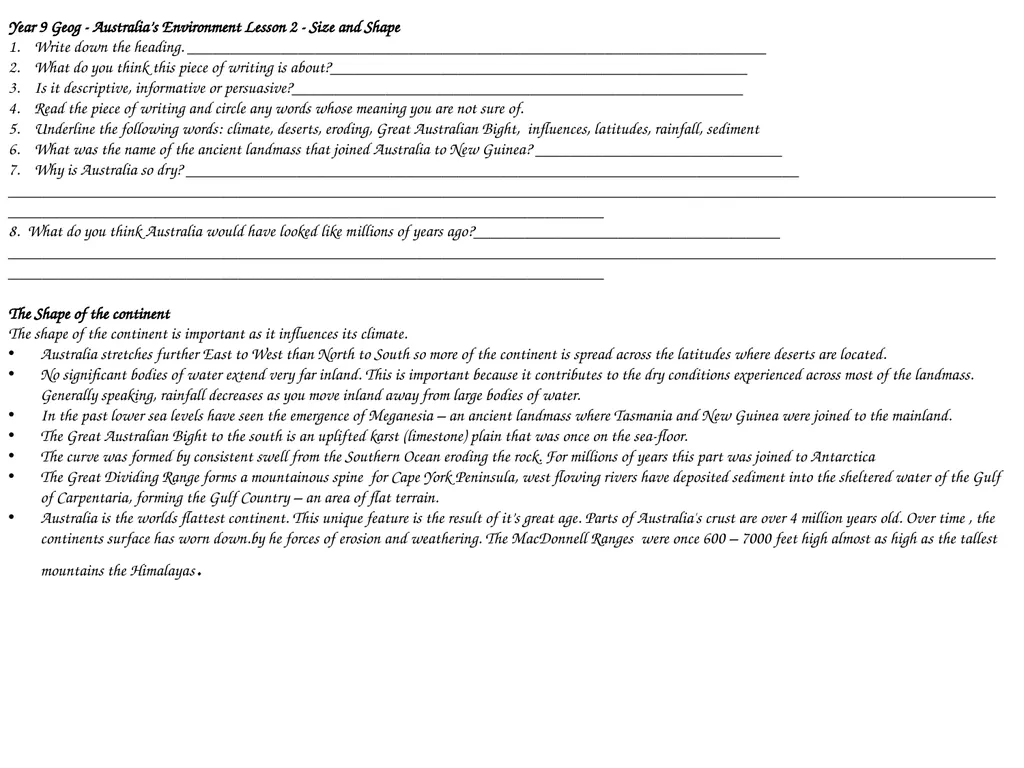
Year 9 Geog - Australia’s Environment Lesson 2 - Size and Shape
Write down the heading. ____________________________________________________________________
What do you think this piece of writing is about?_________________________________________________
Is it descriptive, informative or persuasive?_____________________________________________________
Read the piece of writing and circle any words whose meaning you are not sure of.
Underline the following words: climate, deserts, eroding, Great Australian Bight, influences, latitudes, rainfall, sediment
What was the name of the ancient landmass that joined Australia to New Guinea? _____________________________
Why is Australia so dry? ________________________________________________________________________
__________________________________________________________________________________________________________________________________________________________________________________________
8. What do you think Australia would have looked like millions of years ago?____________________________________
__________________________________________________________________________________________________________________________________________________________________________________________
The Shape of the continent
The shape of the continent is important as it influences its climate.
Australia stretches further East to West than North to South so more of the continent is spread across the latitudes where deserts are located.
No significant bodies of water extend very far inland. This is important because it contributes to the dry conditions experienced across most of the landmass. Generally speaking, rainfall decreases as you move inland away from large bodies of water.
In the past lower sea levels have seen the emergence of Meganesia – an ancient landmass where Tasmania and New Guinea were joined to the mainland.
The Great Australian Bight to the south is an uplifted karst (limestone) plain that was once on the sea-floor.
The curve was formed by consistent swell from the Southern Ocean eroding the rock. For millions of years this part was joined to Antarctica
The Great Dividing Range forms a mountainous spine for Cape York Peninsula, west flowing rivers have deposited sediment into the sheltered water of the Gulf of Carpentaria, forming the Gulf Country – an area of flat terrain.
Australia is the worlds flattest continent. This unique feature is the result of it’s great age. Parts of Australia's crust are over 4 million years old. Over time , the continents surface has worn down.by he forces of erosion and weathering. The MacDonnell Ranges were once 600 – 7000 feet high almost as high as the tallest mountains the Himalayas.<br>
Write down the heading. ____________________________________________________________________
What do you think this piece of writing is about?_________________________________________________
Is it descriptive, informative or persuasive?_____________________________________________________
Read the piece of writing and circle any words whose meaning you are not sure of.
Underline the following words: climate, deserts, eroding, Great Australian Bight, influences, latitudes, rainfall, sediment
What was the name of the ancient landmass that joined Australia to New Guinea? _____________________________
Why is Australia so dry? ________________________________________________________________________
__________________________________________________________________________________________________________________________________________________________________________________________
8. What do you think Australia would have looked like millions of years ago?____________________________________
__________________________________________________________________________________________________________________________________________________________________________________________
The Shape of the continent
The shape of the continent is important as it influences its climate.
Australia stretches further East to West than North to South so more of the continent is spread across the latitudes where deserts are located.
No significant bodies of water extend very far inland. This is important because it contributes to the dry conditions experienced across most of the landmass. Generally speaking, rainfall decreases as you move inland away from large bodies of water.
In the past lower sea levels have seen the emergence of Meganesia – an ancient landmass where Tasmania and New Guinea were joined to the mainland.
The Great Australian Bight to the south is an uplifted karst (limestone) plain that was once on the sea-floor.
The curve was formed by consistent swell from the Southern Ocean eroding the rock. For millions of years this part was joined to Antarctica
The Great Dividing Range forms a mountainous spine for Cape York Peninsula, west flowing rivers have deposited sediment into the sheltered water of the Gulf of Carpentaria, forming the Gulf Country – an area of flat terrain.
Australia is the worlds flattest continent. This unique feature is the result of it’s great age. Parts of Australia's crust are over 4 million years old. Over time , the continents surface has worn down.by he forces of erosion and weathering. The MacDonnell Ranges were once 600 – 7000 feet high almost as high as the tallest mountains the Himalayas.<br>
04
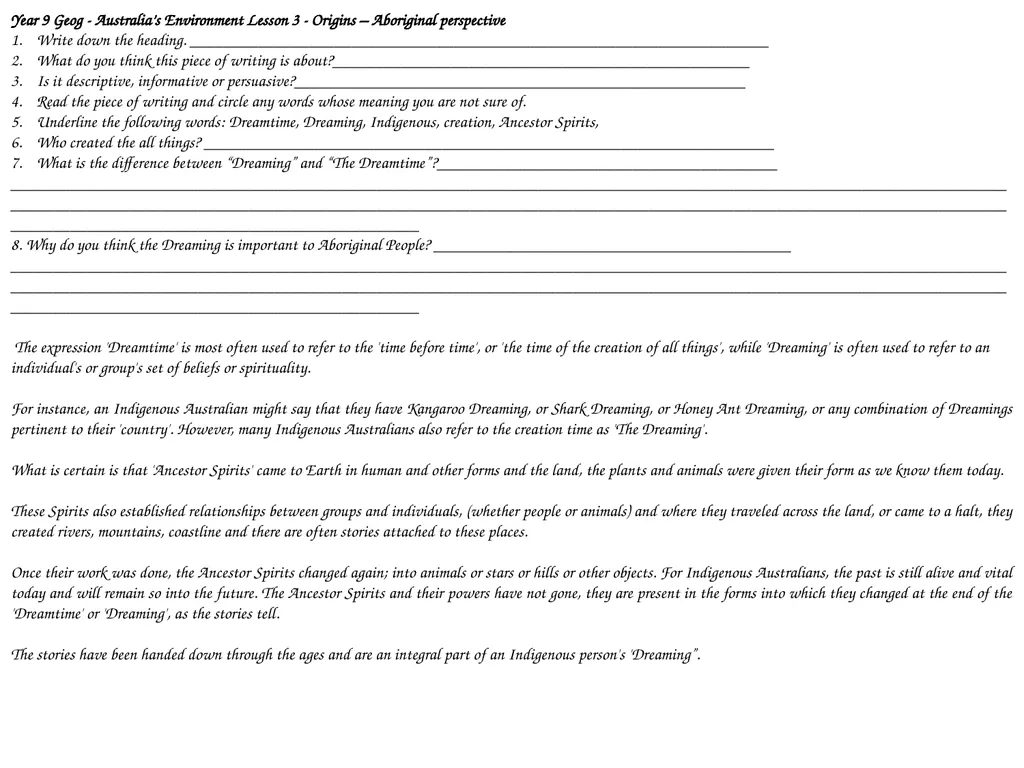
Year 9 Geog - Australia’s Environment Lesson 3 - Origins – Aboriginal perspective
Write down the heading. ____________________________________________________________________
What do you think this piece of writing is about?_________________________________________________
Is it descriptive, informative or persuasive?_____________________________________________________
Read the piece of writing and circle any words whose meaning you are not sure of.
Underline the following words: Dreamtime, Dreaming, Indigenous, creation, Ancestor Spirits,
Who created the all things? ___________________________________________________________________
What is the difference between “Dreaming” and “The Dreamtime”?________________________________________
__________________________________________________________________________________________________________________________________________________________________________________________________________________________________________________________________________________________
8. Why do you think the Dreaming is important to Aboriginal People? __________________________________________
__________________________________________________________________________________________________________________________________________________________________________________________________________________________________________________________________________________________
The expression 'Dreamtime' is most often used to refer to the 'time before time', or 'the time of the creation of all things', while 'Dreaming' is often used to refer to an individual's or group's set of beliefs or spirituality.
For instance, an Indigenous Australian might say that they have Kangaroo Dreaming, or Shark Dreaming, or Honey Ant Dreaming, or any combination of Dreamings pertinent to their 'country'. However, many Indigenous Australians also refer to the creation time as 'The Dreaming'.
What is certain is that 'Ancestor Spirits' came to Earth in human and other forms and the land, the plants and animals were given their form as we know them today.
These Spirits also established relationships between groups and individuals, (whether people or animals) and where they traveled across the land, or came to a halt, they created rivers, mountains, coastline and there are often stories attached to these places.
Once their work was done, the Ancestor Spirits changed again; into animals or stars or hills or other objects. For Indigenous Australians, the past is still alive and vital today and will remain so into the future. The Ancestor Spirits and their powers have not gone, they are present in the forms into which they changed at the end of the 'Dreamtime' or 'Dreaming', as the stories tell.
The stories have been handed down through the ages and are an integral part of an Indigenous person's 'Dreaming”.<br>
Write down the heading. ____________________________________________________________________
What do you think this piece of writing is about?_________________________________________________
Is it descriptive, informative or persuasive?_____________________________________________________
Read the piece of writing and circle any words whose meaning you are not sure of.
Underline the following words: Dreamtime, Dreaming, Indigenous, creation, Ancestor Spirits,
Who created the all things? ___________________________________________________________________
What is the difference between “Dreaming” and “The Dreamtime”?________________________________________
__________________________________________________________________________________________________________________________________________________________________________________________________________________________________________________________________________________________
8. Why do you think the Dreaming is important to Aboriginal People? __________________________________________
__________________________________________________________________________________________________________________________________________________________________________________________________________________________________________________________________________________________
The expression 'Dreamtime' is most often used to refer to the 'time before time', or 'the time of the creation of all things', while 'Dreaming' is often used to refer to an individual's or group's set of beliefs or spirituality.
For instance, an Indigenous Australian might say that they have Kangaroo Dreaming, or Shark Dreaming, or Honey Ant Dreaming, or any combination of Dreamings pertinent to their 'country'. However, many Indigenous Australians also refer to the creation time as 'The Dreaming'.
What is certain is that 'Ancestor Spirits' came to Earth in human and other forms and the land, the plants and animals were given their form as we know them today.
These Spirits also established relationships between groups and individuals, (whether people or animals) and where they traveled across the land, or came to a halt, they created rivers, mountains, coastline and there are often stories attached to these places.
Once their work was done, the Ancestor Spirits changed again; into animals or stars or hills or other objects. For Indigenous Australians, the past is still alive and vital today and will remain so into the future. The Ancestor Spirits and their powers have not gone, they are present in the forms into which they changed at the end of the 'Dreamtime' or 'Dreaming', as the stories tell.
The stories have been handed down through the ages and are an integral part of an Indigenous person's 'Dreaming”.<br>
05
Year 9 Geog - Australia’s Environment Lesson 4 – Origins Geographical Perspective
Write down the heading. ____________________________________________________________________
What do you think this piece of writing is about?_________________________________________________
Is it descriptive, informative or persuasive?_____________________________________________________
Read the piece of writing and circle any words whose meaning you are not sure of.
Underline the following words: climate change , continental, convention currents, erosion, geological, Gondwana, Laurasia , Pangaea , tectonic plates, weathering,
What has Australia’s continental crust been shaped by? _______________________________________________ _
What two factors have been most influential? _______________________________________________________
_____________________________________________________________________________________________
8. What was Australia like millions of years ago? _________________________________________________________
__________________________________________________________________________________________________________________________________________________________________________________________________________________________________________________________________________________________
Australia's continental crust has been shaped by many geological processes, especially continental drift which has caused the crust to constantly be broken up and reassembled. Rising and falling sea levels associated with climate change have altered the coastline many times. Mountain-building forces and weathering and erosion have shaped the surface of the continent and individual landforms.
The earth’s crust is made up of thirteen plates which contain the oceans and continents. Convection currents underneath the crust cause the plates to move. Over millions of years the continents have moved backwards and forwards between the North Pole and the South Pole. This movement is known as continental drift.
Even today the earths crust is not stable. It is divided into plates, known as tectonic plates. They fit together like a jigsaw puzzle and each plate is named relative to its geographical location. Tectonic plates are always moving against each other, sometimes with dramatic effect. Volcanoes and earthquakes are the result of the sudden movement of tectonic plates, however, most of the changes in the Earth's surface are very slow, taking millions of years
Another important factor that affected the Australian continent over time was climate change. Australia's climate has not always been the same. In fact, over millions of years the climate has undergone dramatic changes. There have been a number of ice ages, when the world's climates became considerably colder. Long ago, Australia's climate was warmer and wetter than it is today. The sea covered large areas of the continent, as indicated by seashells and marine fossils found in inland areas.
Millions of years ago the world’s land masses were joined in one huge continent known as Pangaea, The northern section, Laurasia, was the land mass from which the present North American, European and Asian continents formed. The southern section, Gondwana, contained the present continents of South America, Africa, Australia and Antarctica. Enormous forces deep within the earth's crust caused Pangaea to split up, and by 153 million years ago, Laurasia and Gondwana had separated.<br>
Write down the heading. ____________________________________________________________________
What do you think this piece of writing is about?_________________________________________________
Is it descriptive, informative or persuasive?_____________________________________________________
Read the piece of writing and circle any words whose meaning you are not sure of.
Underline the following words: climate change , continental, convention currents, erosion, geological, Gondwana, Laurasia , Pangaea , tectonic plates, weathering,
What has Australia’s continental crust been shaped by? _______________________________________________ _
What two factors have been most influential? _______________________________________________________
_____________________________________________________________________________________________
8. What was Australia like millions of years ago? _________________________________________________________
__________________________________________________________________________________________________________________________________________________________________________________________________________________________________________________________________________________________
Australia's continental crust has been shaped by many geological processes, especially continental drift which has caused the crust to constantly be broken up and reassembled. Rising and falling sea levels associated with climate change have altered the coastline many times. Mountain-building forces and weathering and erosion have shaped the surface of the continent and individual landforms.
The earth’s crust is made up of thirteen plates which contain the oceans and continents. Convection currents underneath the crust cause the plates to move. Over millions of years the continents have moved backwards and forwards between the North Pole and the South Pole. This movement is known as continental drift.
Even today the earths crust is not stable. It is divided into plates, known as tectonic plates. They fit together like a jigsaw puzzle and each plate is named relative to its geographical location. Tectonic plates are always moving against each other, sometimes with dramatic effect. Volcanoes and earthquakes are the result of the sudden movement of tectonic plates, however, most of the changes in the Earth's surface are very slow, taking millions of years
Another important factor that affected the Australian continent over time was climate change. Australia's climate has not always been the same. In fact, over millions of years the climate has undergone dramatic changes. There have been a number of ice ages, when the world's climates became considerably colder. Long ago, Australia's climate was warmer and wetter than it is today. The sea covered large areas of the continent, as indicated by seashells and marine fossils found in inland areas.
Millions of years ago the world’s land masses were joined in one huge continent known as Pangaea, The northern section, Laurasia, was the land mass from which the present North American, European and Asian continents formed. The southern section, Gondwana, contained the present continents of South America, Africa, Australia and Antarctica. Enormous forces deep within the earth's crust caused Pangaea to split up, and by 153 million years ago, Laurasia and Gondwana had separated.<br>
06
Year 9 Geog - Australia’s Environment Lesson 5 – Major Landforms
Write down the heading. ____________________________________________________________________
What do you think this piece of writing is about?_________________________________________________
Is it descriptive, informative or persuasive?_____________________________________________________
Read the piece of writing and circle any words whose meaning you are not sure of.
Underline the following words: artesian, faulting, igneous, inland sea, metaphoric , plateaus, sandridge, sedimentary , rift valley, tablelands, weather.
Name the 5 major landforms_____________________________________________________________________
_____________________________________________________________________________________________
Australia can be broken into five major landform regions:
Coastal Plain- Narrow strip of land along the eastern coast of Australia, extending from Queensland to Victoria. Flat with relatively high rainfall. Well suited to building large cities. Australia's largest cities, including Sydney, Melbourne and Brisbane, are all located along the coastal plains.
Eastern Highlands, including the Great Dividing Range, are a series of tablelands and plateaus. Most of the area is rugged because rivers have cut deep valleys. The range extends north to the Cape York Peninsula in Queensland and south to Tasmania. The Eastern Highlands are tall enough to affect the weather in the rest of their region. They cause rain to fall upon the coastal plains and keep the central lowlands dry. It is the source of most of the major rivers including, Fitzroy, Darling and Murray. The highest part is the Southeast where snow covers the alpine area.
South Australian Highlands. A series of low ranges formed by faulting. The Mount Lofty Ranges and the Flinders Ranges were formed by this process. Spencer Gulf and Gulf of St Vincent (where Adelaide is located) are drowned rift valleys.
Western Plateau. Approximately one third of the continent, or about 2 700 000 square kilometres. Significant parts of Western Australia, South Australia and the Northern Territory. Massive block of igneous and metaphoric rock, some rocks being over 3.6 billion years old. Relatively flat - average elevation less than 500m. This is due to erosion. There are a number of large, free-standing rocks, including Kata Tjuta, Mt Connor and Uluru (large sandstone rock formation that is 346m high with a circumference of 8km).
Central Lowlands. Accounts for 25% of the continent. Extremely flat, low-lying plains of sedimentary rock - created by sediments, or silt and biological matter, deposited when the inner part of Australia was covered by an inland sea. Covers the area from Australia's largest river basin, the Murray-Darling, through the Great Artesian Basin, extending north to the Gulf of Carpentaria. The Great Artesian Basin is one of the largest artesian groundwater basins in the world, and covers 1 711 000 square kilometres (km2). The lowest landforms of the continent are found in this region - average height of less than 200m. Lake Eyre - lowest point of the Australian continent at 15m below sea level and spreading over almost 10 000 km2. The Central Lowlands also receive the least amount of rain a year out of all the regions, less than 125 millimetres per year, and contain large deserts and salt plans. The Sturt Stony Desert (29 750km2), the Strzelecki Desert (80 250km2), and the Simpson (176 500km2) Desert are all located in the Central Lowlands. The Simpson contains the world's largest sand ridge desert. The 30-metre high dunes consist of red sand ridges extending for hundreds of kilometres. The dunes are held in position by vegetation.<br>
Write down the heading. ____________________________________________________________________
What do you think this piece of writing is about?_________________________________________________
Is it descriptive, informative or persuasive?_____________________________________________________
Read the piece of writing and circle any words whose meaning you are not sure of.
Underline the following words: artesian, faulting, igneous, inland sea, metaphoric , plateaus, sandridge, sedimentary , rift valley, tablelands, weather.
Name the 5 major landforms_____________________________________________________________________
_____________________________________________________________________________________________
Australia can be broken into five major landform regions:
Coastal Plain- Narrow strip of land along the eastern coast of Australia, extending from Queensland to Victoria. Flat with relatively high rainfall. Well suited to building large cities. Australia's largest cities, including Sydney, Melbourne and Brisbane, are all located along the coastal plains.
Eastern Highlands, including the Great Dividing Range, are a series of tablelands and plateaus. Most of the area is rugged because rivers have cut deep valleys. The range extends north to the Cape York Peninsula in Queensland and south to Tasmania. The Eastern Highlands are tall enough to affect the weather in the rest of their region. They cause rain to fall upon the coastal plains and keep the central lowlands dry. It is the source of most of the major rivers including, Fitzroy, Darling and Murray. The highest part is the Southeast where snow covers the alpine area.
South Australian Highlands. A series of low ranges formed by faulting. The Mount Lofty Ranges and the Flinders Ranges were formed by this process. Spencer Gulf and Gulf of St Vincent (where Adelaide is located) are drowned rift valleys.
Western Plateau. Approximately one third of the continent, or about 2 700 000 square kilometres. Significant parts of Western Australia, South Australia and the Northern Territory. Massive block of igneous and metaphoric rock, some rocks being over 3.6 billion years old. Relatively flat - average elevation less than 500m. This is due to erosion. There are a number of large, free-standing rocks, including Kata Tjuta, Mt Connor and Uluru (large sandstone rock formation that is 346m high with a circumference of 8km).
Central Lowlands. Accounts for 25% of the continent. Extremely flat, low-lying plains of sedimentary rock - created by sediments, or silt and biological matter, deposited when the inner part of Australia was covered by an inland sea. Covers the area from Australia's largest river basin, the Murray-Darling, through the Great Artesian Basin, extending north to the Gulf of Carpentaria. The Great Artesian Basin is one of the largest artesian groundwater basins in the world, and covers 1 711 000 square kilometres (km2). The lowest landforms of the continent are found in this region - average height of less than 200m. Lake Eyre - lowest point of the Australian continent at 15m below sea level and spreading over almost 10 000 km2. The Central Lowlands also receive the least amount of rain a year out of all the regions, less than 125 millimetres per year, and contain large deserts and salt plans. The Sturt Stony Desert (29 750km2), the Strzelecki Desert (80 250km2), and the Simpson (176 500km2) Desert are all located in the Central Lowlands. The Simpson contains the world's largest sand ridge desert. The 30-metre high dunes consist of red sand ridges extending for hundreds of kilometres. The dunes are held in position by vegetation.<br>
07
Year 9 Geog - Australia’s Environment Lesson 7 – Australia’’s Climate
Write down the heading. ____________________________________________________________________
What do you think this piece of writing is about?_________________________________________________
Is it descriptive, informative or persuasive?_____________________________________________________
Read the piece of writing and circle any words whose meaning you are not sure of.
Underline the following words: decreases, Equator, high pressure, latitude, low pressure, onshore, precipitation , reverses, settled, unsettled, variability
What is the distinctive feature of the Australian climate?_______________________________________________
Name the 7 factors that affect our climate. _________________________________________________________
_________________________________________________________________________________________________________________________________________________________________________________________________________________________________________________________________________________________
8. In the Australian environment what do you think is affected by the climate. ________________________________________________________________________________________________________________________________________________________________________________________________________________________________________________________________________________________________________________________________________________________________________________________
One of the most distinctive features of the Australian climate is its variability. There are a range of factors that influence climate and are responsible for the changes that occur from region to region and from year to year. .
Latitude - The Earth receives more of the Sun’s energy at the Equator than at the poles so temperatures are highest at the Equator and decrease as latitude increases.
Distance from the coast - The sea has a moderating effect so temperature ranges are less at the coast than inland. Onshore winds bring higher precipitation to coastal areas.
Ocean currents - Currents from nearer the poles bring cooler conditions and those from nearer the Equator bring warmer conditions.
Direction of prevailing winds - winds from nearer Equator the are warmer than those from nearer the poles. Winds from over the ocean bring precipitation and those from inland are city.
Relief - Temperature decreases with height. Moist air that is forced to rise by mountains cools, and the water vapour condenses, producing increased cloud cover and precipitation. Highland areas are cooler and wetter than lowland areas.
Pressure system - High pressure associated with sinking air brings dry settled weather. Low pressure caused by rising air brings unsettled weather. Australia is dominated by high pressure with low pressure in the north during summer and in the south during winter.
El Nino -The normal circulation pattern in the Pacific Ocean brings rain to Australia. in an El Nino year the circulation reverses and South America receives the rain while Australia remains dry.<br>
Write down the heading. ____________________________________________________________________
What do you think this piece of writing is about?_________________________________________________
Is it descriptive, informative or persuasive?_____________________________________________________
Read the piece of writing and circle any words whose meaning you are not sure of.
Underline the following words: decreases, Equator, high pressure, latitude, low pressure, onshore, precipitation , reverses, settled, unsettled, variability
What is the distinctive feature of the Australian climate?_______________________________________________
Name the 7 factors that affect our climate. _________________________________________________________
_________________________________________________________________________________________________________________________________________________________________________________________________________________________________________________________________________________________
8. In the Australian environment what do you think is affected by the climate. ________________________________________________________________________________________________________________________________________________________________________________________________________________________________________________________________________________________________________________________________________________________________________________________
One of the most distinctive features of the Australian climate is its variability. There are a range of factors that influence climate and are responsible for the changes that occur from region to region and from year to year. .
Latitude - The Earth receives more of the Sun’s energy at the Equator than at the poles so temperatures are highest at the Equator and decrease as latitude increases.
Distance from the coast - The sea has a moderating effect so temperature ranges are less at the coast than inland. Onshore winds bring higher precipitation to coastal areas.
Ocean currents - Currents from nearer the poles bring cooler conditions and those from nearer the Equator bring warmer conditions.
Direction of prevailing winds - winds from nearer Equator the are warmer than those from nearer the poles. Winds from over the ocean bring precipitation and those from inland are city.
Relief - Temperature decreases with height. Moist air that is forced to rise by mountains cools, and the water vapour condenses, producing increased cloud cover and precipitation. Highland areas are cooler and wetter than lowland areas.
Pressure system - High pressure associated with sinking air brings dry settled weather. Low pressure caused by rising air brings unsettled weather. Australia is dominated by high pressure with low pressure in the north during summer and in the south during winter.
El Nino -The normal circulation pattern in the Pacific Ocean brings rain to Australia. in an El Nino year the circulation reverses and South America receives the rain while Australia remains dry.<br>
08
Year 9 Geog – Australia’s Environment Lesson 10 Reading Activity – Australia’ s Flora and Fauna
Write down the heading. ____________________________________________________________________
What do you think this piece of writing is about?_________________________________________________
Is it descriptive, informative or persuasive?_____________________________________________________
Read the piece of writing and circle any words whose meaning you are not sure of.
Underline the following words: adapted, botanic, eucalyptus, evolution, infertile, inhospitable, saltbush, symbiotic
What is the soil like in this area? __________________________________________________________________
How did the plants adapt to the environment? _________________________________________________________
______________________________________________________________________________________________
8. What does he mean evolution has proceeded apace? _____________________________________________________
____________________________________________________________________________________________________________________________________________________________________________________________
LET A THOUSAND FLOWERS BLOOM
Restoring Australia's Botanic Wonderland
By Ron Geatz
Smooth, white-barked eucalyptus trees rise from ochre soil. topped by umbrellas of brassy-olive leaves. Silvery saltbush hugs the ground, sheltering goanna lizards. The hot white surface of a dry salt lake glistens in the distance. The screech of black cockatoos draws attention skyward, summoning visions of pterodactyls soaring overhead.
This 3-billion-year-old landscape in south-western Australia has over the past 250 million years gone largely undisturbed by catastrophic events such as volcanoes, earthquakes and glaciers. It is flat, infertile, leached of nutrients and laden with salt. The result, bewilderingly, is a botanic wonderland.
In this isolated and seemingly inhospitable landscape, native plants-about half of which exist nowhere else adapted and evolved intriguing methods of survival. Some became carnivorous; others established symbiotic relationships with hardier neighbours; still others developed bizarre root systems to scavenge sparse sustenance. And as the climate changed over millenniums, identical plants just metres apart evolved into distinct species-estimated to be some 900 as did the animals that depend on them.
'This is a rare part of the world where evolution has proceeded apace,' explains Keith Bradby, coordinator of Gondwana Link.
Source: Nature Conservancy Maqazine, Autumn 2006<br>
Write down the heading. ____________________________________________________________________
What do you think this piece of writing is about?_________________________________________________
Is it descriptive, informative or persuasive?_____________________________________________________
Read the piece of writing and circle any words whose meaning you are not sure of.
Underline the following words: adapted, botanic, eucalyptus, evolution, infertile, inhospitable, saltbush, symbiotic
What is the soil like in this area? __________________________________________________________________
How did the plants adapt to the environment? _________________________________________________________
______________________________________________________________________________________________
8. What does he mean evolution has proceeded apace? _____________________________________________________
____________________________________________________________________________________________________________________________________________________________________________________________
LET A THOUSAND FLOWERS BLOOM
Restoring Australia's Botanic Wonderland
By Ron Geatz
Smooth, white-barked eucalyptus trees rise from ochre soil. topped by umbrellas of brassy-olive leaves. Silvery saltbush hugs the ground, sheltering goanna lizards. The hot white surface of a dry salt lake glistens in the distance. The screech of black cockatoos draws attention skyward, summoning visions of pterodactyls soaring overhead.
This 3-billion-year-old landscape in south-western Australia has over the past 250 million years gone largely undisturbed by catastrophic events such as volcanoes, earthquakes and glaciers. It is flat, infertile, leached of nutrients and laden with salt. The result, bewilderingly, is a botanic wonderland.
In this isolated and seemingly inhospitable landscape, native plants-about half of which exist nowhere else adapted and evolved intriguing methods of survival. Some became carnivorous; others established symbiotic relationships with hardier neighbours; still others developed bizarre root systems to scavenge sparse sustenance. And as the climate changed over millenniums, identical plants just metres apart evolved into distinct species-estimated to be some 900 as did the animals that depend on them.
'This is a rare part of the world where evolution has proceeded apace,' explains Keith Bradby, coordinator of Gondwana Link.
Source: Nature Conservancy Maqazine, Autumn 2006<br>
09
Year 9 Geog – Australia’s Environment Lesson 11 Reading Activity – Australia’ s Resources
Write down the heading. ____________________________________________________________________
What do you think this piece of writing is about?_________________________________________________
Is it descriptive, informative or persuasive?_____________________________________________________
Read the piece of writing and circle any words whose meaning you are not sure of.
Underline the following words: bauxite, Broken Hill., crystals, diversity, exporter, fossil fuel, iron-ore, opals, diamonds
What is Australia the biggest exporter of? __________________________________________________________
What mineral resources do we have? _______________________________________________________________
______________________________________________________________________________________________
8. Do you think these are sustainable resources? Why/Why not?______________________________________________
______________________________________________________________________________________________
______________________________________________________________________________________________
Australia's unique mineral wealth
Australia is rich in minerals, both on the continent and beneath the surrounding oceans. It is the world's third largest producer of minerals and metals and is virtually self-sufficient in mineral resources. Despite increasing exports, Australia's demonstrated reserves Of gold, coal, bauxite, copper, lead, zinc and mineral sands are growing due to improved prospecting and extraction technologies. The reserves are huge, even by world standards:
69 billion tonnes of black coal
18 billion tonnes of iron ore
2.5 billion tonnes of bauxite (aluminium ore)
in excess of 3400 tonnes of gold
Its great mineral wealth results from the diversity of materials that make up the very old land mass. The Pilbara region contains the world's largest iron ore deposit (at Pannawonica) as well as many other iron-ore deposits that are among the world's richest and biggest. The rock mass in this area was originally pushed up from the sea floor billions of years ago, bringing with it deposits of iron. The iron was uplifted further and dried into a deposit 2.5 km thick. Australia is one of the world's biggest iron-ore producers.
Some of the crystals in Australia's ancient rocks formed huge, coloured bands of jasper and marble. The most spectacular of the marble bands is found around the town of Marble Bar in Western Australia. Elsewhere in Australia, such as at Coober Pedy and Lightning Ridge, ancient rock crystals have formed opals. Australia has 90% of the world's opals. One of the world's richest deposits of silver, lead and zinc is at Broken Hill.
Coal is Australia's biggest fossil fuel energy resource. Over a third of the world's coal exports come from Australia. Australia also has the world's biggest bauxite deposits, located on the western side of Cape York Peninsula, and is the world's biggest produce r of bauxite ore. Australia is the world's biggest supplier of industrial diamonds and has a significant amount of the world's uranium resources.<br>
Write down the heading. ____________________________________________________________________
What do you think this piece of writing is about?_________________________________________________
Is it descriptive, informative or persuasive?_____________________________________________________
Read the piece of writing and circle any words whose meaning you are not sure of.
Underline the following words: bauxite, Broken Hill., crystals, diversity, exporter, fossil fuel, iron-ore, opals, diamonds
What is Australia the biggest exporter of? __________________________________________________________
What mineral resources do we have? _______________________________________________________________
______________________________________________________________________________________________
8. Do you think these are sustainable resources? Why/Why not?______________________________________________
______________________________________________________________________________________________
______________________________________________________________________________________________
Australia's unique mineral wealth
Australia is rich in minerals, both on the continent and beneath the surrounding oceans. It is the world's third largest producer of minerals and metals and is virtually self-sufficient in mineral resources. Despite increasing exports, Australia's demonstrated reserves Of gold, coal, bauxite, copper, lead, zinc and mineral sands are growing due to improved prospecting and extraction technologies. The reserves are huge, even by world standards:
69 billion tonnes of black coal
18 billion tonnes of iron ore
2.5 billion tonnes of bauxite (aluminium ore)
in excess of 3400 tonnes of gold
Its great mineral wealth results from the diversity of materials that make up the very old land mass. The Pilbara region contains the world's largest iron ore deposit (at Pannawonica) as well as many other iron-ore deposits that are among the world's richest and biggest. The rock mass in this area was originally pushed up from the sea floor billions of years ago, bringing with it deposits of iron. The iron was uplifted further and dried into a deposit 2.5 km thick. Australia is one of the world's biggest iron-ore producers.
Some of the crystals in Australia's ancient rocks formed huge, coloured bands of jasper and marble. The most spectacular of the marble bands is found around the town of Marble Bar in Western Australia. Elsewhere in Australia, such as at Coober Pedy and Lightning Ridge, ancient rock crystals have formed opals. Australia has 90% of the world's opals. One of the world's richest deposits of silver, lead and zinc is at Broken Hill.
Coal is Australia's biggest fossil fuel energy resource. Over a third of the world's coal exports come from Australia. Australia also has the world's biggest bauxite deposits, located on the western side of Cape York Peninsula, and is the world's biggest produce r of bauxite ore. Australia is the world's biggest supplier of industrial diamonds and has a significant amount of the world's uranium resources.<br>
10
Year 9 Geog – Australia’s Environment Lesson 12 Reading Activity – Australia’ s WHSs
Write down the heading. ____________________________________________________________________
What do you think this piece of writing is about?_________________________________________________
Is it descriptive, informative or persuasive?_____________________________________________________
Read the piece of writing and circle any words whose meaning you are not sure of.
Underline the following words: endangered, evolution, largest, managed, protect, species, unique,
What unique features does the WHS list reflect? ___________________________________________________________
______________________________________________________________________________________________________
7. What have we the best t of? _____________________________________________________________________________
8. How can we protect them? _______________________________________________________________________________
_____________________________________________________________________________________________________
Australia's World Heritage Areas (WHAs)
Australia's World Heritage Areas ( WHAs) reflect many of the unique features of the continent: its age, beauty, landforms and plant and animal life, as well as aspects of Aboriginal culture, the world's oldest surviving culture. Australia's World Heritage Areas protect endangered ecosystems such as “wetlands, sea grass beds, coral reefs, desert woodlands and grasslands, as well as many endangered species. Australia is under an obligation to ensure that its World Heritage Are as are properly managed and protected. Australia's World Heritage The Great Barrier Reef
. Covers an area of 35 million ha.
. World's largest and most diverse coral
reef system and largest living structure.
. I 500 species of fish,400 species of
coral,4000 species of molluscs.
. lmportant feeding and breeding ground for endangered species such as the dugong, loggerhead and green turtles Australian Fossil Mammal Sites
(Riversleigh/Naracoorte)
. Outstanding examples of evidence of the earth's evolutionary history.
. Riversleigh-one of the world! Richest fossil sites for the period l5-25 million years ago.
. Naracoorte-fossils spanning several lce Ages. Kakadu National Park
. Outstanding diversity of plant and
animal life.
. Unique Aboriginal heritage-world!
oldest and most extensive rock paintings.
. Spectacular and ancient landforms. Central Eastern Rainforest Reserves . One of the most significant sites for the survival of ancient plants, showing how the world plants evolved. . Shows links with the ancient Gondwanan landmass. Lord Howe Island Group
. Spectacular landscape and scenery. . lmportant site for the conservation of unique plants and animals. . Excellent example of how evolution has occurred on islands. Fraser lsland
. World's largest sand island. . Many unique landforms and exceptional natural beauty. . Outstanding evidence of Australia's climate and sea-level changes over the last 700 000 years. Shark Bay
. World’s most important site for
stromarolites (an ancient life form). Rich diversity of plants and marine animals.
. Feeding and breeding grounds for
several endangered species, e.g.
humpback whale, dugong (one of the
World’s largest populations), green and
loggerhead turtles. The Tasmanian Wilderness
. Outstanding evidence of geological history.
. Wide variety of plants and animals, many of which are endangered or extinct on the mainland.
. Outstanding wilderness area. Uluru - KataTjuta National park
. Unique landforms. Exceptional natural beauty.
. Outstanding Aboriginal heritage. Wet Tropics of Queensland
. Ancient plants provide an outstanding record of evolution.
. Australia's most diverse rainforest. Willandra Lakes Region .
. Unique landforms providing an outstanding record of earth! history.
. Outstanding Aboriginal site.
. World's oldest cremation site.<br>
Write down the heading. ____________________________________________________________________
What do you think this piece of writing is about?_________________________________________________
Is it descriptive, informative or persuasive?_____________________________________________________
Read the piece of writing and circle any words whose meaning you are not sure of.
Underline the following words: endangered, evolution, largest, managed, protect, species, unique,
What unique features does the WHS list reflect? ___________________________________________________________
______________________________________________________________________________________________________
7. What have we the best t of? _____________________________________________________________________________
8. How can we protect them? _______________________________________________________________________________
_____________________________________________________________________________________________________
Australia's World Heritage Areas (WHAs)
Australia's World Heritage Areas ( WHAs) reflect many of the unique features of the continent: its age, beauty, landforms and plant and animal life, as well as aspects of Aboriginal culture, the world's oldest surviving culture. Australia's World Heritage Areas protect endangered ecosystems such as “wetlands, sea grass beds, coral reefs, desert woodlands and grasslands, as well as many endangered species. Australia is under an obligation to ensure that its World Heritage Are as are properly managed and protected. Australia's World Heritage The Great Barrier Reef
. Covers an area of 35 million ha.
. World's largest and most diverse coral
reef system and largest living structure.
. I 500 species of fish,400 species of
coral,4000 species of molluscs.
. lmportant feeding and breeding ground for endangered species such as the dugong, loggerhead and green turtles Australian Fossil Mammal Sites
(Riversleigh/Naracoorte)
. Outstanding examples of evidence of the earth's evolutionary history.
. Riversleigh-one of the world! Richest fossil sites for the period l5-25 million years ago.
. Naracoorte-fossils spanning several lce Ages. Kakadu National Park
. Outstanding diversity of plant and
animal life.
. Unique Aboriginal heritage-world!
oldest and most extensive rock paintings.
. Spectacular and ancient landforms. Central Eastern Rainforest Reserves . One of the most significant sites for the survival of ancient plants, showing how the world plants evolved. . Shows links with the ancient Gondwanan landmass. Lord Howe Island Group
. Spectacular landscape and scenery. . lmportant site for the conservation of unique plants and animals. . Excellent example of how evolution has occurred on islands. Fraser lsland
. World's largest sand island. . Many unique landforms and exceptional natural beauty. . Outstanding evidence of Australia's climate and sea-level changes over the last 700 000 years. Shark Bay
. World’s most important site for
stromarolites (an ancient life form). Rich diversity of plants and marine animals.
. Feeding and breeding grounds for
several endangered species, e.g.
humpback whale, dugong (one of the
World’s largest populations), green and
loggerhead turtles. The Tasmanian Wilderness
. Outstanding evidence of geological history.
. Wide variety of plants and animals, many of which are endangered or extinct on the mainland.
. Outstanding wilderness area. Uluru - KataTjuta National park
. Unique landforms. Exceptional natural beauty.
. Outstanding Aboriginal heritage. Wet Tropics of Queensland
. Ancient plants provide an outstanding record of evolution.
. Australia's most diverse rainforest. Willandra Lakes Region .
. Unique landforms providing an outstanding record of earth! history.
. Outstanding Aboriginal site.
. World's oldest cremation site.<br>
11
Year 9 Geog – Australia’s Environment Lesson 13 Reading Activity –– Willandra Lakes (15 mins) Read and do the following activities
Write down the heading. ____________________________________________________________________
What do you think this piece of writing is about?_________________________________________________
Is it descriptive, informative or persuasive?_____________________________________________________
Read the piece of writing and circle any words whose meaning you are not sure of.
Underline the following words: erosion, glaciated lake basins, lunettes, megafauna.
Why are the Willandra Lakes important geographically? _________________________________________________
____________________________________________________________________________________________________________________________________________________________________________________________
7. Why have the sediments remained undisturbed? _______________________________________________________
_____________________________________________________________________________________________
8. Why did the megafauna die out? ___________________________________________________________________
______________________________________________________________________________________________
______________________________________________________________________________________________
Landscape evolution
The Willandra Lakes region is made up of a series of dry lake basins that were originally fed from the northern end by the Willandra Creek. They range in size from Lake Garnpung, covering over 500 square kilometres, to small depressions that were little more than seasonal ponds. As the supply of water diminished the lakes gradually dried out, becoming increasingly saline from south to north. On the eastern side of each of the lakes there are vast crescent-shaped lunettes made up of layers of sediment deposited between 40 000 and 15 000 years ago. The layered composition, including clays and fossil soils, distinguish lunettes from sand dunes. One of the most spectacular series of lunettes, known as the Walls of China, is found on the eastern side of Lake Mungo
The Willandra Lakes region is particularly important because it has not been glaciated. Whereas sediments in other regions have been removed by glacial processes, here they have remained undisturbed for many thousands of years. By studying the nature and fossil contents of different layers, researchers have been able to gain valuable information about the relationships that exist between climate, landforms, flora and fauna.
Erosion of lunettes
Over the past 100 to 200 years erosion has been accelerated by the removal of vegetation due to grazing. Although little rain falls in the area, when it does it washes away the soft sands and clays, creating the ribbed surfaces and gullies that characterise the region. The erosion is also responsible for uncovering the remains of animals that lived in the area and are now extinct. These include megafauna such as the giant kangaroo and diprotodon, which was the largest marsupial ever to exist, as well as the thylacine, or Tasmanian tiger. Debate still continues about the cause of their disappearance but the theory that they were hunted to extinction seems less likely as more is learnt about the Aboriginal heritage of this region. It seems more probable that the cause was climate change leading to an increasingly hostile environment.<br>
Write down the heading. ____________________________________________________________________
What do you think this piece of writing is about?_________________________________________________
Is it descriptive, informative or persuasive?_____________________________________________________
Read the piece of writing and circle any words whose meaning you are not sure of.
Underline the following words: erosion, glaciated lake basins, lunettes, megafauna.
Why are the Willandra Lakes important geographically? _________________________________________________
____________________________________________________________________________________________________________________________________________________________________________________________
7. Why have the sediments remained undisturbed? _______________________________________________________
_____________________________________________________________________________________________
8. Why did the megafauna die out? ___________________________________________________________________
______________________________________________________________________________________________
______________________________________________________________________________________________
Landscape evolution
The Willandra Lakes region is made up of a series of dry lake basins that were originally fed from the northern end by the Willandra Creek. They range in size from Lake Garnpung, covering over 500 square kilometres, to small depressions that were little more than seasonal ponds. As the supply of water diminished the lakes gradually dried out, becoming increasingly saline from south to north. On the eastern side of each of the lakes there are vast crescent-shaped lunettes made up of layers of sediment deposited between 40 000 and 15 000 years ago. The layered composition, including clays and fossil soils, distinguish lunettes from sand dunes. One of the most spectacular series of lunettes, known as the Walls of China, is found on the eastern side of Lake Mungo
The Willandra Lakes region is particularly important because it has not been glaciated. Whereas sediments in other regions have been removed by glacial processes, here they have remained undisturbed for many thousands of years. By studying the nature and fossil contents of different layers, researchers have been able to gain valuable information about the relationships that exist between climate, landforms, flora and fauna.
Erosion of lunettes
Over the past 100 to 200 years erosion has been accelerated by the removal of vegetation due to grazing. Although little rain falls in the area, when it does it washes away the soft sands and clays, creating the ribbed surfaces and gullies that characterise the region. The erosion is also responsible for uncovering the remains of animals that lived in the area and are now extinct. These include megafauna such as the giant kangaroo and diprotodon, which was the largest marsupial ever to exist, as well as the thylacine, or Tasmanian tiger. Debate still continues about the cause of their disappearance but the theory that they were hunted to extinction seems less likely as more is learnt about the Aboriginal heritage of this region. It seems more probable that the cause was climate change leading to an increasingly hostile environment.<br>
12
Year 9 Geog – Natural Hazards Lesson 1 Reading Activity – Intro to natural hazards
Write down the heading. ____________________________________________________________________
What do you think this piece of writing is about?_________________________________________________
Is it descriptive, informative or persuasive?_____________________________________________________
Read the piece of writing and circle any words whose meaning you are not sure of.
Underline the following words: disaster, environment, hazard, interrelated, negative, resilience.
What is the difference between a hazard and a disaster? ________________________________________________
____________________________________________________________________________________________________________________________________________________________________________________________
7. What hazards affect Australia? ___________________________________________________________________
_____________________________________________________________________________________________
What hazards have impacted on your life? Have you experienced a natural disaster? _____________________________
__________________________________________________________________________________________________________________________________________________________________________________________________________________________________________________________________________________________
Australia’s natural hazards and disasters
A natural hazard is a threat of a naturally occurring event that will have a negative effect on people or the environment. Many natural hazards are interrelated, e.g. earthquakes can cause tsunami and drought can lead directly to famine or population displacement.
A natural disaster is the effect of the earth's natural hazards, for example flood, tornado, hurricane, volcanic eruption, earthquake, heatwave, or landslide. They can lead to financial, environmental or human losses. The resulting loss depends on the vulnerability of the affected population to resist the hazard, also called their resilience. Thus a natural hazard will not result in a natural disaster in areas without vulnerability, e.g. strong earthquakes in uninhabited areas.
While Australia regularly experiences the impacts of a wide range of natural hazards, we have few natural disasters compared to some parts of the world.
This is because most natural hazards in Australia occur in areas where few people live and where there is very little that can be destroyed or damaged.
The impact of natural hazards is more commonly felt through damage and destruction of personal property and loss of income , although sometimes lives are lost as well.
The types of natural hazards also vary depending upon the location and the time of year.
All Australians are at risk of experiencing a severe storm, drought, heatwave or earthquake at some stage.
Only 3 million Australians are at risk of a cyclone, tsunami or landslide and no Australians are at risk from volcanoes.<br>
Write down the heading. ____________________________________________________________________
What do you think this piece of writing is about?_________________________________________________
Is it descriptive, informative or persuasive?_____________________________________________________
Read the piece of writing and circle any words whose meaning you are not sure of.
Underline the following words: disaster, environment, hazard, interrelated, negative, resilience.
What is the difference between a hazard and a disaster? ________________________________________________
____________________________________________________________________________________________________________________________________________________________________________________________
7. What hazards affect Australia? ___________________________________________________________________
_____________________________________________________________________________________________
What hazards have impacted on your life? Have you experienced a natural disaster? _____________________________
__________________________________________________________________________________________________________________________________________________________________________________________________________________________________________________________________________________________
Australia’s natural hazards and disasters
A natural hazard is a threat of a naturally occurring event that will have a negative effect on people or the environment. Many natural hazards are interrelated, e.g. earthquakes can cause tsunami and drought can lead directly to famine or population displacement.
A natural disaster is the effect of the earth's natural hazards, for example flood, tornado, hurricane, volcanic eruption, earthquake, heatwave, or landslide. They can lead to financial, environmental or human losses. The resulting loss depends on the vulnerability of the affected population to resist the hazard, also called their resilience. Thus a natural hazard will not result in a natural disaster in areas without vulnerability, e.g. strong earthquakes in uninhabited areas.
While Australia regularly experiences the impacts of a wide range of natural hazards, we have few natural disasters compared to some parts of the world.
This is because most natural hazards in Australia occur in areas where few people live and where there is very little that can be destroyed or damaged.
The impact of natural hazards is more commonly felt through damage and destruction of personal property and loss of income , although sometimes lives are lost as well.
The types of natural hazards also vary depending upon the location and the time of year.
All Australians are at risk of experiencing a severe storm, drought, heatwave or earthquake at some stage.
Only 3 million Australians are at risk of a cyclone, tsunami or landslide and no Australians are at risk from volcanoes.<br>
13
Year 9 Geog – Natural Hazards Lesson 2 Reading Activity – Impacts of natural hazards
Write down the heading. ____________________________________________________________________
What do you think this piece of writing is about?_________________________________________________
Is it descriptive, informative or persuasive?_____________________________________________________
Read the piece of writing and circle any words whose meaning you are not sure of.
Underline the following words: common sense, essentials, inevitable, planning, resources, scramble,
What does disasters are inevitable mean? __________________________________________________________
7. What things should you have in case of an emergency? __________________________________________________
_____________________________________________________________________________________________
A fire is coming ! What 5 things would you take from your house that cannot be replaced? _________________________
____________________________________________________________________________________________________________________________________________________________________________________________
Good planning makes a difference during natural disaster
DISASTERS are inevitable, but the manner in which they are handled can make the world of difference.
Put yourself, your family and your property in good stead with planning and preparation.
Disaster Recovery coordinator Russell Barne said every new disaster should be treated on its own merit, but preparations are largely similar for all.
"People tend to forget all common sense each and every time there's a new disaster," he said.
"But the essentials are always the same no matter what you are confronting."
Mr Barne said the hardest times associated with disasters were often not the impact itself, but the clean-up effort and scramble for resources.
"Everyone always forgets simple things like filling up their cars with petrol and withdrawing cash from ATMs," he said.
"It's common courtesy to help your neighbours out, and I must say, Australians are pretty good for that. Do yourself a favour and stock up to avoiding fighting over the last loaf of bread."
Getting ready:
• Prepare an emergency kit with essential items to survive several days without power including a radio, food, torch, water batteries and candles.
• Be aware of what risks exist in your area.
• Be prepared to lose access to your local store, or main roads.
• Sign up for Early Warning Alert System on the council website.
• Ensure you have cash: ATM's can be expected to be down for a number of days.
• Fill your vehicles with fuel<br>
Write down the heading. ____________________________________________________________________
What do you think this piece of writing is about?_________________________________________________
Is it descriptive, informative or persuasive?_____________________________________________________
Read the piece of writing and circle any words whose meaning you are not sure of.
Underline the following words: common sense, essentials, inevitable, planning, resources, scramble,
What does disasters are inevitable mean? __________________________________________________________
7. What things should you have in case of an emergency? __________________________________________________
_____________________________________________________________________________________________
A fire is coming ! What 5 things would you take from your house that cannot be replaced? _________________________
____________________________________________________________________________________________________________________________________________________________________________________________
Good planning makes a difference during natural disaster
DISASTERS are inevitable, but the manner in which they are handled can make the world of difference.
Put yourself, your family and your property in good stead with planning and preparation.
Disaster Recovery coordinator Russell Barne said every new disaster should be treated on its own merit, but preparations are largely similar for all.
"People tend to forget all common sense each and every time there's a new disaster," he said.
"But the essentials are always the same no matter what you are confronting."
Mr Barne said the hardest times associated with disasters were often not the impact itself, but the clean-up effort and scramble for resources.
"Everyone always forgets simple things like filling up their cars with petrol and withdrawing cash from ATMs," he said.
"It's common courtesy to help your neighbours out, and I must say, Australians are pretty good for that. Do yourself a favour and stock up to avoiding fighting over the last loaf of bread."
Getting ready:
• Prepare an emergency kit with essential items to survive several days without power including a radio, food, torch, water batteries and candles.
• Be aware of what risks exist in your area.
• Be prepared to lose access to your local store, or main roads.
• Sign up for Early Warning Alert System on the council website.
• Ensure you have cash: ATM's can be expected to be down for a number of days.
• Fill your vehicles with fuel<br>
14
Year 9 Geog – Natural Hazards Lesson 3 Reading Activity – Severe storms
Write down the heading. ____________________________________________________________________
What do you think this piece of writing is about?_________________________________________________
Is it descriptive, informative or persuasive?_____________________________________________________
Read the piece of writing and circle any words whose meaning you are not sure of.
Underline the following words: accompanied, common, damage, hazard, impact, intensity, unstable,
What is a severe storm? ________________________________________________________________________
What are the impacts of a severe storm? ___________________________________________________________
______________________________________________________________________________________________
8. What dangers are there in a severe storm? ___________________________________________________________
______________________________________________________________________________________________
Severe storms are Australia’s most common natural hazard. They are localised disturbances in the atmosphere accompanied by thunder, lightning, rain, snow or hail. They can occur anywhere in Australia and are responsible for more damage (as measured by insurance costs) than tropical cyclones, bushfires or earthquakes.
Storms usually affect a smaller area than do tropical cyclones and floods, so their impact is often underestimated. On average, severe storms in Australia kill between five and ten people a year, mostly because of lightning strikes. More deaths occur when strong winds cause power lines and tree limbs to fall, and debris (such as roofing iron) to become airborne.
How do storms develop?
Storms develop when warm, moist air rises rapidly in an unstable atmosphere. Sometimes this upward movement is initiated by the passage of a cold front. On other occasions (often in summer), the heating of the earth’s surface is enough to initiate the rapid upward movement of moist air. Most of these storms do not reach the level of intensity needed to produce widespread damage, but they all produce lightning, which can cause death, injury and damage. Sometimes they are accompanied by hail, wind gusts and flash flooding. At 1:10 PM, Bureau of Meteorology weather radar detected severe thunderstorms near Kurri Kurri and Lochinvar. These thunderstorms are moving towards the south-east.
Severe thunderstorms are forecast to affect Maitland, Raymond Terrace and Newcastle City by 1:40 PM and Lemon Tree Passage, Anna Bay and Nelson Bay by 2:10 PM.
Large hailstones, destructive winds and very heavy rainfall are possible. The State Emergency Service advises that people should do the following:
Move your car under cover or away from trees.
Secure or put away loose items around your house, yard and balcony.
Keep clear of fallen power lines.
Keep clear of creeks and storm drains.
Don't walk, ride your bike or drive through flood water.
Unplug computers and appliances.
Avoid using the phone during the storm.
Stay indoors away from windows, and keep children and pets indoors as well.
For emergency help in floods and storms, ring your local SES Unit on 13 2500.
The next warning is due to be issued by 2:10 PM. NSW SEVERE THUNDERSTORM WARN ING—SYDNEY/NEWCAS TLE/WOLLONGONG REGION for LARGE HAILSTONES, DESTRUCTIVE WIND and VERY HEAVY RAINFALL For people in parts of the Greater Newcastle and Maitland/Cessnock areas. Issued at 1:14 PM Monday, 13 November 2006.<br>
Write down the heading. ____________________________________________________________________
What do you think this piece of writing is about?_________________________________________________
Is it descriptive, informative or persuasive?_____________________________________________________
Read the piece of writing and circle any words whose meaning you are not sure of.
Underline the following words: accompanied, common, damage, hazard, impact, intensity, unstable,
What is a severe storm? ________________________________________________________________________
What are the impacts of a severe storm? ___________________________________________________________
______________________________________________________________________________________________
8. What dangers are there in a severe storm? ___________________________________________________________
______________________________________________________________________________________________
Severe storms are Australia’s most common natural hazard. They are localised disturbances in the atmosphere accompanied by thunder, lightning, rain, snow or hail. They can occur anywhere in Australia and are responsible for more damage (as measured by insurance costs) than tropical cyclones, bushfires or earthquakes.
Storms usually affect a smaller area than do tropical cyclones and floods, so their impact is often underestimated. On average, severe storms in Australia kill between five and ten people a year, mostly because of lightning strikes. More deaths occur when strong winds cause power lines and tree limbs to fall, and debris (such as roofing iron) to become airborne.
How do storms develop?
Storms develop when warm, moist air rises rapidly in an unstable atmosphere. Sometimes this upward movement is initiated by the passage of a cold front. On other occasions (often in summer), the heating of the earth’s surface is enough to initiate the rapid upward movement of moist air. Most of these storms do not reach the level of intensity needed to produce widespread damage, but they all produce lightning, which can cause death, injury and damage. Sometimes they are accompanied by hail, wind gusts and flash flooding. At 1:10 PM, Bureau of Meteorology weather radar detected severe thunderstorms near Kurri Kurri and Lochinvar. These thunderstorms are moving towards the south-east.
Severe thunderstorms are forecast to affect Maitland, Raymond Terrace and Newcastle City by 1:40 PM and Lemon Tree Passage, Anna Bay and Nelson Bay by 2:10 PM.
Large hailstones, destructive winds and very heavy rainfall are possible. The State Emergency Service advises that people should do the following:
Move your car under cover or away from trees.
Secure or put away loose items around your house, yard and balcony.
Keep clear of fallen power lines.
Keep clear of creeks and storm drains.
Don't walk, ride your bike or drive through flood water.
Unplug computers and appliances.
Avoid using the phone during the storm.
Stay indoors away from windows, and keep children and pets indoors as well.
For emergency help in floods and storms, ring your local SES Unit on 13 2500.
The next warning is due to be issued by 2:10 PM. NSW SEVERE THUNDERSTORM WARN ING—SYDNEY/NEWCAS TLE/WOLLONGONG REGION for LARGE HAILSTONES, DESTRUCTIVE WIND and VERY HEAVY RAINFALL For people in parts of the Greater Newcastle and Maitland/Cessnock areas. Issued at 1:14 PM Monday, 13 November 2006.<br>
15
Year 9 Geog – Natural Hazards Lesson 4 Reading Activity – Flooding
Write down the heading. ____________________________________________________________________
What do you think this piece of writing is about?_________________________________________________
Is it descriptive, informative or persuasive?_____________________________________________________
Read the piece of writing and circle any words whose meaning you are not sure of.
Underline the following words: costly, impacts, ecosystems, infrastructure, insufficient, intense, relatively,
What provides a natural separation between westerly and easterly flowing rivers? ____________________________
Why are floods so costly? ______________________________________________________________________
________________________________________________________________________________________________________________________________________________________________________________________
8. How do you think flood damage be prevented? ________________________________________________________
________________________________________________________________________________________________________________________________________________________________________________________
Flooding in Australia
Floods can have both positive and negative impacts. They can bring welcome relief for people and ecosystems suffering from prolonged drought, but also are estimated to be the most costly natural disaster in Australia.
Every year in Australia, floods cause millions of dollars damage to buildings and critical infrastructure, such as roads and railways as well as to agricultural land and crops. They also disrupt business and can affect the health of communities.
Flooding occurs in relatively low-lying areas adjacent to streams and rivers. In the extensive flat inland regions of Australia, floods may spread over thousands of square kilometres and last several weeks, with flood warnings sometimes issued months in advance.
In the mountain and coastal regions of Australia flooding can happen rapidly with a warning of only a few hours in some cases.
The Great Dividing Range which extends along the length of eastern Australia provides a natural separation between the longer and slower westerly flowing rivers and the shorter, faster easterly flowing coastal rivers. In some cases natural blockages at river mouths, including storm surge and high tides, also may cause localised flooding of estuaries and coastal lake systems.
Flash floods can occur almost anywhere there is a relatively short intense burst of rainfall such as during a thunderstorm. As a result of these events the drainage system has insufficient capacity or time to cope with the downpour. Although flash floods are generally localised, they pose a significant threat because of their unpredictability and normally short duration.<br>
Write down the heading. ____________________________________________________________________
What do you think this piece of writing is about?_________________________________________________
Is it descriptive, informative or persuasive?_____________________________________________________
Read the piece of writing and circle any words whose meaning you are not sure of.
Underline the following words: costly, impacts, ecosystems, infrastructure, insufficient, intense, relatively,
What provides a natural separation between westerly and easterly flowing rivers? ____________________________
Why are floods so costly? ______________________________________________________________________
________________________________________________________________________________________________________________________________________________________________________________________
8. How do you think flood damage be prevented? ________________________________________________________
________________________________________________________________________________________________________________________________________________________________________________________
Flooding in Australia
Floods can have both positive and negative impacts. They can bring welcome relief for people and ecosystems suffering from prolonged drought, but also are estimated to be the most costly natural disaster in Australia.
Every year in Australia, floods cause millions of dollars damage to buildings and critical infrastructure, such as roads and railways as well as to agricultural land and crops. They also disrupt business and can affect the health of communities.
Flooding occurs in relatively low-lying areas adjacent to streams and rivers. In the extensive flat inland regions of Australia, floods may spread over thousands of square kilometres and last several weeks, with flood warnings sometimes issued months in advance.
In the mountain and coastal regions of Australia flooding can happen rapidly with a warning of only a few hours in some cases.
The Great Dividing Range which extends along the length of eastern Australia provides a natural separation between the longer and slower westerly flowing rivers and the shorter, faster easterly flowing coastal rivers. In some cases natural blockages at river mouths, including storm surge and high tides, also may cause localised flooding of estuaries and coastal lake systems.
Flash floods can occur almost anywhere there is a relatively short intense burst of rainfall such as during a thunderstorm. As a result of these events the drainage system has insufficient capacity or time to cope with the downpour. Although flash floods are generally localised, they pose a significant threat because of their unpredictability and normally short duration.<br>
16
Year 9 Geog – Natural Hazards Lesson 5 Reading Activity – Bushfires (15 mins).
Write down the heading. ____________________________________________________________________
What do you think this piece of writing is about?_________________________________________________
Is it descriptive, informative or persuasive?_____________________________________________________
Read the piece of writing and circle any words whose meaning you are not sure of.
Underline the following words: damage, environment, essential, flammable, management, patterns, regeneration,
What was the Aboriginals most important land use management tool? ______________________________________
What plants are susceptible to burning? ____________________________________________________________
Why do the peak season for fires differ throughout Australia? ____________________________________________
____________________________________________________________________________________________________________________________________________________________________________________________
THE BUSHFIRE THREAT
Bushfires have been shaping the Australian environment for many thousands of years. Not all bushfires are disastrous; although a change in weather conditions can change even small fires into raging infernos. A fire can destroy homes, crops, forests,
wildlife and livestock. If a fire gets out of control, lives can be put at risk. Fires can race through grasslands and forests at a speed so fast that even experienced firefighters cannot escape them. Bushfires are caused by extreme heat, lightning strikes and human activity.
Fires, of both natural and human origin, have shaped Australia's environment. Fire, which is essential for the regeneration of many fire-adapted plant species, was the most powerful land-use management tool of the Aborigines.
Aboriginal people have long used fire to shape their environments and to manage the regions in which they live. They use fire for hunting, cooking, signalling and the regeneration of food plants. There is also evidence to indicate that fire has been used by Aboriginal people as a seasonal means of clearing undergrowth before the winter rains. This creates
grassland suitable for grazing animals, such as the kangaroo, and makes the land easier to hunt in and to cross. The fires are
usually of low intensity and designed to regenerate useful plants rather than decimate the whole ecosystem.
Large areas of Australia suffer from the threat of bushfires. The Australian climate is generally hot, dry and prone to drought. In the southeast, occasional strong winds with summertime cold fronts can lead to extreme fire danger.
Many of Australia's native plants burn easily. The eucalypts' high oil content makes them particularly fire prone. The vast areas of dry grass common in mid-to-late summer also burn readily.
Most loss of life and property damage occurs around the fringes of the cities where homes are sometimes surrounded by flammable vegetation.
Varied fire seasons reflect different weather patterns. For most of southern Australia, the danger period is summer and autumn. For New South Wales and southern Queensland, the peak risk usually occurs in spring and early summer. Northern Australia experiences most of its fires in winter and spring.<br>
Write down the heading. ____________________________________________________________________
What do you think this piece of writing is about?_________________________________________________
Is it descriptive, informative or persuasive?_____________________________________________________
Read the piece of writing and circle any words whose meaning you are not sure of.
Underline the following words: damage, environment, essential, flammable, management, patterns, regeneration,
What was the Aboriginals most important land use management tool? ______________________________________
What plants are susceptible to burning? ____________________________________________________________
Why do the peak season for fires differ throughout Australia? ____________________________________________
____________________________________________________________________________________________________________________________________________________________________________________________
THE BUSHFIRE THREAT
Bushfires have been shaping the Australian environment for many thousands of years. Not all bushfires are disastrous; although a change in weather conditions can change even small fires into raging infernos. A fire can destroy homes, crops, forests,
wildlife and livestock. If a fire gets out of control, lives can be put at risk. Fires can race through grasslands and forests at a speed so fast that even experienced firefighters cannot escape them. Bushfires are caused by extreme heat, lightning strikes and human activity.
Fires, of both natural and human origin, have shaped Australia's environment. Fire, which is essential for the regeneration of many fire-adapted plant species, was the most powerful land-use management tool of the Aborigines.
Aboriginal people have long used fire to shape their environments and to manage the regions in which they live. They use fire for hunting, cooking, signalling and the regeneration of food plants. There is also evidence to indicate that fire has been used by Aboriginal people as a seasonal means of clearing undergrowth before the winter rains. This creates
grassland suitable for grazing animals, such as the kangaroo, and makes the land easier to hunt in and to cross. The fires are
usually of low intensity and designed to regenerate useful plants rather than decimate the whole ecosystem.
Large areas of Australia suffer from the threat of bushfires. The Australian climate is generally hot, dry and prone to drought. In the southeast, occasional strong winds with summertime cold fronts can lead to extreme fire danger.
Many of Australia's native plants burn easily. The eucalypts' high oil content makes them particularly fire prone. The vast areas of dry grass common in mid-to-late summer also burn readily.
Most loss of life and property damage occurs around the fringes of the cities where homes are sometimes surrounded by flammable vegetation.
Varied fire seasons reflect different weather patterns. For most of southern Australia, the danger period is summer and autumn. For New South Wales and southern Queensland, the peak risk usually occurs in spring and early summer. Northern Australia experiences most of its fires in winter and spring.<br>
17
Fire management within Kosciuszko National Park since 1986 has been more ecologically based with the basic objective being the exclusion of fire from all vegetation communities for fifteen to fifty years or more.
This has been a very specific objective for the snow gum woodland communities. Unlike other
eucalypts, which very quickly regenerate
after fire by sprouting epicormic growth, the
snow gums above-ground growth is killed
by fire and they can only recover by sending
up new stems and trunks from the
underground lignotuber. Repeated fire
incidents may exhaust the ability of the
lignotuber to do this. A long period without
fire is necessary for the dense understorey
of shrubs to be replaced by grass.
The subalpine woodland with a grassy
understorey provides for greater
decomposition of the litter fall and higher
fuel moisture conditions. This means that
the litter has a low fire ignition potential in
all but the driest years. Fire above the snowline
By Roger Good, Scientist, NSW National
Park and Wildlife Service
The top of Australia’s Snowy Mountains
have some very unique environments: the
subalpine snow gum woodlands and the
treeless alpine communities. In normal
circumstances, a fire with the heat intensity
and extent of the 2003 fires might only
impact on these environments once in
centuries.
Various researchers agree that there is
little if any evidence that Aboriginal
Australians regularly burnt the high country.
Unlike Aboriginals in more arid
environments the tribes of the area were not traditional users of fire. They did, however, light fires in the mountains during their summer gatherings. Over thousands of
generations, they visited the area for
spiritual purposes and they may have used
fire to smoke out the Bogong moths from
rock crevices and to cook them for their
feasts. No documentary evidence exists of
wildfires occurring directly as a result of
this Aboriginal use of fire, but it is feasible
that infrequent fire escapes may have
occurred and burnt over limited areas of the
mountains.
European settlement and the grazing era
in the mountains changed the fire regime in
the high country. The graziers burnt their
lease areas towards the end of each summer
to encourage a ‘green pick’ in the following
year. A combination of grazing and burning
caused severe and widespread erosion and
favoured the regrowth of healthy shrubs at
the expense of grasses and herbs in the
alpine area. The only way to recover the
natural snowgrass cover here was to stop
burning. The snow gum woodlands were also
dramatically changed over the many years
of grazing, followed by prescribed burning
programs designed to prevent bushfires,
beginning in the 1950s. Year 9 Geog – Natural Hazards Lesson 6 Reading Activity – Fires in the High country
Write down the heading. ____________________________________________________________________
What do you think this piece of writing is about?_________________________________________________
Is it descriptive, informative or persuasive?_____________________________________________________
Read the piece of writing and circle any words whose meaning you are not sure of
Underline the following words: ability, exhaust, combination, erosion, evidence, intensity, recover, unique,
Is there evidence that Aboriginals used fire in the high country? __________________________________________
When did they light fires? _______________________________________________________________________
Why has fire management not being doing burning off in the Kosciuszko National Park since 1986 ? __________________________
_______________________________________________________________________________________________________________________________________________________________________________________________________________________________________________________________________________________________________________________________________________________________<br>
This has been a very specific objective for the snow gum woodland communities. Unlike other
eucalypts, which very quickly regenerate
after fire by sprouting epicormic growth, the
snow gums above-ground growth is killed
by fire and they can only recover by sending
up new stems and trunks from the
underground lignotuber. Repeated fire
incidents may exhaust the ability of the
lignotuber to do this. A long period without
fire is necessary for the dense understorey
of shrubs to be replaced by grass.
The subalpine woodland with a grassy
understorey provides for greater
decomposition of the litter fall and higher
fuel moisture conditions. This means that
the litter has a low fire ignition potential in
all but the driest years. Fire above the snowline
By Roger Good, Scientist, NSW National
Park and Wildlife Service
The top of Australia’s Snowy Mountains
have some very unique environments: the
subalpine snow gum woodlands and the
treeless alpine communities. In normal
circumstances, a fire with the heat intensity
and extent of the 2003 fires might only
impact on these environments once in
centuries.
Various researchers agree that there is
little if any evidence that Aboriginal
Australians regularly burnt the high country.
Unlike Aboriginals in more arid
environments the tribes of the area were not traditional users of fire. They did, however, light fires in the mountains during their summer gatherings. Over thousands of
generations, they visited the area for
spiritual purposes and they may have used
fire to smoke out the Bogong moths from
rock crevices and to cook them for their
feasts. No documentary evidence exists of
wildfires occurring directly as a result of
this Aboriginal use of fire, but it is feasible
that infrequent fire escapes may have
occurred and burnt over limited areas of the
mountains.
European settlement and the grazing era
in the mountains changed the fire regime in
the high country. The graziers burnt their
lease areas towards the end of each summer
to encourage a ‘green pick’ in the following
year. A combination of grazing and burning
caused severe and widespread erosion and
favoured the regrowth of healthy shrubs at
the expense of grasses and herbs in the
alpine area. The only way to recover the
natural snowgrass cover here was to stop
burning. The snow gum woodlands were also
dramatically changed over the many years
of grazing, followed by prescribed burning
programs designed to prevent bushfires,
beginning in the 1950s. Year 9 Geog – Natural Hazards Lesson 6 Reading Activity – Fires in the High country
Write down the heading. ____________________________________________________________________
What do you think this piece of writing is about?_________________________________________________
Is it descriptive, informative or persuasive?_____________________________________________________
Read the piece of writing and circle any words whose meaning you are not sure of
Underline the following words: ability, exhaust, combination, erosion, evidence, intensity, recover, unique,
Is there evidence that Aboriginals used fire in the high country? __________________________________________
When did they light fires? _______________________________________________________________________
Why has fire management not being doing burning off in the Kosciuszko National Park since 1986 ? __________________________
_______________________________________________________________________________________________________________________________________________________________________________________________________________________________________________________________________________________________________________________________________________________________<br>
18
Year 9 Geog – Natural Hazards Lesson 7 Reading Activity – Cyclone Tracy Part 1
Write down the heading. ____________________________________________________________________
What do you think this piece of writing is about?_________________________________________________
Is it descriptive, informative or persuasive?_____________________________________________________
Read the piece of writing and circle any words whose meaning you are not sure of.
Underline the following words: authority, catastrophe, destructive, essential, tropical, unprepared, veered, warning,
When did cyclone Tracy strike? ________________________________________________________________
Why were people unprepared? ____________________________________________________________________
______________________________________________________________________________________________
8. Where could you hide in your house to survive a cyclone? _________________________________________________
Santa Never Made It Into Darwin
Santa, that tough old guy, undaunted by snow or darkness or tight chimneys, was no match for tropical cyclone “Tracy”. He never made it into Darwin on Christmas Eve 1974. He wasn’t expecting anything like it. Nor was anyone else. The cyclone had been around for four days and early on 24th December it was obvious to the Tropical Warning Centre in Darwin that it was making straight for the city. However, only a pre - recorded cyclone warning alarm was sent over local radio stations. No one in authority seems to have taken it seriously except the Regional Director of the Bureau of Meteorology in the city at the time, Mr Ray Wilkie. His regular warnings were sent out from early in the evening on Christmas Eve.
Tracy had begun as a weak tropical low some 700 kilometres northeast of Darwin on the 20th December and was given its name on the 21st when officially classified as a cyclone. Another cyclone had threatened a few weeks earlier on the same course, until it veered away. It did little or no damage from high winds and it was not believed that this other one would be any different. Most Government Departments had closed down on the 24th December and Christmas Eve was being celebrated everywhere. Parties, last minute shopping and all the usual preparations for next day went on. When the cyclone struck just after midnight, the local authorities were totally unprepared.
By 3.30 a.m power was gone and in the blackness and violent winds and rain, the horror continued. Families huddled in the remains of their homes and possessions. Many were killed by flying debris and collapsing buildings. Some sought safety under beds, in cupboards, bathrooms. Children were whirled from parents arms. Birds and insects were blown away and trees stripped or destroyed.
After four hours of savage fury a queer calm fell on the city. Many believed it to be over. Instead it was the eye of the storm and the destructive winds roared in again from the opposite direction. Small craft at sea were lost. Altogether sixty - five died, over one hundred severely injured, and 1,000 more suffered minor injuries. The damaged hospital had plastic sheets arranged like tents to protect patients from dripping ceilings or roofless parts. At least one baby had been born during the onslaught.
At dawn on Christmas morning Darwin was a city in ruins, with dead and injured, without shelter, power, food, water, essential services or communication.
Although the usual telephone system had apparently been operable, for the first hours it was impossible to reach Darwin by telephone or telex. Even the Defence Forces with their powerful equipment could not raise Darwin. One STD call did get through to the Duty Police Sergeant in Darwin. Conflicting reports flew round the country. At length, the Royal Australian Navy sent a convoy of supply ships which arrived on 30th December. It was nine hours before Canberra was made aware of the catastrophe.<br>
Write down the heading. ____________________________________________________________________
What do you think this piece of writing is about?_________________________________________________
Is it descriptive, informative or persuasive?_____________________________________________________
Read the piece of writing and circle any words whose meaning you are not sure of.
Underline the following words: authority, catastrophe, destructive, essential, tropical, unprepared, veered, warning,
When did cyclone Tracy strike? ________________________________________________________________
Why were people unprepared? ____________________________________________________________________
______________________________________________________________________________________________
8. Where could you hide in your house to survive a cyclone? _________________________________________________
Santa Never Made It Into Darwin
Santa, that tough old guy, undaunted by snow or darkness or tight chimneys, was no match for tropical cyclone “Tracy”. He never made it into Darwin on Christmas Eve 1974. He wasn’t expecting anything like it. Nor was anyone else. The cyclone had been around for four days and early on 24th December it was obvious to the Tropical Warning Centre in Darwin that it was making straight for the city. However, only a pre - recorded cyclone warning alarm was sent over local radio stations. No one in authority seems to have taken it seriously except the Regional Director of the Bureau of Meteorology in the city at the time, Mr Ray Wilkie. His regular warnings were sent out from early in the evening on Christmas Eve.
Tracy had begun as a weak tropical low some 700 kilometres northeast of Darwin on the 20th December and was given its name on the 21st when officially classified as a cyclone. Another cyclone had threatened a few weeks earlier on the same course, until it veered away. It did little or no damage from high winds and it was not believed that this other one would be any different. Most Government Departments had closed down on the 24th December and Christmas Eve was being celebrated everywhere. Parties, last minute shopping and all the usual preparations for next day went on. When the cyclone struck just after midnight, the local authorities were totally unprepared.
By 3.30 a.m power was gone and in the blackness and violent winds and rain, the horror continued. Families huddled in the remains of their homes and possessions. Many were killed by flying debris and collapsing buildings. Some sought safety under beds, in cupboards, bathrooms. Children were whirled from parents arms. Birds and insects were blown away and trees stripped or destroyed.
After four hours of savage fury a queer calm fell on the city. Many believed it to be over. Instead it was the eye of the storm and the destructive winds roared in again from the opposite direction. Small craft at sea were lost. Altogether sixty - five died, over one hundred severely injured, and 1,000 more suffered minor injuries. The damaged hospital had plastic sheets arranged like tents to protect patients from dripping ceilings or roofless parts. At least one baby had been born during the onslaught.
At dawn on Christmas morning Darwin was a city in ruins, with dead and injured, without shelter, power, food, water, essential services or communication.
Although the usual telephone system had apparently been operable, for the first hours it was impossible to reach Darwin by telephone or telex. Even the Defence Forces with their powerful equipment could not raise Darwin. One STD call did get through to the Duty Police Sergeant in Darwin. Conflicting reports flew round the country. At length, the Royal Australian Navy sent a convoy of supply ships which arrived on 30th December. It was nine hours before Canberra was made aware of the catastrophe.<br>
19
Year 9 Geog – Natural Hazards Lesson 8 Reading Activity – Cyclone Tracy Part 2
Write down the heading. ____________________________________________________________________
What do you think this piece of writing is about?_________________________________________________
Is it descriptive, informative or persuasive?_____________________________________________________
Read the piece of writing and circle any words whose meaning you are not sure of.
Underline the following words: disintegration, healed, problems, regulations, relief operation, supporting, stoicism,
Who was in charge of the relief operation? _________________________________________________________
How did Australian people help? __________________________________________________________________
____________________________________________________________________________________________
8. How do you think a future cyclone disaster like this could be prevented? ____________________________________
_____________________________________________________________________________________________
The Prime Minister, Mr Whitlam, was in Europe. The Acting Prime Minister, Dr Jim Cairns, placed Major General Alan Stretton in charge of the whole relief operation of Darwin. He was chief of the Natural Disaster Organisation which had only been in operation a short time.
One of the immediate massive problems to be dealt with was the morale of the shocked and dazed people. Strong action was needed to prevent any disintegration or panic. Rather than bring in extra troops, needing to be fed, Major General Stretton believed the top - enders could more quickly deal with much of the work themselves, under his leadership. The army would play a supporting role.
The Darwin people responded with courage and stoicism to the challenge. Working day and night among the chaos, they ran a twenty - four hour Committee that put the city in working order within a week. To avoid the risk of disease and to relieve the overall situation, the most extensive airlift ever attempted by Australia in peace or was organised and was completed in five days. For a population of 45.000 there were now 10.500. Many had already left by road. Thousands of caravans and removable houses and a ship were used to provide additional housing. An emergency radio station was given early priority in order to get in touch with those still among the wreckage of their homes and unable to know what was going on. On the 28th December, Major general Stretton spoke through the ABC, advising and rallying the people.
A few racial problems surfaced. Some of the leading citizens suggesting that Aborigines be sent out of the town to prevent the spread of disease. But the Major General’s ruling was that all people of whatever race, creed or colour would be treated equally. Throughout Australia the response and the desire to help the victims was immediate and whole - hearted. Appeals were taken up free accommodation offered. Entertainers gave their services to charity concerts, a television station held a telethon on New Year’s Eve. Insurance companies did not hesitate to begin immediate payments of the one hundred million dollars which the catastrophe’s claims added up to.
The wounds of cyclone Tracy slowly healed, but the memory would never pass from these who had been through that terrible time. Only about half the evacuees returned to Darwin but the population gradually build up and passed the previous level, and a thriving, attractive city replaced the wreckage. One of the many lessons learned was of the inadequate building regulations which allowed the erection of homes incapable of protection from cyclones. Never again must this northern city be caught unaware and unprepared for such a disaster, nor Santa not be able to make it into Darwin<br>
Write down the heading. ____________________________________________________________________
What do you think this piece of writing is about?_________________________________________________
Is it descriptive, informative or persuasive?_____________________________________________________
Read the piece of writing and circle any words whose meaning you are not sure of.
Underline the following words: disintegration, healed, problems, regulations, relief operation, supporting, stoicism,
Who was in charge of the relief operation? _________________________________________________________
How did Australian people help? __________________________________________________________________
____________________________________________________________________________________________
8. How do you think a future cyclone disaster like this could be prevented? ____________________________________
_____________________________________________________________________________________________
The Prime Minister, Mr Whitlam, was in Europe. The Acting Prime Minister, Dr Jim Cairns, placed Major General Alan Stretton in charge of the whole relief operation of Darwin. He was chief of the Natural Disaster Organisation which had only been in operation a short time.
One of the immediate massive problems to be dealt with was the morale of the shocked and dazed people. Strong action was needed to prevent any disintegration or panic. Rather than bring in extra troops, needing to be fed, Major General Stretton believed the top - enders could more quickly deal with much of the work themselves, under his leadership. The army would play a supporting role.
The Darwin people responded with courage and stoicism to the challenge. Working day and night among the chaos, they ran a twenty - four hour Committee that put the city in working order within a week. To avoid the risk of disease and to relieve the overall situation, the most extensive airlift ever attempted by Australia in peace or was organised and was completed in five days. For a population of 45.000 there were now 10.500. Many had already left by road. Thousands of caravans and removable houses and a ship were used to provide additional housing. An emergency radio station was given early priority in order to get in touch with those still among the wreckage of their homes and unable to know what was going on. On the 28th December, Major general Stretton spoke through the ABC, advising and rallying the people.
A few racial problems surfaced. Some of the leading citizens suggesting that Aborigines be sent out of the town to prevent the spread of disease. But the Major General’s ruling was that all people of whatever race, creed or colour would be treated equally. Throughout Australia the response and the desire to help the victims was immediate and whole - hearted. Appeals were taken up free accommodation offered. Entertainers gave their services to charity concerts, a television station held a telethon on New Year’s Eve. Insurance companies did not hesitate to begin immediate payments of the one hundred million dollars which the catastrophe’s claims added up to.
The wounds of cyclone Tracy slowly healed, but the memory would never pass from these who had been through that terrible time. Only about half the evacuees returned to Darwin but the population gradually build up and passed the previous level, and a thriving, attractive city replaced the wreckage. One of the many lessons learned was of the inadequate building regulations which allowed the erection of homes incapable of protection from cyclones. Never again must this northern city be caught unaware and unprepared for such a disaster, nor Santa not be able to make it into Darwin<br>
20
Environmental costs
Cyclone Tracy, 1974, ended in almost complete destruction, which caused a catastrophic disruption to Darwin.
Water supplies were down as Darwin's supply was contaminated and there were no clean supplies. Sewerage lines were cut, resulting in a lack of sanitation, and poisons therefore leached out into the environment. Surprisingly, there was not a lot of drenching rain or storm surge associated with Cyclone Tracy, so none of the usual problems resulted from that quarter.
Trees were uprooted, and animal habitats destroyed. Witnesses reported absolute silence the following morning, signaling the loss of the majority of bird life at that time. As with any such natural disaster, the food chain was broken, and it was many months before food chain order was reestablished among the various species. The beaches were strewn with dead marine or coastal-dwelling creatures.
Economic Costs
90% of Darwin’s 12,000 homes were destroyed
Insured property loss exceeded $700 million dollars
Total estimated costs were $3.5 billion
Social Costs
During the cyclone, families huddled in the remains of their homes and possessions. Many were killed by flying debris and collapsing buildings. Some sought safety under beds, in cupboards, bathrooms. Children were whirled from parents arms.
Altogether sixty five people died (49 @ Darwin 16 @ sea), over one hundred severely injured, and 1,000 more suffered minor injuries. The damaged hospital had plastic sheets arranged like tents to protect patients from dripping ceilings or roofless parts.
One of the immediate massive problems to be dealt with was the morale of the shocked and dazed people. Strong action was needed to prevent any disintegration or panic.
Christmas morning Darwin was a city in ruins, with dead and injured, without shelter, power, food, water, essential services or communication.
Strong action was needed to prevent any disintegration or panic. Rather than bring in extra troops, needing to be fed, Major General Stretton believed the top - enders could more quickly deal with much of the work themselves, under his leadership. The army would play a supporting role
To avoid the risk of disease and to relieve the overall situation, the most extensive airlift ever attempted by Australia in peace or was organised and was completed in five days. For a population of 45.000 there were now 10.500. Many had already left by road. Thousands of caravans and removable houses and a ship were used to provide additional housing.<br>
Cyclone Tracy, 1974, ended in almost complete destruction, which caused a catastrophic disruption to Darwin.
Water supplies were down as Darwin's supply was contaminated and there were no clean supplies. Sewerage lines were cut, resulting in a lack of sanitation, and poisons therefore leached out into the environment. Surprisingly, there was not a lot of drenching rain or storm surge associated with Cyclone Tracy, so none of the usual problems resulted from that quarter.
Trees were uprooted, and animal habitats destroyed. Witnesses reported absolute silence the following morning, signaling the loss of the majority of bird life at that time. As with any such natural disaster, the food chain was broken, and it was many months before food chain order was reestablished among the various species. The beaches were strewn with dead marine or coastal-dwelling creatures.
Economic Costs
90% of Darwin’s 12,000 homes were destroyed
Insured property loss exceeded $700 million dollars
Total estimated costs were $3.5 billion
Social Costs
During the cyclone, families huddled in the remains of their homes and possessions. Many were killed by flying debris and collapsing buildings. Some sought safety under beds, in cupboards, bathrooms. Children were whirled from parents arms.
Altogether sixty five people died (49 @ Darwin 16 @ sea), over one hundred severely injured, and 1,000 more suffered minor injuries. The damaged hospital had plastic sheets arranged like tents to protect patients from dripping ceilings or roofless parts.
One of the immediate massive problems to be dealt with was the morale of the shocked and dazed people. Strong action was needed to prevent any disintegration or panic.
Christmas morning Darwin was a city in ruins, with dead and injured, without shelter, power, food, water, essential services or communication.
Strong action was needed to prevent any disintegration or panic. Rather than bring in extra troops, needing to be fed, Major General Stretton believed the top - enders could more quickly deal with much of the work themselves, under his leadership. The army would play a supporting role
To avoid the risk of disease and to relieve the overall situation, the most extensive airlift ever attempted by Australia in peace or was organised and was completed in five days. For a population of 45.000 there were now 10.500. Many had already left by road. Thousands of caravans and removable houses and a ship were used to provide additional housing.<br>
21
Year 9 Geog – Australia’s population 1: Introduction (15 mins) Read and do the following activities
Write down the heading. ________________________________________________________________________
What do you think this piece of writing is about?_______________________________________________________
Read the piece of writing and circle any words whose meaning you are not sure of.
Underline the following words: continent, developed, exporter, multicultural, support,
What is the main point of each paragraph?
___________________________________________________________________________________________
___________________________________________________________________________________________
___________________________________________________________________________________________
___________________________________________________________________________________________
6. In summary what makes Australia’s population unique? ___________________________________________________
________________________________________________________________________________________________________________________________________________________________________________________________________________________________________________________________________________
Australia is the only continent that consists of just one country. It is also the world's driest inhabited continent with a larger proportion of desert than any other continent. Australia has one of the lowest population densities in the world. Only a few areas along or near the coasts receive enough rainfall to support a large population. Today, most Australians live in a narrow coastal strip extending from Brisbane to Adelaide. Eighty-six per cent of Australians live in towns that have populations of more than 1000.
Australia is a developed country with busy cities and highly productive farms and mines. It is the world's leading exporter of wool and bauxite (the ore from which aluminium is made). The income from these and other exports has made it possible for most Australians to enjoy a high standard of living.
Until 1788 Indigenous people alone occupied Australia. They had lived and prospered in Australia for at least
50 000 years before the first white settlers arrived. Britain settled Australia as a prison colony in 1788 and, as the numbers of British migrants increased, the proportion of Indigenous people in the population decreased.
Since 1945, immigration from southern European nations such as Greece and Italy and more recently from Asian nations has turned Australia into one of the most multicultural countries in the world.
Much of Australia's population growth occurs in and around towns and cities that have a population of 1000 or more people. The fastest growing areas are generally those on the fringes of capital cities. New suburbs grow into areas that were previously used for farming. As people move into new housing estates, shops are built to cater for their needs. As the population continues to grow, other amenities such as schools, medical services and sporting facilities are built.<br>
Write down the heading. ________________________________________________________________________
What do you think this piece of writing is about?_______________________________________________________
Read the piece of writing and circle any words whose meaning you are not sure of.
Underline the following words: continent, developed, exporter, multicultural, support,
What is the main point of each paragraph?
___________________________________________________________________________________________
___________________________________________________________________________________________
___________________________________________________________________________________________
___________________________________________________________________________________________
6. In summary what makes Australia’s population unique? ___________________________________________________
________________________________________________________________________________________________________________________________________________________________________________________________________________________________________________________________________________
Australia is the only continent that consists of just one country. It is also the world's driest inhabited continent with a larger proportion of desert than any other continent. Australia has one of the lowest population densities in the world. Only a few areas along or near the coasts receive enough rainfall to support a large population. Today, most Australians live in a narrow coastal strip extending from Brisbane to Adelaide. Eighty-six per cent of Australians live in towns that have populations of more than 1000.
Australia is a developed country with busy cities and highly productive farms and mines. It is the world's leading exporter of wool and bauxite (the ore from which aluminium is made). The income from these and other exports has made it possible for most Australians to enjoy a high standard of living.
Until 1788 Indigenous people alone occupied Australia. They had lived and prospered in Australia for at least
50 000 years before the first white settlers arrived. Britain settled Australia as a prison colony in 1788 and, as the numbers of British migrants increased, the proportion of Indigenous people in the population decreased.
Since 1945, immigration from southern European nations such as Greece and Italy and more recently from Asian nations has turned Australia into one of the most multicultural countries in the world.
Much of Australia's population growth occurs in and around towns and cities that have a population of 1000 or more people. The fastest growing areas are generally those on the fringes of capital cities. New suburbs grow into areas that were previously used for farming. As people move into new housing estates, shops are built to cater for their needs. As the population continues to grow, other amenities such as schools, medical services and sporting facilities are built.<br>
22
Year 9 Geog – Australia’s population 2: Population change in Australia (15 mins) Read and do the following activities
Write down the heading. ________________________________________________________________________
What do you think this piece of writing is about?_______________________________________________________
Read the piece of writing and circle any words whose meaning you are not sure of.
Underline the following words: census, crude birth rate, crude death rate, immigrating, increased, migrating, walked
What is the main point of each paragraph?
___________________________________________________________________________________________
___________________________________________________________________________________________
___________________________________________________________________________________________
___________________________________________________________________________________________
___________________________________________________________________________________________
6. In summary Australia’s population has changed because __________________________________________________________
_____________________________________________________________________________________________________
Population change in Australia
Every five years the Australian Bureau of Statistics(ABS) conducts a census on the population of Australia to determine its size, rate of increase, age and sex distribution, life expectancy, migration, and where people live. Such information helps governments to decide where to build new schools, hospitals and roads, and where there is a need for retirement homes or kindergartens.
Australia has a population of more than 20 million. The population of Australia increased rapidly during the twentieth century, being about five times greater at the end of the twentieth century than it was in 1900. There have been two main reasons for this increase:
· Natural increase. This occurs when the number of people born (birth rate) is higher than the number of people dying (death rate).
· Migration. The proportion of Australia's population born overseas increased from less than 10 per cent in 1947 to 23 percent in 1996.
Natural increase From 1861, natural increase has been the major component of Australia's total population growth. Natural increase is the excess of births over deaths, and is usually expressed as a percentage. Fertility or births are measured and compared by using the crude birth rate, which is the number of live births per 1000 population. Mortality or death is commonly measured by the crude death rate, which is the number of deaths per 1000 population. To show how the rates are used, imagine a population of 2000 that has had 32 births and 17 deaths in a year. The crude birth rate (CBR) for the year is 16 and the crude death rate (CDR) is 8.5. The rate of natural increase is (CBR16 − CDR8.5) = 7.5 per 1000 = 0.75 per cent. The difference between CBR and CDR is divided by 10, because the rate of natural increase is expressed as a percentage, whereas the CBR and CDR are numbers per 1000 population.
Migration Australia's net overseas migration is the number of people migrating to live in Australia minus the number of people emigrating from Australia to live in other countries. Net overseas migration is expressed as a percentage of the total population. For example, in 2002 -03 Australia's net overseas migration was 139 000 and its total population was 19 881 500. Divide the net overseas migration by the total population (139 000 / 19 881 500) and multiply by 100 to achieve a percentage rate for net overseas migration in 2002-03 (0.7 per cent).
Migration to Australia began more than 50 000 years ago when the sea level was 60 metres lower than it is today. Aboriginals are thought to have walked most of the way to Australia to become our first migrants. The second phase of migration began with the arrival in Australia of the British in 1788. Immigration to Australia by Europeans provided more people for the population than natural increase before 1861.<br>
Write down the heading. ________________________________________________________________________
What do you think this piece of writing is about?_______________________________________________________
Read the piece of writing and circle any words whose meaning you are not sure of.
Underline the following words: census, crude birth rate, crude death rate, immigrating, increased, migrating, walked
What is the main point of each paragraph?
___________________________________________________________________________________________
___________________________________________________________________________________________
___________________________________________________________________________________________
___________________________________________________________________________________________
___________________________________________________________________________________________
6. In summary Australia’s population has changed because __________________________________________________________
_____________________________________________________________________________________________________
Population change in Australia
Every five years the Australian Bureau of Statistics(ABS) conducts a census on the population of Australia to determine its size, rate of increase, age and sex distribution, life expectancy, migration, and where people live. Such information helps governments to decide where to build new schools, hospitals and roads, and where there is a need for retirement homes or kindergartens.
Australia has a population of more than 20 million. The population of Australia increased rapidly during the twentieth century, being about five times greater at the end of the twentieth century than it was in 1900. There have been two main reasons for this increase:
· Natural increase. This occurs when the number of people born (birth rate) is higher than the number of people dying (death rate).
· Migration. The proportion of Australia's population born overseas increased from less than 10 per cent in 1947 to 23 percent in 1996.
Natural increase From 1861, natural increase has been the major component of Australia's total population growth. Natural increase is the excess of births over deaths, and is usually expressed as a percentage. Fertility or births are measured and compared by using the crude birth rate, which is the number of live births per 1000 population. Mortality or death is commonly measured by the crude death rate, which is the number of deaths per 1000 population. To show how the rates are used, imagine a population of 2000 that has had 32 births and 17 deaths in a year. The crude birth rate (CBR) for the year is 16 and the crude death rate (CDR) is 8.5. The rate of natural increase is (CBR16 − CDR8.5) = 7.5 per 1000 = 0.75 per cent. The difference between CBR and CDR is divided by 10, because the rate of natural increase is expressed as a percentage, whereas the CBR and CDR are numbers per 1000 population.
Migration Australia's net overseas migration is the number of people migrating to live in Australia minus the number of people emigrating from Australia to live in other countries. Net overseas migration is expressed as a percentage of the total population. For example, in 2002 -03 Australia's net overseas migration was 139 000 and its total population was 19 881 500. Divide the net overseas migration by the total population (139 000 / 19 881 500) and multiply by 100 to achieve a percentage rate for net overseas migration in 2002-03 (0.7 per cent).
Migration to Australia began more than 50 000 years ago when the sea level was 60 metres lower than it is today. Aboriginals are thought to have walked most of the way to Australia to become our first migrants. The second phase of migration began with the arrival in Australia of the British in 1788. Immigration to Australia by Europeans provided more people for the population than natural increase before 1861.<br>
23
Year 9 Geog – Australia’s population 3:Changes to Australia's population structure (15 mins) Read and do the following activities
Write down the heading. ________________________________________________________________________
What do you think this piece of writing is about?_______________________________________________________
Read the piece of writing and circle any words whose meaning you are not sure of.
Underline the following words: consequences, dependent population, expenditure, family friendly, geriatric, predicting,
What is the main point of each paragraph?
___________________________________________________________________________________________
___________________________________________________________________________________________
___________________________________________________________________________________________
___________________________________________________________________________________________
___________________________________________________________________________________________
6. In summary why are governments concerned by Australia’s changing population structure? _________________________________
______________________________________________________________________________________________________
Changes to Australia's population structure
Accurate calculation of the current and future age and sex structure of a population is important when predicting the uses of resources such as schools and hospitals, the labour force and recreational facilities. The age and sex distribution of a population is usually presented as a set of graphs known as a population pyramid. These graphs show the age and sex of the population and are useful in telling us about the past as well as making predictions for the future.
In Australia the people in the 0-15 and over 65 age groups are known as the dependent population, because they are generally not part of the labour force and are supported by the rest of the population. In other countries, especially those that rely heavily on agriculture, children may begin work well before the age of 15, and people over the age of 65 may continue to work. Dependency can be a very important economic factor in a population, as the larger the dependent population grows, the greater the pressure is on the working population to support them.
During the twentieth century the population of Australia gradually aged. In 1900, 4 per cent of the population was over 65 years; in 2001 it was 14 per cent. The reasons for the change in Australia's population structure are:
1. Australia has one of the lowest crude death rates (7 per 1000) in the world.
2. Australia has one of the lowest crude birth rates (14 per 1000) in the world.
3. Australia has one of the highest life expectancies (over 75 for men and over 80 for women).
4. The children of the postwar baby boom are reaching retirement age in the year 2010.
5. Twenty-five per cent of Australian women are electing not to have children. Other women are having fewer children and giving birth at an older age. For example, in 1979, 25 per cent of births were to women over 30 years compared to 50 per cent today.
The consequences of an ageing Australian population are numerous. Taxpayers will need to provide more funds for pensions, for not only will there be more people collecting a pension, but they will be collecting it for a longer time. The health and welfare of the elderly is also an issue. Hospitals and geriatric centres are expensive to establish and to staff, and governments are faced with increasing expenditure in these areas as the population continues to age.
Projected population of Australia, 2051
The Australian Government has expressed concern over the decreasing birth rate, believing that population growth is important to the wellbeing of the country. Fertility reached a low point of 2.1 babies per woman during the 1930s Great Depression. At the height of the `baby boom' in 1961, the fertility rate reached 3.5 babies per woman. In the 1970s, changing laws and attitudes towards the role of women in society allowed women greater reproductive choice and freedom to pursue an education and a job. As a result, fertility declined below the replacement rate of 2.1 babies per woman to the present rate of 1.7. This trend is similar to other developed countries such as Italy (1.2) and Japan (1.3), but well below the world average of 2.7 babies per woman.
These trends have resulted in `family-friendly‘ policies, such as paid parental leave, subsidised childcare and the government's baby bonus, which aim to enable parents, especially mothers, to combine work and family.<br>
Write down the heading. ________________________________________________________________________
What do you think this piece of writing is about?_______________________________________________________
Read the piece of writing and circle any words whose meaning you are not sure of.
Underline the following words: consequences, dependent population, expenditure, family friendly, geriatric, predicting,
What is the main point of each paragraph?
___________________________________________________________________________________________
___________________________________________________________________________________________
___________________________________________________________________________________________
___________________________________________________________________________________________
___________________________________________________________________________________________
6. In summary why are governments concerned by Australia’s changing population structure? _________________________________
______________________________________________________________________________________________________
Changes to Australia's population structure
Accurate calculation of the current and future age and sex structure of a population is important when predicting the uses of resources such as schools and hospitals, the labour force and recreational facilities. The age and sex distribution of a population is usually presented as a set of graphs known as a population pyramid. These graphs show the age and sex of the population and are useful in telling us about the past as well as making predictions for the future.
In Australia the people in the 0-15 and over 65 age groups are known as the dependent population, because they are generally not part of the labour force and are supported by the rest of the population. In other countries, especially those that rely heavily on agriculture, children may begin work well before the age of 15, and people over the age of 65 may continue to work. Dependency can be a very important economic factor in a population, as the larger the dependent population grows, the greater the pressure is on the working population to support them.
During the twentieth century the population of Australia gradually aged. In 1900, 4 per cent of the population was over 65 years; in 2001 it was 14 per cent. The reasons for the change in Australia's population structure are:
1. Australia has one of the lowest crude death rates (7 per 1000) in the world.
2. Australia has one of the lowest crude birth rates (14 per 1000) in the world.
3. Australia has one of the highest life expectancies (over 75 for men and over 80 for women).
4. The children of the postwar baby boom are reaching retirement age in the year 2010.
5. Twenty-five per cent of Australian women are electing not to have children. Other women are having fewer children and giving birth at an older age. For example, in 1979, 25 per cent of births were to women over 30 years compared to 50 per cent today.
The consequences of an ageing Australian population are numerous. Taxpayers will need to provide more funds for pensions, for not only will there be more people collecting a pension, but they will be collecting it for a longer time. The health and welfare of the elderly is also an issue. Hospitals and geriatric centres are expensive to establish and to staff, and governments are faced with increasing expenditure in these areas as the population continues to age.
Projected population of Australia, 2051
The Australian Government has expressed concern over the decreasing birth rate, believing that population growth is important to the wellbeing of the country. Fertility reached a low point of 2.1 babies per woman during the 1930s Great Depression. At the height of the `baby boom' in 1961, the fertility rate reached 3.5 babies per woman. In the 1970s, changing laws and attitudes towards the role of women in society allowed women greater reproductive choice and freedom to pursue an education and a job. As a result, fertility declined below the replacement rate of 2.1 babies per woman to the present rate of 1.7. This trend is similar to other developed countries such as Italy (1.2) and Japan (1.3), but well below the world average of 2.7 babies per woman.
These trends have resulted in `family-friendly‘ policies, such as paid parental leave, subsidised childcare and the government's baby bonus, which aim to enable parents, especially mothers, to combine work and family.<br>
24
Year 9 Geog – Population distribution in Australia 4 (15 mins) Read and do the following activities
Write down the heading. ________________________________________________________________________
What do you think this piece of writing is about?_______________________________________________________
Read the piece of writing and circle any words whose meaning you are not sure of.
Underline the following words: consequences, dependent population, expenditure, family friendly, geriatric, predicting,
What is the main point of each paragraph?
___________________________________________________________________________________________
___________________________________________________________________________________________
___________________________________________________________________________________________
___________________________________________________________________________________________
___________________________________________________________________________________________
6. In summary what has determined Australia’s settlement patterns? __________________________________________
___________________________________________________________________________________________________________________________________________________________________________________________________________________________________________________________________________________________________
Settlement patterns in Australia
A settlement is a group of people living in one place or location. There may be a collection of buildings and transport links within and between settlements. There are two main types of settlements: rural and urban. In rural settlements most of the population is engaged in primary economic activities, such as farming, fishing and mining. In urban settlements most of the population is engaged in secondary and tertiary economic activities, such as transportation, commerce and administration.
The position of a settlement includes both its site and situation. Site is the area occupied by a settlement. For example, settlements may be located close to a reliable water supply, near a port or on a plain. Situation is the position of a settlement in relation to access to the surrounding areas and its location in relation to other settlements. Originally settlements grew unplanned, but now they are mostly planned. They may take one of three forms, as shown in the diagram. Nucleated (or cluster) settlements have a centre point that historically was the centre of the settlement. In a linear settlement, the buildings are located along a main transport route. When individual farms are scattered, the settlement pattern is said to be `dispersed'. Planned settlements, on the other hand, usually form more regular, organised patterns.
When Europeans arrived in Australia in 1788, they began to change the natural environment. Before 1788 about nine per cent of the continent was covered with forests. Within 200 years, nearly half of Australia's forest areas disappeared. The changes to Australia's environments have caused many species of plants, animals and birds to lose their natural habitats and have led to problems such as land degradation and decreased biodiversity.
Stages in European land settlement in Australia
By the 1830s more than 100 000 new settlers had come to Australia, and the development of new technologies encouraged the wheat and wool industries to expand. Between 1851 and 1860, about 600 000 migrants came to Australia, attracted by the discovery of gold and the economic development that followed. The expansion of railways enabled farmers to move further inland. Irrigation schemes, which were set up in the 1880s, allowed areas of more intensive agriculture and settlement to develop. Many new towns grew and prospered, providing services to rural industries. Cities such as Sydney expanded rapidly after World War II. Manufacturing and services became more important, displacing agriculture as the most significant form of economic activity. This had the effect of lowering the average income of farmers compared with city dwellers. The total number of people living in rural areas began to decline.<br>
Write down the heading. ________________________________________________________________________
What do you think this piece of writing is about?_______________________________________________________
Read the piece of writing and circle any words whose meaning you are not sure of.
Underline the following words: consequences, dependent population, expenditure, family friendly, geriatric, predicting,
What is the main point of each paragraph?
___________________________________________________________________________________________
___________________________________________________________________________________________
___________________________________________________________________________________________
___________________________________________________________________________________________
___________________________________________________________________________________________
6. In summary what has determined Australia’s settlement patterns? __________________________________________
___________________________________________________________________________________________________________________________________________________________________________________________________________________________________________________________________________________________________
Settlement patterns in Australia
A settlement is a group of people living in one place or location. There may be a collection of buildings and transport links within and between settlements. There are two main types of settlements: rural and urban. In rural settlements most of the population is engaged in primary economic activities, such as farming, fishing and mining. In urban settlements most of the population is engaged in secondary and tertiary economic activities, such as transportation, commerce and administration.
The position of a settlement includes both its site and situation. Site is the area occupied by a settlement. For example, settlements may be located close to a reliable water supply, near a port or on a plain. Situation is the position of a settlement in relation to access to the surrounding areas and its location in relation to other settlements. Originally settlements grew unplanned, but now they are mostly planned. They may take one of three forms, as shown in the diagram. Nucleated (or cluster) settlements have a centre point that historically was the centre of the settlement. In a linear settlement, the buildings are located along a main transport route. When individual farms are scattered, the settlement pattern is said to be `dispersed'. Planned settlements, on the other hand, usually form more regular, organised patterns.
When Europeans arrived in Australia in 1788, they began to change the natural environment. Before 1788 about nine per cent of the continent was covered with forests. Within 200 years, nearly half of Australia's forest areas disappeared. The changes to Australia's environments have caused many species of plants, animals and birds to lose their natural habitats and have led to problems such as land degradation and decreased biodiversity.
Stages in European land settlement in Australia
By the 1830s more than 100 000 new settlers had come to Australia, and the development of new technologies encouraged the wheat and wool industries to expand. Between 1851 and 1860, about 600 000 migrants came to Australia, attracted by the discovery of gold and the economic development that followed. The expansion of railways enabled farmers to move further inland. Irrigation schemes, which were set up in the 1880s, allowed areas of more intensive agriculture and settlement to develop. Many new towns grew and prospered, providing services to rural industries. Cities such as Sydney expanded rapidly after World War II. Manufacturing and services became more important, displacing agriculture as the most significant form of economic activity. This had the effect of lowering the average income of farmers compared with city dwellers. The total number of people living in rural areas began to decline.<br>
25
Year 9 Geog – Australia’s population 5 : Aboriginal Australia (15 mins) Read and do the following activities
Write down the heading. ________________________________________________________________________
What do you think this piece of writing is about?_______________________________________________________
Read the piece of writing and circle any words whose meaning you are not sure of.
Underline the following words: migrated, 600, 50 000, 500 000,
What is the main point of each paragraph?
___________________________________________________________________________________________
___________________________________________________________________________________________
___________________________________________________________________________________________
___________________________________________________________________________________________
___________________________________________________________________________________________
The first people to live in, and cope with, the Australian environment were the Indigenous people. Aboriginal people probably migrated from the north during the last Ice Age and have lived in Australia for at least 50 000 years, occupying all the different environments within the continent. It is estimated that, prior to European settlement, there were between 500 000 and one million people already living in Australia.
Over 600 language groups were spread across the continent. Many Indigenous people lived along the coast where more abundant food could be found. Large numbers also lived along inland rivers, such as the Murray. Their detailed knowledge of the land enabled them to find vast supplies of food in places where white explorers died of starvation. Through Dreamtime stories, songs, art and ceremonies, Aboriginal elders taught the younger generation about the history and geography of their land, where to find food and the best places to live, and where to obtain materials to make tools and weapons. They viewed the natural and human environment as linked together. The people did not own the land, they owned the responsibility for looking after it.
Rather than staying in one place, clans moved around their land using only what they needed before moving on. They were not wandering at random but making regular trips to the same places to obtain particular foods and materials or to care for the land. Their movements were scheduled according to the season of the year and the availability of resources, particularly water, and were patterned according to cultural traditions developed over many thousands of years. The Indigenous people learned to live with the environment and manage its resources. While they did not cultivate the land in an agricultural sense, they had an impact on it in other ways. For example, Aboriginal groups used fire to farm the wildlife in their territory. Seasonal climate, wind patterns and fire dynamics were known in detail by Indigenous people and used to control the direction and extent of the fires.
Firestick farming created a more open vegetation and encouraged the growth of fresh leaves and shoots. Some animals, such as kangaroos, were attracted by the new growth. Others were more accessible after fire (for example, burrowing animals) and many were caught as they fled from the fire. Certain Aboriginal food plants, such as bracken fern and Macrozamia, also appear to have spread due to this frequent low intensity firing. Many native plants are dependent on fire for their regeneration, for example, to explode seed pods. When European settlers displaced or decimated Indigenous populations the fire regime over large areas was altered. Fire was no longer used as a land management tool. Consequently, open woodland was often replaced by dense bush. Settlers began to use fire to clear the land with little understanding of its behaviour and effect. Often these fires raged out of control.
Indigenous people built no roads, cities or factories and caused minimal pollution. Some would say that the Aboriginal way of life had little impact on the natural environment, whereas others now believe that the widespread use of fire helped to create the eucalypt forests we have today.<br>
Write down the heading. ________________________________________________________________________
What do you think this piece of writing is about?_______________________________________________________
Read the piece of writing and circle any words whose meaning you are not sure of.
Underline the following words: migrated, 600, 50 000, 500 000,
What is the main point of each paragraph?
___________________________________________________________________________________________
___________________________________________________________________________________________
___________________________________________________________________________________________
___________________________________________________________________________________________
___________________________________________________________________________________________
The first people to live in, and cope with, the Australian environment were the Indigenous people. Aboriginal people probably migrated from the north during the last Ice Age and have lived in Australia for at least 50 000 years, occupying all the different environments within the continent. It is estimated that, prior to European settlement, there were between 500 000 and one million people already living in Australia.
Over 600 language groups were spread across the continent. Many Indigenous people lived along the coast where more abundant food could be found. Large numbers also lived along inland rivers, such as the Murray. Their detailed knowledge of the land enabled them to find vast supplies of food in places where white explorers died of starvation. Through Dreamtime stories, songs, art and ceremonies, Aboriginal elders taught the younger generation about the history and geography of their land, where to find food and the best places to live, and where to obtain materials to make tools and weapons. They viewed the natural and human environment as linked together. The people did not own the land, they owned the responsibility for looking after it.
Rather than staying in one place, clans moved around their land using only what they needed before moving on. They were not wandering at random but making regular trips to the same places to obtain particular foods and materials or to care for the land. Their movements were scheduled according to the season of the year and the availability of resources, particularly water, and were patterned according to cultural traditions developed over many thousands of years. The Indigenous people learned to live with the environment and manage its resources. While they did not cultivate the land in an agricultural sense, they had an impact on it in other ways. For example, Aboriginal groups used fire to farm the wildlife in their territory. Seasonal climate, wind patterns and fire dynamics were known in detail by Indigenous people and used to control the direction and extent of the fires.
Firestick farming created a more open vegetation and encouraged the growth of fresh leaves and shoots. Some animals, such as kangaroos, were attracted by the new growth. Others were more accessible after fire (for example, burrowing animals) and many were caught as they fled from the fire. Certain Aboriginal food plants, such as bracken fern and Macrozamia, also appear to have spread due to this frequent low intensity firing. Many native plants are dependent on fire for their regeneration, for example, to explode seed pods. When European settlers displaced or decimated Indigenous populations the fire regime over large areas was altered. Fire was no longer used as a land management tool. Consequently, open woodland was often replaced by dense bush. Settlers began to use fire to clear the land with little understanding of its behaviour and effect. Often these fires raged out of control.
Indigenous people built no roads, cities or factories and caused minimal pollution. Some would say that the Aboriginal way of life had little impact on the natural environment, whereas others now believe that the widespread use of fire helped to create the eucalypt forests we have today.<br>
26
Year 9 Geog – Australia’s population 6 : Multicultural Australia (15 mins) Read and do the following activities
Write down the heading. ________________________________________________________________________
What do you think this piece of writing is about?_______________________________________________________
Read the piece of writing and circle any words whose meaning you are not sure of.
Underline the following words: emigration, humanitarian, immigration, migration, non-discriminatory, refugees, skilled
What is the main point of each paragraph?
___________________________________________________________________________________________
___________________________________________________________________________________________
___________________________________________________________________________________________
___________________________________________________________________________________________
6. In summary how has immigration to Australia changed? __________________________________________________
____________________________________________________________________________________________________________________________________________________________________________________________
Multicultural Australia
Migration is the permanent or semi-permanent movement of people from one location to another. Immigration is the movement of people into a country and emigration is the movement of people out of a country. A migrant is different from a refugee: migrants elect to move to another country and are free to return. In contrast, refugees are forced to leave their country and cannot return, because of persecution based on their race, religion, nationality, political opinion or membership of a particular social group. In 1948, the Universal Declaration of Human Rights stated that anyone in fear of persecution should be able to seek a safe refuge in another country. This is a basic human right.
Australia has a non-discriminatory immigration policy, this means that anyone from any country can apply to migrate, regardless of ethnic origin, gender, race or religion. Each year, the government decides how many migrants are allowed into Australia and whether they can enter via the family, skilled or humanitarian categories. These decisions are made in consultation with states, territories and local governments, as well as with businesses, trade unions and environmental organisations. This process determines the migration levels that will contribute to sustainable development.
Since 1788, immigration has contributed to Australia's increasing population. Over time, however, the number, the country of origin and the reason why people migrate to Australia have changed. In 1947, the proportion of the population born overseas was 10 per cent, and 81 per cent came from English-speaking countries. By 2001, 22 per cent of the population were born overseas, 33 per cent migrated from north-west Europe (mainly the United Kingdom and Ireland), 18.9 per cent from southern and eastern Europe, and 12.1 per cent from South-East Asia.
The changes to the immigration pattern started after World War II, when many Australians feared an invasion from countries located to the immediate north. The slogan `populate or perish' was touted, and migrants and refugees from Europe were encouraged. Many British citizens were seduced by advertisements of sun, surf and opportunities, and they emigrated to Australia as `ten pound tourists'. After the White Australia Policy was abandoned in the 1970s, a larger proportion of migrants and refugees arrived from Asia, especially during the Vietnam War. Today the Asian region has become an increasingly important source of migrants, who bring with them a diversity of cultures.<br>
Write down the heading. ________________________________________________________________________
What do you think this piece of writing is about?_______________________________________________________
Read the piece of writing and circle any words whose meaning you are not sure of.
Underline the following words: emigration, humanitarian, immigration, migration, non-discriminatory, refugees, skilled
What is the main point of each paragraph?
___________________________________________________________________________________________
___________________________________________________________________________________________
___________________________________________________________________________________________
___________________________________________________________________________________________
6. In summary how has immigration to Australia changed? __________________________________________________
____________________________________________________________________________________________________________________________________________________________________________________________
Multicultural Australia
Migration is the permanent or semi-permanent movement of people from one location to another. Immigration is the movement of people into a country and emigration is the movement of people out of a country. A migrant is different from a refugee: migrants elect to move to another country and are free to return. In contrast, refugees are forced to leave their country and cannot return, because of persecution based on their race, religion, nationality, political opinion or membership of a particular social group. In 1948, the Universal Declaration of Human Rights stated that anyone in fear of persecution should be able to seek a safe refuge in another country. This is a basic human right.
Australia has a non-discriminatory immigration policy, this means that anyone from any country can apply to migrate, regardless of ethnic origin, gender, race or religion. Each year, the government decides how many migrants are allowed into Australia and whether they can enter via the family, skilled or humanitarian categories. These decisions are made in consultation with states, territories and local governments, as well as with businesses, trade unions and environmental organisations. This process determines the migration levels that will contribute to sustainable development.
Since 1788, immigration has contributed to Australia's increasing population. Over time, however, the number, the country of origin and the reason why people migrate to Australia have changed. In 1947, the proportion of the population born overseas was 10 per cent, and 81 per cent came from English-speaking countries. By 2001, 22 per cent of the population were born overseas, 33 per cent migrated from north-west Europe (mainly the United Kingdom and Ireland), 18.9 per cent from southern and eastern Europe, and 12.1 per cent from South-East Asia.
The changes to the immigration pattern started after World War II, when many Australians feared an invasion from countries located to the immediate north. The slogan `populate or perish' was touted, and migrants and refugees from Europe were encouraged. Many British citizens were seduced by advertisements of sun, surf and opportunities, and they emigrated to Australia as `ten pound tourists'. After the White Australia Policy was abandoned in the 1970s, a larger proportion of migrants and refugees arrived from Asia, especially during the Vietnam War. Today the Asian region has become an increasingly important source of migrants, who bring with them a diversity of cultures.<br>
27
Year 9 Geog – Australia’s population 7 : Interstate migration (15 mins) Read and do the following activities
Write down the heading. ________________________________________________________________________
What do you think this piece of writing is about?_______________________________________________________
Read the piece of writing and circle any words whose meaning you are not sure of.
Underline the following words: affect, common, mobile, rural, substantial, suburbs, urban,
What is the main point of each paragraph?
___________________________________________________________________________________________
___________________________________________________________________________________________
___________________________________________________________________________________________
___________________________________________________________________________________________
6. In summary why do people migrate interstate and what effect does this have? ________________________________
_________________________________________________________________________________________________________________________________________________________________________________________________________________________________________________________________________________________
Interstate migration
Perhaps you have lived in different countries, or have moved to different states and suburbs to live; and in the future you will move again. Australia has a mobile population. Males move 12.8 times in their life, and females 13.6 times. Between 1996 and 2001, 6.8 million people (42.4 per cent) changed their place of residence, 86 per cent moved within the same state or territory, and 11 per cent moved to a different state.
Within Australia, people move between states (interstate migration) and within a state (intrastate migration). Some move from rural to urban areas (rural-urban migration), whereas others move from the city to rural areas, attracted by less expensive land and a cleaner atmosphere. There has also been a sustained outmigration from inland to coastal areas as people move for a `sea change'.
Over the past two decades, people have moved from the cooler south to the warmer north, up the east coast to Queensland and towards Western Australia. All states and territories experienced a loss of people to Queensland, most were between 25 and 34 years and 65 per cent came from New South Wales. The size of a state's population affects its share of Commonwealth funds and the number of seats in the House of Representatives. At the local level, changes in the size of the population affect the demand for housing and services such as health and education.
Who moves? The people most likely to move interstate are young adults, people who are separated or divorced, unemployed people and recent immigrants from English-speaking countries. The most common reasons are related to employment and social amenity (for example, to be near family or friends). Immigrants from non-English speaking countries, married people and older people are less likely to move interstate.
Many small towns, particularly in rural areas, are experiencing a loss of population and a decline in prosperity. Thirty-five per cent of rural areas have declined in the past 15 years. Most declining towns are located inland in wheat and sheep belts, dry land grazing regions or mining regions.
Loss of population in a particular town may be unique to that town (for example, closure of a mine or local factory). Most towns experiencing substantial population growth are located on the coast near capital cities. Some towns are gaining population due to the growth of industries such as wine growing or tourism. A drop in the population of a community can lead to a loss of jobs and services (such as schools, hospitals, shops, banks), a fall in property values and a decrease in the quality of life.<br>
Write down the heading. ________________________________________________________________________
What do you think this piece of writing is about?_______________________________________________________
Read the piece of writing and circle any words whose meaning you are not sure of.
Underline the following words: affect, common, mobile, rural, substantial, suburbs, urban,
What is the main point of each paragraph?
___________________________________________________________________________________________
___________________________________________________________________________________________
___________________________________________________________________________________________
___________________________________________________________________________________________
6. In summary why do people migrate interstate and what effect does this have? ________________________________
_________________________________________________________________________________________________________________________________________________________________________________________________________________________________________________________________________________________
Interstate migration
Perhaps you have lived in different countries, or have moved to different states and suburbs to live; and in the future you will move again. Australia has a mobile population. Males move 12.8 times in their life, and females 13.6 times. Between 1996 and 2001, 6.8 million people (42.4 per cent) changed their place of residence, 86 per cent moved within the same state or territory, and 11 per cent moved to a different state.
Within Australia, people move between states (interstate migration) and within a state (intrastate migration). Some move from rural to urban areas (rural-urban migration), whereas others move from the city to rural areas, attracted by less expensive land and a cleaner atmosphere. There has also been a sustained outmigration from inland to coastal areas as people move for a `sea change'.
Over the past two decades, people have moved from the cooler south to the warmer north, up the east coast to Queensland and towards Western Australia. All states and territories experienced a loss of people to Queensland, most were between 25 and 34 years and 65 per cent came from New South Wales. The size of a state's population affects its share of Commonwealth funds and the number of seats in the House of Representatives. At the local level, changes in the size of the population affect the demand for housing and services such as health and education.
Who moves? The people most likely to move interstate are young adults, people who are separated or divorced, unemployed people and recent immigrants from English-speaking countries. The most common reasons are related to employment and social amenity (for example, to be near family or friends). Immigrants from non-English speaking countries, married people and older people are less likely to move interstate.
Many small towns, particularly in rural areas, are experiencing a loss of population and a decline in prosperity. Thirty-five per cent of rural areas have declined in the past 15 years. Most declining towns are located inland in wheat and sheep belts, dry land grazing regions or mining regions.
Loss of population in a particular town may be unique to that town (for example, closure of a mine or local factory). Most towns experiencing substantial population growth are located on the coast near capital cities. Some towns are gaining population due to the growth of industries such as wine growing or tourism. A drop in the population of a community can lead to a loss of jobs and services (such as schools, hospitals, shops, banks), a fall in property values and a decrease in the quality of life.<br>
28
Year 9 Geog – Australia’s community 1: Introduction (15 mins) Read and do the following activities
Write down the heading. ________________________________________________________________________
What do you think this piece of writing is about?_______________________________________________________
Read the piece of writing and circle any words whose meaning you are not sure of.
Underline the following words: common, identify, urban, shared space, social organisation, technological
What is the main point of each paragraph?
___________________________________________________________________________________________
___________________________________________________________________________________________
___________________________________________________________________________________________
6. In summary what is a community? _________________________________________________________________________ _________________________________________________________________________________________________________________________________________________________________________________________________________________________________________________________________________________________________________
What is a Community
A community is made up of people who have something in common. A sense of community often develops when people share the same space or have similar beliefs and interests. In geography, you focus on two types of communities:
• Communities based on shared space. These may be an urban community or neighbourhood, a rural town, a farming district or a mining centre • Communities based on shared social organisation or interest. These may comprise people who belong to the same sporting club, profession, political party or interest group; people who speak the same language or have the same religion; and people who have a common heritage or cultural background. Members of communities based on shared social organisation or interest often have links that go beyond a particular location or place.
Technological advances have allowed communities such as these to interact across the globe. Some people, for example, use the internet to maintain contact with people with similar interests. Communities can be of any size, and people can belong to several different groups or communities at once. Those communities that share space or social organisation often share an identity as well. Communities are defined by the extent to which people identify with them.<br>
Write down the heading. ________________________________________________________________________
What do you think this piece of writing is about?_______________________________________________________
Read the piece of writing and circle any words whose meaning you are not sure of.
Underline the following words: common, identify, urban, shared space, social organisation, technological
What is the main point of each paragraph?
___________________________________________________________________________________________
___________________________________________________________________________________________
___________________________________________________________________________________________
6. In summary what is a community? _________________________________________________________________________ _________________________________________________________________________________________________________________________________________________________________________________________________________________________________________________________________________________________________________
What is a Community
A community is made up of people who have something in common. A sense of community often develops when people share the same space or have similar beliefs and interests. In geography, you focus on two types of communities:
• Communities based on shared space. These may be an urban community or neighbourhood, a rural town, a farming district or a mining centre • Communities based on shared social organisation or interest. These may comprise people who belong to the same sporting club, profession, political party or interest group; people who speak the same language or have the same religion; and people who have a common heritage or cultural background. Members of communities based on shared social organisation or interest often have links that go beyond a particular location or place.
Technological advances have allowed communities such as these to interact across the globe. Some people, for example, use the internet to maintain contact with people with similar interests. Communities can be of any size, and people can belong to several different groups or communities at once. Those communities that share space or social organisation often share an identity as well. Communities are defined by the extent to which people identify with them.<br>
29
Year 9 Geog – Australia’s community 2: Types of Communities (15 mins) Read and do the following activities
Write down the heading. ________________________________________________________________________
What do you think this piece of writing is about?_______________________________________________________
Read the piece of writing and circle any words whose meaning you are not sure of.
Underline the following words: allegiance, common, culture, identity, impact, occupation, space
What is the main point of each paragraph?
___________________________________________________________________________________________
___________________________________________________________________________________________
___________________________________________________________________________________________
6. In summary
Forming Communities
A community can be defined as a group of people who share the same space and/or social organisation. People with similar interests often get together to form communities. Members of a community who share something in common often share an identity too.
Some of the factors that can contribute to a sense of identity and community include culture, heritage, occupation, gender, religion, hobbies and sports. The culture and experiences that we share in common as members of a community can also have a big influence on how we see the culture and experiences of other people.
Sporting Communities
About 5.8 million Australians aged five years and over participate in organised sport or physical activity. Many people are active members of a team or a club, such as a swimming, soccer or netball club. This means they have an allegiance to the club and are interested in its success. Many people also follow sport on television. People who play or follow a sport are members of a community with an interest in common.
When attending a sporting event, such a community shares the same space (a track or sports ground) as well as social organisation (teams and supporters wear particular colours). Some sporting communities have a long history. For example, the origins of the Sydney Swans AFL team go back over 100 years.
Interest Groups
People join groups that cater for or promote their particular interests. Residents might join together to take action about a community issue, such as pollution, traffic problems or raising funds to renovate the local surf club. Students belong to groups with interests as varied as stamp collecting (for example, philatelic society), playing instruments in a band or supporting World Vision's 40 Hour Famine.
Interest groups often come together for special events or celebrations. For example, more than 150 community groups participate in Sydney's Mardi Gras, an annual parade that began as a protest march by the gay and lesbian communities. The event now attracts huge crowds, including many international tourists. It was estimated that the 2004 Mardi Gras festival brought more than $100 million to the Sydney economy.
Work Communities
The communities that people form at work can have a major impact on their lives. A person who works for a transnational corporation (TNC) might know hundreds of people in different occupations and from different cultures. A person employed in a specialised field or in an isolated location might have only a few co-workers. As the following example suggests, shared space and social organisation in the workplace can
encourage a sense of community.<br>
Write down the heading. ________________________________________________________________________
What do you think this piece of writing is about?_______________________________________________________
Read the piece of writing and circle any words whose meaning you are not sure of.
Underline the following words: allegiance, common, culture, identity, impact, occupation, space
What is the main point of each paragraph?
___________________________________________________________________________________________
___________________________________________________________________________________________
___________________________________________________________________________________________
6. In summary
Forming Communities
A community can be defined as a group of people who share the same space and/or social organisation. People with similar interests often get together to form communities. Members of a community who share something in common often share an identity too.
Some of the factors that can contribute to a sense of identity and community include culture, heritage, occupation, gender, religion, hobbies and sports. The culture and experiences that we share in common as members of a community can also have a big influence on how we see the culture and experiences of other people.
Sporting Communities
About 5.8 million Australians aged five years and over participate in organised sport or physical activity. Many people are active members of a team or a club, such as a swimming, soccer or netball club. This means they have an allegiance to the club and are interested in its success. Many people also follow sport on television. People who play or follow a sport are members of a community with an interest in common.
When attending a sporting event, such a community shares the same space (a track or sports ground) as well as social organisation (teams and supporters wear particular colours). Some sporting communities have a long history. For example, the origins of the Sydney Swans AFL team go back over 100 years.
Interest Groups
People join groups that cater for or promote their particular interests. Residents might join together to take action about a community issue, such as pollution, traffic problems or raising funds to renovate the local surf club. Students belong to groups with interests as varied as stamp collecting (for example, philatelic society), playing instruments in a band or supporting World Vision's 40 Hour Famine.
Interest groups often come together for special events or celebrations. For example, more than 150 community groups participate in Sydney's Mardi Gras, an annual parade that began as a protest march by the gay and lesbian communities. The event now attracts huge crowds, including many international tourists. It was estimated that the 2004 Mardi Gras festival brought more than $100 million to the Sydney economy.
Work Communities
The communities that people form at work can have a major impact on their lives. A person who works for a transnational corporation (TNC) might know hundreds of people in different occupations and from different cultures. A person employed in a specialised field or in an isolated location might have only a few co-workers. As the following example suggests, shared space and social organisation in the workplace can
encourage a sense of community.<br>
30
Year 9 Geog – Australia’s community 3: Teenage Communities (15 mins) Read and do the following activities
Write down the heading. ________________________________________________________________________
What do you think this piece of writing is about?______________________________________________________________________
In summary teenage communities are based on_________________________________________________________________________
______________________________________________________________________________________________________________
Teenage communities
Skaters, Surfies, Homies, Punks, Goths and Web Geeks are terms familiar to most Australian teenagers. They are used to identify groups of teenagers that share similar interests. These groups can be distinguished by the clothes they wear, the music they listen to, the language they use and the way they spend their leisure time.
The factors contributing to the sense of community experienced by these groups include the following:
• Neighbourhood. Most teenage groups have a neighbourhood focus. The local school plays an important role in bringing teenagers together.
• Socioeconomic status. Neighbourhoods are often occupied by people with a similar socioeconomic background. This is frequently reflected in the nature of the groups formed within the neighbourhood.
• Popular culture. Young people are attracted to elements of popular culture, especially music, clothing, recreational interests and the ‘lifestyle’ products that teenagers consume.
• Demographic characteristics. Teenage peer groups usually consist of people of the same age.
• Gender. Most teenage groups are gender-based, at least initially.
• Ethnic background. While many teenage groups reflect the diversity of Australia’s multicultural society, some are dominated by teenagers from particular ethnic backgrounds. Ethnic-based teenage groups are common in those immigrant
communities that have been in Australia for the briefest time. Group members find a level of acceptance that is not readily available elsewhere. Ethnic-based groups often have a strong spatial association with particular suburban areas. Bankstown, for example, is closely identified with Sydney’s Lebanese community and Cabramatta with the Vietnamese community.
The role of the school
In many cases school is a major focus of teenage socialisation; the playground being the context in which many enduring friendships and peer group associations are made. Sometimes the association with a particular school becomes a contributing factor to a sense of community that can last a lifetime. In some cases this attachment is passed from one generation to the next when children are enrolled in the schools their parents attended. This is more common in the private school sector.
Teenagers’ use of space
Geographers are interested in the way teenagers use space. The size of the area in which teenagers interact with each other generally increases with age. For younger teenagers, the area of interaction may be confined to the local neighbourhood. With the social and physical development that accompanies the progress towards adulthood, the area of interaction widens significantly to take in adjacent suburbs, beaches, large shopping malls and entertainment precincts. The area of interaction becomes even wider when group members become old enough to drive.
Teenage groups often use space in ways that were not anticipated by the adults who designed them. Planned spaces, such as playgrounds and sporting fields, are often ignored in favour of ‘hidden’ spaces. Back alleys, building sites, vacant lots, areas of remnant bushland and riverbeds become places to ‘hang out’.
Other favoured places may be more public, and concentrations of young people may be seen as threatening by local shop owners and other adults who would like to use the space. Shopping malls are a popular place for teenagers to meet and interact. These have the advantage of being acceptable to many parents, who see them as a safe environment for teenagers to socialise in. Business operators have responded to the demand generated by young consumers. Many large shopping centres have tenants who depend on the teenage market. Cinema complexes, fast-food outlets, electronic game arcades and surf shops are just some of the facilities catering for the needs of teenagers.
Social role of teenage communities
Teenage groups play an important social role. They provide teenagers with a sense of belonging and acceptance. They also make an important contribution to the process by which young people struggle for independence. This struggle shows up among teenagers as a rejection of family-based activities in favour of adults and teenagers each increasingly going their own ways socially, and each doing their own thing.<br>
Write down the heading. ________________________________________________________________________
What do you think this piece of writing is about?______________________________________________________________________
In summary teenage communities are based on_________________________________________________________________________
______________________________________________________________________________________________________________
Teenage communities
Skaters, Surfies, Homies, Punks, Goths and Web Geeks are terms familiar to most Australian teenagers. They are used to identify groups of teenagers that share similar interests. These groups can be distinguished by the clothes they wear, the music they listen to, the language they use and the way they spend their leisure time.
The factors contributing to the sense of community experienced by these groups include the following:
• Neighbourhood. Most teenage groups have a neighbourhood focus. The local school plays an important role in bringing teenagers together.
• Socioeconomic status. Neighbourhoods are often occupied by people with a similar socioeconomic background. This is frequently reflected in the nature of the groups formed within the neighbourhood.
• Popular culture. Young people are attracted to elements of popular culture, especially music, clothing, recreational interests and the ‘lifestyle’ products that teenagers consume.
• Demographic characteristics. Teenage peer groups usually consist of people of the same age.
• Gender. Most teenage groups are gender-based, at least initially.
• Ethnic background. While many teenage groups reflect the diversity of Australia’s multicultural society, some are dominated by teenagers from particular ethnic backgrounds. Ethnic-based teenage groups are common in those immigrant
communities that have been in Australia for the briefest time. Group members find a level of acceptance that is not readily available elsewhere. Ethnic-based groups often have a strong spatial association with particular suburban areas. Bankstown, for example, is closely identified with Sydney’s Lebanese community and Cabramatta with the Vietnamese community.
The role of the school
In many cases school is a major focus of teenage socialisation; the playground being the context in which many enduring friendships and peer group associations are made. Sometimes the association with a particular school becomes a contributing factor to a sense of community that can last a lifetime. In some cases this attachment is passed from one generation to the next when children are enrolled in the schools their parents attended. This is more common in the private school sector.
Teenagers’ use of space
Geographers are interested in the way teenagers use space. The size of the area in which teenagers interact with each other generally increases with age. For younger teenagers, the area of interaction may be confined to the local neighbourhood. With the social and physical development that accompanies the progress towards adulthood, the area of interaction widens significantly to take in adjacent suburbs, beaches, large shopping malls and entertainment precincts. The area of interaction becomes even wider when group members become old enough to drive.
Teenage groups often use space in ways that were not anticipated by the adults who designed them. Planned spaces, such as playgrounds and sporting fields, are often ignored in favour of ‘hidden’ spaces. Back alleys, building sites, vacant lots, areas of remnant bushland and riverbeds become places to ‘hang out’.
Other favoured places may be more public, and concentrations of young people may be seen as threatening by local shop owners and other adults who would like to use the space. Shopping malls are a popular place for teenagers to meet and interact. These have the advantage of being acceptable to many parents, who see them as a safe environment for teenagers to socialise in. Business operators have responded to the demand generated by young consumers. Many large shopping centres have tenants who depend on the teenage market. Cinema complexes, fast-food outlets, electronic game arcades and surf shops are just some of the facilities catering for the needs of teenagers.
Social role of teenage communities
Teenage groups play an important social role. They provide teenagers with a sense of belonging and acceptance. They also make an important contribution to the process by which young people struggle for independence. This struggle shows up among teenagers as a rejection of family-based activities in favour of adults and teenagers each increasingly going their own ways socially, and each doing their own thing.<br>
31
Year 9 Geog – Australia’s community 4: Processes of change -Technology & Globalisation (15 mins) Read and do the following activities
Write down the heading. ________________________________________________________________________
What do you think this piece of writing is about?_______________________________________________________
Read the piece of writing and circle any words whose meaning you are not sure of.
Underline the following words: access, autonomy, constant, global, information, interact, reduced, restrained, travel,
Processes of Change
Australian communities, whether based on shared space or shared social organisation, undergo constant change. The technological and telecommunications revolution is changing the way we do business, earn a living, interact with the world, organise our social lives, communicate with our friends and identify and form communities. Many of the interactions within and between Australian communities are becoming faster, more complex, more flexible and, in many ways, less secure. There is, for example, a growing sense that we are more closely connected to distant people and places than ever before, yet many people fear that they are becoming more isolated and alone. We can now interact with friends and colleagues, purchase goods and services and access vast amounts of information via the internet without making physical or visual contact with other people.
Our outlook is increasingly global, and governments are less able to isolate communities from the effects of global economic and cultural change. Australian communities are increasingly affected by decisions made in places such as New York, Tokyo and London. The term ‘globalisation’ is used to describe the economic and cultural integration now taking place. It is characterised by dramatically increased flows of money, people and ideas. Some of the processes that are causing change in communities are
outlined below
Technological advances (particularly in the area of telecommunications, transport and computers) have transformed the ways communities interact. Barriers, such as distance and cost, are being broken down. People and information are now more mobile. Mobile telephones and the internet enable people anywhere on earth to access and distribute vast amounts of information. Advanced satellite and television technologies now make it possible for communities to participate in global events, such as the Olympic Games. New labour-saving technologies have displaced workers in some industries but created new forms of employment in others. Advances in shipping and cargo-handling technologies have enabled the volume of world trade to increase substantially. Developments in aviation have greatly reduced the cost and time involved in travel. This, in turn, has led to growth in international tourism and the movement of people to other countries in search of work and services, such as education and health care.
Globalisation of Economic activity. Barriers such as distance and transport and communication costs that once separated national economic systems from each other are being broken down. The technological developments outlined above have reduced the cost of producing goods and services and increased the ease with which people, information, goods and services can be moved between countries. As a result, national economies are merging into a single global economy and individual national markets are being replaced by a worldwide market. Familiar brand names (such as Coca-Cola, Nike, Levi’s and Sanyo) can now be found in stores around the world and advertising campaigns are increasingly conducted on an international scale.
Closely linked to the development of the global economy is the rise of transnational corporations (TNCs). These are large businesses that operate in a number of countries. Capital can be moved from one country to another with ease. This allows TNCs to relocate their activities to whichever country provides the best opportunity for them to make profits. As more of the world’s trade is dominated by TNCs, the ability of national governments to control and shape their own economic development is reduced. Individual countries’ autonomy and sovereignty are further restrained by the mobility of capital and by the power of international financial institutions, credit-rating agencies and global institutions, such as the International Monetary Fund, the World Bank and the World Trade Organization<br>
Write down the heading. ________________________________________________________________________
What do you think this piece of writing is about?_______________________________________________________
Read the piece of writing and circle any words whose meaning you are not sure of.
Underline the following words: access, autonomy, constant, global, information, interact, reduced, restrained, travel,
Processes of Change
Australian communities, whether based on shared space or shared social organisation, undergo constant change. The technological and telecommunications revolution is changing the way we do business, earn a living, interact with the world, organise our social lives, communicate with our friends and identify and form communities. Many of the interactions within and between Australian communities are becoming faster, more complex, more flexible and, in many ways, less secure. There is, for example, a growing sense that we are more closely connected to distant people and places than ever before, yet many people fear that they are becoming more isolated and alone. We can now interact with friends and colleagues, purchase goods and services and access vast amounts of information via the internet without making physical or visual contact with other people.
Our outlook is increasingly global, and governments are less able to isolate communities from the effects of global economic and cultural change. Australian communities are increasingly affected by decisions made in places such as New York, Tokyo and London. The term ‘globalisation’ is used to describe the economic and cultural integration now taking place. It is characterised by dramatically increased flows of money, people and ideas. Some of the processes that are causing change in communities are
outlined below
Technological advances (particularly in the area of telecommunications, transport and computers) have transformed the ways communities interact. Barriers, such as distance and cost, are being broken down. People and information are now more mobile. Mobile telephones and the internet enable people anywhere on earth to access and distribute vast amounts of information. Advanced satellite and television technologies now make it possible for communities to participate in global events, such as the Olympic Games. New labour-saving technologies have displaced workers in some industries but created new forms of employment in others. Advances in shipping and cargo-handling technologies have enabled the volume of world trade to increase substantially. Developments in aviation have greatly reduced the cost and time involved in travel. This, in turn, has led to growth in international tourism and the movement of people to other countries in search of work and services, such as education and health care.
Globalisation of Economic activity. Barriers such as distance and transport and communication costs that once separated national economic systems from each other are being broken down. The technological developments outlined above have reduced the cost of producing goods and services and increased the ease with which people, information, goods and services can be moved between countries. As a result, national economies are merging into a single global economy and individual national markets are being replaced by a worldwide market. Familiar brand names (such as Coca-Cola, Nike, Levi’s and Sanyo) can now be found in stores around the world and advertising campaigns are increasingly conducted on an international scale.
Closely linked to the development of the global economy is the rise of transnational corporations (TNCs). These are large businesses that operate in a number of countries. Capital can be moved from one country to another with ease. This allows TNCs to relocate their activities to whichever country provides the best opportunity for them to make profits. As more of the world’s trade is dominated by TNCs, the ability of national governments to control and shape their own economic development is reduced. Individual countries’ autonomy and sovereignty are further restrained by the mobility of capital and by the power of international financial institutions, credit-rating agencies and global institutions, such as the International Monetary Fund, the World Bank and the World Trade Organization<br>
32
Year 9 Geog – Australia’s community 5: Processes of change Media, Work & Lifestyle (15 mins) Read and do the following activities
Write down the heading. ________________________________________________________________________
What do you think this piece of writing is about?_______________________________________________________
Read the piece of writing and circle any words whose meaning you are not sure of.
Underline the following words: contemporary, displaced, identities, middle class, polarisation, productive, revolutionised,
Processes of change Media, Work & Lifestyle
Global media networks The media has become a central influence in shaping individual, community and national identities. A small number of TNCs (for example Disney, Time Warner, Viacom, News Corp, Sony, Bertelsmann AG, Vivendi) control the vast majority of the media content available to audiences in most countries. Rupert Murdoch’s News Corporation, for example, can reach two-thirds of the world’s population through its ownership of BskyB (Europe), Fox (North America) and Star TV (Asia). The concentration of media ownership and control concerns many people. They argue that the people who control these organisations have the power to determine what information is available to people and thereby influence public opinion on important contemporary issues.
Changing nature and patterns of work. The technological changes described above have helped to transform the workplace. Computers, for example, have revolutionised the way information is stored, processed and transferred. These changes are most apparent in the banking and finance sectors and in all forms of administration. Elsewhere, robotics perform a wide range of complex assembly-line tasks that were once carried out by unskilled and semi-skilled workers.
While these developments displace some workers, and make others more productive (by increasing the output per worker), they also create new types of employment. People are required to design, build, operate and service the new technologies. Technological advances also act as a stimulus to further innovation, which ultimately generates additional jobs and new types of work. Change, however, is never without its social and economic costs. Technological advances, together with the economic restructuring that accompanied Australia’s integration into the global economy, have disadvantaged some workers. Those who are displaced do not always find it easy to acquire new skills and shift to areas of employment growth. The result is often a polarisation between a privileged minority with access to well-paid jobs (many of which are in the high-tech, information-based sectors) and those who are pushed to the economic and social margins.
Lifestyle expectations In the 1960s and 1970s, the economic and social well-being of Australian communities was closely linked to the expansion of manufacturing. It was a time of rising wages, strengthening of trade unions, expansion of government services and growth of suburban living. It was also a time of rising lifestyle expectations. However, in the last three decades there has been a gradual shift away from the production of consumer goods towards specialised services. This shift has undercut the security of the middle class and the aspirations of the working class.
The growth of the service sector has created thousands of new jobs, particularly for women and teenagers. However, many of these jobs are temporary or part-time, with relatively low wages and few benefits. As a result, many families cannot realise the lifestyle they aspire to. Many now experience real hardship. For those able to benefit from the technological and economic changes taking place, lifestyle expectations continue to rise. For the winners there are high incomes, the opportunity to travel and access to the lifestyle products of the global marketplace. Houses have become significantly larger and now house an ever-increasing array of labour-saving appliances, not to mention the range and sophistication of entertainment-based technologies. The need for mobility means that it is becoming common for families to have two or three cars. People eat out much more often and engage in a wide range of recreational activities.<br>
Write down the heading. ________________________________________________________________________
What do you think this piece of writing is about?_______________________________________________________
Read the piece of writing and circle any words whose meaning you are not sure of.
Underline the following words: contemporary, displaced, identities, middle class, polarisation, productive, revolutionised,
Processes of change Media, Work & Lifestyle
Global media networks The media has become a central influence in shaping individual, community and national identities. A small number of TNCs (for example Disney, Time Warner, Viacom, News Corp, Sony, Bertelsmann AG, Vivendi) control the vast majority of the media content available to audiences in most countries. Rupert Murdoch’s News Corporation, for example, can reach two-thirds of the world’s population through its ownership of BskyB (Europe), Fox (North America) and Star TV (Asia). The concentration of media ownership and control concerns many people. They argue that the people who control these organisations have the power to determine what information is available to people and thereby influence public opinion on important contemporary issues.
Changing nature and patterns of work. The technological changes described above have helped to transform the workplace. Computers, for example, have revolutionised the way information is stored, processed and transferred. These changes are most apparent in the banking and finance sectors and in all forms of administration. Elsewhere, robotics perform a wide range of complex assembly-line tasks that were once carried out by unskilled and semi-skilled workers.
While these developments displace some workers, and make others more productive (by increasing the output per worker), they also create new types of employment. People are required to design, build, operate and service the new technologies. Technological advances also act as a stimulus to further innovation, which ultimately generates additional jobs and new types of work. Change, however, is never without its social and economic costs. Technological advances, together with the economic restructuring that accompanied Australia’s integration into the global economy, have disadvantaged some workers. Those who are displaced do not always find it easy to acquire new skills and shift to areas of employment growth. The result is often a polarisation between a privileged minority with access to well-paid jobs (many of which are in the high-tech, information-based sectors) and those who are pushed to the economic and social margins.
Lifestyle expectations In the 1960s and 1970s, the economic and social well-being of Australian communities was closely linked to the expansion of manufacturing. It was a time of rising wages, strengthening of trade unions, expansion of government services and growth of suburban living. It was also a time of rising lifestyle expectations. However, in the last three decades there has been a gradual shift away from the production of consumer goods towards specialised services. This shift has undercut the security of the middle class and the aspirations of the working class.
The growth of the service sector has created thousands of new jobs, particularly for women and teenagers. However, many of these jobs are temporary or part-time, with relatively low wages and few benefits. As a result, many families cannot realise the lifestyle they aspire to. Many now experience real hardship. For those able to benefit from the technological and economic changes taking place, lifestyle expectations continue to rise. For the winners there are high incomes, the opportunity to travel and access to the lifestyle products of the global marketplace. Houses have become significantly larger and now house an ever-increasing array of labour-saving appliances, not to mention the range and sophistication of entertainment-based technologies. The need for mobility means that it is becoming common for families to have two or three cars. People eat out much more often and engage in a wide range of recreational activities.<br>
33
Year 9 Geog – Australia’s community 6: Processes of change- Demography, disasters, Culture, Native title, & Resources. (15 mins) Read and do the following activities
Write down the heading. ________________________________________________________________________
What do you think this piece of writing is about?_______________________________________________________
Read the piece of writing and circle any words whose meaning you are not sure of.
Underline the following words: enriched, extraction, generational, potential, rebuild, reconciliation, retirees, transformed
Processes of change-
Demographic changes. Many teenage communities have a membership drawn from a particular age group. Other communities may not be as narrowly defined, but many have a generational focus. Retirees, for example, often form communities based on shared social organisation. With plenty of discretionary time, they often join leisure-related clubs or become active in community-based organisations.
In some cases, retirees form communities based on shared space. Retirement villages and resort settlements, such as Port Macquarie, are some of the more obvious examples. Another important demographic trend is the changing structure of the Australian family. The traditional family unit (the couple family with children) is in decline, while the proportions of couple-only family units and one-parent-with-children family units are on the increase. The increase in the proportion of one-parent with- children family units has contributed to the ‘feminisation of poverty’: Australia’s poorest suburbs have a disproportionate number of one-parent (usually the mother) households.
Impact of natural disasters. Natural disasters have the potential to disrupt and even destroy communities. Cyclone Tracy for example, had a devastating impact on community life in Darwin. Thousands of people were evacuated from the city; many never returned. On the other hand, natural disasters can bring communities closer together. People need to work together to fight bushfires, repair damaged levee banks and secure buildings against cyclonic winds. Following a disaster, people often work together to rebuild communities.
Intercultural exchanges. Immigration and tourism have exposed Australian communities to the cultures of other people. Many of these cultures have enriched Australian communities. In some cases they have transformed entire neighbourhoods. For example, Leichhardt is closely associated with Sydney’s Italian community. Some of the most obvious examples of the impacts of cultural integration can be seen in the music we listen to, the television programs and movies we watch, the food and beverages we consume, the clothes we wear and the sports we play and watch.
Recognition of native title The recognition of Native Title has the potential to significantly enhance the spiritual and material well-being of Indigenous Australians. It has, for example, enabled them to exercise their indigenous rights, strengthened their spiritual attachment to their traditional lands, provided a source of economic security and advanced the cause of reconciliation.
Resource depletion Communities whose economic and social well-being is reliant on the extraction of mineral or timber resources are adversely affected by the depletion of these resources. Some communities are abandoned altogether and some undergo a period of rapid decline. Others are able to survive by developing other functions, such as tourism.<br>
Write down the heading. ________________________________________________________________________
What do you think this piece of writing is about?_______________________________________________________
Read the piece of writing and circle any words whose meaning you are not sure of.
Underline the following words: enriched, extraction, generational, potential, rebuild, reconciliation, retirees, transformed
Processes of change-
Demographic changes. Many teenage communities have a membership drawn from a particular age group. Other communities may not be as narrowly defined, but many have a generational focus. Retirees, for example, often form communities based on shared social organisation. With plenty of discretionary time, they often join leisure-related clubs or become active in community-based organisations.
In some cases, retirees form communities based on shared space. Retirement villages and resort settlements, such as Port Macquarie, are some of the more obvious examples. Another important demographic trend is the changing structure of the Australian family. The traditional family unit (the couple family with children) is in decline, while the proportions of couple-only family units and one-parent-with-children family units are on the increase. The increase in the proportion of one-parent with- children family units has contributed to the ‘feminisation of poverty’: Australia’s poorest suburbs have a disproportionate number of one-parent (usually the mother) households.
Impact of natural disasters. Natural disasters have the potential to disrupt and even destroy communities. Cyclone Tracy for example, had a devastating impact on community life in Darwin. Thousands of people were evacuated from the city; many never returned. On the other hand, natural disasters can bring communities closer together. People need to work together to fight bushfires, repair damaged levee banks and secure buildings against cyclonic winds. Following a disaster, people often work together to rebuild communities.
Intercultural exchanges. Immigration and tourism have exposed Australian communities to the cultures of other people. Many of these cultures have enriched Australian communities. In some cases they have transformed entire neighbourhoods. For example, Leichhardt is closely associated with Sydney’s Italian community. Some of the most obvious examples of the impacts of cultural integration can be seen in the music we listen to, the television programs and movies we watch, the food and beverages we consume, the clothes we wear and the sports we play and watch.
Recognition of native title The recognition of Native Title has the potential to significantly enhance the spiritual and material well-being of Indigenous Australians. It has, for example, enabled them to exercise their indigenous rights, strengthened their spiritual attachment to their traditional lands, provided a source of economic security and advanced the cause of reconciliation.
Resource depletion Communities whose economic and social well-being is reliant on the extraction of mineral or timber resources are adversely affected by the depletion of these resources. Some communities are abandoned altogether and some undergo a period of rapid decline. Others are able to survive by developing other functions, such as tourism.<br>
34
Year 9 Geog – Australia’s community 7: Investigating a community (15 mins) Read and do the following activities
Write down the heading. _______________________________________________________________________
What do you think this piece of writing is about?_______________________________________________________
Read the piece of writing and circle any words whose meaning you are not sure of.
Underline the following words: characteristics, statistical , surveys, visually
What is the main point of each paragraph?
___________________________________________________________________________________________
___________________________________________________________________________________________
___________________________________________________________________________________________
6. In summary how can the ABS provide data to build up a community survey.
Investigating a community
Many of the characteristics of a community cannot be observed visually. Looking at the type and size of homes, the general streetscape, and the range of shops and restaurants serving the area may suggest some features of the community, but actual statistics are often needed before any conclusions can be drawn. The best source of statistical data for any area of Australia is the Australian Bureau of Statistics (ABS), which is recognised throughout the world as one of the best gatherers of statistical data. This government agency conducts a census of every Australian household every five years. During the census, a range of data is obtained, including details of people’s occupations, ages, families, religion, education and ethnic background.
At other times the ABS uses surveys to gather information from a sample of the population. All this information is readily available to the public. Many public libraries keep a range of ABS publications. Others can be obtained directly from the ABS or from government bookshops. Some data, are available via the Internet the range of CD-ROM databases produced by the ABS. Newspapers often use ABS data in a graphic form to illustrate stories.
Building up a community profile
Who lives in the community?
The ABS can provide you with information about age, birthplace, family size and ethnic background.
What can we learn about how the community lives?
The ABS can provide you with information about income, home ownership, education and occupations.
How does this community compare with other areas?
The statistics mean more when they are compared with those of other areas<br>
Write down the heading. _______________________________________________________________________
What do you think this piece of writing is about?_______________________________________________________
Read the piece of writing and circle any words whose meaning you are not sure of.
Underline the following words: characteristics, statistical , surveys, visually
What is the main point of each paragraph?
___________________________________________________________________________________________
___________________________________________________________________________________________
___________________________________________________________________________________________
6. In summary how can the ABS provide data to build up a community survey.
Investigating a community
Many of the characteristics of a community cannot be observed visually. Looking at the type and size of homes, the general streetscape, and the range of shops and restaurants serving the area may suggest some features of the community, but actual statistics are often needed before any conclusions can be drawn. The best source of statistical data for any area of Australia is the Australian Bureau of Statistics (ABS), which is recognised throughout the world as one of the best gatherers of statistical data. This government agency conducts a census of every Australian household every five years. During the census, a range of data is obtained, including details of people’s occupations, ages, families, religion, education and ethnic background.
At other times the ABS uses surveys to gather information from a sample of the population. All this information is readily available to the public. Many public libraries keep a range of ABS publications. Others can be obtained directly from the ABS or from government bookshops. Some data, are available via the Internet the range of CD-ROM databases produced by the ABS. Newspapers often use ABS data in a graphic form to illustrate stories.
Building up a community profile
Who lives in the community?
The ABS can provide you with information about age, birthplace, family size and ethnic background.
What can we learn about how the community lives?
The ABS can provide you with information about income, home ownership, education and occupations.
How does this community compare with other areas?
The statistics mean more when they are compared with those of other areas<br>
35
Year 9 Geog – Australia’s community 8: Interest groups (15 mins) Read and do the following activities
Write down the heading. ________________________________________________________________________
What do you think this piece of writing is about?_______________________________________________________
Read the piece of writing and circle any words whose meaning you are not sure of.
Underline the following words: decision, democratic, grievances, influence, organisations, political, reaction, unevenly
What is the main point of each paragraph?
___________________________________________________________________________________________
___________________________________________________________________________________________
___________________________________________________________________________________________
___________________________________________________________________________________________
__________________________________________________________________________________________
6. In summary interest groups are ___________________________________________________________________
____________________________________________________________________________________________________________________________________________________________________________________________________________________________________________________________________________
Interest groups
In Australia it is possible for everybody, including teenagers, to join a political party. However, very few people are prepared to become so actively involved in politics. In theory, each individual in Australia has the opportunity to present demands to the government through his or her local representative. Some individuals do take advantage of this opportunity. In reality, however, power is unevenly distributed and most ordinary citizens have little of it. Nevertheless, a great many people do wish to influence decision-makers and, as a result, they join what are called ‘interest groups’.
Interest groups are organisations that seek to influence, either directly or indirectly, the decision-making processes of government and large corporations. They do this by trying to exercise direct influence over decision-making processes or by attempting to shape the demands that other groups and the general public make on decision-makers. Interest groups are formed when people who have a common cause or concern join together to try to have their grievances addressed. They play an important role in democratic societies, such as Australia. Some of these groups are very effective and influence decisions at the highest level of government, while others are weak and have little impact. Interest groups may be concerned with a single issue (such as the construction of a freeway through an area of bushland) or focus on long-term objectives (such as a reduction in greenhouse gas emissions). An interest group may arise as a reaction to a government decision or action or be the result of a long-standing commitment to a particular issue, viewpoint or cause.
An interest group may be highly organised, with a paid professional staff, or it may be forced to rely on the commitment and organisational skills of a small group of volunteers. It may be well resourced or have only limited means.
An interest group’s size is not always a good indication of its power to influence decision-making processes. Some small groups are able to exercise great power and to operate through direct contact with government, while others need to engage in direct action, such as demonstrations, to be successful.
Interest groups use a range of strategies when they attempt to influence the decision-making processes of governments and large corporations .<br>
Write down the heading. ________________________________________________________________________
What do you think this piece of writing is about?_______________________________________________________
Read the piece of writing and circle any words whose meaning you are not sure of.
Underline the following words: decision, democratic, grievances, influence, organisations, political, reaction, unevenly
What is the main point of each paragraph?
___________________________________________________________________________________________
___________________________________________________________________________________________
___________________________________________________________________________________________
___________________________________________________________________________________________
__________________________________________________________________________________________
6. In summary interest groups are ___________________________________________________________________
____________________________________________________________________________________________________________________________________________________________________________________________________________________________________________________________________________
Interest groups
In Australia it is possible for everybody, including teenagers, to join a political party. However, very few people are prepared to become so actively involved in politics. In theory, each individual in Australia has the opportunity to present demands to the government through his or her local representative. Some individuals do take advantage of this opportunity. In reality, however, power is unevenly distributed and most ordinary citizens have little of it. Nevertheless, a great many people do wish to influence decision-makers and, as a result, they join what are called ‘interest groups’.
Interest groups are organisations that seek to influence, either directly or indirectly, the decision-making processes of government and large corporations. They do this by trying to exercise direct influence over decision-making processes or by attempting to shape the demands that other groups and the general public make on decision-makers. Interest groups are formed when people who have a common cause or concern join together to try to have their grievances addressed. They play an important role in democratic societies, such as Australia. Some of these groups are very effective and influence decisions at the highest level of government, while others are weak and have little impact. Interest groups may be concerned with a single issue (such as the construction of a freeway through an area of bushland) or focus on long-term objectives (such as a reduction in greenhouse gas emissions). An interest group may arise as a reaction to a government decision or action or be the result of a long-standing commitment to a particular issue, viewpoint or cause.
An interest group may be highly organised, with a paid professional staff, or it may be forced to rely on the commitment and organisational skills of a small group of volunteers. It may be well resourced or have only limited means.
An interest group’s size is not always a good indication of its power to influence decision-making processes. Some small groups are able to exercise great power and to operate through direct contact with government, while others need to engage in direct action, such as demonstrations, to be successful.
Interest groups use a range of strategies when they attempt to influence the decision-making processes of governments and large corporations .<br>