Zoogeography Lesson 3 Def. a large naturally occurring community of flora and fauna occupying a major habitat, e.g. forest or tundra. Biome Tropical and temperate rain forest Layers of the rainforests The emergent layer is the uppermost
"Zoogeography Lesson 3 Def. a large naturally" is the property of its rightful owner. Permission is granted to
download and print the materials on this website for personal, non-commercial use only, and to display it
on your personal computer provided you do not modify the materials and that you retain all copyright
notices contained in the materials. By downloading content from our website, you accept the terms of this
agreement.
Presentation Transcript
01
Zoogeography Lesson 3<br>
02
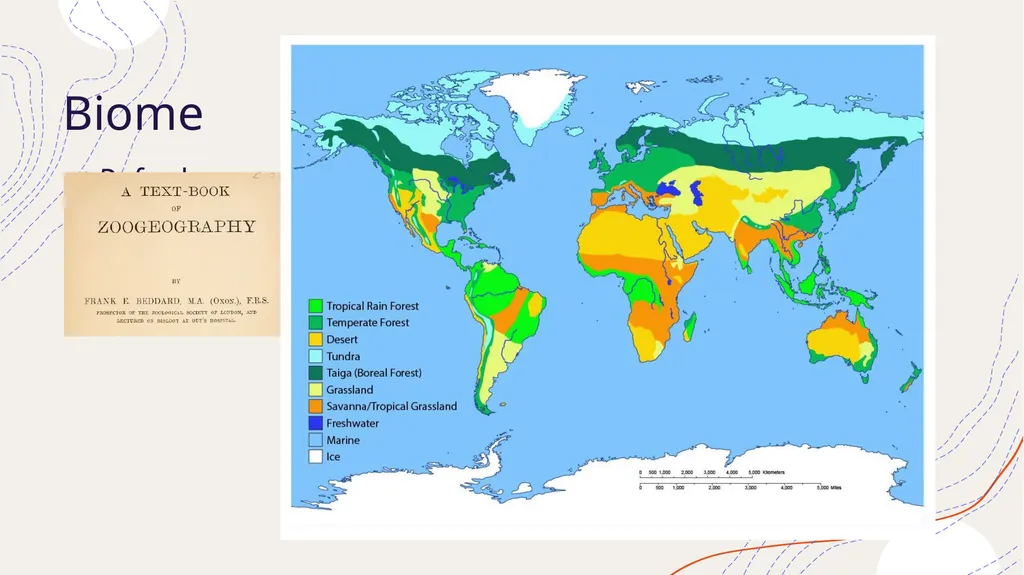
Def. a large naturally occurring community of flora and fauna occupying a major habitat, e.g. forest or tundra. Biome<br>
03
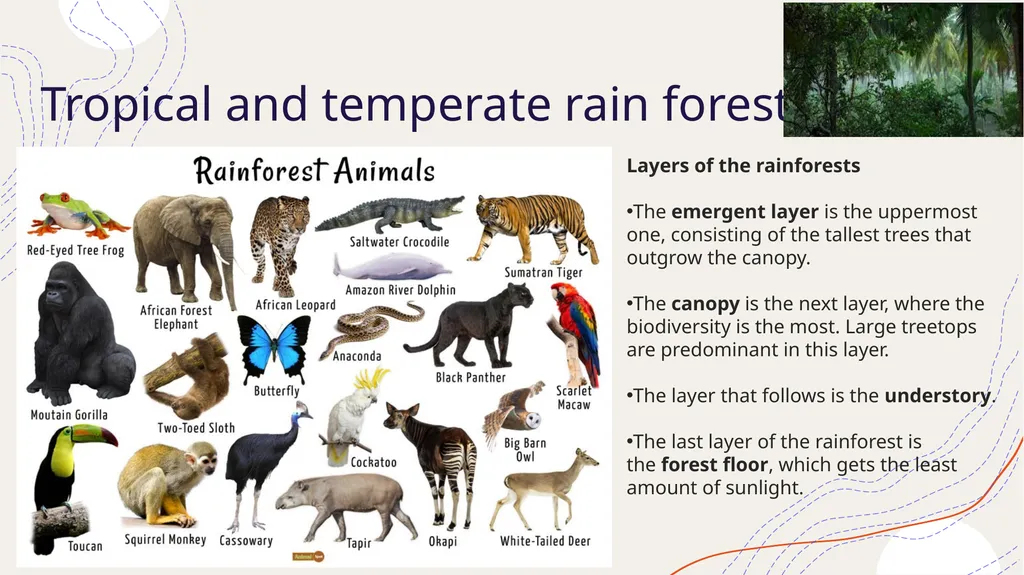
Tropical and temperate rain forest Layers of the rainforests
The emergent layer is the uppermost one, consisting of the tallest trees that outgrow the canopy.
The canopy is the next layer, where the biodiversity is the most. Large treetops are predominant in this layer.
The layer that follows is the understory.
The last layer of the rainforest is the forest floor, which gets the least amount of sunlight.<br>
04
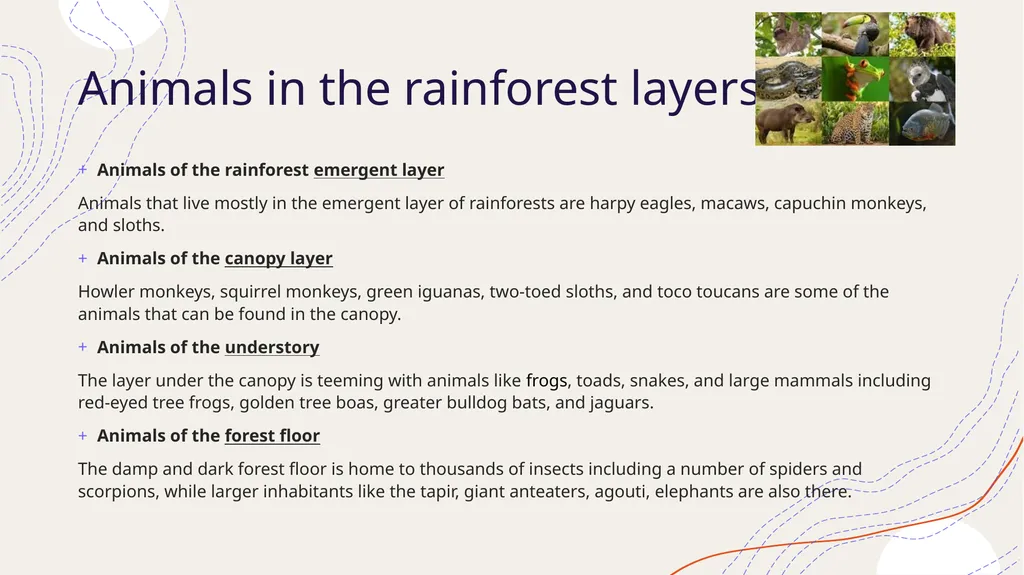
Animals in the rainforest layers Animals of the rainforest emergent layer
Animals that live mostly in the emergent layer of rainforests are harpy eagles, macaws, capuchin monkeys, and sloths.
Animals of the canopy layer
Howler monkeys, squirrel monkeys, green iguanas, two-toed sloths, and toco toucans are some of the animals that can be found in the canopy.
Animals of the understory
The layer under the canopy is teeming with animals like frogs, toads, snakes, and large mammals including red-eyed tree frogs, golden tree boas, greater bulldog bats, and jaguars.
Animals of the forest floor
The damp and dark forest floor is home to thousands of insects including a number of spiders and scorpions, while larger inhabitants like the tapir, giant anteaters, agouti, elephants are also there.<br>
05
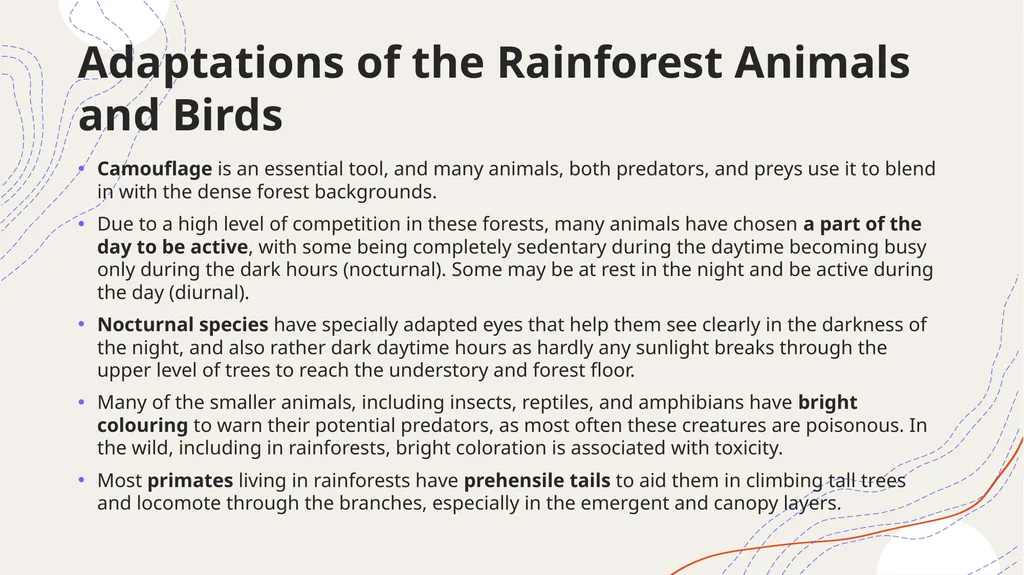
Adaptations of the Rainforest Animals and Birds Camouflage is an essential tool, and many animals, both predators, and preys use it to blend in with the dense forest backgrounds.
Due to a high level of competition in these forests, many animals have chosen a part of the day to be active, with some being completely sedentary during the daytime becoming busy only during the dark hours (nocturnal). Some may be at rest in the night and be active during the day (diurnal).
Nocturnal species have specially adapted eyes that help them see clearly in the darkness of the night, and also rather dark daytime hours as hardly any sunlight breaks through the upper level of trees to reach the understory and forest floor.
Many of the smaller animals, including insects, reptiles, and amphibians have bright colouring to warn their potential predators, as most often these creatures are poisonous. In the wild, including in rainforests, bright coloration is associated with toxicity.
Most primates living in rainforests have prehensile tails to aid them in climbing tall trees and locomote through the branches, especially in the emergent and canopy layers.<br>
06
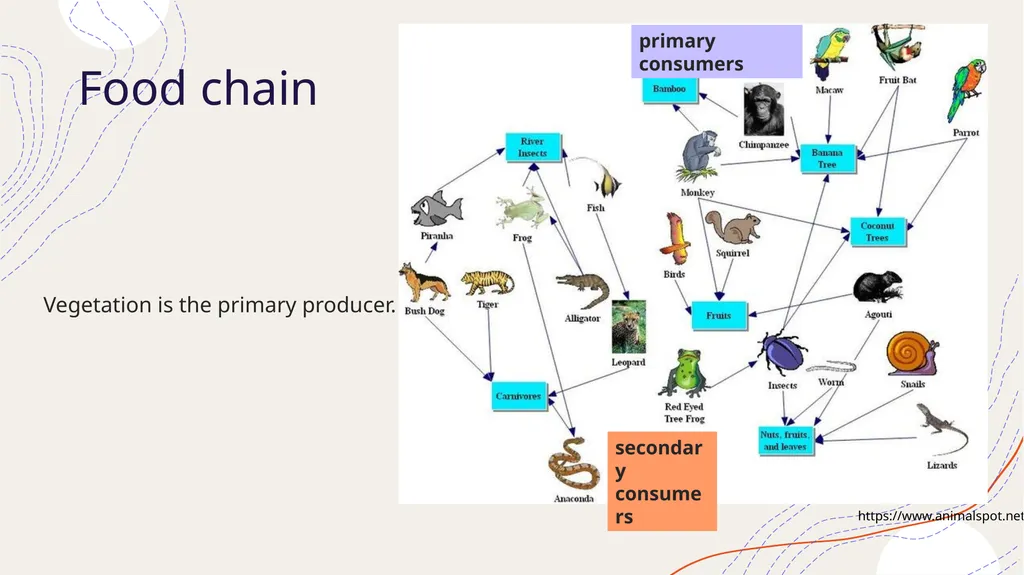
Food chain https://www.animalspot.net/ Vegetation is the primary producer. primary consumers secondary consumers<br>
07
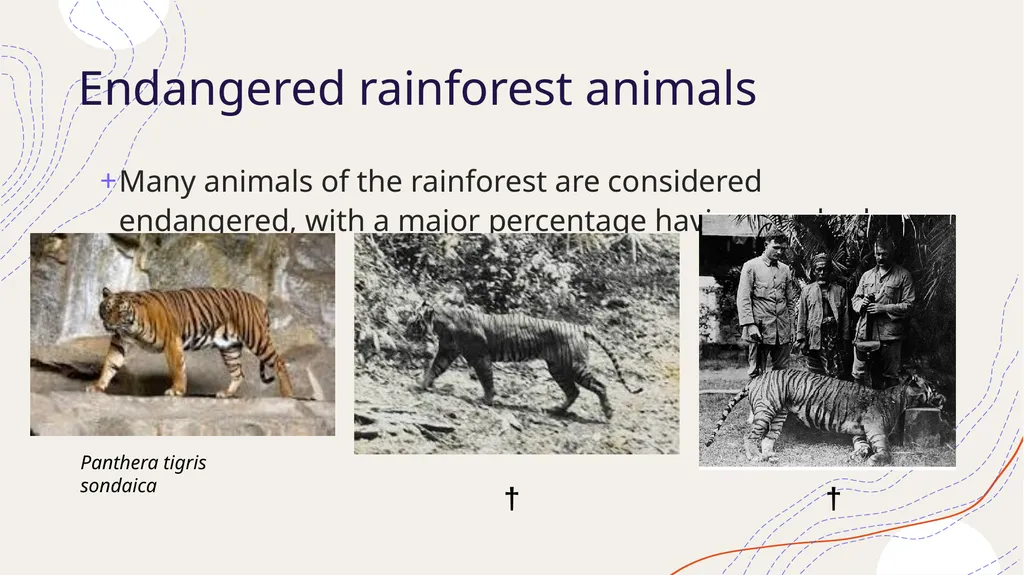
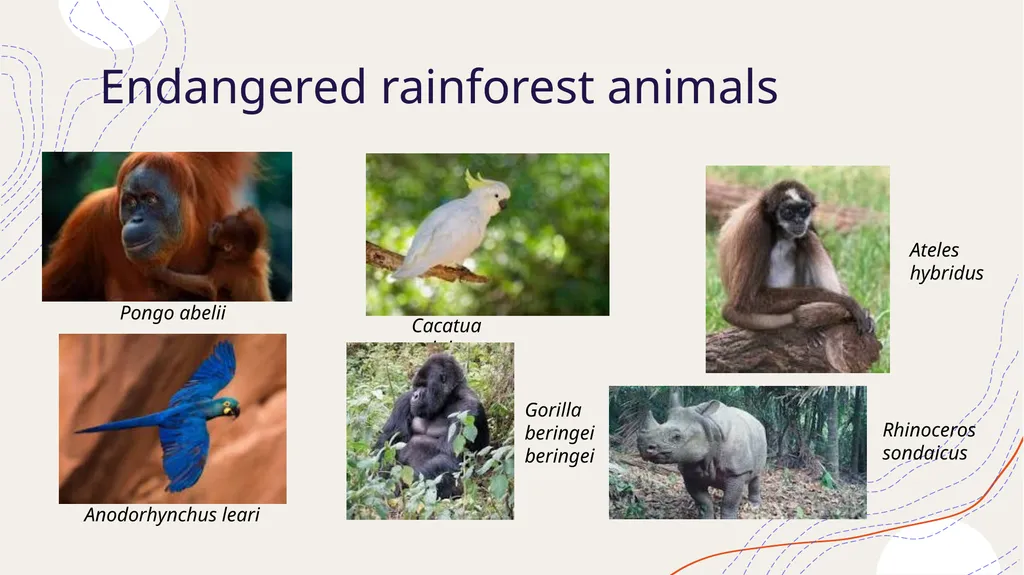
Endangered rainforest animals Many animals of the rainforest are considered endangered, with a major percentage having reached a critical stage. Panthera tigris sondaica † †<br>
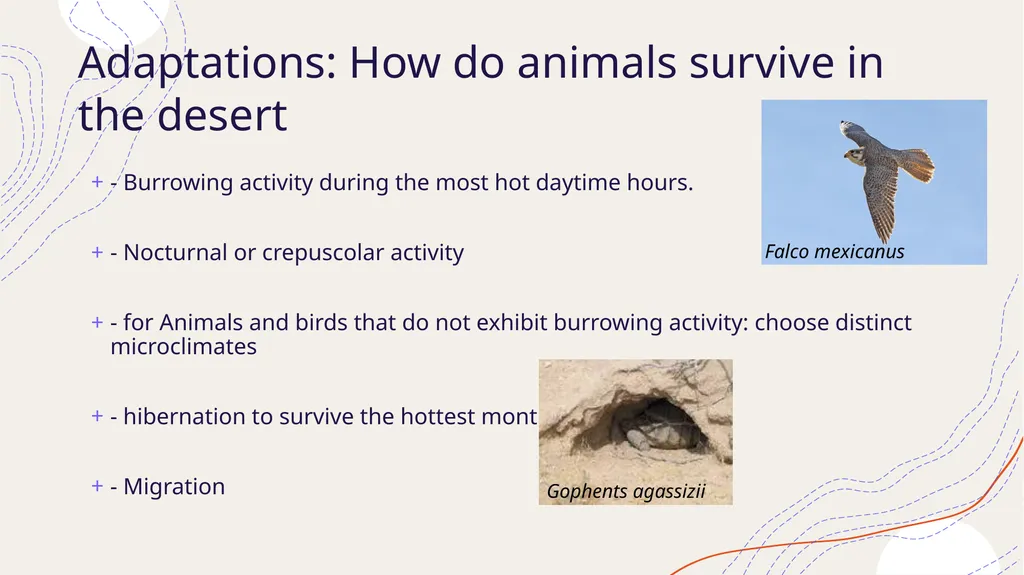
Adaptations: How do animals survive in the desert - Burrowing activity during the most hot daytime hours.
- Nocturnal or crepuscolar activity
- for Animals and birds that do not exhibit burrowing activity: choose distinct microclimates
- hibernation to survive the hottest months
- Migration Gophents agassizii<br>
12
Physical adaptations The bodies of the burrowing animals are capable of absorbing moisture from the ground, which is why they prefer to dig into relatively moist areas.
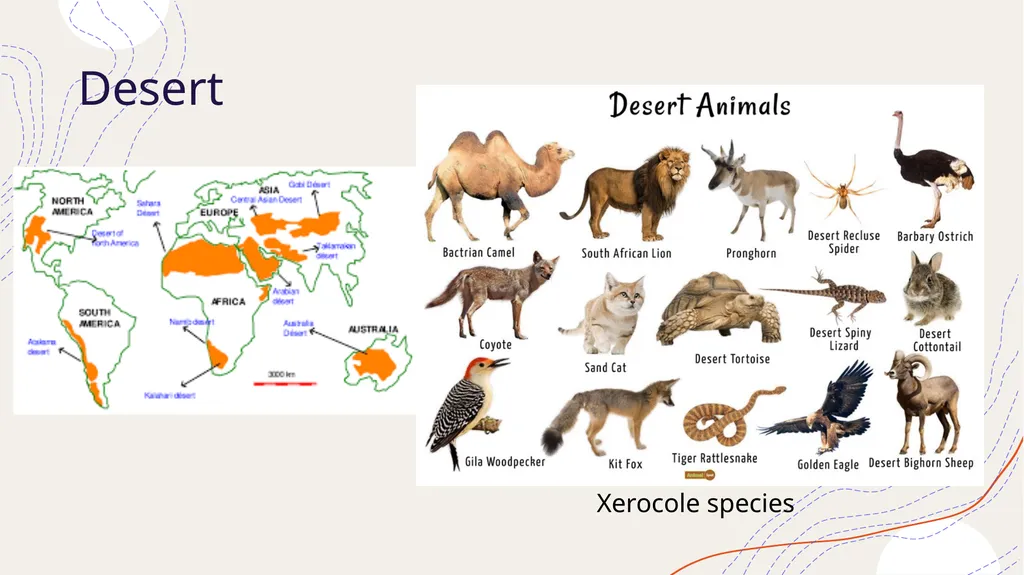
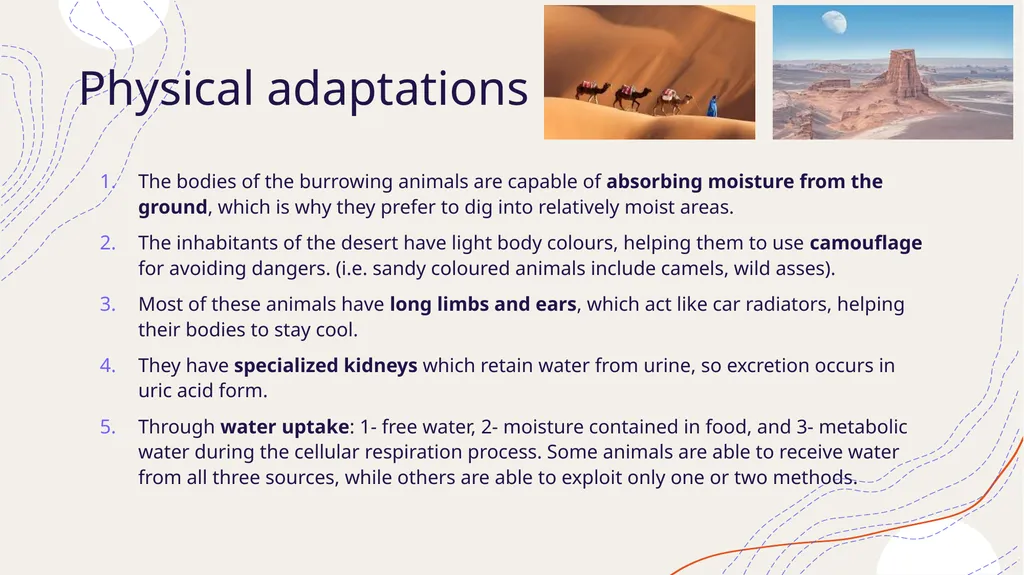
The inhabitants of the desert have light body colours, helping them to use camouflage for avoiding dangers. (i.e. sandy coloured animals include camels, wild asses).
Most of these animals have long limbs and ears, which act like car radiators, helping their bodies to stay cool.
They have specialized kidneys which retain water from urine, so excretion occurs in uric acid form.
Through water uptake: 1- free water, 2- moisture contained in food, and 3- metabolic water during the cellular respiration process. Some animals are able to receive water from all three sources, while others are able to exploit only one or two methods.<br>
13
Diet: What do desert animals eat Some animals, like camels, and kangaroo rats derive a lot of moisture from succulent plants like cactuses.
While some species may extract nectar or sap from different plants, others may get their water from the plant parts they eat. Since insects are also aplenty in the desert, they become a regular source of food for many birds, reptiles, and bats.
Carnivores like hyenas, leopards, and lions that are at the top of the food chain, get their share of water from the bodies of their prey. Some examples of omnivores include coyotes and ravens.
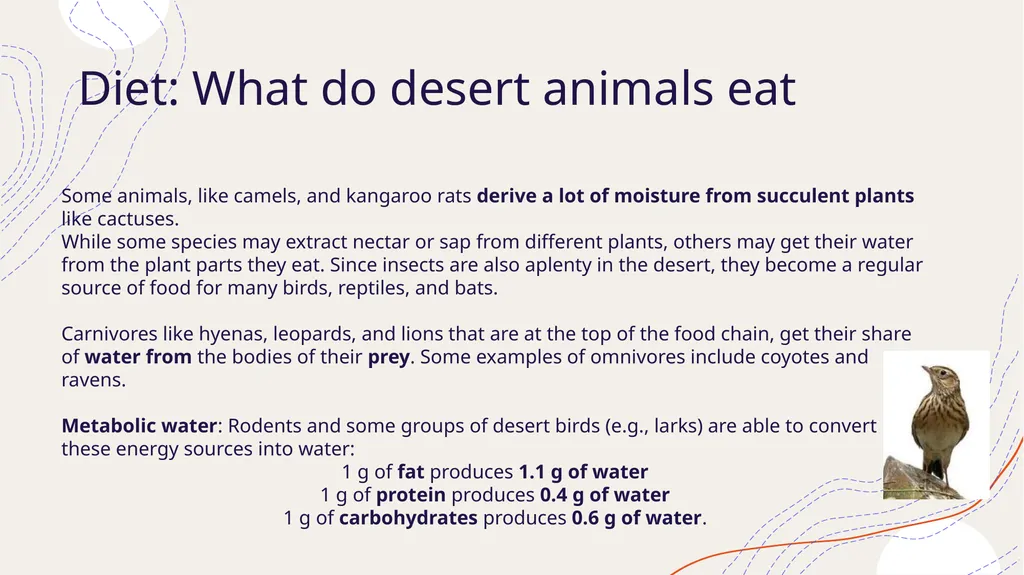
Metabolic water: Rodents and some groups of desert birds (e.g., larks) are able to convert these energy sources into water:
1 g of fat produces 1.1 g of water
1 g of protein produces 0.4 g of water
1 g of carbohydrates produces 0.6 g of water.<br>
14
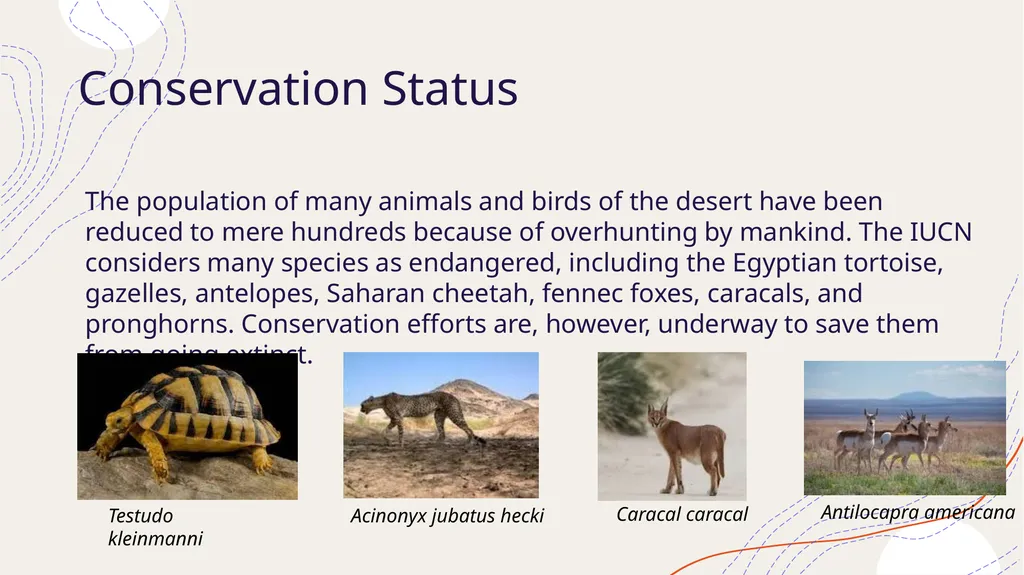
Conservation Status The population of many animals and birds of the desert have been reduced to mere hundreds because of overhunting by mankind. The IUCN considers many species as endangered, including the Egyptian tortoise, gazelles, antelopes, Saharan cheetah, fennec foxes, caracals, and pronghorns. Conservation efforts are, however, underway to save them from going extinct. Testudo kleinmanni Acinonyx jubatus hecki Caracal caracal Antilocapra americana<br>