Search Results for 'metal electrons'

metal electrons published presentations and documents on DocSlides.
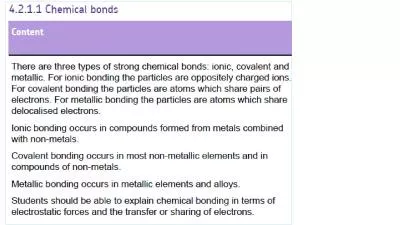
Ionic  bonding (metal + non-metal)
Ionic bonding (metal + non-metal)
by bency
Ionic bonds form a . giant lattice structure. Sodi...
Non-metal  to Metal  Transitions
Non-metal to Metal Transitions
by marina-yarberry
. Purpose of this course – understanding the d...
Non-metal  to Metal  Transitions
Non-metal to Metal Transitions
by lindy-dunigan
. Purpose of this course – understanding the d...
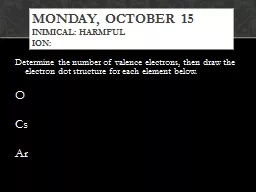
Determine the number of valence electrons, then draw the el
by giovanna-bartolotta
O. Cs. Ar. Monday, October 15. inimical: harmful....
Valence Electrons Day 1
by lois-ondreau
Review. Electrons are the negatively charged part...
Nonmetal Gases
Nonmetal Gases
by liane-varnes
Noble gases and diatomic elements (except bromine...
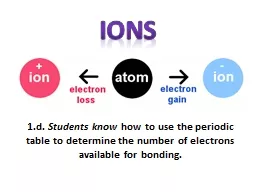
1.d .  Students know  how to use the periodic table to determine the number of electrons available
1.d . Students know how to use the periodic table to determine the number of electrons available
by debby-jeon
Ions. Valence electrons are the electrons that ar...
Day 72
Day 72
by tatyana-admore
Metallic Bonding. Warm Up. What force holds two i...
…plating
…plating
by jane-oiler
By . Rocio. SANCHEZ. Definition. The process use...
C4 Revision Cards
C4 Revision Cards
by ellena-manuel
Hope you find these useful. - V. Atomic Structure...
Metallic Bonding
Metallic Bonding
by pasty-toler
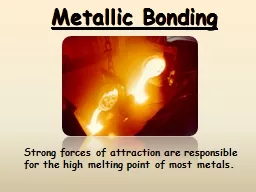
Strong forces of attraction are responsible for t...
Metallic, Ionic and Network Solids
by pasty-toler
SCH4U1. Mr. . Dvorsky. Ionic Solids. Result from ...
1 18e Rule
1 18e Rule
by kittie-lecroy
Electronic structures of many . organometallic. ...
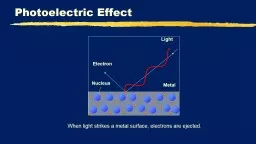
Photoelectric Effect
by debby-jeon
When light strikes a metal surface, electrons are...
Metallic Bonding Strong forces of attraction are responsible for the high melting point of most met
by faustina-dinatale
CA Standards. Students know . atoms combine to fo...
Periodic Groups and Trends
by marina-yarberry
Periodic Table. Periodicity:. regular variations...
Ionic Compounds and Bonding
by lindy-dunigan
SNC2D – Academic Science. Learning Goals. Use ....
Elements and  Symbols
Elements and Symbols
by calandra-battersby
Elements and Symbols 1 letter symbols C = Carbo...
Unit 3: Ionic and Metallic Substances Review
by PrettyLittlething
Honors Chemistry. 1. Which of the following is ion...
Metallic Bonding Metallic Bonding
by sadie
Metallic Bond – the force that holds metal atoms...
N4/5 Chemistry Metals Properties of Metals
by murphy
Strength. – metals that are . strong. are used...
Periodic Table of Elements
by delcy
Important facts to remember. There are over 100 el...
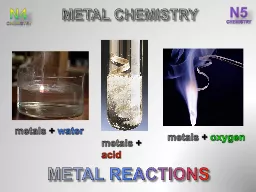
METAL REACTIONS
METAL REACTIONS
by briana-ranney
METAL CHEMISTRY. N4. CHEMISTRY. metals. . +. wa...
Alkali Metals
Alkali Metals
by giovanna-bartolotta
Elements in Group 1 are called . alkali metals. ....
Aim: How Do Metal Atoms Bond in a Metal? Do
by debby-jeon
Aim: How Do Metal Atoms Bond in a Metal? Do Now: t...
Oxidation-Reduction Reactions
by mitsue-stanley
Part 1. Notes 11. Beginning Unit 4. Salt on icy r...
Chemistry
Chemistry
by mitsue-stanley
Contents . Atomic models. Properties of electrons...
Covalent Bonding
Covalent Bonding
by karlyn-bohler
Covalent Bonding. Many compounds do not form ioni...
1 PH300
1 PH300
by marina-yarberry
Modern . Physics SP11. 2/15 Day 9: . Questions?. ...
1 L 23 Electricity & Magnetism [1]
by trish-goza
Static electricity. Why do I get a shock when I w...
ELECTROLYSIS
ELECTROLYSIS
by giovanna-bartolotta
The purpose of electrolysis is to split up ionic ...
A.P. Chemistry
A.P. Chemistry
by stefany-barnette
Electrochemistry. Electrochemistry . - study of t...
Atomic structure
Atomic structure
by stefany-barnette
Application. Property. Metal. Non-metal. Colour. ...
Understanding metals
by pasty-toler
Why are metals used to make these items?. Propert...
Metallic Bonding
Metallic Bonding
by calandra-battersby
Metals. Look at the Periodic Table…. 75% of ele...
Periodic
Periodic
by test
Table. Dmitri. . Mendeleev. . organized the kno...
03 Periodicity
03 Periodicity
by tatiana-dople
3.1 the periodic table . The Periodic Table . Gro...
Additional Science
Additional Science
by celsa-spraggs
C2- Chemistry. Covalent bonds, covalent structure...
Introduction to the Atom and the Periodic Table
by faustina-dinatale
Physical Science 115. 1. Atoms—The Building Blo...
IONS!
IONS!
by ellena-manuel
How they are formed. Valence Electrons. Valence E...