
05 Supply chain and inventory management at
TA
Published · 23 slides · 0 views

1 / 1


Description
05 Supply chain and inventory management at testing site level Learning objectives At the end of this module, you should be able to: Identify the principles and importance of good supply chain management Identify and implement adequate
Related Topics
Share
Embed code
Download this presentation From Below
"05 Supply chain and inventory management at" is the property of its rightful owner. Permission is granted to download and print the materials on this website for personal, non-commercial use only, and to display it on your personal computer provided you do not modify the materials and that you retain all copyright notices contained in the materials. By downloading content from our website, you accept the terms of this agreement.
Presentation Transcript
01
05 Supply chain and inventory management at testing site level<br>
02
Learning objectives At the end of this module, you should be able to:
Identify the principles and importance of good supply chain management
Identify and implement adequate storage conditions
Define testing site needs
Define order parameters: Average Monthly Consumption, Buffer and alert stock, lead time…
Calculate quantity to order
Describe how to inspect the delivery of supplies before acceptance
Know good inventory practices and procedure 2 QMS non-lab testing sites - training package – v1.0 | Supply chain management, Quantification and Inventory<br>
Identify the principles and importance of good supply chain management
Identify and implement adequate storage conditions
Define testing site needs
Define order parameters: Average Monthly Consumption, Buffer and alert stock, lead time…
Calculate quantity to order
Describe how to inspect the delivery of supplies before acceptance
Know good inventory practices and procedure 2 QMS non-lab testing sites - training package – v1.0 | Supply chain management, Quantification and Inventory<br>
03
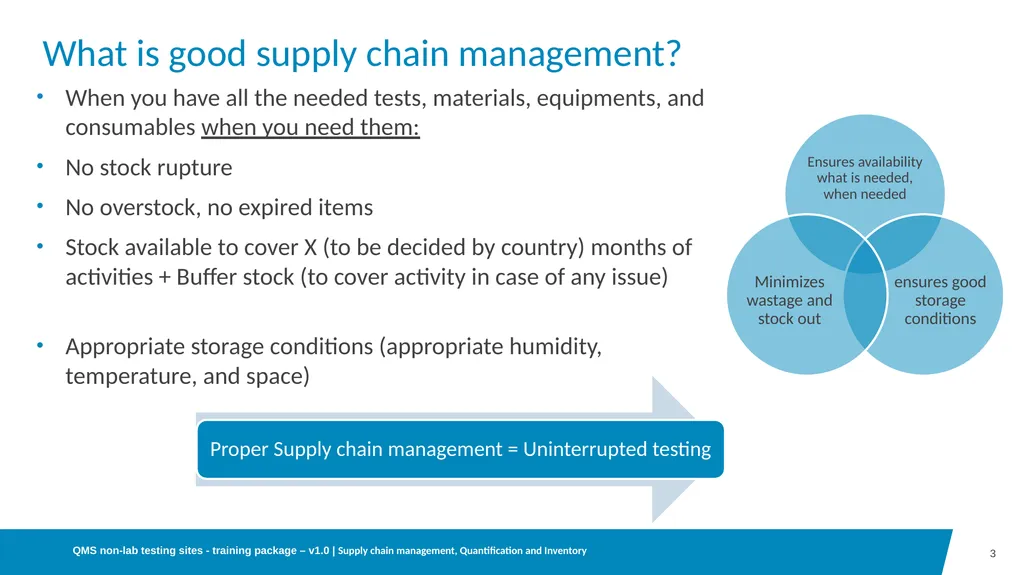
What is good supply chain management? When you have all the needed tests, materials, equipments, and consumables when you need them:
No stock rupture
No overstock, no expired items
Stock available to cover X (to be decided by country) months of activities + Buffer stock (to cover activity in case of any issue)
Appropriate storage conditions (appropriate humidity, temperature, and space) 3 QMS non-lab testing sites - training package – v1.0 | Supply chain management, Quantification and Inventory<br>
No stock rupture
No overstock, no expired items
Stock available to cover X (to be decided by country) months of activities + Buffer stock (to cover activity in case of any issue)
Appropriate storage conditions (appropriate humidity, temperature, and space) 3 QMS non-lab testing sites - training package – v1.0 | Supply chain management, Quantification and Inventory<br>
04
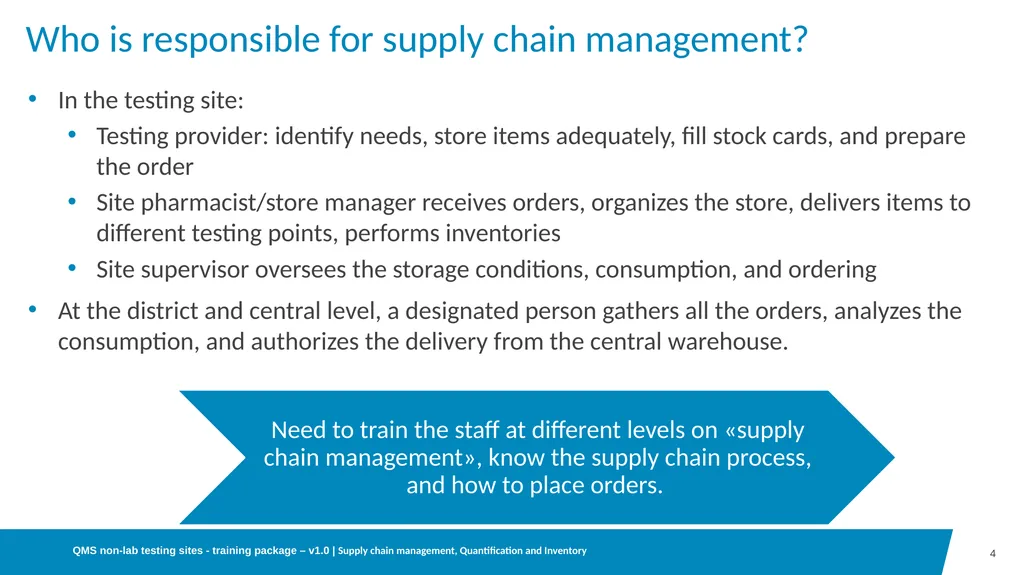
Who is responsible for supply chain management? In the testing site:
Testing provider: identify needs, store items adequately, fill stock cards, and prepare the order
Site pharmacist/store manager receives orders, organizes the store, delivers items to different testing points, performs inventories
Site supervisor oversees the storage conditions, consumption, and ordering
At the district and central level, a designated person gathers all the orders, analyzes the consumption, and authorizes the delivery from the central warehouse. 4 QMS non-lab testing sites - training package – v1.0 | Supply chain management, Quantification and Inventory<br>
Testing provider: identify needs, store items adequately, fill stock cards, and prepare the order
Site pharmacist/store manager receives orders, organizes the store, delivers items to different testing points, performs inventories
Site supervisor oversees the storage conditions, consumption, and ordering
At the district and central level, a designated person gathers all the orders, analyzes the consumption, and authorizes the delivery from the central warehouse. 4 QMS non-lab testing sites - training package – v1.0 | Supply chain management, Quantification and Inventory<br>
05
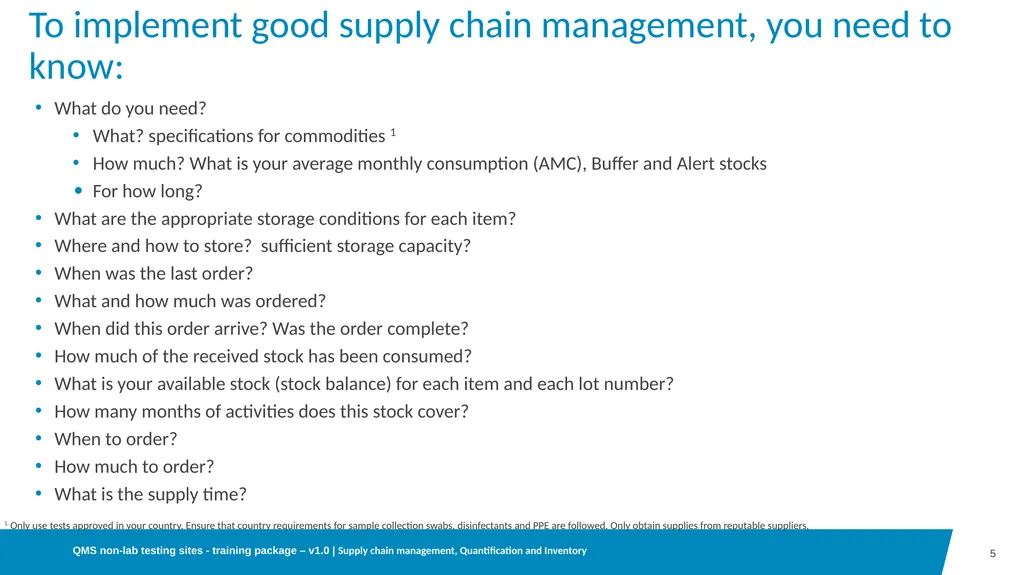
To implement good supply chain management, you need to know: What do you need?
What? specifications for commodities 1
How much? What is your average monthly consumption (AMC), Buffer and Alert stocks
For how long?
What are the appropriate storage conditions for each item?
Where and how to store? sufficient storage capacity?
When was the last order?
What and how much was ordered?
When did this order arrive? Was the order complete?
How much of the received stock has been consumed?
What is your available stock (stock balance) for each item and each lot number?
How many months of activities does this stock cover?
When to order?
How much to order?
What is the supply time? 5 1. Only use tests approved in your country. Ensure that country requirements for sample collection swabs, disinfectants and PPE are followed. Only obtain supplies from reputable suppliers. QMS non-lab testing sites - training package – v1.0 | Supply chain management, Quantification and Inventory<br>
What? specifications for commodities 1
How much? What is your average monthly consumption (AMC), Buffer and Alert stocks
For how long?
What are the appropriate storage conditions for each item?
Where and how to store? sufficient storage capacity?
When was the last order?
What and how much was ordered?
When did this order arrive? Was the order complete?
How much of the received stock has been consumed?
What is your available stock (stock balance) for each item and each lot number?
How many months of activities does this stock cover?
When to order?
How much to order?
What is the supply time? 5 1. Only use tests approved in your country. Ensure that country requirements for sample collection swabs, disinfectants and PPE are followed. Only obtain supplies from reputable suppliers. QMS non-lab testing sites - training package – v1.0 | Supply chain management, Quantification and Inventory<br>
06
Supply chain and inventory tasks 6 QMS non-lab testing sites - training package – v1.0 | Supply chain management, Quantification and Inventory<br>
07
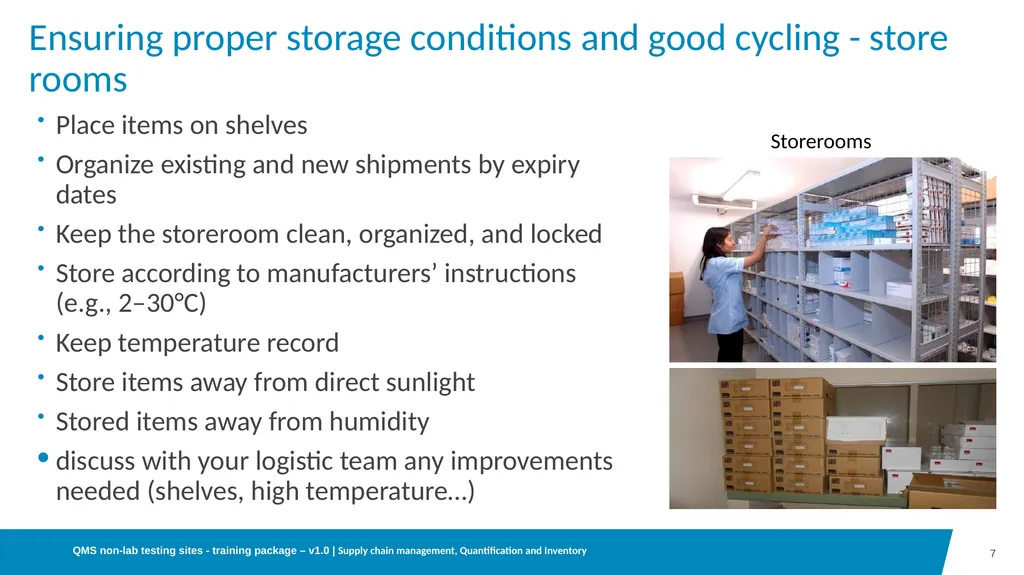
Ensuring proper storage conditions and good cycling - store rooms Place items on shelves
Organize existing and new shipments by expiry dates
Keep the storeroom clean, organized, and locked
Store according to manufacturers’ instructions (e.g., 2–30°C)
Keep temperature record
Store items away from direct sunlight
Stored items away from humidity
discuss with your logistic team any improvements needed (shelves, high temperature…) 7 Storerooms QMS non-lab testing sites - training package – v1.0 | Supply chain management, Quantification and Inventory<br>
Organize existing and new shipments by expiry dates
Keep the storeroom clean, organized, and locked
Store according to manufacturers’ instructions (e.g., 2–30°C)
Keep temperature record
Store items away from direct sunlight
Stored items away from humidity
discuss with your logistic team any improvements needed (shelves, high temperature…) 7 Storerooms QMS non-lab testing sites - training package – v1.0 | Supply chain management, Quantification and Inventory<br>
08
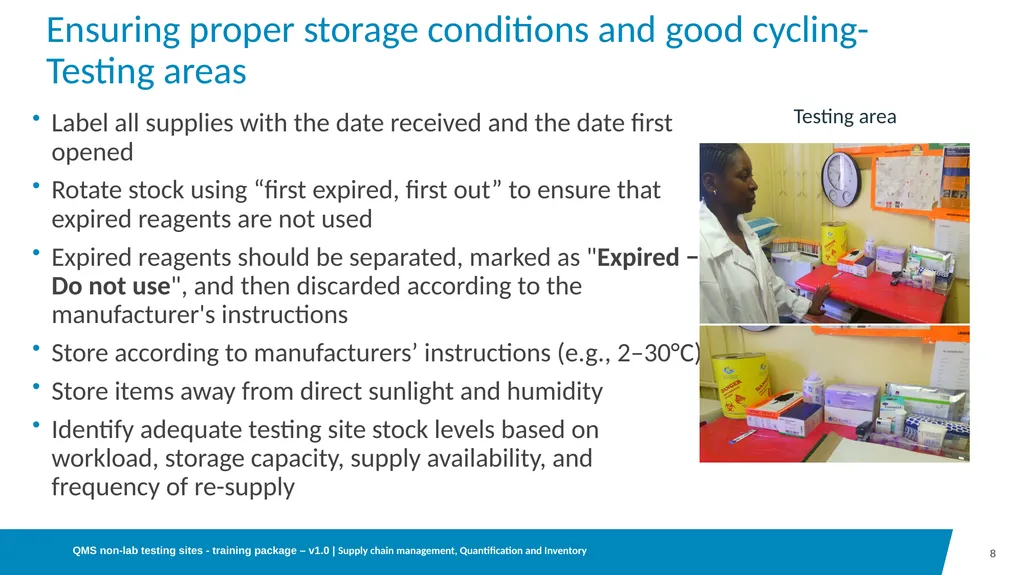
Label all supplies with the date received and the date first opened
Rotate stock using “first expired, first out” to ensure that expired reagents are not used
Expired reagents should be separated, marked as "Expired − Do not use", and then discarded according to the manufacturer's instructions
Store according to manufacturers’ instructions (e.g., 2–30°C)
Store items away from direct sunlight and humidity
Identify adequate testing site stock levels based on workload, storage capacity, supply availability, and frequency of re-supply 8 Testing area Ensuring proper storage conditions and good cycling- Testing areas QMS non-lab testing sites - training package – v1.0 | Supply chain management, Quantification and Inventory<br>
Rotate stock using “first expired, first out” to ensure that expired reagents are not used
Expired reagents should be separated, marked as "Expired − Do not use", and then discarded according to the manufacturer's instructions
Store according to manufacturers’ instructions (e.g., 2–30°C)
Store items away from direct sunlight and humidity
Identify adequate testing site stock levels based on workload, storage capacity, supply availability, and frequency of re-supply 8 Testing area Ensuring proper storage conditions and good cycling- Testing areas QMS non-lab testing sites - training package – v1.0 | Supply chain management, Quantification and Inventory<br>
09
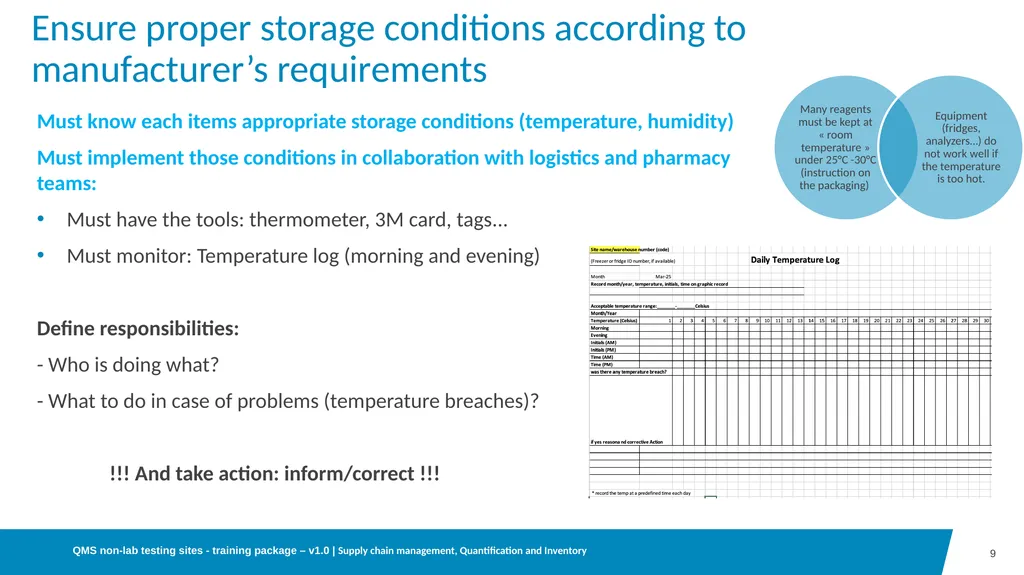
Must know each items appropriate storage conditions (temperature, humidity)
Must implement those conditions in collaboration with logistics and pharmacy teams:
Must have the tools: thermometer, 3M card, tags...
Must monitor: Temperature log (morning and evening)
Define responsibilities:
- Who is doing what?
- What to do in case of problems (temperature breaches)?
!!! And take action: inform/correct !!! 9 Ensure proper storage conditions according to manufacturer’s requirements QMS non-lab testing sites - training package – v1.0 | Supply chain management, Quantification and Inventory<br>
Must implement those conditions in collaboration with logistics and pharmacy teams:
Must have the tools: thermometer, 3M card, tags...
Must monitor: Temperature log (morning and evening)
Define responsibilities:
- Who is doing what?
- What to do in case of problems (temperature breaches)?
!!! And take action: inform/correct !!! 9 Ensure proper storage conditions according to manufacturer’s requirements QMS non-lab testing sites - training package – v1.0 | Supply chain management, Quantification and Inventory<br>
10
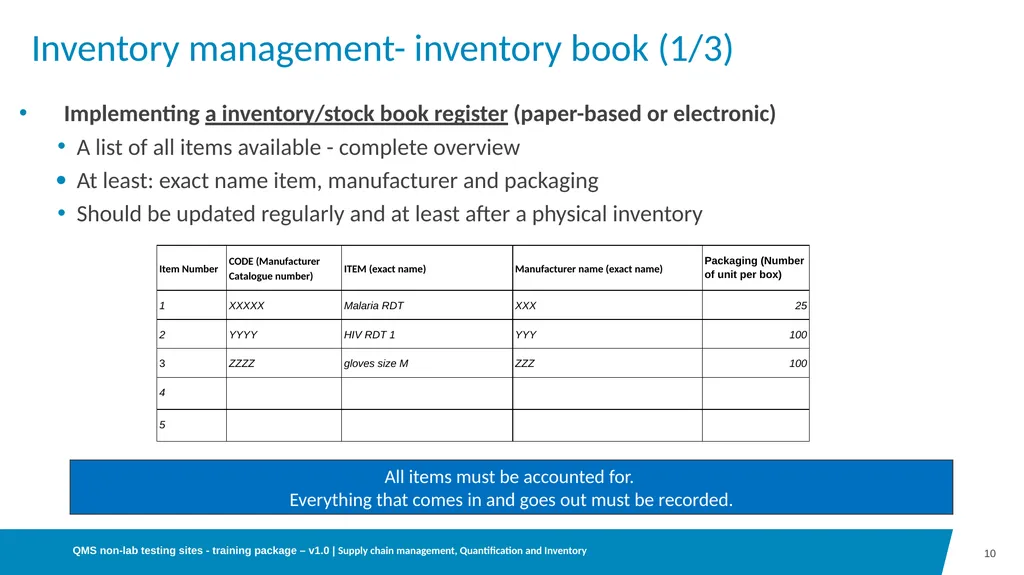
Inventory management- inventory book (1/3) Implementing a inventory/stock book register (paper-based or electronic)
A list of all items available - complete overview
At least: exact name item, manufacturer and packaging
Should be updated regularly and at least after a physical inventory 10 All items must be accounted for.
Everything that comes in and goes out must be recorded. QMS non-lab testing sites - training package – v1.0 | Supply chain management, Quantification and Inventory<br>
A list of all items available - complete overview
At least: exact name item, manufacturer and packaging
Should be updated regularly and at least after a physical inventory 10 All items must be accounted for.
Everything that comes in and goes out must be recorded. QMS non-lab testing sites - training package – v1.0 | Supply chain management, Quantification and Inventory<br>
11
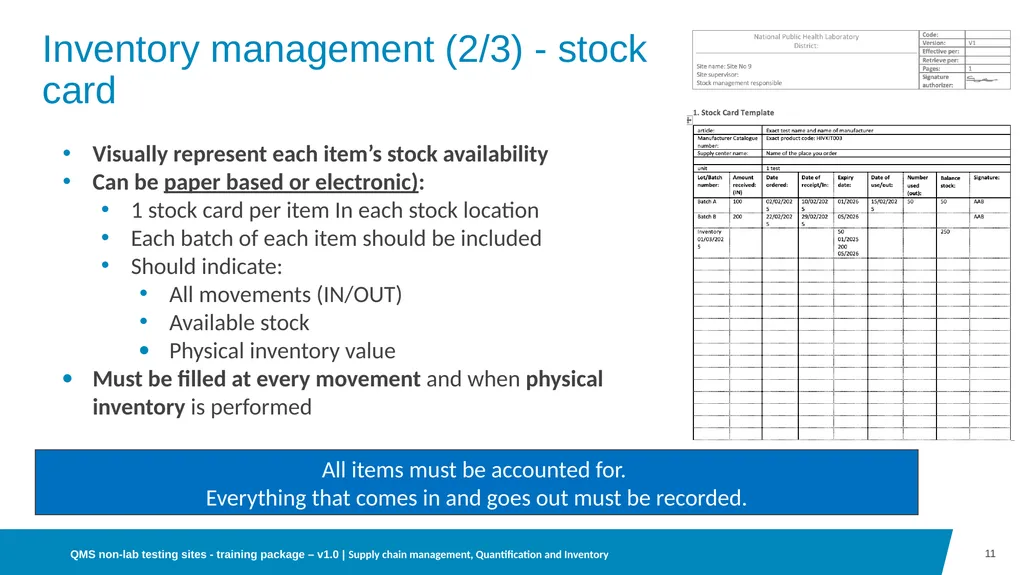
Inventory management (2/3) - stock card Visually represent each item’s stock availability
Can be paper based or electronic):
1 stock card per item In each stock location
Each batch of each item should be included
Should indicate:
All movements (IN/OUT)
Available stock
Physical inventory value
Must be filled at every movement and when physical inventory is performed 11 All items must be accounted for.
Everything that comes in and goes out must be recorded. QMS non-lab testing sites - training package – v1.0 | Supply chain management, Quantification and Inventory<br>
Can be paper based or electronic):
1 stock card per item In each stock location
Each batch of each item should be included
Should indicate:
All movements (IN/OUT)
Available stock
Physical inventory value
Must be filled at every movement and when physical inventory is performed 11 All items must be accounted for.
Everything that comes in and goes out must be recorded. QMS non-lab testing sites - training package – v1.0 | Supply chain management, Quantification and Inventory<br>
12
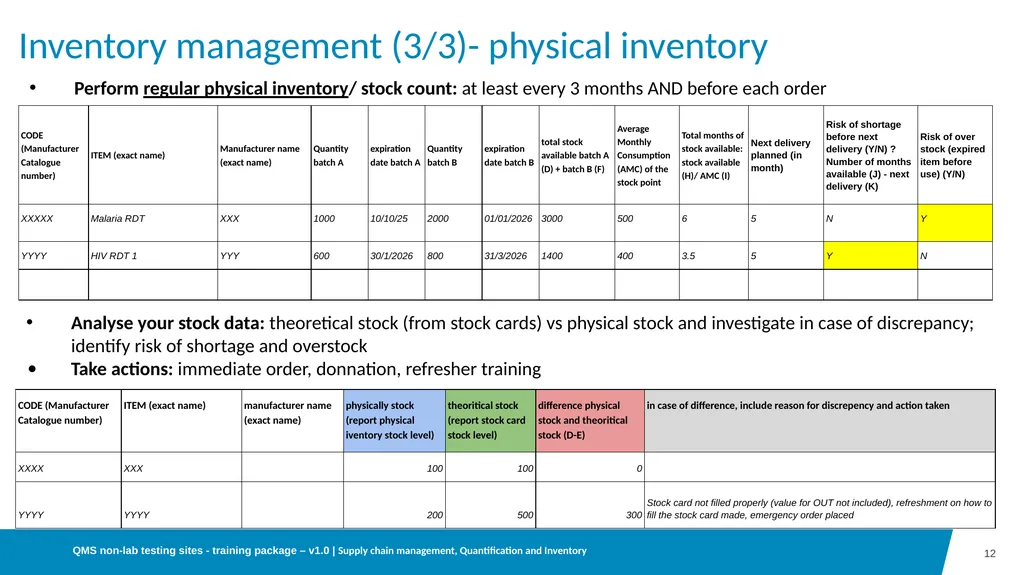
12 Perform regular physical inventory/ stock count: at least every 3 months AND before each order Inventory management (3/3)- physical inventory QMS non-lab testing sites - training package – v1.0 | Supply chain management, Quantification and Inventory Analyse your stock data: theoretical stock (from stock cards) vs physical stock and investigate in case of discrepancy; identify risk of shortage and overstock
Take actions: immediate order, donnation, refresher training<br>
Take actions: immediate order, donnation, refresher training<br>
13
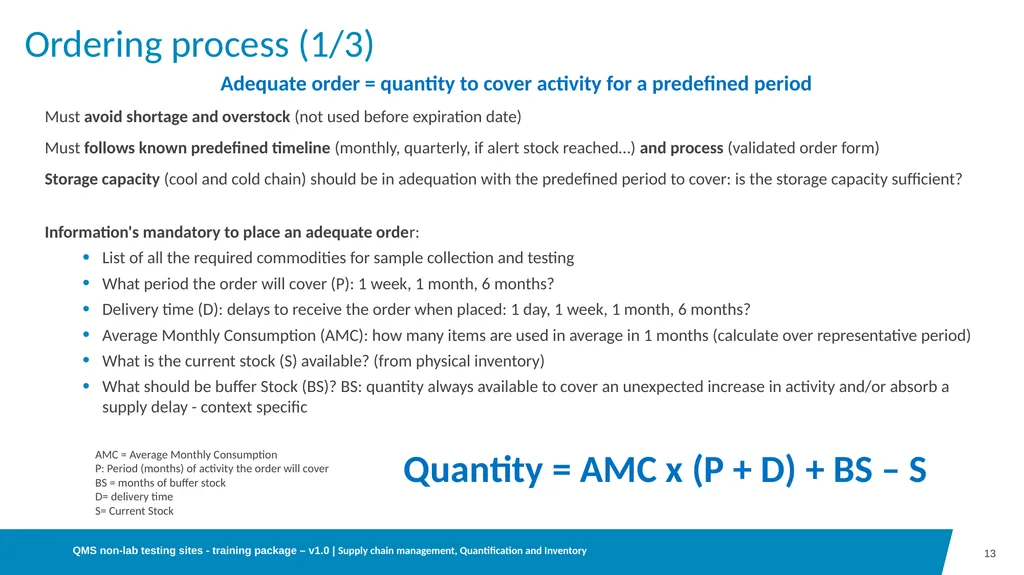
Ordering process (1/3) Adequate order = quantity to cover activity for a predefined period
Must avoid shortage and overstock (not used before expiration date)
Must follows known predefined timeline (monthly, quarterly, if alert stock reached…) and process (validated order form)
Storage capacity (cool and cold chain) should be in adequation with the predefined period to cover: is the storage capacity sufficient?
Information's mandatory to place an adequate order:
List of all the required commodities for sample collection and testing
What period the order will cover (P): 1 week, 1 month, 6 months?
Delivery time (D): delays to receive the order when placed: 1 day, 1 week, 1 month, 6 months?
Average Monthly Consumption (AMC): how many items are used in average in 1 months (calculate over representative period)
What is the current stock (S) available? (from physical inventory)
What should be buffer Stock (BS)? BS: quantity always available to cover an unexpected increase in activity and/or absorb a supply delay - context specific 13 Quantity = AMC x (P + D) + BS – S AMC = Average Monthly Consumption
P: Period (months) of activity the order will cover
BS = months of buffer stock
D= delivery time
S= Current Stock QMS non-lab testing sites - training package – v1.0 | Supply chain management, Quantification and Inventory<br>
Must avoid shortage and overstock (not used before expiration date)
Must follows known predefined timeline (monthly, quarterly, if alert stock reached…) and process (validated order form)
Storage capacity (cool and cold chain) should be in adequation with the predefined period to cover: is the storage capacity sufficient?
Information's mandatory to place an adequate order:
List of all the required commodities for sample collection and testing
What period the order will cover (P): 1 week, 1 month, 6 months?
Delivery time (D): delays to receive the order when placed: 1 day, 1 week, 1 month, 6 months?
Average Monthly Consumption (AMC): how many items are used in average in 1 months (calculate over representative period)
What is the current stock (S) available? (from physical inventory)
What should be buffer Stock (BS)? BS: quantity always available to cover an unexpected increase in activity and/or absorb a supply delay - context specific 13 Quantity = AMC x (P + D) + BS – S AMC = Average Monthly Consumption
P: Period (months) of activity the order will cover
BS = months of buffer stock
D= delivery time
S= Current Stock QMS non-lab testing sites - training package – v1.0 | Supply chain management, Quantification and Inventory<br>
14
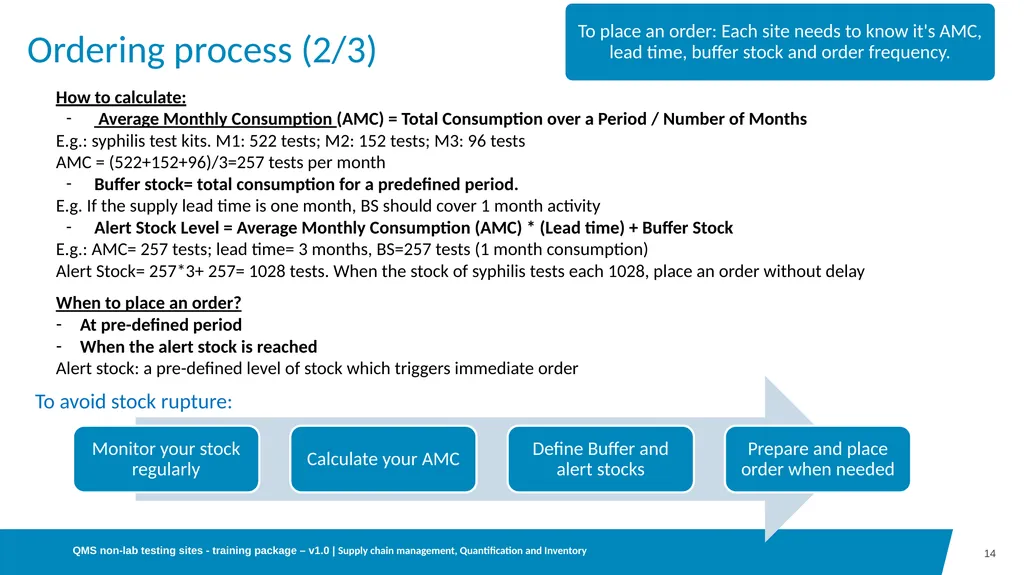
Ordering process (2/3) 14 How to calculate:
Average Monthly Consumption (AMC) = Total Consumption over a Period / Number of Months
E.g.: syphilis test kits. M1: 522 tests; M2: 152 tests; M3: 96 tests
AMC = (522+152+96)/3=257 tests per month
Buffer stock= total consumption for a predefined period.
E.g. If the supply lead time is one month, BS should cover 1 month activity
Alert Stock Level = Average Monthly Consumption (AMC) * (Lead time) + Buffer Stock
E.g.: AMC= 257 tests; lead time= 3 months, BS=257 tests (1 month consumption)
Alert Stock= 257*3+ 257= 1028 tests. When the stock of syphilis tests each 1028, place an order without delay
When to place an order?
At pre-defined period
When the alert stock is reached
Alert stock: a pre-defined level of stock which triggers immediate order To avoid stock rupture: QMS non-lab testing sites - training package – v1.0 | Supply chain management, Quantification and Inventory<br>
Average Monthly Consumption (AMC) = Total Consumption over a Period / Number of Months
E.g.: syphilis test kits. M1: 522 tests; M2: 152 tests; M3: 96 tests
AMC = (522+152+96)/3=257 tests per month
Buffer stock= total consumption for a predefined period.
E.g. If the supply lead time is one month, BS should cover 1 month activity
Alert Stock Level = Average Monthly Consumption (AMC) * (Lead time) + Buffer Stock
E.g.: AMC= 257 tests; lead time= 3 months, BS=257 tests (1 month consumption)
Alert Stock= 257*3+ 257= 1028 tests. When the stock of syphilis tests each 1028, place an order without delay
When to place an order?
At pre-defined period
When the alert stock is reached
Alert stock: a pre-defined level of stock which triggers immediate order To avoid stock rupture: QMS non-lab testing sites - training package – v1.0 | Supply chain management, Quantification and Inventory<br>
15
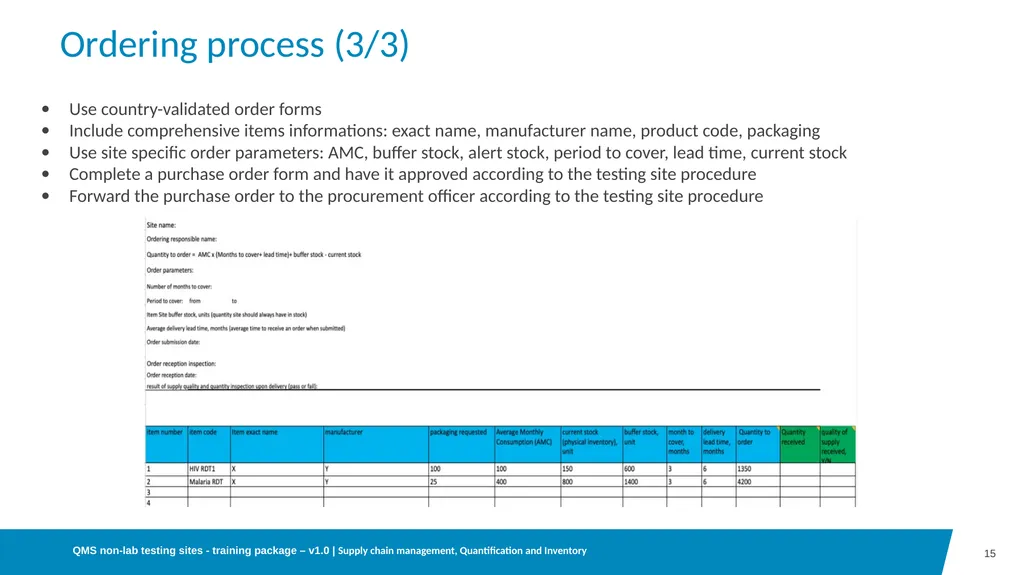
Ordering process (3/3) 15 Use country-validated order forms
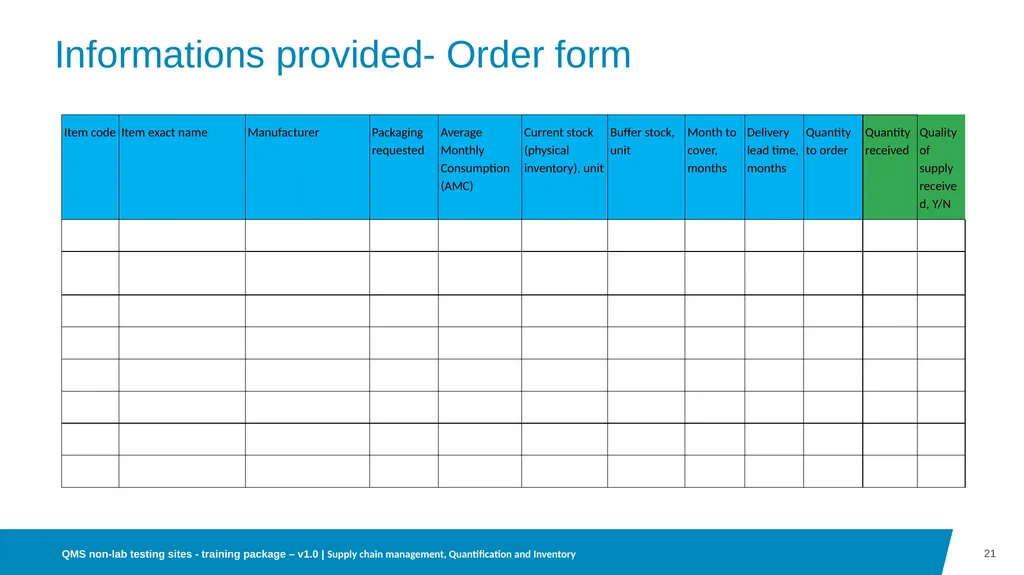
Include comprehensive items informations: exact name, manufacturer name, product code, packaging
Use site specific order parameters: AMC, buffer stock, alert stock, period to cover, lead time, current stock
Complete a purchase order form and have it approved according to the testing site procedure
Forward the purchase order to the procurement officer according to the testing site procedure QMS non-lab testing sites - training package – v1.0 | Supply chain management, Quantification and Inventory<br>
Include comprehensive items informations: exact name, manufacturer name, product code, packaging
Use site specific order parameters: AMC, buffer stock, alert stock, period to cover, lead time, current stock
Complete a purchase order form and have it approved according to the testing site procedure
Forward the purchase order to the procurement officer according to the testing site procedure QMS non-lab testing sites - training package – v1.0 | Supply chain management, Quantification and Inventory<br>
16
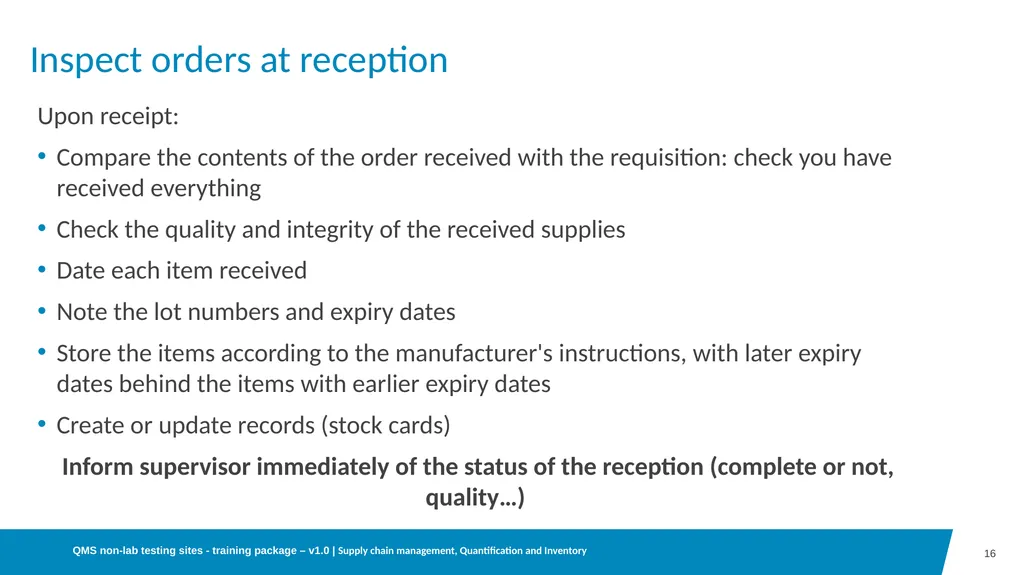
Inspect orders at reception Upon receipt:
Compare the contents of the order received with the requisition: check you have received everything
Check the quality and integrity of the received supplies
Date each item received
Note the lot numbers and expiry dates
Store the items according to the manufacturer's instructions, with later expiry dates behind the items with earlier expiry dates
Create or update records (stock cards)
Inform supervisor immediately of the status of the reception (complete or not, quality…) 16 QMS non-lab testing sites - training package – v1.0 | Supply chain management, Quantification and Inventory<br>
Compare the contents of the order received with the requisition: check you have received everything
Check the quality and integrity of the received supplies
Date each item received
Note the lot numbers and expiry dates
Store the items according to the manufacturer's instructions, with later expiry dates behind the items with earlier expiry dates
Create or update records (stock cards)
Inform supervisor immediately of the status of the reception (complete or not, quality…) 16 QMS non-lab testing sites - training package – v1.0 | Supply chain management, Quantification and Inventory<br>
17
Questions?
Exercise: how to calculate order quantity? 17<br>
Exercise: how to calculate order quantity? 17<br>
18
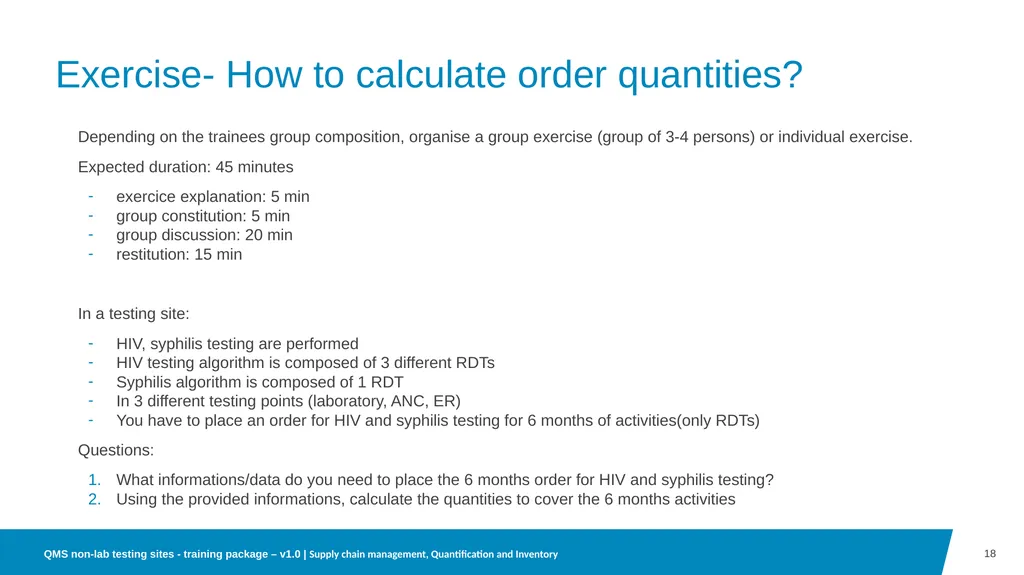
Exercise- How to calculate order quantities? Depending on the trainees group composition, organise a group exercise (group of 3-4 persons) or individual exercise.
Expected duration: 45 minutes
exercice explanation: 5 min
group constitution: 5 min
group discussion: 20 min
restitution: 15 min
In a testing site:
HIV, syphilis testing are performed
HIV testing algorithm is composed of 3 different RDTs
Syphilis algorithm is composed of 1 RDT
In 3 different testing points (laboratory, ANC, ER)
You have to place an order for HIV and syphilis testing for 6 months of activities(only RDTs)
Questions:
What informations/data do you need to place the 6 months order for HIV and syphilis testing?
Using the provided informations, calculate the quantities to cover the 6 months activities 18 QMS non-lab testing sites - training package – v1.0 | Supply chain management, Quantification and Inventory<br>
Expected duration: 45 minutes
exercice explanation: 5 min
group constitution: 5 min
group discussion: 20 min
restitution: 15 min
In a testing site:
HIV, syphilis testing are performed
HIV testing algorithm is composed of 3 different RDTs
Syphilis algorithm is composed of 1 RDT
In 3 different testing points (laboratory, ANC, ER)
You have to place an order for HIV and syphilis testing for 6 months of activities(only RDTs)
Questions:
What informations/data do you need to place the 6 months order for HIV and syphilis testing?
Using the provided informations, calculate the quantities to cover the 6 months activities 18 QMS non-lab testing sites - training package – v1.0 | Supply chain management, Quantification and Inventory<br>
19
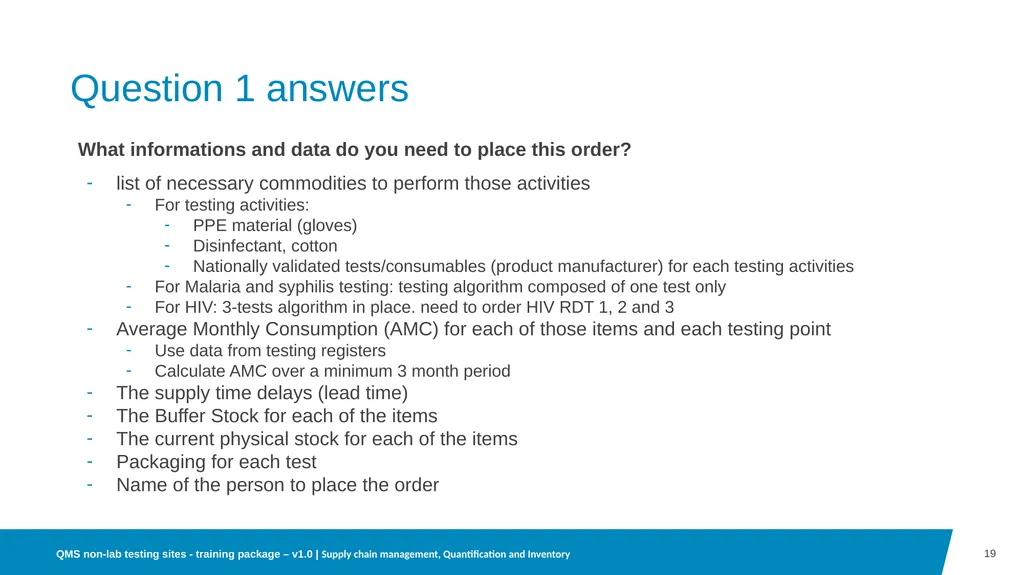
Question 1 answers What informations and data do you need to place this order?
list of necessary commodities to perform those activities
For testing activities:
PPE material (gloves)
Disinfectant, cotton
Nationally validated tests/consumables (product manufacturer) for each testing activities
For Malaria and syphilis testing: testing algorithm composed of one test only
For HIV: 3-tests algorithm in place. need to order HIV RDT 1, 2 and 3
Average Monthly Consumption (AMC) for each of those items and each testing point
Use data from testing registers
Calculate AMC over a minimum 3 month period
The supply time delays (lead time)
The Buffer Stock for each of the items
The current physical stock for each of the items
Packaging for each test
Name of the person to place the order 19 QMS non-lab testing sites - training package – v1.0 | Supply chain management, Quantification and Inventory<br>
list of necessary commodities to perform those activities
For testing activities:
PPE material (gloves)
Disinfectant, cotton
Nationally validated tests/consumables (product manufacturer) for each testing activities
For Malaria and syphilis testing: testing algorithm composed of one test only
For HIV: 3-tests algorithm in place. need to order HIV RDT 1, 2 and 3
Average Monthly Consumption (AMC) for each of those items and each testing point
Use data from testing registers
Calculate AMC over a minimum 3 month period
The supply time delays (lead time)
The Buffer Stock for each of the items
The current physical stock for each of the items
Packaging for each test
Name of the person to place the order 19 QMS non-lab testing sites - training package – v1.0 | Supply chain management, Quantification and Inventory<br>
20
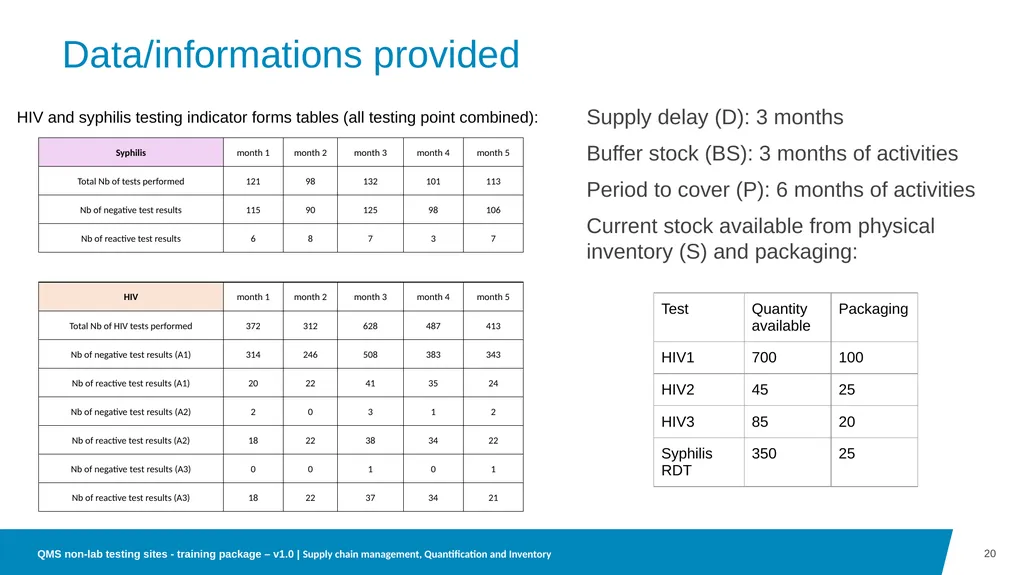
Data/informations provided Supply delay (D): 3 months
Buffer stock (BS): 3 months of activities
Period to cover (P): 6 months of activities
Current stock available from physical inventory (S) and packaging: 20 HIV and syphilis testing indicator forms tables (all testing point combined): QMS non-lab testing sites - training package – v1.0 | Supply chain management, Quantification and Inventory<br>
Buffer stock (BS): 3 months of activities
Period to cover (P): 6 months of activities
Current stock available from physical inventory (S) and packaging: 20 HIV and syphilis testing indicator forms tables (all testing point combined): QMS non-lab testing sites - training package – v1.0 | Supply chain management, Quantification and Inventory<br>
21
Informations provided- Order form 21 QMS non-lab testing sites - training package – v1.0 | Supply chain management, Quantification and Inventory<br>
22
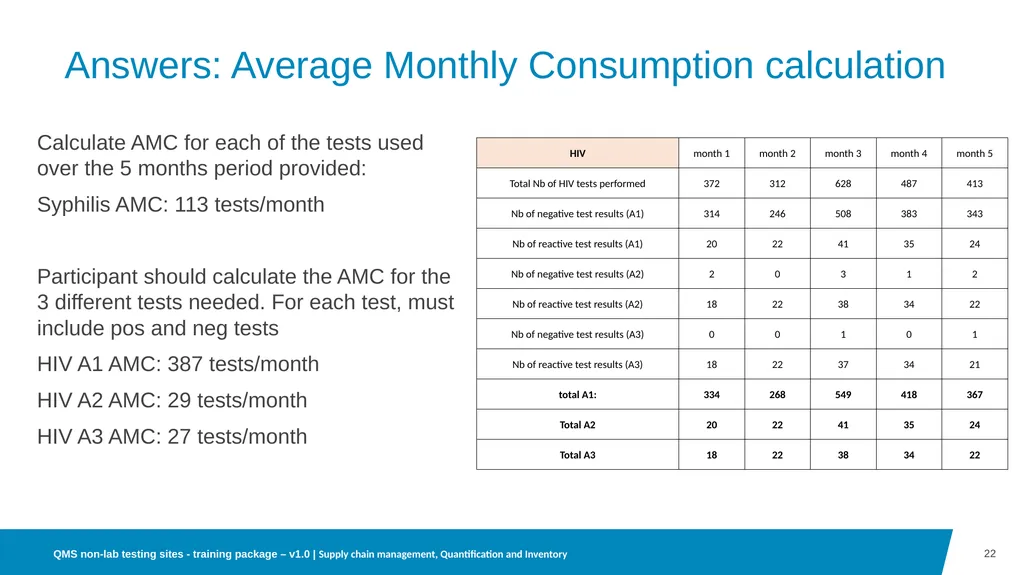
Answers: Average Monthly Consumption calculation Calculate AMC for each of the tests used over the 5 months period provided:
Syphilis AMC: 113 tests/month
Participant should calculate the AMC for the 3 different tests needed. For each test, must include pos and neg tests
HIV A1 AMC: 387 tests/month
HIV A2 AMC: 29 tests/month
HIV A3 AMC: 27 tests/month 22 QMS non-lab testing sites - training package – v1.0 | Supply chain management, Quantification and Inventory<br>
Syphilis AMC: 113 tests/month
Participant should calculate the AMC for the 3 different tests needed. For each test, must include pos and neg tests
HIV A1 AMC: 387 tests/month
HIV A2 AMC: 29 tests/month
HIV A3 AMC: 27 tests/month 22 QMS non-lab testing sites - training package – v1.0 | Supply chain management, Quantification and Inventory<br>
23
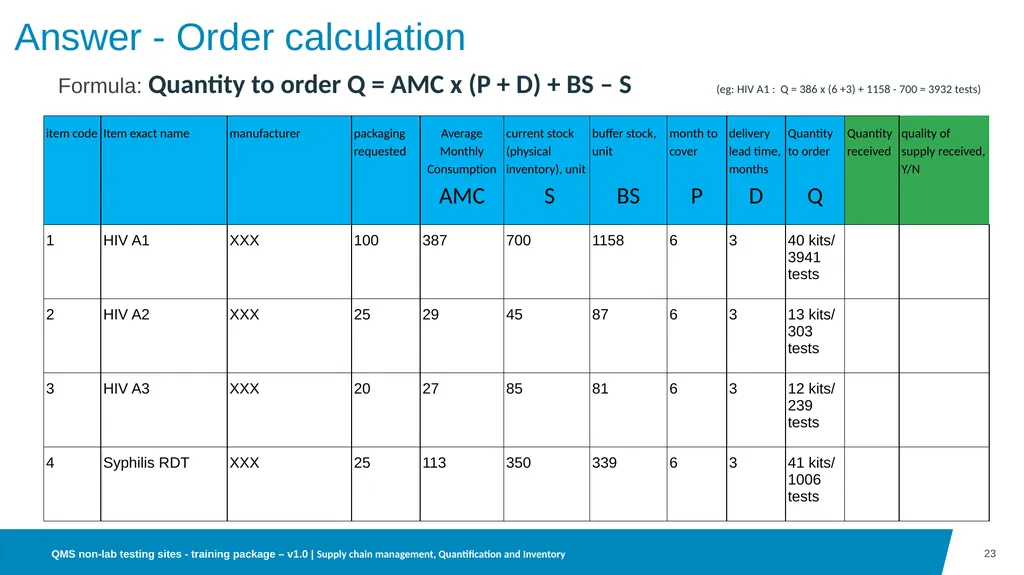
Answer - Order calculation Formula: Quantity to order Q = AMC x (P + D) + BS – S (eg: HIV A1 : Q = 386 x (6 +3) + 1158 - 700 = 3932 tests) 23 QMS non-lab testing sites - training package – v1.0 | Supply chain management, Quantification and Inventory<br>