
1 1926 Construction Focus Four Struck-By Hazards 2

Description: 1 1926 Construction Focus Four Struck-By Hazards 2 Struck-By Hazards Struck-By Hazards Focus Four 3 Objectives By the end of the session, students will be able to: List the three main causes of struck-by fatalities. Describe how to prevent
Related Topics
Download Presentation
"1 1926 Construction Focus Four Struck-By Hazards 2" is the property of its rightful owner. Permission is granted to download and print the materials on this website for personal, non-commercial use only, and to display it on your personal computer provided you do not modify the materials and that you retain all copyright notices contained in the materials. By downloading content from our website, you accept the terms of this agreement.
Presentation Transcript
slide1. 1 1926 Construction
Focus Four
Struck-By Hazards<br>
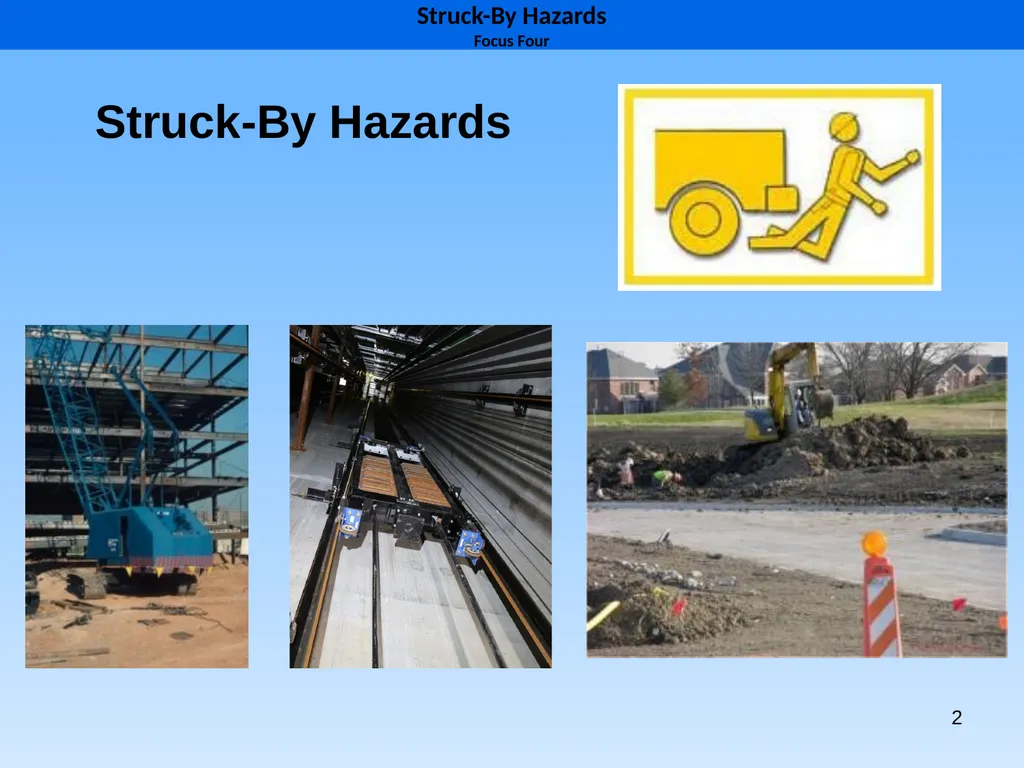
slide2. 2 Struck-By Hazards Struck-By Hazards Focus Four<br>
slide3. 3 Objectives By the end of the session, students will be able to: List the three main causes of struck-by fatalities. Describe how to prevent struck-by fatalities. Describe safe equipment operation to avoid struck-by accidents. Struck-By Hazards Focus Four<br>
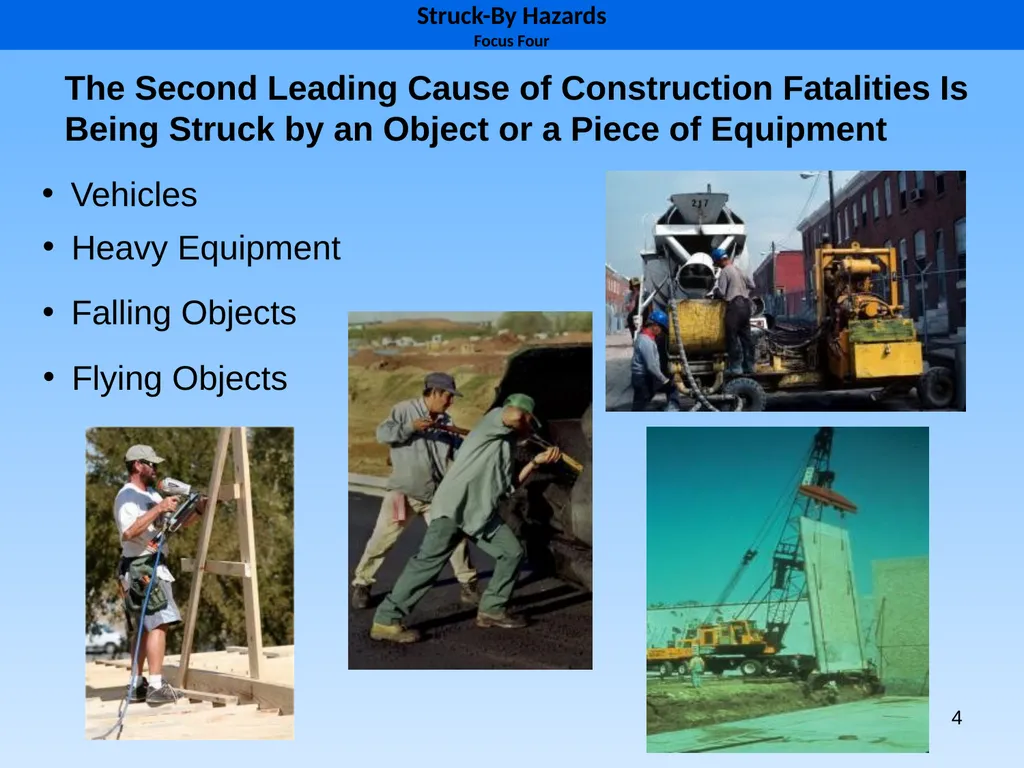
slide4. 4 The Second Leading Cause of Construction Fatalities Is Being Struck by an Object or a Piece of Equipment Vehicles Heavy Equipment Falling Objects Flying Objects Struck-By Hazards Focus Four<br>
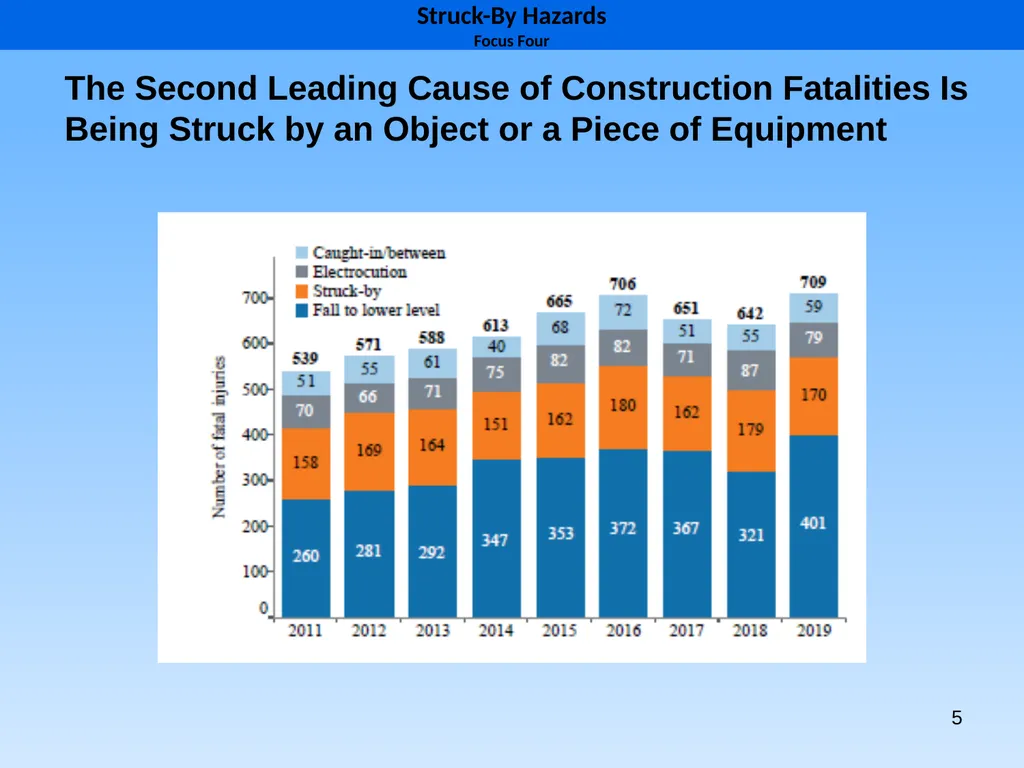
slide5. 5 Struck-By Hazards Focus Four The Second Leading Cause of Construction Fatalities Is Being Struck by an Object or a Piece of Equipment<br>
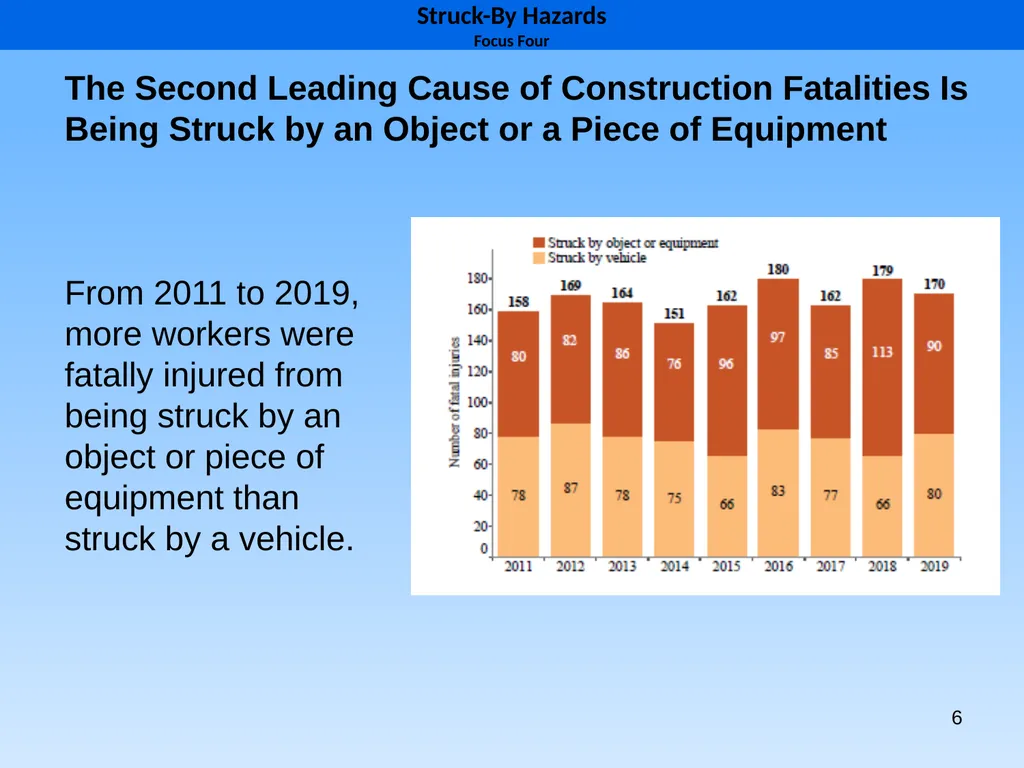
slide6. 6 Struck-By Hazards Focus Four The Second Leading Cause of Construction Fatalities Is Being Struck by an Object or a Piece of Equipment From 2011 to 2019, more workers were fatally injured from being struck by an object or piece of equipment than struck by a vehicle.<br>
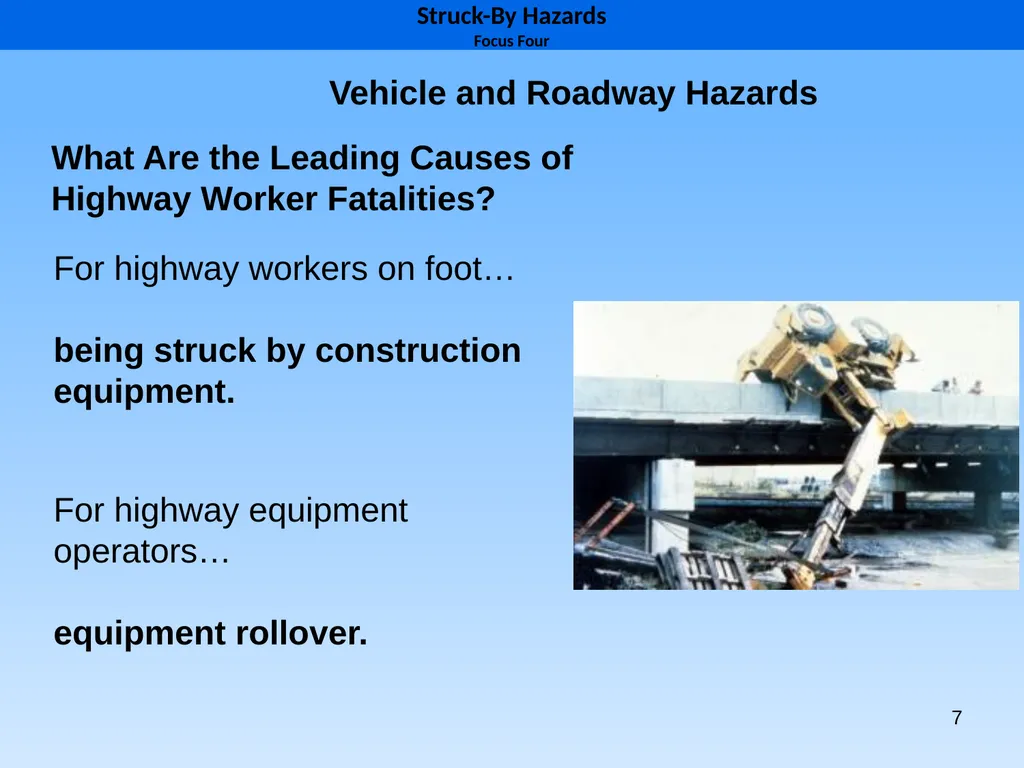
slide7. 7 What Are the Leading Causes of Highway Worker Fatalities? For highway workers on foot… being struck by construction equipment. For highway equipment operators… equipment rollover. Vehicle and Roadway Hazards Struck-By Hazards Focus Four<br>
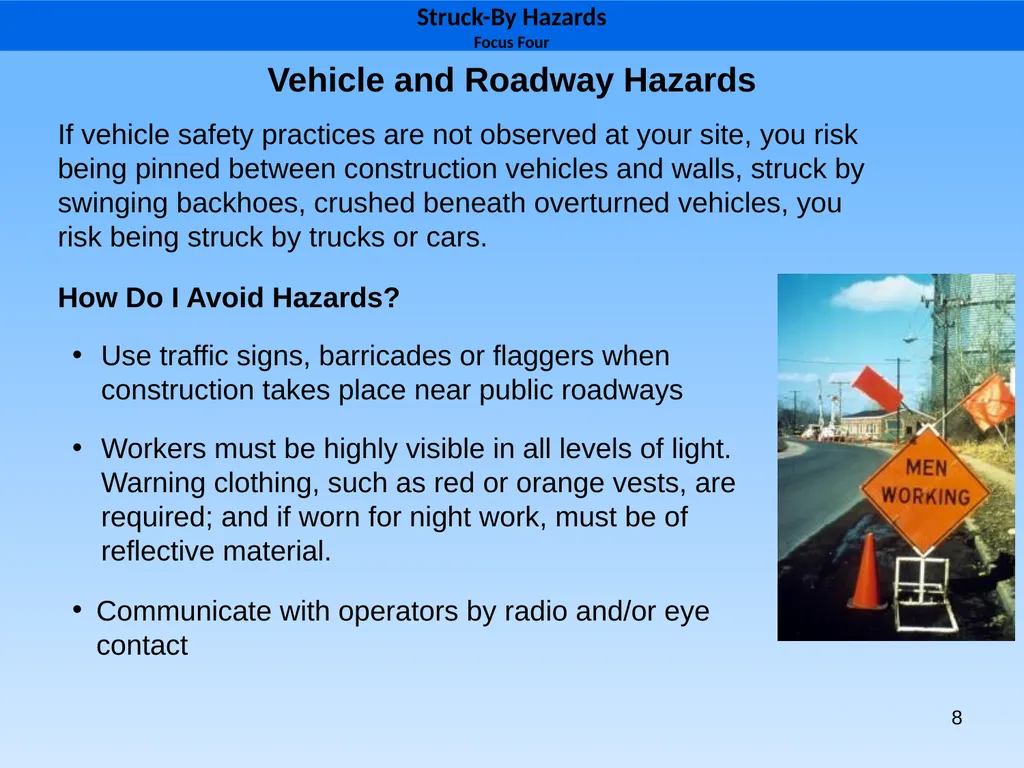
slide8. 8 If vehicle safety practices are not observed at your site, you risk being pinned between construction vehicles and walls, struck by swinging backhoes, crushed beneath overturned vehicles, you risk being struck by trucks or cars. How Do I Avoid Hazards? Use traffic signs, barricades or flaggers when construction takes place near public roadways Workers must be highly visible in all levels of light. Warning clothing, such as red or orange vests, are required; and if worn for night work, must be of reflective material. Communicate with operators by radio and/or eye contact Vehicle and Roadway Hazards Struck-By Hazards Focus Four<br>
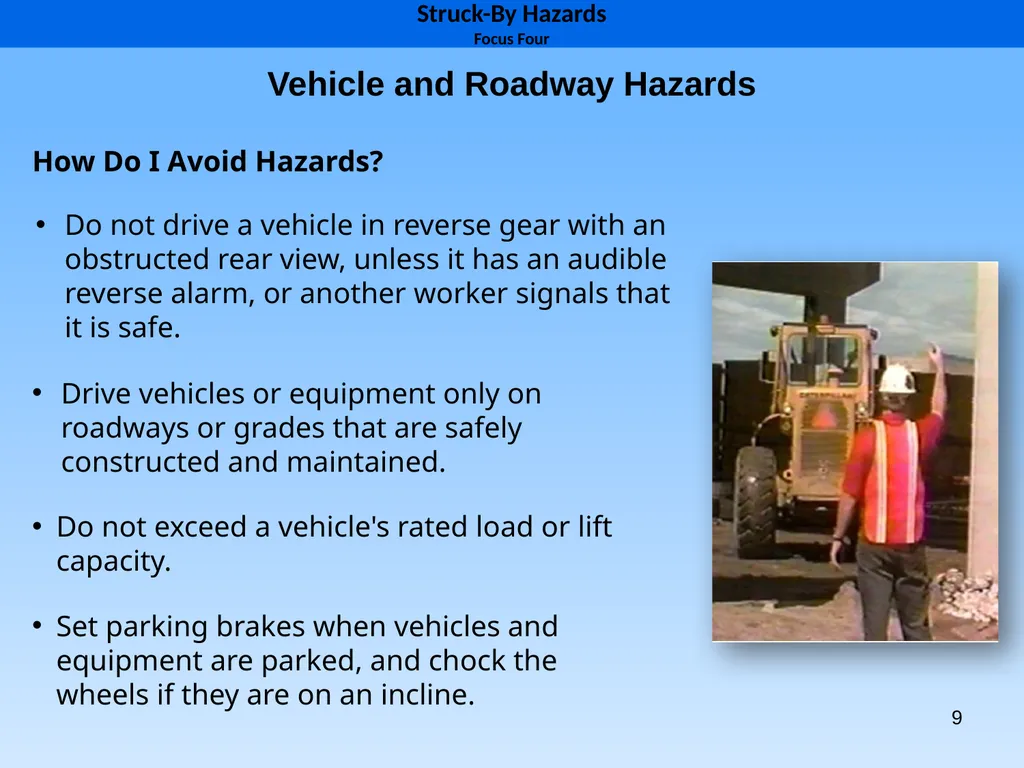
slide9. 9 How Do I Avoid Hazards? Do not drive a vehicle in reverse gear with an obstructed rear view, unless it has an audible reverse alarm, or another worker signals that it is safe. Drive vehicles or equipment only on roadways or grades that are safely constructed and maintained. Do not exceed a vehicle's rated load or lift capacity. Set parking brakes when vehicles and equipment are parked, and chock the wheels if they are on an incline. Vehicle and Roadway Hazards Struck-By Hazards Focus Four<br>
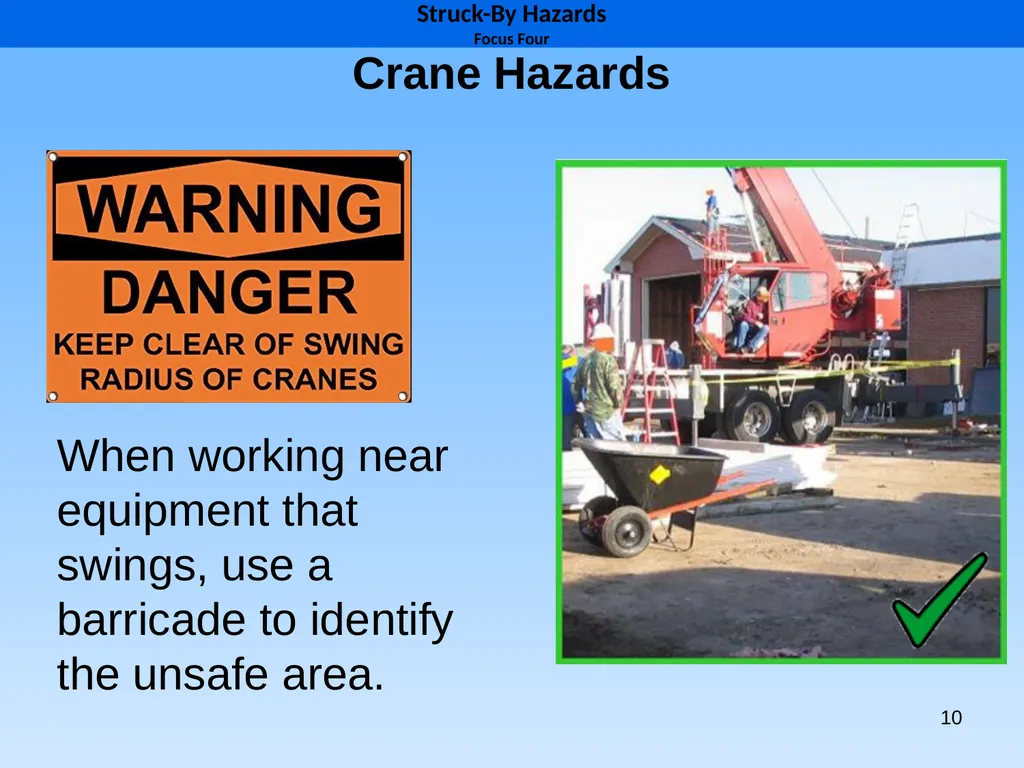
slide10. 10 Struck-By Hazards Focus Four When working near equipment that swings, use a barricade to identify the unsafe area. Crane Hazards<br>
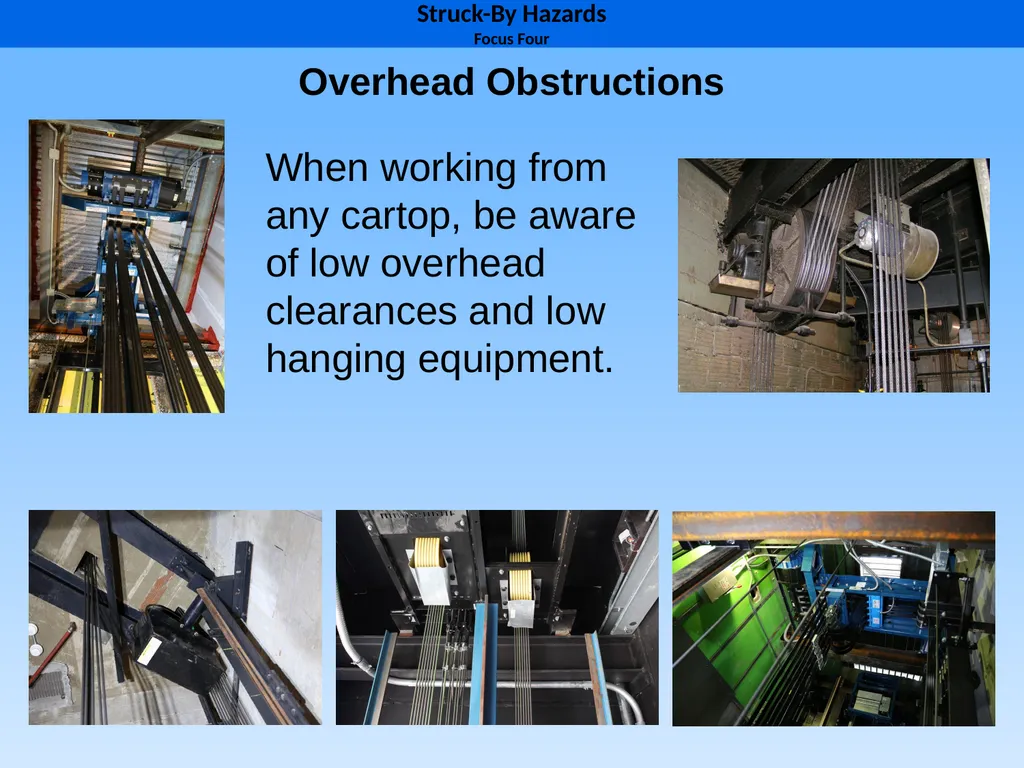
slide11. 11 Struck-By Hazards Focus Four Overhead Obstructions When working from any cartop, be aware of low overhead clearances and low hanging equipment.<br>
slide12. 12 Falling Objects Struck-By Hazards Focus Four<br>
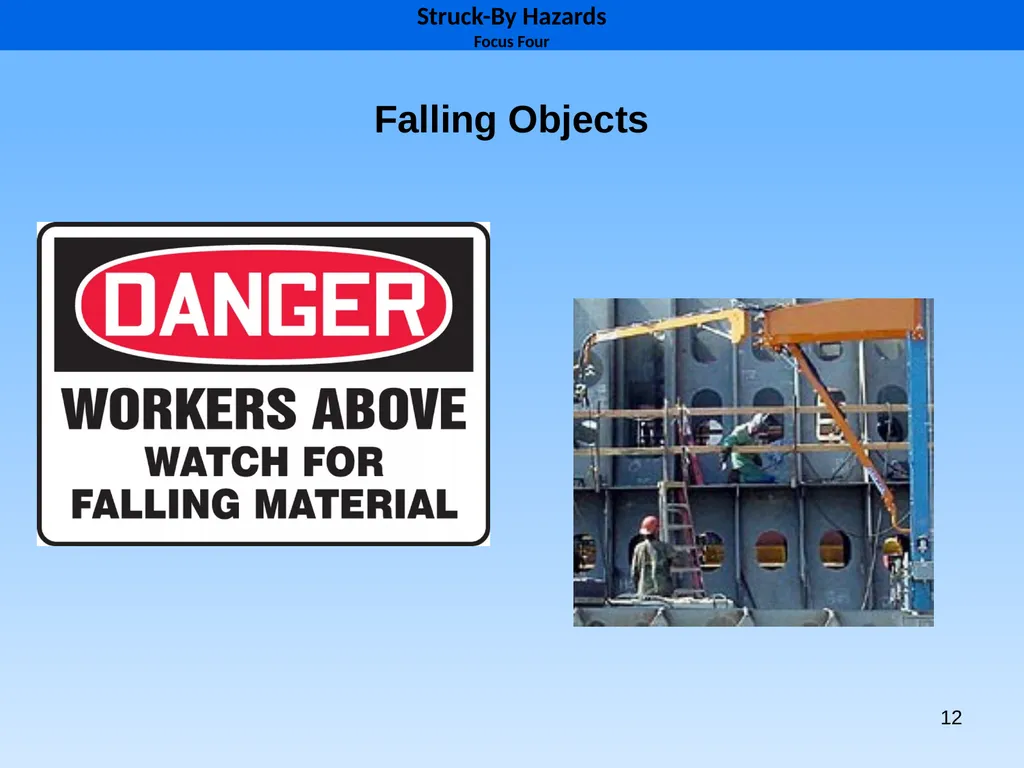
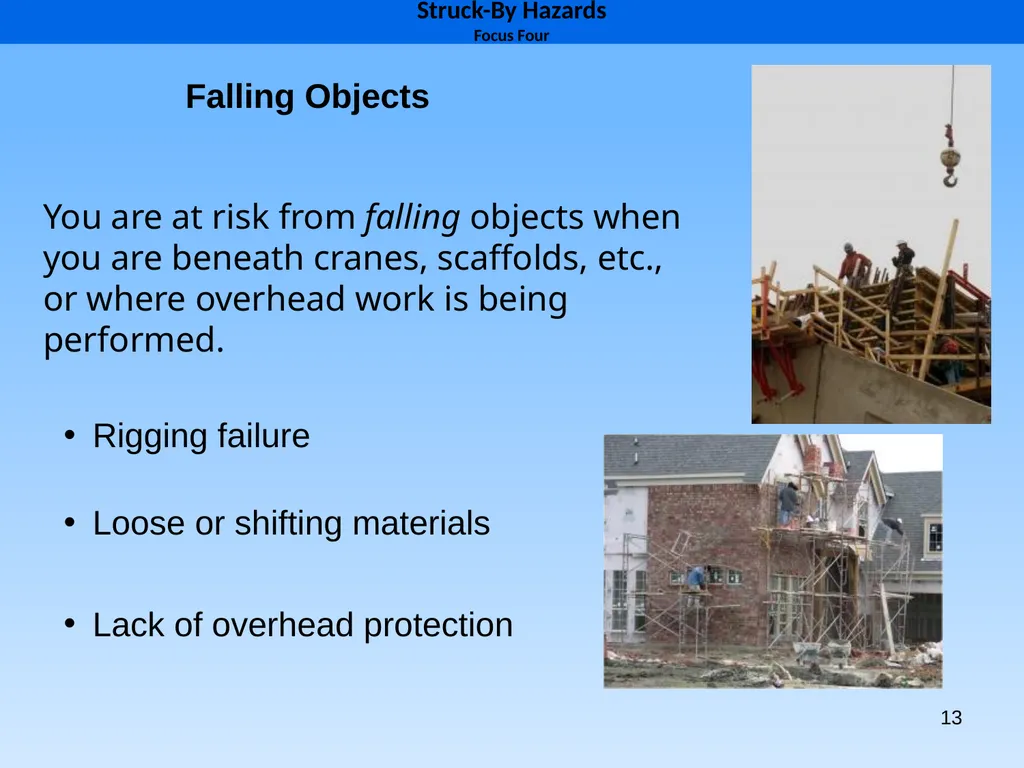
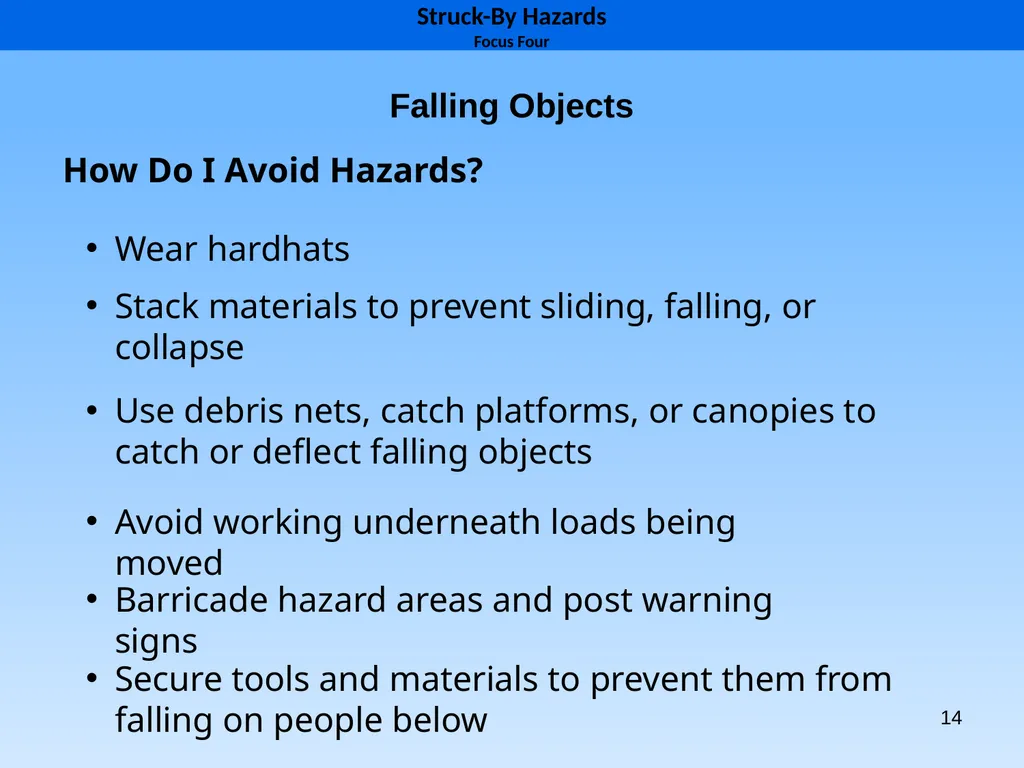
slide13. 13 Falling Objects You are at risk from falling objects when you are beneath cranes, scaffolds, etc., or where overhead work is being performed. Rigging failure Loose or shifting materials Lack of overhead protection Struck-By Hazards Focus Four<br>
slide14. 14 Falling Objects How Do I Avoid Hazards? Wear hardhats Stack materials to prevent sliding, falling, or collapse Use debris nets, catch platforms, or canopies to catch or deflect falling objects Avoid working underneath loads being moved Barricade hazard areas and post warning signs Secure tools and materials to prevent them from falling on people below Struck-By Hazards Focus Four<br>
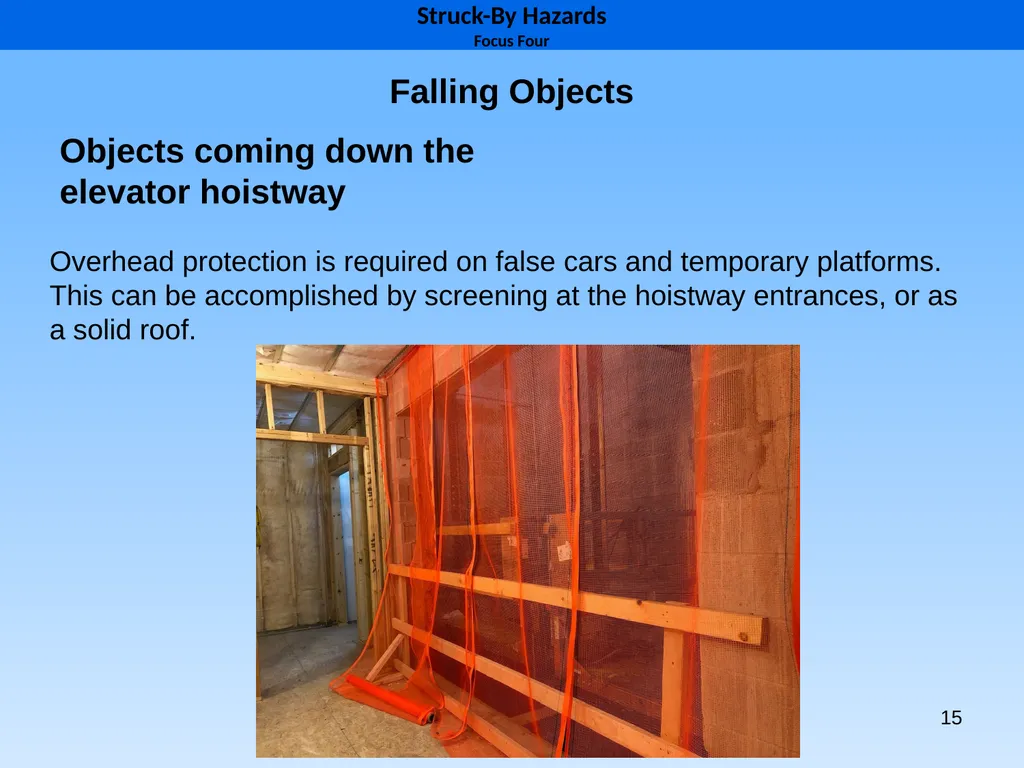
slide15. 15 Falling Objects Objects coming down the elevator hoistway Overhead protection is required on false cars and temporary platforms. This can be accomplished by screening at the hoistway entrances, or as a solid roof. Struck-By Hazards Focus Four<br>
slide16. 16 Struck-By Hazards Focus Four ACCIDENT A mechanic and 2 apprentices were on the job site and the 2 apprentices were hooking up the governor rope on a new construction job.
One apprentice was in the pit on the side of the car platform that had the releasing carrier for the car safeties. The governor rope was taped (spliced) and hanging in the hoistway approximately 2 floors above the pit. The tape needed to be removed to attach the governor rope.
One of the apprentices went up to the ground floor (2 floors above the pit). He could not reach the taped splice, so he decided to tape a knife to a stick to cut the tape splicing the governor ropes together.<br>
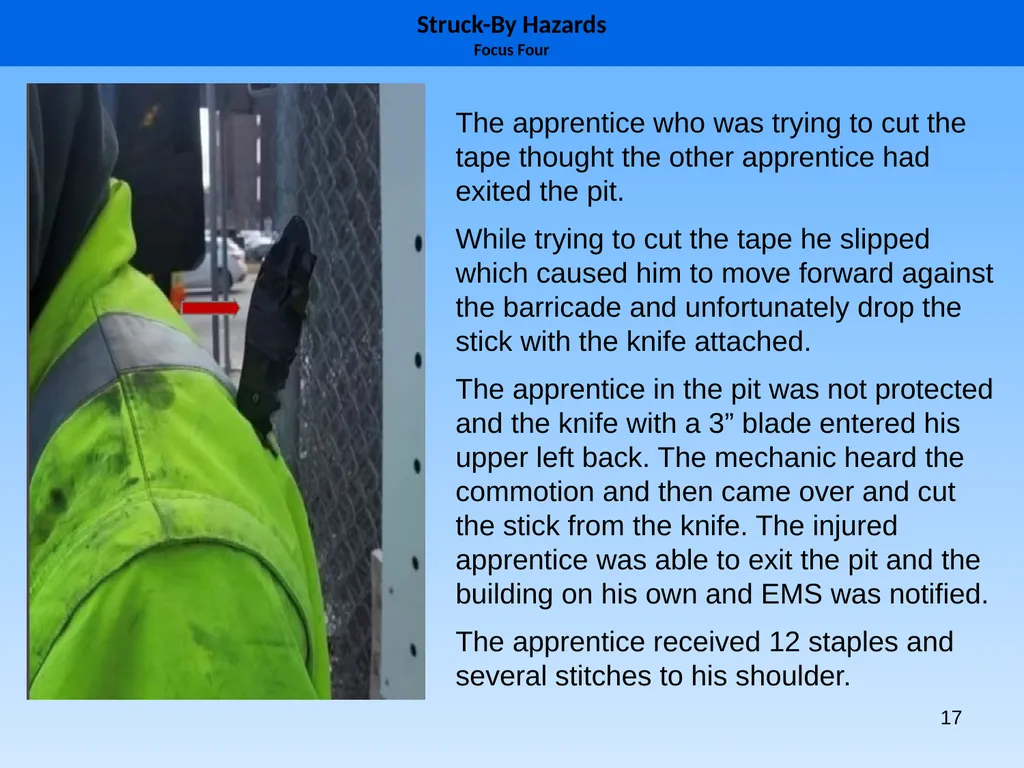
slide17. 17 Struck-By Hazards Focus Four The apprentice who was trying to cut the tape thought the other apprentice had exited the pit.
While trying to cut the tape he slipped which caused him to move forward against the barricade and unfortunately drop the stick with the knife attached.
The apprentice in the pit was not protected and the knife with a 3” blade entered his upper left back. The mechanic heard the commotion and then came over and cut the stick from the knife. The injured apprentice was able to exit the pit and the building on his own and EMS was notified.
The apprentice received 12 staples and several stitches to his shoulder.<br>
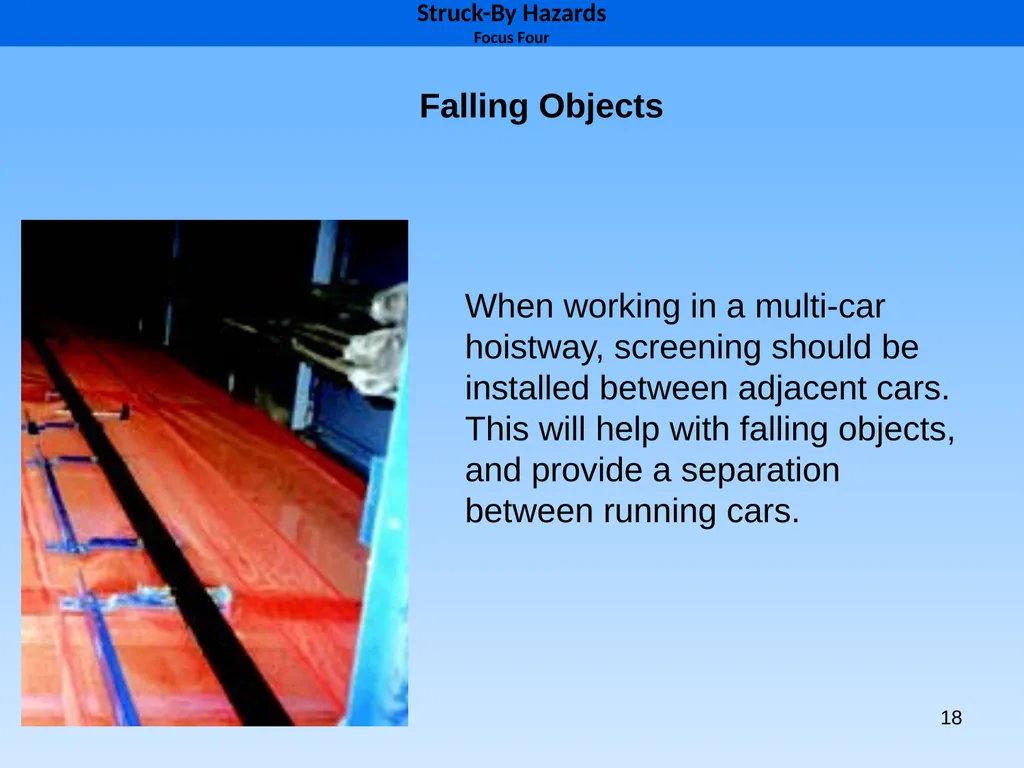
slide18. 18 Falling Objects When working in a multi-car hoistway, screening should be installed between adjacent cars. This will help with falling objects, and provide a separation between running cars. Struck-By Hazards Focus Four<br>
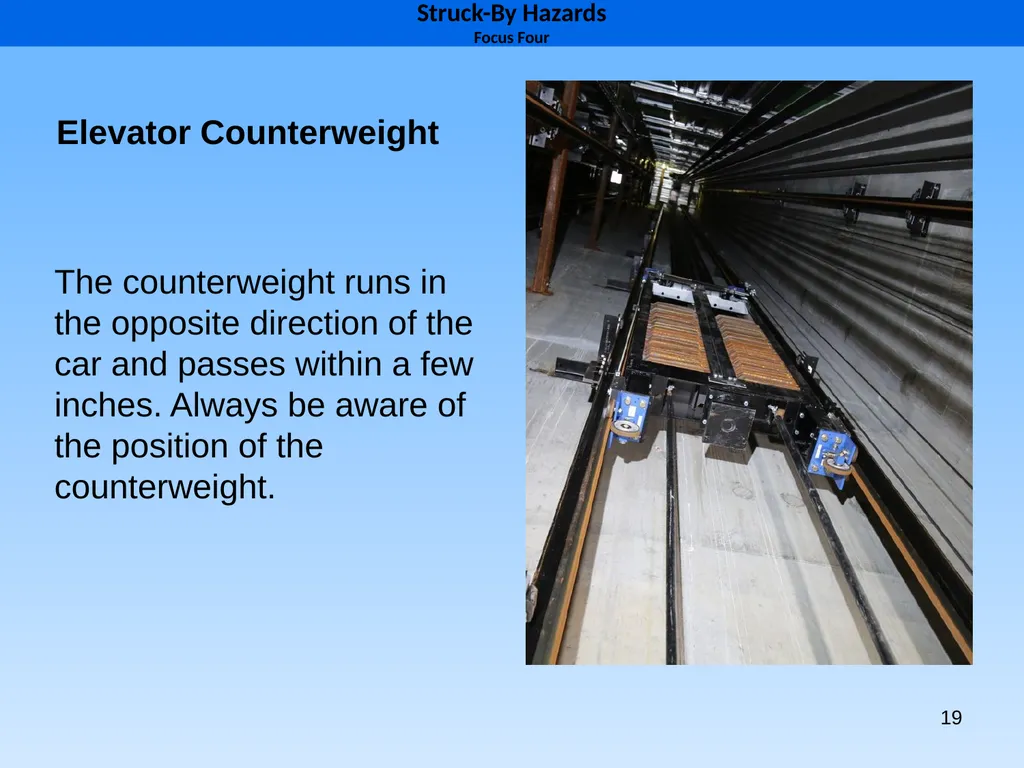
slide19. 19 Elevator Counterweight The counterweight runs in the opposite direction of the car and passes within a few inches. Always be aware of the position of the counterweight. Struck-By Hazards Focus Four<br>
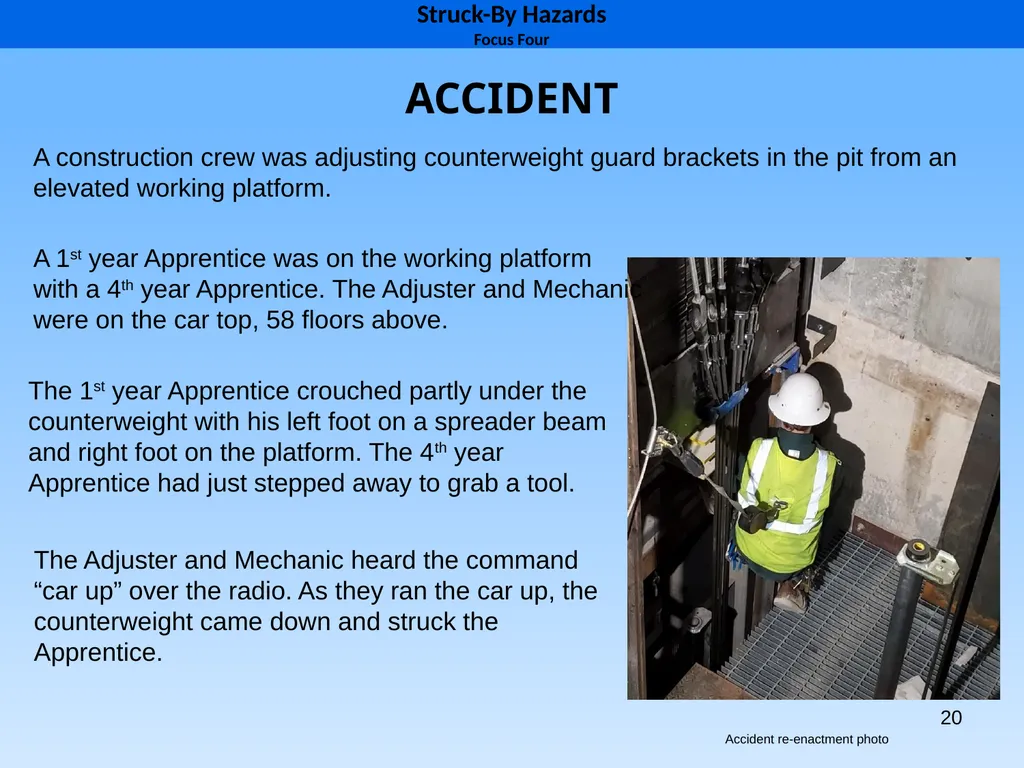
slide20. 20 ACCIDENT Accident re-enactment photo A construction crew was adjusting counterweight guard brackets in the pit from an elevated working platform. A 1st year Apprentice was on the working platform with a 4th year Apprentice. The Adjuster and Mechanic were on the car top, 58 floors above. The 1st year Apprentice crouched partly under the counterweight with his left foot on a spreader beam and right foot on the platform. The 4th year Apprentice had just stepped away to grab a tool. The Adjuster and Mechanic heard the command “car up” over the radio. As they ran the car up, the counterweight came down and struck the Apprentice. Struck-By Hazards Focus Four<br>
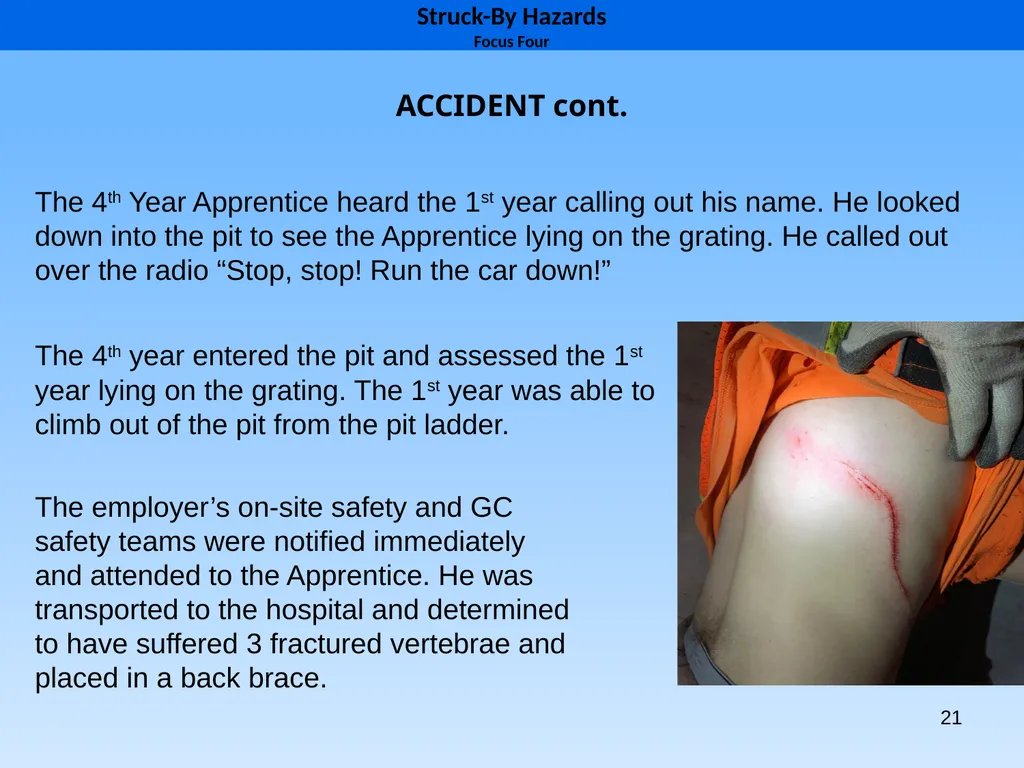
slide21. 21 ACCIDENT cont. The 4th Year Apprentice heard the 1st year calling out his name. He looked down into the pit to see the Apprentice lying on the grating. He called out over the radio “Stop, stop! Run the car down!” The 4th year entered the pit and assessed the 1st year lying on the grating. The 1st year was able to climb out of the pit from the pit ladder. The employer’s on-site safety and GC safety teams were notified immediately and attended to the Apprentice. He was transported to the hospital and determined to have suffered 3 fractured vertebrae and placed in a back brace. Struck-By Hazards Focus Four<br>
slide22. 22 ACCIDENT cont. Recommendations and lessons learned: Always perform a detailed JHA Never place your body or limbs in the path of travel Install standard railing on working platforms as required Test and verify two-way communication Verbally repeat commands for direction of movement and all personnel are clear prior to initiating movement Use separate, dedicated radio channels and repeaters Struck-By Hazards Focus Four All personnel must exit the pit prior to moving the conveyance<br>
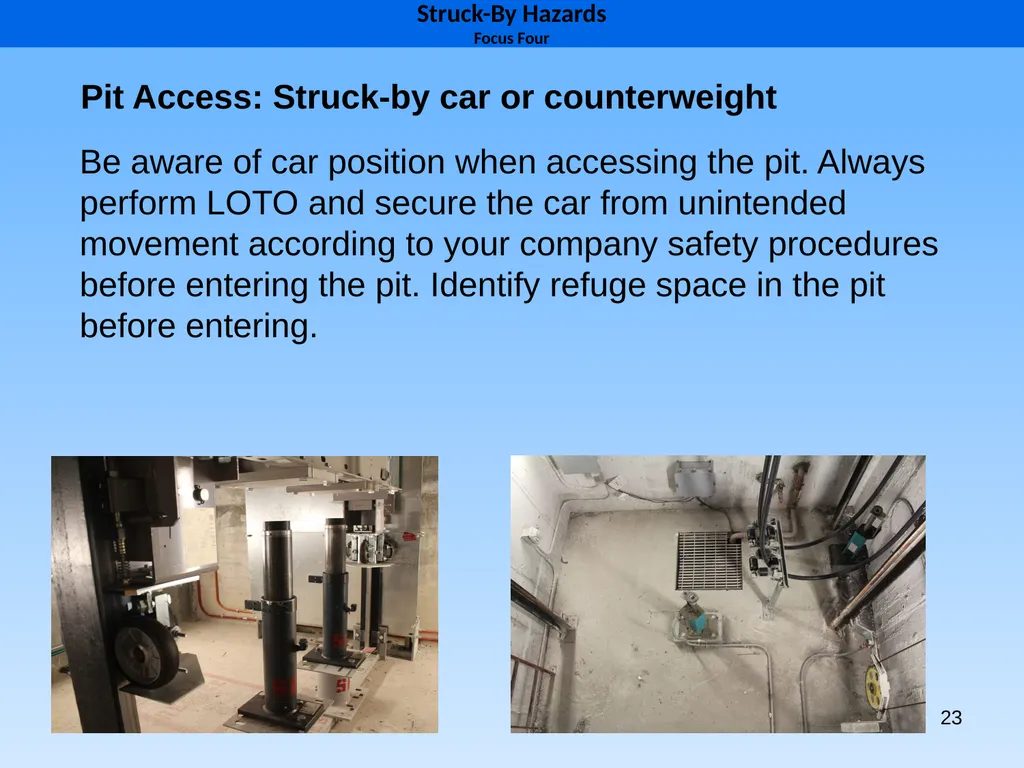
slide23. 23 Pit Access: Struck-by car or counterweight Be aware of car position when accessing the pit. Always perform LOTO and secure the car from unintended movement according to your company safety procedures before entering the pit. Identify refuge space in the pit before entering. Struck-By Hazards Focus Four<br>
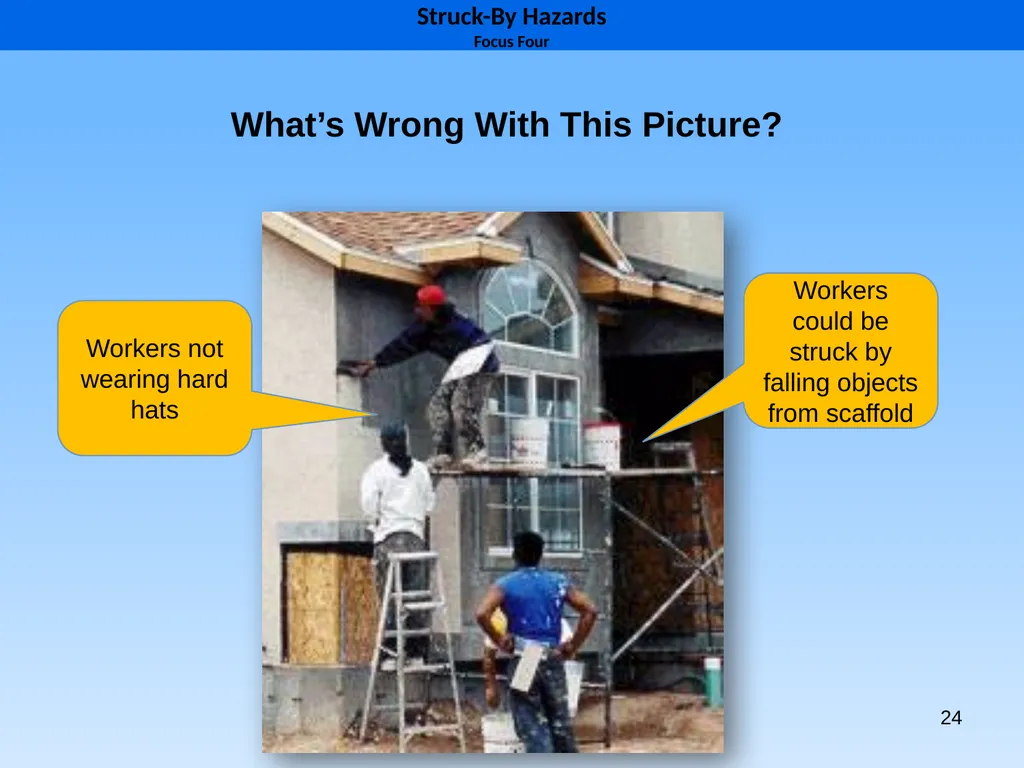
slide24. 24 What’s Wrong With This Picture? Workers could be struck by falling objects from scaffold Workers not wearing hard hats Struck-By Hazards Focus Four<br>
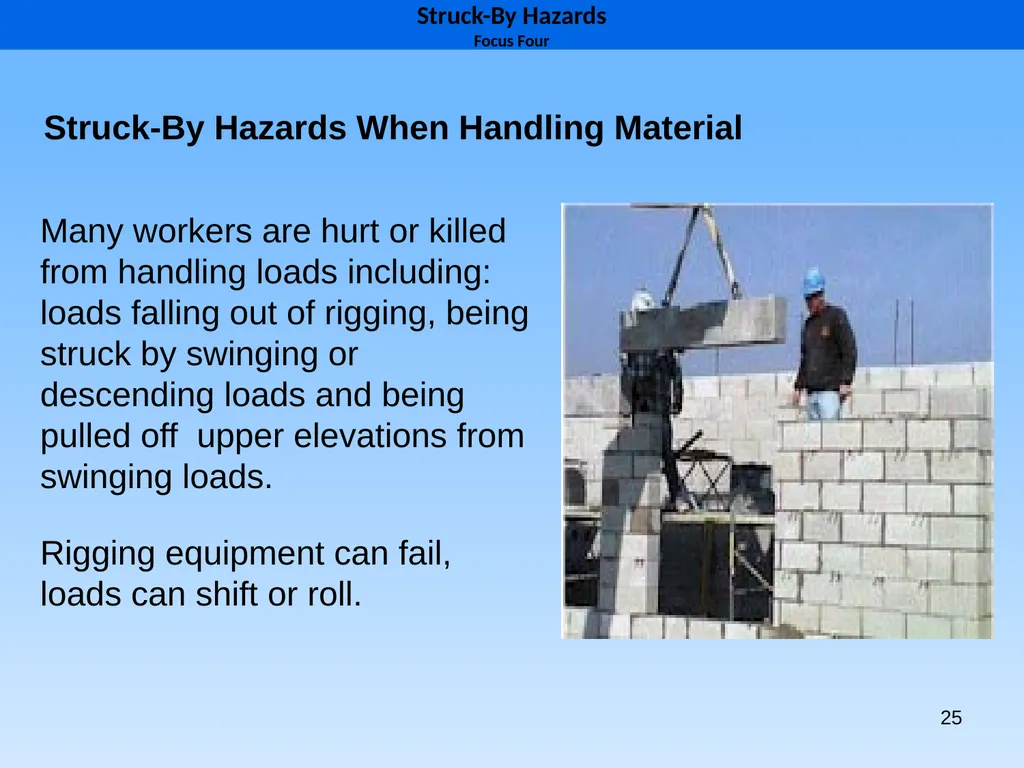
slide25. 25 Struck-By Hazards When Handling Material Many workers are hurt or killed from handling loads including: loads falling out of rigging, being struck by swinging or descending loads and being pulled off upper elevations from swinging loads.
Rigging equipment can fail, loads can shift or roll. Struck-By Hazards Focus Four<br>
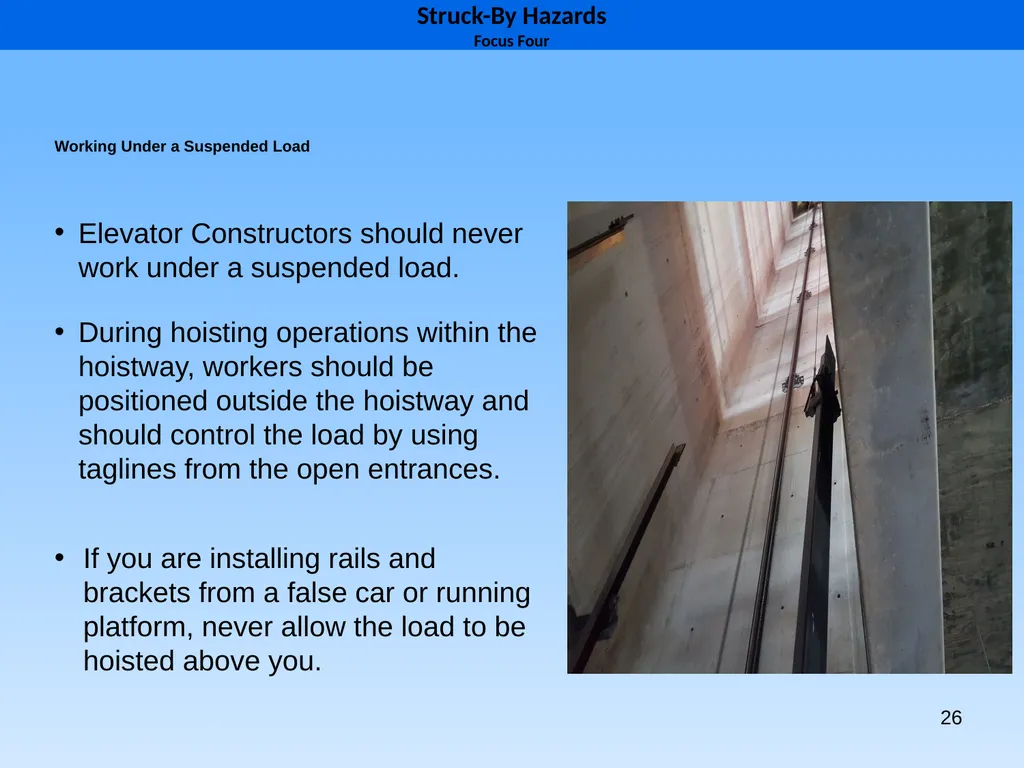
slide26. 26 Working Under a Suspended Load If you are installing rails and brackets from a false car or running platform, never allow the load to be hoisted above you. Elevator Constructors should never work under a suspended load. During hoisting operations within the hoistway, workers should be positioned outside the hoistway and should control the load by using taglines from the open entrances. Struck-By Hazards Focus Four<br>
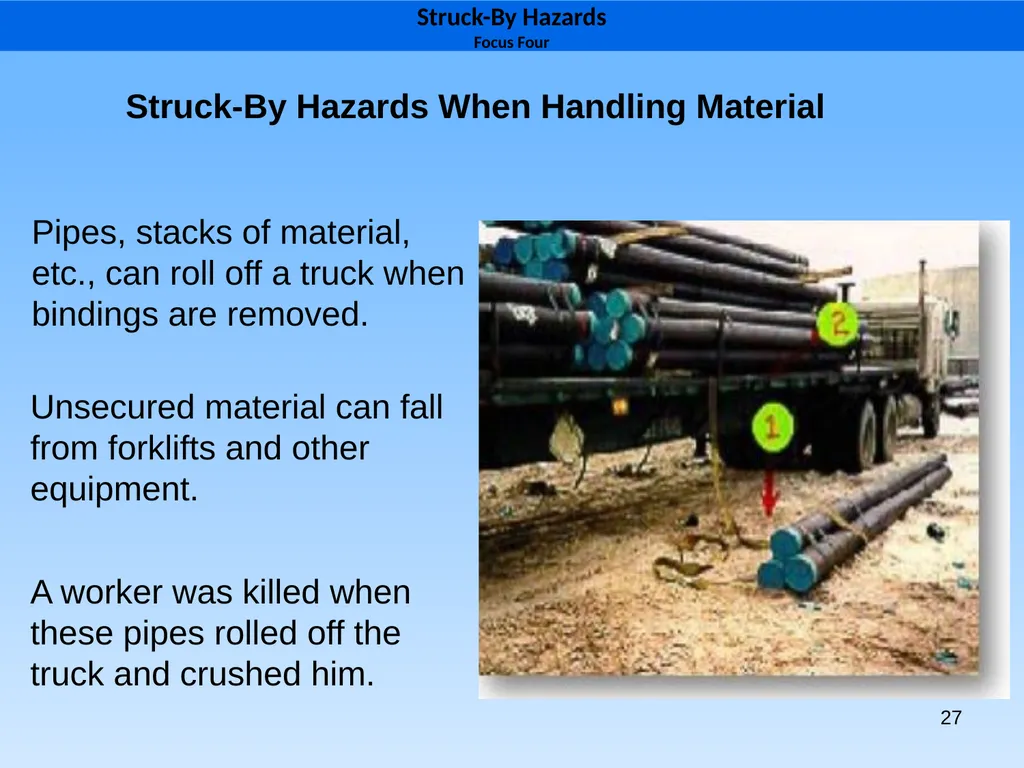
slide27. 27 Struck-By Hazards When Handling Material Pipes, stacks of material, etc., can roll off a truck when bindings are removed. Unsecured material can fall from forklifts and other equipment. A worker was killed when these pipes rolled off the truck and crushed him. Struck-By Hazards Focus Four<br>
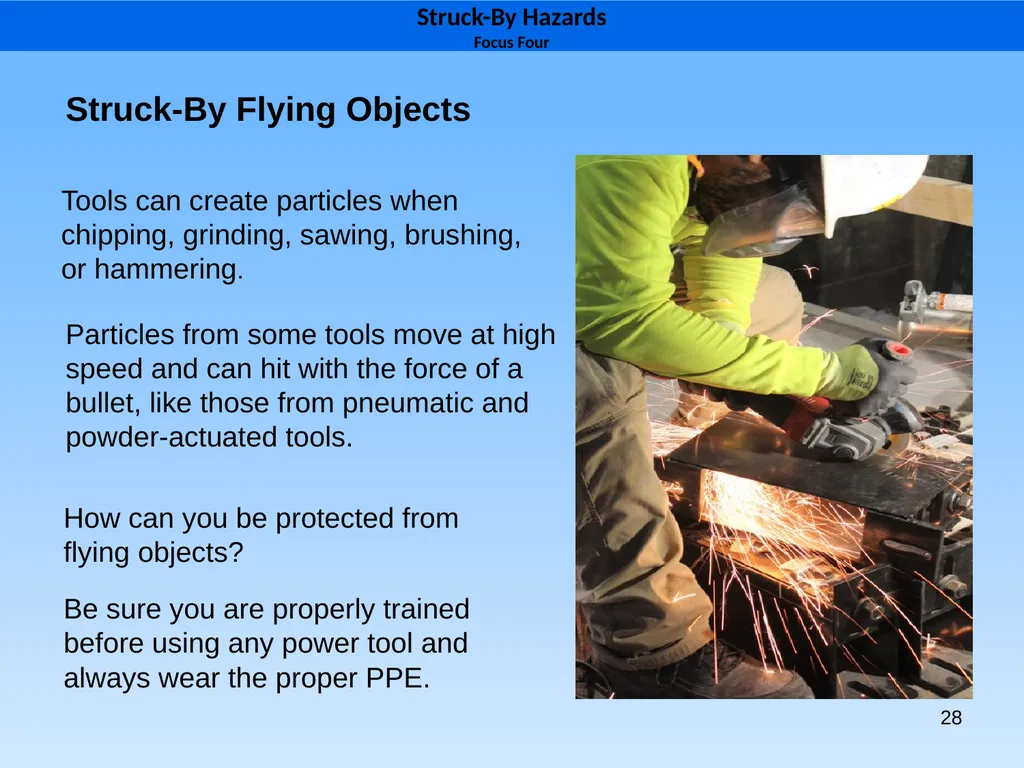
slide28. 28 Struck-By Flying Objects Tools can create particles when chipping, grinding, sawing, brushing, or hammering. Particles from some tools move at high speed and can hit with the force of a bullet, like those from pneumatic and powder-actuated tools. How can you be protected from flying objects? Be sure you are properly trained before using any power tool and always wear the proper PPE. Struck-By Hazards Focus Four<br>
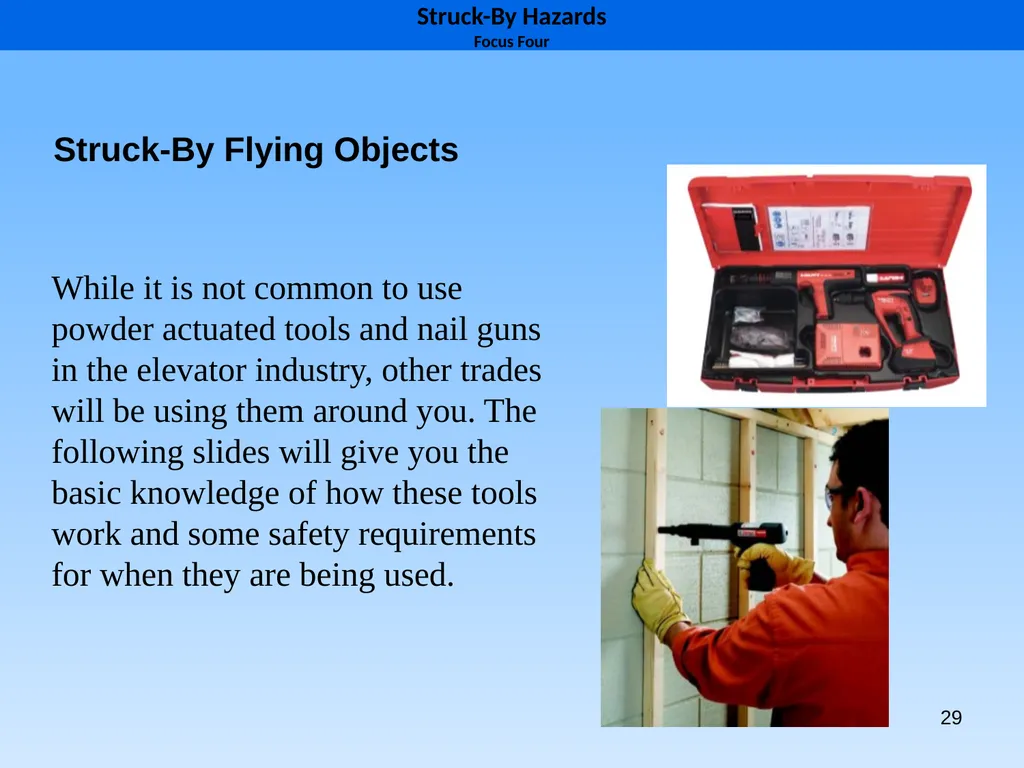
slide29. 29 Struck-By Flying Objects While it is not common to use powder actuated tools and nail guns in the elevator industry, other trades will be using them around you. The following slides will give you the basic knowledge of how these tools work and some safety requirements for when they are being used. Struck-By Hazards Focus Four<br>
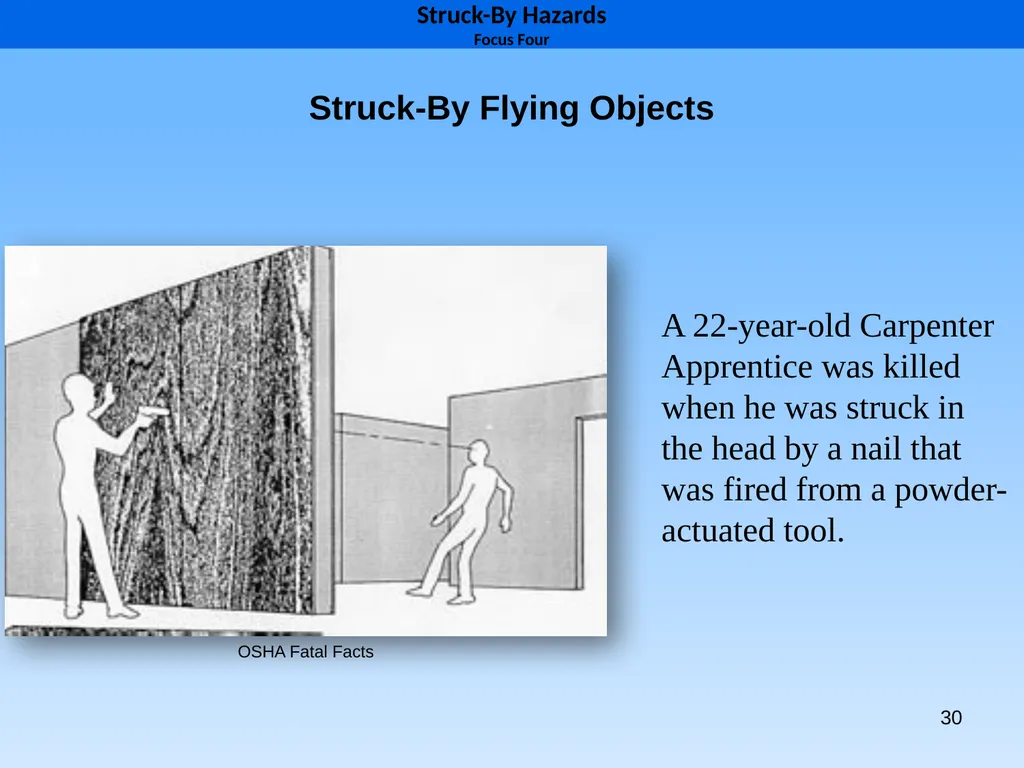
slide30. 30 Struck-By Flying Objects A 22-year-old Carpenter Apprentice was killed when he was struck in the head by a nail that was fired from a powder-actuated tool. OSHA Fatal Facts Struck-By Hazards Focus Four<br>
slide31. 31 Using powder actuated tools correctly and safely – 1926.302(e): Struck-By Flying Objects Only employees who have been trained in the operation of the particular tool in use shall be allowed to operate a powder-actuated tool Personal protective equipment is required – eye/face, hands, hearing protection Struck-By Hazards Focus Four<br>
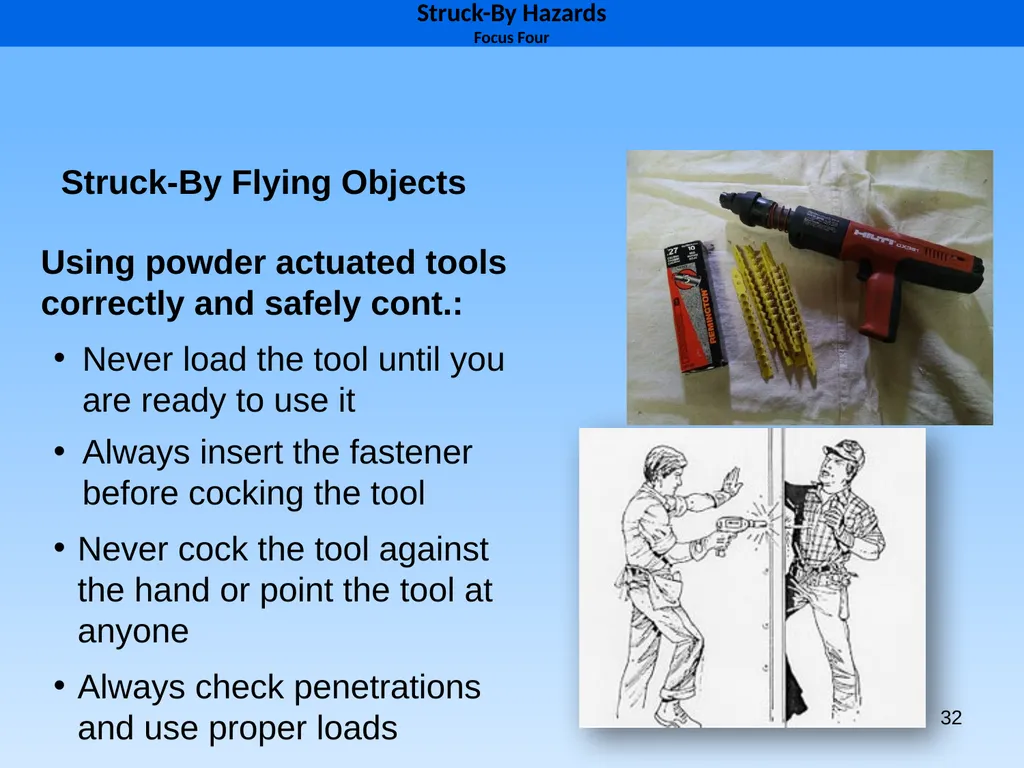
slide32. 32 Struck-By Flying Objects Using powder actuated tools correctly and safely cont.: Never load the tool until you are ready to use it Always insert the fastener before cocking the tool Never cock the tool against the hand or point the tool at anyone Always check penetrations and use proper loads Struck-By Hazards Focus Four<br>
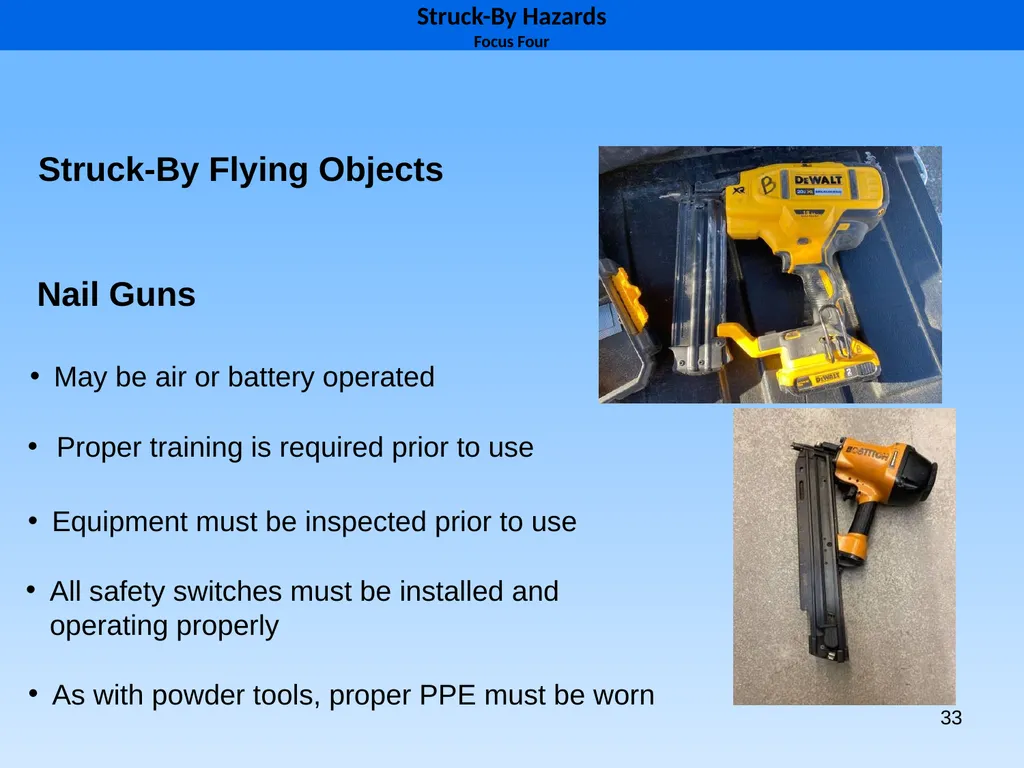
slide33. 33 Struck-By Flying Objects Nail Guns May be air or battery operated Proper training is required prior to use Equipment must be inspected prior to use All safety switches must be installed and operating properly As with powder tools, proper PPE must be worn Struck-By Hazards Focus Four<br>
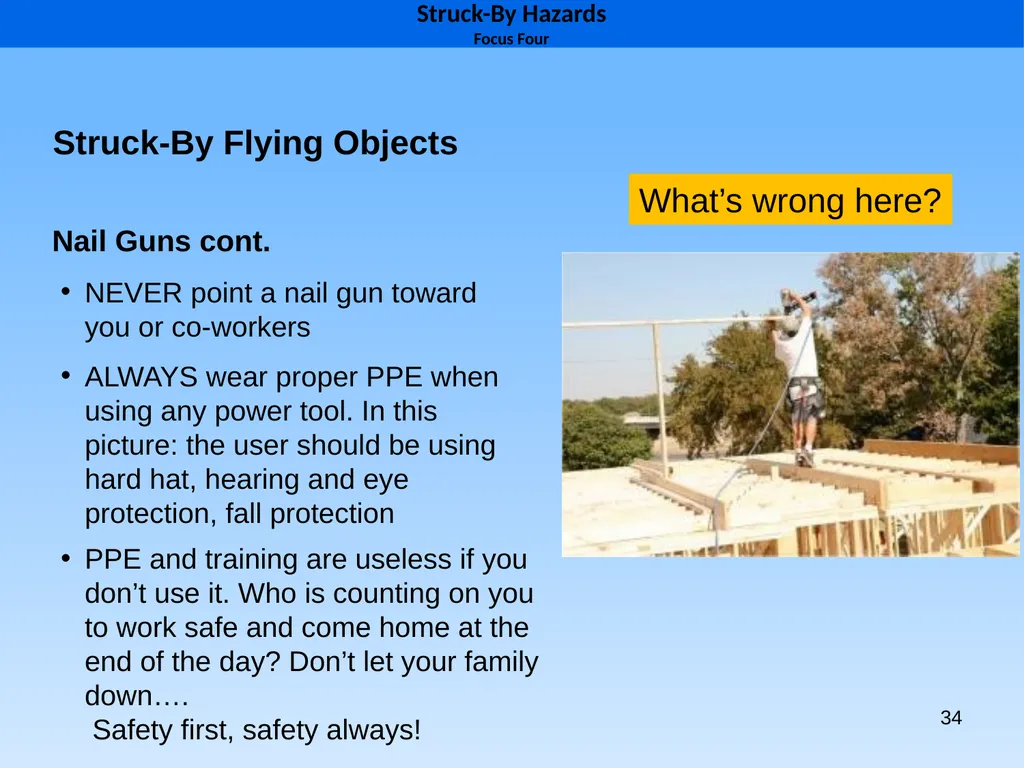
slide34. 34 Struck-By Flying Objects Nail Guns cont. NEVER point a nail gun toward you or co-workers What’s wrong here? ALWAYS wear proper PPE when using any power tool. In this picture: the user should be using hard hat, hearing and eye protection, fall protection PPE and training are useless if you don’t use it. Who is counting on you to work safe and come home at the end of the day? Don’t let your family down….
Safety first, safety always! Struck-By Hazards Focus Four<br>
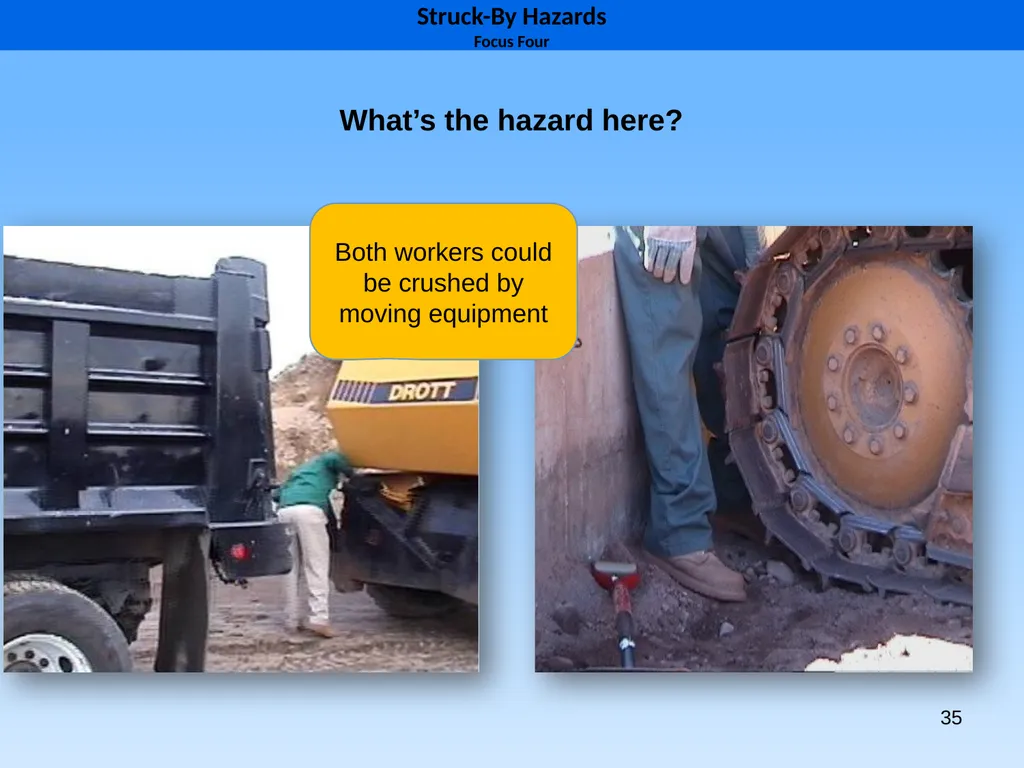
slide35. 35 What’s the hazard here? Both workers could be crushed by moving equipment Struck-By Hazards Focus Four<br>
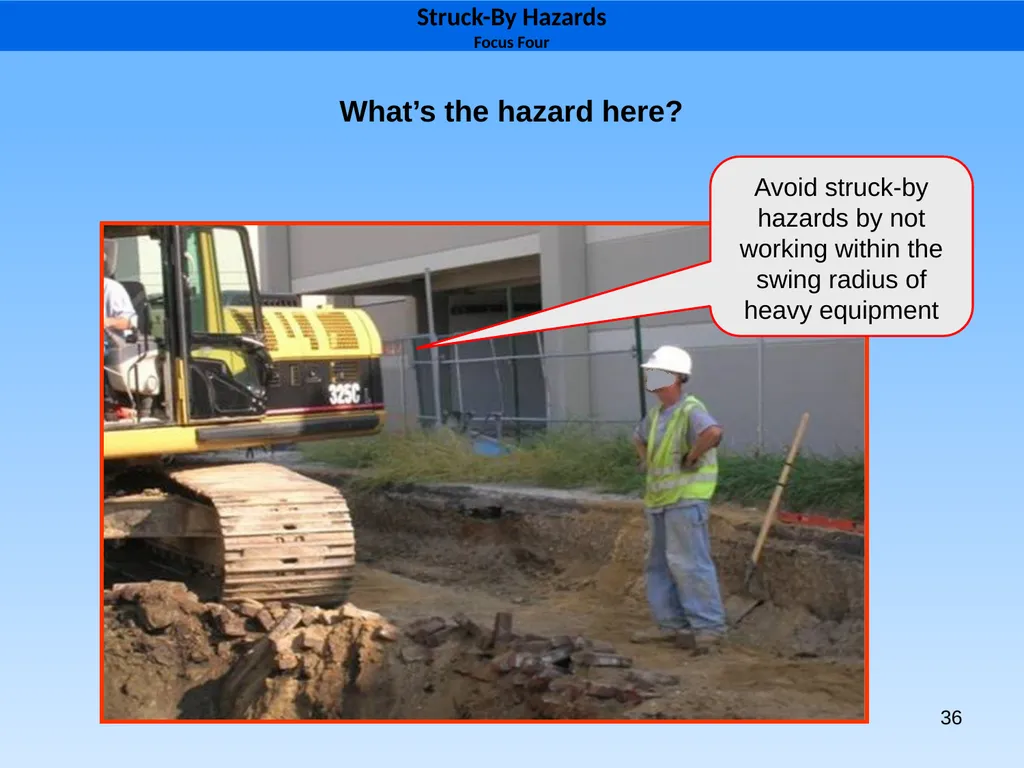
slide36. 36 What’s the hazard here? Avoid struck-by hazards by not working within the swing radius of heavy equipment Struck-By Hazards Focus Four<br>
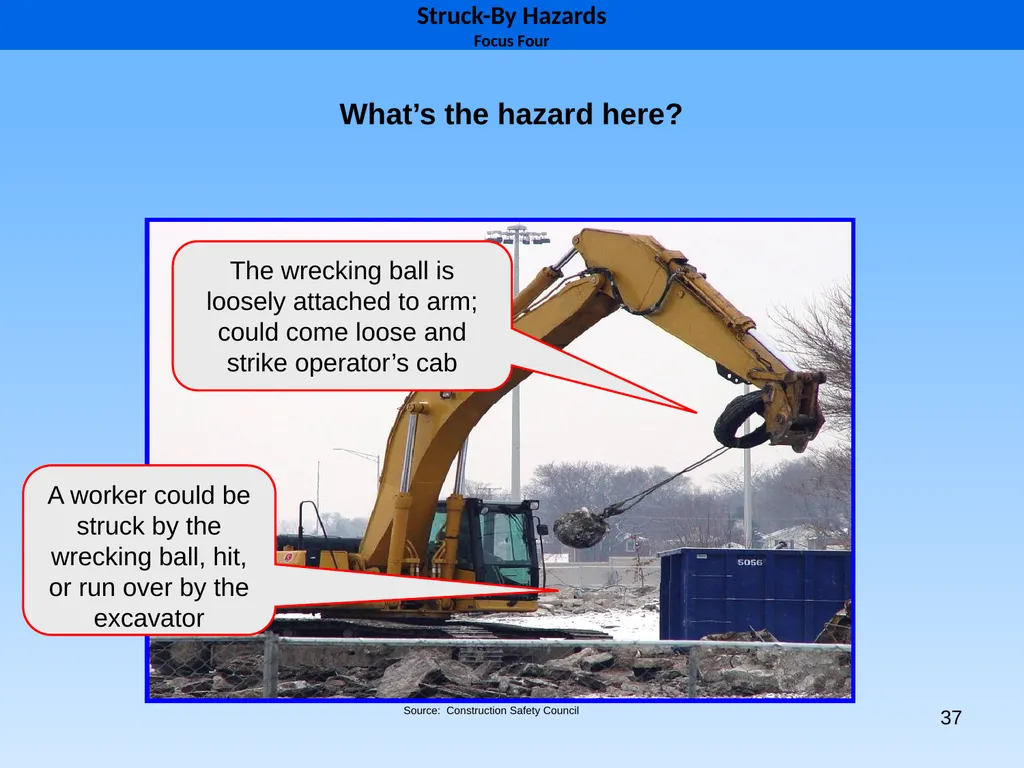
slide37. 37 What’s the hazard here? Source: Construction Safety Council The wrecking ball is loosely attached to arm; could come loose and strike operator’s cab A worker could be struck by the wrecking ball, hit, or run over by the excavator Struck-By Hazards Focus Four<br>
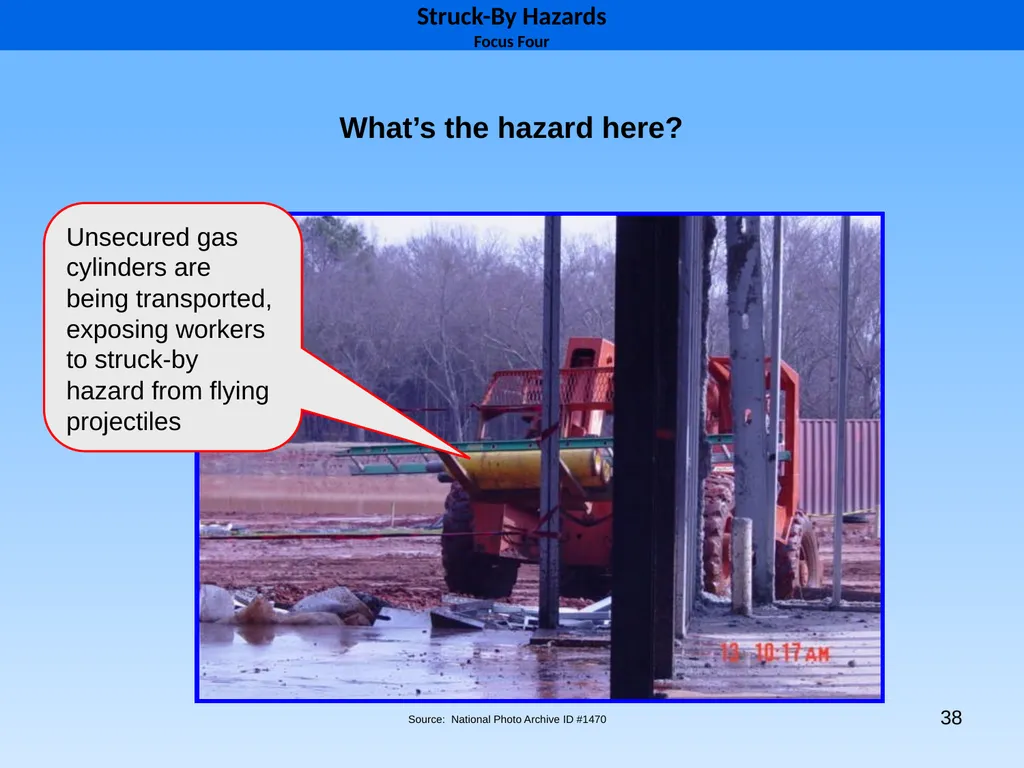
slide38. 38 What’s the hazard here? Source: National Photo Archive ID #1470 Unsecured gas cylinders are being transported, exposing workers to struck-by hazard from flying projectiles Struck-By Hazards Focus Four<br>
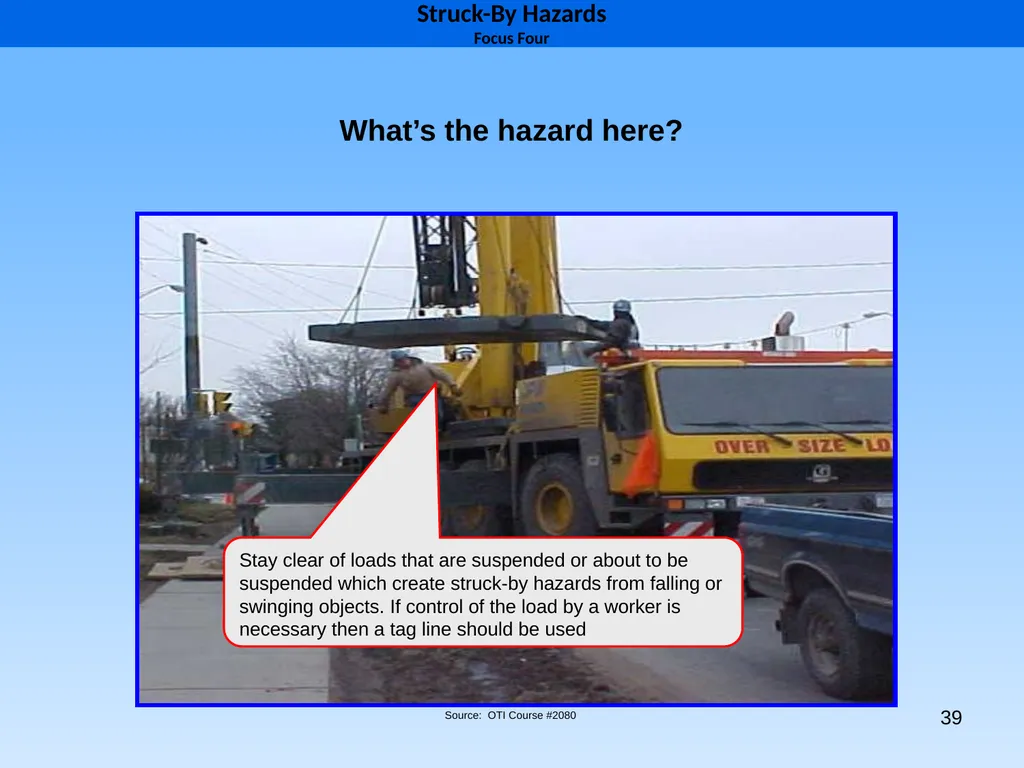
slide39. 39 What’s the hazard here? Source: OTI Course #2080 Stay clear of loads that are suspended or about to be suspended which create struck-by hazards from falling or swinging objects. If control of the load by a worker is necessary then a tag line should be used Struck-By Hazards Focus Four<br>
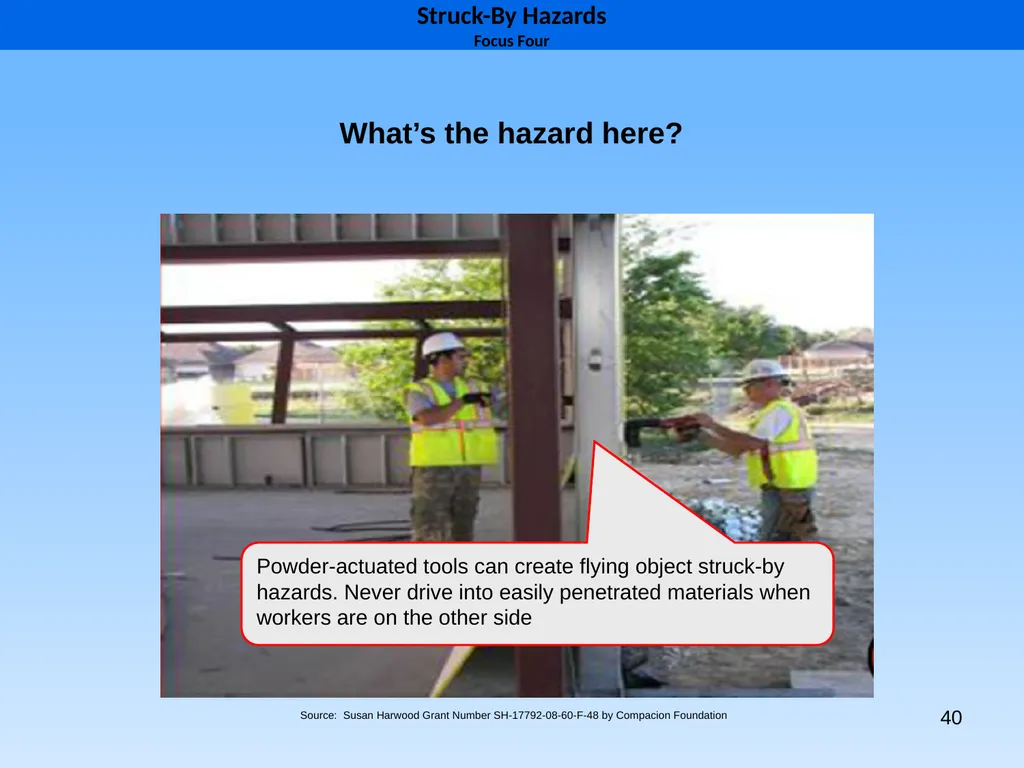
slide40. 40 What’s the hazard here? Source: Susan Harwood Grant Number SH-17792-08-60-F-48 by Compacion Foundation Powder-actuated tools can create flying object struck-by hazards. Never drive into easily penetrated materials when workers are on the other side Struck-By Hazards Focus Four<br>
slide41. 41 Summary: As you can see, struck-by hazards are everywhere. They fall into one of three categories: Vehicle and roadway hazards Falling objects Flying objects Struck-by hazards are preventable. Stay clear of operating vehicles and equipment, communicate with operators and maintain eye contact, avoid blind spots, wear high visibility clothing, and never stand under a load. Power and powder actuated tools are dangerous and should only be used after proper training and only as directed. PPE must always be used and you must perform penetration checks when setting up the tool. Remember who is counting on you to come home safe each day. Struck-By Hazards Focus Four<br>
slide42. 42 Struck-By Hazards Focus Four Through the Alliance between OSHA’s 10 Regional Offices and the Elevator Contractors of America (ECA), Elevator Industry Work Preservation Fund (EIWPF), International Union of Elevator Constructors (IUEC), National Association of Elevator Contractors (NAEC), National Elevator Industry Educational Program (NEIEP), and National Elevator Industry Inc. (NEII), collectively known as The Elevator Industry Safety Partners, developed this Industry Specific Content for informational purposes only. It does not necessarily reflect the official views of OSHA or the U.S. Department of Labor. May 2021
Under the Occupational Safety and Health Act, employers are responsible (http://www.osha.gov/as/opa/worker/employer-responsibility.html) for providing a safe and healthy workplace and workers have rights (https://www.osha.gov/workers). OSHA can help answer questions or concerns from employers and workers. OSHA's On-Site Consultation Program (https://www.osha.gov/consultation) offers free and confidential advice to small and medium-sized businesses, with priority given to high-hazard worksites. For more information, contact your regional or area OSHA office (https://www.osha.gov/contactus/bystate), call 1-800-321-OSHA (6742), or visit https://www.osha.gov/.<br>
slide43. 43 Struck-By Hazards Focus Four<br>
Focus Four
Struck-By Hazards<br>
slide2. 2 Struck-By Hazards Struck-By Hazards Focus Four<br>
slide3. 3 Objectives By the end of the session, students will be able to: List the three main causes of struck-by fatalities. Describe how to prevent struck-by fatalities. Describe safe equipment operation to avoid struck-by accidents. Struck-By Hazards Focus Four<br>
slide4. 4 The Second Leading Cause of Construction Fatalities Is Being Struck by an Object or a Piece of Equipment Vehicles Heavy Equipment Falling Objects Flying Objects Struck-By Hazards Focus Four<br>
slide5. 5 Struck-By Hazards Focus Four The Second Leading Cause of Construction Fatalities Is Being Struck by an Object or a Piece of Equipment<br>
slide6. 6 Struck-By Hazards Focus Four The Second Leading Cause of Construction Fatalities Is Being Struck by an Object or a Piece of Equipment From 2011 to 2019, more workers were fatally injured from being struck by an object or piece of equipment than struck by a vehicle.<br>
slide7. 7 What Are the Leading Causes of Highway Worker Fatalities? For highway workers on foot… being struck by construction equipment. For highway equipment operators… equipment rollover. Vehicle and Roadway Hazards Struck-By Hazards Focus Four<br>
slide8. 8 If vehicle safety practices are not observed at your site, you risk being pinned between construction vehicles and walls, struck by swinging backhoes, crushed beneath overturned vehicles, you risk being struck by trucks or cars. How Do I Avoid Hazards? Use traffic signs, barricades or flaggers when construction takes place near public roadways Workers must be highly visible in all levels of light. Warning clothing, such as red or orange vests, are required; and if worn for night work, must be of reflective material. Communicate with operators by radio and/or eye contact Vehicle and Roadway Hazards Struck-By Hazards Focus Four<br>
slide9. 9 How Do I Avoid Hazards? Do not drive a vehicle in reverse gear with an obstructed rear view, unless it has an audible reverse alarm, or another worker signals that it is safe. Drive vehicles or equipment only on roadways or grades that are safely constructed and maintained. Do not exceed a vehicle's rated load or lift capacity. Set parking brakes when vehicles and equipment are parked, and chock the wheels if they are on an incline. Vehicle and Roadway Hazards Struck-By Hazards Focus Four<br>
slide10. 10 Struck-By Hazards Focus Four When working near equipment that swings, use a barricade to identify the unsafe area. Crane Hazards<br>
slide11. 11 Struck-By Hazards Focus Four Overhead Obstructions When working from any cartop, be aware of low overhead clearances and low hanging equipment.<br>
slide12. 12 Falling Objects Struck-By Hazards Focus Four<br>
slide13. 13 Falling Objects You are at risk from falling objects when you are beneath cranes, scaffolds, etc., or where overhead work is being performed. Rigging failure Loose or shifting materials Lack of overhead protection Struck-By Hazards Focus Four<br>
slide14. 14 Falling Objects How Do I Avoid Hazards? Wear hardhats Stack materials to prevent sliding, falling, or collapse Use debris nets, catch platforms, or canopies to catch or deflect falling objects Avoid working underneath loads being moved Barricade hazard areas and post warning signs Secure tools and materials to prevent them from falling on people below Struck-By Hazards Focus Four<br>
slide15. 15 Falling Objects Objects coming down the elevator hoistway Overhead protection is required on false cars and temporary platforms. This can be accomplished by screening at the hoistway entrances, or as a solid roof. Struck-By Hazards Focus Four<br>
slide16. 16 Struck-By Hazards Focus Four ACCIDENT A mechanic and 2 apprentices were on the job site and the 2 apprentices were hooking up the governor rope on a new construction job.
One apprentice was in the pit on the side of the car platform that had the releasing carrier for the car safeties. The governor rope was taped (spliced) and hanging in the hoistway approximately 2 floors above the pit. The tape needed to be removed to attach the governor rope.
One of the apprentices went up to the ground floor (2 floors above the pit). He could not reach the taped splice, so he decided to tape a knife to a stick to cut the tape splicing the governor ropes together.<br>
slide17. 17 Struck-By Hazards Focus Four The apprentice who was trying to cut the tape thought the other apprentice had exited the pit.
While trying to cut the tape he slipped which caused him to move forward against the barricade and unfortunately drop the stick with the knife attached.
The apprentice in the pit was not protected and the knife with a 3” blade entered his upper left back. The mechanic heard the commotion and then came over and cut the stick from the knife. The injured apprentice was able to exit the pit and the building on his own and EMS was notified.
The apprentice received 12 staples and several stitches to his shoulder.<br>
slide18. 18 Falling Objects When working in a multi-car hoistway, screening should be installed between adjacent cars. This will help with falling objects, and provide a separation between running cars. Struck-By Hazards Focus Four<br>
slide19. 19 Elevator Counterweight The counterweight runs in the opposite direction of the car and passes within a few inches. Always be aware of the position of the counterweight. Struck-By Hazards Focus Four<br>
slide20. 20 ACCIDENT Accident re-enactment photo A construction crew was adjusting counterweight guard brackets in the pit from an elevated working platform. A 1st year Apprentice was on the working platform with a 4th year Apprentice. The Adjuster and Mechanic were on the car top, 58 floors above. The 1st year Apprentice crouched partly under the counterweight with his left foot on a spreader beam and right foot on the platform. The 4th year Apprentice had just stepped away to grab a tool. The Adjuster and Mechanic heard the command “car up” over the radio. As they ran the car up, the counterweight came down and struck the Apprentice. Struck-By Hazards Focus Four<br>
slide21. 21 ACCIDENT cont. The 4th Year Apprentice heard the 1st year calling out his name. He looked down into the pit to see the Apprentice lying on the grating. He called out over the radio “Stop, stop! Run the car down!” The 4th year entered the pit and assessed the 1st year lying on the grating. The 1st year was able to climb out of the pit from the pit ladder. The employer’s on-site safety and GC safety teams were notified immediately and attended to the Apprentice. He was transported to the hospital and determined to have suffered 3 fractured vertebrae and placed in a back brace. Struck-By Hazards Focus Four<br>
slide22. 22 ACCIDENT cont. Recommendations and lessons learned: Always perform a detailed JHA Never place your body or limbs in the path of travel Install standard railing on working platforms as required Test and verify two-way communication Verbally repeat commands for direction of movement and all personnel are clear prior to initiating movement Use separate, dedicated radio channels and repeaters Struck-By Hazards Focus Four All personnel must exit the pit prior to moving the conveyance<br>
slide23. 23 Pit Access: Struck-by car or counterweight Be aware of car position when accessing the pit. Always perform LOTO and secure the car from unintended movement according to your company safety procedures before entering the pit. Identify refuge space in the pit before entering. Struck-By Hazards Focus Four<br>
slide24. 24 What’s Wrong With This Picture? Workers could be struck by falling objects from scaffold Workers not wearing hard hats Struck-By Hazards Focus Four<br>
slide25. 25 Struck-By Hazards When Handling Material Many workers are hurt or killed from handling loads including: loads falling out of rigging, being struck by swinging or descending loads and being pulled off upper elevations from swinging loads.
Rigging equipment can fail, loads can shift or roll. Struck-By Hazards Focus Four<br>
slide26. 26 Working Under a Suspended Load If you are installing rails and brackets from a false car or running platform, never allow the load to be hoisted above you. Elevator Constructors should never work under a suspended load. During hoisting operations within the hoistway, workers should be positioned outside the hoistway and should control the load by using taglines from the open entrances. Struck-By Hazards Focus Four<br>
slide27. 27 Struck-By Hazards When Handling Material Pipes, stacks of material, etc., can roll off a truck when bindings are removed. Unsecured material can fall from forklifts and other equipment. A worker was killed when these pipes rolled off the truck and crushed him. Struck-By Hazards Focus Four<br>
slide28. 28 Struck-By Flying Objects Tools can create particles when chipping, grinding, sawing, brushing, or hammering. Particles from some tools move at high speed and can hit with the force of a bullet, like those from pneumatic and powder-actuated tools. How can you be protected from flying objects? Be sure you are properly trained before using any power tool and always wear the proper PPE. Struck-By Hazards Focus Four<br>
slide29. 29 Struck-By Flying Objects While it is not common to use powder actuated tools and nail guns in the elevator industry, other trades will be using them around you. The following slides will give you the basic knowledge of how these tools work and some safety requirements for when they are being used. Struck-By Hazards Focus Four<br>
slide30. 30 Struck-By Flying Objects A 22-year-old Carpenter Apprentice was killed when he was struck in the head by a nail that was fired from a powder-actuated tool. OSHA Fatal Facts Struck-By Hazards Focus Four<br>
slide31. 31 Using powder actuated tools correctly and safely – 1926.302(e): Struck-By Flying Objects Only employees who have been trained in the operation of the particular tool in use shall be allowed to operate a powder-actuated tool Personal protective equipment is required – eye/face, hands, hearing protection Struck-By Hazards Focus Four<br>
slide32. 32 Struck-By Flying Objects Using powder actuated tools correctly and safely cont.: Never load the tool until you are ready to use it Always insert the fastener before cocking the tool Never cock the tool against the hand or point the tool at anyone Always check penetrations and use proper loads Struck-By Hazards Focus Four<br>
slide33. 33 Struck-By Flying Objects Nail Guns May be air or battery operated Proper training is required prior to use Equipment must be inspected prior to use All safety switches must be installed and operating properly As with powder tools, proper PPE must be worn Struck-By Hazards Focus Four<br>
slide34. 34 Struck-By Flying Objects Nail Guns cont. NEVER point a nail gun toward you or co-workers What’s wrong here? ALWAYS wear proper PPE when using any power tool. In this picture: the user should be using hard hat, hearing and eye protection, fall protection PPE and training are useless if you don’t use it. Who is counting on you to work safe and come home at the end of the day? Don’t let your family down….
Safety first, safety always! Struck-By Hazards Focus Four<br>
slide35. 35 What’s the hazard here? Both workers could be crushed by moving equipment Struck-By Hazards Focus Four<br>
slide36. 36 What’s the hazard here? Avoid struck-by hazards by not working within the swing radius of heavy equipment Struck-By Hazards Focus Four<br>
slide37. 37 What’s the hazard here? Source: Construction Safety Council The wrecking ball is loosely attached to arm; could come loose and strike operator’s cab A worker could be struck by the wrecking ball, hit, or run over by the excavator Struck-By Hazards Focus Four<br>
slide38. 38 What’s the hazard here? Source: National Photo Archive ID #1470 Unsecured gas cylinders are being transported, exposing workers to struck-by hazard from flying projectiles Struck-By Hazards Focus Four<br>
slide39. 39 What’s the hazard here? Source: OTI Course #2080 Stay clear of loads that are suspended or about to be suspended which create struck-by hazards from falling or swinging objects. If control of the load by a worker is necessary then a tag line should be used Struck-By Hazards Focus Four<br>
slide40. 40 What’s the hazard here? Source: Susan Harwood Grant Number SH-17792-08-60-F-48 by Compacion Foundation Powder-actuated tools can create flying object struck-by hazards. Never drive into easily penetrated materials when workers are on the other side Struck-By Hazards Focus Four<br>
slide41. 41 Summary: As you can see, struck-by hazards are everywhere. They fall into one of three categories: Vehicle and roadway hazards Falling objects Flying objects Struck-by hazards are preventable. Stay clear of operating vehicles and equipment, communicate with operators and maintain eye contact, avoid blind spots, wear high visibility clothing, and never stand under a load. Power and powder actuated tools are dangerous and should only be used after proper training and only as directed. PPE must always be used and you must perform penetration checks when setting up the tool. Remember who is counting on you to come home safe each day. Struck-By Hazards Focus Four<br>
slide42. 42 Struck-By Hazards Focus Four Through the Alliance between OSHA’s 10 Regional Offices and the Elevator Contractors of America (ECA), Elevator Industry Work Preservation Fund (EIWPF), International Union of Elevator Constructors (IUEC), National Association of Elevator Contractors (NAEC), National Elevator Industry Educational Program (NEIEP), and National Elevator Industry Inc. (NEII), collectively known as The Elevator Industry Safety Partners, developed this Industry Specific Content for informational purposes only. It does not necessarily reflect the official views of OSHA or the U.S. Department of Labor. May 2021
Under the Occupational Safety and Health Act, employers are responsible (http://www.osha.gov/as/opa/worker/employer-responsibility.html) for providing a safe and healthy workplace and workers have rights (https://www.osha.gov/workers). OSHA can help answer questions or concerns from employers and workers. OSHA's On-Site Consultation Program (https://www.osha.gov/consultation) offers free and confidential advice to small and medium-sized businesses, with priority given to high-hazard worksites. For more information, contact your regional or area OSHA office (https://www.osha.gov/contactus/bystate), call 1-800-321-OSHA (6742), or visit https://www.osha.gov/.<br>
slide43. 43 Struck-By Hazards Focus Four<br>