
1 1926 Construction Stairways and Ladders
TA
Published · 39 slides · 0 views

1 / 1



Description
1 1926 Construction Stairways and Ladders Objectives By the end of this session, participants will be able to: Identify types of stairways and ladders used at a construction site. Describe types of hazards (i.e., slips, trips, and falls)
Related Topics
Share
Embed code
Download this presentation From Below
"1 1926 Construction Stairways and Ladders" is the property of its rightful owner. Permission is granted to download and print the materials on this website for personal, non-commercial use only, and to display it on your personal computer provided you do not modify the materials and that you retain all copyright notices contained in the materials. By downloading content from our website, you accept the terms of this agreement.
Presentation Transcript
01
1 1926 Construction
Stairways and Ladders<br>
Stairways and Ladders<br>
02
Objectives By the end of this session, participants will be able to:
Identify types of stairways and ladders used at a construction site.
Describe types of hazards (i.e., slips, trips, and falls) associated with the use of stairs and ladders.
Describe protective methods used to prevent stairway and ladder hazards.
Recognize employer requirements to protect workers from stairway and ladder hazards. Stairways and Ladders<br>
Identify types of stairways and ladders used at a construction site.
Describe types of hazards (i.e., slips, trips, and falls) associated with the use of stairs and ladders.
Describe protective methods used to prevent stairway and ladder hazards.
Recognize employer requirements to protect workers from stairway and ladder hazards. Stairways and Ladders<br>
03
Introduction Falls are the leading cause of fatalities in constructions
Falls from ladders make up about one-third of these fatalities
Approximately 25,000 injuries per year due to falls from stairways and ladders
Falls are preventable Stairways and Ladders<br>
Falls from ladders make up about one-third of these fatalities
Approximately 25,000 injuries per year due to falls from stairways and ladders
Falls are preventable Stairways and Ladders<br>
04
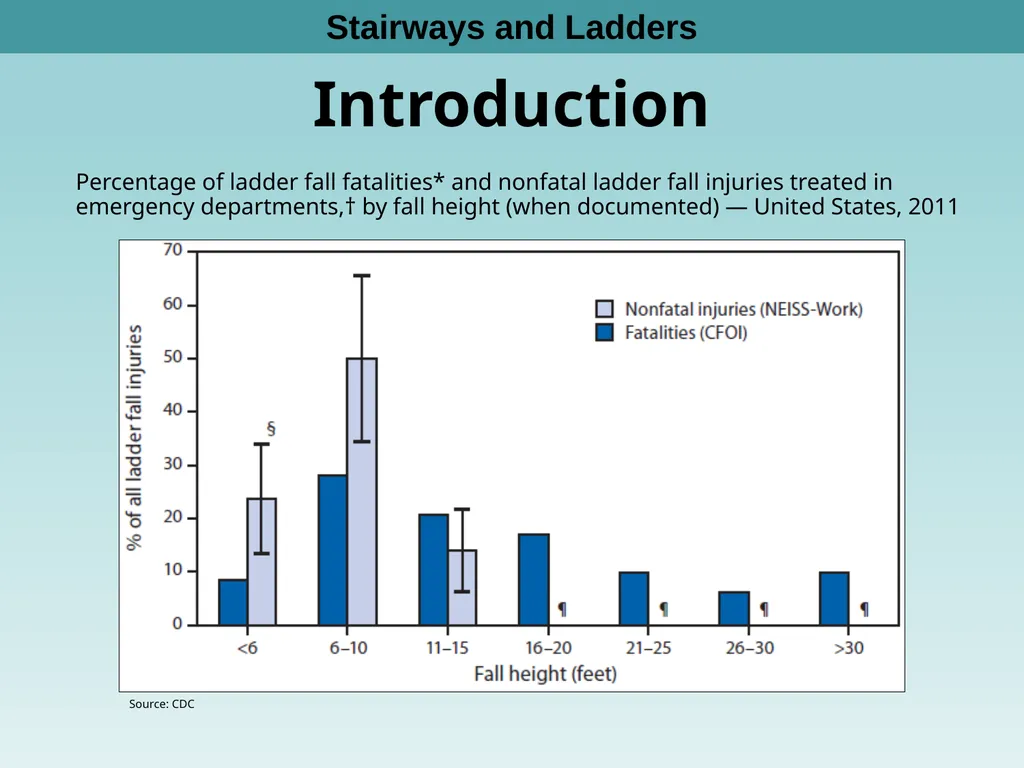
Introduction Percentage of ladder fall fatalities* and nonfatal ladder fall injuries treated in emergency departments,† by fall height (when documented) — United States, 2011 Source: CDC Stairways and Ladders<br>
05
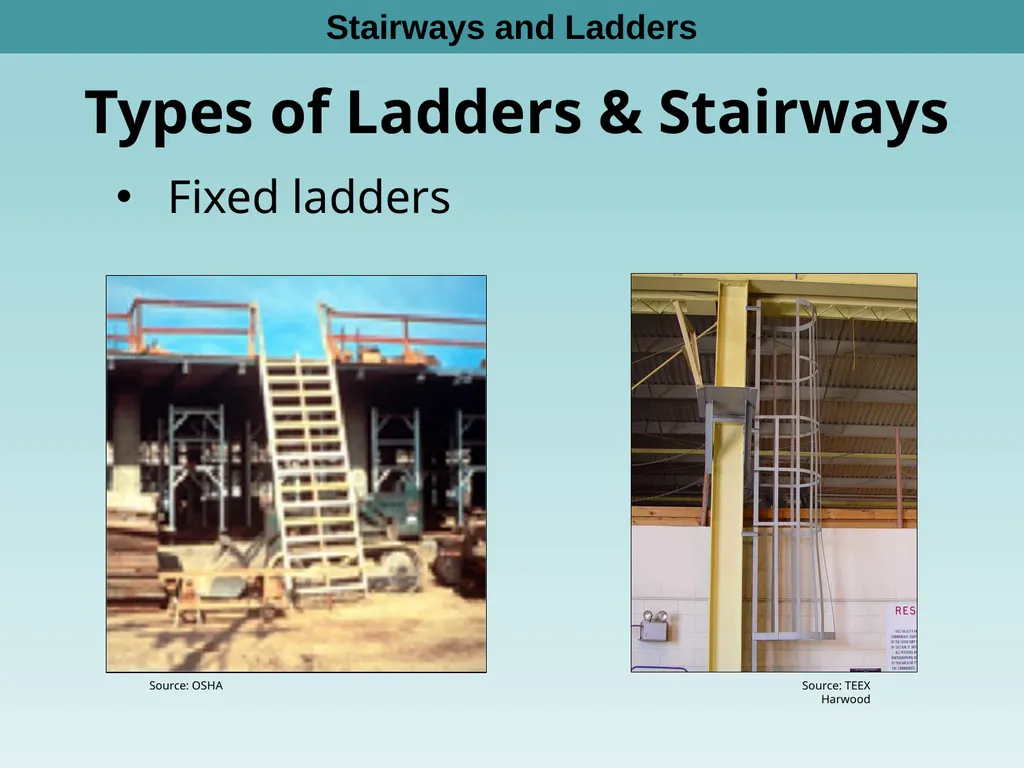
Types of Ladders & Stairways Fixed ladders Source: OSHA Source: TEEX Harwood Stairways and Ladders<br>
06
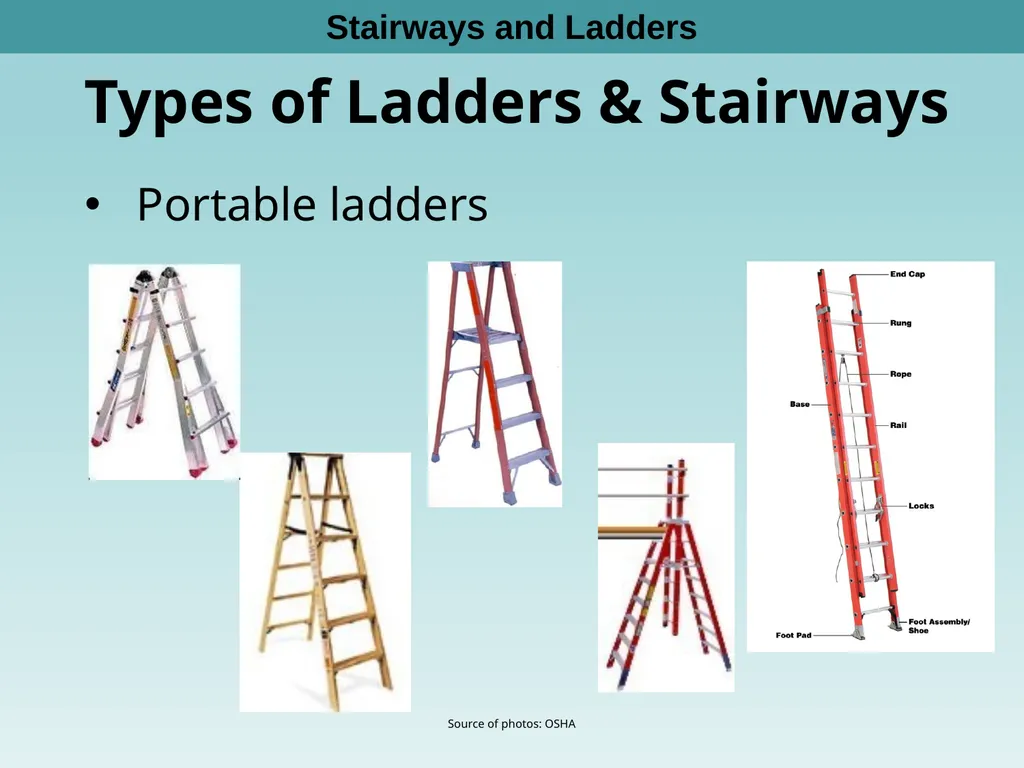
Types of Ladders & Stairways Portable ladders Source of photos: OSHA Stairways and Ladders<br>
07
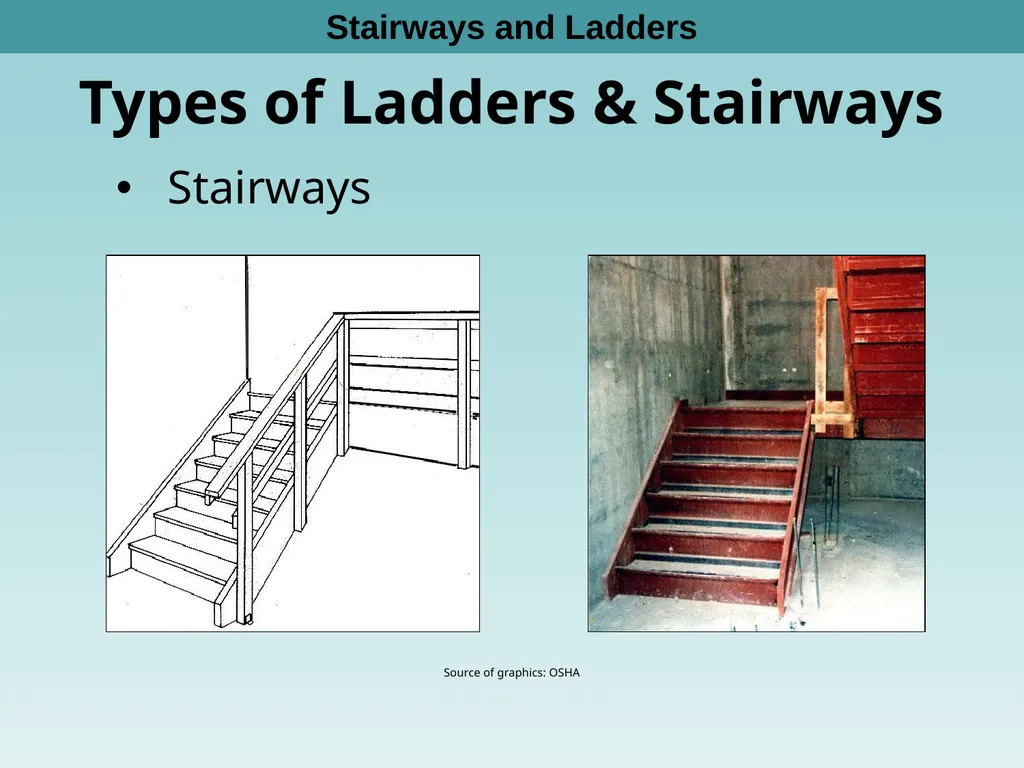
Stairways Source of graphics: OSHA Types of Ladders & Stairways Stairways and Ladders<br>
08
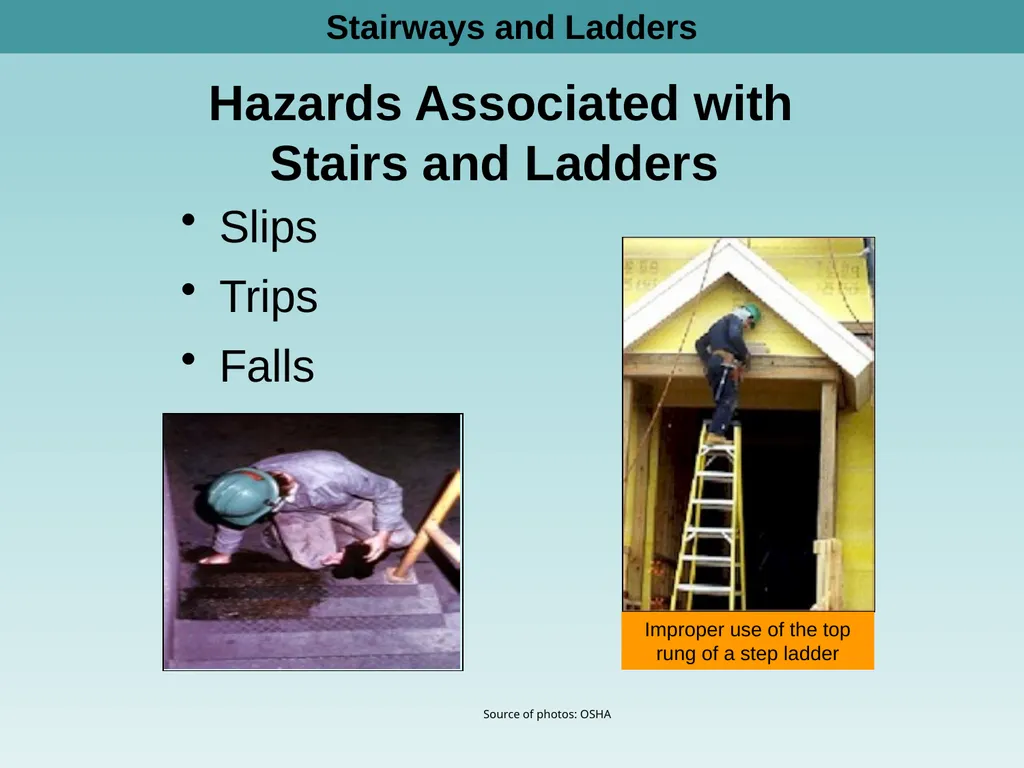
Slips
Trips
Falls Hazards Associated with Stairs and Ladders Improper use of the top rung of a step ladder Source of photos: OSHA Stairways and Ladders<br>
Trips
Falls Hazards Associated with Stairs and Ladders Improper use of the top rung of a step ladder Source of photos: OSHA Stairways and Ladders<br>
09
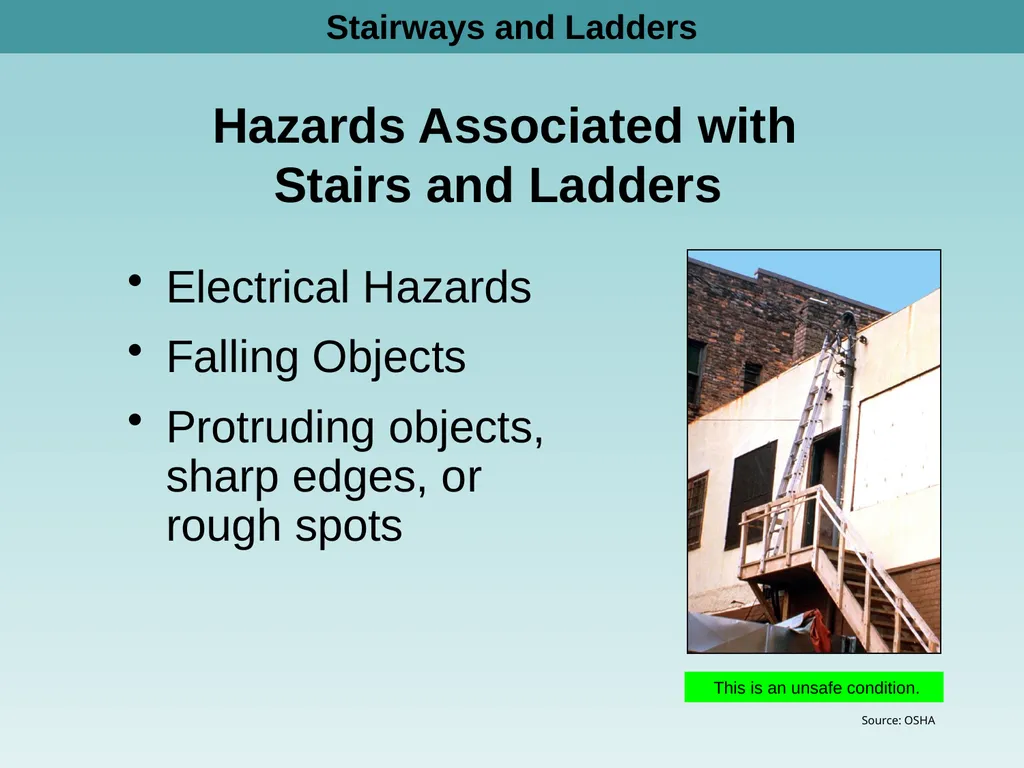
Electrical Hazards
Falling Objects
Protruding objects, sharp edges, or rough spots Hazards Associated with Stairs and Ladders Source: OSHA This is an unsafe condition. Stairways and Ladders<br>
Falling Objects
Protruding objects, sharp edges, or rough spots Hazards Associated with Stairs and Ladders Source: OSHA This is an unsafe condition. Stairways and Ladders<br>
10
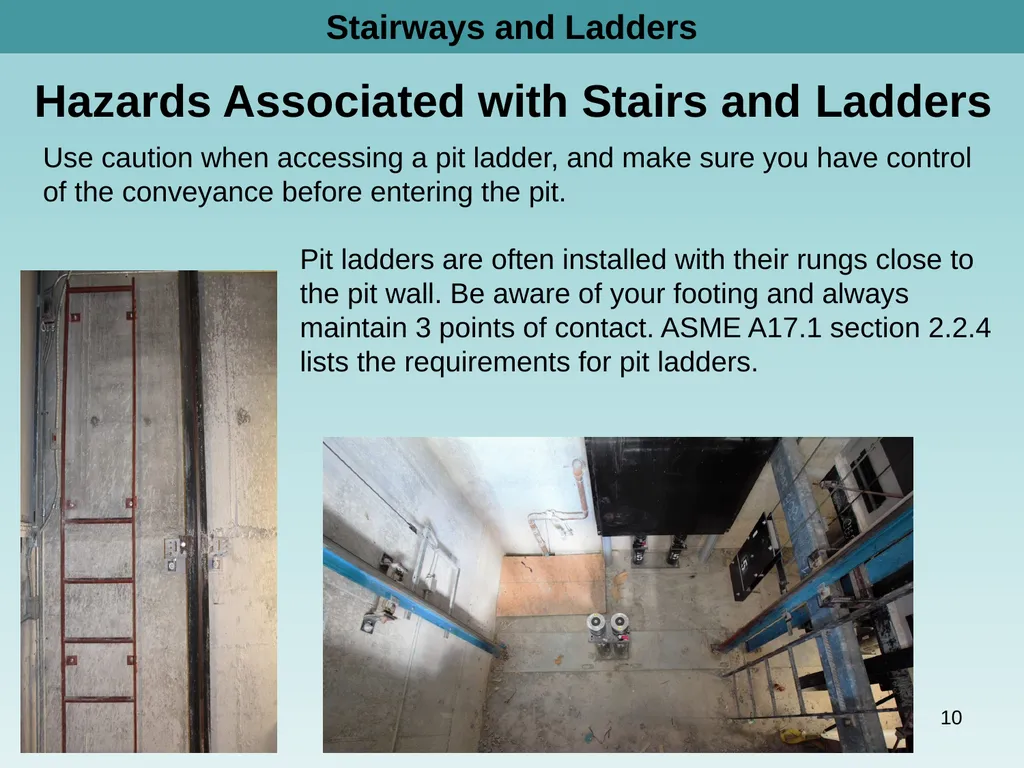
10 Hazards Associated with Stairs and Ladders Stairways and Ladders Use caution when accessing a pit ladder, and make sure you have control
of the conveyance before entering the pit. Pit ladders are often installed with their rungs close to
the pit wall. Be aware of your footing and always
maintain 3 points of contact. ASME A17.1 section 2.2.4
lists the requirements for pit ladders.<br>
of the conveyance before entering the pit. Pit ladders are often installed with their rungs close to
the pit wall. Be aware of your footing and always
maintain 3 points of contact. ASME A17.1 section 2.2.4
lists the requirements for pit ladders.<br>
11
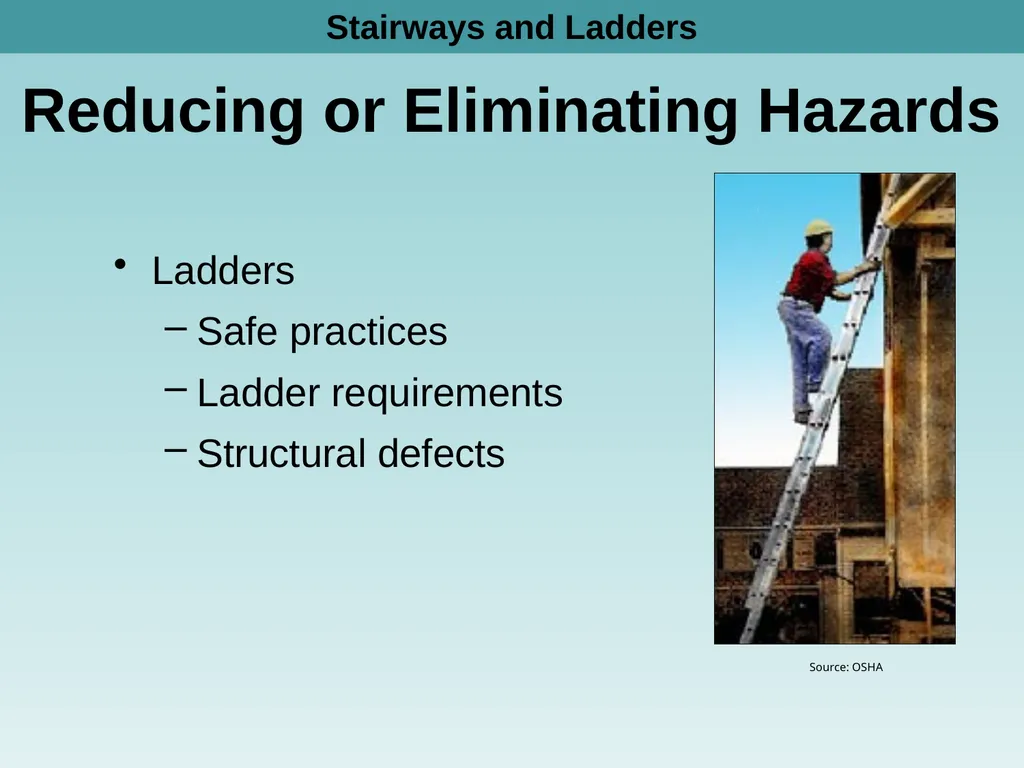
Ladders
Safe practices
Ladder requirements
Structural defects Reducing or Eliminating Hazards Source: OSHA Stairways and Ladders<br>
Safe practices
Ladder requirements
Structural defects Reducing or Eliminating Hazards Source: OSHA Stairways and Ladders<br>
12
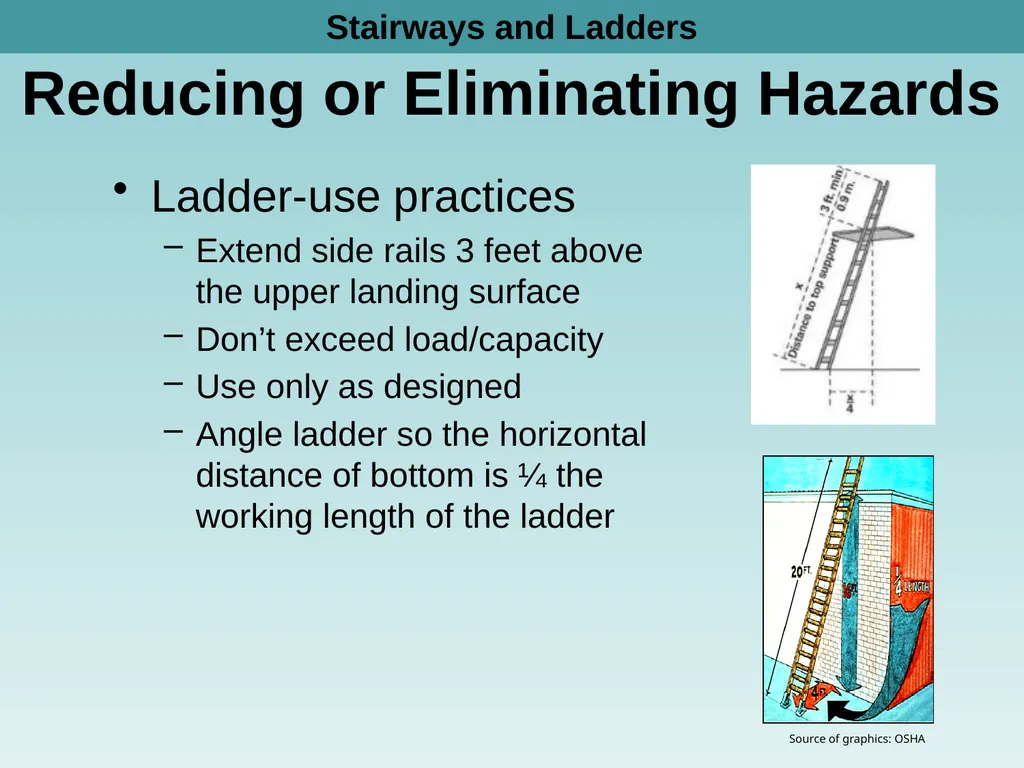
Ladder-use practices
Extend side rails 3 feet above the upper landing surface
Don’t exceed load/capacity
Use only as designed
Angle ladder so the horizontal distance of bottom is ¼ the working length of the ladder Source of graphics: OSHA Reducing or Eliminating Hazards Stairways and Ladders<br>
Extend side rails 3 feet above the upper landing surface
Don’t exceed load/capacity
Use only as designed
Angle ladder so the horizontal distance of bottom is ¼ the working length of the ladder Source of graphics: OSHA Reducing or Eliminating Hazards Stairways and Ladders<br>
13
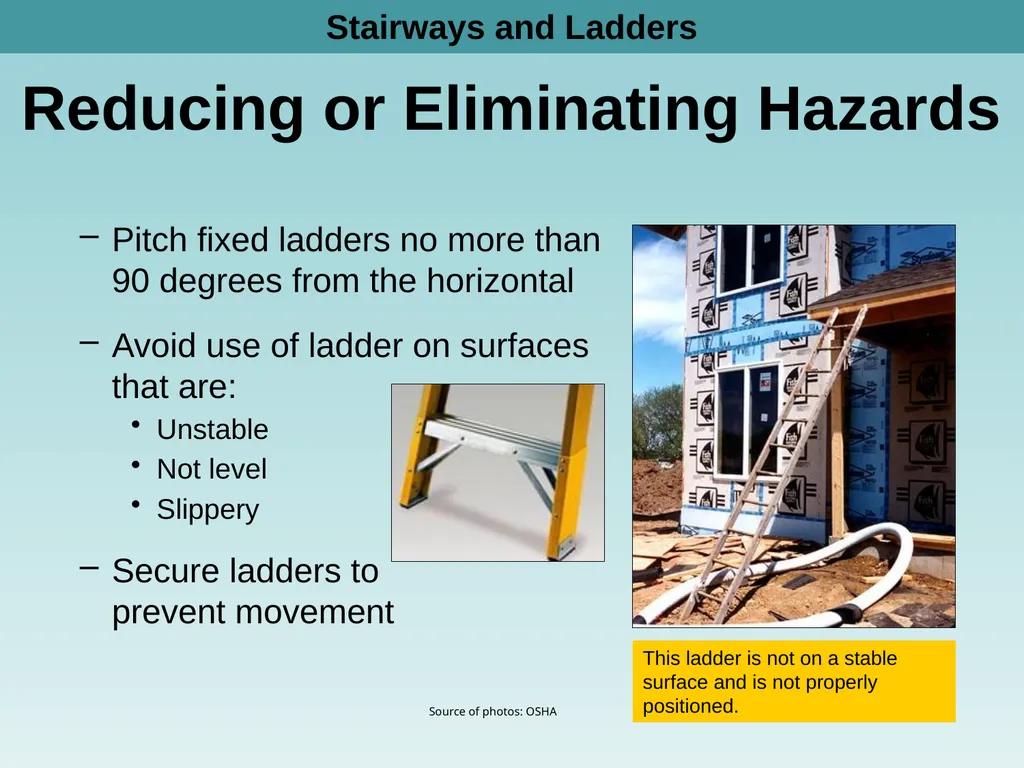
Pitch fixed ladders no more than 90 degrees from the horizontal
Avoid use of ladder on surfaces that are:
Unstable
Not level
Slippery
Secure ladders to prevent movement Reducing or Eliminating Hazards This ladder is not on a stable surface and is not properly positioned. Source of photos: OSHA Stairways and Ladders<br>
Avoid use of ladder on surfaces that are:
Unstable
Not level
Slippery
Secure ladders to prevent movement Reducing or Eliminating Hazards This ladder is not on a stable surface and is not properly positioned. Source of photos: OSHA Stairways and Ladders<br>
14
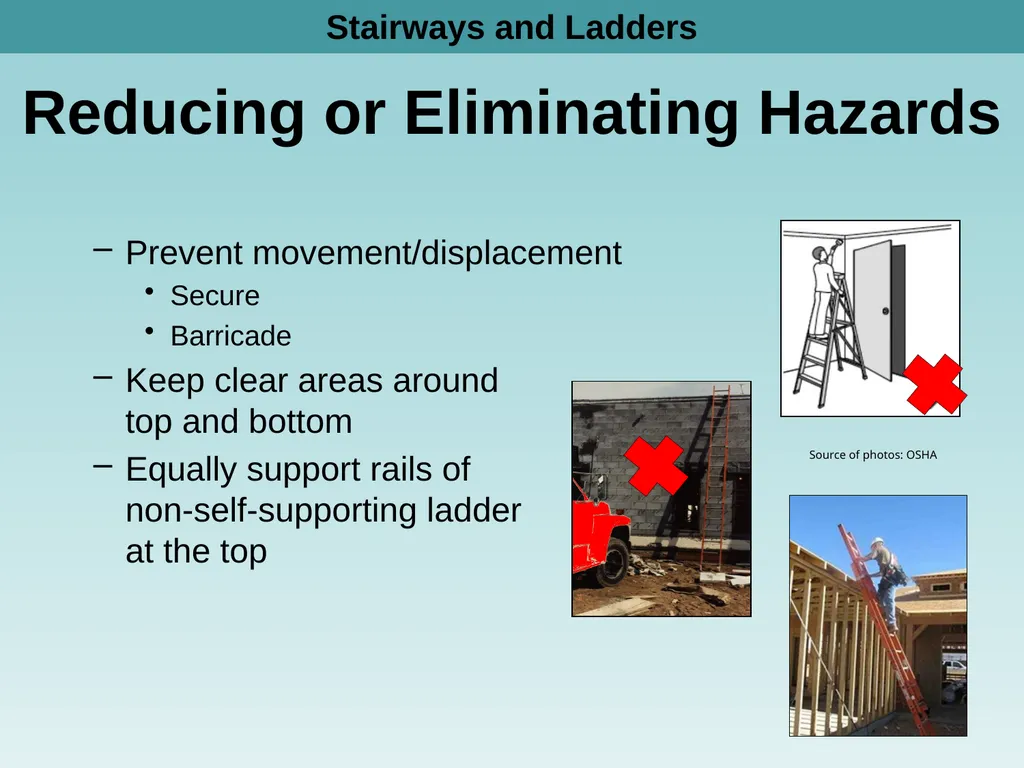
Prevent movement/displacement
Secure
Barricade
Keep clear areas around top and bottom
Equally support rails of non-self-supporting ladder at the top Source of photos: OSHA Reducing or Eliminating Hazards Stairways and Ladders<br>
Secure
Barricade
Keep clear areas around top and bottom
Equally support rails of non-self-supporting ladder at the top Source of photos: OSHA Reducing or Eliminating Hazards Stairways and Ladders<br>
15
Ascending or descending ladder
Maintain 3-point contact
Face ladder
Stay inside side rails
Never carry tools/objects in hands
Be extra careful getting on or off Source: OSHA Reducing or Eliminating Hazards Source: OSHA Stairways and Ladders<br>
Maintain 3-point contact
Face ladder
Stay inside side rails
Never carry tools/objects in hands
Be extra careful getting on or off Source: OSHA Reducing or Eliminating Hazards Source: OSHA Stairways and Ladders<br>
16
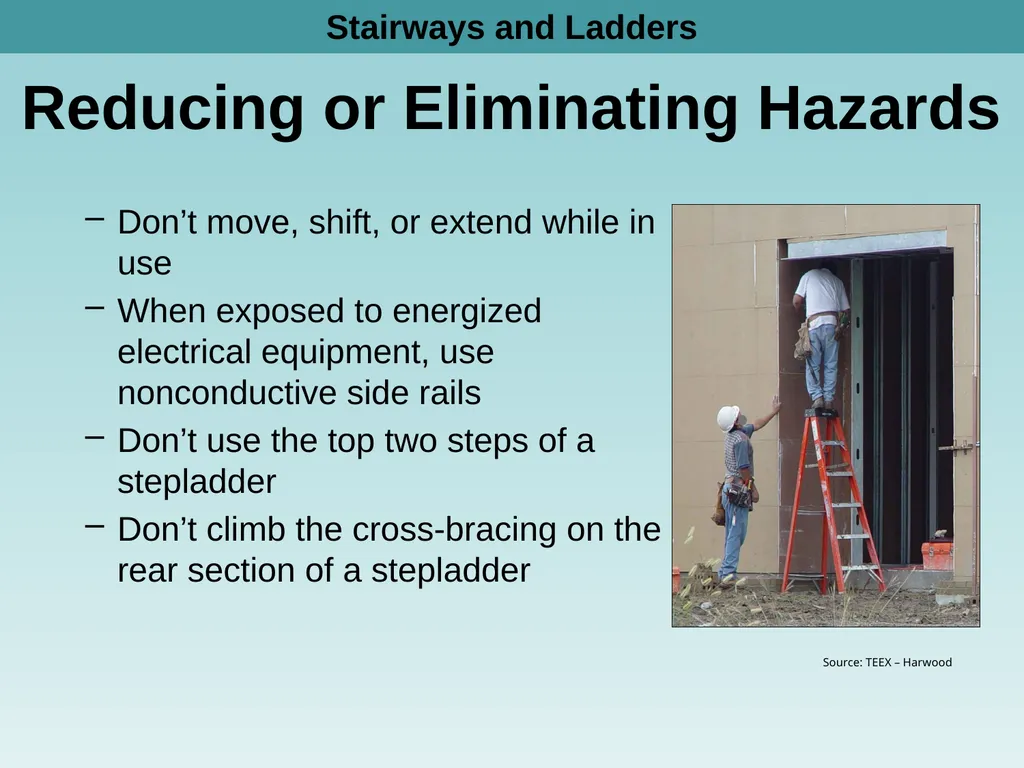
Don’t move, shift, or extend while in use
When exposed to energized electrical equipment, use nonconductive side rails
Don’t use the top two steps of a stepladder
Don’t climb the cross-bracing on the rear section of a stepladder Reducing or Eliminating Hazards Source: TEEX – Harwood Stairways and Ladders<br>
When exposed to energized electrical equipment, use nonconductive side rails
Don’t use the top two steps of a stepladder
Don’t climb the cross-bracing on the rear section of a stepladder Reducing or Eliminating Hazards Source: TEEX – Harwood Stairways and Ladders<br>
17
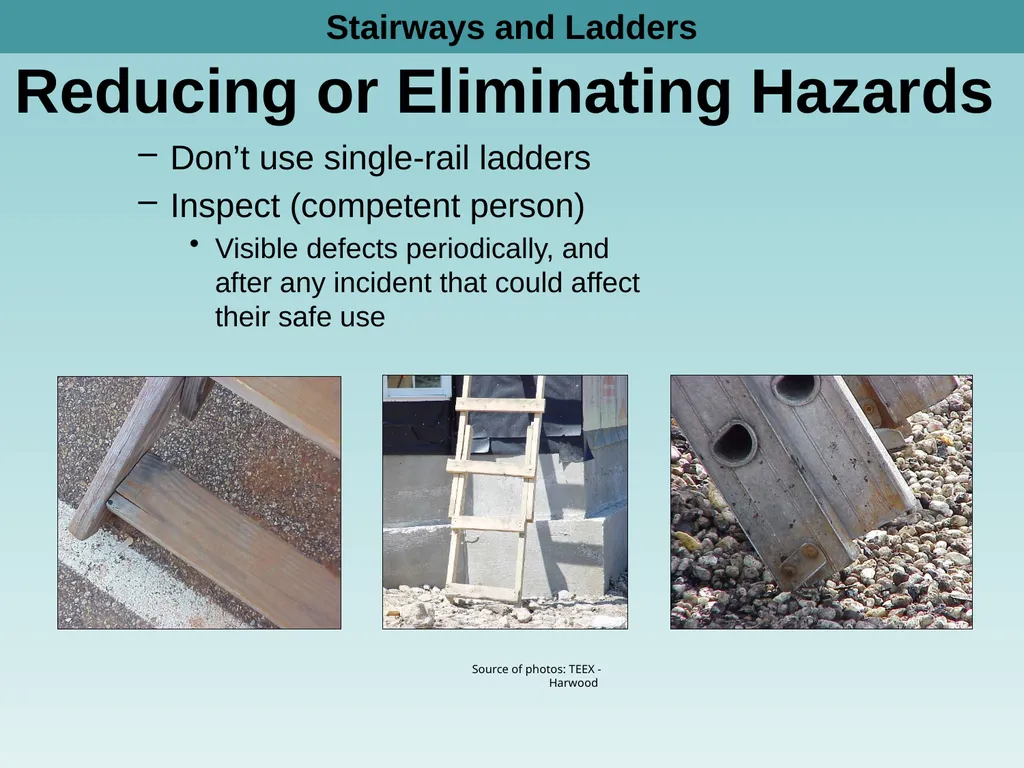
Don’t use single-rail ladders
Inspect (competent person)
Visible defects periodically, and after any incident that could affect their safe use Source of photos: TEEX - Harwood Reducing or Eliminating Hazards Stairways and Ladders<br>
Inspect (competent person)
Visible defects periodically, and after any incident that could affect their safe use Source of photos: TEEX - Harwood Reducing or Eliminating Hazards Stairways and Ladders<br>
18
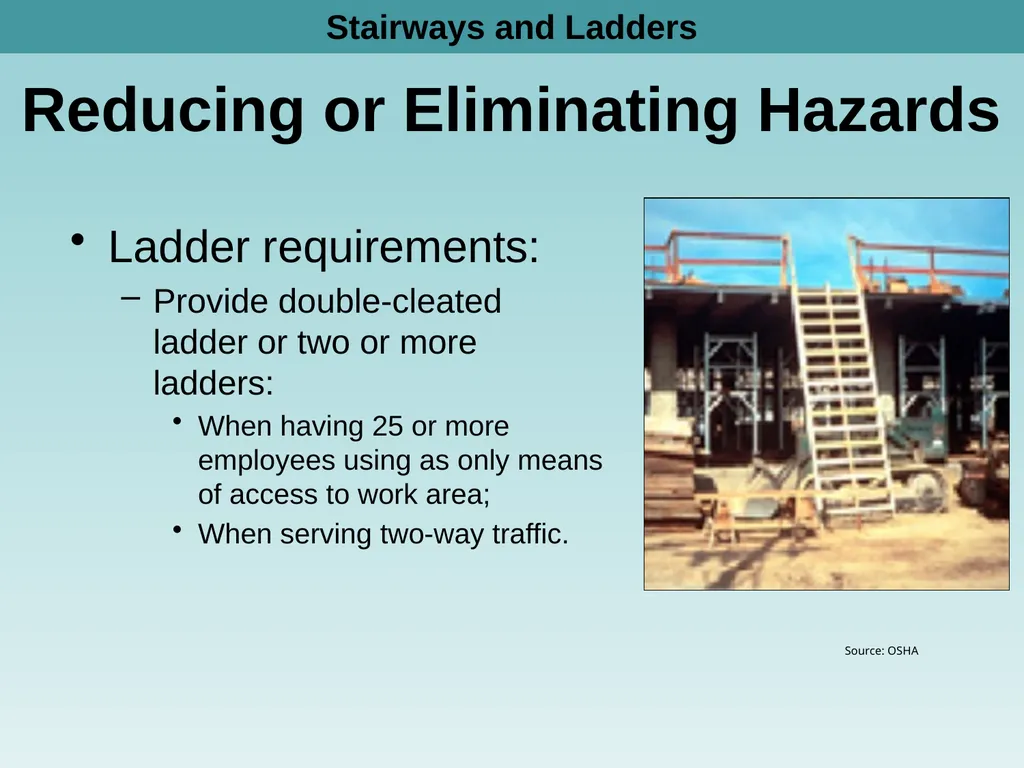
Ladder requirements:
Provide double-cleated ladder or two or more ladders:
When having 25 or more employees using as only means of access to work area;
When serving two-way traffic. Source: OSHA Reducing or Eliminating Hazards Stairways and Ladders<br>
Provide double-cleated ladder or two or more ladders:
When having 25 or more employees using as only means of access to work area;
When serving two-way traffic. Source: OSHA Reducing or Eliminating Hazards Stairways and Ladders<br>
19
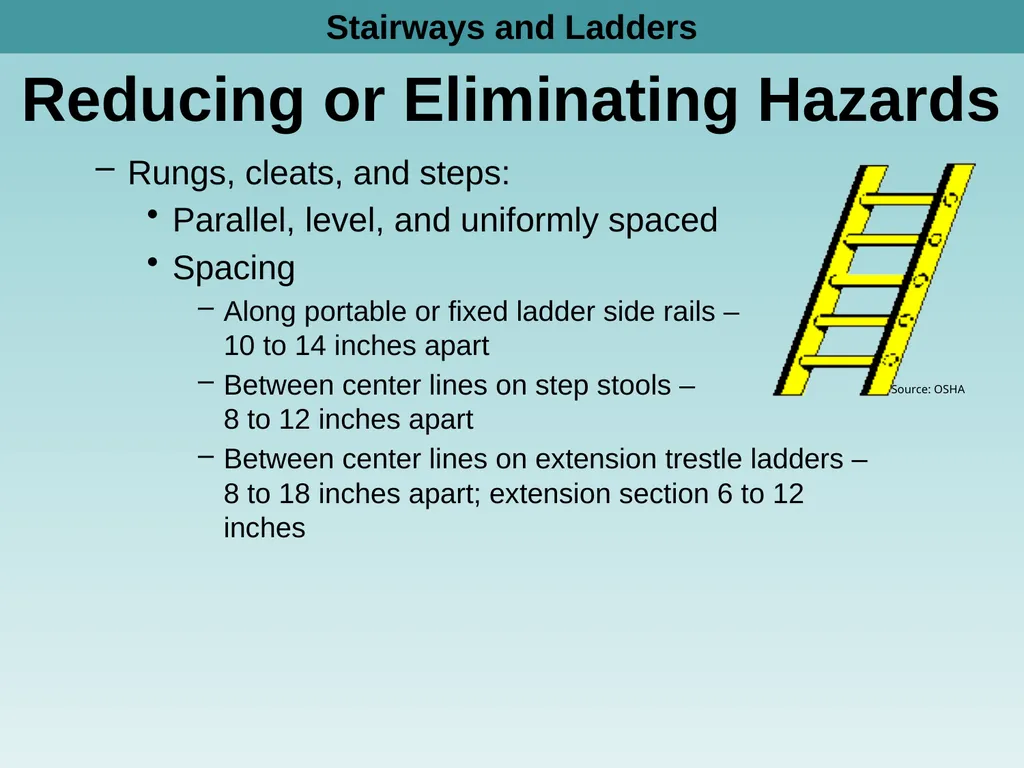
Rungs, cleats, and steps:
Parallel, level, and uniformly spaced
Spacing
Along portable or fixed ladder side rails – 10 to 14 inches apart
Between center lines on step stools – 8 to 12 inches apart
Between center lines on extension trestle ladders – 8 to 18 inches apart; extension section 6 to 12 inches Source: OSHA Reducing or Eliminating Hazards Stairways and Ladders<br>
Parallel, level, and uniformly spaced
Spacing
Along portable or fixed ladder side rails – 10 to 14 inches apart
Between center lines on step stools – 8 to 12 inches apart
Between center lines on extension trestle ladders – 8 to 18 inches apart; extension section 6 to 12 inches Source: OSHA Reducing or Eliminating Hazards Stairways and Ladders<br>
20
Don’t tie or fasten together to create longer sections, unless design allows
Side rail of spliced side rails must have strength equal to one-piece side rail
Stepladder must have a metal spreader or locking device to hold in open position. Source: OSHA Source: OSHA Reducing or Eliminating Hazards Stairways and Ladders<br>
Side rail of spliced side rails must have strength equal to one-piece side rail
Stepladder must have a metal spreader or locking device to hold in open position. Source: OSHA Source: OSHA Reducing or Eliminating Hazards Stairways and Ladders<br>
21
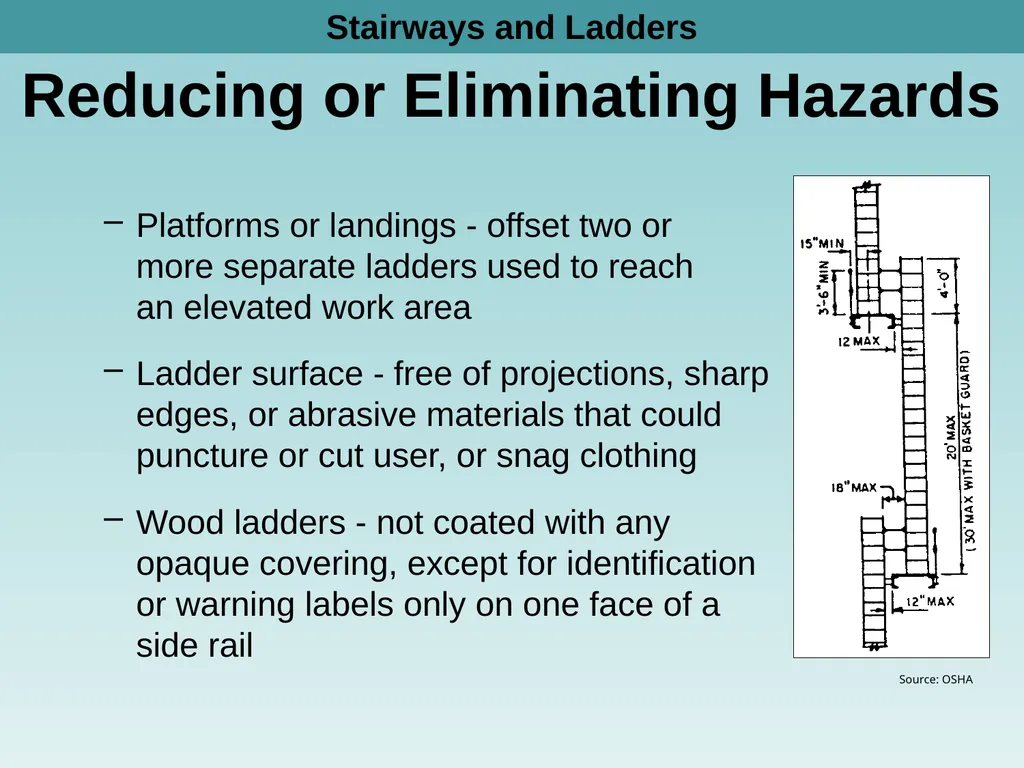
Platforms or landings - offset two or
more separate ladders used to reach
an elevated work area
Ladder surface - free of projections, sharp edges, or abrasive materials that could puncture or cut user, or snag clothing
Wood ladders - not coated with any opaque covering, except for identification or warning labels only on one face of a side rail Reducing or Eliminating Hazards Source: OSHA Stairways and Ladders<br>
Ladder surface - free of projections, sharp edges, or abrasive materials that could puncture or cut user, or snag clothing
Wood ladders - not coated with any opaque covering, except for identification or warning labels only on one face of a side rail Reducing or Eliminating Hazards Source: OSHA Stairways and Ladders<br>
22
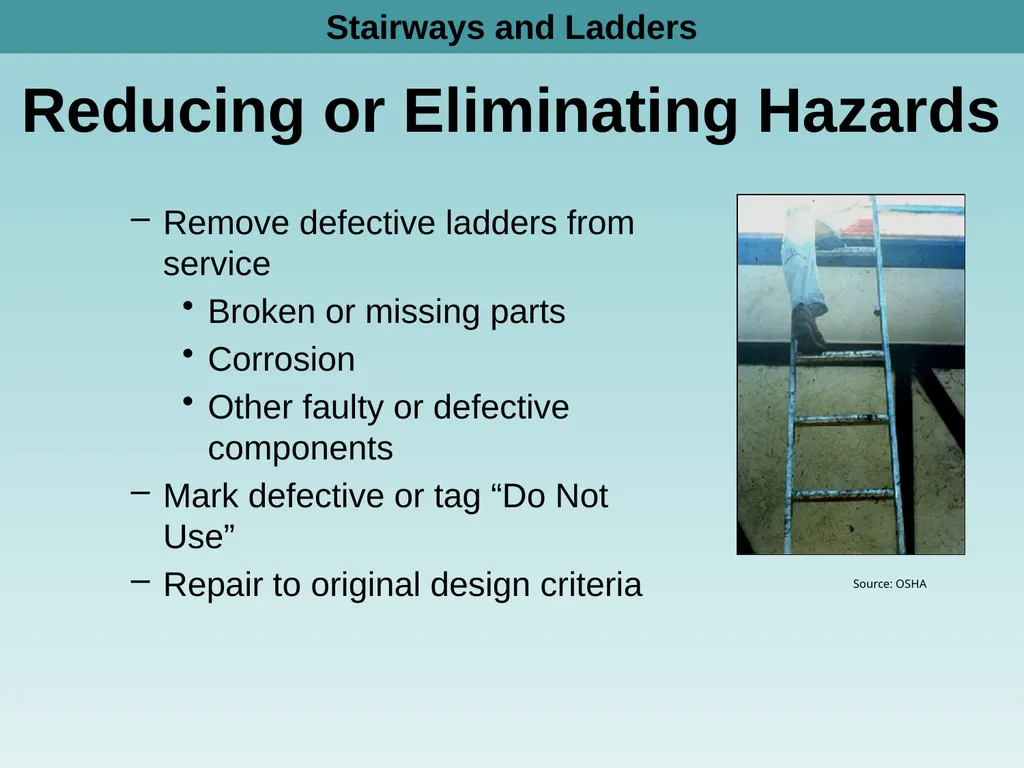
Remove defective ladders from service
Broken or missing parts
Corrosion
Other faulty or defective components
Mark defective or tag “Do Not Use”
Repair to original design criteria Source: OSHA Reducing or Eliminating Hazards Stairways and Ladders<br>
Broken or missing parts
Corrosion
Other faulty or defective components
Mark defective or tag “Do Not Use”
Repair to original design criteria Source: OSHA Reducing or Eliminating Hazards Stairways and Ladders<br>
23
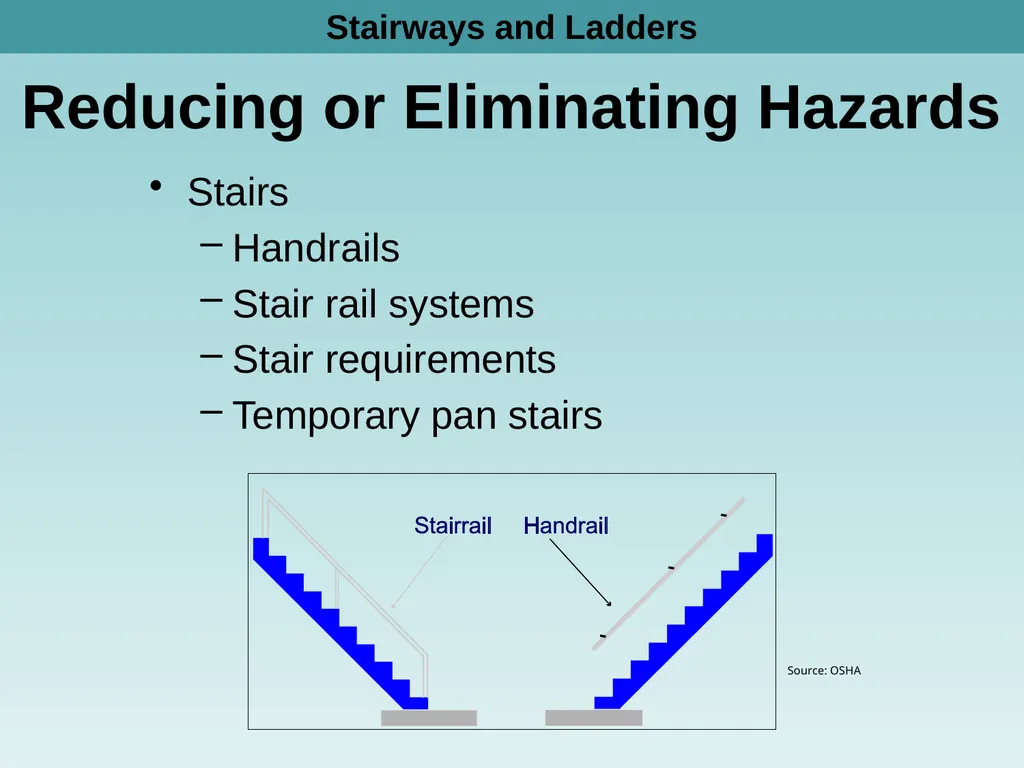
Stairs
Handrails
Stair rail systems
Stair requirements
Temporary pan stairs Reducing or Eliminating Hazards Source: OSHA Stairways and Ladders<br>
Handrails
Stair rail systems
Stair requirements
Temporary pan stairs Reducing or Eliminating Hazards Source: OSHA Stairways and Ladders<br>
24
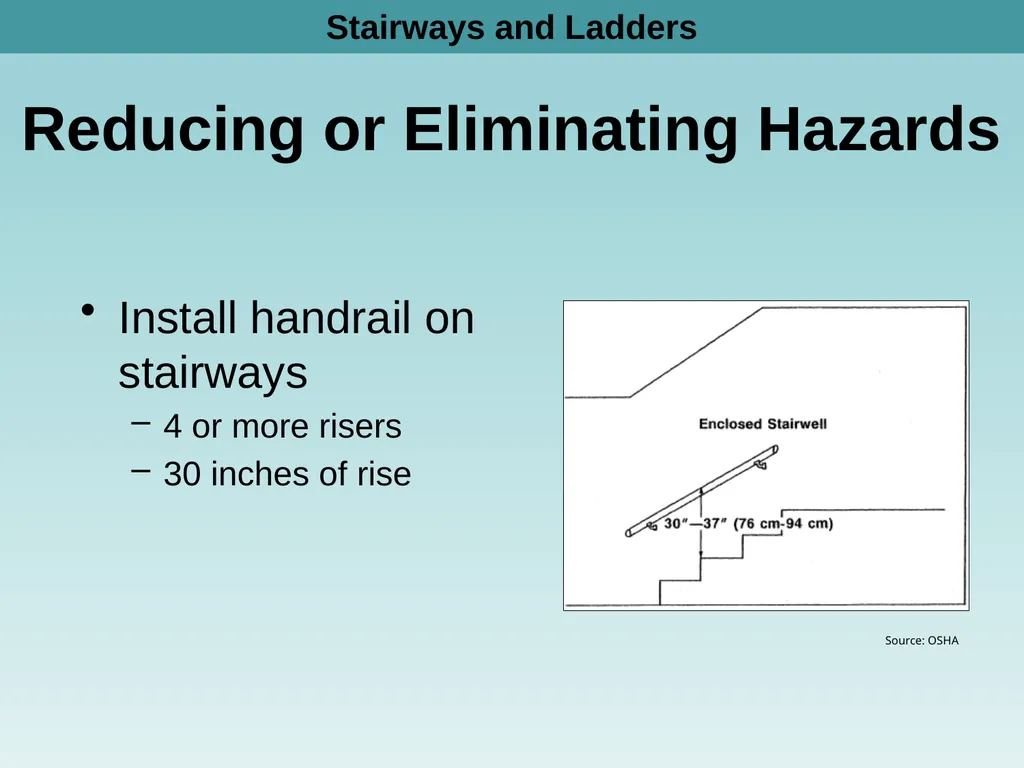
Install handrail on stairways
4 or more risers
30 inches of rise Reducing or Eliminating Hazards Source: OSHA Stairways and Ladders<br>
4 or more risers
30 inches of rise Reducing or Eliminating Hazards Source: OSHA Stairways and Ladders<br>
25
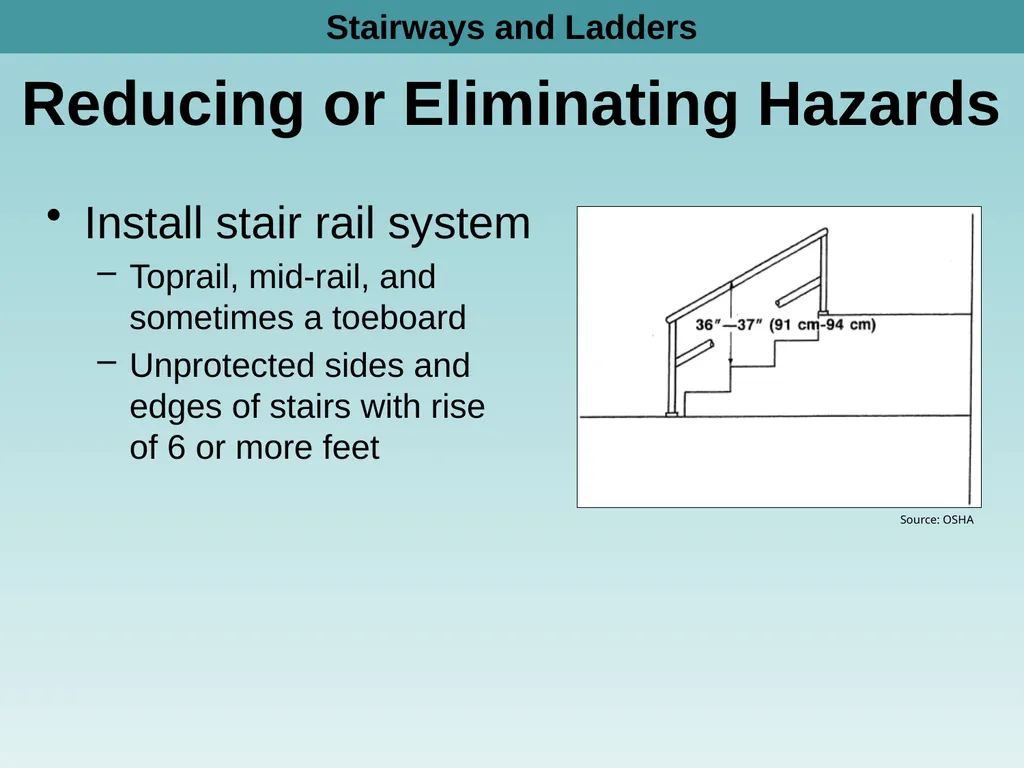
Install stair rail system
Toprail, mid-rail, and sometimes a toeboard
Unprotected sides and edges of stairs with rise of 6 or more feet Reducing or Eliminating Hazards Source: OSHA Stairways and Ladders<br>
Toprail, mid-rail, and sometimes a toeboard
Unprotected sides and edges of stairs with rise of 6 or more feet Reducing or Eliminating Hazards Source: OSHA Stairways and Ladders<br>
26
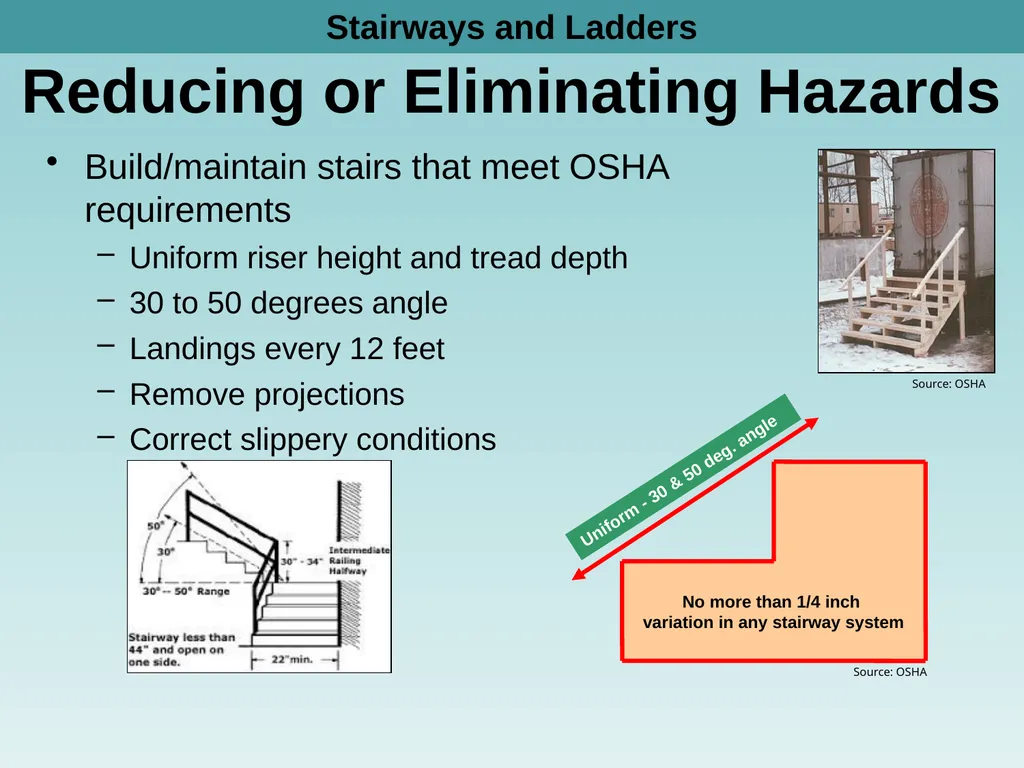
Build/maintain stairs that meet OSHA requirements
Uniform riser height and tread depth
30 to 50 degrees angle
Landings every 12 feet
Remove projections
Correct slippery conditions Reducing or Eliminating Hazards Source: OSHA Source: OSHA Stairways and Ladders<br>
Uniform riser height and tread depth
30 to 50 degrees angle
Landings every 12 feet
Remove projections
Correct slippery conditions Reducing or Eliminating Hazards Source: OSHA Source: OSHA Stairways and Ladders<br>
27
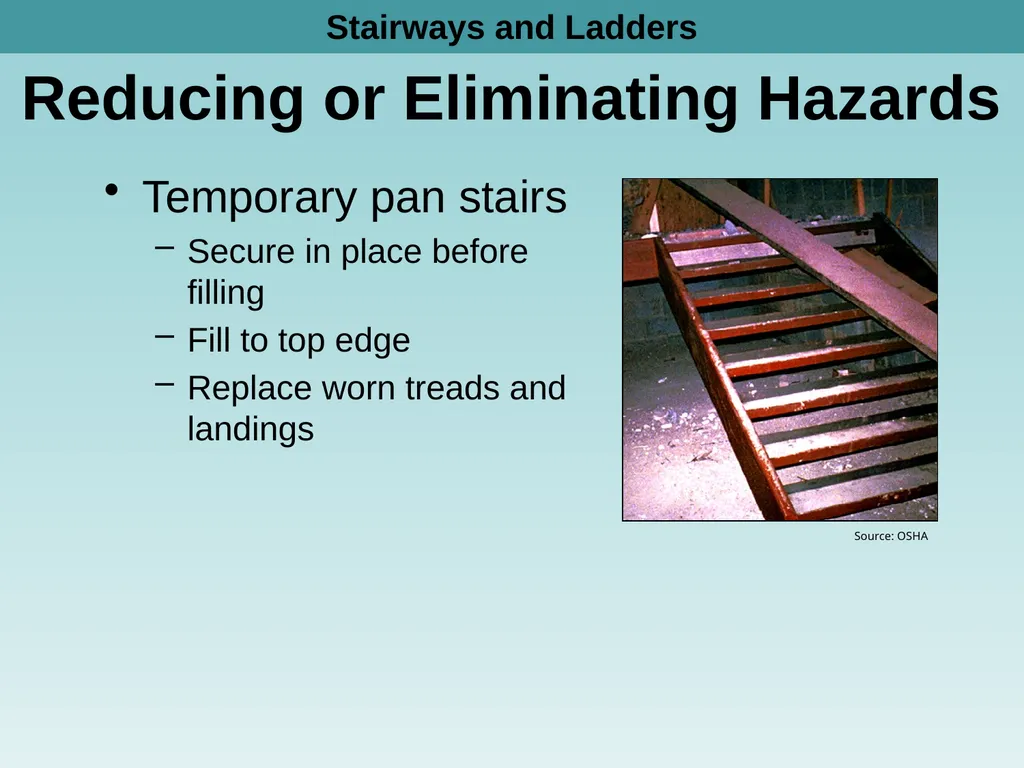
Temporary pan stairs
Secure in place before filling
Fill to top edge
Replace worn treads and landings Reducing or Eliminating Hazards Source: OSHA Stairways and Ladders<br>
Secure in place before filling
Fill to top edge
Replace worn treads and landings Reducing or Eliminating Hazards Source: OSHA Stairways and Ladders<br>
28
Comply with OSHA standards related to stairs and ladders
Training
Inspection
Comply with manufacturers’ requirements and recommendations for all ladders. Employer requirements Stairways and Ladders<br>
Training
Inspection
Comply with manufacturers’ requirements and recommendations for all ladders. Employer requirements Stairways and Ladders<br>
29
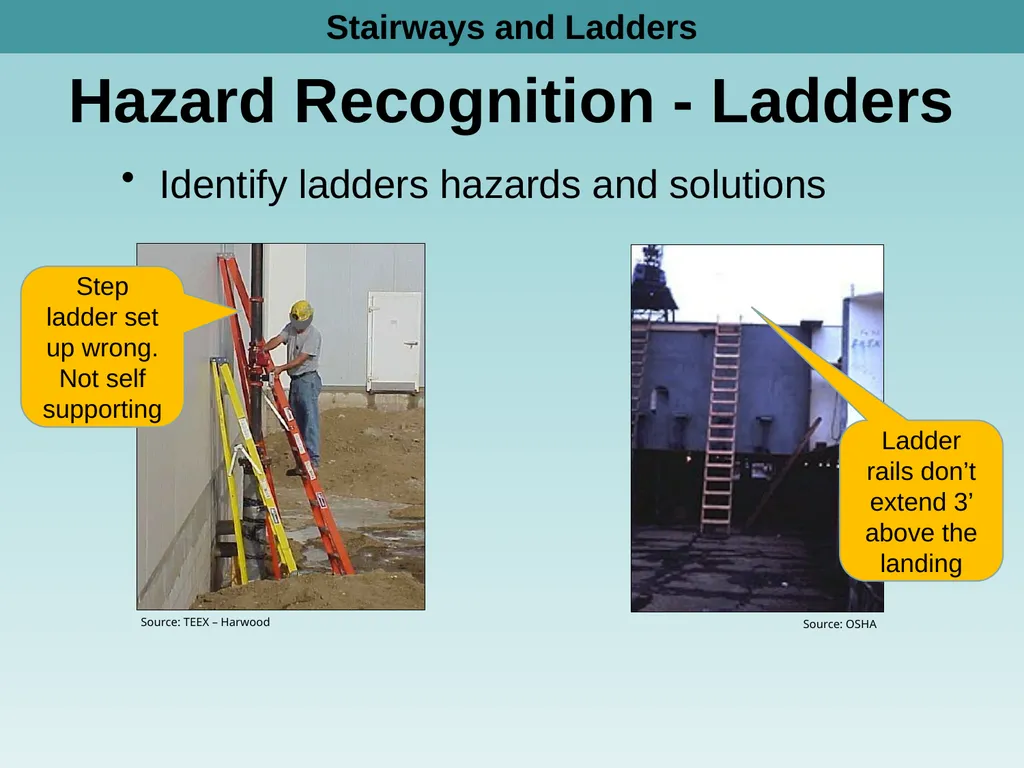
Identify ladders hazards and solutions Hazard Recognition - Ladders Source: TEEX – Harwood Source: OSHA Stairways and Ladders Step ladder set up wrong. Not self supporting Ladder rails don’t extend 3’ above the landing<br>
30
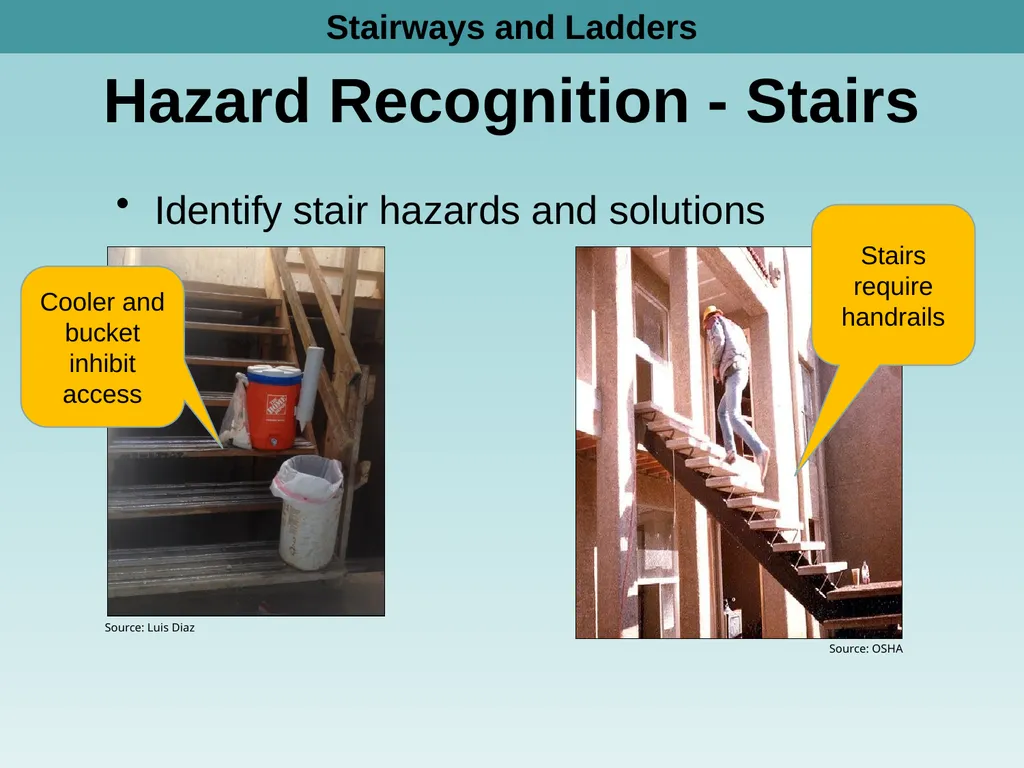
Identify stair hazards and solutions Hazard Recognition - Stairs Source: OSHA Source: Luis Diaz Stairways and Ladders Cooler and bucket inhibit access Stairs require handrails<br>
31
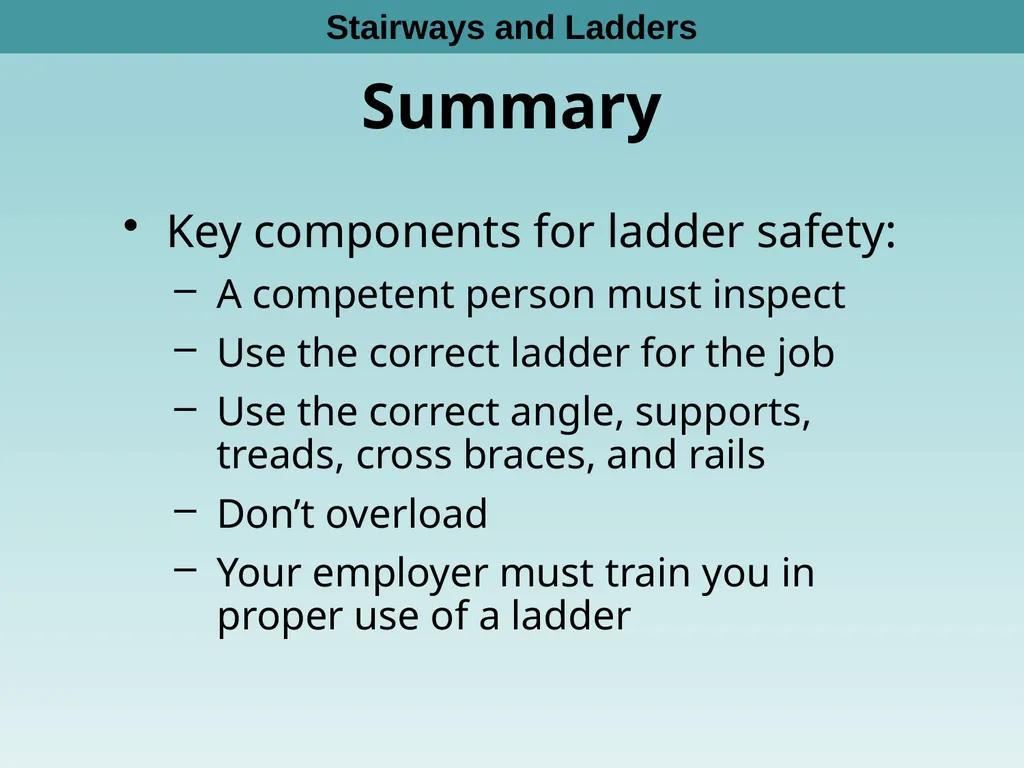
Summary Key components for ladder safety:
A competent person must inspect
Use the correct ladder for the job
Use the correct angle, supports, treads, cross braces, and rails
Don’t overload
Your employer must train you in proper use of a ladder Stairways and Ladders<br>
A competent person must inspect
Use the correct ladder for the job
Use the correct angle, supports, treads, cross braces, and rails
Don’t overload
Your employer must train you in proper use of a ladder Stairways and Ladders<br>
32
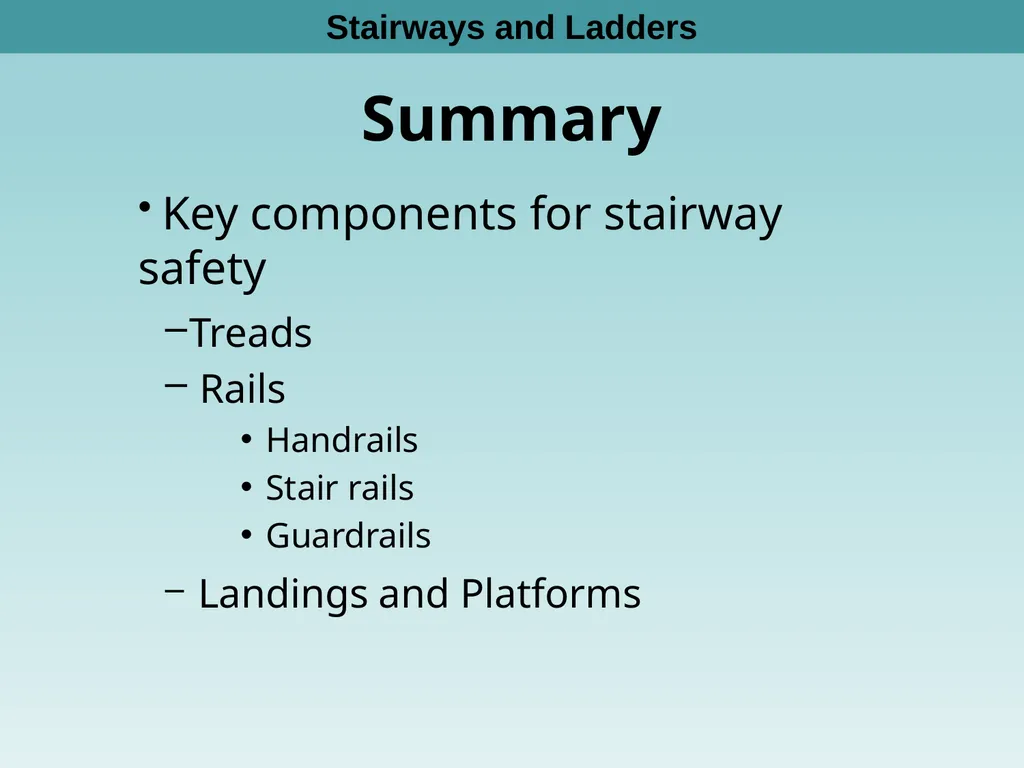
Summary Key components for stairway safety
Treads
Rails
Handrails
Stair rails
Guardrails
Landings and Platforms Stairways and Ladders<br>
Treads
Rails
Handrails
Stair rails
Guardrails
Landings and Platforms Stairways and Ladders<br>
33
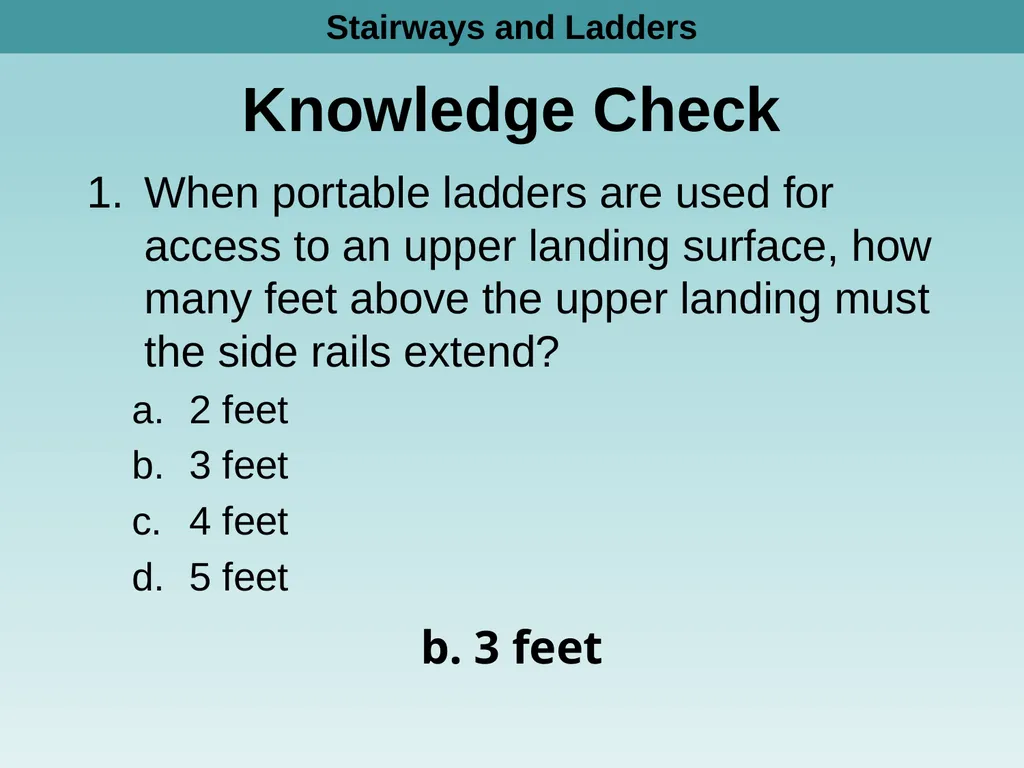
Knowledge Check When portable ladders are used for access to an upper landing surface, how many feet above the upper landing must the side rails extend?
2 feet
3 feet
4 feet
5 feet b. 3 feet Stairways and Ladders<br>
2 feet
3 feet
4 feet
5 feet b. 3 feet Stairways and Ladders<br>
34
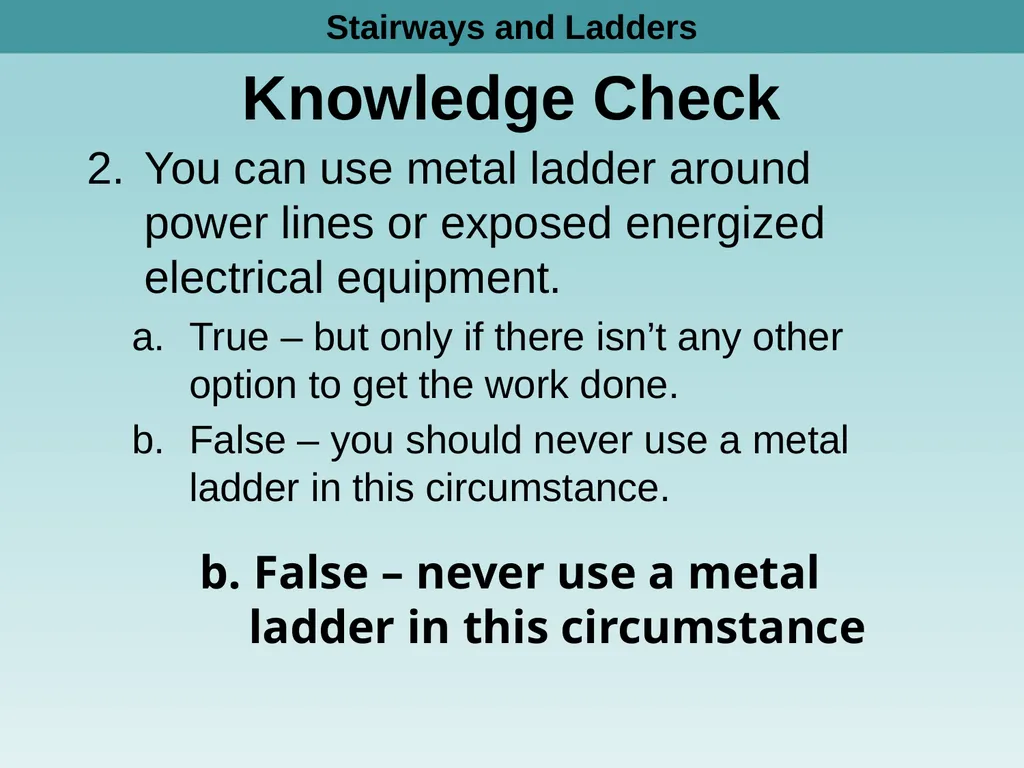
Knowledge Check You can use metal ladder around power lines or exposed energized electrical equipment.
True – but only if there isn’t any other option to get the work done.
False – you should never use a metal ladder in this circumstance. b. False – never use a metal ladder in this circumstance Stairways and Ladders<br>
True – but only if there isn’t any other option to get the work done.
False – you should never use a metal ladder in this circumstance. b. False – never use a metal ladder in this circumstance Stairways and Ladders<br>
35
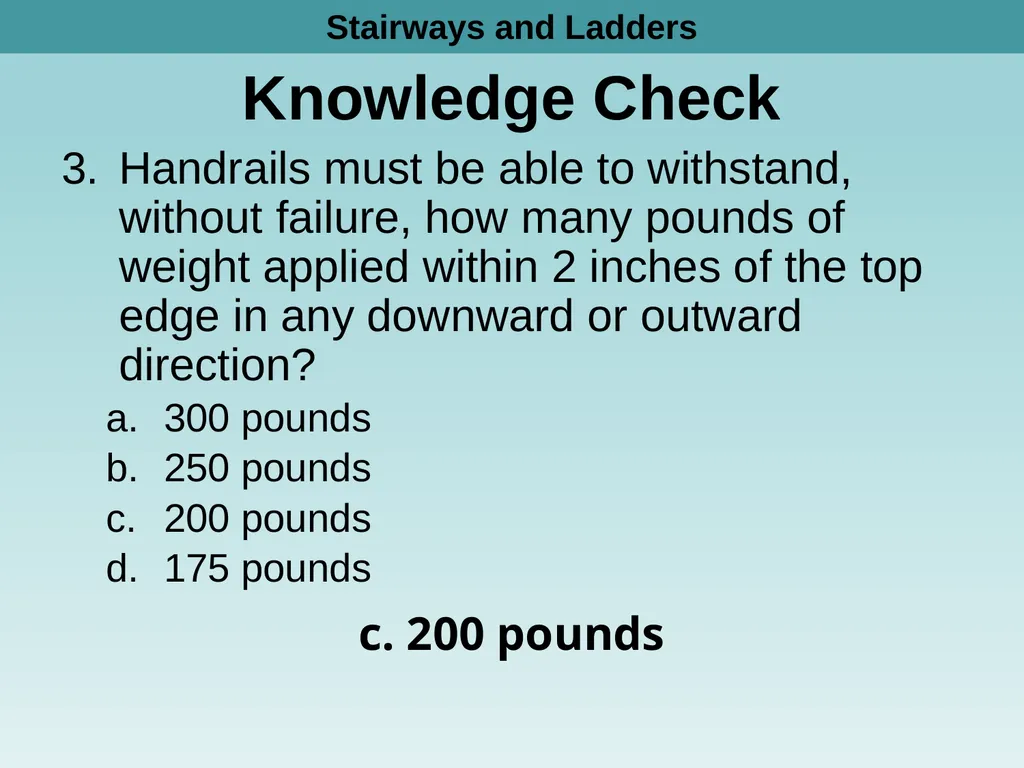
Knowledge Check Handrails must be able to withstand, without failure, how many pounds of weight applied within 2 inches of the top edge in any downward or outward direction?
300 pounds
250 pounds
200 pounds
175 pounds c. 200 pounds Stairways and Ladders<br>
300 pounds
250 pounds
200 pounds
175 pounds c. 200 pounds Stairways and Ladders<br>
36
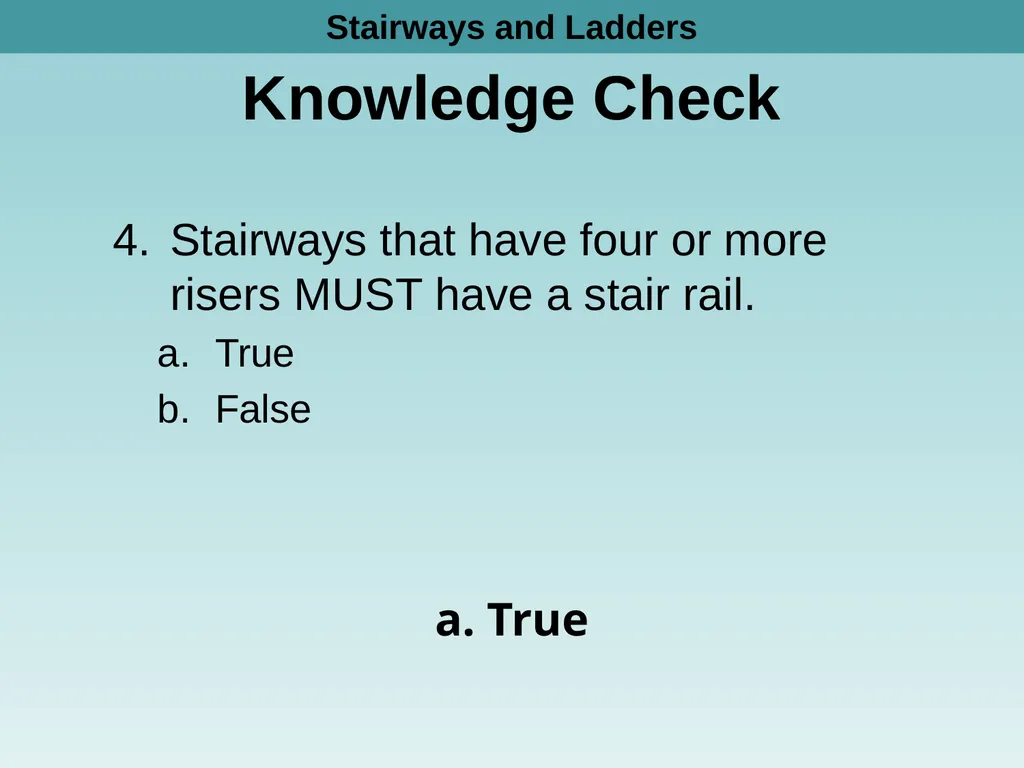
Knowledge Check Stairways that have four or more risers MUST have a stair rail.
True
False a. True Stairways and Ladders<br>
True
False a. True Stairways and Ladders<br>
37
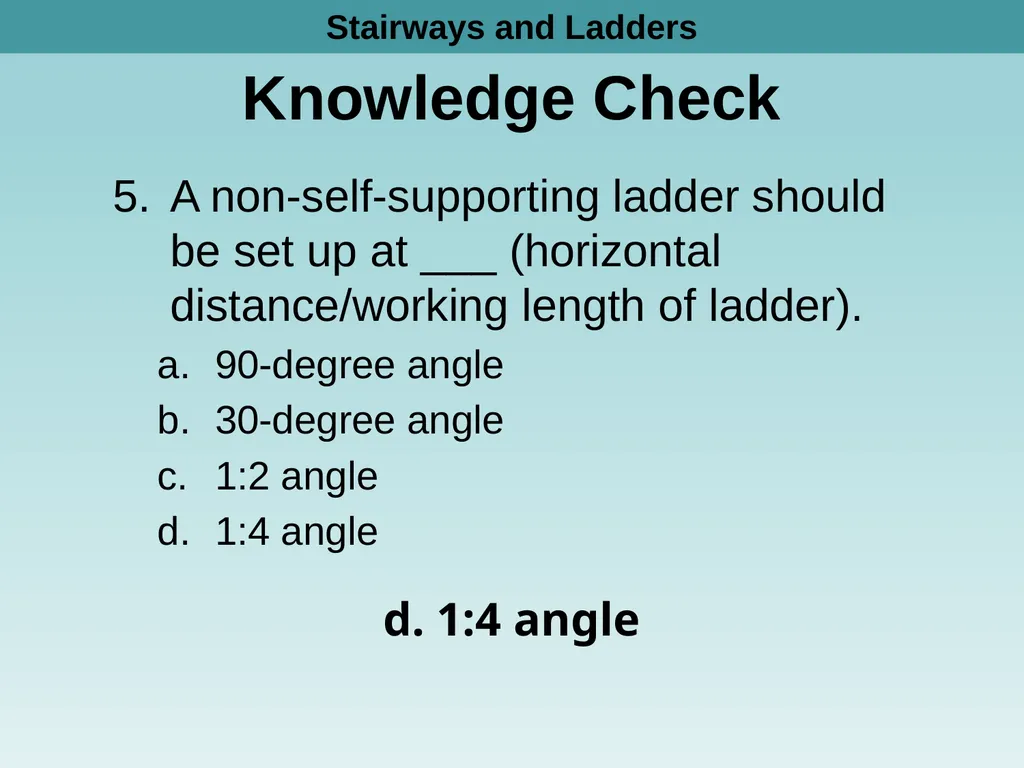
Knowledge Check A non-self-supporting ladder should be set up at ___ (horizontal distance/working length of ladder).
90-degree angle
30-degree angle
1:2 angle
1:4 angle d. 1:4 angle Stairways and Ladders<br>
90-degree angle
30-degree angle
1:2 angle
1:4 angle d. 1:4 angle Stairways and Ladders<br>
38
Stairways and Ladders Through the Alliance between OSHA’s 10 Regional Offices and the Elevator Contractors of America (ECA), Elevator Industry Work Preservation Fund (EIWPF), International Union of Elevator Constructors (IUEC), National Association of Elevator Contractors (NAEC), National Elevator Industry Educational Program (NEIEP), and National Elevator Industry Inc. (NEII), collectively known as The Elevator Industry Safety Partners, developed this Industry Specific Training for informational purposes only. It does not necessarily reflect the official views of OSHA or the U.S. Department of Labor. May 2021
Under the Occupational Safety and Health Act, employers are responsible (http://www.osha.gov/as/opa/worker/employer-responsibility.html) for providing a safe and healthy workplace and workers have rights (https://www.osha.gov/workers). OSHA can help answer questions or concerns from employers and workers. OSHA's On-Site Consultation Program (https://www.osha.gov/consultation) offers free and confidential advice to small and medium-sized businesses, with priority given to high-hazard worksites. For more information, contact your regional or area OSHA office (https://www.osha.gov/contactus/bystate), call 1-800-321-OSHA (6742), or visit https://www.osha.gov/.<br>
Under the Occupational Safety and Health Act, employers are responsible (http://www.osha.gov/as/opa/worker/employer-responsibility.html) for providing a safe and healthy workplace and workers have rights (https://www.osha.gov/workers). OSHA can help answer questions or concerns from employers and workers. OSHA's On-Site Consultation Program (https://www.osha.gov/consultation) offers free and confidential advice to small and medium-sized businesses, with priority given to high-hazard worksites. For more information, contact your regional or area OSHA office (https://www.osha.gov/contactus/bystate), call 1-800-321-OSHA (6742), or visit https://www.osha.gov/.<br>
39
Stairways and Ladders 39<br>