
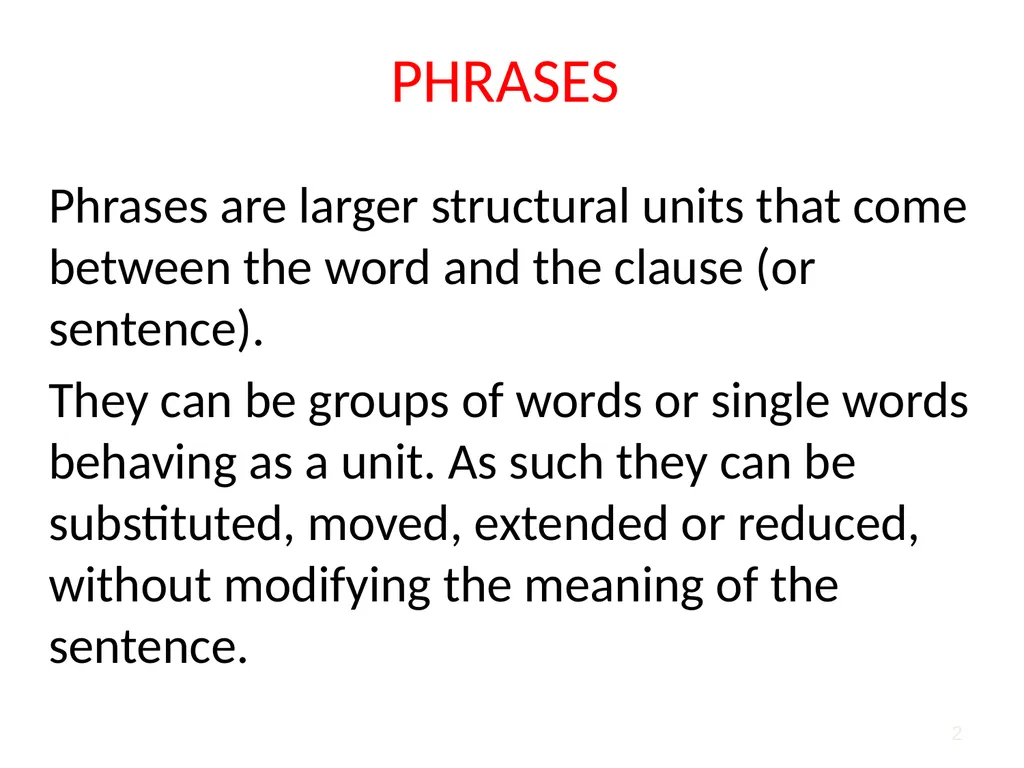
1 2 Phrases are larger structural units that come
A
Published · 22 slides · 0 views

1 / 1
Description
1 2 Phrases are larger structural units that come between the word and the clause (or sentence). They can be groups of words or single words behaving as a unit. As such they can be substituted, moved, extended or reduced, without modifying
Related Topics
Share
Embed code
Download this presentation From Below
"1 2 Phrases are larger structural units that come" is the property of its rightful owner. Permission is granted to download and print the materials on this website for personal, non-commercial use only, and to display it on your personal computer provided you do not modify the materials and that you retain all copyright notices contained in the materials. By downloading content from our website, you accept the terms of this agreement.
Presentation Transcript
01
1<br>
02
2 Phrases are larger structural units that come between the word and the clause (or sentence).
They can be groups of words or single words behaving as a unit. As such they can be substituted, moved, extended or reduced, without modifying the meaning of the sentence. PHRASES<br>
They can be groups of words or single words behaving as a unit. As such they can be substituted, moved, extended or reduced, without modifying the meaning of the sentence. PHRASES<br>
03
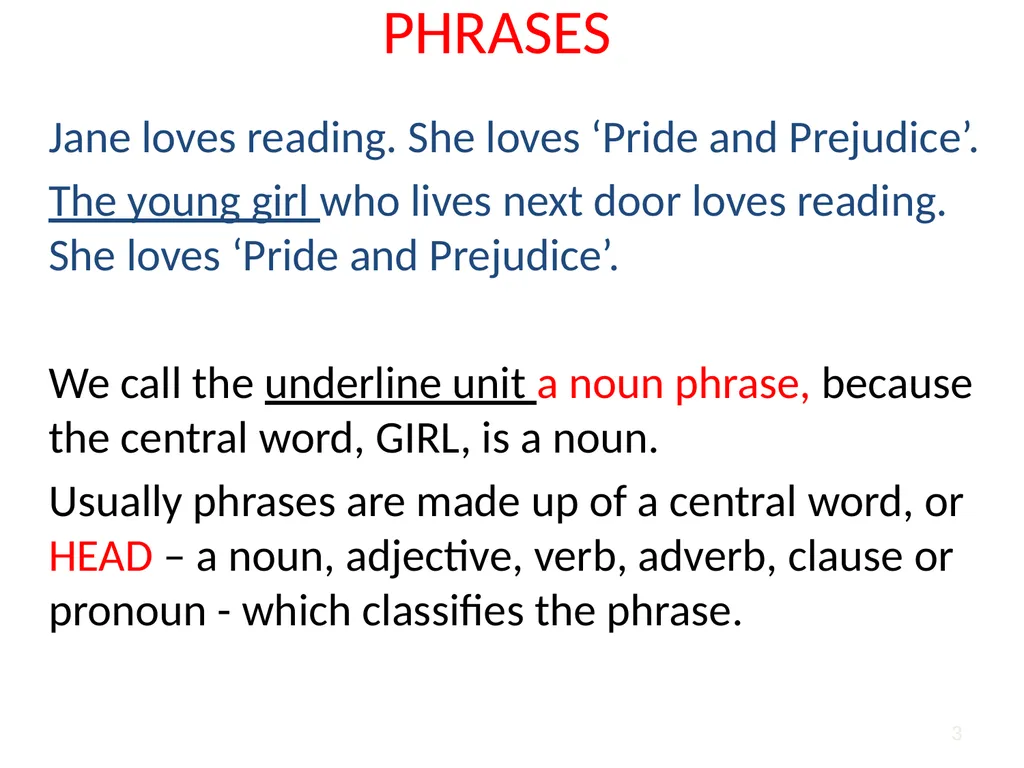
3 Jane loves reading. She loves ‘Pride and Prejudice’.
The young girl who lives next door loves reading. She loves ‘Pride and Prejudice’.
We call the underline unit a noun phrase, because the central word, GIRL, is a noun.
Usually phrases are made up of a central word, or HEAD – a noun, adjective, verb, adverb, clause or pronoun - which classifies the phrase. PHRASES<br>
The young girl who lives next door loves reading. She loves ‘Pride and Prejudice’.
We call the underline unit a noun phrase, because the central word, GIRL, is a noun.
Usually phrases are made up of a central word, or HEAD – a noun, adjective, verb, adverb, clause or pronoun - which classifies the phrase. PHRASES<br>
04
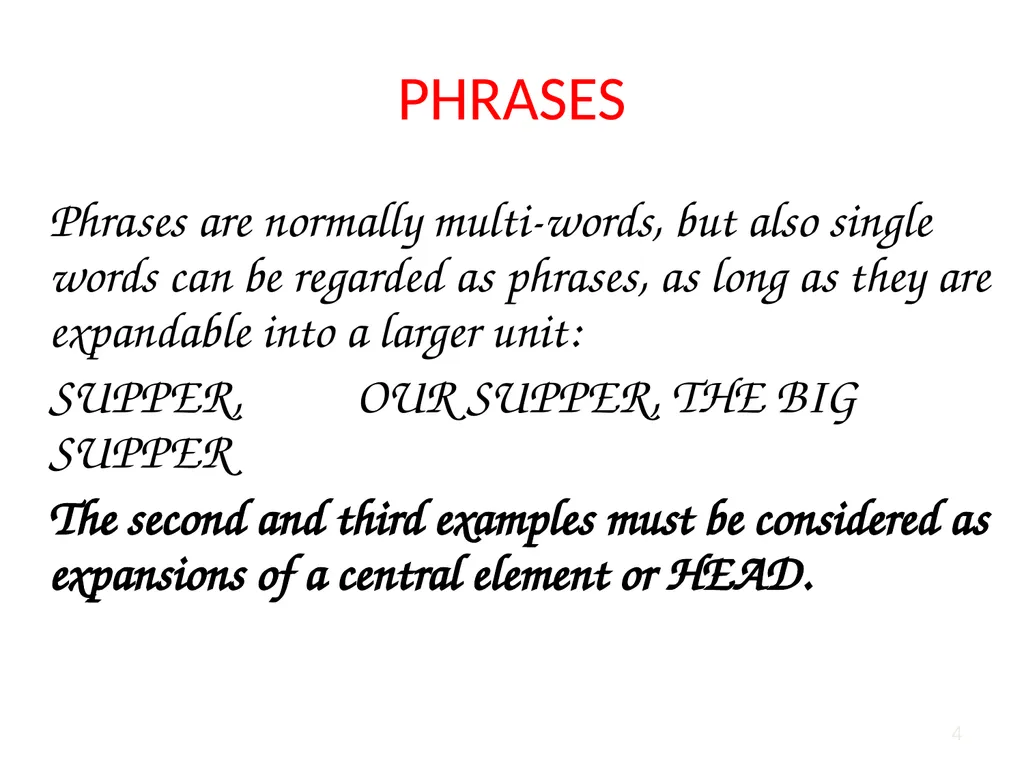
4 Phrases are normally multi-words, but also single words can be regarded as phrases, as long as they are expandable into a larger unit:
SUPPER, OUR SUPPER, THE BIG SUPPER
The second and third examples must be considered as expansions of a central element or HEAD. PHRASES<br>
SUPPER, OUR SUPPER, THE BIG SUPPER
The second and third examples must be considered as expansions of a central element or HEAD. PHRASES<br>
05
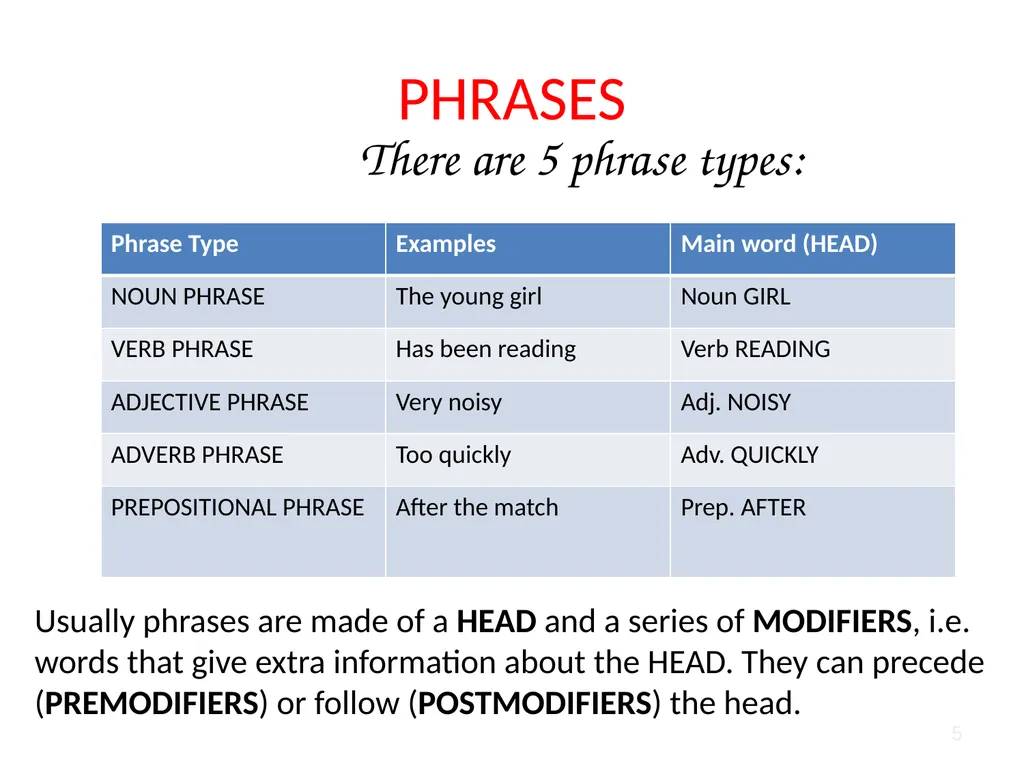
5 There are 5 phrase types: PHRASES Usually phrases are made of a HEAD and a series of MODIFIERS, i.e. words that give extra information about the HEAD. They can precede (PREMODIFIERS) or follow (POSTMODIFIERS) the head.<br>
06
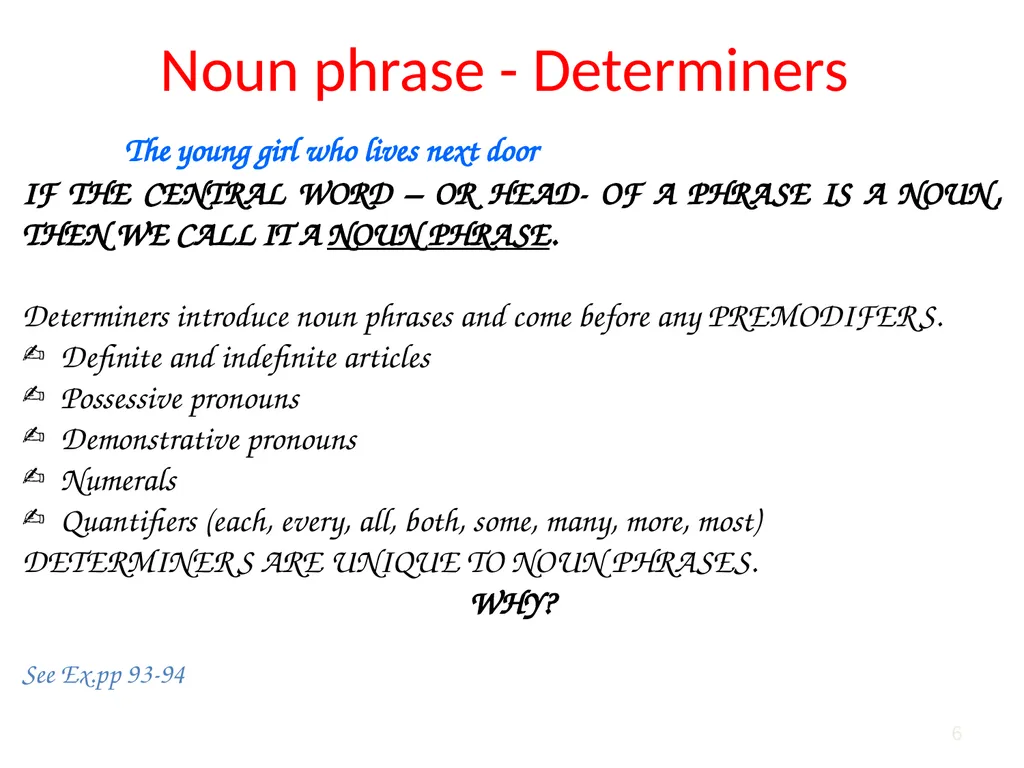
6 The young girl who lives next door
IF THE CENTRAL WORD – OR HEAD- OF A PHRASE IS A NOUN, THEN WE CALL IT A NOUN PHRASE.
Determiners introduce noun phrases and come before any PREMODIFERS.
Definite and indefinite articles
Possessive pronouns
Demonstrative pronouns
Numerals
Quantifiers (each, every, all, both, some, many, more, most)
DETERMINERS ARE UNIQUE TO NOUN PHRASES.
WHY?
See Ex.pp 93-94 Noun phrase - Determiners<br>
IF THE CENTRAL WORD – OR HEAD- OF A PHRASE IS A NOUN, THEN WE CALL IT A NOUN PHRASE.
Determiners introduce noun phrases and come before any PREMODIFERS.
Definite and indefinite articles
Possessive pronouns
Demonstrative pronouns
Numerals
Quantifiers (each, every, all, both, some, many, more, most)
DETERMINERS ARE UNIQUE TO NOUN PHRASES.
WHY?
See Ex.pp 93-94 Noun phrase - Determiners<br>
07
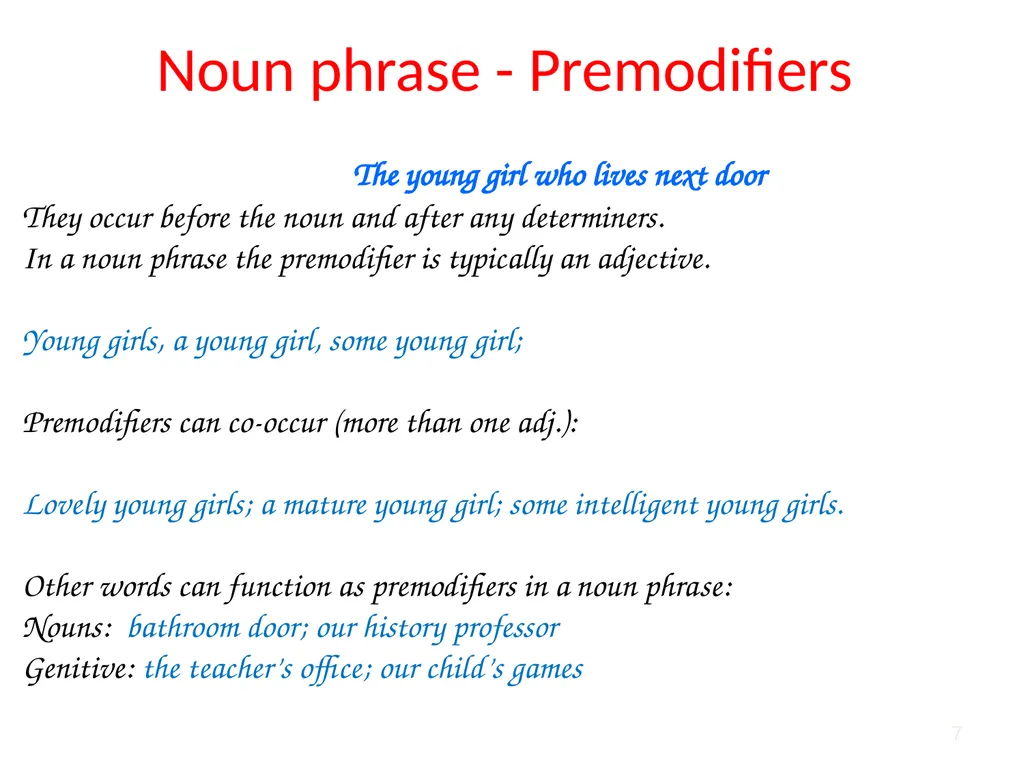
7 The young girl who lives next door
They occur before the noun and after any determiners.
In a noun phrase the premodifier is typically an adjective.
Young girls, a young girl, some young girl;
Premodifiers can co-occur (more than one adj.):
Lovely young girls; a mature young girl; some intelligent young girls.
Other words can function as premodifiers in a noun phrase:
Nouns: bathroom door; our history professor
Genitive: the teacher’s office; our child’s games Noun phrase - Premodifiers<br>
They occur before the noun and after any determiners.
In a noun phrase the premodifier is typically an adjective.
Young girls, a young girl, some young girl;
Premodifiers can co-occur (more than one adj.):
Lovely young girls; a mature young girl; some intelligent young girls.
Other words can function as premodifiers in a noun phrase:
Nouns: bathroom door; our history professor
Genitive: the teacher’s office; our child’s games Noun phrase - Premodifiers<br>
08
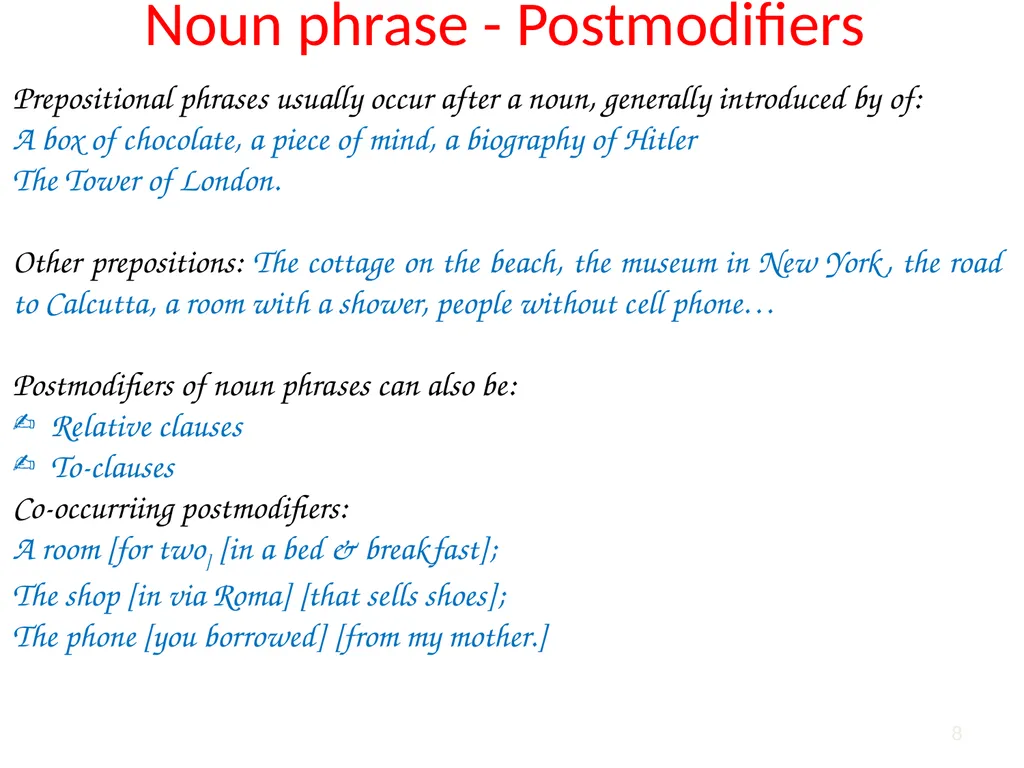
8 Prepositional phrases usually occur after a noun, generally introduced by of:
A box of chocolate, a piece of mind, a biography of Hitler
The Tower of London.
Other prepositions: The cottage on the beach, the museum in New York, the road to Calcutta, a room with a shower, people without cell phone…
Postmodifiers of noun phrases can also be:
Relative clauses
To-clauses
Co-occurriing postmodifiers:
A room [for two] [in a bed & breakfast];
The shop [in via Roma] [that sells shoes];
The phone [you borrowed] [from my mother.] Noun phrase - Postmodifiers<br>
A box of chocolate, a piece of mind, a biography of Hitler
The Tower of London.
Other prepositions: The cottage on the beach, the museum in New York, the road to Calcutta, a room with a shower, people without cell phone…
Postmodifiers of noun phrases can also be:
Relative clauses
To-clauses
Co-occurriing postmodifiers:
A room [for two] [in a bed & breakfast];
The shop [in via Roma] [that sells shoes];
The phone [you borrowed] [from my mother.] Noun phrase - Postmodifiers<br>
09
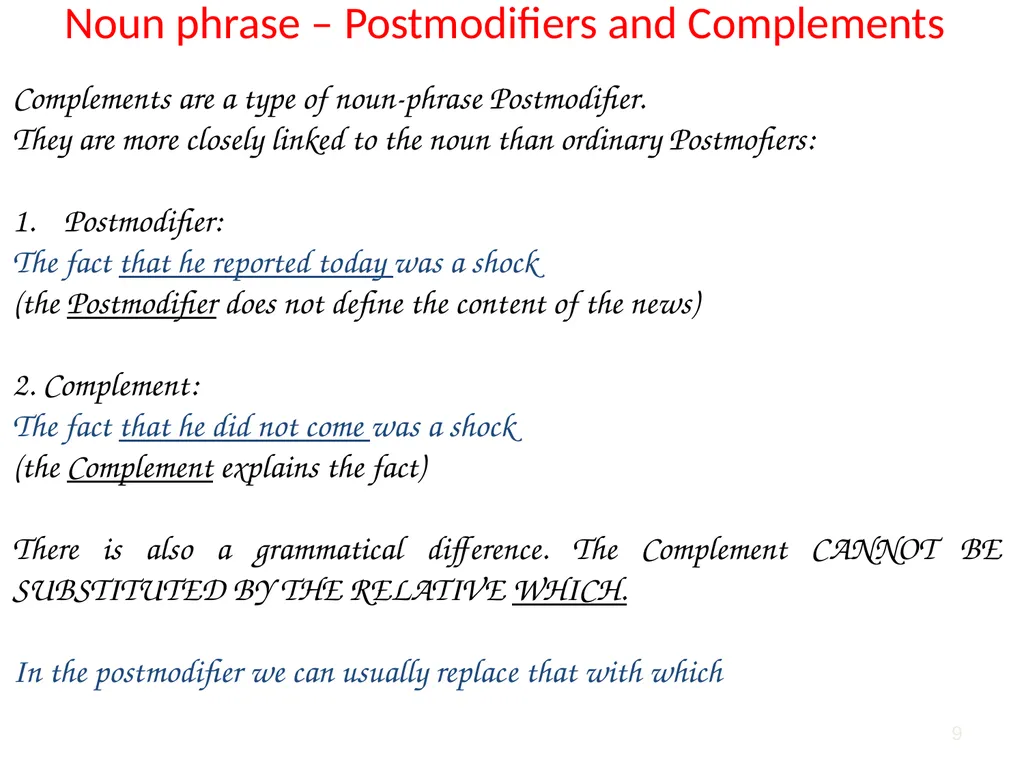
9 Complements are a type of noun-phrase Postmodifier.
They are more closely linked to the noun than ordinary Postmofiers:
Postmodifier:
The fact that he reported today was a shock
(the Postmodifier does not define the content of the news)
2. Complement:
The fact that he did not come was a shock
(the Complement explains the fact)
There is also a grammatical difference. The Complement CANNOT BE SUBSTITUTED BY THE RELATIVE WHICH.
In the postmodifier we can usually replace that with which Noun phrase – Postmodifiers and Complements<br>
They are more closely linked to the noun than ordinary Postmofiers:
Postmodifier:
The fact that he reported today was a shock
(the Postmodifier does not define the content of the news)
2. Complement:
The fact that he did not come was a shock
(the Complement explains the fact)
There is also a grammatical difference. The Complement CANNOT BE SUBSTITUTED BY THE RELATIVE WHICH.
In the postmodifier we can usually replace that with which Noun phrase – Postmodifiers and Complements<br>
10
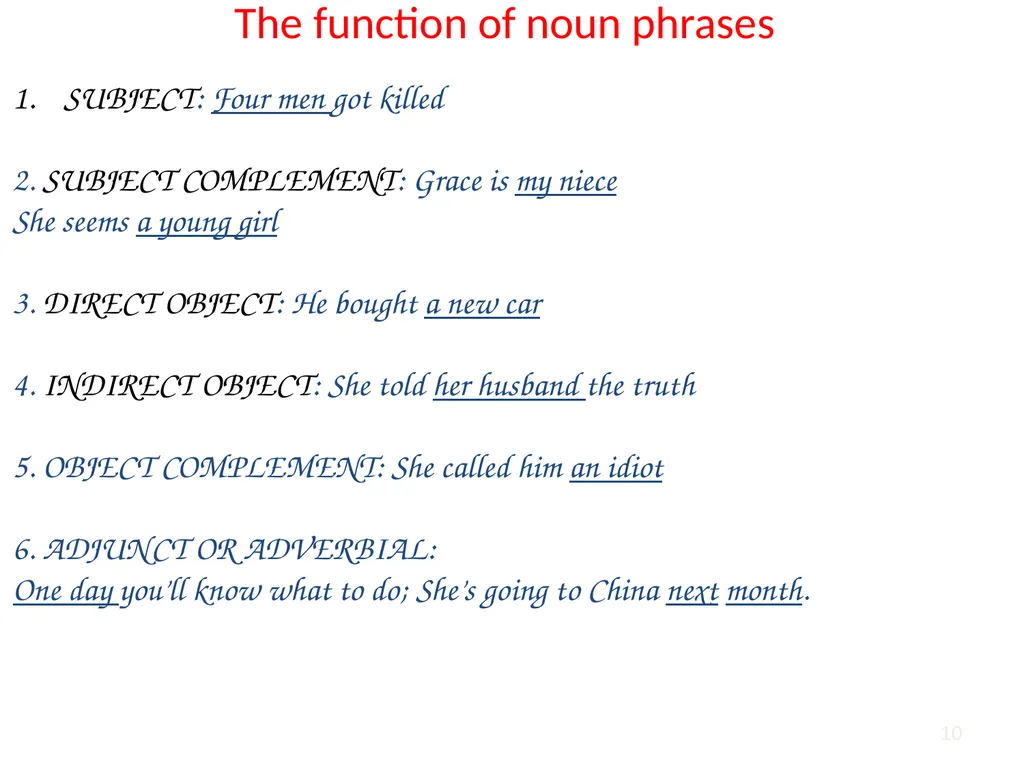
10 SUBJECT: Four men got killed
2. SUBJECT COMPLEMENT: Grace is my niece
She seems a young girl
3. DIRECT OBJECT: He bought a new car
4. INDIRECT OBJECT: She told her husband the truth
5. OBJECT COMPLEMENT: She called him an idiot
6. ADJUNCT OR ADVERBIAL:
One day you’ll know what to do; She’s going to China next month. The function of noun phrases<br>
2. SUBJECT COMPLEMENT: Grace is my niece
She seems a young girl
3. DIRECT OBJECT: He bought a new car
4. INDIRECT OBJECT: She told her husband the truth
5. OBJECT COMPLEMENT: She called him an idiot
6. ADJUNCT OR ADVERBIAL:
One day you’ll know what to do; She’s going to China next month. The function of noun phrases<br>
11
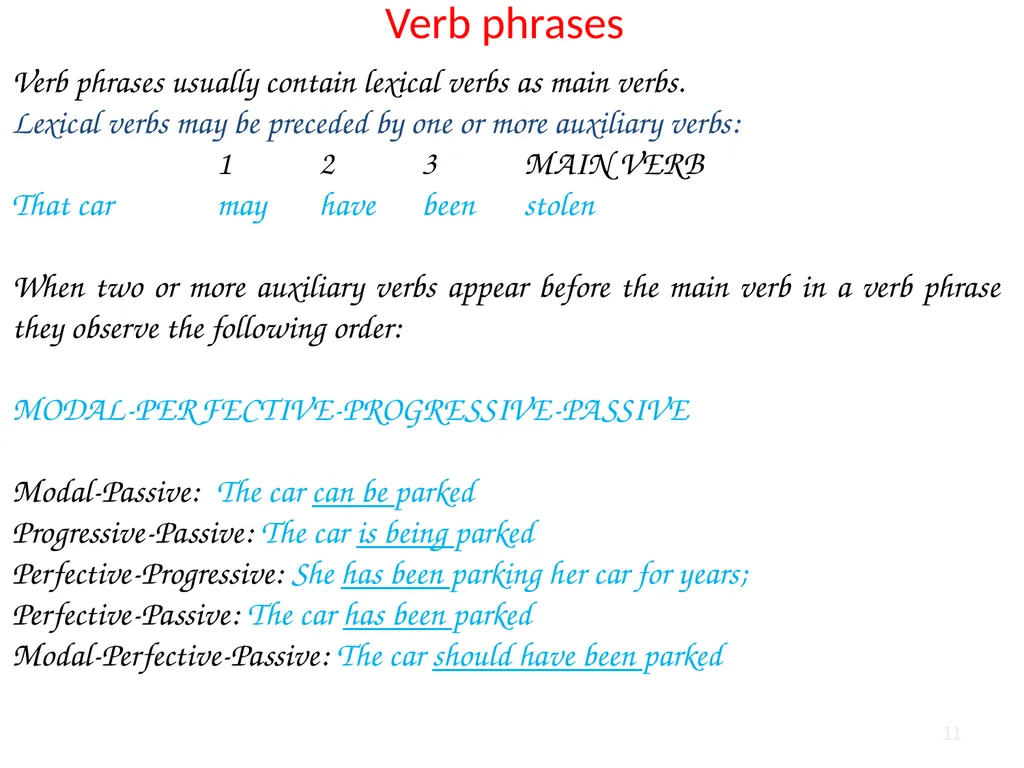
11 Verb phrases usually contain lexical verbs as main verbs.
Lexical verbs may be preceded by one or more auxiliary verbs:
1 2 3 MAIN VERB
That car may have been stolen
When two or more auxiliary verbs appear before the main verb in a verb phrase they observe the following order:
MODAL-PERFECTIVE-PROGRESSIVE-PASSIVE
Modal-Passive: The car can be parked
Progressive-Passive: The car is being parked
Perfective-Progressive: She has been parking her car for years;
Perfective-Passive: The car has been parked
Modal-Perfective-Passive: The car should have been parked Verb phrases<br>
Lexical verbs may be preceded by one or more auxiliary verbs:
1 2 3 MAIN VERB
That car may have been stolen
When two or more auxiliary verbs appear before the main verb in a verb phrase they observe the following order:
MODAL-PERFECTIVE-PROGRESSIVE-PASSIVE
Modal-Passive: The car can be parked
Progressive-Passive: The car is being parked
Perfective-Progressive: She has been parking her car for years;
Perfective-Passive: The car has been parked
Modal-Perfective-Passive: The car should have been parked Verb phrases<br>
12
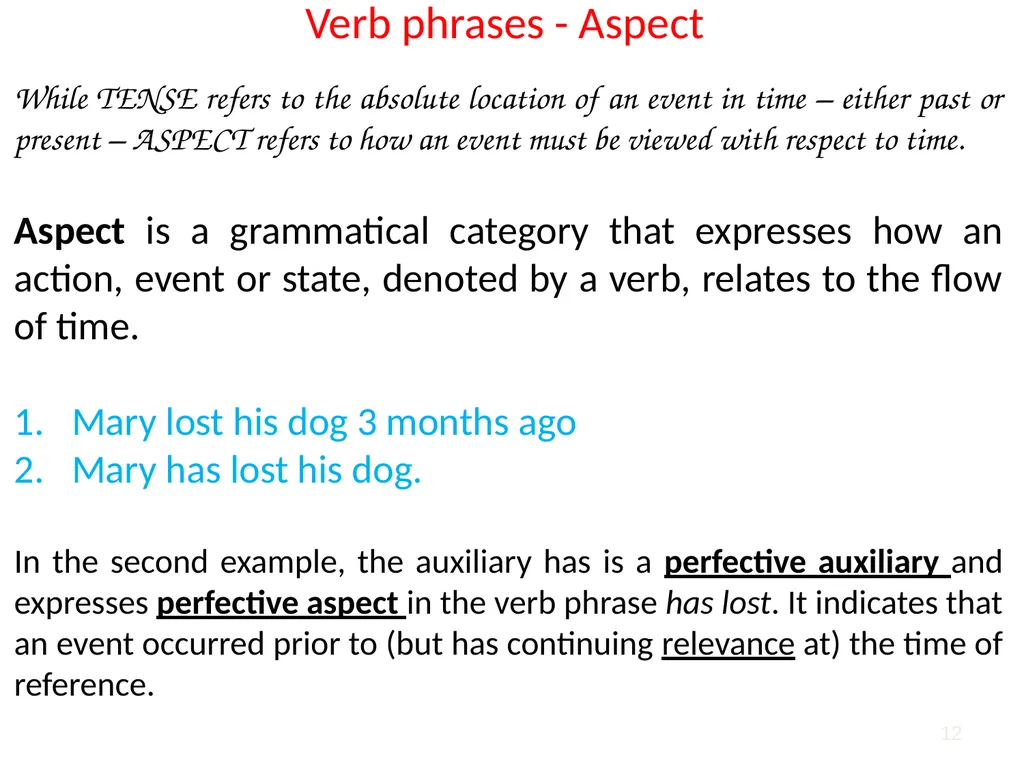
12 While TENSE refers to the absolute location of an event in time – either past or present – ASPECT refers to how an event must be viewed with respect to time.
Aspect is a grammatical category that expresses how an action, event or state, denoted by a verb, relates to the flow of time.
Mary lost his dog 3 months ago
Mary has lost his dog.
In the second example, the auxiliary has is a perfective auxiliary and expresses perfective aspect in the verb phrase has lost. It indicates that an event occurred prior to (but has continuing relevance at) the time of reference. Verb phrases - Aspect<br>
Aspect is a grammatical category that expresses how an action, event or state, denoted by a verb, relates to the flow of time.
Mary lost his dog 3 months ago
Mary has lost his dog.
In the second example, the auxiliary has is a perfective auxiliary and expresses perfective aspect in the verb phrase has lost. It indicates that an event occurred prior to (but has continuing relevance at) the time of reference. Verb phrases - Aspect<br>
13
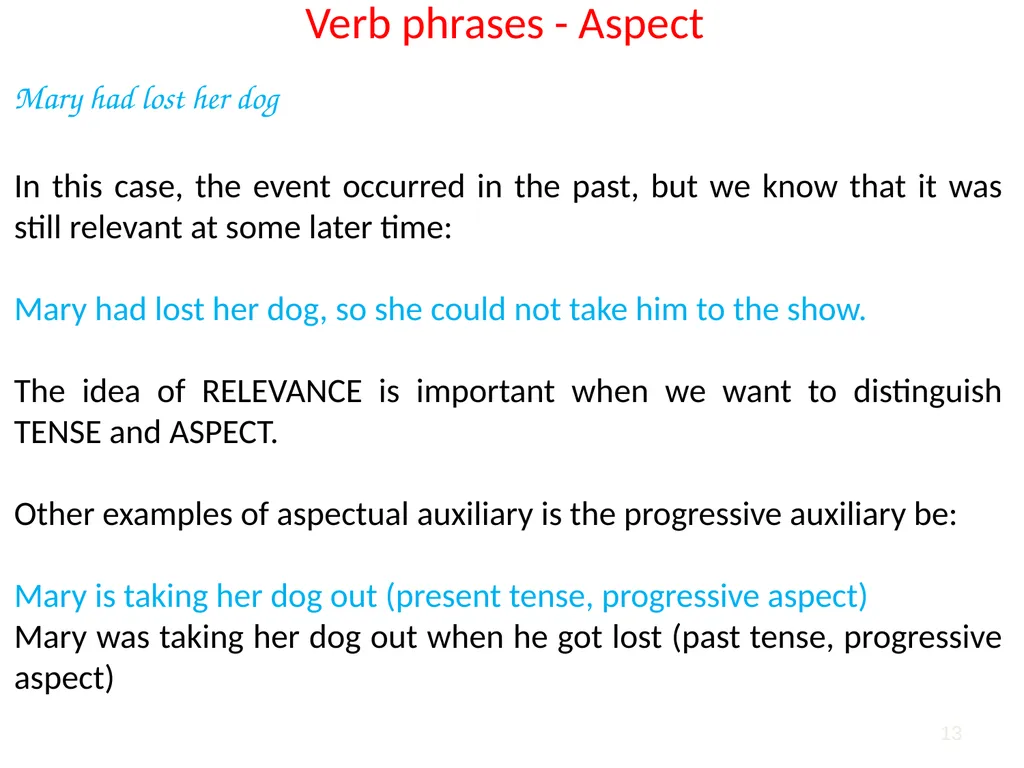
13 Mary had lost her dog
In this case, the event occurred in the past, but we know that it was still relevant at some later time:
Mary had lost her dog, so she could not take him to the show.
The idea of RELEVANCE is important when we want to distinguish TENSE and ASPECT.
Other examples of aspectual auxiliary is the progressive auxiliary be:
Mary is taking her dog out (present tense, progressive aspect)
Mary was taking her dog out when he got lost (past tense, progressive aspect) Verb phrases - Aspect<br>
In this case, the event occurred in the past, but we know that it was still relevant at some later time:
Mary had lost her dog, so she could not take him to the show.
The idea of RELEVANCE is important when we want to distinguish TENSE and ASPECT.
Other examples of aspectual auxiliary is the progressive auxiliary be:
Mary is taking her dog out (present tense, progressive aspect)
Mary was taking her dog out when he got lost (past tense, progressive aspect) Verb phrases - Aspect<br>
14
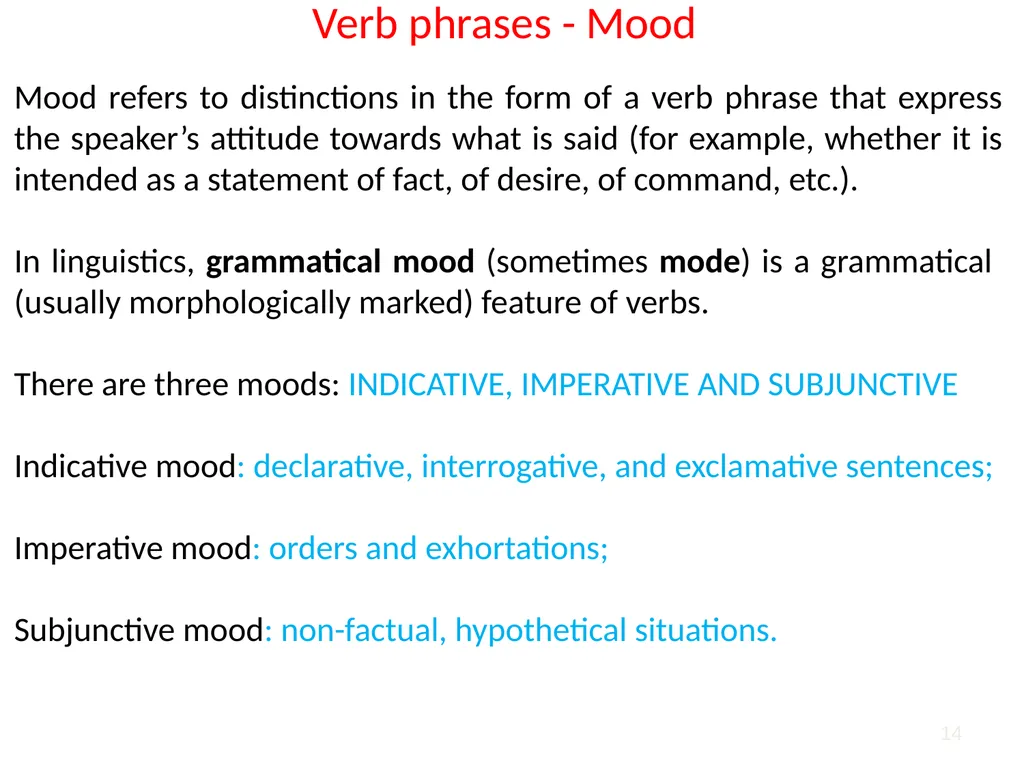
14 Mood refers to distinctions in the form of a verb phrase that express the speaker’s attitude towards what is said (for example, whether it is intended as a statement of fact, of desire, of command, etc.).
In linguistics, grammatical mood (sometimes mode) is a grammatical (usually morphologically marked) feature of verbs.
There are three moods: INDICATIVE, IMPERATIVE AND SUBJUNCTIVE
Indicative mood: declarative, interrogative, and exclamative sentences;
Imperative mood: orders and exhortations;
Subjunctive mood: non-factual, hypothetical situations. Verb phrases - Mood<br>
In linguistics, grammatical mood (sometimes mode) is a grammatical (usually morphologically marked) feature of verbs.
There are three moods: INDICATIVE, IMPERATIVE AND SUBJUNCTIVE
Indicative mood: declarative, interrogative, and exclamative sentences;
Imperative mood: orders and exhortations;
Subjunctive mood: non-factual, hypothetical situations. Verb phrases - Mood<br>
15
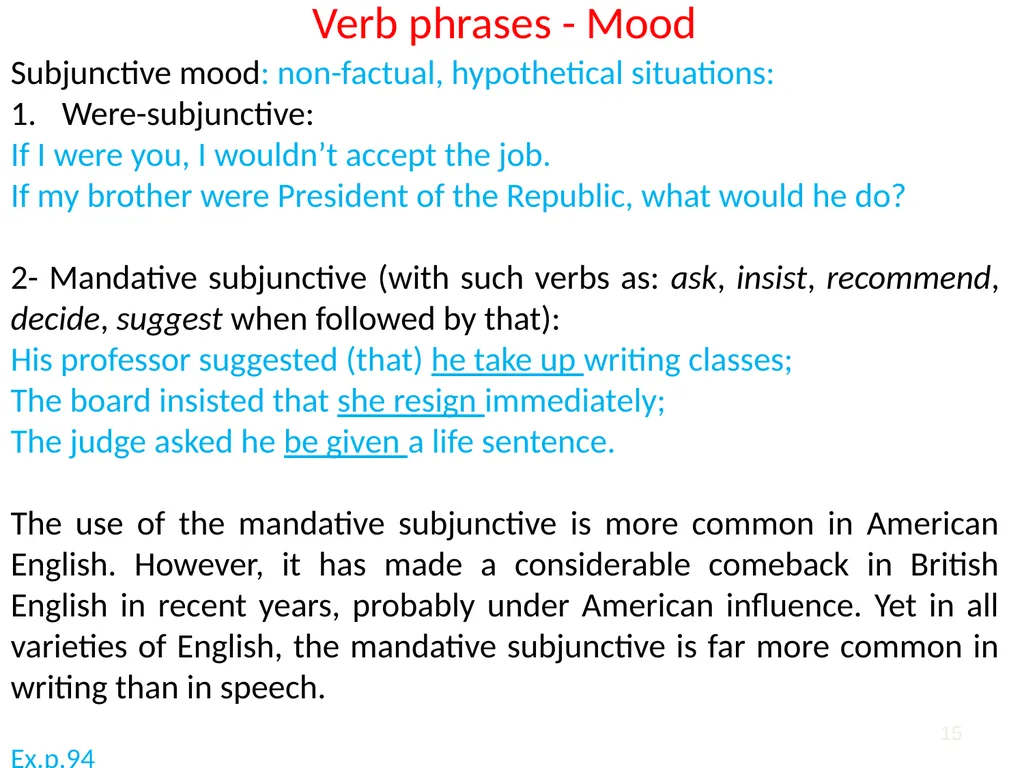
15 Subjunctive mood: non-factual, hypothetical situations:
Were-subjunctive:
If I were you, I wouldn’t accept the job.
If my brother were President of the Republic, what would he do?
2- Mandative subjunctive (with such verbs as: ask, insist, recommend, decide, suggest when followed by that):
His professor suggested (that) he take up writing classes;
The board insisted that she resign immediately;
The judge asked he be given a life sentence.
The use of the mandative subjunctive is more common in American English. However, it has made a considerable comeback in British English in recent years, probably under American influence. Yet in all varieties of English, the mandative subjunctive is far more common in writing than in speech.
Ex.p.94 Verb phrases - Mood<br>
Were-subjunctive:
If I were you, I wouldn’t accept the job.
If my brother were President of the Republic, what would he do?
2- Mandative subjunctive (with such verbs as: ask, insist, recommend, decide, suggest when followed by that):
His professor suggested (that) he take up writing classes;
The board insisted that she resign immediately;
The judge asked he be given a life sentence.
The use of the mandative subjunctive is more common in American English. However, it has made a considerable comeback in British English in recent years, probably under American influence. Yet in all varieties of English, the mandative subjunctive is far more common in writing than in speech.
Ex.p.94 Verb phrases - Mood<br>
16
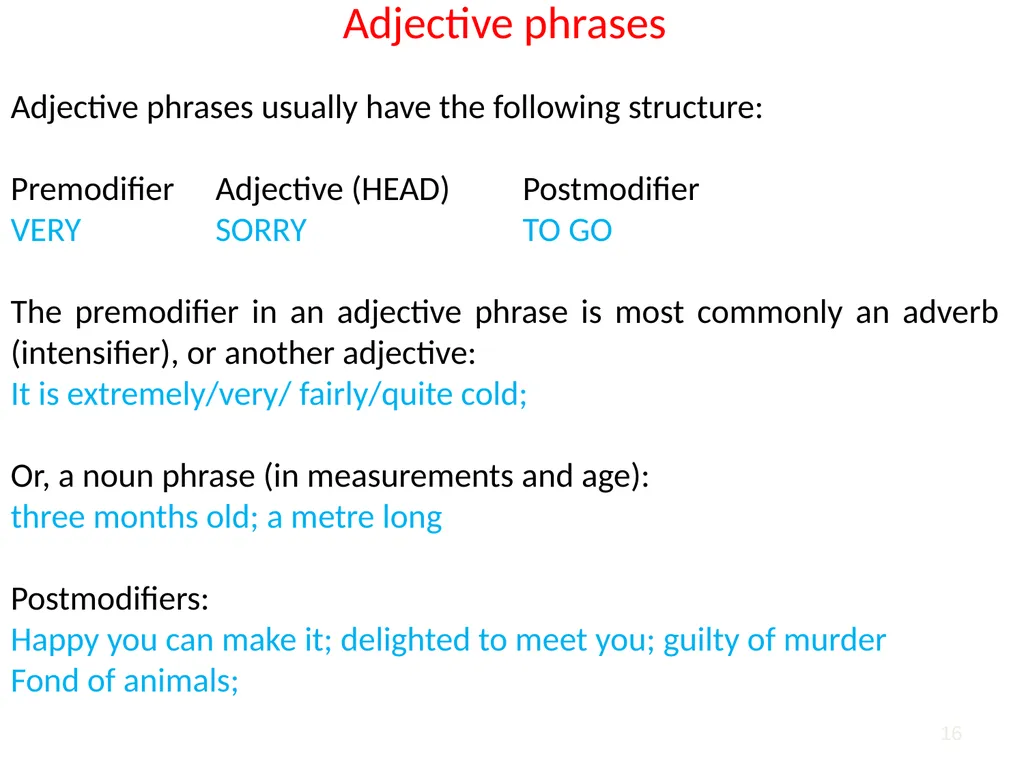
16 Adjective phrases usually have the following structure:
Premodifier Adjective (HEAD) Postmodifier
VERY SORRY TO GO
The premodifier in an adjective phrase is most commonly an adverb (intensifier), or another adjective:
It is extremely/very/ fairly/quite cold;
Or, a noun phrase (in measurements and age):
three months old; a metre long
Postmodifiers:
Happy you can make it; delighted to meet you; guilty of murder
Fond of animals; Adjective phrases<br>
Premodifier Adjective (HEAD) Postmodifier
VERY SORRY TO GO
The premodifier in an adjective phrase is most commonly an adverb (intensifier), or another adjective:
It is extremely/very/ fairly/quite cold;
Or, a noun phrase (in measurements and age):
three months old; a metre long
Postmodifiers:
Happy you can make it; delighted to meet you; guilty of murder
Fond of animals; Adjective phrases<br>
17
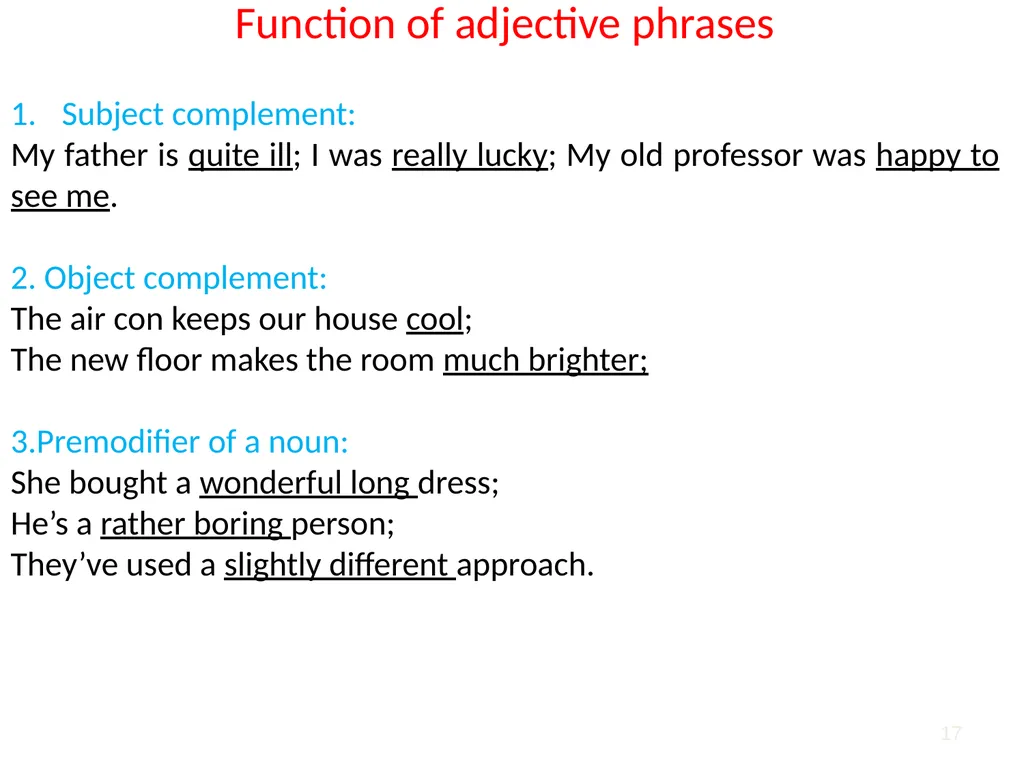
17 Subject complement:
My father is quite ill; I was really lucky; My old professor was happy to see me.
2. Object complement:
The air con keeps our house cool;
The new floor makes the room much brighter;
3.Premodifier of a noun:
She bought a wonderful long dress;
He’s a rather boring person;
They’ve used a slightly different approach. Function of adjective phrases<br>
My father is quite ill; I was really lucky; My old professor was happy to see me.
2. Object complement:
The air con keeps our house cool;
The new floor makes the room much brighter;
3.Premodifier of a noun:
She bought a wonderful long dress;
He’s a rather boring person;
They’ve used a slightly different approach. Function of adjective phrases<br>
18
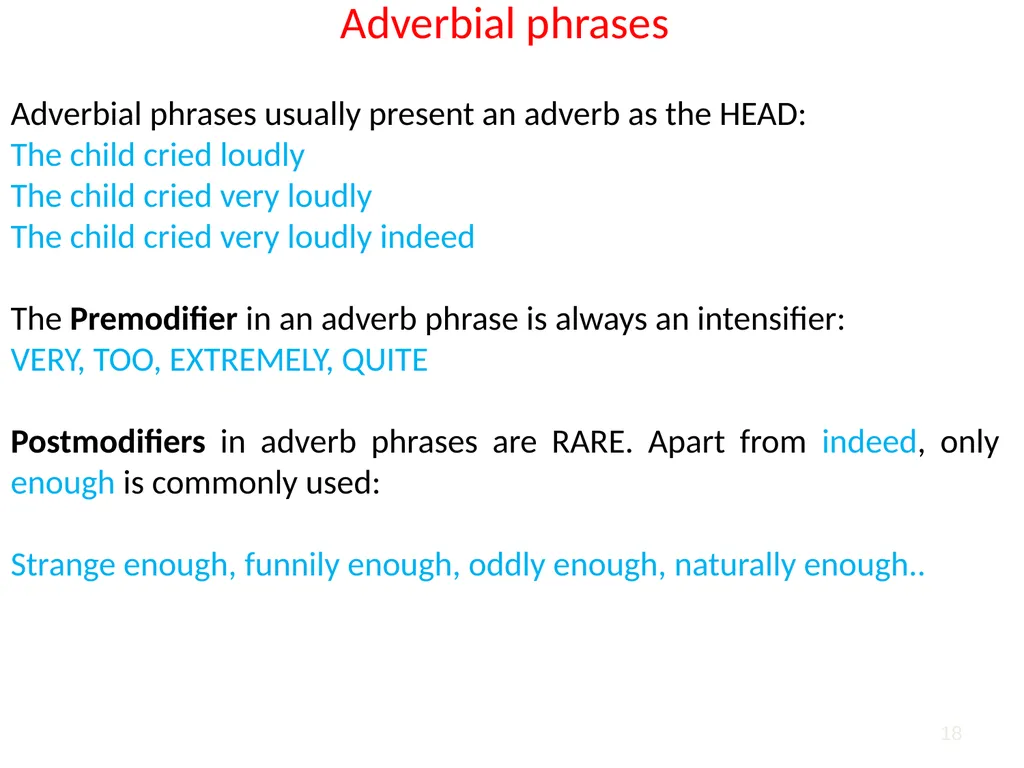
18 Adverbial phrases usually present an adverb as the HEAD:
The child cried loudly
The child cried very loudly
The child cried very loudly indeed
The Premodifier in an adverb phrase is always an intensifier:
VERY, TOO, EXTREMELY, QUITE
Postmodifiers in adverb phrases are RARE. Apart from indeed, only enough is commonly used:
Strange enough, funnily enough, oddly enough, naturally enough.. Adverbial phrases<br>
The child cried loudly
The child cried very loudly
The child cried very loudly indeed
The Premodifier in an adverb phrase is always an intensifier:
VERY, TOO, EXTREMELY, QUITE
Postmodifiers in adverb phrases are RARE. Apart from indeed, only enough is commonly used:
Strange enough, funnily enough, oddly enough, naturally enough.. Adverbial phrases<br>
19
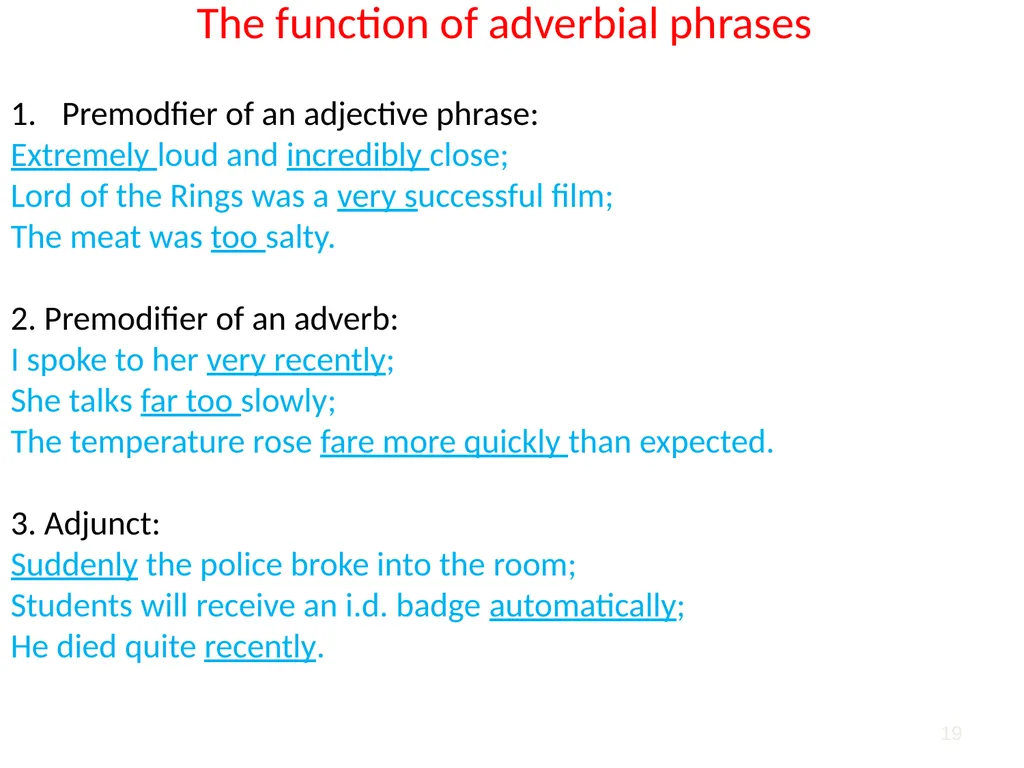
19 Premodfier of an adjective phrase:
Extremely loud and incredibly close;
Lord of the Rings was a very successful film;
The meat was too salty.
2. Premodifier of an adverb:
I spoke to her very recently;
She talks far too slowly;
The temperature rose fare more quickly than expected.
3. Adjunct:
Suddenly the police broke into the room;
Students will receive an i.d. badge automatically;
He died quite recently. The function of adverbial phrases<br>
Extremely loud and incredibly close;
Lord of the Rings was a very successful film;
The meat was too salty.
2. Premodifier of an adverb:
I spoke to her very recently;
She talks far too slowly;
The temperature rose fare more quickly than expected.
3. Adjunct:
Suddenly the police broke into the room;
Students will receive an i.d. badge automatically;
He died quite recently. The function of adverbial phrases<br>
20
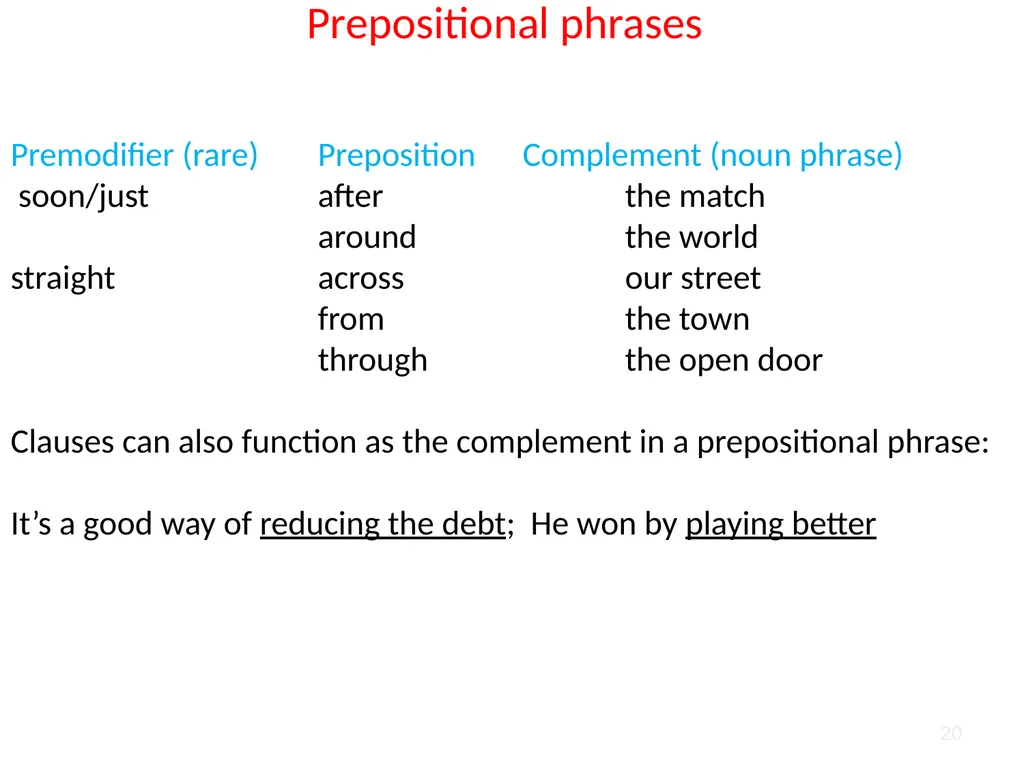
20 Premodifier (rare) Preposition Complement (noun phrase)
soon/just after the match
around the world
straight across our street
from the town
through the open door
Clauses can also function as the complement in a prepositional phrase:
It’s a good way of reducing the debt; He won by playing better Prepositional phrases<br>
soon/just after the match
around the world
straight across our street
from the town
through the open door
Clauses can also function as the complement in a prepositional phrase:
It’s a good way of reducing the debt; He won by playing better Prepositional phrases<br>
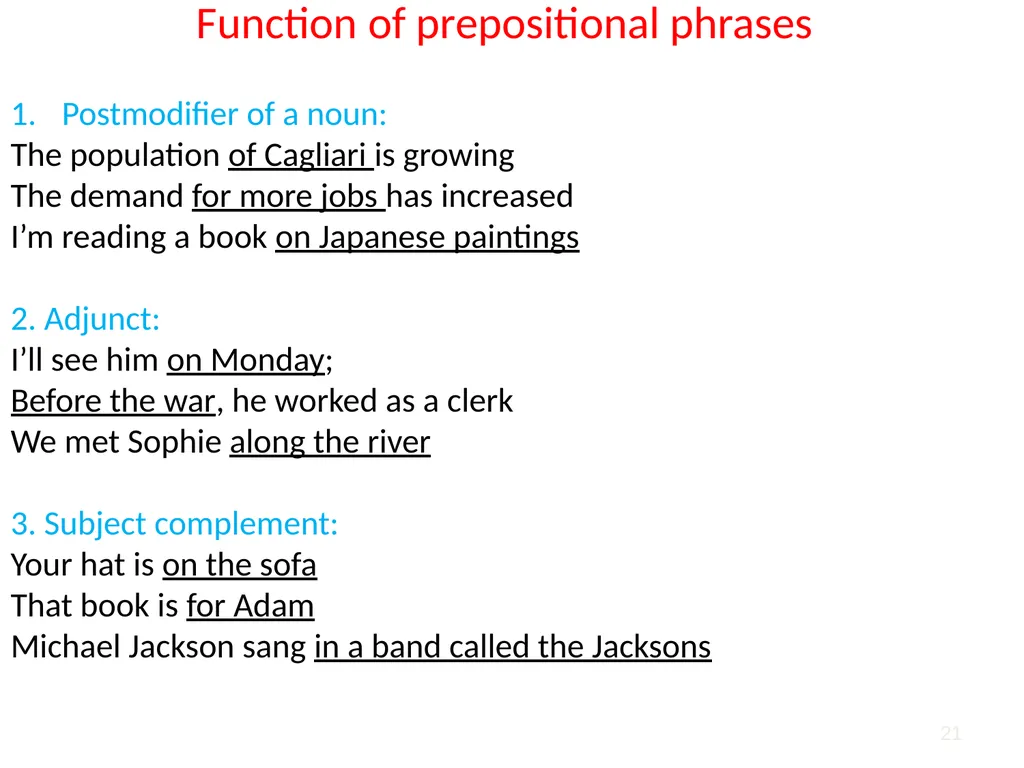
21
21 Postmodifier of a noun:
The population of Cagliari is growing
The demand for more jobs has increased
I’m reading a book on Japanese paintings
2. Adjunct:
I’ll see him on Monday;
Before the war, he worked as a clerk
We met Sophie along the river
3. Subject complement:
Your hat is on the sofa
That book is for Adam
Michael Jackson sang in a band called the Jacksons Function of prepositional phrases<br>
The population of Cagliari is growing
The demand for more jobs has increased
I’m reading a book on Japanese paintings
2. Adjunct:
I’ll see him on Monday;
Before the war, he worked as a clerk
We met Sophie along the river
3. Subject complement:
Your hat is on the sofa
That book is for Adam
Michael Jackson sang in a band called the Jacksons Function of prepositional phrases<br>
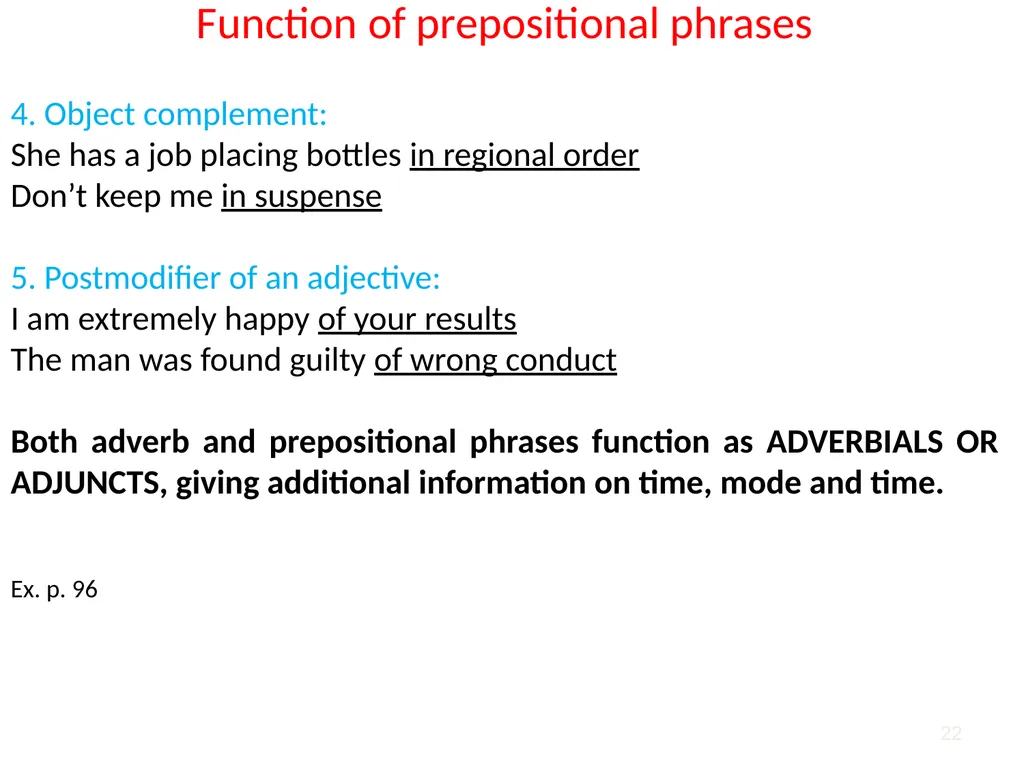
22
22 4. Object complement:
She has a job placing bottles in regional order
Don’t keep me in suspense
5. Postmodifier of an adjective:
I am extremely happy of your results
The man was found guilty of wrong conduct
Both adverb and prepositional phrases function as ADVERBIALS OR ADJUNCTS, giving additional information on time, mode and time.
Ex. p. 96 Function of prepositional phrases<br>
She has a job placing bottles in regional order
Don’t keep me in suspense
5. Postmodifier of an adjective:
I am extremely happy of your results
The man was found guilty of wrong conduct
Both adverb and prepositional phrases function as ADVERBIALS OR ADJUNCTS, giving additional information on time, mode and time.
Ex. p. 96 Function of prepositional phrases<br>