
1 27-750 Texture, Microstructure & Anisotropy A.D.
BR
Published · 28 slides · 0 views
1 / 1
Description
1 27-750 Texture, Microstructure Anisotropy A.D. (Tony) Rollett, Seth R. Wilson Rodrigues vectors, unit Quaternions Last revised: 21st Mar. 2014 Iowa State Univ. Briefly describe rotationsorientations Introduce Rodrigues-Frank vectors
Related Topics
Share
Embed code
Download this presentation From Below
"1 27-750 Texture, Microstructure & Anisotropy A.D." is the property of its rightful owner. Permission is granted to download and print the materials on this website for personal, non-commercial use only, and to display it on your personal computer provided you do not modify the materials and that you retain all copyright notices contained in the materials. By downloading content from our website, you accept the terms of this agreement.
Presentation Transcript
01
1 27-750
Texture, Microstructure & Anisotropy
A.D. (Tony) Rollett, Seth R. Wilson* Rodrigues vectors, unit Quaternions Last revised: 21st Mar. 2014 *Iowa State Univ.<br>
A.D. (Tony) Rollett, Seth R. Wilson* Rodrigues vectors, unit Quaternions Last revised: 21st Mar. 2014 *Iowa State Univ.<br>
02
Briefly describe rotations/orientations
Introduce Rodrigues-Frank vectors
Introduce quaternions
Learn how to manipulate and use quaternions as rotation operators
Discuss conversions between Euler angles, rotation matrices, RF vectors, and (unit) quaternions Objectives<br>
Introduce Rodrigues-Frank vectors
Introduce quaternions
Learn how to manipulate and use quaternions as rotation operators
Discuss conversions between Euler angles, rotation matrices, RF vectors, and (unit) quaternions Objectives<br>
03
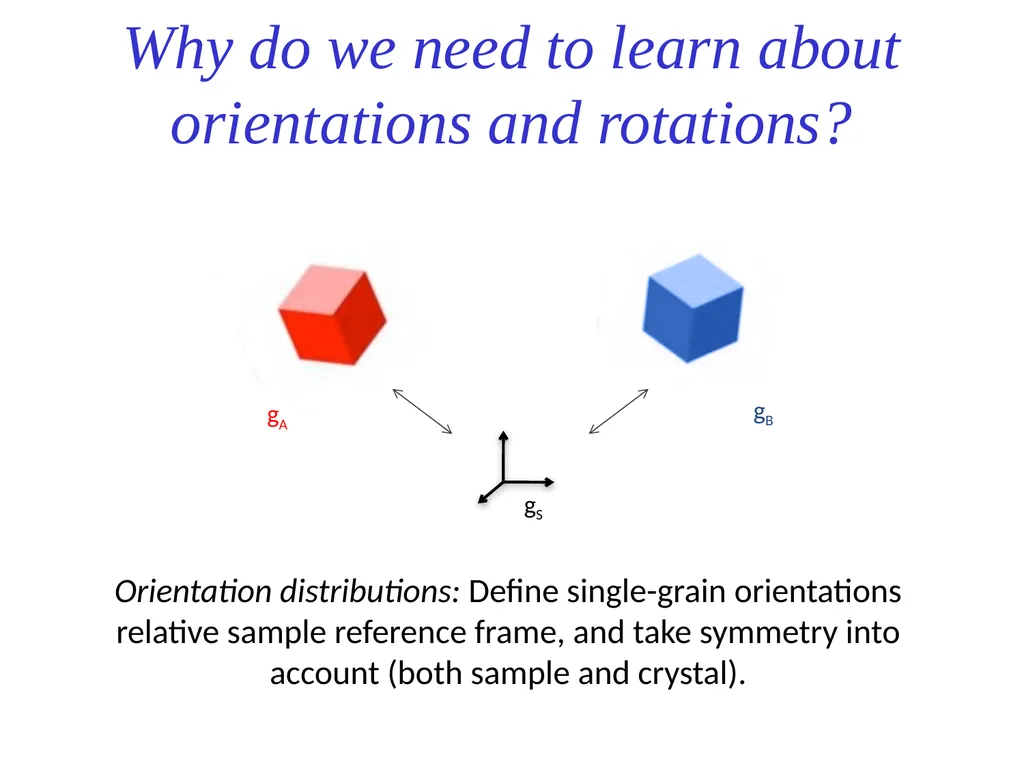
Why do we need to learn about orientations and rotations? Orientation distributions: Define single-grain orientations relative sample reference frame, and take symmetry into account (both sample and crystal). gA gB gS<br>
04
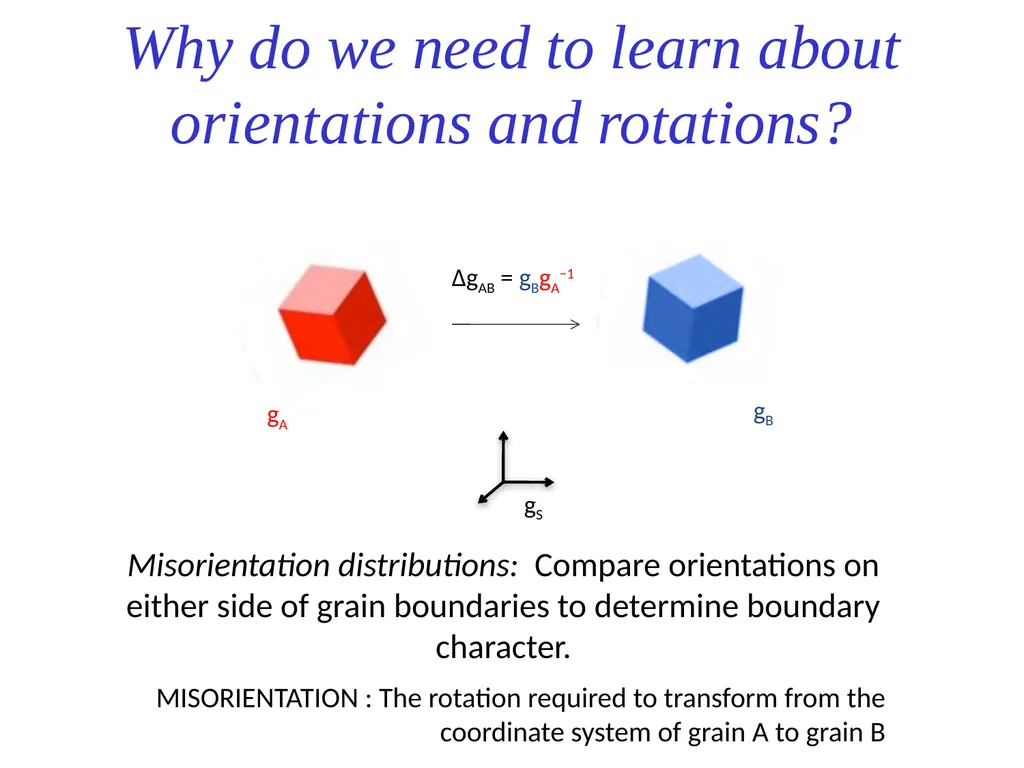
Why do we need to learn about orientations and rotations? Misorientation distributions: Compare orientations on either side of grain boundaries to determine boundary character. gA gB gS ΔgAB = gBgA−1 MISORIENTATION : The rotation required to transform from the coordinate system of grain A to grain B<br>
05
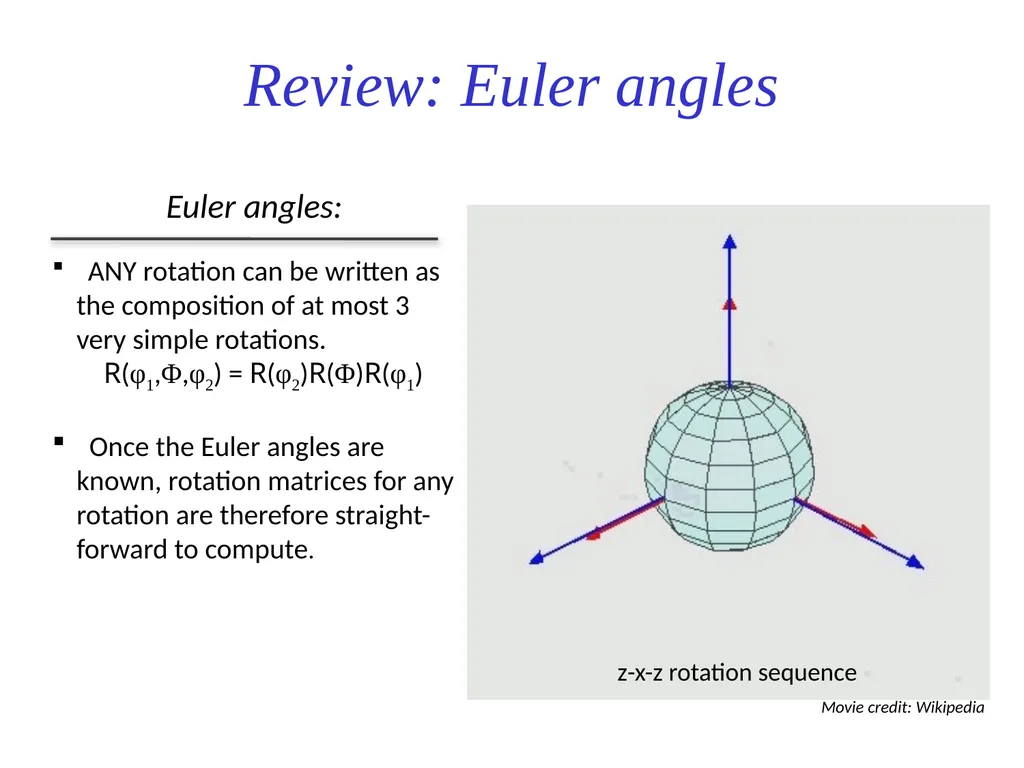
Review: Euler angles Euler angles: ANY rotation can be written as the composition of at most 3 very simple rotations.
R(φ1,Φ,φ2) = R(φ2)R(Φ)R(φ1)
Once the Euler angles are known, rotation matrices for any rotation are therefore straight-forward to compute. Movie credit: Wikipedia z-x-z rotation sequence<br>
R(φ1,Φ,φ2) = R(φ2)R(Φ)R(φ1)
Once the Euler angles are known, rotation matrices for any rotation are therefore straight-forward to compute. Movie credit: Wikipedia z-x-z rotation sequence<br>
06
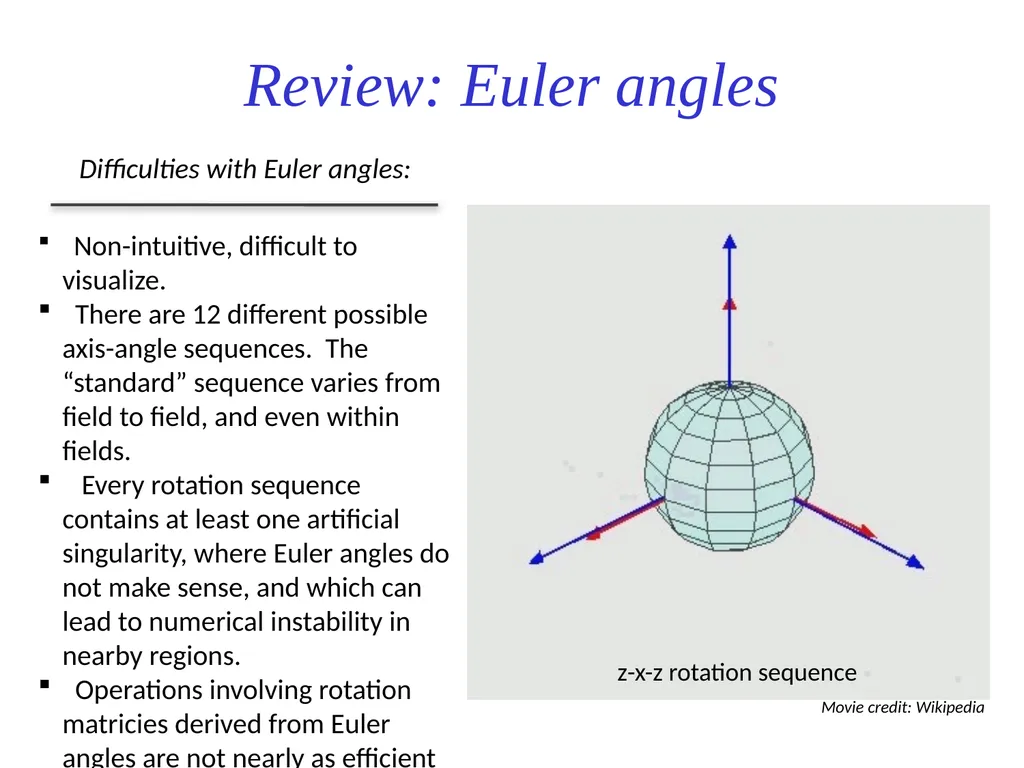
Review: Euler angles z-x-z rotation sequence Difficulties with Euler angles: Non-intuitive, difficult to visualize.
There are 12 different possible axis-angle sequences. The “standard” sequence varies from field to field, and even within fields.
Every rotation sequence contains at least one artificial singularity, where Euler angles do not make sense, and which can lead to numerical instability in nearby regions.
Operations involving rotation matricies derived from Euler angles are not nearly as efficient as quaternions. Movie credit: Wikipedia<br>
There are 12 different possible axis-angle sequences. The “standard” sequence varies from field to field, and even within fields.
Every rotation sequence contains at least one artificial singularity, where Euler angles do not make sense, and which can lead to numerical instability in nearby regions.
Operations involving rotation matricies derived from Euler angles are not nearly as efficient as quaternions. Movie credit: Wikipedia<br>
07
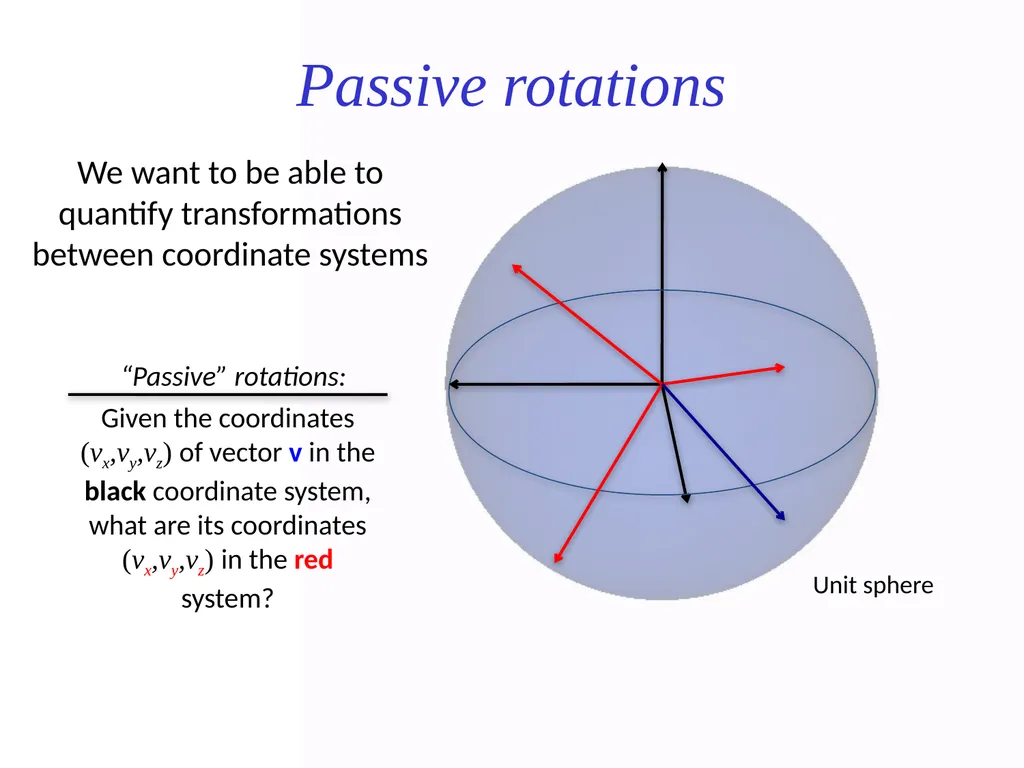
Passive rotations Unit sphere We want to be able to quantify transformations between coordinate systems<br>
08
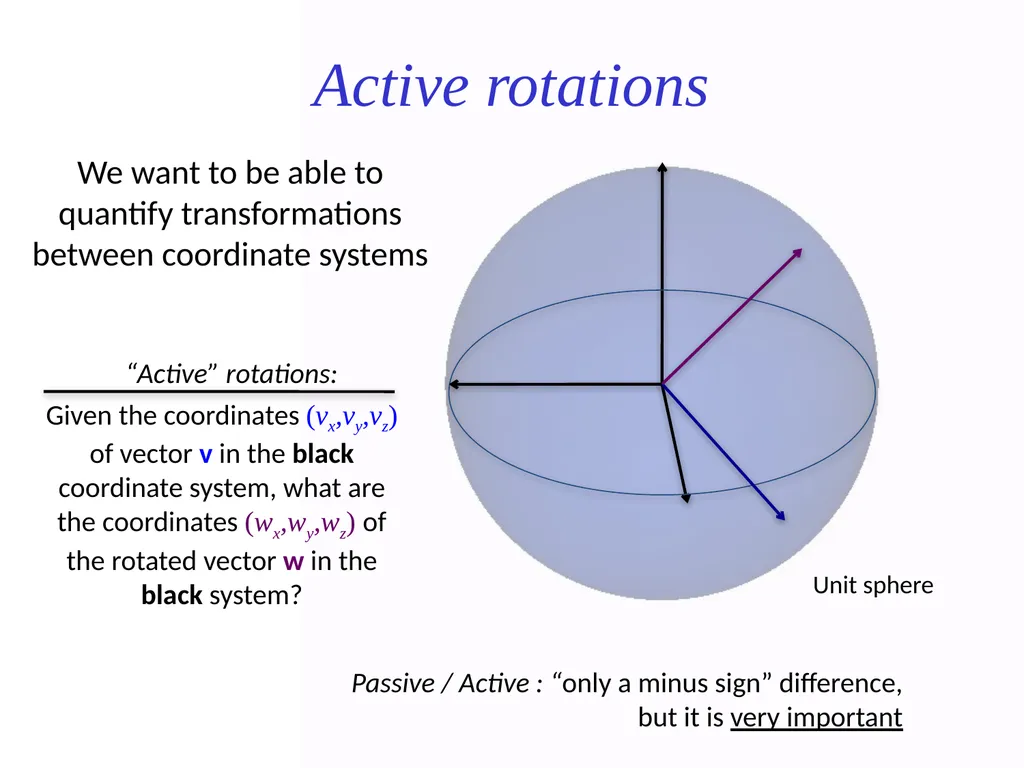
Active rotations We want to be able to quantify transformations between coordinate systems Passive / Active : “only a minus sign” difference, but it is very important Unit sphere<br>
09
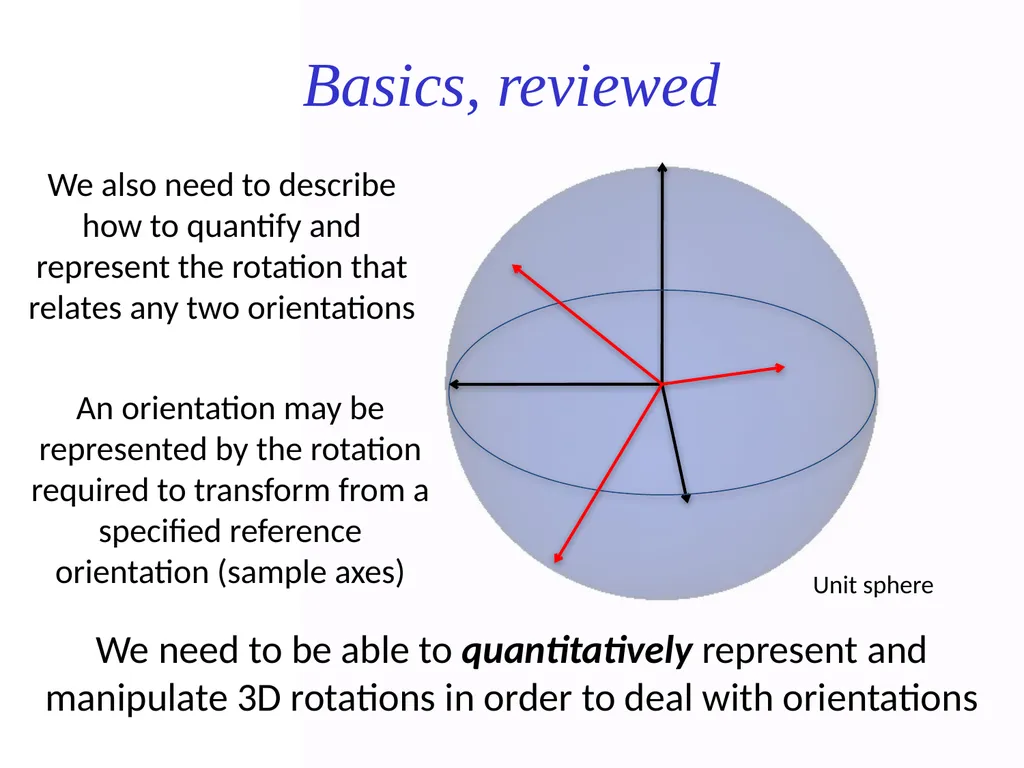
Basics, reviewed We also need to describe how to quantify and represent the rotation that relates any two orientations An orientation may be represented by the rotation required to transform from a specified reference orientation (sample axes) We need to be able to quantitatively represent and manipulate 3D rotations in order to deal with orientations Unit sphere<br>
10
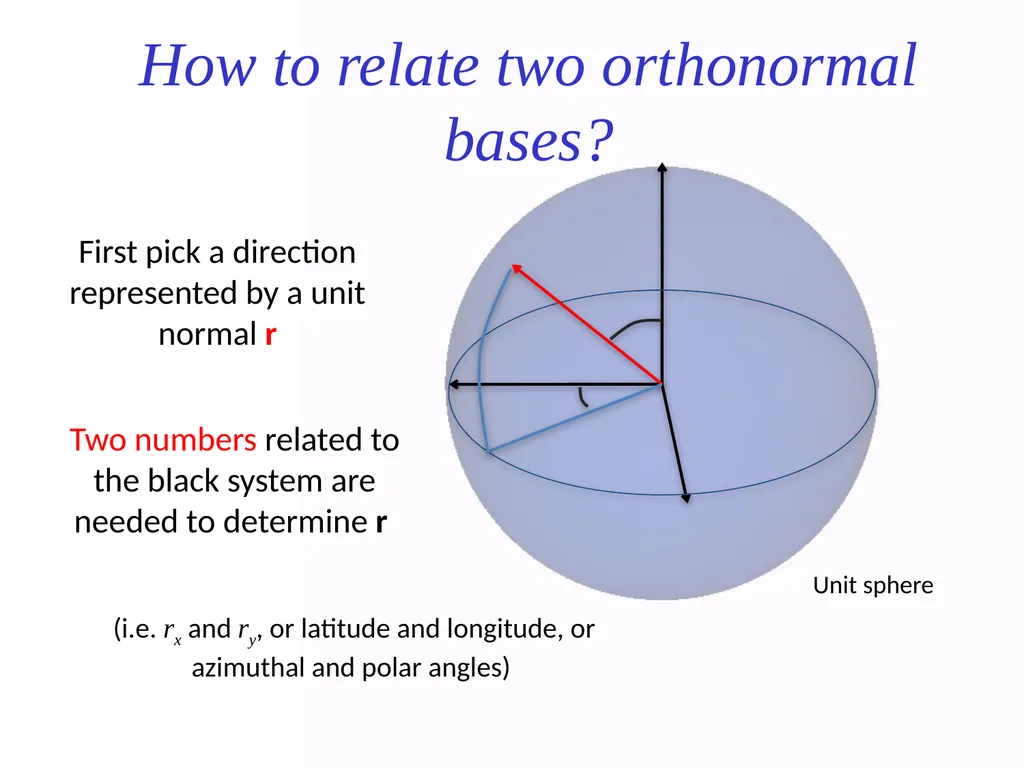
Two numbers related to the black system are needed to determine r First pick a direction represented by a unit normal r How to relate two orthonormal bases? Unit sphere (i.e. rx and ry, or latitude and longitude, or azimuthal and polar angles)<br>
11
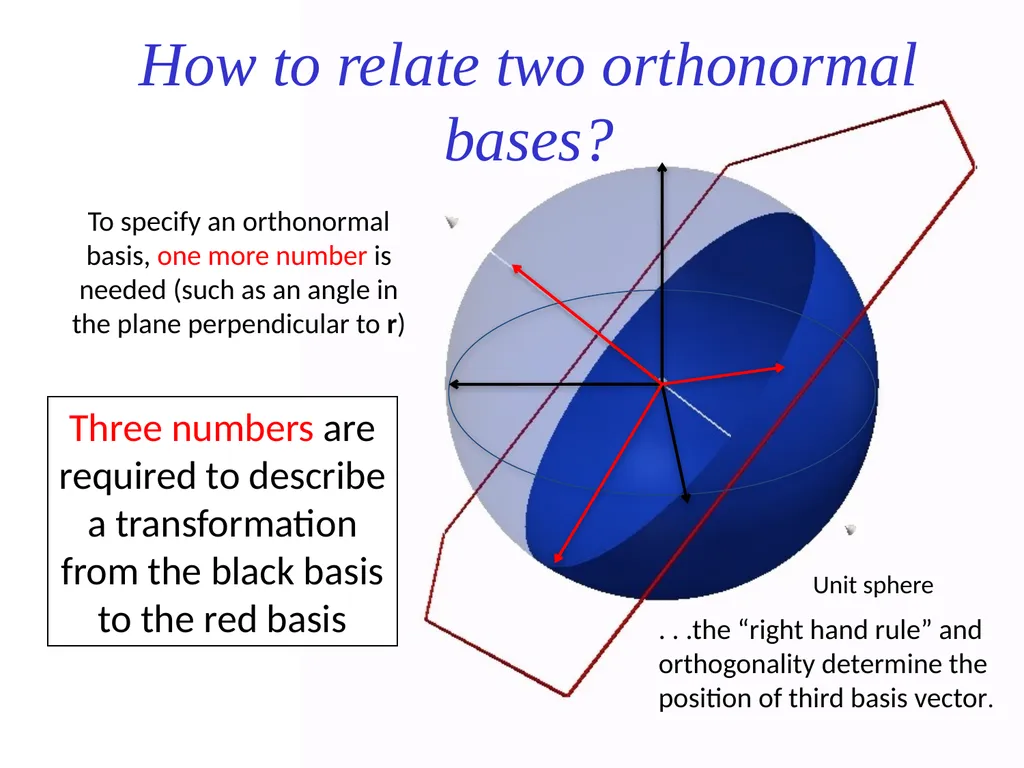
To specify an orthonormal basis, one more number is needed (such as an angle in the plane perpendicular to r) . . .the “right hand rule” and orthogonality determine the position of third basis vector. Three numbers are required to describe a transformation from the black basis to the red basis How to relate two orthonormal bases? Unit sphere<br>
12
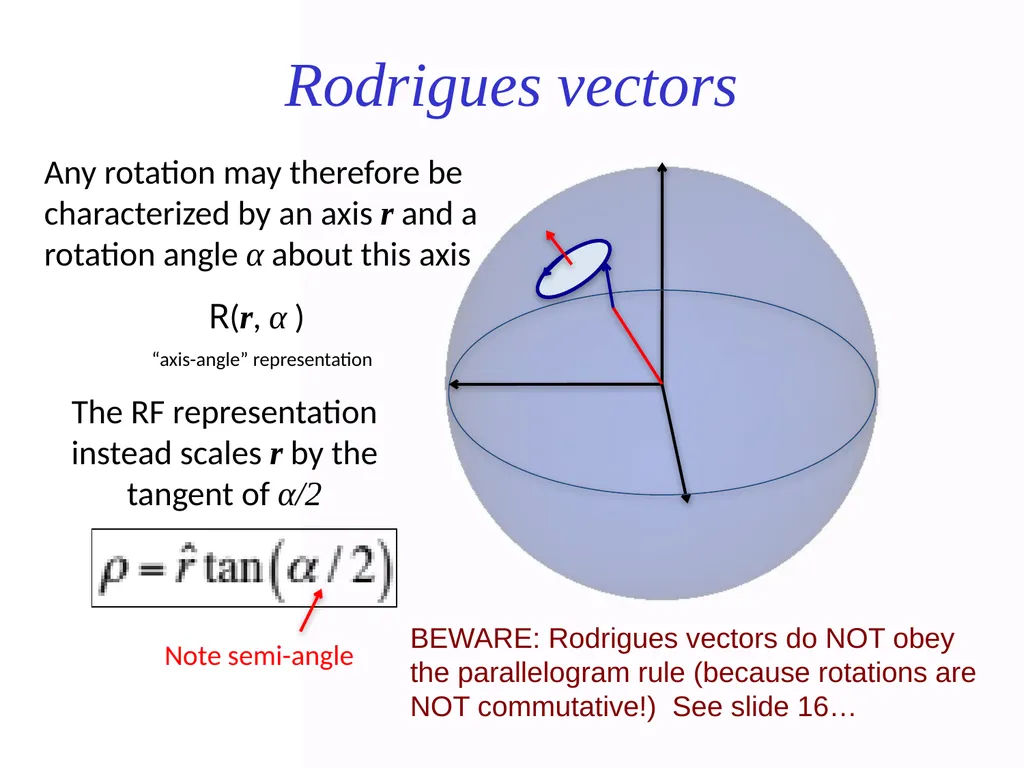
Rodrigues vectors Any rotation may therefore be characterized by an axis r and a rotation angle α about this axis R(r, α ) “axis-angle” representation The RF representation instead scales r by the tangent of α/2 Note semi-angle BEWARE: Rodrigues vectors do NOT obey the parallelogram rule (because rotations are NOT commutative!) See slide 16…<br>
13
13 Rodrigues vectors were popularized by Frank [“Orientation mapping.” Metall. Trans. 19A: 403-408 (1988)], hence the term Rodrigues-Frank space for the set of vectors.
Most useful for representation of misorientations, i.e. grain boundary character; also useful for orientations (texture components).
Application to misorientations is popular because the Rodrigues vector is so closely linked to the rotation axis, which is meaningful for the crystallography of grain boundaries. Rodrigues vectors<br>
Most useful for representation of misorientations, i.e. grain boundary character; also useful for orientations (texture components).
Application to misorientations is popular because the Rodrigues vector is so closely linked to the rotation axis, which is meaningful for the crystallography of grain boundaries. Rodrigues vectors<br>
14
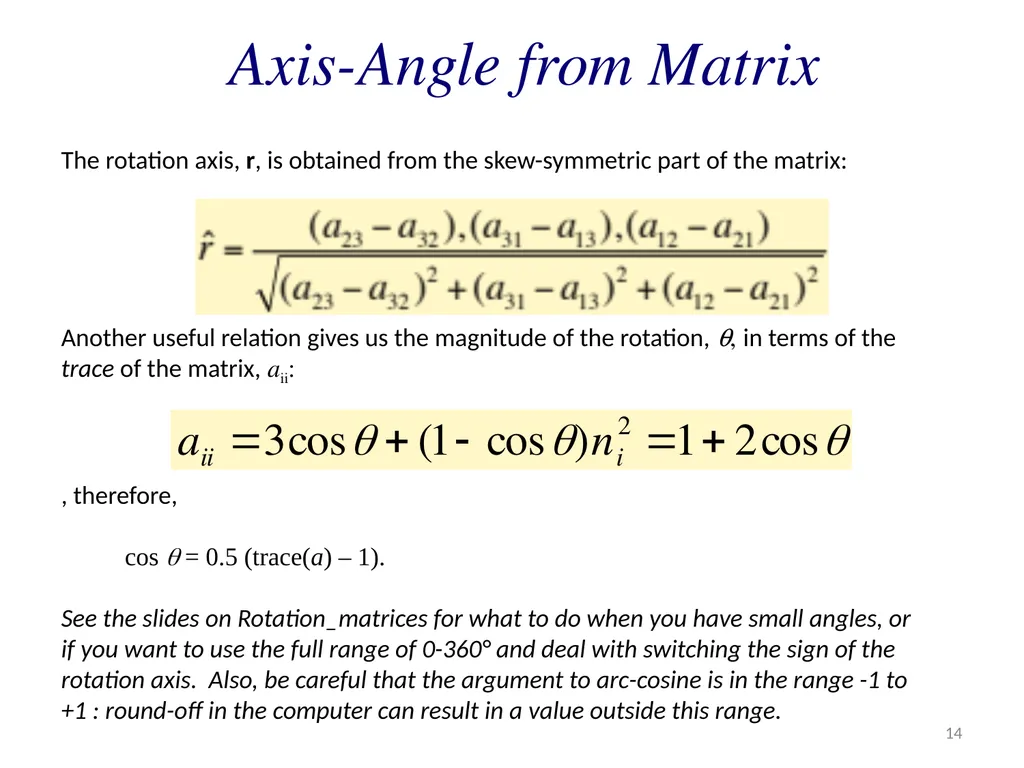
14 Another useful relation gives us the magnitude of the rotation, q, in terms of the trace of the matrix, aii:
, therefore, cos = 0.5 (trace(a) – 1). See the slides on Rotation_matrices for what to do when you have small angles, or if you want to use the full range of 0-360° and deal with switching the sign of the rotation axis. Also, be careful that the argument to arc-cosine is in the range -1 to +1 : round-off in the computer can result in a value outside this range. Axis-Angle from Matrix The rotation axis, r, is obtained from the skew-symmetric part of the matrix:<br>
, therefore, cos = 0.5 (trace(a) – 1). See the slides on Rotation_matrices for what to do when you have small angles, or if you want to use the full range of 0-360° and deal with switching the sign of the rotation axis. Also, be careful that the argument to arc-cosine is in the range -1 to +1 : round-off in the computer can result in a value outside this range. Axis-Angle from Matrix The rotation axis, r, is obtained from the skew-symmetric part of the matrix:<br>
15
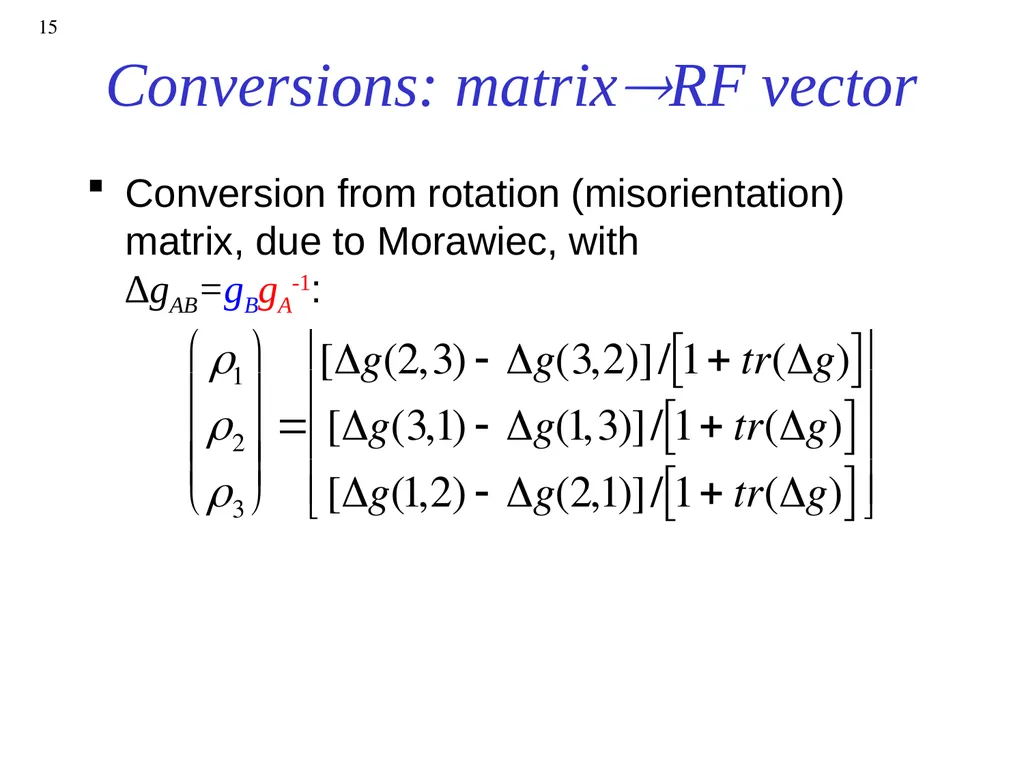
15 Conversions: matrixRF vector Conversion from rotation (misorientation) matrix, due to Morawiec, with ∆gAB=gBgA-1:<br>
16
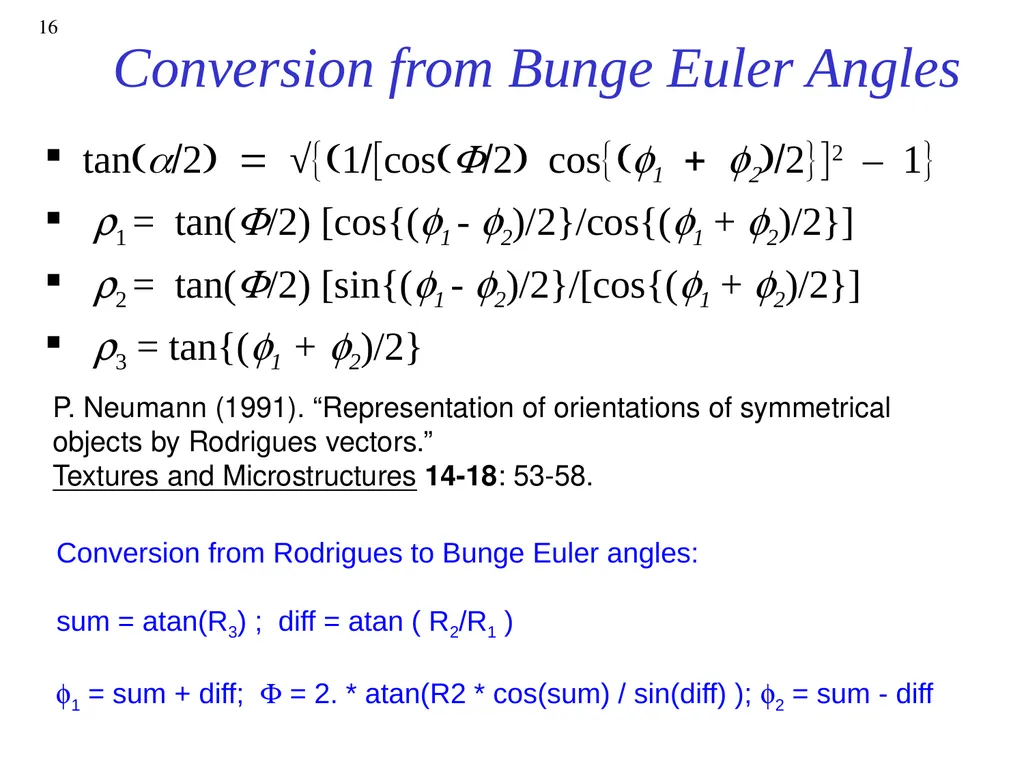
16 Conversion from Bunge Euler Angles tanα√cosFcosf1f–
r1 = tan(F/2) [cos{(f1 - f2)/2}/cos{(f1 + f2)/2}]
r2 = tan(F/2) [sin{(f1 - f2)/2}/[cos{(f1 + f2)/2}]
r3 = tan{(f1 + f2)/2} P. Neumann (1991). “Representation of orientations of symmetrical objects by Rodrigues vectors.” Textures and Microstructures 14-18: 53-58. Conversion from Rodrigues to Bunge Euler angles:
sum = atan(R3) ; diff = atan ( R2/R1 ) f1 = sum + diff; F = 2. * atan(R2 * cos(sum) / sin(diff) ); f2 = sum - diff<br>
r1 = tan(F/2) [cos{(f1 - f2)/2}/cos{(f1 + f2)/2}]
r2 = tan(F/2) [sin{(f1 - f2)/2}/[cos{(f1 + f2)/2}]
r3 = tan{(f1 + f2)/2} P. Neumann (1991). “Representation of orientations of symmetrical objects by Rodrigues vectors.” Textures and Microstructures 14-18: 53-58. Conversion from Rodrigues to Bunge Euler angles:
sum = atan(R3) ; diff = atan ( R2/R1 ) f1 = sum + diff; F = 2. * atan(R2 * cos(sum) / sin(diff) ); f2 = sum - diff<br>
17
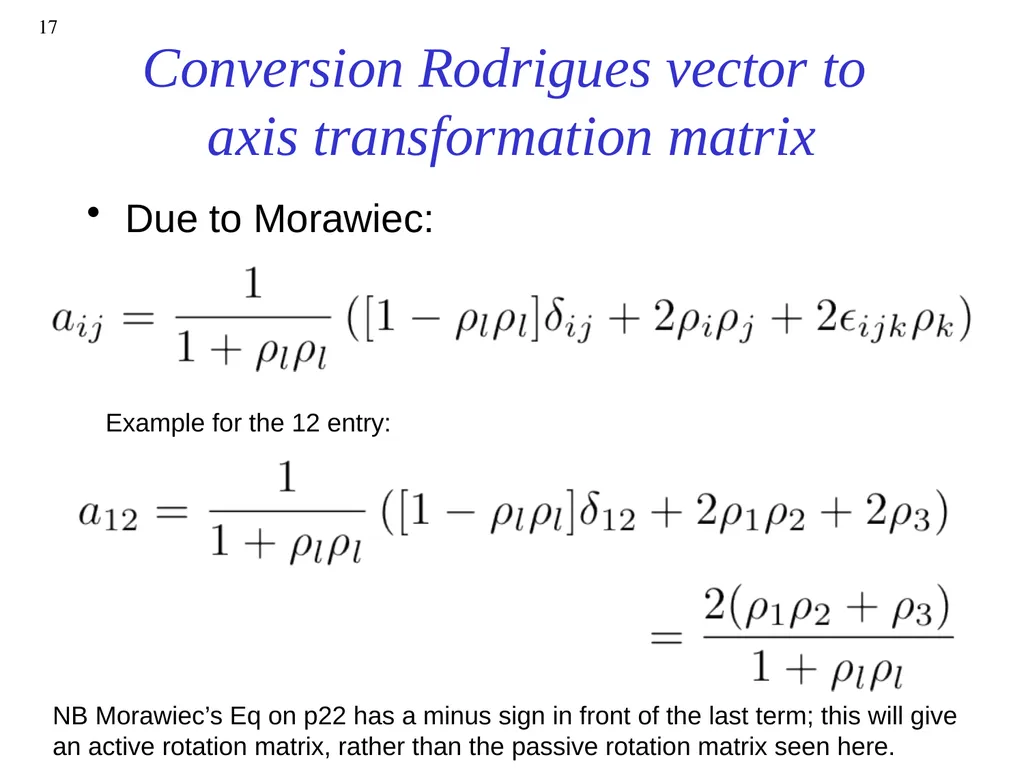
17 Conversion Rodrigues vector to
axis transformation matrix Due to Morawiec: Example for the 12 entry: NB Morawiec’s Eq on p22 has a minus sign in front of the last term; this will give an active rotation matrix, rather than the passive rotation matrix seen here.<br>
18
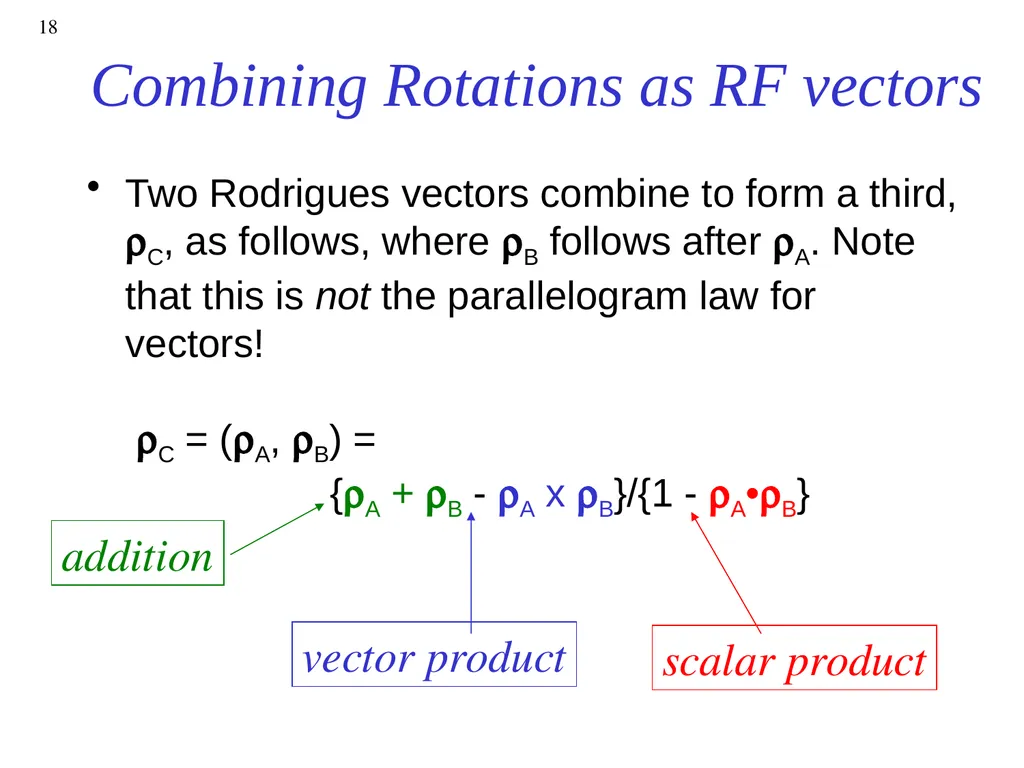
18 Combining Rotations as RF vectors Two Rodrigues vectors combine to form a third, rC, as follows, where rB follows after rA. Note that this is not the parallelogram law for vectors!
rC = (rA, rB) =
{rA + rB - rA x rB}/{1 - rA•rB} vector product scalar product addition<br>
19
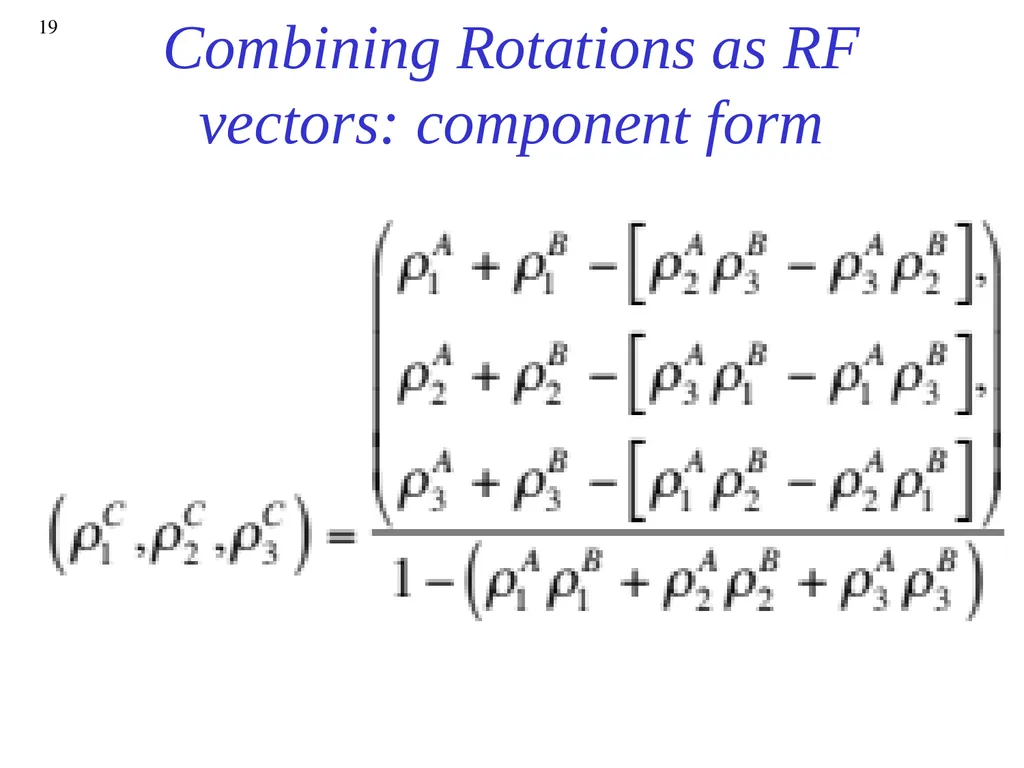
19 Combining Rotations as RF vectors: component form<br>
20
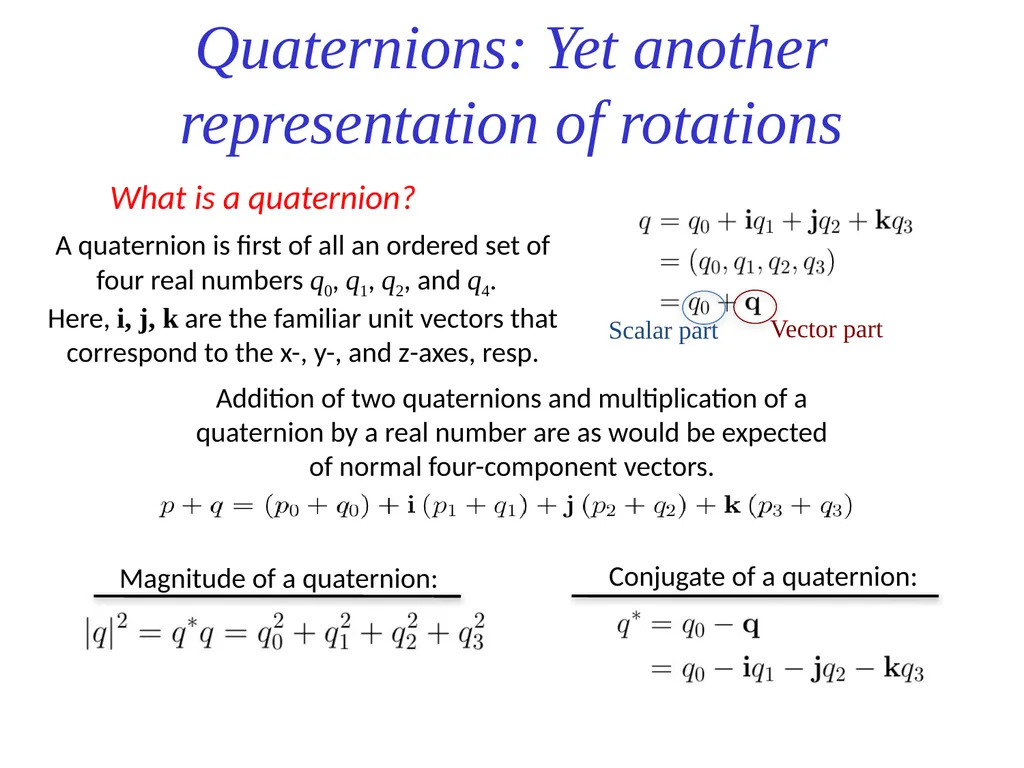
Quaternions: Yet another representation of rotations What is a quaternion? A quaternion is first of all an ordered set of four real numbers q0, q1, q2, and q4.
Here, i, j, k are the familiar unit vectors that correspond to the x-, y-, and z-axes, resp. Addition of two quaternions and multiplication of a quaternion by a real number are as would be expected of normal four-component vectors. Magnitude of a quaternion: Scalar part Vector part Conjugate of a quaternion:<br>
Here, i, j, k are the familiar unit vectors that correspond to the x-, y-, and z-axes, resp. Addition of two quaternions and multiplication of a quaternion by a real number are as would be expected of normal four-component vectors. Magnitude of a quaternion: Scalar part Vector part Conjugate of a quaternion:<br>
21
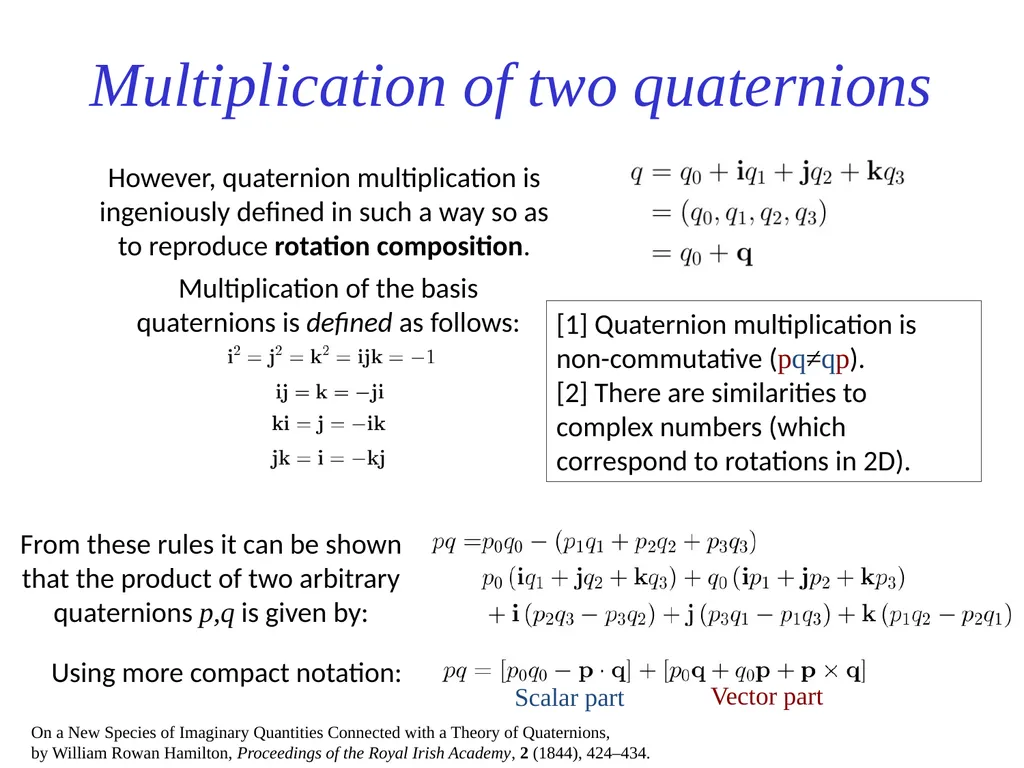
Multiplication of two quaternions However, quaternion multiplication is ingeniously defined in such a way so as to reproduce rotation composition. Multiplication of the basis quaternions is defined as follows: [1] Quaternion multiplication is non-commutative (pq≠qp).
[2] There are similarities to complex numbers (which correspond to rotations in 2D). From these rules it can be shown that the product of two arbitrary quaternions p,q is given by: Using more compact notation: Scalar part Vector part On a New Species of Imaginary Quantities Connected with a Theory of Quaternions, by William Rowan Hamilton, Proceedings of the Royal Irish Academy, 2 (1844), 424–434.<br>
[2] There are similarities to complex numbers (which correspond to rotations in 2D). From these rules it can be shown that the product of two arbitrary quaternions p,q is given by: Using more compact notation: Scalar part Vector part On a New Species of Imaginary Quantities Connected with a Theory of Quaternions, by William Rowan Hamilton, Proceedings of the Royal Irish Academy, 2 (1844), 424–434.<br>
22
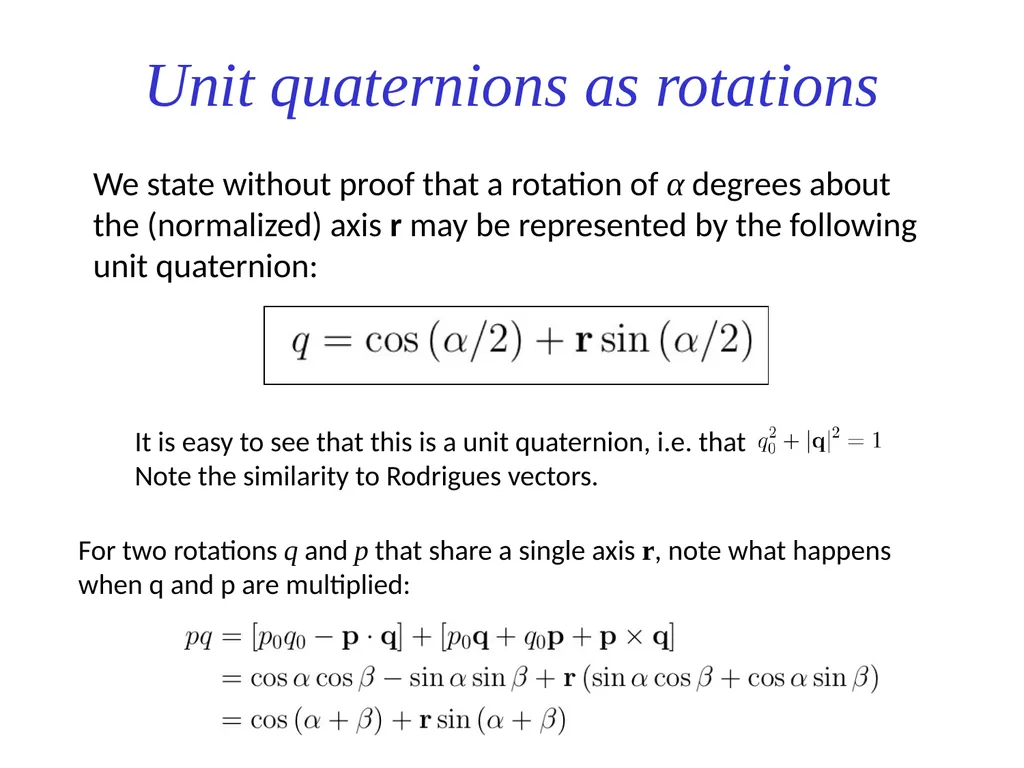
Unit quaternions as rotations We state without proof that a rotation of α degrees about the (normalized) axis r may be represented by the following unit quaternion: It is easy to see that this is a unit quaternion, i.e. that
Note the similarity to Rodrigues vectors. For two rotations q and p that share a single axis r, note what happens when q and p are multiplied:<br>
Note the similarity to Rodrigues vectors. For two rotations q and p that share a single axis r, note what happens when q and p are multiplied:<br>
23
Multiplication of a quaternion
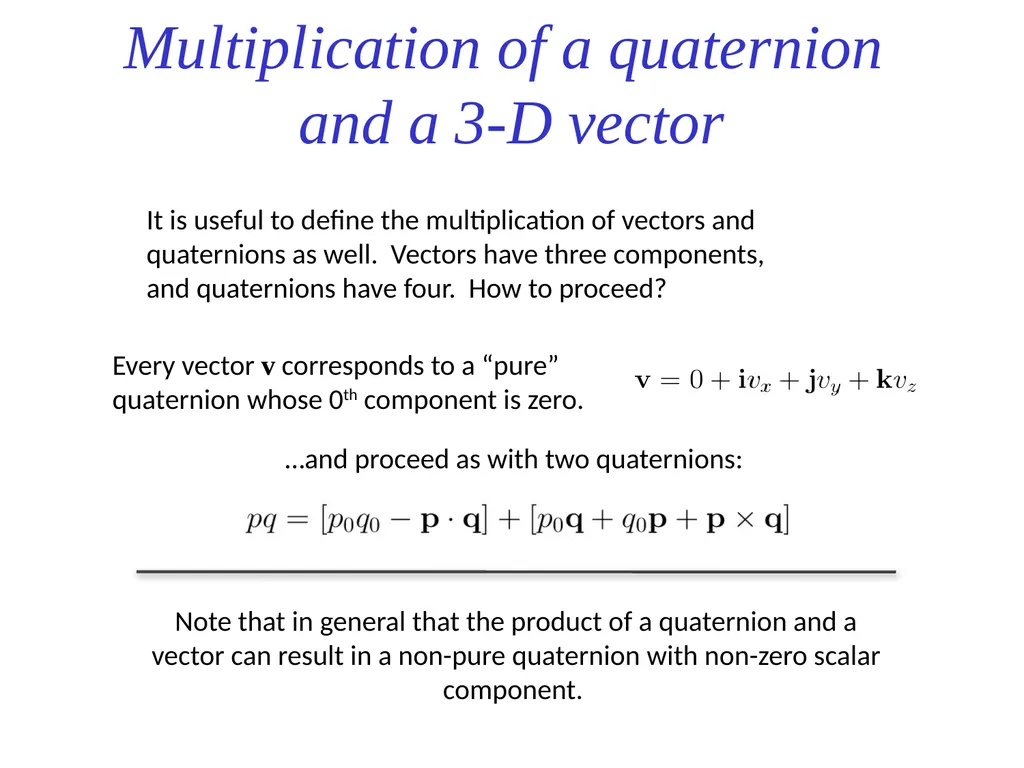
and a 3-D vector It is useful to define the multiplication of vectors and quaternions as well. Vectors have three components, and quaternions have four. How to proceed? Every vector v corresponds to a “pure” quaternion whose 0th component is zero. …and proceed as with two quaternions: Note that in general that the product of a quaternion and a vector can result in a non-pure quaternion with non-zero scalar component.<br>
and a 3-D vector It is useful to define the multiplication of vectors and quaternions as well. Vectors have three components, and quaternions have four. How to proceed? Every vector v corresponds to a “pure” quaternion whose 0th component is zero. …and proceed as with two quaternions: Note that in general that the product of a quaternion and a vector can result in a non-pure quaternion with non-zero scalar component.<br>
24
Rotation of a vector
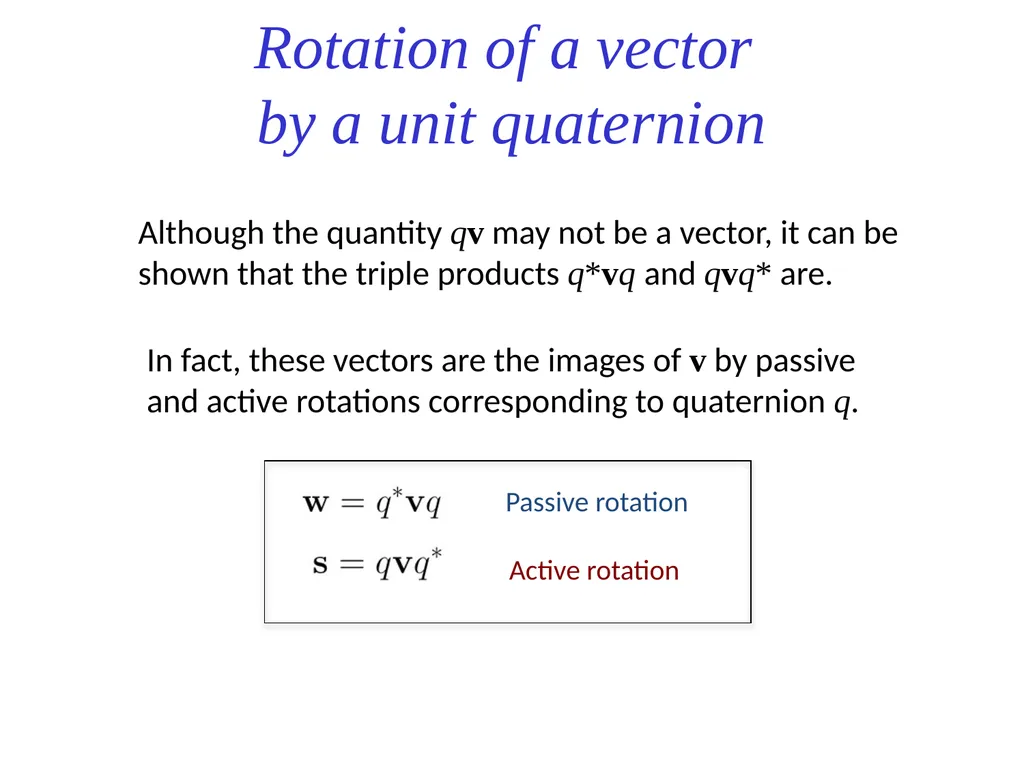
by a unit quaternion Although the quantity qv may not be a vector, it can be shown that the triple products q*vq and qvq* are. In fact, these vectors are the images of v by passive and active rotations corresponding to quaternion q. Passive rotation Active rotation<br>
by a unit quaternion Although the quantity qv may not be a vector, it can be shown that the triple products q*vq and qvq* are. In fact, these vectors are the images of v by passive and active rotations corresponding to quaternion q. Passive rotation Active rotation<br>
25
Rotation of a vector
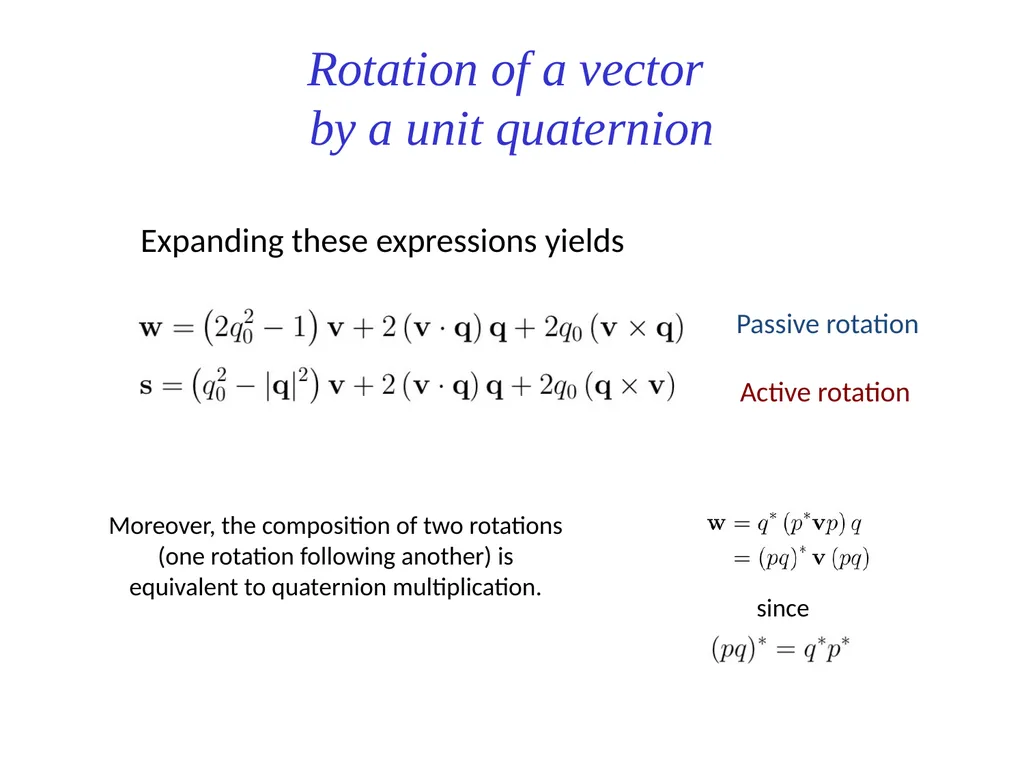
by a unit quaternion Expanding these expressions yields Passive rotation Active rotation Moreover, the composition of two rotations (one rotation following another) is equivalent to quaternion multiplication. since<br>
26
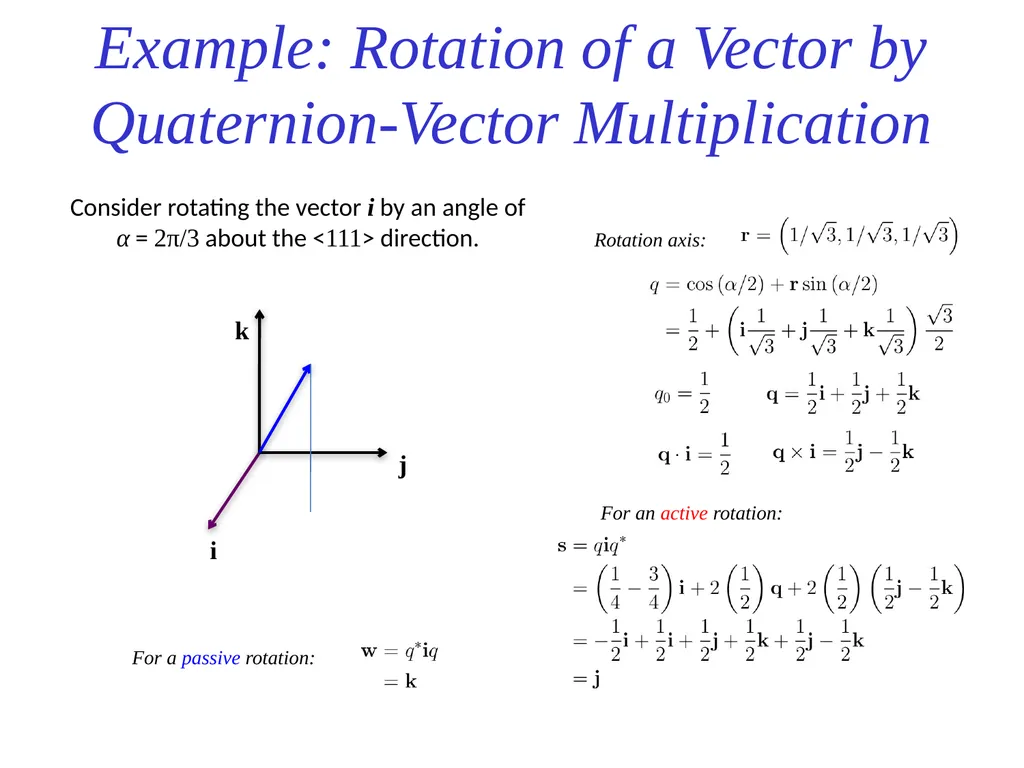
Example: Rotation of a Vector by Quaternion-Vector Multiplication Consider rotating the vector i by an angle of α = 2π/3 about the <111> direction. Rotation axis: For an active rotation: For a passive rotation: j i k<br>
27
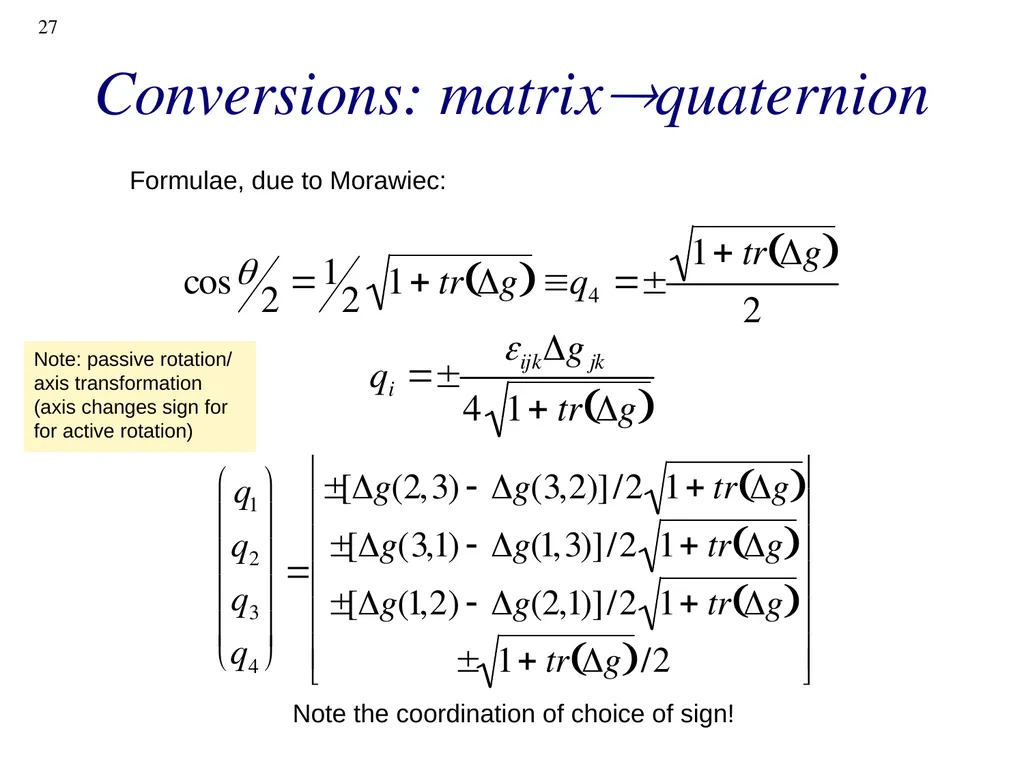
27 Conversions: matrixquaternion Formulae, due to Morawiec: Note the coordination of choice of sign! Note: passive rotation/ axis transformation (axis changes sign for for active rotation)<br>
28
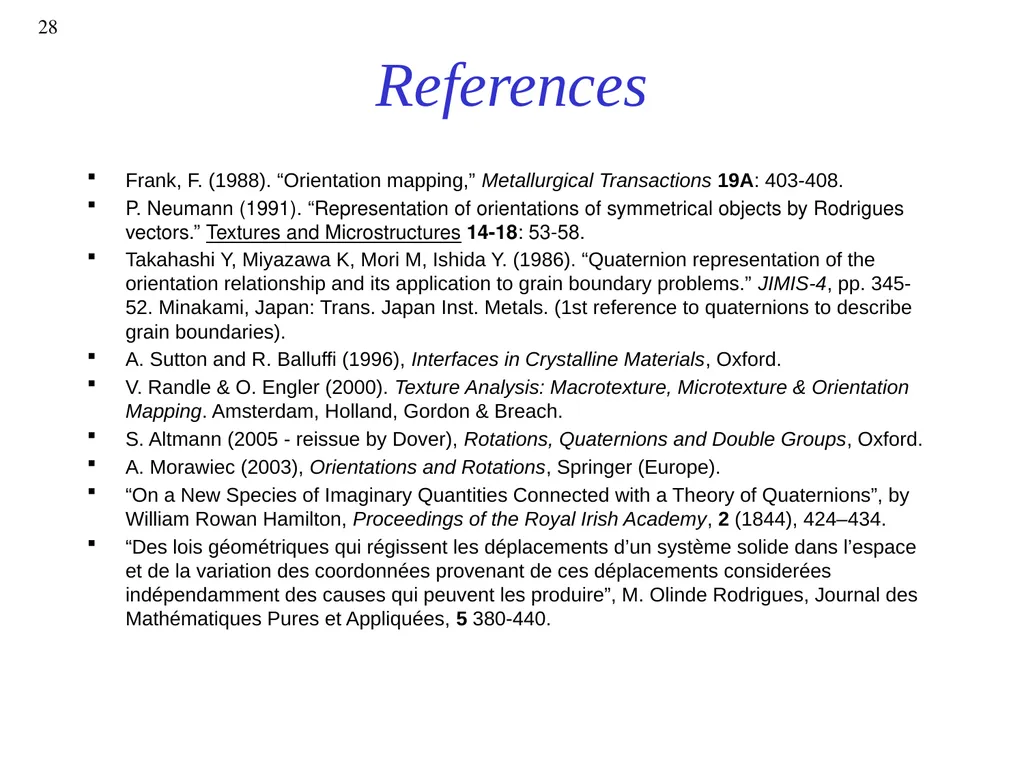
28 References Frank, F. (1988). “Orientation mapping,” Metallurgical Transactions 19A: 403-408.
P. Neumann (1991). “Representation of orientations of symmetrical objects by Rodrigues vectors.” Textures and Microstructures 14-18: 53-58.
Takahashi Y, Miyazawa K, Mori M, Ishida Y. (1986). “Quaternion representation of the orientation relationship and its application to grain boundary problems.” JIMIS-4, pp. 345-52. Minakami, Japan: Trans. Japan Inst. Metals. (1st reference to quaternions to describe grain boundaries).
A. Sutton and R. Balluffi (1996), Interfaces in Crystalline Materials, Oxford.
V. Randle & O. Engler (2000). Texture Analysis: Macrotexture, Microtexture & Orientation Mapping. Amsterdam, Holland, Gordon & Breach.
S. Altmann (2005 - reissue by Dover), Rotations, Quaternions and Double Groups, Oxford.
A. Morawiec (2003), Orientations and Rotations, Springer (Europe).
“On a New Species of Imaginary Quantities Connected with a Theory of Quaternions”, by William Rowan Hamilton, Proceedings of the Royal Irish Academy, 2 (1844), 424–434.
“Des lois géométriques qui régissent les déplacements d’un système solide dans l’espace et de la variation des coordonnées provenant de ces déplacements considerées indépendamment des causes qui peuvent les produire”, M. Olinde Rodrigues, Journal des Mathématiques Pures et Appliquées, 5 380-440.<br>
P. Neumann (1991). “Representation of orientations of symmetrical objects by Rodrigues vectors.” Textures and Microstructures 14-18: 53-58.
Takahashi Y, Miyazawa K, Mori M, Ishida Y. (1986). “Quaternion representation of the orientation relationship and its application to grain boundary problems.” JIMIS-4, pp. 345-52. Minakami, Japan: Trans. Japan Inst. Metals. (1st reference to quaternions to describe grain boundaries).
A. Sutton and R. Balluffi (1996), Interfaces in Crystalline Materials, Oxford.
V. Randle & O. Engler (2000). Texture Analysis: Macrotexture, Microtexture & Orientation Mapping. Amsterdam, Holland, Gordon & Breach.
S. Altmann (2005 - reissue by Dover), Rotations, Quaternions and Double Groups, Oxford.
A. Morawiec (2003), Orientations and Rotations, Springer (Europe).
“On a New Species of Imaginary Quantities Connected with a Theory of Quaternions”, by William Rowan Hamilton, Proceedings of the Royal Irish Academy, 2 (1844), 424–434.
“Des lois géométriques qui régissent les déplacements d’un système solide dans l’espace et de la variation des coordonnées provenant de ces déplacements considerées indépendamment des causes qui peuvent les produire”, M. Olinde Rodrigues, Journal des Mathématiques Pures et Appliquées, 5 380-440.<br>