
1-Bromopropane (1-BP) Proposed Rulemaking Under
TF
Published · 27 slides · 0 views

1 / 1












Description
1-Bromopropane (1-BP) Proposed Rulemaking Under TSCA Section 6(a) Public Webinar August 28, 2024 RIN 2070-AK73 Agenda Purpose and Overview of Rulemaking 1-BP Background TSCA Regulatory Toolbox Developing Effective Regulations Proposed
Related Topics
Share
Embed code
Download this presentation From Below
"1-Bromopropane (1-BP) Proposed Rulemaking Under" is the property of its rightful owner. Permission is granted to download and print the materials on this website for personal, non-commercial use only, and to display it on your personal computer provided you do not modify the materials and that you retain all copyright notices contained in the materials. By downloading content from our website, you accept the terms of this agreement.
Presentation Transcript
01
1-Bromopropane (1-BP) Proposed Rulemaking Under TSCA Section 6(a)
Public Webinar
August 28, 2024
RIN 2070-AK73<br>
Public Webinar
August 28, 2024
RIN 2070-AK73<br>
02
Agenda Purpose and Overview of Rulemaking
1-BP Background
TSCA Regulatory Toolbox
Developing Effective Regulations
Proposed Regulation
Alternative Regulatory Action
Benefits
Requests for Comment and Opportunities for Engagement
Next Steps
Additional Resources<br>
1-BP Background
TSCA Regulatory Toolbox
Developing Effective Regulations
Proposed Regulation
Alternative Regulatory Action
Benefits
Requests for Comment and Opportunities for Engagement
Next Steps
Additional Resources<br>
03
In June 2016, Congress amended the Toxic Substances Control Act (TSCA)
EPA must assess and address risks from chemicals currently in commerce
Statutory timeframes for regulation
Protection for the public and predictability for the regulated community
1-BP was identified in 2016 as one of the first chemicals for risk evaluation
2020 Risk Evaluation followed a public draft and peer review process
2022 Revised Unreasonable Risk Determination
EPA determined 1-BP presents an unreasonable risk under its conditions of use (COUs) EPA’s Proposal and the Toxic Substances Control Act (TSCA)<br>
EPA must assess and address risks from chemicals currently in commerce
Statutory timeframes for regulation
Protection for the public and predictability for the regulated community
1-BP was identified in 2016 as one of the first chemicals for risk evaluation
2020 Risk Evaluation followed a public draft and peer review process
2022 Revised Unreasonable Risk Determination
EPA determined 1-BP presents an unreasonable risk under its conditions of use (COUs) EPA’s Proposal and the Toxic Substances Control Act (TSCA)<br>
04
Addresses the unreasonable risk identified in the risk evaluation of 1-BP
Rule will protect consumers and occupational users through workplace requirements, prescriptive controls, and prohibitions
Public comment period open until September 23, 2024
EPA will consider public comments as it develops a final regulation Purpose and Overview Of Rulemaking<br>
Rule will protect consumers and occupational users through workplace requirements, prescriptive controls, and prohibitions
Public comment period open until September 23, 2024
EPA will consider public comments as it develops a final regulation Purpose and Overview Of Rulemaking<br>
05
1-BP is a volatile chemical with a low global warming potential. It is used in vapor degreasing, as an industrial solvent in aerospace and defense applications, and in a variety of commercial and consumer products.
Annual production volume of 1-50 million pounds reported in 2020 Chemical Data Reporting (CDR)
Risk to workers, occupational non-users (ONUs), consumers, and bystanders for 23 of the 25 conditions of use contribute to the unreasonable risk from 1-BP.
Timeline:
August 8, 2024: EPA Proposed Rule for the Regulation of 1-BP under TSCA Section 6(a)
September 23, 2024: Public comment period closes
2025: Publication of 1-BP Final Rule (estimated) 1-BP Background<br>
Annual production volume of 1-50 million pounds reported in 2020 Chemical Data Reporting (CDR)
Risk to workers, occupational non-users (ONUs), consumers, and bystanders for 23 of the 25 conditions of use contribute to the unreasonable risk from 1-BP.
Timeline:
August 8, 2024: EPA Proposed Rule for the Regulation of 1-BP under TSCA Section 6(a)
September 23, 2024: Public comment period closes
2025: Publication of 1-BP Final Rule (estimated) 1-BP Background<br>
06
Cancer from chronic inhalation and dermal exposure is the most sensitive endpoint
Additional adverse effects from acute and chronic non-cancer exposures include other developmental toxicity (i.e., post-implantation loss), reproductive toxicity, liver toxicity, kidney toxicity, and neurotoxicity
No unreasonable risk to the environment 1-BP Risk Evaluation: Unreasonable Risk for Workers and Consumers<br>
Additional adverse effects from acute and chronic non-cancer exposures include other developmental toxicity (i.e., post-implantation loss), reproductive toxicity, liver toxicity, kidney toxicity, and neurotoxicity
No unreasonable risk to the environment 1-BP Risk Evaluation: Unreasonable Risk for Workers and Consumers<br>
07
TSCA provides authority to regulate entities including:
Manufacturers (including importers) and processors (e.g., formulators)
Distributors
Commercial users (workplaces and workers)
Entities disposing of chemicals for commercial purposes
Cannot directly regulate consumer users
Under TSCA, EPA has authority to regulate at the manufacturing, processing and distribution levels in the supply chain to eliminate or restrict the availability of chemicals and chemical-containing products for consumer use
These authorities allow EPA to regulate at key points in the supply chain to effectively address unreasonable risks to consumers TSCA Section 6(a) Regulatory Options<br>
Manufacturers (including importers) and processors (e.g., formulators)
Distributors
Commercial users (workplaces and workers)
Entities disposing of chemicals for commercial purposes
Cannot directly regulate consumer users
Under TSCA, EPA has authority to regulate at the manufacturing, processing and distribution levels in the supply chain to eliminate or restrict the availability of chemicals and chemical-containing products for consumer use
These authorities allow EPA to regulate at key points in the supply chain to effectively address unreasonable risks to consumers TSCA Section 6(a) Regulatory Options<br>
08
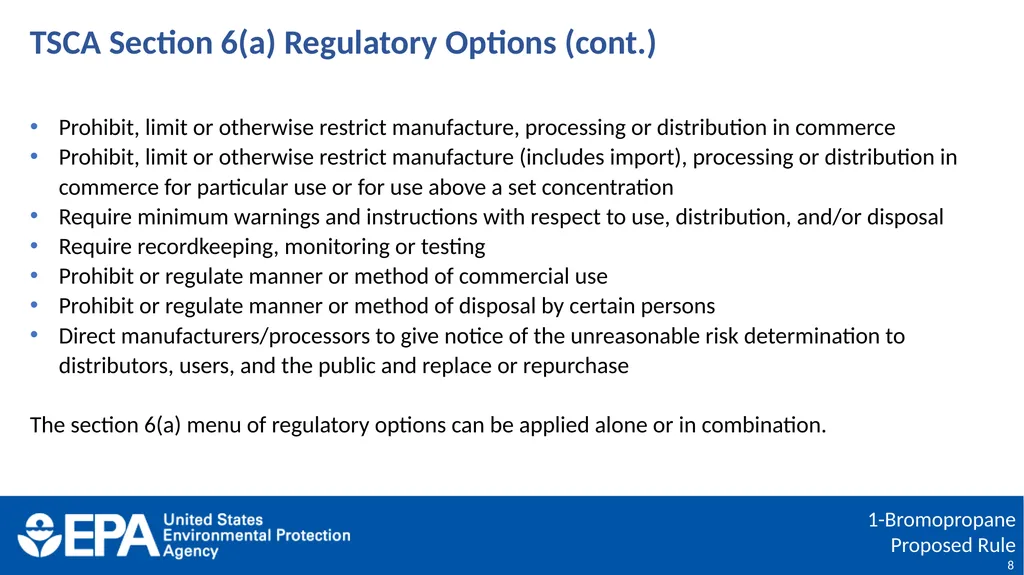
Prohibit, limit or otherwise restrict manufacture, processing or distribution in commerce
Prohibit, limit or otherwise restrict manufacture (includes import), processing or distribution in commerce for particular use or for use above a set concentration
Require minimum warnings and instructions with respect to use, distribution, and/or disposal
Require recordkeeping, monitoring or testing
Prohibit or regulate manner or method of commercial use
Prohibit or regulate manner or method of disposal by certain persons
Direct manufacturers/processors to give notice of the unreasonable risk determination to distributors, users, and the public and replace or repurchase
The section 6(a) menu of regulatory options can be applied alone or in combination. TSCA Section 6(a) Regulatory Options (cont.)<br>
Prohibit, limit or otherwise restrict manufacture (includes import), processing or distribution in commerce for particular use or for use above a set concentration
Require minimum warnings and instructions with respect to use, distribution, and/or disposal
Require recordkeeping, monitoring or testing
Prohibit or regulate manner or method of commercial use
Prohibit or regulate manner or method of disposal by certain persons
Direct manufacturers/processors to give notice of the unreasonable risk determination to distributors, users, and the public and replace or repurchase
The section 6(a) menu of regulatory options can be applied alone or in combination. TSCA Section 6(a) Regulatory Options (cont.)<br>
09
Transparent, proactive, and meaningful engagement during risk management helps EPA develop practical and protective regulations
One-on-one meetings, public webinars, and required consultations with state and local governments, Tribes, environmental justice communities, and small businesses
Consultation and coordination with other Federal agencies
OSHA, NIOSH, and CPSC for a consistent approach, facilitate compliance, and avoid duplicative requirements
DOD, DOE, and NASA for uses that might affect U.S. critical infrastructure or national security and to facilitate compliance
SBA Advocacy and OMB/OIRA for a Small Business Advocacy Review panel to obtain advice and recommendations from small entity representatives
Extensive dialogue helps people understand risk evaluation findings, the TSCA risk management process, and available options for managing unreasonable risks
Have been seeking input from stakeholders on potential risk management approaches, their effectiveness, and impacts those approaches might have on businesses, workers, and consumers Principles for Transparency During Risk Management<br>
One-on-one meetings, public webinars, and required consultations with state and local governments, Tribes, environmental justice communities, and small businesses
Consultation and coordination with other Federal agencies
OSHA, NIOSH, and CPSC for a consistent approach, facilitate compliance, and avoid duplicative requirements
DOD, DOE, and NASA for uses that might affect U.S. critical infrastructure or national security and to facilitate compliance
SBA Advocacy and OMB/OIRA for a Small Business Advocacy Review panel to obtain advice and recommendations from small entity representatives
Extensive dialogue helps people understand risk evaluation findings, the TSCA risk management process, and available options for managing unreasonable risks
Have been seeking input from stakeholders on potential risk management approaches, their effectiveness, and impacts those approaches might have on businesses, workers, and consumers Principles for Transparency During Risk Management<br>
10
EPA’s mandate is to address unreasonable risk
EPA must consider:
Effects and magnitude of exposure to human health and the environment
Potentially Exposed or Susceptible Subpopulations
Benefits of a chemical substance
Economic consequences of the rule
Availability of alternatives
Proposal is based on best available science and reasonably available information Developing Effective Regulations<br>
EPA must consider:
Effects and magnitude of exposure to human health and the environment
Potentially Exposed or Susceptible Subpopulations
Benefits of a chemical substance
Economic consequences of the rule
Availability of alternatives
Proposal is based on best available science and reasonably available information Developing Effective Regulations<br>
11
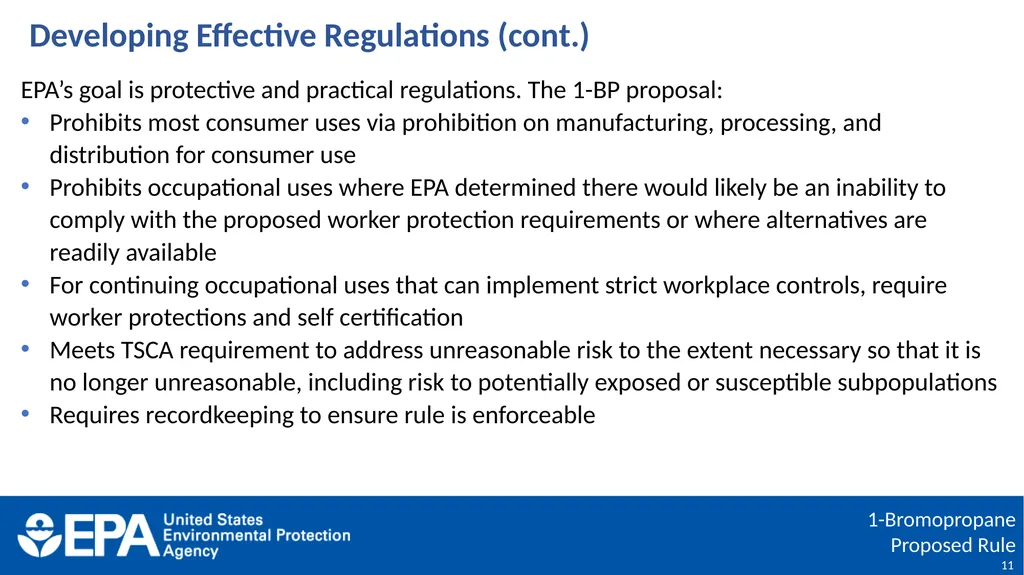
EPA’s goal is protective and practical regulations. The 1-BP proposal:
Prohibits most consumer uses via prohibition on manufacturing, processing, and distribution for consumer use
Prohibits occupational uses where EPA determined there would likely be an inability to comply with the proposed worker protection requirements or where alternatives are readily available
For continuing occupational uses that can implement strict workplace controls, require worker protections and self certification
Meets TSCA requirement to address unreasonable risk to the extent necessary so that it is no longer unreasonable, including risk to potentially exposed or susceptible subpopulations
Requires recordkeeping to ensure rule is enforceable Developing Effective Regulations (cont.)<br>
Prohibits most consumer uses via prohibition on manufacturing, processing, and distribution for consumer use
Prohibits occupational uses where EPA determined there would likely be an inability to comply with the proposed worker protection requirements or where alternatives are readily available
For continuing occupational uses that can implement strict workplace controls, require worker protections and self certification
Meets TSCA requirement to address unreasonable risk to the extent necessary so that it is no longer unreasonable, including risk to potentially exposed or susceptible subpopulations
Requires recordkeeping to ensure rule is enforceable Developing Effective Regulations (cont.)<br>
12
Requesting comment on all elements of the proposed and alternative regulatory actions
EPA may in the final rule modify elements of the proposed regulatory action
Public comments could result in changes when this rule is finalized Developing Effective Regulations (cont.)<br>
EPA may in the final rule modify elements of the proposed regulatory action
Public comments could result in changes when this rule is finalized Developing Effective Regulations (cont.)<br>
13
The Proposed Regulation<br>
14
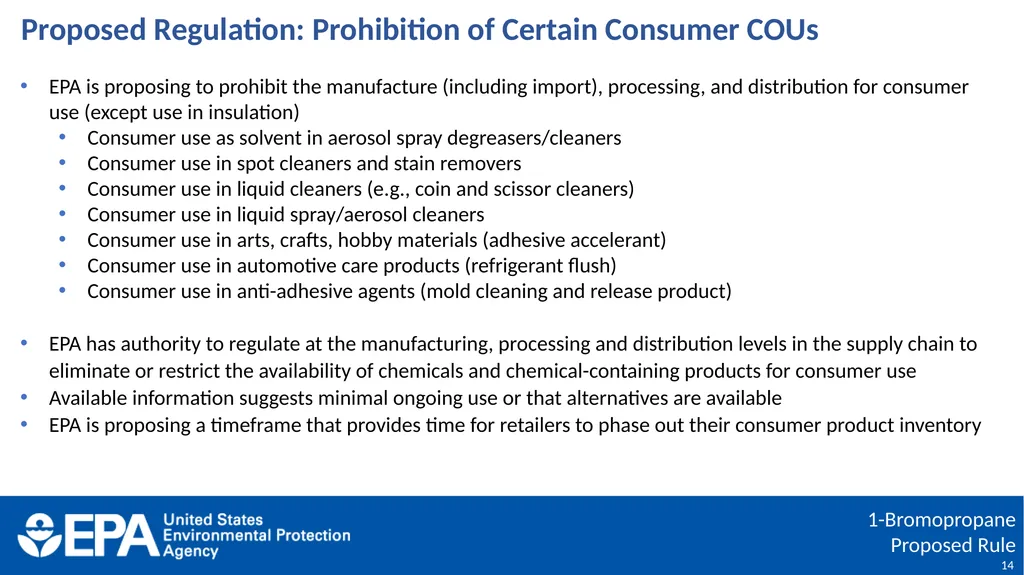
EPA is proposing to prohibit the manufacture (including import), processing, and distribution for consumer use (except use in insulation)
Consumer use as solvent in aerosol spray degreasers/cleaners
Consumer use in spot cleaners and stain removers
Consumer use in liquid cleaners (e.g., coin and scissor cleaners)
Consumer use in liquid spray/aerosol cleaners
Consumer use in arts, crafts, hobby materials (adhesive accelerant)
Consumer use in automotive care products (refrigerant flush)
Consumer use in anti-adhesive agents (mold cleaning and release product)
EPA has authority to regulate at the manufacturing, processing and distribution levels in the supply chain to eliminate or restrict the availability of chemicals and chemical-containing products for consumer use
Available information suggests minimal ongoing use or that alternatives are available
EPA is proposing a timeframe that provides time for retailers to phase out their consumer product inventory Proposed Regulation: Prohibition of Certain Consumer COUs<br>
Consumer use as solvent in aerosol spray degreasers/cleaners
Consumer use in spot cleaners and stain removers
Consumer use in liquid cleaners (e.g., coin and scissor cleaners)
Consumer use in liquid spray/aerosol cleaners
Consumer use in arts, crafts, hobby materials (adhesive accelerant)
Consumer use in automotive care products (refrigerant flush)
Consumer use in anti-adhesive agents (mold cleaning and release product)
EPA has authority to regulate at the manufacturing, processing and distribution levels in the supply chain to eliminate or restrict the availability of chemicals and chemical-containing products for consumer use
Available information suggests minimal ongoing use or that alternatives are available
EPA is proposing a timeframe that provides time for retailers to phase out their consumer product inventory Proposed Regulation: Prohibition of Certain Consumer COUs<br>
15
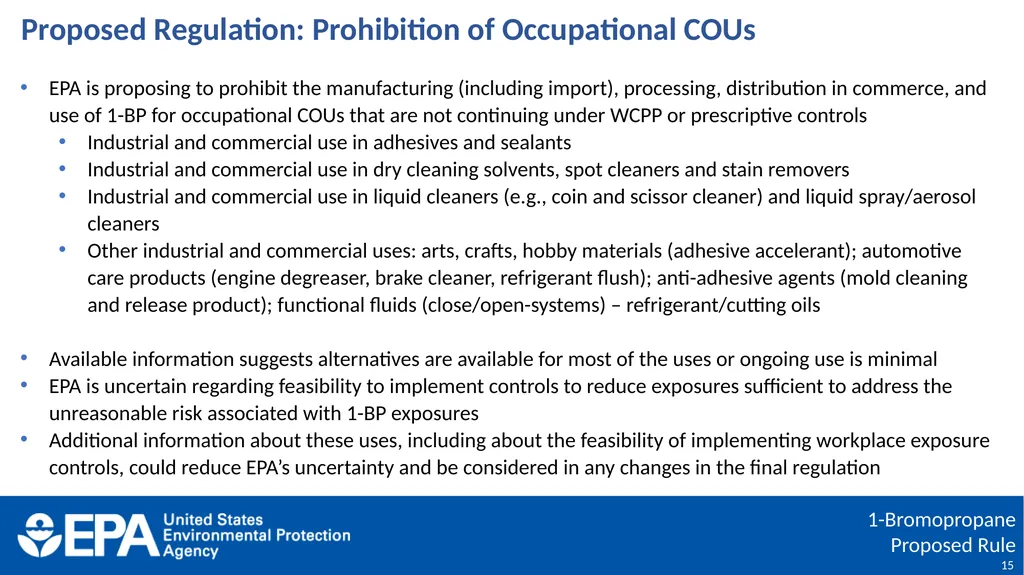
EPA is proposing to prohibit the manufacturing (including import), processing, distribution in commerce, and use of 1-BP for occupational COUs that are not continuing under WCPP or prescriptive controls
Industrial and commercial use in adhesives and sealants
Industrial and commercial use in dry cleaning solvents, spot cleaners and stain removers
Industrial and commercial use in liquid cleaners (e.g., coin and scissor cleaner) and liquid spray/aerosol cleaners
Other industrial and commercial uses: arts, crafts, hobby materials (adhesive accelerant); automotive care products (engine degreaser, brake cleaner, refrigerant flush); anti-adhesive agents (mold cleaning and release product); functional fluids (close/open-systems) – refrigerant/cutting oils
Available information suggests alternatives are available for most of the uses or ongoing use is minimal
EPA is uncertain regarding feasibility to implement controls to reduce exposures sufficient to address the unreasonable risk associated with 1-BP exposures
Additional information about these uses, including about the feasibility of implementing workplace exposure controls, could reduce EPA’s uncertainty and be considered in any changes in the final regulation Proposed Regulation: Prohibition of Occupational COUs<br>
Industrial and commercial use in adhesives and sealants
Industrial and commercial use in dry cleaning solvents, spot cleaners and stain removers
Industrial and commercial use in liquid cleaners (e.g., coin and scissor cleaner) and liquid spray/aerosol cleaners
Other industrial and commercial uses: arts, crafts, hobby materials (adhesive accelerant); automotive care products (engine degreaser, brake cleaner, refrigerant flush); anti-adhesive agents (mold cleaning and release product); functional fluids (close/open-systems) – refrigerant/cutting oils
Available information suggests alternatives are available for most of the uses or ongoing use is minimal
EPA is uncertain regarding feasibility to implement controls to reduce exposures sufficient to address the unreasonable risk associated with 1-BP exposures
Additional information about these uses, including about the feasibility of implementing workplace exposure controls, could reduce EPA’s uncertainty and be considered in any changes in the final regulation Proposed Regulation: Prohibition of Occupational COUs<br>
16
EPA is proposing strict workplace controls, including an inhalation exposure limit (ECEL of 0.05 ppm), while also providing flexibility in implementation and compatibility with existing OSHA requirements wherever possible
OSHA Method 1017 is fully validated and has a limit of quantification of 1.2 ppb
Owners or operators is broader than “employers”
Includes additional recordkeeping, dermal, and exposure control plan requirements
EPA expects some workplaces already have these controls in place
Uncertainty regarding ability to comply with WCPP is the primary driver of difference between the proposed approaches
Longer compliance timeframes for Federal agencies and Federal contractors acting for or on behalf of the Federal Government Proposed Regulation: Workplace Chemical Protection Program (WCPP)<br>
OSHA Method 1017 is fully validated and has a limit of quantification of 1.2 ppb
Owners or operators is broader than “employers”
Includes additional recordkeeping, dermal, and exposure control plan requirements
EPA expects some workplaces already have these controls in place
Uncertainty regarding ability to comply with WCPP is the primary driver of difference between the proposed approaches
Longer compliance timeframes for Federal agencies and Federal contractors acting for or on behalf of the Federal Government Proposed Regulation: Workplace Chemical Protection Program (WCPP)<br>
17
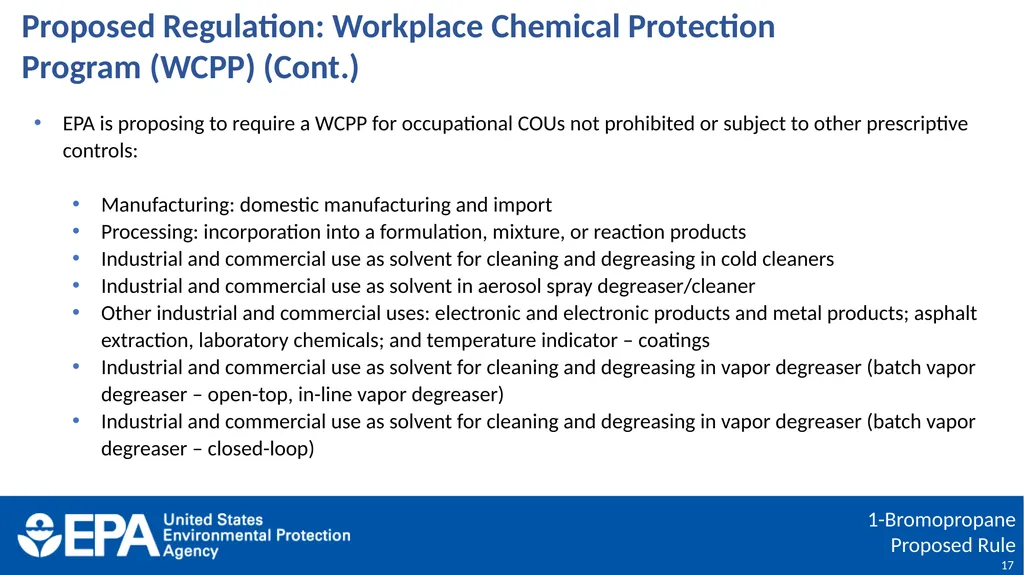
EPA is proposing to require a WCPP for occupational COUs not prohibited or subject to other prescriptive controls:
Manufacturing: domestic manufacturing and import
Processing: incorporation into a formulation, mixture, or reaction products
Industrial and commercial use as solvent for cleaning and degreasing in cold cleaners
Industrial and commercial use as solvent in aerosol spray degreaser/cleaner
Other industrial and commercial uses: electronic and electronic products and metal products; asphalt extraction, laboratory chemicals; and temperature indicator – coatings
Industrial and commercial use as solvent for cleaning and degreasing in vapor degreaser (batch vapor degreaser – open-top, in-line vapor degreaser)
Industrial and commercial use as solvent for cleaning and degreasing in vapor degreaser (batch vapor degreaser – closed-loop) Proposed Regulation: Workplace Chemical Protection Program (WCPP) (Cont.)<br>
Manufacturing: domestic manufacturing and import
Processing: incorporation into a formulation, mixture, or reaction products
Industrial and commercial use as solvent for cleaning and degreasing in cold cleaners
Industrial and commercial use as solvent in aerosol spray degreaser/cleaner
Other industrial and commercial uses: electronic and electronic products and metal products; asphalt extraction, laboratory chemicals; and temperature indicator – coatings
Industrial and commercial use as solvent for cleaning and degreasing in vapor degreaser (batch vapor degreaser – open-top, in-line vapor degreaser)
Industrial and commercial use as solvent for cleaning and degreasing in vapor degreaser (batch vapor degreaser – closed-loop) Proposed Regulation: Workplace Chemical Protection Program (WCPP) (Cont.)<br>
18
EPA is proposing specific prescriptive controls (gloves) for certain occupational COUs with only dermal exposure driving the unreasonable risk
Manufacturing (Import)
Processing as a reactant
Processing: incorporation into articles
Processing: repackaging
Processing: recycling
Disposal
EPA is also proposing workplace training requirements in accordance with OSHA’s general PPE requirement standards. Proposed Regulation: Prescriptive Controls<br>
Manufacturing (Import)
Processing as a reactant
Processing: incorporation into articles
Processing: repackaging
Processing: recycling
Disposal
EPA is also proposing workplace training requirements in accordance with OSHA’s general PPE requirement standards. Proposed Regulation: Prescriptive Controls<br>
19
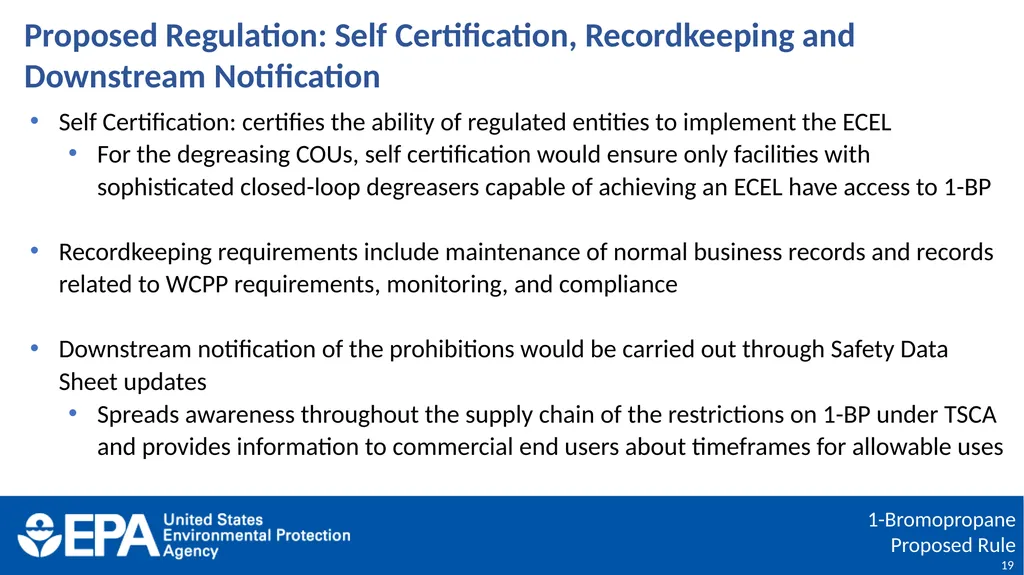
Self Certification: certifies the ability of regulated entities to implement the ECEL
For the degreasing COUs, self certification would ensure only facilities with sophisticated closed-loop degreasers capable of achieving an ECEL have access to 1-BP
Recordkeeping requirements include maintenance of normal business records and records related to WCPP requirements, monitoring, and compliance
Downstream notification of the prohibitions would be carried out through Safety Data Sheet updates
Spreads awareness throughout the supply chain of the restrictions on 1-BP under TSCA and provides information to commercial end users about timeframes for allowable uses Proposed Regulation: Self Certification, Recordkeeping and Downstream Notification<br>
For the degreasing COUs, self certification would ensure only facilities with sophisticated closed-loop degreasers capable of achieving an ECEL have access to 1-BP
Recordkeeping requirements include maintenance of normal business records and records related to WCPP requirements, monitoring, and compliance
Downstream notification of the prohibitions would be carried out through Safety Data Sheet updates
Spreads awareness throughout the supply chain of the restrictions on 1-BP under TSCA and provides information to commercial end users about timeframes for allowable uses Proposed Regulation: Self Certification, Recordkeeping and Downstream Notification<br>
20
Alternative Regulatory Actions Considered The primary alternative regulatory action differs from the proposed regulatory action by:
Proposing prescriptive controls instead of WCPP for 2 COUs
Industrial and commercial use as a solvent in open-top and in-line batch vapor degreasing
Industrial and commercial use as a solvent in closed-loop vapor degreasing
Including longer compliance timeframes (take effect 6 months later)
Second alternative regulatory action: Prohibition (36-months without supply chain stagger)<br>
Proposing prescriptive controls instead of WCPP for 2 COUs
Industrial and commercial use as a solvent in open-top and in-line batch vapor degreasing
Industrial and commercial use as a solvent in closed-loop vapor degreasing
Including longer compliance timeframes (take effect 6 months later)
Second alternative regulatory action: Prohibition (36-months without supply chain stagger)<br>
21
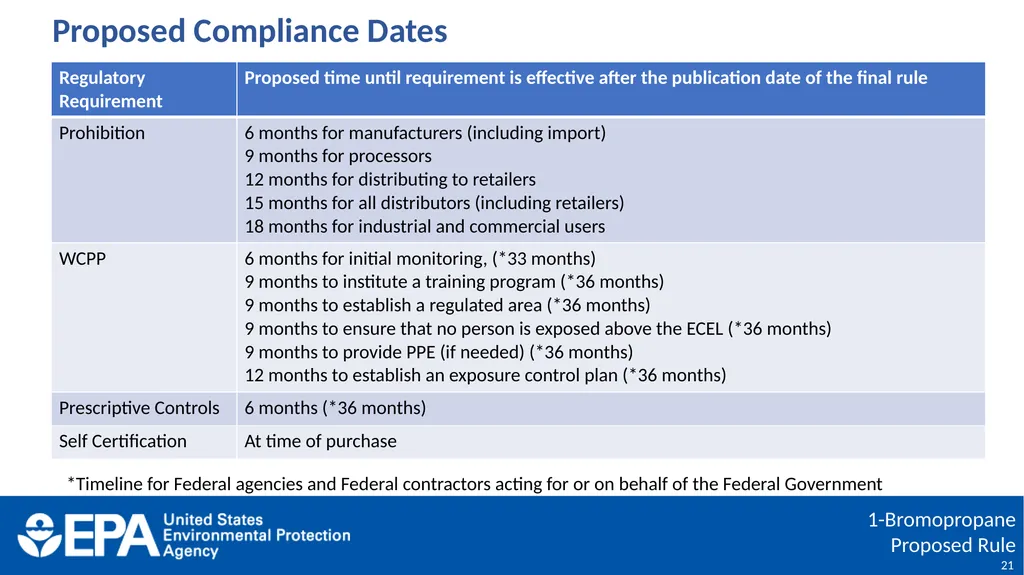
Proposed Compliance Dates *Timeline for Federal agencies and Federal contractors acting for or on behalf of the Federal Government<br>
22
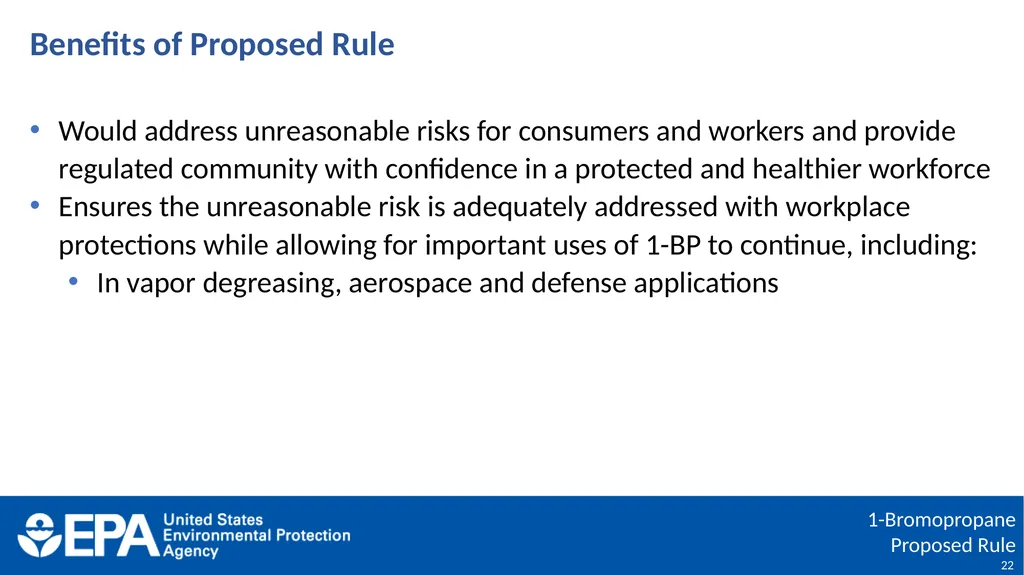
Would address unreasonable risks for consumers and workers and provide regulated community with confidence in a protected and healthier workforce
Ensures the unreasonable risk is adequately addressed with workplace protections while allowing for important uses of 1-BP to continue, including:
In vapor degreasing, aerospace and defense applications Benefits of Proposed Rule<br>
Ensures the unreasonable risk is adequately addressed with workplace protections while allowing for important uses of 1-BP to continue, including:
In vapor degreasing, aerospace and defense applications Benefits of Proposed Rule<br>
23
Requesting comments and substantiative information regarding several topics, including:
The Workplace Chemical Protection Program (WCPP) and its various components (e.g., ECEL, restricted areas, monitoring frequency)
Timeframes for implementation of the requirements
Specific engineering or administrative controls that could address the unreasonable risk
Feasibility of alternatives to 1-BP and their availability
Timeframes for prohibitions for any uses that are currently proposed to be prohibited
The need for and associated costs of ambient air monitoring or facility emissions source monitoring to prevent inadvertent releases associated with WCPP compliance
Whether to include a regulatory threshold limit of 1-BP in formulations Request for Comments<br>
The Workplace Chemical Protection Program (WCPP) and its various components (e.g., ECEL, restricted areas, monitoring frequency)
Timeframes for implementation of the requirements
Specific engineering or administrative controls that could address the unreasonable risk
Feasibility of alternatives to 1-BP and their availability
Timeframes for prohibitions for any uses that are currently proposed to be prohibited
The need for and associated costs of ambient air monitoring or facility emissions source monitoring to prevent inadvertent releases associated with WCPP compliance
Whether to include a regulatory threshold limit of 1-BP in formulations Request for Comments<br>
24
Potentially useful information for comments should include relevant data from the last 20 years.
Descriptions of commercial worker activities and associated sources of exposure
Process emission factors
Product formulation information
Relevant unpublished data Types of Information that Best Inform Comments<br>
Descriptions of commercial worker activities and associated sources of exposure
Process emission factors
Product formulation information
Relevant unpublished data Types of Information that Best Inform Comments<br>
25
Next Steps<br>
26
Risk management for 1-BP: https://www.epa.gov/assessing-and-managing-chemicals-under-tsca/final-risk-evaluation-1-bromopropane-1-bp
1-BP risk evaluation, supplemental risk evaluation materials, and proposed rulemaking are in dockets EPA-HQ-OPPT-2019-0235, EPA-HQ-OPPT-2016-0741, and EPA-HQ-OPPT-2020-0471 respectively, and may be accessed through www.regulations.gov
General TSCA: https://www.epa.gov/assessing-and-managing-chemicals-under-tsca/frank-r-lautenberg-chemical-safety-21st-century-act
Chemicals Undergoing Risk Evaluation under TSCA: https://www.epa.gov/assessing-and-managing-chemicals-under-tsca/chemicals-undergoing-risk-evaluation-under-tsca
Current Chemical Risk Management Activities: https://www.epa.gov/assessing-and-managing-chemicals-under-tsca/current-chemical-risk-management-activities Additional Resources<br>
1-BP risk evaluation, supplemental risk evaluation materials, and proposed rulemaking are in dockets EPA-HQ-OPPT-2019-0235, EPA-HQ-OPPT-2016-0741, and EPA-HQ-OPPT-2020-0471 respectively, and may be accessed through www.regulations.gov
General TSCA: https://www.epa.gov/assessing-and-managing-chemicals-under-tsca/frank-r-lautenberg-chemical-safety-21st-century-act
Chemicals Undergoing Risk Evaluation under TSCA: https://www.epa.gov/assessing-and-managing-chemicals-under-tsca/chemicals-undergoing-risk-evaluation-under-tsca
Current Chemical Risk Management Activities: https://www.epa.gov/assessing-and-managing-chemicals-under-tsca/current-chemical-risk-management-activities Additional Resources<br>
27
All comments in order to be considered should be submitted to the docket at EPA-HQ-OPPT-2020-0471
For general questions, email EPA at 1BP_TSCA@epa.gov Contact Us<br>
For general questions, email EPA at 1BP_TSCA@epa.gov Contact Us<br>