
1 Changes in the September 2026 standards update
Description: 1 Changes in the September 2026 standards update Draft standards scheduled to be published in December 2026 Draft standards scheduled for consultation Changes to standards September 2026 Interactive briefing slide deck Changes to standards
Related Topics
Download Presentation
"1 Changes in the September 2026 standards update" is the property of its rightful owner. Permission is granted to download and print the materials on this website for personal, non-commercial use only, and to display it on your personal computer provided you do not modify the materials and that you retain all copyright notices contained in the materials. By downloading content from our website, you accept the terms of this agreement.
Presentation Transcript
slide1. 1 Changes in the September 2026 standards update
Draft standards scheduled to be published in December 2026
Draft standards scheduled for consultation Changes to standards September 2026 Interactive briefing slide deck Changes to standards September 2026<br>
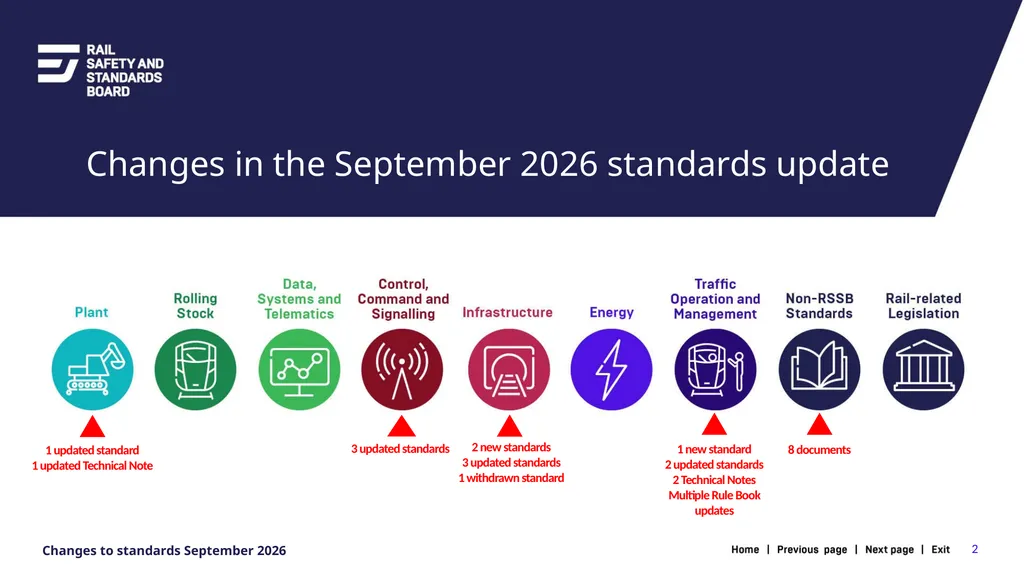
slide2. 2 Changes in the September 2026 standards update 2 1 new standard
2 updated standards
2 Technical Notes
Multiple Rule Book updates Changes to standards September 2026 8 documents 2 new standards
3 updated standards
1 withdrawn standard 3 updated standards 1 updated standard
1 updated Technical Note<br>
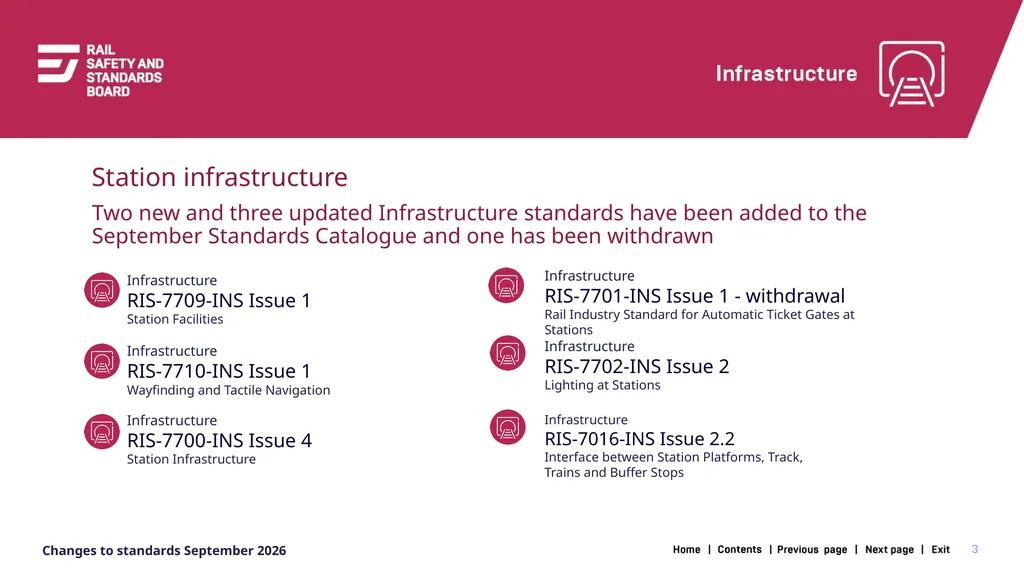
slide3. Infrastructure RIS-7710-INS Issue 1 Wayfinding and Tactile Navigation Infrastructure RIS-7709-INS Issue 1 Station Facilities Infrastructure RIS-7702-INS Issue 2 Lighting at Stations Infrastructure RIS-7701-INS Issue 1 - withdrawal Rail Industry Standard for Automatic Ticket Gates at Stations Infrastructure RIS-7700-INS Issue 4 Station Infrastructure Station infrastructure
Two new and three updated Infrastructure standards have been added to the September Standards Catalogue and one has been withdrawn Infrastructure RIS-7016-INS Issue 2.2 Interface between Station Platforms, Track, Trains and Buffer Stops Changes to standards September 2026 3<br>
slide4. 4 4 RIS-7709-INS Issue 1 Station Facilities Overview This new standard is part of RSSB’s suite of station design standards and is the first of its kind to define the minimum facilities to be provided at GB mainline railway stations. It establishes requirements and guidance for facilities across station categories A to F, supporting a safe, accessible and high-quality passenger experience.
Benefits RIS-7709-INS provides a single, coherent framework that brings greater consistency to the provision and design of station facilities across the GB network. It clarifies requirements to support legal compliance, accessibility and inclusivity, while enhancing the passenger experience through structured, evidence-based planning. The standard also aligns with wider sustainability and circular-economy principles, supporting industry decarbonisation and resource efficiency. Changes to standards September 2026 This document is intended to be used by:
Infrastructure managers | Designers | Train operators | Local authorities Infrastructure<br>
slide5. 5 5 RIS-7710-INS Issue 1 Wayfinding and Tactile Navigation Overview This new standard sets out requirements and guidance for the design and provision of wayfinding and tactile navigation within stations on the GB mainline railway. The standard supports the delivery of accessible, inclusive and consistent station environments by establishing requirements for signage, wayfinding systems, tactile navigation routes and associated design principles.
Benefits RIS-7710-INS brings consistency to the design of wayfinding systems and signage, and the provision and design of tactile navigation in stations. It clarifies requirements to support legal compliance, accessibility and inclusivity, while enhancing the passenger experience. Embedding of modern technology in the design of wayfinding systems helps modernise stations and improves accessibility. Changes to standards September 2026 This document is intended to be used by:
Infrastructure managers | Designers Infrastructure<br>
slide6. 6 6 RIS-7700-INS Issue 4 Station Infrastructure Overview RIS-7700-INS has been comprehensively updated to introduce new requirements, guidance and rationale relating to automatic ticket gates, fire precautions, environmental sustainability, accessibility, station security and the management of unauthorised access. The structure of the document has also been improved, and references have been updated throughout to align with current legislation, industry practice and related railway standards.
Benefits RIS-7700-INS Issue 4 supports the delivery of £7 million of benefit from the update to the RSSB station design standards. The changes are expected to provide benefits in improved compliance and reduction of rework, a standardised approach to design of automatic ticket gates, clearer requirements and guidance for fire precautions, improved customer experience and sense of security, and more sustainable designs that take into consideration environmental impacts. Changes to standards September 2026 This document is intended to be used by:
Infrastructure managers | Project entities Infrastructure<br>
slide7. 7 7 RIS-7702-INS Issue 2 Lighting at Stations Overview RIS-7702-INS has been revised throughout to provide a framework for consistent station lighting system design across GB mainline stations. Requirements have been created or revised to promote environmental sustainability and conservation of energy use, good CCTV image quality, safe conditions during temporary and emergency lighting periods, a consistent approach to lighting design, adequate lighting design for different areas of the station and station signage, good practice in lighting design calculations, the selection of robust and resilient lighting equipment including columns, and glare reduction.
Benefits RIS-7702-INS Issue 2 supports the delivery of £7 million of benefits from the update to the RSSB station design standards. The changes are expected to provide benefits in safety and accessibility improvements delivered from better lighting levels, improved compliance and reduction of rework, a reduction in energy use and reduced maintenance from LED light sources and intelligent lighting controls, robust, fit-for-purpose equipment from new product requirements, and an improved customer experience and sense of security. Changes to standards September 2026 This document is intended to be used by:
Infrastructure managers | Project entities Infrastructure<br>
slide8. 8 8 RIS-7016-INS Issue 2.2 Interface between Station Platforms, Track, Trains and Buffer Stops Overview This point release moved or withdrew content relating to platform lighting. Part 6 Lighting of platforms is now incorporated in RIS-7702-INS Issue 2 Lighting at Stations. Appendix C Platform lighting is withdrawn as the content is guidance which is covered or replicated in RIS-7702-INS.
Benefits Creating a single document for lighting in all areas of the station helps with the consistent application of requirements, reducing variability in design and lowering the cost and effort associated with station lighting design. Changes to standards September 2026 This document is intended to be used by:
Infrastructure managers | Designers Infrastructure<br>
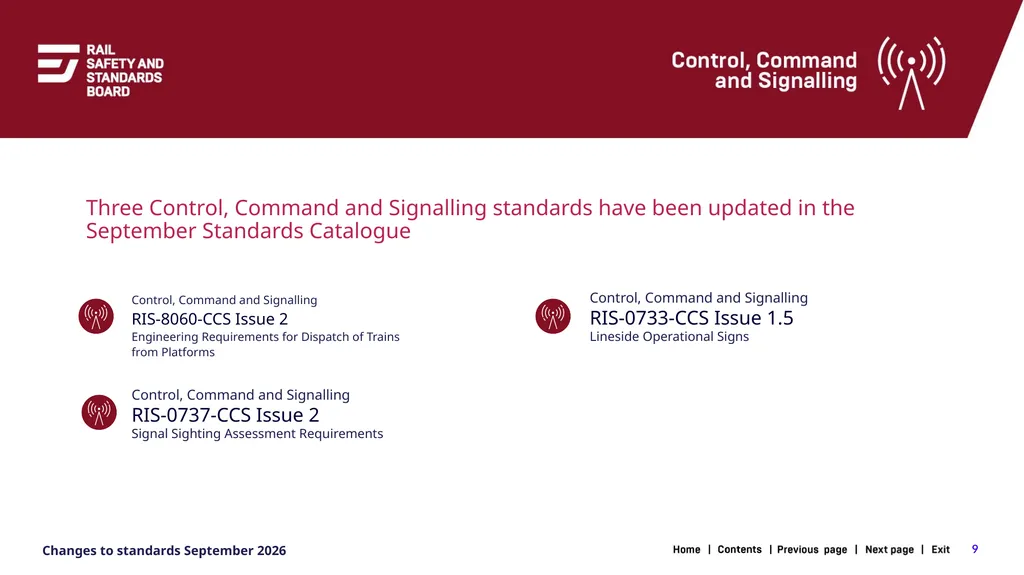
slide9. 9 Control, Command and Signalling RIS-8060-CCS Issue 2 Engineering Requirements for Dispatch of Trains from Platforms Control, Command and Signalling RIS-0733-CCS Issue 1.5 Lineside Operational Signs Control, Command and Signalling RIS-0737-CCS Issue 2 Signal Sighting Assessment Requirements Three Control, Command and Signalling standards have been updated in the September Standards Catalogue 9 9 Changes to standards September 2026 9<br>
slide10. This document is intended to be used by:
Suppliers | Designers | Infrastructure managers | Railway undertakings | Engineers Overview RIS-8060-CCS has been updated to clarify the definition of train dispatch systems, align with current technology and industry practices, add an appendix on applying human-centred design principles to the design and positioning of dispatch equipment, update requirements for compatibility and visibility, include requirements for data recording, storage and security, provide guidance on equipment maintenance and GDPR compliance, and incorporate amendments published in Issue 1 as Annex C.
Benefits The update will help to reduce safety incidents, prevent route delays, cut costs associated with redesigns and retrofit, and improve staff health. The RIS promotes efficiency, reliability, security and safety in train dispatch systems, underpinned by requirements that align with modern technology and human-centred design principles. The estimated value of the changes is £734,000 over five years. RIS-8060-CCS Issue 2 Engineering Requirements for Dispatch of Trains from Platforms 10 10 Changes to standards September 2026 10<br>
slide11. This document is intended to be used by:
Infrastructure managers | Railway undertakings | Project entities Overview RIS-0737-CCS Issue 2 expands beyond signalling to cover most trackside visible objects, with updated terminology, guidance and examples. It addresses RAIB’s Spital Junction overspeed recommendation by enhancing requirements for junction signals, readability and human perception. It also incorporates good practice, including ETCS examples, contextual factors, clearer rationales and principles.
Benefits The update strengthens requirements and guidance to reduce the risk of incidents, and enhances safety by ensuring trackside visible objects are reliably detected and interpreted. The estimated value of the changes is £293,000 over five years. RIS-0737-CCS Issue 2 Signal Sighting Assessment Requirements Changes to standards September 2026 11<br>
slide12. This document is intended to be used by:
Infrastructure managers | Railway undertakings | Project entities Overview RIS-0733-CCS Issue 1.5 provides revisions to guidance to clarify that most lineside operational signs require a sighting assessment as part of ensuring safe integration. This update aligns the guidance in RIS-0733-CCS with the updates introduced in RIS-0737-CCS Issue 2.
Benefits RIS-0733-CCS Issue 1.5 clarifies which lineside operational signs require a sighting assessment and ensures consistency in terminology used in RIS 0733-CCS and RIS-0737-CCS. The overall benefit of the changes to both documents is estimated at £293,000 over five years. RIS-0733-CCS Issue 1.5 Lineside Operational Signs Changes to standards September 2026 12<br>
slide13. 13 Improving freight train preparation One new and one updated Traffic Operation and Management document and one Rule Book module have been added to the September Standards Catalogue Changes to standards September 2026 Traffic Operation and Management GOGN3617 Issue 1 Guidance on Competence and Training of Freight Train Preparers Traffic Operation and Management RIS-3781-TOM Issue 3 Requirements for the Operation of Freight Trains and the Conveyance of Dangerous Goods by any Train Rule Book GERT8000-TW4 Issue 3 Preparation and working of freight trains<br>
slide14. 14 This document is intended to be used by:
Freight operating companies | Freight terminal operators Overview RIS-3781-TOM sets out requirements and guidance relating to the safe operation of freight trains and the safe movement of dangerous goods. New requirements have been included regarding the vehicle condition check to be undertaken before a freight train begins its journey, the securing of vehicles, brake overcharge and enhanced air brake continuity tests.
Benefits Wagons entering the network that have not been prepared adequately and are subsequently involved in incidents cause delays with network-wide impacts. The changes to the standard have the potential to reduce delays caused by trains entering the network when not safe to do so. The changes might also improve performance in freight operations through improvements in securing vehicles and train preparation activities. These changes have the potential to save the industry £1m over five years. RIS-3781-TOM Issue 3 Requirements for the Operation of Freight Trains and the Conveyance of Dangerous Goods by any Train 14 Changes to standards September 2026<br>
slide15. 15 This document is intended to be used by:
Railway undertakings Overview Freight train preparation is a complicated and varied task. The task is critical in ensuring a freight train is safe to enter service.
Industry previously had no common approach to managing the training and competence of staff undertaking the freight train preparer role. GOGN3617 is a new guidance note that assists railway undertakings in creating a framework for training, competence and assessment of staff who undertake a freight train preparer role.
Benefits A standardised training framework can contribute to improving training effectiveness by ensuring staff responsibilities are matched to training content. GOGN3617 provides undertakings with a framework that, if adopted, will help them satisfy their legal obligations. This standard has the potential to save the industry £1.5m over five years. GOGN3617 Issue 1 Guidance on Competence and Training of Freight Train Preparers 15 Changes to standards September 2026<br>
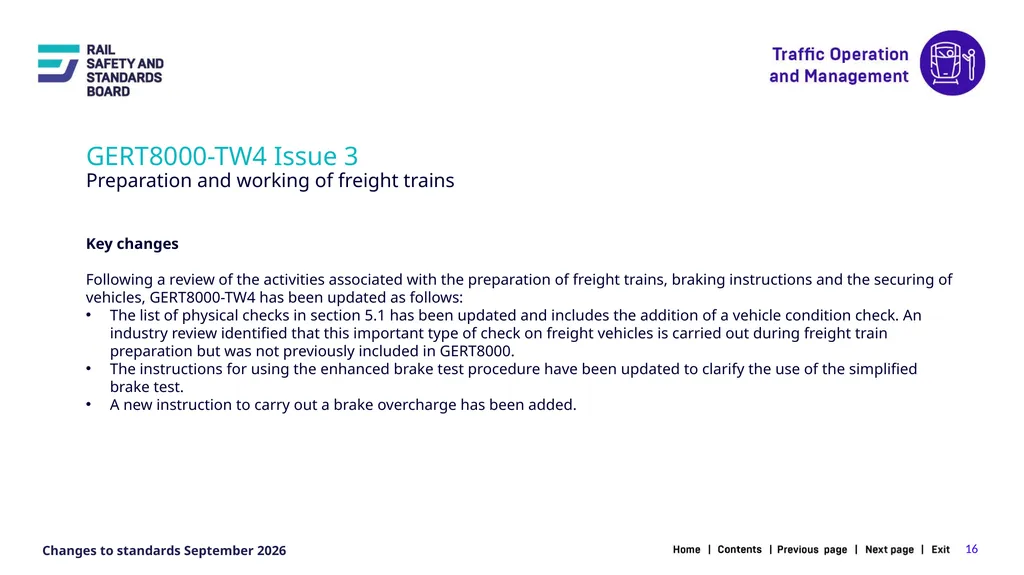
slide16. 16 Key changes
Following a review of the activities associated with the preparation of freight trains, braking instructions and the securing of vehicles, GERT8000-TW4 has been updated as follows:
The list of physical checks in section 5.1 has been updated and includes the addition of a vehicle condition check. An industry review identified that this important type of check on freight vehicles is carried out during freight train preparation but was not previously included in GERT8000.
The instructions for using the enhanced brake test procedure have been updated to clarify the use of the simplified brake test.
A new instruction to carry out a brake overcharge has been added. GERT8000-TW4 Issue 3 Preparation and working of freight trains 16 Changes to standards September 2026<br>
slide17. Traffic Operation and Management RIS-3702-TOM Issue 4 Management of Route Knowledge Updating route knowledge standards for train crew
One Traffic Operation and Management standard has been updated in the September Standards Catalogue Changes to standards September 2026 17<br>
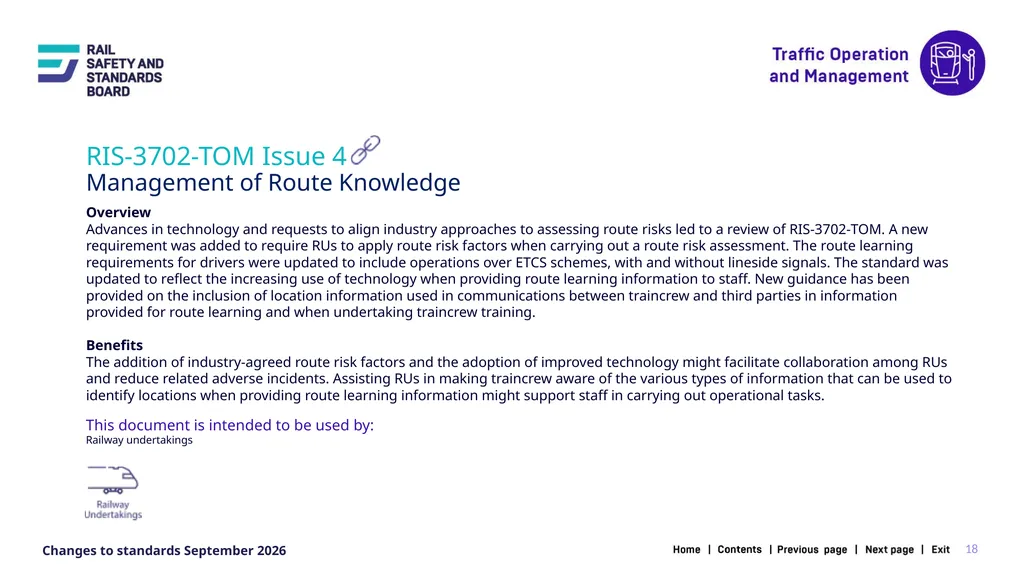
slide18. 18 This document is intended to be used by:
Railway undertakings Overview Advances in technology and requests to align industry approaches to assessing route risks led to a review of RIS‑3702‑TOM. A new requirement was added to require RUs to apply route risk factors when carrying out a route risk assessment. The route learning requirements for drivers were updated to include operations over ETCS schemes, with and without lineside signals. The standard was updated to reflect the increasing use of technology when providing route learning information to staff. New guidance has been provided on the inclusion of location information used in communications between traincrew and third parties in information provided for route learning and when undertaking traincrew training.
Benefits The addition of industry-agreed route risk factors and the adoption of improved technology might facilitate collaboration among RUs and reduce related adverse incidents. Assisting RUs in making traincrew aware of the various types of information that can be used to identify locations when providing route learning information might support staff in carrying out operational tasks. RIS-3702-TOM Issue 4 Management of Route Knowledge Changes to standards September 2026<br>
slide19. Two Traffic Operation and Management Technical Notes have been added to the September Standards Catalogue TN3302 Issue 1 – Clarifying Freight Train Preparation Responsibilities
TN3303 Issue 1 – Clarification on drugs and alcohol testing for safety-critical workers (renumbered from TN3300) Changes to standards September 2026 19<br>
slide20. This document is intended to be used by:
Freight operating companies | Entities in charge of maintenance Overview Freight operating companies (FOCs) and entities in charge of maintenance (ECMs) share responsibility for keeping freight vehicles in a safe condition to complete journeys. This technical note sets out each party’s responsibilities by identifying those that each might reasonably expect the other party to undertake to promote the safe preparation and operation of freight trains.
Benefits This technical note will assist industry in clarifying the responsibilities for freight train preparation between freight operating companies and entities in charge of maintenance. TN3302 Issue 1 Clarifying Freight Train Preparation Responsibilities Changes to standards September 2026 20<br>
slide21. This document is intended to be used by:
Infrastructure managers | Railway undertakings Overview This document was previously published as TN3300 and has been renumbered to avoid confusion with another document. The content is unchanged and remains identical to TN3300 Issue 1.
Benefits This technical note aims to provide a greater understanding of the importance of drugs and alcohol testing for safety-critical workers by providing the rationale for the requirement and the importance of undertaking the tests. TN3303 Issue 1 Clarification on drugs and alcohol testing for safety-critical workers Renumbered from TN3300 Changes to standards September 2026 21<br>
slide22. Plant RIS-1710-PLT Issue 3 Engineering Certification of Railborne Plant and the Assessment of Non-Railborne Plant One Plant standard has been updated in the September Standards Catalogue Changes to standards September 2026 22<br>
slide23. 23 This document is intended to be used by:
Infrastructure managers | Plant assessment bodies | Designers | Manufacturers Overview The primary reason for the update was to refer to the guidance in RIS-2700-RST Issue 3 considering software changes and cyber security. RIS-1710-PLT Issue 3 refers to the latest legislative regime, and to the latest issues of the European Standards.
Benefits The update helps the user to understand better the process of engineering acceptance of OTMs, OTP and non-railborne plant. The updates also help designers, manufacturers and plant assessment bodies (PABs) to understand the implications of design and maintenance changes, including changes to software and those potentially affecting cyber security. RIS-1710-PLT Issue 3 Engineering Certification of Railborne Plant and the Assessment of Non-Railborne Plant Changes to standards September 2026 23<br>
slide24. One Plant Technical Note has been updated in the September Standards Catalogue TN4300 Issue 2 – Key Plant Principles Changes to standards September 2026 24<br>
slide25. 25 This document is intended to be used by:
Manufacturers Overview This technical note has been updated to refer to RIS-1710-PLT Issue 3. It is aimed at manufacturers of on-track machines (OTMs), manufacturers and converters of on-track plant (OTP), manufacturers of non-railborne plant used on railway infrastructure, and owners and operators of OTMs, OTP, and non-railborne plant used on railway infrastructure.
Benefits During the revision of its plant standards, RSSB found some duplication. RSSB and Plant Standards Committee decided it would be helpful to industry to publish a single document providing general information about using railborne and other plant and to provide links to the many other sources of useful information and guidance. This technical note is intended to complement Key Train Requirements and Key Wagon Maintenance Principles. TN4300 Issue 2 Key Plant Principles Changes to standards September 2026 25<br>
slide26. The following Rule Book modules and handbooks have been updated in the September Standards Catalogue Changes to standards September 2026 26<br>
slide27. 27 Consolidating Rule Book requirements for protecting staff Changes to standards September 2026 GERT8000-HB9 Issue 10 - IWA or COSS setting up safe systems of work within possessions
GERT8000-HB11 Issue 12 - Duties of the person in charge of the possession (PICOP)
GERT8000-HB12 Issue 12 - Duties of the engineering supervisor (ES) in a possession
GERT8000-T3 Issue 14 - Possession of a running line for engineering work
GERT8000-TS11 Issue 9 - Failure of, or work on, signalling equipment – signallers’ regulations
Form RT3198 Issue 12-26
Form RT3199 Issue 12-26<br>
slide28. 28 Key changes
Section 3.1, ‘Agreeing the site of work with the ES’ has been changed to remove the requirement to sign the RT3199 certificate. The ability of an IWA or COSS to receive a work-site briefing and to ‘sign in’ with the ES helps to avoid unnecessary road journeys and exposure to the associated risks. A reduction in the extent of such risks can be anticipated.
Previous rules changes to reduce the use of unassisted lookouts as a safe system of work led to issues when work was to be carried out between work sites because, when this had been done with the permission of the PICOP, lookouts were used. Following trials, new rules have been introduced at section 4 describing the arrangements for ‘transient work sites’ (a portion of line between two established work sites). These are now the only method by which work can take place outside a work site. As a result, section 3.6 which allowed the use of equipment warning has been withdrawn.
For completeness, a definition of an engineering train has been added at section 1. GERT8000-HB9 Issue 10 IWA or COSS setting up safe systems of work within possessions 28 Changes to standards September 2026<br>
slide29. 29 Key changes
Following trials, new rules have been introduced permitting the use of engineering controls as an alternative to the use of detonator protection for possessions. The existing rules have been revised to show the arrangements that apply to a possession with engineering controls where these are different from a possession using detonator protection, which is referred to as a possession without engineering controls. Where the same rules would apply to both protection procedures, they are generally left unchanged. The new rules are estimated to generate substantial cost benefits (ca. £40M over 5 years) as well as assisting in taking forward the findings of research into the risks and benefits of using detonators which suggested that alternatives might exist to their use in possessions.
Previous rules changes to reduce the use of unassisted lookouts as a safe system of work led to issues when work was to be carried out between work sites because, when this had been done with the permission of the PICOP, lookouts were used. Following trials, new rules have been introduced at section 3.7 describing the arrangements for ‘transient work sites’ (a portion of line between two established work sites). These are now the only method by which work can take place outside a work site. GERT8000-HB11 Issue 12 Duties of the person in charge of the possession (PICOP) 29 Changes to standards September 2026<br>
slide30. 30 Key changes
Sections 11.1, 11.2 and 11.3 (formerly section 10.1, 10.2 and 10.3) have been amended to refer to the use of Appendix B of the RT3199 certificate. These changes form part of the annual updates, which are intended to improve understanding and application of the Rule Book and provide opportunities for duty holders to operate more efficiently.
Following trials, new rules have been introduced permitting the use of engineering controls as an alternative to the use of detonator protection for possessions. The rules have been revised to show the arrangements that apply to a possession with engineering controls where these are different from a possession using detonator protection, which is referred to as a possession without engineering controls. Where the same rules would apply to both protection procedures, they are generally left unchanged. The new rules are estimated to generate substantial cost benefits (ca. £40M over 5 years) as well as assisting in taking forward the findings of research into the risks and benefits of using detonators.
Previous rules changes to reduce the use of unassisted lookouts as a safe system of work led to issues when work was to be carried out between work sites because, when this had been done with the permission of the PICOP, lookouts were used. Following trials, new rules have been introduced at section 3.7 describing the arrangements for ‘transient work sites’ (a portion of line between two established work sites). These are now the only method by which work can take place outside a work site. GERT8000-HB12 Issue 12 Duties of the engineering supervisor (ES) in a possession 30 Changes to standards September 2026<br>
slide31. 31 Key changes
Following trials, new rules have been introduced permitting the use of engineering controls as an alternative to the use of detonator protection for possessions. The rules have been revised to show the arrangements that apply to a possession with engineering controls where these are different from a possession using detonator protection, which is referred to as a possession without engineering controls. Where the same rules would apply to both protection procedures, they are generally left unchanged. The new rules are estimated to generate substantial cost benefits (ca. £40M over 5 years) as well as assisting in taking forward the findings of research into the risks and benefits of using detonators which suggested that alternatives might exist to their use in possessions. GERT8000-T3 Issue 14 Possession of a running line for engineering work 31 Changes to standards September 2026<br>
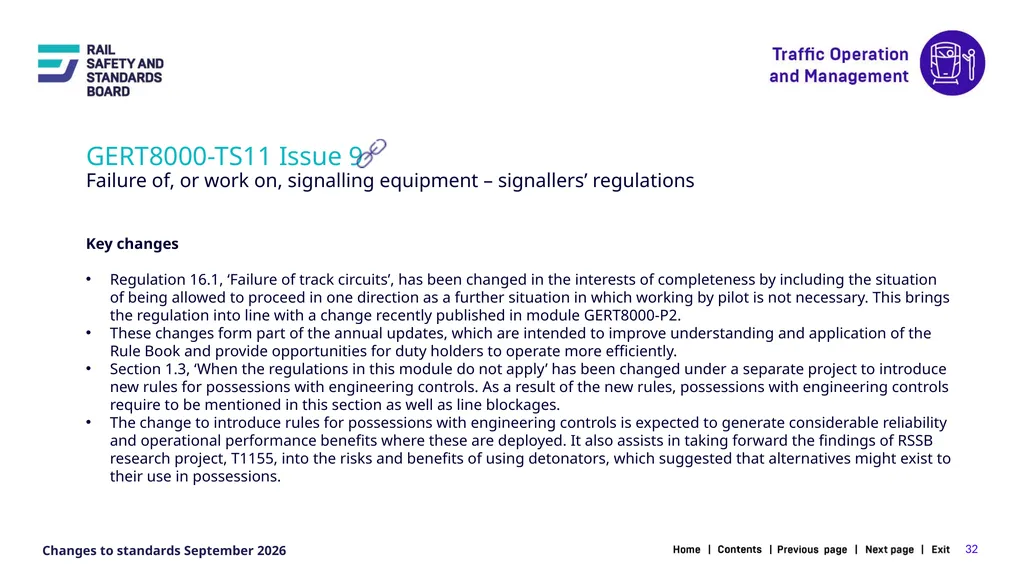
slide32. 32 Key changes
Regulation 16.1, ‘Failure of track circuits’, has been changed in the interests of completeness by including the situation of being allowed to proceed in one direction as a further situation in which working by pilot is not necessary. This brings the regulation into line with a change recently published in module GERT8000-P2.
These changes form part of the annual updates, which are intended to improve understanding and application of the Rule Book and provide opportunities for duty holders to operate more efficiently.
Section 1.3, ‘When the regulations in this module do not apply’ has been changed under a separate project to introduce new rules for possessions with engineering controls. As a result of the new rules, possessions with engineering controls require to be mentioned in this section as well as line blockages.
The change to introduce rules for possessions with engineering controls is expected to generate considerable reliability and operational performance benefits where these are deployed. It also assists in taking forward the findings of RSSB research project, T1155, into the risks and benefits of using detonators, which suggested that alternatives might exist to their use in possessions. GERT8000-TS11 Issue 9 Failure of, or work on, signalling equipment – signallers’ regulations 32 Changes to standards September 2026<br>
slide33. Reviewing track worker safety rules for IWAs and use of Lookout Operated Warning System
GERT8000-HB6 Issue 9 - General duties of an individual working alone (IWA)
GERT8000-HB7 Issue 11 - General duties of a controller of site safety (COSS) Changes to standards September 2026 33<br>
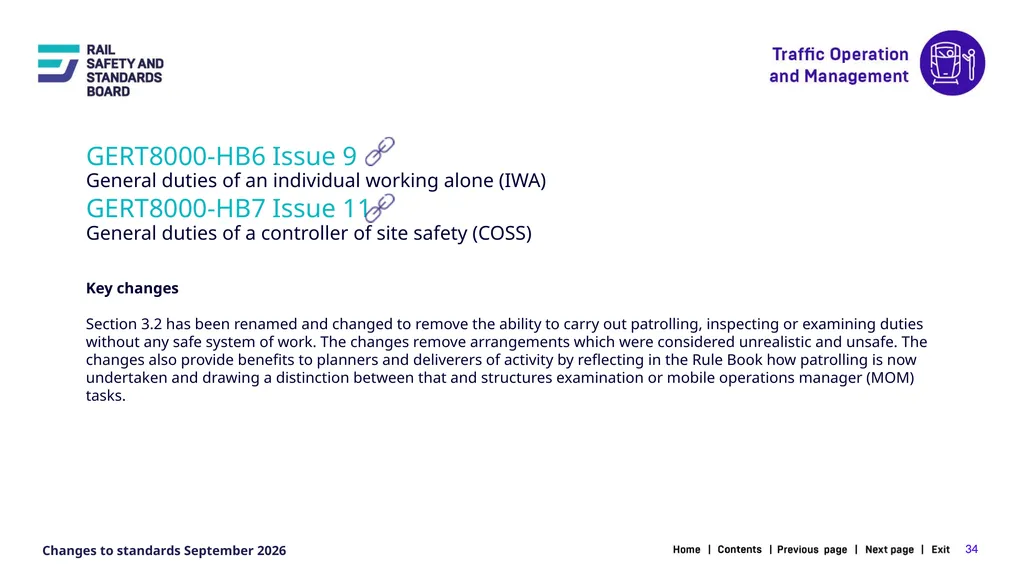
slide34. 34 Key changes
Section 3.2 has been renamed and changed to remove the ability to carry out patrolling, inspecting or examining duties without any safe system of work. The changes remove arrangements which were considered unrealistic and unsafe. The changes also provide benefits to planners and deliverers of activity by reflecting in the Rule Book how patrolling is now undertaken and drawing a distinction between that and structures examination or mobile operations manager (MOM) tasks. GERT8000-HB6 Issue 9 General duties of an individual working alone (IWA) 34 Changes to standards September 2026 GERT8000-HB7 Issue 11 General duties of a controller of site safety (COSS)<br>
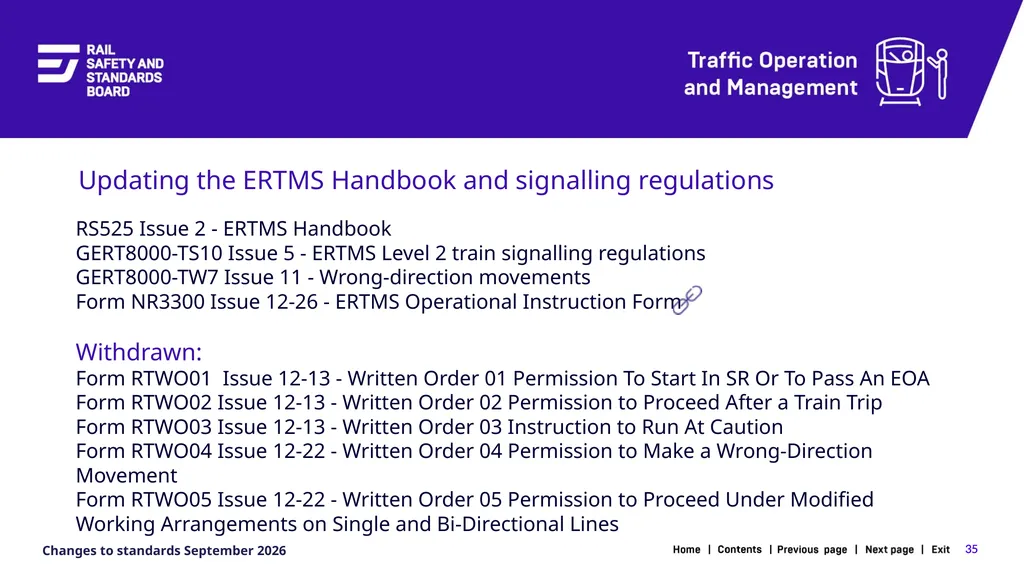
slide35. 35 Updating the ERTMS Handbook and signalling regulations RS525 Issue 2 - ERTMS Handbook
GERT8000-TS10 Issue 5 - ERTMS Level 2 train signalling regulations
GERT8000-TW7 Issue 11 - Wrong-direction movements
Form NR3300 Issue 12-26 - ERTMS Operational Instruction Form
Withdrawn:
Form RTWO01 Issue 12-13 - Written Order 01 Permission To Start In SR Or To Pass An EOA
Form RTWO02 Issue 12-13 - Written Order 02 Permission to Proceed After a Train Trip
Form RTWO03 Issue 12-13 - Written Order 03 Instruction to Run At Caution
Form RTWO04 Issue 12-22 - Written Order 04 Permission to Make a Wrong-Direction Movement
Form RTWO05 Issue 12-22 - Written Order 05 Permission to Proceed Under Modified Working Arrangements on Single and Bi-Directional Lines 35 35 Changes to standards September 2026 35<br>
slide36. 36 Key changes
Revision of language and terms now used widely in ERTMS deployments.
Information to cover the working of the system from the perspective of as many deployments as possible.
Section 8 has been rewritten to convey the current position regarding operational instructions in use in the GERT8000 Rule Book and mention the NR3300 form. RS525 Issue 2 ERTMS Handbook 36 Changes to standards September 2026<br>
slide37. 37 Key changes
This module has been amended alongside RS525 ERTMS Handbook and contains wording amendments to align with the language being used in ERTMS deployments currently based on lessons learned over time.
Additions regarding the use of OS MA and operational instructions. GERT8000-TS10 Issue 5 ERTMS Level 2 train signalling regulations 37 Changes to standards September 2026<br>
slide38. 38 Key changes
Clauses have been added on the issuing of operational instructions to drivers before they are able to make a wrong-direction move when a train is operating in ERTMS Level 2. GERT8000-TW7 Issue 11 Wrong-direction movements 38 Changes to standards September 2026<br>
slide39. 39 GERT8000-M1 Issue 10 – Dealing with a train accident or train evacuation
GERT8000-M2 Issue 10 – Train stopped by train failure
GERT8000-S5 Issue 14 – Passing a signal at danger or an end of authority (EoA) without a movement authority (MA)
GERT8000-S7 Issue 8 – Observing and obeying signalling indications. Train warning systems. Reporting signalling failures and irregularities
GERT8000-TS1 Issue 20 – General signalling regulations
GERT8000-TW1 Issue 23 – Preparation and movement of trains The following six Rule Book modules have been updated in the September Standards Catalogue 39 39 Changes to standards September 2026 39<br>
slide40. 40 Key changes
Section 4, ‘Fire on a train’, has been revised at sub-section 4.1, ‘Stopping the train’, to give more detail on when an attempt should be made to deal with a fire and to include instructions concerning smoke or fumes. This change forms part of the annual updates, which are intended to improve understanding and application of the Rule Book and provide opportunities for duty holders to operate more efficiently.
In section 5.5, ‘Dealing with an assisting train’, instructions have been added on the issuing of an on-sight (OS) movement authority (MA) for trains that need to work into occupied sections. The use of operational instructions if an OS MA cannot be issued for trains on ERTMS lines without lineside signals is now also stated. These changes arise from a separate project that reviewed the ERTMS handbook, RS525, and associated modules. GERT8000-M1 Issue 10 Dealing with a train accident or train evacuation 40 Changes to standards September 2026<br>
slide41. 41 Key changes
Section 3.6, ‘When the failed train is being assisted’ has been changed to say that the driver must get permission from the signaller before starting the movement. This change forms part of the annual updates, which are intended to improve understanding and application of the Rule Book and provide opportunities for duty holders to operate more efficiently.
Section 3.2 and section 3.3 have been changed to add instructions for ERTMS lines regarding the use of an on-sight (OS) movement authority (MA), or operational instructions if an OS MA cannot be issued, to allow an assisting train to enter an occupied section. These changes arise from a separate project that reviewed the ERTMS handbook, RS525 and associated modules. GERT8000-M2 Issue 10 Train stopped by train failure 41 Changes to standards September 2026<br>
slide42. 42 Key changes
In section 3, ‘Authorising the movement’, a reference to modified working has been added at sub-section 3.1, ‘Instructions from the signaller’, as a situation in which a signaller does not have to tell a driver to proceed at caution.
In section 6.1, ‘Before allowing a train to pass two signals at danger’, the requirement to examine the line has been removed.
In section 8, ‘Driver passing a signal at danger or an EoA without authority’, the signaller’s actions at section 8.3 have been updated to state that the instructions in section 2 must be carried out before allowing the movement.
The above changes are part of the annual updates, which aim to improve understanding and application of the Rule Book.
The changes below arise from a separate project that reviewed the ERTMS handbook, RS525 and associated modules.
In sections 1.1, ‘Signaller’s authority’, and 1.2, ‘Driver getting authority’, a clause has been added on issuing an on-sight (OS) MA if possible. A further clause has been added to both to state that, if it is not possible to issue an OS MA, there is a requirement to pass on operational instructions to a driver if passing an EoA without an MA.
In section 3, the requirement to pass on operational instructions to a driver if passing an EoA without an MA on an ERTMS line has been added to sub-sections 3.1 and 3.3, with the additional instructions that should be communicated.
In section 4, ‘During the movement’, the requirement that, if operating in ERTMS, speed should not exceed that given in operational instructions has been added to sub-section 4.2.
In sections 8.1 and 8.2, new sub-sections have been added regarding operating in ERTMS, including the requirement to pass on operational instructions to a driver to allow authority to proceed into Post-Trip mode. GERT8000-S5 Issue 14 Passing a signal at danger or an end of authority (EoA) without a movement authority (MA) 42 Changes to standards September 2026<br>
slide43. 43 Key changes
At section 7.3, ‘Signals difficult to see because of sunlight, street lights or reflections’, a new instruction has been included requiring a report to be obtained from another driver after approximately 30 minutes to establish whether the signal is still affected by sunlight.
In section 7.8, ‘Reporting a signal/AWS/ERTMS/TPWS failure or irregularity’, sub-section b) ‘Reporting to Operations Control’, which had previously been omitted in error, has been reinstated.
The changes above form part of the annual updates, which are intended to improve understanding and application of the Rule Book and provide opportunities for duty holders to operate more efficiently.
The changes below arise from a separate project that reviewed the ERTMS handbook, RS525 and associated modules.
In section 2.1, ‘Train stopped on the approach to a signal or end of authority (EoA)’, the wording regarding the requirement for a valid movement authority (MA) to proceed has been amended for clarity.
The title of section 3 has been amended and now includes the use of an on-sight (OS) MA.
A new section has been added at 3.4 to describe when the use of OS MA is appropriate and what a driver must do before accepting an OS MA if their train is operating in ERTMS.
In section 8.3, ‘Train receiving a trip’, clauses have been added referring to the need for the signaller to pass on operational instructions to a driver to give authority to proceed after a trip. GERT8000-S7 Issue 8 Observing and obeying signalling indications. Train warning systems. Reporting signalling failures and irregularities 43 Changes to standards September 2026<br>
slide44. 44 Key changes
Regulation 17.1.2, ‘Authority to run trains’, now states that the requirement to stop movements on an adjacent line applies only when a Rail Defect Nominee (RDN) remains on site.
Regulation 17.2.2, ‘Overline bridge strike’, now states that it may not be necessary for a strike examiner to examine the bridge.
Regulation 20.1, ‘When the line is to be examined’, now states that it may not be necessary for the competent engineer to examine the line.
Regulation 20.2, ‘Before an examination using a train can start’, now describes the situation of another line being affected when the driver has reported only one line. A cross reference to GERT8000-AC has been added to remove an inconsistency.
Regulation 20.3, ‘Dealing with the train that will be used to examine the line’, now refers to a 'suspected' track defect (one which has been felt or heard) to agree with the terminology in GERT8000-TW1.
Regulation 20.5, ‘Resuming normal working’, now uses the terms ‘confirmed' or 'suspected' track defect and states that the requirement not to exceed a speed of 10 mph through a tunnel also applies to subsequent trains. Wording has also been changed to clarify what 'normal operation' can mean.
The above changes form part of the annual updates, which aim to improve understanding and application of the Rule Book.
Regulation 20.3 and 20.6.3 now refer to the use of an on-sight (OS) movement authority and operational instructions to the driver if they must pass an ‘end of authority’ (EoA) without a ‘movement authority’ (MA).
These changes arise from a separate project that reviewed the ERTMS handbook, RS525 and associated modules. GERT8000-TS1 Issue 20 General signalling regulations 44 Changes to standards September 2026<br>
slide45. 45 Key changes
Section 5.3, ‘Track defects’, revised to cover a wider range of defects and expand the detail to be obtained.
New instruction added to section 12.4, ‘Examining ac overhead line equipment’, to be consistent with GERT8000-AC.
Section 14.4, ‘Lights when making a wrong-direction movement’, now states it is not necessary to change the lights for a wrong-direction movement of less than 1/4 mile (400 metres) if this cannot be done using the normal lamp controls.
The above changes form part of the annual updates, which aim to improve understanding and application of the Rule Book.
The changes below arise from a separate project that reviewed the ERTMS handbook, RS525 and associated modules.
New section 20 added containing details on operational instructions and when they will be used.
Definition in section 21.1 on permissive working now includes applicability on an ERTMS line and the use of an on-sight (OS) movement authority (MA) where this is permitted.
Section 21.6, ‘Emergency permissive working’, changed to include the use of an OS MA for the movement or use of operational instructions to the driver if they must pass an ‘end of authority’ (EoA) without an MA on an ERTMS line.
Section 22, ‘Personal equipment’, formerly section 21, now states that, for ERTMS Level 2, the driver must have Form NR3300 ERTMS Operational Instructions and the means of completing it, if required by company instructions.
Section 24, ‘Preparing a train’, formerly section 23, now includes a requirement for the driver to have been given information in operational instruction 7 from the signaller if required to start the train in staff responsible (SR) or shunting (SH) modes. GERT8000-TW1 Issue 23 Preparation and movement of trains 45 Changes to standards September 2026<br>
slide46. The following eight Rule Book modules and handbooks have been updated in the September Standards Catalogue GERT8000-G1 Issue 11 – General safety responsibilities and personal track safety for non-track workers
GERT8000-M3 Issue 6 – Managing incidents, floods and snow
GERT8000-SP Issue 8 – Speeds
GERT8000-SS2 Issue 8 – Shunting
GERT8000-TS9 Issue 6 – Level crossings - signallers' regulations
GERT8000-HB1 Issue 10 – General duties and track safety for track workers
GERT8000-HB15 Issue 8 – Duties of the machine controller (MC) and on-track plant operator
RS521 Issue 10 – Signals, Handsignals, Indicators and Signs Handbook Changes to standards September 2026 46<br>
slide47. 47 Key changes
It has been identified that on-train balise reader antennae can emit potentially harmful electromagnetic forces. Rolling stock that is equipped with balises is intended to carry warning indications. A new instruction containing a similar warning has been added to section 1.12.
The change forms part of the annual updates, which aim to improve understanding and application of the Rule Book and provide opportunities for duty holders to operate more efficiently. GERT8000-G1 Issue 11 General safety responsibilities and personal track safety for non-track workers 47 Changes to standards September 2026<br>
slide48. 48 Key changes
The titles of sections 2 and 2.2 have been changed to refer to 'impacts' rather than 'heavy impacts' to avoid unnecessary judgement on what is to be reported. Section 2.2, ‘Collisions or impacts with other vehicles or buffer stops’, has also been changed to allow movement to be permitted when it is not necessary for a rolling stock technician to examine the vehicle beforehand.
Section 7.2, ‘Train running when damage to structures or earthworks is reported’, has been changed as it is not always necessary for a competent engineer to examine the line.
The changes form part of the annual updates, which aim to improve understanding and application of the Rule Book and provide opportunities for duty holders to operate more efficiently. GERT8000-M3 Issue 6 Managing incidents, floods and snow 48 Changes to standards September 2026<br>
slide49. 49 Key changes
Section 5.1, ‘Speed restriction boards or indicators missing or incorrect’, has been changed to state that only drivers of trains to which the speed restriction applies need to be told.
Section 5.3, ‘Defective or missing emergency indicators’, has been changed as it would not always be necessary to stop a train as this is a situation in which an acknowledged safety broadcast call can be used.
The changes form part of the annual updates, which aim to improve understanding and application of the Rule Book and provide opportunities for duty holders to operate more efficiently. GERT8000-SP Issue 8 Speeds 49 Changes to standards September 2026<br>
slide50. 50 Key changes
Section 5.2, ‘Controlling movements by radio’, has been changed to refer to speaking approximately every three seconds, rather than continuously.
Section 9.4, ‘Leaving vehicles or traction units on a dead-end line’, has been changed to state that a red light rather than a white light can be shown when the buffer stop shows a white light, when shown in train operating company instructions, and that an exemption from placing any light can also be shown in the Sectional Appendix.
The changes form part of the annual updates, which aim to improve understanding and application of the Rule Book and provide opportunities for duty holders to operate more efficiently. GERT8000-SS2 Issue 8 Shunting 50 Changes to standards September 2026<br>
slide51. 51 Key changes
Regulation 2.1.2, ‘Animals or large, low or slow-moving vehicles or a trolley with small wheels’, has been reworded to clarify that it refers to the movement of animals or vehicles and the crossing user that have cleared the crossing, rather than a train movement.
The change forms part of the annual updates, which aim to improve understanding and application of the Rule Book and provide opportunities for duty holders to operate more efficiently. GERT8000-TS9 Issue 6 Level crossings - signallers' regulations 51 Changes to standards September 2026<br>
slide52. 52 Key changes
It has been identified that on-train balise reader antennae can emit potentially harmful electromagnetic forces. Rolling stock that is equipped with balises is intended to carry warning indications. A new instruction containing a similar warning has been added to section 7.8.
The change forms part of the annual updates, which aim to improve understanding and application of the Rule Book and provide opportunities for duty holders to operate more efficiently. GERT8000-HB1 Issue 10 General duties and track safety for track workers 52 Changes to standards September 2026<br>
slide53. 53 Key changes
A definition of cross-tracking has been introduced at section 1.
At section 6, ‘On- and off-tracking’, two references to cross-tracking have been added.
Section 9, ‘Controlling OTP movements’, has been changed at sub-section 9.2, ‘Using radio’, to refer to speaking approximately every three seconds, rather than continuously.
The changes form part of the annual updates, which aim to improve understanding and application of the Rule Book and provide opportunities for duty holders to operate more efficiently. GERT8000-HB15 Issue 8 Duties of the machine controller (MC) and on-track plant operator 53 Changes to standards September 2026<br>
slide54. 54 Key changes
Wording has been added at section 2.6, ‘Splitting distant signals’, to explain that this describes some principles, but that the actual aspects displayed at any location will be shown in local instructions.
A description and illustration of a European Rail Traffic Management System (ERTMS) location marker have been introduced at a new section 4.2.
At section 4.4, the explanations of ERTMS cab signalling boards have been altered to that shown in RS525 ERTMS Handbook, which is more correct.
The changes form part of the annual updates, which aim to improve understanding and application of the Rule Book and provide opportunities for duty holders to operate more efficiently. RS521 Issue 10 Signals, Handsignals, Indicators and Signs Handbook 54 Changes to standards September 2026<br>
slide55. The following nine Rule Book documents have been updated in the September Standards Catalogue GERT8001 Issue 91 ― Changes to National Operations Publications for September 2026
GERT8000 Issue 41 ― Rule Book Module Issue History
GERT8000 Issue HB Issue 22 ― Rule Book Handbook Issue History
GERT8000-RBBL Issue 44 ― Rule Book Briefing Leaflet
GERM8000-master-module Issue 18 – Master Manual
GERM8000-traindriver Issue 18 – Train Driver Manual
GERM8000-signallersignallingtechnician Issue 18 – Signaller and Signalling Technician Manual
GERM8000-trackworkers Issue 17 – Track Workers Manual
GERM8000-trainoperationsstaff Issue 18 – Train Operations Staff Manual Changes to standards September 2026 55<br>
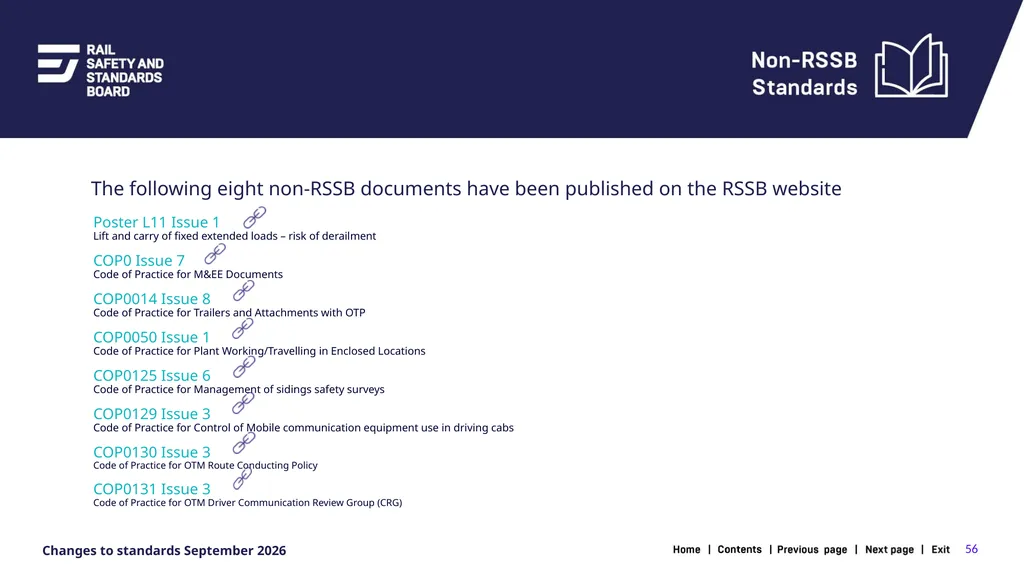
slide56. 56 Poster L11 Issue 1 Lift and carry of fixed extended loads – risk of derailment
COP0 Issue 7 Code of Practice for M&EE Documents
COP0014 Issue 8
Code of Practice for Trailers and Attachments with OTP
COP0050 Issue 1
Code of Practice for Plant Working/Travelling in Enclosed Locations
COP0125 Issue 6
Code of Practice for Management of sidings safety surveys
COP0129 Issue 3
Code of Practice for Control of Mobile communication equipment use in driving cabs
COP0130 Issue 3
Code of Practice for OTM Route Conducting Policy
COP0131 Issue 3
Code of Practice for OTM Driver Communication Review Group (CRG) The following eight non-RSSB documents have been published on the RSSB website Changes to standards September 2026<br>
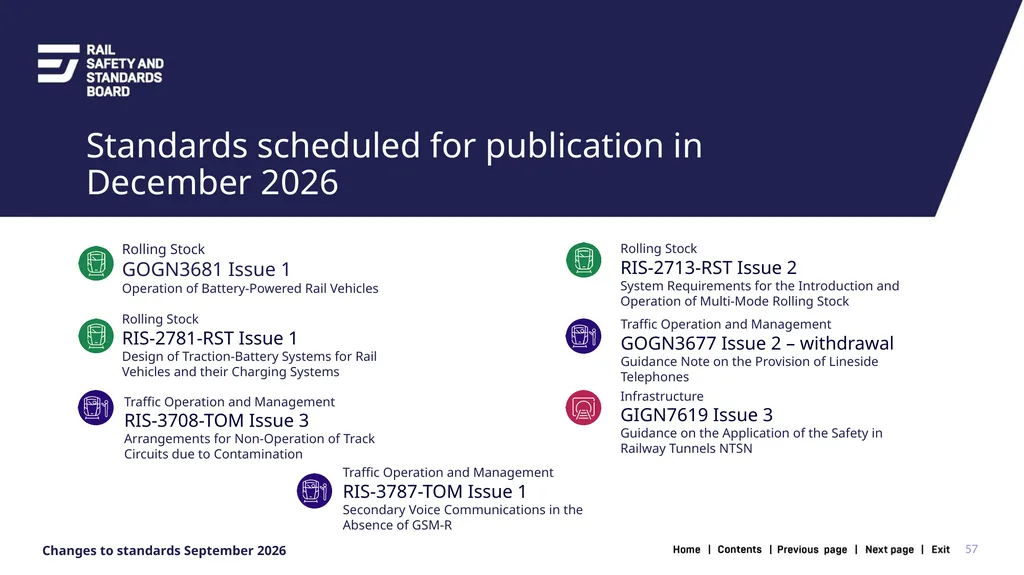
slide57. 57 Standards scheduled for publication in December 2026 Changes to standards September 2026 Rolling Stock GOGN3681 Issue 1 Operation of Battery-Powered Rail Vehicles Rolling Stock RIS-2781-RST Issue 1 Design of Traction-Battery Systems for Rail Vehicles and their Charging Systems Rolling Stock RIS-2713-RST Issue 2 System Requirements for the Introduction and Operation of Multi-Mode Rolling Stock Traffic Operation and Management RIS-3708-TOM Issue 3 Arrangements for Non-Operation of Track Circuits due to Contamination Traffic Operation and Management RIS-3787-TOM Issue 1 Secondary Voice Communications in the Absence of GSM-R Traffic Operation and Management GOGN3677 Issue 2 – withdrawal Guidance Note on the Provision of Lineside Telephones Infrastructure GIGN7619 Issue 3 Guidance on the Application of the Safety in Railway Tunnels NTSN<br>
slide58. 58 Draft standards scheduled for consultation Draft standards scheduled for consultation Changes to standards September 2026 58<br>
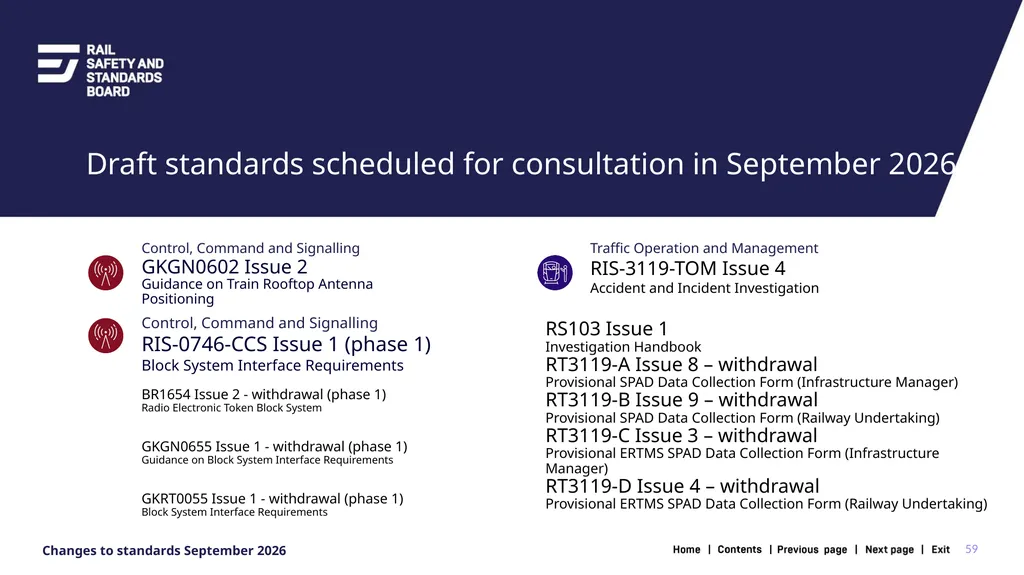
slide59. Draft standards scheduled for consultation in September 2026 Changes to standards September 2026 BR1654 Issue 2 - withdrawal (phase 1) Radio Electronic Token Block System
GKGN0655 Issue 1 - withdrawal (phase 1) Guidance on Block System Interface Requirements
GKRT0055 Issue 1 - withdrawal (phase 1) Block System Interface Requirements 59 Control, Command and Signalling GKGN0602 Issue 2 Guidance on Train Rooftop Antenna Positioning Control, Command and Signalling RIS-0746-CCS Issue 1 (phase 1) Block System Interface Requirements RS103 Issue 1 Investigation Handbook RT3119-A Issue 8 – withdrawal Provisional SPAD Data Collection Form (Infrastructure Manager) RT3119-B Issue 9 – withdrawal Provisional SPAD Data Collection Form (Railway Undertaking) RT3119-C Issue 3 – withdrawal Provisional ERTMS SPAD Data Collection Form (Infrastructure Manager) RT3119-D Issue 4 – withdrawal Provisional ERTMS SPAD Data Collection Form (Railway Undertaking) Traffic Operation and Management RIS-3119-TOM Issue 4 Accident and Incident Investigation<br>
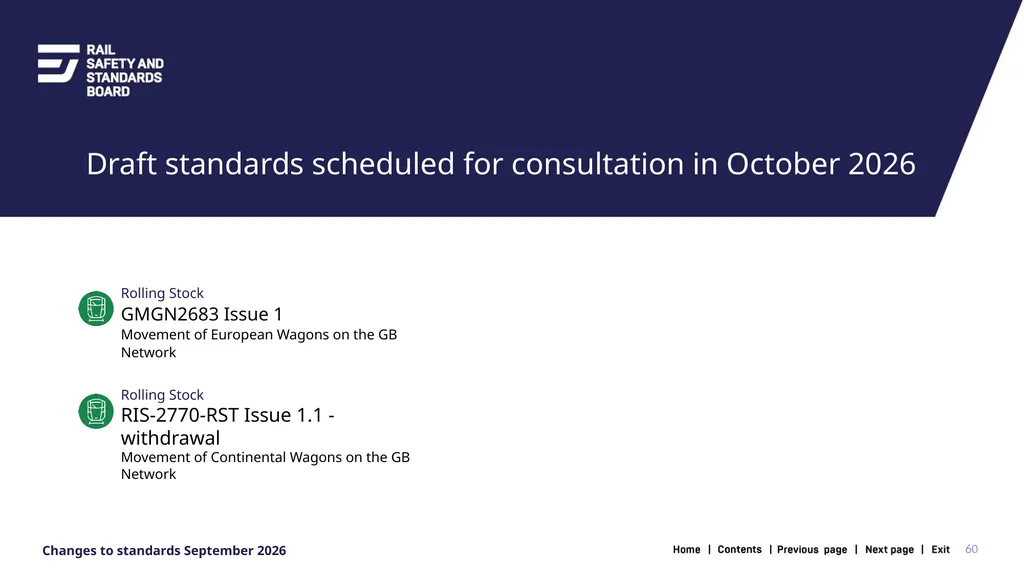
slide60. Draft standards scheduled for consultation in October 2026 Changes to standards September 2026 60 Rolling Stock RIS-2770-RST Issue 1.1 - withdrawal Movement of Continental Wagons on the GB Network Rolling Stock GMGN2683 Issue 1 Movement of European Wagons on the GB Network<br>
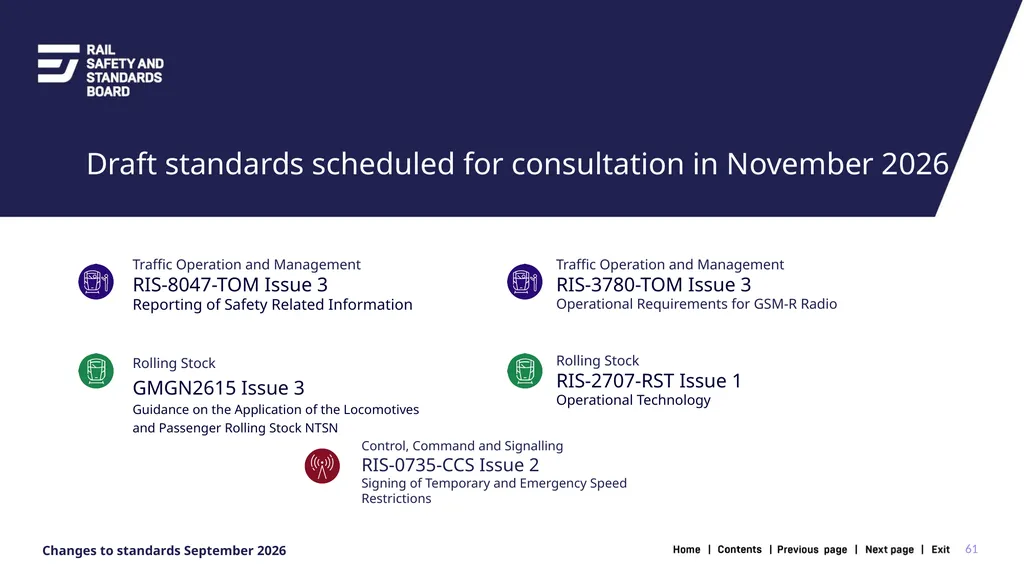
slide61. Draft standards scheduled for consultation in November 2026 Control, Command and Signalling RIS-0735-CCS Issue 2 Signing of Temporary and Emergency Speed Restrictions Traffic Operation and Management RIS-3780-TOM Issue 3 Operational Requirements for GSM-R Radio Traffic Operation and Management RIS-8047-TOM Issue 3 Reporting of Safety Related Information Changes to standards September 2026 61 Rolling Stock GMGN2615 Issue 3 Guidance on the Application of the Locomotives and Passenger Rolling Stock NTSN Rolling Stock RIS-2707-RST Issue 1 Operational Technology<br>
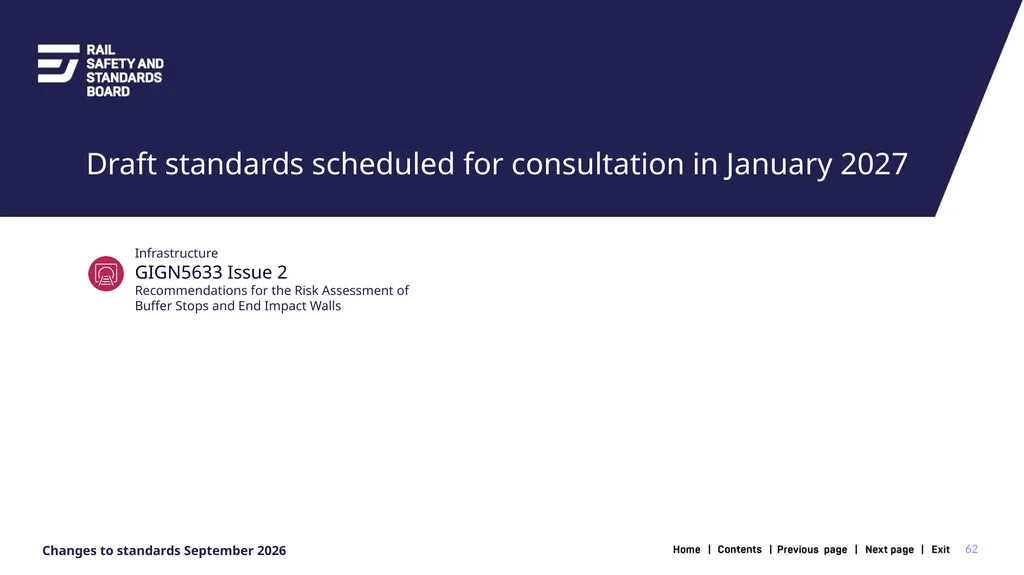
slide62. Draft standards scheduled for consultation in January 2027 Infrastructure GIGN5633 Issue 2 Recommendations for the Risk Assessment of Buffer Stops and End Impact Walls Changes to standards September 2026 62<br>
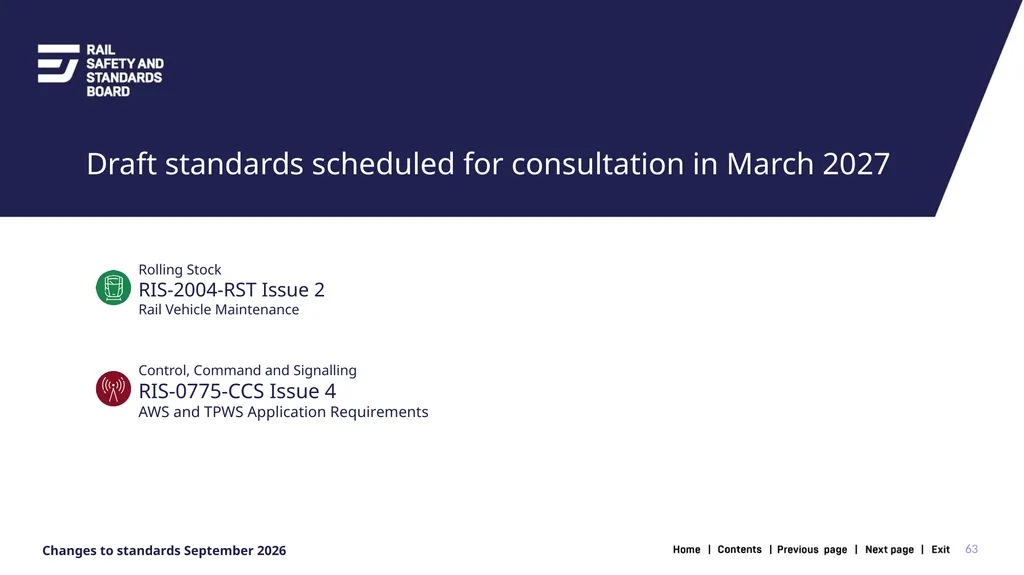
slide63. Draft standards scheduled for consultation in March 2027 Changes to standards September 2026 Rolling Stock RIS-2004-RST Issue 2 Rail Vehicle Maintenance 63 Control, Command and Signalling RIS-0775-CCS Issue 4 AWS and TPWS Application Requirements<br>
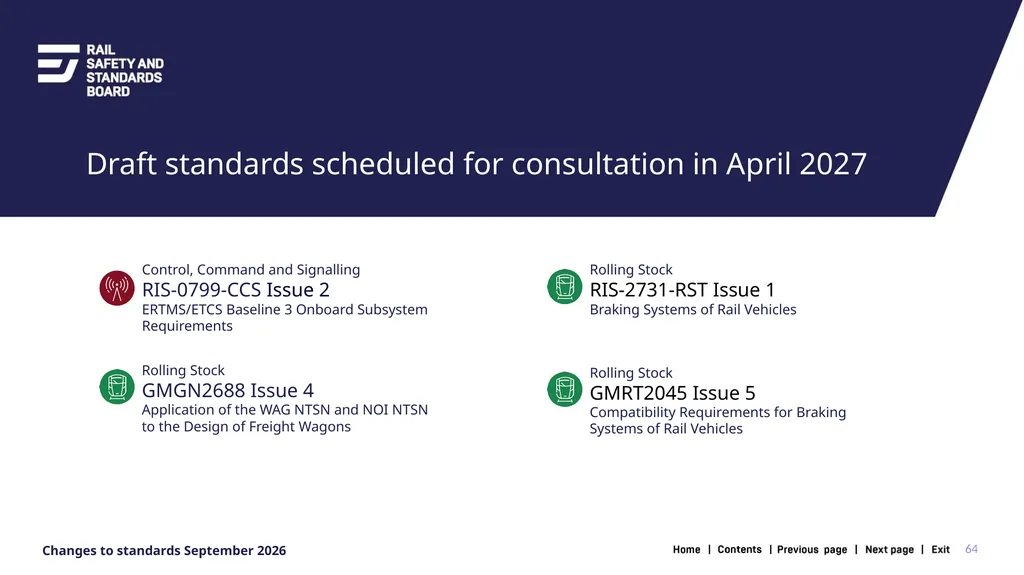
slide64. 64 Draft standards scheduled for consultation in April 2027 Changes to standards September 2026 Control, Command and Signalling RIS-0799-CCS Issue 2 ERTMS/ETCS Baseline 3 Onboard Subsystem Requirements Rolling Stock GMGN2688 Issue 4 Application of the WAG NTSN and NOI NTSN to the Design of Freight Wagons Rolling Stock GMRT2045 Issue 5 Compatibility Requirements for Braking Systems of Rail Vehicles Rolling Stock RIS-2731-RST Issue 1 Braking Systems of Rail Vehicles<br>
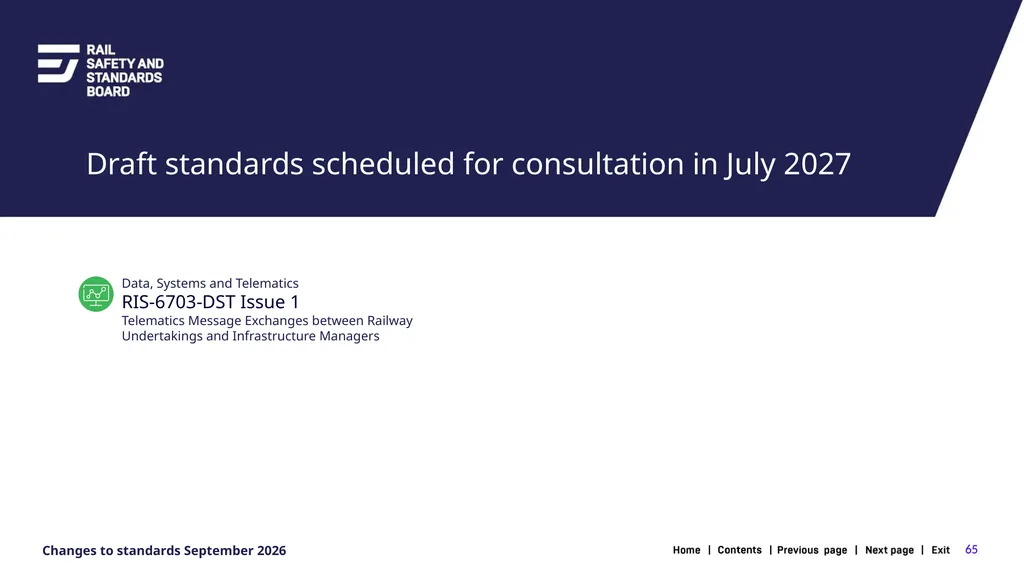
slide65. 65 Draft standards scheduled for consultation in July 2027 Data, Systems and Telematics RIS-6703-DST Issue 1 Telematics Message Exchanges between Railway Undertakings and Infrastructure Managers Changes to standards September 2026 65<br>
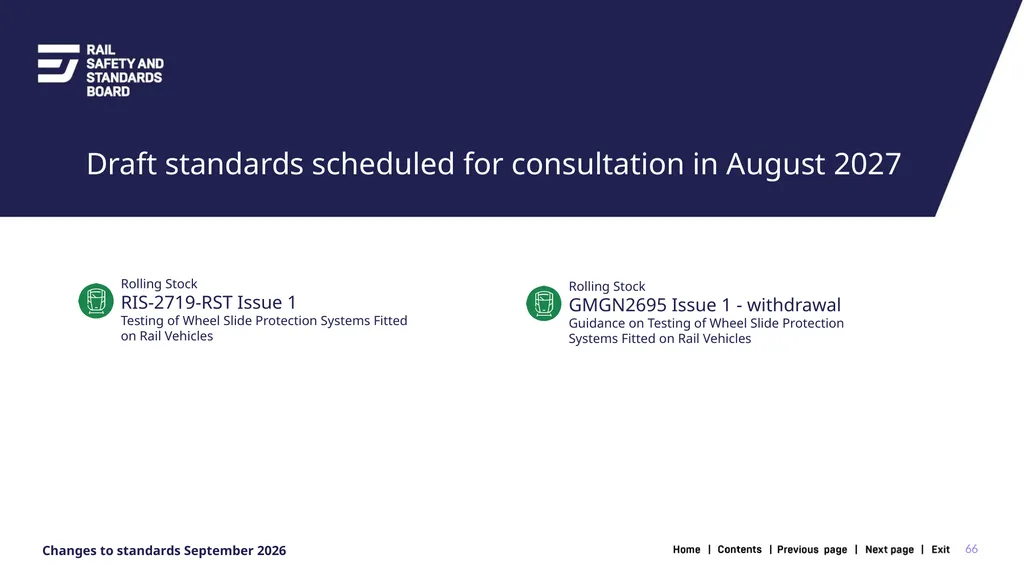
slide66. 66 Draft standards scheduled for consultation in August 2027 Changes to standards September 2026 Rolling Stock RIS-2719-RST Issue 1 Testing of Wheel Slide Protection Systems Fitted on Rail Vehicles Rolling Stock GMGN2695 Issue 1 - withdrawal Guidance on Testing of Wheel Slide Protection Systems Fitted on Rail Vehicles<br>
Draft standards scheduled to be published in December 2026
Draft standards scheduled for consultation Changes to standards September 2026 Interactive briefing slide deck Changes to standards September 2026<br>
slide2. 2 Changes in the September 2026 standards update 2 1 new standard
2 updated standards
2 Technical Notes
Multiple Rule Book updates Changes to standards September 2026 8 documents 2 new standards
3 updated standards
1 withdrawn standard 3 updated standards 1 updated standard
1 updated Technical Note<br>
slide3. Infrastructure RIS-7710-INS Issue 1 Wayfinding and Tactile Navigation Infrastructure RIS-7709-INS Issue 1 Station Facilities Infrastructure RIS-7702-INS Issue 2 Lighting at Stations Infrastructure RIS-7701-INS Issue 1 - withdrawal Rail Industry Standard for Automatic Ticket Gates at Stations Infrastructure RIS-7700-INS Issue 4 Station Infrastructure Station infrastructure
Two new and three updated Infrastructure standards have been added to the September Standards Catalogue and one has been withdrawn Infrastructure RIS-7016-INS Issue 2.2 Interface between Station Platforms, Track, Trains and Buffer Stops Changes to standards September 2026 3<br>
slide4. 4 4 RIS-7709-INS Issue 1 Station Facilities Overview This new standard is part of RSSB’s suite of station design standards and is the first of its kind to define the minimum facilities to be provided at GB mainline railway stations. It establishes requirements and guidance for facilities across station categories A to F, supporting a safe, accessible and high-quality passenger experience.
Benefits RIS-7709-INS provides a single, coherent framework that brings greater consistency to the provision and design of station facilities across the GB network. It clarifies requirements to support legal compliance, accessibility and inclusivity, while enhancing the passenger experience through structured, evidence-based planning. The standard also aligns with wider sustainability and circular-economy principles, supporting industry decarbonisation and resource efficiency. Changes to standards September 2026 This document is intended to be used by:
Infrastructure managers | Designers | Train operators | Local authorities Infrastructure<br>
slide5. 5 5 RIS-7710-INS Issue 1 Wayfinding and Tactile Navigation Overview This new standard sets out requirements and guidance for the design and provision of wayfinding and tactile navigation within stations on the GB mainline railway. The standard supports the delivery of accessible, inclusive and consistent station environments by establishing requirements for signage, wayfinding systems, tactile navigation routes and associated design principles.
Benefits RIS-7710-INS brings consistency to the design of wayfinding systems and signage, and the provision and design of tactile navigation in stations. It clarifies requirements to support legal compliance, accessibility and inclusivity, while enhancing the passenger experience. Embedding of modern technology in the design of wayfinding systems helps modernise stations and improves accessibility. Changes to standards September 2026 This document is intended to be used by:
Infrastructure managers | Designers Infrastructure<br>
slide6. 6 6 RIS-7700-INS Issue 4 Station Infrastructure Overview RIS-7700-INS has been comprehensively updated to introduce new requirements, guidance and rationale relating to automatic ticket gates, fire precautions, environmental sustainability, accessibility, station security and the management of unauthorised access. The structure of the document has also been improved, and references have been updated throughout to align with current legislation, industry practice and related railway standards.
Benefits RIS-7700-INS Issue 4 supports the delivery of £7 million of benefit from the update to the RSSB station design standards. The changes are expected to provide benefits in improved compliance and reduction of rework, a standardised approach to design of automatic ticket gates, clearer requirements and guidance for fire precautions, improved customer experience and sense of security, and more sustainable designs that take into consideration environmental impacts. Changes to standards September 2026 This document is intended to be used by:
Infrastructure managers | Project entities Infrastructure<br>
slide7. 7 7 RIS-7702-INS Issue 2 Lighting at Stations Overview RIS-7702-INS has been revised throughout to provide a framework for consistent station lighting system design across GB mainline stations. Requirements have been created or revised to promote environmental sustainability and conservation of energy use, good CCTV image quality, safe conditions during temporary and emergency lighting periods, a consistent approach to lighting design, adequate lighting design for different areas of the station and station signage, good practice in lighting design calculations, the selection of robust and resilient lighting equipment including columns, and glare reduction.
Benefits RIS-7702-INS Issue 2 supports the delivery of £7 million of benefits from the update to the RSSB station design standards. The changes are expected to provide benefits in safety and accessibility improvements delivered from better lighting levels, improved compliance and reduction of rework, a reduction in energy use and reduced maintenance from LED light sources and intelligent lighting controls, robust, fit-for-purpose equipment from new product requirements, and an improved customer experience and sense of security. Changes to standards September 2026 This document is intended to be used by:
Infrastructure managers | Project entities Infrastructure<br>
slide8. 8 8 RIS-7016-INS Issue 2.2 Interface between Station Platforms, Track, Trains and Buffer Stops Overview This point release moved or withdrew content relating to platform lighting. Part 6 Lighting of platforms is now incorporated in RIS-7702-INS Issue 2 Lighting at Stations. Appendix C Platform lighting is withdrawn as the content is guidance which is covered or replicated in RIS-7702-INS.
Benefits Creating a single document for lighting in all areas of the station helps with the consistent application of requirements, reducing variability in design and lowering the cost and effort associated with station lighting design. Changes to standards September 2026 This document is intended to be used by:
Infrastructure managers | Designers Infrastructure<br>
slide9. 9 Control, Command and Signalling RIS-8060-CCS Issue 2 Engineering Requirements for Dispatch of Trains from Platforms Control, Command and Signalling RIS-0733-CCS Issue 1.5 Lineside Operational Signs Control, Command and Signalling RIS-0737-CCS Issue 2 Signal Sighting Assessment Requirements Three Control, Command and Signalling standards have been updated in the September Standards Catalogue 9 9 Changes to standards September 2026 9<br>
slide10. This document is intended to be used by:
Suppliers | Designers | Infrastructure managers | Railway undertakings | Engineers Overview RIS-8060-CCS has been updated to clarify the definition of train dispatch systems, align with current technology and industry practices, add an appendix on applying human-centred design principles to the design and positioning of dispatch equipment, update requirements for compatibility and visibility, include requirements for data recording, storage and security, provide guidance on equipment maintenance and GDPR compliance, and incorporate amendments published in Issue 1 as Annex C.
Benefits The update will help to reduce safety incidents, prevent route delays, cut costs associated with redesigns and retrofit, and improve staff health. The RIS promotes efficiency, reliability, security and safety in train dispatch systems, underpinned by requirements that align with modern technology and human-centred design principles. The estimated value of the changes is £734,000 over five years. RIS-8060-CCS Issue 2 Engineering Requirements for Dispatch of Trains from Platforms 10 10 Changes to standards September 2026 10<br>
slide11. This document is intended to be used by:
Infrastructure managers | Railway undertakings | Project entities Overview RIS-0737-CCS Issue 2 expands beyond signalling to cover most trackside visible objects, with updated terminology, guidance and examples. It addresses RAIB’s Spital Junction overspeed recommendation by enhancing requirements for junction signals, readability and human perception. It also incorporates good practice, including ETCS examples, contextual factors, clearer rationales and principles.
Benefits The update strengthens requirements and guidance to reduce the risk of incidents, and enhances safety by ensuring trackside visible objects are reliably detected and interpreted. The estimated value of the changes is £293,000 over five years. RIS-0737-CCS Issue 2 Signal Sighting Assessment Requirements Changes to standards September 2026 11<br>
slide12. This document is intended to be used by:
Infrastructure managers | Railway undertakings | Project entities Overview RIS-0733-CCS Issue 1.5 provides revisions to guidance to clarify that most lineside operational signs require a sighting assessment as part of ensuring safe integration. This update aligns the guidance in RIS-0733-CCS with the updates introduced in RIS-0737-CCS Issue 2.
Benefits RIS-0733-CCS Issue 1.5 clarifies which lineside operational signs require a sighting assessment and ensures consistency in terminology used in RIS 0733-CCS and RIS-0737-CCS. The overall benefit of the changes to both documents is estimated at £293,000 over five years. RIS-0733-CCS Issue 1.5 Lineside Operational Signs Changes to standards September 2026 12<br>
slide13. 13 Improving freight train preparation One new and one updated Traffic Operation and Management document and one Rule Book module have been added to the September Standards Catalogue Changes to standards September 2026 Traffic Operation and Management GOGN3617 Issue 1 Guidance on Competence and Training of Freight Train Preparers Traffic Operation and Management RIS-3781-TOM Issue 3 Requirements for the Operation of Freight Trains and the Conveyance of Dangerous Goods by any Train Rule Book GERT8000-TW4 Issue 3 Preparation and working of freight trains<br>
slide14. 14 This document is intended to be used by:
Freight operating companies | Freight terminal operators Overview RIS-3781-TOM sets out requirements and guidance relating to the safe operation of freight trains and the safe movement of dangerous goods. New requirements have been included regarding the vehicle condition check to be undertaken before a freight train begins its journey, the securing of vehicles, brake overcharge and enhanced air brake continuity tests.
Benefits Wagons entering the network that have not been prepared adequately and are subsequently involved in incidents cause delays with network-wide impacts. The changes to the standard have the potential to reduce delays caused by trains entering the network when not safe to do so. The changes might also improve performance in freight operations through improvements in securing vehicles and train preparation activities. These changes have the potential to save the industry £1m over five years. RIS-3781-TOM Issue 3 Requirements for the Operation of Freight Trains and the Conveyance of Dangerous Goods by any Train 14 Changes to standards September 2026<br>
slide15. 15 This document is intended to be used by:
Railway undertakings Overview Freight train preparation is a complicated and varied task. The task is critical in ensuring a freight train is safe to enter service.
Industry previously had no common approach to managing the training and competence of staff undertaking the freight train preparer role. GOGN3617 is a new guidance note that assists railway undertakings in creating a framework for training, competence and assessment of staff who undertake a freight train preparer role.
Benefits A standardised training framework can contribute to improving training effectiveness by ensuring staff responsibilities are matched to training content. GOGN3617 provides undertakings with a framework that, if adopted, will help them satisfy their legal obligations. This standard has the potential to save the industry £1.5m over five years. GOGN3617 Issue 1 Guidance on Competence and Training of Freight Train Preparers 15 Changes to standards September 2026<br>
slide16. 16 Key changes
Following a review of the activities associated with the preparation of freight trains, braking instructions and the securing of vehicles, GERT8000-TW4 has been updated as follows:
The list of physical checks in section 5.1 has been updated and includes the addition of a vehicle condition check. An industry review identified that this important type of check on freight vehicles is carried out during freight train preparation but was not previously included in GERT8000.
The instructions for using the enhanced brake test procedure have been updated to clarify the use of the simplified brake test.
A new instruction to carry out a brake overcharge has been added. GERT8000-TW4 Issue 3 Preparation and working of freight trains 16 Changes to standards September 2026<br>
slide17. Traffic Operation and Management RIS-3702-TOM Issue 4 Management of Route Knowledge Updating route knowledge standards for train crew
One Traffic Operation and Management standard has been updated in the September Standards Catalogue Changes to standards September 2026 17<br>
slide18. 18 This document is intended to be used by:
Railway undertakings Overview Advances in technology and requests to align industry approaches to assessing route risks led to a review of RIS‑3702‑TOM. A new requirement was added to require RUs to apply route risk factors when carrying out a route risk assessment. The route learning requirements for drivers were updated to include operations over ETCS schemes, with and without lineside signals. The standard was updated to reflect the increasing use of technology when providing route learning information to staff. New guidance has been provided on the inclusion of location information used in communications between traincrew and third parties in information provided for route learning and when undertaking traincrew training.
Benefits The addition of industry-agreed route risk factors and the adoption of improved technology might facilitate collaboration among RUs and reduce related adverse incidents. Assisting RUs in making traincrew aware of the various types of information that can be used to identify locations when providing route learning information might support staff in carrying out operational tasks. RIS-3702-TOM Issue 4 Management of Route Knowledge Changes to standards September 2026<br>
slide19. Two Traffic Operation and Management Technical Notes have been added to the September Standards Catalogue TN3302 Issue 1 – Clarifying Freight Train Preparation Responsibilities
TN3303 Issue 1 – Clarification on drugs and alcohol testing for safety-critical workers (renumbered from TN3300) Changes to standards September 2026 19<br>
slide20. This document is intended to be used by:
Freight operating companies | Entities in charge of maintenance Overview Freight operating companies (FOCs) and entities in charge of maintenance (ECMs) share responsibility for keeping freight vehicles in a safe condition to complete journeys. This technical note sets out each party’s responsibilities by identifying those that each might reasonably expect the other party to undertake to promote the safe preparation and operation of freight trains.
Benefits This technical note will assist industry in clarifying the responsibilities for freight train preparation between freight operating companies and entities in charge of maintenance. TN3302 Issue 1 Clarifying Freight Train Preparation Responsibilities Changes to standards September 2026 20<br>
slide21. This document is intended to be used by:
Infrastructure managers | Railway undertakings Overview This document was previously published as TN3300 and has been renumbered to avoid confusion with another document. The content is unchanged and remains identical to TN3300 Issue 1.
Benefits This technical note aims to provide a greater understanding of the importance of drugs and alcohol testing for safety-critical workers by providing the rationale for the requirement and the importance of undertaking the tests. TN3303 Issue 1 Clarification on drugs and alcohol testing for safety-critical workers Renumbered from TN3300 Changes to standards September 2026 21<br>
slide22. Plant RIS-1710-PLT Issue 3 Engineering Certification of Railborne Plant and the Assessment of Non-Railborne Plant One Plant standard has been updated in the September Standards Catalogue Changes to standards September 2026 22<br>
slide23. 23 This document is intended to be used by:
Infrastructure managers | Plant assessment bodies | Designers | Manufacturers Overview The primary reason for the update was to refer to the guidance in RIS-2700-RST Issue 3 considering software changes and cyber security. RIS-1710-PLT Issue 3 refers to the latest legislative regime, and to the latest issues of the European Standards.
Benefits The update helps the user to understand better the process of engineering acceptance of OTMs, OTP and non-railborne plant. The updates also help designers, manufacturers and plant assessment bodies (PABs) to understand the implications of design and maintenance changes, including changes to software and those potentially affecting cyber security. RIS-1710-PLT Issue 3 Engineering Certification of Railborne Plant and the Assessment of Non-Railborne Plant Changes to standards September 2026 23<br>
slide24. One Plant Technical Note has been updated in the September Standards Catalogue TN4300 Issue 2 – Key Plant Principles Changes to standards September 2026 24<br>
slide25. 25 This document is intended to be used by:
Manufacturers Overview This technical note has been updated to refer to RIS-1710-PLT Issue 3. It is aimed at manufacturers of on-track machines (OTMs), manufacturers and converters of on-track plant (OTP), manufacturers of non-railborne plant used on railway infrastructure, and owners and operators of OTMs, OTP, and non-railborne plant used on railway infrastructure.
Benefits During the revision of its plant standards, RSSB found some duplication. RSSB and Plant Standards Committee decided it would be helpful to industry to publish a single document providing general information about using railborne and other plant and to provide links to the many other sources of useful information and guidance. This technical note is intended to complement Key Train Requirements and Key Wagon Maintenance Principles. TN4300 Issue 2 Key Plant Principles Changes to standards September 2026 25<br>
slide26. The following Rule Book modules and handbooks have been updated in the September Standards Catalogue Changes to standards September 2026 26<br>
slide27. 27 Consolidating Rule Book requirements for protecting staff Changes to standards September 2026 GERT8000-HB9 Issue 10 - IWA or COSS setting up safe systems of work within possessions
GERT8000-HB11 Issue 12 - Duties of the person in charge of the possession (PICOP)
GERT8000-HB12 Issue 12 - Duties of the engineering supervisor (ES) in a possession
GERT8000-T3 Issue 14 - Possession of a running line for engineering work
GERT8000-TS11 Issue 9 - Failure of, or work on, signalling equipment – signallers’ regulations
Form RT3198 Issue 12-26
Form RT3199 Issue 12-26<br>
slide28. 28 Key changes
Section 3.1, ‘Agreeing the site of work with the ES’ has been changed to remove the requirement to sign the RT3199 certificate. The ability of an IWA or COSS to receive a work-site briefing and to ‘sign in’ with the ES helps to avoid unnecessary road journeys and exposure to the associated risks. A reduction in the extent of such risks can be anticipated.
Previous rules changes to reduce the use of unassisted lookouts as a safe system of work led to issues when work was to be carried out between work sites because, when this had been done with the permission of the PICOP, lookouts were used. Following trials, new rules have been introduced at section 4 describing the arrangements for ‘transient work sites’ (a portion of line between two established work sites). These are now the only method by which work can take place outside a work site. As a result, section 3.6 which allowed the use of equipment warning has been withdrawn.
For completeness, a definition of an engineering train has been added at section 1. GERT8000-HB9 Issue 10 IWA or COSS setting up safe systems of work within possessions 28 Changes to standards September 2026<br>
slide29. 29 Key changes
Following trials, new rules have been introduced permitting the use of engineering controls as an alternative to the use of detonator protection for possessions. The existing rules have been revised to show the arrangements that apply to a possession with engineering controls where these are different from a possession using detonator protection, which is referred to as a possession without engineering controls. Where the same rules would apply to both protection procedures, they are generally left unchanged. The new rules are estimated to generate substantial cost benefits (ca. £40M over 5 years) as well as assisting in taking forward the findings of research into the risks and benefits of using detonators which suggested that alternatives might exist to their use in possessions.
Previous rules changes to reduce the use of unassisted lookouts as a safe system of work led to issues when work was to be carried out between work sites because, when this had been done with the permission of the PICOP, lookouts were used. Following trials, new rules have been introduced at section 3.7 describing the arrangements for ‘transient work sites’ (a portion of line between two established work sites). These are now the only method by which work can take place outside a work site. GERT8000-HB11 Issue 12 Duties of the person in charge of the possession (PICOP) 29 Changes to standards September 2026<br>
slide30. 30 Key changes
Sections 11.1, 11.2 and 11.3 (formerly section 10.1, 10.2 and 10.3) have been amended to refer to the use of Appendix B of the RT3199 certificate. These changes form part of the annual updates, which are intended to improve understanding and application of the Rule Book and provide opportunities for duty holders to operate more efficiently.
Following trials, new rules have been introduced permitting the use of engineering controls as an alternative to the use of detonator protection for possessions. The rules have been revised to show the arrangements that apply to a possession with engineering controls where these are different from a possession using detonator protection, which is referred to as a possession without engineering controls. Where the same rules would apply to both protection procedures, they are generally left unchanged. The new rules are estimated to generate substantial cost benefits (ca. £40M over 5 years) as well as assisting in taking forward the findings of research into the risks and benefits of using detonators.
Previous rules changes to reduce the use of unassisted lookouts as a safe system of work led to issues when work was to be carried out between work sites because, when this had been done with the permission of the PICOP, lookouts were used. Following trials, new rules have been introduced at section 3.7 describing the arrangements for ‘transient work sites’ (a portion of line between two established work sites). These are now the only method by which work can take place outside a work site. GERT8000-HB12 Issue 12 Duties of the engineering supervisor (ES) in a possession 30 Changes to standards September 2026<br>
slide31. 31 Key changes
Following trials, new rules have been introduced permitting the use of engineering controls as an alternative to the use of detonator protection for possessions. The rules have been revised to show the arrangements that apply to a possession with engineering controls where these are different from a possession using detonator protection, which is referred to as a possession without engineering controls. Where the same rules would apply to both protection procedures, they are generally left unchanged. The new rules are estimated to generate substantial cost benefits (ca. £40M over 5 years) as well as assisting in taking forward the findings of research into the risks and benefits of using detonators which suggested that alternatives might exist to their use in possessions. GERT8000-T3 Issue 14 Possession of a running line for engineering work 31 Changes to standards September 2026<br>
slide32. 32 Key changes
Regulation 16.1, ‘Failure of track circuits’, has been changed in the interests of completeness by including the situation of being allowed to proceed in one direction as a further situation in which working by pilot is not necessary. This brings the regulation into line with a change recently published in module GERT8000-P2.
These changes form part of the annual updates, which are intended to improve understanding and application of the Rule Book and provide opportunities for duty holders to operate more efficiently.
Section 1.3, ‘When the regulations in this module do not apply’ has been changed under a separate project to introduce new rules for possessions with engineering controls. As a result of the new rules, possessions with engineering controls require to be mentioned in this section as well as line blockages.
The change to introduce rules for possessions with engineering controls is expected to generate considerable reliability and operational performance benefits where these are deployed. It also assists in taking forward the findings of RSSB research project, T1155, into the risks and benefits of using detonators, which suggested that alternatives might exist to their use in possessions. GERT8000-TS11 Issue 9 Failure of, or work on, signalling equipment – signallers’ regulations 32 Changes to standards September 2026<br>
slide33. Reviewing track worker safety rules for IWAs and use of Lookout Operated Warning System
GERT8000-HB6 Issue 9 - General duties of an individual working alone (IWA)
GERT8000-HB7 Issue 11 - General duties of a controller of site safety (COSS) Changes to standards September 2026 33<br>
slide34. 34 Key changes
Section 3.2 has been renamed and changed to remove the ability to carry out patrolling, inspecting or examining duties without any safe system of work. The changes remove arrangements which were considered unrealistic and unsafe. The changes also provide benefits to planners and deliverers of activity by reflecting in the Rule Book how patrolling is now undertaken and drawing a distinction between that and structures examination or mobile operations manager (MOM) tasks. GERT8000-HB6 Issue 9 General duties of an individual working alone (IWA) 34 Changes to standards September 2026 GERT8000-HB7 Issue 11 General duties of a controller of site safety (COSS)<br>
slide35. 35 Updating the ERTMS Handbook and signalling regulations RS525 Issue 2 - ERTMS Handbook
GERT8000-TS10 Issue 5 - ERTMS Level 2 train signalling regulations
GERT8000-TW7 Issue 11 - Wrong-direction movements
Form NR3300 Issue 12-26 - ERTMS Operational Instruction Form
Withdrawn:
Form RTWO01 Issue 12-13 - Written Order 01 Permission To Start In SR Or To Pass An EOA
Form RTWO02 Issue 12-13 - Written Order 02 Permission to Proceed After a Train Trip
Form RTWO03 Issue 12-13 - Written Order 03 Instruction to Run At Caution
Form RTWO04 Issue 12-22 - Written Order 04 Permission to Make a Wrong-Direction Movement
Form RTWO05 Issue 12-22 - Written Order 05 Permission to Proceed Under Modified Working Arrangements on Single and Bi-Directional Lines 35 35 Changes to standards September 2026 35<br>
slide36. 36 Key changes
Revision of language and terms now used widely in ERTMS deployments.
Information to cover the working of the system from the perspective of as many deployments as possible.
Section 8 has been rewritten to convey the current position regarding operational instructions in use in the GERT8000 Rule Book and mention the NR3300 form. RS525 Issue 2 ERTMS Handbook 36 Changes to standards September 2026<br>
slide37. 37 Key changes
This module has been amended alongside RS525 ERTMS Handbook and contains wording amendments to align with the language being used in ERTMS deployments currently based on lessons learned over time.
Additions regarding the use of OS MA and operational instructions. GERT8000-TS10 Issue 5 ERTMS Level 2 train signalling regulations 37 Changes to standards September 2026<br>
slide38. 38 Key changes
Clauses have been added on the issuing of operational instructions to drivers before they are able to make a wrong-direction move when a train is operating in ERTMS Level 2. GERT8000-TW7 Issue 11 Wrong-direction movements 38 Changes to standards September 2026<br>
slide39. 39 GERT8000-M1 Issue 10 – Dealing with a train accident or train evacuation
GERT8000-M2 Issue 10 – Train stopped by train failure
GERT8000-S5 Issue 14 – Passing a signal at danger or an end of authority (EoA) without a movement authority (MA)
GERT8000-S7 Issue 8 – Observing and obeying signalling indications. Train warning systems. Reporting signalling failures and irregularities
GERT8000-TS1 Issue 20 – General signalling regulations
GERT8000-TW1 Issue 23 – Preparation and movement of trains The following six Rule Book modules have been updated in the September Standards Catalogue 39 39 Changes to standards September 2026 39<br>
slide40. 40 Key changes
Section 4, ‘Fire on a train’, has been revised at sub-section 4.1, ‘Stopping the train’, to give more detail on when an attempt should be made to deal with a fire and to include instructions concerning smoke or fumes. This change forms part of the annual updates, which are intended to improve understanding and application of the Rule Book and provide opportunities for duty holders to operate more efficiently.
In section 5.5, ‘Dealing with an assisting train’, instructions have been added on the issuing of an on-sight (OS) movement authority (MA) for trains that need to work into occupied sections. The use of operational instructions if an OS MA cannot be issued for trains on ERTMS lines without lineside signals is now also stated. These changes arise from a separate project that reviewed the ERTMS handbook, RS525, and associated modules. GERT8000-M1 Issue 10 Dealing with a train accident or train evacuation 40 Changes to standards September 2026<br>
slide41. 41 Key changes
Section 3.6, ‘When the failed train is being assisted’ has been changed to say that the driver must get permission from the signaller before starting the movement. This change forms part of the annual updates, which are intended to improve understanding and application of the Rule Book and provide opportunities for duty holders to operate more efficiently.
Section 3.2 and section 3.3 have been changed to add instructions for ERTMS lines regarding the use of an on-sight (OS) movement authority (MA), or operational instructions if an OS MA cannot be issued, to allow an assisting train to enter an occupied section. These changes arise from a separate project that reviewed the ERTMS handbook, RS525 and associated modules. GERT8000-M2 Issue 10 Train stopped by train failure 41 Changes to standards September 2026<br>
slide42. 42 Key changes
In section 3, ‘Authorising the movement’, a reference to modified working has been added at sub-section 3.1, ‘Instructions from the signaller’, as a situation in which a signaller does not have to tell a driver to proceed at caution.
In section 6.1, ‘Before allowing a train to pass two signals at danger’, the requirement to examine the line has been removed.
In section 8, ‘Driver passing a signal at danger or an EoA without authority’, the signaller’s actions at section 8.3 have been updated to state that the instructions in section 2 must be carried out before allowing the movement.
The above changes are part of the annual updates, which aim to improve understanding and application of the Rule Book.
The changes below arise from a separate project that reviewed the ERTMS handbook, RS525 and associated modules.
In sections 1.1, ‘Signaller’s authority’, and 1.2, ‘Driver getting authority’, a clause has been added on issuing an on-sight (OS) MA if possible. A further clause has been added to both to state that, if it is not possible to issue an OS MA, there is a requirement to pass on operational instructions to a driver if passing an EoA without an MA.
In section 3, the requirement to pass on operational instructions to a driver if passing an EoA without an MA on an ERTMS line has been added to sub-sections 3.1 and 3.3, with the additional instructions that should be communicated.
In section 4, ‘During the movement’, the requirement that, if operating in ERTMS, speed should not exceed that given in operational instructions has been added to sub-section 4.2.
In sections 8.1 and 8.2, new sub-sections have been added regarding operating in ERTMS, including the requirement to pass on operational instructions to a driver to allow authority to proceed into Post-Trip mode. GERT8000-S5 Issue 14 Passing a signal at danger or an end of authority (EoA) without a movement authority (MA) 42 Changes to standards September 2026<br>
slide43. 43 Key changes
At section 7.3, ‘Signals difficult to see because of sunlight, street lights or reflections’, a new instruction has been included requiring a report to be obtained from another driver after approximately 30 minutes to establish whether the signal is still affected by sunlight.
In section 7.8, ‘Reporting a signal/AWS/ERTMS/TPWS failure or irregularity’, sub-section b) ‘Reporting to Operations Control’, which had previously been omitted in error, has been reinstated.
The changes above form part of the annual updates, which are intended to improve understanding and application of the Rule Book and provide opportunities for duty holders to operate more efficiently.
The changes below arise from a separate project that reviewed the ERTMS handbook, RS525 and associated modules.
In section 2.1, ‘Train stopped on the approach to a signal or end of authority (EoA)’, the wording regarding the requirement for a valid movement authority (MA) to proceed has been amended for clarity.
The title of section 3 has been amended and now includes the use of an on-sight (OS) MA.
A new section has been added at 3.4 to describe when the use of OS MA is appropriate and what a driver must do before accepting an OS MA if their train is operating in ERTMS.
In section 8.3, ‘Train receiving a trip’, clauses have been added referring to the need for the signaller to pass on operational instructions to a driver to give authority to proceed after a trip. GERT8000-S7 Issue 8 Observing and obeying signalling indications. Train warning systems. Reporting signalling failures and irregularities 43 Changes to standards September 2026<br>
slide44. 44 Key changes
Regulation 17.1.2, ‘Authority to run trains’, now states that the requirement to stop movements on an adjacent line applies only when a Rail Defect Nominee (RDN) remains on site.
Regulation 17.2.2, ‘Overline bridge strike’, now states that it may not be necessary for a strike examiner to examine the bridge.
Regulation 20.1, ‘When the line is to be examined’, now states that it may not be necessary for the competent engineer to examine the line.
Regulation 20.2, ‘Before an examination using a train can start’, now describes the situation of another line being affected when the driver has reported only one line. A cross reference to GERT8000-AC has been added to remove an inconsistency.
Regulation 20.3, ‘Dealing with the train that will be used to examine the line’, now refers to a 'suspected' track defect (one which has been felt or heard) to agree with the terminology in GERT8000-TW1.
Regulation 20.5, ‘Resuming normal working’, now uses the terms ‘confirmed' or 'suspected' track defect and states that the requirement not to exceed a speed of 10 mph through a tunnel also applies to subsequent trains. Wording has also been changed to clarify what 'normal operation' can mean.
The above changes form part of the annual updates, which aim to improve understanding and application of the Rule Book.
Regulation 20.3 and 20.6.3 now refer to the use of an on-sight (OS) movement authority and operational instructions to the driver if they must pass an ‘end of authority’ (EoA) without a ‘movement authority’ (MA).
These changes arise from a separate project that reviewed the ERTMS handbook, RS525 and associated modules. GERT8000-TS1 Issue 20 General signalling regulations 44 Changes to standards September 2026<br>
slide45. 45 Key changes
Section 5.3, ‘Track defects’, revised to cover a wider range of defects and expand the detail to be obtained.
New instruction added to section 12.4, ‘Examining ac overhead line equipment’, to be consistent with GERT8000-AC.
Section 14.4, ‘Lights when making a wrong-direction movement’, now states it is not necessary to change the lights for a wrong-direction movement of less than 1/4 mile (400 metres) if this cannot be done using the normal lamp controls.
The above changes form part of the annual updates, which aim to improve understanding and application of the Rule Book.
The changes below arise from a separate project that reviewed the ERTMS handbook, RS525 and associated modules.
New section 20 added containing details on operational instructions and when they will be used.
Definition in section 21.1 on permissive working now includes applicability on an ERTMS line and the use of an on-sight (OS) movement authority (MA) where this is permitted.
Section 21.6, ‘Emergency permissive working’, changed to include the use of an OS MA for the movement or use of operational instructions to the driver if they must pass an ‘end of authority’ (EoA) without an MA on an ERTMS line.
Section 22, ‘Personal equipment’, formerly section 21, now states that, for ERTMS Level 2, the driver must have Form NR3300 ERTMS Operational Instructions and the means of completing it, if required by company instructions.
Section 24, ‘Preparing a train’, formerly section 23, now includes a requirement for the driver to have been given information in operational instruction 7 from the signaller if required to start the train in staff responsible (SR) or shunting (SH) modes. GERT8000-TW1 Issue 23 Preparation and movement of trains 45 Changes to standards September 2026<br>
slide46. The following eight Rule Book modules and handbooks have been updated in the September Standards Catalogue GERT8000-G1 Issue 11 – General safety responsibilities and personal track safety for non-track workers
GERT8000-M3 Issue 6 – Managing incidents, floods and snow
GERT8000-SP Issue 8 – Speeds
GERT8000-SS2 Issue 8 – Shunting
GERT8000-TS9 Issue 6 – Level crossings - signallers' regulations
GERT8000-HB1 Issue 10 – General duties and track safety for track workers
GERT8000-HB15 Issue 8 – Duties of the machine controller (MC) and on-track plant operator
RS521 Issue 10 – Signals, Handsignals, Indicators and Signs Handbook Changes to standards September 2026 46<br>
slide47. 47 Key changes
It has been identified that on-train balise reader antennae can emit potentially harmful electromagnetic forces. Rolling stock that is equipped with balises is intended to carry warning indications. A new instruction containing a similar warning has been added to section 1.12.
The change forms part of the annual updates, which aim to improve understanding and application of the Rule Book and provide opportunities for duty holders to operate more efficiently. GERT8000-G1 Issue 11 General safety responsibilities and personal track safety for non-track workers 47 Changes to standards September 2026<br>
slide48. 48 Key changes
The titles of sections 2 and 2.2 have been changed to refer to 'impacts' rather than 'heavy impacts' to avoid unnecessary judgement on what is to be reported. Section 2.2, ‘Collisions or impacts with other vehicles or buffer stops’, has also been changed to allow movement to be permitted when it is not necessary for a rolling stock technician to examine the vehicle beforehand.
Section 7.2, ‘Train running when damage to structures or earthworks is reported’, has been changed as it is not always necessary for a competent engineer to examine the line.
The changes form part of the annual updates, which aim to improve understanding and application of the Rule Book and provide opportunities for duty holders to operate more efficiently. GERT8000-M3 Issue 6 Managing incidents, floods and snow 48 Changes to standards September 2026<br>
slide49. 49 Key changes
Section 5.1, ‘Speed restriction boards or indicators missing or incorrect’, has been changed to state that only drivers of trains to which the speed restriction applies need to be told.
Section 5.3, ‘Defective or missing emergency indicators’, has been changed as it would not always be necessary to stop a train as this is a situation in which an acknowledged safety broadcast call can be used.
The changes form part of the annual updates, which aim to improve understanding and application of the Rule Book and provide opportunities for duty holders to operate more efficiently. GERT8000-SP Issue 8 Speeds 49 Changes to standards September 2026<br>
slide50. 50 Key changes
Section 5.2, ‘Controlling movements by radio’, has been changed to refer to speaking approximately every three seconds, rather than continuously.
Section 9.4, ‘Leaving vehicles or traction units on a dead-end line’, has been changed to state that a red light rather than a white light can be shown when the buffer stop shows a white light, when shown in train operating company instructions, and that an exemption from placing any light can also be shown in the Sectional Appendix.
The changes form part of the annual updates, which aim to improve understanding and application of the Rule Book and provide opportunities for duty holders to operate more efficiently. GERT8000-SS2 Issue 8 Shunting 50 Changes to standards September 2026<br>
slide51. 51 Key changes
Regulation 2.1.2, ‘Animals or large, low or slow-moving vehicles or a trolley with small wheels’, has been reworded to clarify that it refers to the movement of animals or vehicles and the crossing user that have cleared the crossing, rather than a train movement.
The change forms part of the annual updates, which aim to improve understanding and application of the Rule Book and provide opportunities for duty holders to operate more efficiently. GERT8000-TS9 Issue 6 Level crossings - signallers' regulations 51 Changes to standards September 2026<br>
slide52. 52 Key changes
It has been identified that on-train balise reader antennae can emit potentially harmful electromagnetic forces. Rolling stock that is equipped with balises is intended to carry warning indications. A new instruction containing a similar warning has been added to section 7.8.
The change forms part of the annual updates, which aim to improve understanding and application of the Rule Book and provide opportunities for duty holders to operate more efficiently. GERT8000-HB1 Issue 10 General duties and track safety for track workers 52 Changes to standards September 2026<br>
slide53. 53 Key changes
A definition of cross-tracking has been introduced at section 1.
At section 6, ‘On- and off-tracking’, two references to cross-tracking have been added.
Section 9, ‘Controlling OTP movements’, has been changed at sub-section 9.2, ‘Using radio’, to refer to speaking approximately every three seconds, rather than continuously.
The changes form part of the annual updates, which aim to improve understanding and application of the Rule Book and provide opportunities for duty holders to operate more efficiently. GERT8000-HB15 Issue 8 Duties of the machine controller (MC) and on-track plant operator 53 Changes to standards September 2026<br>
slide54. 54 Key changes
Wording has been added at section 2.6, ‘Splitting distant signals’, to explain that this describes some principles, but that the actual aspects displayed at any location will be shown in local instructions.
A description and illustration of a European Rail Traffic Management System (ERTMS) location marker have been introduced at a new section 4.2.
At section 4.4, the explanations of ERTMS cab signalling boards have been altered to that shown in RS525 ERTMS Handbook, which is more correct.
The changes form part of the annual updates, which aim to improve understanding and application of the Rule Book and provide opportunities for duty holders to operate more efficiently. RS521 Issue 10 Signals, Handsignals, Indicators and Signs Handbook 54 Changes to standards September 2026<br>
slide55. The following nine Rule Book documents have been updated in the September Standards Catalogue GERT8001 Issue 91 ― Changes to National Operations Publications for September 2026
GERT8000 Issue 41 ― Rule Book Module Issue History
GERT8000 Issue HB Issue 22 ― Rule Book Handbook Issue History
GERT8000-RBBL Issue 44 ― Rule Book Briefing Leaflet
GERM8000-master-module Issue 18 – Master Manual
GERM8000-traindriver Issue 18 – Train Driver Manual
GERM8000-signallersignallingtechnician Issue 18 – Signaller and Signalling Technician Manual
GERM8000-trackworkers Issue 17 – Track Workers Manual
GERM8000-trainoperationsstaff Issue 18 – Train Operations Staff Manual Changes to standards September 2026 55<br>
slide56. 56 Poster L11 Issue 1 Lift and carry of fixed extended loads – risk of derailment
COP0 Issue 7 Code of Practice for M&EE Documents
COP0014 Issue 8
Code of Practice for Trailers and Attachments with OTP
COP0050 Issue 1
Code of Practice for Plant Working/Travelling in Enclosed Locations
COP0125 Issue 6
Code of Practice for Management of sidings safety surveys
COP0129 Issue 3
Code of Practice for Control of Mobile communication equipment use in driving cabs
COP0130 Issue 3
Code of Practice for OTM Route Conducting Policy
COP0131 Issue 3
Code of Practice for OTM Driver Communication Review Group (CRG) The following eight non-RSSB documents have been published on the RSSB website Changes to standards September 2026<br>
slide57. 57 Standards scheduled for publication in December 2026 Changes to standards September 2026 Rolling Stock GOGN3681 Issue 1 Operation of Battery-Powered Rail Vehicles Rolling Stock RIS-2781-RST Issue 1 Design of Traction-Battery Systems for Rail Vehicles and their Charging Systems Rolling Stock RIS-2713-RST Issue 2 System Requirements for the Introduction and Operation of Multi-Mode Rolling Stock Traffic Operation and Management RIS-3708-TOM Issue 3 Arrangements for Non-Operation of Track Circuits due to Contamination Traffic Operation and Management RIS-3787-TOM Issue 1 Secondary Voice Communications in the Absence of GSM-R Traffic Operation and Management GOGN3677 Issue 2 – withdrawal Guidance Note on the Provision of Lineside Telephones Infrastructure GIGN7619 Issue 3 Guidance on the Application of the Safety in Railway Tunnels NTSN<br>
slide58. 58 Draft standards scheduled for consultation Draft standards scheduled for consultation Changes to standards September 2026 58<br>
slide59. Draft standards scheduled for consultation in September 2026 Changes to standards September 2026 BR1654 Issue 2 - withdrawal (phase 1) Radio Electronic Token Block System
GKGN0655 Issue 1 - withdrawal (phase 1) Guidance on Block System Interface Requirements
GKRT0055 Issue 1 - withdrawal (phase 1) Block System Interface Requirements 59 Control, Command and Signalling GKGN0602 Issue 2 Guidance on Train Rooftop Antenna Positioning Control, Command and Signalling RIS-0746-CCS Issue 1 (phase 1) Block System Interface Requirements RS103 Issue 1 Investigation Handbook RT3119-A Issue 8 – withdrawal Provisional SPAD Data Collection Form (Infrastructure Manager) RT3119-B Issue 9 – withdrawal Provisional SPAD Data Collection Form (Railway Undertaking) RT3119-C Issue 3 – withdrawal Provisional ERTMS SPAD Data Collection Form (Infrastructure Manager) RT3119-D Issue 4 – withdrawal Provisional ERTMS SPAD Data Collection Form (Railway Undertaking) Traffic Operation and Management RIS-3119-TOM Issue 4 Accident and Incident Investigation<br>
slide60. Draft standards scheduled for consultation in October 2026 Changes to standards September 2026 60 Rolling Stock RIS-2770-RST Issue 1.1 - withdrawal Movement of Continental Wagons on the GB Network Rolling Stock GMGN2683 Issue 1 Movement of European Wagons on the GB Network<br>
slide61. Draft standards scheduled for consultation in November 2026 Control, Command and Signalling RIS-0735-CCS Issue 2 Signing of Temporary and Emergency Speed Restrictions Traffic Operation and Management RIS-3780-TOM Issue 3 Operational Requirements for GSM-R Radio Traffic Operation and Management RIS-8047-TOM Issue 3 Reporting of Safety Related Information Changes to standards September 2026 61 Rolling Stock GMGN2615 Issue 3 Guidance on the Application of the Locomotives and Passenger Rolling Stock NTSN Rolling Stock RIS-2707-RST Issue 1 Operational Technology<br>
slide62. Draft standards scheduled for consultation in January 2027 Infrastructure GIGN5633 Issue 2 Recommendations for the Risk Assessment of Buffer Stops and End Impact Walls Changes to standards September 2026 62<br>
slide63. Draft standards scheduled for consultation in March 2027 Changes to standards September 2026 Rolling Stock RIS-2004-RST Issue 2 Rail Vehicle Maintenance 63 Control, Command and Signalling RIS-0775-CCS Issue 4 AWS and TPWS Application Requirements<br>
slide64. 64 Draft standards scheduled for consultation in April 2027 Changes to standards September 2026 Control, Command and Signalling RIS-0799-CCS Issue 2 ERTMS/ETCS Baseline 3 Onboard Subsystem Requirements Rolling Stock GMGN2688 Issue 4 Application of the WAG NTSN and NOI NTSN to the Design of Freight Wagons Rolling Stock GMRT2045 Issue 5 Compatibility Requirements for Braking Systems of Rail Vehicles Rolling Stock RIS-2731-RST Issue 1 Braking Systems of Rail Vehicles<br>
slide65. 65 Draft standards scheduled for consultation in July 2027 Data, Systems and Telematics RIS-6703-DST Issue 1 Telematics Message Exchanges between Railway Undertakings and Infrastructure Managers Changes to standards September 2026 65<br>
slide66. 66 Draft standards scheduled for consultation in August 2027 Changes to standards September 2026 Rolling Stock RIS-2719-RST Issue 1 Testing of Wheel Slide Protection Systems Fitted on Rail Vehicles Rolling Stock GMGN2695 Issue 1 - withdrawal Guidance on Testing of Wheel Slide Protection Systems Fitted on Rail Vehicles<br>