
1 CHAPTER 1 Understanding Trade Secrets Protecting
OM
Published · 100 slides · 0 views

1 / 1


Description
1 CHAPTER 1 Understanding Trade Secrets Protecting Trade Secrets: A Practical Guide to Law and Strategy 2 What Comes to Mind? Trade Secrets 3 Trade Secrets Are Everywhere Cell phone plans, software algorithms, gym memberships, restaurant
Related Topics
Share
Embed code
Download this presentation From Below
"1 CHAPTER 1 Understanding Trade Secrets Protecting" is the property of its rightful owner. Permission is granted to download and print the materials on this website for personal, non-commercial use only, and to display it on your personal computer provided you do not modify the materials and that you retain all copyright notices contained in the materials. By downloading content from our website, you accept the terms of this agreement.
Presentation Transcript
01
1 CHAPTER 1 Understanding
Trade Secrets Protecting Trade Secrets: A Practical Guide to Law and Strategy<br>
Trade Secrets Protecting Trade Secrets: A Practical Guide to Law and Strategy<br>
02
2 What Comes to Mind? "Trade Secrets"<br>
03
3 Trade Secrets Are Everywhere Cell phone plans, software algorithms, gym memberships, restaurant recipes, business strategies, customer lists<br>
04
4 This Course:
Doctrine + Strategy Learn the law, then build a plan
Seven chapters, seven stages
Each chapter = doctrine + application<br>
Doctrine + Strategy Learn the law, then build a plan
Seven chapters, seven stages
Each chapter = doctrine + application<br>
05
5 The TSPP Trade Secret Protection Plan
Your semester-long deliverable
A professional-grade plan for a real client<br>
Your semester-long deliverable
A professional-grade plan for a real client<br>
06
Your Client: Pico Salsa Small food startup in Albuquerque
Fermented salsa, proprietary process
Enthusiastic founders, informal culture 6<br>
Fermented salsa, proprietary process
Enthusiastic founders, informal culture 6<br>
07
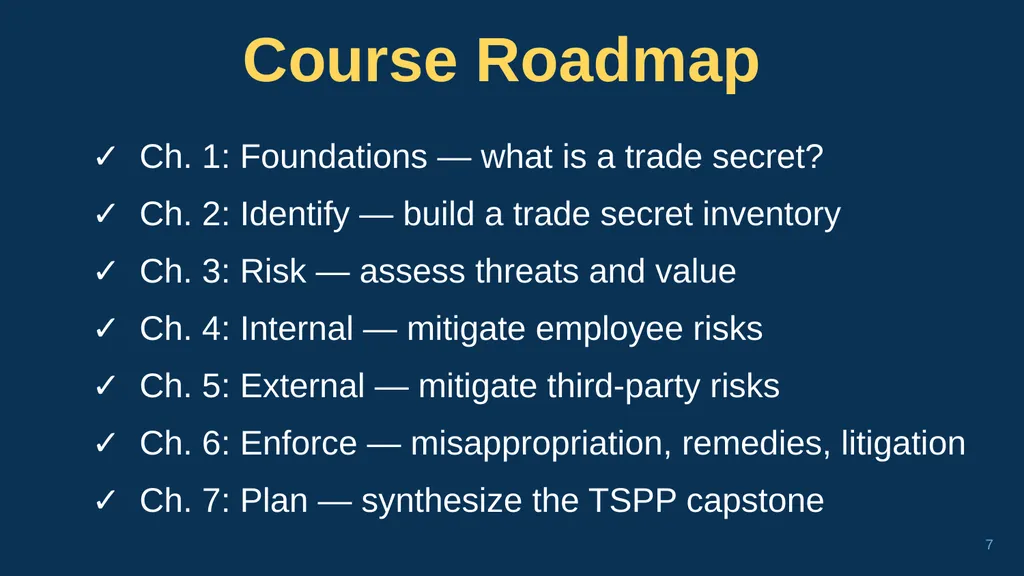
7 Course Roadmap ✓ Ch. 1: Foundations — what is a trade secret?
✓ Ch. 2: Identify — build a trade secret inventory
✓ Ch. 3: Risk — assess threats and value
✓ Ch. 4: Internal — mitigate employee risks
✓ Ch. 5: External — mitigate third-party risks
✓ Ch. 6: Enforce — misappropriation, remedies, litigation
✓ Ch. 7: Plan — synthesize the TSPP capstone<br>
✓ Ch. 2: Identify — build a trade secret inventory
✓ Ch. 3: Risk — assess threats and value
✓ Ch. 4: Internal — mitigate employee risks
✓ Ch. 5: External — mitigate third-party risks
✓ Ch. 6: Enforce — misappropriation, remedies, litigation
✓ Ch. 7: Plan — synthesize the TSPP capstone<br>
08
8 Next:
The Legal Definition What makes a trade secret?<br>
The Legal Definition What makes a trade secret?<br>
09
9 THE THREE-ELEMENT TEST The Foundation of Trade Secret Law<br>
10
10 All Three Elements Required If any element fails: no trade secret protection<br>
11
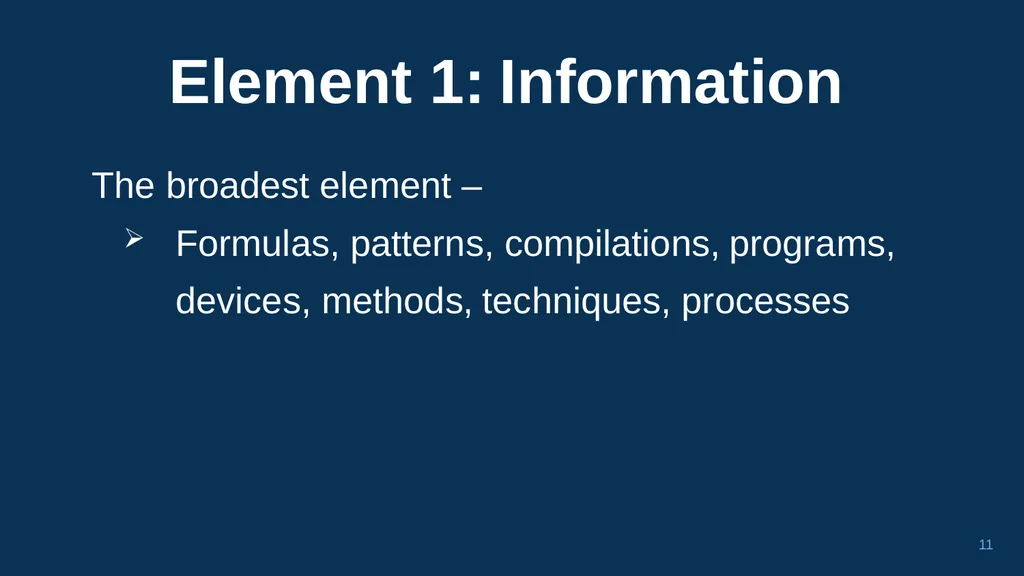
11 Element 1: Information The broadest element –
Formulas, patterns, compilations, programs, devices, methods, techniques, processes<br>
Formulas, patterns, compilations, programs, devices, methods, techniques, processes<br>
12
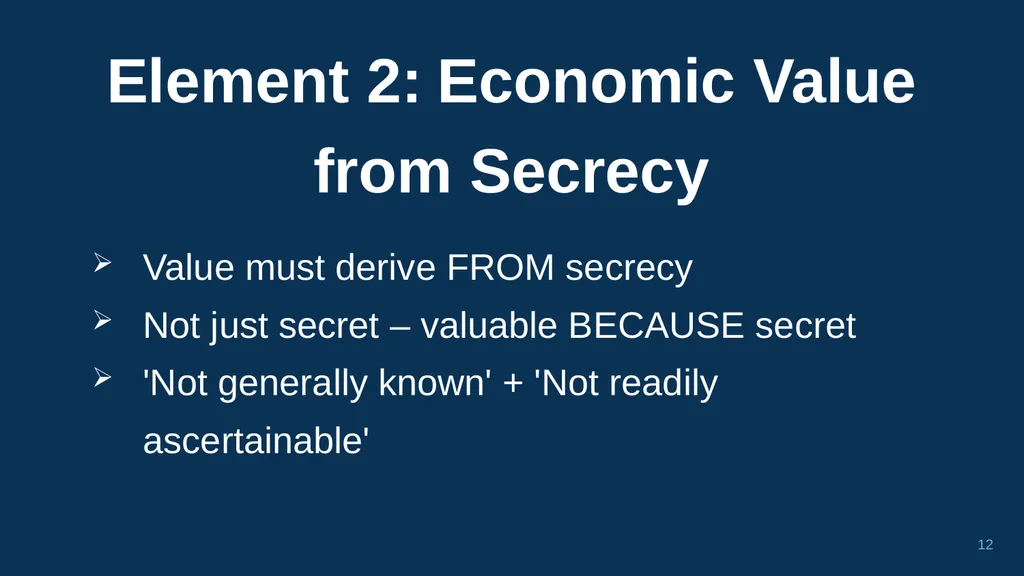
12 Element 2: Economic Value
from Secrecy Value must derive FROM secrecy
Not just secret – valuable BECAUSE secret
'Not generally known' + 'Not readily ascertainable'<br>
from Secrecy Value must derive FROM secrecy
Not just secret – valuable BECAUSE secret
'Not generally known' + 'Not readily ascertainable'<br>
13
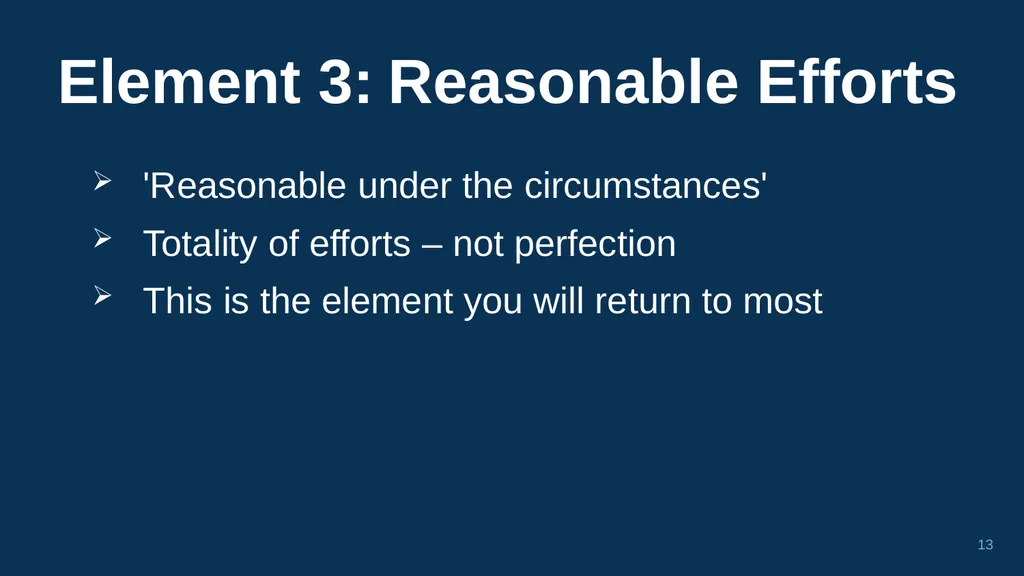
13 Element 3: Reasonable Efforts 'Reasonable under the circumstances'
Totality of efforts – not perfection
This is the element you will return to most<br>
Totality of efforts – not perfection
This is the element you will return to most<br>
14
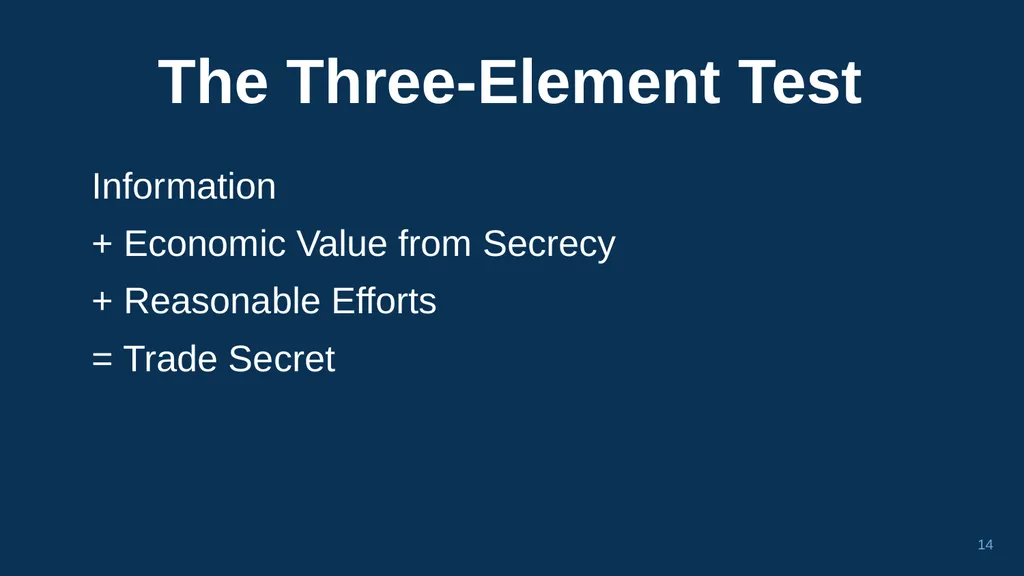
14 The Three-Element Test Information
+ Economic Value from Secrecy
+ Reasonable Efforts
= Trade Secret<br>
+ Economic Value from Secrecy
+ Reasonable Efforts
= Trade Secret<br>
15
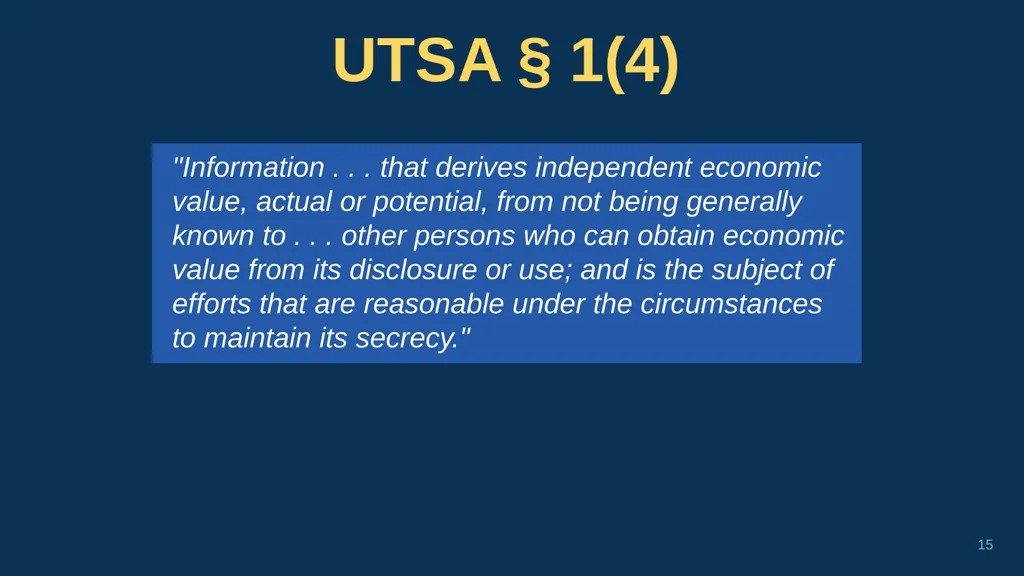
15 UTSA § 1(4) "Information . . . that derives independent economic
value, actual or potential, from not being generally
known to . . . other persons who can obtain economic
value from its disclosure or use; and is the subject of
efforts that are reasonable under the circumstances
to maintain its secrecy."<br>
value, actual or potential, from not being generally
known to . . . other persons who can obtain economic
value from its disclosure or use; and is the subject of
efforts that are reasonable under the circumstances
to maintain its secrecy."<br>
16
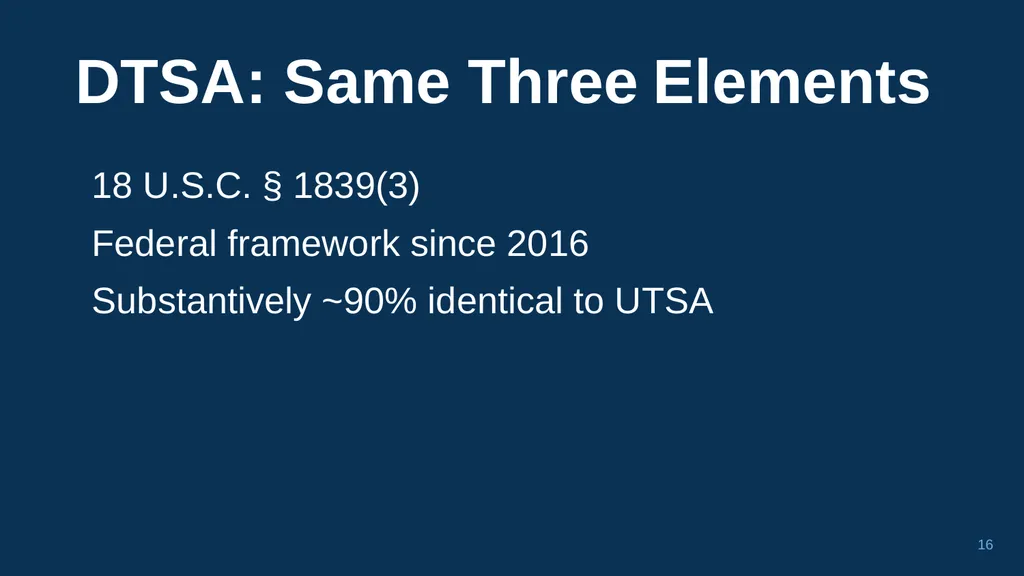
16 DTSA: Same Three Elements 18 U.S.C. § 1839(3)
Federal framework since 2016
Substantively ~90% identical to UTSA<br>
Federal framework since 2016
Substantively ~90% identical to UTSA<br>
17
17 ELEMENT 1:
INFORMATION The Broadest Element<br>
INFORMATION The Broadest Element<br>
18
18 "Information" Is Broad Formulas, patterns, compilations, programs, devices, methods, techniques, processes<br>
19
19 Technical Information Formulas, algorithms, source code, manufacturing processes, prototypes, engineering specifications<br>
20
20 Business Information Customer lists, pricing strategies, marketing plans, sales forecasts, supplier terms, financial data<br>
21
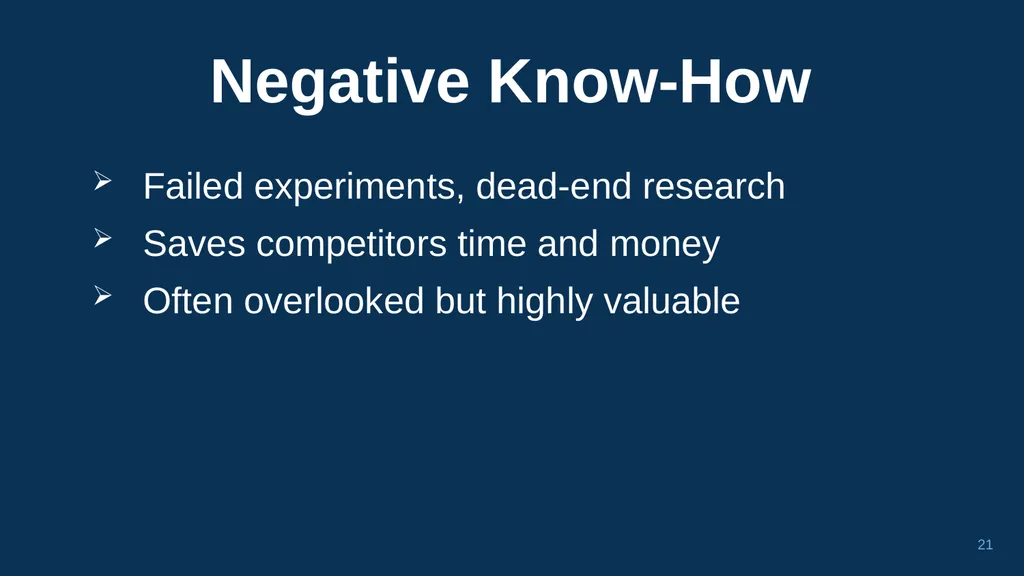
21 Negative Know-How Failed experiments, dead-end research
Saves competitors time and money
Often overlooked but highly valuable<br>
Saves competitors time and money
Often overlooked but highly valuable<br>
22
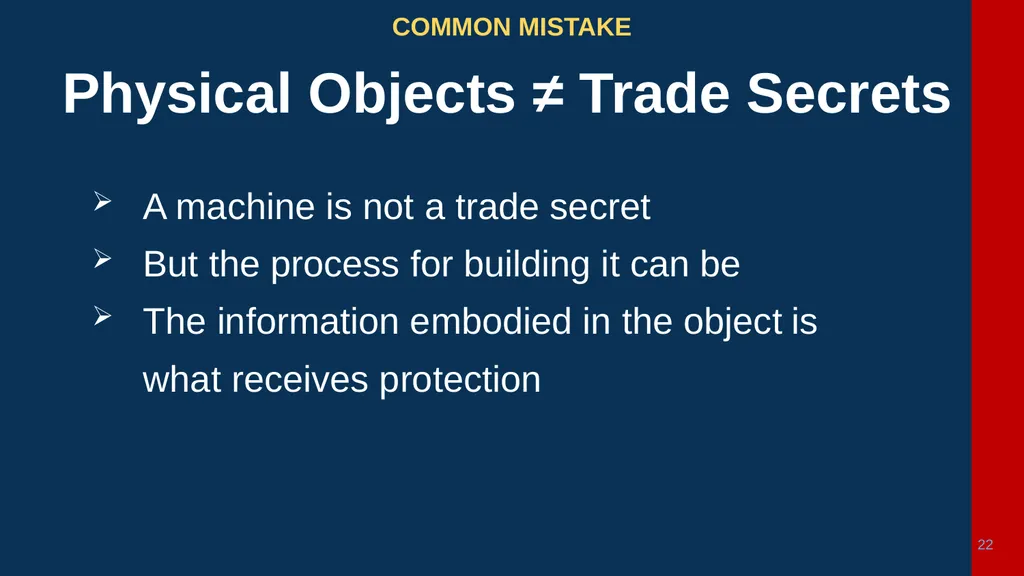
COMMON MISTAKE Physical Objects ≠ Trade Secrets A machine is not a trade secret
But the process for building it can be
The information embodied in the object is what receives protection 22<br>
But the process for building it can be
The information embodied in the object is what receives protection 22<br>
23
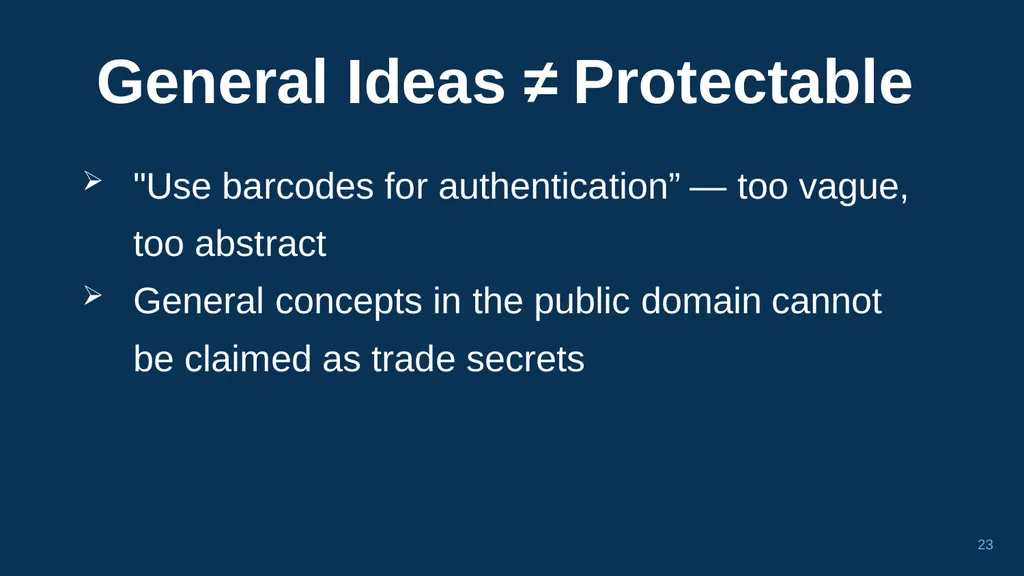
23 General Ideas ≠ Protectable "Use barcodes for authentication” — too vague, too abstract
General concepts in the public domain cannot be claimed as trade secrets<br>
General concepts in the public domain cannot be claimed as trade secrets<br>
24
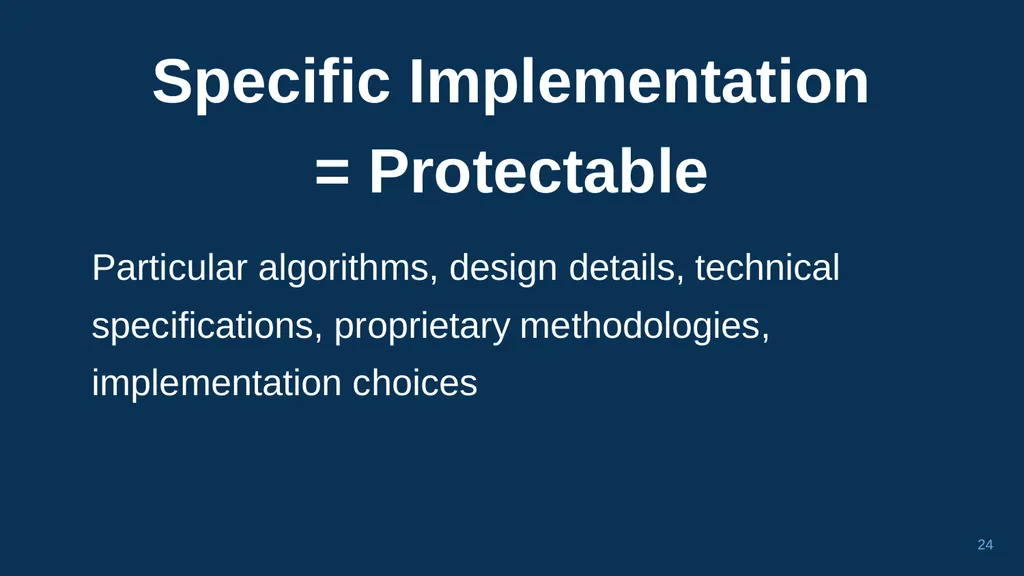
24 Specific Implementation
= Protectable Particular algorithms, design details, technical specifications, proprietary methodologies, implementation choices<br>
= Protectable Particular algorithms, design details, technical specifications, proprietary methodologies, implementation choices<br>
25
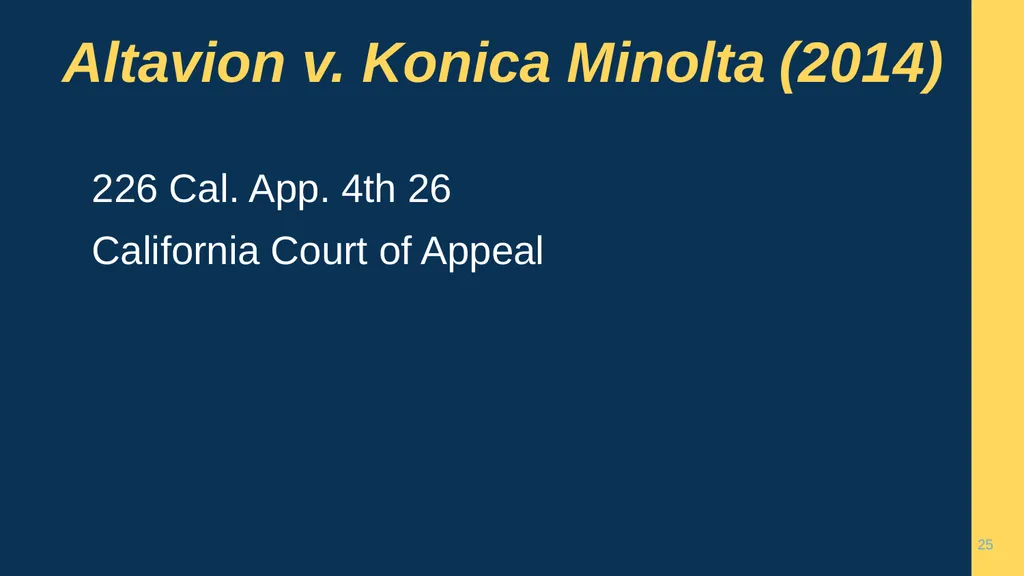
Altavion v. Konica Minolta (2014) 226 Cal. App. 4th 26
California Court of Appeal 25<br>
California Court of Appeal 25<br>
26
26 ELEMENT 2: ECONOMIC
VALUE FROM SECRECY The Distinguishing Feature<br>
VALUE FROM SECRECY The Distinguishing Feature<br>
27
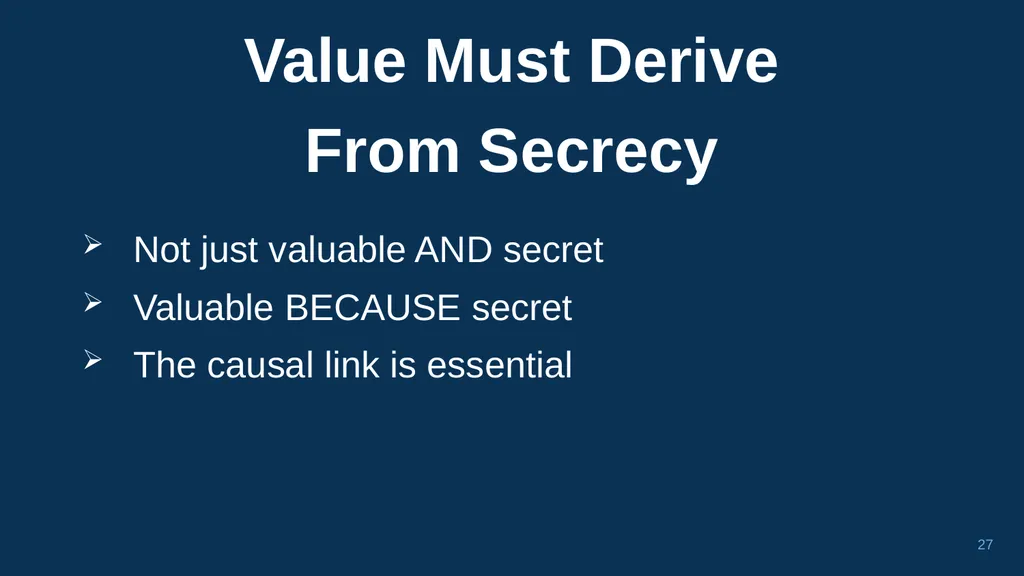
27 Value Must Derive
From Secrecy Not just valuable AND secret
Valuable BECAUSE secret
The causal link is essential<br>
From Secrecy Not just valuable AND secret
Valuable BECAUSE secret
The causal link is essential<br>
28
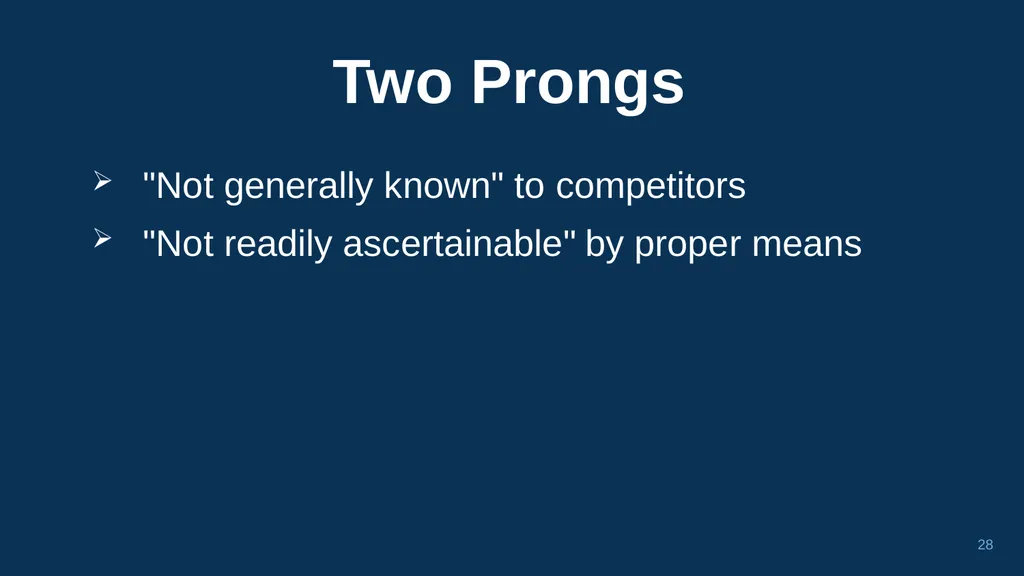
28 Two Prongs "Not generally known" to competitors
"Not readily ascertainable" by proper means<br>
"Not readily ascertainable" by proper means<br>
29
29 Value Can Be Actual or Potential No need to prove current monetization
Potential competitive advantage suffices
Early-stage secrets qualify<br>
Potential competitive advantage suffices
Early-stage secrets qualify<br>
30
30 ELEMENT 3:
REASONABLE EFFORTS Where Cases Are Won and Lost<br>
REASONABLE EFFORTS Where Cases Are Won and Lost<br>
31
31 "Reasonable Under the
Circumstances" Totality of efforts – not perfection
Proportional to value and risk
Systematic, documented, consistent<br>
Circumstances" Totality of efforts – not perfection
Proportional to value and risk
Systematic, documented, consistent<br>
32
Fail-Safe v. A.O. Smith No NDAs, no confidentiality markings
Voluntary disclosure to business partner
Court: no reasonable efforts 32<br>
Voluntary disclosure to business partner
Court: no reasonable efforts 32<br>
33
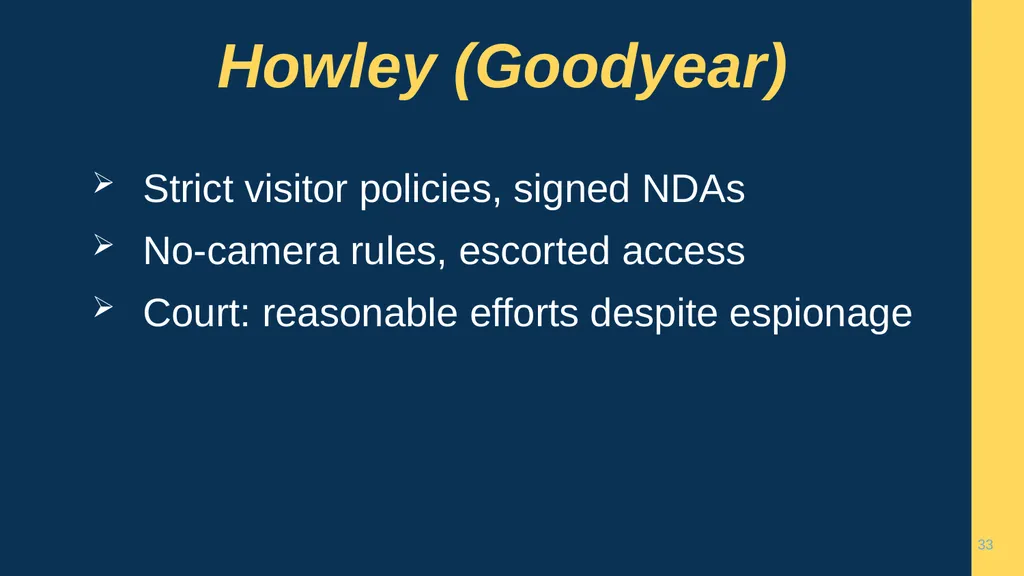
Howley (Goodyear) Strict visitor policies, signed NDAs
No-camera rules, escorted access
Court: reasonable efforts despite espionage 33<br>
No-camera rules, escorted access
Court: reasonable efforts despite espionage 33<br>
34
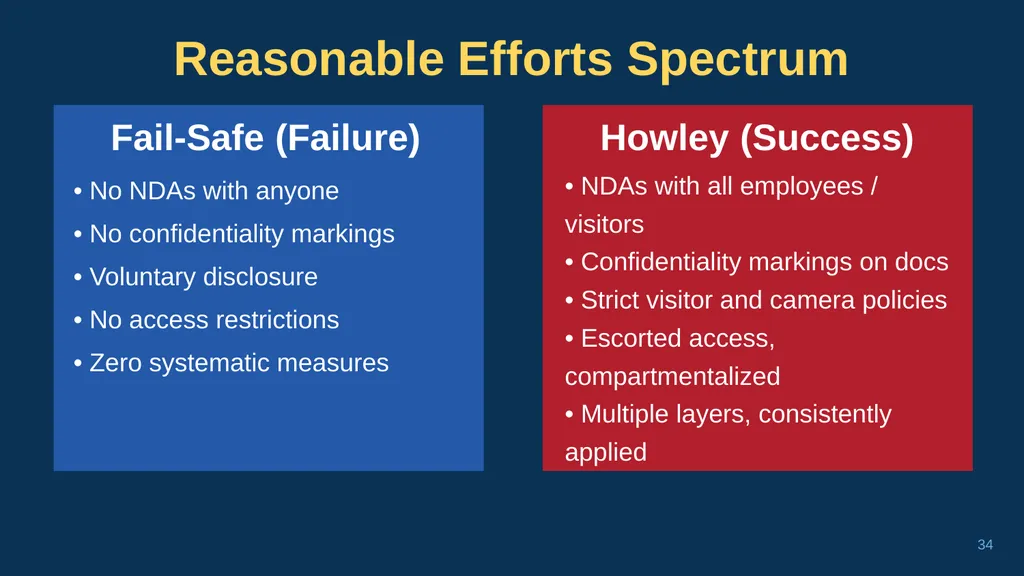
34 Reasonable Efforts Spectrum Fail-Safe (Failure) Howley (Success) • No NDAs with anyone
• No confidentiality markings
• Voluntary disclosure
• No access restrictions
• Zero systematic measures • NDAs with all employees / visitors
• Confidentiality markings on docs
• Strict visitor and camera policies
• Escorted access, compartmentalized
• Multiple layers, consistently applied<br>
• No confidentiality markings
• Voluntary disclosure
• No access restrictions
• Zero systematic measures • NDAs with all employees / visitors
• Confidentiality markings on docs
• Strict visitor and camera policies
• Escorted access, compartmentalized
• Multiple layers, consistently applied<br>
35
Quick Check What are the three elements
of a trade secret? 35<br>
of a trade secret? 35<br>
36
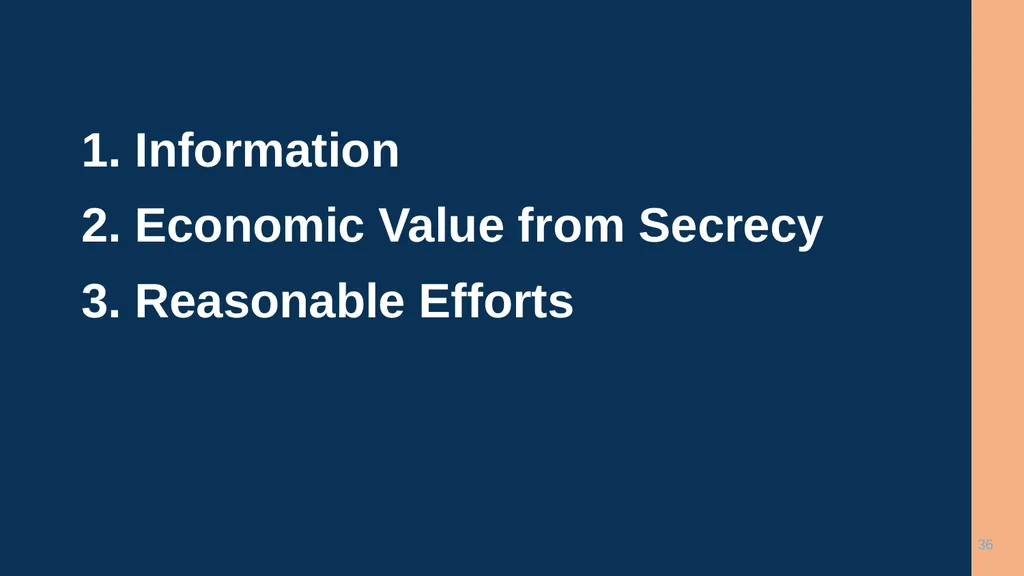
1. Information
2. Economic Value from Secrecy
3. Reasonable Efforts 36<br>
2. Economic Value from Secrecy
3. Reasonable Efforts 36<br>
37
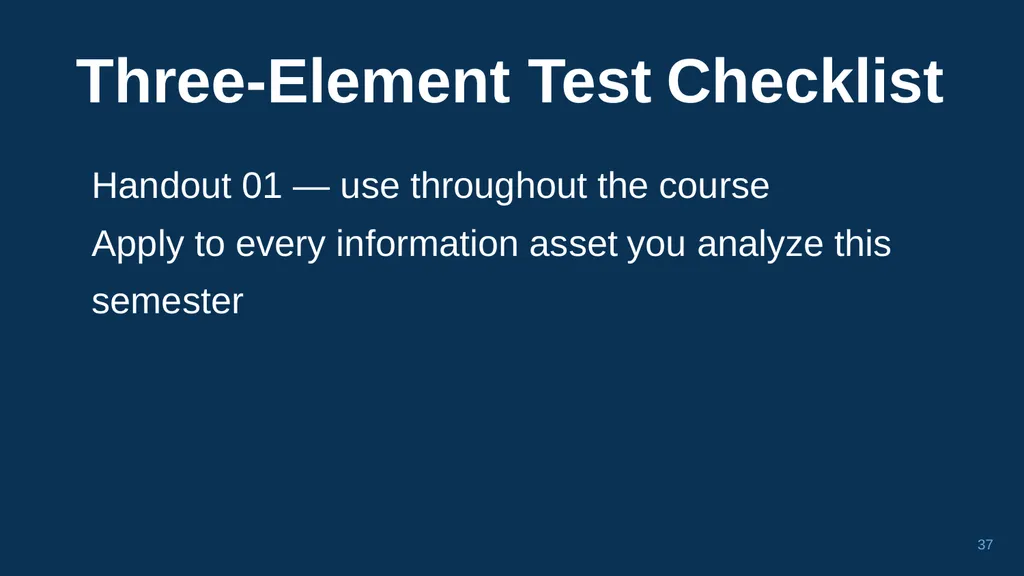
37 Three-Element Test Checklist Handout 01 — use throughout the course
Apply to every information asset you analyze this semester<br>
Apply to every information asset you analyze this semester<br>
38
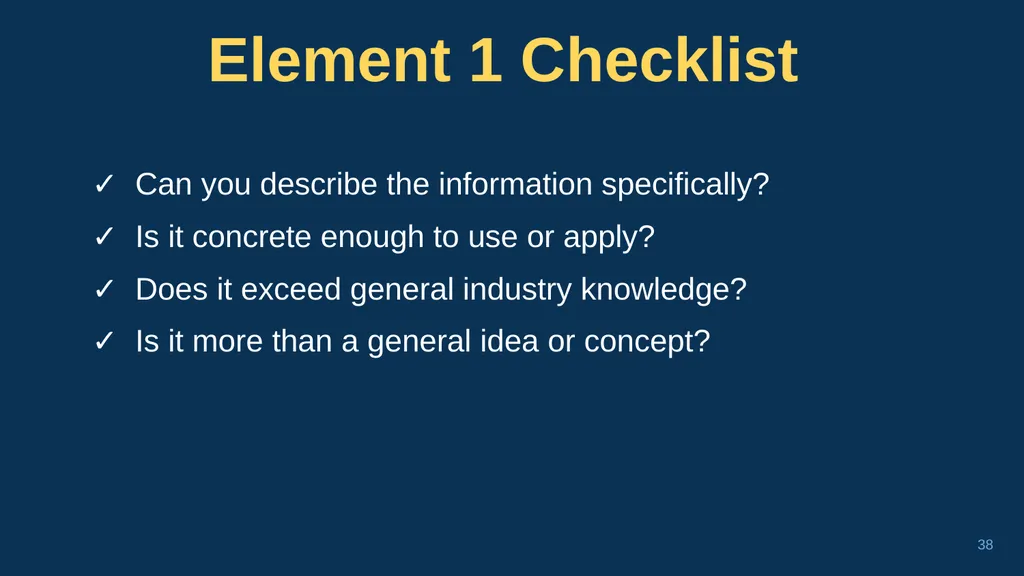
38 Element 1 Checklist ✓ Can you describe the information specifically?
✓ Is it concrete enough to use or apply?
✓ Does it exceed general industry knowledge?
✓ Is it more than a general idea or concept?<br>
✓ Is it concrete enough to use or apply?
✓ Does it exceed general industry knowledge?
✓ Is it more than a general idea or concept?<br>
39
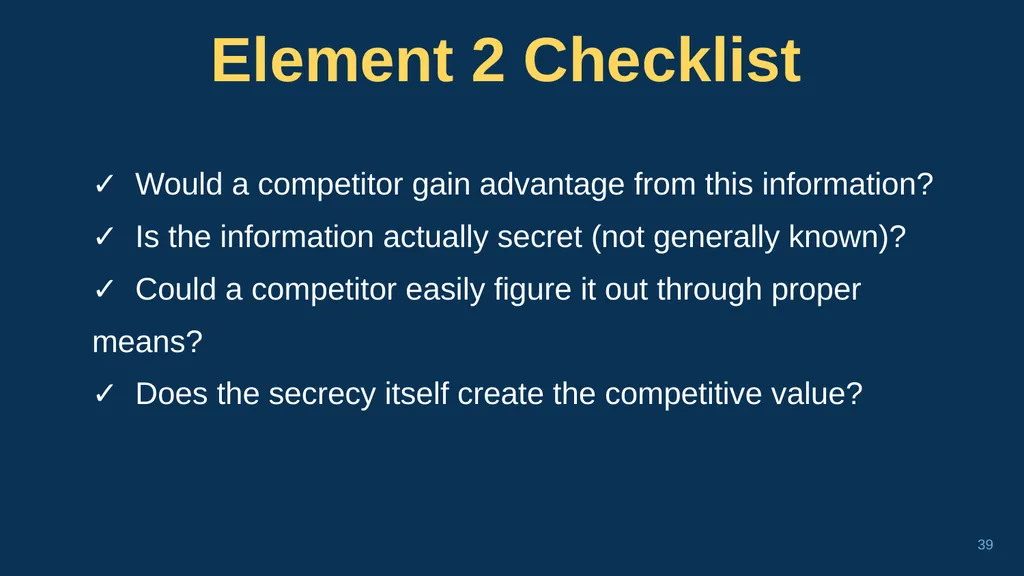
39 Element 2 Checklist ✓ Would a competitor gain advantage from this information?
✓ Is the information actually secret (not generally known)?
✓ Could a competitor easily figure it out through proper means?
✓ Does the secrecy itself create the competitive value?<br>
✓ Is the information actually secret (not generally known)?
✓ Could a competitor easily figure it out through proper means?
✓ Does the secrecy itself create the competitive value?<br>
40
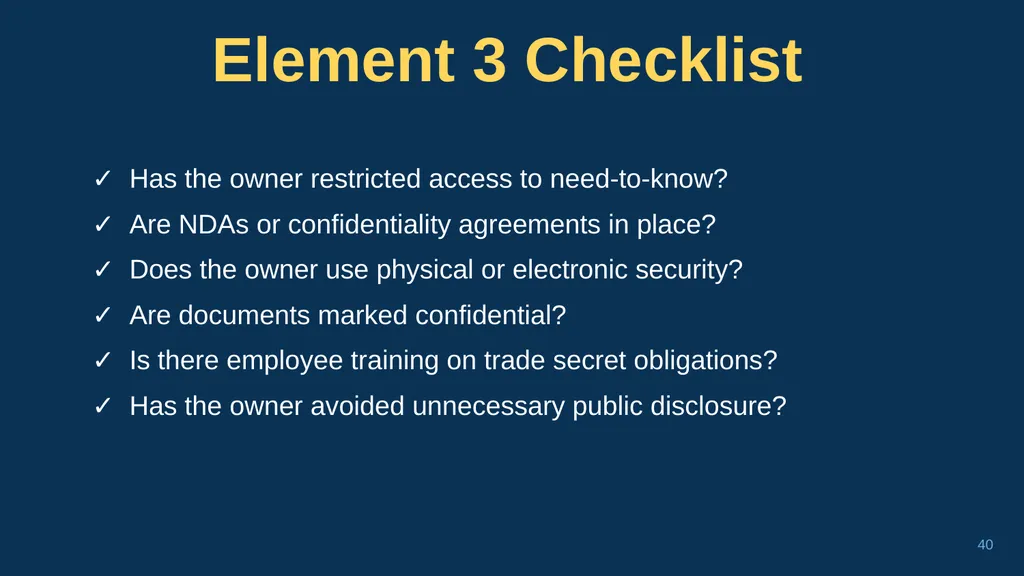
40 Element 3 Checklist ✓ Has the owner restricted access to need-to-know?
✓ Are NDAs or confidentiality agreements in place?
✓ Does the owner use physical or electronic security?
✓ Are documents marked confidential?
✓ Is there employee training on trade secret obligations?
✓ Has the owner avoided unnecessary public disclosure?<br>
✓ Are NDAs or confidentiality agreements in place?
✓ Does the owner use physical or electronic security?
✓ Are documents marked confidential?
✓ Is there employee training on trade secret obligations?
✓ Has the owner avoided unnecessary public disclosure?<br>
41
41 TRADE SECRETS vs.
OTHER IP Patents, Copyrights, Trademarks<br>
OTHER IP Patents, Copyrights, Trademarks<br>
42
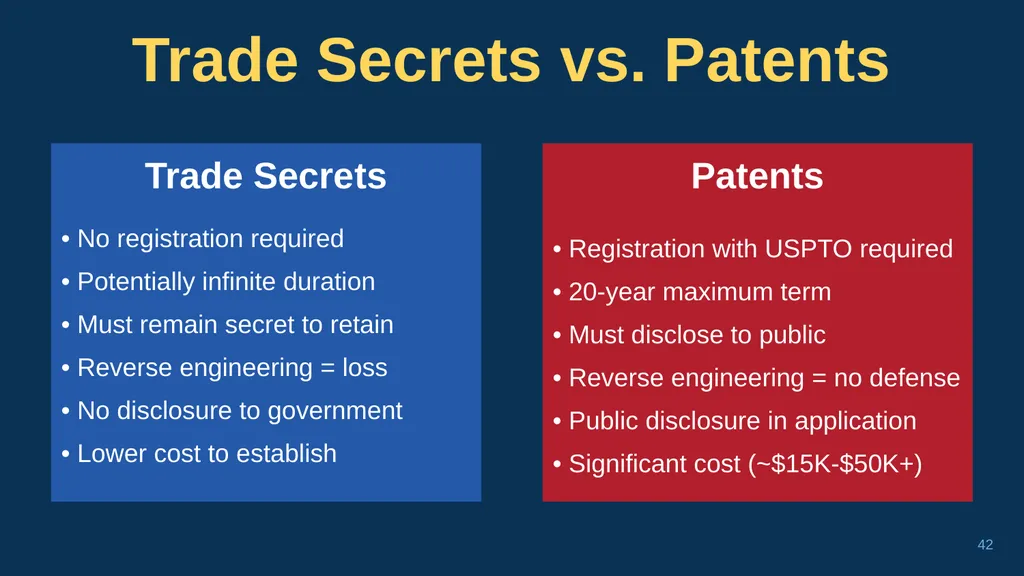
42 Trade Secrets vs. Patents Trade Secrets Patents • No registration required
• Potentially infinite duration
• Must remain secret to retain
• Reverse engineering = loss
• No disclosure to government
• Lower cost to establish • Registration with USPTO required
• 20-year maximum term
• Must disclose to public
• Reverse engineering = no defense
• Public disclosure in application
• Significant cost (~$15K-$50K+)<br>
• Potentially infinite duration
• Must remain secret to retain
• Reverse engineering = loss
• No disclosure to government
• Lower cost to establish • Registration with USPTO required
• 20-year maximum term
• Must disclose to public
• Reverse engineering = no defense
• Public disclosure in application
• Significant cost (~$15K-$50K+)<br>
43
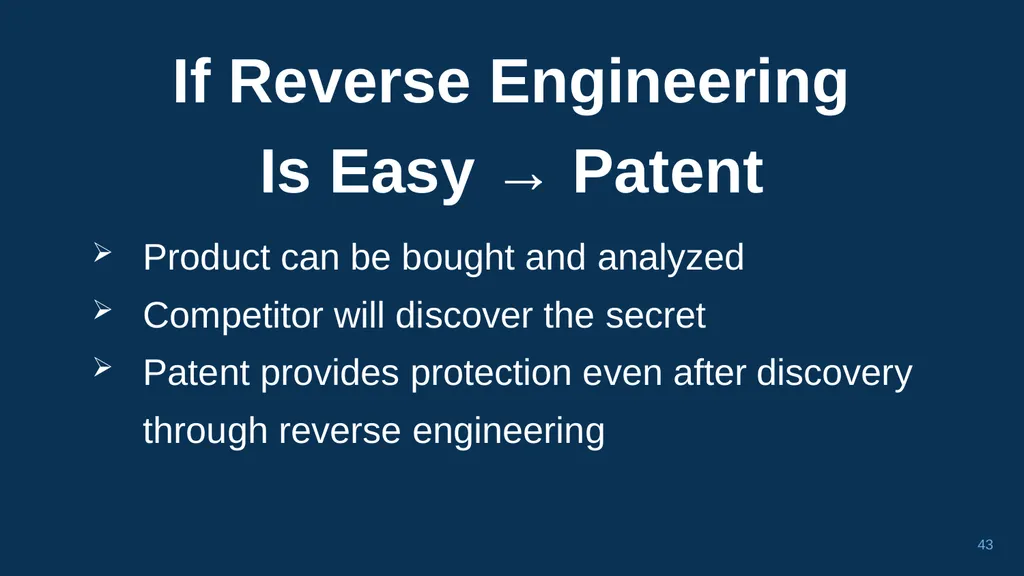
43 If Reverse Engineering
Is Easy → Patent Product can be bought and analyzed
Competitor will discover the secret
Patent provides protection even after discovery through reverse engineering<br>
Is Easy → Patent Product can be bought and analyzed
Competitor will discover the secret
Patent provides protection even after discovery through reverse engineering<br>
44
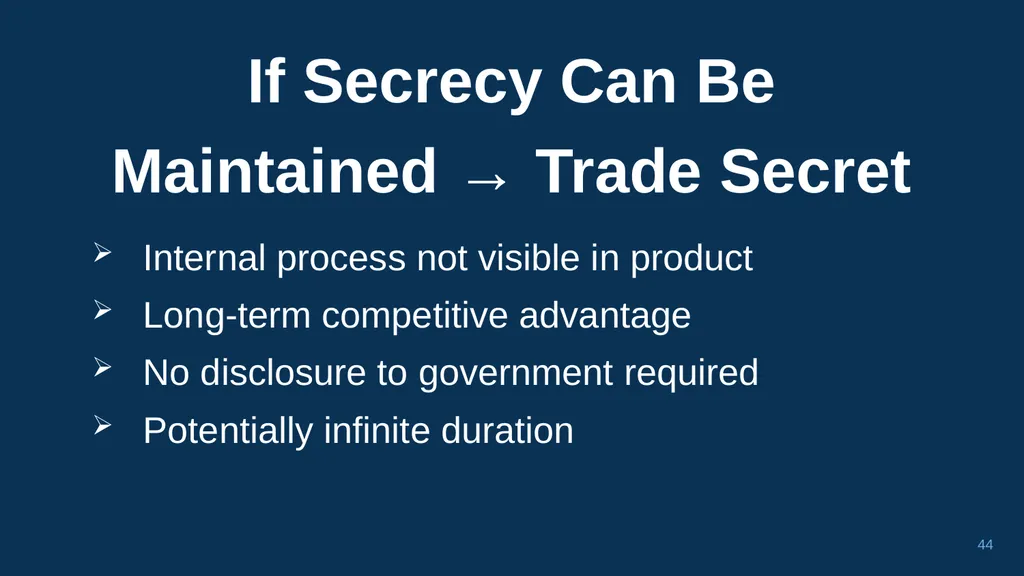
44 If Secrecy Can Be
Maintained → Trade Secret Internal process not visible in product
Long-term competitive advantage
No disclosure to government required
Potentially infinite duration<br>
Maintained → Trade Secret Internal process not visible in product
Long-term competitive advantage
No disclosure to government required
Potentially infinite duration<br>
45
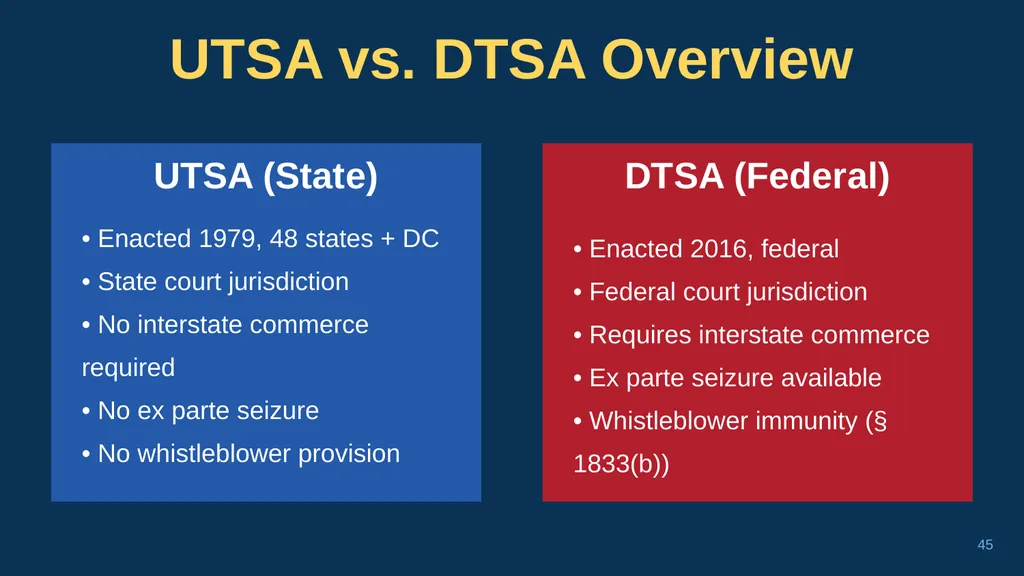
45 UTSA vs. DTSA Overview UTSA (State) DTSA (Federal) • Enacted 1979, 48 states + DC
• State court jurisdiction
• No interstate commerce required
• No ex parte seizure
• No whistleblower provision • Enacted 2016, federal
• Federal court jurisdiction
• Requires interstate commerce
• Ex parte seizure available
• Whistleblower immunity (§ 1833(b))<br>
• State court jurisdiction
• No interstate commerce required
• No ex parte seizure
• No whistleblower provision • Enacted 2016, federal
• Federal court jurisdiction
• Requires interstate commerce
• Ex parte seizure available
• Whistleblower immunity (§ 1833(b))<br>
46
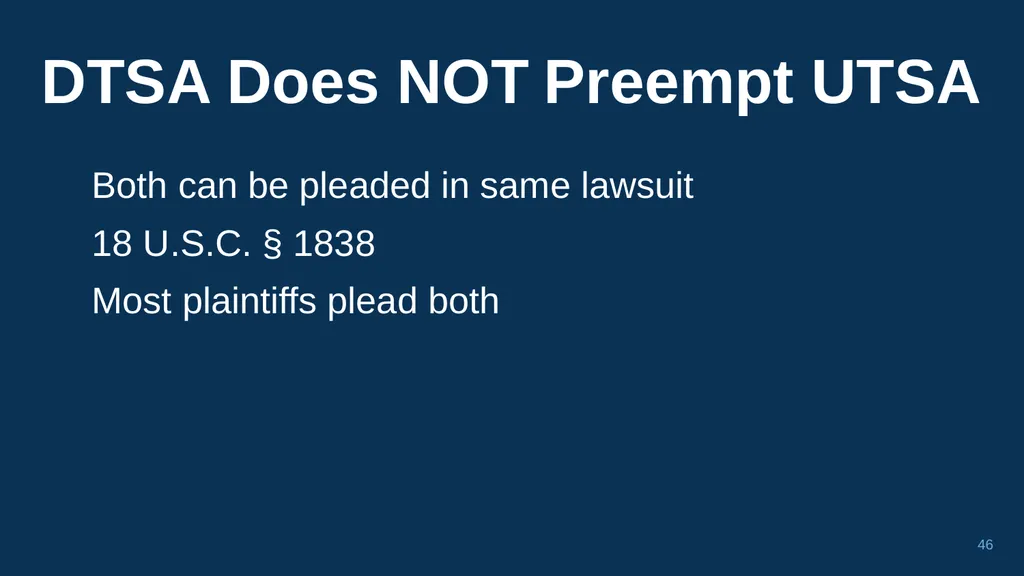
46 DTSA Does NOT Preempt UTSA Both can be pleaded in same lawsuit
18 U.S.C. § 1838
Most plaintiffs plead both<br>
18 U.S.C. § 1838
Most plaintiffs plead both<br>
47
DEEP DIVE Kewanee Oil Co. v.
Bicron Corp. (1974) 416 U.S. 470 — Supreme Court of the United States 47<br>
Bicron Corp. (1974) 416 U.S. 470 — Supreme Court of the United States 47<br>
48
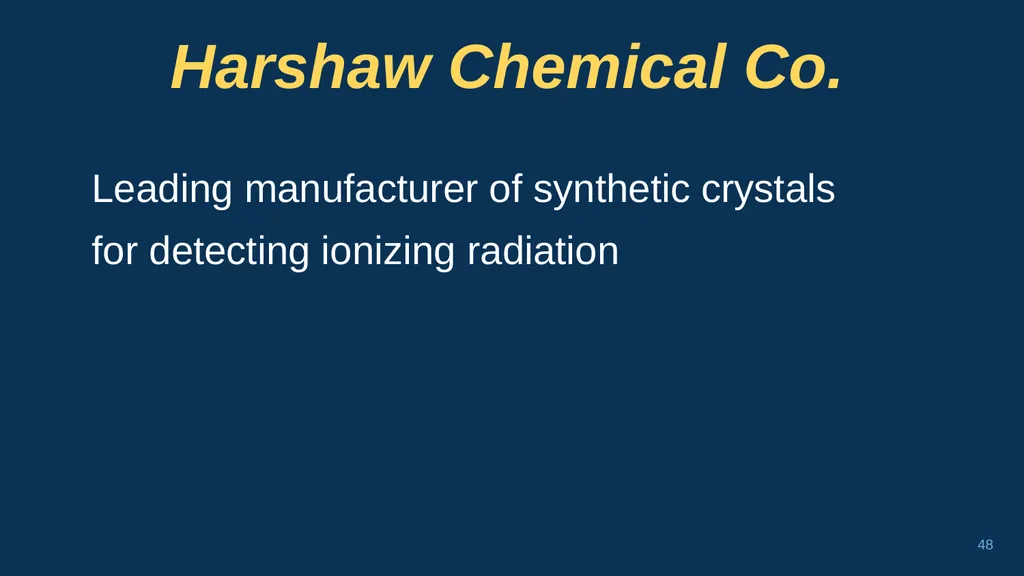
48 Harshaw Chemical Co. Leading manufacturer of synthetic crystals
for detecting ionizing radiation<br>
for detecting ionizing radiation<br>
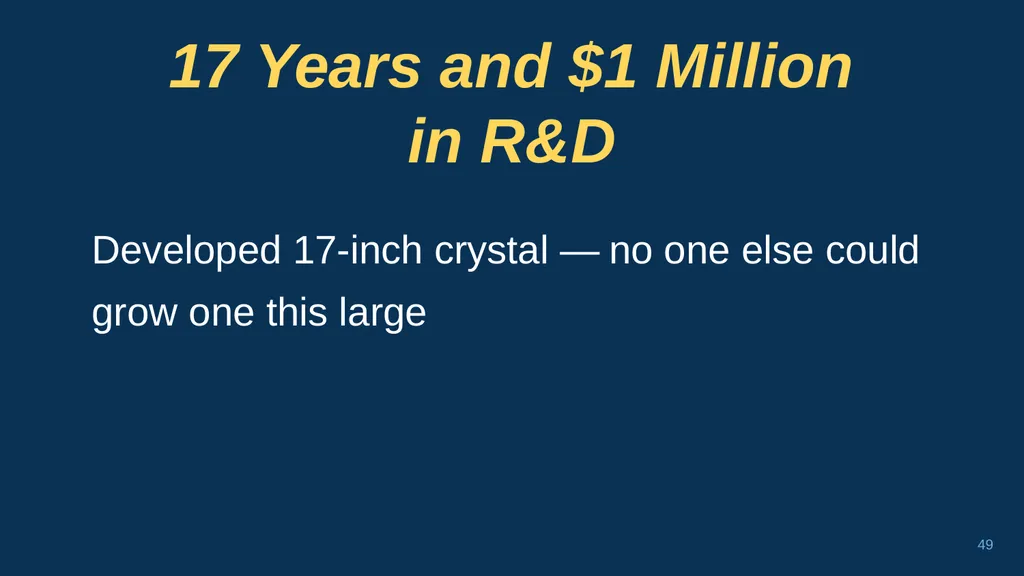
49
49 17 Years and $1 Million
in R&D Developed 17-inch crystal — no one else could grow one this large<br>
in R&D Developed 17-inch crystal — no one else could grow one this large<br>
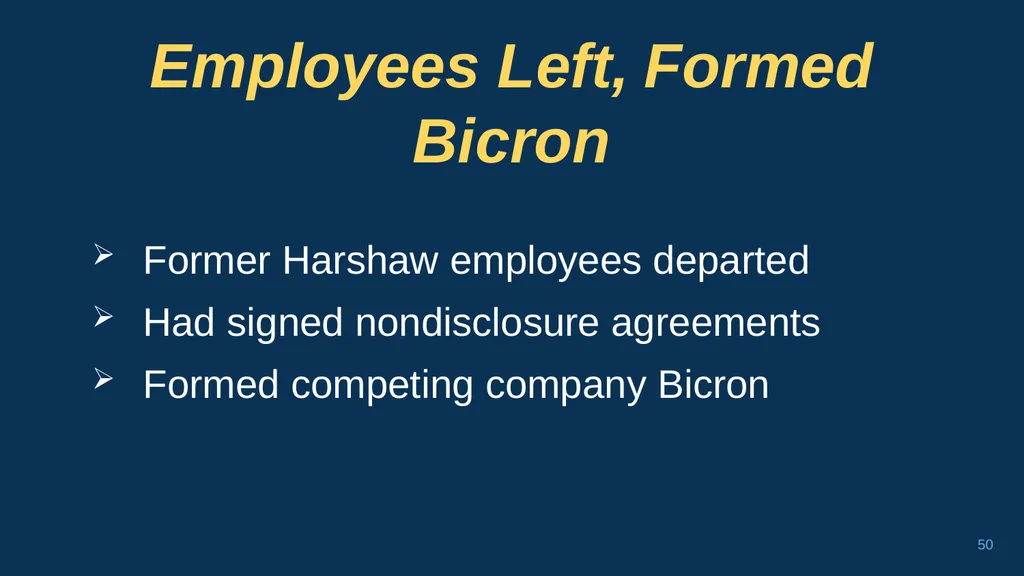
50
50 Employees Left, Formed Bicron Former Harshaw employees departed
Had signed nondisclosure agreements
Formed competing company Bicron<br>
Had signed nondisclosure agreements
Formed competing company Bicron<br>
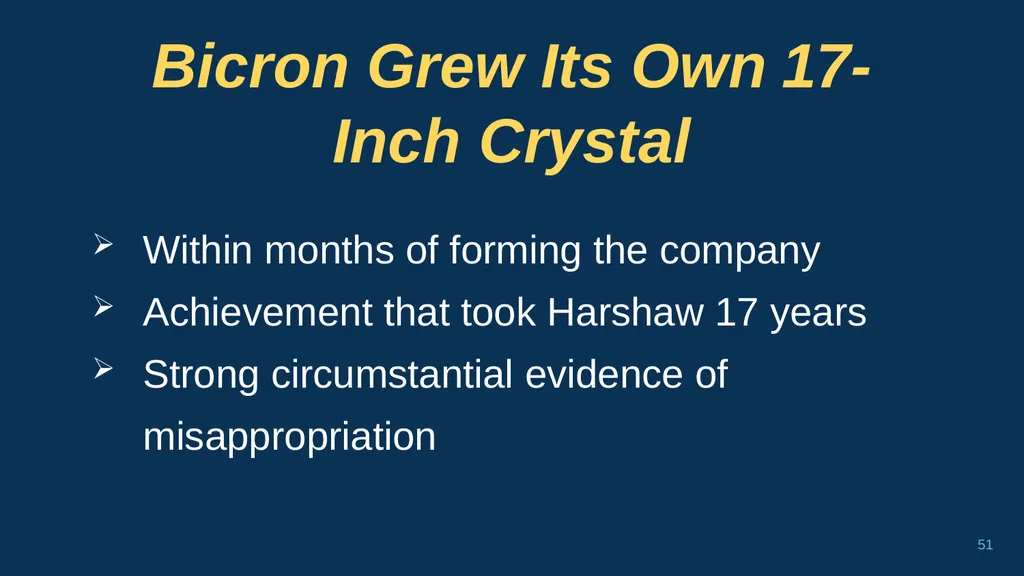
51
51 Bicron Grew Its Own 17-Inch Crystal Within months of forming the company
Achievement that took Harshaw 17 years
Strong circumstantial evidence of misappropriation<br>
Achievement that took Harshaw 17 years
Strong circumstantial evidence of misappropriation<br>
52
Issue Does federal patent law preempt state trade secret law? DEEP DIVE 52<br>
53
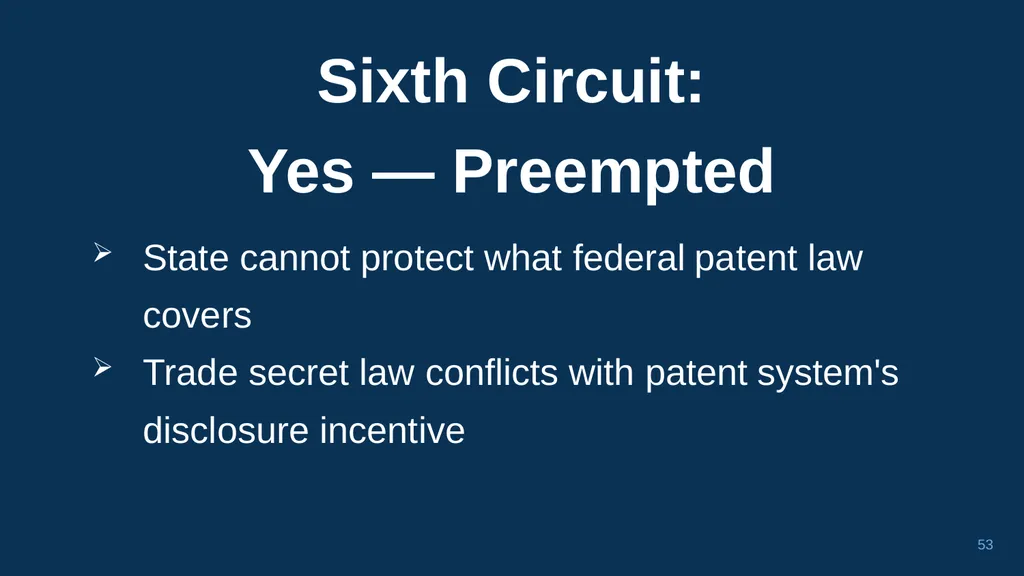
53 Sixth Circuit:
Yes — Preempted State cannot protect what federal patent law covers
Trade secret law conflicts with patent system's disclosure incentive<br>
Yes — Preempted State cannot protect what federal patent law covers
Trade secret law conflicts with patent system's disclosure incentive<br>
54
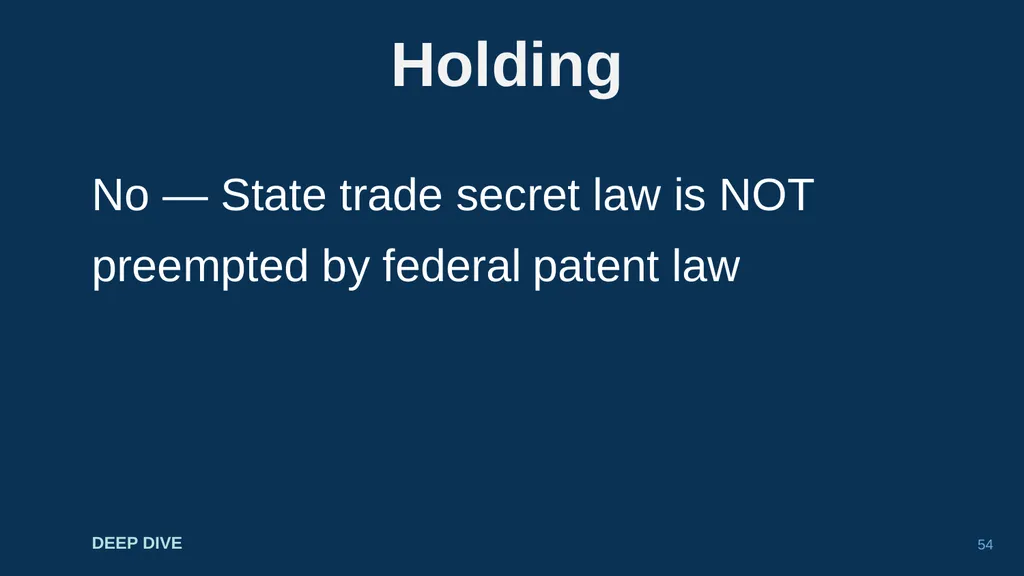
54 Holding No — State trade secret law is NOT preempted by federal patent law DEEP DIVE<br>
55
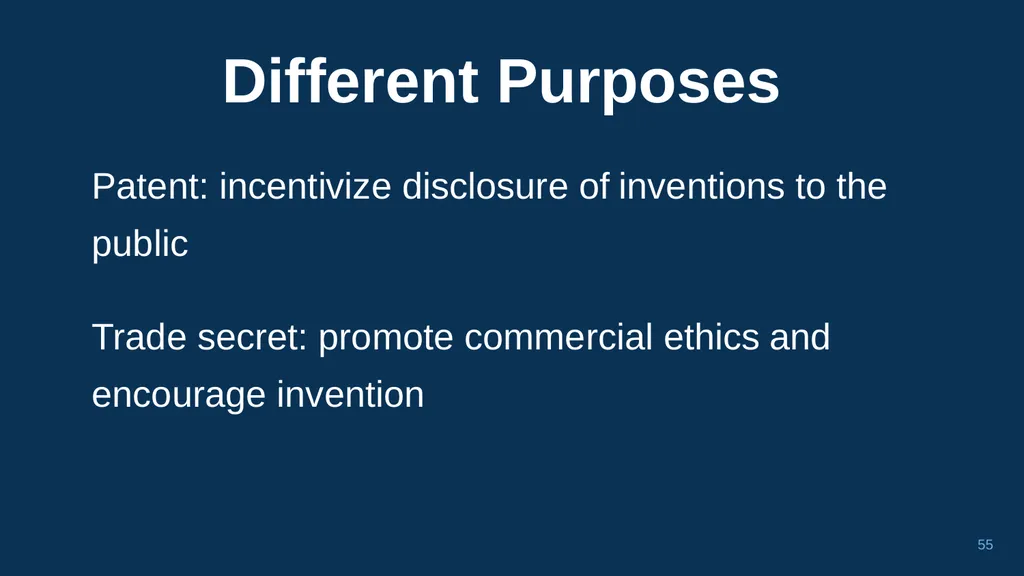
55 Different Purposes Patent: incentivize disclosure of inventions to the public
Trade secret: promote commercial ethics and encourage invention<br>
Trade secret: promote commercial ethics and encourage invention<br>
56
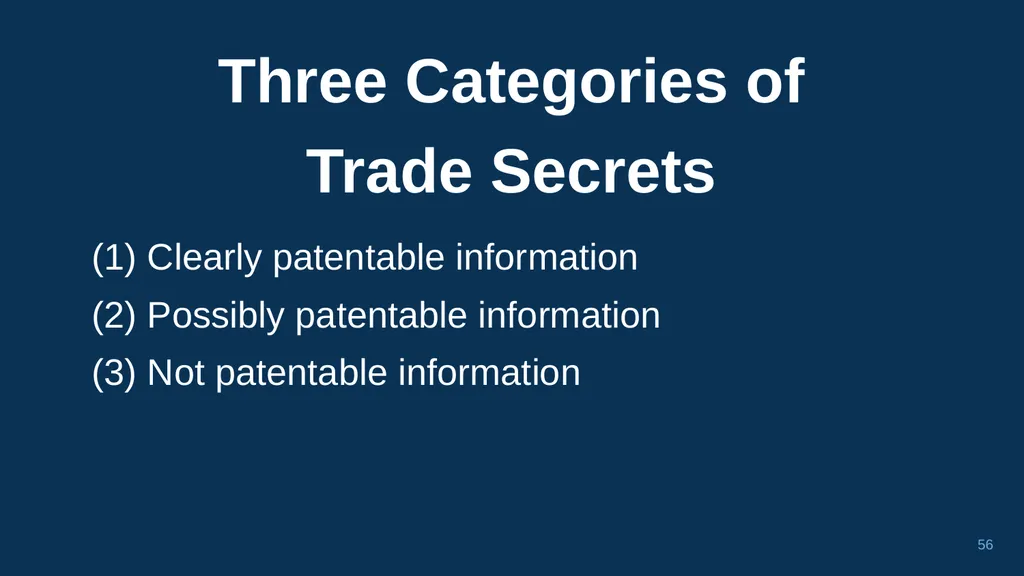
56 Three Categories of
Trade Secrets (1) Clearly patentable information
(2) Possibly patentable information
(3) Not patentable information<br>
Trade Secrets (1) Clearly patentable information
(2) Possibly patentable information
(3) Not patentable information<br>
57
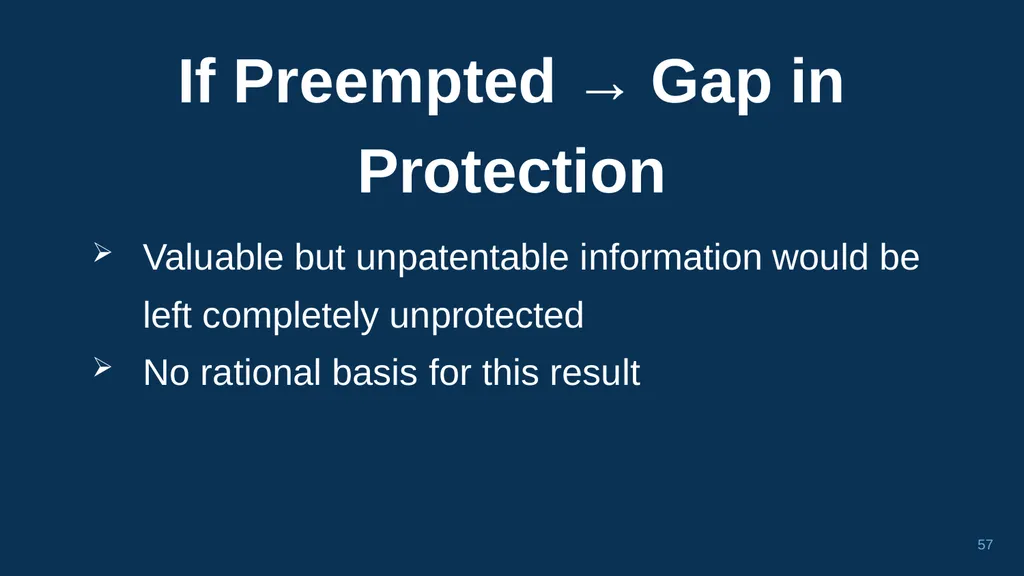
57 If Preempted → Gap in Protection Valuable but unpatentable information would be left completely unprotected
No rational basis for this result<br>
No rational basis for this result<br>
58
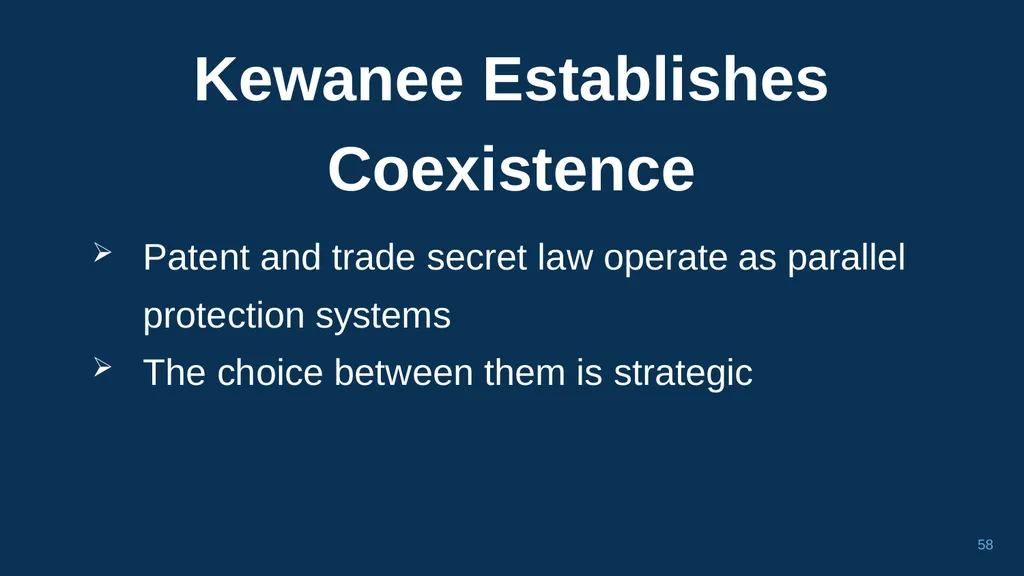
58 Kewanee Establishes
Coexistence Patent and trade secret law operate as parallel protection systems
The choice between them is strategic<br>
Coexistence Patent and trade secret law operate as parallel protection systems
The choice between them is strategic<br>
59
59 REASONABLE EFFORTS
IN PRACTICE Case Illustrations and Historical Roots<br>
IN PRACTICE Case Illustrations and Historical Roots<br>
60
Peabody v. Norfolk (1868) 98 Mass. 452
Supreme Court of Massachusetts 60<br>
Supreme Court of Massachusetts 60<br>
61
Vickery v. Welch (1837) 36 Mass. 523
Supreme Court of Massachusetts 61<br>
Supreme Court of Massachusetts 61<br>
62
62 Historical Foundation Trade secret law predates the UTSA by more than 150 years
Peabody (1868) + Vickery (1837) establish core principles still in use<br>
Peabody (1868) + Vickery (1837) establish core principles still in use<br>
63
63 HYPOTHETICAL:
SOLARSPARK Applying Element 3 to a Startup<br>
SOLARSPARK Applying Element 3 to a Startup<br>
64
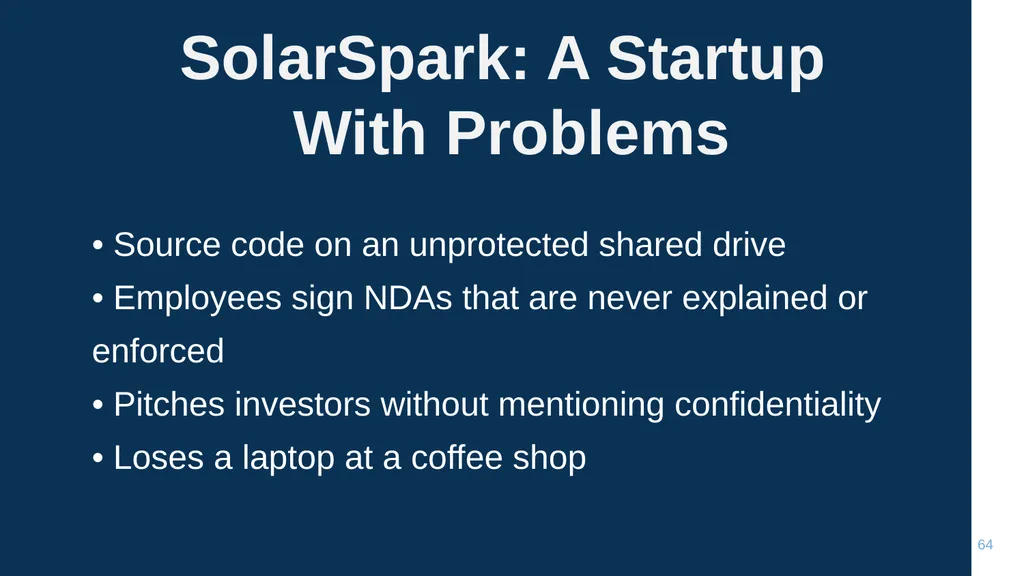
SolarSpark: A Startup
With Problems • Source code on an unprotected shared drive
• Employees sign NDAs that are never explained or enforced
• Pitches investors without mentioning confidentiality
• Loses a laptop at a coffee shop 64<br>
With Problems • Source code on an unprotected shared drive
• Employees sign NDAs that are never explained or enforced
• Pitches investors without mentioning confidentiality
• Loses a laptop at a coffee shop 64<br>
65
65 Identify the Failures What went wrong?
What would you fix?
10 minutes — group exercise<br>
What would you fix?
10 minutes — group exercise<br>
66
Quick Check Could SolarSpark's source code
still qualify as a trade secret? 66<br>
still qualify as a trade secret? 66<br>
67
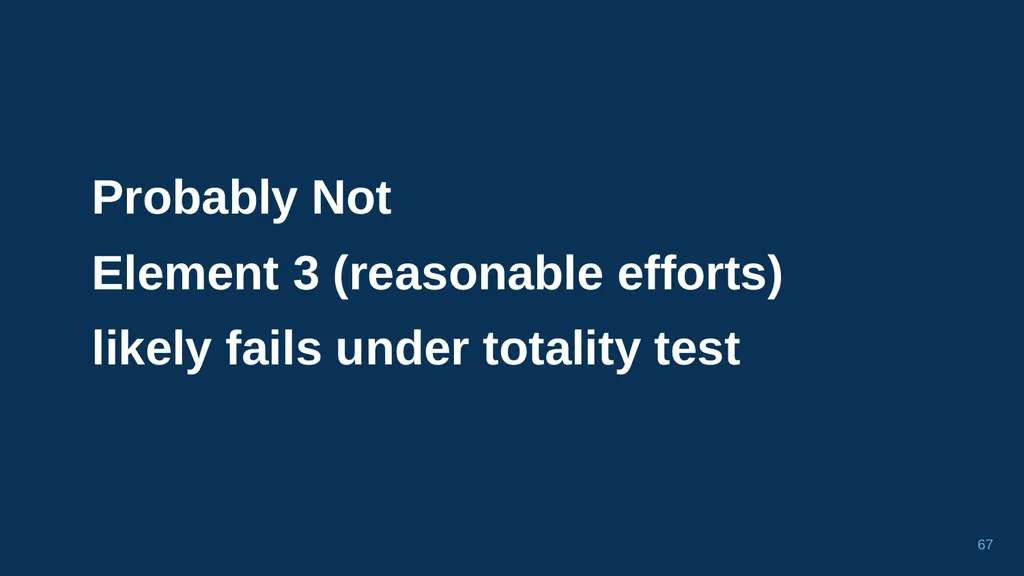
67 Probably Not
Element 3 (reasonable efforts)
likely fails under totality test<br>
Element 3 (reasonable efforts)
likely fails under totality test<br>
68
68 Next: Session 2 How trade secrets are lost
Reverse engineering, independent discovery
Combination secrets
Preview of the TSPP project<br>
Reverse engineering, independent discovery
Combination secrets
Preview of the TSPP project<br>
69
69 SESSION 2 Loss of Secrecy and Combination Secrets<br>
70
Quick Check Name the three elements
of a trade secret 70<br>
of a trade secret 70<br>
71
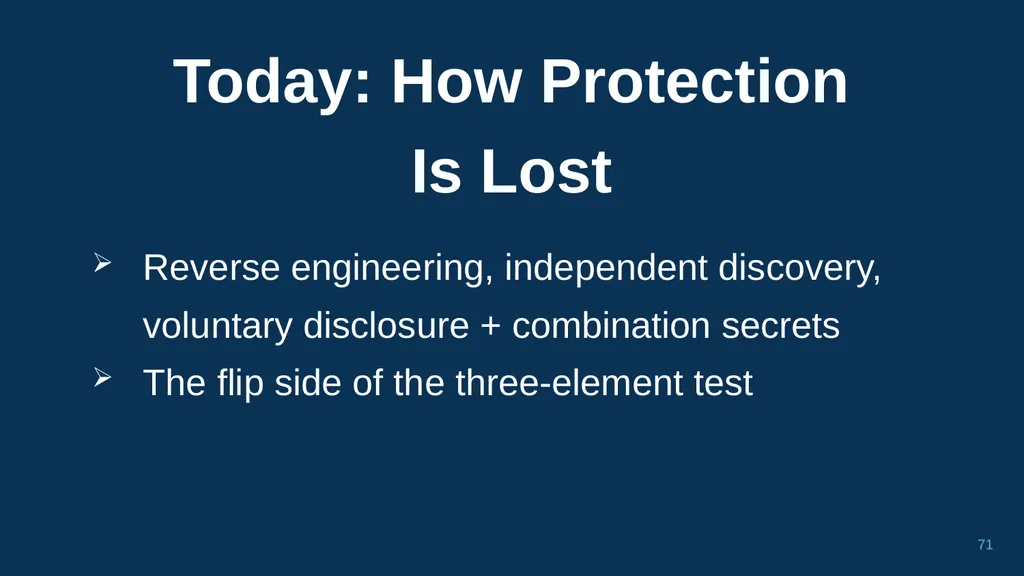
71 Today: How Protection
Is Lost Reverse engineering, independent discovery, voluntary disclosure + combination secrets
The flip side of the three-element test<br>
Is Lost Reverse engineering, independent discovery, voluntary disclosure + combination secrets
The flip side of the three-element test<br>
72
72 HOW TRADE SECRETS
ARE LOST Lawful and Unlawful Paths<br>
ARE LOST Lawful and Unlawful Paths<br>
73
73 Lawful Means of Discovery Not all loss of secrecy = misappropriation
Some paths are perfectly legal and provide no legal recourse<br>
Some paths are perfectly legal and provide no legal recourse<br>
74
74 Path 1: Reverse Engineering Buy the product, take it apart
"Proper means" under UTSA and DTSA
Lawful discovery — no misappropriation<br>
"Proper means" under UTSA and DTSA
Lawful discovery — no misappropriation<br>
75
75 Easy to Reverse-Engineer?
Consider Patent If competitors can discover the secret through product analysis, trade secret protection is fragile
Patent may be the better choice<br>
Consider Patent If competitors can discover the secret through product analysis, trade secret protection is fragile
Patent may be the better choice<br>
76
76 Path 2: Independent Discovery Competitor develops same information through its own research
No copying, no theft, no liability
Parallel innovation is lawful<br>
No copying, no theft, no liability
Parallel innovation is lawful<br>
77
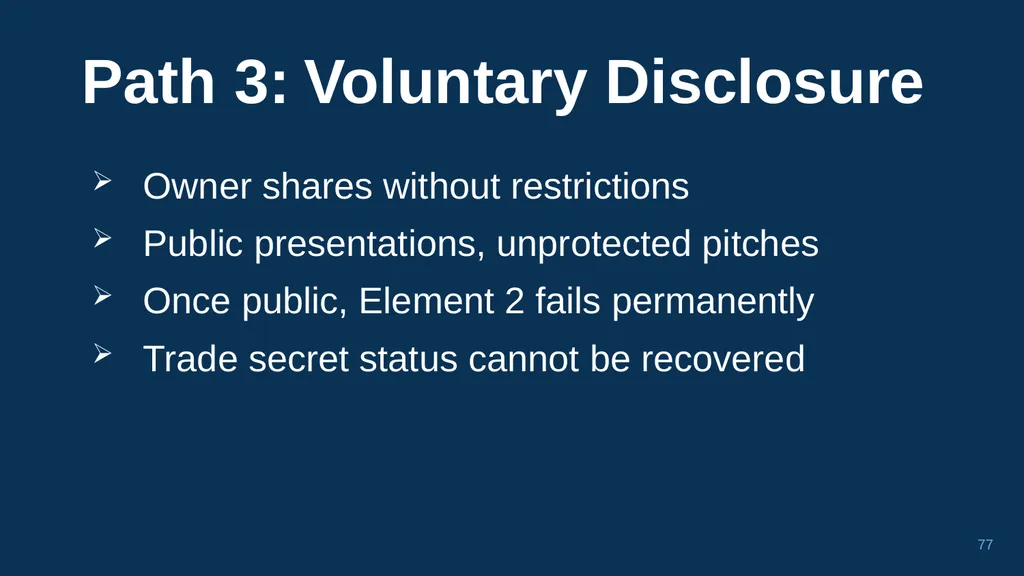
77 Path 3: Voluntary Disclosure Owner shares without restrictions
Public presentations, unprotected pitches
Once public, Element 2 fails permanently
Trade secret status cannot be recovered<br>
Public presentations, unprotected pitches
Once public, Element 2 fails permanently
Trade secret status cannot be recovered<br>
78
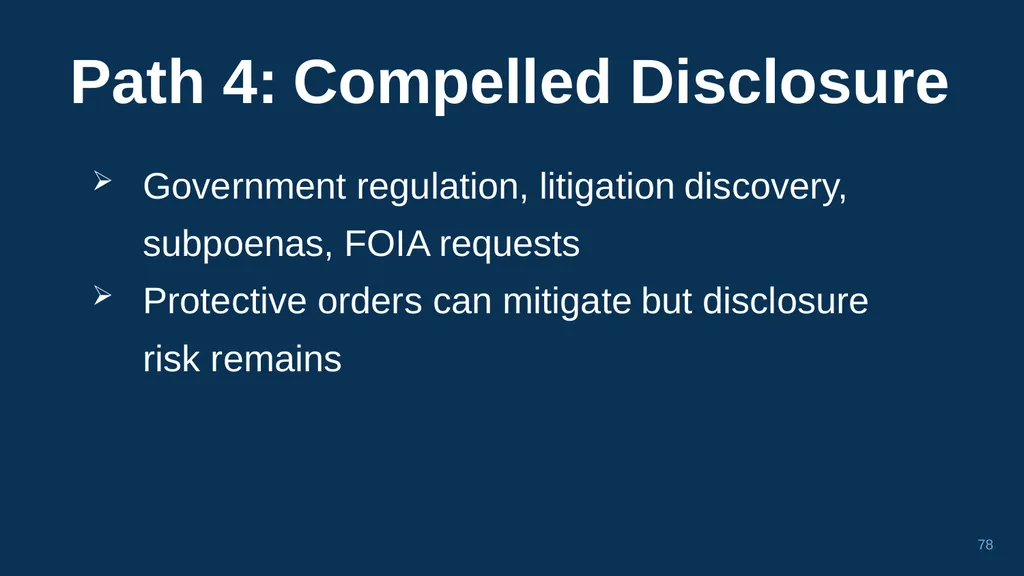
78 Path 4: Compelled Disclosure Government regulation, litigation discovery, subpoenas, FOIA requests
Protective orders can mitigate but disclosure risk remains<br>
Protective orders can mitigate but disclosure risk remains<br>
79
Quick Check Name three lawful paths to
losing trade secret protection 79<br>
losing trade secret protection 79<br>
80
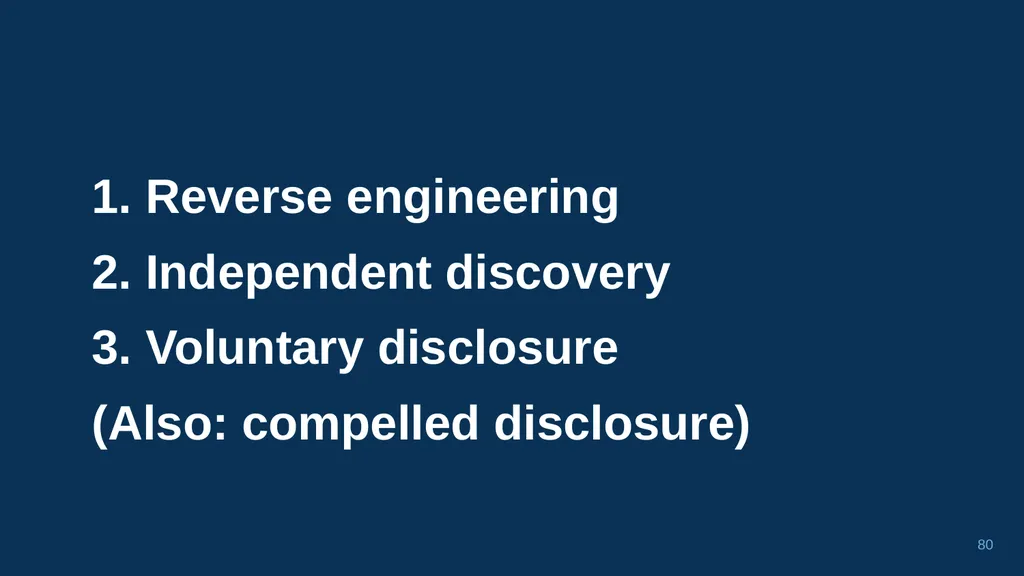
80 1. Reverse engineering
2. Independent discovery
3. Voluntary disclosure
(Also: compelled disclosure)<br>
2. Independent discovery
3. Voluntary disclosure
(Also: compelled disclosure)<br>
81
81 COMBINATION SECRETS When Public Elements Create Private Value<br>
82
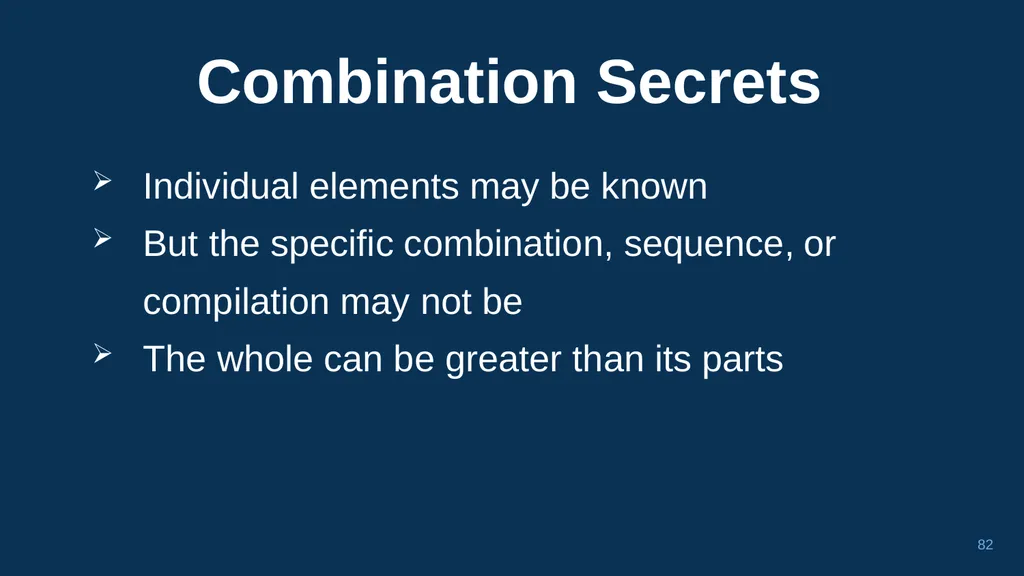
82 Combination Secrets Individual elements may be known
But the specific combination, sequence, or compilation may not be
The whole can be greater than its parts<br>
But the specific combination, sequence, or compilation may not be
The whole can be greater than its parts<br>
83
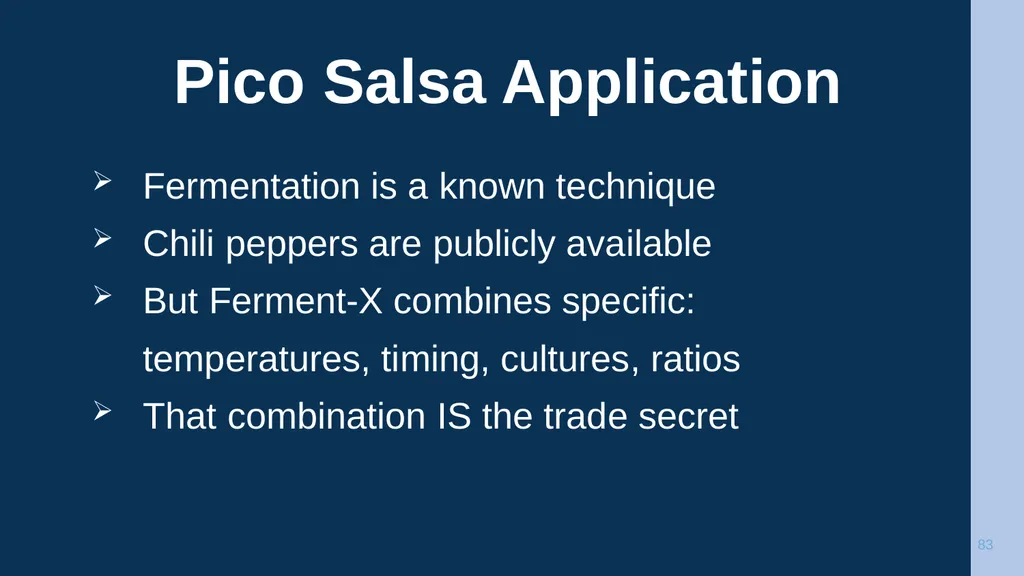
Pico Salsa Application Fermentation is a known technique
Chili peppers are publicly available
But Ferment-X combines specific: temperatures, timing, cultures, ratios
That combination IS the trade secret 83<br>
Chili peppers are publicly available
But Ferment-X combines specific: temperatures, timing, cultures, ratios
That combination IS the trade secret 83<br>
84
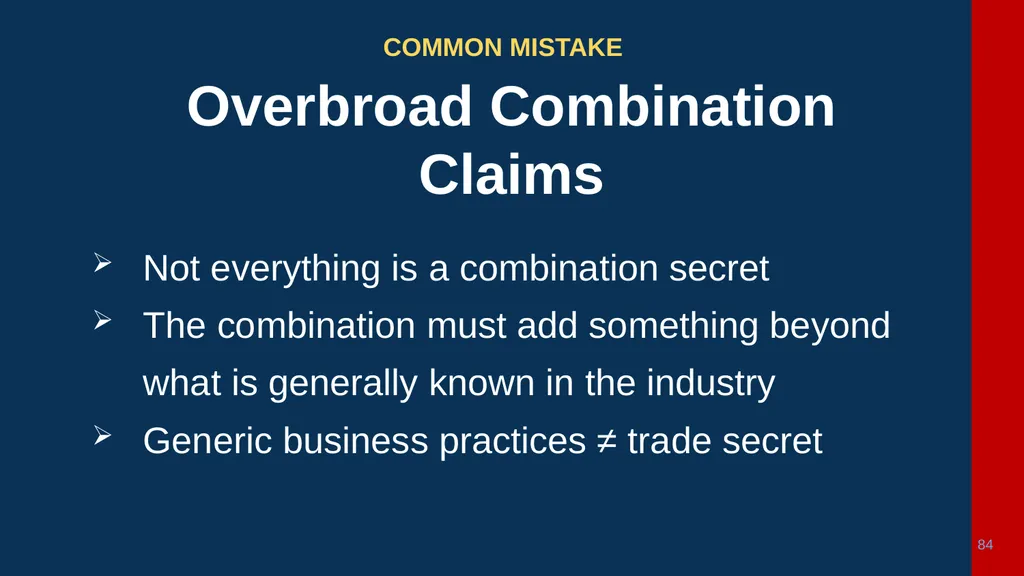
COMMON MISTAKE Overbroad Combination Claims Not everything is a combination secret
The combination must add something beyond what is generally known in the industry
Generic business practices ≠ trade secret 84<br>
The combination must add something beyond what is generally known in the industry
Generic business practices ≠ trade secret 84<br>
85
85 HYPOTHETICAL:
MEGASPICE Multiple Vulnerabilities in One Company<br>
MEGASPICE Multiple Vulnerabilities in One Company<br>
86
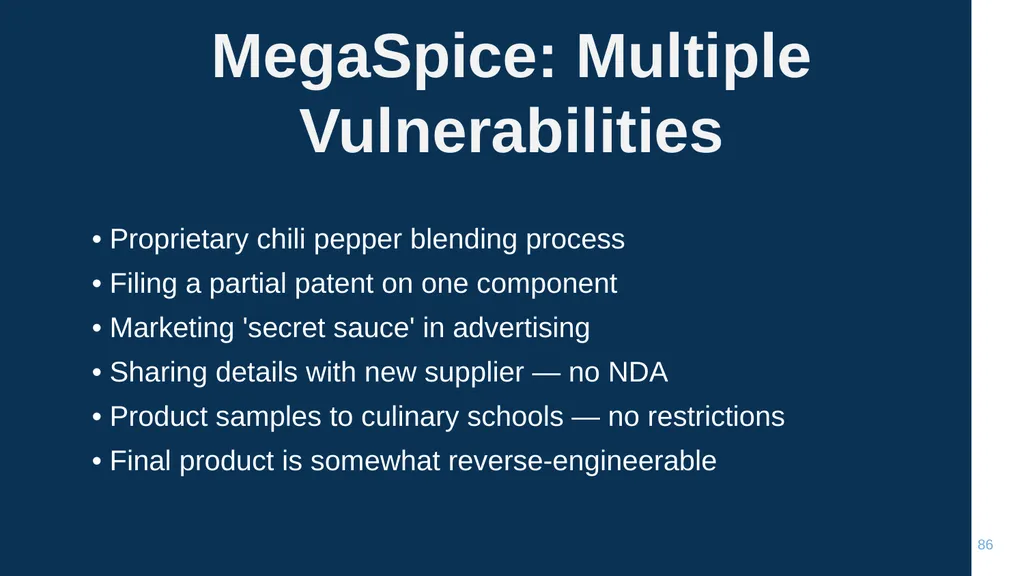
MegaSpice: Multiple Vulnerabilities • Proprietary chili pepper blending process
• Filing a partial patent on one component
• Marketing 'secret sauce' in advertising
• Sharing details with new supplier — no NDA
• Product samples to culinary schools — no restrictions
• Final product is somewhat reverse-engineerable 86<br>
• Filing a partial patent on one component
• Marketing 'secret sauce' in advertising
• Sharing details with new supplier — no NDA
• Product samples to culinary schools — no restrictions
• Final product is somewhat reverse-engineerable 86<br>
87
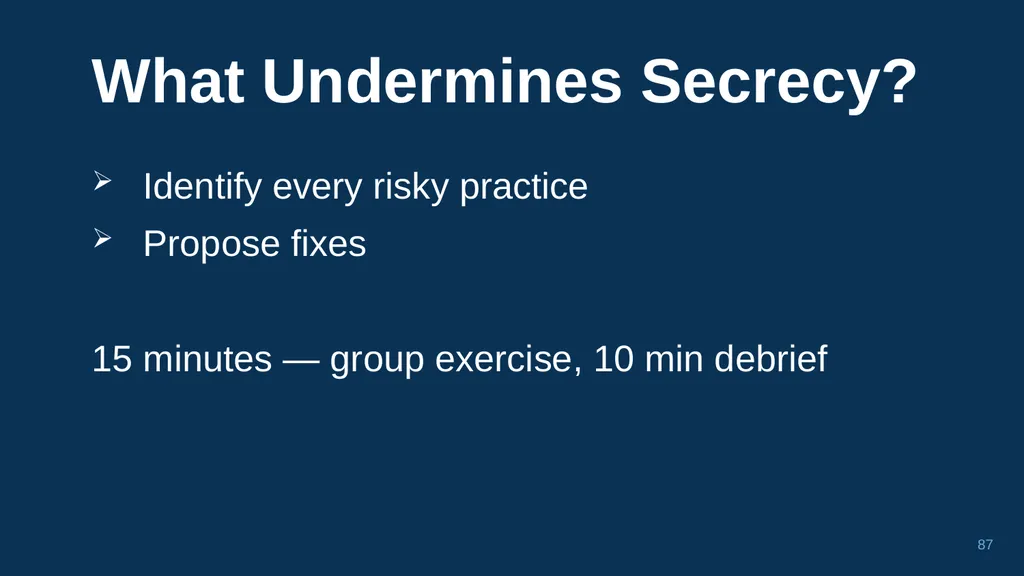
87 What Undermines Secrecy? Identify every risky practice
Propose fixes
15 minutes — group exercise, 10 min debrief<br>
Propose fixes
15 minutes — group exercise, 10 min debrief<br>
88
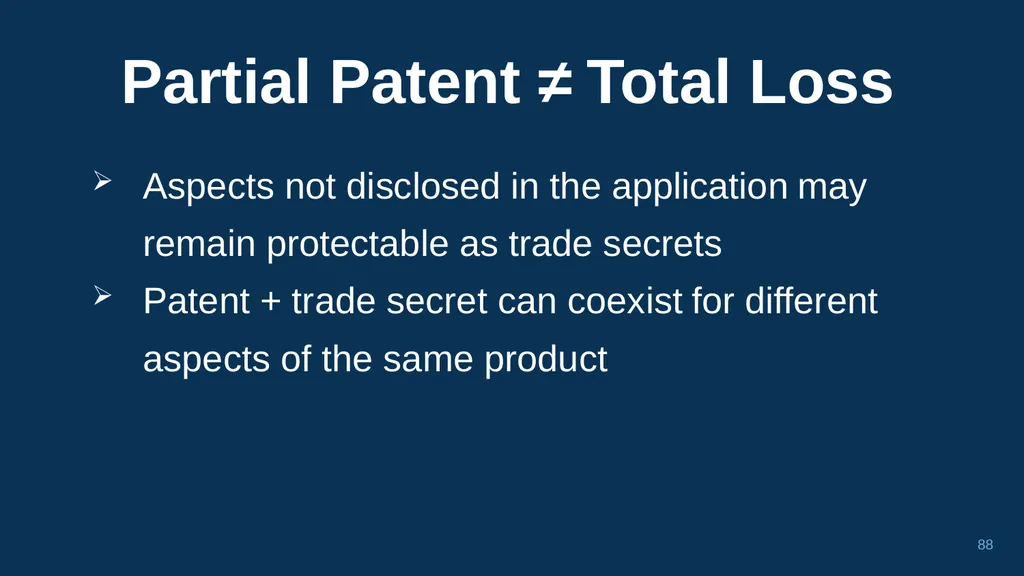
88 Partial Patent ≠ Total Loss Aspects not disclosed in the application may remain protectable as trade secrets
Patent + trade secret can coexist for different aspects of the same product<br>
Patent + trade secret can coexist for different aspects of the same product<br>
89
Quick Check Does 'secret sauce' marketing
help or hurt a trade secret claim? 89<br>
help or hurt a trade secret claim? 89<br>
90
90 LOOKING AHEAD From Chapter 1 to Chapter 2<br>
91
91 If You Can't Name It,
You Can't Protect It Next: Building a Trade Secret Inventory
Chapter 2 moves from abstract rights to concrete identification<br>
You Can't Protect It Next: Building a Trade Secret Inventory
Chapter 2 moves from abstract rights to concrete identification<br>
92
92 Before Next Class Read: Pico Salsa Fact File, Parts I and II
Company background + technical and business assets
Begin thinking: what qualifies?<br>
Company background + technical and business assets
Begin thinking: what qualifies?<br>
93
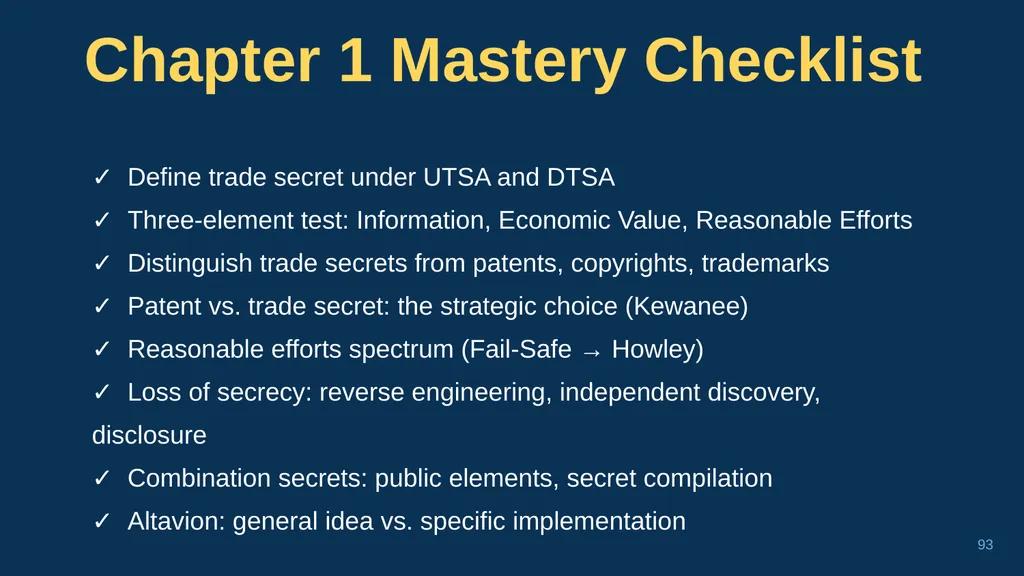
93 Chapter 1 Mastery Checklist ✓ Define trade secret under UTSA and DTSA
✓ Three-element test: Information, Economic Value, Reasonable Efforts
✓ Distinguish trade secrets from patents, copyrights, trademarks
✓ Patent vs. trade secret: the strategic choice (Kewanee)
✓ Reasonable efforts spectrum (Fail-Safe → Howley)
✓ Loss of secrecy: reverse engineering, independent discovery, disclosure
✓ Combination secrets: public elements, secret compilation
✓ Altavion: general idea vs. specific implementation<br>
✓ Three-element test: Information, Economic Value, Reasonable Efforts
✓ Distinguish trade secrets from patents, copyrights, trademarks
✓ Patent vs. trade secret: the strategic choice (Kewanee)
✓ Reasonable efforts spectrum (Fail-Safe → Howley)
✓ Loss of secrecy: reverse engineering, independent discovery, disclosure
✓ Combination secrets: public elements, secret compilation
✓ Altavion: general idea vs. specific implementation<br>
94
94 Next:
Chapter 2 Identifying and classifying Trade Secrets<br>
Chapter 2 Identifying and classifying Trade Secrets<br>
95
95 TSPP STAGE 1 Orientation and Team Formation<br>
96
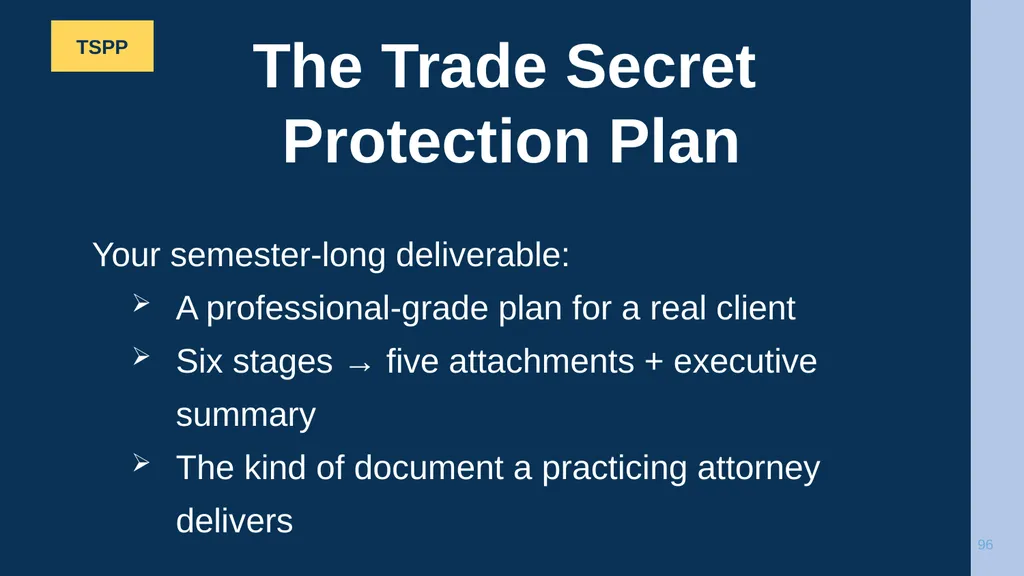
TSPP The Trade Secret
Protection Plan Your semester-long deliverable:
A professional-grade plan for a real client
Six stages → five attachments + executive summary
The kind of document a practicing attorney delivers 96<br>
Protection Plan Your semester-long deliverable:
A professional-grade plan for a real client
Six stages → five attachments + executive summary
The kind of document a practicing attorney delivers 96<br>
97
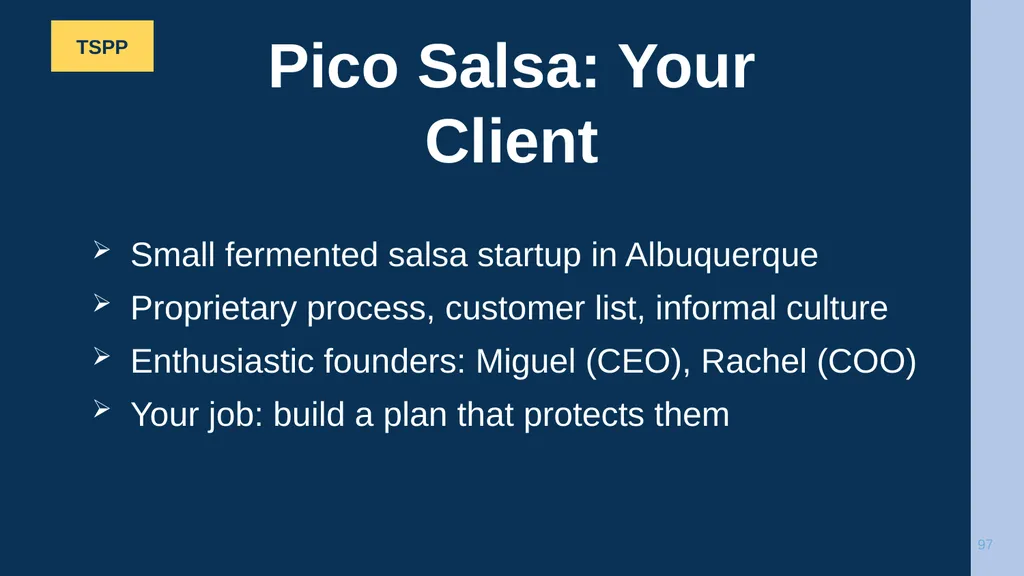
TSPP Pico Salsa: Your Client Small fermented salsa startup in Albuquerque
Proprietary process, customer list, informal culture
Enthusiastic founders: Miguel (CEO), Rachel (COO)
Your job: build a plan that protects them 97<br>
Proprietary process, customer list, informal culture
Enthusiastic founders: Miguel (CEO), Rachel (COO)
Your job: build a plan that protects them 97<br>
98
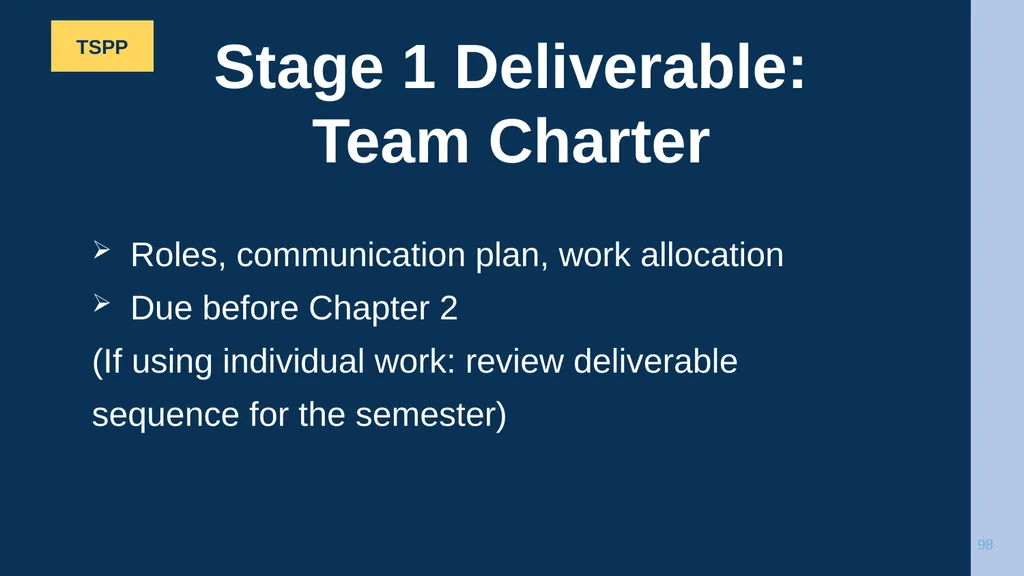
TSPP Stage 1 Deliverable:
Team Charter Roles, communication plan, work allocation
Due before Chapter 2
(If using individual work: review deliverable
sequence for the semester) 98<br>
Team Charter Roles, communication plan, work allocation
Due before Chapter 2
(If using individual work: review deliverable
sequence for the semester) 98<br>
99
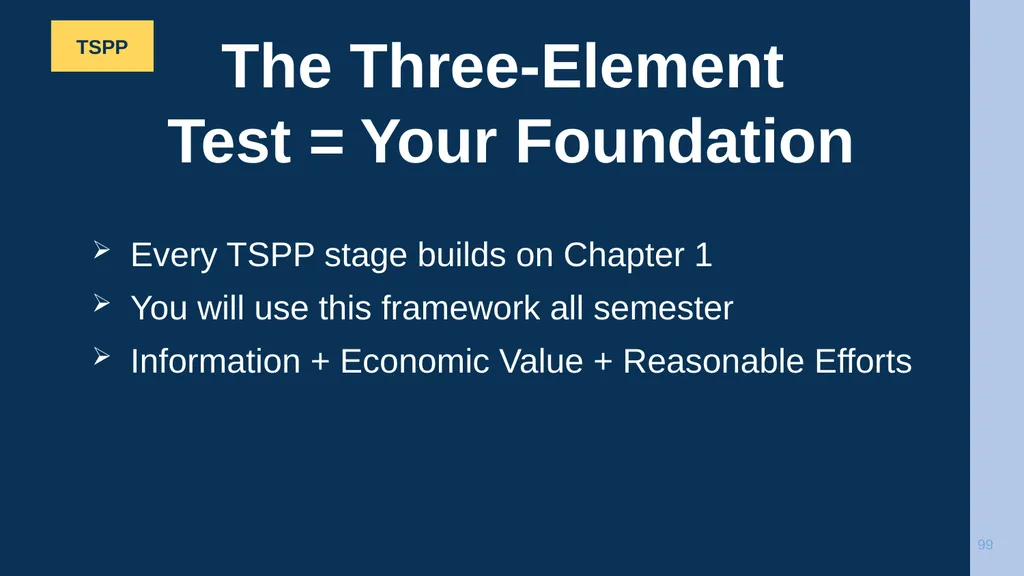
TSPP The Three-Element
Test = Your Foundation Every TSPP stage builds on Chapter 1
You will use this framework all semester
Information + Economic Value + Reasonable Efforts 99<br>
Test = Your Foundation Every TSPP stage builds on Chapter 1
You will use this framework all semester
Information + Economic Value + Reasonable Efforts 99<br>
100
To request the full slide deck, please email kerri.hughes@cap-press.com<br>