
1 Cybersecurity (Security+) and P4 Programmable




Description: 1 Cybersecurity (Security) and P4 Programmable Switches Intrusion Detection and Prevention Systems Ali AlSabeh, Jorge Crichigno University of South Carolina http:ce.sc.educyberinfra Western Academy Support and Training Center (WASTC)
Related Topics
Download Presentation
"1 Cybersecurity (Security+) and P4 Programmable" is the property of its rightful owner. Permission is granted to download and print the materials on this website for personal, non-commercial use only, and to display it on your personal computer provided you do not modify the materials and that you retain all copyright notices contained in the materials. By downloading content from our website, you accept the terms of this agreement.
Presentation Transcript
slide1. 1 Cybersecurity (Security+) and P4
Programmable Switches
Intrusion Detection and Prevention Systems
Ali AlSabeh, Jorge Crichigno
University of South Carolina
http://ce.sc.edu/cyberinfra
Western Academy Support and Training Center (WASTC)
University of South Carolina (USC)
Energy Sciences Network (ESnet)
June 21st, 2023<br>
slide2. Intrusion Detection and Prevention Systems 2<br>
slide3. Intrusion Detection/Prevention System (IDS/IPS) Intrusion Detection System (IDS) and Intrusion Prevention System (IPS) monitor network traffic to detect and prevent malicious activities
These systems are either implemented on a dedicated hardware or implemented as applications on a general-purpose server
IDS and IPS are placed at strategic points in the network to be able to monitor traffic from all devices 3<br>
slide4. Intrusion Detection/Prevention System (IDS/IPS) IDS and IPS leverage a database of attacks’ signatures to detect malicious traffic
Signature-based IDS/IPS are popular and effective, but cannot detect zero-day attacks
Machine learning can be leveraged to create a model of the normal behavior of the network
Thus, the normal model can be used as a baseline to detect any abnormalities in the network 4<br>
slide5. Intrusion Detection System (IDS) An IDS monitors the traffic of a network passively
i.e., the IDS is not deployed inline in the topology
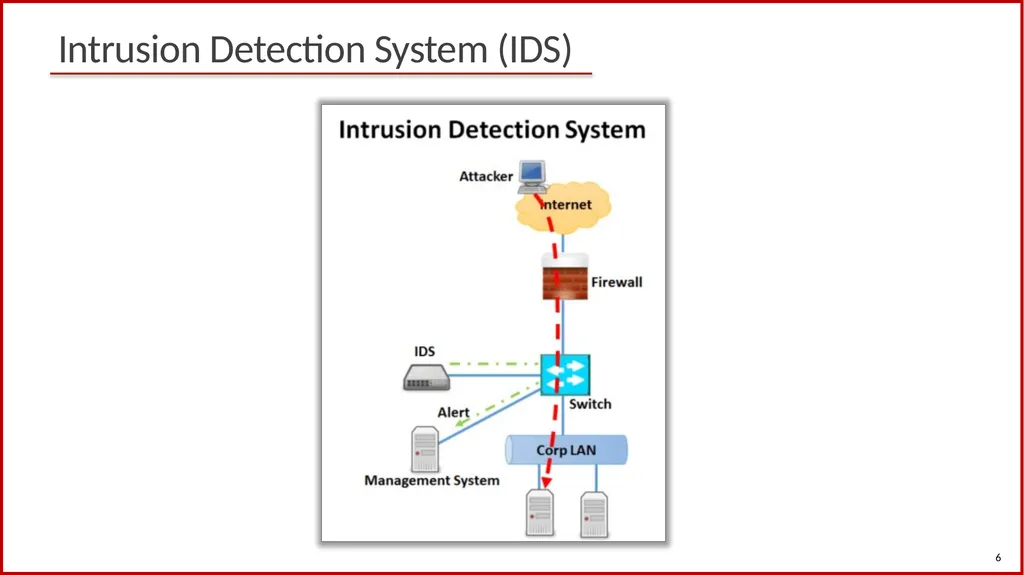
Instead, a network device (e.g., switch, router) duplicates and forwards the traffic to the IDS
The IDS then analyzes the traffic offline (promiscuous mode) and matches the traffic stream with known malicious signatures
Advantages of IDS:
It does not negatively impact the performance of the network
It does not affect the network if a problem or misconfiguration of the IDS occurs
Disadvantages of IDS:
It cannot stop malicious single-packet attacks from reaching the target
It requires assistance from other networking devices to respond to the attack 5<br>
slide6. Intrusion Detection System (IDS) 6<br>
slide7. Intrusion Prevention System (IPS) An IPS device monitors the network traffic actively
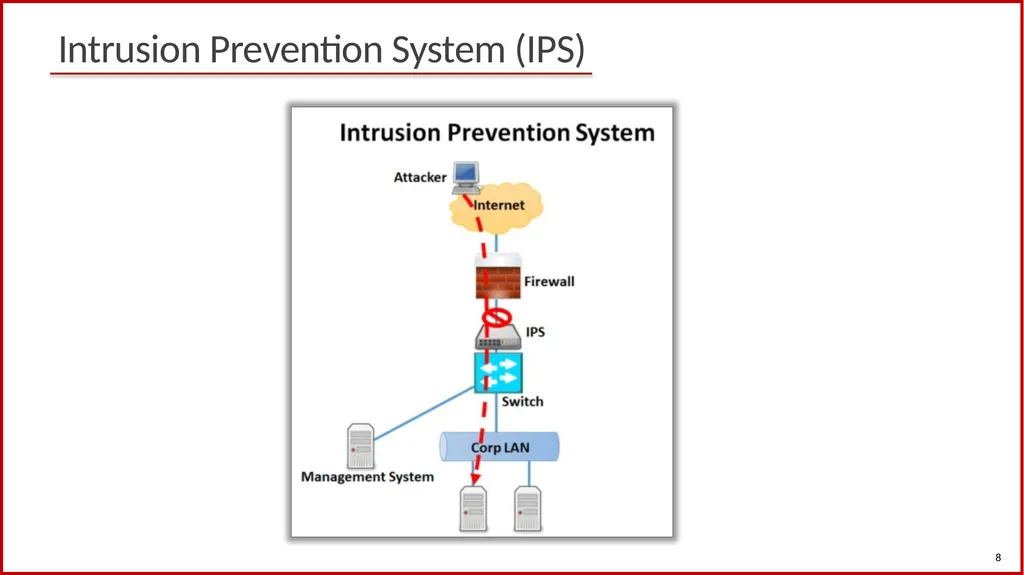
i.e., the IPS is deployed inline in the topology
The IPS analyzes traffic online, thus, all ingress and egress traffic must flow through the IPS for processing
Advantages of IPS:
It can stop single packet attacks
Disadvantages of IPS:
It can negatively affect the performance of the network
It can disrupt the network if a problem or misconfiguration of the IPS occurs 7<br>
slide8. Intrusion Prevention System (IPS) 8<br>
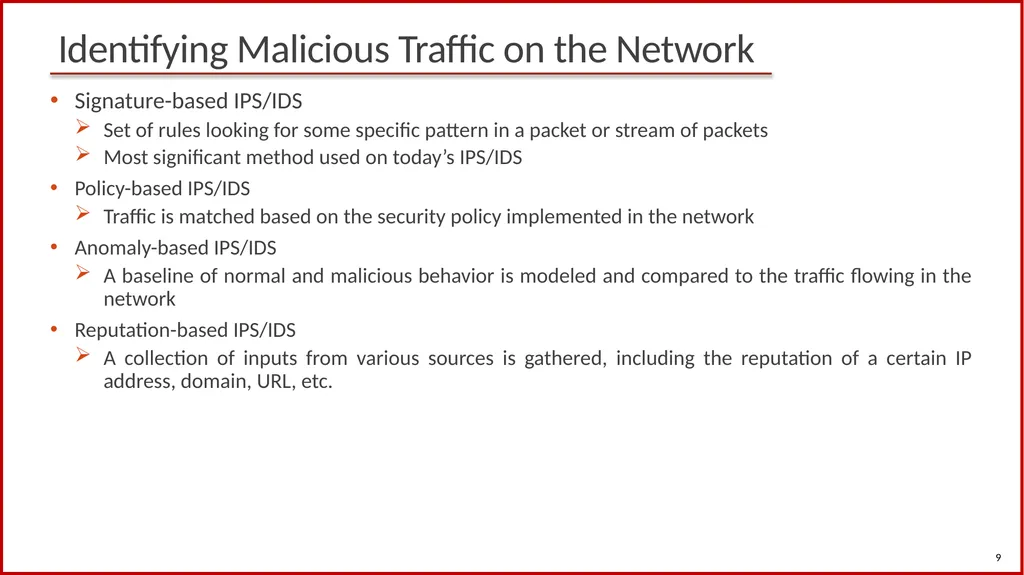
slide9. Identifying Malicious Traffic on the Network Signature-based IPS/IDS
Set of rules looking for some specific pattern in a packet or stream of packets
Most significant method used on today’s IPS/IDS
Policy-based IPS/IDS
Traffic is matched based on the security policy implemented in the network
Anomaly-based IPS/IDS
A baseline of normal and malicious behavior is modeled and compared to the traffic flowing in the network
Reputation-based IPS/IDS
A collection of inputs from various sources is gathered, including the reputation of a certain IP address, domain, URL, etc. 9<br>
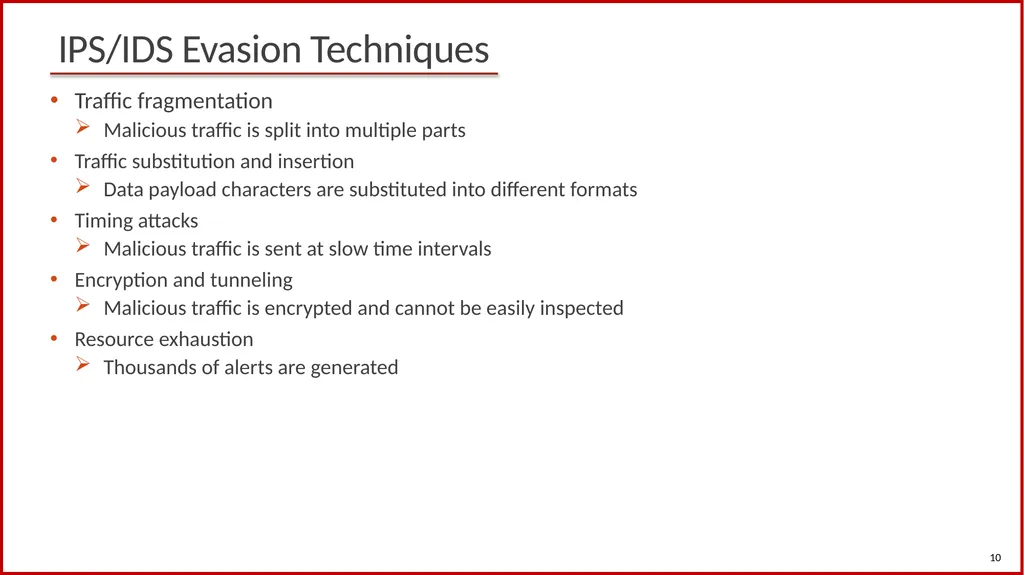
slide10. IPS/IDS Evasion Techniques Traffic fragmentation
Malicious traffic is split into multiple parts
Traffic substitution and insertion
Data payload characters are substituted into different formats
Timing attacks
Malicious traffic is sent at slow time intervals
Encryption and tunneling
Malicious traffic is encrypted and cannot be easily inspected
Resource exhaustion
Thousands of alerts are generated 10<br>
slide11. Suricata 11<br>
slide12. Introduction to Suricata Suricata is an open-source engine Intrusion Detection System (IDS), Intrusion Prevention System (IPS)
It is capable of performing Deep Packet Inspection (DPI)
Suricata has the following properties:
Multithreading: multiple cores can be allocated to a single Suricata instance
Application ID: Suricata can detect the application type, regardless of the port number
Supports logging of events
Extensible through a scripting language (Lua)
Suricata is backed by the Open Information Security Foundation (OISF) 12<br>
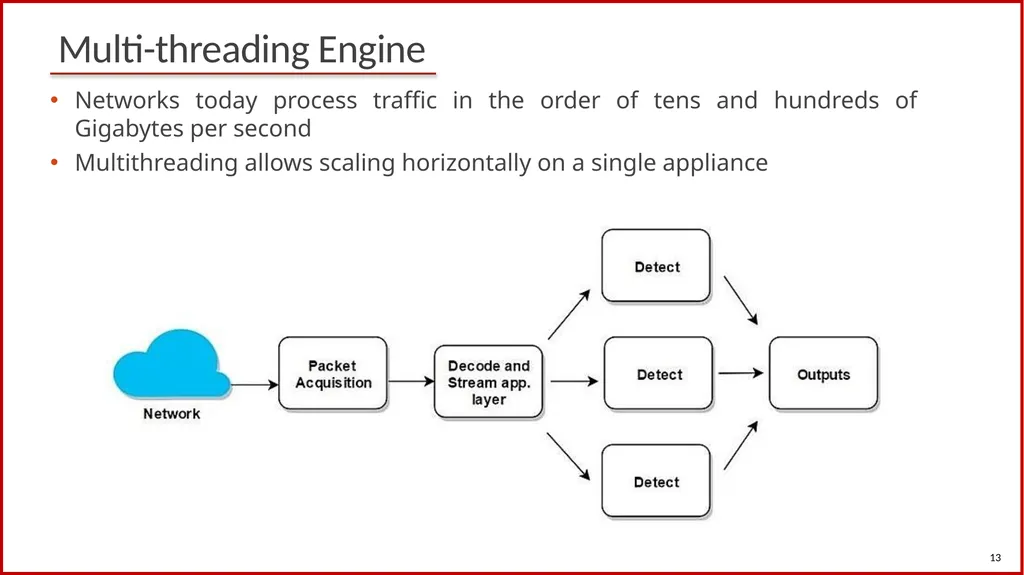
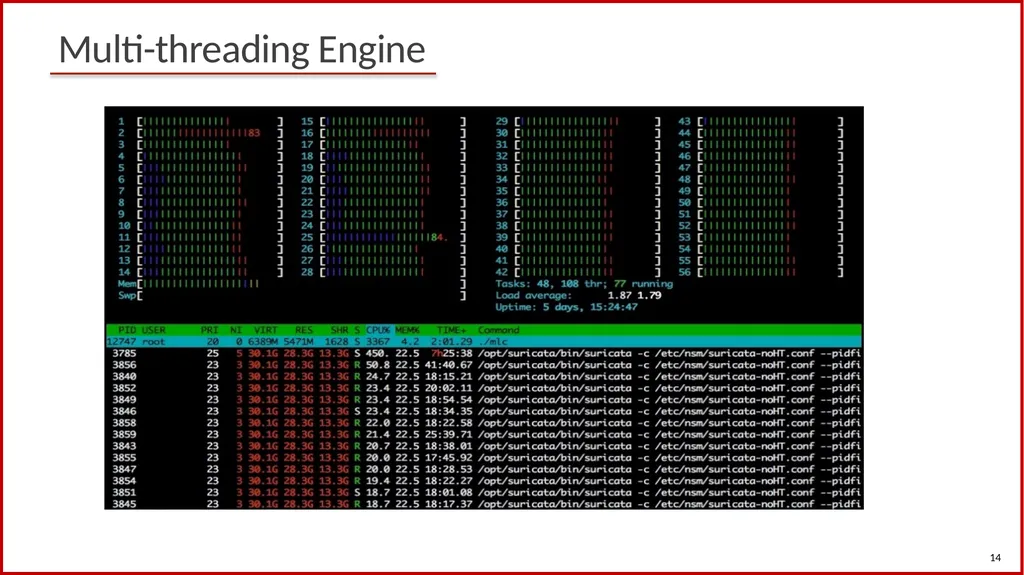
slide13. Multi-threading Engine Networks today process traffic in the order of tens and hundreds of Gigabytes per second
Multithreading allows scaling horizontally on a single appliance 13<br>
slide14. Multi-threading Engine 14<br>
Programmable Switches
Intrusion Detection and Prevention Systems
Ali AlSabeh, Jorge Crichigno
University of South Carolina
http://ce.sc.edu/cyberinfra
Western Academy Support and Training Center (WASTC)
University of South Carolina (USC)
Energy Sciences Network (ESnet)
June 21st, 2023<br>
slide2. Intrusion Detection and Prevention Systems 2<br>
slide3. Intrusion Detection/Prevention System (IDS/IPS) Intrusion Detection System (IDS) and Intrusion Prevention System (IPS) monitor network traffic to detect and prevent malicious activities
These systems are either implemented on a dedicated hardware or implemented as applications on a general-purpose server
IDS and IPS are placed at strategic points in the network to be able to monitor traffic from all devices 3<br>
slide4. Intrusion Detection/Prevention System (IDS/IPS) IDS and IPS leverage a database of attacks’ signatures to detect malicious traffic
Signature-based IDS/IPS are popular and effective, but cannot detect zero-day attacks
Machine learning can be leveraged to create a model of the normal behavior of the network
Thus, the normal model can be used as a baseline to detect any abnormalities in the network 4<br>
slide5. Intrusion Detection System (IDS) An IDS monitors the traffic of a network passively
i.e., the IDS is not deployed inline in the topology
Instead, a network device (e.g., switch, router) duplicates and forwards the traffic to the IDS
The IDS then analyzes the traffic offline (promiscuous mode) and matches the traffic stream with known malicious signatures
Advantages of IDS:
It does not negatively impact the performance of the network
It does not affect the network if a problem or misconfiguration of the IDS occurs
Disadvantages of IDS:
It cannot stop malicious single-packet attacks from reaching the target
It requires assistance from other networking devices to respond to the attack 5<br>
slide6. Intrusion Detection System (IDS) 6<br>
slide7. Intrusion Prevention System (IPS) An IPS device monitors the network traffic actively
i.e., the IPS is deployed inline in the topology
The IPS analyzes traffic online, thus, all ingress and egress traffic must flow through the IPS for processing
Advantages of IPS:
It can stop single packet attacks
Disadvantages of IPS:
It can negatively affect the performance of the network
It can disrupt the network if a problem or misconfiguration of the IPS occurs 7<br>
slide8. Intrusion Prevention System (IPS) 8<br>
slide9. Identifying Malicious Traffic on the Network Signature-based IPS/IDS
Set of rules looking for some specific pattern in a packet or stream of packets
Most significant method used on today’s IPS/IDS
Policy-based IPS/IDS
Traffic is matched based on the security policy implemented in the network
Anomaly-based IPS/IDS
A baseline of normal and malicious behavior is modeled and compared to the traffic flowing in the network
Reputation-based IPS/IDS
A collection of inputs from various sources is gathered, including the reputation of a certain IP address, domain, URL, etc. 9<br>
slide10. IPS/IDS Evasion Techniques Traffic fragmentation
Malicious traffic is split into multiple parts
Traffic substitution and insertion
Data payload characters are substituted into different formats
Timing attacks
Malicious traffic is sent at slow time intervals
Encryption and tunneling
Malicious traffic is encrypted and cannot be easily inspected
Resource exhaustion
Thousands of alerts are generated 10<br>
slide11. Suricata 11<br>
slide12. Introduction to Suricata Suricata is an open-source engine Intrusion Detection System (IDS), Intrusion Prevention System (IPS)
It is capable of performing Deep Packet Inspection (DPI)
Suricata has the following properties:
Multithreading: multiple cores can be allocated to a single Suricata instance
Application ID: Suricata can detect the application type, regardless of the port number
Supports logging of events
Extensible through a scripting language (Lua)
Suricata is backed by the Open Information Security Foundation (OISF) 12<br>
slide13. Multi-threading Engine Networks today process traffic in the order of tens and hundreds of Gigabytes per second
Multithreading allows scaling horizontally on a single appliance 13<br>
slide14. Multi-threading Engine 14<br>