1 Cybersecurity (Security) and P4 Programmable Switches Lab 1: Reconnaissance: Scanning with NMAP, Vulnerability Assessment with OpenVAS Elie Kfoury, Jorge Crichigno University of South Carolina http:ce.sc.educyberinfra Western Academy
"1 Cybersecurity (Security+) and P4 Programmable" is the property of its rightful owner. Permission is granted to
download and print the materials on this website for personal, non-commercial use only, and to display it
on your personal computer provided you do not modify the materials and that you retain all copyright
notices contained in the materials. By downloading content from our website, you accept the terms of this
agreement.
Presentation Transcript
01
1 Cybersecurity (Security+) and P4
Programmable Switches
Lab 1: Reconnaissance: Scanning with NMAP, Vulnerability Assessment with OpenVAS
Elie Kfoury, Jorge Crichigno
University of South Carolina
http://ce.sc.edu/cyberinfra
Western Academy Support and Training Center (WASTC)
University of South Carolina (USC)
Energy Sciences Network (ESnet)
June 19th, 2023<br>
02
Reconnaissance 2 Reconnaissance is the first step in a cyber attack
It allows gathering information about targets
Two methods by which reconnaissance can be performed:
Active reconnaissance: sending probes to the target
Passive reconnaissance: no interaction with the target
Reconnaissance can be used by white hat hackers or black hat hackers<br>
03
Active Reconnaissance 3 By sending probes, information about a target server can be gathered:
Host discovery: determine the IP addresses of targets
Port scanning: determine the services running on targets
Service version detection: determine the version of the services running on targets
OS fingerprinting: determine the operating system used by the target<br>
04
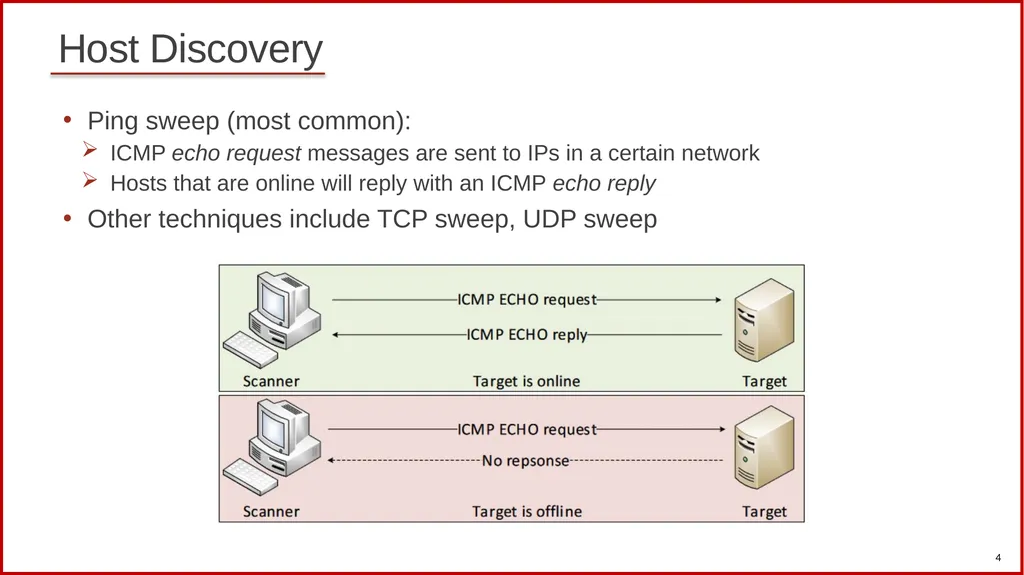
Host Discovery 4 Ping sweep (most common):
ICMP echo request messages are sent to IPs in a certain network
Hosts that are online will reply with an ICMP echo reply
Other techniques include TCP sweep, UDP sweep<br>
05
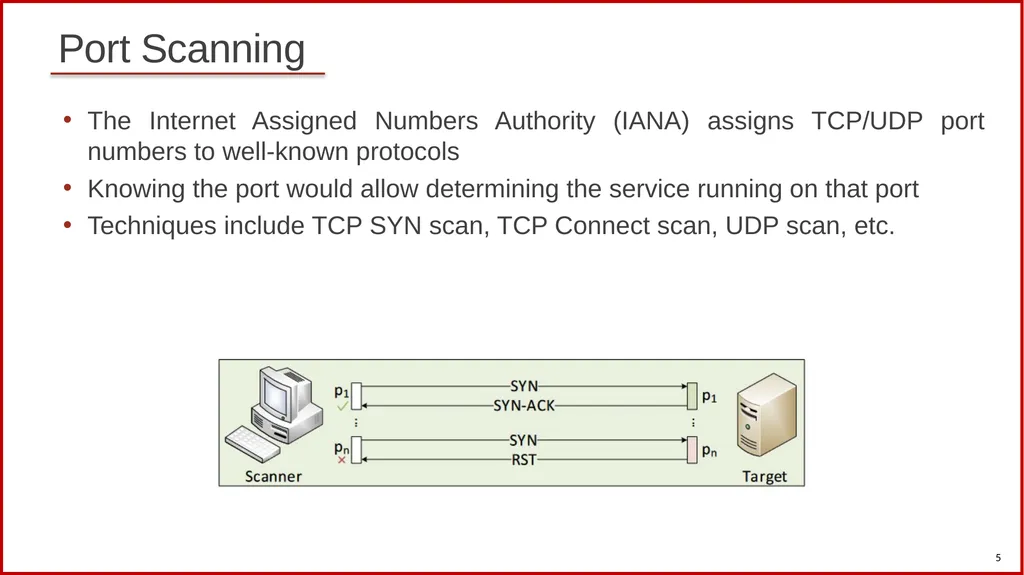
Port Scanning 5 The Internet Assigned Numbers Authority (IANA) assigns TCP/UDP port numbers to well-known protocols
Knowing the port would allow determining the service running on that port
Techniques include TCP SYN scan, TCP Connect scan, UDP scan, etc.<br>
06
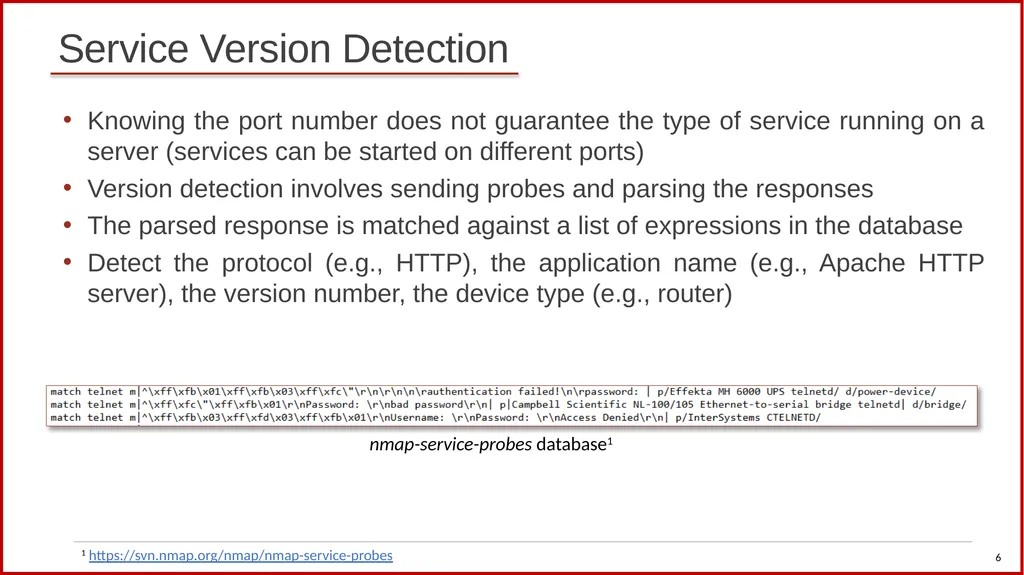
Service Version Detection 6 Knowing the port number does not guarantee the type of service running on a server (services can be started on different ports)
Version detection involves sending probes and parsing the responses
The parsed response is matched against a list of expressions in the database
Detect the protocol (e.g., HTTP), the application name (e.g., Apache HTTP server), the version number, the device type (e.g., router) nmap-service-probes database1 1 https://svn.nmap.org/nmap/nmap-service-probes<br>
07
OS Fingerprinting 7 Scanners can identify the OS running on a target host by fingerprinting the TCP/IP stack
The scanner performs tests on the responses and compares these values against a database containing the OS fingerprints
E.g., examining the TCP options, the initial window size, etc.<br>
08
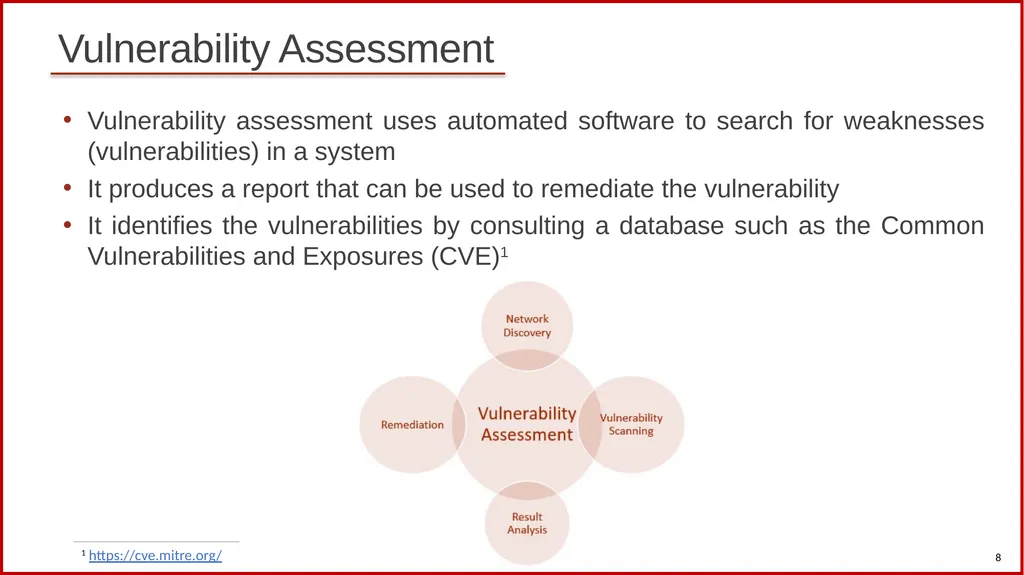
Vulnerability Assessment 8 Vulnerability assessment uses automated software to search for weaknesses (vulnerabilities) in a system
It produces a report that can be used to remediate the vulnerability
It identifies the vulnerabilities by consulting a database such as the Common Vulnerabilities and Exposures (CVE)1 1 https://cve.mitre.org/<br>
09
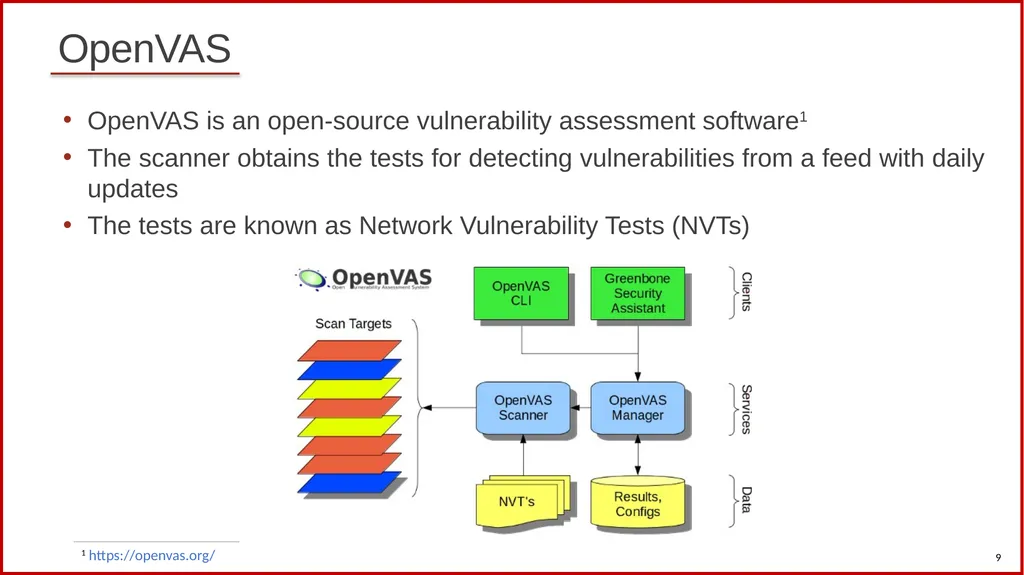
OpenVAS 9 OpenVAS is an open-source vulnerability assessment software1
The scanner obtains the tests for detecting vulnerabilities from a feed with daily updates
The tests are known as Network Vulnerability Tests (NVTs) 1 https://openvas.org/<br>
10
Lab 1: Reconnaissance: Scanning with NMAP, Vulnerability Assessment with OpenVAS 10<br>
11
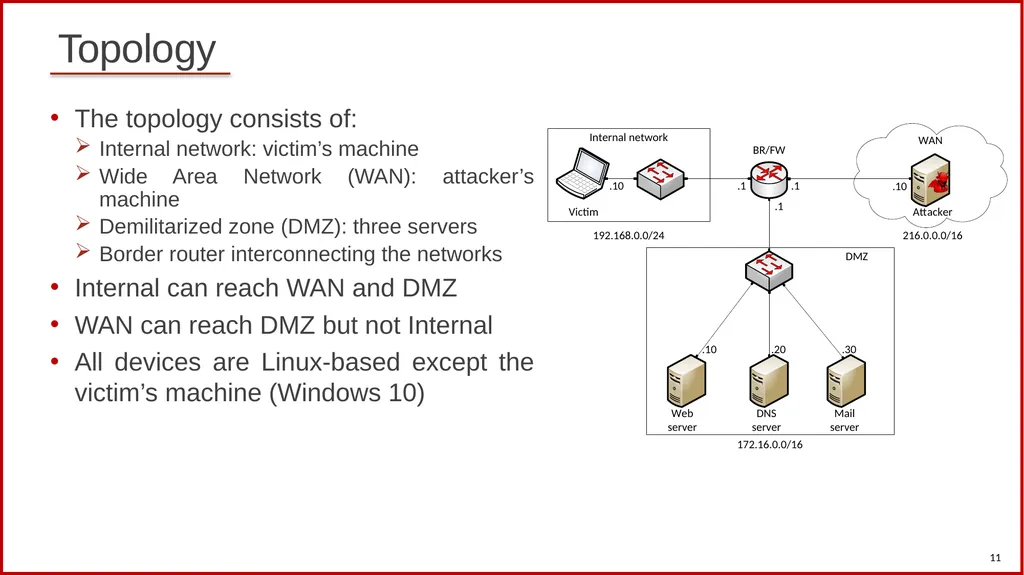
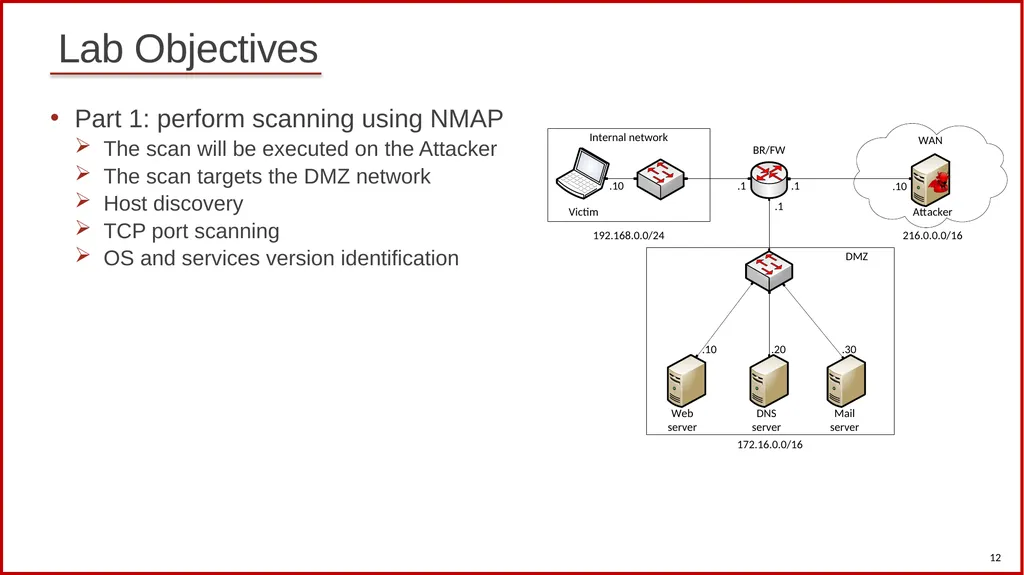
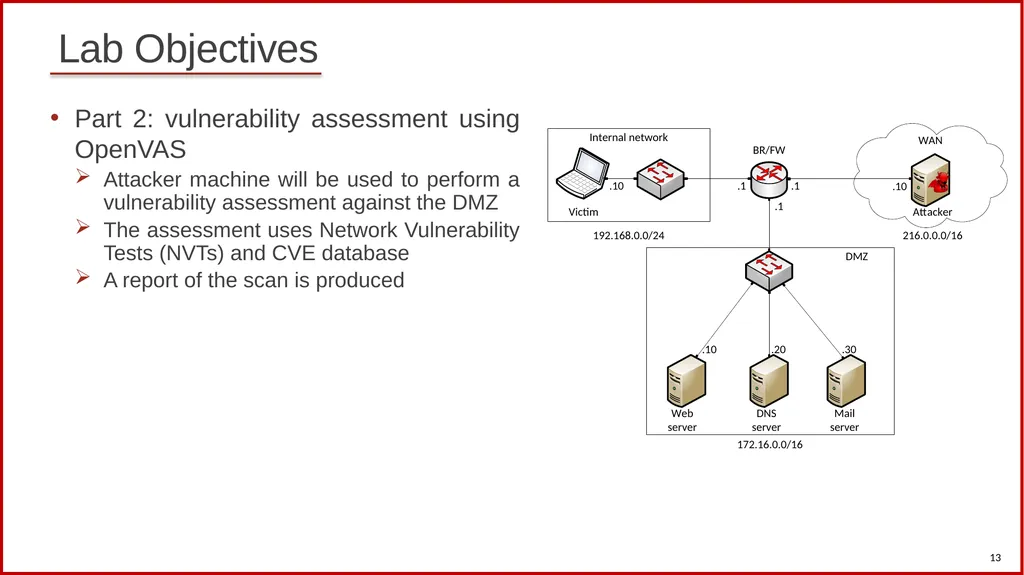
11 The topology consists of:
Internal network: victim’s machine
Wide Area Network (WAN): attacker’s machine
Demilitarized zone (DMZ): three servers
Border router interconnecting the networks
Internal can reach WAN and DMZ
WAN can reach DMZ but not Internal
All devices are Linux-based except the victim’s machine (Windows 10) Topology<br>
12
12 Part 1: perform scanning using NMAP
The scan will be executed on the Attacker
The scan targets the DMZ network
Host discovery
TCP port scanning
OS and services version identification Lab Objectives<br>
13
13 Part 2: vulnerability assessment using OpenVAS
Attacker machine will be used to perform a vulnerability assessment against the DMZ
The assessment uses Network Vulnerability Tests (NVTs) and CVE database
A report of the scan is produced Lab Objectives<br>
14
14 We will use the NETLAB virtual platform:
URL: https://netlab.cec.sc.edu/
Username: your_email_address
Temporary Password: wastc2023 Platform Information<br>