
1 Decay Data for Fusion Applications: Status,

Description: 1 Decay Data for Fusion Applications: Status, Issues and Needs M. Fleming Culham Centre for Fusion Energy UK Atomic Energy Authority OECD NEA Data Week Fusion Paris 27 April 2016 2 This work was funded by the Research Councils United
Related Topics
Download Presentation
"1 Decay Data for Fusion Applications: Status," is the property of its rightful owner. Permission is granted to download and print the materials on this website for personal, non-commercial use only, and to display it on your personal computer provided you do not modify the materials and that you retain all copyright notices contained in the materials. By downloading content from our website, you accept the terms of this agreement.
Presentation Transcript
slide1. 1 Decay Data for Fusion Applications:
Status, Issues and Needs M. Fleming Culham Centre for Fusion Energy
UK Atomic Energy Authority OECD NEA Data Week
Fusion
Paris 27 April 2016<br>
slide2. 2 This work was funded by the Research Councils United Kingdom Energy Programme under grant EP/I501045<br>
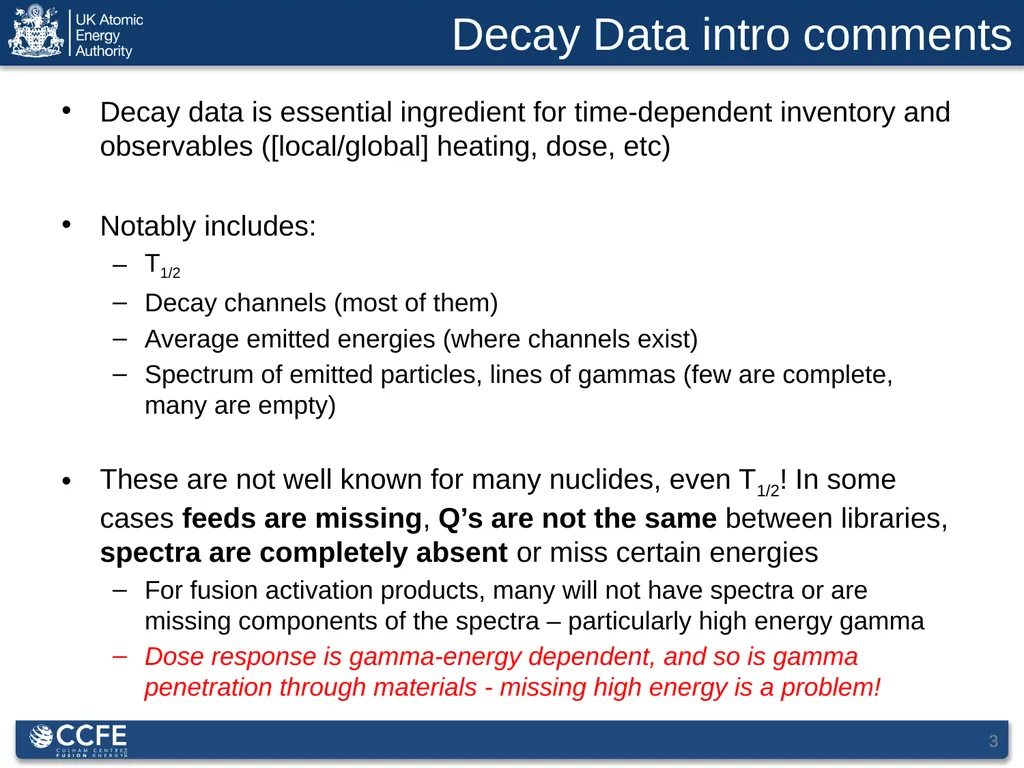
slide3. Decay data is essential ingredient for time-dependent inventory and observables ([local/global] heating, dose, etc)
Notably includes:
T1/2
Decay channels (most of them)
Average emitted energies (where channels exist)
Spectrum of emitted particles, lines of gammas (few are complete, many are empty)
These are not well known for many nuclides, even T1/2! In some cases feeds are missing, Q’s are not the same between libraries, spectra are completely absent or miss certain energies
For fusion activation products, many will not have spectra or are missing components of the spectra – particularly high energy gamma
Dose response is gamma-energy dependent, and so is gamma penetration through materials - missing high energy is a problem! Decay Data intro comments 3<br>
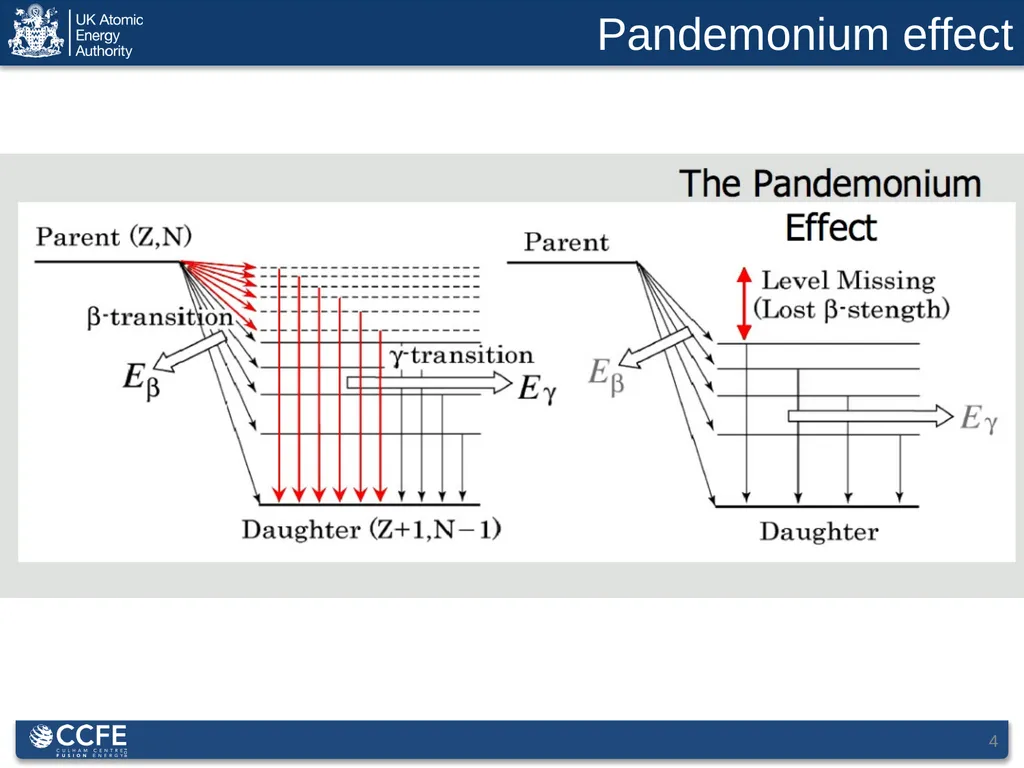
slide4. Pandemonium effect 4<br>
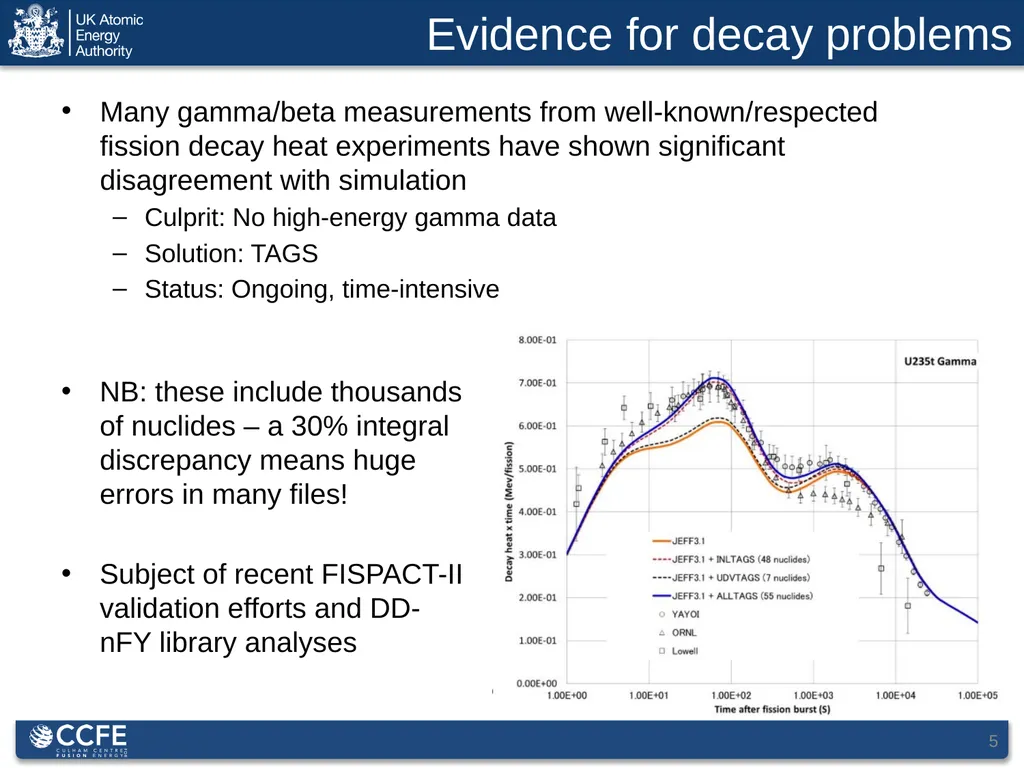
slide5. Many gamma/beta measurements from well-known/respected fission decay heat experiments have shown significant disagreement with simulation
Culprit: No high-energy gamma data
Solution: TAGS
Status: Ongoing, time-intensive Evidence for decay problems 5 NB: these include thousands of nuclides – a 30% integral discrepancy means huge errors in many files!
Subject of recent FISPACT-II validation efforts and DD-nFY library analyses<br>
slide6. FISPACT-II can handle all ENDF-6 decay data files including:
JEFF-3.X
JENDL-4.0u and 2015/16 updates
ENDF/B-VII.1
UKDD-12
as well as legacy EAF
UKDD-12 represents the evolution of EAF data with many JEFF-3.1.1 replacements and a few other nuclides poached from ENDF/B and JENDL
Comparisons between libraries can quickly demonstrate unresolved issues in decay data FISPACT-II decay handling 6<br>
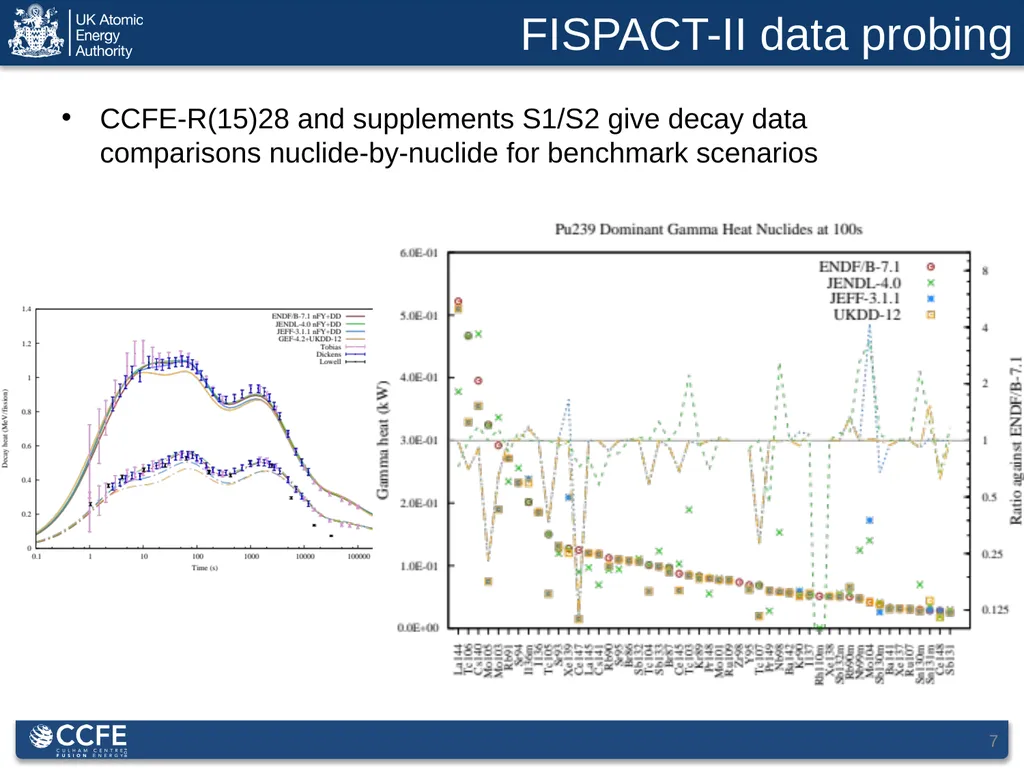
slide7. CCFE-R(15)28 and supplements S1/S2 give decay data comparisons nuclide-by-nuclide for benchmark scenarios FISPACT-II data probing 7<br>
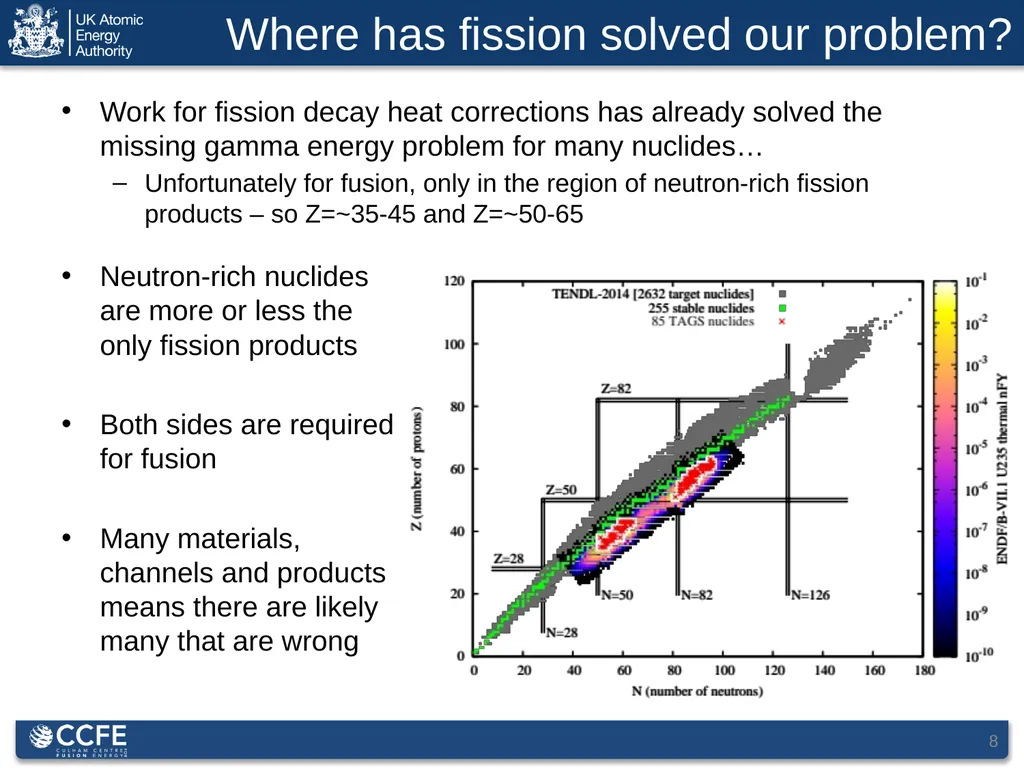
slide8. Work for fission decay heat corrections has already solved the missing gamma energy problem for many nuclides…
Unfortunately for fusion, only in the region of neutron-rich fission products – so Z=~35-45 and Z=~50-65 Where has fission solved our problem? 8 Neutron-rich nuclides are more or less the only fission products
Both sides are required for fusion
Many materials, channels and products means there are likely many that are wrong<br>
slide9. Zr98 (exotic, but extreme demonstration of what can happen…) Looking at the files… 9 Gamma=0 Gamma=449 keV ENDF/B-VII.1 JEFF-3.1.1<br>
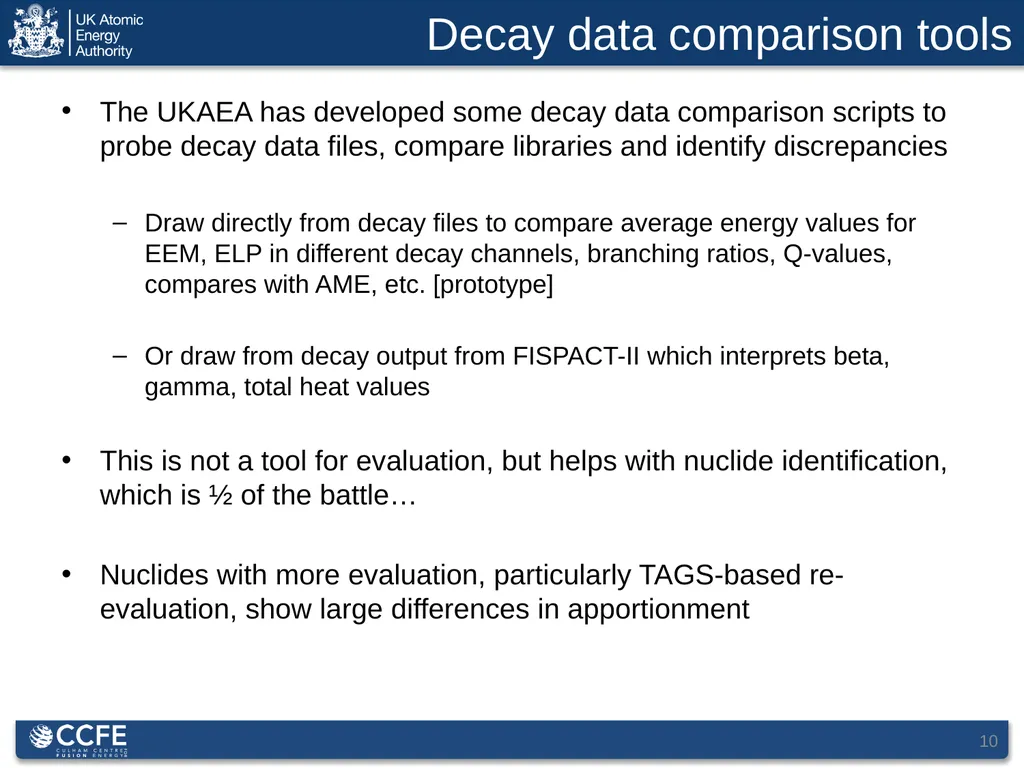
slide10. The UKAEA has developed some decay data comparison scripts to probe decay data files, compare libraries and identify discrepancies
Draw directly from decay files to compare average energy values for EEM, ELP in different decay channels, branching ratios, Q-values, compares with AME, etc. [prototype]
Or draw from decay output from FISPACT-II which interprets beta, gamma, total heat values
This is not a tool for evaluation, but helps with nuclide identification, which is ½ of the battle…
Nuclides with more evaluation, particularly TAGS-based re-evaluation, show large differences in apportionment Decay data comparison tools 10<br>
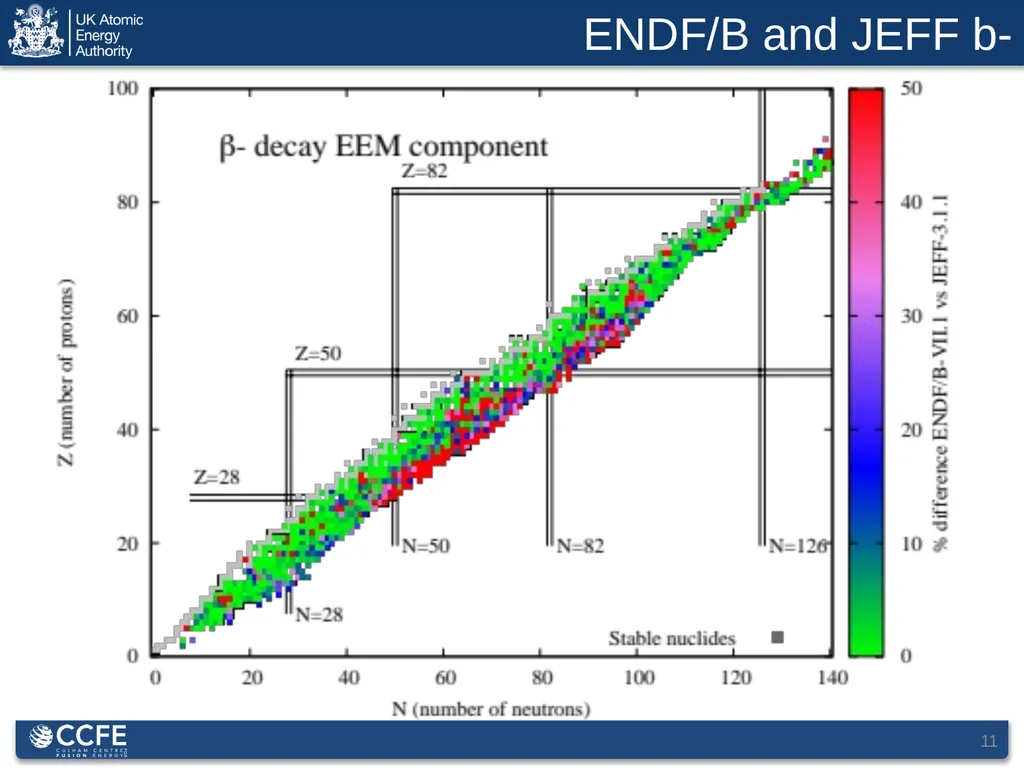
slide11. ENDF/B and JEFF b- 11<br>
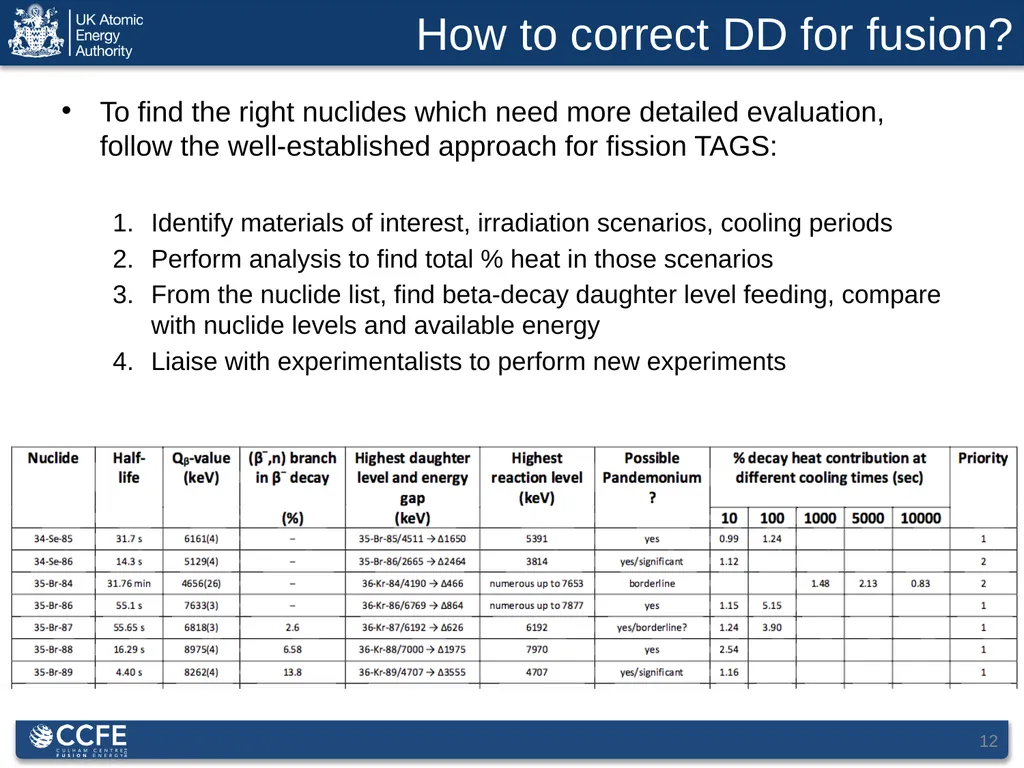
slide12. To find the right nuclides which need more detailed evaluation, follow the well-established approach for fission TAGS:
Identify materials of interest, irradiation scenarios, cooling periods
Perform analysis to find total % heat in those scenarios
From the nuclide list, find beta-decay daughter level feeding, compare with nuclide levels and available energy
Liaise with experimentalists to perform new experiments How to correct DD for fusion? 12<br>
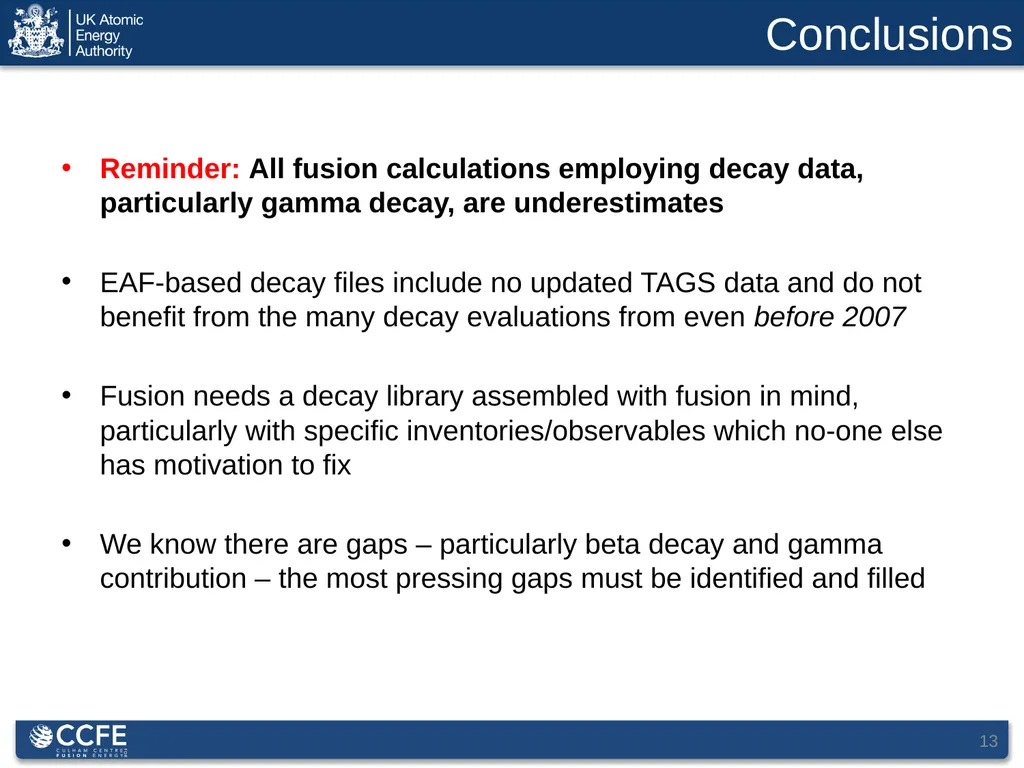
slide13. Reminder: All fusion calculations employing decay data, particularly gamma decay, are underestimates
EAF-based decay files include no updated TAGS data and do not benefit from the many decay evaluations from even before 2007
Fusion needs a decay library assembled with fusion in mind, particularly with specific inventories/observables which no-one else has motivation to fix
We know there are gaps – particularly beta decay and gamma contribution – the most pressing gaps must be identified and filled Conclusions 13<br>
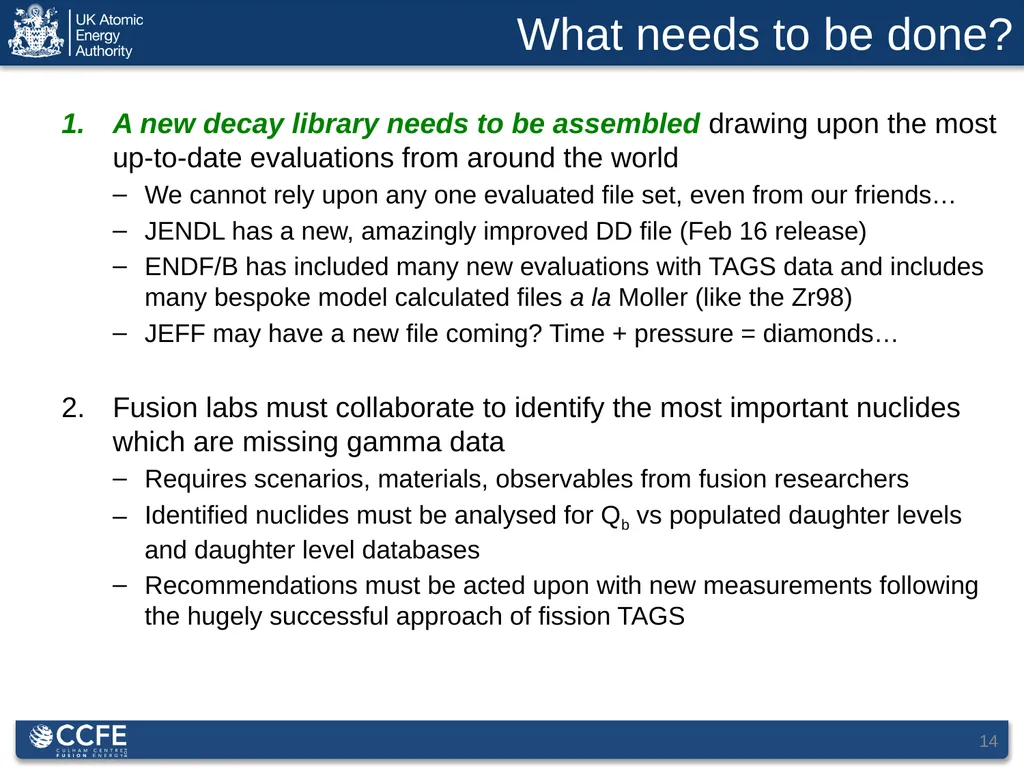
slide14. A new decay library needs to be assembled drawing upon the most up-to-date evaluations from around the world
We cannot rely upon any one evaluated file set, even from our friends…
JENDL has a new, amazingly improved DD file (Feb 16 release)
ENDF/B has included many new evaluations with TAGS data and includes many bespoke model calculated files a la Moller (like the Zr98)
JEFF may have a new file coming? Time + pressure = diamonds…
Fusion labs must collaborate to identify the most important nuclides which are missing gamma data
Requires scenarios, materials, observables from fusion researchers
Identified nuclides must be analysed for Qb vs populated daughter levels and daughter level databases
Recommendations must be acted upon with new measurements following the hugely successful approach of fission TAGS What needs to be done? 14<br>
Status, Issues and Needs M. Fleming Culham Centre for Fusion Energy
UK Atomic Energy Authority OECD NEA Data Week
Fusion
Paris 27 April 2016<br>
slide2. 2 This work was funded by the Research Councils United Kingdom Energy Programme under grant EP/I501045<br>
slide3. Decay data is essential ingredient for time-dependent inventory and observables ([local/global] heating, dose, etc)
Notably includes:
T1/2
Decay channels (most of them)
Average emitted energies (where channels exist)
Spectrum of emitted particles, lines of gammas (few are complete, many are empty)
These are not well known for many nuclides, even T1/2! In some cases feeds are missing, Q’s are not the same between libraries, spectra are completely absent or miss certain energies
For fusion activation products, many will not have spectra or are missing components of the spectra – particularly high energy gamma
Dose response is gamma-energy dependent, and so is gamma penetration through materials - missing high energy is a problem! Decay Data intro comments 3<br>
slide4. Pandemonium effect 4<br>
slide5. Many gamma/beta measurements from well-known/respected fission decay heat experiments have shown significant disagreement with simulation
Culprit: No high-energy gamma data
Solution: TAGS
Status: Ongoing, time-intensive Evidence for decay problems 5 NB: these include thousands of nuclides – a 30% integral discrepancy means huge errors in many files!
Subject of recent FISPACT-II validation efforts and DD-nFY library analyses<br>
slide6. FISPACT-II can handle all ENDF-6 decay data files including:
JEFF-3.X
JENDL-4.0u and 2015/16 updates
ENDF/B-VII.1
UKDD-12
as well as legacy EAF
UKDD-12 represents the evolution of EAF data with many JEFF-3.1.1 replacements and a few other nuclides poached from ENDF/B and JENDL
Comparisons between libraries can quickly demonstrate unresolved issues in decay data FISPACT-II decay handling 6<br>
slide7. CCFE-R(15)28 and supplements S1/S2 give decay data comparisons nuclide-by-nuclide for benchmark scenarios FISPACT-II data probing 7<br>
slide8. Work for fission decay heat corrections has already solved the missing gamma energy problem for many nuclides…
Unfortunately for fusion, only in the region of neutron-rich fission products – so Z=~35-45 and Z=~50-65 Where has fission solved our problem? 8 Neutron-rich nuclides are more or less the only fission products
Both sides are required for fusion
Many materials, channels and products means there are likely many that are wrong<br>
slide9. Zr98 (exotic, but extreme demonstration of what can happen…) Looking at the files… 9 Gamma=0 Gamma=449 keV ENDF/B-VII.1 JEFF-3.1.1<br>
slide10. The UKAEA has developed some decay data comparison scripts to probe decay data files, compare libraries and identify discrepancies
Draw directly from decay files to compare average energy values for EEM, ELP in different decay channels, branching ratios, Q-values, compares with AME, etc. [prototype]
Or draw from decay output from FISPACT-II which interprets beta, gamma, total heat values
This is not a tool for evaluation, but helps with nuclide identification, which is ½ of the battle…
Nuclides with more evaluation, particularly TAGS-based re-evaluation, show large differences in apportionment Decay data comparison tools 10<br>
slide11. ENDF/B and JEFF b- 11<br>
slide12. To find the right nuclides which need more detailed evaluation, follow the well-established approach for fission TAGS:
Identify materials of interest, irradiation scenarios, cooling periods
Perform analysis to find total % heat in those scenarios
From the nuclide list, find beta-decay daughter level feeding, compare with nuclide levels and available energy
Liaise with experimentalists to perform new experiments How to correct DD for fusion? 12<br>
slide13. Reminder: All fusion calculations employing decay data, particularly gamma decay, are underestimates
EAF-based decay files include no updated TAGS data and do not benefit from the many decay evaluations from even before 2007
Fusion needs a decay library assembled with fusion in mind, particularly with specific inventories/observables which no-one else has motivation to fix
We know there are gaps – particularly beta decay and gamma contribution – the most pressing gaps must be identified and filled Conclusions 13<br>
slide14. A new decay library needs to be assembled drawing upon the most up-to-date evaluations from around the world
We cannot rely upon any one evaluated file set, even from our friends…
JENDL has a new, amazingly improved DD file (Feb 16 release)
ENDF/B has included many new evaluations with TAGS data and includes many bespoke model calculated files a la Moller (like the Zr98)
JEFF may have a new file coming? Time + pressure = diamonds…
Fusion labs must collaborate to identify the most important nuclides which are missing gamma data
Requires scenarios, materials, observables from fusion researchers
Identified nuclides must be analysed for Qb vs populated daughter levels and daughter level databases
Recommendations must be acted upon with new measurements following the hugely successful approach of fission TAGS What needs to be done? 14<br>