
1 FIRE FIGHTING OBJECTIVE Upon completion of this
MY
Published · 71 slides · 0 views
1 / 1




Description
1 FIRE FIGHTING OBJECTIVE Upon completion of this lesson, you will be able to: What is fire and Type Fire fighting technique Types of Combustion, Mode of spread of fire and Stages Phases of burning Type of Fire Extinguisher in details
Related Topics
Share
Embed code
Download this presentation From Below
"1 FIRE FIGHTING OBJECTIVE Upon completion of this" is the property of its rightful owner. Permission is granted to download and print the materials on this website for personal, non-commercial use only, and to display it on your personal computer provided you do not modify the materials and that you retain all copyright notices contained in the materials. By downloading content from our website, you accept the terms of this agreement.
Presentation Transcript
01
1 FIRE FIGHTING<br>
02
OBJECTIVE Upon completion of this lesson, you will be able to:
What is fire and Type
Fire fighting technique
Types of Combustion, Mode of spread of fire and Stages & Phases of burning
Type of Fire Extinguisher in details
Fire Extinguishing Safety Techniques And procedure
Advantages and disadvantages
IV. Operation, care & maintenance, standard test,
V.Demonstrator of method of recharging 2<br>
What is fire and Type
Fire fighting technique
Types of Combustion, Mode of spread of fire and Stages & Phases of burning
Type of Fire Extinguisher in details
Fire Extinguishing Safety Techniques And procedure
Advantages and disadvantages
IV. Operation, care & maintenance, standard test,
V.Demonstrator of method of recharging 2<br>
03
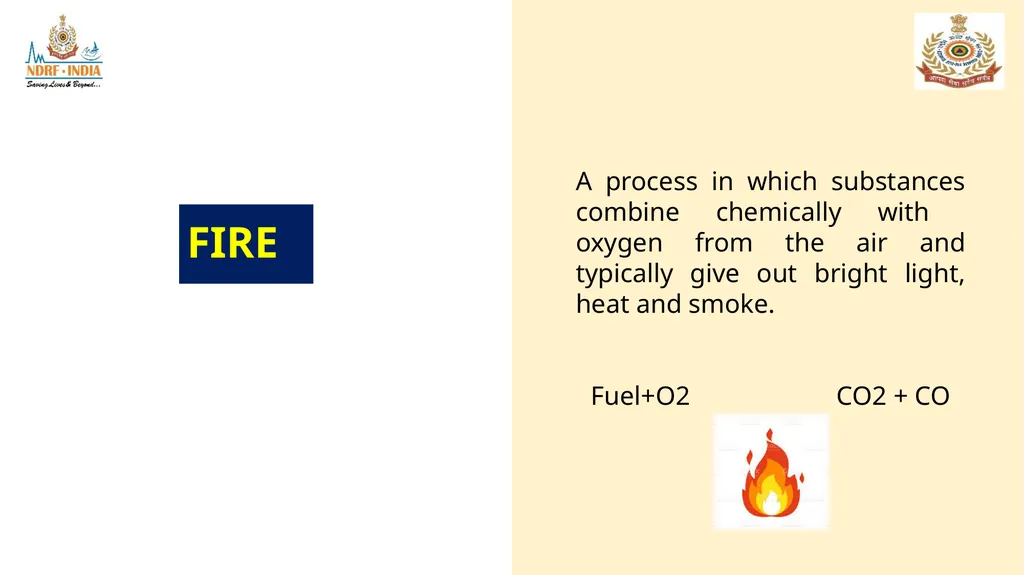
FIRE A process in which substances combine chemically with oxygen from the air and typically give out bright light, heat and smoke.
Fuel+O2 CO2 + CO<br>
Fuel+O2 CO2 + CO<br>
04
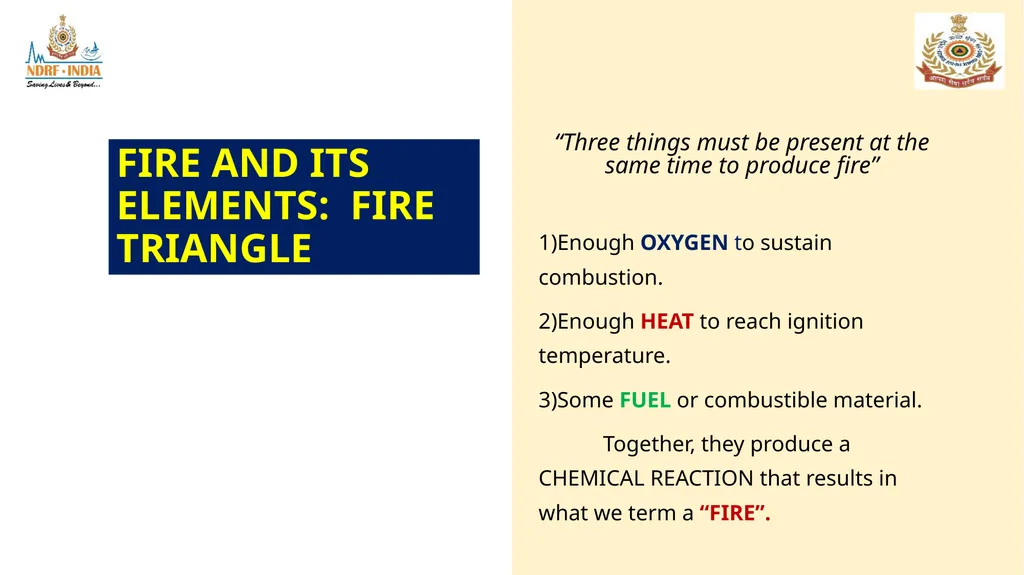
FIRE AND ITS ELEMENTS: FIRE TRIANGLE “Three things must be present at the same time to produce fire”
Enough OXYGEN to sustain combustion.
Enough HEAT to reach ignition temperature.
Some FUEL or combustible material.
Together, they produce a CHEMICAL REACTION that results in what we term a “FIRE”.<br>
Enough OXYGEN to sustain combustion.
Enough HEAT to reach ignition temperature.
Some FUEL or combustible material.
Together, they produce a CHEMICAL REACTION that results in what we term a “FIRE”.<br>
05
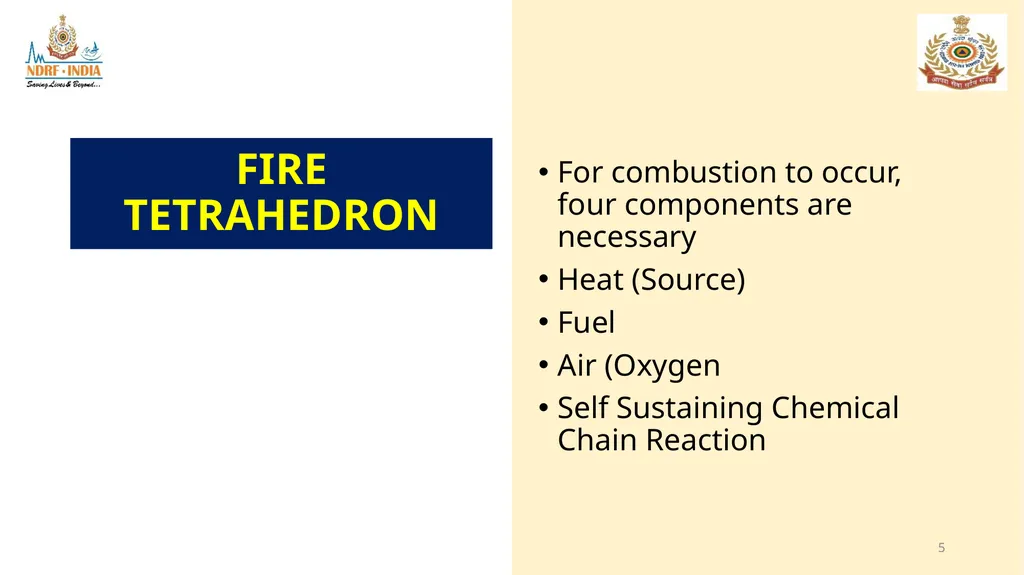
For combustion to occur, four components are necessary
Heat (Source)
Fuel
Air (Oxygen
Self Sustaining Chemical Chain Reaction 5 FIRE TETRAHEDRON<br>
Heat (Source)
Fuel
Air (Oxygen
Self Sustaining Chemical Chain Reaction 5 FIRE TETRAHEDRON<br>
06
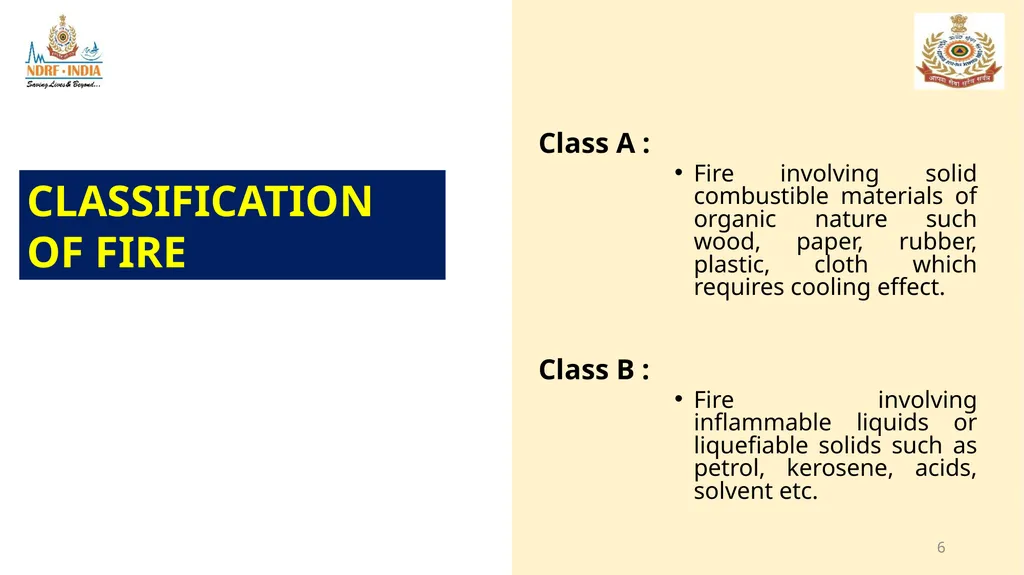
Class A :
Fire involving solid combustible materials of organic nature such wood, paper, rubber, plastic, cloth which requires cooling effect.
Class B :
Fire involving inflammable liquids or liquefiable solids such as petrol, kerosene, acids, solvent etc. 6 CLASSIFICATION OF FIRE<br>
Fire involving solid combustible materials of organic nature such wood, paper, rubber, plastic, cloth which requires cooling effect.
Class B :
Fire involving inflammable liquids or liquefiable solids such as petrol, kerosene, acids, solvent etc. 6 CLASSIFICATION OF FIRE<br>
07
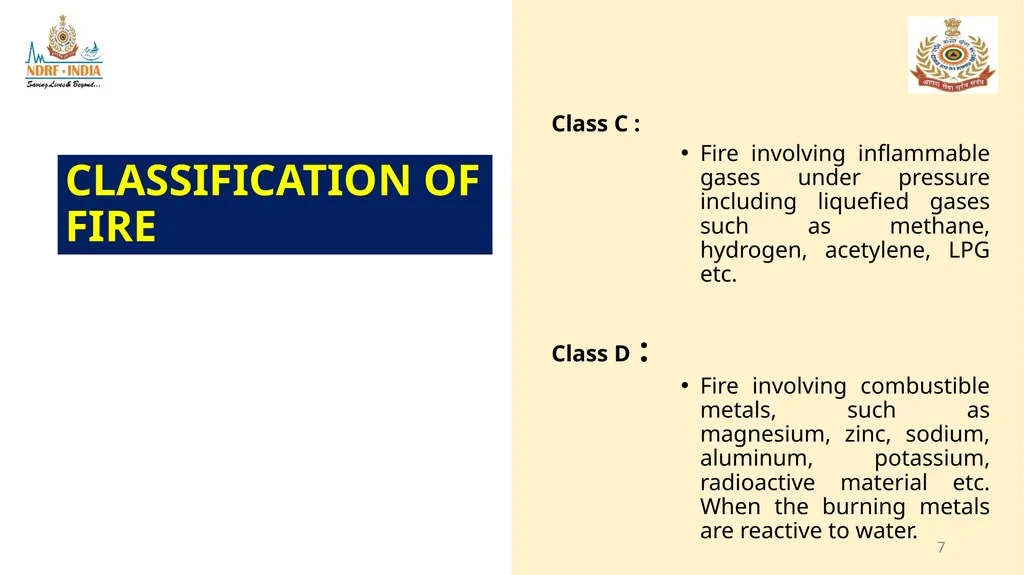
Class C :
Fire involving inflammable gases under pressure including liquefied gases such as methane, hydrogen, acetylene, LPG etc.
Class D :
Fire involving combustible metals, such as magnesium, zinc, sodium, aluminum, potassium, radioactive material etc. When the burning metals are reactive to water. 7 CLASSIFICATION OF FIRE<br>
Fire involving inflammable gases under pressure including liquefied gases such as methane, hydrogen, acetylene, LPG etc.
Class D :
Fire involving combustible metals, such as magnesium, zinc, sodium, aluminum, potassium, radioactive material etc. When the burning metals are reactive to water. 7 CLASSIFICATION OF FIRE<br>
08
FIRE EXTINGUISHING TECHNIQUE: Extinguishing fire involve the elimination or removal of one or more of the four elements
COOLING:
Removal of heat from the burning material/fire area.<br>
COOLING:
Removal of heat from the burning material/fire area.<br>
09
2. SMOOTHERING:
Cutting the supply of oxygen from the f ire area. 3. STARVATION:
Removal of un-burnt material or fuel. 4. BREAKING OF CHAIN REACTION:
Interrupt the chain reaction between fuel, heat and oxygen.<br>
Cutting the supply of oxygen from the f ire area. 3. STARVATION:
Removal of un-burnt material or fuel. 4. BREAKING OF CHAIN REACTION:
Interrupt the chain reaction between fuel, heat and oxygen.<br>
10
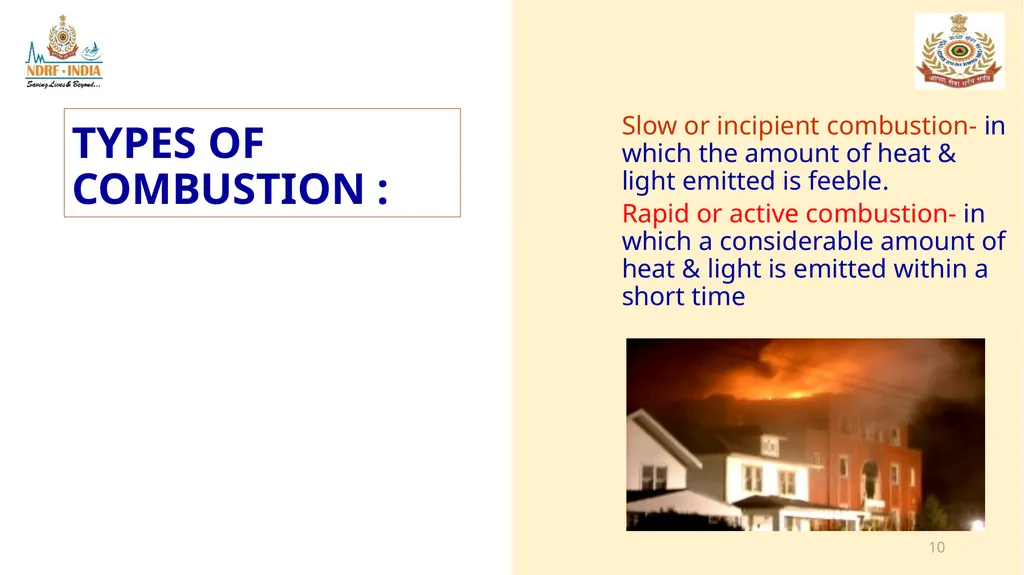
TYPES OF COMBUSTION : Slow or incipient combustion- in which the amount of heat & light emitted is feeble.
Rapid or active combustion- in which a considerable amount of heat & light is emitted within a short time 10<br>
Rapid or active combustion- in which a considerable amount of heat & light is emitted within a short time 10<br>
11
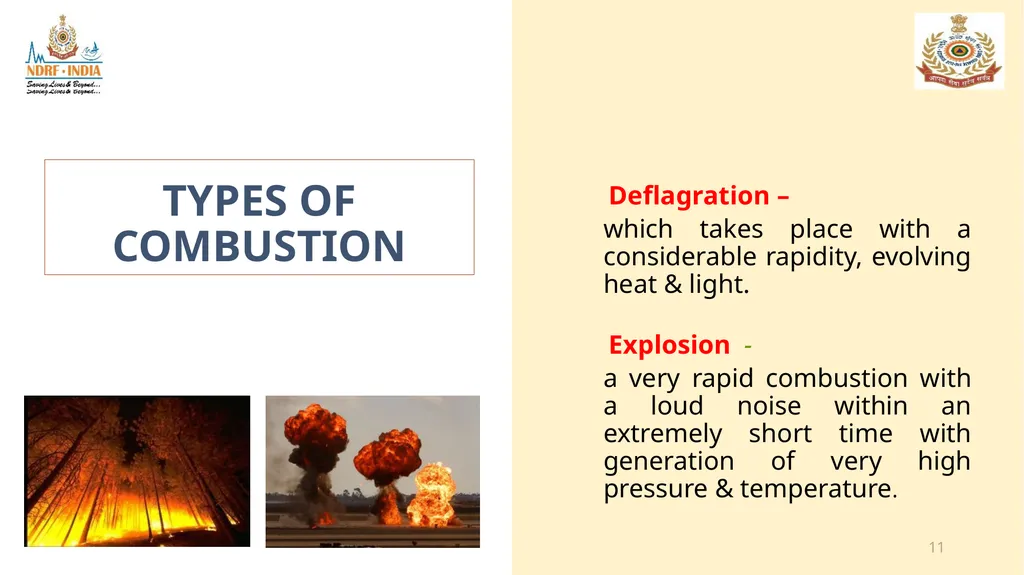
TYPES OF COMBUSTION Deflagration –
which takes place with a considerable rapidity, evolving heat & light.
Explosion -
a very rapid combustion with a loud noise within an extremely short time with generation of very high pressure & temperature. 11<br>
which takes place with a considerable rapidity, evolving heat & light.
Explosion -
a very rapid combustion with a loud noise within an extremely short time with generation of very high pressure & temperature. 11<br>
12
RATE OF COMBUSTION It is the rate of burning of any substance and measured in length over time like millimeters per sec.
A rate of combustion or the spread of fire would depends on :
The area of solid/liquid in contact with air.
The amount of heat generated to raise the temperature of un-burnt portion. 12<br>
A rate of combustion or the spread of fire would depends on :
The area of solid/liquid in contact with air.
The amount of heat generated to raise the temperature of un-burnt portion. 12<br>
13
RATE OF COMBUSTION The ability of materials to conduct heat away.
Atmospheric humidity.
Wind velocity.
Temperature.
Atmospheric pressure. 13<br>
Atmospheric humidity.
Wind velocity.
Temperature.
Atmospheric pressure. 13<br>
14
14 Conduction:
The process by which heat is directly transmitted through the material of a substance when there is a difference of temp bet adjoining regions.
It occurs only in solids i.e. metallic objects. MODES OF SPREAD OF FIRE<br>
The process by which heat is directly transmitted through the material of a substance when there is a difference of temp bet adjoining regions.
It occurs only in solids i.e. metallic objects. MODES OF SPREAD OF FIRE<br>
15
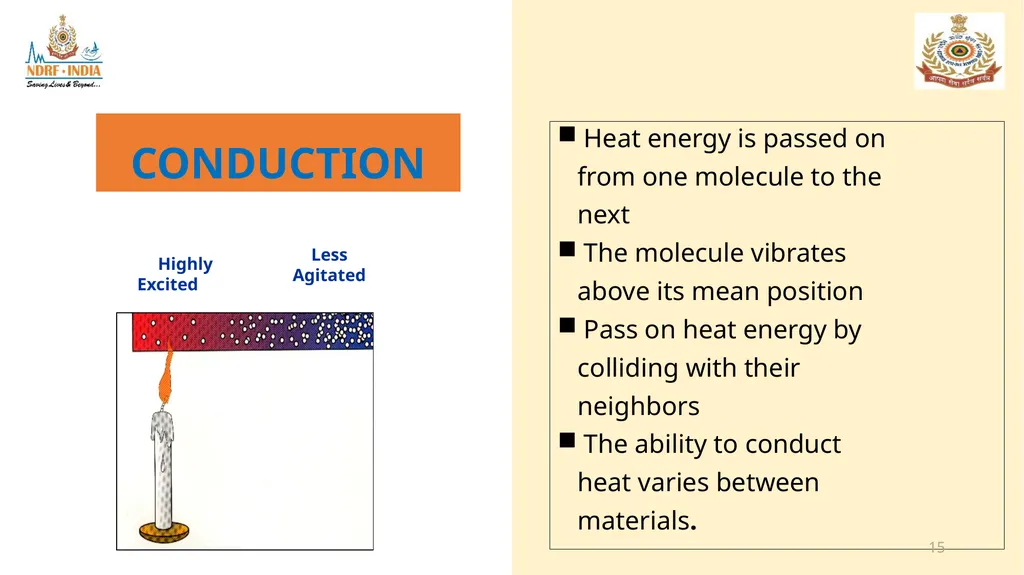
CONDUCTION Heat energy is passed on
from one molecule to the
next
The molecule vibrates
above its mean position
Pass on heat energy by
colliding with their
neighbors
The ability to conduct
heat varies between
materials. 15 Highly Excited Less Agitated<br>
from one molecule to the
next
The molecule vibrates
above its mean position
Pass on heat energy by
colliding with their
neighbors
The ability to conduct
heat varies between
materials. 15 Highly Excited Less Agitated<br>
16
16 Convection:
Transfer of heat by the movement of a fluid (liquid) or gas bet areas of different temp.
It occurs both in liquids & gases MODES OF SPREAD OF FIRE<br>
Transfer of heat by the movement of a fluid (liquid) or gas bet areas of different temp.
It occurs both in liquids & gases MODES OF SPREAD OF FIRE<br>
17
17 Radiation :
It is neither conduction nor convection. These are heated rays emanating from the hot object.
It travels at the speed of light. MODES OF SPREAD OF FIRE<br>
It is neither conduction nor convection. These are heated rays emanating from the hot object.
It travels at the speed of light. MODES OF SPREAD OF FIRE<br>
18
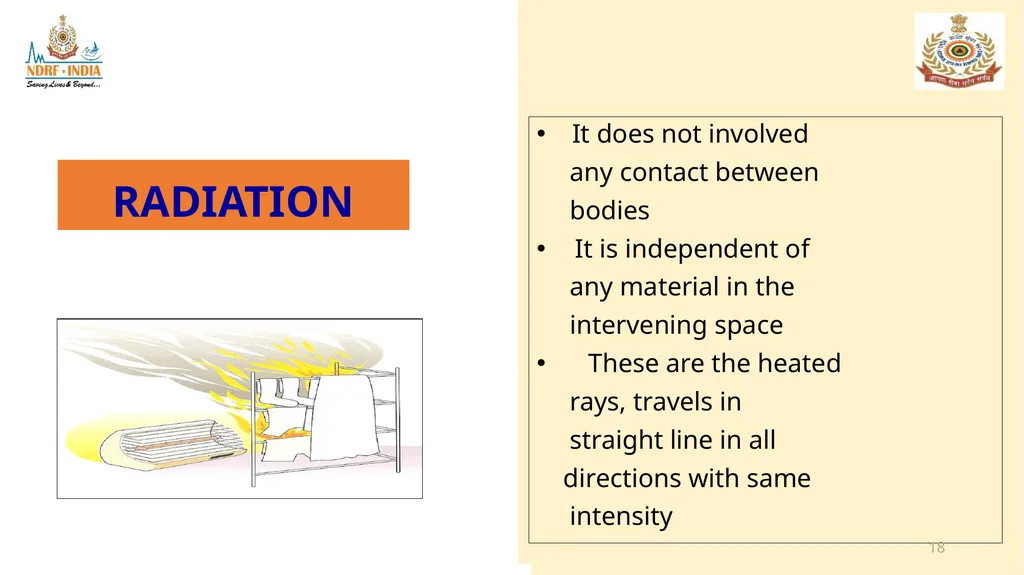
RADIATION It does not involved
any contact between
bodies
It is independent of
any material in the
intervening space
These are the heated
rays, travels in
straight line in all
directions with same
intensity 18<br>
any contact between
bodies
It is independent of
any material in the
intervening space
These are the heated
rays, travels in
straight line in all
directions with same
intensity 18<br>
19
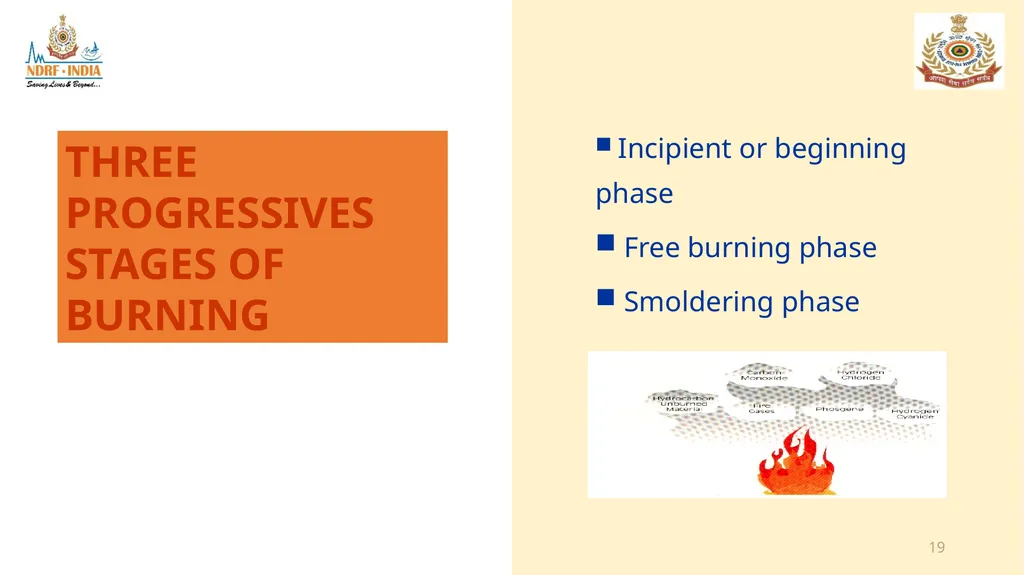
Incipient or beginning phase
Free burning phase
Smoldering phase 19 THREE PROGRESSIVES STAGES OF BURNING<br>
Free burning phase
Smoldering phase 19 THREE PROGRESSIVES STAGES OF BURNING<br>
20
PHASES OF BURNING It depends on the following factors
The amount of time the fire has burnt.
The ventilation characteristics of the confining structure
The amount and type of combustibles present. 20<br>
The amount of time the fire has burnt.
The ventilation characteristics of the confining structure
The amount and type of combustibles present. 20<br>
21
INCIPIENT OR BEGINNING PHASE Oxygen plentiful
Temperature has not built
up to high peak
Thermal updraft rises,
accumulates at highest point
Breathing not difficult
Fire extinguishments :
Direct application of water at base of fire. 21<br>
Temperature has not built
up to high peak
Thermal updraft rises,
accumulates at highest point
Breathing not difficult
Fire extinguishments :
Direct application of water at base of fire. 21<br>
22
FREE BURNING PHASE Fire has involved more fuel
Oxygen supply is being
depleted
Heat accumulated at upper
areas
Breathing difficult : Masks
recommended
Fire extinguishments is
reaching the area of major
involvement
Good steam production 22<br>
Oxygen supply is being
depleted
Heat accumulated at upper
areas
Breathing difficult : Masks
recommended
Fire extinguishments is
reaching the area of major
involvement
Good steam production 22<br>
23
SMOLDERING PHASE Oxygen supply not equal to demands of fire
Temperature throughout
building is very high
Normal breathing is not
possible
Maximum steam
production from water fog 23<br>
Temperature throughout
building is very high
Normal breathing is not
possible
Maximum steam
production from water fog 23<br>
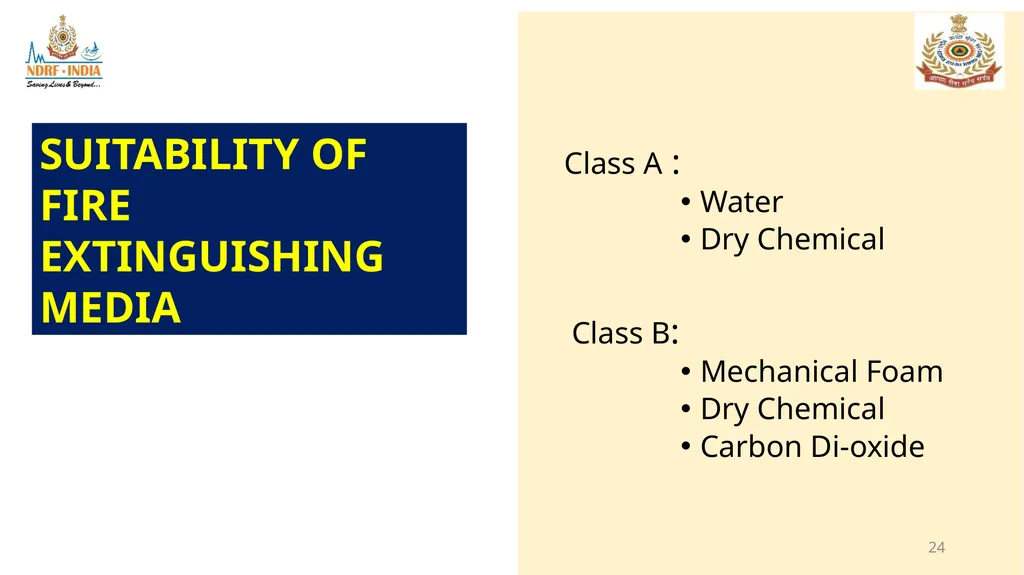
24
Class A :
Water
Dry Chemical
Class B:
Mechanical Foam
Dry Chemical
Carbon Di-oxide 24 SUITABILITY OF FIRE EXTINGUISHING MEDIA<br>
Water
Dry Chemical
Class B:
Mechanical Foam
Dry Chemical
Carbon Di-oxide 24 SUITABILITY OF FIRE EXTINGUISHING MEDIA<br>
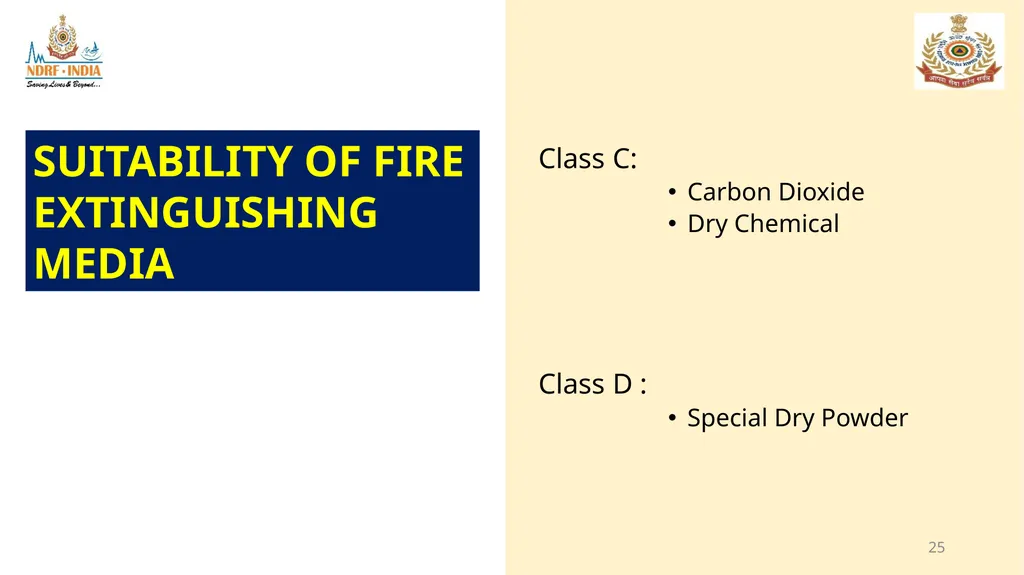
25
Class C:
Carbon Dioxide
Dry Chemical
Class D :
Special Dry Powder 25 SUITABILITY OF FIRE EXTINGUISHING MEDIA<br>
Carbon Dioxide
Dry Chemical
Class D :
Special Dry Powder 25 SUITABILITY OF FIRE EXTINGUISHING MEDIA<br>
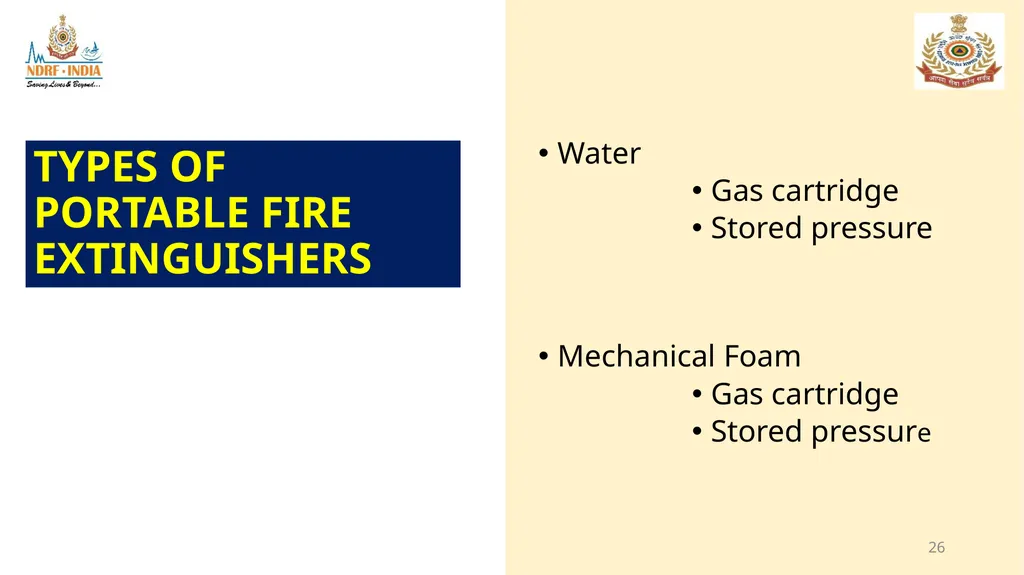
26
TYPES OF PORTABLE FIRE EXTINGUISHERS Water
Gas cartridge
Stored pressure
Mechanical Foam
Gas cartridge
Stored pressure 26<br>
Gas cartridge
Stored pressure
Mechanical Foam
Gas cartridge
Stored pressure 26<br>
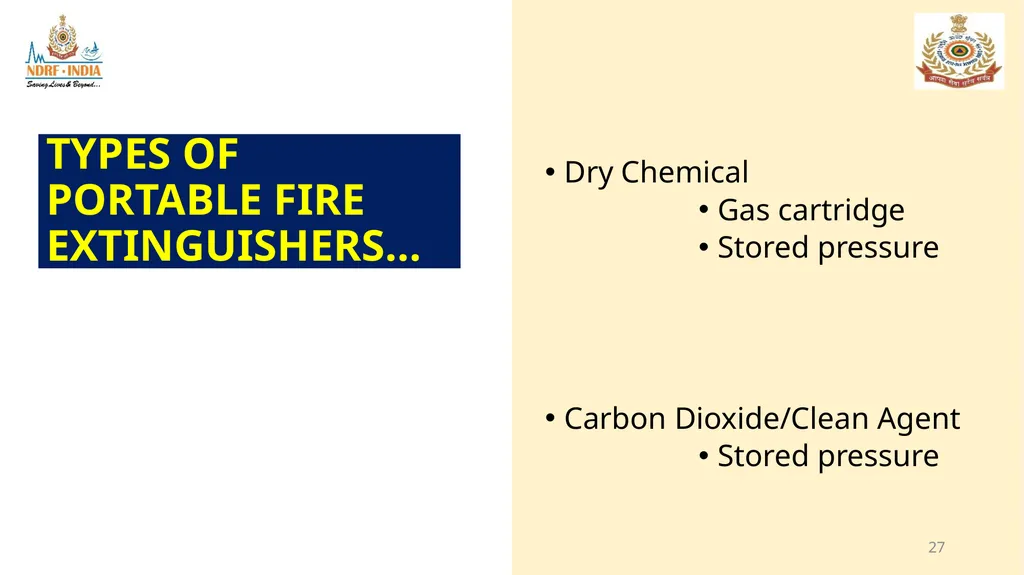
27
TYPES OF PORTABLE FIRE EXTINGUISHERS… Dry Chemical
Gas cartridge
Stored pressure
Carbon Dioxide/Clean Agent
Stored pressure 27<br>
Gas cartridge
Stored pressure
Carbon Dioxide/Clean Agent
Stored pressure 27<br>
28
CHARACTERISTICS OF FIRE EXTINGUISHER: In order that fire extinguishers are effective, they should:
be portable/light weight,
operate instantly,
have adequate throw,
have adequate quantity of extinguishant, and
have long shelf-life.<br>
be portable/light weight,
operate instantly,
have adequate throw,
have adequate quantity of extinguishant, and
have long shelf-life.<br>
29
SELECTION OF FIRE EXTINGUISHER:
(AS PER BIS) The basic types of fires can be grouped into following four classes:
Class A Fires: Fires involving solid combustible materials of organic nature such as wood, paper, rubber, plastics, etc,
Class B Fires: Fires involving flammable liquids or liquefiable solids or the like where a blanketing effect is essential.
Class C Fires: Fires involving flammable gases under pressure including liquefied gases.
Class D Fires: Fires involving combustible metals, such as magnesium, aluminum, zinc, sodium, potassium, etc,<br>
Class A Fires: Fires involving solid combustible materials of organic nature such as wood, paper, rubber, plastics, etc,
Class B Fires: Fires involving flammable liquids or liquefiable solids or the like where a blanketing effect is essential.
Class C Fires: Fires involving flammable gases under pressure including liquefied gases.
Class D Fires: Fires involving combustible metals, such as magnesium, aluminum, zinc, sodium, potassium, etc,<br>
30
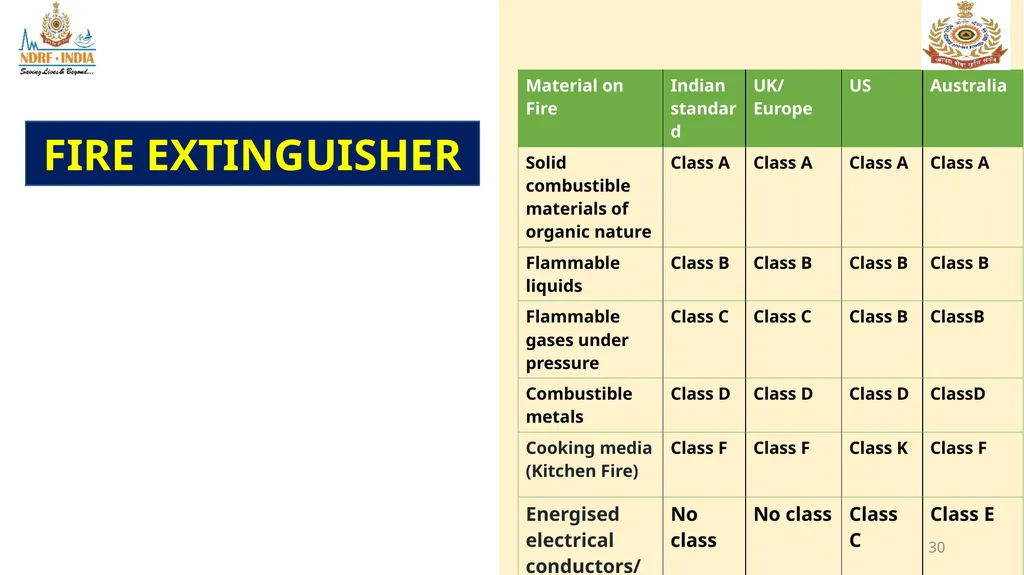
30 FIRE EXTINGUISHER<br>
31
NUMBER AND SIZE OF FIRE EXTINGUISHERS Considerations:
Severity of incipient fire anticipated
Rapidity of fire spread
Intensity of heat
Accessibility to fire
Type of extinguishers
The smoke contributed by burning materials
Special features of building construction
Nature of occupancy (single or mixed)
Electrical fitting, equipment installed<br>
Severity of incipient fire anticipated
Rapidity of fire spread
Intensity of heat
Accessibility to fire
Type of extinguishers
The smoke contributed by burning materials
Special features of building construction
Nature of occupancy (single or mixed)
Electrical fitting, equipment installed<br>
32
WATER Effective on class A fires
Advantage of being inexpensive, harmless, and relatively easy to clean up
has high heat capacity (4.2 J/g•K) and high latent heat of vaporization (2442 J/g) can absorb a significant quantity of heat from flames and fuels (cooling)
Water also expands 1700 times when it evaporates to steam, results in the dilution of the surrounding oxygen and fuel vapours 32<br>
Advantage of being inexpensive, harmless, and relatively easy to clean up
has high heat capacity (4.2 J/g•K) and high latent heat of vaporization (2442 J/g) can absorb a significant quantity of heat from flames and fuels (cooling)
Water also expands 1700 times when it evaporates to steam, results in the dilution of the surrounding oxygen and fuel vapours 32<br>
33
FOAM Applied to fuel fires as either an aspirated (mixed & expanded with air in a branch pipe) or;
Non-aspirated form to form a frothy blanket or seal over the fuel,
Preventing oxygen reaching it (smothering)
Foam can be used to progressively extinguish fires without flashback. 33<br>
Non-aspirated form to form a frothy blanket or seal over the fuel,
Preventing oxygen reaching it (smothering)
Foam can be used to progressively extinguish fires without flashback. 33<br>
34
WATER/FOAM (GAS CARTRIDGE) EXTINGUISHER Water for Class A fires and AFFF for Class A and B fires.
Spray nozzle
Polyester powder coating
Controlled discharge
Brass nickel plated head valve with simple squeeze operation
Rechargeable and easy maintenance
Capacity 9 litre, cylindrical shape
Upright operation
Rubber braided hose 34<br>
Spray nozzle
Polyester powder coating
Controlled discharge
Brass nickel plated head valve with simple squeeze operation
Rechargeable and easy maintenance
Capacity 9 litre, cylindrical shape
Upright operation
Rubber braided hose 34<br>
35
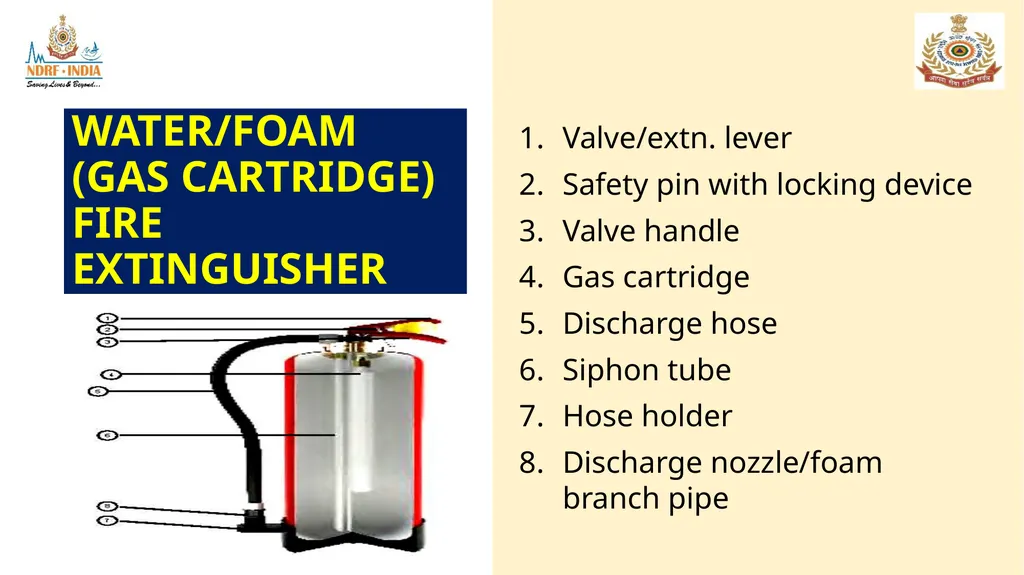
WATER/FOAM (GAS CARTRIDGE) FIRE EXTINGUISHER Valve/extn. lever
Safety pin with locking device
Valve handle
Gas cartridge
Discharge hose
Siphon tube
Hose holder
Discharge nozzle/foam branch pipe<br>
Safety pin with locking device
Valve handle
Gas cartridge
Discharge hose
Siphon tube
Hose holder
Discharge nozzle/foam branch pipe<br>
36
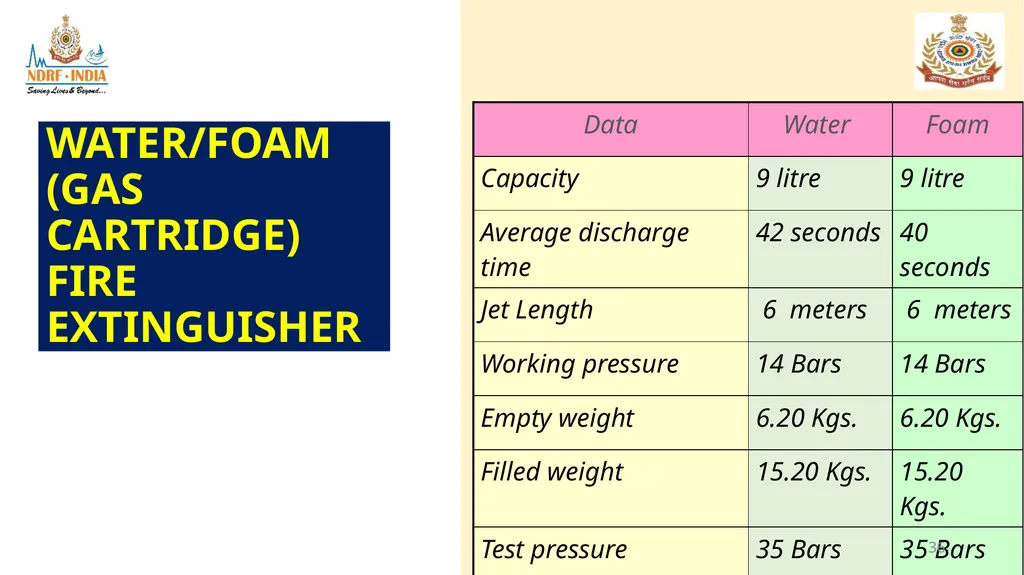
WATER/FOAM (GAS CARTRIDGE) FIRE EXTINGUISHER 36<br>
37
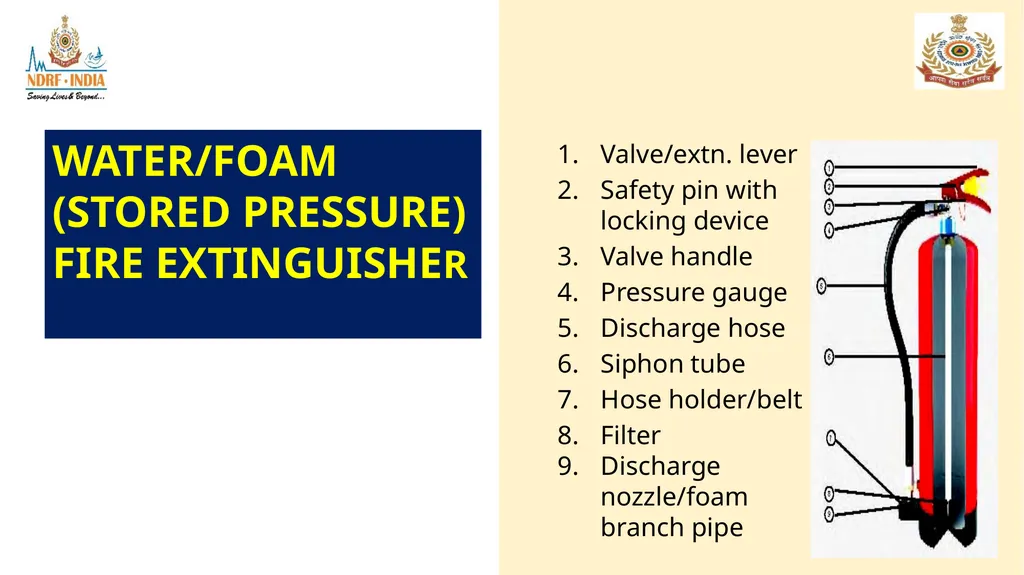
37 WATER/FOAM (STORED PRESSURE) FIRE EXTINGUISHER Valve/extn. lever
Safety pin with locking device
Valve handle
Pressure gauge
Discharge hose
Siphon tube
Hose holder/belt
Filter
Discharge nozzle/foam branch pipe<br>
Safety pin with locking device
Valve handle
Pressure gauge
Discharge hose
Siphon tube
Hose holder/belt
Filter
Discharge nozzle/foam branch pipe<br>
38
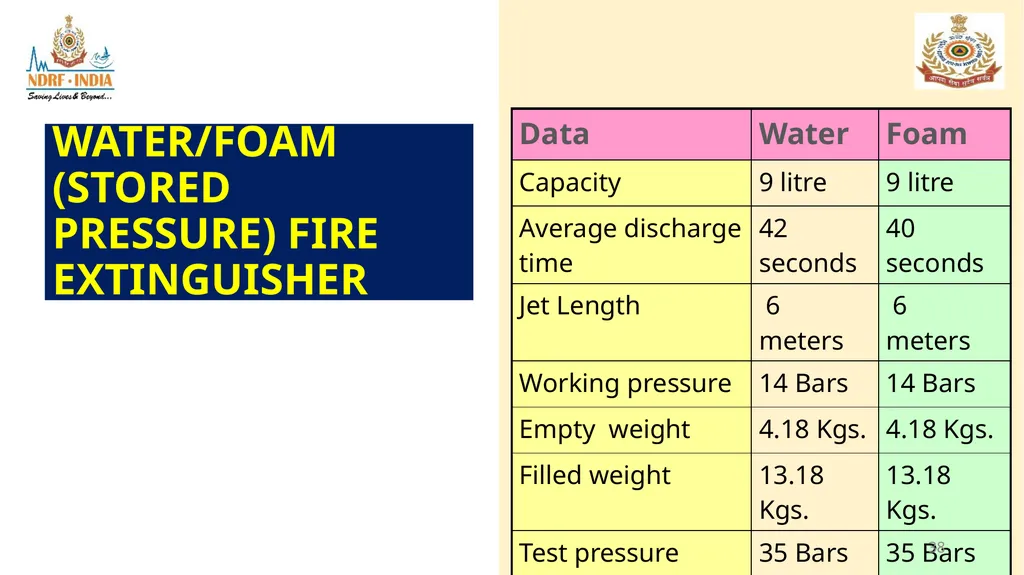
WATER/FOAM (STORED PRESSURE) FIRE EXTINGUISHER 38<br>
39
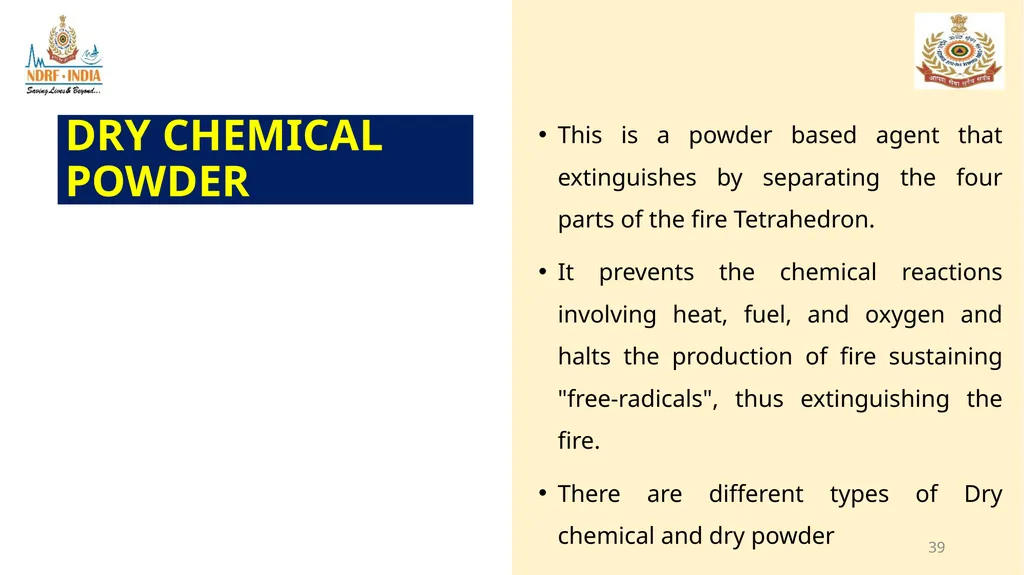
DRY CHEMICAL POWDER This is a powder based agent that extinguishes by separating the four parts of the fire Tetrahedron.
It prevents the chemical reactions involving heat, fuel, and oxygen and halts the production of fire sustaining "free-radicals", thus extinguishing the fire.
There are different types of Dry chemical and dry powder 39<br>
It prevents the chemical reactions involving heat, fuel, and oxygen and halts the production of fire sustaining "free-radicals", thus extinguishing the fire.
There are different types of Dry chemical and dry powder 39<br>
40
DRY CHEMICAL POWDER Mono-ammonium phosphate
Sodium Bicarbonate
Potassium Bicarbonate
Potassium Bicarbonate & Urea (Monnex/Powerex)
Met-l-kyl/Pyrokil 40<br>
Sodium Bicarbonate
Potassium Bicarbonate
Potassium Bicarbonate & Urea (Monnex/Powerex)
Met-l-kyl/Pyrokil 40<br>
41
DRY CHEMICAL POWDER a. Mono-ammonium phosphate, also known as "tri-class", "multipurpose" or "ABC" dry chemical
used on class A, B, and C fires.
more corrosive than other dry chemical agents.
Pale yellow in color 41<br>
used on class A, B, and C fires.
more corrosive than other dry chemical agents.
Pale yellow in color 41<br>
42
DRY CHEMICAL POWDER b. Sodium Bicarbonate, "regular" or "ordinary" used on class B and C fires
in the heat of a fire, it releases a cloud of carbon dioxide that smothers the fire.
white or blue in color 42<br>
in the heat of a fire, it releases a cloud of carbon dioxide that smothers the fire.
white or blue in color 42<br>
43
DRY CHEMICAL POWDER c. Potassium Bicarbonate
(Purple-K), used on class B and C fires
about two times as effective on class B fires as sodium bicarbonate
preferred dry chemical agent of the oil and gas industry.
colored violet to distinguish it. 43<br>
(Purple-K), used on class B and C fires
about two times as effective on class B fires as sodium bicarbonate
preferred dry chemical agent of the oil and gas industry.
colored violet to distinguish it. 43<br>
44
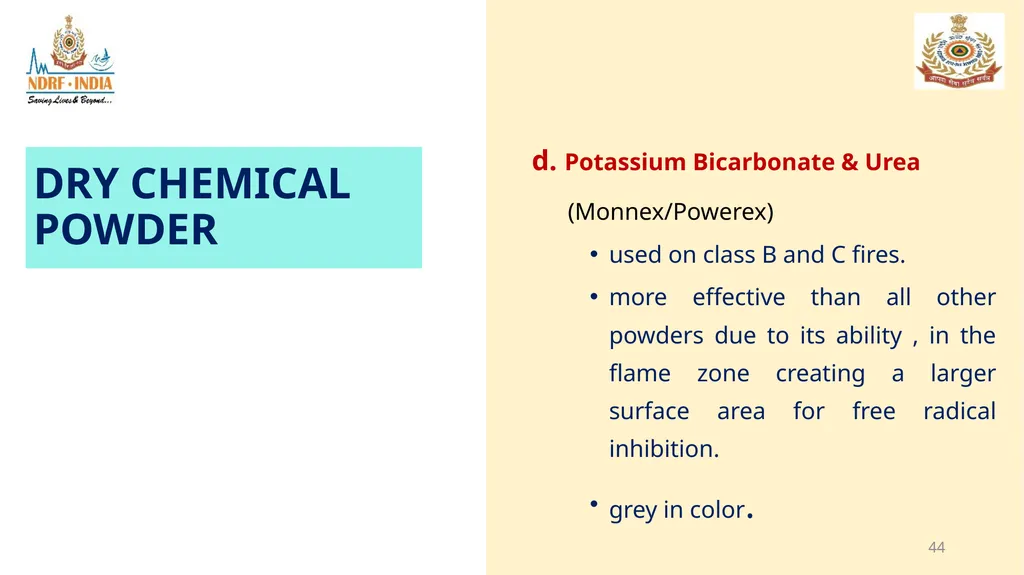
DRY CHEMICAL POWDER d. Potassium Bicarbonate & Urea
(Monnex/Powerex)
used on class B and C fires.
more effective than all other powders due to its ability , in the flame zone creating a larger surface area for free radical inhibition.
grey in color. 44<br>
(Monnex/Powerex)
used on class B and C fires.
more effective than all other powders due to its ability , in the flame zone creating a larger surface area for free radical inhibition.
grey in color. 44<br>
45
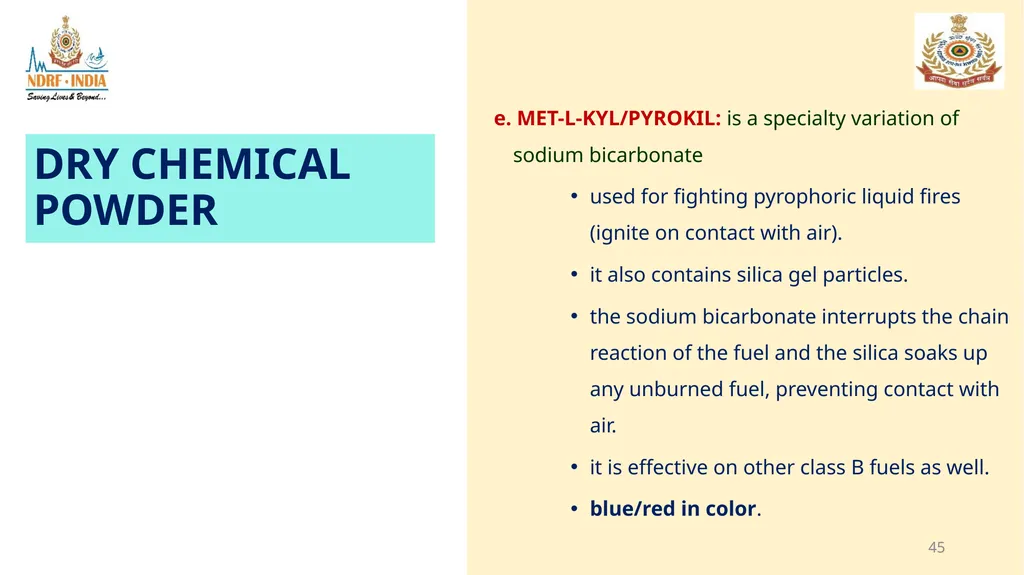
DRY CHEMICAL POWDER e. MET-L-KYL/PYROKIL: is a specialty variation of sodium bicarbonate
used for fighting pyrophoric liquid fires (ignite on contact with air).
it also contains silica gel particles.
the sodium bicarbonate interrupts the chain reaction of the fuel and the silica soaks up any unburned fuel, preventing contact with air.
it is effective on other class B fuels as well.
blue/red in color. 45<br>
used for fighting pyrophoric liquid fires (ignite on contact with air).
it also contains silica gel particles.
the sodium bicarbonate interrupts the chain reaction of the fuel and the silica soaks up any unburned fuel, preventing contact with air.
it is effective on other class B fuels as well.
blue/red in color. 45<br>
46
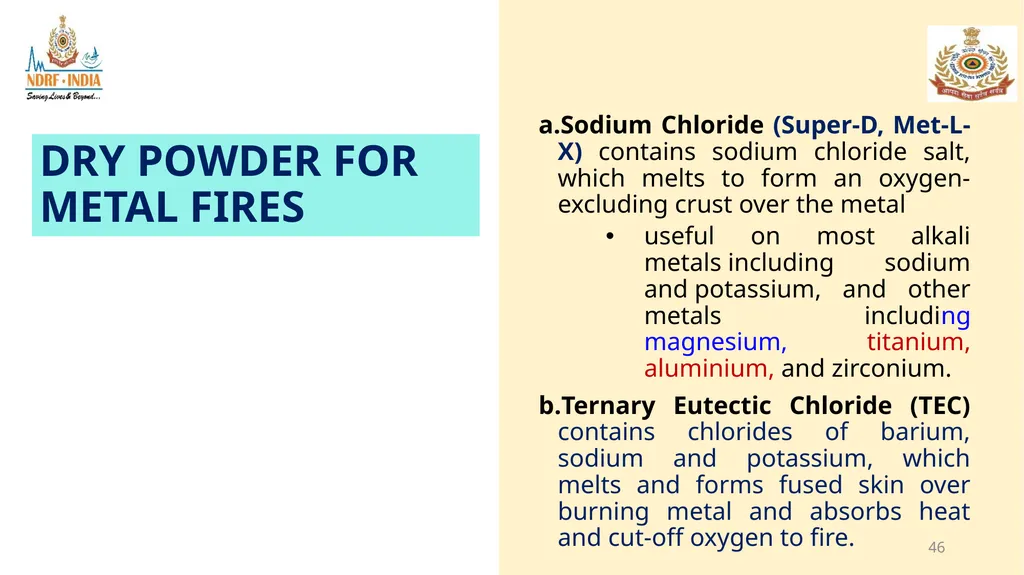
DRY POWDER FOR METAL FIRES Sodium Chloride (Super-D, Met-L-X) contains sodium chloride salt, which melts to form an oxygen-excluding crust over the metal
useful on most alkali metals including sodium and potassium, and other metals including magnesium, titanium, aluminium, and zirconium.
Ternary Eutectic Chloride (TEC) contains chlorides of barium, sodium and potassium, which melts and forms fused skin over burning metal and absorbs heat and cut-off oxygen to fire. 46<br>
useful on most alkali metals including sodium and potassium, and other metals including magnesium, titanium, aluminium, and zirconium.
Ternary Eutectic Chloride (TEC) contains chlorides of barium, sodium and potassium, which melts and forms fused skin over burning metal and absorbs heat and cut-off oxygen to fire. 46<br>
47
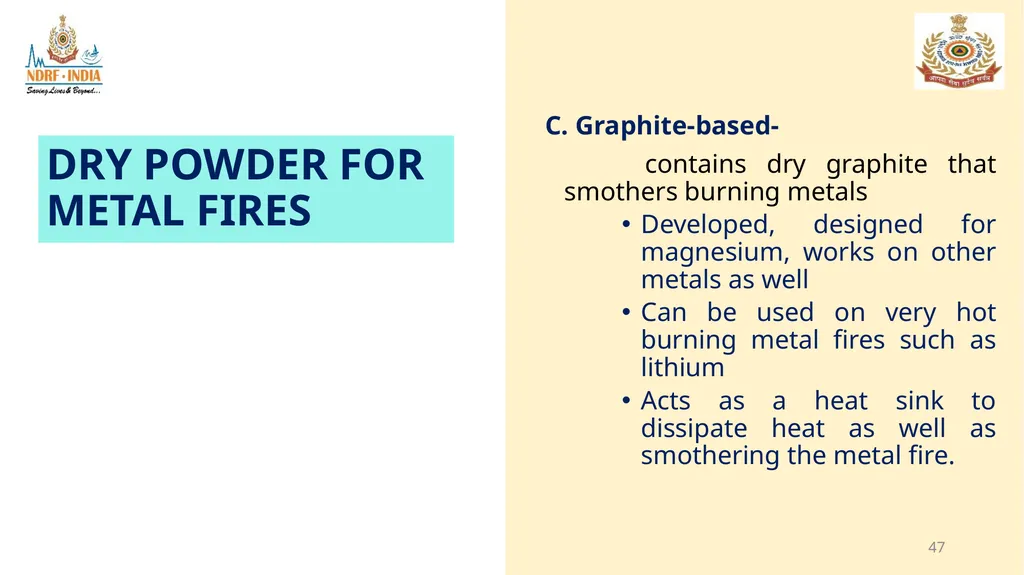
DRY POWDER FOR METAL FIRES C. Graphite-based-
contains dry graphite that smothers burning metals
Developed, designed for magnesium, works on other metals as well
Can be used on very hot burning metal fires such as lithium
Acts as a heat sink to dissipate heat as well as smothering the metal fire. 47<br>
contains dry graphite that smothers burning metals
Developed, designed for magnesium, works on other metals as well
Can be used on very hot burning metal fires such as lithium
Acts as a heat sink to dissipate heat as well as smothering the metal fire. 47<br>
48
DRY POWDER FOR METAL FIRES d. Sodium Carbonate-based (Na-X)
used where stainless steel piping and equipment could be damaged by sodium chloride based agents to control sodium, potassium, and sodium-potassium alloy fires.
limited use on other metals. Smothers and forms a crust. 48<br>
used where stainless steel piping and equipment could be damaged by sodium chloride based agents to control sodium, potassium, and sodium-potassium alloy fires.
limited use on other metals. Smothers and forms a crust. 48<br>
49
DRY CHEMICAL (GAS CARTRIDGE) EXTINGUISHER Polyester powder coating
Controlled discharge
Brass nickel plated head valve with simple squeeze operation
Rechargeable and easy maintenance
Capacity from 1 to 9 kg, cylindrical shape
Rubber braided hose
Upright operation 49<br>
Controlled discharge
Brass nickel plated head valve with simple squeeze operation
Rechargeable and easy maintenance
Capacity from 1 to 9 kg, cylindrical shape
Rubber braided hose
Upright operation 49<br>
50
DRY CHEMICAL (GAS CARTRIDGE) EXTINGUISHER 50 Valve/extn. lever
Safety pin with locking device
Valve handle
Gas cartridge
Discharge hose
Siphon tube inlet
Siphon tube outlet
Hose holder/belt
Discharge nozzle<br>
Safety pin with locking device
Valve handle
Gas cartridge
Discharge hose
Siphon tube inlet
Siphon tube outlet
Hose holder/belt
Discharge nozzle<br>
51
DRY CHEMICAL (GAS CARTRIDGE) EXTINGUISHER 51 SPECIFICATIONS<br>
52
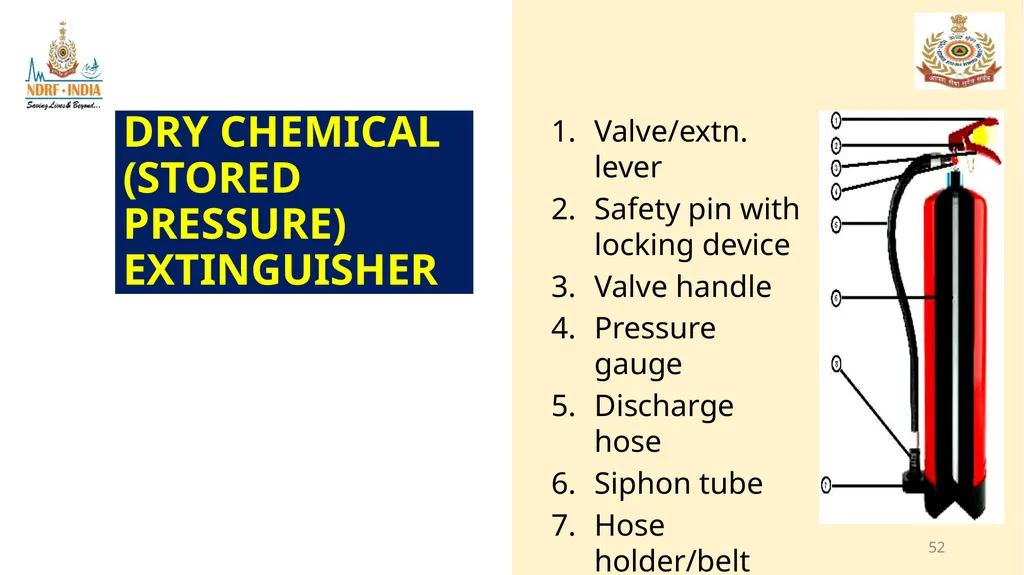
DRY CHEMICAL (STORED PRESSURE) EXTINGUISHER 52 Valve/extn. lever
Safety pin with locking device
Valve handle
Pressure gauge
Discharge hose
Siphon tube
Hose holder/belt
Discharge nozzle<br>
Safety pin with locking device
Valve handle
Pressure gauge
Discharge hose
Siphon tube
Hose holder/belt
Discharge nozzle<br>
53
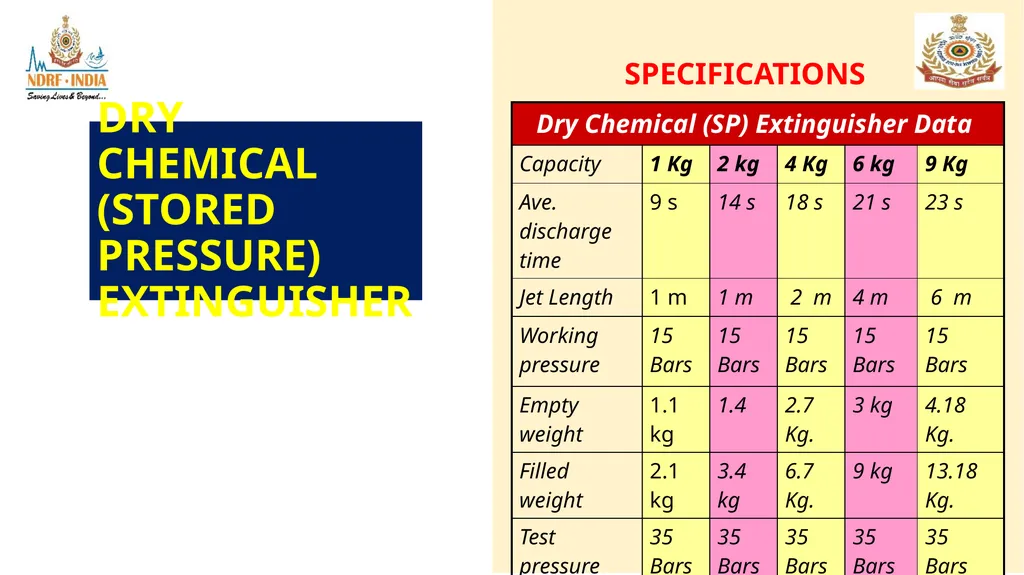
DRY CHEMICAL (STORED PRESSURE) EXTINGUISHER 53 SPECIFICATIONS<br>
54
CARBON DIOXIDE FIRE EXTINGUISHER it is a gas at standard temperature and pressure
carbon dioxide is colorless, non-toxic and odorless,
heavier than air, displaces oxygen (smothering)
non conductor of electricity,
non-residual gas - (clean agent) because they do not leave any residue after discharge 54 CHARACTERISTICS:<br>
carbon dioxide is colorless, non-toxic and odorless,
heavier than air, displaces oxygen (smothering)
non conductor of electricity,
non-residual gas - (clean agent) because they do not leave any residue after discharge 54 CHARACTERISTICS:<br>
55
CARBON DIOXIDE FIRE EXTINGUISHER This is ideal for sensitive electronics and documents.
This is not intended for class a fires, as the high-pressure cloud of gas can scatter burning materials.
CO2 is not suitable for use on fires containing their own oxygen source, metals or cooking media
Although it can be rather successful on a person on fire 55 CHARACTERISTICS:<br>
This is not intended for class a fires, as the high-pressure cloud of gas can scatter burning materials.
CO2 is not suitable for use on fires containing their own oxygen source, metals or cooking media
Although it can be rather successful on a person on fire 55 CHARACTERISTICS:<br>
56
CARBON DIOXIDE FIRE EXTINGUISHER Made of Manganese steel
Controlled discharge
Brass nickel plated head valve with simple squeeze operation
Rechargeable and easy maintenance
Capacity from 2 to 4.5 kg, cylindrical shape
Upright operation
Swivel horn with no cold burns 56<br>
Controlled discharge
Brass nickel plated head valve with simple squeeze operation
Rechargeable and easy maintenance
Capacity from 2 to 4.5 kg, cylindrical shape
Upright operation
Swivel horn with no cold burns 56<br>
57
CARBON DIOXIDE FIRE EXTINGUISHER 57 Valve/extn. lever
Safety pin with locking device
Valve handle
Discharge hose and horn
Siphon tube<br>
Safety pin with locking device
Valve handle
Discharge hose and horn
Siphon tube<br>
58
CARBON DIOXIDE FIRE EXTINGUISHER 58 SPECIFICATIONS<br>
59
CLEAN AGENT FIRE EXTINGUISHERS They are labelled clean agents because they do not leave any residue after discharge which is ideal for sensitive electronics and documents.
Removes heat from the combustion zone (Halotron, FE-36)
Inhibits chemical chain reaction (Halons) 59<br>
Removes heat from the combustion zone (Halotron, FE-36)
Inhibits chemical chain reaction (Halons) 59<br>
60
CLEAN AGENT FIRE EXTINGUISHERS 60 SPECIFICATIONS<br>
61
WATER MIST + CAFS The term "water mist" refers to fine water sprays in which 99% of the volume of the spray is in drops with diameters less than 1000 microns
Is very efficient in controlling liquid and solid fuel fires, and suppressing hydrocarbon mist explosions, and Live Electrical Fire up to 1000 Volts
no toxic, asphyxiation and environmental problems;
low system cost; limited or no water damage
high efficiency in suppressing certain fires. 61 CAFS—compressed Air Foam System<br>
Is very efficient in controlling liquid and solid fuel fires, and suppressing hydrocarbon mist explosions, and Live Electrical Fire up to 1000 Volts
no toxic, asphyxiation and environmental problems;
low system cost; limited or no water damage
high efficiency in suppressing certain fires. 61 CAFS—compressed Air Foam System<br>
62
WATER MIST + CAFS… Primary extinguishment mechanism
heat extraction
cooling of fire plume
wetting/cooling of the fuel surface
displacement
displacement of oxygen
dilution of fuel vapour 62<br>
heat extraction
cooling of fire plume
wetting/cooling of the fuel surface
displacement
displacement of oxygen
dilution of fuel vapour 62<br>
63
MODULAR EXTINGUISHER Provides concentrated fire protection for vital equipment
Highly cost effective compared to fixed fire protection system
Portable unit
Automated and reliable security round the clock
Provides security in case of fire and power failure without power back-up
Rechargeable and easy to service 63<br>
Highly cost effective compared to fixed fire protection system
Portable unit
Automated and reliable security round the clock
Provides security in case of fire and power failure without power back-up
Rechargeable and easy to service 63<br>
64
FIRE EXTINGUISHING BALL Several modern ball or "grenade" style extinguishers are on the market.
They are manually operated by rolling or throwing into a fire.
The modern version of the ball will self-destruct once in contact with flame, dispersing a cloud of ABC dry chemical powder over the fire which extinguishes the flame. 64<br>
They are manually operated by rolling or throwing into a fire.
The modern version of the ball will self-destruct once in contact with flame, dispersing a cloud of ABC dry chemical powder over the fire which extinguishes the flame. 64<br>
65
FIRE EXTINGUISHING BALL… The coverage area is about 5 square meters.
One benefit of this type is that it may be used for passive suppression. The ball can be placed in a fire prone area and will deploy automatically if a fire develops, being triggered by heat.
Most modern extinguishers of this type are designed to make a loud noise upon deployment 65<br>
One benefit of this type is that it may be used for passive suppression. The ball can be placed in a fire prone area and will deploy automatically if a fire develops, being triggered by heat.
Most modern extinguishers of this type are designed to make a loud noise upon deployment 65<br>
66
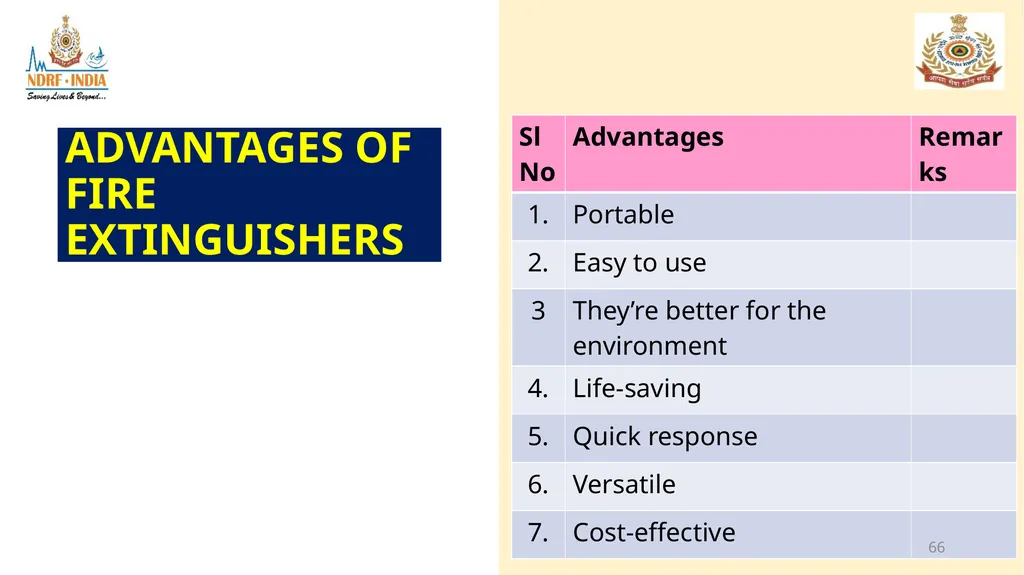
ADVANTAGES OF FIRE EXTINGUISHERS 66<br>
67
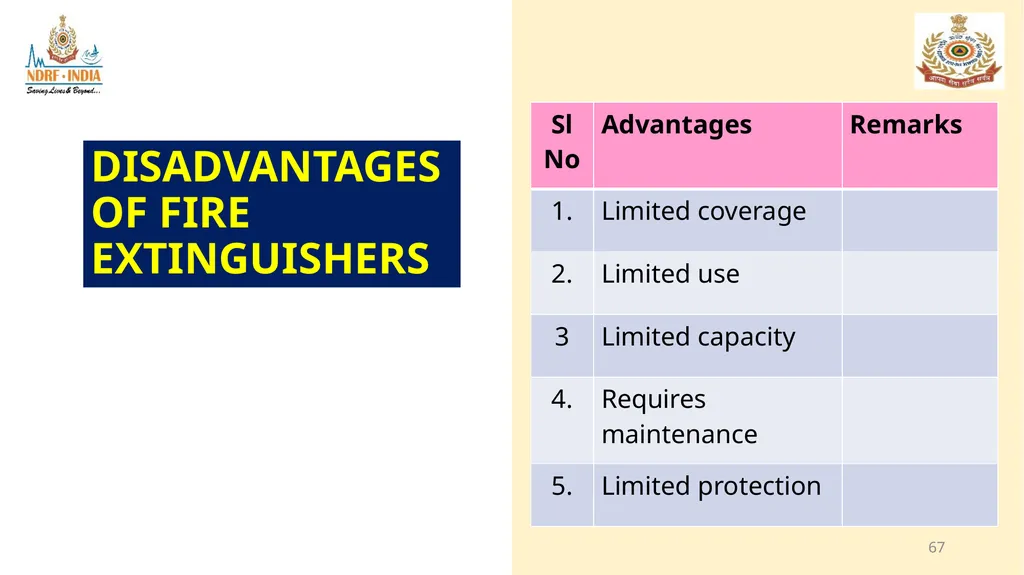
DISADVANTAGES OF FIRE EXTINGUISHERS 67<br>
68
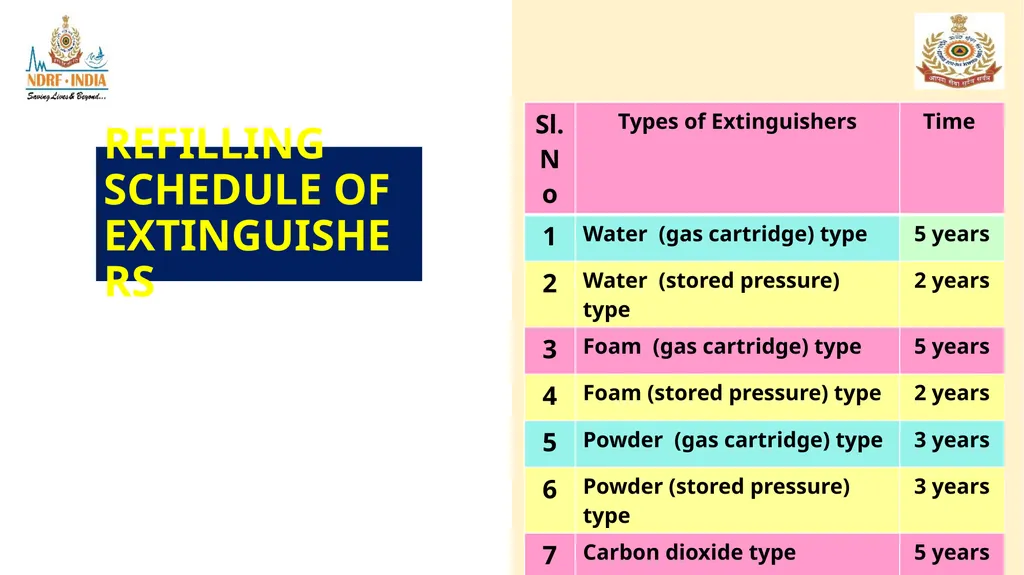
REFILLING SCHEDULE OF EXTINGUISHERS 68<br>
69
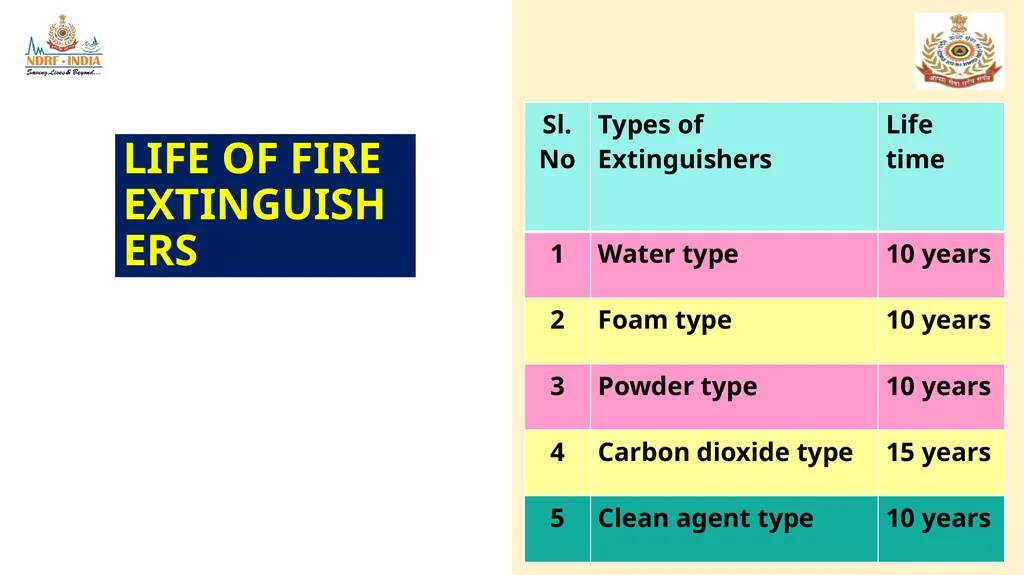
LIFE OF FIRE EXTINGUISHERS 69<br>
70
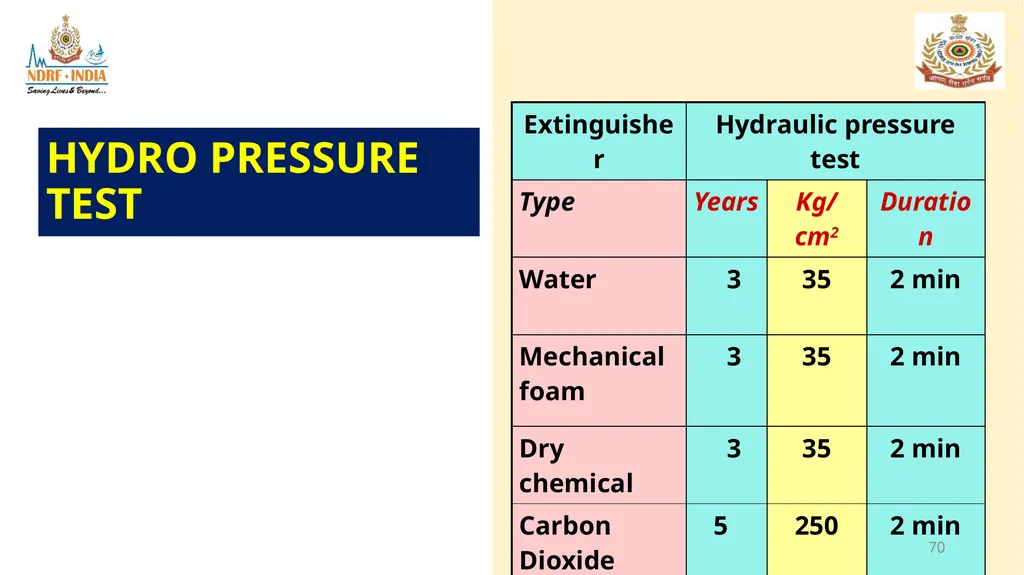
HYDRO PRESSURE TEST 70<br>
71
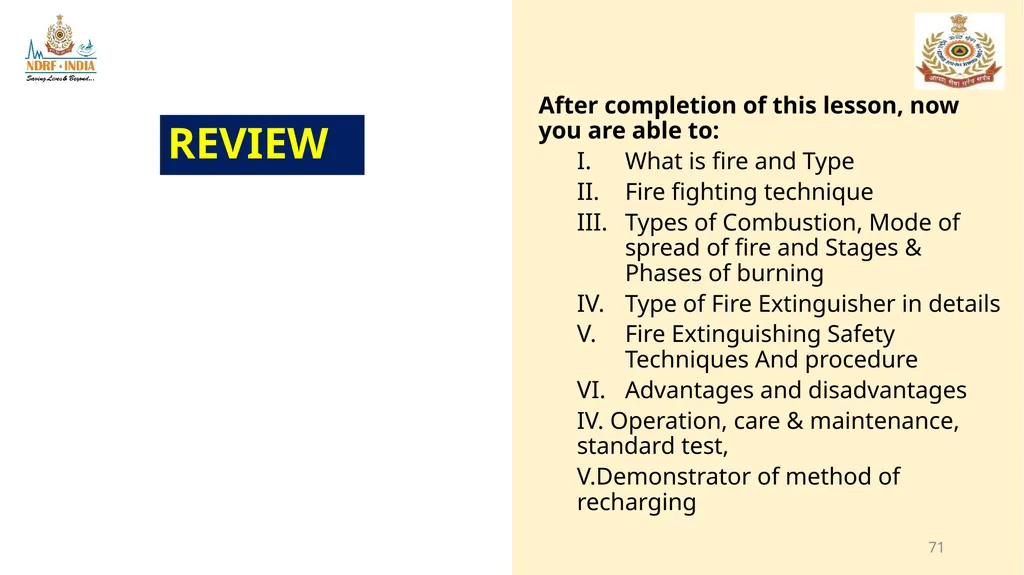
REVIEW After completion of this lesson, now you are able to:
What is fire and Type
Fire fighting technique
Types of Combustion, Mode of spread of fire and Stages & Phases of burning
Type of Fire Extinguisher in details
Fire Extinguishing Safety Techniques And procedure
Advantages and disadvantages
IV. Operation, care & maintenance, standard test,
V.Demonstrator of method of recharging 71<br>
What is fire and Type
Fire fighting technique
Types of Combustion, Mode of spread of fire and Stages & Phases of burning
Type of Fire Extinguisher in details
Fire Extinguishing Safety Techniques And procedure
Advantages and disadvantages
IV. Operation, care & maintenance, standard test,
V.Demonstrator of method of recharging 71<br>