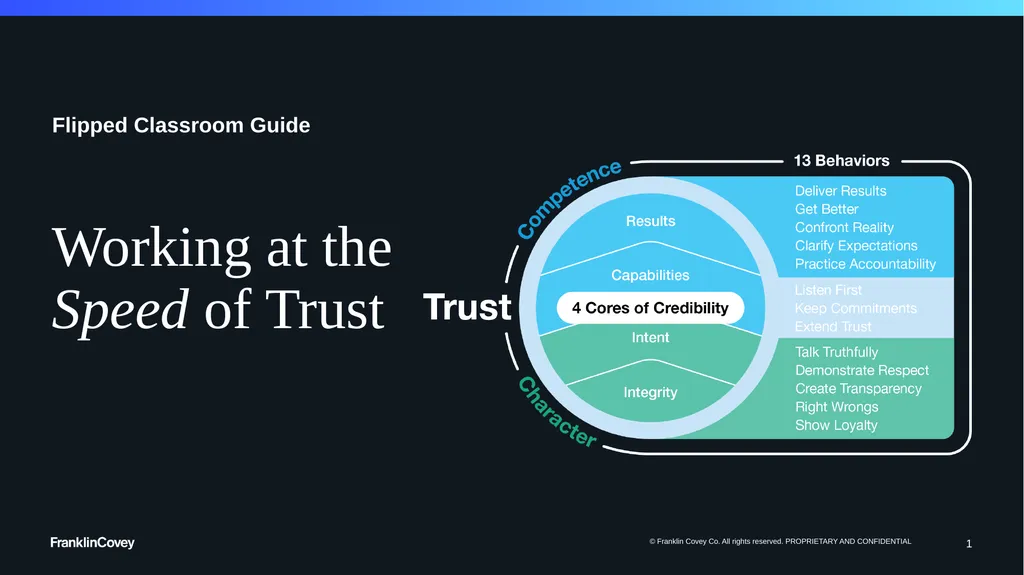
1 Flipped Classroom Guide Working at the Speed of Trust Discussion Session Components 2 Kick-Off Session 1 (date) The Case for Trust Session 2 (date) Be a High-Trust Contributor Session 3 (date) Extend, Restore, and Develop Trust 3
"1 Flipped Classroom Guide Working at the Speed of" is the property of its rightful owner. Permission is granted to
download and print the materials on this website for personal, non-commercial use only, and to display it
on your personal computer provided you do not modify the materials and that you retain all copyright
notices contained in the materials. By downloading content from our website, you accept the terms of this
agreement.
Presentation Transcript
01
1 Flipped Classroom Guide Working at the
Speed of Trust<br>
02
Discussion Session Components 2 Kick-Off
Session 1 – (date)
The Case for Trust
Session 2 – (date)
Be a High-Trust Contributor
Session 3 – (date)
Extend, Restore, and Develop Trust<br>
03
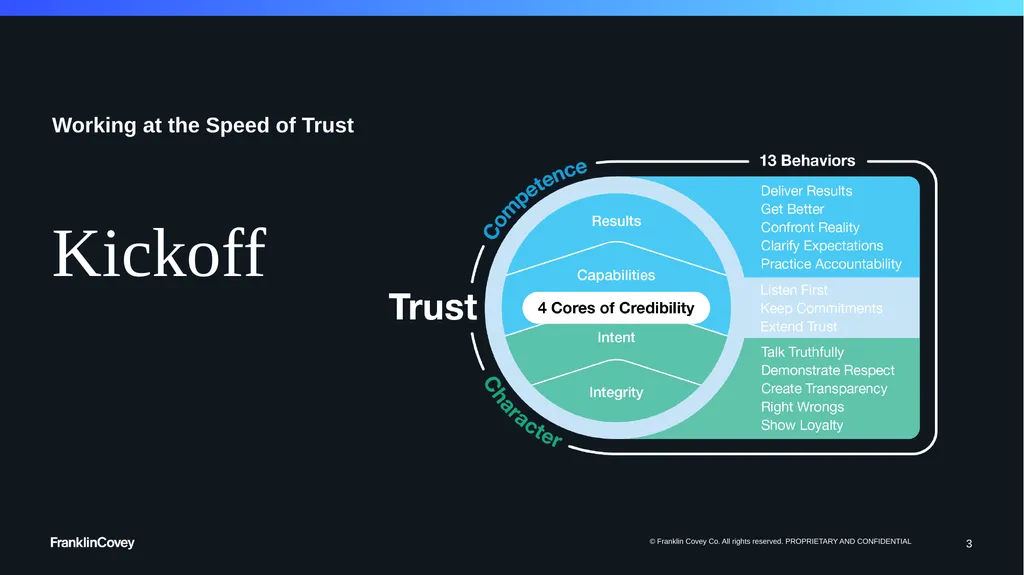
3 Working at the Speed of Trust Kickoff<br>
04
Include the main purpose for the session, how will these skills improve their work and the business, what are your goals for the course and how will you measure success. Share any information on how these skills and their work contributes to the larger organizational goals. 4 Purpose<br>
05
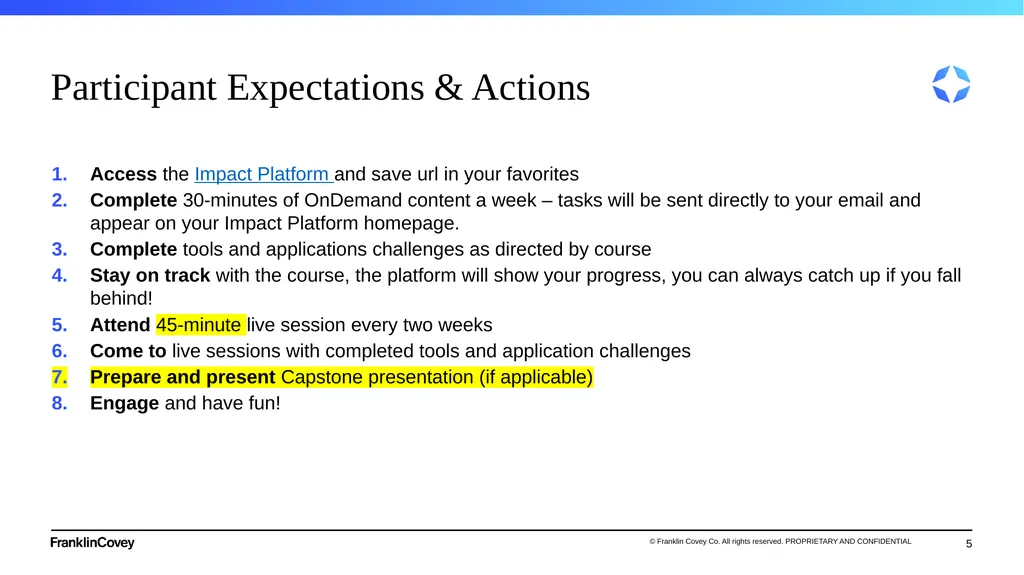
Participant Expectations & Actions 5 Access the Impact Platform and save url in your favorites
Complete 30-minutes of OnDemand content a week – tasks will be sent directly to your email and appear on your Impact Platform homepage.
Complete tools and applications challenges as directed by course
Stay on track with the course, the platform will show your progress, you can always catch up if you fall behind!
Attend 45-minute live session every two weeks
Come to live sessions with completed tools and application challenges
Prepare and present Capstone presentation (if applicable)
Engage and have fun!<br>
06
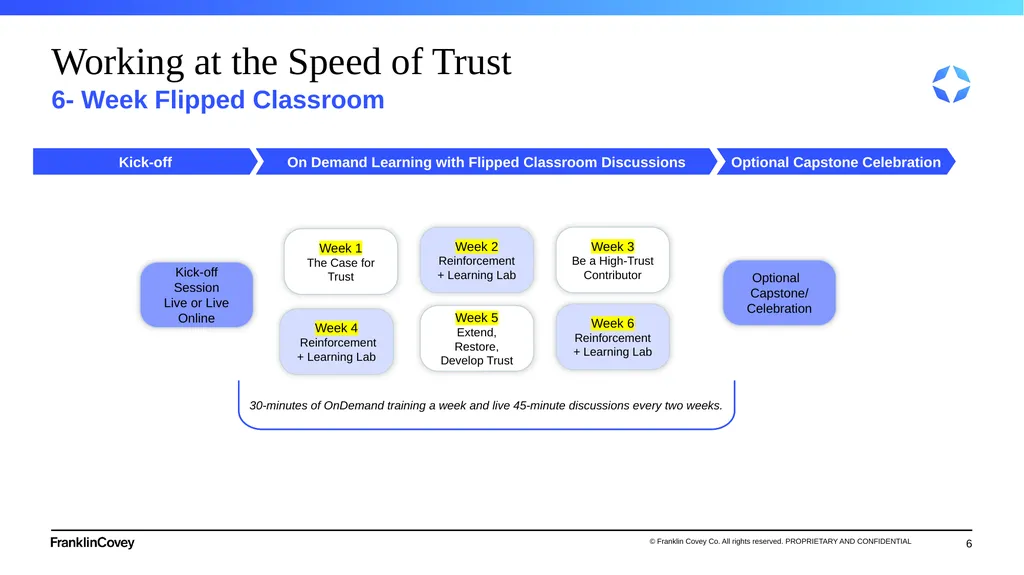
6 Working at the Speed of Trust
6- Week Flipped Classroom 30-minutes of OnDemand training a week and live 45-minute discussions every two weeks.<br>
07
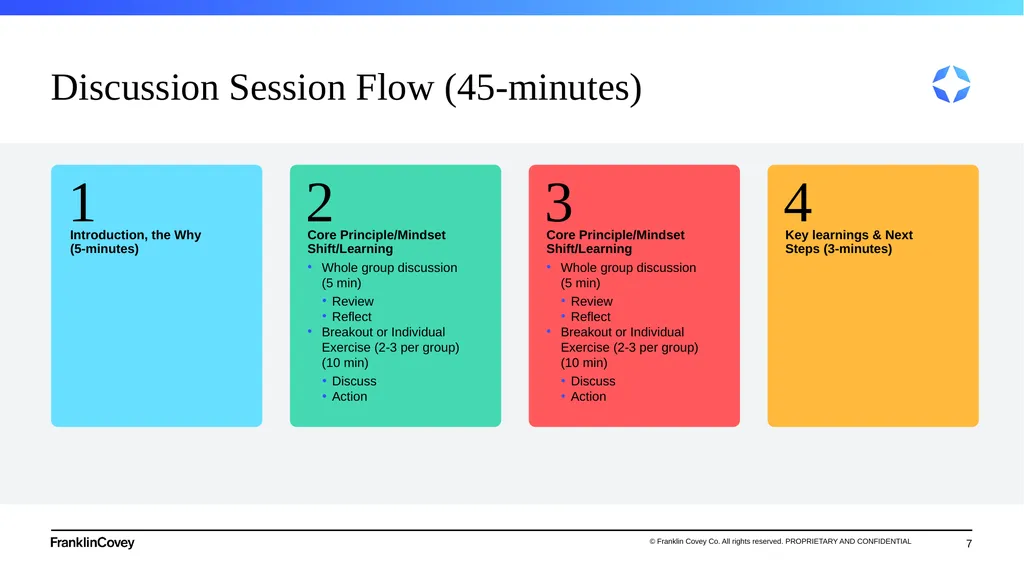
Discussion Session Flow (45-minutes) 7 Introduction, the Why (5-minutes) 1 Core Principle/Mindset Shift/Learning
Whole group discussion (5 min)
Review
Reflect
Breakout or Individual Exercise (2-3 per group) (10 min)
Discuss
Action 2 Core Principle/Mindset Shift/Learning
Whole group discussion (5 min)
Review
Reflect
Breakout or Individual Exercise (2-3 per group) (10 min)
Discuss
Action 3 Key learnings & Next Steps (3-minutes) 4<br>
08
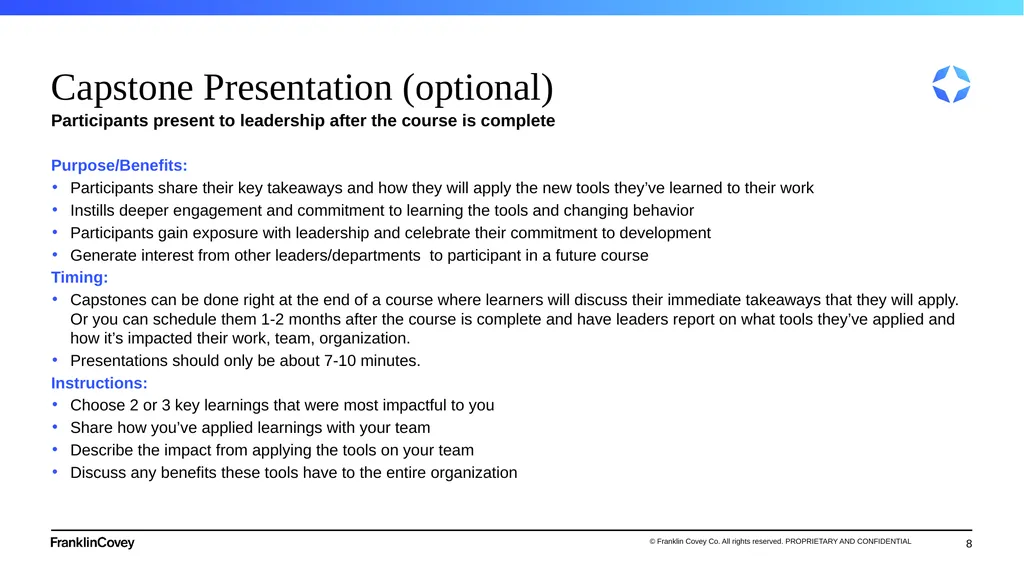
Purpose/Benefits:
Participants share their key takeaways and how they will apply the new tools they’ve learned to their work
Instills deeper engagement and commitment to learning the tools and changing behavior
Participants gain exposure with leadership and celebrate their commitment to development
Generate interest from other leaders/departments to participant in a future course
Timing:
Capstones can be done right at the end of a course where learners will discuss their immediate takeaways that they will apply. Or you can schedule them 1-2 months after the course is complete and have leaders report on what tools they’ve applied and how it’s impacted their work, team, organization.
Presentations should only be about 7-10 minutes.
Instructions:
Choose 2 or 3 key learnings that were most impactful to you
Share how you’ve applied learnings with your team
Describe the impact from applying the tools on your team
Discuss any benefits these tools have to the entire organization 8 Capstone Presentation (optional) Participants present to leadership after the course is complete<br>
09
Discussion Sessions Discussion
Sessions<br>
10
Module 1
The Case for Trust Working at the Speed of Trust<br>
11
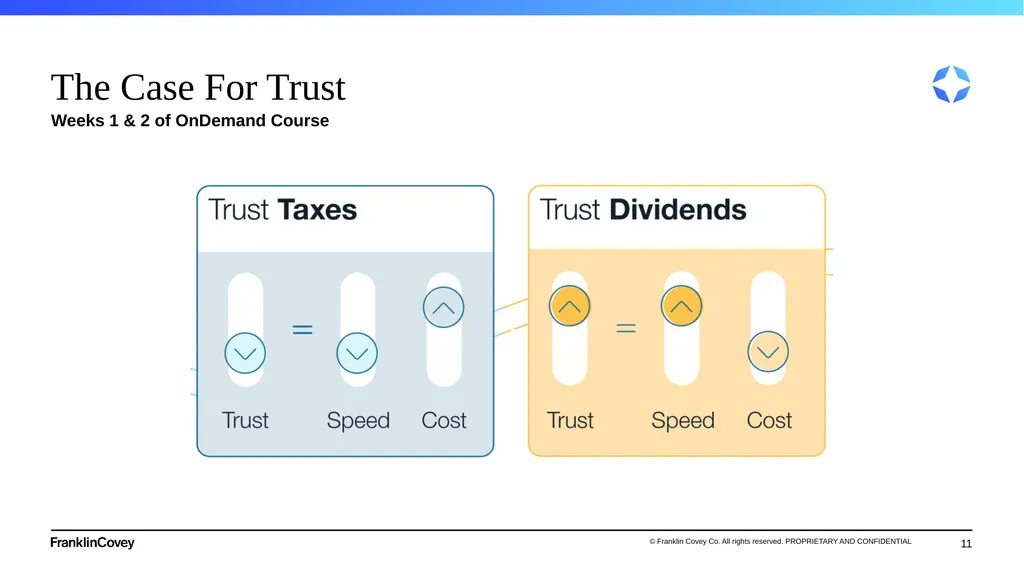
11 The Case For Trust Weeks 1 & 2 of OnDemand Course<br>
12
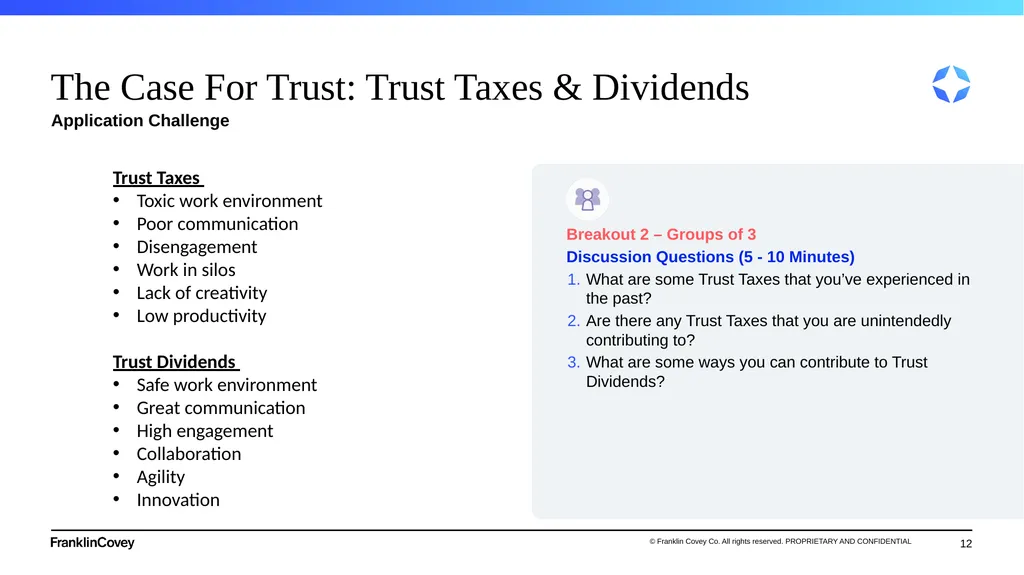
Breakout 2 – Groups of 3
Discussion Questions (5 - 10 Minutes)
What are some Trust Taxes that you’ve experienced in the past?
Are there any Trust Taxes that you are unintendedly contributing to?
What are some ways you can contribute to Trust Dividends? 12 The Case For Trust: Trust Taxes & Dividends Application Challenge Trust Taxes
Toxic work environment
Poor communication
Disengagement
Work in silos
Lack of creativity
Low productivity
Trust Dividends
Safe work environment
Great communication
High engagement
Collaboration
Agility
Innovation<br>
13
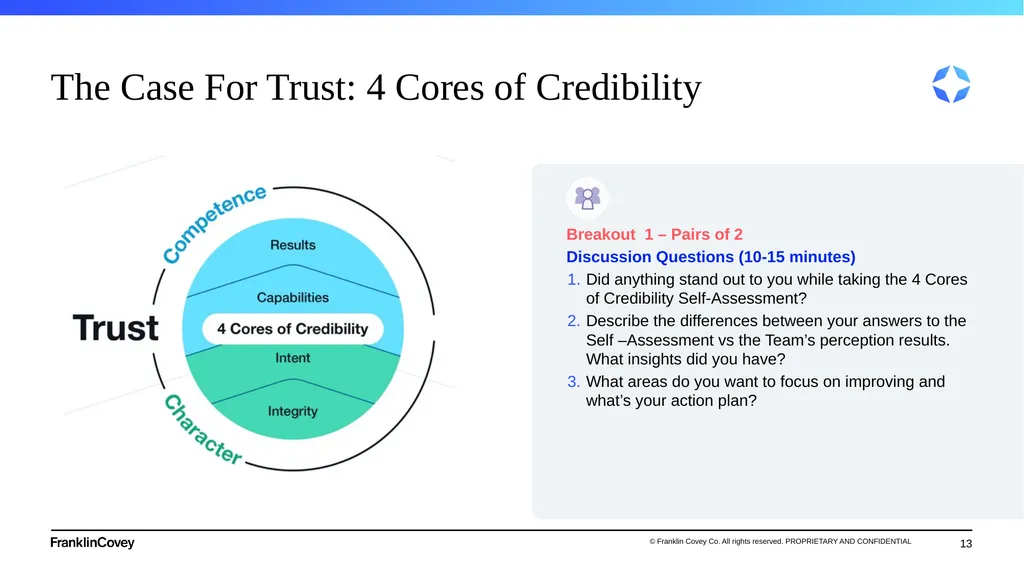
Breakout 1 – Pairs of 2
Discussion Questions (10-15 minutes)
Did anything stand out to you while taking the 4 Cores of Credibility Self-Assessment?
Describe the differences between your answers to the Self –Assessment vs the Team’s perception results. What insights did you have?
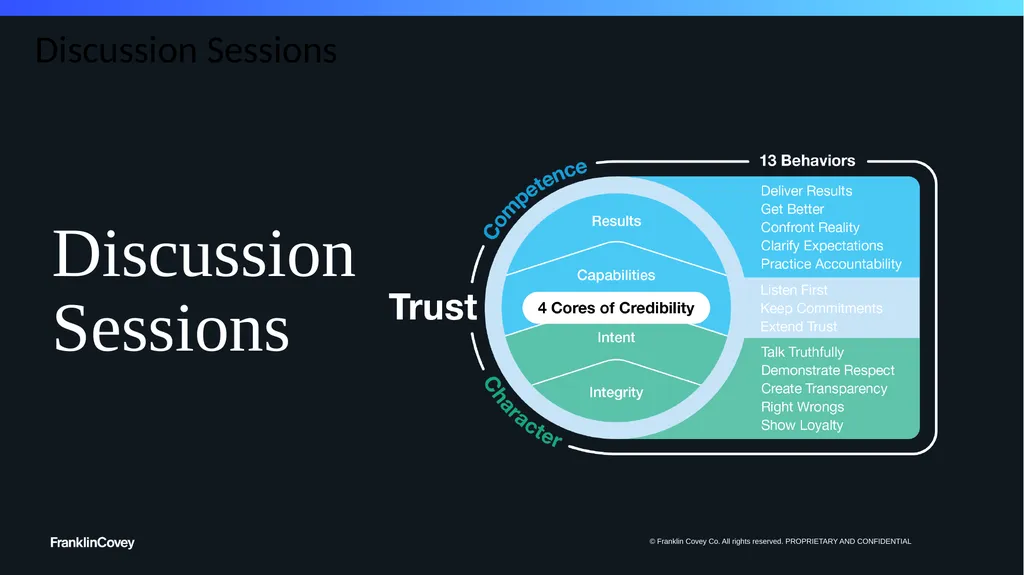
What areas do you want to focus on improving and what’s your action plan? 13 The Case For Trust: 4 Cores of Credibility<br>
14
Module 2
Be a high-trust contributor Working at the Speed of Trust<br>
15
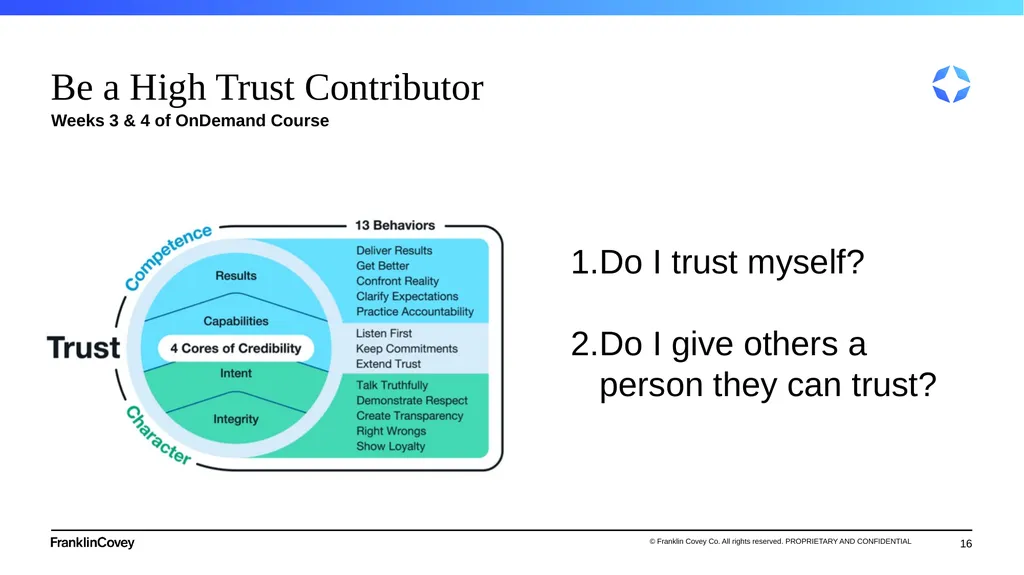
16 Be a High Trust Contributor Weeks 3 & 4 of OnDemand Course Effective Mindset:
I see potential when I look for it. Do I trust myself?
Do I give others a person they can trust?<br>
16
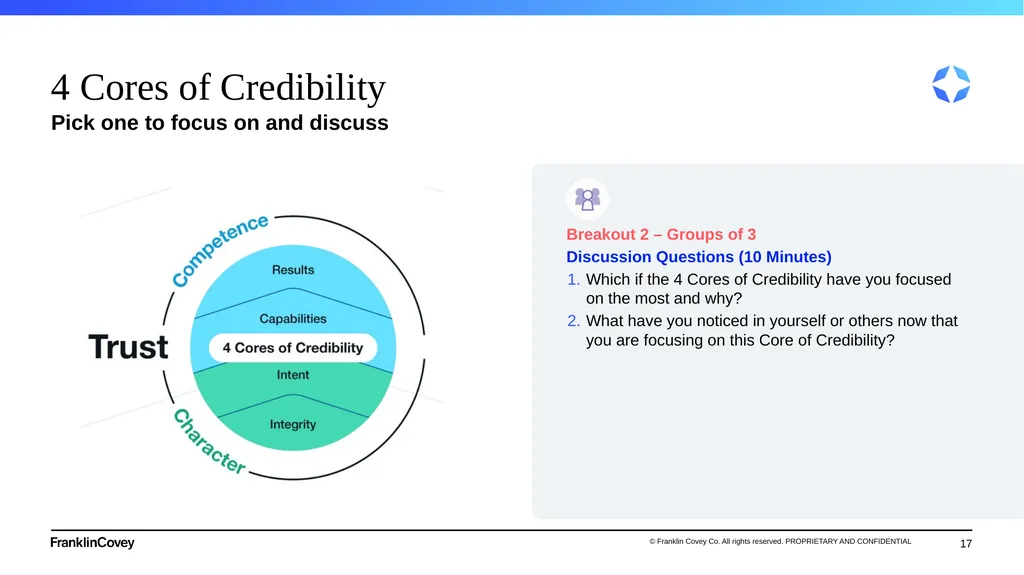
Breakout 2 – Groups of 3
Discussion Questions (10 Minutes)
Which if the 4 Cores of Credibility have you focused on the most and why?
What have you noticed in yourself or others now that you are focusing on this Core of Credibility? 17 4 Cores of Credibility Pick one to focus on and discuss<br>
17
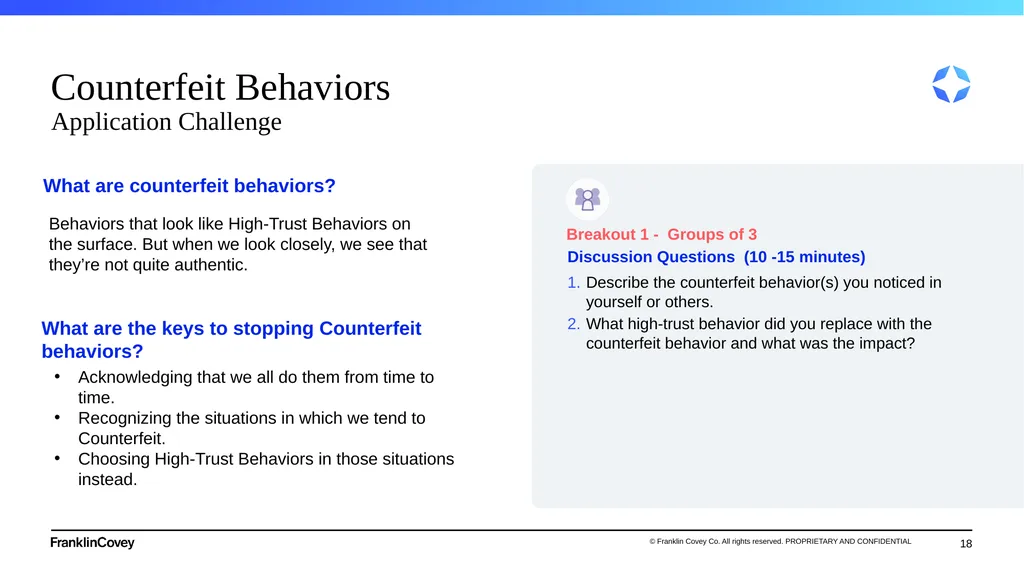
Breakout 1 - Groups of 3
Discussion Questions (10 -15 minutes)
Describe the counterfeit behavior(s) you noticed in yourself or others.
What high-trust behavior did you replace with the counterfeit behavior and what was the impact? 18 Counterfeit Behaviors Application Challenge What are counterfeit behaviors? What are the keys to stopping Counterfeit behaviors? Acknowledging that we all do them from time to time.
Recognizing the situations in which we tend to Counterfeit.
Choosing High-Trust Behaviors in those situations instead. Behaviors that look like High-Trust Behaviors on the surface. But when we look closely, we see that they’re not quite authentic.<br>
18
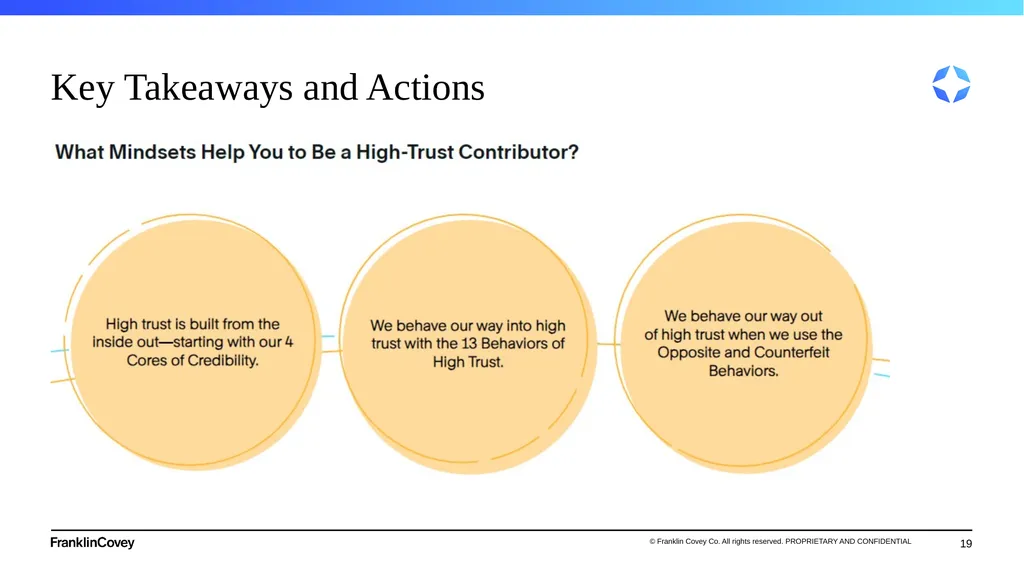
19 Key Takeaways and Actions<br>
19
Module 3
Extend, Restore, and Develop Trust Working at the Speed of Trust<br>
20
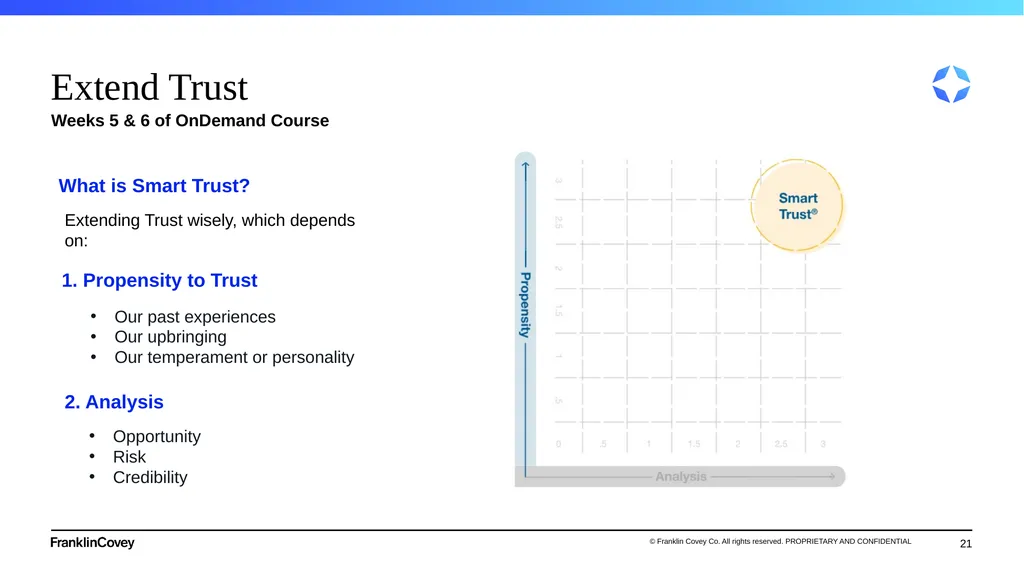
21 Extend Trust Weeks 5 & 6 of OnDemand Course What is Smart Trust? 1. Propensity to Trust 2. Analysis Extending Trust wisely, which depends on: Our past experiences
Our upbringing
Our temperament or personality Opportunity
Risk
Credibility<br>
21
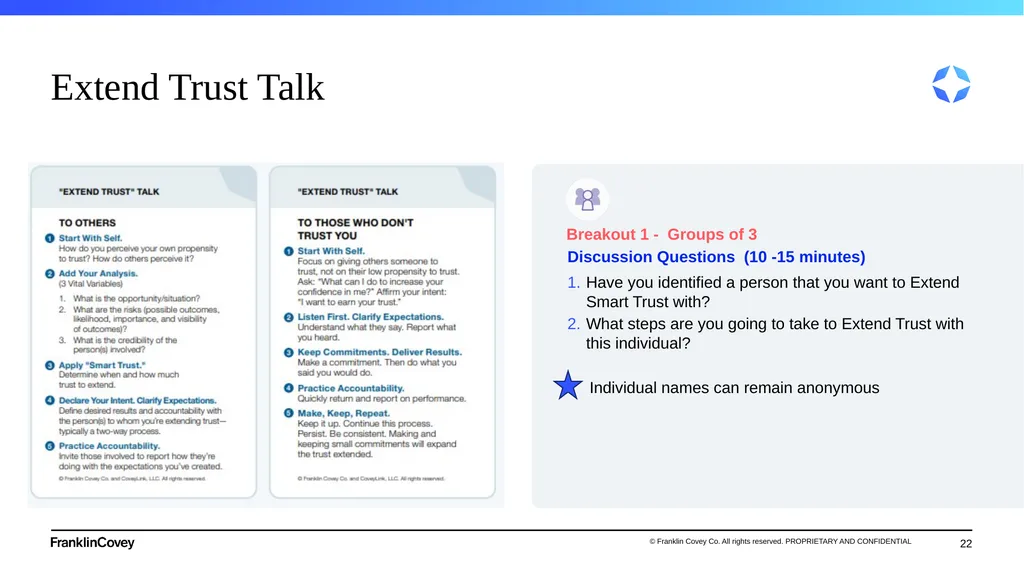
Breakout 1 - Groups of 3
Discussion Questions (10 -15 minutes)
Have you identified a person that you want to Extend Smart Trust with?
What steps are you going to take to Extend Trust with this individual?
Individual names can remain anonymous 22 Extend Trust Talk<br>
22
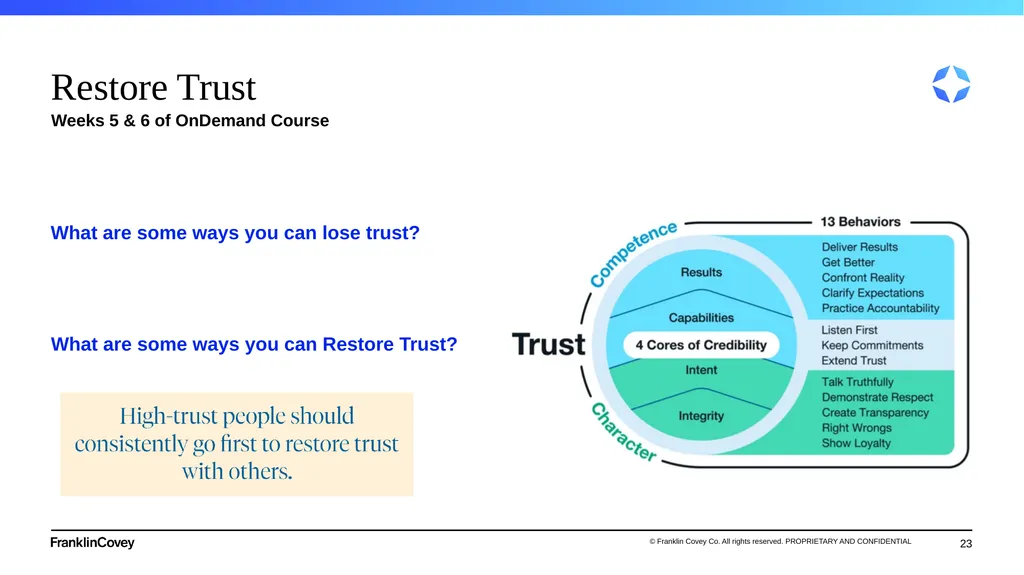
23 Restore Trust Weeks 5 & 6 of OnDemand Course What are some ways you can lose trust? What are some ways you can Restore Trust?<br>
23
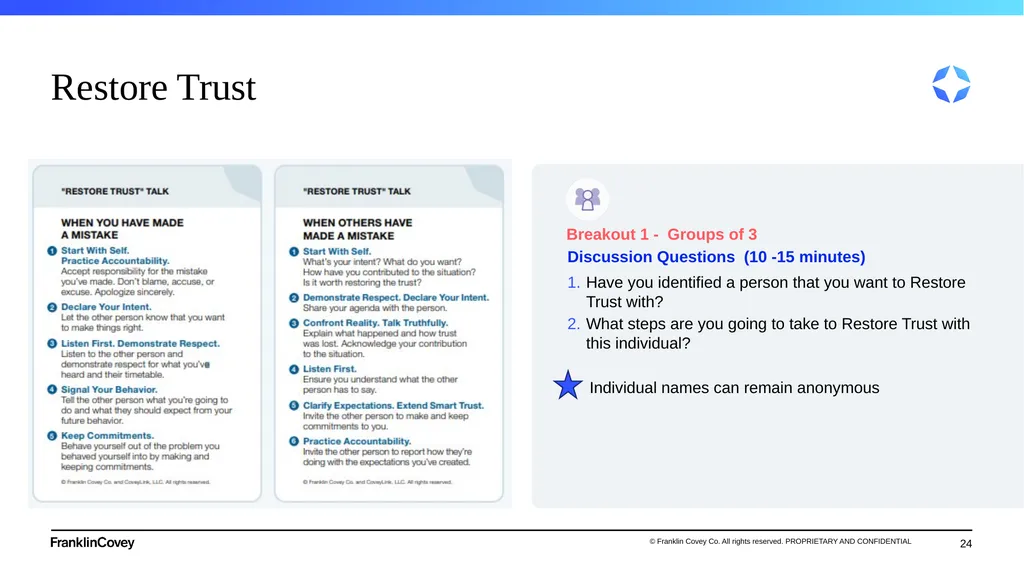
Breakout 1 - Groups of 3
Discussion Questions (10 -15 minutes)
Have you identified a person that you want to Restore Trust with?
What steps are you going to take to Restore Trust with this individual?
Individual names can remain anonymous 24 Restore Trust<br>
24
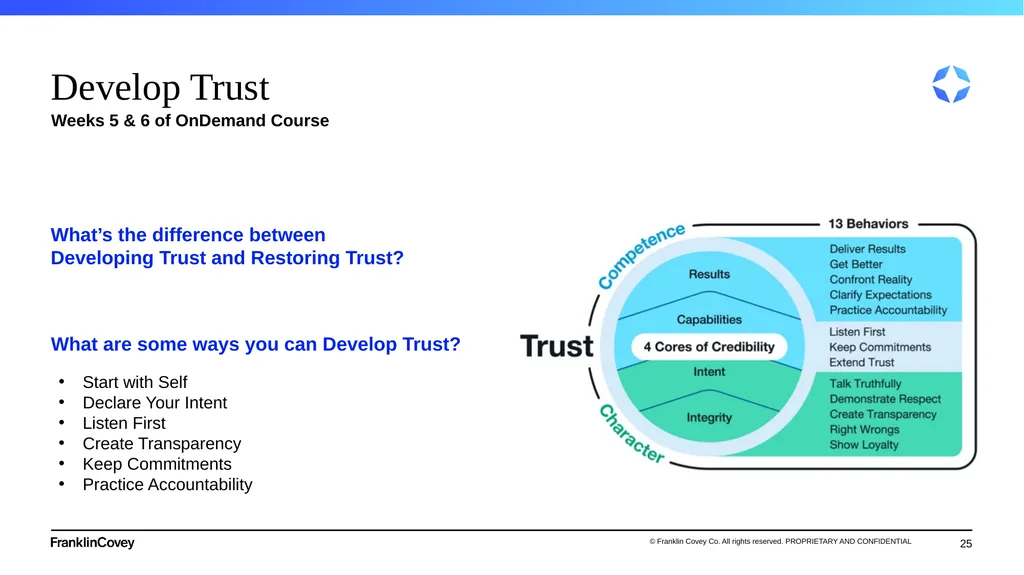
25 Develop Trust Weeks 5 & 6 of OnDemand Course What’s the difference between Developing Trust and Restoring Trust? What are some ways you can Develop Trust? Start with Self
Declare Your Intent
Listen First
Create Transparency
Keep Commitments
Practice Accountability<br>
25
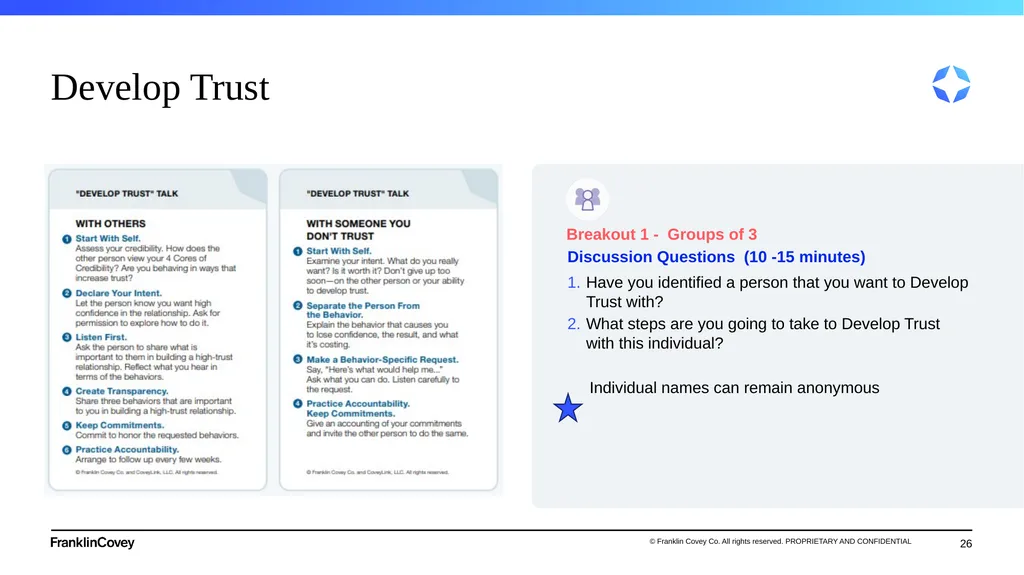
Breakout 1 - Groups of 3
Discussion Questions (10 -15 minutes)
Have you identified a person that you want to Develop Trust with?
What steps are you going to take to Develop Trust with this individual?
Individual names can remain anonymous 26 Develop Trust<br>