
1 Housekeeping 2 All participant video &
CM
Published · 70 slides · 0 views

1 / 1



Description
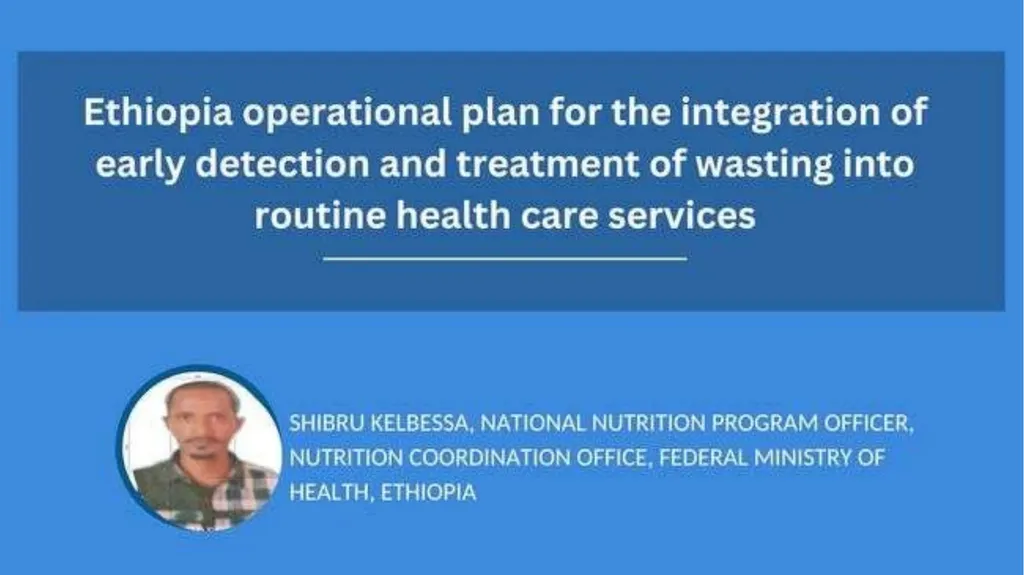
1 Housekeeping 2 All participant video microphones are muted during presentations. Use the QA button to submit your questions for the speakers. We will get to as many questions as we can. Closed captioning can be turned on using the Show
Related Topics
Share
Embed code
Download this presentation From Below
"1 Housekeeping 2 All participant video &" is the property of its rightful owner. Permission is granted to download and print the materials on this website for personal, non-commercial use only, and to display it on your personal computer provided you do not modify the materials and that you retain all copyright notices contained in the materials. By downloading content from our website, you accept the terms of this agreement.
Presentation Transcript
01
1<br>
02
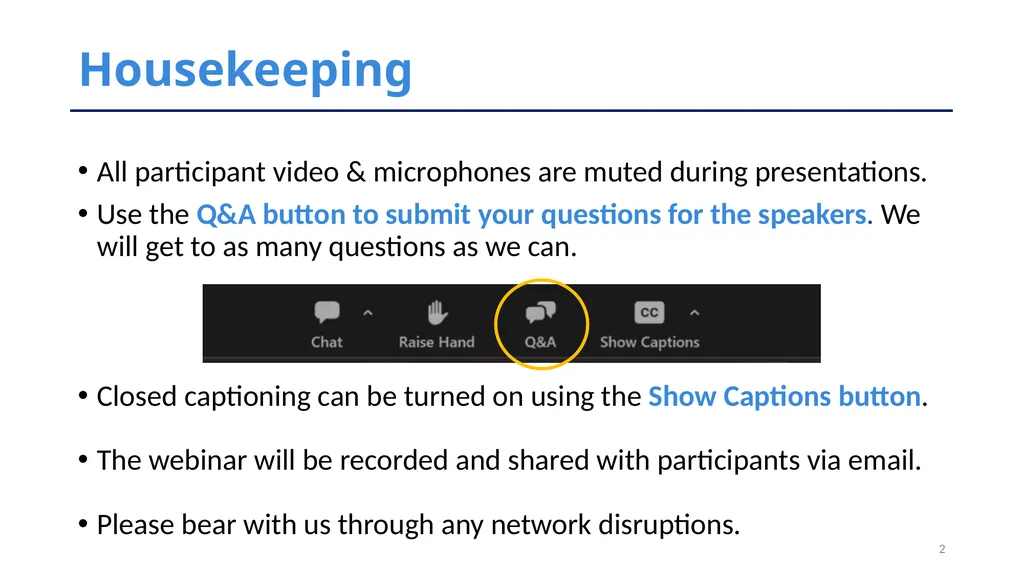
Housekeeping 2 All participant video & microphones are muted during presentations.
Use the Q&A button to submit your questions for the speakers. We will get to as many questions as we can.
Closed captioning can be turned on using the Show Captions button.
The webinar will be recorded and shared with participants via email.
Please bear with us through any network disruptions.<br>
Use the Q&A button to submit your questions for the speakers. We will get to as many questions as we can.
Closed captioning can be turned on using the Show Captions button.
The webinar will be recorded and shared with participants via email.
Please bear with us through any network disruptions.<br>
03
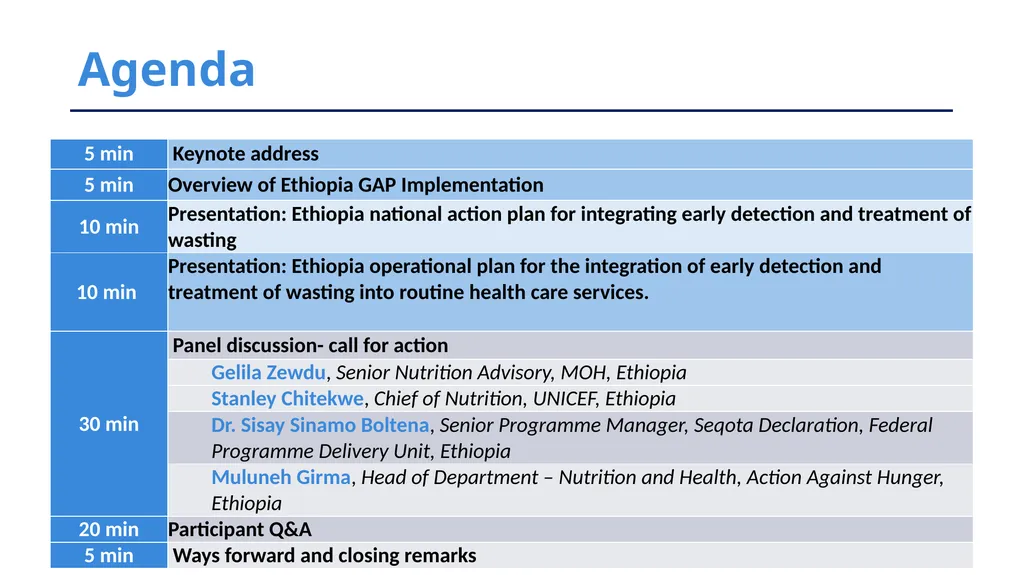
Agenda 3<br>
04
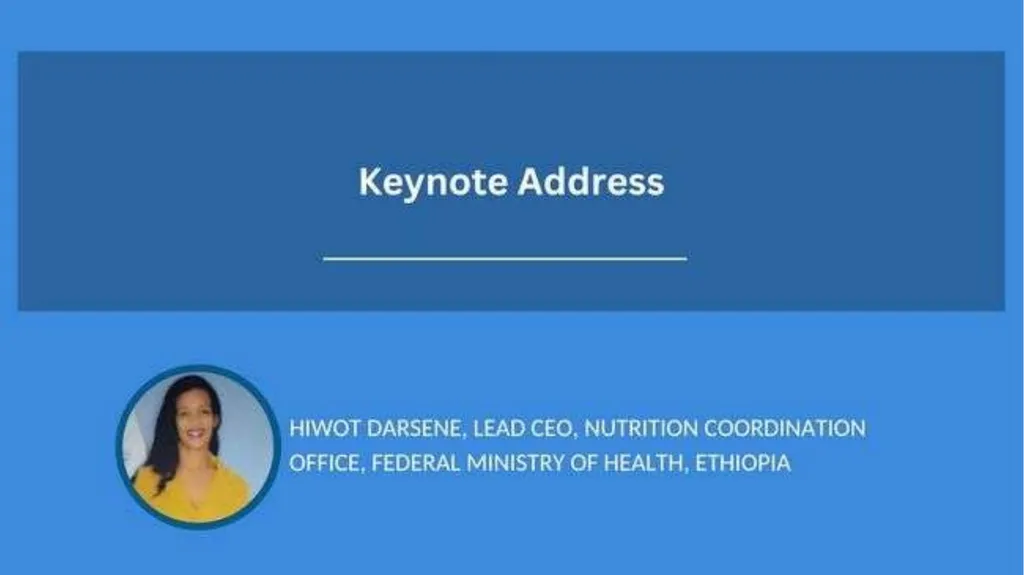
4 Hiwot Intro<br>
05
5<br>
06
Ethiopia GAP progress in Ethiopia<br>
07
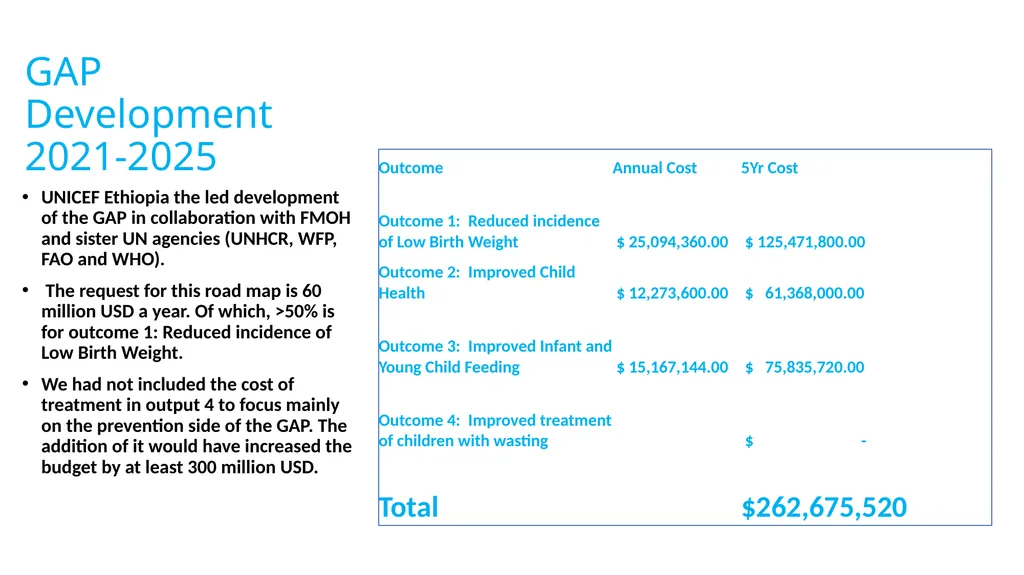
GAP Development 2021-2025 UNICEF Ethiopia the led development of the GAP in collaboration with FMOH and sister UN agencies (UNHCR, WFP, FAO and WHO).
The request for this road map is 60 million USD a year. Of which, >50% is for outcome 1: Reduced incidence of Low Birth Weight.
We had not included the cost of treatment in output 4 to focus mainly on the prevention side of the GAP. The addition of it would have increased the budget by at least 300 million USD.<br>
The request for this road map is 60 million USD a year. Of which, >50% is for outcome 1: Reduced incidence of Low Birth Weight.
We had not included the cost of treatment in output 4 to focus mainly on the prevention side of the GAP. The addition of it would have increased the budget by at least 300 million USD.<br>
08
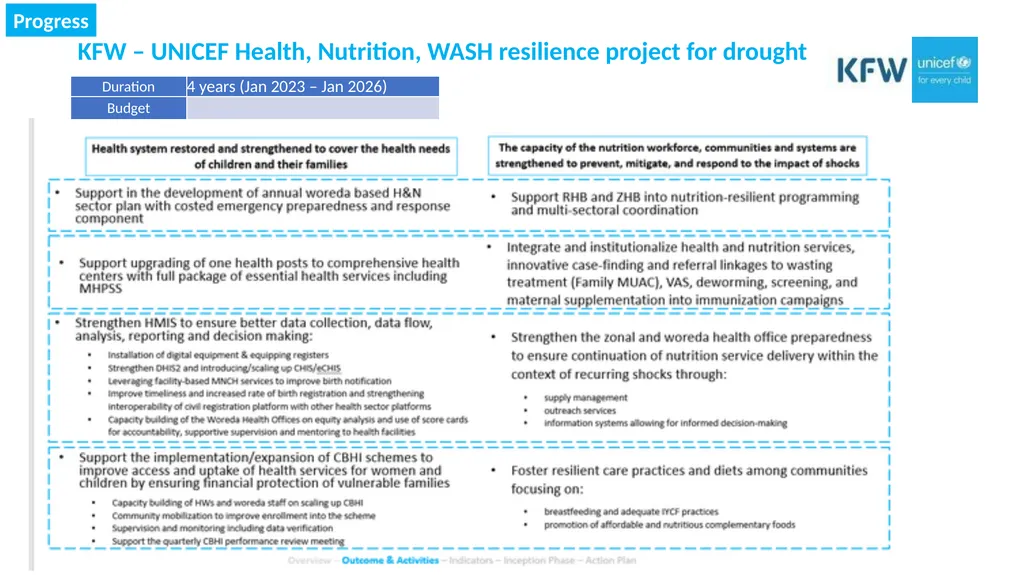
KFW – UNICEF Health, Nutrition, WASH resilience project for drought Progress<br>
09
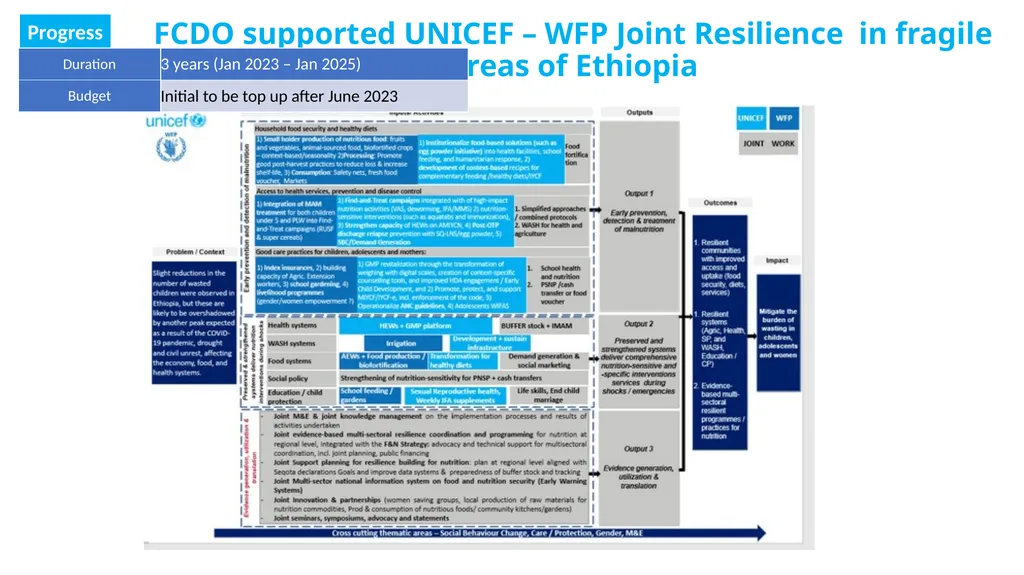
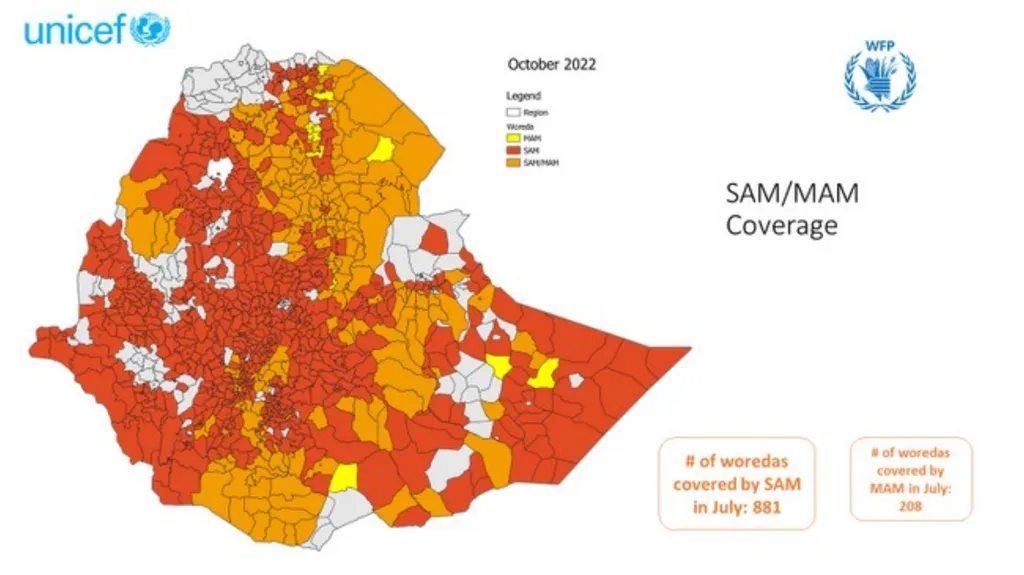
FCDO supported UNICEF – WFP Joint Resilience in fragile areas of Ethiopia Progress<br>
10
UNICEF-CIFF Grant on resilience in drought affected regions Progress<br>
11
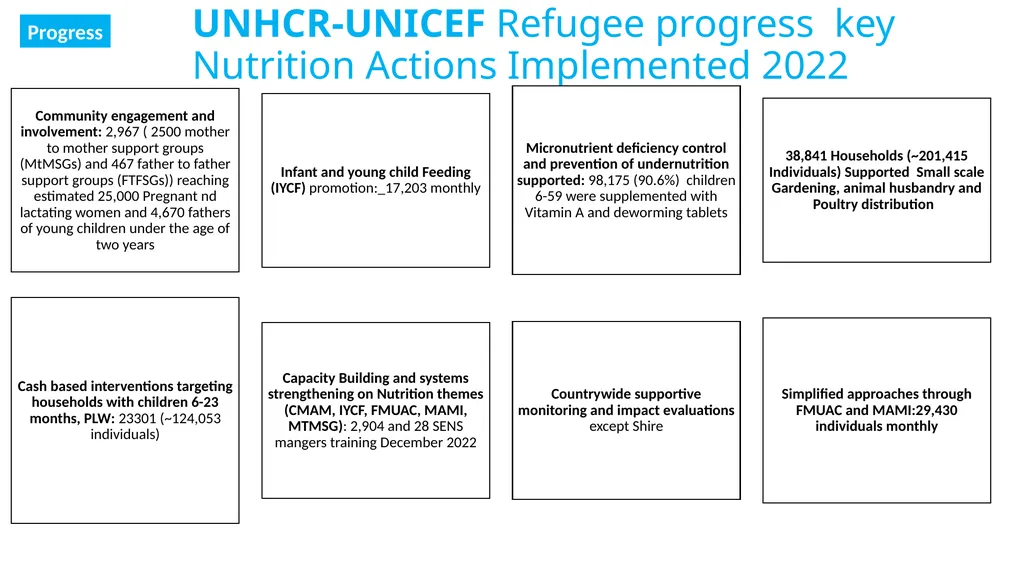
UNHCR-UNICEF Refugee progress key Nutrition Actions Implemented 2022 Progress<br>
12
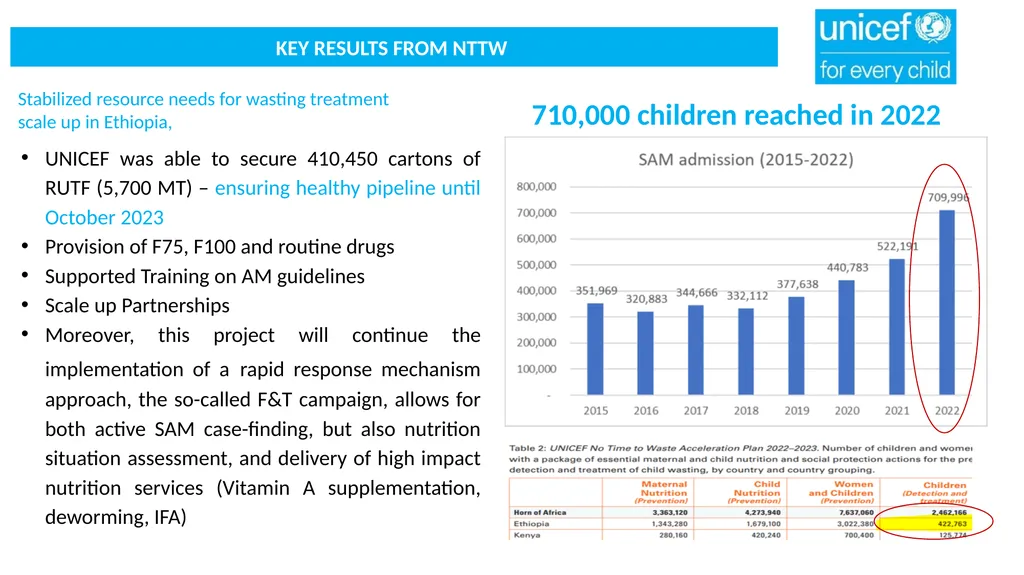
KEY RESULTS FROM NTTW UNICEF was able to secure 410,450 cartons of RUTF (5,700 MT) – ensuring healthy pipeline until October 2023
Provision of F75, F100 and routine drugs
Supported Training on AM guidelines
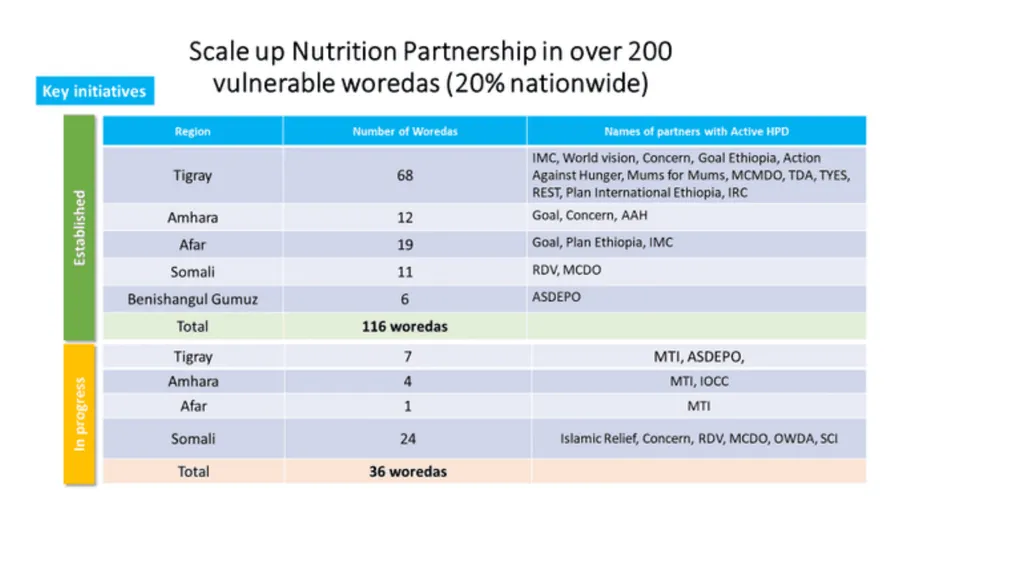
Scale up Partnerships
Moreover, this project will continue the implementation of a rapid response mechanism approach, the so-called F&T campaign, allows for both active SAM case-finding, but also nutrition situation assessment, and delivery of high impact nutrition services (Vitamin A supplementation, deworming, IFA) Stabilized resource needs for wasting treatment scale up in Ethiopia, 710,000 children reached in 2022<br>
Provision of F75, F100 and routine drugs
Supported Training on AM guidelines
Scale up Partnerships
Moreover, this project will continue the implementation of a rapid response mechanism approach, the so-called F&T campaign, allows for both active SAM case-finding, but also nutrition situation assessment, and delivery of high impact nutrition services (Vitamin A supplementation, deworming, IFA) Stabilized resource needs for wasting treatment scale up in Ethiopia, 710,000 children reached in 2022<br>
13
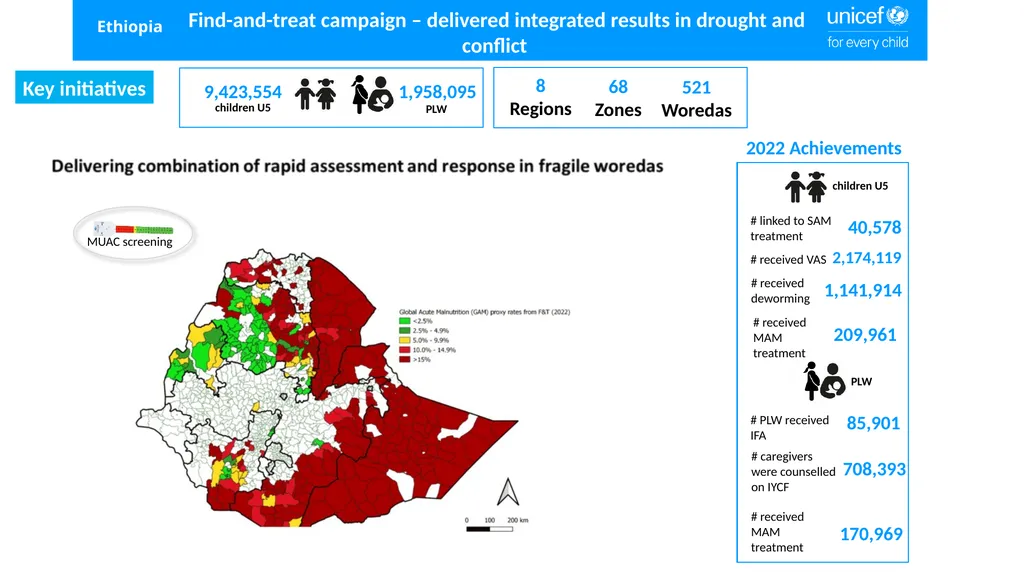
El Niño-Driven Nutrition Emergency in Ethiopia As of 27 April 2016 Find-and-treat campaign – delivered integrated results in drought and conflict 9,423,554 1,958,095 8
Regions 68
Zones 521
Woredas # linked to SAM treatment # received VAS # received deworming # PLW received IFA # caregivers were counselled on IYCF 40,578 2,174,119 1,141,914 85,901 708,393 2022 Achievements # received MAM treatment # received MAM treatment 209,961 PLW 170,969 Key initiatives<br>
Regions 68
Zones 521
Woredas # linked to SAM treatment # received VAS # received deworming # PLW received IFA # caregivers were counselled on IYCF 40,578 2,174,119 1,141,914 85,901 708,393 2022 Achievements # received MAM treatment # received MAM treatment 209,961 PLW 170,969 Key initiatives<br>
14
17<br>
15
What do we mean by wasting and integration? 18 Improving ability to screen, refer and treat children with wasting by integrating these services within routine health care system Encompasses all forms of acute malnutrition including those diagnosed using WHZ
(<-2WHZ), oedema and/or MUAC (<125mm). WASTING INTEGRATION<br>
(<-2WHZ), oedema and/or MUAC (<125mm). WASTING INTEGRATION<br>
16
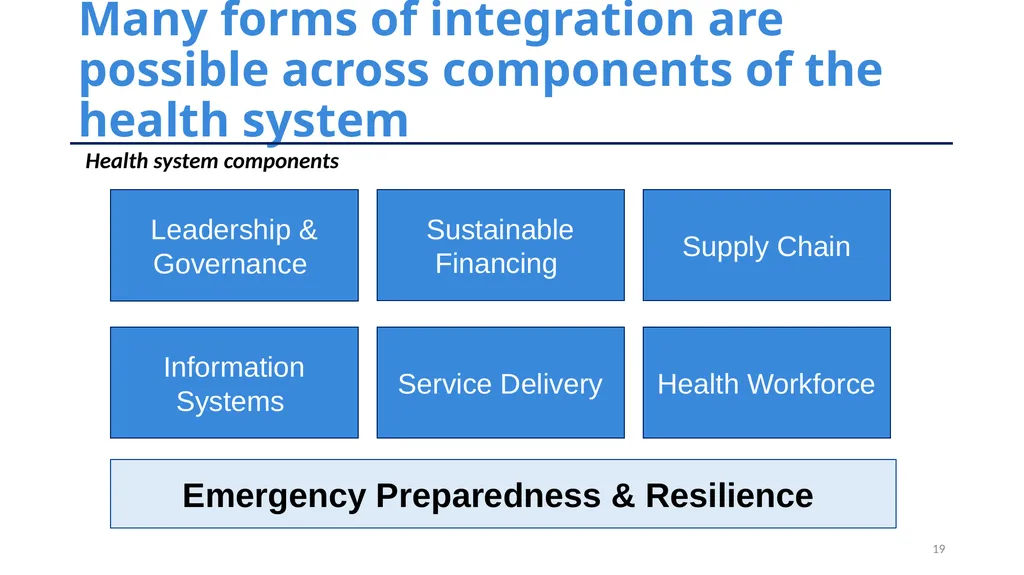
Many forms of integration are possible across components of the health system Leadership & Governance Sustainable Financing Service Delivery Information Systems Health Workforce Supply Chain Emergency Preparedness & Resilience Health system components 19<br>
17
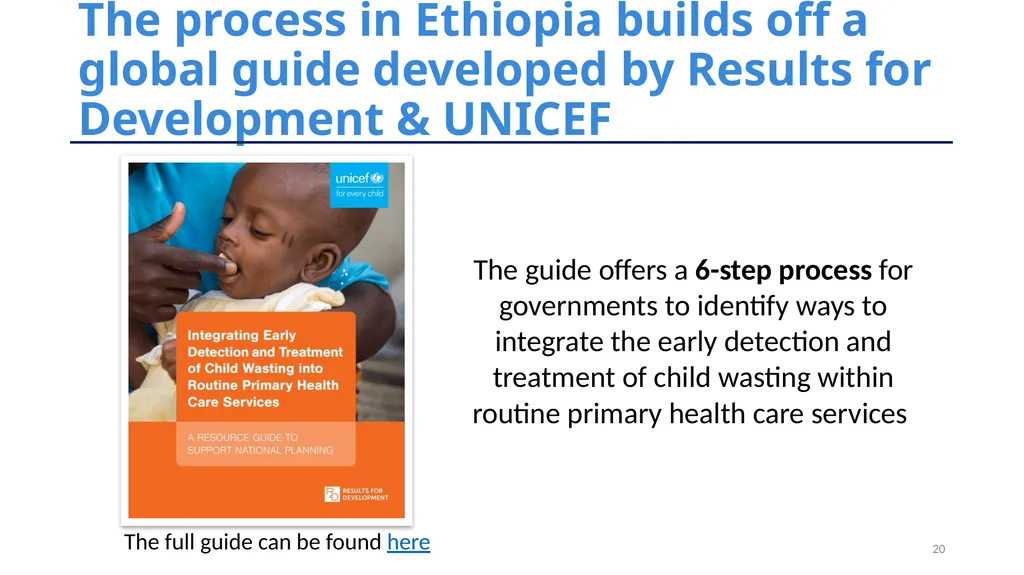
The process in Ethiopia builds off a global guide developed by Results for Development & UNICEF The full guide can be found here The guide offers a 6-step process for governments to identify ways to integrate the early detection and treatment of child wasting within routine primary health care services 20<br>
18
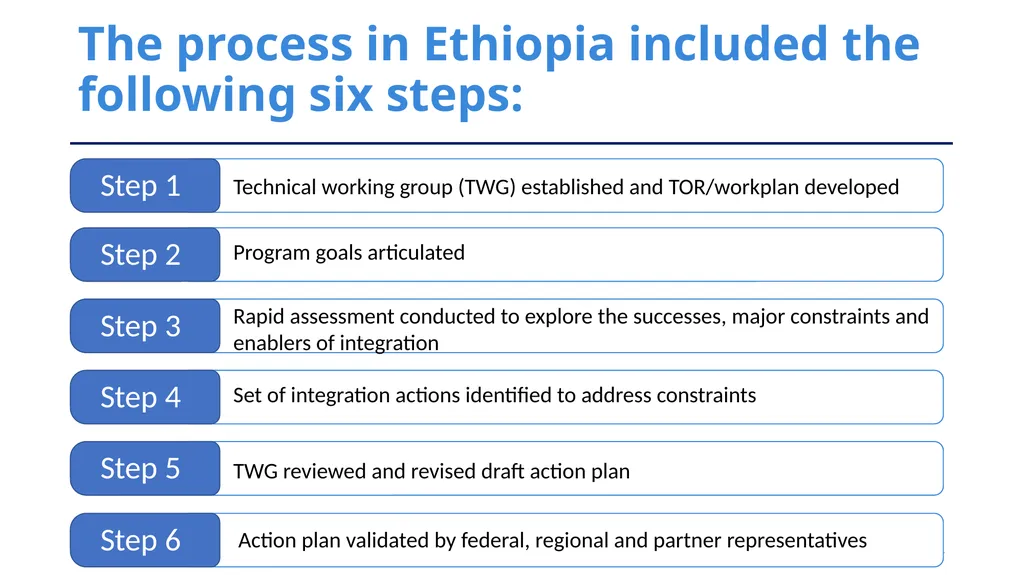
The process in Ethiopia included the following six steps: 21 Step 1 Step 2 Step 3 Step 4 Step 5 Step 6 Program goals articulated Rapid assessment conducted to explore the successes, major constraints and enablers of integration Set of integration actions identified to address constraints TWG reviewed and revised draft action plan Action plan validated by federal, regional and partner representatives Technical working group (TWG) established and TOR/workplan developed<br>
19
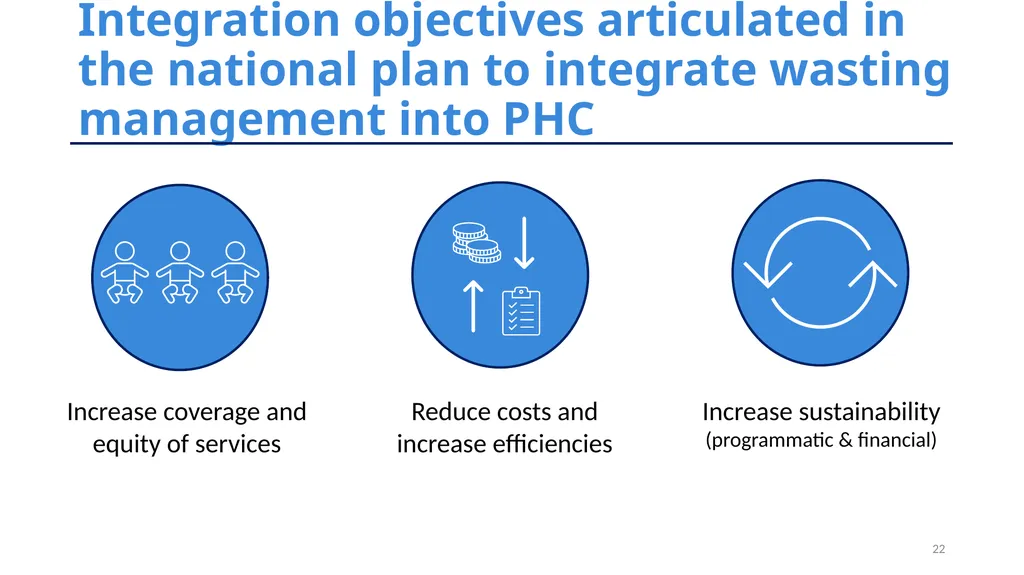
Integration objectives articulated in the national plan to integrate wasting management into PHC Increase coverage and equity of services Reduce costs and increase efficiencies Increase sustainability (programmatic & financial) 22<br>
20
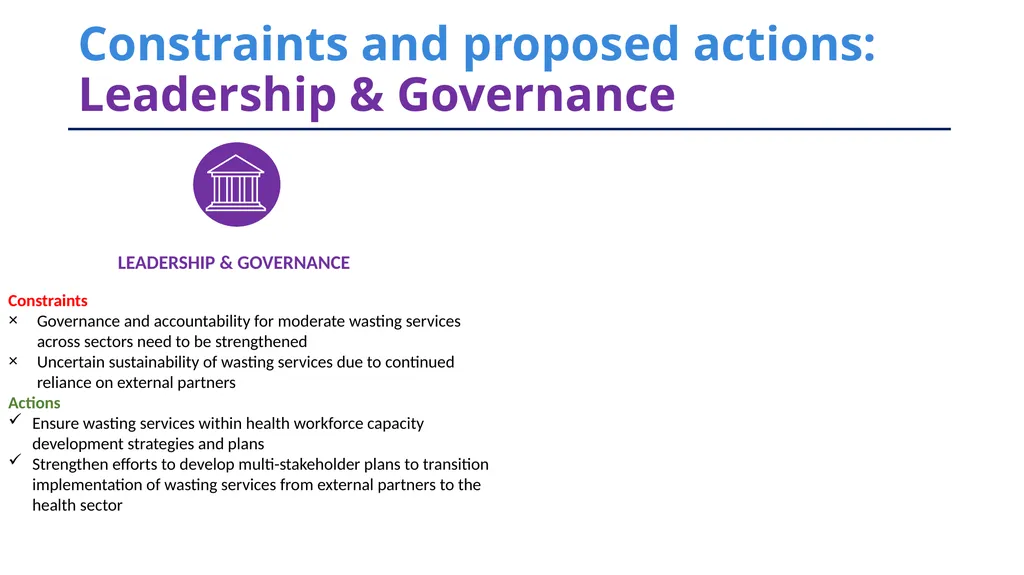
Constraints and proposed actions:
Leadership & Governance<br>
Leadership & Governance<br>
21
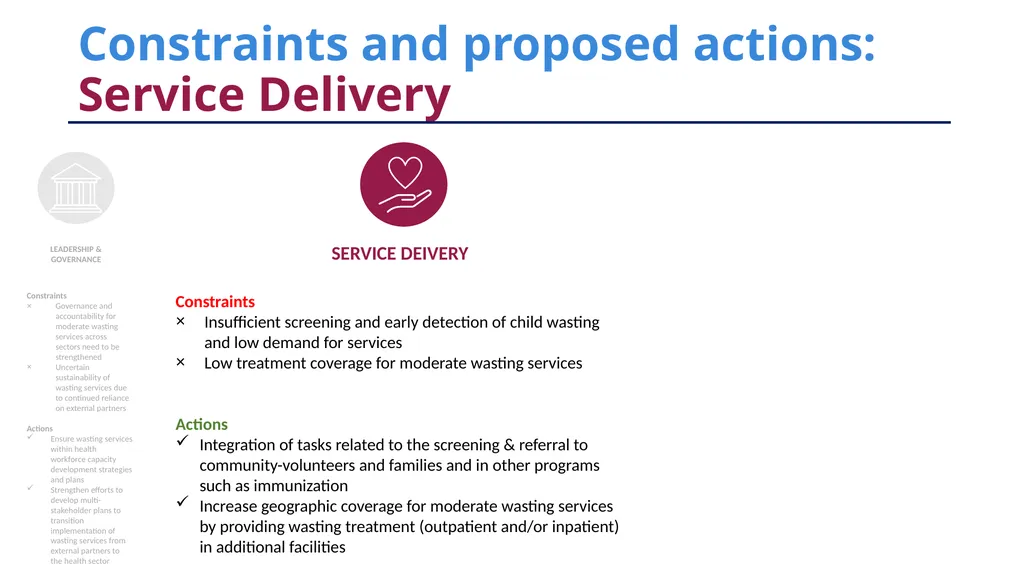
Constraints and proposed actions:
Service Delivery<br>
Service Delivery<br>
22
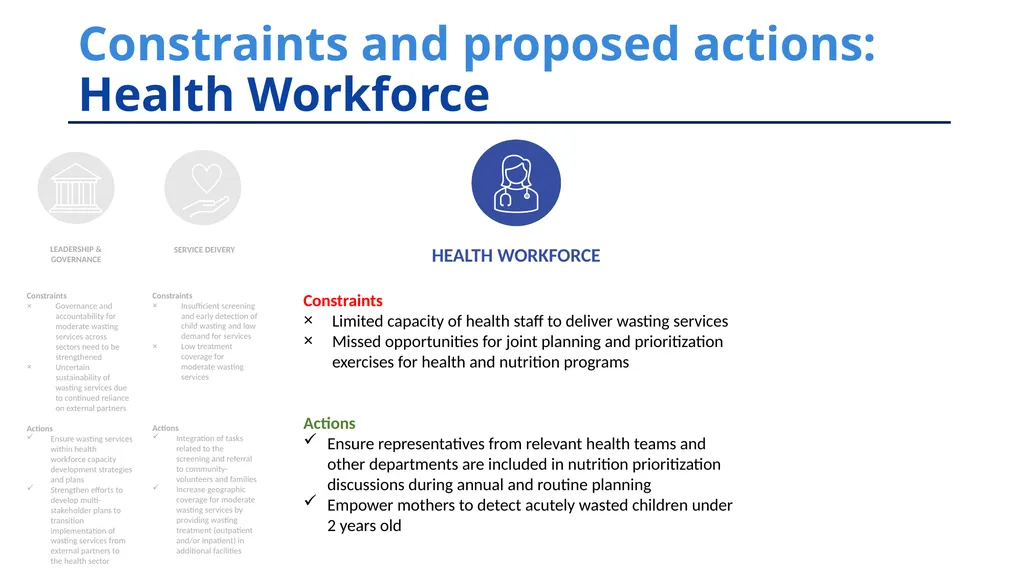
Constraints and proposed actions:
Health Workforce<br>
Health Workforce<br>
23
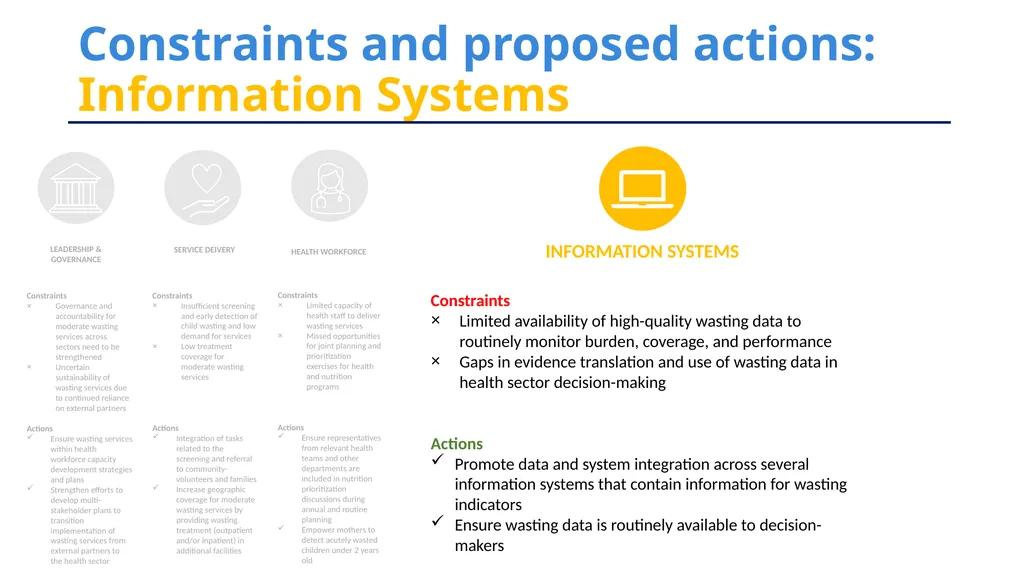
Constraints and proposed actions:
Information Systems<br>
Information Systems<br>
24
Constraints and proposed actions:
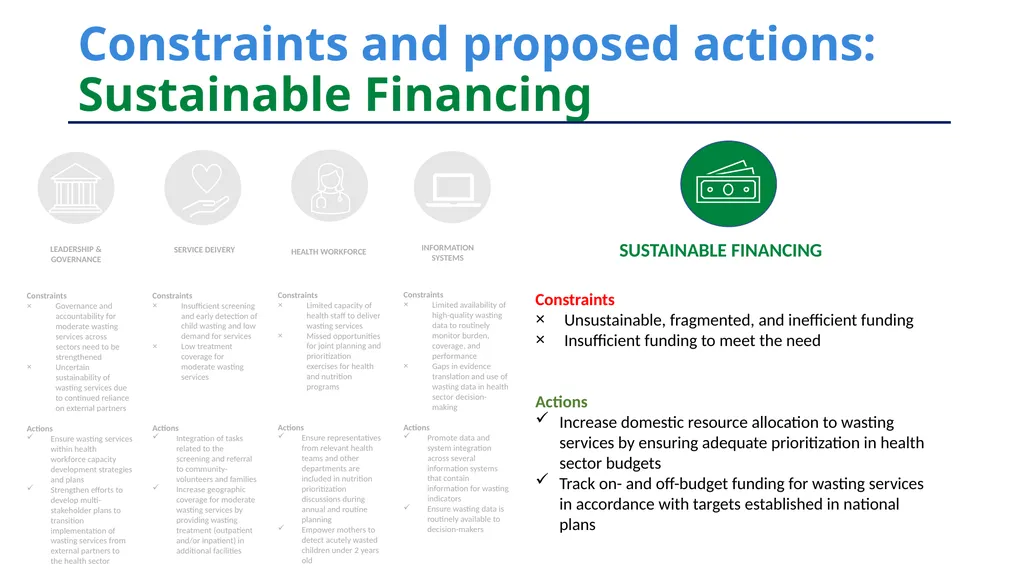
Sustainable Financing<br>
Sustainable Financing<br>
25
Constraints and proposed actions:
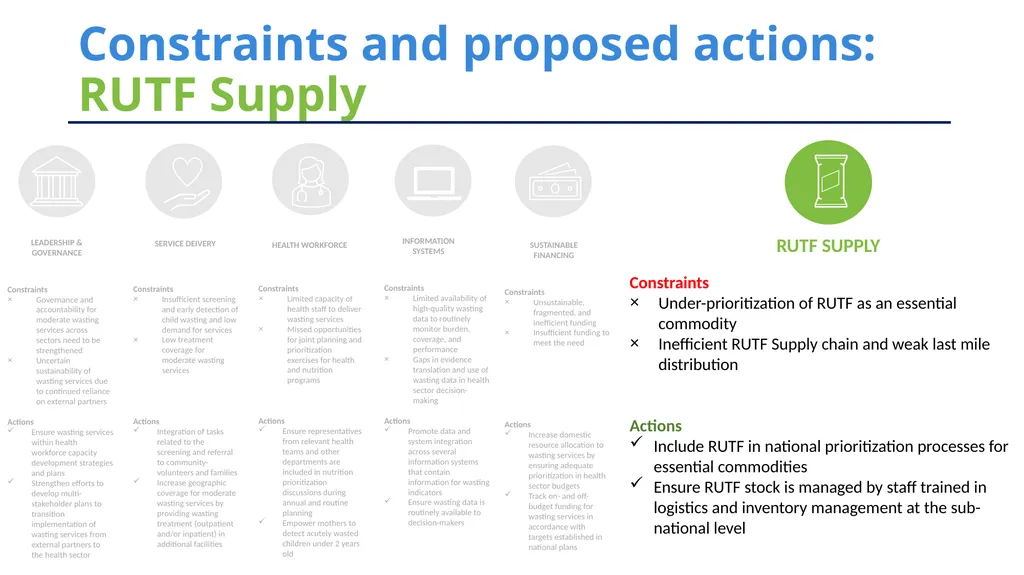
RUTF Supply<br>
RUTF Supply<br>
26
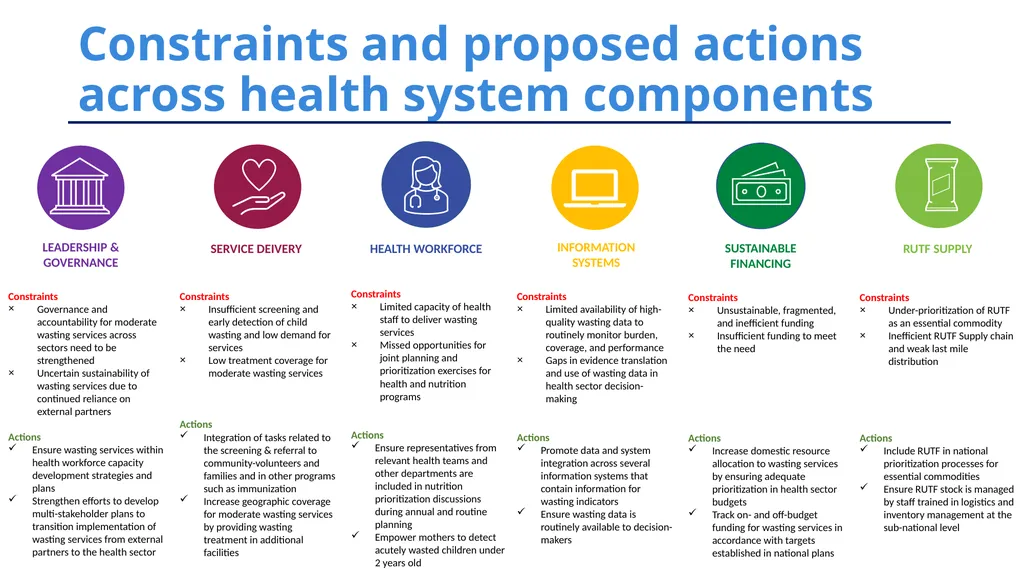
Constraints and proposed actions across health system components<br>
27
Thank you for listening A big thank you to the members of the technical working group! 30<br>
28
31<br>
29
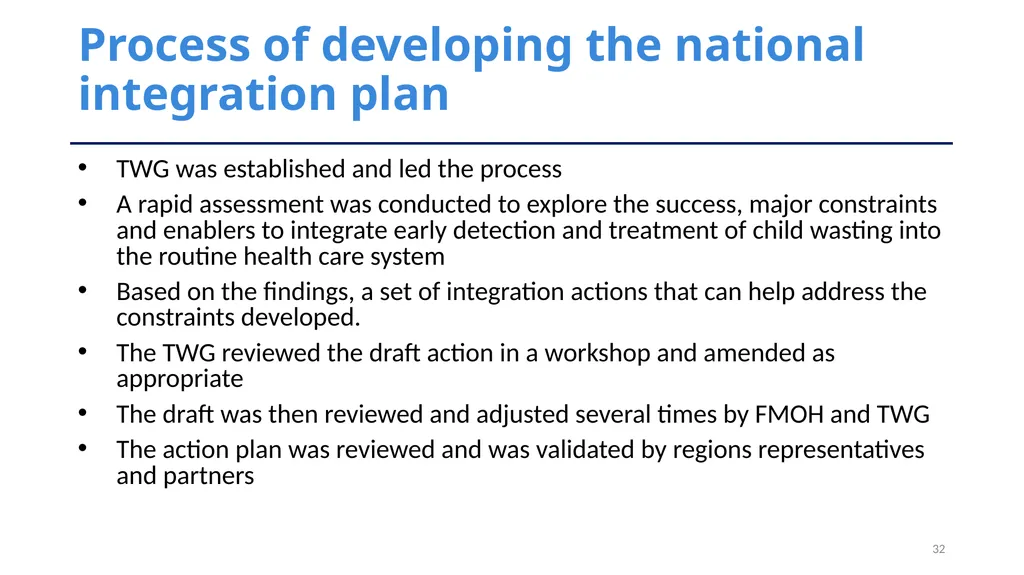
Process of developing the national integration plan 32 TWG was established and led the process
A rapid assessment was conducted to explore the success, major constraints and enablers to integrate early detection and treatment of child wasting into the routine health care system
Based on the findings, a set of integration actions that can help address the constraints developed.
The TWG reviewed the draft action in a workshop and amended as appropriate
The draft was then reviewed and adjusted several times by FMOH and TWG
The action plan was reviewed and was validated by regions representatives and partners<br>
A rapid assessment was conducted to explore the success, major constraints and enablers to integrate early detection and treatment of child wasting into the routine health care system
Based on the findings, a set of integration actions that can help address the constraints developed.
The TWG reviewed the draft action in a workshop and amended as appropriate
The draft was then reviewed and adjusted several times by FMOH and TWG
The action plan was reviewed and was validated by regions representatives and partners<br>
30
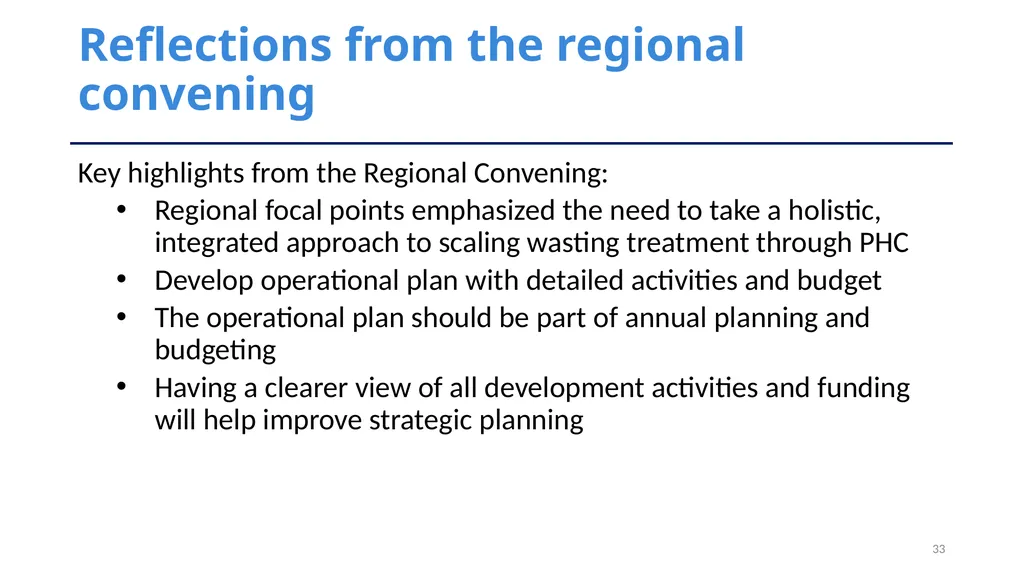
Reflections from the regional convening 33 Key highlights from the Regional Convening:
Regional focal points emphasized the need to take a holistic, integrated approach to scaling wasting treatment through PHC
Develop operational plan with detailed activities and budget
The operational plan should be part of annual planning and budgeting
Having a clearer view of all development activities and funding will help improve strategic planning<br>
Regional focal points emphasized the need to take a holistic, integrated approach to scaling wasting treatment through PHC
Develop operational plan with detailed activities and budget
The operational plan should be part of annual planning and budgeting
Having a clearer view of all development activities and funding will help improve strategic planning<br>
31
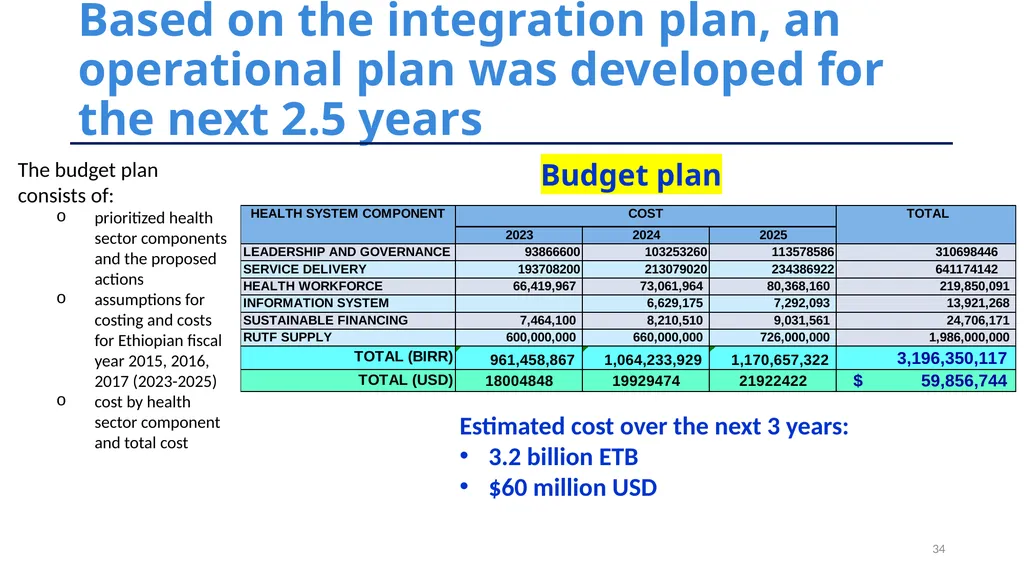
Based on the integration plan, an operational plan was developed for the next 2.5 years 34 The budget plan consists of:
prioritized health sector components and the proposed actions
assumptions for costing and costs for Ethiopian fiscal year 2015, 2016, 2017 (2023-2025)
cost by health sector component and total cost Estimated cost over the next 3 years:
3.2 billion ETB
$60 million USD Budget plan<br>
prioritized health sector components and the proposed actions
assumptions for costing and costs for Ethiopian fiscal year 2015, 2016, 2017 (2023-2025)
cost by health sector component and total cost Estimated cost over the next 3 years:
3.2 billion ETB
$60 million USD Budget plan<br>
32
35<br>
33
36<br>
34
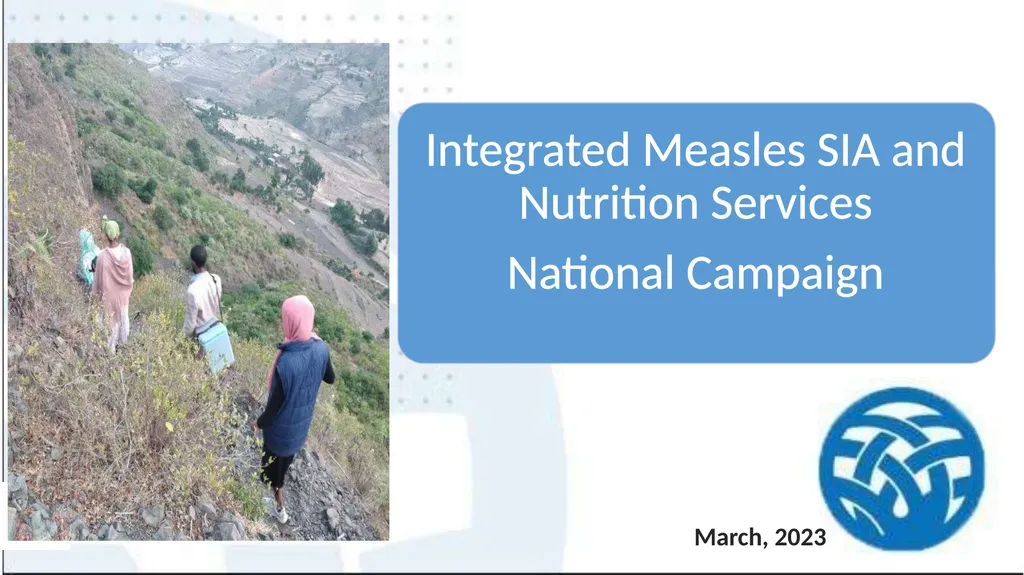
March, 2023<br>
35
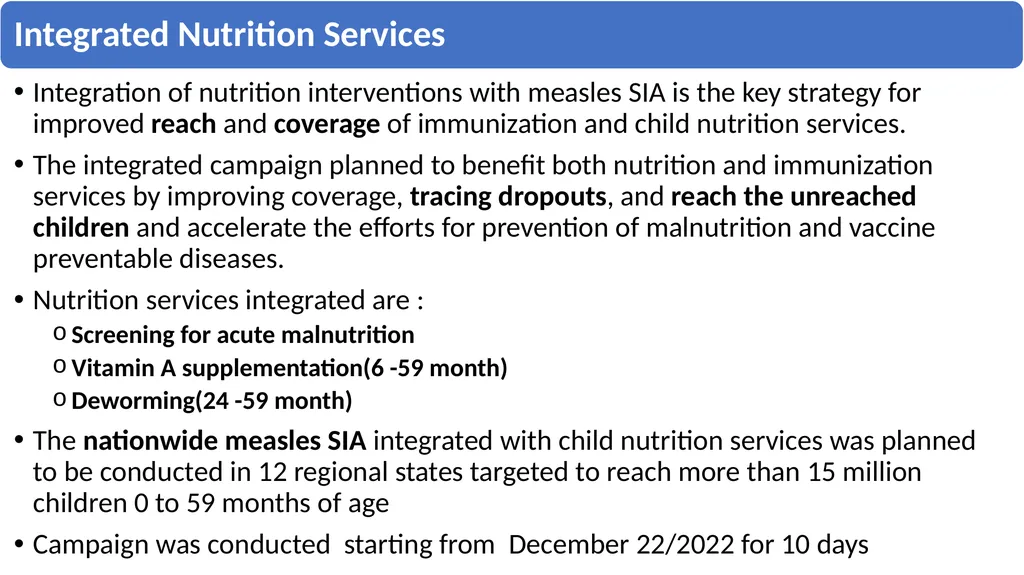
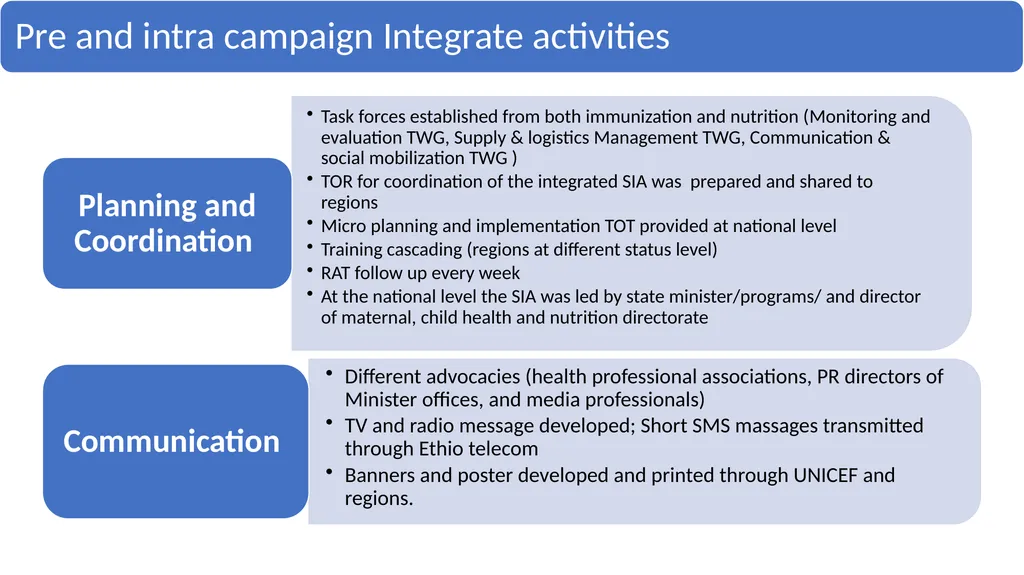
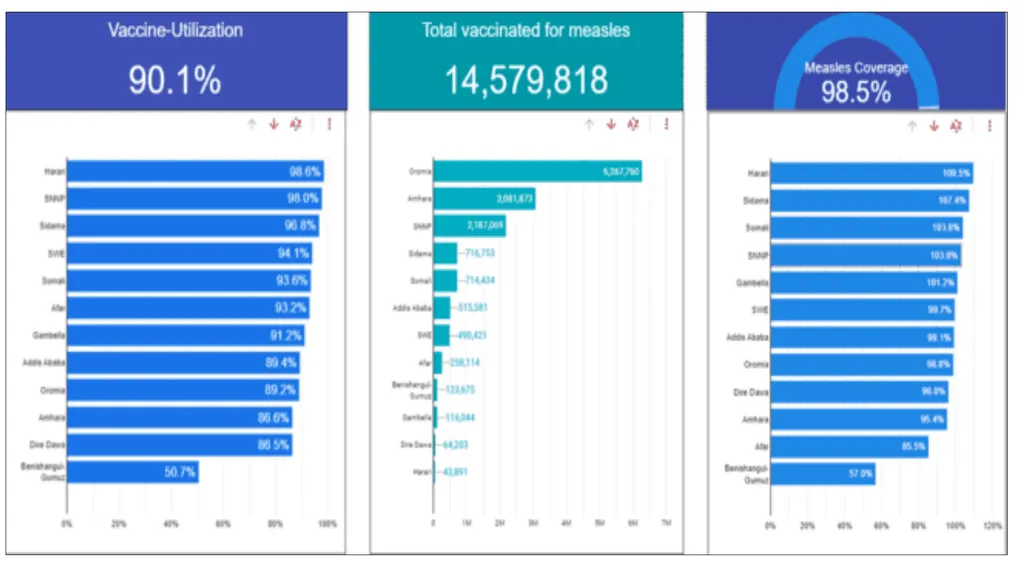
Integration of nutrition interventions with measles SIA is the key strategy for improved reach and coverage of immunization and child nutrition services.
The integrated campaign planned to benefit both nutrition and immunization services by improving coverage, tracing dropouts, and reach the unreached children and accelerate the efforts for prevention of malnutrition and vaccine preventable diseases.
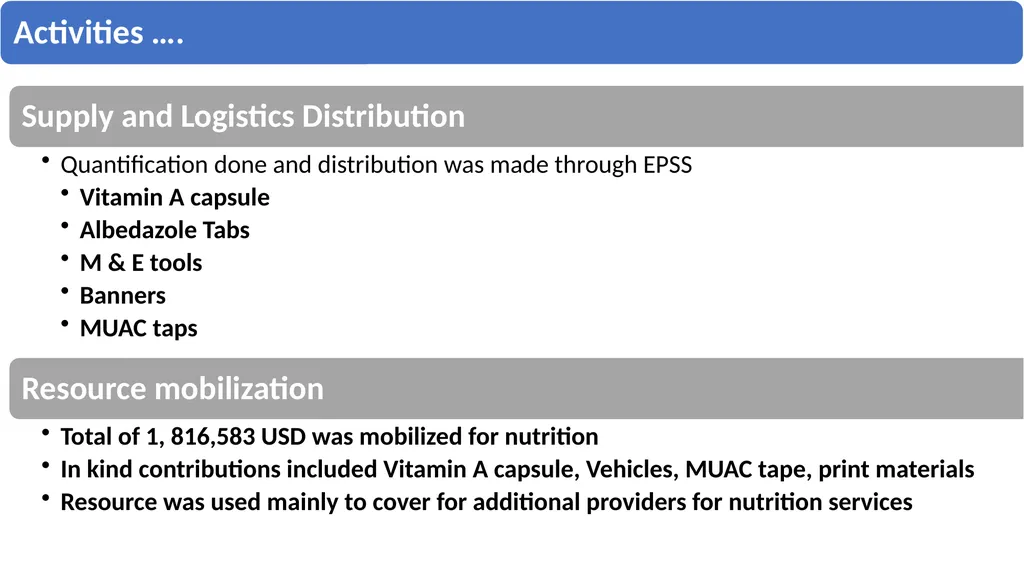
Nutrition services integrated are :
Screening for acute malnutrition
Vitamin A supplementation(6 -59 month)
Deworming(24 -59 month)
The nationwide measles SIA integrated with child nutrition services was planned to be conducted in 12 regional states targeted to reach more than 15 million children 0 to 59 months of age
Campaign was conducted starting from December 22/2022 for 10 days<br>
The integrated campaign planned to benefit both nutrition and immunization services by improving coverage, tracing dropouts, and reach the unreached children and accelerate the efforts for prevention of malnutrition and vaccine preventable diseases.
Nutrition services integrated are :
Screening for acute malnutrition
Vitamin A supplementation(6 -59 month)
Deworming(24 -59 month)
The nationwide measles SIA integrated with child nutrition services was planned to be conducted in 12 regional states targeted to reach more than 15 million children 0 to 59 months of age
Campaign was conducted starting from December 22/2022 for 10 days<br>
36
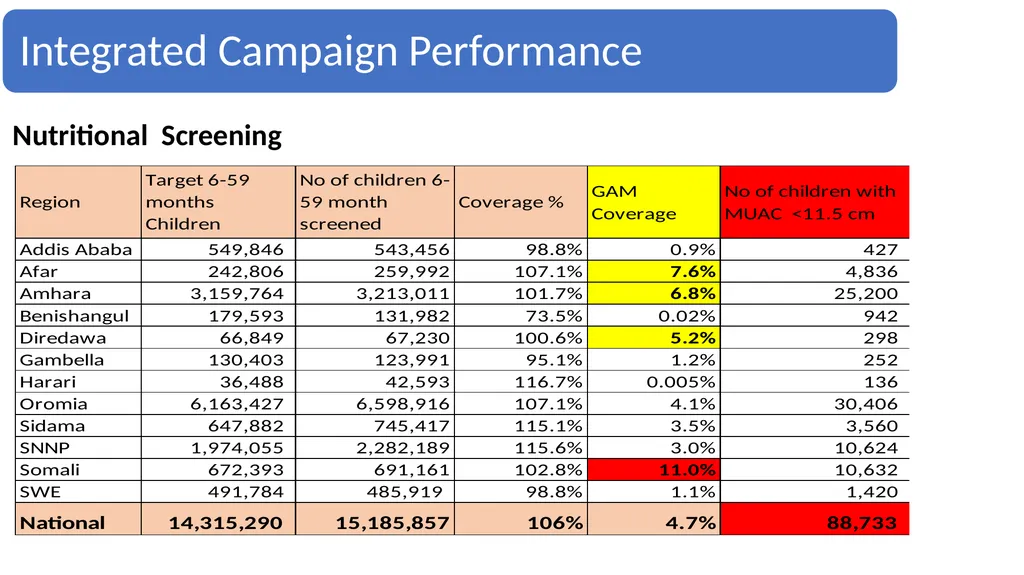
Nutritional Screening<br>
37
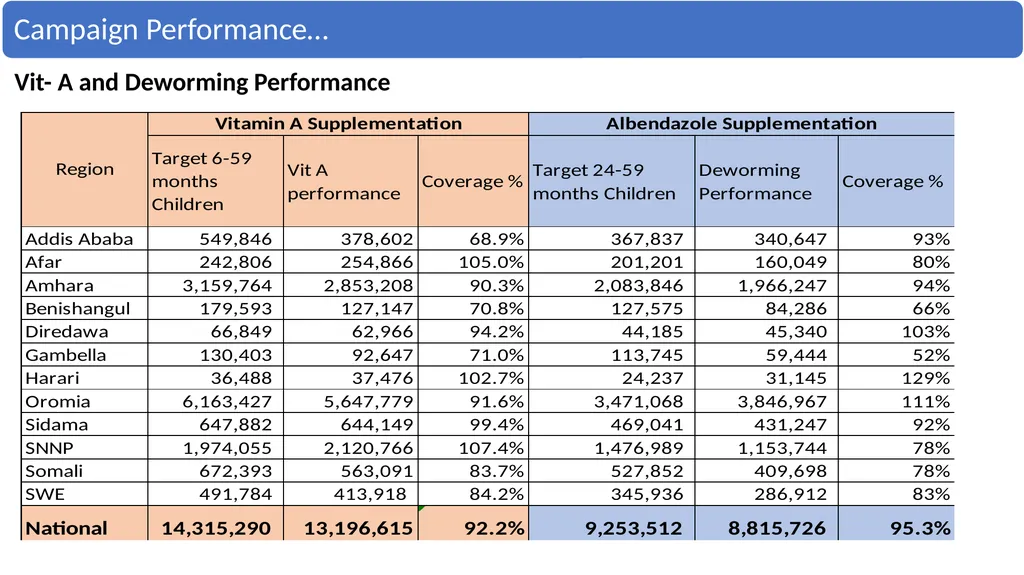
Vit- A and Deworming Performance<br>
38
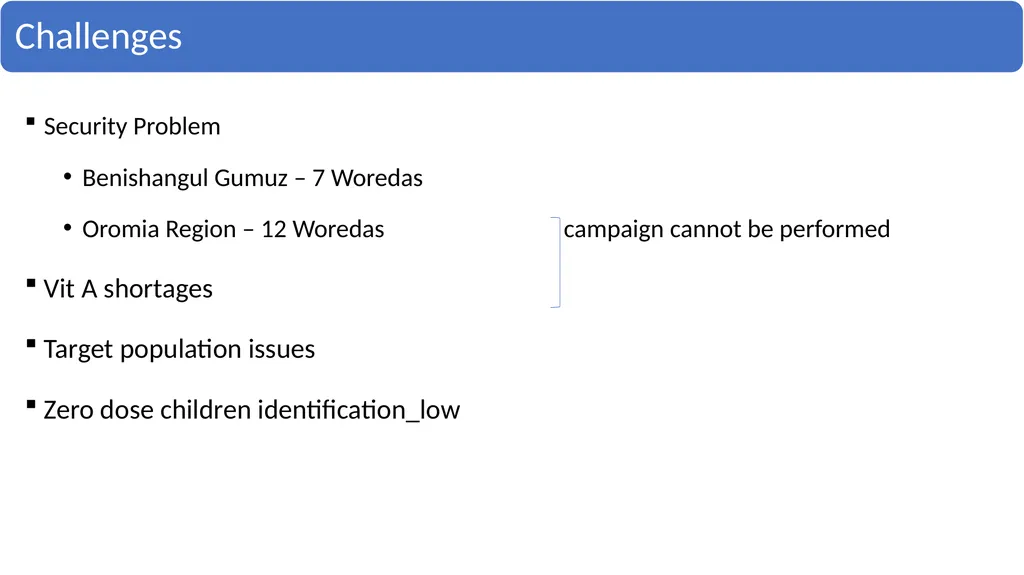
Security Problem
Benishangul Gumuz – 7 Woredas
Oromia Region – 12 Woredas campaign cannot be performed
Vit A shortages
Target population issues
Zero dose children identification_low<br>
Benishangul Gumuz – 7 Woredas
Oromia Region – 12 Woredas campaign cannot be performed
Vit A shortages
Target population issues
Zero dose children identification_low<br>
39
Thank you!<br>
40
49<br>
41
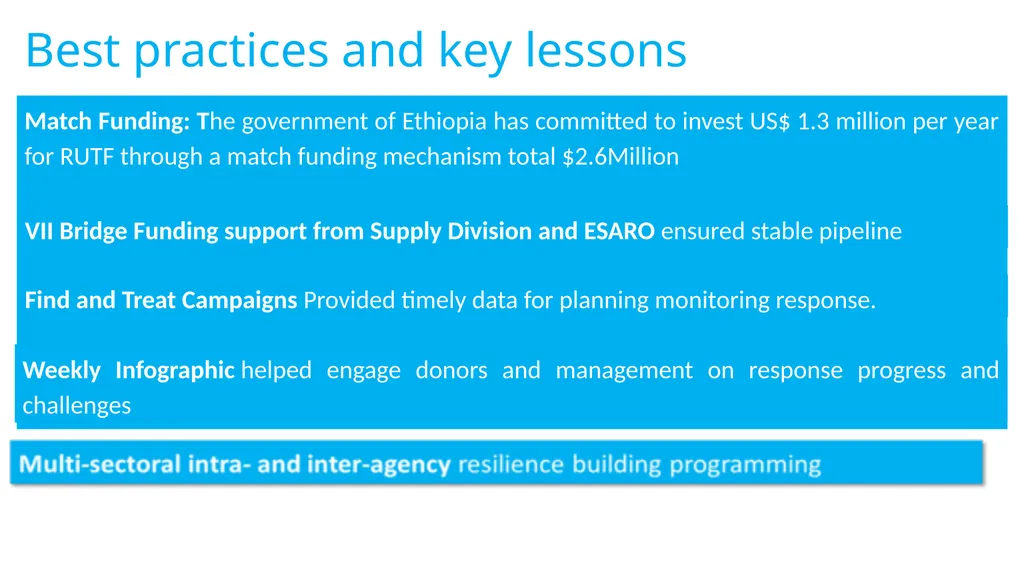
Best practices and key lessons Match Funding: The government of Ethiopia has committed to invest US$ 1.3 million per year for RUTF through a match funding mechanism total $2.6Million Weekly Infographic helped engage donors and management on response progress and challenges Find and Treat Campaigns Provided timely data for planning monitoring response. VII Bridge Funding support from Supply Division and ESARO ensured stable pipeline<br>
42
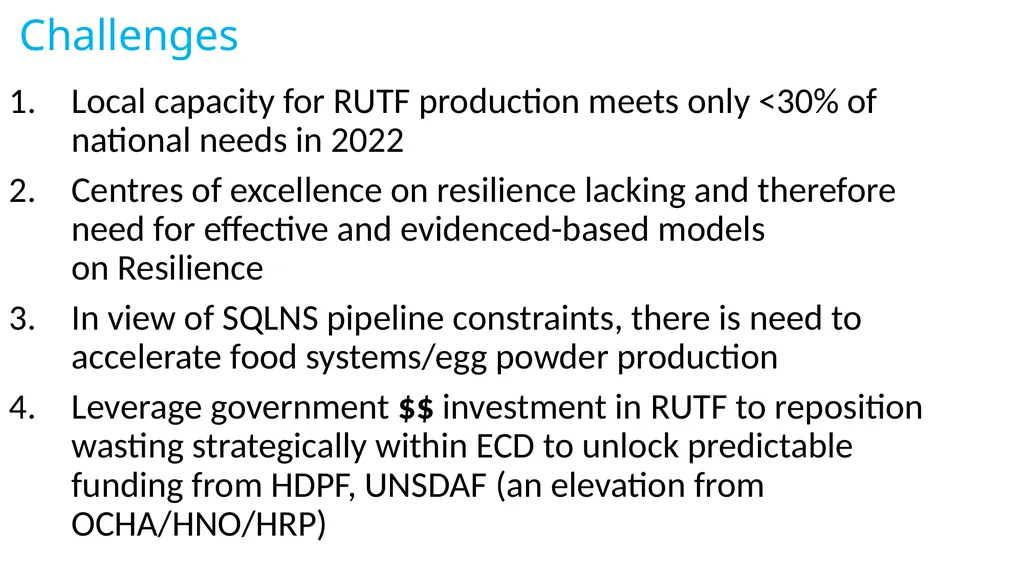
Challenges Local capacity for RUTF production meets only <30% of national needs in 2022
Centres of excellence on resilience lacking and therefore need for effective and evidenced-based models on Resilience
In view of SQLNS pipeline constraints, there is need to accelerate food systems/egg powder production
Leverage government $$ investment in RUTF to reposition wasting strategically within ECD to unlock predictable funding from HDPF, UNSDAF (an elevation from OCHA/HNO/HRP)<br>
Centres of excellence on resilience lacking and therefore need for effective and evidenced-based models on Resilience
In view of SQLNS pipeline constraints, there is need to accelerate food systems/egg powder production
Leverage government $$ investment in RUTF to reposition wasting strategically within ECD to unlock predictable funding from HDPF, UNSDAF (an elevation from OCHA/HNO/HRP)<br>
43
52<br>
44
53<br>
45
Successful ways to scale-up services for both the prevention and treatment of child wasting: Action Against Hunger
March 23, 2023<br>
March 23, 2023<br>
46
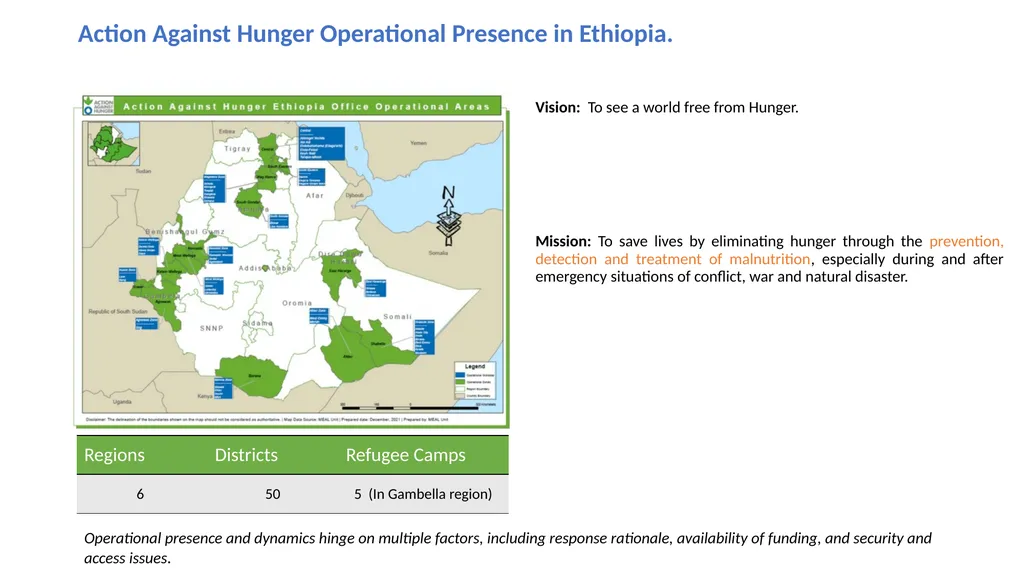
Action Against Hunger Operational Presence in Ethiopia. Vision: To see a world free from Hunger.
Mission: To save lives by eliminating hunger through the prevention, detection and treatment of malnutrition, especially during and after emergency situations of conflict, war and natural disaster. Operational presence and dynamics hinge on multiple factors, including response rationale, availability of funding, and security and access issues.<br>
Mission: To save lives by eliminating hunger through the prevention, detection and treatment of malnutrition, especially during and after emergency situations of conflict, war and natural disaster. Operational presence and dynamics hinge on multiple factors, including response rationale, availability of funding, and security and access issues.<br>
47
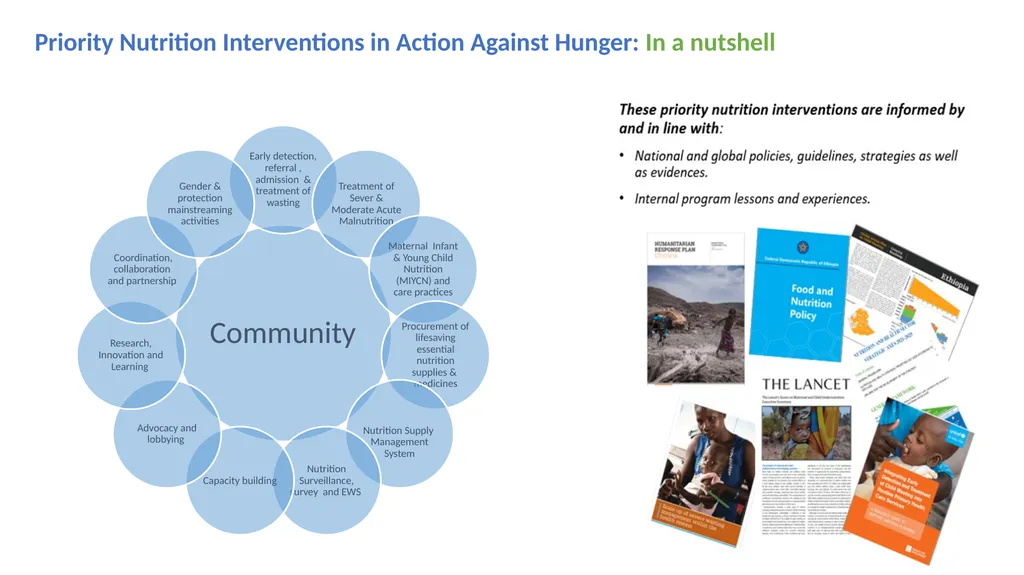
Priority Nutrition Interventions in Action Against Hunger: In a nutshell<br>
48
Experience so far:
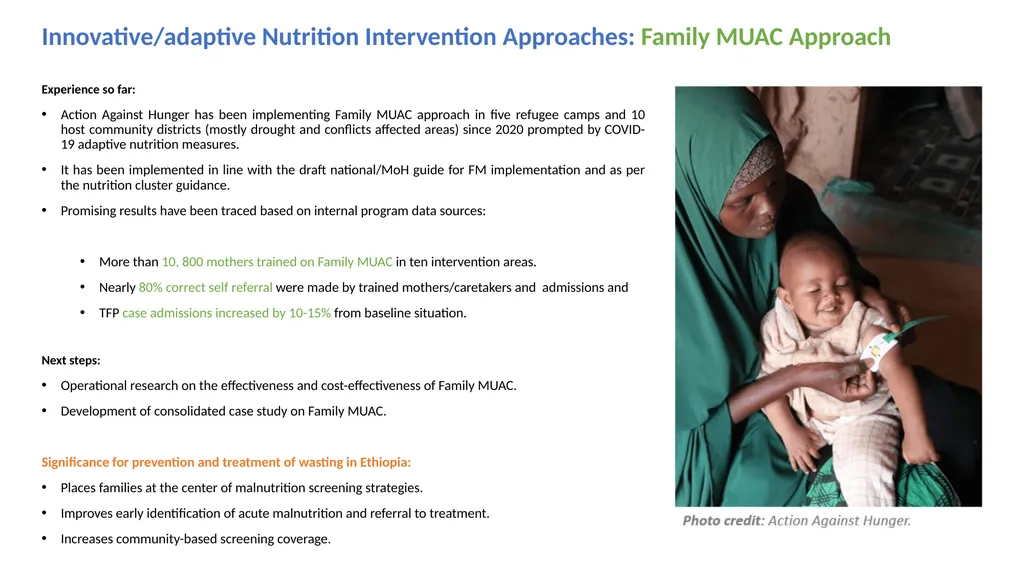
Action Against Hunger has been implementing Family MUAC approach in five refugee camps and 10 host community districts (mostly drought and conflicts affected areas) since 2020 prompted by COVID-19 adaptive nutrition measures.
It has been implemented in line with the draft national/MoH guide for FM implementation and as per the nutrition cluster guidance.
Promising results have been traced based on internal program data sources:
More than 10, 800 mothers trained on Family MUAC in ten intervention areas.
Nearly 80% correct self referral were made by trained mothers/caretakers and admissions and
TFP case admissions increased by 10-15% from baseline situation.
Next steps:
Operational research on the effectiveness and cost-effectiveness of Family MUAC.
Development of consolidated case study on Family MUAC.
Significance for prevention and treatment of wasting in Ethiopia:
Places families at the center of malnutrition screening strategies.
Improves early identification of acute malnutrition and referral to treatment.
Increases community-based screening coverage. Innovative/adaptive Nutrition Intervention Approaches: Family MUAC Approach<br>
Action Against Hunger has been implementing Family MUAC approach in five refugee camps and 10 host community districts (mostly drought and conflicts affected areas) since 2020 prompted by COVID-19 adaptive nutrition measures.
It has been implemented in line with the draft national/MoH guide for FM implementation and as per the nutrition cluster guidance.
Promising results have been traced based on internal program data sources:
More than 10, 800 mothers trained on Family MUAC in ten intervention areas.
Nearly 80% correct self referral were made by trained mothers/caretakers and admissions and
TFP case admissions increased by 10-15% from baseline situation.
Next steps:
Operational research on the effectiveness and cost-effectiveness of Family MUAC.
Development of consolidated case study on Family MUAC.
Significance for prevention and treatment of wasting in Ethiopia:
Places families at the center of malnutrition screening strategies.
Improves early identification of acute malnutrition and referral to treatment.
Increases community-based screening coverage. Innovative/adaptive Nutrition Intervention Approaches: Family MUAC Approach<br>
49
National experience:
Action Against Hunger has applied key wasting prevention and treatment measures during COVID-19 peak pandemic seasons, which included:
Family MUAC
Modified Admission and Discharge Criteria
Reduced Frequency of Follow-up Visits
Use of smart phones/social media app (WhatsApp) to support CMAM in remote HPs
Lessons and documentations:
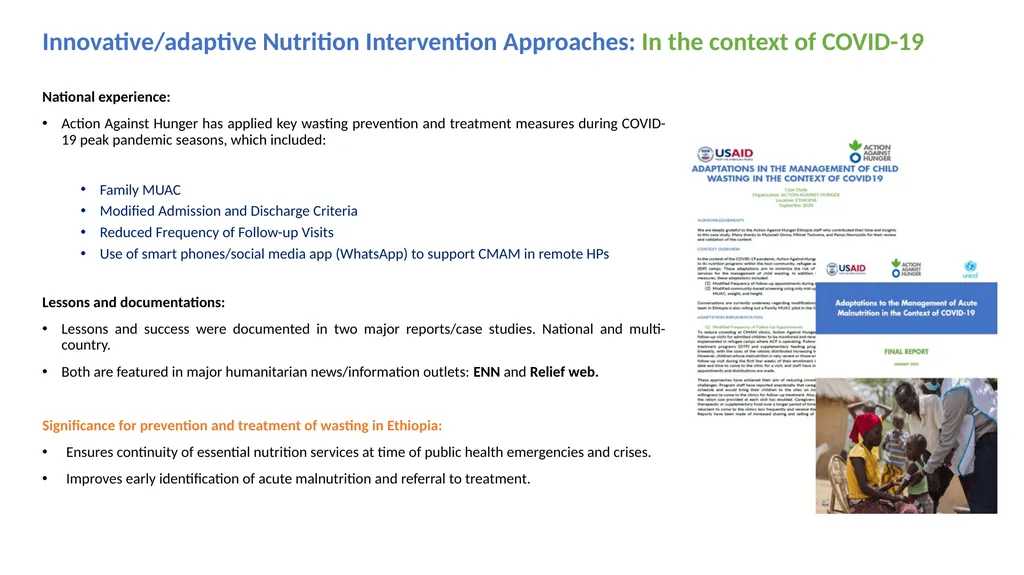
Lessons and success were documented in two major reports/case studies. National and multi-country.
Both are featured in major humanitarian news/information outlets: ENN and Relief web.
Significance for prevention and treatment of wasting in Ethiopia:
Ensures continuity of essential nutrition services at time of public health emergencies and crises.
Improves early identification of acute malnutrition and referral to treatment. Innovative/adaptive Nutrition Intervention Approaches: In the context of COVID-19<br>
Action Against Hunger has applied key wasting prevention and treatment measures during COVID-19 peak pandemic seasons, which included:
Family MUAC
Modified Admission and Discharge Criteria
Reduced Frequency of Follow-up Visits
Use of smart phones/social media app (WhatsApp) to support CMAM in remote HPs
Lessons and documentations:
Lessons and success were documented in two major reports/case studies. National and multi-country.
Both are featured in major humanitarian news/information outlets: ENN and Relief web.
Significance for prevention and treatment of wasting in Ethiopia:
Ensures continuity of essential nutrition services at time of public health emergencies and crises.
Improves early identification of acute malnutrition and referral to treatment. Innovative/adaptive Nutrition Intervention Approaches: In the context of COVID-19<br>
50
National experience:
MAMI: Management of small & nutritionally at-risk infants under six months & their mothers.
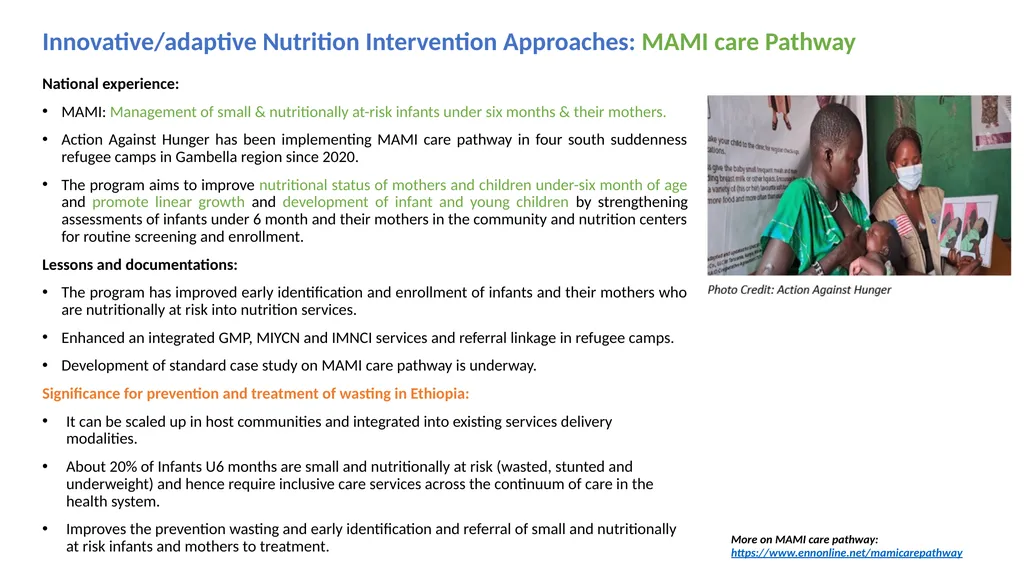
Action Against Hunger has been implementing MAMI care pathway in four south suddenness refugee camps in Gambella region since 2020.
The program aims to improve nutritional status of mothers and children under-six month of age and promote linear growth and development of infant and young children by strengthening assessments of infants under 6 month and their mothers in the community and nutrition centers for routine screening and enrollment.
Lessons and documentations:
The program has improved early identification and enrollment of infants and their mothers who are nutritionally at risk into nutrition services.
Enhanced an integrated GMP, MIYCN and IMNCI services and referral linkage in refugee camps.
Development of standard case study on MAMI care pathway is underway.
Significance for prevention and treatment of wasting in Ethiopia:
It can be scaled up in host communities and integrated into existing services delivery modalities.
About 20% of Infants U6 months are small and nutritionally at risk (wasted, stunted and underweight) and hence require inclusive care services across the continuum of care in the health system.
Improves the prevention wasting and early identification and referral of small and nutritionally at risk infants and mothers to treatment. Innovative/adaptive Nutrition Intervention Approaches: MAMI care Pathway More on MAMI care pathway: https://www.ennonline.net/mamicarepathway<br>
MAMI: Management of small & nutritionally at-risk infants under six months & their mothers.
Action Against Hunger has been implementing MAMI care pathway in four south suddenness refugee camps in Gambella region since 2020.
The program aims to improve nutritional status of mothers and children under-six month of age and promote linear growth and development of infant and young children by strengthening assessments of infants under 6 month and their mothers in the community and nutrition centers for routine screening and enrollment.
Lessons and documentations:
The program has improved early identification and enrollment of infants and their mothers who are nutritionally at risk into nutrition services.
Enhanced an integrated GMP, MIYCN and IMNCI services and referral linkage in refugee camps.
Development of standard case study on MAMI care pathway is underway.
Significance for prevention and treatment of wasting in Ethiopia:
It can be scaled up in host communities and integrated into existing services delivery modalities.
About 20% of Infants U6 months are small and nutritionally at risk (wasted, stunted and underweight) and hence require inclusive care services across the continuum of care in the health system.
Improves the prevention wasting and early identification and referral of small and nutritionally at risk infants and mothers to treatment. Innovative/adaptive Nutrition Intervention Approaches: MAMI care Pathway More on MAMI care pathway: https://www.ennonline.net/mamicarepathway<br>
51
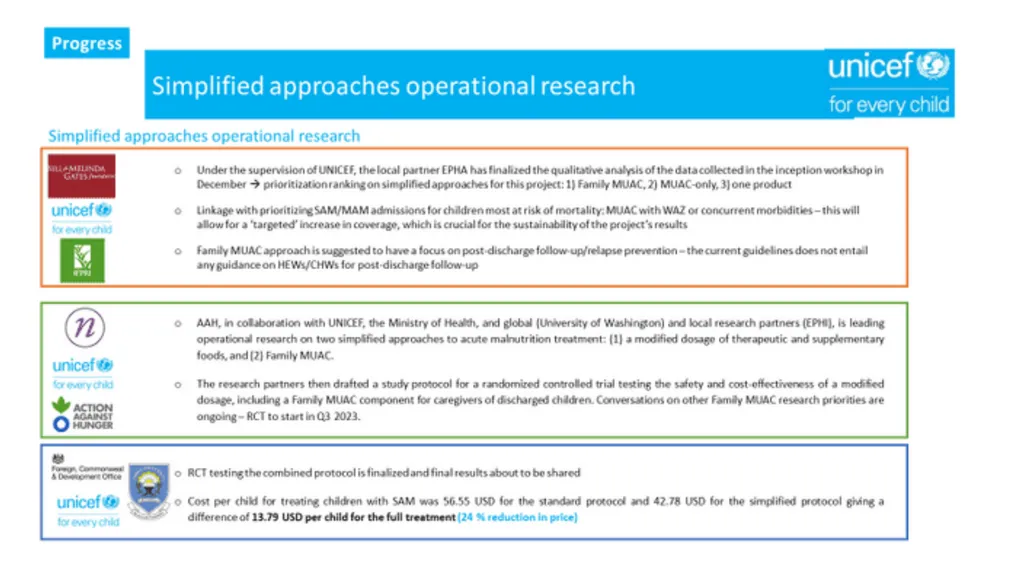
Research and Innovation: Simplified Approaches Aim and Objectives:
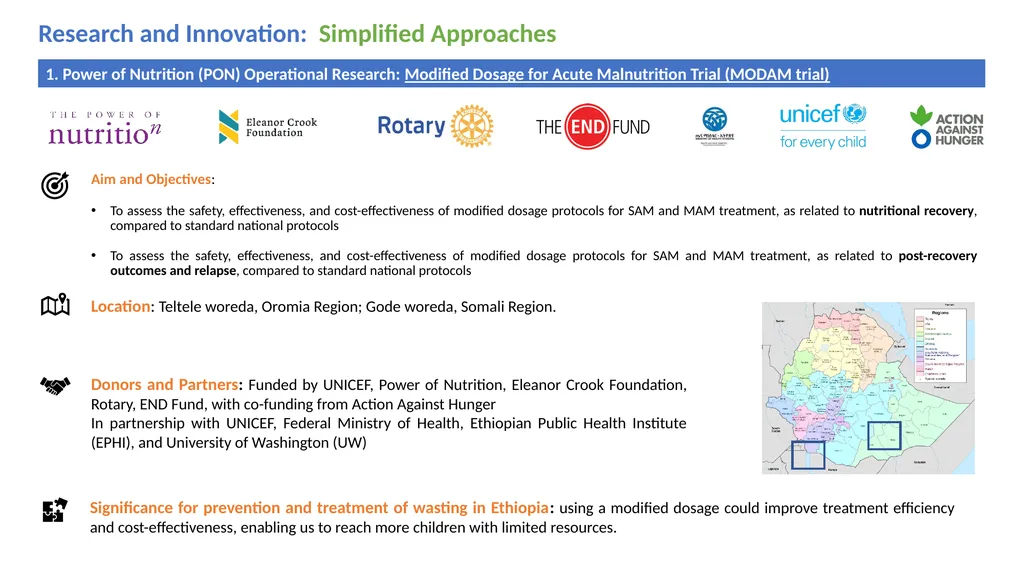
To assess the safety, effectiveness, and cost-effectiveness of modified dosage protocols for SAM and MAM treatment, as related to nutritional recovery, compared to standard national protocols
To assess the safety, effectiveness, and cost-effectiveness of modified dosage protocols for SAM and MAM treatment, as related to post-recovery outcomes and relapse, compared to standard national protocols 1. Power of Nutrition (PON) Operational Research: Modified Dosage for Acute Malnutrition Trial (MODAM trial) Location: Teltele woreda, Oromia Region; Gode woreda, Somali Region. Donors and Partners: Funded by UNICEF, Power of Nutrition, Eleanor Crook Foundation, Rotary, END Fund, with co-funding from Action Against Hunger
In partnership with UNICEF, Federal Ministry of Health, Ethiopian Public Health Institute (EPHI), and University of Washington (UW) Significance for prevention and treatment of wasting in Ethiopia: using a modified dosage could improve treatment efficiency and cost-effectiveness, enabling us to reach more children with limited resources.<br>
To assess the safety, effectiveness, and cost-effectiveness of modified dosage protocols for SAM and MAM treatment, as related to nutritional recovery, compared to standard national protocols
To assess the safety, effectiveness, and cost-effectiveness of modified dosage protocols for SAM and MAM treatment, as related to post-recovery outcomes and relapse, compared to standard national protocols 1. Power of Nutrition (PON) Operational Research: Modified Dosage for Acute Malnutrition Trial (MODAM trial) Location: Teltele woreda, Oromia Region; Gode woreda, Somali Region. Donors and Partners: Funded by UNICEF, Power of Nutrition, Eleanor Crook Foundation, Rotary, END Fund, with co-funding from Action Against Hunger
In partnership with UNICEF, Federal Ministry of Health, Ethiopian Public Health Institute (EPHI), and University of Washington (UW) Significance for prevention and treatment of wasting in Ethiopia: using a modified dosage could improve treatment efficiency and cost-effectiveness, enabling us to reach more children with limited resources.<br>
52
For more information on the two operational research, please contact:
Heather Stobaugh Yosef Beyene Maria Wrabel
Principal Investigator Principal Investigator Research Project Coordinator
Action Against Hunger Ethiopia Public Health Institute (EPHI) Action Against Hunger
Email: hstobaugh@actionagainsthunger.org Email: yosef_beyene@yahoo.com Email: pon-pc@et-actionagainsthunger.org Aim and Objectives:
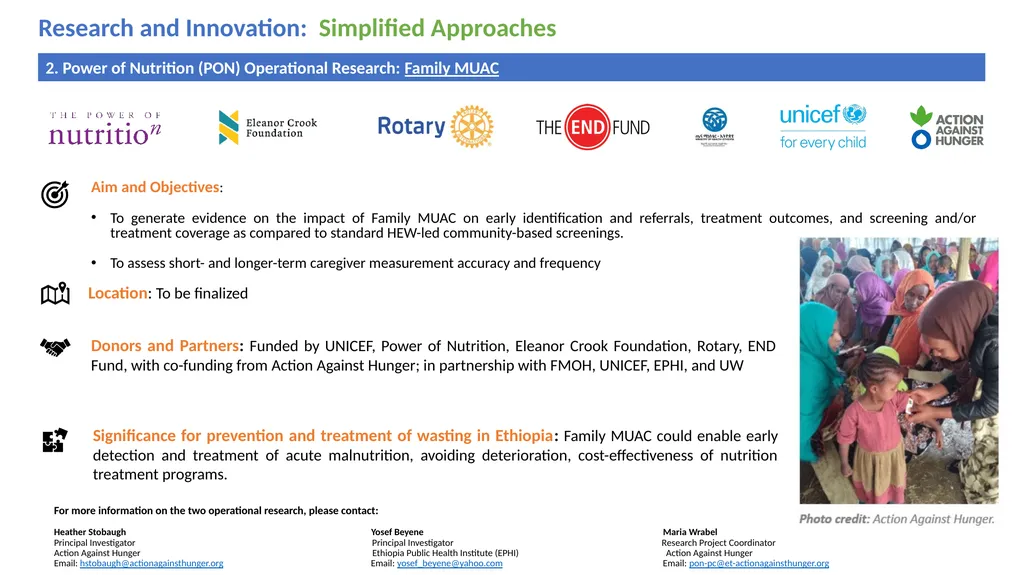
To generate evidence on the impact of Family MUAC on early identification and referrals, treatment outcomes, and screening and/or treatment coverage as compared to standard HEW-led community-based screenings.
To assess short- and longer-term caregiver measurement accuracy and frequency 2. Power of Nutrition (PON) Operational Research: Family MUAC Location: To be finalized Donors and Partners: Funded by UNICEF, Power of Nutrition, Eleanor Crook Foundation, Rotary, END Fund, with co-funding from Action Against Hunger; in partnership with FMOH, UNICEF, EPHI, and UW Significance for prevention and treatment of wasting in Ethiopia: Family MUAC could enable early detection and treatment of acute malnutrition, avoiding deterioration, cost-effectiveness of nutrition treatment programs. Research and Innovation: Simplified Approaches<br>
To generate evidence on the impact of Family MUAC on early identification and referrals, treatment outcomes, and screening and/or treatment coverage as compared to standard HEW-led community-based screenings.
To assess short- and longer-term caregiver measurement accuracy and frequency 2. Power of Nutrition (PON) Operational Research: Family MUAC Location: To be finalized Donors and Partners: Funded by UNICEF, Power of Nutrition, Eleanor Crook Foundation, Rotary, END Fund, with co-funding from Action Against Hunger; in partnership with FMOH, UNICEF, EPHI, and UW Significance for prevention and treatment of wasting in Ethiopia: Family MUAC could enable early detection and treatment of acute malnutrition, avoiding deterioration, cost-effectiveness of nutrition treatment programs. Research and Innovation: Simplified Approaches<br>
53
Aim and Objectives:
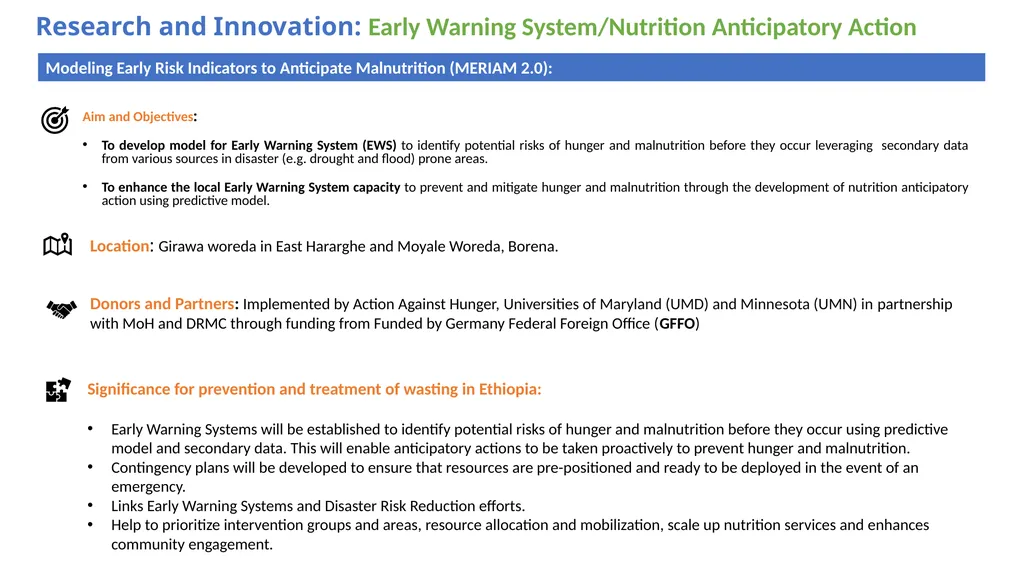
To develop model for Early Warning System (EWS) to identify potential risks of hunger and malnutrition before they occur leveraging secondary data from various sources in disaster (e.g. drought and flood) prone areas.
To enhance the local Early Warning System capacity to prevent and mitigate hunger and malnutrition through the development of nutrition anticipatory action using predictive model. Modeling Early Risk Indicators to Anticipate Malnutrition (MERIAM 2.0): Location: Girawa woreda in East Hararghe and Moyale Woreda, Borena. Donors and Partners: Implemented by Action Against Hunger, Universities of Maryland (UMD) and Minnesota (UMN) in partnership with MoH and DRMC through funding from Funded by Germany Federal Foreign Office (GFFO) Significance for prevention and treatment of wasting in Ethiopia:
Early Warning Systems will be established to identify potential risks of hunger and malnutrition before they occur using predictive model and secondary data. This will enable anticipatory actions to be taken proactively to prevent hunger and malnutrition.
Contingency plans will be developed to ensure that resources are pre-positioned and ready to be deployed in the event of an emergency.
Links Early Warning Systems and Disaster Risk Reduction efforts.
Help to prioritize intervention groups and areas, resource allocation and mobilization, scale up nutrition services and enhances community engagement. Research and Innovation: Early Warning System/Nutrition Anticipatory Action<br>
To develop model for Early Warning System (EWS) to identify potential risks of hunger and malnutrition before they occur leveraging secondary data from various sources in disaster (e.g. drought and flood) prone areas.
To enhance the local Early Warning System capacity to prevent and mitigate hunger and malnutrition through the development of nutrition anticipatory action using predictive model. Modeling Early Risk Indicators to Anticipate Malnutrition (MERIAM 2.0): Location: Girawa woreda in East Hararghe and Moyale Woreda, Borena. Donors and Partners: Implemented by Action Against Hunger, Universities of Maryland (UMD) and Minnesota (UMN) in partnership with MoH and DRMC through funding from Funded by Germany Federal Foreign Office (GFFO) Significance for prevention and treatment of wasting in Ethiopia:
Early Warning Systems will be established to identify potential risks of hunger and malnutrition before they occur using predictive model and secondary data. This will enable anticipatory actions to be taken proactively to prevent hunger and malnutrition.
Contingency plans will be developed to ensure that resources are pre-positioned and ready to be deployed in the event of an emergency.
Links Early Warning Systems and Disaster Risk Reduction efforts.
Help to prioritize intervention groups and areas, resource allocation and mobilization, scale up nutrition services and enhances community engagement. Research and Innovation: Early Warning System/Nutrition Anticipatory Action<br>
54
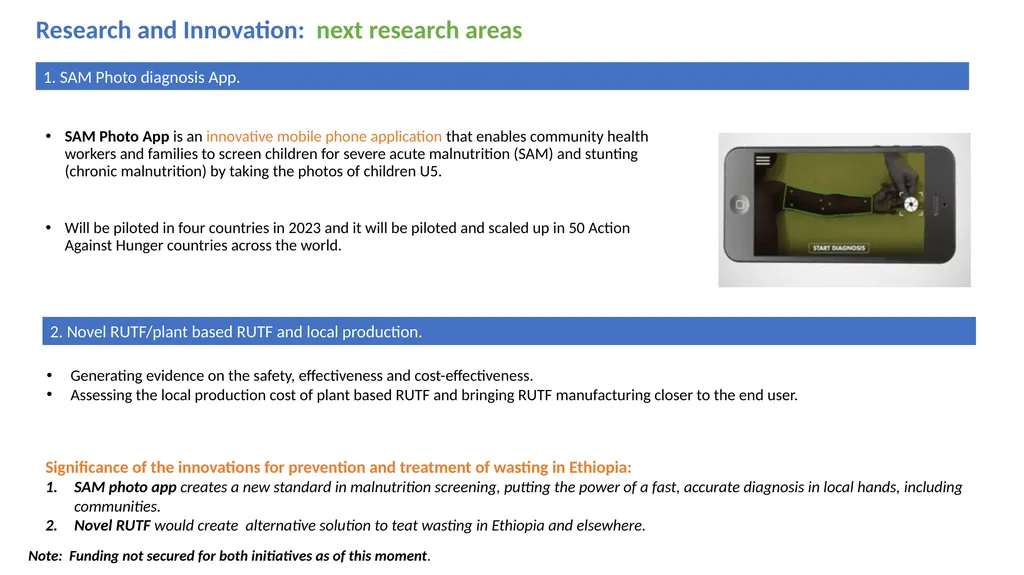
SAM Photo App is an innovative mobile phone application that enables community health workers and families to screen children for severe acute malnutrition (SAM) and stunting (chronic malnutrition) by taking the photos of children U5.
Will be piloted in four countries in 2023 and it will be piloted and scaled up in 50 Action Against Hunger countries across the world. Research and Innovation: next research areas Significance of the innovations for prevention and treatment of wasting in Ethiopia:
SAM photo app creates a new standard in malnutrition screening, putting the power of a fast, accurate diagnosis in local hands, including communities.
Novel RUTF would create alternative solution to teat wasting in Ethiopia and elsewhere. Generating evidence on the safety, effectiveness and cost-effectiveness.
Assessing the local production cost of plant based RUTF and bringing RUTF manufacturing closer to the end user. 1. SAM Photo diagnosis App. 2. Novel RUTF/plant based RUTF and local production. Note: Funding not secured for both initiatives as of this moment.<br>
Will be piloted in four countries in 2023 and it will be piloted and scaled up in 50 Action Against Hunger countries across the world. Research and Innovation: next research areas Significance of the innovations for prevention and treatment of wasting in Ethiopia:
SAM photo app creates a new standard in malnutrition screening, putting the power of a fast, accurate diagnosis in local hands, including communities.
Novel RUTF would create alternative solution to teat wasting in Ethiopia and elsewhere. Generating evidence on the safety, effectiveness and cost-effectiveness.
Assessing the local production cost of plant based RUTF and bringing RUTF manufacturing closer to the end user. 1. SAM Photo diagnosis App. 2. Novel RUTF/plant based RUTF and local production. Note: Funding not secured for both initiatives as of this moment.<br>
55
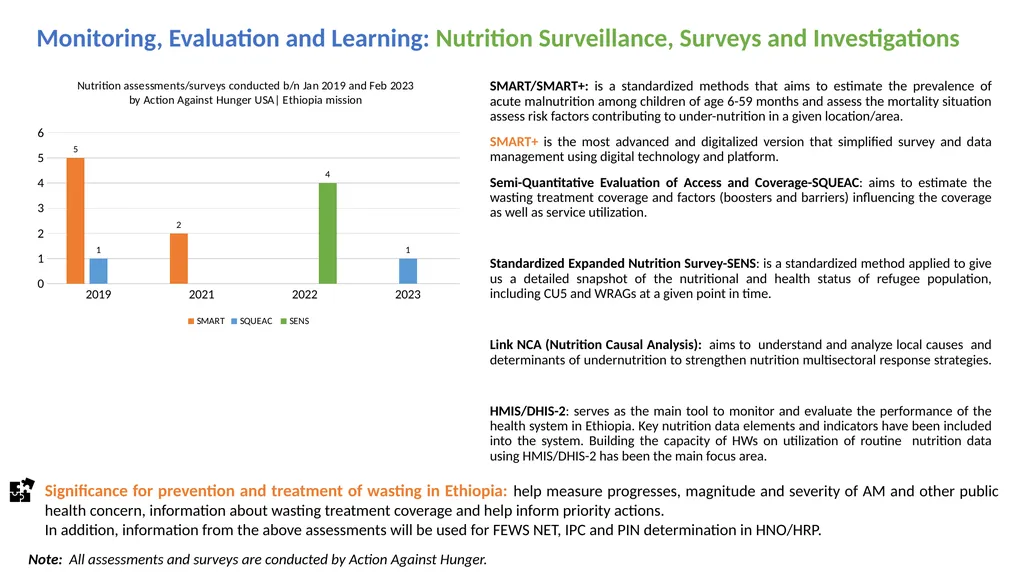
Monitoring, Evaluation and Learning: Nutrition Surveillance, Surveys and Investigations SMART/SMART+: is a standardized methods that aims to estimate the prevalence of acute malnutrition among children of age 6-59 months and assess the mortality situation assess risk factors contributing to under-nutrition in a given location/area.
SMART+ is the most advanced and digitalized version that simplified survey and data management using digital technology and platform.
Semi-Quantitative Evaluation of Access and Coverage-SQUEAC: aims to estimate the wasting treatment coverage and factors (boosters and barriers) influencing the coverage as well as service utilization.
Standardized Expanded Nutrition Survey-SENS: is a standardized method applied to give us a detailed snapshot of the nutritional and health status of refugee population, including CU5 and WRAGs at a given point in time.
Link NCA (Nutrition Causal Analysis): aims to understand and analyze local causes and determinants of undernutrition to strengthen nutrition multisectoral response strategies.
HMIS/DHIS-2: serves as the main tool to monitor and evaluate the performance of the health system in Ethiopia. Key nutrition data elements and indicators have been included into the system. Building the capacity of HWs on utilization of routine nutrition data using HMIS/DHIS-2 has been the main focus area. Significance for prevention and treatment of wasting in Ethiopia: help measure progresses, magnitude and severity of AM and other public health concern, information about wasting treatment coverage and help inform priority actions.
In addition, information from the above assessments will be used for FEWS NET, IPC and PIN determination in HNO/HRP. Note: All assessments and surveys are conducted by Action Against Hunger.<br>
SMART+ is the most advanced and digitalized version that simplified survey and data management using digital technology and platform.
Semi-Quantitative Evaluation of Access and Coverage-SQUEAC: aims to estimate the wasting treatment coverage and factors (boosters and barriers) influencing the coverage as well as service utilization.
Standardized Expanded Nutrition Survey-SENS: is a standardized method applied to give us a detailed snapshot of the nutritional and health status of refugee population, including CU5 and WRAGs at a given point in time.
Link NCA (Nutrition Causal Analysis): aims to understand and analyze local causes and determinants of undernutrition to strengthen nutrition multisectoral response strategies.
HMIS/DHIS-2: serves as the main tool to monitor and evaluate the performance of the health system in Ethiopia. Key nutrition data elements and indicators have been included into the system. Building the capacity of HWs on utilization of routine nutrition data using HMIS/DHIS-2 has been the main focus area. Significance for prevention and treatment of wasting in Ethiopia: help measure progresses, magnitude and severity of AM and other public health concern, information about wasting treatment coverage and help inform priority actions.
In addition, information from the above assessments will be used for FEWS NET, IPC and PIN determination in HNO/HRP. Note: All assessments and surveys are conducted by Action Against Hunger.<br>
56
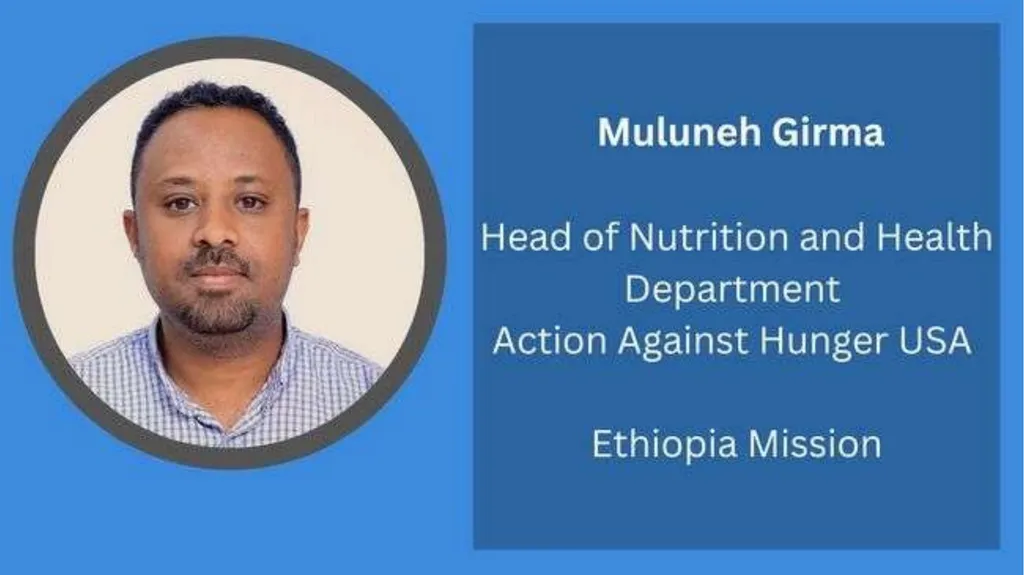
Thank you for listening! Muluneh Girma
HoD-Nutrition and health
Action Against Hunger
Email: nh-hod@et-actionagainsthunger.org<br>
57
66<br>
58
67<br>
59
68<br>
60
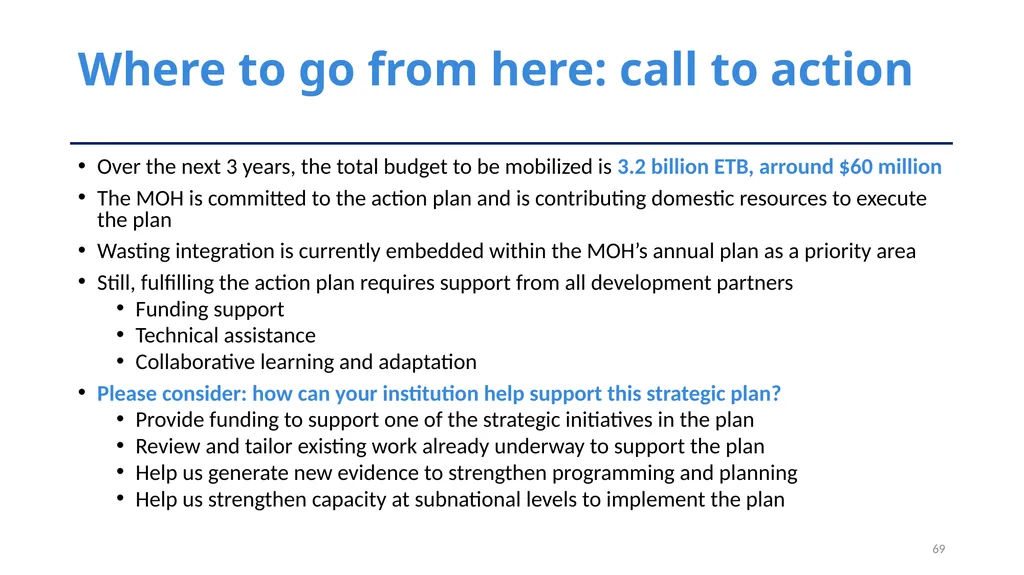
Where to go from here: call to action 69 Over the next 3 years, the total budget to be mobilized is 3.2 billion ETB, arround $60 million
The MOH is committed to the action plan and is contributing domestic resources to execute the plan
Wasting integration is currently embedded within the MOH’s annual plan as a priority area
Still, fulfilling the action plan requires support from all development partners
Funding support
Technical assistance
Collaborative learning and adaptation
Please consider: how can your institution help support this strategic plan?
Provide funding to support one of the strategic initiatives in the plan
Review and tailor existing work already underway to support the plan
Help us generate new evidence to strengthen programming and planning
Help us strengthen capacity at subnational levels to implement the plan<br>
The MOH is committed to the action plan and is contributing domestic resources to execute the plan
Wasting integration is currently embedded within the MOH’s annual plan as a priority area
Still, fulfilling the action plan requires support from all development partners
Funding support
Technical assistance
Collaborative learning and adaptation
Please consider: how can your institution help support this strategic plan?
Provide funding to support one of the strategic initiatives in the plan
Review and tailor existing work already underway to support the plan
Help us generate new evidence to strengthen programming and planning
Help us strengthen capacity at subnational levels to implement the plan<br>
61
70<br>