
1 Icons Activating prior knowledge Remember what
CP
Published · 21 slides · 0 views
1 / 1
Description
1 Icons Activating prior knowledge Remember what you already know about a topic before you start to learn something new, to help build connections in your long-term memory. Retrieval practice Quizzing, recall and memory activities to slow
Related Topics
Share
Embed code
Download this presentation From Below
"1 Icons Activating prior knowledge Remember what" is the property of its rightful owner. Permission is granted to download and print the materials on this website for personal, non-commercial use only, and to display it on your personal computer provided you do not modify the materials and that you retain all copyright notices contained in the materials. By downloading content from our website, you accept the terms of this agreement.
Presentation Transcript
01
1<br>
02
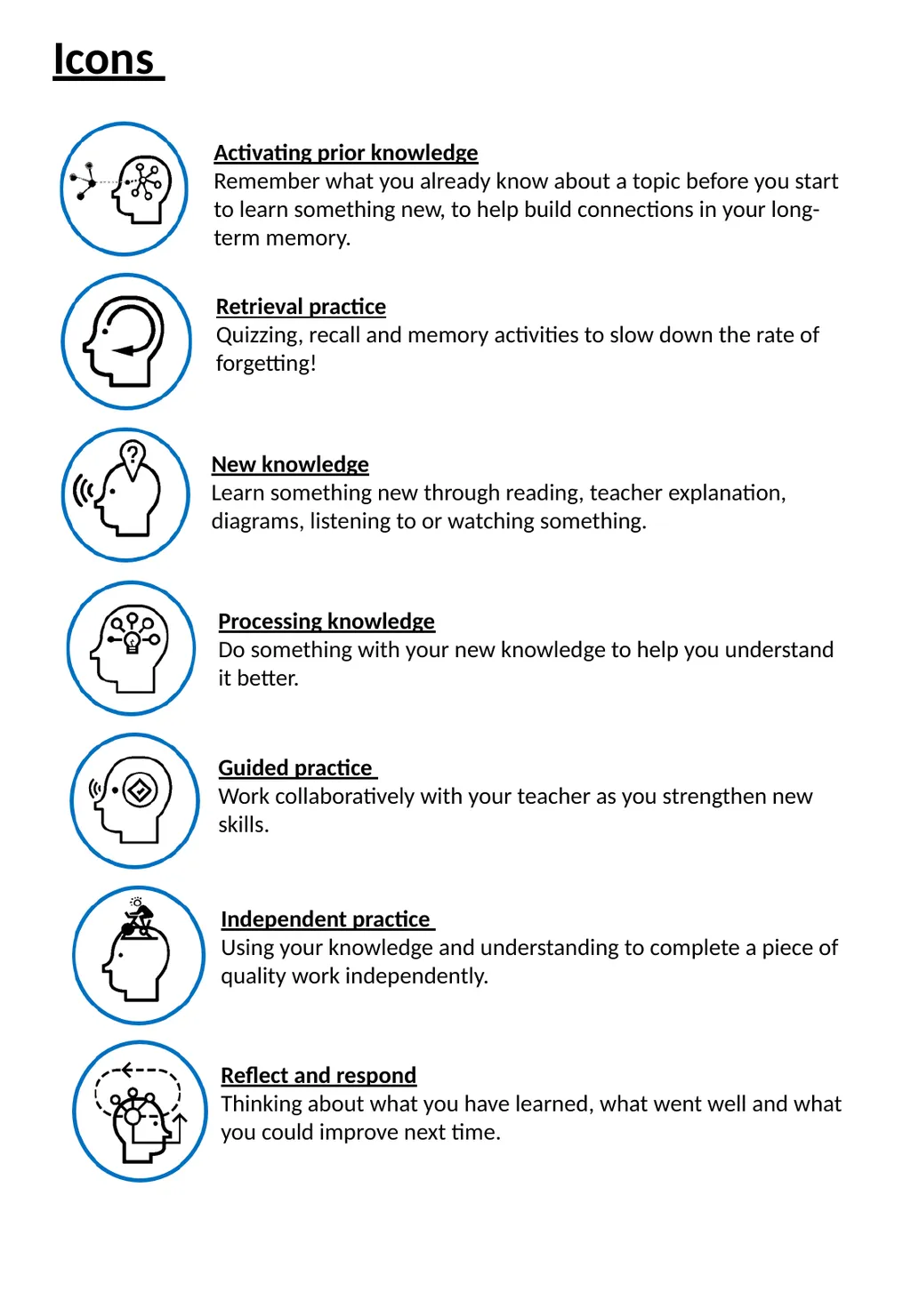
Icons Activating prior knowledge
Remember what you already know about a topic before you start to learn something new, to help build connections in your long-term memory. Retrieval practice
Quizzing, recall and memory activities to slow down the rate of forgetting! New knowledge
Learn something new through reading, teacher explanation, diagrams, listening to or watching something. Processing knowledge
Do something with your new knowledge to help you understand it better. Guided practice
Work collaboratively with your teacher as you strengthen new skills. Independent practice
Using your knowledge and understanding to complete a piece of quality work independently. Reflect and respond
Thinking about what you have learned, what went well and what you could improve next time.<br>
Remember what you already know about a topic before you start to learn something new, to help build connections in your long-term memory. Retrieval practice
Quizzing, recall and memory activities to slow down the rate of forgetting! New knowledge
Learn something new through reading, teacher explanation, diagrams, listening to or watching something. Processing knowledge
Do something with your new knowledge to help you understand it better. Guided practice
Work collaboratively with your teacher as you strengthen new skills. Independent practice
Using your knowledge and understanding to complete a piece of quality work independently. Reflect and respond
Thinking about what you have learned, what went well and what you could improve next time.<br>
03
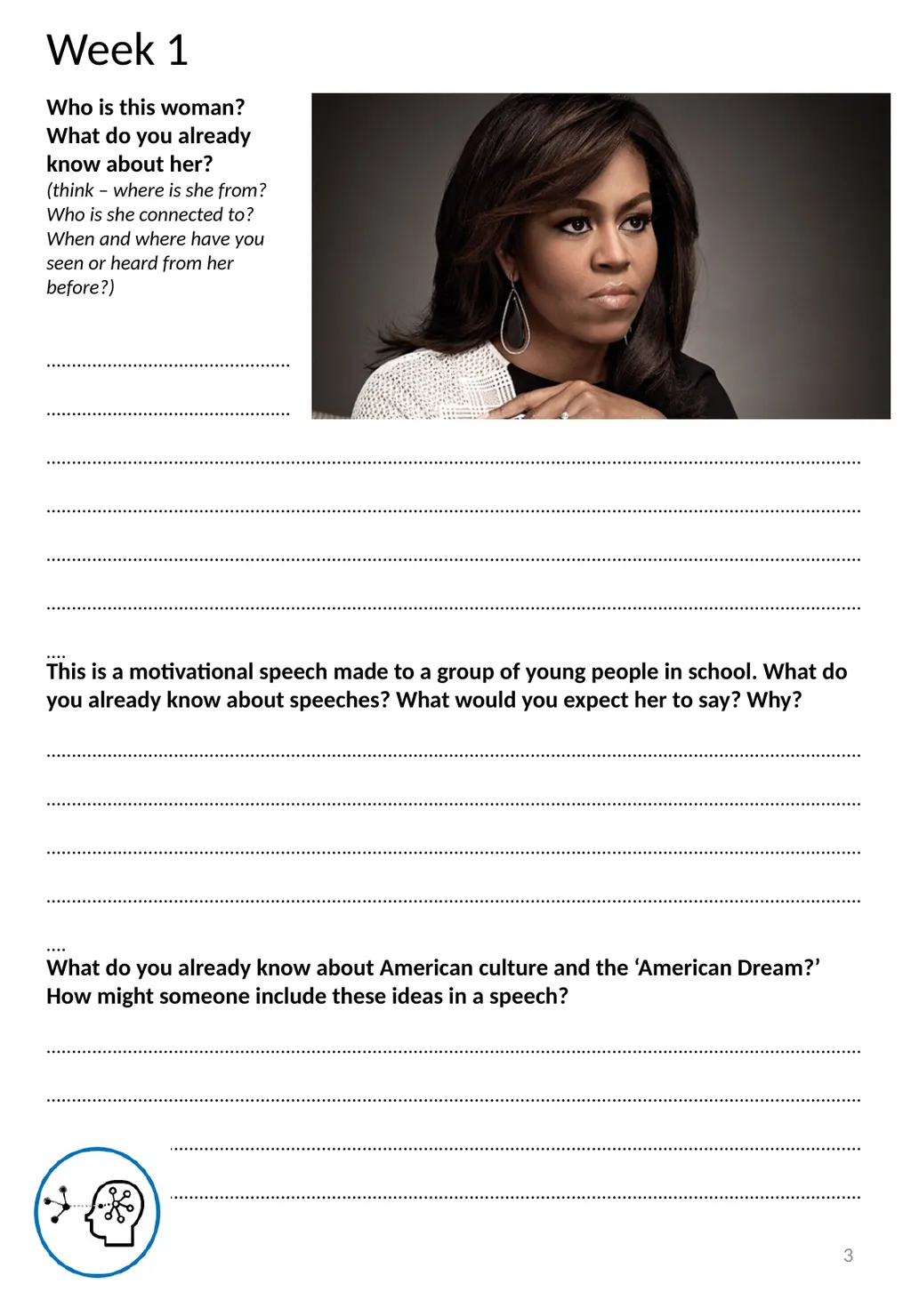
3 Who is this woman?
What do you already
know about her?
(think – where is she from?
Who is she connected to?
When and where have you
seen or heard from her
before?)
................................................
................................................
.................................................................................................................................................................................................................................................................................................................................................................................................................................................................................................................................................................................................................................................................... This is a motivational speech made to a group of young people in school. What do you already know about speeches? What would you expect her to say? Why?
.................................................................................................................................................................................................................................................................................................................................................................................................................................................................................................................................................................................................................................................................... What do you already know about American culture and the ‘American Dream?’ How might someone include these ideas in a speech?
.................................................................................................................................................................................................................................................................................................................................................................................................................................................................................................................................................................................................................................................................... Week 1<br>
What do you already
know about her?
(think – where is she from?
Who is she connected to?
When and where have you
seen or heard from her
before?)
................................................
................................................
.................................................................................................................................................................................................................................................................................................................................................................................................................................................................................................................................................................................................................................................................... This is a motivational speech made to a group of young people in school. What do you already know about speeches? What would you expect her to say? Why?
.................................................................................................................................................................................................................................................................................................................................................................................................................................................................................................................................................................................................................................................................... What do you already know about American culture and the ‘American Dream?’ How might someone include these ideas in a speech?
.................................................................................................................................................................................................................................................................................................................................................................................................................................................................................................................................................................................................................................................................... Week 1<br>
04
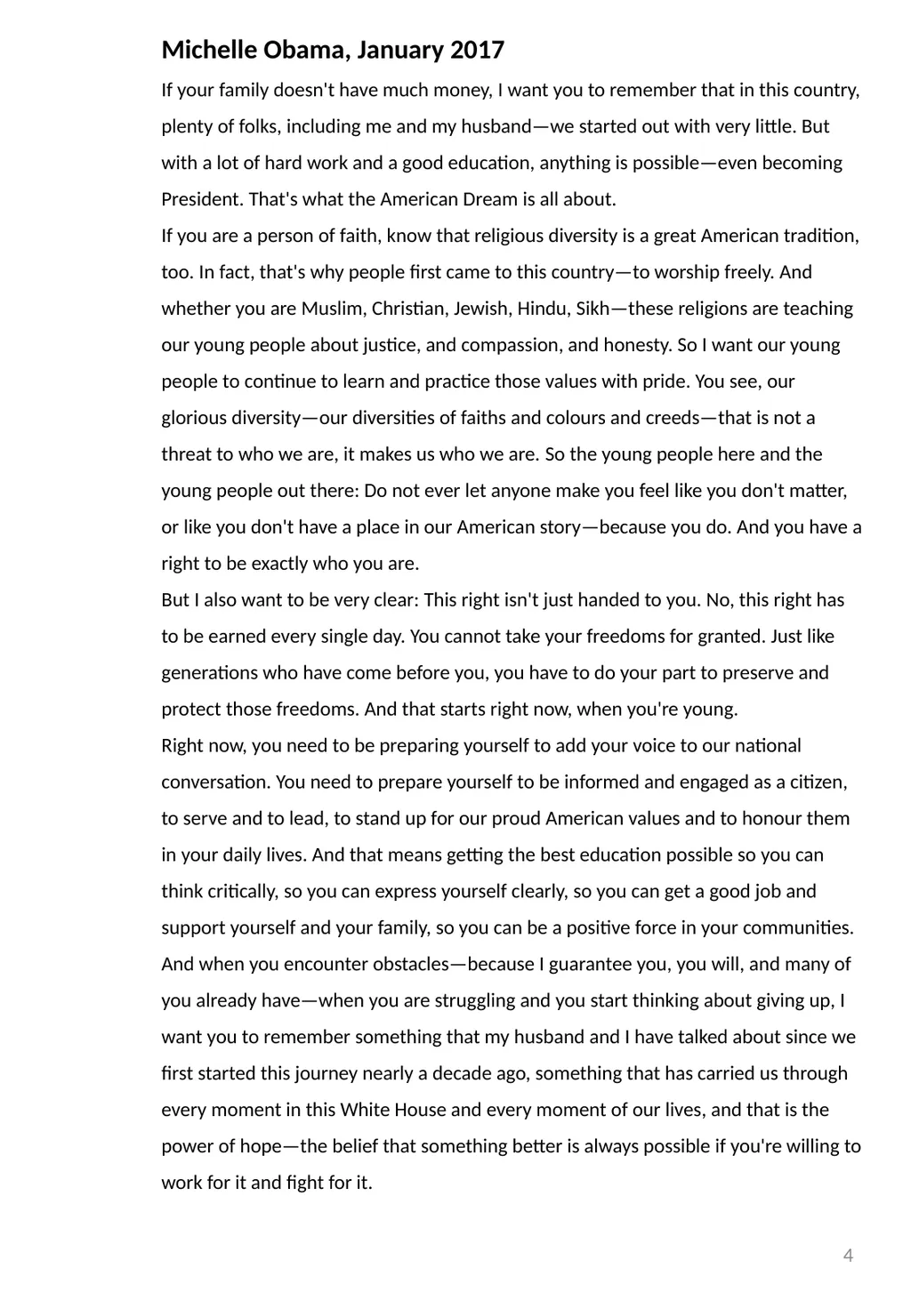
4 Michelle Obama, January 2017
If your family doesn't have much money, I want you to remember that in this country, plenty of folks, including me and my husband—we started out with very little. But with a lot of hard work and a good education, anything is possible—even becoming President. That's what the American Dream is all about.
If you are a person of faith, know that religious diversity is a great American tradition, too. In fact, that's why people first came to this country—to worship freely. And whether you are Muslim, Christian, Jewish, Hindu, Sikh—these religions are teaching our young people about justice, and compassion, and honesty. So I want our young people to continue to learn and practice those values with pride. You see, our glorious diversity—our diversities of faiths and colours and creeds—that is not a threat to who we are, it makes us who we are. So the young people here and the young people out there: Do not ever let anyone make you feel like you don't matter, or like you don't have a place in our American story—because you do. And you have a right to be exactly who you are.
But I also want to be very clear: This right isn't just handed to you. No, this right has to be earned every single day. You cannot take your freedoms for granted. Just like generations who have come before you, you have to do your part to preserve and protect those freedoms. And that starts right now, when you're young.
Right now, you need to be preparing yourself to add your voice to our national conversation. You need to prepare yourself to be informed and engaged as a citizen, to serve and to lead, to stand up for our proud American values and to honour them in your daily lives. And that means getting the best education possible so you can think critically, so you can express yourself clearly, so you can get a good job and support yourself and your family, so you can be a positive force in your communities.
And when you encounter obstacles—because I guarantee you, you will, and many of you already have—when you are struggling and you start thinking about giving up, I want you to remember something that my husband and I have talked about since we first started this journey nearly a decade ago, something that has carried us through every moment in this White House and every moment of our lives, and that is the power of hope—the belief that something better is always possible if you're willing to work for it and fight for it.<br>
05
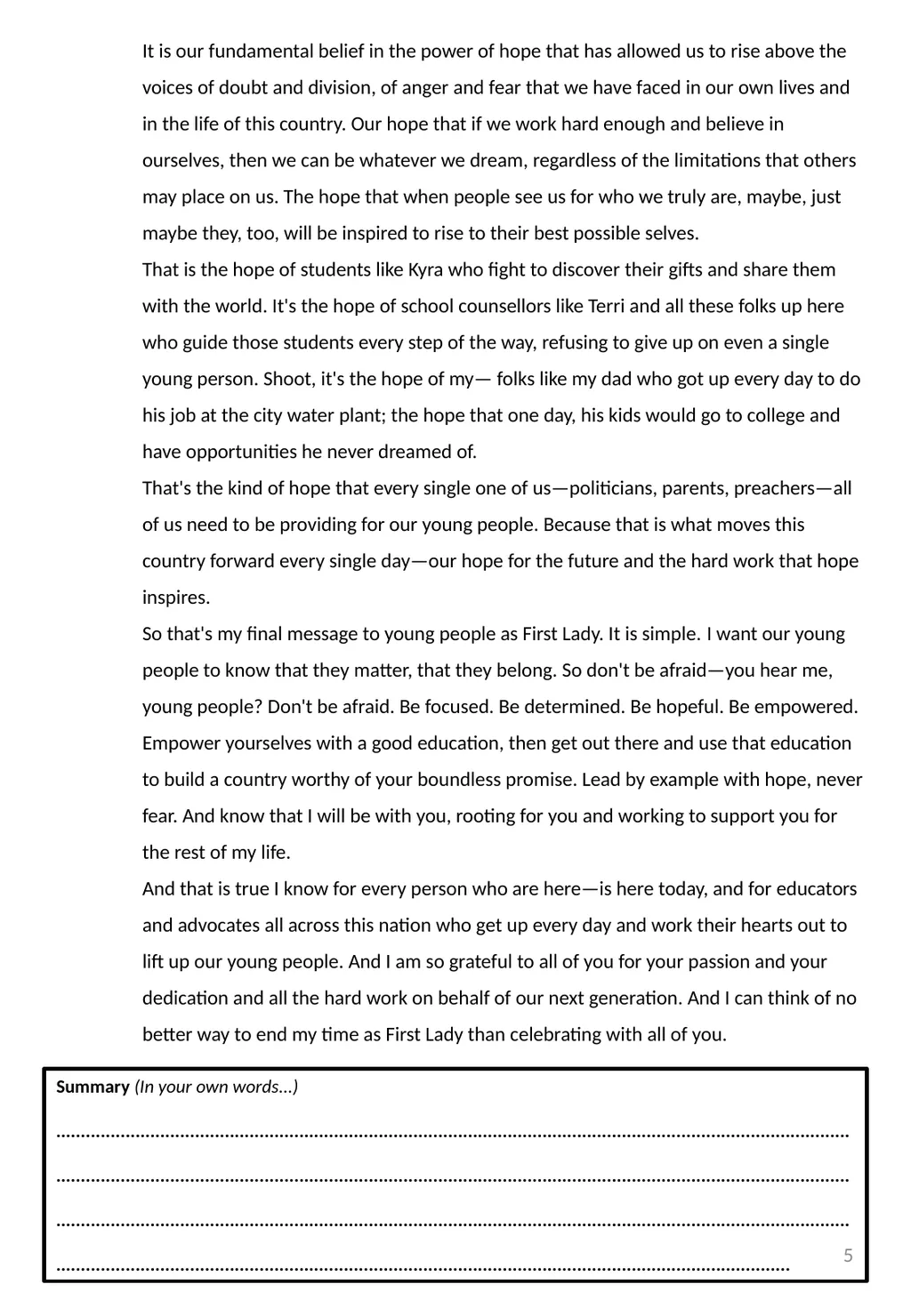
5 It is our fundamental belief in the power of hope that has allowed us to rise above the voices of doubt and division, of anger and fear that we have faced in our own lives and in the life of this country. Our hope that if we work hard enough and believe in ourselves, then we can be whatever we dream, regardless of the limitations that others may place on us. The hope that when people see us for who we truly are, maybe, just maybe they, too, will be inspired to rise to their best possible selves.
That is the hope of students like Kyra who fight to discover their gifts and share them with the world. It's the hope of school counsellors like Terri and all these folks up here who guide those students every step of the way, refusing to give up on even a single young person. Shoot, it's the hope of my— folks like my dad who got up every day to do his job at the city water plant; the hope that one day, his kids would go to college and have opportunities he never dreamed of.
That's the kind of hope that every single one of us—politicians, parents, preachers—all of us need to be providing for our young people. Because that is what moves this country forward every single day—our hope for the future and the hard work that hope inspires.
So that's my final message to young people as First Lady. It is simple. I want our young people to know that they matter, that they belong. So don't be afraid—you hear me, young people? Don't be afraid. Be focused. Be determined. Be hopeful. Be empowered. Empower yourselves with a good education, then get out there and use that education to build a country worthy of your boundless promise. Lead by example with hope, never fear. And know that I will be with you, rooting for you and working to support you for the rest of my life.
And that is true I know for every person who are here—is here today, and for educators and advocates all across this nation who get up every day and work their hearts out to lift up our young people. And I am so grateful to all of you for your passion and your dedication and all the hard work on behalf of our next generation. And I can think of no better way to end my time as First Lady than celebrating with all of you. Summary (In your own words...)
....................................................................................................................................................................................................................................................................................................................................................................................................................................................................................................................................................................................................................................................<br>
....................................................................................................................................................................................................................................................................................................................................................................................................................................................................................................................................................................................................................................................<br>
06
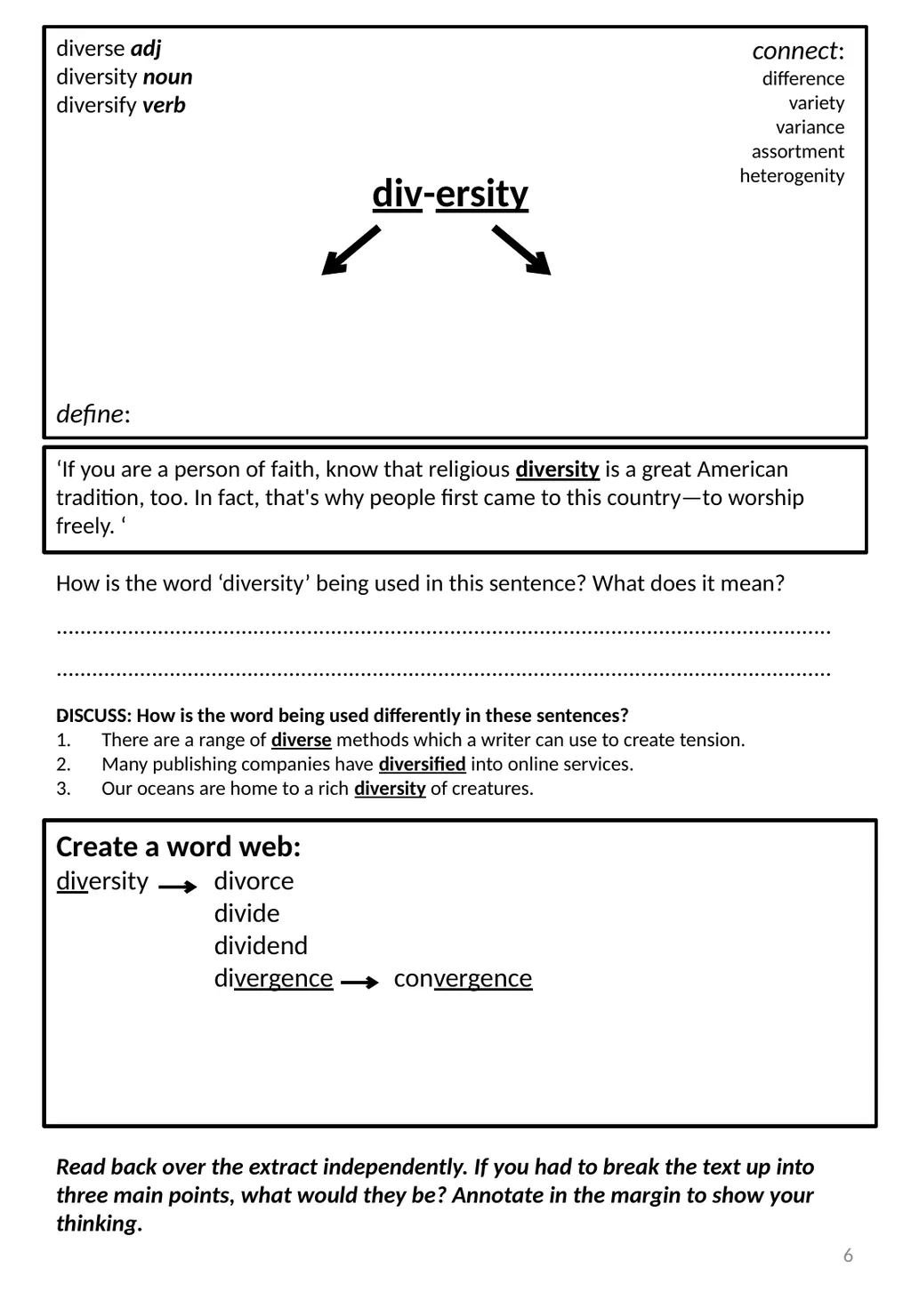
6 div-ersity Create a word web:
diversity divorce
divide
dividend
divergence convergence connect:
difference
variety
variance
assortment
heterogenity diverse adj
diversity noun
diversify verb define: ‘If you are a person of faith, know that religious diversity is a great American tradition, too. In fact, that's why people first came to this country—to worship freely. ‘ How is the word ‘diversity’ being used in this sentence? What does it mean?
...................................................................................................................................................................................................................................................................... DISCUSS: How is the word being used differently in these sentences?
There are a range of diverse methods which a writer can use to create tension.
Many publishing companies have diversified into online services.
Our oceans are home to a rich diversity of creatures. Read back over the extract independently. If you had to break the text up into three main points, what would they be? Annotate in the margin to show your thinking.<br>
diversity divorce
divide
dividend
divergence convergence connect:
difference
variety
variance
assortment
heterogenity diverse adj
diversity noun
diversify verb define: ‘If you are a person of faith, know that religious diversity is a great American tradition, too. In fact, that's why people first came to this country—to worship freely. ‘ How is the word ‘diversity’ being used in this sentence? What does it mean?
...................................................................................................................................................................................................................................................................... DISCUSS: How is the word being used differently in these sentences?
There are a range of diverse methods which a writer can use to create tension.
Many publishing companies have diversified into online services.
Our oceans are home to a rich diversity of creatures. Read back over the extract independently. If you had to break the text up into three main points, what would they be? Annotate in the margin to show your thinking.<br>
07
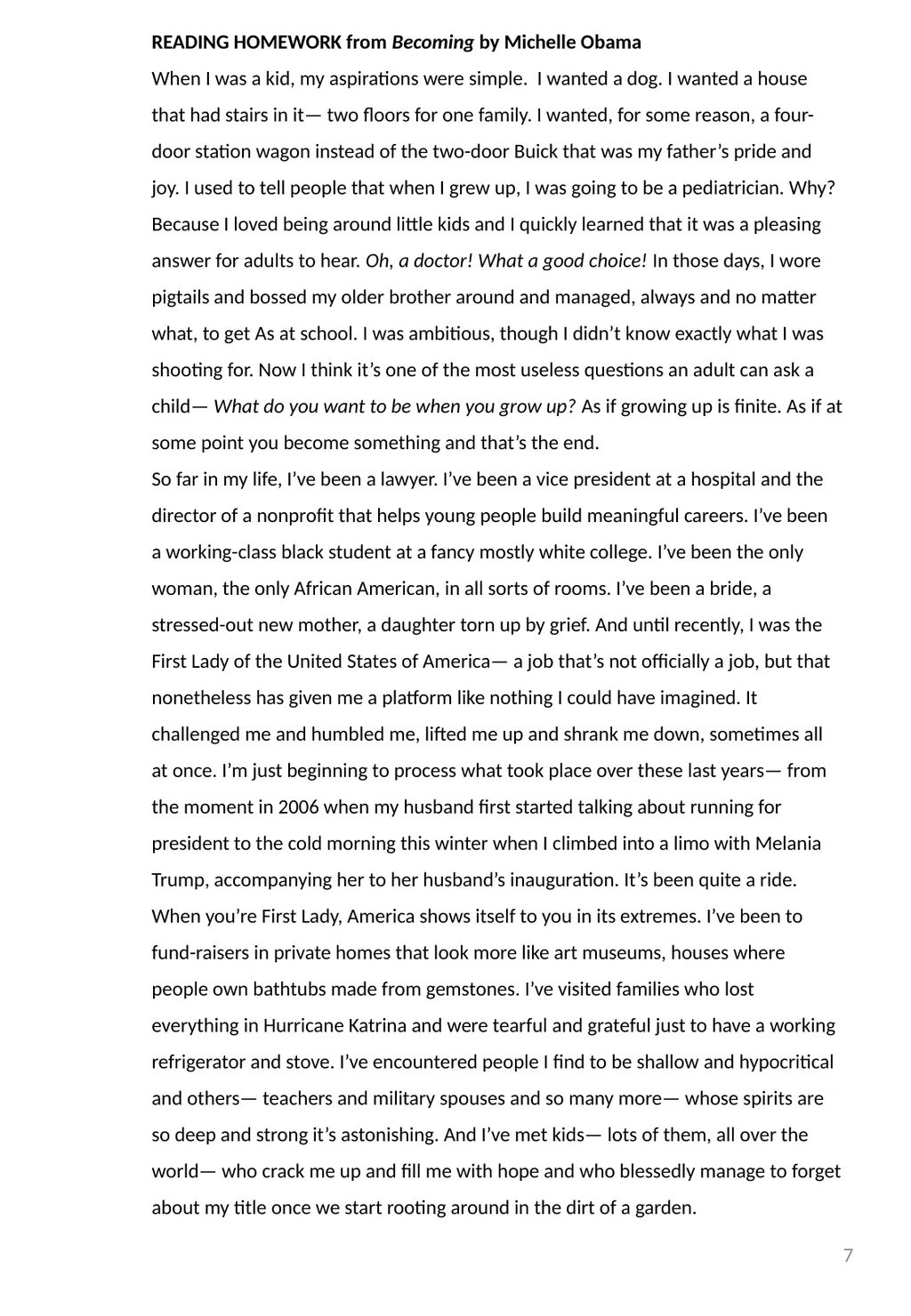
7 READING HOMEWORK from Becoming by Michelle Obama
When I was a kid, my aspirations were simple. I wanted a dog. I wanted a house that had stairs in it— two floors for one family. I wanted, for some reason, a four-door station wagon instead of the two-door Buick that was my father’s pride and joy. I used to tell people that when I grew up, I was going to be a pediatrician. Why? Because I loved being around little kids and I quickly learned that it was a pleasing answer for adults to hear. Oh, a doctor! What a good choice! In those days, I wore pigtails and bossed my older brother around and managed, always and no matter what, to get As at school. I was ambitious, though I didn’t know exactly what I was shooting for. Now I think it’s one of the most useless questions an adult can ask a child— What do you want to be when you grow up? As if growing up is finite. As if at some point you become something and that’s the end.
So far in my life, I’ve been a lawyer. I’ve been a vice president at a hospital and the director of a nonprofit that helps young people build meaningful careers. I’ve been a working-class black student at a fancy mostly white college. I’ve been the only woman, the only African American, in all sorts of rooms. I’ve been a bride, a stressed-out new mother, a daughter torn up by grief. And until recently, I was the First Lady of the United States of America— a job that’s not officially a job, but that nonetheless has given me a platform like nothing I could have imagined. It challenged me and humbled me, lifted me up and shrank me down, sometimes all at once. I’m just beginning to process what took place over these last years— from the moment in 2006 when my husband first started talking about running for president to the cold morning this winter when I climbed into a limo with Melania Trump, accompanying her to her husband’s inauguration. It’s been quite a ride.
When you’re First Lady, America shows itself to you in its extremes. I’ve been to fund-raisers in private homes that look more like art museums, houses where people own bathtubs made from gemstones. I’ve visited families who lost everything in Hurricane Katrina and were tearful and grateful just to have a working refrigerator and stove. I’ve encountered people I find to be shallow and hypocritical and others— teachers and military spouses and so many more— whose spirits are so deep and strong it’s astonishing. And I’ve met kids— lots of them, all over the world— who crack me up and fill me with hope and who blessedly manage to forget about my title once we start rooting around in the dirt of a garden.<br>
When I was a kid, my aspirations were simple. I wanted a dog. I wanted a house that had stairs in it— two floors for one family. I wanted, for some reason, a four-door station wagon instead of the two-door Buick that was my father’s pride and joy. I used to tell people that when I grew up, I was going to be a pediatrician. Why? Because I loved being around little kids and I quickly learned that it was a pleasing answer for adults to hear. Oh, a doctor! What a good choice! In those days, I wore pigtails and bossed my older brother around and managed, always and no matter what, to get As at school. I was ambitious, though I didn’t know exactly what I was shooting for. Now I think it’s one of the most useless questions an adult can ask a child— What do you want to be when you grow up? As if growing up is finite. As if at some point you become something and that’s the end.
So far in my life, I’ve been a lawyer. I’ve been a vice president at a hospital and the director of a nonprofit that helps young people build meaningful careers. I’ve been a working-class black student at a fancy mostly white college. I’ve been the only woman, the only African American, in all sorts of rooms. I’ve been a bride, a stressed-out new mother, a daughter torn up by grief. And until recently, I was the First Lady of the United States of America— a job that’s not officially a job, but that nonetheless has given me a platform like nothing I could have imagined. It challenged me and humbled me, lifted me up and shrank me down, sometimes all at once. I’m just beginning to process what took place over these last years— from the moment in 2006 when my husband first started talking about running for president to the cold morning this winter when I climbed into a limo with Melania Trump, accompanying her to her husband’s inauguration. It’s been quite a ride.
When you’re First Lady, America shows itself to you in its extremes. I’ve been to fund-raisers in private homes that look more like art museums, houses where people own bathtubs made from gemstones. I’ve visited families who lost everything in Hurricane Katrina and were tearful and grateful just to have a working refrigerator and stove. I’ve encountered people I find to be shallow and hypocritical and others— teachers and military spouses and so many more— whose spirits are so deep and strong it’s astonishing. And I’ve met kids— lots of them, all over the world— who crack me up and fill me with hope and who blessedly manage to forget about my title once we start rooting around in the dirt of a garden.<br>
08
8 Since stepping reluctantly into public life, I’ve been held up as the most powerful woman in the world and taken down as an “angry black woman.” I’ve wanted to ask my detractors which part of that phrase matters to them the most— is it “angry” or “black” or “woman”? I’ve smiled for photos with people who call my husband horrible names on national television, but still want a framed keepsake for their mantel. I’ve heard about the swampy parts of the internet that question everything about me, right down to whether I’m a woman or a man. A sitting U.S. congressman has made fun of my butt. I’ve been hurt. I’ve been furious. But mostly, I’ve tried to laugh this stuff off.
There’s a lot I still don’t know about America, about life, about what the future might bring. But I do know myself. My father, Fraser, taught me to work hard, laugh often, and keep my word. My mother, Marian, showed me how to think for myself and to use my voice. Together, in our cramped apartment on the South Side of Chicago, they helped me see the value in our story, in my story, in the larger story of our country. Even when it’s not pretty or perfect. Even when it’s more real than you want it to be. Your story is what you have, what you will always have. It is something to own.
For eight years, I lived in the White House, a place with more stairs than I can count— plus elevators, a bowling alley, and an in-house florist. I slept in a bed that was made up with Italian linens. Our meals were cooked by a team of world- class chefs and delivered by professionals more highly trained than those at any five-star restaurant or hotel. Secret Service agents, with their earpieces and guns and deliberately flat expressions, stood outside our doors, doing their best to stay out of our family’s private life. We got used to it, eventually, sort of— the strange grandeur of our new home and also the constant, quiet presence of others.
The White House is where our two girls played ball in the hallways and climbed trees on the South Lawn. It’s where Barack sat up late at night, poring over briefings and drafts of speeches in the Treaty Room, and where Sunny, one of our dogs, sometimes pooped on the rug. I could stand on the Truman Balcony and watch the tourists posing with their selfie sticks and peering through the iron fence, trying to guess at what went on inside. There were days when I felt suffocated by the fact that our windows had to be kept shut for security, that I couldn’t get some fresh air without causing a fuss. There were other times when I’d be awestruck by the white magnolias blooming outside, the everyday bustle of government business, the majesty of a military welcome. There were days, weeks, and months when I hated politics. And there were moments when the beauty of this country and its people so overwhelmed me that I couldn’t speak.<br>
There’s a lot I still don’t know about America, about life, about what the future might bring. But I do know myself. My father, Fraser, taught me to work hard, laugh often, and keep my word. My mother, Marian, showed me how to think for myself and to use my voice. Together, in our cramped apartment on the South Side of Chicago, they helped me see the value in our story, in my story, in the larger story of our country. Even when it’s not pretty or perfect. Even when it’s more real than you want it to be. Your story is what you have, what you will always have. It is something to own.
For eight years, I lived in the White House, a place with more stairs than I can count— plus elevators, a bowling alley, and an in-house florist. I slept in a bed that was made up with Italian linens. Our meals were cooked by a team of world- class chefs and delivered by professionals more highly trained than those at any five-star restaurant or hotel. Secret Service agents, with their earpieces and guns and deliberately flat expressions, stood outside our doors, doing their best to stay out of our family’s private life. We got used to it, eventually, sort of— the strange grandeur of our new home and also the constant, quiet presence of others.
The White House is where our two girls played ball in the hallways and climbed trees on the South Lawn. It’s where Barack sat up late at night, poring over briefings and drafts of speeches in the Treaty Room, and where Sunny, one of our dogs, sometimes pooped on the rug. I could stand on the Truman Balcony and watch the tourists posing with their selfie sticks and peering through the iron fence, trying to guess at what went on inside. There were days when I felt suffocated by the fact that our windows had to be kept shut for security, that I couldn’t get some fresh air without causing a fuss. There were other times when I’d be awestruck by the white magnolias blooming outside, the everyday bustle of government business, the majesty of a military welcome. There were days, weeks, and months when I hated politics. And there were moments when the beauty of this country and its people so overwhelmed me that I couldn’t speak.<br>
09
9 Then it was over. Even if you see it coming, even as your final weeks are filled with emotional good-byes, the day itself is still a blur. A hand goes on a Bible; an oath gets repeated. One president’s furniture gets carried out while another’s comes in. Closets are emptied and refilled in the span of a few hours. Just like that, there are new heads on new pillows— new temperaments, new dreams. And when it ends, when you walk out the door that last time from the world’s most famous address, you’re left in many ways to find yourself again. What three new things have you learned about Michelle Obama?
What was it like for Michelle and her family to live in the White House?
How do you think Michelle felt about leaving the White House? Why do you think that?<br>
What was it like for Michelle and her family to live in the White House?
How do you think Michelle felt about leaving the White House? Why do you think that?<br>
10
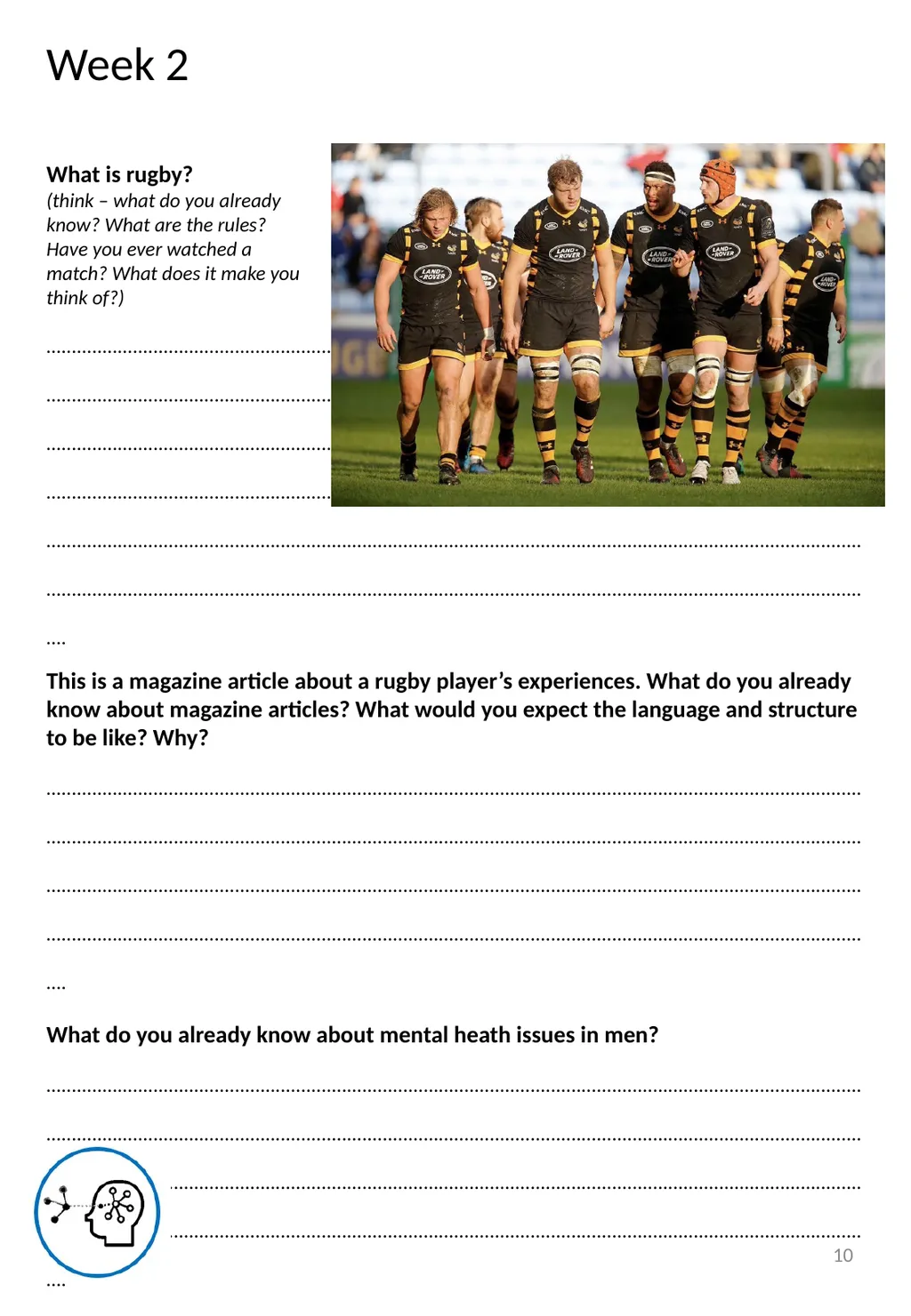
10 What is rugby?
(think – what do you already
know? What are the rules?
Have you ever watched a
match? What does it make you
think of?)
..........................................................
.........................................................
.................................................................................................................................................................................................................................................................................................................................................................................................................................................................................................................................................................................................................................................................... This is a magazine article about a rugby player’s experiences. What do you already know about magazine articles? What would you expect the language and structure to be like? Why?
.................................................................................................................................................................................................................................................................................................................................................................................................................................................................................................................................................................................................................................................................... What do you already know about mental heath issues in men?
.................................................................................................................................................................................................................................................................................................................................................................................................................................................................................................................................................................................................................................................................... Week 2<br>
(think – what do you already
know? What are the rules?
Have you ever watched a
match? What does it make you
think of?)
..........................................................
.........................................................
.................................................................................................................................................................................................................................................................................................................................................................................................................................................................................................................................................................................................................................................................... This is a magazine article about a rugby player’s experiences. What do you already know about magazine articles? What would you expect the language and structure to be like? Why?
.................................................................................................................................................................................................................................................................................................................................................................................................................................................................................................................................................................................................................................................................... What do you already know about mental heath issues in men?
.................................................................................................................................................................................................................................................................................................................................................................................................................................................................................................................................................................................................................................................................... Week 2<br>
11
11 Kearnan Myall
No one is paying much attention to the tall man sitting quietly on a sunny hotel terrace in Richmond. Such is life for the majority of professional rugby players, even those with 13 years of sterling club service. Kearnan Myall played more than 200 games for Wasps, Sale and Leeds and toured with England to Argentina in 2013 without many people contemplating the human being beneath the headguard.
Only a few close friends know about the secret battles the 32‑year‑old has been fighting. His hugely important story, told here for the first time, will change all that and, hopefully, have a significant impact on the sport at all levels worldwide. Because rugby, Myall firmly believes, is facing a mounting crisis in terms of the mental strain on its participants. In the most extreme cases, such as his own, it is driving leading players to the brink and sometimes beyond.
Which is partly how, on a mid‑season break with a group of Wasps players, he came to be staring blankly out at the Dubai skyline from the wrong side of a 15th-floor apartment balcony. “I imagine suicide is very different with different people,” he says, looking down at his flat white. “With some people it’s a cry for help but that wasn’t what I was doing at all. I just wanted the situation to be over. Luckily one of my teammates, Charlie Davies, came out, grabbed me and dragged me back over. I remember him shouting at me: ‘What are you doing?’ I just started crying and saying: ‘I don’t know.’ I can’t say if I was going to do it but I was in a place where it wasn’t a big deal. I’d already made my peace with it. It was just a case of it happening at some point in time.”
Myall’s testimony is all the more striking because the 6ft 7in Yorkshireman is such an intelligent, honest witness. His only reason for going public is to help those in similar states of despair. He is also about to embark on a PhD in psychiatry at Oxford University, researching mindfulness and mental health in athletes, with the aim of helping players to cope with the stresses of their harsh trade.
An alarming number, he believes, are struggling with anxiety, not least within the current England squad. “There are several England players I know who dread going into camp. They don’t want to go there.” Some have been resorting to meditation as a coping mechanism. “It’s nothing to do with being worried about the physical aspects of training, or the media. It’s a combination of pressure, scrutiny, what’s going to be said and what they’re going to be made to do within the confines of the camp. What are the longevity of those sort of tactics?”<br>
12
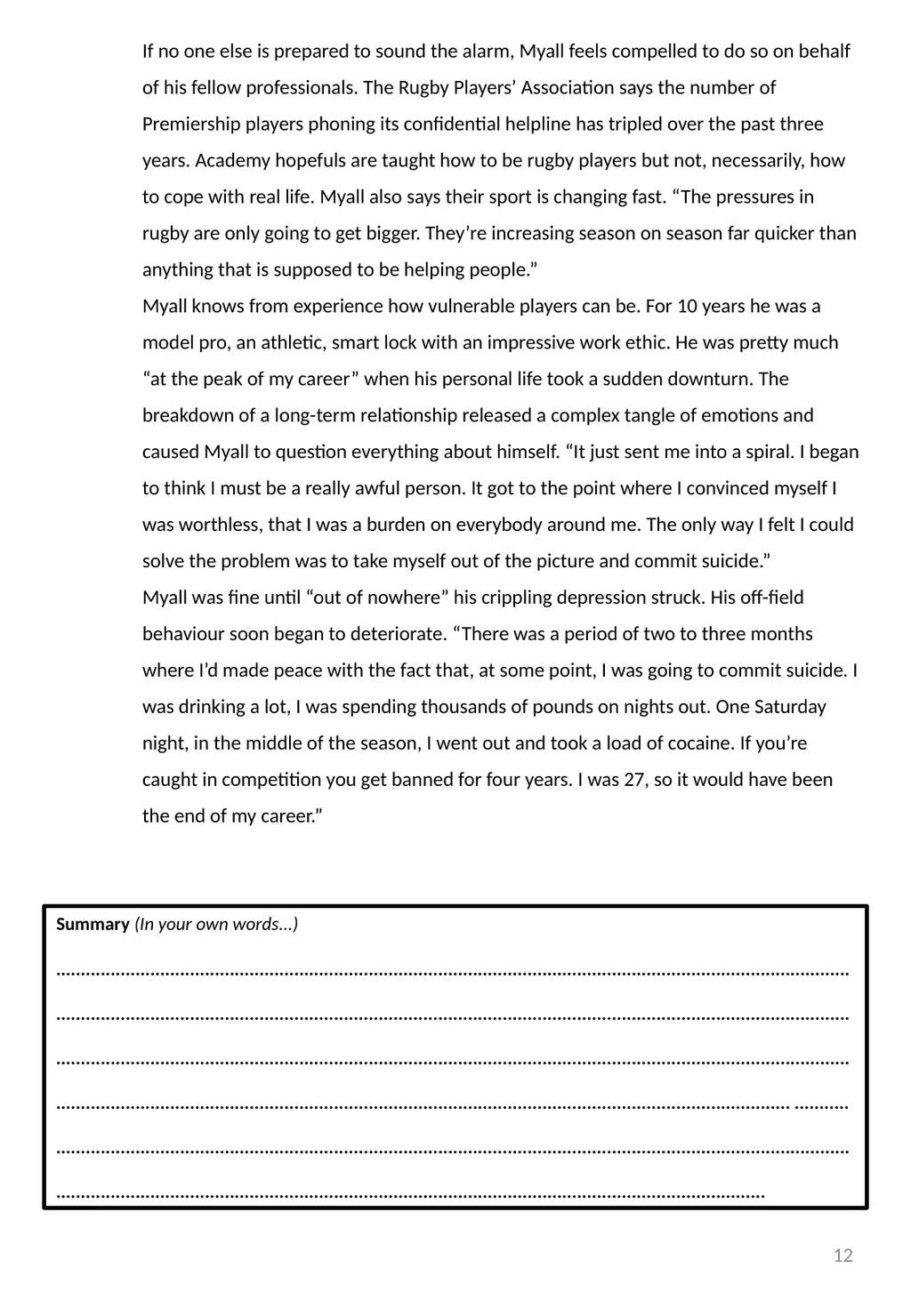
12 If no one else is prepared to sound the alarm, Myall feels compelled to do so on behalf of his fellow professionals. The Rugby Players’ Association says the number of Premiership players phoning its confidential helpline has tripled over the past three years. Academy hopefuls are taught how to be rugby players but not, necessarily, how to cope with real life. Myall also says their sport is changing fast. “The pressures in rugby are only going to get bigger. They’re increasing season on season far quicker than anything that is supposed to be helping people.”
Myall knows from experience how vulnerable players can be. For 10 years he was a model pro, an athletic, smart lock with an impressive work ethic. He was pretty much “at the peak of my career” when his personal life took a sudden downturn. The breakdown of a long-term relationship released a complex tangle of emotions and caused Myall to question everything about himself. “It just sent me into a spiral. I began to think I must be a really awful person. It got to the point where I convinced myself I was worthless, that I was a burden on everybody around me. The only way I felt I could solve the problem was to take myself out of the picture and commit suicide.”
Myall was fine until “out of nowhere” his crippling depression struck. His off-field behaviour soon began to deteriorate. “There was a period of two to three months where I’d made peace with the fact that, at some point, I was going to commit suicide. I was drinking a lot, I was spending thousands of pounds on nights out. One Saturday night, in the middle of the season, I went out and took a load of cocaine. If you’re caught in competition you get banned for four years. I was 27, so it would have been the end of my career.” Summary (In your own words...)
.................................................................................................................................................................................................................................................................................................................................................................................................................................................................................................................................................................................................................................................... ..........................................................................................................................................................................................................................................................................................................................<br>
.................................................................................................................................................................................................................................................................................................................................................................................................................................................................................................................................................................................................................................................... ..........................................................................................................................................................................................................................................................................................................................<br>
13
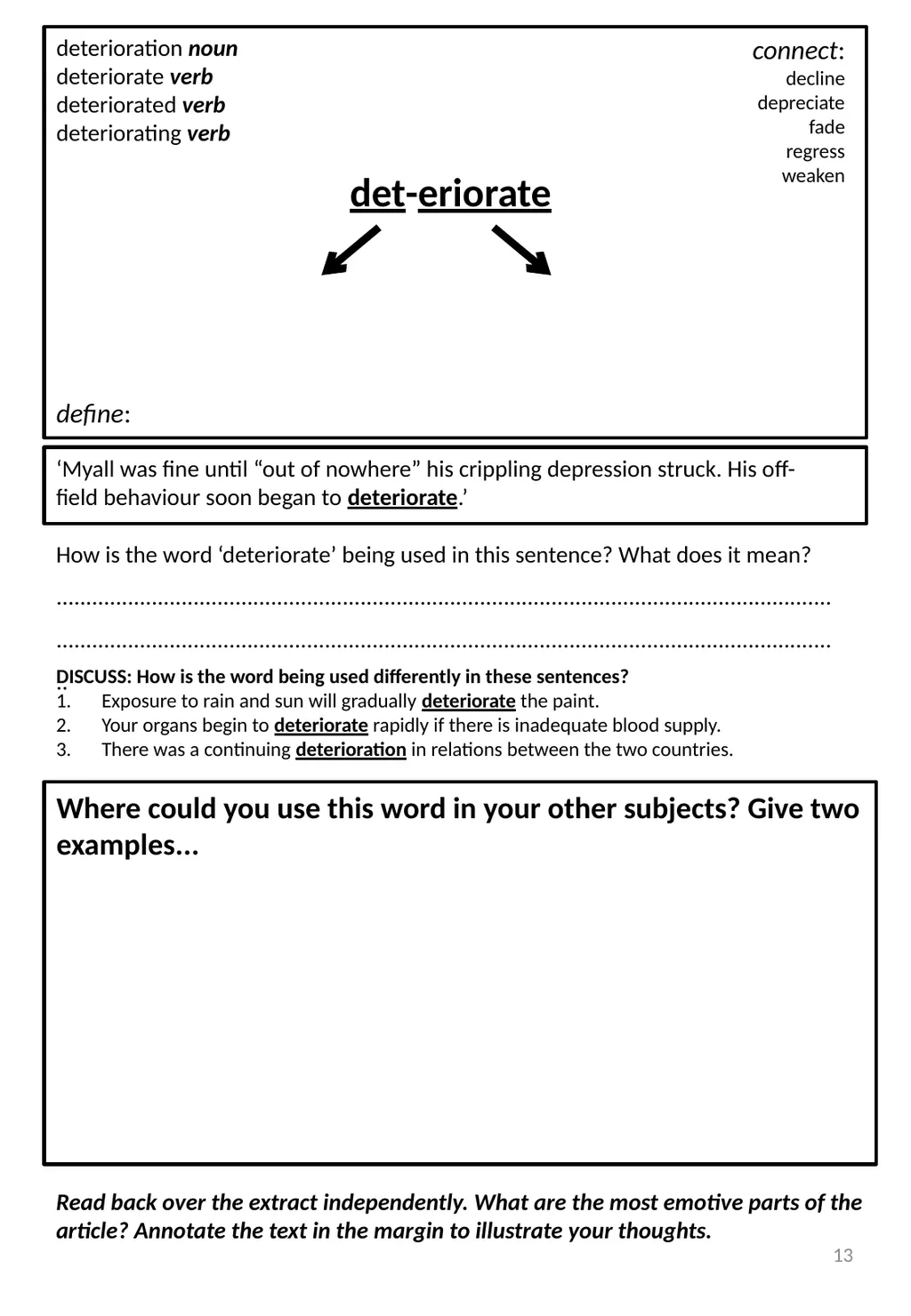
13 det-eriorate Where could you use this word in your other subjects? Give two examples... connect:
decline
depreciate
fade
regress
weaken deterioration noun
deteriorate verb
deteriorated verb
deteriorating verb define: ‘Myall was fine until “out of nowhere” his crippling depression struck. His off-field behaviour soon began to deteriorate.’ How is the word ‘deteriorate’ being used in this sentence? What does it mean?
...................................................................................................................................................................................................................................................................... DISCUSS: How is the word being used differently in these sentences?
Exposure to rain and sun will gradually deteriorate the paint.
Your organs begin to deteriorate rapidly if there is inadequate blood supply.
There was a continuing deterioration in relations between the two countries. Read back over the extract independently. What are the most emotive parts of the article? Annotate the text in the margin to illustrate your thoughts.<br>
decline
depreciate
fade
regress
weaken deterioration noun
deteriorate verb
deteriorated verb
deteriorating verb define: ‘Myall was fine until “out of nowhere” his crippling depression struck. His off-field behaviour soon began to deteriorate.’ How is the word ‘deteriorate’ being used in this sentence? What does it mean?
...................................................................................................................................................................................................................................................................... DISCUSS: How is the word being used differently in these sentences?
Exposure to rain and sun will gradually deteriorate the paint.
Your organs begin to deteriorate rapidly if there is inadequate blood supply.
There was a continuing deterioration in relations between the two countries. Read back over the extract independently. What are the most emotive parts of the article? Annotate the text in the margin to illustrate your thoughts.<br>
14
14 READING HOMEWORK
Dear Anxiety by Clayton Jennings
Watch this spoken word performance: https://www.youtube.com/watch?v=m4s9qNCAZjY This poem is about the same topic as the Kearnon Myall article, but mental health is explored in a different way. Think about both of these texts and answer these questions:
What are the main differences between magazine articles and spoken word poems?
How are they different in the way they use language?
Which text do you prefer? Why?<br>
Dear Anxiety by Clayton Jennings
Watch this spoken word performance: https://www.youtube.com/watch?v=m4s9qNCAZjY This poem is about the same topic as the Kearnon Myall article, but mental health is explored in a different way. Think about both of these texts and answer these questions:
What are the main differences between magazine articles and spoken word poems?
How are they different in the way they use language?
Which text do you prefer? Why?<br>
15
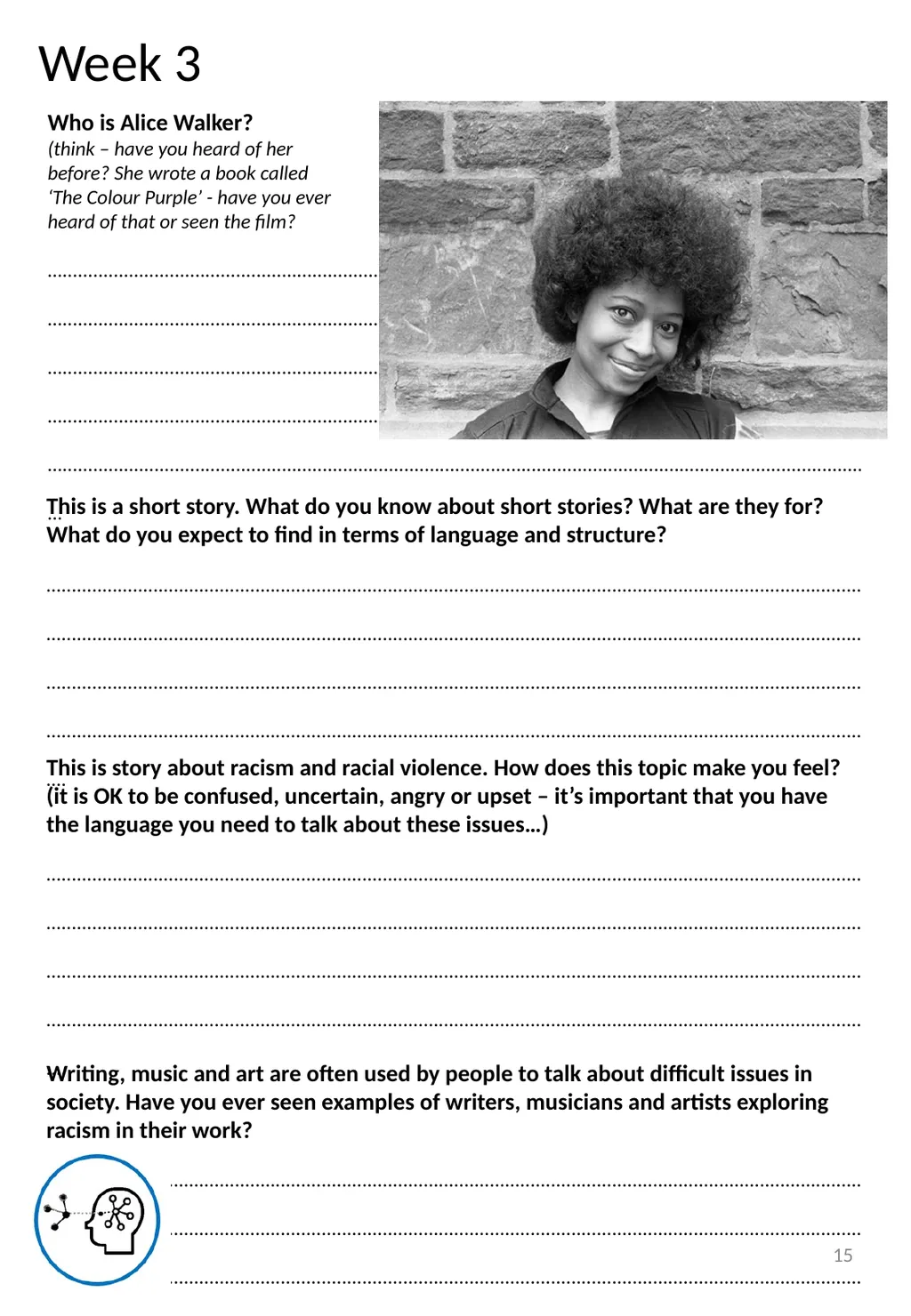
15 Who is Alice Walker?
(think – have you heard of her
before? She wrote a book called
‘The Colour Purple’ - have you ever
heard of that or seen the film?
..................................................................
..................................................................
................................................................................................................................................................................................................................................................................................................................................................................................................................................................................................... This is a short story. What do you know about short stories? What are they for? What do you expect to find in terms of language and structure?
.................................................................................................................................................................................................................................................................................................................................................................................................................................................................................................................................................................................................................................................................... Writing, music and art are often used by people to talk about difficult issues in society. Have you ever seen examples of writers, musicians and artists exploring racism in their work?
................................................................................................................................................................................................................................................................................................................................................................................................................................................................................................... This is story about racism and racial violence. How does this topic make you feel? (it is OK to be confused, uncertain, angry or upset – it’s important that you have the language you need to talk about these issues…)
.................................................................................................................................................................................................................................................................................................................................................................................................................................................................................................................................................................................................................................................................... Week 3<br>
(think – have you heard of her
before? She wrote a book called
‘The Colour Purple’ - have you ever
heard of that or seen the film?
..................................................................
..................................................................
................................................................................................................................................................................................................................................................................................................................................................................................................................................................................................... This is a short story. What do you know about short stories? What are they for? What do you expect to find in terms of language and structure?
.................................................................................................................................................................................................................................................................................................................................................................................................................................................................................................................................................................................................................................................................... Writing, music and art are often used by people to talk about difficult issues in society. Have you ever seen examples of writers, musicians and artists exploring racism in their work?
................................................................................................................................................................................................................................................................................................................................................................................................................................................................................................... This is story about racism and racial violence. How does this topic make you feel? (it is OK to be confused, uncertain, angry or upset – it’s important that you have the language you need to talk about these issues…)
.................................................................................................................................................................................................................................................................................................................................................................................................................................................................................................................................................................................................................................................................... Week 3<br>
16
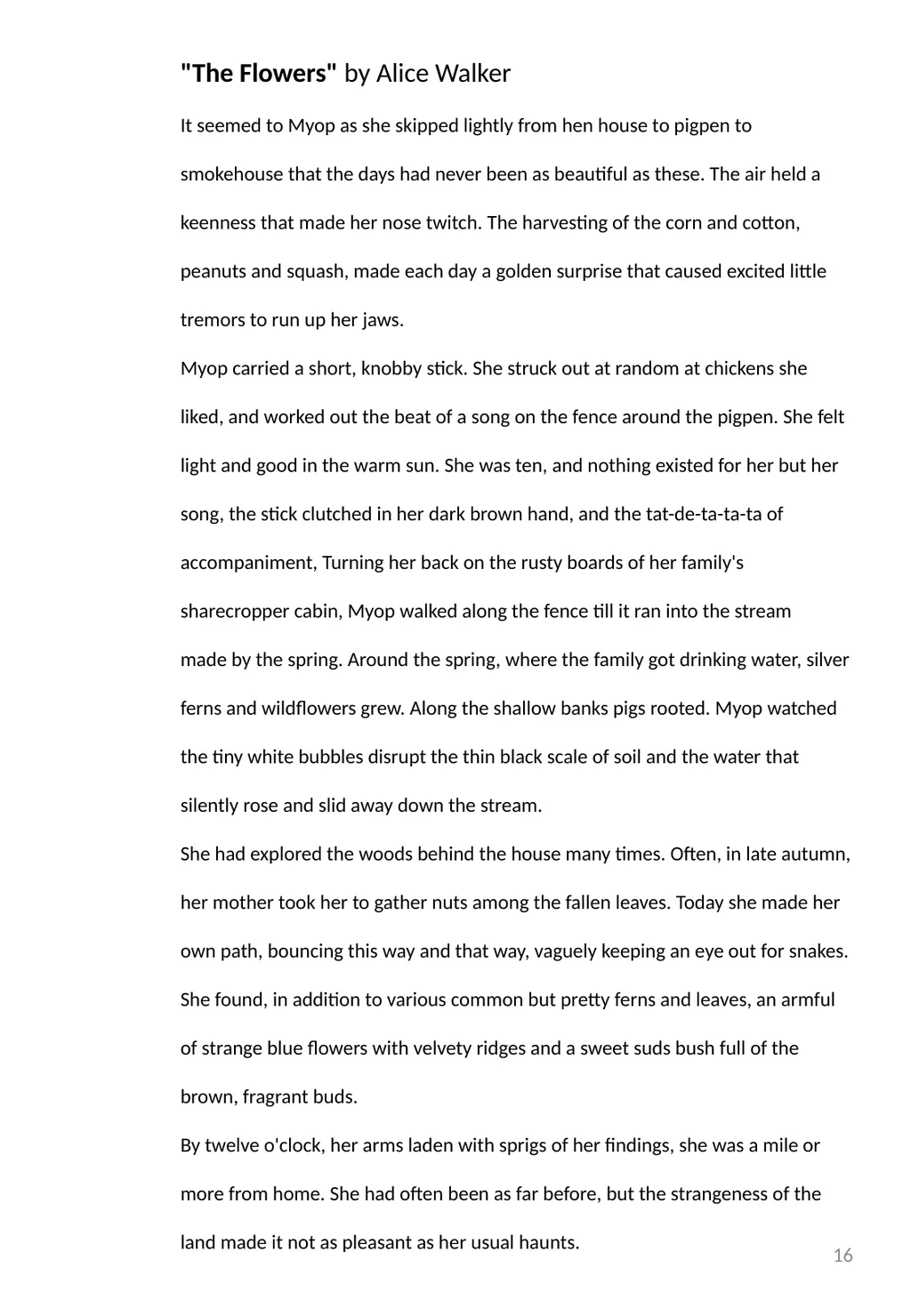
16 "The Flowers" by Alice Walker
It seemed to Myop as she skipped lightly from hen house to pigpen to smokehouse that the days had never been as beautiful as these. The air held a keenness that made her nose twitch. The harvesting of the corn and cotton, peanuts and squash, made each day a golden surprise that caused excited little tremors to run up her jaws.
Myop carried a short, knobby stick. She struck out at random at chickens she liked, and worked out the beat of a song on the fence around the pigpen. She felt light and good in the warm sun. She was ten, and nothing existed for her but her song, the stick clutched in her dark brown hand, and the tat-de-ta-ta-ta of accompaniment, Turning her back on the rusty boards of her family's sharecropper cabin, Myop walked along the fence till it ran into the stream
made by the spring. Around the spring, where the family got drinking water, silver ferns and wildflowers grew. Along the shallow banks pigs rooted. Myop watched the tiny white bubbles disrupt the thin black scale of soil and the water that silently rose and slid away down the stream.
She had explored the woods behind the house many times. Often, in late autumn, her mother took her to gather nuts among the fallen leaves. Today she made her own path, bouncing this way and that way, vaguely keeping an eye out for snakes. She found, in addition to various common but pretty ferns and leaves, an armful of strange blue flowers with velvety ridges and a sweet suds bush full of the brown, fragrant buds.
By twelve o'clock, her arms laden with sprigs of her findings, she was a mile or more from home. She had often been as far before, but the strangeness of the land made it not as pleasant as her usual haunts.<br>
It seemed to Myop as she skipped lightly from hen house to pigpen to smokehouse that the days had never been as beautiful as these. The air held a keenness that made her nose twitch. The harvesting of the corn and cotton, peanuts and squash, made each day a golden surprise that caused excited little tremors to run up her jaws.
Myop carried a short, knobby stick. She struck out at random at chickens she liked, and worked out the beat of a song on the fence around the pigpen. She felt light and good in the warm sun. She was ten, and nothing existed for her but her song, the stick clutched in her dark brown hand, and the tat-de-ta-ta-ta of accompaniment, Turning her back on the rusty boards of her family's sharecropper cabin, Myop walked along the fence till it ran into the stream
made by the spring. Around the spring, where the family got drinking water, silver ferns and wildflowers grew. Along the shallow banks pigs rooted. Myop watched the tiny white bubbles disrupt the thin black scale of soil and the water that silently rose and slid away down the stream.
She had explored the woods behind the house many times. Often, in late autumn, her mother took her to gather nuts among the fallen leaves. Today she made her own path, bouncing this way and that way, vaguely keeping an eye out for snakes. She found, in addition to various common but pretty ferns and leaves, an armful of strange blue flowers with velvety ridges and a sweet suds bush full of the brown, fragrant buds.
By twelve o'clock, her arms laden with sprigs of her findings, she was a mile or more from home. She had often been as far before, but the strangeness of the land made it not as pleasant as her usual haunts.<br>
17
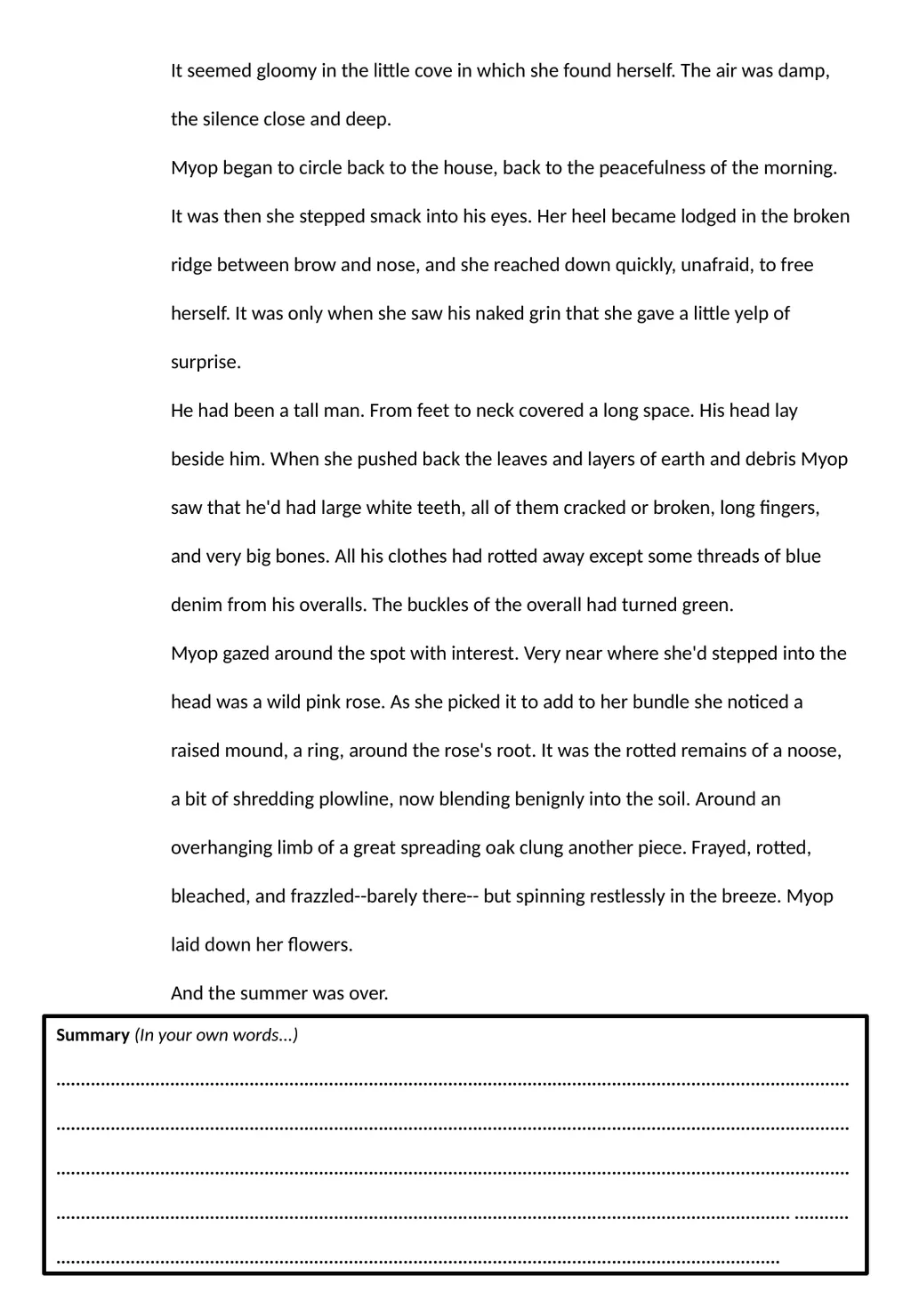
17 It seemed gloomy in the little cove in which she found herself. The air was damp, the silence close and deep.
Myop began to circle back to the house, back to the peacefulness of the morning. It was then she stepped smack into his eyes. Her heel became lodged in the broken ridge between brow and nose, and she reached down quickly, unafraid, to free herself. It was only when she saw his naked grin that she gave a little yelp of surprise.
He had been a tall man. From feet to neck covered a long space. His head lay beside him. When she pushed back the leaves and layers of earth and debris Myop saw that he'd had large white teeth, all of them cracked or broken, long fingers, and very big bones. All his clothes had rotted away except some threads of blue denim from his overalls. The buckles of the overall had turned green.
Myop gazed around the spot with interest. Very near where she'd stepped into the head was a wild pink rose. As she picked it to add to her bundle she noticed a raised mound, a ring, around the rose's root. It was the rotted remains of a noose, a bit of shredding plowline, now blending benignly into the soil. Around an overhanging limb of a great spreading oak clung another piece. Frayed, rotted, bleached, and frazzled--barely there-- but spinning restlessly in the breeze. Myop laid down her flowers.
And the summer was over. Summary (In your own words...)
.................................................................................................................................................................................................................................................................................................................................................................................................................................................................................................................................................................................................................................................... .............................................................................................................................................................<br>
Myop began to circle back to the house, back to the peacefulness of the morning. It was then she stepped smack into his eyes. Her heel became lodged in the broken ridge between brow and nose, and she reached down quickly, unafraid, to free herself. It was only when she saw his naked grin that she gave a little yelp of surprise.
He had been a tall man. From feet to neck covered a long space. His head lay beside him. When she pushed back the leaves and layers of earth and debris Myop saw that he'd had large white teeth, all of them cracked or broken, long fingers, and very big bones. All his clothes had rotted away except some threads of blue denim from his overalls. The buckles of the overall had turned green.
Myop gazed around the spot with interest. Very near where she'd stepped into the head was a wild pink rose. As she picked it to add to her bundle she noticed a raised mound, a ring, around the rose's root. It was the rotted remains of a noose, a bit of shredding plowline, now blending benignly into the soil. Around an overhanging limb of a great spreading oak clung another piece. Frayed, rotted, bleached, and frazzled--barely there-- but spinning restlessly in the breeze. Myop laid down her flowers.
And the summer was over. Summary (In your own words...)
.................................................................................................................................................................................................................................................................................................................................................................................................................................................................................................................................................................................................................................................... .............................................................................................................................................................<br>
18
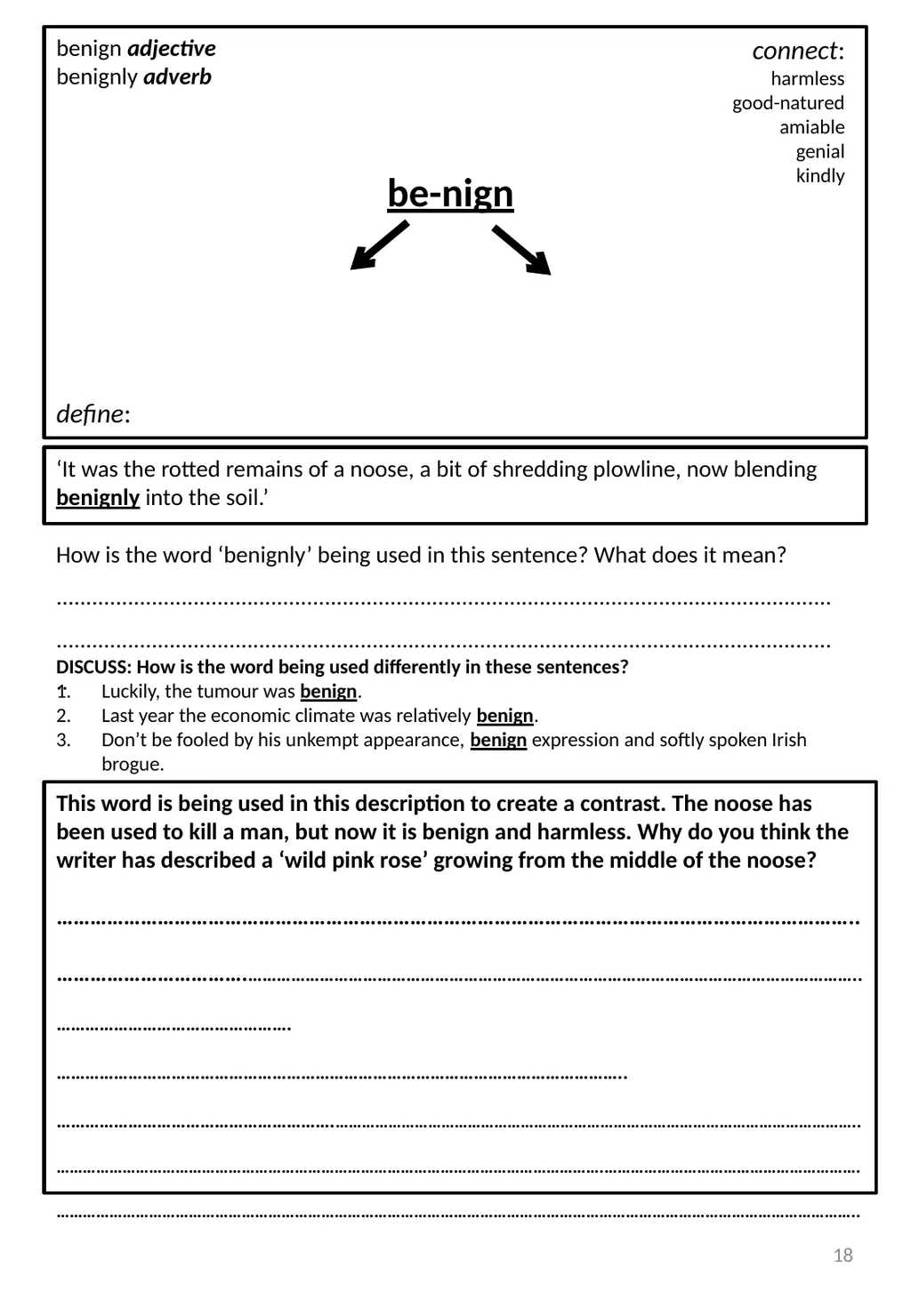
18 be-nign This word is being used in this description to create a contrast. The noose has been used to kill a man, but now it is benign and harmless. Why do you think the writer has described a ‘wild pink rose’ growing from the middle of the noose?
……………………………………………………………………………………………………………………………..…………………………….………………………………………………………………………………………………………………..………………………………………….………………………………………………………………………………………………………..………………………………………………….………………………………………………………………………………………………………..…………………………………………………………………………………………………………….………………………………………………….……………………………………………………………………………………………………………………………………………………………….. connect:
harmless
good-natured
amiable
genial
kindly benign adjective
benignly adverb define: ‘It was the rotted remains of a noose, a bit of shredding plowline, now blending benignly into the soil.’ How is the word ‘benignly’ being used in this sentence? What does it mean?
...................................................................................................................................................................................................................................................................... DISCUSS: How is the word being used differently in these sentences?
Luckily, the tumour was benign.
Last year the economic climate was relatively benign.
Don’t be fooled by his unkempt appearance, benign expression and softly spoken Irish brogue.<br>
……………………………………………………………………………………………………………………………..…………………………….………………………………………………………………………………………………………………..………………………………………….………………………………………………………………………………………………………..………………………………………………….………………………………………………………………………………………………………..…………………………………………………………………………………………………………….………………………………………………….……………………………………………………………………………………………………………………………………………………………….. connect:
harmless
good-natured
amiable
genial
kindly benign adjective
benignly adverb define: ‘It was the rotted remains of a noose, a bit of shredding plowline, now blending benignly into the soil.’ How is the word ‘benignly’ being used in this sentence? What does it mean?
...................................................................................................................................................................................................................................................................... DISCUSS: How is the word being used differently in these sentences?
Luckily, the tumour was benign.
Last year the economic climate was relatively benign.
Don’t be fooled by his unkempt appearance, benign expression and softly spoken Irish brogue.<br>
19
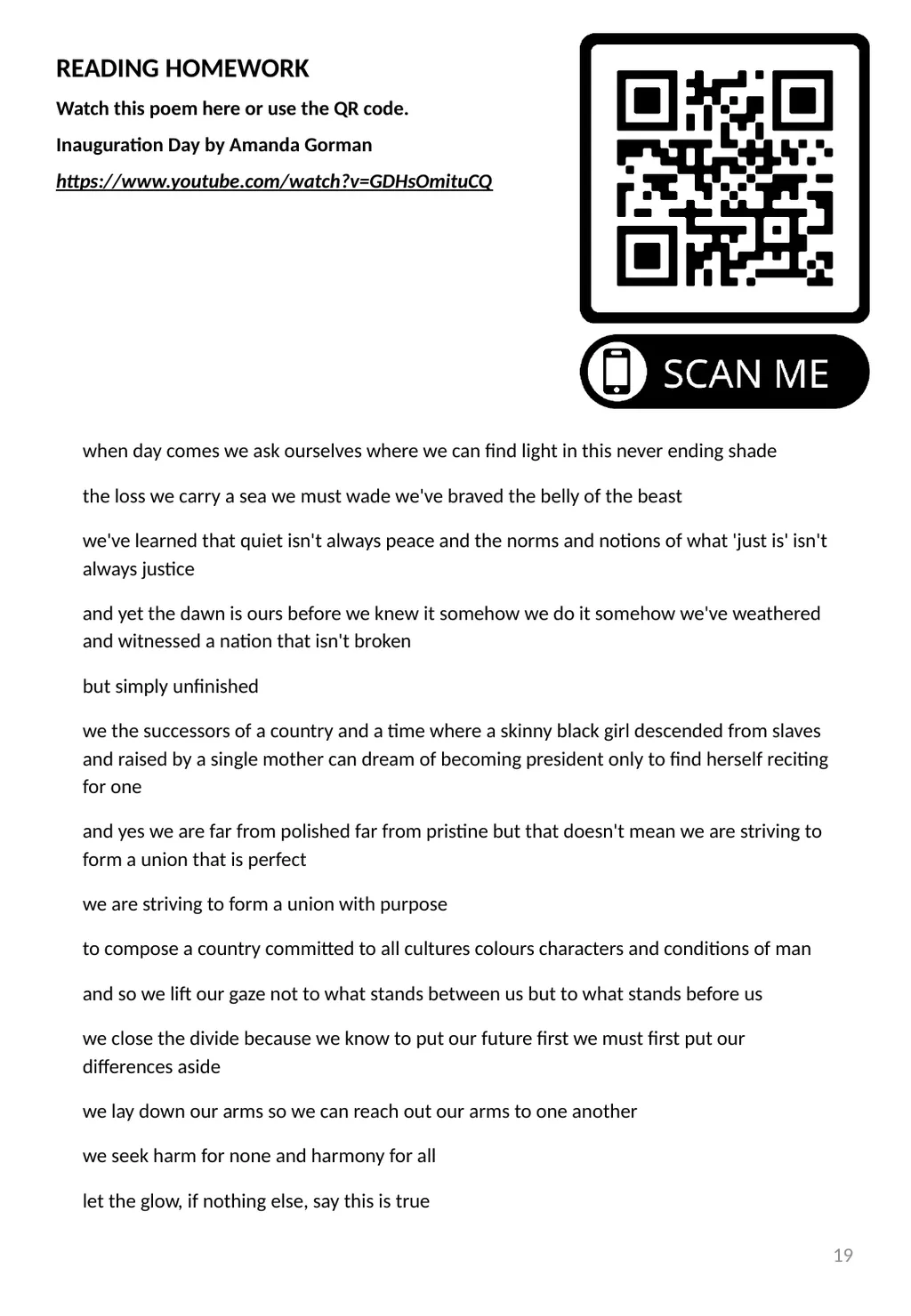
19 READING HOMEWORK
Watch this poem here or use the QR code.
Inauguration Day by Amanda Gorman
https://www.youtube.com/watch?v=GDHsOmituCQ when day comes we ask ourselves where we can find light in this never ending shade
the loss we carry a sea we must wade we've braved the belly of the beast
we've learned that quiet isn't always peace and the norms and notions of what 'just is' isn't always justice
and yet the dawn is ours before we knew it somehow we do it somehow we've weathered and witnessed a nation that isn't broken
but simply unfinished
we the successors of a country and a time where a skinny black girl descended from slaves and raised by a single mother can dream of becoming president only to find herself reciting for one
and yes we are far from polished far from pristine but that doesn't mean we are striving to form a union that is perfect
we are striving to form a union with purpose
to compose a country committed to all cultures colours characters and conditions of man
and so we lift our gaze not to what stands between us but to what stands before us
we close the divide because we know to put our future first we must first put our differences aside
we lay down our arms so we can reach out our arms to one another
we seek harm for none and harmony for all
let the glow, if nothing else, say this is true<br>
Watch this poem here or use the QR code.
Inauguration Day by Amanda Gorman
https://www.youtube.com/watch?v=GDHsOmituCQ when day comes we ask ourselves where we can find light in this never ending shade
the loss we carry a sea we must wade we've braved the belly of the beast
we've learned that quiet isn't always peace and the norms and notions of what 'just is' isn't always justice
and yet the dawn is ours before we knew it somehow we do it somehow we've weathered and witnessed a nation that isn't broken
but simply unfinished
we the successors of a country and a time where a skinny black girl descended from slaves and raised by a single mother can dream of becoming president only to find herself reciting for one
and yes we are far from polished far from pristine but that doesn't mean we are striving to form a union that is perfect
we are striving to form a union with purpose
to compose a country committed to all cultures colours characters and conditions of man
and so we lift our gaze not to what stands between us but to what stands before us
we close the divide because we know to put our future first we must first put our differences aside
we lay down our arms so we can reach out our arms to one another
we seek harm for none and harmony for all
let the glow, if nothing else, say this is true<br>
20
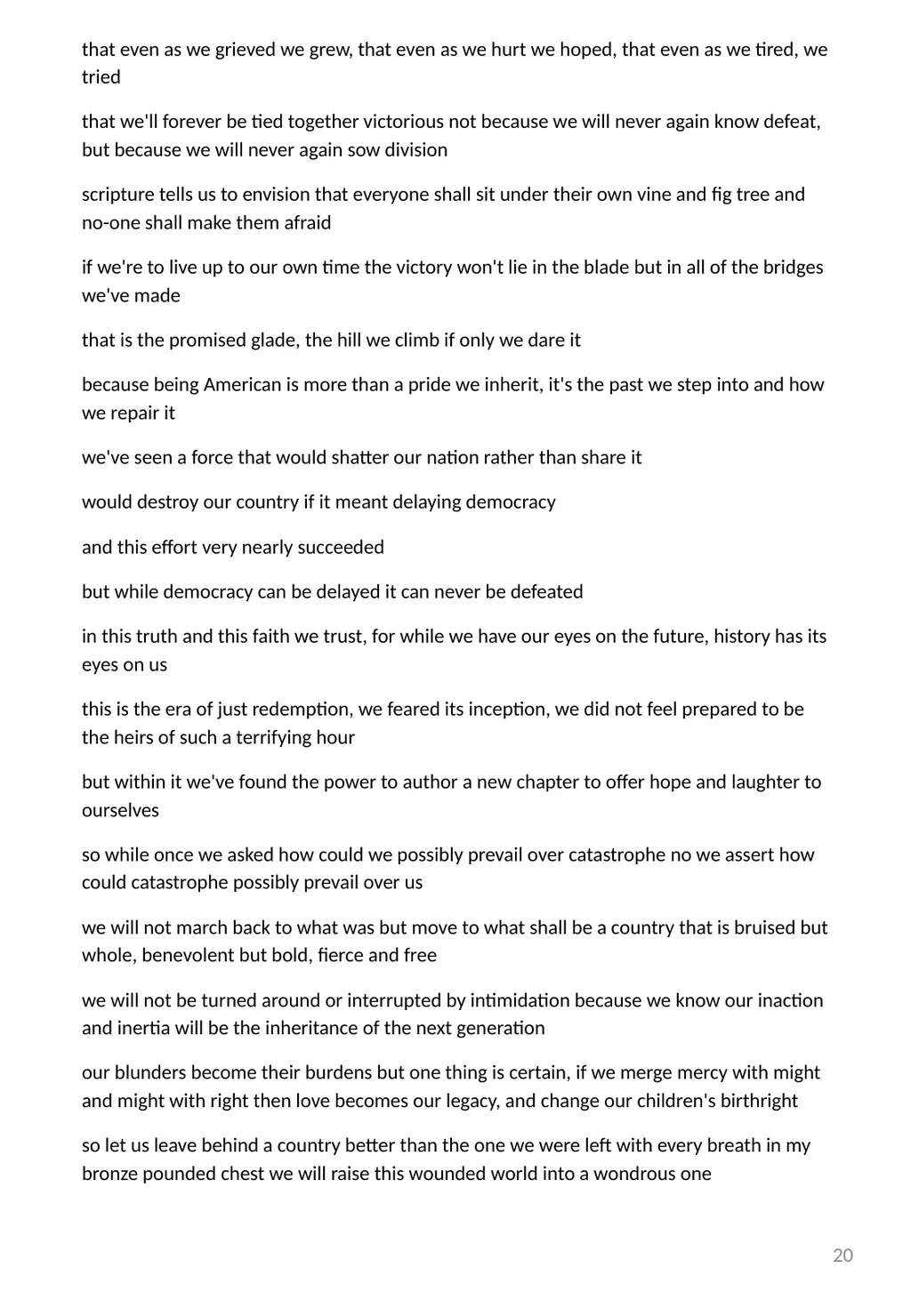
20 that even as we grieved we grew, that even as we hurt we hoped, that even as we tired, we tried
that we'll forever be tied together victorious not because we will never again know defeat, but because we will never again sow division
scripture tells us to envision that everyone shall sit under their own vine and fig tree and no-one shall make them afraid
if we're to live up to our own time the victory won't lie in the blade but in all of the bridges we've made
that is the promised glade, the hill we climb if only we dare it
because being American is more than a pride we inherit, it's the past we step into and how we repair it
we've seen a force that would shatter our nation rather than share it
would destroy our country if it meant delaying democracy
and this effort very nearly succeeded
but while democracy can be delayed it can never be defeated
in this truth and this faith we trust, for while we have our eyes on the future, history has its eyes on us
this is the era of just redemption, we feared its inception, we did not feel prepared to be the heirs of such a terrifying hour
but within it we've found the power to author a new chapter to offer hope and laughter to ourselves
so while once we asked how could we possibly prevail over catastrophe no we assert how could catastrophe possibly prevail over us
we will not march back to what was but move to what shall be a country that is bruised but whole, benevolent but bold, fierce and free
we will not be turned around or interrupted by intimidation because we know our inaction and inertia will be the inheritance of the next generation
our blunders become their burdens but one thing is certain, if we merge mercy with might and might with right then love becomes our legacy, and change our children's birthright
so let us leave behind a country better than the one we were left with every breath in my bronze pounded chest we will raise this wounded world into a wondrous one<br>
that we'll forever be tied together victorious not because we will never again know defeat, but because we will never again sow division
scripture tells us to envision that everyone shall sit under their own vine and fig tree and no-one shall make them afraid
if we're to live up to our own time the victory won't lie in the blade but in all of the bridges we've made
that is the promised glade, the hill we climb if only we dare it
because being American is more than a pride we inherit, it's the past we step into and how we repair it
we've seen a force that would shatter our nation rather than share it
would destroy our country if it meant delaying democracy
and this effort very nearly succeeded
but while democracy can be delayed it can never be defeated
in this truth and this faith we trust, for while we have our eyes on the future, history has its eyes on us
this is the era of just redemption, we feared its inception, we did not feel prepared to be the heirs of such a terrifying hour
but within it we've found the power to author a new chapter to offer hope and laughter to ourselves
so while once we asked how could we possibly prevail over catastrophe no we assert how could catastrophe possibly prevail over us
we will not march back to what was but move to what shall be a country that is bruised but whole, benevolent but bold, fierce and free
we will not be turned around or interrupted by intimidation because we know our inaction and inertia will be the inheritance of the next generation
our blunders become their burdens but one thing is certain, if we merge mercy with might and might with right then love becomes our legacy, and change our children's birthright
so let us leave behind a country better than the one we were left with every breath in my bronze pounded chest we will raise this wounded world into a wondrous one<br>
21
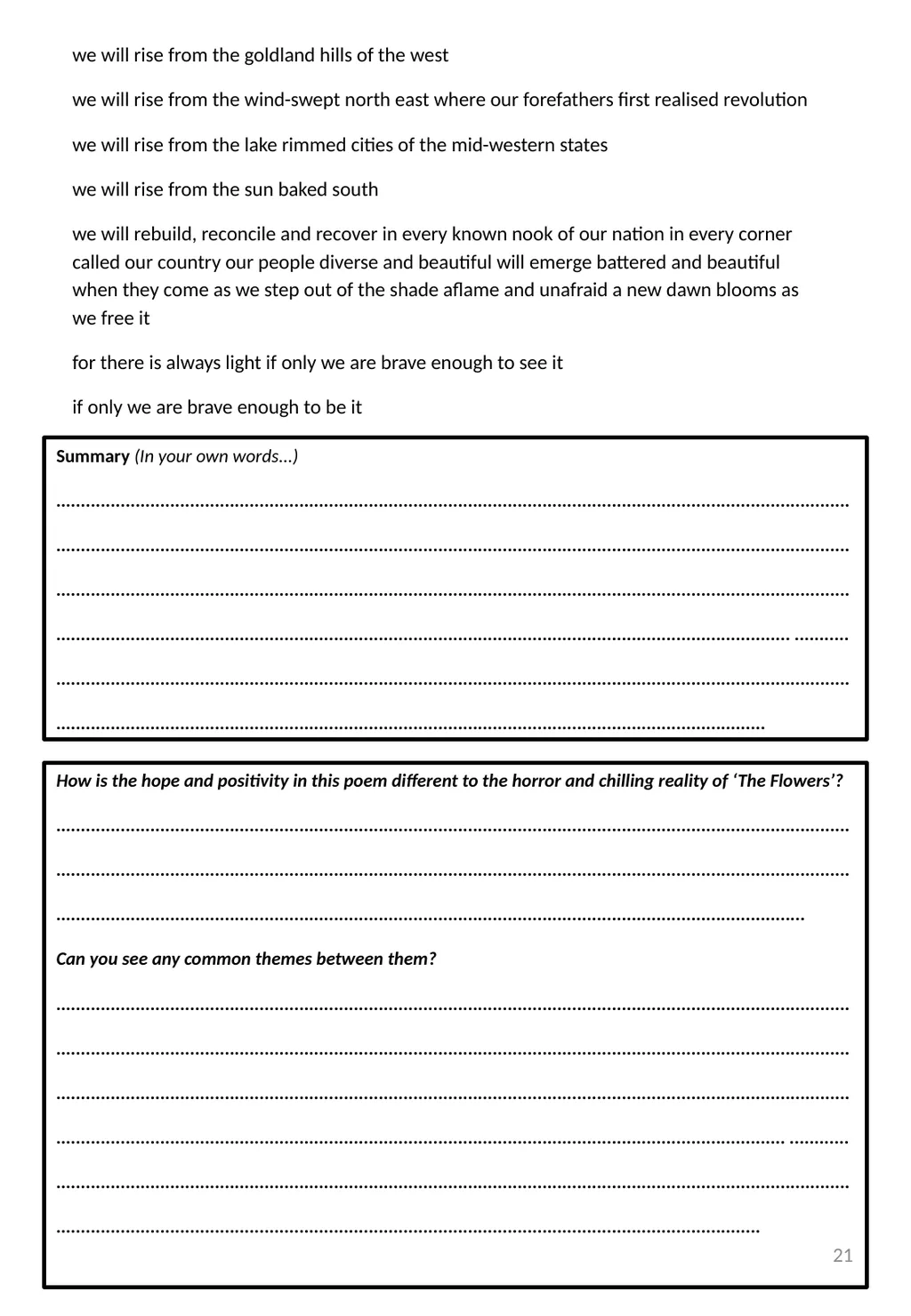
21 we will rise from the goldland hills of the west
we will rise from the wind-swept north east where our forefathers first realised revolution
we will rise from the lake rimmed cities of the mid-western states
we will rise from the sun baked south
we will rebuild, reconcile and recover in every known nook of our nation in every corner called our country our people diverse and beautiful will emerge battered and beautiful when they come as we step out of the shade aflame and unafraid a new dawn blooms as we free it
for there is always light if only we are brave enough to see it
if only we are brave enough to be it Summary (In your own words...)
.................................................................................................................................................................................................................................................................................................................................................................................................................................................................................................................................................................................................................................................... .......................................................................................................................................................................................................................................................................................................................... How is the hope and positivity in this poem different to the horror and chilling reality of ‘The Flowers’?
.......................................................................................................................................................................................................................................................................................................................................................................................................................................................................................
Can you see any common themes between them?
................................................................................................................................................................................................................................................................................................................................................................................................................................................................................................................................................................................................................................................... ..........................................................................................................................................................................................................................................................................................................................<br>
we will rise from the wind-swept north east where our forefathers first realised revolution
we will rise from the lake rimmed cities of the mid-western states
we will rise from the sun baked south
we will rebuild, reconcile and recover in every known nook of our nation in every corner called our country our people diverse and beautiful will emerge battered and beautiful when they come as we step out of the shade aflame and unafraid a new dawn blooms as we free it
for there is always light if only we are brave enough to see it
if only we are brave enough to be it Summary (In your own words...)
.................................................................................................................................................................................................................................................................................................................................................................................................................................................................................................................................................................................................................................................... .......................................................................................................................................................................................................................................................................................................................... How is the hope and positivity in this poem different to the horror and chilling reality of ‘The Flowers’?
.......................................................................................................................................................................................................................................................................................................................................................................................................................................................................................
Can you see any common themes between them?
................................................................................................................................................................................................................................................................................................................................................................................................................................................................................................................................................................................................................................................... ..........................................................................................................................................................................................................................................................................................................................<br>