
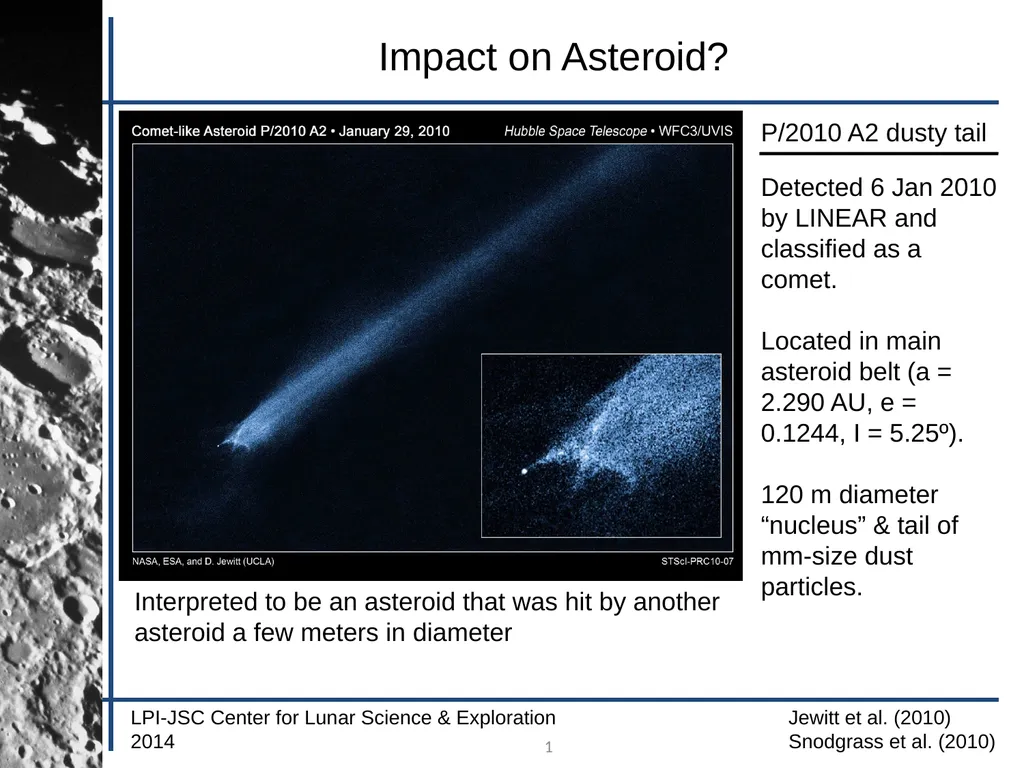
1 Impact on Asteroid? P/2010 A2 dusty tail

Description: 1 Impact on Asteroid? P2010 A2 dusty tail Detected 6 Jan 2010 by LINEAR and classified as a comet. Located in main asteroid belt (a 2.290 AU, e 0.1244, I 5.25º). 120 m diameter nucleus tail of mm-size dust particles. Interpreted
Related Topics
Download Presentation
"1 Impact on Asteroid? P/2010 A2 dusty tail" is the property of its rightful owner. Permission is granted to download and print the materials on this website for personal, non-commercial use only, and to display it on your personal computer provided you do not modify the materials and that you retain all copyright notices contained in the materials. By downloading content from our website, you accept the terms of this agreement.
Presentation Transcript
slide1. 1 Impact on Asteroid? P/2010 A2 dusty tail
Detected 6 Jan 2010 by LINEAR and classified as a comet.
Located in main asteroid belt (a = 2.290 AU, e = 0.1244, I = 5.25º).
120 m diameter “nucleus” & tail of mm-size dust particles. Interpreted to be an asteroid that was hit by another
asteroid a few meters in diameter Jewitt et al. (2010)
Snodgrass et al. (2010)<br>
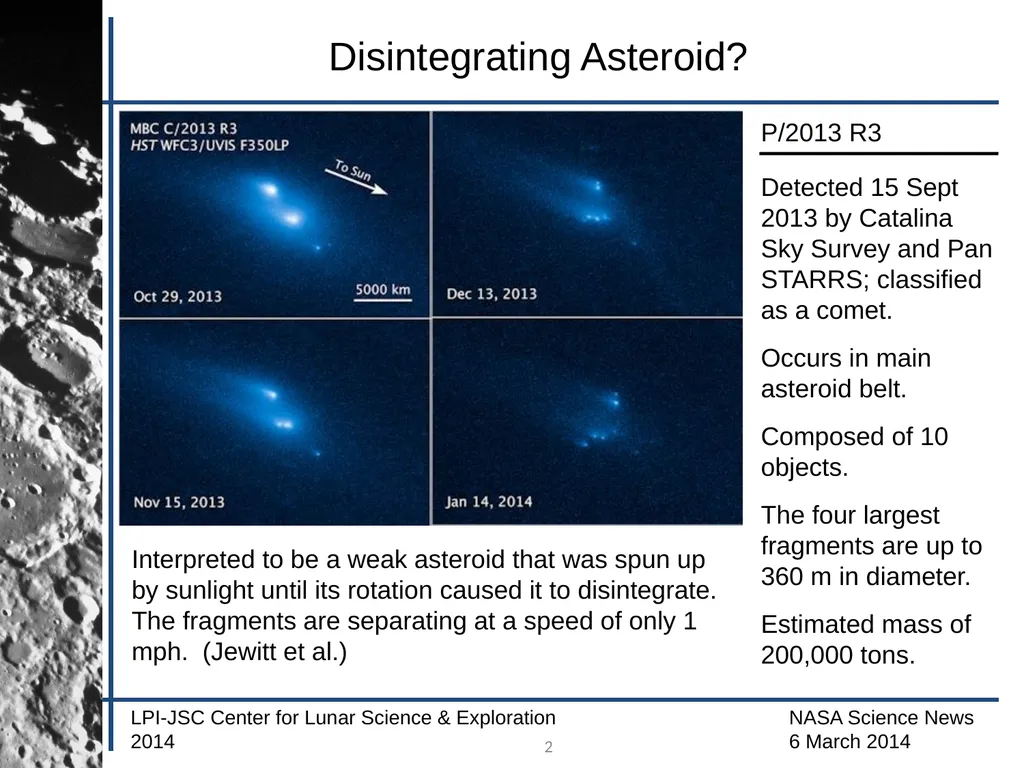
slide2. 2 Disintegrating Asteroid? P/2013 R3
Detected 15 Sept 2013 by Catalina Sky Survey and Pan STARRS; classified as a comet.
Occurs in main asteroid belt.
Composed of 10 objects.
The four largest fragments are up to 360 m in diameter.
Estimated mass of 200,000 tons. Interpreted to be a weak asteroid that was spun up by sunlight until its rotation caused it to disintegrate. The fragments are separating at a speed of only 1 mph. (Jewitt et al.) NASA Science News
6 March 2014<br>
slide3. 3 Comets - What is in a name? Naming conventions for survey-detected comets (revised in 2003)
Prefix
P/ = periodic
C/ = non-periodic
X/ = comet without a reliable orbit
D/ = broken up or otherwise lost
A/ = object first thought to be a comet and later reclassified as an asteroid
Year of discovery
Followed by letter indicating half-month of discovery
A for first half of January
B for second half of January
C for first half of February, etc.
& number indicating order of discovery
Thus, P/2010 A2 was classified as a periodic comet when it was discovered in the first half of January of 2010; it was the second comet of that period.<br>
slide4. 4 Asteroids - What is in a name? Naming conventions for asteroids
Provisional designation assigned when first observed
Composed of the year
A letter to indicate the half-month of discovery
A letter and subscript number to indicate sequential order of discovery within that year; the subscript indicates how many times the alphabet has been cycled before the object was discovered. (I is not used, so each cycle has 25 letters rather than 26 letters)
e.g., 1993 HH3 was discovered in 1993, in the first half of April; it was the (3 x 25) + 8 = 63rd minor planet in that period.
Once enough data is calculated to define an orbit
A sequential number or designation is assigned
e.g., (8391)
After a designation is assigned, the discoverer can propose a name
e.g., The Spacewatch program proposed the name Kring, which was accepted by the IAU
Final name: (8391) Kring = 1993 HH3<br>
Detected 6 Jan 2010 by LINEAR and classified as a comet.
Located in main asteroid belt (a = 2.290 AU, e = 0.1244, I = 5.25º).
120 m diameter “nucleus” & tail of mm-size dust particles. Interpreted to be an asteroid that was hit by another
asteroid a few meters in diameter Jewitt et al. (2010)
Snodgrass et al. (2010)<br>
slide2. 2 Disintegrating Asteroid? P/2013 R3
Detected 15 Sept 2013 by Catalina Sky Survey and Pan STARRS; classified as a comet.
Occurs in main asteroid belt.
Composed of 10 objects.
The four largest fragments are up to 360 m in diameter.
Estimated mass of 200,000 tons. Interpreted to be a weak asteroid that was spun up by sunlight until its rotation caused it to disintegrate. The fragments are separating at a speed of only 1 mph. (Jewitt et al.) NASA Science News
6 March 2014<br>
slide3. 3 Comets - What is in a name? Naming conventions for survey-detected comets (revised in 2003)
Prefix
P/ = periodic
C/ = non-periodic
X/ = comet without a reliable orbit
D/ = broken up or otherwise lost
A/ = object first thought to be a comet and later reclassified as an asteroid
Year of discovery
Followed by letter indicating half-month of discovery
A for first half of January
B for second half of January
C for first half of February, etc.
& number indicating order of discovery
Thus, P/2010 A2 was classified as a periodic comet when it was discovered in the first half of January of 2010; it was the second comet of that period.<br>
slide4. 4 Asteroids - What is in a name? Naming conventions for asteroids
Provisional designation assigned when first observed
Composed of the year
A letter to indicate the half-month of discovery
A letter and subscript number to indicate sequential order of discovery within that year; the subscript indicates how many times the alphabet has been cycled before the object was discovered. (I is not used, so each cycle has 25 letters rather than 26 letters)
e.g., 1993 HH3 was discovered in 1993, in the first half of April; it was the (3 x 25) + 8 = 63rd minor planet in that period.
Once enough data is calculated to define an orbit
A sequential number or designation is assigned
e.g., (8391)
After a designation is assigned, the discoverer can propose a name
e.g., The Spacewatch program proposed the name Kring, which was accepted by the IAU
Final name: (8391) Kring = 1993 HH3<br>