1 Introduction to Internet Marketing Introduction
Description: 1 Introduction to Internet Marketing Introduction to Internet Marketing Todays Objectives Objectives will be to: Define the scope of Internet marketing Explore the stages of Internet marketing Discuss the relationship stages and the
Related Topics
Download Presentation
"1 Introduction to Internet Marketing Introduction" is the property of its rightful owner. Permission is granted to download and print the materials on this website for personal, non-commercial use only, and to display it on your personal computer provided you do not modify the materials and that you retain all copyright notices contained in the materials. By downloading content from our website, you accept the terms of this agreement.
Presentation Transcript
slide1. 1 Introduction to Internet Marketing<br>
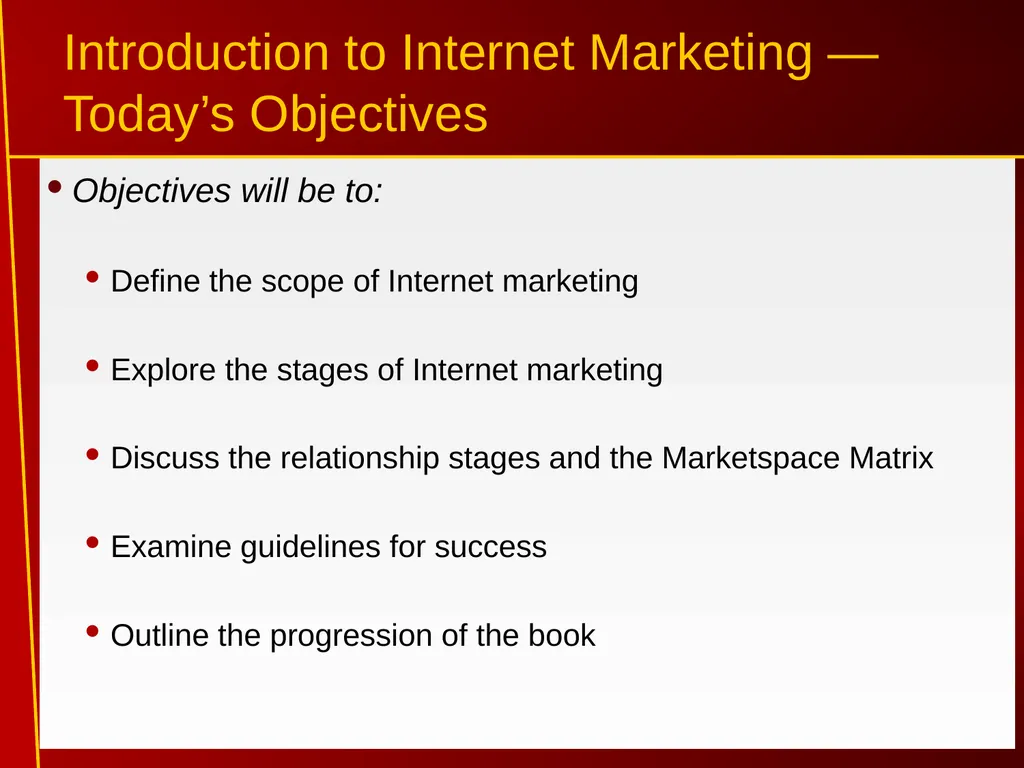
slide2. Introduction to Internet Marketing — Today’s Objectives Objectives will be to:
Define the scope of Internet marketing
Explore the stages of Internet marketing
Discuss the relationship stages and the Marketspace Matrix
Examine guidelines for success
Outline the progression of the book<br>
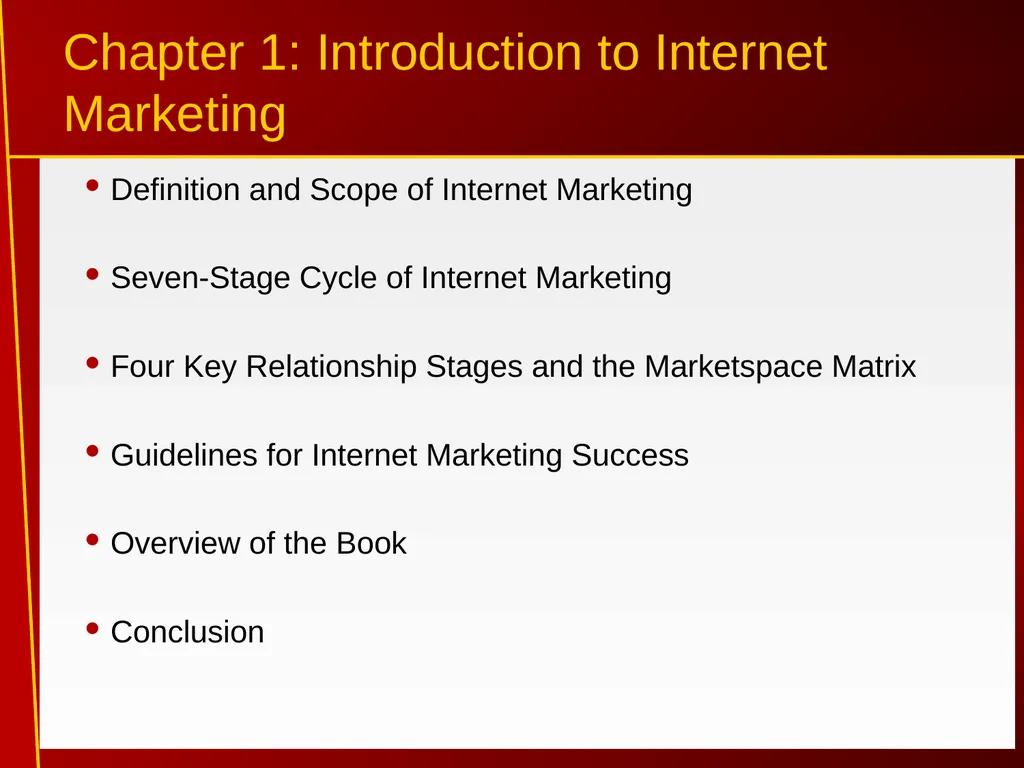
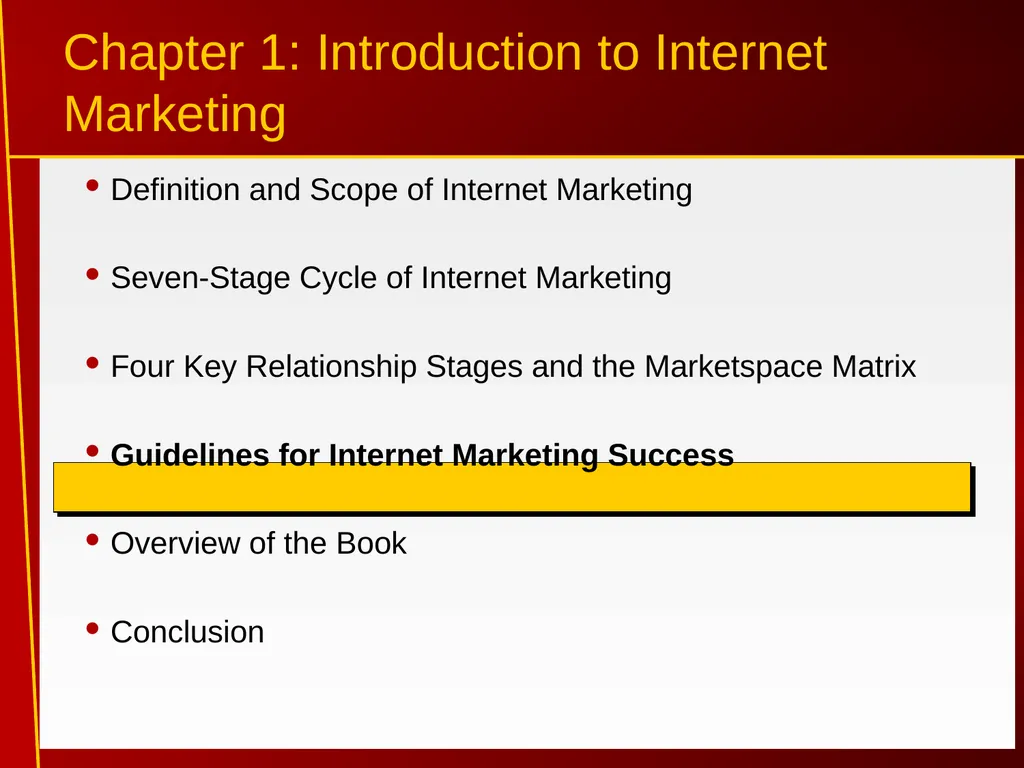
slide3. Chapter 1: Introduction to Internet Marketing Definition and Scope of Internet Marketing
Seven-Stage Cycle of Internet Marketing
Four Key Relationship Stages and the Marketspace Matrix
Guidelines for Internet Marketing Success
Overview of the Book
Conclusion<br>
slide4. Chapter 1: Introduction to Internet Marketing Definition and Scope of Internet Marketing
Seven-Stage Cycle of Internet Marketing
Four Key Relationship Stages and the Marketspace Matrix
Guidelines for Internet Marketing Success
Overview of the Book
Conclusion<br>
slide5. Definition and Scope of Internet Marketing<br>
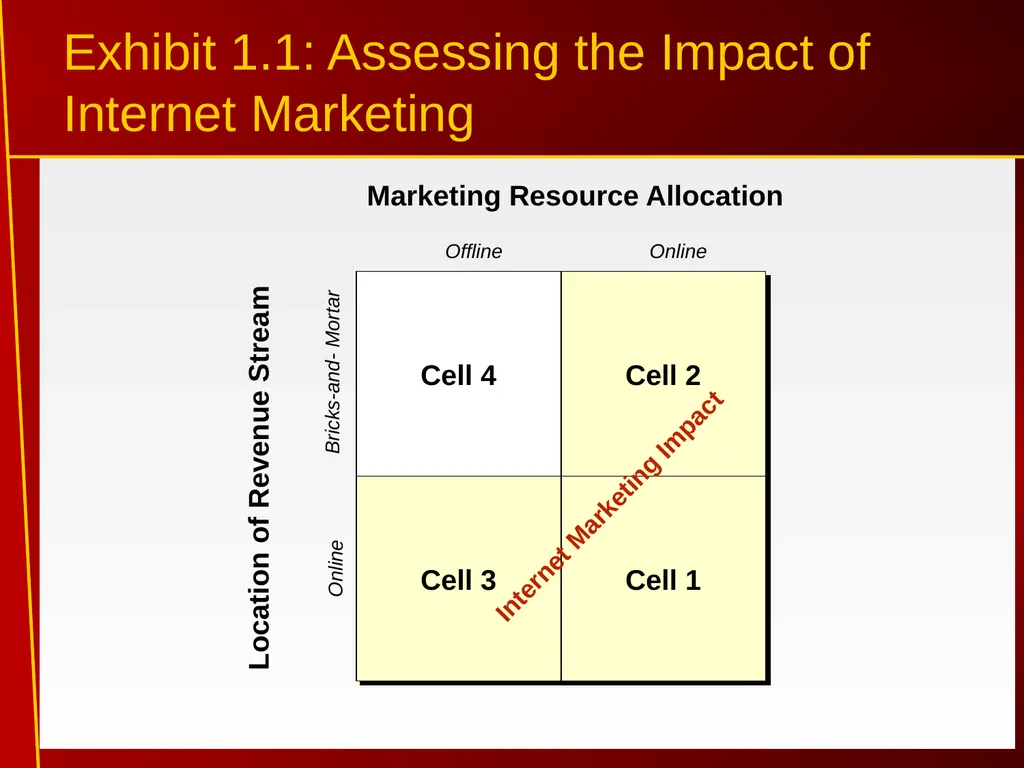
slide6. Cell 4 Cell 2 Cell 3 Cell 1 Location of Revenue Stream Bricks-and- Mortar Online Marketing Resource Allocation Offline Online Internet Marketing Impact Exhibit 1.1: Assessing the Impact of Internet Marketing<br>
slide7. Chapter 1: Introduction to Internet Marketing Definition and Scope of Internet Marketing
Seven-Stage Cycle of Internet Marketing
Four Key Relationship Stages and the Marketspace Matrix
Guidelines for Internet Marketing Success
Overview of the Book
Conclusion<br>
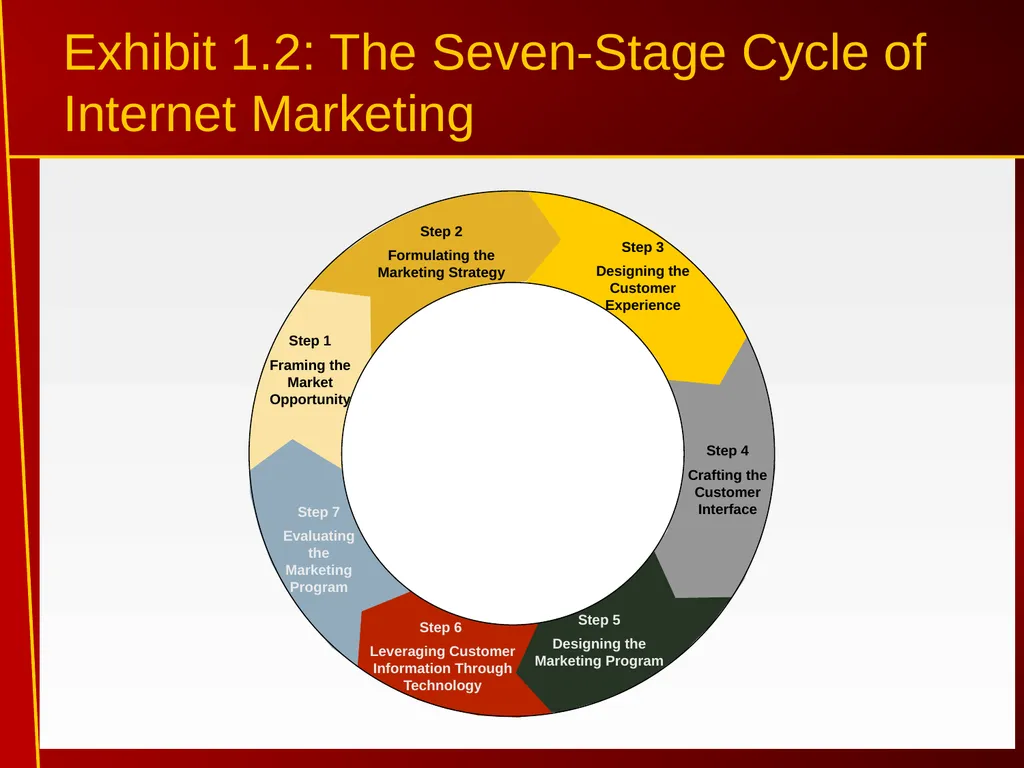
slide8. Exhibit 1.2: The Seven-Stage Cycle of Internet Marketing Step 2
Formulating the Marketing Strategy Step 3
Designing the Customer Experience Step 4
Crafting the Customer Interface Step 5
Designing the Marketing Program Step 6
Leveraging Customer Information Through Technology Step 7
Evaluating the Marketing Program Step 1
Framing the Market Opportunity<br>
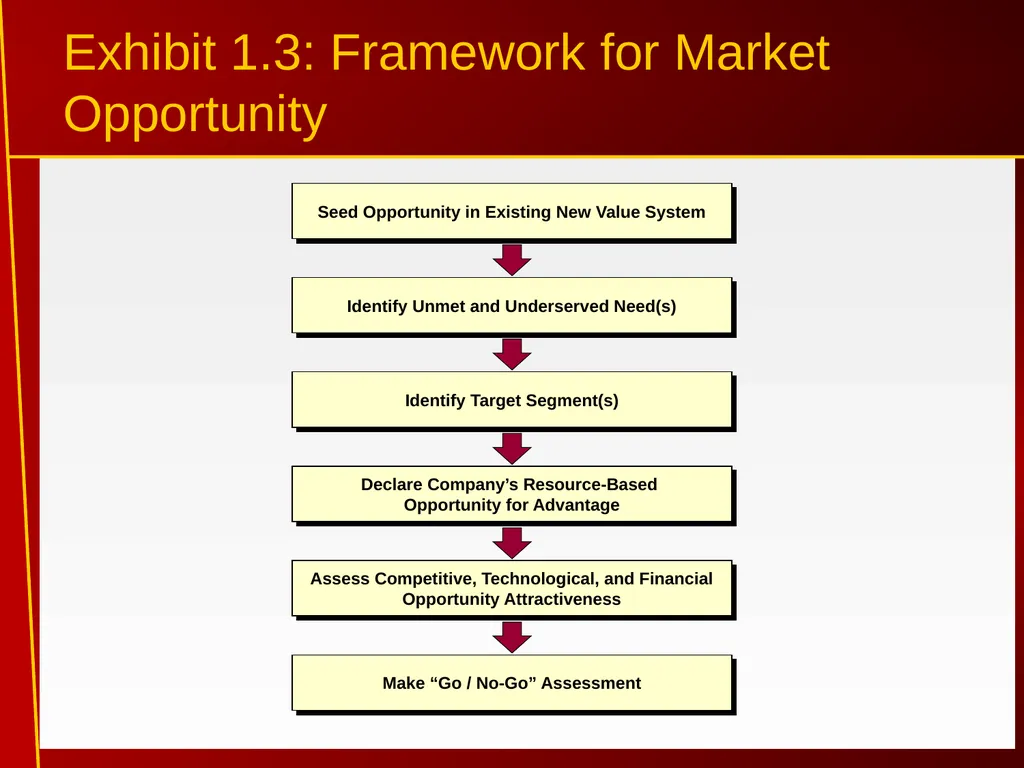
slide9. Exhibit 1.3: Framework for Market Opportunity Seed Opportunity in Existing New Value System Identify Unmet and Underserved Need(s) Identify Target Segment(s) Declare Company’s Resource-Based Opportunity for Advantage Assess Competitive, Technological, and Financial Opportunity Attractiveness Make “Go / No-Go” Assessment<br>
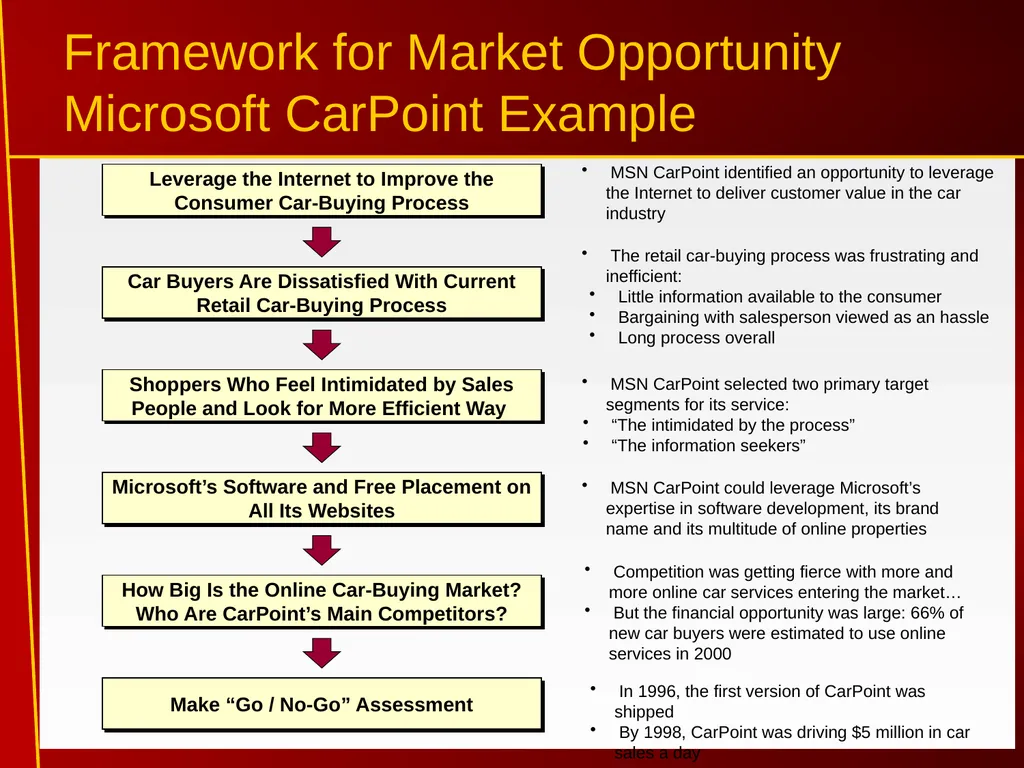
slide10. Framework for Market OpportunityMicrosoft CarPoint Example Leverage the Internet to Improve the Consumer Car-Buying Process Car Buyers Are Dissatisfied With Current Retail Car-Buying Process Shoppers Who Feel Intimidated by Sales People and Look for More Efficient Way Microsoft’s Software and Free Placement on All Its Websites How Big Is the Online Car-Buying Market? Who Are CarPoint’s Main Competitors? Make “Go / No-Go” Assessment MSN CarPoint identified an opportunity to leverage the Internet to deliver customer value in the car industry The retail car-buying process was frustrating and inefficient:
Little information available to the consumer
Bargaining with salesperson viewed as an hassle
Long process overall MSN CarPoint selected two primary target segments for its service:
“The intimidated by the process”
“The information seekers” MSN CarPoint could leverage Microsoft’s expertise in software development, its brand name and its multitude of online properties Competition was getting fierce with more and more online car services entering the market…
But the financial opportunity was large: 66% of new car buyers were estimated to use online services in 2000 In 1996, the first version of CarPoint was shipped
By 1998, CarPoint was driving $5 million in car sales a day<br>
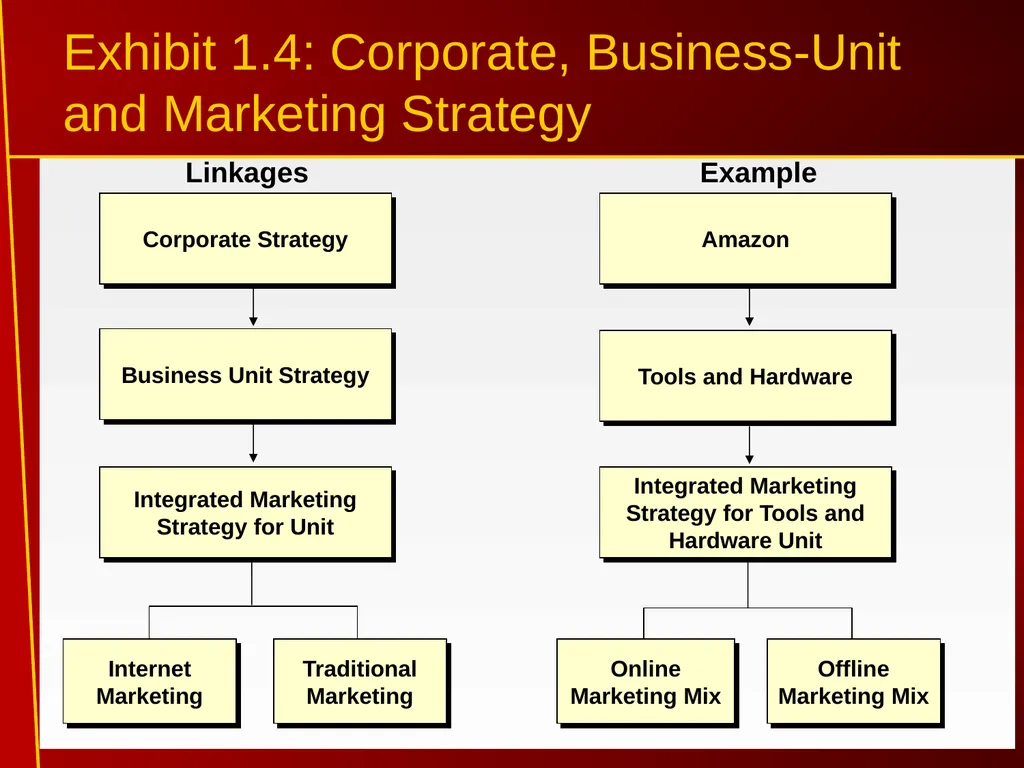
slide11. Exhibit 1.4: Corporate, Business-Unit and Marketing Strategy Corporate Strategy Business Unit Strategy Amazon Tools and Hardware Integrated Marketing Strategy for Tools and Hardware Unit Linkages Example Integrated Marketing Strategy for Unit Internet Marketing Traditional Marketing Online Marketing Mix Offline Marketing Mix<br>
slide12. Chapter 1: Introduction to Internet Marketing Definition and Scope of Internet Marketing
Seven-Stage Cycle of Internet Marketing
Four Key Relationship Stages and the Marketspace Matrix
Guidelines for Internet Marketing Success
Overview of the Book
Conclusion<br>
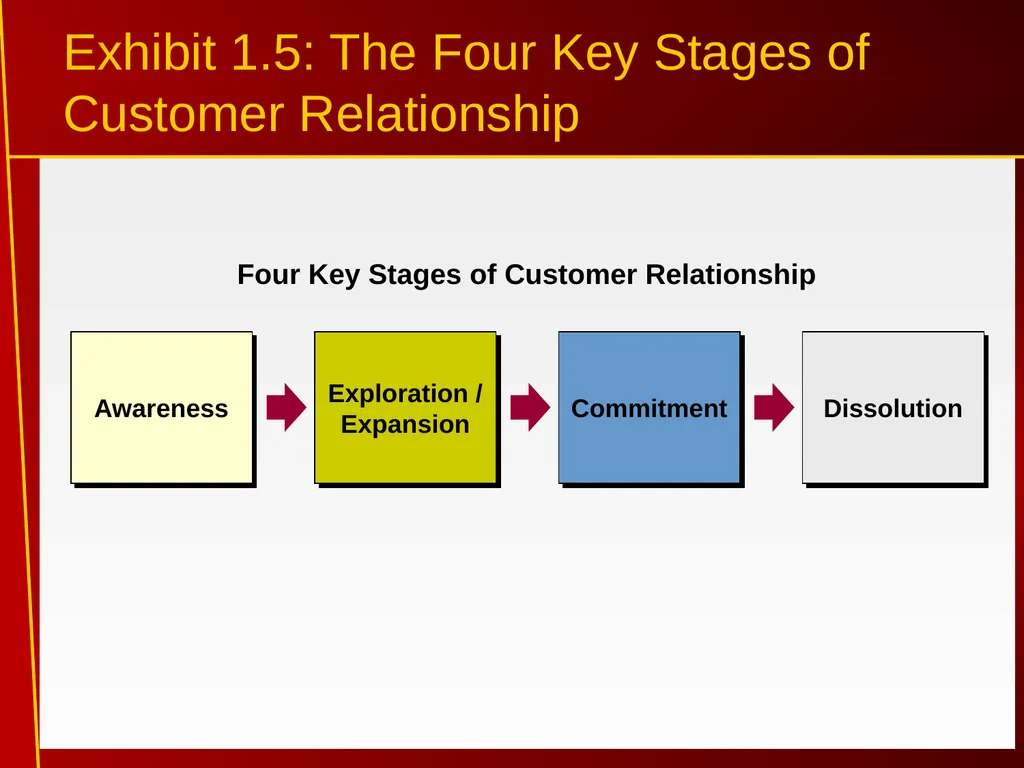
slide13. Awareness Exploration /
Expansion Commitment Dissolution Four Key Stages of Customer Relationship Exhibit 1.5: The Four Key Stages of Customer Relationship<br>
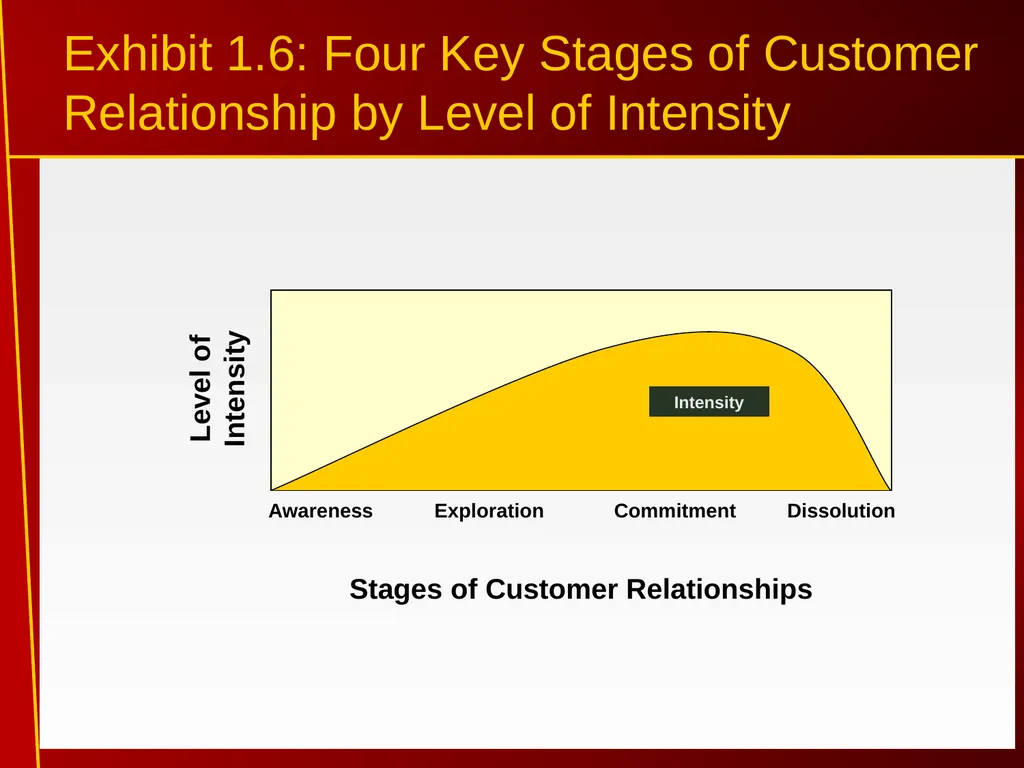
slide14. Exhibit 1.6: Four Key Stages of Customer Relationship by Level of Intensity Level of Intensity Stages of Customer Relationships Awareness Exploration Commitment Dissolution Intensity<br>
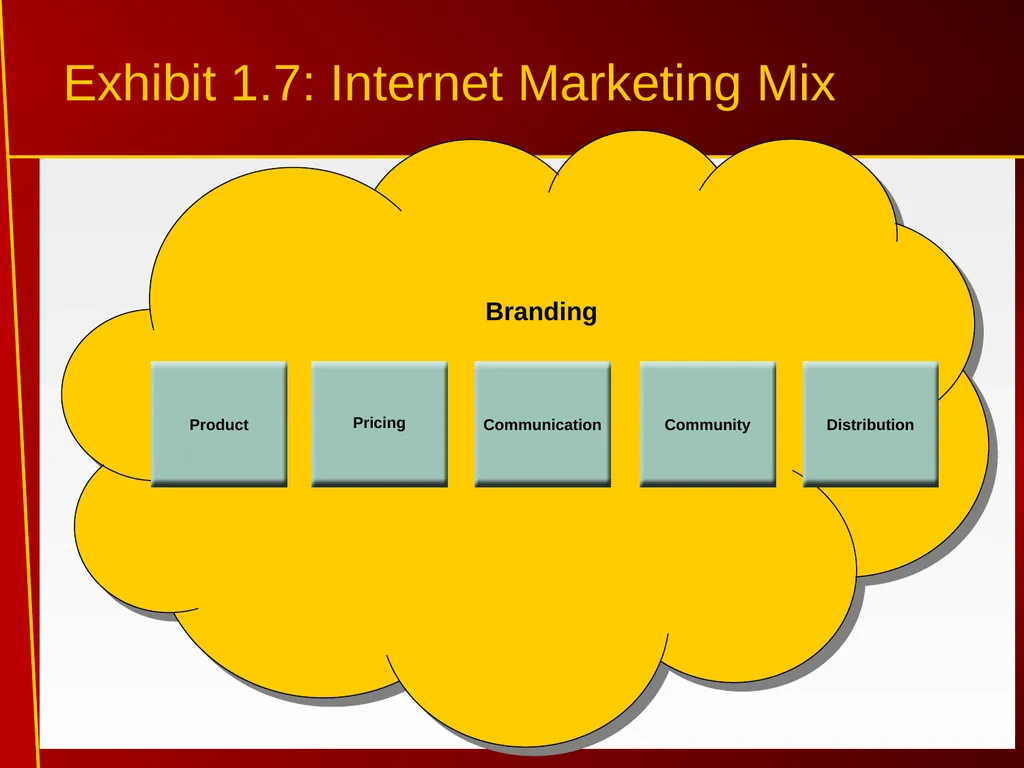
slide15. Exhibit 1.7: Internet Marketing Mix Branding<br>
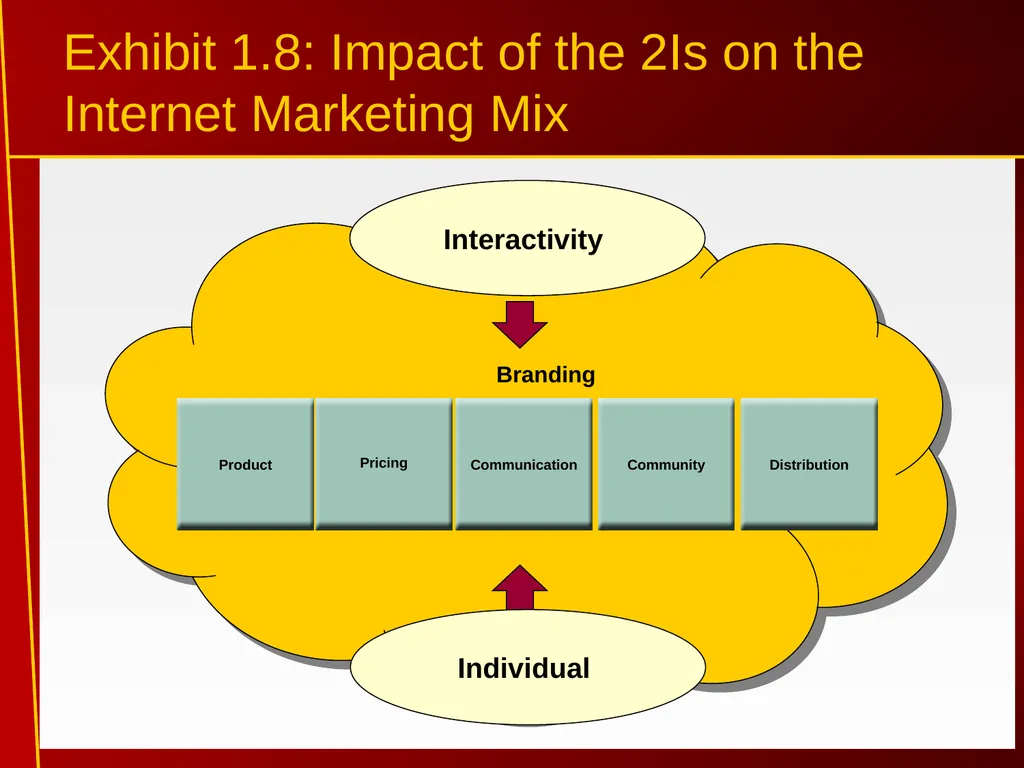
slide16. Exhibit 1.8: Impact of the 2Is on the Internet Marketing Mix Branding Individual Interactivity<br>
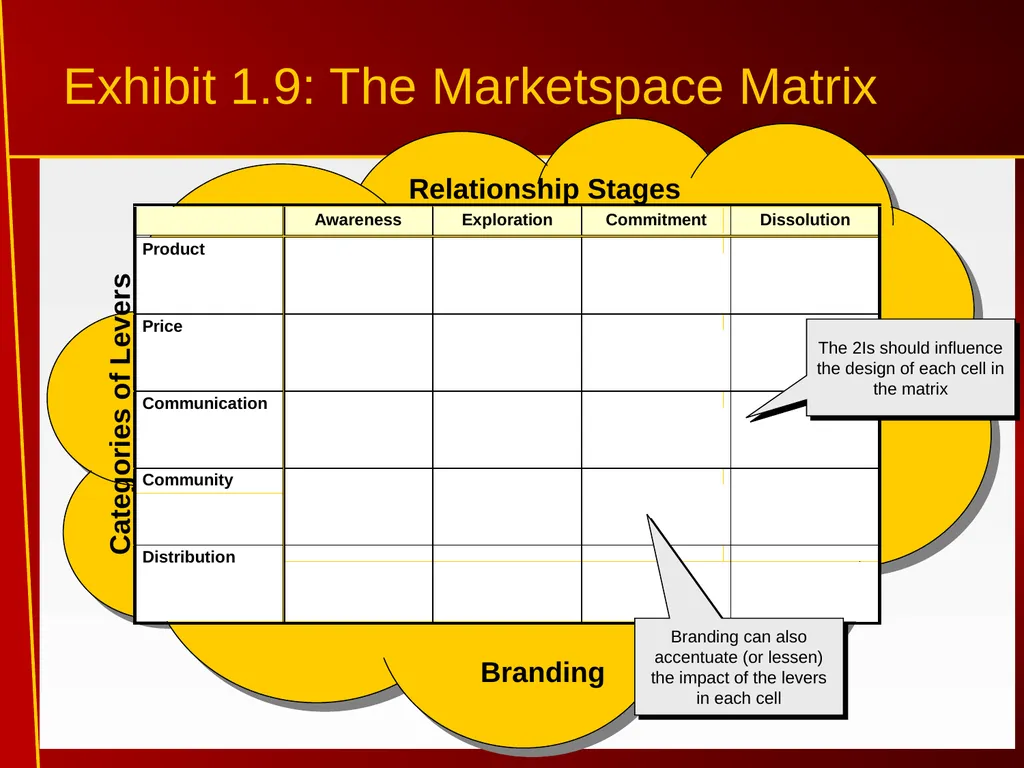
slide17. Exhibit 1.9: The Marketspace Matrix Relationship Stages Categories of Levers Branding Branding can also accentuate (or lessen) the impact of the levers in each cell The 2Is should influence the design of each cell in the matrix<br>
slide18. Chapter 1: Introduction to Internet Marketing Definition and Scope of Internet Marketing
Seven-Stage Cycle of Internet Marketing
Four Key Relationship Stages and the Marketspace Matrix
Guidelines for Internet Marketing Success
Overview of the Book
Conclusion<br>
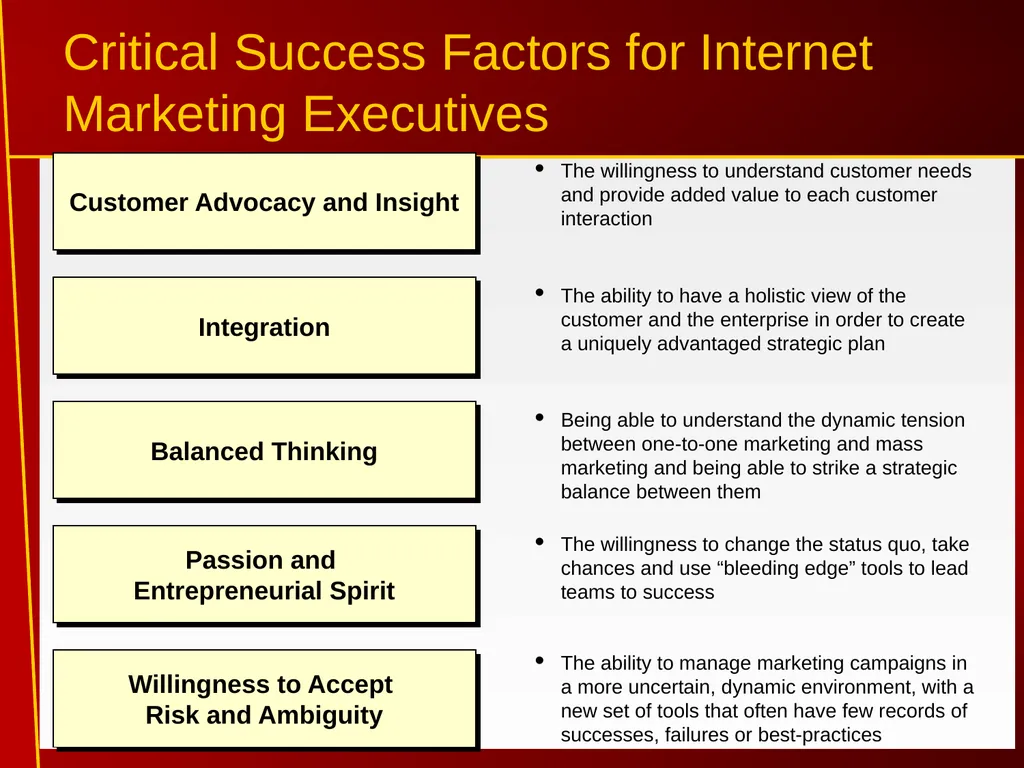
slide19. Critical Success Factors for Internet Marketing Executives Customer Advocacy and Insight Integration Balanced Thinking Passion and Entrepreneurial Spirit Willingness to Accept Risk and Ambiguity The willingness to understand customer needs and provide added value to each customer interaction The ability to manage marketing campaigns in a more uncertain, dynamic environment, with a new set of tools that often have few records of successes, failures or best-practices The ability to have a holistic view of the customer and the enterprise in order to create a uniquely advantaged strategic plan Being able to understand the dynamic tension between one-to-one marketing and mass marketing and being able to strike a strategic balance between them The willingness to change the status quo, take chances and use “bleeding edge” tools to lead teams to success<br>
slide20. Exhibit 1.10: The New Rules of Marketing for the Global Digital World The New Rules
1. Target segments of one, and create virtual communities
2. Design for customer-led positioning
3. Expand the role of branding in the global portfolio
4. Leverage consumers as coproducers through customization
5. Use creative pricing in the Priceline.com world
6. Create anytime/anyplace distribution and integrated supply chains
7. Redesign advertising as interactive and integrated marketing, communication, education and entertainment
8. Reinvent marketing research and modeling as knowledge creation and dissemination
9. Use adaptive experimentation
10. Redesign the strategy process and supporting organizational architecture Source: Wind, Jerry and Vijay Mahajan. Digital Marketing. New York: John Wiley and Sons, p.8.<br>
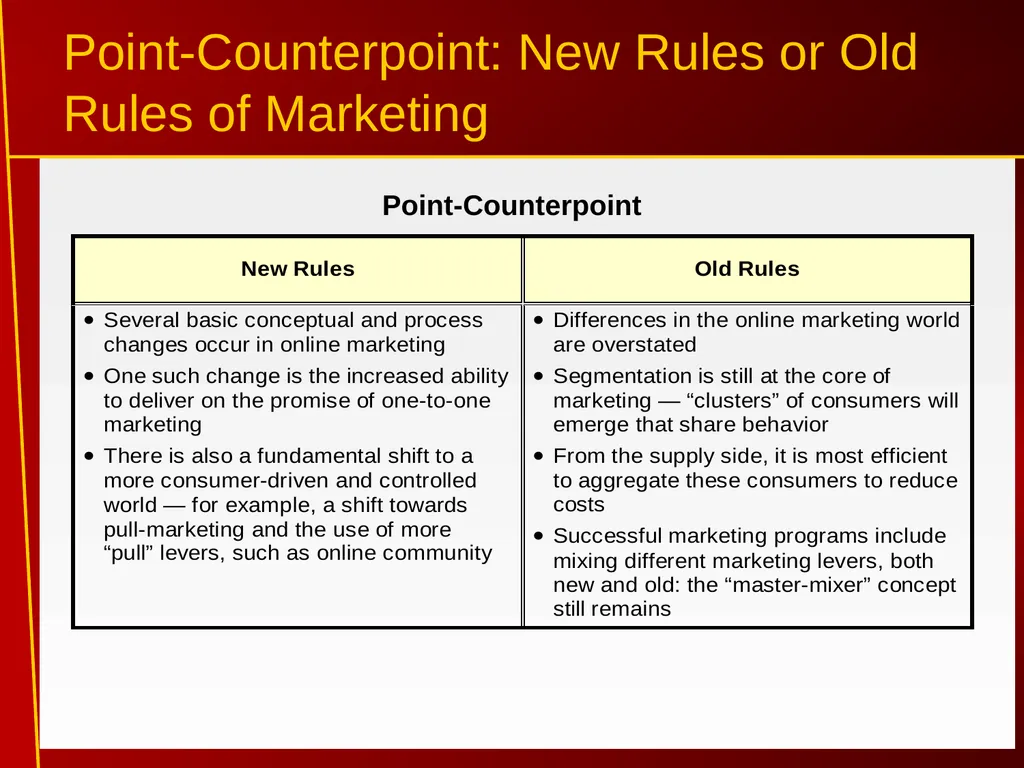
slide21. Point-Counterpoint: New Rules or Old Rules of Marketing Point-Counterpoint<br>
slide22. Chapter 1: Introduction to Internet Marketing Definition and Scope of Internet Marketing
Seven-Stage Cycle of Internet Marketing
Four Key Relationship Stages and the Marketspace Matrix
Guidelines for Internet Marketing Success
Overview of the Book
Conclusion<br>
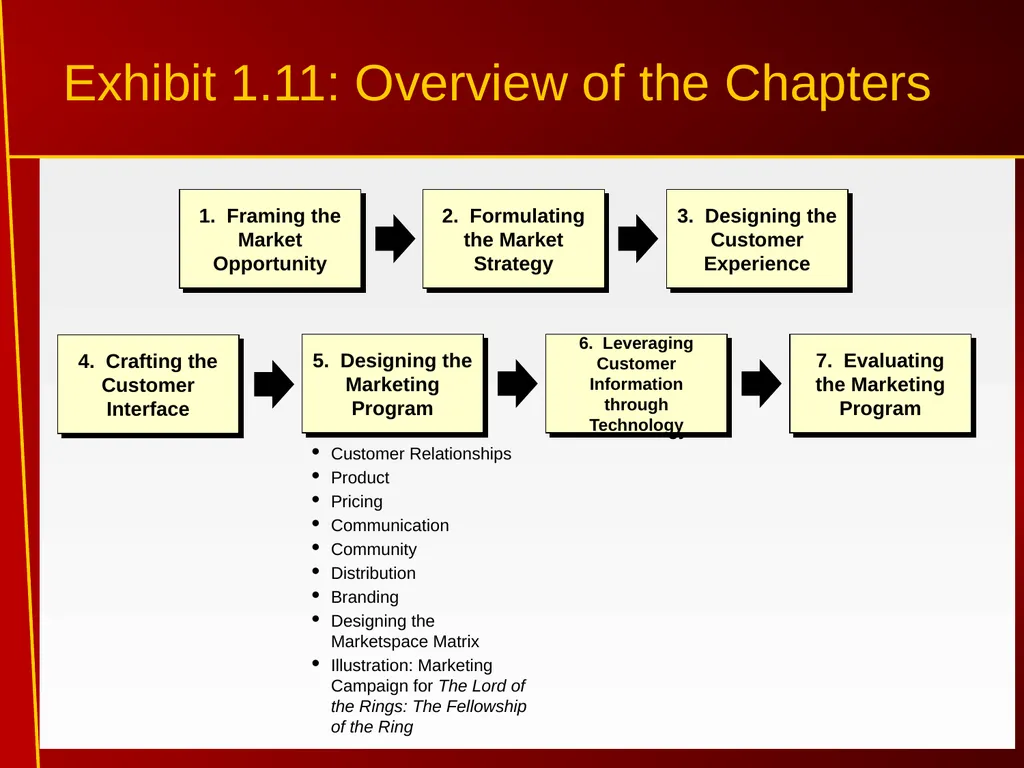
slide23. 4. Crafting the Customer Interface 1. Framing the Market Opportunity 2. Formulating the Market Strategy 3. Designing the Customer Experience Exhibit 1.11: Overview of the Chapters 5. Designing the Marketing Program 6. Leveraging Customer Information through Technology 7. Evaluating the Marketing Program Customer Relationships
Product
Pricing
Communication
Community
Distribution
Branding
Designing the Marketspace Matrix
Illustration: Marketing Campaign for The Lord of the Rings: The Fellowship of the Ring<br>
slide24. Chapter 1: Introduction to Internet Marketing Definition and Scope of Internet Marketing
Seven-Stage Cycle of Internet Marketing
Four Key Relationship Stages and the Marketspace Matrix
Guidelines for Internet Marketing Success
Overview of the Book
Conclusion<br>
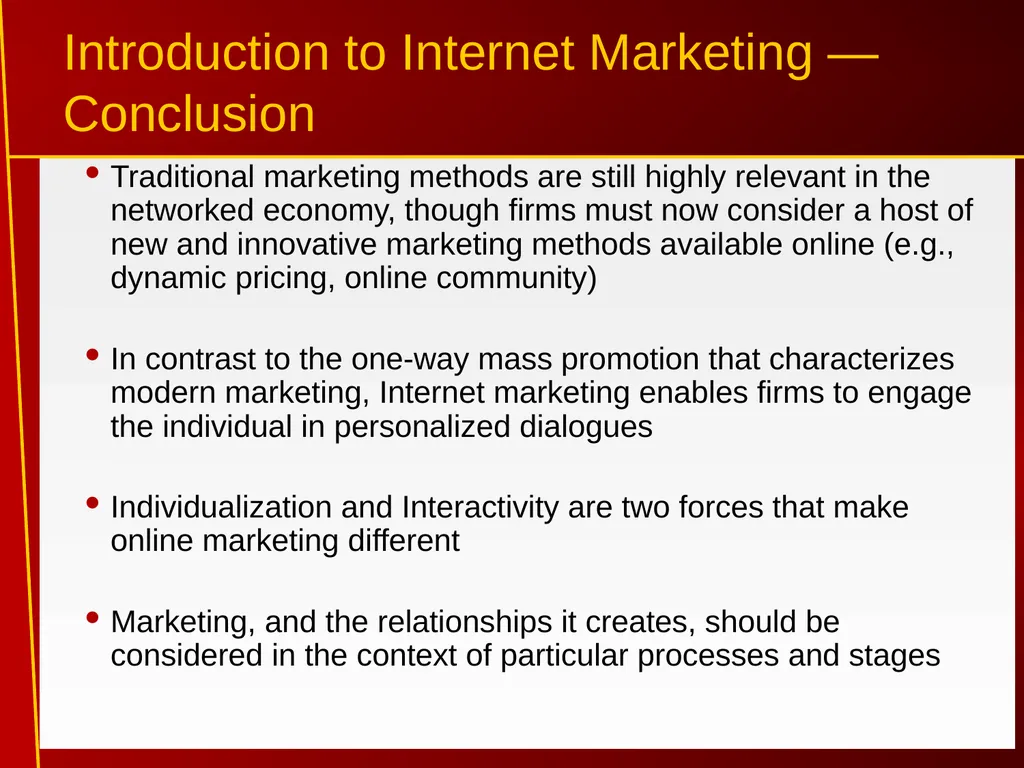
slide25. Traditional marketing methods are still highly relevant in the networked economy, though firms must now consider a host of new and innovative marketing methods available online (e.g., dynamic pricing, online community)
In contrast to the one-way mass promotion that characterizes modern marketing, Internet marketing enables firms to engage the individual in personalized dialogues
Individualization and Interactivity are two forces that make online marketing different
Marketing, and the relationships it creates, should be considered in the context of particular processes and stages Introduction to Internet Marketing — Conclusion<br>

slide2. Introduction to Internet Marketing — Today’s Objectives Objectives will be to:
Define the scope of Internet marketing
Explore the stages of Internet marketing
Discuss the relationship stages and the Marketspace Matrix
Examine guidelines for success
Outline the progression of the book<br>
slide3. Chapter 1: Introduction to Internet Marketing Definition and Scope of Internet Marketing
Seven-Stage Cycle of Internet Marketing
Four Key Relationship Stages and the Marketspace Matrix
Guidelines for Internet Marketing Success
Overview of the Book
Conclusion<br>
slide4. Chapter 1: Introduction to Internet Marketing Definition and Scope of Internet Marketing
Seven-Stage Cycle of Internet Marketing
Four Key Relationship Stages and the Marketspace Matrix
Guidelines for Internet Marketing Success
Overview of the Book
Conclusion<br>
slide5. Definition and Scope of Internet Marketing<br>
slide6. Cell 4 Cell 2 Cell 3 Cell 1 Location of Revenue Stream Bricks-and- Mortar Online Marketing Resource Allocation Offline Online Internet Marketing Impact Exhibit 1.1: Assessing the Impact of Internet Marketing<br>
slide7. Chapter 1: Introduction to Internet Marketing Definition and Scope of Internet Marketing
Seven-Stage Cycle of Internet Marketing
Four Key Relationship Stages and the Marketspace Matrix
Guidelines for Internet Marketing Success
Overview of the Book
Conclusion<br>
slide8. Exhibit 1.2: The Seven-Stage Cycle of Internet Marketing Step 2
Formulating the Marketing Strategy Step 3
Designing the Customer Experience Step 4
Crafting the Customer Interface Step 5
Designing the Marketing Program Step 6
Leveraging Customer Information Through Technology Step 7
Evaluating the Marketing Program Step 1
Framing the Market Opportunity<br>
slide9. Exhibit 1.3: Framework for Market Opportunity Seed Opportunity in Existing New Value System Identify Unmet and Underserved Need(s) Identify Target Segment(s) Declare Company’s Resource-Based Opportunity for Advantage Assess Competitive, Technological, and Financial Opportunity Attractiveness Make “Go / No-Go” Assessment<br>
slide10. Framework for Market OpportunityMicrosoft CarPoint Example Leverage the Internet to Improve the Consumer Car-Buying Process Car Buyers Are Dissatisfied With Current Retail Car-Buying Process Shoppers Who Feel Intimidated by Sales People and Look for More Efficient Way Microsoft’s Software and Free Placement on All Its Websites How Big Is the Online Car-Buying Market? Who Are CarPoint’s Main Competitors? Make “Go / No-Go” Assessment MSN CarPoint identified an opportunity to leverage the Internet to deliver customer value in the car industry The retail car-buying process was frustrating and inefficient:
Little information available to the consumer
Bargaining with salesperson viewed as an hassle
Long process overall MSN CarPoint selected two primary target segments for its service:
“The intimidated by the process”
“The information seekers” MSN CarPoint could leverage Microsoft’s expertise in software development, its brand name and its multitude of online properties Competition was getting fierce with more and more online car services entering the market…
But the financial opportunity was large: 66% of new car buyers were estimated to use online services in 2000 In 1996, the first version of CarPoint was shipped
By 1998, CarPoint was driving $5 million in car sales a day<br>
slide11. Exhibit 1.4: Corporate, Business-Unit and Marketing Strategy Corporate Strategy Business Unit Strategy Amazon Tools and Hardware Integrated Marketing Strategy for Tools and Hardware Unit Linkages Example Integrated Marketing Strategy for Unit Internet Marketing Traditional Marketing Online Marketing Mix Offline Marketing Mix<br>
slide12. Chapter 1: Introduction to Internet Marketing Definition and Scope of Internet Marketing
Seven-Stage Cycle of Internet Marketing
Four Key Relationship Stages and the Marketspace Matrix
Guidelines for Internet Marketing Success
Overview of the Book
Conclusion<br>
slide13. Awareness Exploration /
Expansion Commitment Dissolution Four Key Stages of Customer Relationship Exhibit 1.5: The Four Key Stages of Customer Relationship<br>
slide14. Exhibit 1.6: Four Key Stages of Customer Relationship by Level of Intensity Level of Intensity Stages of Customer Relationships Awareness Exploration Commitment Dissolution Intensity<br>
slide15. Exhibit 1.7: Internet Marketing Mix Branding<br>
slide16. Exhibit 1.8: Impact of the 2Is on the Internet Marketing Mix Branding Individual Interactivity<br>
slide17. Exhibit 1.9: The Marketspace Matrix Relationship Stages Categories of Levers Branding Branding can also accentuate (or lessen) the impact of the levers in each cell The 2Is should influence the design of each cell in the matrix<br>
slide18. Chapter 1: Introduction to Internet Marketing Definition and Scope of Internet Marketing
Seven-Stage Cycle of Internet Marketing
Four Key Relationship Stages and the Marketspace Matrix
Guidelines for Internet Marketing Success
Overview of the Book
Conclusion<br>
slide19. Critical Success Factors for Internet Marketing Executives Customer Advocacy and Insight Integration Balanced Thinking Passion and Entrepreneurial Spirit Willingness to Accept Risk and Ambiguity The willingness to understand customer needs and provide added value to each customer interaction The ability to manage marketing campaigns in a more uncertain, dynamic environment, with a new set of tools that often have few records of successes, failures or best-practices The ability to have a holistic view of the customer and the enterprise in order to create a uniquely advantaged strategic plan Being able to understand the dynamic tension between one-to-one marketing and mass marketing and being able to strike a strategic balance between them The willingness to change the status quo, take chances and use “bleeding edge” tools to lead teams to success<br>
slide20. Exhibit 1.10: The New Rules of Marketing for the Global Digital World The New Rules
1. Target segments of one, and create virtual communities
2. Design for customer-led positioning
3. Expand the role of branding in the global portfolio
4. Leverage consumers as coproducers through customization
5. Use creative pricing in the Priceline.com world
6. Create anytime/anyplace distribution and integrated supply chains
7. Redesign advertising as interactive and integrated marketing, communication, education and entertainment
8. Reinvent marketing research and modeling as knowledge creation and dissemination
9. Use adaptive experimentation
10. Redesign the strategy process and supporting organizational architecture Source: Wind, Jerry and Vijay Mahajan. Digital Marketing. New York: John Wiley and Sons, p.8.<br>
slide21. Point-Counterpoint: New Rules or Old Rules of Marketing Point-Counterpoint<br>
slide22. Chapter 1: Introduction to Internet Marketing Definition and Scope of Internet Marketing
Seven-Stage Cycle of Internet Marketing
Four Key Relationship Stages and the Marketspace Matrix
Guidelines for Internet Marketing Success
Overview of the Book
Conclusion<br>
slide23. 4. Crafting the Customer Interface 1. Framing the Market Opportunity 2. Formulating the Market Strategy 3. Designing the Customer Experience Exhibit 1.11: Overview of the Chapters 5. Designing the Marketing Program 6. Leveraging Customer Information through Technology 7. Evaluating the Marketing Program Customer Relationships
Product
Pricing
Communication
Community
Distribution
Branding
Designing the Marketspace Matrix
Illustration: Marketing Campaign for The Lord of the Rings: The Fellowship of the Ring<br>
slide24. Chapter 1: Introduction to Internet Marketing Definition and Scope of Internet Marketing
Seven-Stage Cycle of Internet Marketing
Four Key Relationship Stages and the Marketspace Matrix
Guidelines for Internet Marketing Success
Overview of the Book
Conclusion<br>
slide25. Traditional marketing methods are still highly relevant in the networked economy, though firms must now consider a host of new and innovative marketing methods available online (e.g., dynamic pricing, online community)
In contrast to the one-way mass promotion that characterizes modern marketing, Internet marketing enables firms to engage the individual in personalized dialogues
Individualization and Interactivity are two forces that make online marketing different
Marketing, and the relationships it creates, should be considered in the context of particular processes and stages Introduction to Internet Marketing — Conclusion<br>