
1 LAND VALUE CAPTURE INVESTMENT IN INFRASTRUCTURE
CB
Published · 46 slides · 0 views

1 / 1


Description
1 LAND VALUE CAPTURE INVESTMENT IN INFRASTRUCTURE THREE PILLARS OF CITY RESILIENCE Investment needs for cities extend beyond the reach of public finances Projections show that investments of 4.1 to 4.3 trillion in urban infrastructure are
Related Topics
Share
Embed code
Download this presentation From Below
"1 LAND VALUE CAPTURE INVESTMENT IN INFRASTRUCTURE" is the property of its rightful owner. Permission is granted to download and print the materials on this website for personal, non-commercial use only, and to display it on your personal computer provided you do not modify the materials and that you retain all copyright notices contained in the materials. By downloading content from our website, you accept the terms of this agreement.
Presentation Transcript
01
1 LAND VALUE CAPTURE INVESTMENT IN INFRASTRUCTURE<br>
02
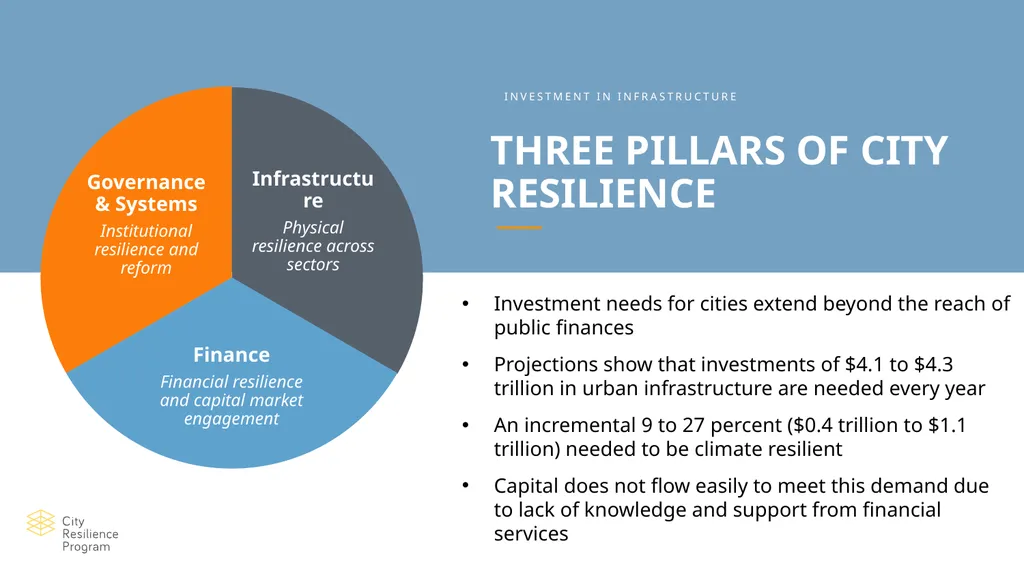
THREE PILLARS OF CITY RESILIENCE Investment needs for cities extend beyond the reach of public finances
Projections show that investments of $4.1 to $4.3 trillion in urban infrastructure are needed every year
An incremental 9 to 27 percent ($0.4 trillion to $1.1 trillion) needed to be climate resilient
Capital does not flow easily to meet this demand due to lack of knowledge and support from financial services INVESTMENT IN INFRASTRUCTURE<br>
Projections show that investments of $4.1 to $4.3 trillion in urban infrastructure are needed every year
An incremental 9 to 27 percent ($0.4 trillion to $1.1 trillion) needed to be climate resilient
Capital does not flow easily to meet this demand due to lack of knowledge and support from financial services INVESTMENT IN INFRASTRUCTURE<br>
03
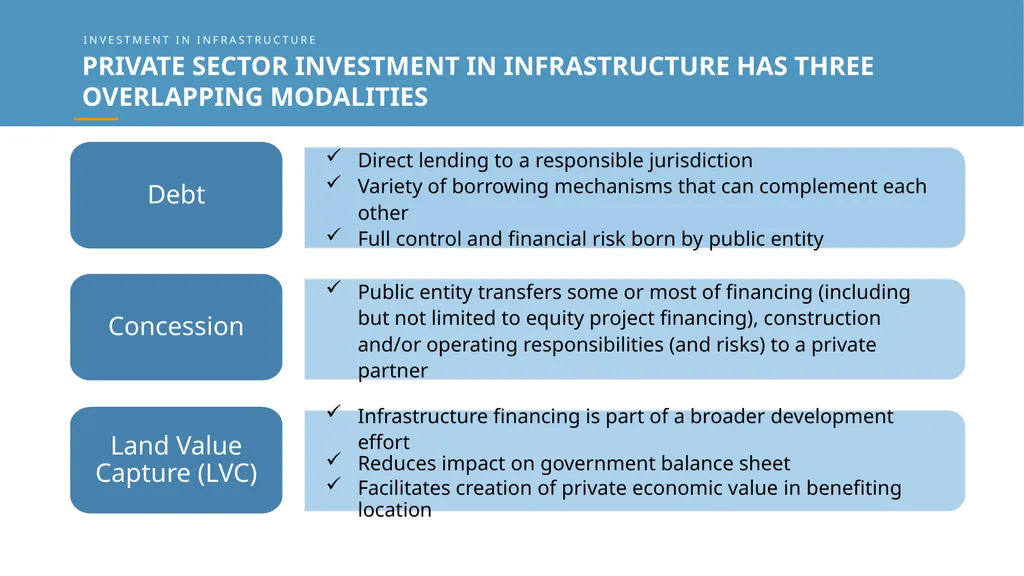
PRIVATE SECTOR INVESTMENT IN INFRASTRUCTURE HAS THREE OVERLAPPING MODALITIES INVESTMENT IN INFRASTRUCTURE<br>
04
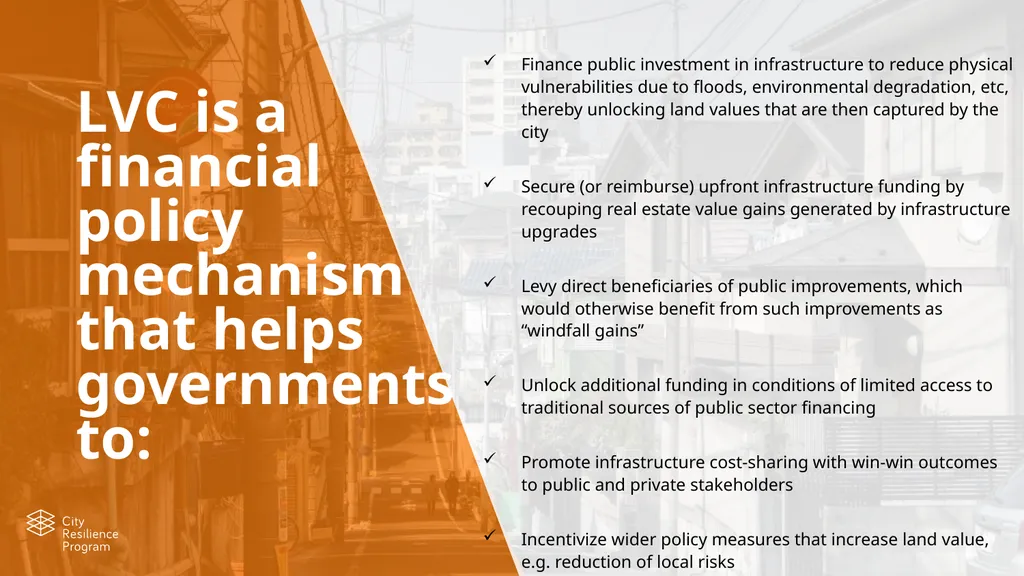
LVC is a financial
policy mechanism that helps governments to: Finance public investment in infrastructure to reduce physical vulnerabilities due to floods, environmental degradation, etc, thereby unlocking land values that are then captured by the city
Secure (or reimburse) upfront infrastructure funding by recouping real estate value gains generated by infrastructure upgrades
Levy direct beneficiaries of public improvements, which would otherwise benefit from such improvements as “windfall gains”
Unlock additional funding in conditions of limited access to traditional sources of public sector financing
Promote infrastructure cost-sharing with win-win outcomes to public and private stakeholders
Incentivize wider policy measures that increase land value, e.g. reduction of local risks<br>
Secure (or reimburse) upfront infrastructure funding by recouping real estate value gains generated by infrastructure upgrades
Levy direct beneficiaries of public improvements, which would otherwise benefit from such improvements as “windfall gains”
Unlock additional funding in conditions of limited access to traditional sources of public sector financing
Promote infrastructure cost-sharing with win-win outcomes to public and private stakeholders
Incentivize wider policy measures that increase land value, e.g. reduction of local risks<br>
05
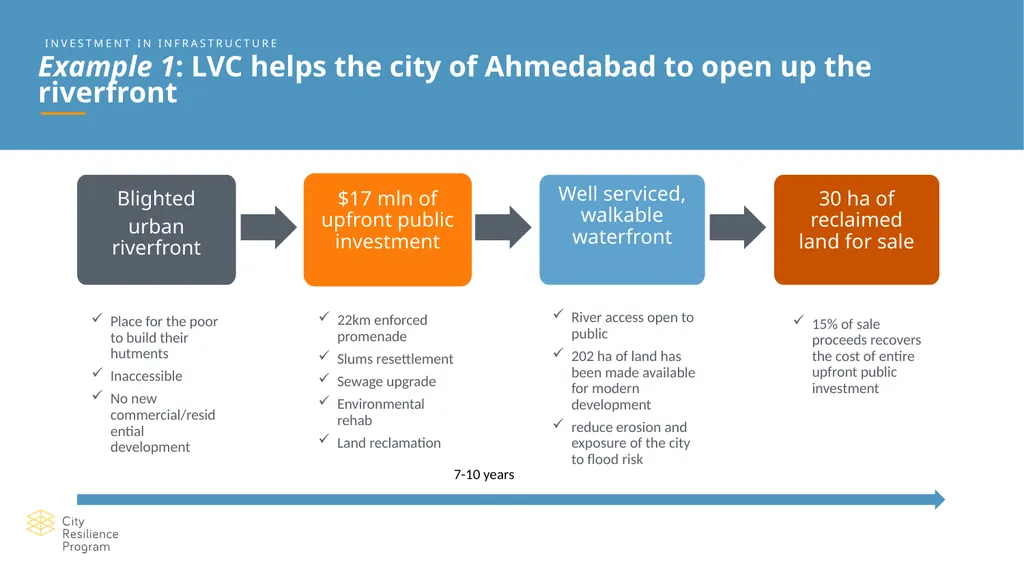
Example 1: LVC helps the city of Ahmedabad to open up the riverfront INVESTMENT IN INFRASTRUCTURE Blighted
urban riverfront Place for the poor to build their hutments
Inaccessible
No new commercial/residential development $17 mln of upfront public investment 22km enforced promenade
Slums resettlement
Sewage upgrade
Environmental rehab
Land reclamation Well serviced, walkable waterfront River access open to public
202 ha of land has been made available for modern development
reduce erosion and exposure of the city to flood risk 30 ha of reclaimed land for sale 15% of sale proceeds recovers the cost of entire upfront public investment 7-10 years<br>
urban riverfront Place for the poor to build their hutments
Inaccessible
No new commercial/residential development $17 mln of upfront public investment 22km enforced promenade
Slums resettlement
Sewage upgrade
Environmental rehab
Land reclamation Well serviced, walkable waterfront River access open to public
202 ha of land has been made available for modern development
reduce erosion and exposure of the city to flood risk 30 ha of reclaimed land for sale 15% of sale proceeds recovers the cost of entire upfront public investment 7-10 years<br>
06
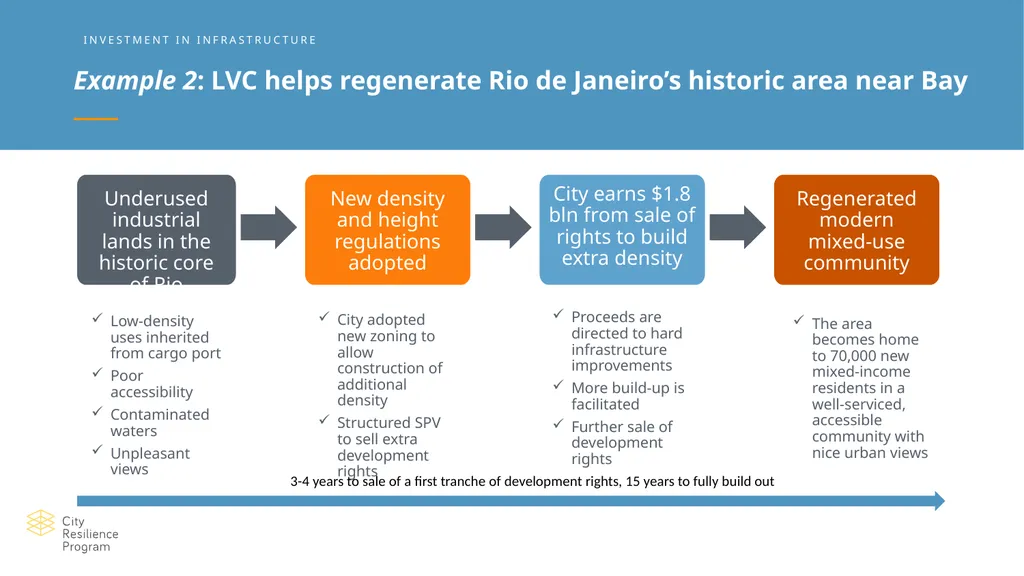
Example 2: LVC helps regenerate Rio de Janeiro’s historic area near Bay INVESTMENT IN INFRASTRUCTURE Underused industrial lands in the historic core of Rio Low-density uses inherited from cargo port
Poor accessibility
Contaminated waters
Unpleasant views New density and height regulations adopted City adopted new zoning to allow construction of additional density
Structured SPV to sell extra development rights City earns $1.8 bln from sale of rights to build extra density Proceeds are directed to hard infrastructure improvements
More build-up is facilitated
Further sale of development rights Regenerated modern mixed-use community The area becomes home to 70,000 new mixed-income residents in a well-serviced, accessible community with nice urban views 3-4 years to sale of a first tranche of development rights, 15 years to fully build out<br>
Poor accessibility
Contaminated waters
Unpleasant views New density and height regulations adopted City adopted new zoning to allow construction of additional density
Structured SPV to sell extra development rights City earns $1.8 bln from sale of rights to build extra density Proceeds are directed to hard infrastructure improvements
More build-up is facilitated
Further sale of development rights Regenerated modern mixed-use community The area becomes home to 70,000 new mixed-income residents in a well-serviced, accessible community with nice urban views 3-4 years to sale of a first tranche of development rights, 15 years to fully build out<br>
07
Investments can include hard infrastructure, slum upgrading, environmental remediation Improved infrastructure translates into higher desirability and increased development potential of land Value captured
as a fraction of imputed
private developer’s profit.
Can be captured either upfront or post project completion
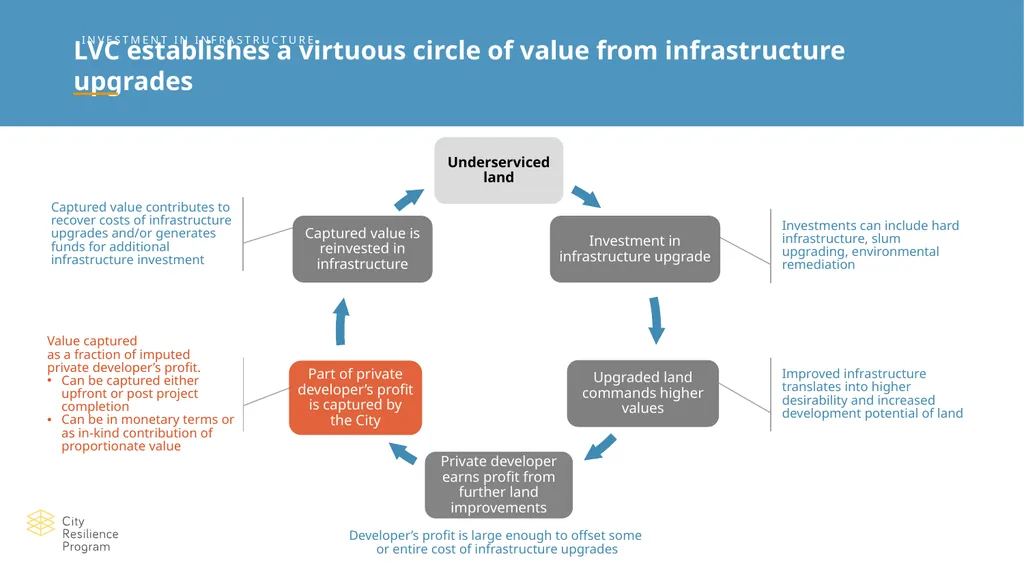
Can be in monetary terms or as in-kind contribution of proportionate value Captured value contributes to recover costs of infrastructure upgrades and/or generates funds for additional infrastructure investment LVC establishes a virtuous circle of value from infrastructure upgrades INVESTMENT IN INFRASTRUCTURE Underserviced land Investment in infrastructure upgrade Upgraded land commands higher values Private developer earns profit from further land improvements Part of private developer’s profit is captured by the City Captured value is reinvested in infrastructure Developer’s profit is large enough to offset some or entire cost of infrastructure upgrades<br>
as a fraction of imputed
private developer’s profit.
Can be captured either upfront or post project completion
Can be in monetary terms or as in-kind contribution of proportionate value Captured value contributes to recover costs of infrastructure upgrades and/or generates funds for additional infrastructure investment LVC establishes a virtuous circle of value from infrastructure upgrades INVESTMENT IN INFRASTRUCTURE Underserviced land Investment in infrastructure upgrade Upgraded land commands higher values Private developer earns profit from further land improvements Part of private developer’s profit is captured by the City Captured value is reinvested in infrastructure Developer’s profit is large enough to offset some or entire cost of infrastructure upgrades<br>
08
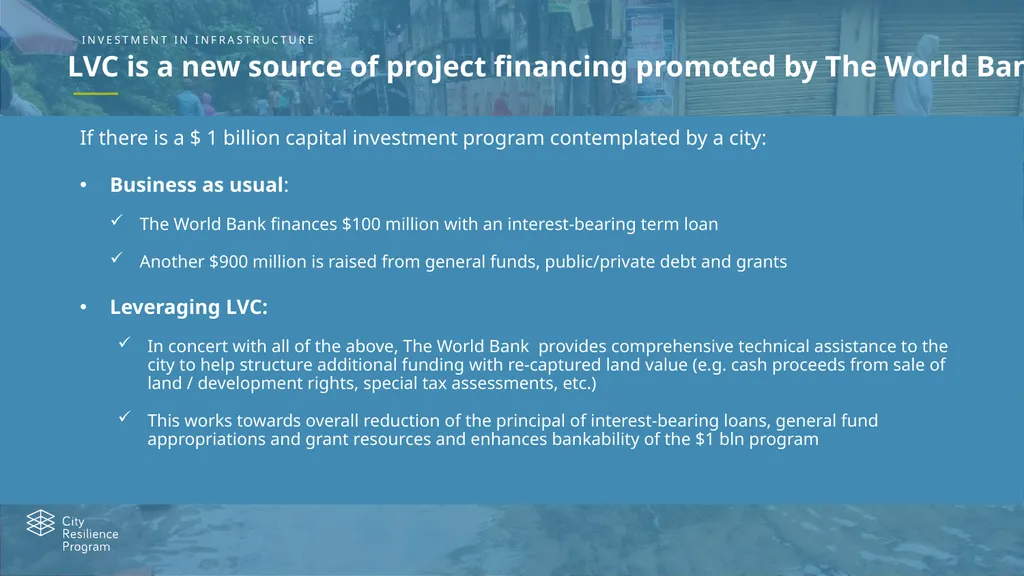
LVC is a new source of project financing promoted by The World Bank INVESTMENT IN INFRASTRUCTURE If there is a $ 1 billion capital investment program contemplated by a city:
Business as usual:
The World Bank finances $100 million with an interest-bearing term loan
Another $900 million is raised from general funds, public/private debt and grants
Leveraging LVC:
In concert with all of the above, The World Bank provides comprehensive technical assistance to the city to help structure additional funding with re-captured land value (e.g. cash proceeds from sale of land / development rights, special tax assessments, etc.)
This works towards overall reduction of the principal of interest-bearing loans, general fund appropriations and grant resources and enhances bankability of the $1 bln program<br>
Business as usual:
The World Bank finances $100 million with an interest-bearing term loan
Another $900 million is raised from general funds, public/private debt and grants
Leveraging LVC:
In concert with all of the above, The World Bank provides comprehensive technical assistance to the city to help structure additional funding with re-captured land value (e.g. cash proceeds from sale of land / development rights, special tax assessments, etc.)
This works towards overall reduction of the principal of interest-bearing loans, general fund appropriations and grant resources and enhances bankability of the $1 bln program<br>
09
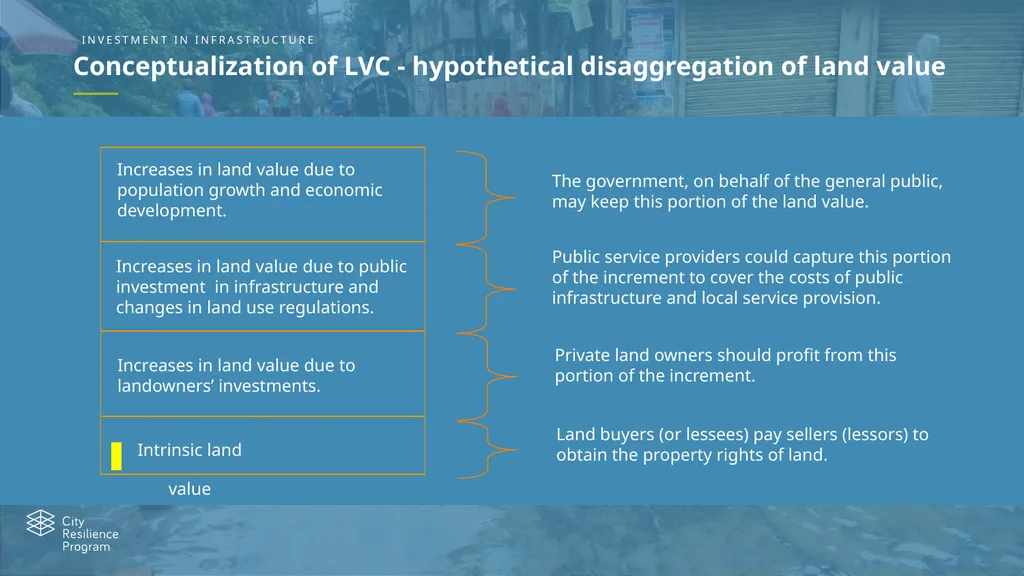
Conceptualization of LVC - hypothetical disaggregation of land value INVESTMENT IN INFRASTRUCTURE Intrinsic land value Land buyers (or lessees) pay sellers (lessors) to obtain the property rights of land. Increases in land value due to landowners’ investments. Private land owners should profit from this portion of the increment. Increases in land value due to public investment in infrastructure and changes in land use regulations. Public service providers could capture this portion of the increment to cover the costs of public infrastructure and local service provision. Increases in land value due to population growth and economic development. The government, on behalf of the general public, may keep this portion of the land value.<br>
10
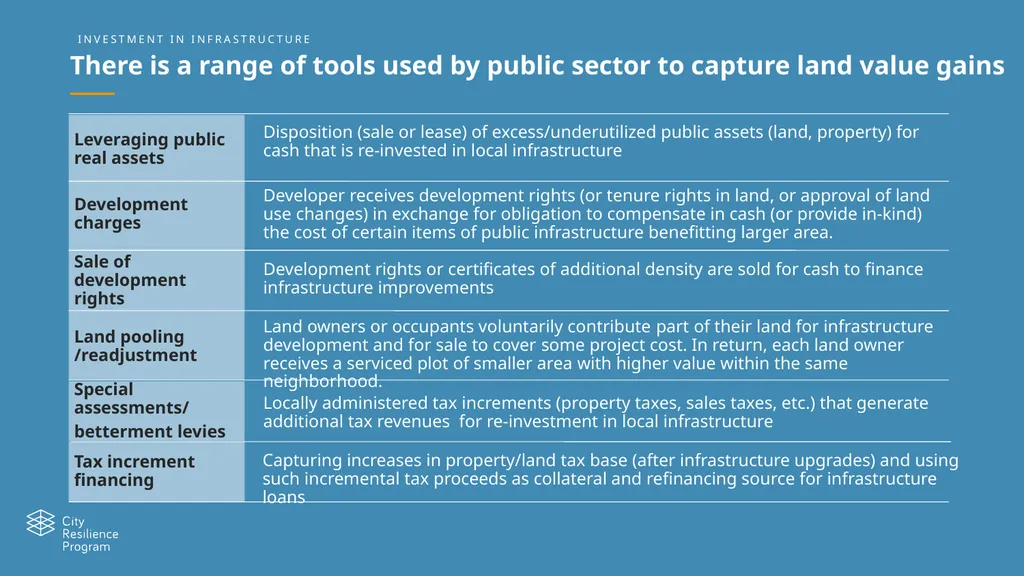
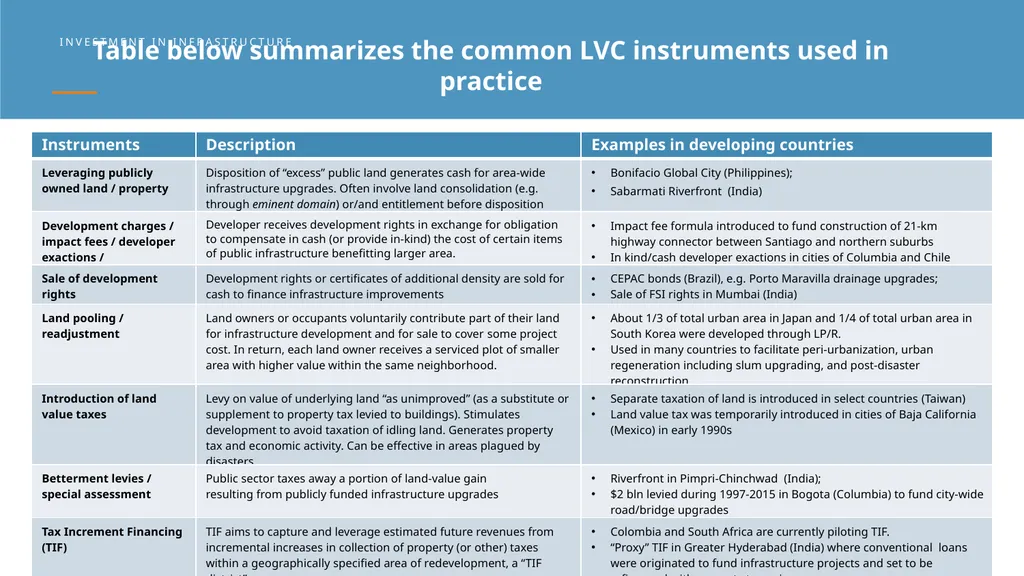
There is a range of tools used by public sector to capture land value gains INVESTMENT IN INFRASTRUCTURE Leveraging public real assets Development charges Sale of development rights Land pooling /readjustment Special assessments/
betterment levies Disposition (sale or lease) of excess/underutilized public assets (land, property) for cash that is re-invested in local infrastructure Developer receives development rights (or tenure rights in land, or approval of land use changes) in exchange for obligation to compensate in cash (or provide in-kind) the cost of certain items of public infrastructure benefitting larger area. Development rights or certificates of additional density are sold for cash to finance infrastructure improvements Land owners or occupants voluntarily contribute part of their land for infrastructure development and for sale to cover some project cost. In return, each land owner receives a serviced plot of smaller area with higher value within the same neighborhood. Locally administered tax increments (property taxes, sales taxes, etc.) that generate additional tax revenues for re-investment in local infrastructure Tax increment financing Capturing increases in property/land tax base (after infrastructure upgrades) and using such incremental tax proceeds as collateral and refinancing source for infrastructure loans<br>
betterment levies Disposition (sale or lease) of excess/underutilized public assets (land, property) for cash that is re-invested in local infrastructure Developer receives development rights (or tenure rights in land, or approval of land use changes) in exchange for obligation to compensate in cash (or provide in-kind) the cost of certain items of public infrastructure benefitting larger area. Development rights or certificates of additional density are sold for cash to finance infrastructure improvements Land owners or occupants voluntarily contribute part of their land for infrastructure development and for sale to cover some project cost. In return, each land owner receives a serviced plot of smaller area with higher value within the same neighborhood. Locally administered tax increments (property taxes, sales taxes, etc.) that generate additional tax revenues for re-investment in local infrastructure Tax increment financing Capturing increases in property/land tax base (after infrastructure upgrades) and using such incremental tax proceeds as collateral and refinancing source for infrastructure loans<br>
11
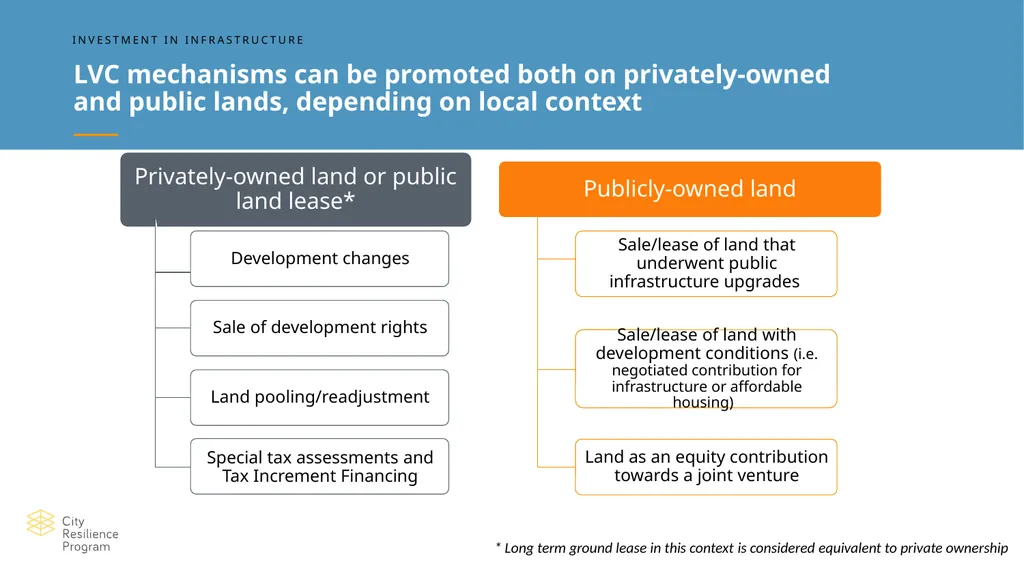
LVC mechanisms can be promoted both on privately-owned and public lands, depending on local context Privately-owned land or public land lease* Development changes Sale of development rights Land pooling/readjustment Special tax assessments and Tax Increment Financing Publicly-owned land Sale/lease of land that underwent public infrastructure upgrades Sale/lease of land with development conditions (i.e. negotiated contribution for infrastructure or affordable housing) Land as an equity contribution towards a joint venture * Long term ground lease in this context is considered equivalent to private ownership INVESTMENT IN INFRASTRUCTURE<br>
12
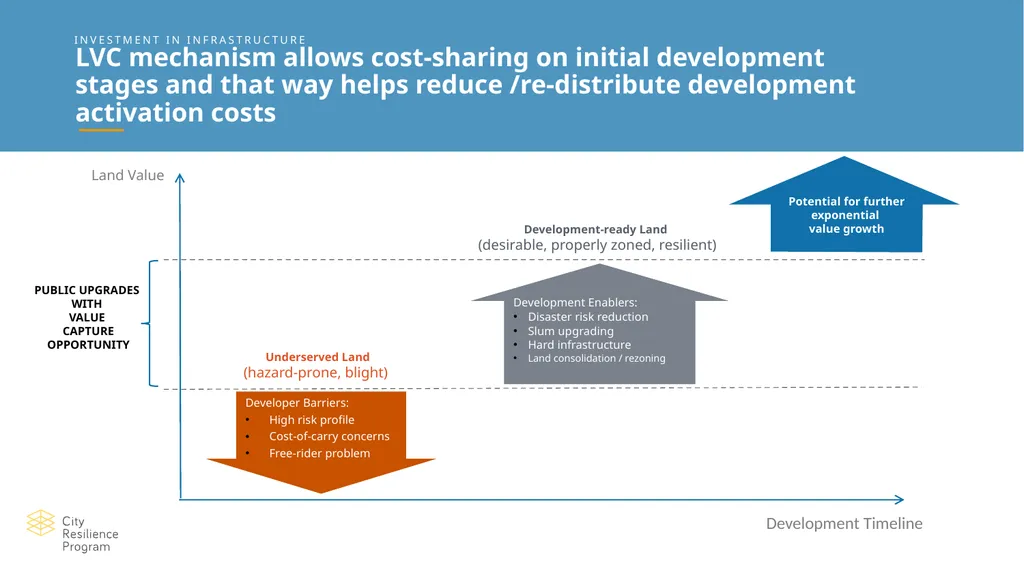
LVC mechanism allows cost-sharing on initial development stages and that way helps reduce /re-distribute development activation costs INVESTMENT IN INFRASTRUCTURE Underserved Land
(hazard-prone, blight) Developer Barriers:
High risk profile
Cost-of-carry concerns
Free-rider problem Development-ready Land
(desirable, properly zoned, resilient) Development Enablers:
Disaster risk reduction
Slum upgrading
Hard infrastructure
Land consolidation / rezoning Development Timeline Land Value PUBLIC UPGRADES
WITH
VALUE
CAPTURE
OPPORTUNITY Potential for further exponential
value growth<br>
(hazard-prone, blight) Developer Barriers:
High risk profile
Cost-of-carry concerns
Free-rider problem Development-ready Land
(desirable, properly zoned, resilient) Development Enablers:
Disaster risk reduction
Slum upgrading
Hard infrastructure
Land consolidation / rezoning Development Timeline Land Value PUBLIC UPGRADES
WITH
VALUE
CAPTURE
OPPORTUNITY Potential for further exponential
value growth<br>
13
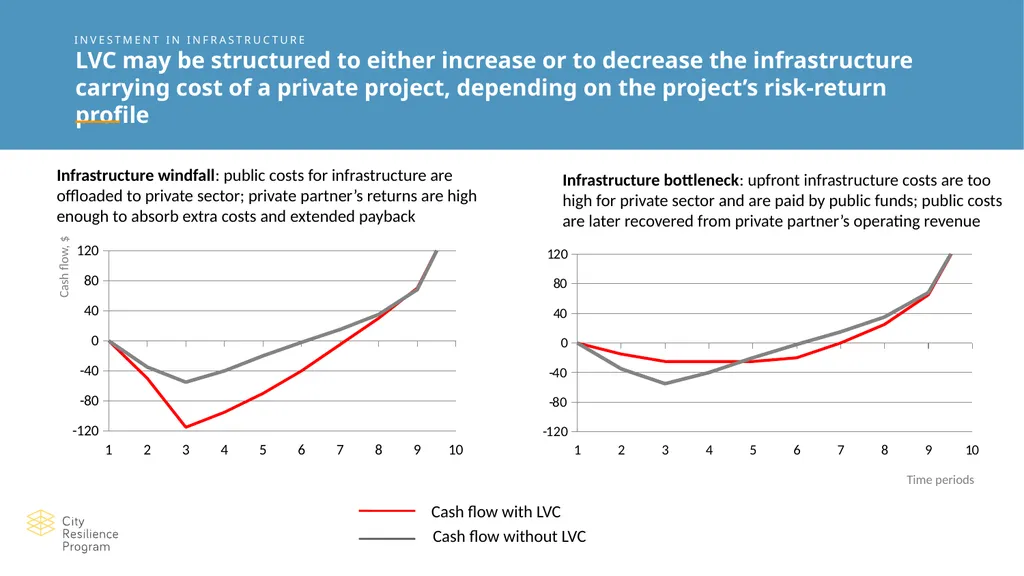
LVC may be structured to either increase or to decrease the infrastructure carrying cost of a private project, depending on the project’s risk-return profile INVESTMENT IN INFRASTRUCTURE Cash flow, $ Time periods Infrastructure windfall: public costs for infrastructure are offloaded to private sector; private partner’s returns are high enough to absorb extra costs and extended payback Infrastructure bottleneck: upfront infrastructure costs are too high for private sector and are paid by public funds; public costs are later recovered from private partner’s operating revenue Cash flow with LVC Cash flow without LVC<br>
14
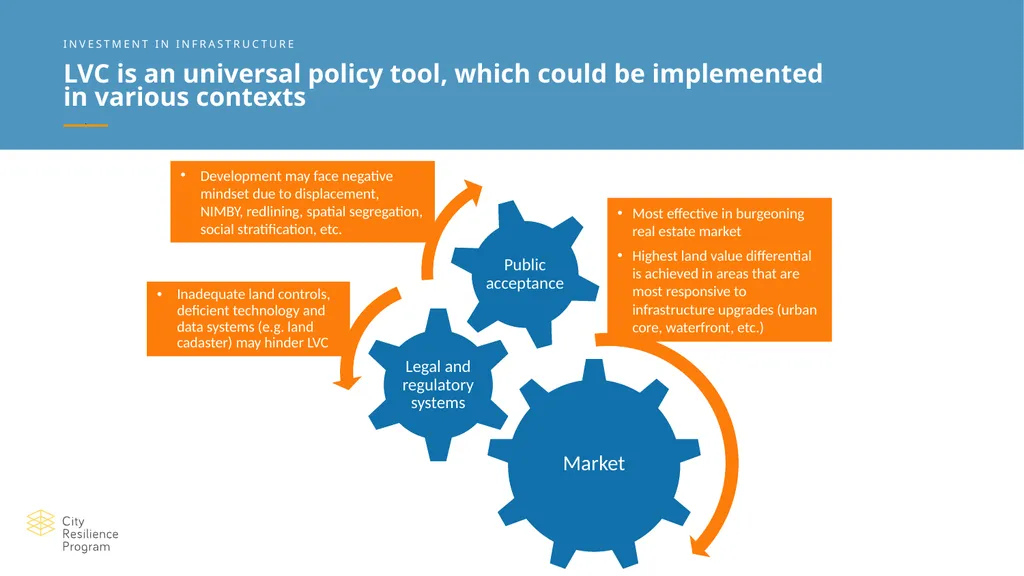
LVC is an universal policy tool, which could be implemented
in various contexts INVESTMENT IN INFRASTRUCTURE ` Most effective in burgeoning real estate market
Highest land value differential is achieved in areas that are most responsive to infrastructure upgrades (urban core, waterfront, etc.) Development may face negative mindset due to displacement, NIMBY, redlining, spatial segregation, social stratification, etc. Inadequate land controls, deficient technology and data systems (e.g. land cadaster) may hinder LVC<br>
Highest land value differential is achieved in areas that are most responsive to infrastructure upgrades (urban core, waterfront, etc.) Development may face negative mindset due to displacement, NIMBY, redlining, spatial segregation, social stratification, etc. Inadequate land controls, deficient technology and data systems (e.g. land cadaster) may hinder LVC<br>
15
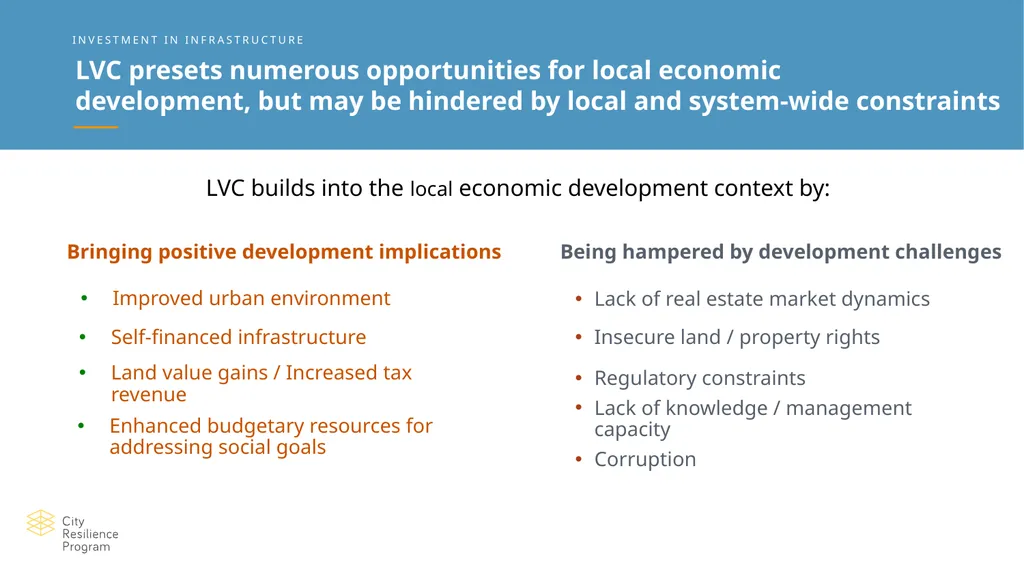
LVC presets numerous opportunities for local economic
development, but may be hindered by local and system-wide constraints INVESTMENT IN INFRASTRUCTURE Enhanced budgetary resources for addressing social goals Land value gains / Increased tax revenue Self-financed infrastructure Improved urban environment Regulatory constraints Insecure land / property rights Lack of real estate market dynamics LVC builds into the local economic development context by: Bringing positive development implications Being hampered by development challenges Lack of knowledge / management capacity Corruption<br>
16
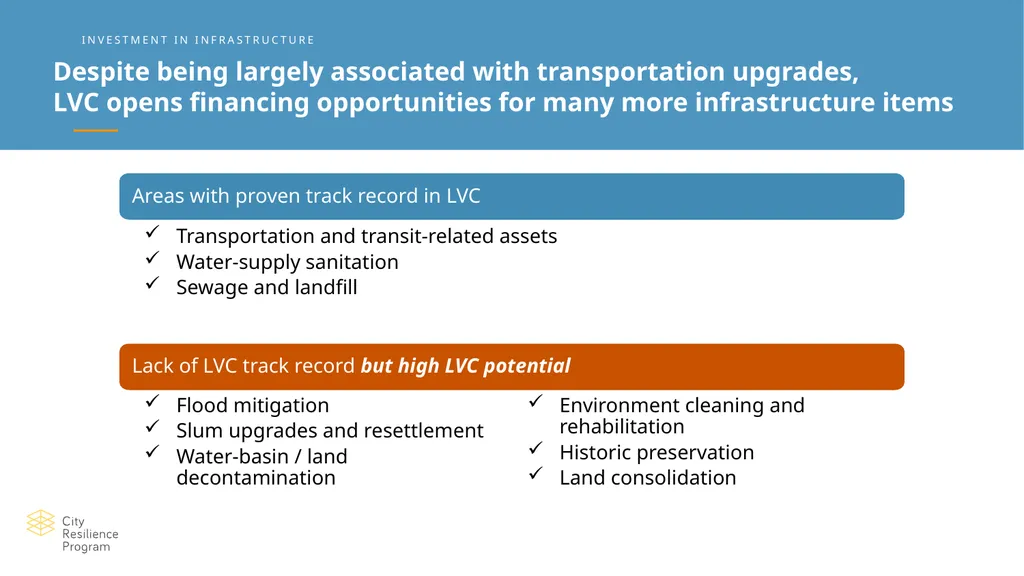
Despite being largely associated with transportation upgrades,
LVC opens financing opportunities for many more infrastructure items INVESTMENT IN INFRASTRUCTURE Areas with proven track record in LVC Transportation and transit-related assets
Water-supply sanitation
Sewage and landfill Lack of LVC track record but high LVC potential Flood mitigation
Slum upgrades and resettlement
Water-basin / land decontamination
Environment cleaning and rehabilitation
Historic preservation
Land consolidation<br>
Water-supply sanitation
Sewage and landfill Lack of LVC track record but high LVC potential Flood mitigation
Slum upgrades and resettlement
Water-basin / land decontamination
Environment cleaning and rehabilitation
Historic preservation
Land consolidation<br>
17
Table below summarizes the common LVC instruments used in practice INVESTMENT IN INFRASTRUCTURE<br>
18
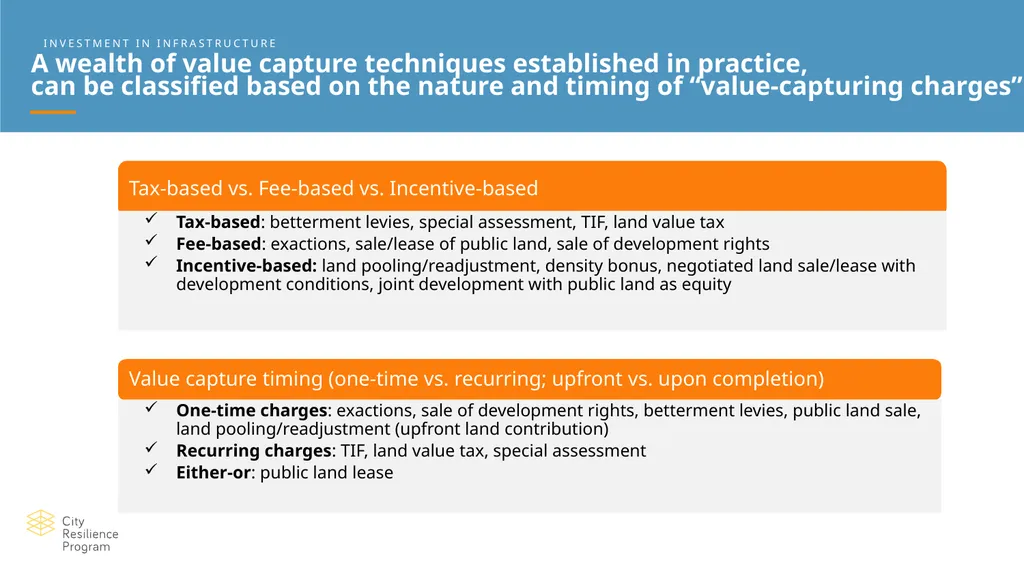
A wealth of value capture techniques established in practice,
can be classified based on the nature and timing of “value-capturing charges” INVESTMENT IN INFRASTRUCTURE Tax-based vs. Fee-based vs. Incentive-based Tax-based: betterment levies, special assessment, TIF, land value tax
Fee-based: exactions, sale/lease of public land, sale of development rights
Incentive-based: land pooling/readjustment, density bonus, negotiated land sale/lease with development conditions, joint development with public land as equity Value capture timing (one-time vs. recurring; upfront vs. upon completion) One-time charges: exactions, sale of development rights, betterment levies, public land sale, land pooling/readjustment (upfront land contribution)
Recurring charges: TIF, land value tax, special assessment
Either-or: public land lease<br>
Fee-based: exactions, sale/lease of public land, sale of development rights
Incentive-based: land pooling/readjustment, density bonus, negotiated land sale/lease with development conditions, joint development with public land as equity Value capture timing (one-time vs. recurring; upfront vs. upon completion) One-time charges: exactions, sale of development rights, betterment levies, public land sale, land pooling/readjustment (upfront land contribution)
Recurring charges: TIF, land value tax, special assessment
Either-or: public land lease<br>
19
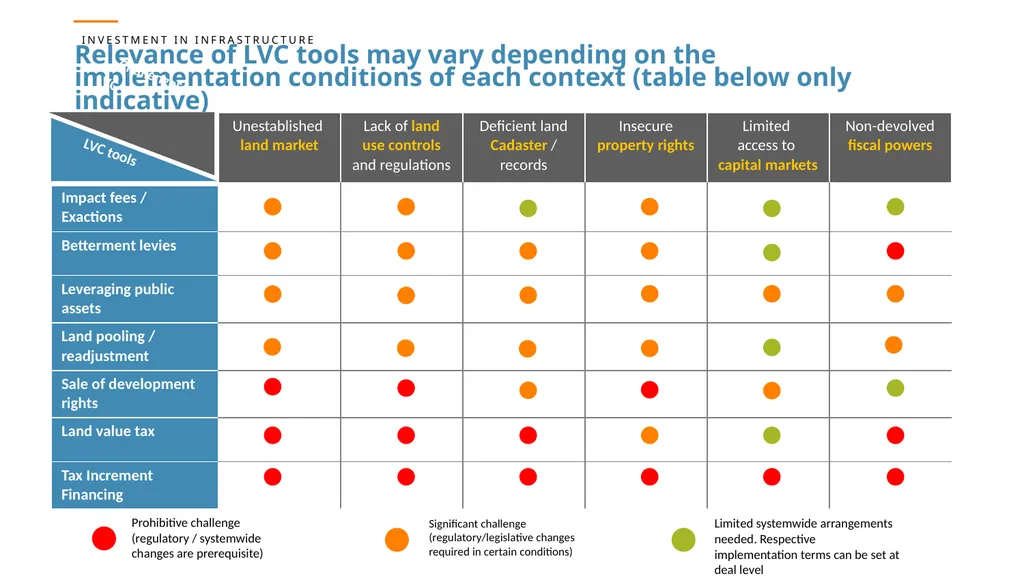
Relevance of LVC tools may vary depending on the implementation conditions of each context (table below only indicative) INVESTMENT IN INFRASTRUCTURE LVC tools LVC
Challenges Prohibitive challenge
(regulatory / systemwide
changes are prerequisite) Significant challenge
(regulatory/legislative changes required in certain conditions) Limited systemwide arrangements needed. Respective implementation terms can be set at deal level<br>
Challenges Prohibitive challenge
(regulatory / systemwide
changes are prerequisite) Significant challenge
(regulatory/legislative changes required in certain conditions) Limited systemwide arrangements needed. Respective implementation terms can be set at deal level<br>
20
APPENDIX SELECTED LAND VALUE CAPTURE INSTRUMENTS Negotiated Exactions
Impact Fees
Leveraging Public Assets
Sale of Development Rights
Land Pooling/Readjustment
Land Value Tax
Betterment Levies
Tax Increment Financing<br>
Impact Fees
Leveraging Public Assets
Sale of Development Rights
Land Pooling/Readjustment
Land Value Tax
Betterment Levies
Tax Increment Financing<br>
21
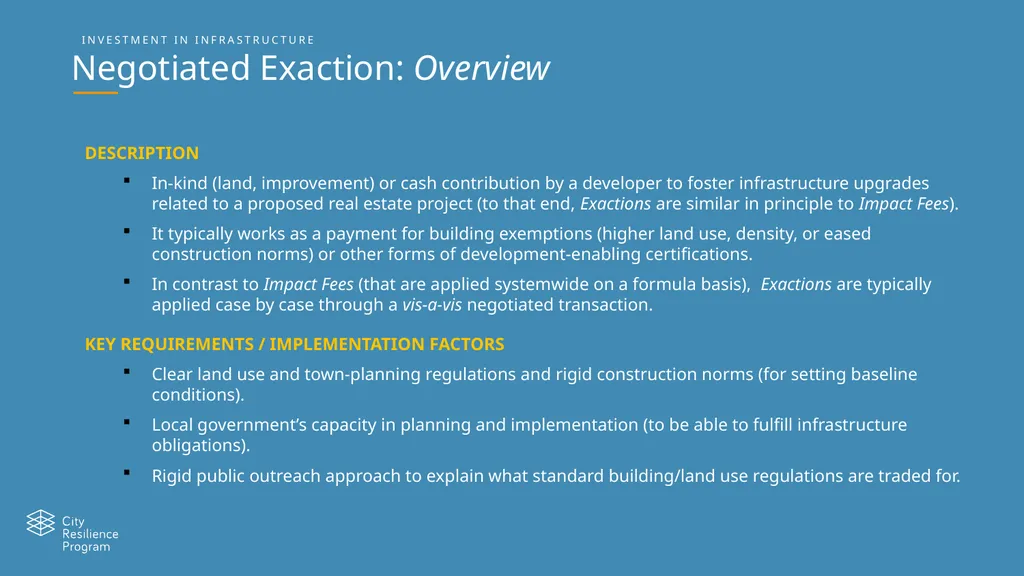
Negotiated Exaction: Overview INVESTMENT IN INFRASTRUCTURE DESCRIPTION
In-kind (land, improvement) or cash contribution by a developer to foster infrastructure upgrades related to a proposed real estate project (to that end, Exactions are similar in principle to Impact Fees).
It typically works as a payment for building exemptions (higher land use, density, or eased construction norms) or other forms of development-enabling certifications.
In contrast to Impact Fees (that are applied systemwide on a formula basis), Exactions are typically applied case by case through a vis-a-vis negotiated transaction.
KEY REQUIREMENTS / IMPLEMENTATION FACTORS
Clear land use and town-planning regulations and rigid construction norms (for setting baseline conditions).
Local government’s capacity in planning and implementation (to be able to fulfill infrastructure obligations).
Rigid public outreach approach to explain what standard building/land use regulations are traded for.<br>
In-kind (land, improvement) or cash contribution by a developer to foster infrastructure upgrades related to a proposed real estate project (to that end, Exactions are similar in principle to Impact Fees).
It typically works as a payment for building exemptions (higher land use, density, or eased construction norms) or other forms of development-enabling certifications.
In contrast to Impact Fees (that are applied systemwide on a formula basis), Exactions are typically applied case by case through a vis-a-vis negotiated transaction.
KEY REQUIREMENTS / IMPLEMENTATION FACTORS
Clear land use and town-planning regulations and rigid construction norms (for setting baseline conditions).
Local government’s capacity in planning and implementation (to be able to fulfill infrastructure obligations).
Rigid public outreach approach to explain what standard building/land use regulations are traded for.<br>
22
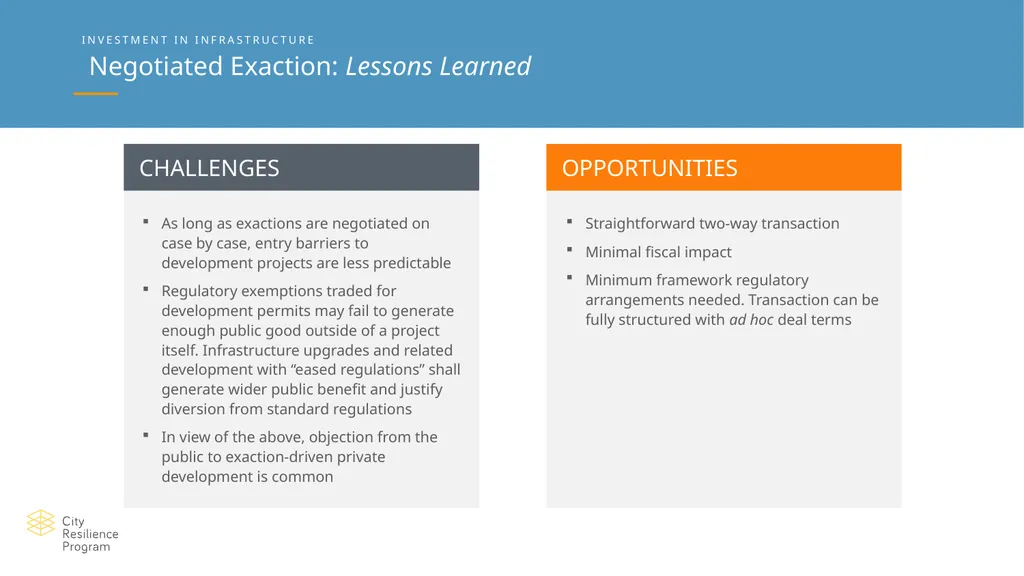
Negotiated Exaction: Lessons Learned INVESTMENT IN INFRASTRUCTURE OPPORTUNITIES CHALLENGES Straightforward two-way transaction
Minimal fiscal impact
Minimum framework regulatory arrangements needed. Transaction can be fully structured with ad hoc deal terms As long as exactions are negotiated on case by case, entry barriers to development projects are less predictable
Regulatory exemptions traded for development permits may fail to generate enough public good outside of a project itself. Infrastructure upgrades and related development with “eased regulations” shall generate wider public benefit and justify diversion from standard regulations
In view of the above, objection from the public to exaction-driven private development is common<br>
Minimal fiscal impact
Minimum framework regulatory arrangements needed. Transaction can be fully structured with ad hoc deal terms As long as exactions are negotiated on case by case, entry barriers to development projects are less predictable
Regulatory exemptions traded for development permits may fail to generate enough public good outside of a project itself. Infrastructure upgrades and related development with “eased regulations” shall generate wider public benefit and justify diversion from standard regulations
In view of the above, objection from the public to exaction-driven private development is common<br>
23
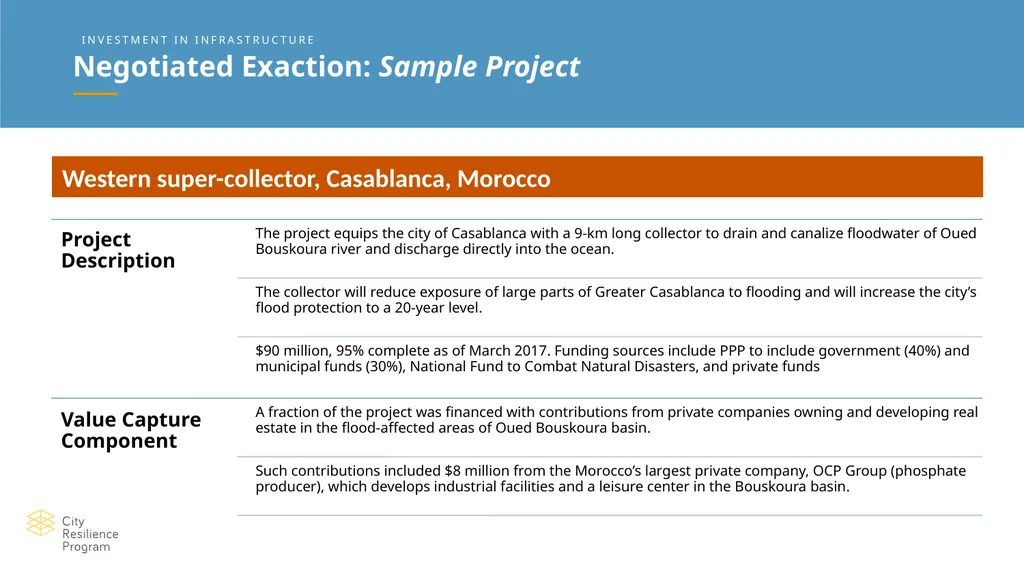
Negotiated Exaction: Sample Project INVESTMENT IN INFRASTRUCTURE Project Description The project equips the city of Casablanca with a 9-km long collector to drain and canalize floodwater of Oued Bouskoura river and discharge directly into the ocean. The collector will reduce exposure of large parts of Greater Casablanca to flooding and will increase the city’s flood protection to a 20-year level. $90 million, 95% complete as of March 2017. Funding sources include PPP to include government (40%) and municipal funds (30%), National Fund to Combat Natural Disasters, and private funds Value Capture Component A fraction of the project was financed with contributions from private companies owning and developing real estate in the flood-affected areas of Oued Bouskoura basin. Such contributions included $8 million from the Morocco’s largest private company, OCP Group (phosphate producer), which develops industrial facilities and a leisure center in the Bouskoura basin. Western super-collector, Casablanca, Morocco<br>
24
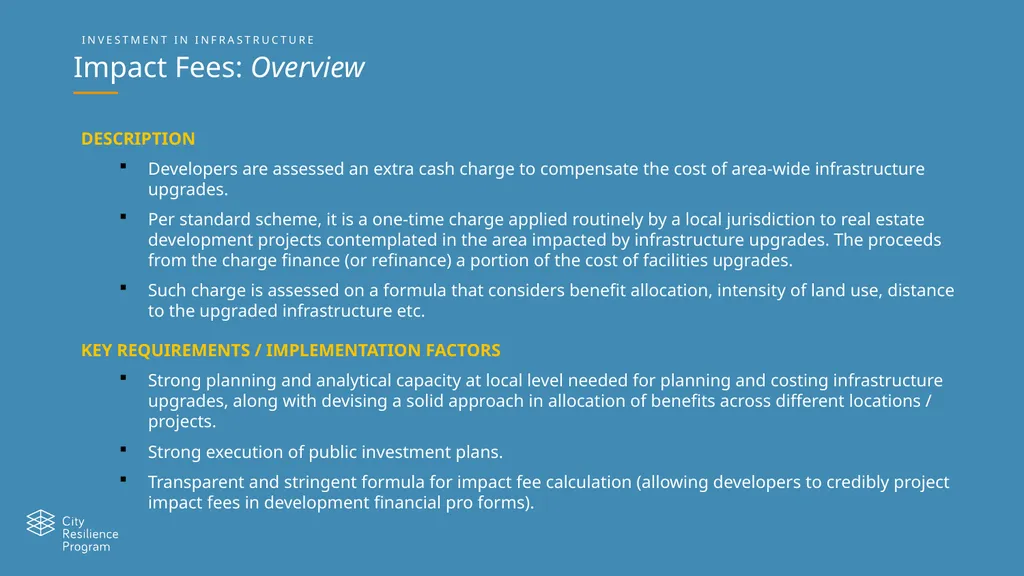
Impact Fees: Overview INVESTMENT IN INFRASTRUCTURE DESCRIPTION
Developers are assessed an extra cash charge to compensate the cost of area-wide infrastructure upgrades.
Per standard scheme, it is a one-time charge applied routinely by a local jurisdiction to real estate development projects contemplated in the area impacted by infrastructure upgrades. The proceeds from the charge finance (or refinance) a portion of the cost of facilities upgrades.
Such charge is assessed on a formula that considers benefit allocation, intensity of land use, distance to the upgraded infrastructure etc.
KEY REQUIREMENTS / IMPLEMENTATION FACTORS
Strong planning and analytical capacity at local level needed for planning and costing infrastructure upgrades, along with devising a solid approach in allocation of benefits across different locations / projects.
Strong execution of public investment plans.
Transparent and stringent formula for impact fee calculation (allowing developers to credibly project impact fees in development financial pro forms).<br>
Developers are assessed an extra cash charge to compensate the cost of area-wide infrastructure upgrades.
Per standard scheme, it is a one-time charge applied routinely by a local jurisdiction to real estate development projects contemplated in the area impacted by infrastructure upgrades. The proceeds from the charge finance (or refinance) a portion of the cost of facilities upgrades.
Such charge is assessed on a formula that considers benefit allocation, intensity of land use, distance to the upgraded infrastructure etc.
KEY REQUIREMENTS / IMPLEMENTATION FACTORS
Strong planning and analytical capacity at local level needed for planning and costing infrastructure upgrades, along with devising a solid approach in allocation of benefits across different locations / projects.
Strong execution of public investment plans.
Transparent and stringent formula for impact fee calculation (allowing developers to credibly project impact fees in development financial pro forms).<br>
25
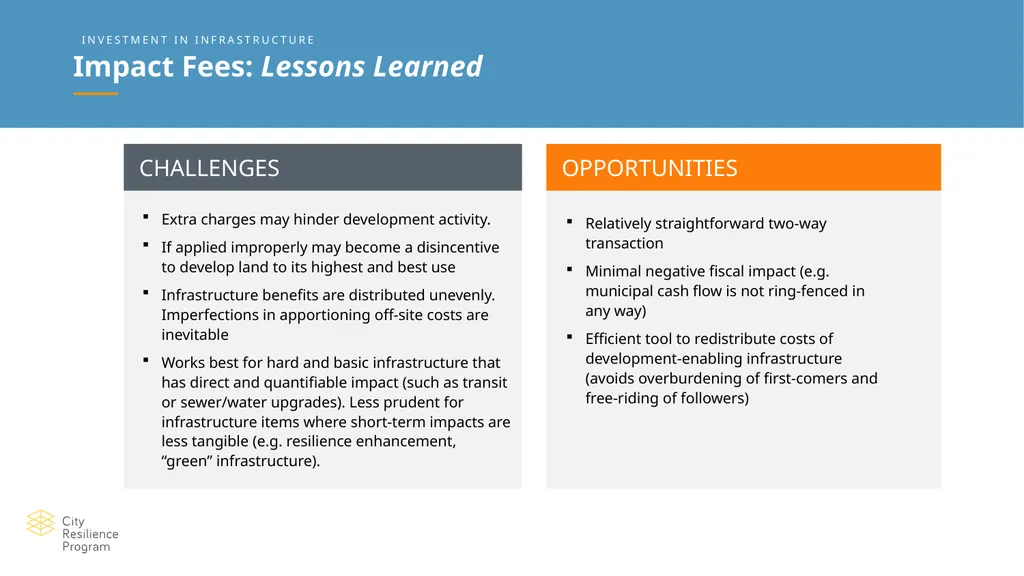
Impact Fees: Lessons Learned INVESTMENT IN INFRASTRUCTURE OPPORTUNITIES CHALLENGES Relatively straightforward two-way transaction
Minimal negative fiscal impact (e.g. municipal cash flow is not ring-fenced in any way)
Efficient tool to redistribute costs of development-enabling infrastructure (avoids overburdening of first-comers and free-riding of followers) Extra charges may hinder development activity.
If applied improperly may become a disincentive to develop land to its highest and best use
Infrastructure benefits are distributed unevenly. Imperfections in apportioning off-site costs are inevitable
Works best for hard and basic infrastructure that has direct and quantifiable impact (such as transit or sewer/water upgrades). Less prudent for infrastructure items where short-term impacts are less tangible (e.g. resilience enhancement, “green” infrastructure).<br>
Minimal negative fiscal impact (e.g. municipal cash flow is not ring-fenced in any way)
Efficient tool to redistribute costs of development-enabling infrastructure (avoids overburdening of first-comers and free-riding of followers) Extra charges may hinder development activity.
If applied improperly may become a disincentive to develop land to its highest and best use
Infrastructure benefits are distributed unevenly. Imperfections in apportioning off-site costs are inevitable
Works best for hard and basic infrastructure that has direct and quantifiable impact (such as transit or sewer/water upgrades). Less prudent for infrastructure items where short-term impacts are less tangible (e.g. resilience enhancement, “green” infrastructure).<br>
26
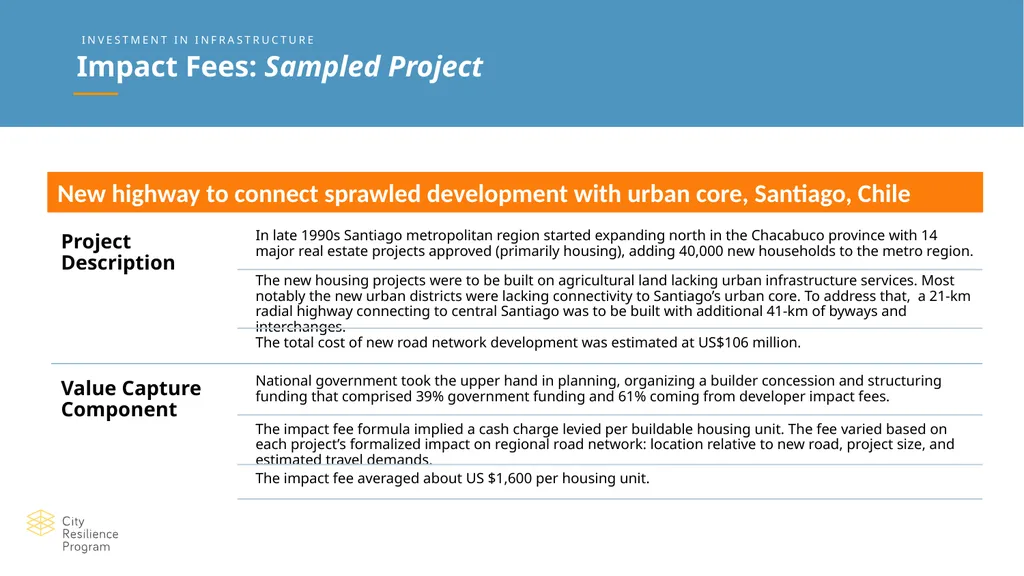
Impact Fees: Sampled Project INVESTMENT IN INFRASTRUCTURE Project Description In late 1990s Santiago metropolitan region started expanding north in the Chacabuco province with 14 major real estate projects approved (primarily housing), adding 40,000 new households to the metro region. The new housing projects were to be built on agricultural land lacking urban infrastructure services. Most notably the new urban districts were lacking connectivity to Santiago’s urban core. To address that, a 21-km radial highway connecting to central Santiago was to be built with additional 41-km of byways and interchanges. The total cost of new road network development was estimated at US$106 million. Value Capture Component National government took the upper hand in planning, organizing a builder concession and structuring funding that comprised 39% government funding and 61% coming from developer impact fees. The impact fee formula implied a cash charge levied per buildable housing unit. The fee varied based on each project’s formalized impact on regional road network: location relative to new road, project size, and estimated travel demands. The impact fee averaged about US $1,600 per housing unit. New highway to connect sprawled development with urban core, Santiago, Chile<br>
27
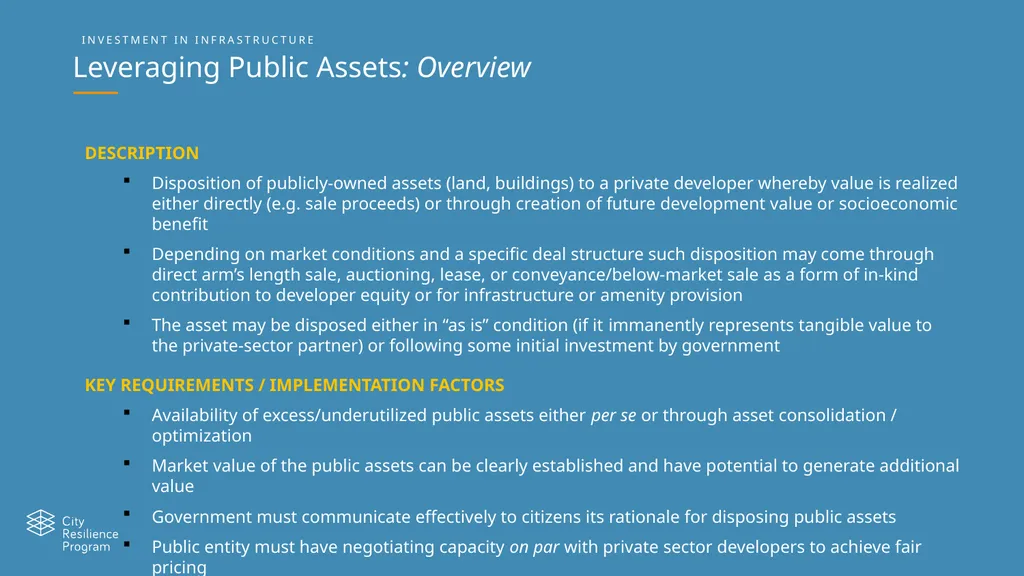
Leveraging Public Assets: Overview INVESTMENT IN INFRASTRUCTURE DESCRIPTION
Disposition of publicly-owned assets (land, buildings) to a private developer whereby value is realized either directly (e.g. sale proceeds) or through creation of future development value or socioeconomic benefit
Depending on market conditions and a specific deal structure such disposition may come through direct arm’s length sale, auctioning, lease, or conveyance/below-market sale as a form of in-kind contribution to developer equity or for infrastructure or amenity provision
The asset may be disposed either in “as is” condition (if it immanently represents tangible value to the private-sector partner) or following some initial investment by government
KEY REQUIREMENTS / IMPLEMENTATION FACTORS
Availability of excess/underutilized public assets either per se or through asset consolidation / optimization
Market value of the public assets can be clearly established and have potential to generate additional value
Government must communicate effectively to citizens its rationale for disposing public assets
Public entity must have negotiating capacity on par with private sector developers to achieve fair pricing<br>
Disposition of publicly-owned assets (land, buildings) to a private developer whereby value is realized either directly (e.g. sale proceeds) or through creation of future development value or socioeconomic benefit
Depending on market conditions and a specific deal structure such disposition may come through direct arm’s length sale, auctioning, lease, or conveyance/below-market sale as a form of in-kind contribution to developer equity or for infrastructure or amenity provision
The asset may be disposed either in “as is” condition (if it immanently represents tangible value to the private-sector partner) or following some initial investment by government
KEY REQUIREMENTS / IMPLEMENTATION FACTORS
Availability of excess/underutilized public assets either per se or through asset consolidation / optimization
Market value of the public assets can be clearly established and have potential to generate additional value
Government must communicate effectively to citizens its rationale for disposing public assets
Public entity must have negotiating capacity on par with private sector developers to achieve fair pricing<br>
28
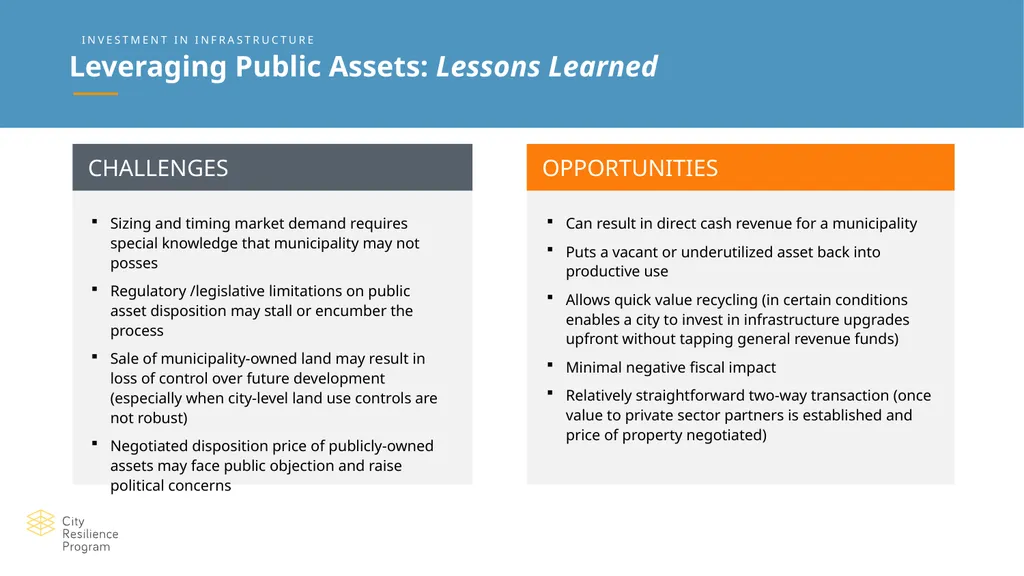
OPPORTUNITIES CHALLENGES Can result in direct cash revenue for a municipality
Puts a vacant or underutilized asset back into productive use
Allows quick value recycling (in certain conditions enables a city to invest in infrastructure upgrades upfront without tapping general revenue funds)
Minimal negative fiscal impact
Relatively straightforward two-way transaction (once value to private sector partners is established and price of property negotiated) Sizing and timing market demand requires special knowledge that municipality may not posses
Regulatory /legislative limitations on public asset disposition may stall or encumber the process
Sale of municipality-owned land may result in loss of control over future development (especially when city-level land use controls are not robust)
Negotiated disposition price of publicly-owned assets may face public objection and raise political concerns Leveraging Public Assets: Lessons Learned INVESTMENT IN INFRASTRUCTURE<br>
Puts a vacant or underutilized asset back into productive use
Allows quick value recycling (in certain conditions enables a city to invest in infrastructure upgrades upfront without tapping general revenue funds)
Minimal negative fiscal impact
Relatively straightforward two-way transaction (once value to private sector partners is established and price of property negotiated) Sizing and timing market demand requires special knowledge that municipality may not posses
Regulatory /legislative limitations on public asset disposition may stall or encumber the process
Sale of municipality-owned land may result in loss of control over future development (especially when city-level land use controls are not robust)
Negotiated disposition price of publicly-owned assets may face public objection and raise political concerns Leveraging Public Assets: Lessons Learned INVESTMENT IN INFRASTRUCTURE<br>
29
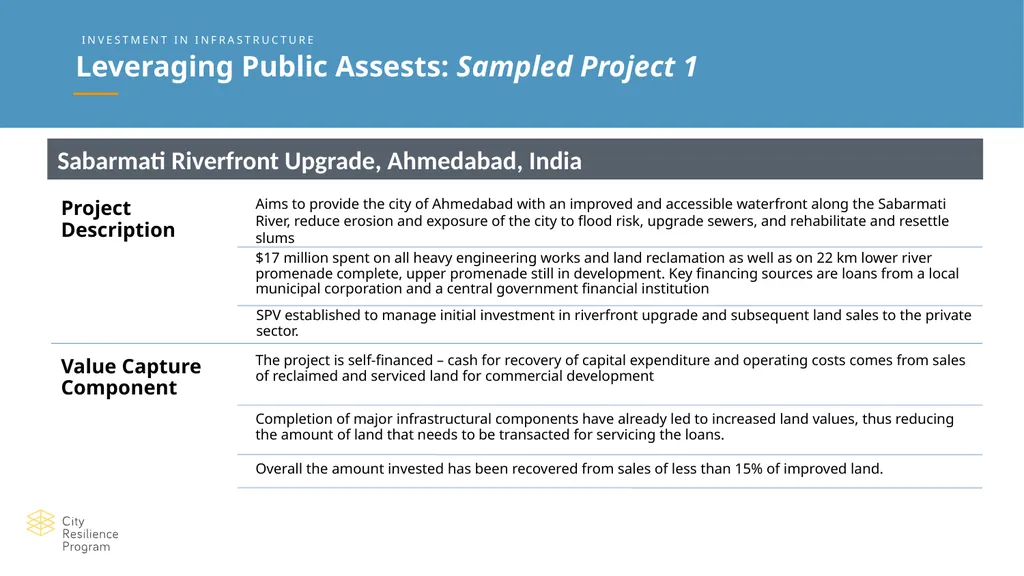
Project Description Aims to provide the city of Ahmedabad with an improved and accessible waterfront along the Sabarmati River, reduce erosion and exposure of the city to flood risk, upgrade sewers, and rehabilitate and resettle slums $17 million spent on all heavy engineering works and land reclamation as well as on 22 km lower river promenade complete, upper promenade still in development. Key financing sources are loans from a local municipal corporation and a central government financial institution Value Capture Component The project is self-financed – cash for recovery of capital expenditure and operating costs comes from sales of reclaimed and serviced land for commercial development Completion of major infrastructural components have already led to increased land values, thus reducing the amount of land that needs to be transacted for servicing the loans. Overall the amount invested has been recovered from sales of less than 15% of improved land. Sabarmati Riverfront Upgrade, Ahmedabad, India SPV established to manage initial investment in riverfront upgrade and subsequent land sales to the private sector. Leveraging Public Assests: Sampled Project 1 INVESTMENT IN INFRASTRUCTURE<br>
30
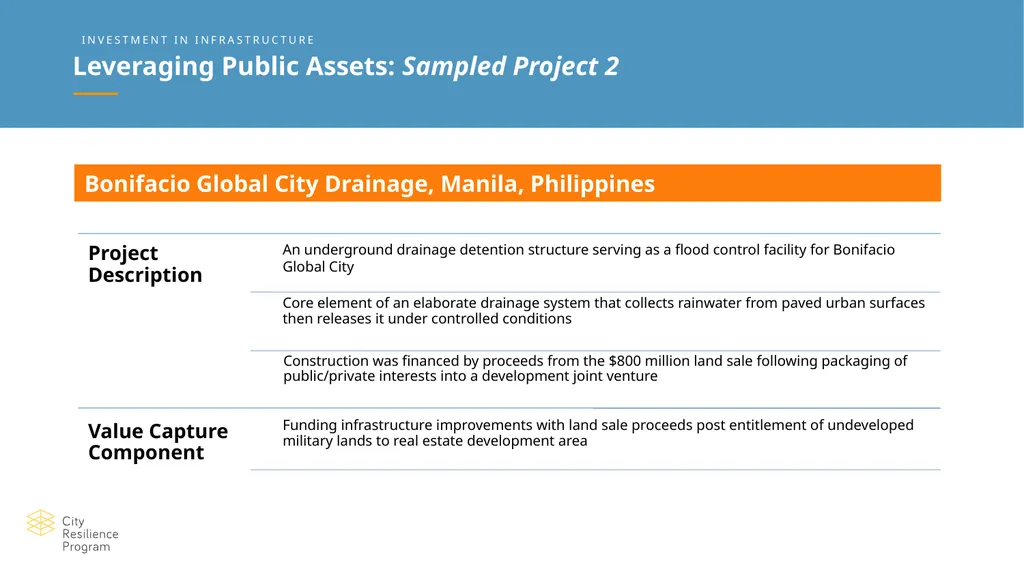
Leveraging Public Assets: Sampled Project 2 INVESTMENT IN INFRASTRUCTURE Project Description An underground drainage detention structure serving as a flood control facility for Bonifacio Global City Core element of an elaborate drainage system that collects rainwater from paved urban surfaces then releases it under controlled conditions Value Capture Component Funding infrastructure improvements with land sale proceeds post entitlement of undeveloped military lands to real estate development area Construction was financed by proceeds from the $800 million land sale following packaging of public/private interests into a development joint venture<br>
31
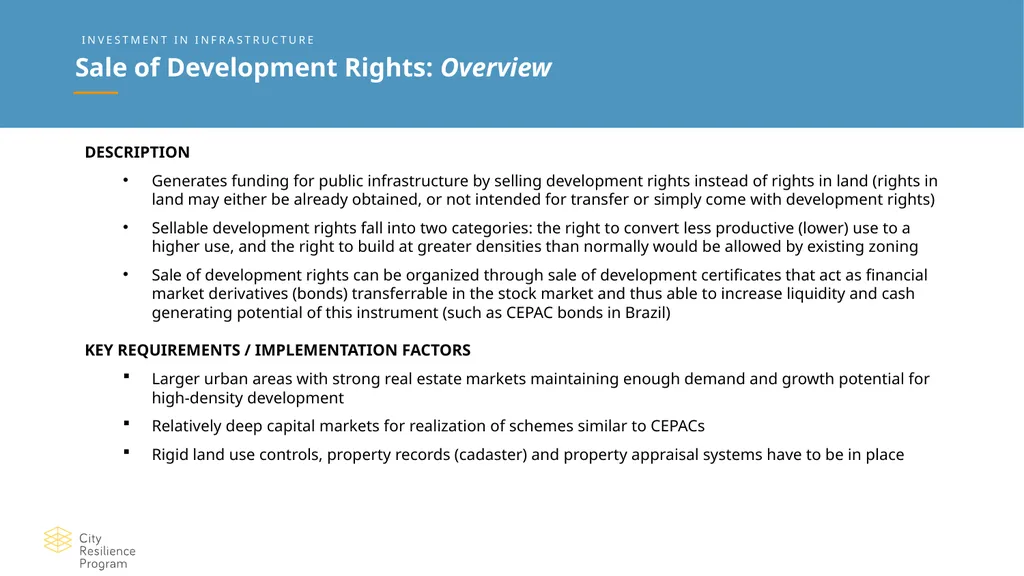
Sale of Development Rights: Overview INVESTMENT IN INFRASTRUCTURE DESCRIPTION
Generates funding for public infrastructure by selling development rights instead of rights in land (rights in land may either be already obtained, or not intended for transfer or simply come with development rights)
Sellable development rights fall into two categories: the right to convert less productive (lower) use to a higher use, and the right to build at greater densities than normally would be allowed by existing zoning
Sale of development rights can be organized through sale of development certificates that act as financial market derivatives (bonds) transferrable in the stock market and thus able to increase liquidity and cash generating potential of this instrument (such as CEPAC bonds in Brazil)
KEY REQUIREMENTS / IMPLEMENTATION FACTORS
Larger urban areas with strong real estate markets maintaining enough demand and growth potential for high-density development
Relatively deep capital markets for realization of schemes similar to CEPACs
Rigid land use controls, property records (cadaster) and property appraisal systems have to be in place<br>
Generates funding for public infrastructure by selling development rights instead of rights in land (rights in land may either be already obtained, or not intended for transfer or simply come with development rights)
Sellable development rights fall into two categories: the right to convert less productive (lower) use to a higher use, and the right to build at greater densities than normally would be allowed by existing zoning
Sale of development rights can be organized through sale of development certificates that act as financial market derivatives (bonds) transferrable in the stock market and thus able to increase liquidity and cash generating potential of this instrument (such as CEPAC bonds in Brazil)
KEY REQUIREMENTS / IMPLEMENTATION FACTORS
Larger urban areas with strong real estate markets maintaining enough demand and growth potential for high-density development
Relatively deep capital markets for realization of schemes similar to CEPACs
Rigid land use controls, property records (cadaster) and property appraisal systems have to be in place<br>
32
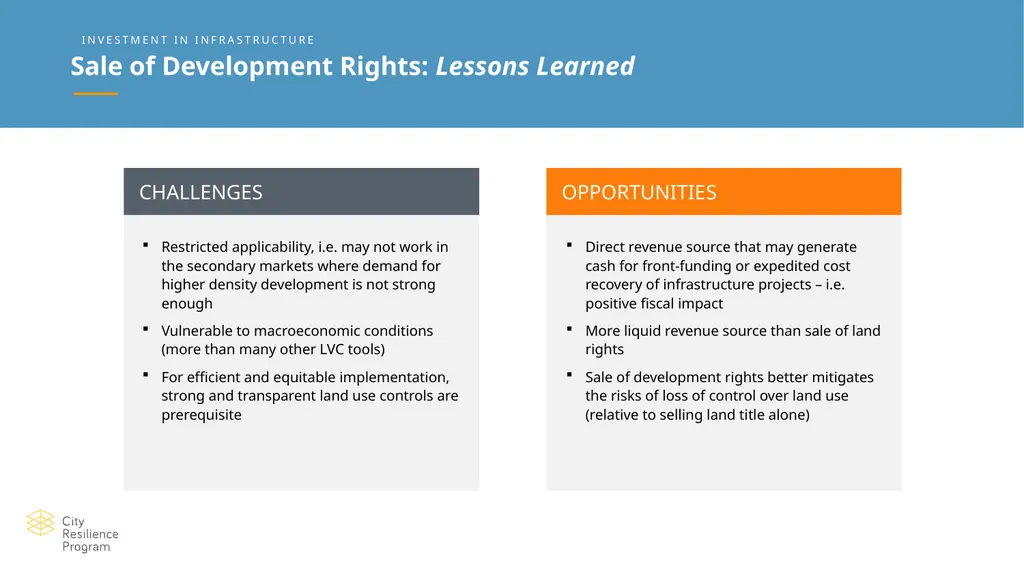
Sale of Development Rights: Lessons Learned INVESTMENT IN INFRASTRUCTURE OPPORTUNITIES CHALLENGES Direct revenue source that may generate cash for front-funding or expedited cost recovery of infrastructure projects – i.e. positive fiscal impact
More liquid revenue source than sale of land rights
Sale of development rights better mitigates the risks of loss of control over land use (relative to selling land title alone) Restricted applicability, i.e. may not work in the secondary markets where demand for higher density development is not strong enough
Vulnerable to macroeconomic conditions (more than many other LVC tools)
For efficient and equitable implementation, strong and transparent land use controls are prerequisite<br>
More liquid revenue source than sale of land rights
Sale of development rights better mitigates the risks of loss of control over land use (relative to selling land title alone) Restricted applicability, i.e. may not work in the secondary markets where demand for higher density development is not strong enough
Vulnerable to macroeconomic conditions (more than many other LVC tools)
For efficient and equitable implementation, strong and transparent land use controls are prerequisite<br>
33
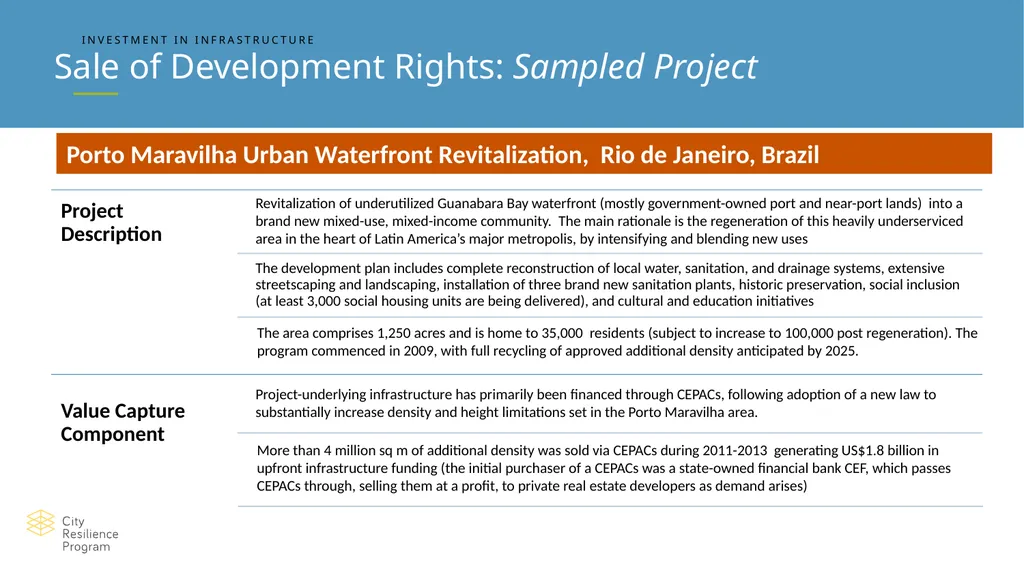
Sale of Development Rights: Sampled Project INVESTMENT IN INFRASTRUCTURE Project Description Revitalization of underutilized Guanabara Bay waterfront (mostly government-owned port and near-port lands) into a brand new mixed-use, mixed-income community. The main rationale is the regeneration of this heavily underserviced area in the heart of Latin America’s major metropolis, by intensifying and blending new uses The development plan includes complete reconstruction of local water, sanitation, and drainage systems, extensive streetscaping and landscaping, installation of three brand new sanitation plants, historic preservation, social inclusion (at least 3,000 social housing units are being delivered), and cultural and education initiatives Value Capture Component Project-underlying infrastructure has primarily been financed through CEPACs, following adoption of a new law to substantially increase density and height limitations set in the Porto Maravilha area. Porto Maravilha Urban Waterfront Revitalization, Rio de Janeiro, Brazil More than 4 million sq m of additional density was sold via CEPACs during 2011-2013 generating US$1.8 billion in upfront infrastructure funding (the initial purchaser of a CEPACs was a state-owned financial bank CEF, which passes CEPACs through, selling them at a profit, to private real estate developers as demand arises) The area comprises 1,250 acres and is home to 35,000 residents (subject to increase to 100,000 post regeneration). The program commenced in 2009, with full recycling of approved additional density anticipated by 2025.<br>
34
Land Pooling / Land Readjustment: Overview INVESTMENT IN INFRASTRUCTURE DESCRIPTION
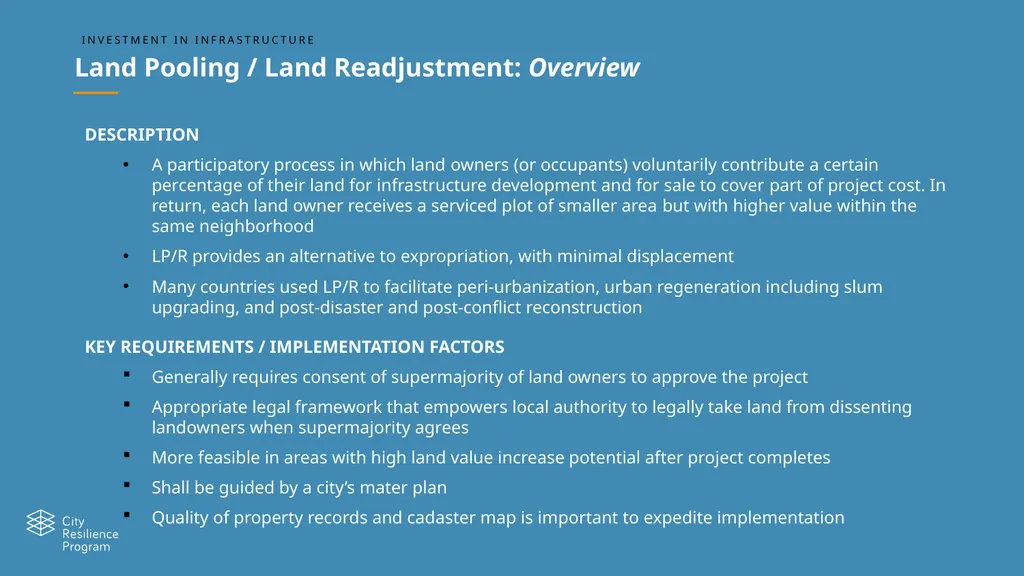
A participatory process in which land owners (or occupants) voluntarily contribute a certain percentage of their land for infrastructure development and for sale to cover part of project cost. In return, each land owner receives a serviced plot of smaller area but with higher value within the same neighborhood
LP/R provides an alternative to expropriation, with minimal displacement
Many countries used LP/R to facilitate peri-urbanization, urban regeneration including slum upgrading, and post-disaster and post-conflict reconstruction
KEY REQUIREMENTS / IMPLEMENTATION FACTORS
Generally requires consent of supermajority of land owners to approve the project
Appropriate legal framework that empowers local authority to legally take land from dissenting landowners when supermajority agrees
More feasible in areas with high land value increase potential after project completes
Shall be guided by a city’s mater plan
Quality of property records and cadaster map is important to expedite implementation<br>
A participatory process in which land owners (or occupants) voluntarily contribute a certain percentage of their land for infrastructure development and for sale to cover part of project cost. In return, each land owner receives a serviced plot of smaller area but with higher value within the same neighborhood
LP/R provides an alternative to expropriation, with minimal displacement
Many countries used LP/R to facilitate peri-urbanization, urban regeneration including slum upgrading, and post-disaster and post-conflict reconstruction
KEY REQUIREMENTS / IMPLEMENTATION FACTORS
Generally requires consent of supermajority of land owners to approve the project
Appropriate legal framework that empowers local authority to legally take land from dissenting landowners when supermajority agrees
More feasible in areas with high land value increase potential after project completes
Shall be guided by a city’s mater plan
Quality of property records and cadaster map is important to expedite implementation<br>
35
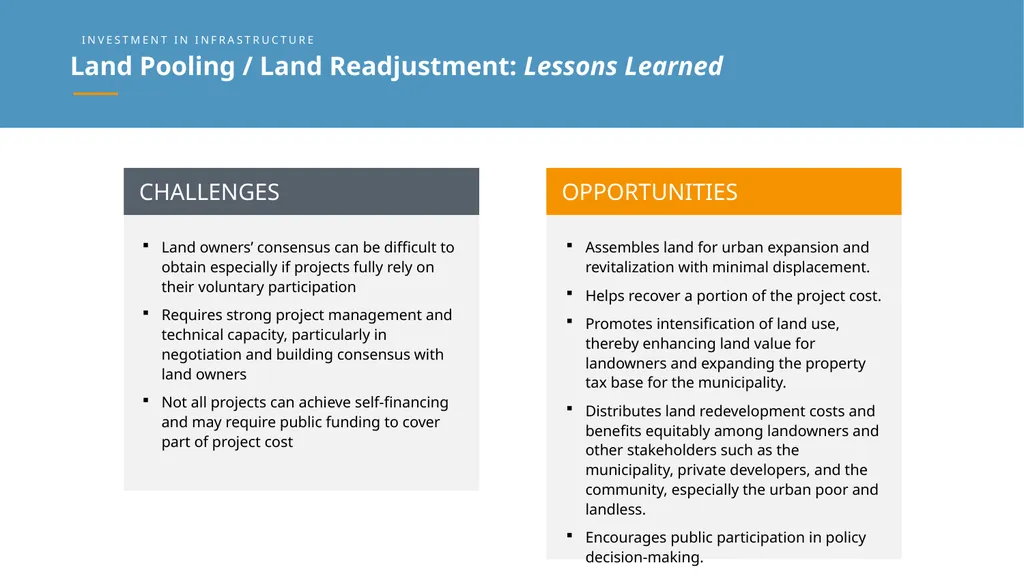
Land Pooling / Land Readjustment: Lessons Learned INVESTMENT IN INFRASTRUCTURE OPPORTUNITIES CHALLENGES Assembles land for urban expansion and revitalization with minimal displacement.
Helps recover a portion of the project cost.
Promotes intensification of land use, thereby enhancing land value for landowners and expanding the property tax base for the municipality.
Distributes land redevelopment costs and benefits equitably among landowners and other stakeholders such as the municipality, private developers, and the community, especially the urban poor and landless.
Encourages public participation in policy decision-making. Land owners’ consensus can be difficult to obtain especially if projects fully rely on their voluntary participation
Requires strong project management and technical capacity, particularly in negotiation and building consensus with land owners
Not all projects can achieve self-financing and may require public funding to cover part of project cost<br>
Helps recover a portion of the project cost.
Promotes intensification of land use, thereby enhancing land value for landowners and expanding the property tax base for the municipality.
Distributes land redevelopment costs and benefits equitably among landowners and other stakeholders such as the municipality, private developers, and the community, especially the urban poor and landless.
Encourages public participation in policy decision-making. Land owners’ consensus can be difficult to obtain especially if projects fully rely on their voluntary participation
Requires strong project management and technical capacity, particularly in negotiation and building consensus with land owners
Not all projects can achieve self-financing and may require public funding to cover part of project cost<br>
36
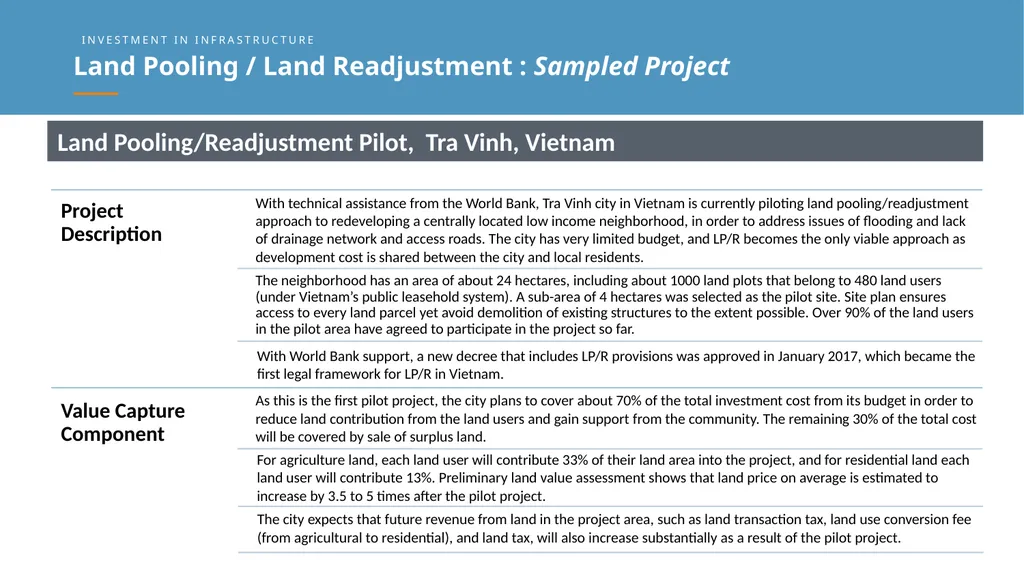
Land Pooling / Land Readjustment : Sampled Project INVESTMENT IN INFRASTRUCTURE Project Description With technical assistance from the World Bank, Tra Vinh city in Vietnam is currently piloting land pooling/readjustment approach to redeveloping a centrally located low income neighborhood, in order to address issues of flooding and lack of drainage network and access roads. The city has very limited budget, and LP/R becomes the only viable approach as development cost is shared between the city and local residents. The neighborhood has an area of about 24 hectares, including about 1000 land plots that belong to 480 land users (under Vietnam’s public leasehold system). A sub-area of 4 hectares was selected as the pilot site. Site plan ensures access to every land parcel yet avoid demolition of existing structures to the extent possible. Over 90% of the land users in the pilot area have agreed to participate in the project so far. Value Capture Component As this is the first pilot project, the city plans to cover about 70% of the total investment cost from its budget in order to reduce land contribution from the land users and gain support from the community. The remaining 30% of the total cost will be covered by sale of surplus land. Land Pooling/Readjustment Pilot, Tra Vinh, Vietnam For agriculture land, each land user will contribute 33% of their land area into the project, and for residential land each land user will contribute 13%. Preliminary land value assessment shows that land price on average is estimated to increase by 3.5 to 5 times after the pilot project. With World Bank support, a new decree that includes LP/R provisions was approved in January 2017, which became the first legal framework for LP/R in Vietnam. The city expects that future revenue from land in the project area, such as land transaction tax, land use conversion fee (from agricultural to residential), and land tax, will also increase substantially as a result of the pilot project.<br>
37
Land Value Tax: Overview INVESTMENT IN INFRASTRUCTURE DESCRIPTION
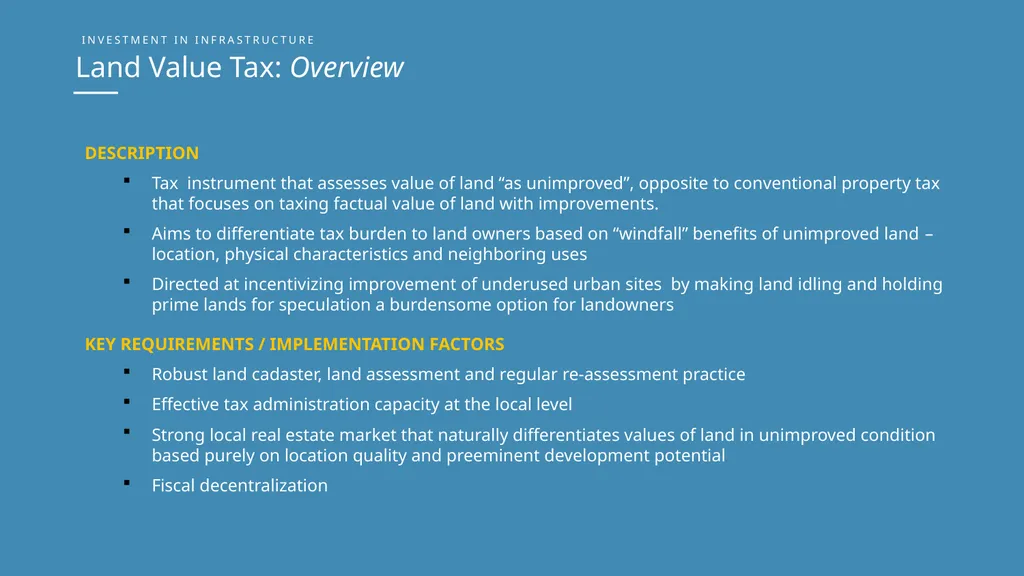
Tax instrument that assesses value of land “as unimproved”, opposite to conventional property tax that focuses on taxing factual value of land with improvements.
Aims to differentiate tax burden to land owners based on “windfall” benefits of unimproved land – location, physical characteristics and neighboring uses
Directed at incentivizing improvement of underused urban sites by making land idling and holding prime lands for speculation a burdensome option for landowners
KEY REQUIREMENTS / IMPLEMENTATION FACTORS
Robust land cadaster, land assessment and regular re-assessment practice
Effective tax administration capacity at the local level
Strong local real estate market that naturally differentiates values of land in unimproved condition based purely on location quality and preeminent development potential
Fiscal decentralization<br>
Tax instrument that assesses value of land “as unimproved”, opposite to conventional property tax that focuses on taxing factual value of land with improvements.
Aims to differentiate tax burden to land owners based on “windfall” benefits of unimproved land – location, physical characteristics and neighboring uses
Directed at incentivizing improvement of underused urban sites by making land idling and holding prime lands for speculation a burdensome option for landowners
KEY REQUIREMENTS / IMPLEMENTATION FACTORS
Robust land cadaster, land assessment and regular re-assessment practice
Effective tax administration capacity at the local level
Strong local real estate market that naturally differentiates values of land in unimproved condition based purely on location quality and preeminent development potential
Fiscal decentralization<br>
38
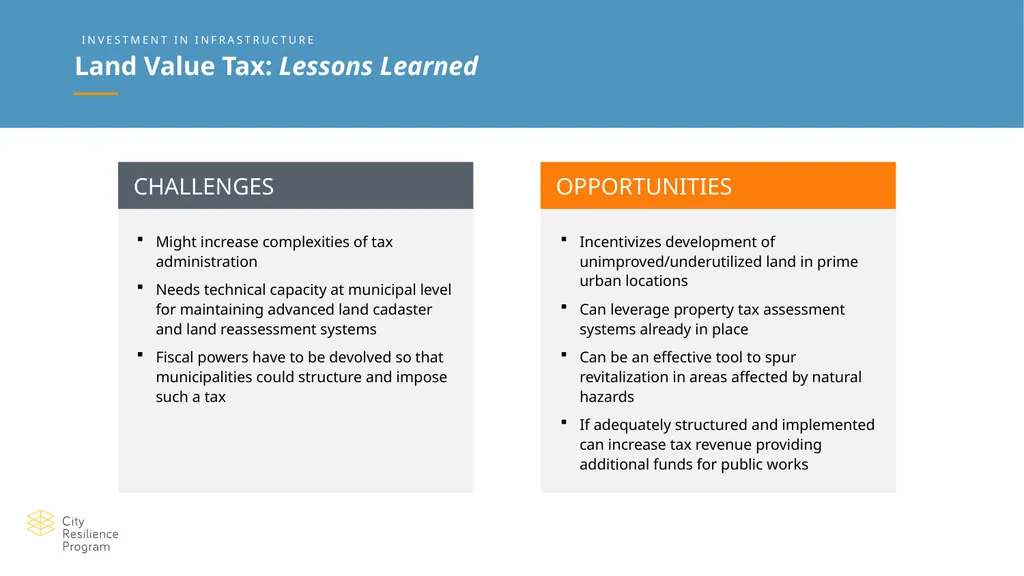
Land Value Tax: Lessons Learned INVESTMENT IN INFRASTRUCTURE OPPORTUNITIES CHALLENGES Incentivizes development of unimproved/underutilized land in prime urban locations
Can leverage property tax assessment systems already in place
Can be an effective tool to spur revitalization in areas affected by natural hazards
If adequately structured and implemented can increase tax revenue providing additional funds for public works Might increase complexities of tax administration
Needs technical capacity at municipal level for maintaining advanced land cadaster and land reassessment systems
Fiscal powers have to be devolved so that municipalities could structure and impose such a tax<br>
Can leverage property tax assessment systems already in place
Can be an effective tool to spur revitalization in areas affected by natural hazards
If adequately structured and implemented can increase tax revenue providing additional funds for public works Might increase complexities of tax administration
Needs technical capacity at municipal level for maintaining advanced land cadaster and land reassessment systems
Fiscal powers have to be devolved so that municipalities could structure and impose such a tax<br>
39
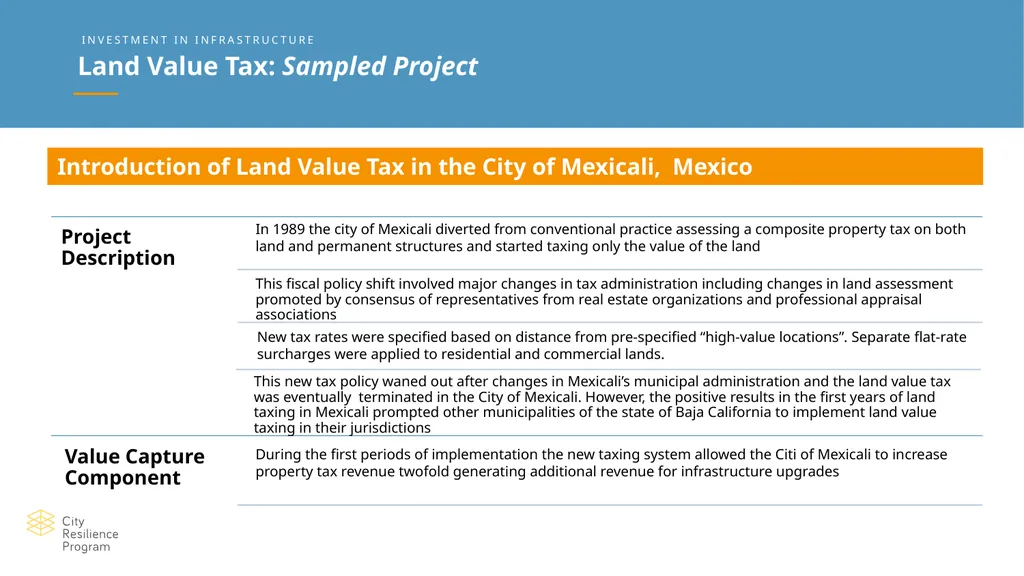
Land Value Tax: Sampled Project INVESTMENT IN INFRASTRUCTURE Project Description In 1989 the city of Mexicali diverted from conventional practice assessing a composite property tax on both land and permanent structures and started taxing only the value of the land This fiscal policy shift involved major changes in tax administration including changes in land assessment promoted by consensus of representatives from real estate organizations and professional appraisal associations Value Capture Component During the first periods of implementation the new taxing system allowed the Citi of Mexicali to increase property tax revenue twofold generating additional revenue for infrastructure upgrades Introduction of Land Value Tax in the City of Mexicali, Mexico New tax rates were specified based on distance from pre-specified “high-value locations”. Separate flat-rate surcharges were applied to residential and commercial lands. This new tax policy waned out after changes in Mexicali’s municipal administration and the land value tax was eventually terminated in the City of Mexicali. However, the positive results in the first years of land taxing in Mexicali prompted other municipalities of the state of Baja California to implement land value taxing in their jurisdictions<br>
40
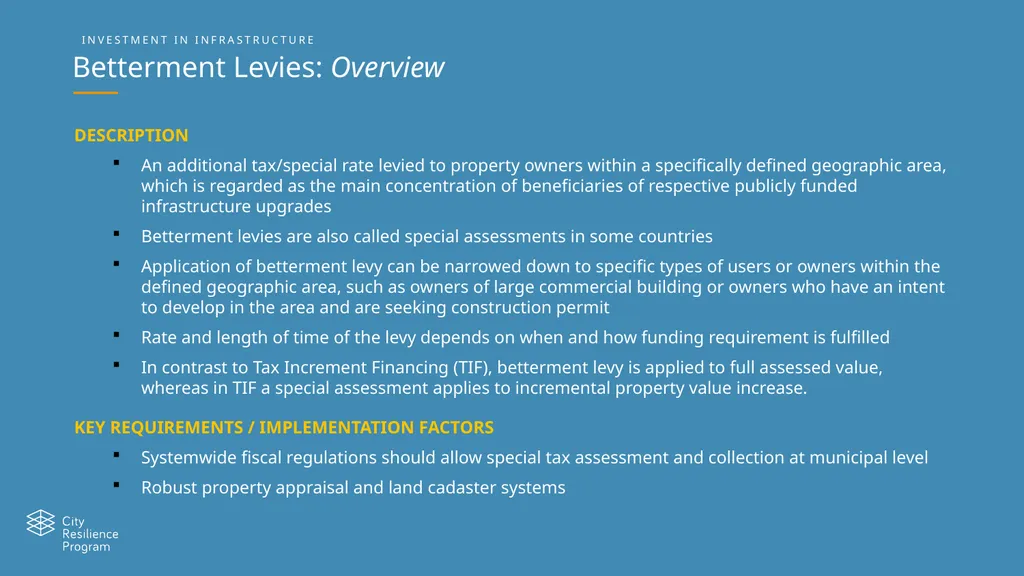
Betterment Levies: Overview INVESTMENT IN INFRASTRUCTURE DESCRIPTION
An additional tax/special rate levied to property owners within a specifically defined geographic area, which is regarded as the main concentration of beneficiaries of respective publicly funded infrastructure upgrades
Betterment levies are also called special assessments in some countries
Application of betterment levy can be narrowed down to specific types of users or owners within the defined geographic area, such as owners of large commercial building or owners who have an intent to develop in the area and are seeking construction permit
Rate and length of time of the levy depends on when and how funding requirement is fulfilled
In contrast to Tax Increment Financing (TIF), betterment levy is applied to full assessed value, whereas in TIF a special assessment applies to incremental property value increase.
KEY REQUIREMENTS / IMPLEMENTATION FACTORS
Systemwide fiscal regulations should allow special tax assessment and collection at municipal level
Robust property appraisal and land cadaster systems<br>
An additional tax/special rate levied to property owners within a specifically defined geographic area, which is regarded as the main concentration of beneficiaries of respective publicly funded infrastructure upgrades
Betterment levies are also called special assessments in some countries
Application of betterment levy can be narrowed down to specific types of users or owners within the defined geographic area, such as owners of large commercial building or owners who have an intent to develop in the area and are seeking construction permit
Rate and length of time of the levy depends on when and how funding requirement is fulfilled
In contrast to Tax Increment Financing (TIF), betterment levy is applied to full assessed value, whereas in TIF a special assessment applies to incremental property value increase.
KEY REQUIREMENTS / IMPLEMENTATION FACTORS
Systemwide fiscal regulations should allow special tax assessment and collection at municipal level
Robust property appraisal and land cadaster systems<br>
41
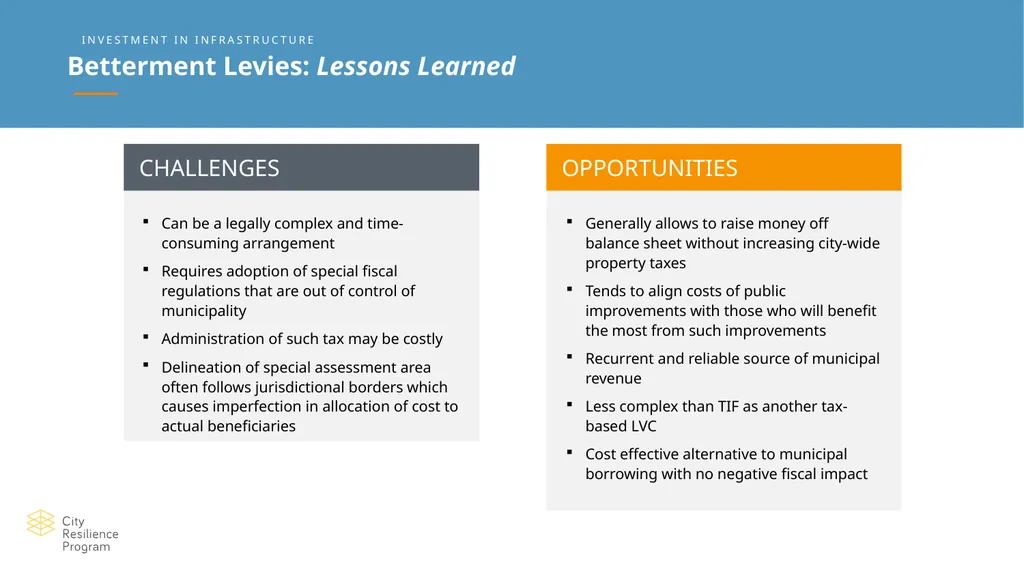
Betterment Levies: Lessons Learned INVESTMENT IN INFRASTRUCTURE OPPORTUNITIES CHALLENGES Generally allows to raise money off balance sheet without increasing city-wide property taxes
Tends to align costs of public improvements with those who will benefit the most from such improvements
Recurrent and reliable source of municipal revenue
Less complex than TIF as another tax-based LVC
Cost effective alternative to municipal borrowing with no negative fiscal impact Can be a legally complex and time-consuming arrangement
Requires adoption of special fiscal regulations that are out of control of municipality
Administration of such tax may be costly
Delineation of special assessment area often follows jurisdictional borders which causes imperfection in allocation of cost to actual beneficiaries<br>
Tends to align costs of public improvements with those who will benefit the most from such improvements
Recurrent and reliable source of municipal revenue
Less complex than TIF as another tax-based LVC
Cost effective alternative to municipal borrowing with no negative fiscal impact Can be a legally complex and time-consuming arrangement
Requires adoption of special fiscal regulations that are out of control of municipality
Administration of such tax may be costly
Delineation of special assessment area often follows jurisdictional borders which causes imperfection in allocation of cost to actual beneficiaries<br>
42
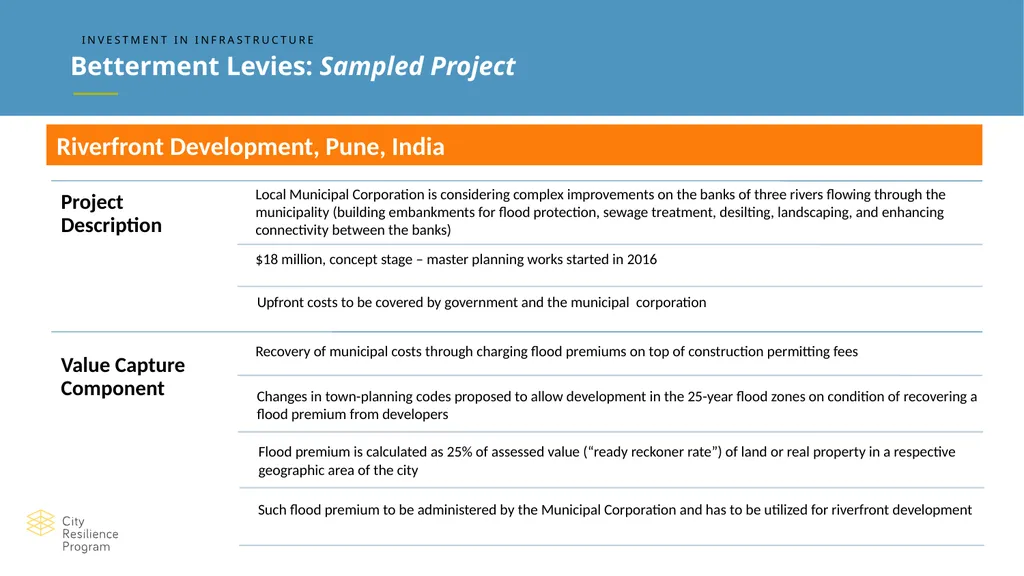
Betterment Levies: Sampled Project INVESTMENT IN INFRASTRUCTURE Project Description Local Municipal Corporation is considering complex improvements on the banks of three rivers flowing through the municipality (building embankments for flood protection, sewage treatment, desilting, landscaping, and enhancing connectivity between the banks) $18 million, concept stage – master planning works started in 2016 Recovery of municipal costs through charging flood premiums on top of construction permitting fees Riverfront Development, Pune, India Changes in town-planning codes proposed to allow development in the 25-year flood zones on condition of recovering a flood premium from developers Upfront costs to be covered by government and the municipal corporation Flood premium is calculated as 25% of assessed value (“ready reckoner rate”) of land or real property in a respective geographic area of the city Value Capture Component Such flood premium to be administered by the Municipal Corporation and has to be utilized for riverfront development<br>
43
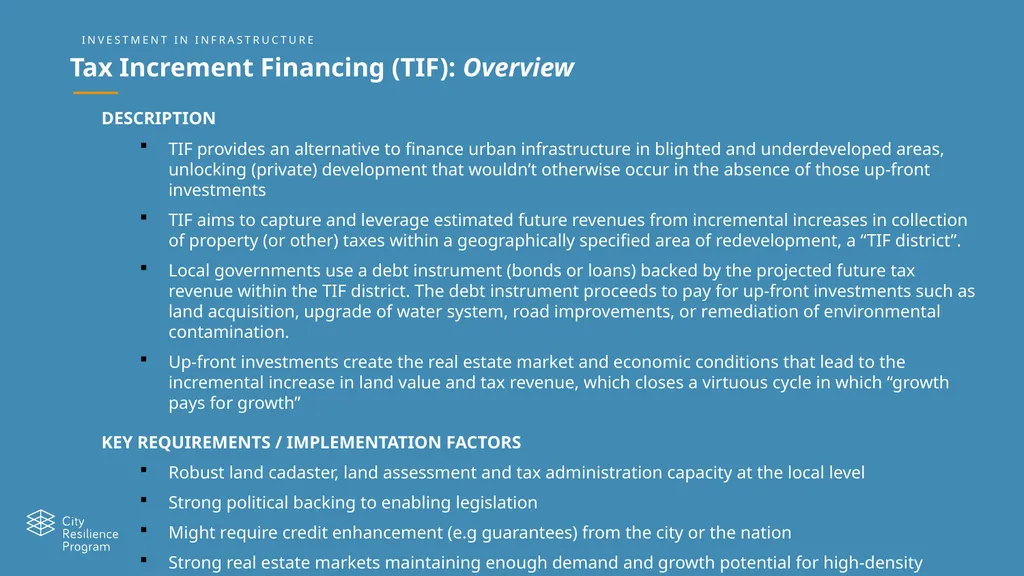
INVESTMENT IN INFRASTRUCTURE Tax Increment Financing (TIF): Overview DESCRIPTION
TIF provides an alternative to finance urban infrastructure in blighted and underdeveloped areas, unlocking (private) development that wouldn’t otherwise occur in the absence of those up-front investments
TIF aims to capture and leverage estimated future revenues from incremental increases in collection of property (or other) taxes within a geographically specified area of redevelopment, a “TIF district”.
Local governments use a debt instrument (bonds or loans) backed by the projected future tax revenue within the TIF district. The debt instrument proceeds to pay for up-front investments such as land acquisition, upgrade of water system, road improvements, or remediation of environmental contamination.
Up-front investments create the real estate market and economic conditions that lead to the incremental increase in land value and tax revenue, which closes a virtuous cycle in which “growth pays for growth”
KEY REQUIREMENTS / IMPLEMENTATION FACTORS
Robust land cadaster, land assessment and tax administration capacity at the local level
Strong political backing to enabling legislation
Might require credit enhancement (e.g guarantees) from the city or the nation
Strong real estate markets maintaining enough demand and growth potential for high-density development
Relatively deep capital markets<br>
TIF provides an alternative to finance urban infrastructure in blighted and underdeveloped areas, unlocking (private) development that wouldn’t otherwise occur in the absence of those up-front investments
TIF aims to capture and leverage estimated future revenues from incremental increases in collection of property (or other) taxes within a geographically specified area of redevelopment, a “TIF district”.
Local governments use a debt instrument (bonds or loans) backed by the projected future tax revenue within the TIF district. The debt instrument proceeds to pay for up-front investments such as land acquisition, upgrade of water system, road improvements, or remediation of environmental contamination.
Up-front investments create the real estate market and economic conditions that lead to the incremental increase in land value and tax revenue, which closes a virtuous cycle in which “growth pays for growth”
KEY REQUIREMENTS / IMPLEMENTATION FACTORS
Robust land cadaster, land assessment and tax administration capacity at the local level
Strong political backing to enabling legislation
Might require credit enhancement (e.g guarantees) from the city or the nation
Strong real estate markets maintaining enough demand and growth potential for high-density development
Relatively deep capital markets<br>
44
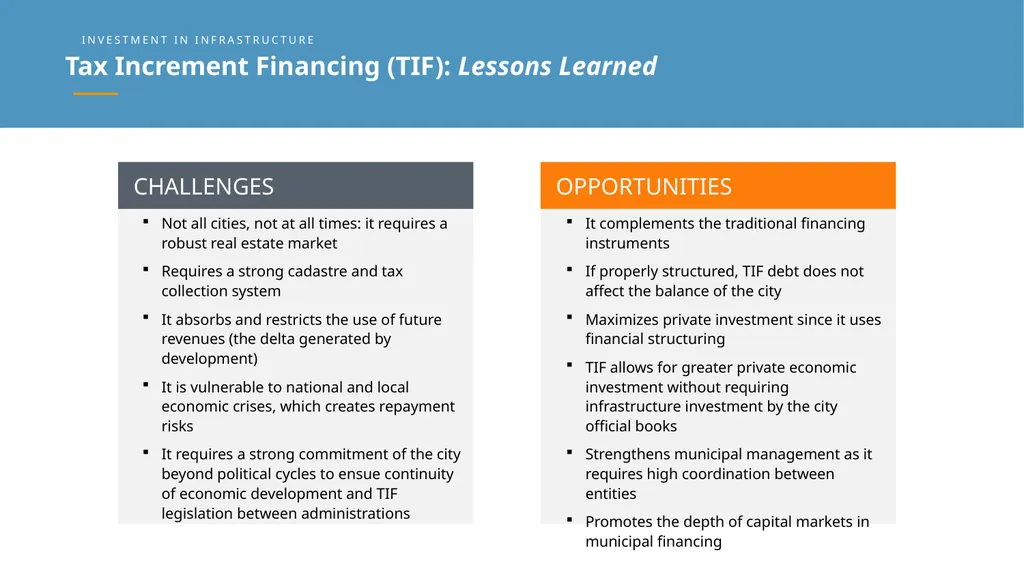
Tax Increment Financing (TIF): Lessons Learned INVESTMENT IN INFRASTRUCTURE OPPORTUNITIES CHALLENGES Not all cities, not at all times: it requires a robust real estate market
Requires a strong cadastre and tax collection system
It absorbs and restricts the use of future revenues (the delta generated by development)
It is vulnerable to national and local economic crises, which creates repayment risks
It requires a strong commitment of the city beyond political cycles to ensue continuity of economic development and TIF legislation between administrations It complements the traditional financing instruments
If properly structured, TIF debt does not affect the balance of the city
Maximizes private investment since it uses financial structuring
TIF allows for greater private economic investment without requiring infrastructure investment by the city official books
Strengthens municipal management as it requires high coordination between entities
Promotes the depth of capital markets in municipal financing<br>
Requires a strong cadastre and tax collection system
It absorbs and restricts the use of future revenues (the delta generated by development)
It is vulnerable to national and local economic crises, which creates repayment risks
It requires a strong commitment of the city beyond political cycles to ensue continuity of economic development and TIF legislation between administrations It complements the traditional financing instruments
If properly structured, TIF debt does not affect the balance of the city
Maximizes private investment since it uses financial structuring
TIF allows for greater private economic investment without requiring infrastructure investment by the city official books
Strengthens municipal management as it requires high coordination between entities
Promotes the depth of capital markets in municipal financing<br>
45
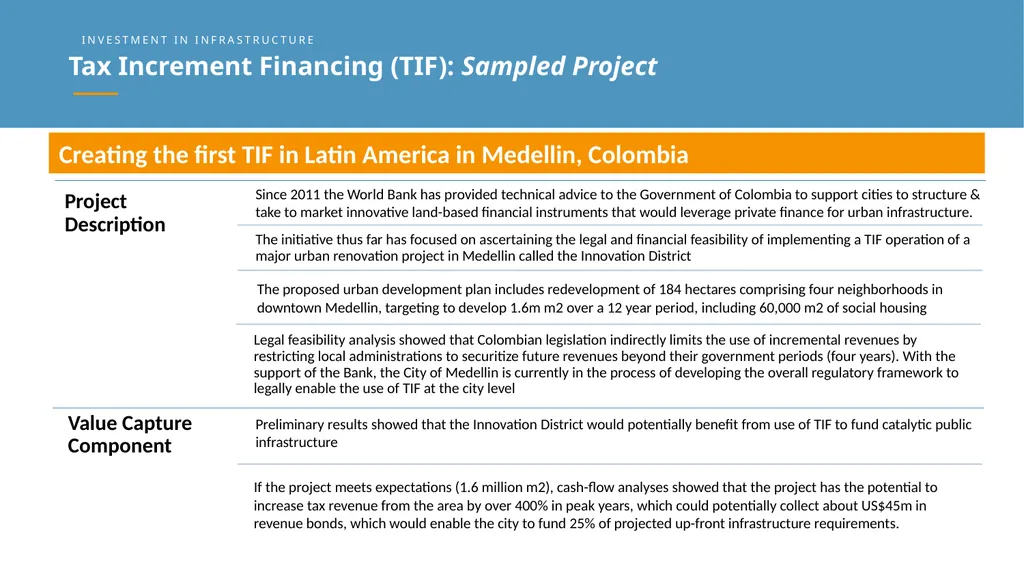
Tax Increment Financing (TIF): Sampled Project INVESTMENT IN INFRASTRUCTURE Project Description Value Capture Component Creating the first TIF in Latin America in Medellin, Colombia Since 2011 the World Bank has provided technical advice to the Government of Colombia to support cities to structure & take to market innovative land-based financial instruments that would leverage private finance for urban infrastructure. The initiative thus far has focused on ascertaining the legal and financial feasibility of implementing a TIF operation of a major urban renovation project in Medellin called the Innovation District Preliminary results showed that the Innovation District would potentially benefit from use of TIF to fund catalytic public infrastructure The proposed urban development plan includes redevelopment of 184 hectares comprising four neighborhoods in downtown Medellin, targeting to develop 1.6m m2 over a 12 year period, including 60,000 m2 of social housing Legal feasibility analysis showed that Colombian legislation indirectly limits the use of incremental revenues by restricting local administrations to securitize future revenues beyond their government periods (four years). With the support of the Bank, the City of Medellin is currently in the process of developing the overall regulatory framework to legally enable the use of TIF at the city level If the project meets expectations (1.6 million m2), cash-flow analyses showed that the project has the potential to increase tax revenue from the area by over 400% in peak years, which could potentially collect about US$45m in revenue bonds, which would enable the city to fund 25% of projected up-front infrastructure requirements.<br>
46
46 THANK YOU<br>