1 MARCH: MAze Routing Under a Concurrent and
Description: 1 MARCH: MAze Routing Under a Concurrent and Hierarchical Scheme for Buses Speaker: Jingsong Chen Authors: Jingsong Chen, Ph.D. student, CSE, CUHK Jinwei Liu, Ph.D. student, CSE, CUHK Gengjie Chen, Ph.D. student, CSE, CUHK Dan Zheng, Ph.D.
Related Topics
Download Presentation
"1 MARCH: MAze Routing Under a Concurrent and" is the property of its rightful owner. Permission is granted to download and print the materials on this website for personal, non-commercial use only, and to display it on your personal computer provided you do not modify the materials and that you retain all copyright notices contained in the materials. By downloading content from our website, you accept the terms of this agreement.
Presentation Transcript
slide1. 1 MARCH: MAze Routing
Under a Concurrent and Hierarchical Scheme
for Buses Speaker:
Jingsong Chen
Authors:
Jingsong Chen, Ph.D. student, CSE, CUHK
Jinwei Liu, Ph.D. student, CSE, CUHK
Gengjie Chen, Ph.D. student, CSE, CUHK
Dan Zheng, Ph.D. student, CSE, CUHK
Evangeline F. Y. Young, Professor, CSE, CUHK<br>
slide2. 2 Problem Formulation
Our Methodology: MARCH
Experimental Results
Conclusion Outline<br>
slide3. 3 Outline Problem Formulation
Our Methodology: MARCH
Experimental Results
Conclusion<br>
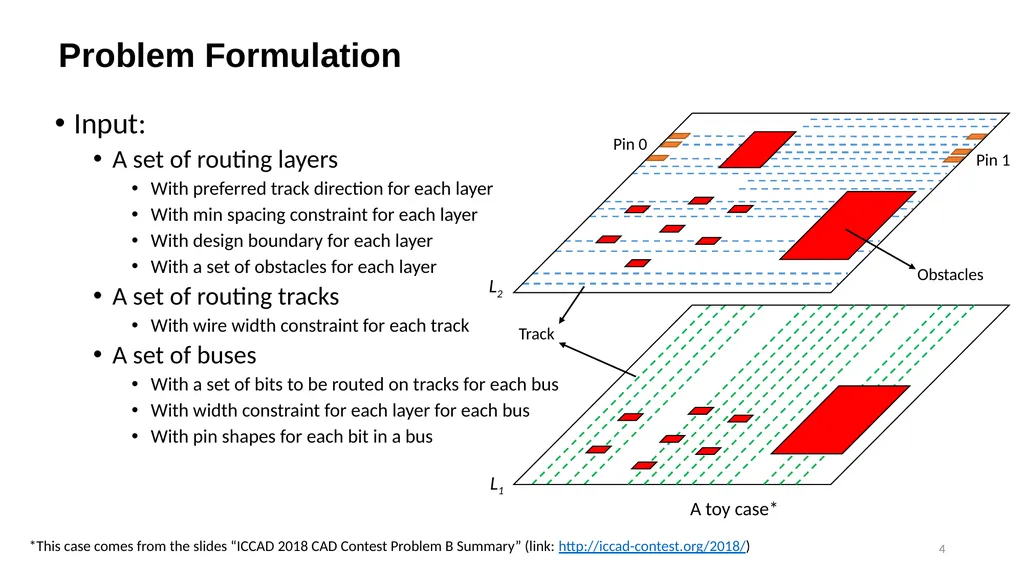
slide4. 4 *This case comes from the slides “ICCAD 2018 CAD Contest Problem B Summary” (link: http://iccad-contest.org/2018/) L2 L1 A toy case* Problem Formulation Input:
A set of routing layers
With preferred track direction for each layer
With min spacing constraint for each layer
With design boundary for each layer
With a set of obstacles for each layer
A set of routing tracks
With wire width constraint for each track
A set of buses
With a set of bits to be routed on tracks for each bus
With width constraint for each layer for each bus
With pin shapes for each bit in a bus Pin 0 Pin 1 Track Obstacles<br>
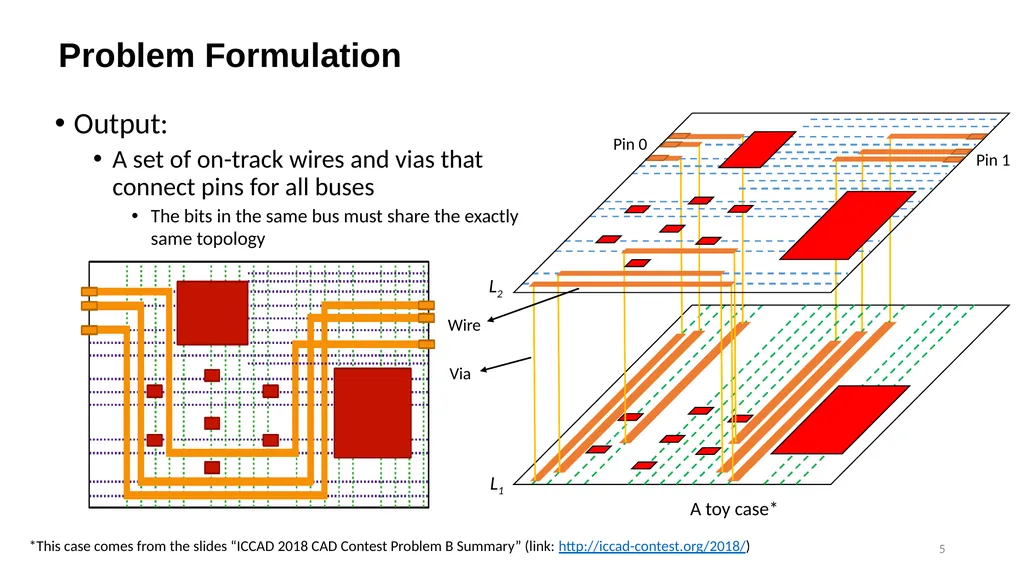
slide5. 5 Problem Formulation *This case comes from the slides “ICCAD 2018 CAD Contest Problem B Summary” (link: http://iccad-contest.org/2018/) A toy case* L2 L1 Output:
A set of on-track wires and vias that connect pins for all buses
The bits in the same bus must share the exactly same topology Pin 0 Pin 1 Via Wire<br>
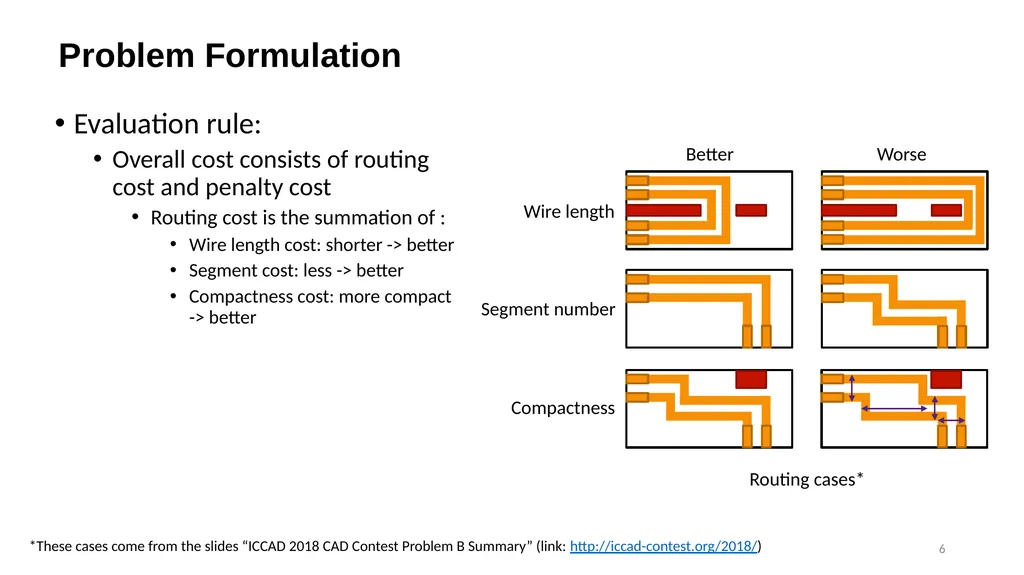
slide6. 6 Problem Formulation Wire length Segment number Compactness Routing cases* *These cases come from the slides “ICCAD 2018 CAD Contest Problem B Summary” (link: http://iccad-contest.org/2018/) Evaluation rule:
Overall cost consists of routing cost and penalty cost
Routing cost is the summation of :
Wire length cost: shorter -> better
Segment cost: less -> better
Compactness cost: more compact -> better<br>
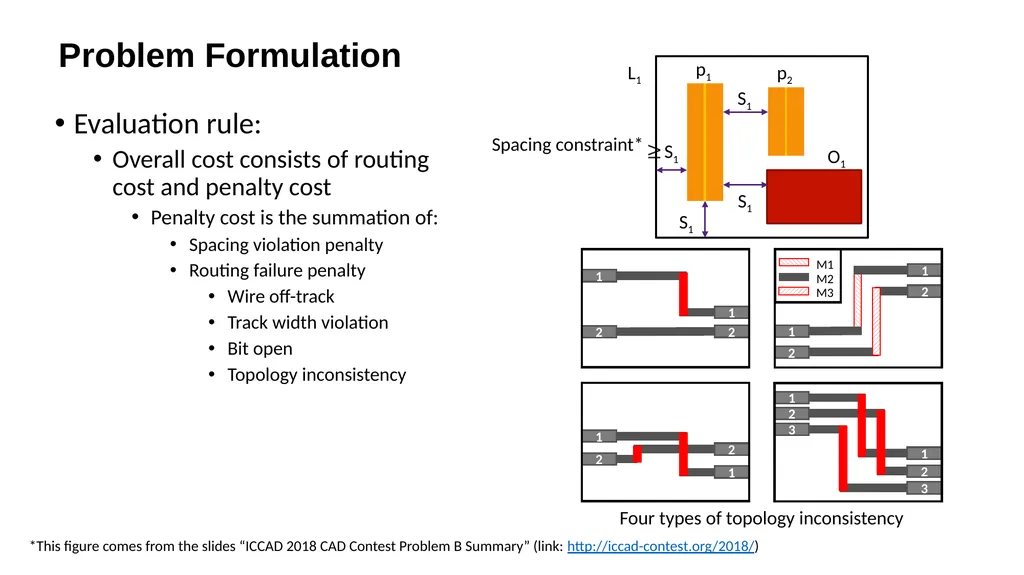
slide7. Problem Formulation Spacing constraint* *This figure comes from the slides “ICCAD 2018 CAD Contest Problem B Summary” (link: http://iccad-contest.org/2018/) Evaluation rule:
Overall cost consists of routing cost and penalty cost
Penalty cost is the summation of:
Spacing violation penalty
Routing failure penalty
Wire off-track
Track width violation
Bit open
Topology inconsistency Four types of topology inconsistency<br>
slide8. 8 Problem Formulation
Our Methodology: MARCH
Experimental Results
Conclusion Outline<br>
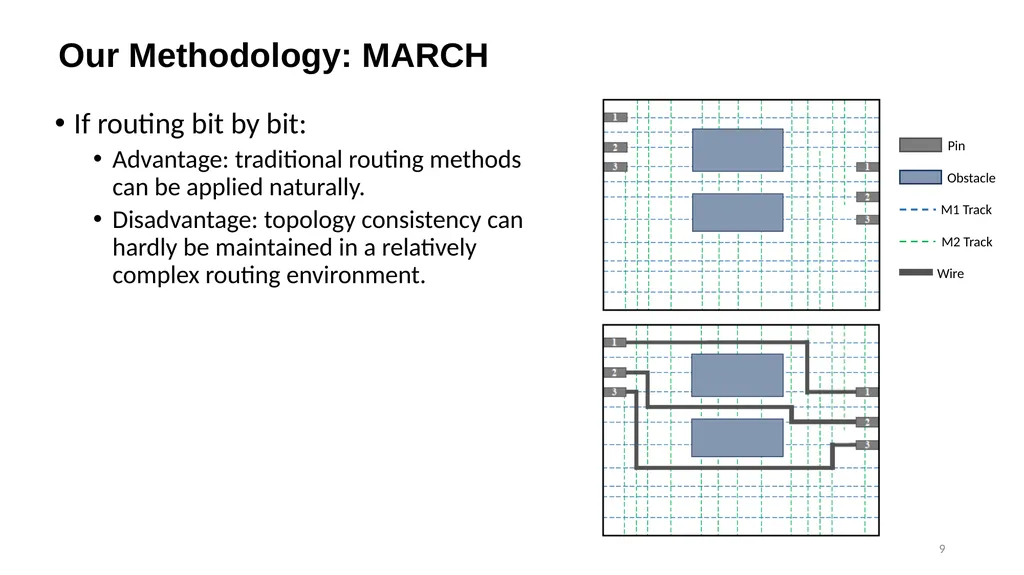
slide9. 9 Our Methodology: MARCH If routing bit by bit:
Advantage: traditional routing methods can be applied naturally.
Disadvantage: topology consistency can hardly be maintained in a relatively complex routing environment.<br>
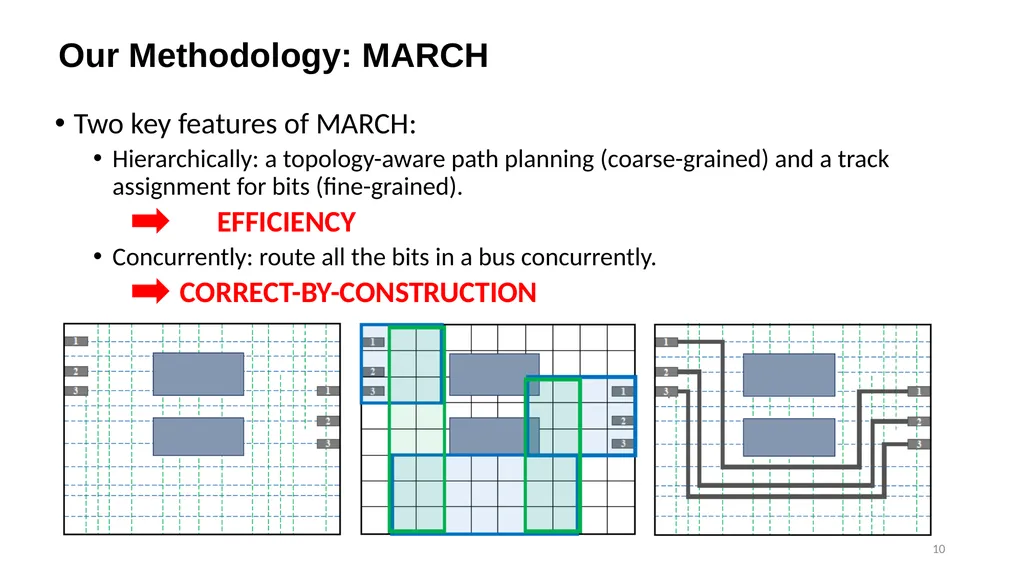
slide10. 10 Our Methodology: MARCH Two key features of MARCH:
Hierarchically: a topology-aware path planning (coarse-grained) and a track assignment for bits (fine-grained).
EFFICIENCY
Concurrently: route all the bits in a bus concurrently.
CORRECT-BY-CONSTRUCTION<br>
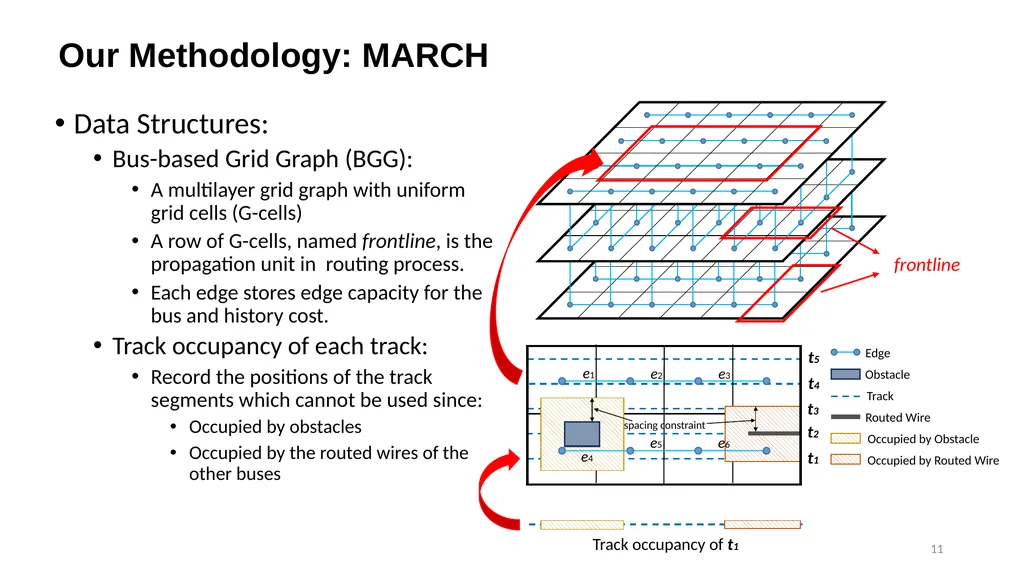
slide11. 11 Our Methodology: MARCH Data Structures:
Bus-based Grid Graph (BGG):
A multilayer grid graph with uniform grid cells (G-cells)
A row of G-cells, named frontline, is the propagation unit in routing process.
Each edge stores edge capacity for the bus and history cost.
Track occupancy of each track:
Record the positions of the track segments which cannot be used since:
Occupied by obstacles
Occupied by the routed wires of the other buses frontline Track occupancy of t1<br>
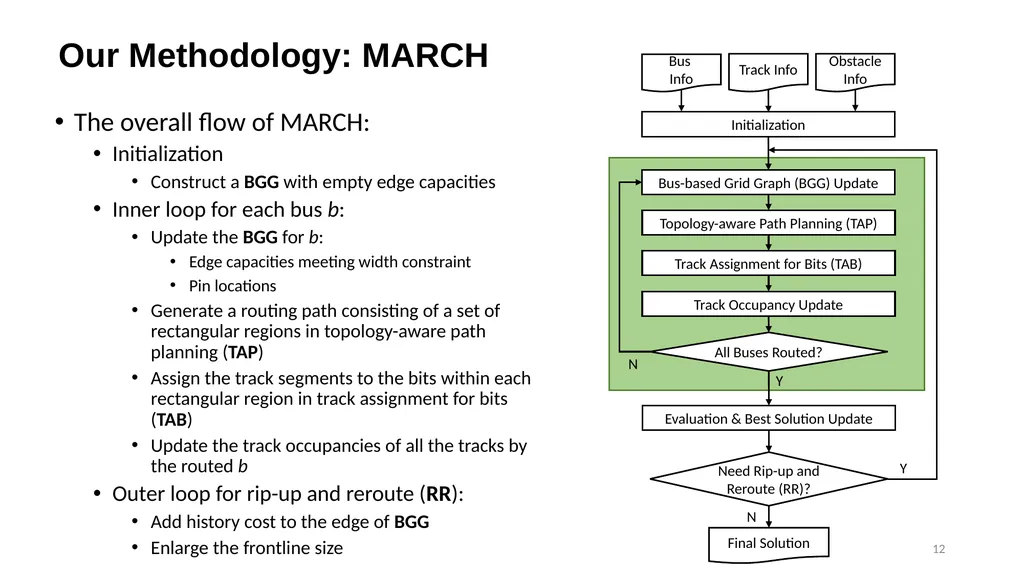
slide12. 12 Our Methodology: MARCH The overall flow of MARCH:
Initialization
Construct a BGG with empty edge capacities
Inner loop for each bus b:
Update the BGG for b:
Edge capacities meeting width constraint
Pin locations
Generate a routing path consisting of a set of rectangular regions in topology-aware path planning (TAP)
Assign the track segments to the bits within each rectangular region in track assignment for bits (TAB)
Update the track occupancies of all the tracks by the routed b
Outer loop for rip-up and reroute (RR):
Add history cost to the edge of BGG
Enlarge the frontline size<br>
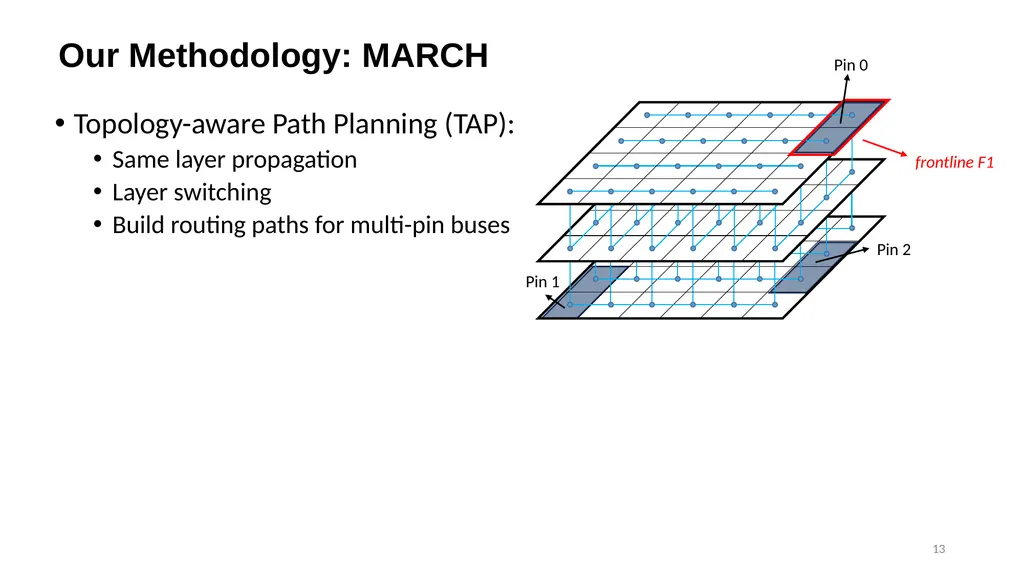
slide13. 13 Our Methodology: MARCH Topology-aware Path Planning (TAP):
Same layer propagation
Layer switching
Build routing paths for multi-pin buses Pin 0 frontline F1 Pin 1 Pin 2<br>
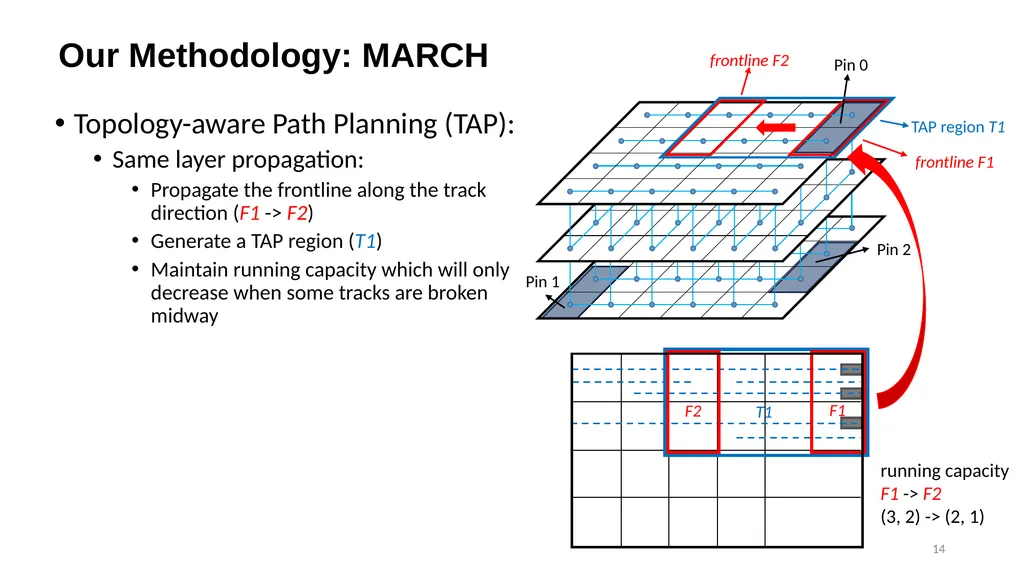
slide14. 14 Our Methodology: MARCH Topology-aware Path Planning (TAP):
Same layer propagation:
Propagate the frontline along the track direction (F1 -> F2)
Generate a TAP region (T1)
Maintain running capacity which will only decrease when some tracks are broken midway Pin 0 frontline F1 frontline F2 Pin 1 TAP region T1 F1 T1 F2 running capacity
F1 -> F2
(3, 2) -> (2, 1) Pin 2<br>
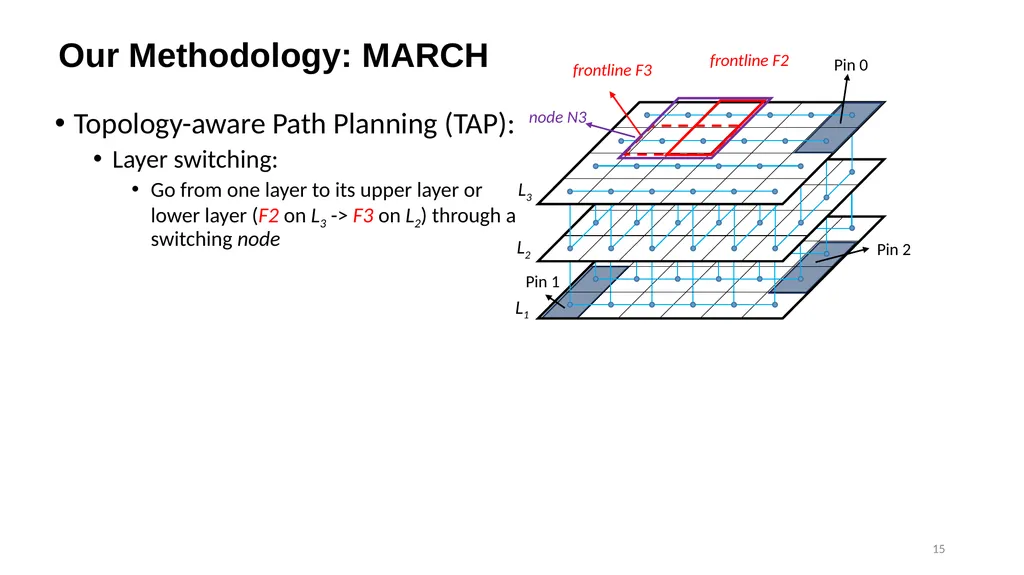
slide15. 15 Our Methodology: MARCH Topology-aware Path Planning (TAP):
Layer switching:
Go from one layer to its upper layer or lower layer (F2 on L3 -> F3 on L2) through a switching node Pin 0 frontline F2 Pin 1 L1 L2 L3 frontline F3 node N3 Pin 2<br>
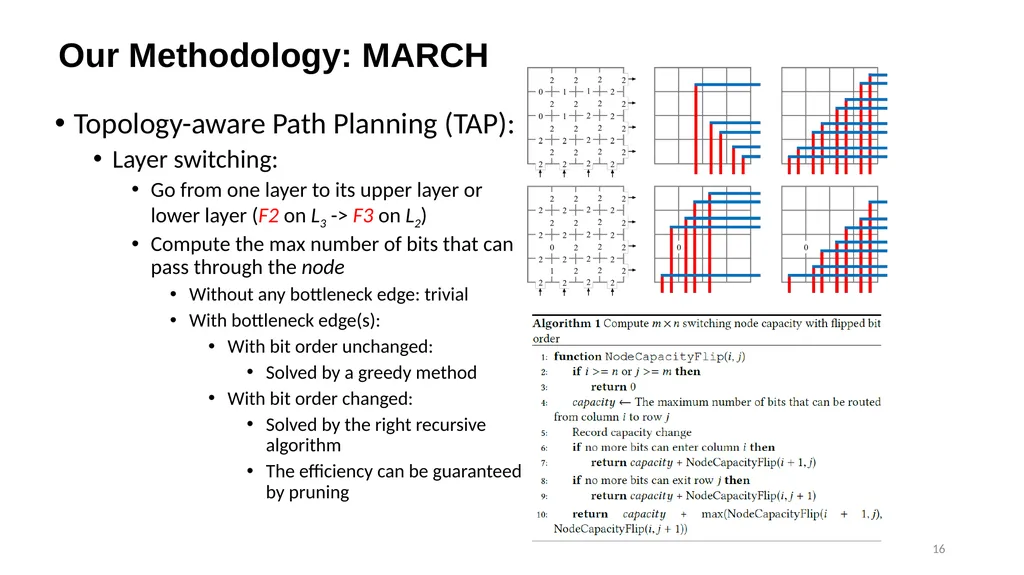
slide16. 16 Our Methodology: MARCH Topology-aware Path Planning (TAP):
Layer switching:
Go from one layer to its upper layer or lower layer (F2 on L3 -> F3 on L2)
Compute the max number of bits that can pass through the node
Without any bottleneck edge: trivial
With bottleneck edge(s):
With bit order unchanged:
Solved by a greedy method
With bit order changed:
Solved by the right recursive algorithm
The efficiency can be guaranteed by pruning<br>
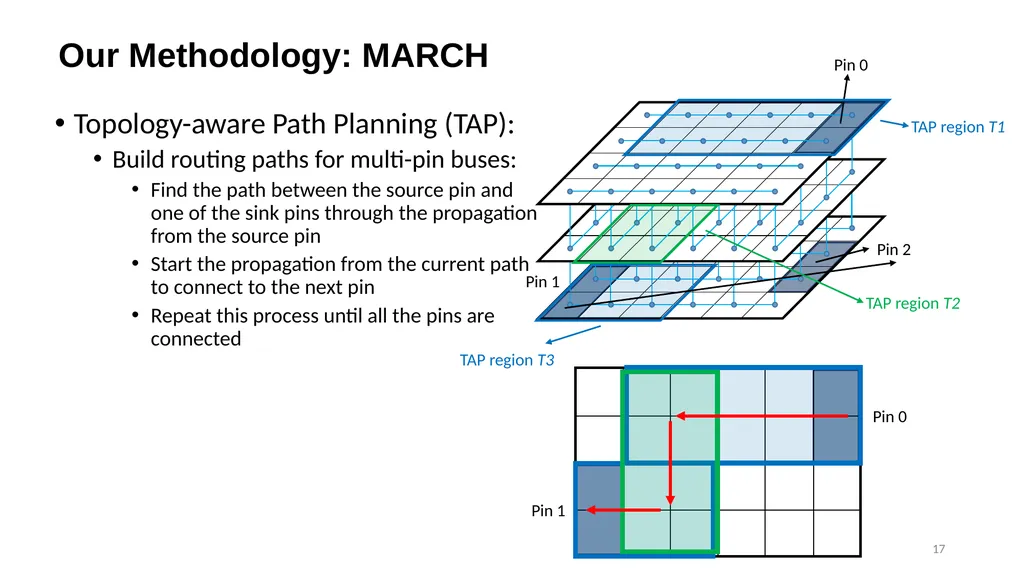
slide17. 17 Our Methodology: MARCH Topology-aware Path Planning (TAP):
Build routing paths for multi-pin buses:
Find the path between the source pin and one of the sink pins through the propagation from the source pin
Start the propagation from the current path to connect to the next pin
Repeat this process until all the pins are connected Pin 0 Pin 2 TAP region T1 TAP region T2 TAP region T3 Pin 1 Pin 0 Pin 1<br>
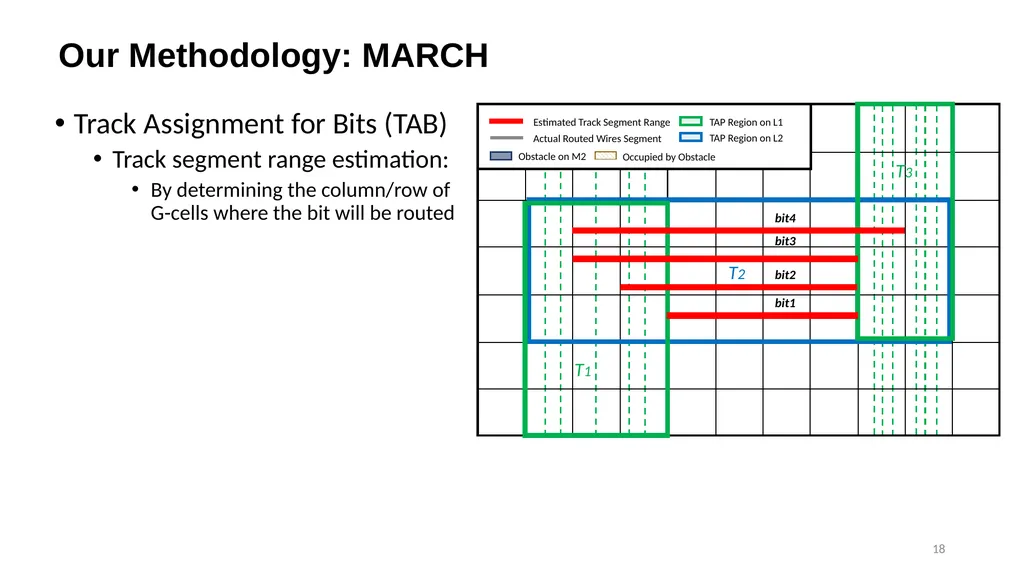
slide18. 18 Our Methodology: MARCH Track Assignment for Bits (TAB)
Track segment range estimation:
By determining the column/row of G-cells where the bit will be routed T2 Estimated Track Segment Range Actual Routed Wires Segment Occupied by Obstacle Obstacle on M2 bit1 bit2 bit3 bit4 T3 T1 TAP Region on L1 TAP Region on L2<br>
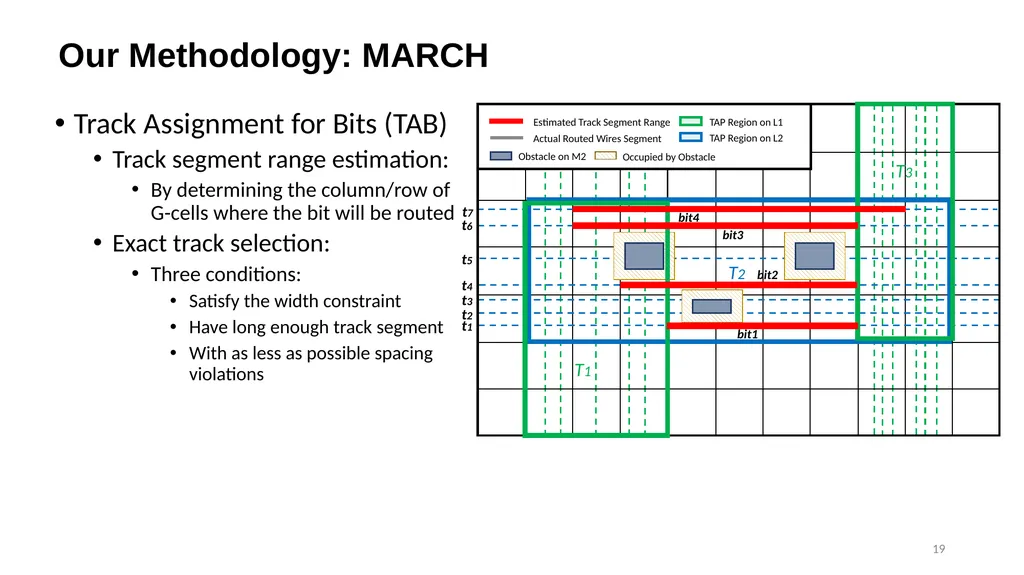
slide19. 19 Our Methodology: MARCH Track Assignment for Bits (TAB)
Track segment range estimation:
By determining the column/row of G-cells where the bit will be routed
Exact track selection:
Three conditions:
Satisfy the width constraint
Have long enough track segment
With as less as possible spacing violations T2 Estimated Track Segment Range Actual Routed Wires Segment Occupied by Obstacle Obstacle on M2 bit1 bit2 bit3 bit4 t1 t2 t3 t4 t5 t6 t7 T3 T1 TAP Region on L1 TAP Region on L2<br>
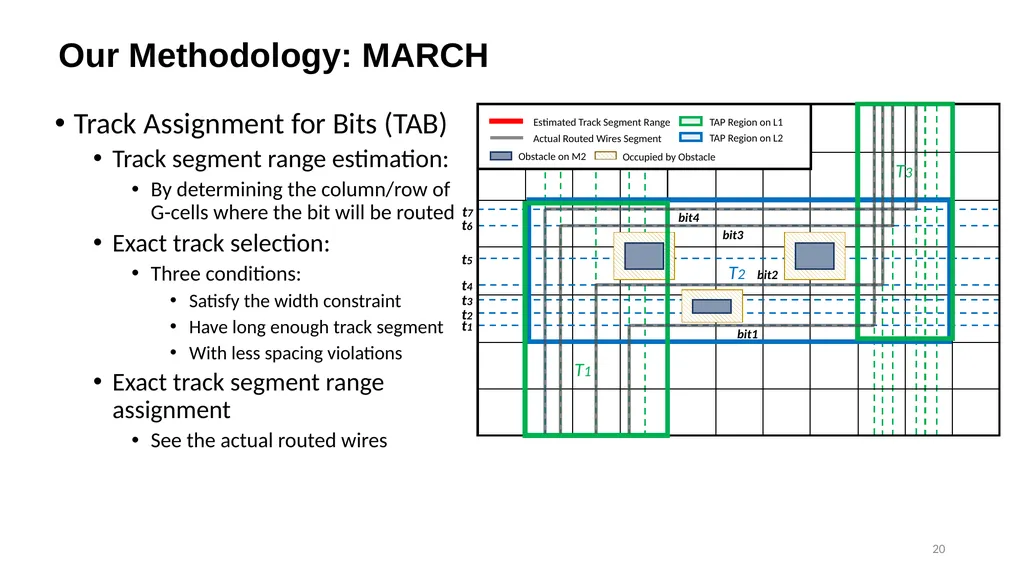
slide20. 20 Our Methodology: MARCH Track Assignment for Bits (TAB)
Track segment range estimation:
By determining the column/row of G-cells where the bit will be routed
Exact track selection:
Three conditions:
Satisfy the width constraint
Have long enough track segment
With less spacing violations
Exact track segment range assignment
See the actual routed wires T2 Estimated Track Segment Range Actual Routed Wires Segment Occupied by Obstacle Obstacle on M2 bit1 bit2 bit3 bit4 t1 t2 t3 t4 t5 t6 t7 T3 T1 TAP Region on L1 TAP Region on L2<br>
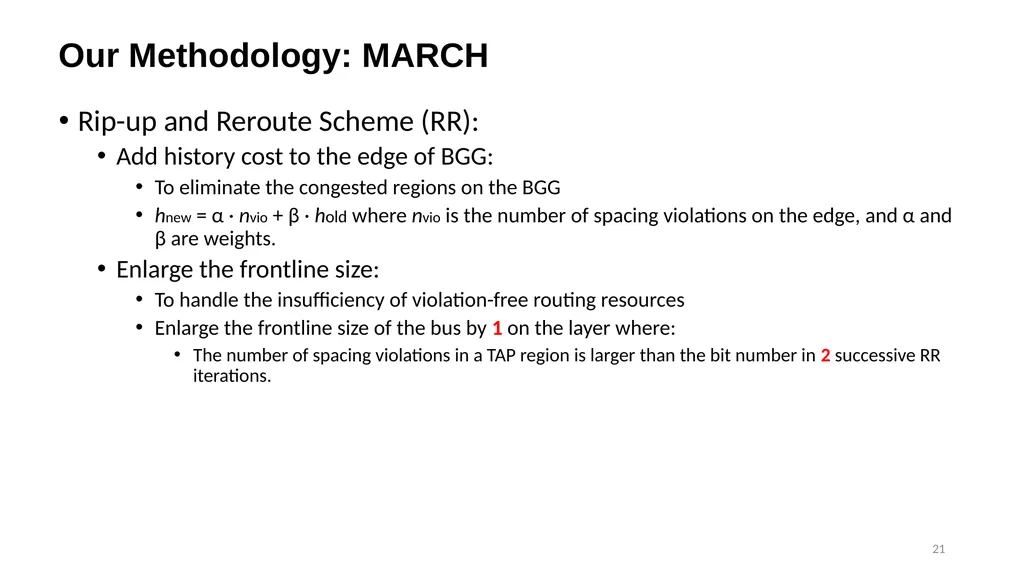
slide21. 21 Our Methodology: MARCH Rip-up and Reroute Scheme (RR):
Add history cost to the edge of BGG:
To eliminate the congested regions on the BGG
hnew = α · nvio + β · hold where nvio is the number of spacing violations on the edge, and α and β are weights.
Enlarge the frontline size:
To handle the insufficiency of violation-free routing resources
Enlarge the frontline size of the bus by 1 on the layer where:
The number of spacing violations in a TAP region is larger than the bit number in 2 successive RR iterations.<br>
slide22. 22 Problem Formulation
Our Methodology: MARCH
Experimental Results
Conclusion Outline<br>
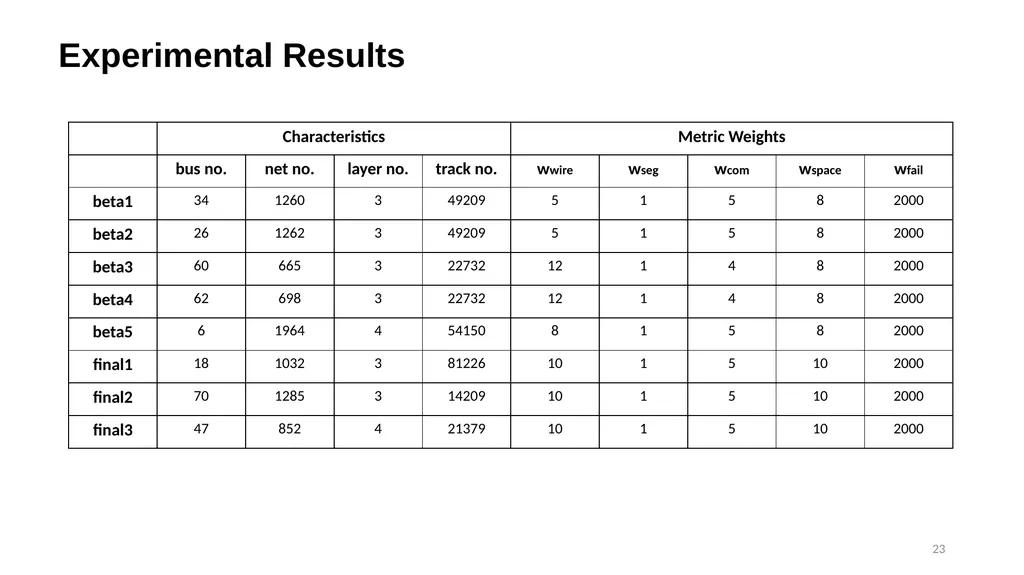
slide23. 23 Experimental Results<br>
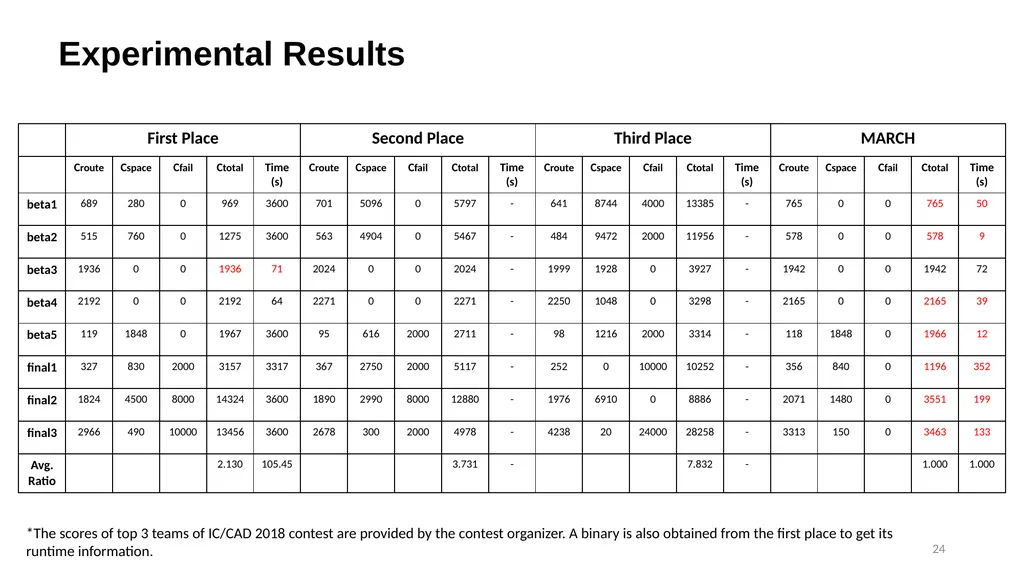
slide24. 24 Experimental Results *The scores of top 3 teams of IC/CAD 2018 contest are provided by the contest organizer. A binary is also obtained from the first place to get its runtime information.<br>
slide25. 25 Problem Formulation
Our Methodology: MARCH
Experimental Results
Conclusion Outline<br>
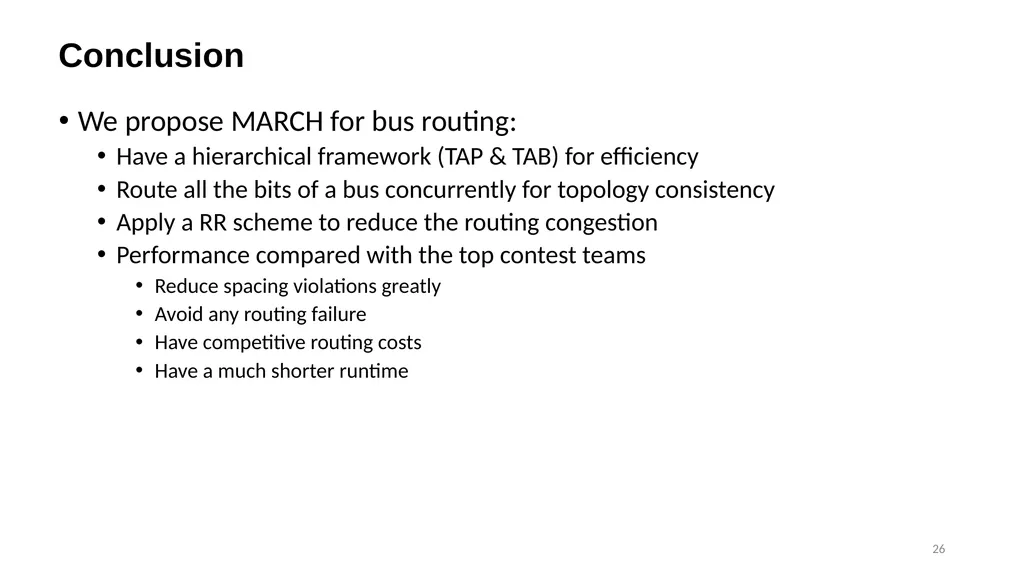
slide26. 26 Conclusion We propose MARCH for bus routing:
Have a hierarchical framework (TAP & TAB) for efficiency
Route all the bits of a bus concurrently for topology consistency
Apply a RR scheme to reduce the routing congestion
Performance compared with the top contest teams
Reduce spacing violations greatly
Avoid any routing failure
Have competitive routing costs
Have a much shorter runtime<br>

slide27. Thank you for attention! 27<br>
slide28. Q & A 28<br>
Under a Concurrent and Hierarchical Scheme
for Buses Speaker:
Jingsong Chen
Authors:
Jingsong Chen, Ph.D. student, CSE, CUHK
Jinwei Liu, Ph.D. student, CSE, CUHK
Gengjie Chen, Ph.D. student, CSE, CUHK
Dan Zheng, Ph.D. student, CSE, CUHK
Evangeline F. Y. Young, Professor, CSE, CUHK<br>
slide2. 2 Problem Formulation
Our Methodology: MARCH
Experimental Results
Conclusion Outline<br>
slide3. 3 Outline Problem Formulation
Our Methodology: MARCH
Experimental Results
Conclusion<br>
slide4. 4 *This case comes from the slides “ICCAD 2018 CAD Contest Problem B Summary” (link: http://iccad-contest.org/2018/) L2 L1 A toy case* Problem Formulation Input:
A set of routing layers
With preferred track direction for each layer
With min spacing constraint for each layer
With design boundary for each layer
With a set of obstacles for each layer
A set of routing tracks
With wire width constraint for each track
A set of buses
With a set of bits to be routed on tracks for each bus
With width constraint for each layer for each bus
With pin shapes for each bit in a bus Pin 0 Pin 1 Track Obstacles<br>
slide5. 5 Problem Formulation *This case comes from the slides “ICCAD 2018 CAD Contest Problem B Summary” (link: http://iccad-contest.org/2018/) A toy case* L2 L1 Output:
A set of on-track wires and vias that connect pins for all buses
The bits in the same bus must share the exactly same topology Pin 0 Pin 1 Via Wire<br>
slide6. 6 Problem Formulation Wire length Segment number Compactness Routing cases* *These cases come from the slides “ICCAD 2018 CAD Contest Problem B Summary” (link: http://iccad-contest.org/2018/) Evaluation rule:
Overall cost consists of routing cost and penalty cost
Routing cost is the summation of :
Wire length cost: shorter -> better
Segment cost: less -> better
Compactness cost: more compact -> better<br>
slide7. Problem Formulation Spacing constraint* *This figure comes from the slides “ICCAD 2018 CAD Contest Problem B Summary” (link: http://iccad-contest.org/2018/) Evaluation rule:
Overall cost consists of routing cost and penalty cost
Penalty cost is the summation of:
Spacing violation penalty
Routing failure penalty
Wire off-track
Track width violation
Bit open
Topology inconsistency Four types of topology inconsistency<br>
slide8. 8 Problem Formulation
Our Methodology: MARCH
Experimental Results
Conclusion Outline<br>
slide9. 9 Our Methodology: MARCH If routing bit by bit:
Advantage: traditional routing methods can be applied naturally.
Disadvantage: topology consistency can hardly be maintained in a relatively complex routing environment.<br>
slide10. 10 Our Methodology: MARCH Two key features of MARCH:
Hierarchically: a topology-aware path planning (coarse-grained) and a track assignment for bits (fine-grained).
EFFICIENCY
Concurrently: route all the bits in a bus concurrently.
CORRECT-BY-CONSTRUCTION<br>
slide11. 11 Our Methodology: MARCH Data Structures:
Bus-based Grid Graph (BGG):
A multilayer grid graph with uniform grid cells (G-cells)
A row of G-cells, named frontline, is the propagation unit in routing process.
Each edge stores edge capacity for the bus and history cost.
Track occupancy of each track:
Record the positions of the track segments which cannot be used since:
Occupied by obstacles
Occupied by the routed wires of the other buses frontline Track occupancy of t1<br>
slide12. 12 Our Methodology: MARCH The overall flow of MARCH:
Initialization
Construct a BGG with empty edge capacities
Inner loop for each bus b:
Update the BGG for b:
Edge capacities meeting width constraint
Pin locations
Generate a routing path consisting of a set of rectangular regions in topology-aware path planning (TAP)
Assign the track segments to the bits within each rectangular region in track assignment for bits (TAB)
Update the track occupancies of all the tracks by the routed b
Outer loop for rip-up and reroute (RR):
Add history cost to the edge of BGG
Enlarge the frontline size<br>
slide13. 13 Our Methodology: MARCH Topology-aware Path Planning (TAP):
Same layer propagation
Layer switching
Build routing paths for multi-pin buses Pin 0 frontline F1 Pin 1 Pin 2<br>
slide14. 14 Our Methodology: MARCH Topology-aware Path Planning (TAP):
Same layer propagation:
Propagate the frontline along the track direction (F1 -> F2)
Generate a TAP region (T1)
Maintain running capacity which will only decrease when some tracks are broken midway Pin 0 frontline F1 frontline F2 Pin 1 TAP region T1 F1 T1 F2 running capacity
F1 -> F2
(3, 2) -> (2, 1) Pin 2<br>
slide15. 15 Our Methodology: MARCH Topology-aware Path Planning (TAP):
Layer switching:
Go from one layer to its upper layer or lower layer (F2 on L3 -> F3 on L2) through a switching node Pin 0 frontline F2 Pin 1 L1 L2 L3 frontline F3 node N3 Pin 2<br>
slide16. 16 Our Methodology: MARCH Topology-aware Path Planning (TAP):
Layer switching:
Go from one layer to its upper layer or lower layer (F2 on L3 -> F3 on L2)
Compute the max number of bits that can pass through the node
Without any bottleneck edge: trivial
With bottleneck edge(s):
With bit order unchanged:
Solved by a greedy method
With bit order changed:
Solved by the right recursive algorithm
The efficiency can be guaranteed by pruning<br>
slide17. 17 Our Methodology: MARCH Topology-aware Path Planning (TAP):
Build routing paths for multi-pin buses:
Find the path between the source pin and one of the sink pins through the propagation from the source pin
Start the propagation from the current path to connect to the next pin
Repeat this process until all the pins are connected Pin 0 Pin 2 TAP region T1 TAP region T2 TAP region T3 Pin 1 Pin 0 Pin 1<br>
slide18. 18 Our Methodology: MARCH Track Assignment for Bits (TAB)
Track segment range estimation:
By determining the column/row of G-cells where the bit will be routed T2 Estimated Track Segment Range Actual Routed Wires Segment Occupied by Obstacle Obstacle on M2 bit1 bit2 bit3 bit4 T3 T1 TAP Region on L1 TAP Region on L2<br>
slide19. 19 Our Methodology: MARCH Track Assignment for Bits (TAB)
Track segment range estimation:
By determining the column/row of G-cells where the bit will be routed
Exact track selection:
Three conditions:
Satisfy the width constraint
Have long enough track segment
With as less as possible spacing violations T2 Estimated Track Segment Range Actual Routed Wires Segment Occupied by Obstacle Obstacle on M2 bit1 bit2 bit3 bit4 t1 t2 t3 t4 t5 t6 t7 T3 T1 TAP Region on L1 TAP Region on L2<br>
slide20. 20 Our Methodology: MARCH Track Assignment for Bits (TAB)
Track segment range estimation:
By determining the column/row of G-cells where the bit will be routed
Exact track selection:
Three conditions:
Satisfy the width constraint
Have long enough track segment
With less spacing violations
Exact track segment range assignment
See the actual routed wires T2 Estimated Track Segment Range Actual Routed Wires Segment Occupied by Obstacle Obstacle on M2 bit1 bit2 bit3 bit4 t1 t2 t3 t4 t5 t6 t7 T3 T1 TAP Region on L1 TAP Region on L2<br>
slide21. 21 Our Methodology: MARCH Rip-up and Reroute Scheme (RR):
Add history cost to the edge of BGG:
To eliminate the congested regions on the BGG
hnew = α · nvio + β · hold where nvio is the number of spacing violations on the edge, and α and β are weights.
Enlarge the frontline size:
To handle the insufficiency of violation-free routing resources
Enlarge the frontline size of the bus by 1 on the layer where:
The number of spacing violations in a TAP region is larger than the bit number in 2 successive RR iterations.<br>
slide22. 22 Problem Formulation
Our Methodology: MARCH
Experimental Results
Conclusion Outline<br>
slide23. 23 Experimental Results<br>
slide24. 24 Experimental Results *The scores of top 3 teams of IC/CAD 2018 contest are provided by the contest organizer. A binary is also obtained from the first place to get its runtime information.<br>
slide25. 25 Problem Formulation
Our Methodology: MARCH
Experimental Results
Conclusion Outline<br>
slide26. 26 Conclusion We propose MARCH for bus routing:
Have a hierarchical framework (TAP & TAB) for efficiency
Route all the bits of a bus concurrently for topology consistency
Apply a RR scheme to reduce the routing congestion
Performance compared with the top contest teams
Reduce spacing violations greatly
Avoid any routing failure
Have competitive routing costs
Have a much shorter runtime<br>

slide27. Thank you for attention! 27<br>
slide28. Q & A 28<br>