
1 May 2023 Integrated Improvement Plan 2023-2024 2
SB
Published · 13 slides · 0 views

1 / 1
Description
1 May 2023 Integrated Improvement Plan 2023-2024 2 Executive leadership team posts filled. Executive and Board leadership development plan in place. Trust Board sighted on key risks and actions taken via appropriate escalation. Evidence of
Related Topics
Share
Embed code
Download this presentation From Below
"1 May 2023 Integrated Improvement Plan 2023-2024 2" is the property of its rightful owner. Permission is granted to download and print the materials on this website for personal, non-commercial use only, and to display it on your personal computer provided you do not modify the materials and that you retain all copyright notices contained in the materials. By downloading content from our website, you accept the terms of this agreement.
Presentation Transcript
01
1 May 2023 Integrated Improvement Plan
2023-2024<br>
02
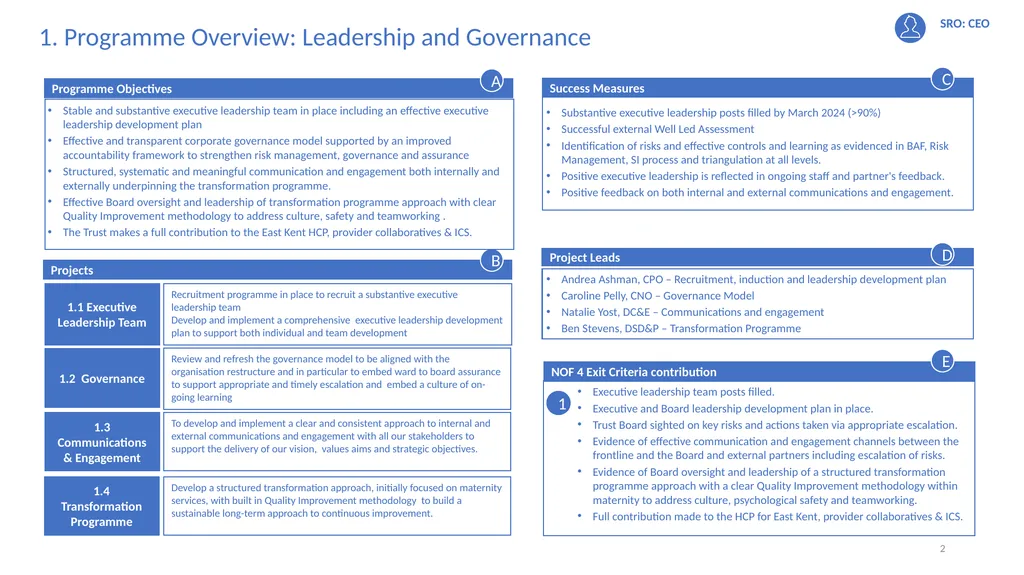
2 Executive leadership team posts filled.
Executive and Board leadership development plan in place.
Trust Board sighted on key risks and actions taken via appropriate escalation.
Evidence of effective communication and engagement channels between the frontline and the Board and external partners including escalation of risks.
Evidence of Board oversight and leadership of a structured transformation programme approach with a clear Quality Improvement methodology within maternity to address culture, psychological safety and teamworking.
Full contribution made to the HCP for East Kent, provider collaboratives & ICS. 1 NOF 4 Exit Criteria contribution E Andrea Ashman, CPO – Recruitment, induction and leadership development plan
Caroline Pelly, CNO – Governance Model
Natalie Yost, DC&E – Communications and engagement
Ben Stevens, DSD&P – Transformation Programme Project Leads D Substantive executive leadership posts filled by March 2024 (>90%)
Successful external Well Led Assessment
Identification of risks and effective controls and learning as evidenced in BAF, Risk Management, SI process and triangulation at all levels.
Positive executive leadership is reflected in ongoing staff and partner's feedback.
Positive feedback on both internal and external communications and engagement. Success Measures C Develop a structured transformation approach, initially focused on maternity services, with built in Quality Improvement methodology to build a sustainable long-term approach to continuous improvement. 1.4 Transformation Programme To develop and implement a clear and consistent approach to internal and external communications and engagement with all our stakeholders to support the delivery of our vision, values aims and strategic objectives. 1.3 Communications & Engagement Review and refresh the governance model to be aligned with the organisation restructure and in particular to embed ward to board assurance to support appropriate and timely escalation and embed a culture of on-going learning 1.2 Governance Recruitment programme in place to recruit a substantive executive leadership team
Develop and implement a comprehensive executive leadership development plan to support both individual and team development 1.1 Executive Leadership Team Projects B Stable and substantive executive leadership team in place including an effective executive leadership development plan
Effective and transparent corporate governance model supported by an improved accountability framework to strengthen risk management, governance and assurance
Structured, systematic and meaningful communication and engagement both internally and externally underpinning the transformation programme.
Effective Board oversight and leadership of transformation programme approach with clear Quality Improvement methodology to address culture, safety and teamworking .
The Trust makes a full contribution to the East Kent HCP, provider collaboratives & ICS. Programme Objectives A SRO: CEO 1. Programme Overview: Leadership and Governance<br>
Executive and Board leadership development plan in place.
Trust Board sighted on key risks and actions taken via appropriate escalation.
Evidence of effective communication and engagement channels between the frontline and the Board and external partners including escalation of risks.
Evidence of Board oversight and leadership of a structured transformation programme approach with a clear Quality Improvement methodology within maternity to address culture, psychological safety and teamworking.
Full contribution made to the HCP for East Kent, provider collaboratives & ICS. 1 NOF 4 Exit Criteria contribution E Andrea Ashman, CPO – Recruitment, induction and leadership development plan
Caroline Pelly, CNO – Governance Model
Natalie Yost, DC&E – Communications and engagement
Ben Stevens, DSD&P – Transformation Programme Project Leads D Substantive executive leadership posts filled by March 2024 (>90%)
Successful external Well Led Assessment
Identification of risks and effective controls and learning as evidenced in BAF, Risk Management, SI process and triangulation at all levels.
Positive executive leadership is reflected in ongoing staff and partner's feedback.
Positive feedback on both internal and external communications and engagement. Success Measures C Develop a structured transformation approach, initially focused on maternity services, with built in Quality Improvement methodology to build a sustainable long-term approach to continuous improvement. 1.4 Transformation Programme To develop and implement a clear and consistent approach to internal and external communications and engagement with all our stakeholders to support the delivery of our vision, values aims and strategic objectives. 1.3 Communications & Engagement Review and refresh the governance model to be aligned with the organisation restructure and in particular to embed ward to board assurance to support appropriate and timely escalation and embed a culture of on-going learning 1.2 Governance Recruitment programme in place to recruit a substantive executive leadership team
Develop and implement a comprehensive executive leadership development plan to support both individual and team development 1.1 Executive Leadership Team Projects B Stable and substantive executive leadership team in place including an effective executive leadership development plan
Effective and transparent corporate governance model supported by an improved accountability framework to strengthen risk management, governance and assurance
Structured, systematic and meaningful communication and engagement both internally and externally underpinning the transformation programme.
Effective Board oversight and leadership of transformation programme approach with clear Quality Improvement methodology to address culture, safety and teamworking .
The Trust makes a full contribution to the East Kent HCP, provider collaboratives & ICS. Programme Objectives A SRO: CEO 1. Programme Overview: Leadership and Governance<br>
03
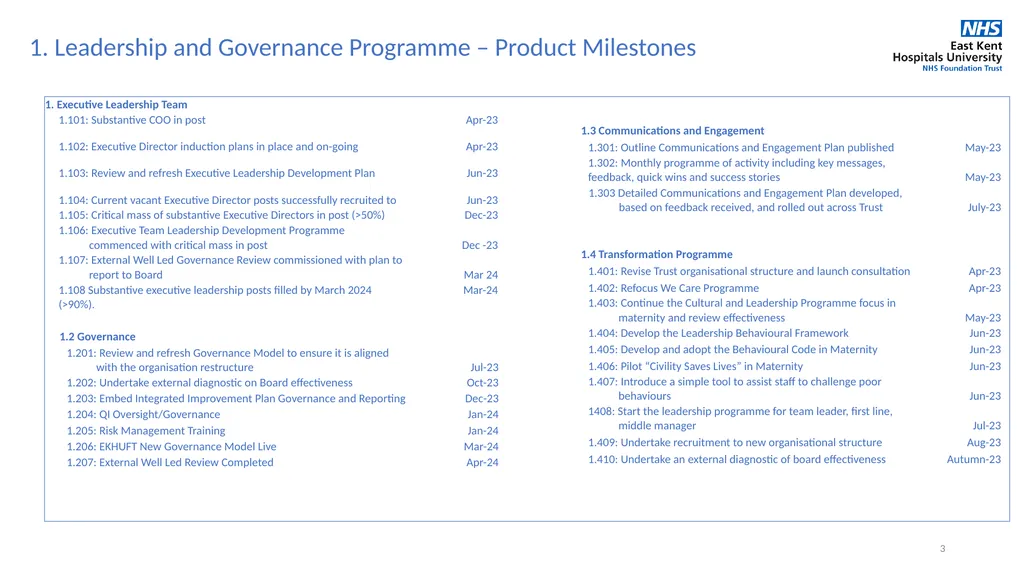
3 1. Leadership and Governance Programme – Product Milestones<br>
04
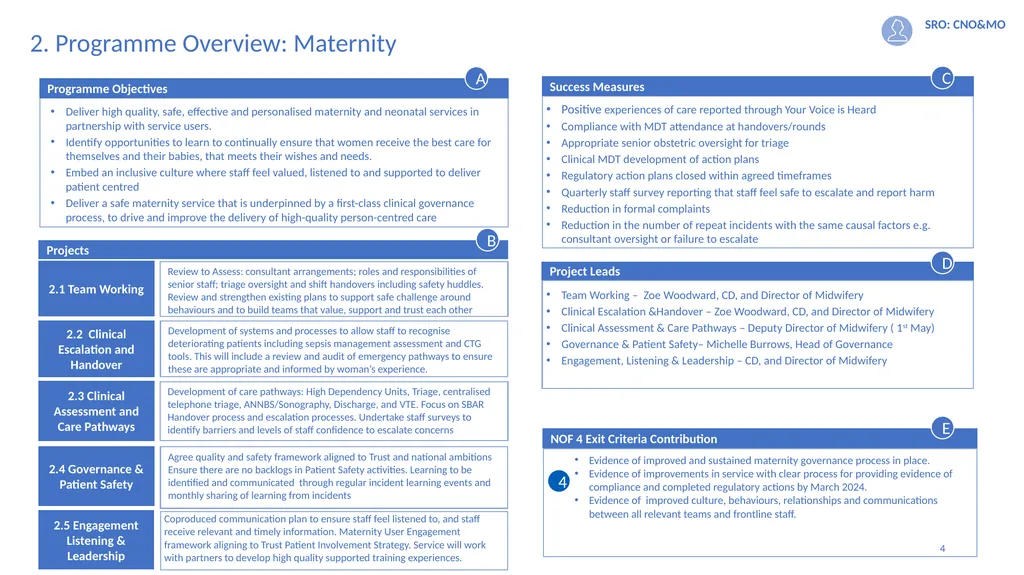
4 Evidence of improved and sustained maternity governance process in place.
Evidence of improvements in service with clear process for providing evidence of compliance and completed regulatory actions by March 2024.
Evidence of improved culture, behaviours, relationships and communications between all relevant teams and frontline staff. 4 NOF 4 Exit Criteria Contribution E Team Working – Zoe Woodward, CD, and Director of Midwifery
Clinical Escalation &Handover – Zoe Woodward, CD, and Director of Midwifery
Clinical Assessment & Care Pathways – Deputy Director of Midwifery ( 1st May)
Governance & Patient Safety– Michelle Burrows, Head of Governance
Engagement, Listening & Leadership – CD, and Director of Midwifery Project Leads D Positive experiences of care reported through Your Voice is Heard
Compliance with MDT attendance at handovers/rounds
Appropriate senior obstetric oversight for triage
Clinical MDT development of action plans
Regulatory action plans closed within agreed timeframes
Quarterly staff survey reporting that staff feel safe to escalate and report harm
Reduction in formal complaints
Reduction in the number of repeat incidents with the same causal factors e.g. consultant oversight or failure to escalate Success Measures C Coproduced communication plan to ensure staff feel listened to, and staff receive relevant and timely information. Maternity User Engagement framework aligning to Trust Patient Involvement Strategy. Service will work with partners to develop high quality supported training experiences. 2.5 Engagement Listening & Leadership Agree quality and safety framework aligned to Trust and national ambitions
Ensure there are no backlogs in Patient Safety activities. Learning to be identified and communicated through regular incident learning events and monthly sharing of learning from incidents 2.4 Governance & Patient Safety Development of care pathways: High Dependency Units, Triage, centralised telephone triage, ANNBS/Sonography, Discharge, and VTE. Focus on SBAR Handover process and escalation processes. Undertake staff surveys to identify barriers and levels of staff confidence to escalate concerns 2.3 Clinical Assessment and Care Pathways Development of systems and processes to allow staff to recognise deteriorating patients including sepsis management assessment and CTG tools. This will include a review and audit of emergency pathways to ensure these are appropriate and informed by woman’s experience. 2.2 Clinical Escalation and Handover Review to Assess: consultant arrangements; roles and responsibilities of senior staff; triage oversight and shift handovers including safety huddles.
Review and strengthen existing plans to support safe challenge around behaviours and to build teams that value, support and trust each other 2.1 Team Working Projects B Deliver high quality, safe, effective and personalised maternity and neonatal services in partnership with service users.
Identify opportunities to learn to continually ensure that women receive the best care for themselves and their babies, that meets their wishes and needs.
Embed an inclusive culture where staff feel valued, listened to and supported to deliver patient centred
Deliver a safe maternity service that is underpinned by a first-class clinical governance process, to drive and improve the delivery of high-quality person-centred care Programme Objectives A SRO: CNO&MO 2. Programme Overview: Maternity<br>
Evidence of improvements in service with clear process for providing evidence of compliance and completed regulatory actions by March 2024.
Evidence of improved culture, behaviours, relationships and communications between all relevant teams and frontline staff. 4 NOF 4 Exit Criteria Contribution E Team Working – Zoe Woodward, CD, and Director of Midwifery
Clinical Escalation &Handover – Zoe Woodward, CD, and Director of Midwifery
Clinical Assessment & Care Pathways – Deputy Director of Midwifery ( 1st May)
Governance & Patient Safety– Michelle Burrows, Head of Governance
Engagement, Listening & Leadership – CD, and Director of Midwifery Project Leads D Positive experiences of care reported through Your Voice is Heard
Compliance with MDT attendance at handovers/rounds
Appropriate senior obstetric oversight for triage
Clinical MDT development of action plans
Regulatory action plans closed within agreed timeframes
Quarterly staff survey reporting that staff feel safe to escalate and report harm
Reduction in formal complaints
Reduction in the number of repeat incidents with the same causal factors e.g. consultant oversight or failure to escalate Success Measures C Coproduced communication plan to ensure staff feel listened to, and staff receive relevant and timely information. Maternity User Engagement framework aligning to Trust Patient Involvement Strategy. Service will work with partners to develop high quality supported training experiences. 2.5 Engagement Listening & Leadership Agree quality and safety framework aligned to Trust and national ambitions
Ensure there are no backlogs in Patient Safety activities. Learning to be identified and communicated through regular incident learning events and monthly sharing of learning from incidents 2.4 Governance & Patient Safety Development of care pathways: High Dependency Units, Triage, centralised telephone triage, ANNBS/Sonography, Discharge, and VTE. Focus on SBAR Handover process and escalation processes. Undertake staff surveys to identify barriers and levels of staff confidence to escalate concerns 2.3 Clinical Assessment and Care Pathways Development of systems and processes to allow staff to recognise deteriorating patients including sepsis management assessment and CTG tools. This will include a review and audit of emergency pathways to ensure these are appropriate and informed by woman’s experience. 2.2 Clinical Escalation and Handover Review to Assess: consultant arrangements; roles and responsibilities of senior staff; triage oversight and shift handovers including safety huddles.
Review and strengthen existing plans to support safe challenge around behaviours and to build teams that value, support and trust each other 2.1 Team Working Projects B Deliver high quality, safe, effective and personalised maternity and neonatal services in partnership with service users.
Identify opportunities to learn to continually ensure that women receive the best care for themselves and their babies, that meets their wishes and needs.
Embed an inclusive culture where staff feel valued, listened to and supported to deliver patient centred
Deliver a safe maternity service that is underpinned by a first-class clinical governance process, to drive and improve the delivery of high-quality person-centred care Programme Objectives A SRO: CNO&MO 2. Programme Overview: Maternity<br>
05
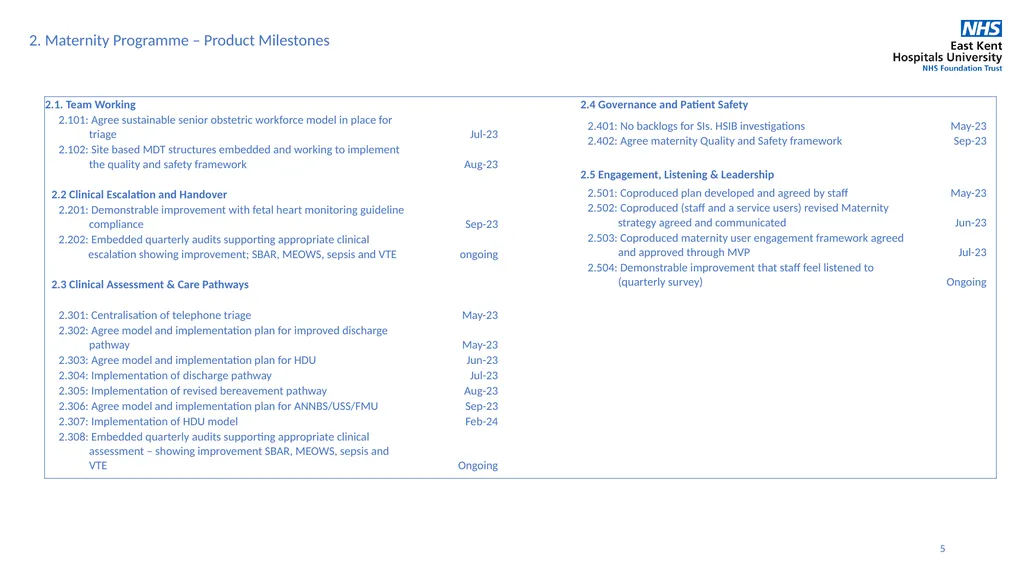
5 2. Maternity Programme – Product Milestones<br>
06
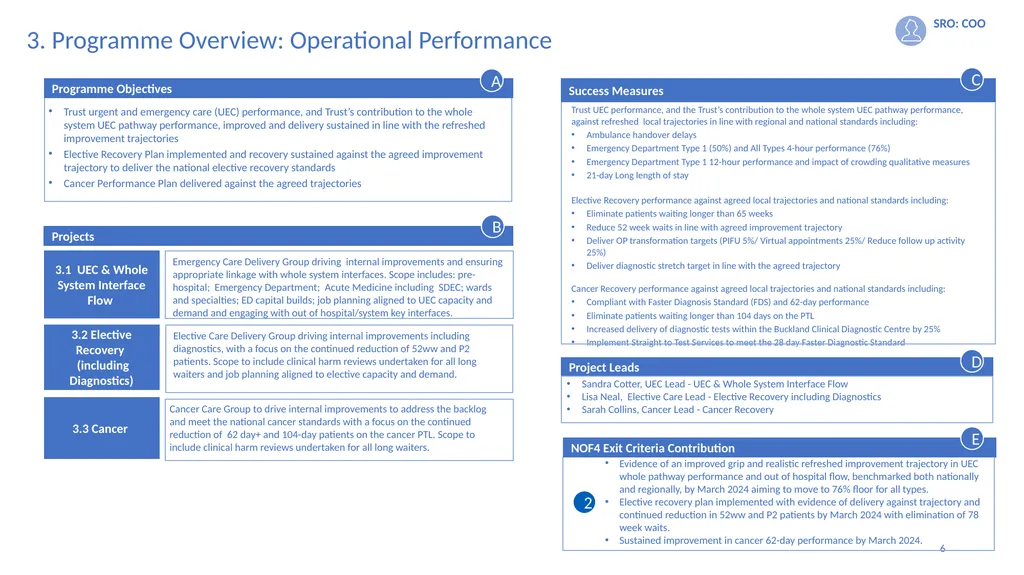
6 Evidence of an improved grip and realistic refreshed improvement trajectory in UEC whole pathway performance and out of hospital flow, benchmarked both nationally and regionally, by March 2024 aiming to move to 76% floor for all types.
Elective recovery plan implemented with evidence of delivery against trajectory and continued reduction in 52ww and P2 patients by March 2024 with elimination of 78 week waits.
Sustained improvement in cancer 62-day performance by March 2024. 2 NOF4 Exit Criteria Contribution E Sandra Cotter, UEC Lead - UEC & Whole System Interface Flow
Lisa Neal, Elective Care Lead - Elective Recovery including Diagnostics
Sarah Collins, Cancer Lead - Cancer Recovery Project Leads D Trust UEC performance, and the Trust’s contribution to the whole system UEC pathway performance, against refreshed local trajectories in line with regional and national standards including:
Ambulance handover delays
Emergency Department Type 1 (50%) and All Types 4-hour performance (76%)
Emergency Department Type 1 12-hour performance and impact of crowding qualitative measures
21-day Long length of stay
Elective Recovery performance against agreed local trajectories and national standards including:
Eliminate patients waiting longer than 65 weeks
Reduce 52 week waits in line with agreed improvement trajectory
Deliver OP transformation targets (PIFU 5%/ Virtual appointments 25%/ Reduce follow up activity 25%)
Deliver diagnostic stretch target in line with the agreed trajectory
Cancer Recovery performance against agreed local trajectories and national standards including:
Compliant with Faster Diagnosis Standard (FDS) and 62-day performance
Eliminate patients waiting longer than 104 days on the PTL
Increased delivery of diagnostic tests within the Buckland Clinical Diagnostic Centre by 25%
Implement Straight to Test Services to meet the 28 day Faster Diagnostic Standard Success Measures C Cancer Care Group to drive internal improvements to address the backlog and meet the national cancer standards with a focus on the continued reduction of 62 day+ and 104-day patients on the cancer PTL. Scope to include clinical harm reviews undertaken for all long waiters. 3.3 Cancer Elective Care Delivery Group driving internal improvements including diagnostics, with a focus on the continued reduction of 52ww and P2 patients. Scope to include clinical harm reviews undertaken for all long waiters and job planning aligned to elective capacity and demand. 3.2 Elective Recovery
(including Diagnostics) Emergency Care Delivery Group driving internal improvements and ensuring appropriate linkage with whole system interfaces. Scope includes: pre-hospital; Emergency Department; Acute Medicine including SDEC; wards and specialties; ED capital builds; job planning aligned to UEC capacity and demand and engaging with out of hospital/system key interfaces. 3.1 UEC & Whole System Interface Flow Projects B Trust urgent and emergency care (UEC) performance, and Trust’s contribution to the whole system UEC pathway performance, improved and delivery sustained in line with the refreshed improvement trajectories
Elective Recovery Plan implemented and recovery sustained against the agreed improvement trajectory to deliver the national elective recovery standards
Cancer Performance Plan delivered against the agreed trajectories Programme Objectives A SRO: COO 3. Programme Overview: Operational Performance<br>
Elective recovery plan implemented with evidence of delivery against trajectory and continued reduction in 52ww and P2 patients by March 2024 with elimination of 78 week waits.
Sustained improvement in cancer 62-day performance by March 2024. 2 NOF4 Exit Criteria Contribution E Sandra Cotter, UEC Lead - UEC & Whole System Interface Flow
Lisa Neal, Elective Care Lead - Elective Recovery including Diagnostics
Sarah Collins, Cancer Lead - Cancer Recovery Project Leads D Trust UEC performance, and the Trust’s contribution to the whole system UEC pathway performance, against refreshed local trajectories in line with regional and national standards including:
Ambulance handover delays
Emergency Department Type 1 (50%) and All Types 4-hour performance (76%)
Emergency Department Type 1 12-hour performance and impact of crowding qualitative measures
21-day Long length of stay
Elective Recovery performance against agreed local trajectories and national standards including:
Eliminate patients waiting longer than 65 weeks
Reduce 52 week waits in line with agreed improvement trajectory
Deliver OP transformation targets (PIFU 5%/ Virtual appointments 25%/ Reduce follow up activity 25%)
Deliver diagnostic stretch target in line with the agreed trajectory
Cancer Recovery performance against agreed local trajectories and national standards including:
Compliant with Faster Diagnosis Standard (FDS) and 62-day performance
Eliminate patients waiting longer than 104 days on the PTL
Increased delivery of diagnostic tests within the Buckland Clinical Diagnostic Centre by 25%
Implement Straight to Test Services to meet the 28 day Faster Diagnostic Standard Success Measures C Cancer Care Group to drive internal improvements to address the backlog and meet the national cancer standards with a focus on the continued reduction of 62 day+ and 104-day patients on the cancer PTL. Scope to include clinical harm reviews undertaken for all long waiters. 3.3 Cancer Elective Care Delivery Group driving internal improvements including diagnostics, with a focus on the continued reduction of 52ww and P2 patients. Scope to include clinical harm reviews undertaken for all long waiters and job planning aligned to elective capacity and demand. 3.2 Elective Recovery
(including Diagnostics) Emergency Care Delivery Group driving internal improvements and ensuring appropriate linkage with whole system interfaces. Scope includes: pre-hospital; Emergency Department; Acute Medicine including SDEC; wards and specialties; ED capital builds; job planning aligned to UEC capacity and demand and engaging with out of hospital/system key interfaces. 3.1 UEC & Whole System Interface Flow Projects B Trust urgent and emergency care (UEC) performance, and Trust’s contribution to the whole system UEC pathway performance, improved and delivery sustained in line with the refreshed improvement trajectories
Elective Recovery Plan implemented and recovery sustained against the agreed improvement trajectory to deliver the national elective recovery standards
Cancer Performance Plan delivered against the agreed trajectories Programme Objectives A SRO: COO 3. Programme Overview: Operational Performance<br>
07
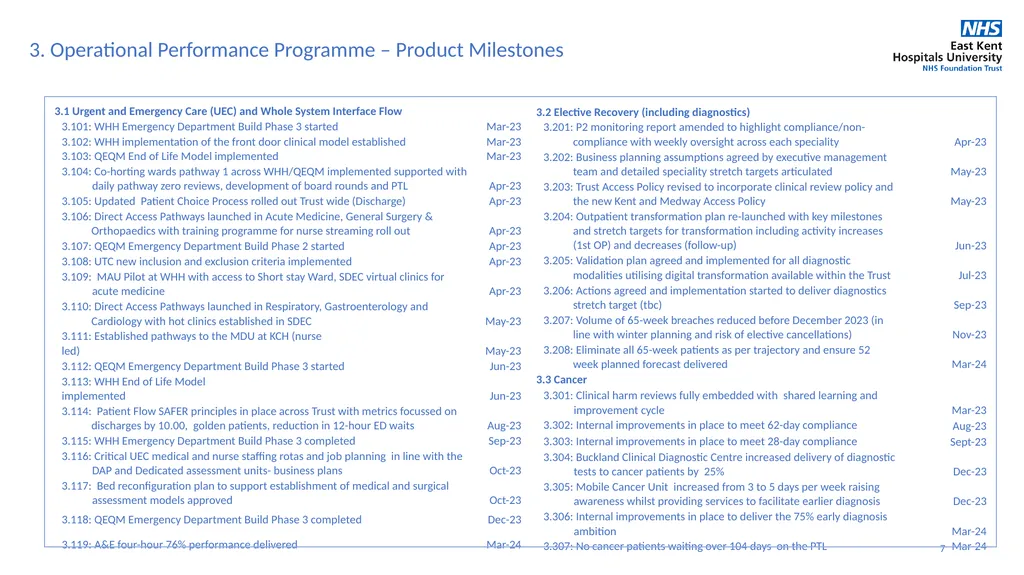
7 3. Operational Performance Programme – Product Milestones<br>
08
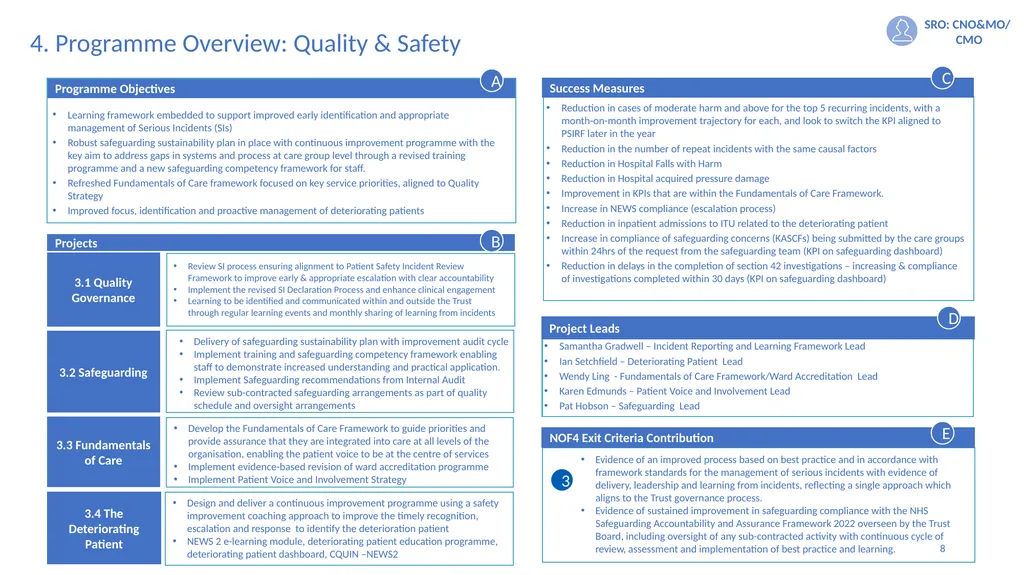
8 Evidence of an improved process based on best practice and in accordance with framework standards for the management of serious incidents with evidence of delivery, leadership and learning from incidents, reflecting a single approach which aligns to the Trust governance process.
Evidence of sustained improvement in safeguarding compliance with the NHS Safeguarding Accountability and Assurance Framework 2022 overseen by the Trust Board, including oversight of any sub-contracted activity with continuous cycle of review, assessment and implementation of best practice and learning. 3 NOF4 Exit Criteria Contribution E Samantha Gradwell – Incident Reporting and Learning Framework Lead
Ian Setchfield – Deteriorating Patient Lead
Wendy Ling - Fundamentals of Care Framework/Ward Accreditation Lead
Karen Edmunds – Patient Voice and Involvement Lead
Pat Hobson – Safeguarding Lead Project Leads D Reduction in cases of moderate harm and above for the top 5 recurring incidents, with a month-on-month improvement trajectory for each, and look to switch the KPI aligned to PSIRF later in the year
Reduction in the number of repeat incidents with the same causal factors
Reduction in Hospital Falls with Harm
Reduction in Hospital acquired pressure damage
Improvement in KPIs that are within the Fundamentals of Care Framework.
Increase in NEWS compliance (escalation process)
Reduction in inpatient admissions to ITU related to the deteriorating patient
Increase in compliance of safeguarding concerns (KASCFs) being submitted by the care groups within 24hrs of the request from the safeguarding team (KPI on safeguarding dashboard)
Reduction in delays in the completion of section 42 investigations – increasing & compliance of investigations completed within 30 days (KPI on safeguarding dashboard) Success Measures C Design and deliver a continuous improvement programme using a safety improvement coaching approach to improve the timely recognition, escalation and response to identify the deterioration patient
NEWS 2 e-learning module, deteriorating patient education programme, deteriorating patient dashboard, CQUIN –NEWS2 3.4 The Deteriorating Patient Develop the Fundamentals of Care Framework to guide priorities and provide assurance that they are integrated into care at all levels of the organisation, enabling the patient voice to be at the centre of services
Implement evidence-based revision of ward accreditation programme
Implement Patient Voice and Involvement Strategy 3.3 Fundamentals of Care Delivery of safeguarding sustainability plan with improvement audit cycle
Implement training and safeguarding competency framework enabling staff to demonstrate increased understanding and practical application.
Implement Safeguarding recommendations from Internal Audit
Review sub-contracted safeguarding arrangements as part of quality schedule and oversight arrangements 3.2 Safeguarding Review SI process ensuring alignment to Patient Safety Incident Review Framework to improve early & appropriate escalation with clear accountability
Implement the revised SI Declaration Process and enhance clinical engagement
Learning to be identified and communicated within and outside the Trust through regular learning events and monthly sharing of learning from incidents 3.1 Quality Governance Projects B Programme Objectives Learning framework embedded to support improved early identification and appropriate management of Serious Incidents (SIs)
Robust safeguarding sustainability plan in place with continuous improvement programme with the key aim to address gaps in systems and process at care group level through a revised training programme and a new safeguarding competency framework for staff.
Refreshed Fundamentals of Care framework focused on key service priorities, aligned to Quality Strategy
Improved focus, identification and proactive management of deteriorating patients A SRO: CNO&MO/
CMO 4. Programme Overview: Quality & Safety<br>
Evidence of sustained improvement in safeguarding compliance with the NHS Safeguarding Accountability and Assurance Framework 2022 overseen by the Trust Board, including oversight of any sub-contracted activity with continuous cycle of review, assessment and implementation of best practice and learning. 3 NOF4 Exit Criteria Contribution E Samantha Gradwell – Incident Reporting and Learning Framework Lead
Ian Setchfield – Deteriorating Patient Lead
Wendy Ling - Fundamentals of Care Framework/Ward Accreditation Lead
Karen Edmunds – Patient Voice and Involvement Lead
Pat Hobson – Safeguarding Lead Project Leads D Reduction in cases of moderate harm and above for the top 5 recurring incidents, with a month-on-month improvement trajectory for each, and look to switch the KPI aligned to PSIRF later in the year
Reduction in the number of repeat incidents with the same causal factors
Reduction in Hospital Falls with Harm
Reduction in Hospital acquired pressure damage
Improvement in KPIs that are within the Fundamentals of Care Framework.
Increase in NEWS compliance (escalation process)
Reduction in inpatient admissions to ITU related to the deteriorating patient
Increase in compliance of safeguarding concerns (KASCFs) being submitted by the care groups within 24hrs of the request from the safeguarding team (KPI on safeguarding dashboard)
Reduction in delays in the completion of section 42 investigations – increasing & compliance of investigations completed within 30 days (KPI on safeguarding dashboard) Success Measures C Design and deliver a continuous improvement programme using a safety improvement coaching approach to improve the timely recognition, escalation and response to identify the deterioration patient
NEWS 2 e-learning module, deteriorating patient education programme, deteriorating patient dashboard, CQUIN –NEWS2 3.4 The Deteriorating Patient Develop the Fundamentals of Care Framework to guide priorities and provide assurance that they are integrated into care at all levels of the organisation, enabling the patient voice to be at the centre of services
Implement evidence-based revision of ward accreditation programme
Implement Patient Voice and Involvement Strategy 3.3 Fundamentals of Care Delivery of safeguarding sustainability plan with improvement audit cycle
Implement training and safeguarding competency framework enabling staff to demonstrate increased understanding and practical application.
Implement Safeguarding recommendations from Internal Audit
Review sub-contracted safeguarding arrangements as part of quality schedule and oversight arrangements 3.2 Safeguarding Review SI process ensuring alignment to Patient Safety Incident Review Framework to improve early & appropriate escalation with clear accountability
Implement the revised SI Declaration Process and enhance clinical engagement
Learning to be identified and communicated within and outside the Trust through regular learning events and monthly sharing of learning from incidents 3.1 Quality Governance Projects B Programme Objectives Learning framework embedded to support improved early identification and appropriate management of Serious Incidents (SIs)
Robust safeguarding sustainability plan in place with continuous improvement programme with the key aim to address gaps in systems and process at care group level through a revised training programme and a new safeguarding competency framework for staff.
Refreshed Fundamentals of Care framework focused on key service priorities, aligned to Quality Strategy
Improved focus, identification and proactive management of deteriorating patients A SRO: CNO&MO/
CMO 4. Programme Overview: Quality & Safety<br>
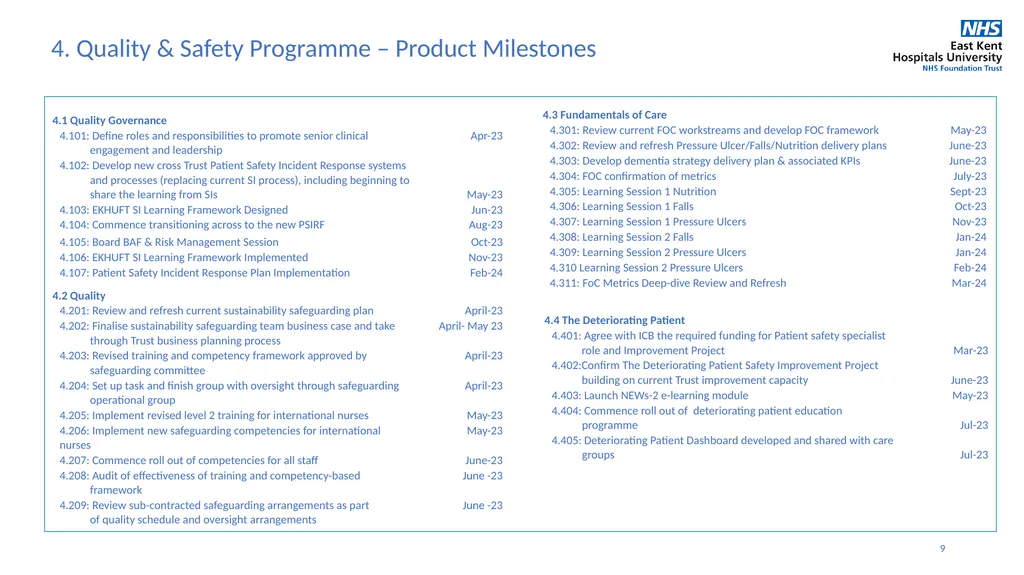
09
9 4. Quality & Safety Programme – Product Milestones<br>
10
10 Evidence of staff and user involvement in and feedback on specific improvements .
Improved staff engagement and Trust leadership in line with national/peer/ICS.
Staff sickness and vacancies tracked and reduced so Trust not an outlier across ICS.
Improved retention and turnover rates for all staff groups and sustained improvement in vacancy rate trajectory in hard to recruit specialties.
International nursing and Clinical Support Worker recruitment trajectories agreed and evidence of delivery against these by March 2024. 5 NOF 4 Exit Criteria Contribution E Andrea Ashman, Chief People Officer
Rita Lawrence – Programme Director, Culture & Leadership Programme
Rebecca Martin – Chief Medical Officer Project Leads D Improved ‘National Staff survey (YOY trend) / Pulse data (1/4ly trend): increased response rate, engagement and staff recommending EKHUFT as a place to work
Improved National Staff survey (Manager questions YOY trend)
Improved Culture dashboard monthly data trends
Improved WRES / WDES / F2SU data
Improved ‘Appraisal Conversation’ completion rates
Leadership development (Development plan + 360 feedback – Board to HLT)
Improved ‘Well Led’ domain CQC rating (date tbc)
Improved People Metrics / KPI’s (recruitment, vacancy rate, retention, job planning, /pipelines, disciplinary’s and sickness rates)
Listening Sessions/Anecdotes / staff live feedback
Pastoral Care award
Development of and improved performance against medical workforce dashboard
Job planning and PA review completed by May 2023
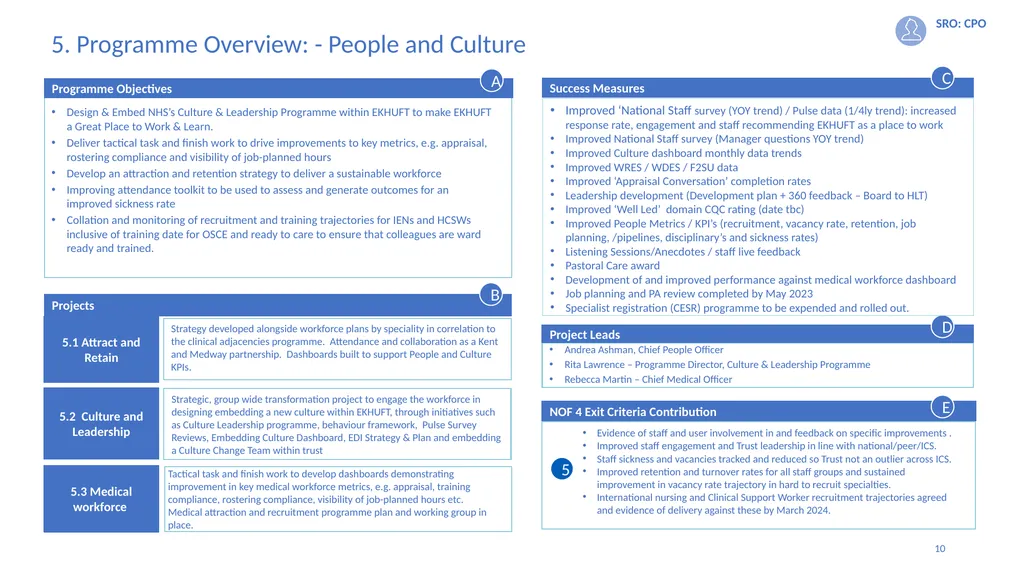
Specialist registration (CESR) programme to be expended and rolled out. Success Measures C Tactical task and finish work to develop dashboards demonstrating improvement in key medical workforce metrics, e.g. appraisal, training compliance, rostering compliance, visibility of job-planned hours etc. Medical attraction and recruitment programme plan and working group in place. 5.3 Medical workforce Strategic, group wide transformation project to engage the workforce in designing embedding a new culture within EKHUFT, through initiatives such as Culture Leadership programme, behaviour framework, Pulse Survey Reviews, Embedding Culture Dashboard, EDI Strategy & Plan and embedding a Culture Change Team within trust 5.2 Culture and Leadership Strategy developed alongside workforce plans by speciality in correlation to the clinical adjacencies programme. Attendance and collaboration as a Kent and Medway partnership. Dashboards built to support People and Culture KPIs. 5.1 Attract and Retain Projects B Design & Embed NHS’s Culture & Leadership Programme within EKHUFT to make EKHUFT a Great Place to Work & Learn.
Deliver tactical task and finish work to drive improvements to key metrics, e.g. appraisal, rostering compliance and visibility of job-planned hours
Develop an attraction and retention strategy to deliver a sustainable workforce
Improving attendance toolkit to be used to assess and generate outcomes for an improved sickness rate
Collation and monitoring of recruitment and training trajectories for IENs and HCSWs inclusive of training date for OSCE and ready to care to ensure that colleagues are ward ready and trained. Programme Objectives A SRO: CPO 5. Programme Overview: - People and Culture<br>
Improved staff engagement and Trust leadership in line with national/peer/ICS.
Staff sickness and vacancies tracked and reduced so Trust not an outlier across ICS.
Improved retention and turnover rates for all staff groups and sustained improvement in vacancy rate trajectory in hard to recruit specialties.
International nursing and Clinical Support Worker recruitment trajectories agreed and evidence of delivery against these by March 2024. 5 NOF 4 Exit Criteria Contribution E Andrea Ashman, Chief People Officer
Rita Lawrence – Programme Director, Culture & Leadership Programme
Rebecca Martin – Chief Medical Officer Project Leads D Improved ‘National Staff survey (YOY trend) / Pulse data (1/4ly trend): increased response rate, engagement and staff recommending EKHUFT as a place to work
Improved National Staff survey (Manager questions YOY trend)
Improved Culture dashboard monthly data trends
Improved WRES / WDES / F2SU data
Improved ‘Appraisal Conversation’ completion rates
Leadership development (Development plan + 360 feedback – Board to HLT)
Improved ‘Well Led’ domain CQC rating (date tbc)
Improved People Metrics / KPI’s (recruitment, vacancy rate, retention, job planning, /pipelines, disciplinary’s and sickness rates)
Listening Sessions/Anecdotes / staff live feedback
Pastoral Care award
Development of and improved performance against medical workforce dashboard
Job planning and PA review completed by May 2023
Specialist registration (CESR) programme to be expended and rolled out. Success Measures C Tactical task and finish work to develop dashboards demonstrating improvement in key medical workforce metrics, e.g. appraisal, training compliance, rostering compliance, visibility of job-planned hours etc. Medical attraction and recruitment programme plan and working group in place. 5.3 Medical workforce Strategic, group wide transformation project to engage the workforce in designing embedding a new culture within EKHUFT, through initiatives such as Culture Leadership programme, behaviour framework, Pulse Survey Reviews, Embedding Culture Dashboard, EDI Strategy & Plan and embedding a Culture Change Team within trust 5.2 Culture and Leadership Strategy developed alongside workforce plans by speciality in correlation to the clinical adjacencies programme. Attendance and collaboration as a Kent and Medway partnership. Dashboards built to support People and Culture KPIs. 5.1 Attract and Retain Projects B Design & Embed NHS’s Culture & Leadership Programme within EKHUFT to make EKHUFT a Great Place to Work & Learn.
Deliver tactical task and finish work to drive improvements to key metrics, e.g. appraisal, rostering compliance and visibility of job-planned hours
Develop an attraction and retention strategy to deliver a sustainable workforce
Improving attendance toolkit to be used to assess and generate outcomes for an improved sickness rate
Collation and monitoring of recruitment and training trajectories for IENs and HCSWs inclusive of training date for OSCE and ready to care to ensure that colleagues are ward ready and trained. Programme Objectives A SRO: CPO 5. Programme Overview: - People and Culture<br>
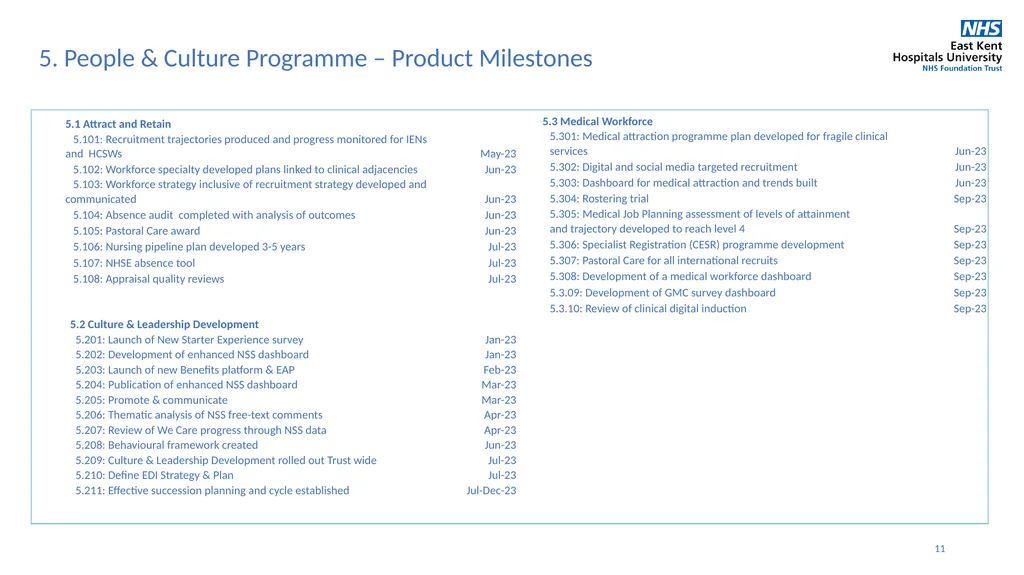
11
11 5. People & Culture Programme – Product Milestones<br>
12
12 Agreed Financial Recovery Plan in place supported by clear evidence base, approved by the board and compliant with agreed trajectories
Evidence of improved delivery against plans, trajectories and envelopes
The Trust fulfils its statutory duties with regard to financial management
Robust oversight, financial controls and processes are in place and overseen through appropriate financial governance procedures
Benchmarks well against model hospital efficiencies or has agreed trajectory.
The trust and system have a shared understanding of risks to the financial plan and have agreed mitigations in place
Control the costs of overseas recruitment against plan 6 NOF4 Exit Criteria Contribution E Michelle Stevens – Interim Chief Financial Officer
Ann Johnson – Financial Improvement Director Project Leads D Review of the whole financial governance aligned to organisational restructure including appropriate agreed oversight, assurance and performance management to support budget holders to deliver
Financial Improvement Oversight Group (FIOG) well attended and discussing and progressing full range of productivity and efficiency improvements.
Regular review of key financial oversight mechanisms to ensure efficacy.
Three-year FRP developed reflecting engagement with key stakeholders and agreed as credible.
Two consecutive quarters of Year 1 3YP run-rate delivered
Improvement over the year in underlying financial run rate.
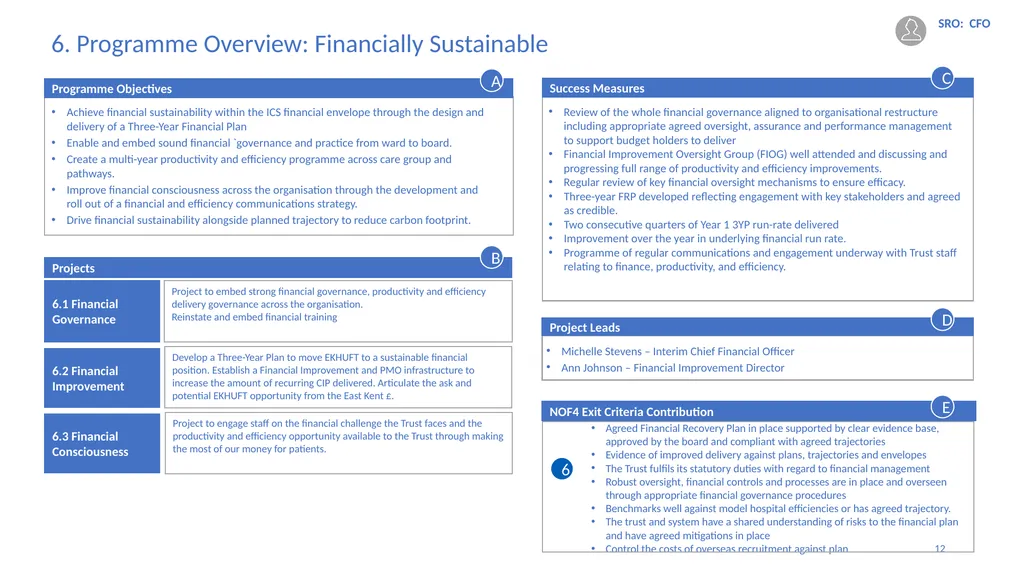
Programme of regular communications and engagement underway with Trust staff relating to finance, productivity, and efficiency. Success Measures C Project to engage staff on the financial challenge the Trust faces and the productivity and efficiency opportunity available to the Trust through making the most of our money for patients. 6.3 Financial Consciousness Develop a Three-Year Plan to move EKHUFT to a sustainable financial position. Establish a Financial Improvement and PMO infrastructure to increase the amount of recurring CIP delivered. Articulate the ask and potential EKHUFT opportunity from the East Kent £. 6.2 Financial Improvement Project to embed strong financial governance, productivity and efficiency delivery governance across the organisation.
Reinstate and embed financial training 6.1 Financial Governance Projects B Achieve financial sustainability within the ICS financial envelope through the design and delivery of a Three-Year Financial Plan
Enable and embed sound financial `governance and practice from ward to board.
Create a multi-year productivity and efficiency programme across care group and pathways.
Improve financial consciousness across the organisation through the development and roll out of a financial and efficiency communications strategy.
Drive financial sustainability alongside planned trajectory to reduce carbon footprint. Programme Objectives A SRO: CFO 6. Programme Overview: Financially Sustainable<br>
Evidence of improved delivery against plans, trajectories and envelopes
The Trust fulfils its statutory duties with regard to financial management
Robust oversight, financial controls and processes are in place and overseen through appropriate financial governance procedures
Benchmarks well against model hospital efficiencies or has agreed trajectory.
The trust and system have a shared understanding of risks to the financial plan and have agreed mitigations in place
Control the costs of overseas recruitment against plan 6 NOF4 Exit Criteria Contribution E Michelle Stevens – Interim Chief Financial Officer
Ann Johnson – Financial Improvement Director Project Leads D Review of the whole financial governance aligned to organisational restructure including appropriate agreed oversight, assurance and performance management to support budget holders to deliver
Financial Improvement Oversight Group (FIOG) well attended and discussing and progressing full range of productivity and efficiency improvements.
Regular review of key financial oversight mechanisms to ensure efficacy.
Three-year FRP developed reflecting engagement with key stakeholders and agreed as credible.
Two consecutive quarters of Year 1 3YP run-rate delivered
Improvement over the year in underlying financial run rate.
Programme of regular communications and engagement underway with Trust staff relating to finance, productivity, and efficiency. Success Measures C Project to engage staff on the financial challenge the Trust faces and the productivity and efficiency opportunity available to the Trust through making the most of our money for patients. 6.3 Financial Consciousness Develop a Three-Year Plan to move EKHUFT to a sustainable financial position. Establish a Financial Improvement and PMO infrastructure to increase the amount of recurring CIP delivered. Articulate the ask and potential EKHUFT opportunity from the East Kent £. 6.2 Financial Improvement Project to embed strong financial governance, productivity and efficiency delivery governance across the organisation.
Reinstate and embed financial training 6.1 Financial Governance Projects B Achieve financial sustainability within the ICS financial envelope through the design and delivery of a Three-Year Financial Plan
Enable and embed sound financial `governance and practice from ward to board.
Create a multi-year productivity and efficiency programme across care group and pathways.
Improve financial consciousness across the organisation through the development and roll out of a financial and efficiency communications strategy.
Drive financial sustainability alongside planned trajectory to reduce carbon footprint. Programme Objectives A SRO: CFO 6. Programme Overview: Financially Sustainable<br>
13
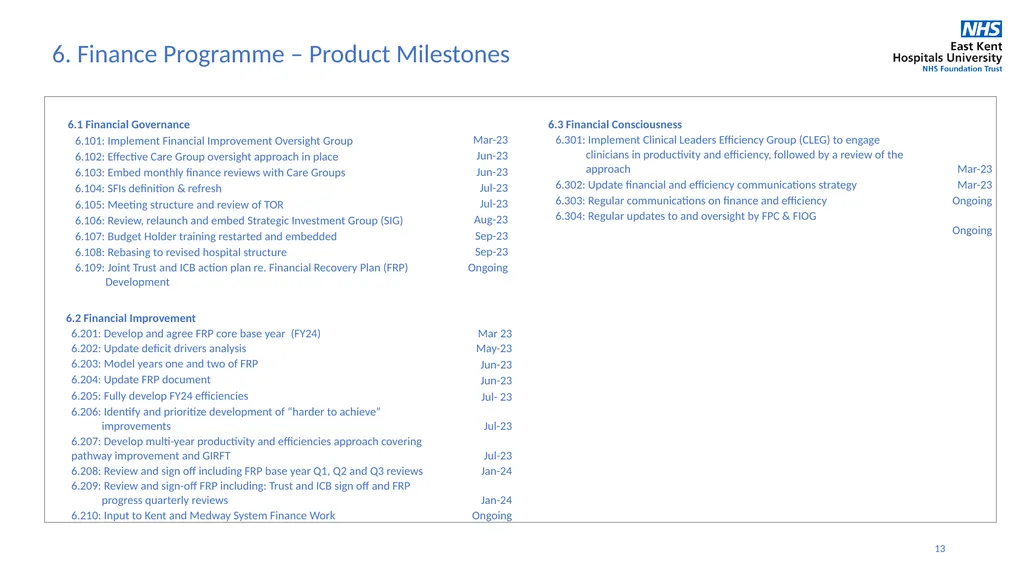
6. Finance Programme – Product Milestones 13<br>